What We WillLearn
1. Solar System
Planets, dwarf planets, asteroids, and comets
2. Stars & Constellations
Star formation and recognizable patterns
3. Moon Phases & Eclipses
Understanding lunar cycles and shadows
4. Galaxies
The Milky Way and types of galaxies
5. Tools for Observation
Telescopes and how we study space
6. Space Missions
Contributions from ISRO and NASA
3.
What Is theUniverse?
Definition
The Universe is commonly defined as the
totality of everything that exists.
• All physical matter (stars, planets, galaxies)
• All energy (light, heat)
• Space and Time themselves
It includes everything from the smallest atom to
the largest galaxy clusters.
Scale & Observation
Observable vs. Entire
We can only see the "Observable Universe"—
the region from which light has had time to
reach us since the beginning of the universe.
A Matter of Perspective
Imagine Earth as a single grain of sand; the
Universe is all the beaches on Earth
combined. We are a tiny part of a vast
cosmos.
4.
Solar System Basics
TheSun & Its Family
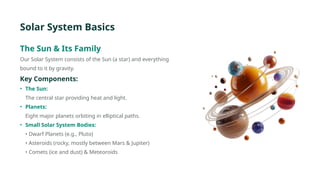
Our Solar System consists of the Sun (a star) and everything
bound to it by gravity.
Key Components:
• The Sun:
The central star providing heat and light.
• Planets:
Eight major planets orbiting in elliptical paths.
• Small Solar System Bodies:
• Dwarf Planets (e.g., Pluto)
• Asteroids (rocky, mostly between Mars & Jupiter)
• Comets (ice and dust) & Meteoroids
5.
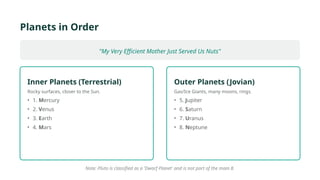
Planets in Order
"MyVery Efficient Mother Just Served Us Nuts"
Inner Planets (Terrestrial)
Rocky surfaces, closer to the Sun.
• 1. Mercury
• 2. Venus
• 3. Earth
• 4. Mars
Outer Planets (Jovian)
Gas/Ice Giants, many moons, rings.
• 5. Jupiter
• 6. Saturn
• 7. Uranus
• 8. Neptune
Note: Pluto is classified as a 'Dwarf Planet' and is not part of the main 8.
6.
Stars and Constellations
WhatAre They?
Stars
Celestial bodies made of hot gases (mostly hydrogen/helium) that
emit their own heat and light. The Sun is our nearest star.
Constellations
Groups of stars that appear to form recognizable patterns or
shapes in the sky.
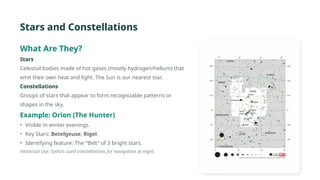
Example: Orion (The Hunter)
• Visible in winter evenings.
• Key Stars: Betelgeuse, Rigel.
• Identifying feature: The "Belt" of 3 bright stars.
Historical Use: Sailors used constellations for navigation at night.
7.
Moon Phases
Why Doesthe Moon Change Shape?
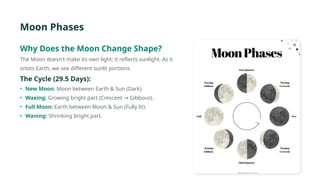
The Moon doesn't make its own light; it reflects sunlight. As it
orbits Earth, we see different sunlit portions.
The Cycle (29.5 Days):
• New Moon: Moon between Earth & Sun (Dark).
• Waxing: Growing bright part (Crescent Gibbous).
→
• Full Moon: Earth between Moon & Sun (Fully lit).
• Waning: Shrinking bright part.
8.
Eclipses (Solar vsLunar)
Solar Eclipse
Occurs when the Moon blocks the Sun.
Alignment: Sun — Moon — Earth
(Shadow falls on Earth)
Lunar Eclipse
Occurs when the Earth blocks sunlight to the
Moon.
Alignment: Sun — Earth — Moon
(Shadow falls on Moon)
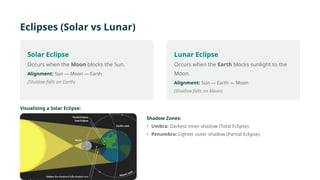
Visualizing a Solar Eclipse:
Shadow Zones:
• Umbra: Darkest inner shadow (Total Eclipse).
• Penumbra: Lighter outer shadow (Partial Eclipse).
9.
Galaxies and theMilky Way
What is a Galaxy?
A massive system of billions of stars, gas, and dust
held together by gravity.
The Milky Way
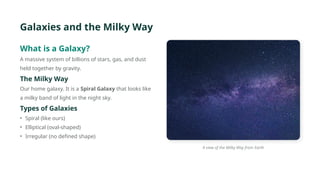
Our home galaxy. It is a Spiral Galaxy that looks like
a milky band of light in the night sky.
Types of Galaxies
• Spiral (like ours)
• Elliptical (oval-shaped)
• Irregular (no defined shape)
A view of the Milky Way from Earth
10.
Tools for Observingthe Universe
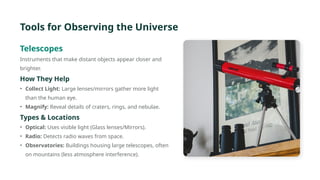
Telescopes
Instruments that make distant objects appear closer and
brighter.
How They Help
• Collect Light: Large lenses/mirrors gather more light
than the human eye.
• Magnify: Reveal details of craters, rings, and nebulae.
Types & Locations
• Optical: Uses visible light (Glass lenses/Mirrors).
• Radio: Detects radio waves from space.
• Observatories: Buildings housing large telescopes, often
on mountains (less atmosphere interference).
11.
Space Missions: ISRO& NASA
🇮🇳 ISRO (India)
Indian Space Research Organisation
Key Achievements:
• Chandrayaan: Lunar exploration missions.
• Mangalyaan: Mars Orbiter Mission.
• Launchers: PSLV & GSLV rockets.
🇺🇸 NASA (USA)
National Aeronautics and Space Admin.
Key Achievements:
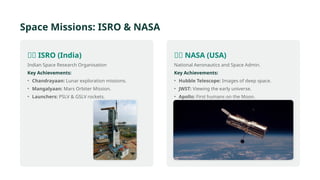
• Hubble Telescope: Images of deep space.
• JWST: Viewing the early universe.
• Apollo: First humans on the Moon.
12.
Quick Recap: KeyPoints
• The Universe: Vast expanse containing all matter, energy, and space.
• Solar System: Sun + 8 Planets (Inner Rocky, Outer Gas/Ice Giants) + Small Bodies.
• Celestial Bodies: Stars emit light; Planets/Moons reflect light. Constellations are star
patterns.
• Phases & Eclipses: Caused by relative positions of Sun, Earth, and Moon.
• Galaxy: We live in the Milky Way (Spiral Galaxy).
• Exploration: Telescopes and Space Missions (ISRO, NASA) help us learn more.
13.
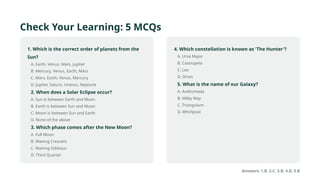
Check Your Learning:5 MCQs
1. Which is the correct order of planets from the
Sun?
A. Earth, Venus, Mars, Jupiter
B. Mercury, Venus, Earth, Mars
C. Mars, Earth, Venus, Mercury
D. Jupiter, Saturn, Uranus, Neptune
2. When does a Solar Eclipse occur?
A. Sun is between Earth and Moon
B. Earth is between Sun and Moon
C. Moon is between Sun and Earth
D. None of the above
3. Which phase comes after the New Moon?
A. Full Moon
B. Waxing Crescent
C. Waning Gibbous
D. Third Quarter
4. Which constellation is known as 'The Hunter'?
A. Ursa Major
B. Cassiopeia
C. Leo
D. Orion
5. What is the name of our Galaxy?
A. Andromeda
B. Milky Way
C. Triangulum
D. Whirlpool
Answers: 1.B, 2.C, 3.B, 4.D, 5.B
14.
Thank You
Keep LookingUp!
"The universe is under no obligation to make sense to you." — Neil
deGrasse Tyson
For more: Check out the NASA App or SkyView Lite
Editor's Notes
#1 Welcome everyone. Today we will explore "The Universe" as part of the CBSE Class 8 Geography curriculum. We'll cover everything from the Solar System to distant galaxies.
#2 Here's our roadmap for the lesson. We'll start close to home with the Solar System, then move outwards to stars and galaxies, and finally look at how humans explore these vast distances.
#3 The Universe is everything—matter, energy, space, and time. It's important to distinguish between the 'entire' universe and the 'observable' universe, which is limited by the speed of light. Our planet is infinitesimally small in this grand scale.
#4 The Solar System is our local neighborhood in space. It's anchored by the Sun, with eight planets and numerous smaller bodies like asteroids and comets orbiting around it.
#5 Remember the order with the phrase 'My Very Efficient Mother Just Served Us Nuts'. We have the four rocky inner planets and the four massive outer planets. Pluto is a dwarf planet, distinct from the main eight.
#6 Stars produce their own light, while constellations are just patterns we imagine connecting them. Orion is a great example—look for the three belt stars in the winter sky.
#7 The Moon's phases depend on its position relative to the Sun and Earth. 'Waxing' means the lit part is growing, while 'Waning' means it's shrinking.
#8 Solar eclipses happen when the Moon casts a shadow on Earth. Lunar eclipses happen when Earth casts a shadow on the Moon. The Umbra is the dark center of the shadow, and the Penumbra is the lighter outer part.
#9 We live in the Milky Way, a spiral galaxy containing billions of stars. Galaxies come in different shapes—spiral, elliptical, and irregular. Gravity is the glue that holds them all together.
#10 To study the vast universe, we use telescopes. They act like giant eyes, collecting more light than we can see, allowing us to observe distant galaxies and details of our own solar system planets.
#11 We have made great strides in space exploration. ISRO has made India proud with missions like Chandrayaan and Mangalyaan, while NASA continues to show us the wonders of the deep universe with telescopes like Hubble.
#12 Before we quiz ourselves, let's quickly review. The universe is huge, our solar system is just one part of the Milky Way galaxy, and we use tools like telescopes to study it all. Remember the difference between stars and planets!
#13 Test your knowledge with these five quick questions. The answers are listed at the bottom right. How many did you get correct?
#14 Thank you for joining this journey through the universe. Keep looking up at the night sky—there's always more to discover.



![Solar system [suriya] slide show](https://cdn.slidesharecdn.com/ss_thumbnails/solarsystemsuriya-slideshow-101001043326-phpapp02-thumbnail.jpg?width=640&height=640&fit=bounds)


