How to Make a Living as a Freelance Journalist

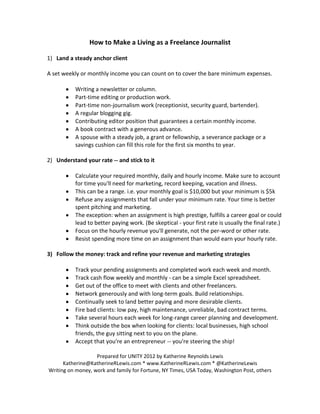
1) Land a steady anchor client

A set weekly or monthly income you can count on to cover the bare minimum expenses.

           Writing a newsletter or column.
           Part-time editing or production work.
           Part-time non-journalism work (receptionist, security guard, bartender).
           A regular blogging gig.
           Contributing editor position that guarantees a certain monthly income.
           A book contract with a generous advance.
           A spouse with a steady job, a grant or fellowship, a severance package or a
           savings cushion can fill this role for the first six months to year.

2) Understand your rate -- and stick to it

           Calculate your required monthly, daily and hourly income. Make sure to account
           for time you'll need for marketing, record keeping, vacation and illness.
           This can be a range. i.e. your monthly goal is $10,000 but your minimum is $5k
           Refuse any assignments that fall under your minimum rate. Your time is better
           spent pitching and marketing.
           The exception: when an assignment is high prestige, fulfills a career goal or could
           lead to better paying work. (Be skeptical - your first rate is usually the final rate.)
           Focus on the hourly revenue you'll generate, not the per-word or other rate.
           Resist spending more time on an assignment than would earn your hourly rate.

3) Follow the money: track and refine your revenue and marketing strategies

           Track your pending assignments and completed work each week and month.
           Track cash flow weekly and monthly - can be a simple Excel spreadsheet.
           Get out of the office to meet with clients and other freelancers.
           Network generously and with long-term goals. Build relationships.
           Continually seek to land better paying and more desirable clients.
           Fire bad clients: low pay, high maintenance, unreliable, bad contract terms.
           Take several hours each week for long-range career planning and development.
           Think outside the box when looking for clients: local businesses, high school
           friends, the guy sitting next to you on the plane.
           Accept that you're an entrepreneur -- you're steering the ship!

                   Prepared for UNITY 2012 by Katherine Reynolds Lewis
      Katherine@KatherineRLewis.com * www.KatherineRLewis.com * @KatherineLewis
Writing on money, work and family for Fortune, NY Times, USA Today, Washington Post, others
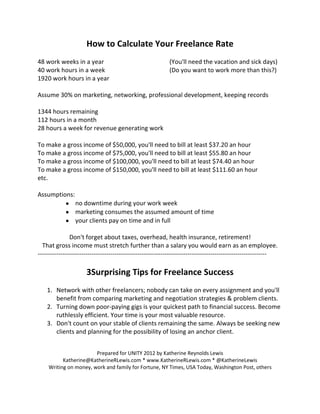
How to Calculate Your Freelance Rate
48 work weeks in a year                                     (You'll need the vacation and sick days)
40 work hours in a week                                     (Do you want to work more than this?)
1920 work hours in a year

Assume 30% on marketing, networking, professional development, keeping records

1344 hours remaining
112 hours in a month
28 hours a week for revenue generating work

To make a gross income of $50,000, you'll need to bill at least $37.20 an hour
To make a gross income of $75,000, you'll need to bill at least $55.80 an hour
To make a gross income of $100,000, you'll need to bill at least $74.40 an hour
To make a gross income of $150,000, you'll need to bill at least $111.60 an hour
etc.

Assumptions:
                 no downtime during your work week
                 marketing consumes the assumed amount of time
                 your clients pay on time and in full

               Don't forget about taxes, overhead, health insurance, retirement!
  That gross income must stretch further than a salary you would earn as an employee.
--------------------------------------------------------------------------------------------------------------

                      3Surprising Tips for Freelance Success
    1. Network with other freelancers; nobody can take on every assignment and you'll
       benefit from comparing marketing and negotiation strategies & problem clients.
    2. Turning down poor-paying gigs is your quickest path to financial success. Become
       ruthlessly efficient. Your time is your most valuable resource.
    3. Don't count on your stable of clients remaining the same. Always be seeking new
       clients and planning for the possibility of losing an anchor client.


                        Prepared for UNITY 2012 by Katherine Reynolds Lewis
           Katherine@KatherineRLewis.com * www.KatherineRLewis.com * @KatherineLewis
     Writing on money, work and family for Fortune, NY Times, USA Today, Washington Post, others
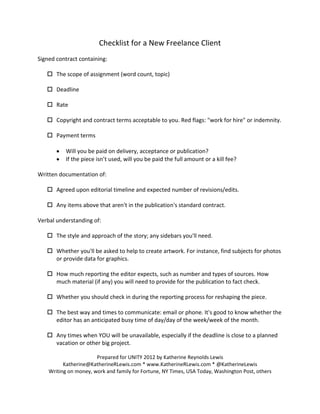
Checklist for a New Freelance Client
Signed contract containing:

    The scope of assignment (word count, topic)

    Deadline

    Rate

    Copyright and contract terms acceptable to you. Red flags: "work for hire" or indemnity.

    Payment terms

           Will you be paid on delivery, acceptance or publication?
           If the piece isn’t used, will you be paid the full amount or a kill fee?

Written documentation of:

    Agreed upon editorial timeline and expected number of revisions/edits.

    Any items above that aren't in the publication's standard contract.

Verbal understanding of:

    The style and approach of the story; any sidebars you'll need.

    Whether you'll be asked to help to create artwork. For instance, find subjects for photos
     or provide data for graphics.

    How much reporting the editor expects, such as number and types of sources. How
     much material (if any) you will need to provide for the publication to fact check.

    Whether you should check in during the reporting process for reshaping the piece.

    The best way and times to communicate: email or phone. It's good to know whether the
     editor has an anticipated busy time of day/day of the week/week of the month.

    Any times when YOU will be unavailable, especially if the deadline is close to a planned
     vacation or other big project.

                       Prepared for UNITY 2012 by Katherine Reynolds Lewis
          Katherine@KatherineRLewis.com * www.KatherineRLewis.com * @KatherineLewis
    Writing on money, work and family for Fortune, NY Times, USA Today, Washington Post, others

Unity 2012 freelance success handout

  • 1.
    How to Makea Living as a Freelance Journalist 1) Land a steady anchor client A set weekly or monthly income you can count on to cover the bare minimum expenses. Writing a newsletter or column. Part-time editing or production work. Part-time non-journalism work (receptionist, security guard, bartender). A regular blogging gig. Contributing editor position that guarantees a certain monthly income. A book contract with a generous advance. A spouse with a steady job, a grant or fellowship, a severance package or a savings cushion can fill this role for the first six months to year. 2) Understand your rate -- and stick to it Calculate your required monthly, daily and hourly income. Make sure to account for time you'll need for marketing, record keeping, vacation and illness. This can be a range. i.e. your monthly goal is $10,000 but your minimum is $5k Refuse any assignments that fall under your minimum rate. Your time is better spent pitching and marketing. The exception: when an assignment is high prestige, fulfills a career goal or could lead to better paying work. (Be skeptical - your first rate is usually the final rate.) Focus on the hourly revenue you'll generate, not the per-word or other rate. Resist spending more time on an assignment than would earn your hourly rate. 3) Follow the money: track and refine your revenue and marketing strategies Track your pending assignments and completed work each week and month. Track cash flow weekly and monthly - can be a simple Excel spreadsheet. Get out of the office to meet with clients and other freelancers. Network generously and with long-term goals. Build relationships. Continually seek to land better paying and more desirable clients. Fire bad clients: low pay, high maintenance, unreliable, bad contract terms. Take several hours each week for long-range career planning and development. Think outside the box when looking for clients: local businesses, high school friends, the guy sitting next to you on the plane. Accept that you're an entrepreneur -- you're steering the ship! Prepared for UNITY 2012 by Katherine Reynolds Lewis Katherine@KatherineRLewis.com * www.KatherineRLewis.com * @KatherineLewis Writing on money, work and family for Fortune, NY Times, USA Today, Washington Post, others
  • 2.
    How to CalculateYour Freelance Rate 48 work weeks in a year (You'll need the vacation and sick days) 40 work hours in a week (Do you want to work more than this?) 1920 work hours in a year Assume 30% on marketing, networking, professional development, keeping records 1344 hours remaining 112 hours in a month 28 hours a week for revenue generating work To make a gross income of $50,000, you'll need to bill at least $37.20 an hour To make a gross income of $75,000, you'll need to bill at least $55.80 an hour To make a gross income of $100,000, you'll need to bill at least $74.40 an hour To make a gross income of $150,000, you'll need to bill at least $111.60 an hour etc. Assumptions: no downtime during your work week marketing consumes the assumed amount of time your clients pay on time and in full Don't forget about taxes, overhead, health insurance, retirement! That gross income must stretch further than a salary you would earn as an employee. -------------------------------------------------------------------------------------------------------------- 3Surprising Tips for Freelance Success 1. Network with other freelancers; nobody can take on every assignment and you'll benefit from comparing marketing and negotiation strategies & problem clients. 2. Turning down poor-paying gigs is your quickest path to financial success. Become ruthlessly efficient. Your time is your most valuable resource. 3. Don't count on your stable of clients remaining the same. Always be seeking new clients and planning for the possibility of losing an anchor client. Prepared for UNITY 2012 by Katherine Reynolds Lewis Katherine@KatherineRLewis.com * www.KatherineRLewis.com * @KatherineLewis Writing on money, work and family for Fortune, NY Times, USA Today, Washington Post, others
  • 3.
    Checklist for aNew Freelance Client Signed contract containing:  The scope of assignment (word count, topic)  Deadline  Rate  Copyright and contract terms acceptable to you. Red flags: "work for hire" or indemnity.  Payment terms Will you be paid on delivery, acceptance or publication? If the piece isn’t used, will you be paid the full amount or a kill fee? Written documentation of:  Agreed upon editorial timeline and expected number of revisions/edits.  Any items above that aren't in the publication's standard contract. Verbal understanding of:  The style and approach of the story; any sidebars you'll need.  Whether you'll be asked to help to create artwork. For instance, find subjects for photos or provide data for graphics.  How much reporting the editor expects, such as number and types of sources. How much material (if any) you will need to provide for the publication to fact check.  Whether you should check in during the reporting process for reshaping the piece.  The best way and times to communicate: email or phone. It's good to know whether the editor has an anticipated busy time of day/day of the week/week of the month.  Any times when YOU will be unavailable, especially if the deadline is close to a planned vacation or other big project. Prepared for UNITY 2012 by Katherine Reynolds Lewis Katherine@KatherineRLewis.com * www.KatherineRLewis.com * @KatherineLewis Writing on money, work and family for Fortune, NY Times, USA Today, Washington Post, others