UNIT II
PROJECTION OF POINTS
Points
1. A point represents a location in space or on a
drawing, and has no width, height and depth.
2. A point is represented by the intersection of
two lines.
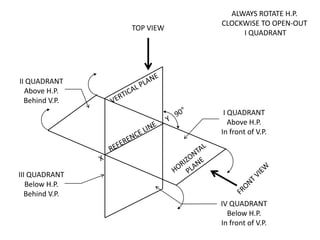
I QUADRANT
Above H.P.
In front of V.P.
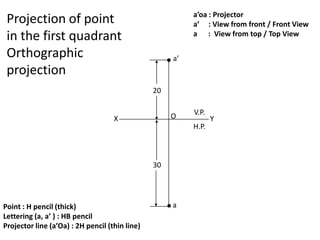
IV QUADRANT
Below H.P.
In front of V.P.
II QUADRANT
Above H.P.
Behind V.P.
III QUADRANT
Below H.P.
Behind V.P.
TOP VIEW
ALWAYS ROTATE H.P.
CLOCKWISE TO OPEN-OUT
I QUADRANT
Positions of a point
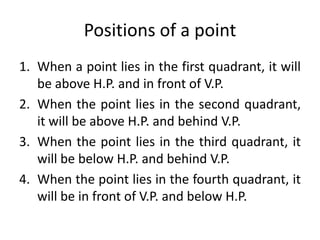
1. When a point lies in the first quadrant, it will
be above H.P. and in front of V.P.
2. When the point lies in the second quadrant,
it will be above H.P. and behind V.P.
3. When the point lies in the third quadrant, it
will be below H.P. and behind V.P.
4. When the point lies in the fourth quadrant, it
will be in front of V.P. and below H.P.
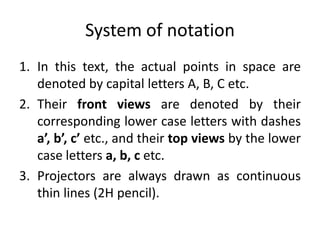
System of notation
1. In this text, the actual points in space are
denoted by capital letters A, B, C etc.
2. Their front views are denoted by their
corresponding lower case letters with dashes
a’, b’, c’ etc., and their top views by the lower
case letters a, b, c etc.
3. Projectors are always drawn as continuous
thin lines (2H pencil).
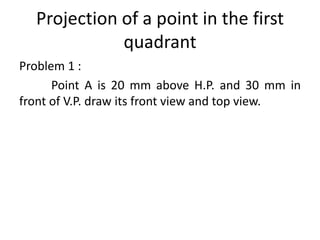
Projection of a point in the first
quadrant
Problem 1 :
Point A is 20 mm above H.P. and 30 mm in
front of V.P. draw its front view and top view.
Projection of a point in the first
quadrant
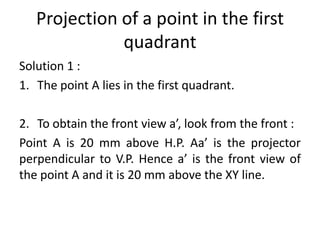
Solution 1 :
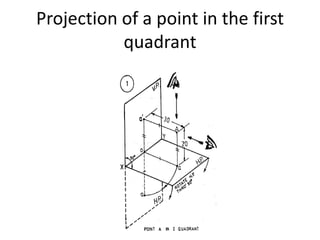
1. The point A lies in the first quadrant.
2. To obtain the front view a’, look from the front :
Point A is 20 mm above H.P. Aa’ is the projector
perpendicular to V.P. Hence a’ is the front view of
the point A and it is 20 mm above the XY line.
Projection of a point in the first
quadrant
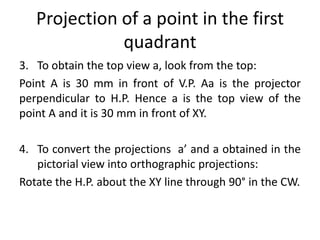
3. To obtain the top view a, look from the top:
Point A is 30 mm in front of V.P. Aa is the projector
perpendicular to H.P. Hence a is the top view of the
point A and it is 30 mm in front of XY.
4. To convert the projections a’ and a obtained in the
pictorial view into orthographic projections:
Rotate the H.P. about the XY line through 90° in the CW.
Projection of a point in the first
quadrant
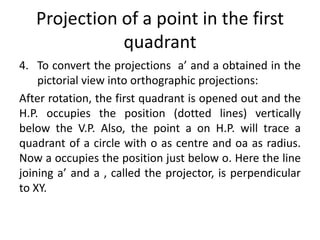
4. To convert the projections a’ and a obtained in the
pictorial view into orthographic projections:
After rotation, the first quadrant is opened out and the
H.P. occupies the position (dotted lines) vertically
below the V.P. Also, the point a on H.P. will trace a
quadrant of a circle with o as centre and oa as radius.
Now a occupies the position just below o. Here the line
joining a’ and a , called the projector, is perpendicular
to XY.
Projection of a point in the first
quadrant
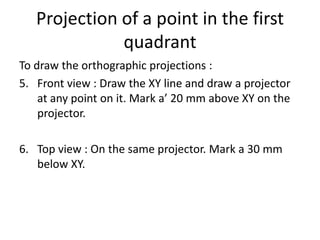
To draw the orthographic projections :
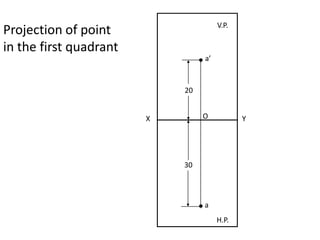
5. Front view : Draw the XY line and draw a projector
at any point on it. Mark a’ 20 mm above XY on the
projector.
6. Top view : On the same projector. Mark a 30 mm
below XY.
Projection of a point in the first
quadrant
V.P.
X Y
H.P.
a’
20
a
30
O
Projection of point
in the first quadrant
V.P.
X Y
H.P.
a’
20
a
30
O
a’oa : Projector
a’ : View from front / Front View
a : View from top / Top View
Projection of point
in the first quadrant
Orthographic
projection
Point : H pencil (thick)
Lettering (a, a’ ) : HB pencil
Projector line (a’Oa) : 2H pencil (thin line)
Projection of a point in the first
quadrant
Problem 2 :
A Point M is 35 mm above H.P. and 45 mm in
front of V.P. Draw its projections.
Projection of a point in the first
quadrant
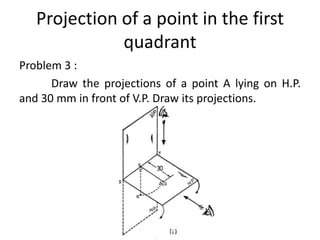
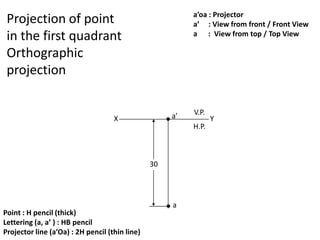
Problem 3 :
Draw the projections of a point A lying on H.P.
and 30 mm in front of V.P. Draw its projections.
V.P.
X Y
H.P.
a’
a
30
a’oa : Projector
a’ : View from front / Front View
a : View from top / Top View
Projection of point
in the first quadrant
Orthographic
projection
Point : H pencil (thick)
Lettering (a, a’ ) : HB pencil
Projector line (a’Oa) : 2H pencil (thin line)
Projection of a point in the first
quadrant
Problem 4 :
Draw the projections of a point B lying on H.P.
and 40 mm in front of V.P. Draw its projections.
Projection of a point in the first
quadrant
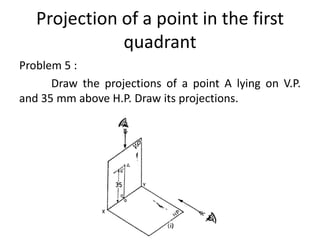
Problem 5 :
Draw the projections of a point A lying on V.P.
and 35 mm above H.P. Draw its projections.
Projection of a point in the first
quadrant
Problem 6 :
Draw the projections of a point F which lies in
both the H.P. and V.P. Draw its projections.
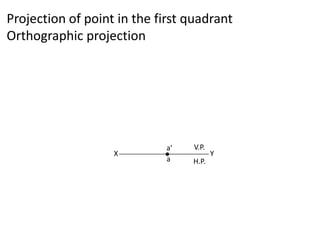
V.P.
X Y
H.P.
a’
a
Projection of point in the first quadrant
Orthographic projection
Projection of a point in the second
quadrant
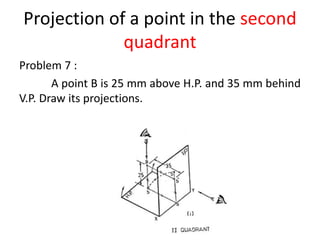
Problem 7 :
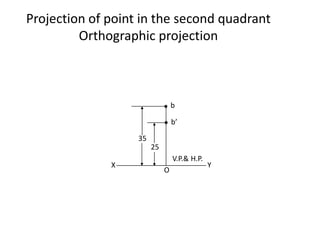
A point B is 25 mm above H.P. and 35 mm behind
V.P. Draw its projections.
H.P.
X Y
V.P.&
b’
25
b
35
O
Projection of point in the second quadrant
Orthographic projection
Projection of a point in the second
quadrant
Problem 8 :
A point S is 35 mm above H.P. and 50 mm behind
V.P. Draw its projections
Projection of a point in the third
quadrant
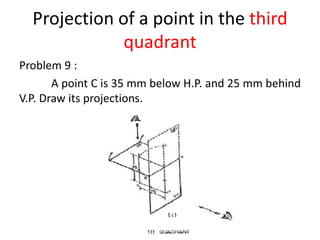
Problem 9 :
A point C is 35 mm below H.P. and 25 mm behind
V.P. Draw its projections.
H.P.
X Y
V.P.
c
25
c’
35
O
Projection of point in the third quadrant
Orthographic projection
Projection of a point in the third
quadrant
Problem 10 :
A point D is 45 mm below H.P. and 55 mm
behind V.P. Draw its projections.
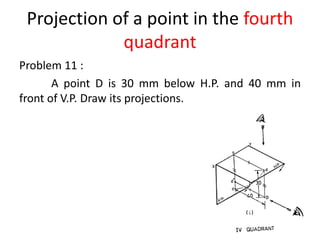
Projection of a point in the fourth
quadrant
Problem 11 :
A point D is 30 mm below H.P. and 40 mm in
front of V.P. Draw its projections.
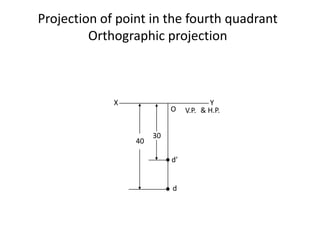
& H.P.
X Y
V.P.
d
40
d’
30
O
Projection of point in the fourth quadrant
Orthographic projection
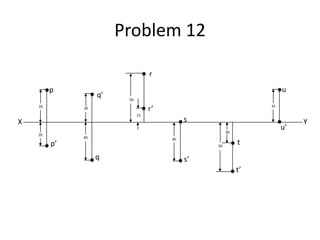
Problem 12
Mark the projections of the following points on a
common reference line :
a) P, 35 mm behind the V.P. and 20 mm below the H.P.
b) Q, 40 mm in front of the V.P. and 30 mm above the
H.P.
c) R, 50 mm behind the V.P. and 15 mm above the H.P.
d) S, 40 mm below the H.P. and in the V.P.
e) T, 30 mm in front of V.P. and 50 mm below the H.P.
f) U, 35 mm behind the V.P. and in the H.P.
X Y
p’
20
p
35
q
40
30
q’
r’
15
r
50
s’
s
40
t’
t
50
30
u’
u
35
Problem 12
Problem 13
Mark the projections of the following points on a
common reference line :
1. P, 25 mm below the H.P. and in the V.P.
2. Q, 40 mm behind the V.P. and in the H.P.
3. R, 30 mm below the H.P. and 30 mm in front of the
V.P.
4. S, 25 mm above the H.P. and 25 mm behind the V.P.
5. T, 25 mm above the H.P. and 30 mm in front of the
V.P.
6. U, in both the V.P. and the H.P.
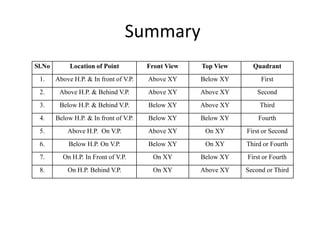
Summary
Sl.No Location of Point Front View Top View Quadrant
1. Above H.P. & In front of V.P. Above XY Below XY First
2. Above H.P. & Behind V.P. Above XY Above XY Second
3. Below H.P. & Behind V.P. Below XY Above XY Third
4. Below H.P. & In front of V.P. Below XY Below XY Fourth
5. Above H.P. On V.P. Above XY On XY First or Second
6. Below H.P. On V.P. Below XY On XY Third or Fourth
7. On H.P. In Front of V.P. On XY Below XY First or Fourth
8. On H.P. Behind V.P. On XY Above XY Second or Third

unit-ii-1.projection_of_points.pdf

  • 1.
  • 2.
    Points 1. A pointrepresents a location in space or on a drawing, and has no width, height and depth. 2. A point is represented by the intersection of two lines.
  • 3.
    I QUADRANT Above H.P. Infront of V.P. IV QUADRANT Below H.P. In front of V.P. II QUADRANT Above H.P. Behind V.P. III QUADRANT Below H.P. Behind V.P. TOP VIEW ALWAYS ROTATE H.P. CLOCKWISE TO OPEN-OUT I QUADRANT
  • 4.
    Positions of apoint 1. When a point lies in the first quadrant, it will be above H.P. and in front of V.P. 2. When the point lies in the second quadrant, it will be above H.P. and behind V.P. 3. When the point lies in the third quadrant, it will be below H.P. and behind V.P. 4. When the point lies in the fourth quadrant, it will be in front of V.P. and below H.P.
  • 5.
    System of notation 1.In this text, the actual points in space are denoted by capital letters A, B, C etc. 2. Their front views are denoted by their corresponding lower case letters with dashes a’, b’, c’ etc., and their top views by the lower case letters a, b, c etc. 3. Projectors are always drawn as continuous thin lines (2H pencil).
  • 6.
    Projection of apoint in the first quadrant Problem 1 : Point A is 20 mm above H.P. and 30 mm in front of V.P. draw its front view and top view.
  • 7.
    Projection of apoint in the first quadrant Solution 1 : 1. The point A lies in the first quadrant. 2. To obtain the front view a’, look from the front : Point A is 20 mm above H.P. Aa’ is the projector perpendicular to V.P. Hence a’ is the front view of the point A and it is 20 mm above the XY line.
  • 8.
    Projection of apoint in the first quadrant 3. To obtain the top view a, look from the top: Point A is 30 mm in front of V.P. Aa is the projector perpendicular to H.P. Hence a is the top view of the point A and it is 30 mm in front of XY. 4. To convert the projections a’ and a obtained in the pictorial view into orthographic projections: Rotate the H.P. about the XY line through 90° in the CW.
  • 9.
    Projection of apoint in the first quadrant 4. To convert the projections a’ and a obtained in the pictorial view into orthographic projections: After rotation, the first quadrant is opened out and the H.P. occupies the position (dotted lines) vertically below the V.P. Also, the point a on H.P. will trace a quadrant of a circle with o as centre and oa as radius. Now a occupies the position just below o. Here the line joining a’ and a , called the projector, is perpendicular to XY.
  • 10.
    Projection of apoint in the first quadrant To draw the orthographic projections : 5. Front view : Draw the XY line and draw a projector at any point on it. Mark a’ 20 mm above XY on the projector. 6. Top view : On the same projector. Mark a 30 mm below XY.
  • 11.
    Projection of apoint in the first quadrant
  • 12.
    V.P. X Y H.P. a’ 20 a 30 O Projection ofpoint in the first quadrant
  • 13.
    V.P. X Y H.P. a’ 20 a 30 O a’oa :Projector a’ : View from front / Front View a : View from top / Top View Projection of point in the first quadrant Orthographic projection Point : H pencil (thick) Lettering (a, a’ ) : HB pencil Projector line (a’Oa) : 2H pencil (thin line)
  • 14.
    Projection of apoint in the first quadrant Problem 2 : A Point M is 35 mm above H.P. and 45 mm in front of V.P. Draw its projections.
  • 15.
    Projection of apoint in the first quadrant Problem 3 : Draw the projections of a point A lying on H.P. and 30 mm in front of V.P. Draw its projections.
  • 16.
    V.P. X Y H.P. a’ a 30 a’oa :Projector a’ : View from front / Front View a : View from top / Top View Projection of point in the first quadrant Orthographic projection Point : H pencil (thick) Lettering (a, a’ ) : HB pencil Projector line (a’Oa) : 2H pencil (thin line)
  • 17.
    Projection of apoint in the first quadrant Problem 4 : Draw the projections of a point B lying on H.P. and 40 mm in front of V.P. Draw its projections.
  • 18.
    Projection of apoint in the first quadrant Problem 5 : Draw the projections of a point A lying on V.P. and 35 mm above H.P. Draw its projections.
  • 19.
    Projection of apoint in the first quadrant Problem 6 : Draw the projections of a point F which lies in both the H.P. and V.P. Draw its projections.
  • 20.
    V.P. X Y H.P. a’ a Projection ofpoint in the first quadrant Orthographic projection
  • 21.
    Projection of apoint in the second quadrant Problem 7 : A point B is 25 mm above H.P. and 35 mm behind V.P. Draw its projections.
  • 22.
    H.P. X Y V.P.& b’ 25 b 35 O Projection ofpoint in the second quadrant Orthographic projection
  • 23.
    Projection of apoint in the second quadrant Problem 8 : A point S is 35 mm above H.P. and 50 mm behind V.P. Draw its projections
  • 24.
    Projection of apoint in the third quadrant Problem 9 : A point C is 35 mm below H.P. and 25 mm behind V.P. Draw its projections.
  • 25.
    H.P. X Y V.P. c 25 c’ 35 O Projection ofpoint in the third quadrant Orthographic projection
  • 26.
    Projection of apoint in the third quadrant Problem 10 : A point D is 45 mm below H.P. and 55 mm behind V.P. Draw its projections.
  • 27.
    Projection of apoint in the fourth quadrant Problem 11 : A point D is 30 mm below H.P. and 40 mm in front of V.P. Draw its projections.
  • 28.
    & H.P. X Y V.P. d 40 d’ 30 O Projectionof point in the fourth quadrant Orthographic projection
  • 29.
    Problem 12 Mark theprojections of the following points on a common reference line : a) P, 35 mm behind the V.P. and 20 mm below the H.P. b) Q, 40 mm in front of the V.P. and 30 mm above the H.P. c) R, 50 mm behind the V.P. and 15 mm above the H.P. d) S, 40 mm below the H.P. and in the V.P. e) T, 30 mm in front of V.P. and 50 mm below the H.P. f) U, 35 mm behind the V.P. and in the H.P.
  • 30.
  • 31.
    Problem 13 Mark theprojections of the following points on a common reference line : 1. P, 25 mm below the H.P. and in the V.P. 2. Q, 40 mm behind the V.P. and in the H.P. 3. R, 30 mm below the H.P. and 30 mm in front of the V.P. 4. S, 25 mm above the H.P. and 25 mm behind the V.P. 5. T, 25 mm above the H.P. and 30 mm in front of the V.P. 6. U, in both the V.P. and the H.P.
  • 32.
    Summary Sl.No Location ofPoint Front View Top View Quadrant 1. Above H.P. & In front of V.P. Above XY Below XY First 2. Above H.P. & Behind V.P. Above XY Above XY Second 3. Below H.P. & Behind V.P. Below XY Above XY Third 4. Below H.P. & In front of V.P. Below XY Below XY Fourth 5. Above H.P. On V.P. Above XY On XY First or Second 6. Below H.P. On V.P. Below XY On XY Third or Fourth 7. On H.P. In Front of V.P. On XY Below XY First or Fourth 8. On H.P. Behind V.P. On XY Above XY Second or Third