Unit 4: Plan, planning Programme
and Project
1
Project
2
• Latin word projectum from the Latin verb proicere, "to throw
something forward“
• pro-, which denotes something that precedes the action of the
next part of the word in time and
• iacere, "to throw" Project is a specific job which is non routine
and temporary job with specific objective which serves a
certain purpose uniquely.
Project
3
• According to Cleland and King, a project is a combination of
human and non human resources pulled together in a
temporary organization to achieve a specified purpose
• According to Harold Kerzner, a project is any series of
activities and tasks that have a specific objective to be
completed within certain specifications, have defined start and
end dates, have funding limits and consume resources
Project Management
4
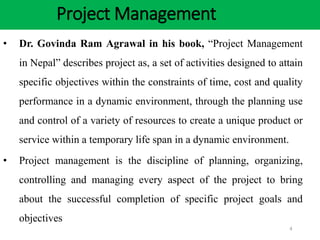
• Dr. Govinda Ram Agrawal in his book, “Project Management
in Nepal” describes project as, a set of activities designed to attain
specific objectives within the constraints of time, cost and quality
performance in a dynamic environment, through the planning use
and control of a variety of resources to create a unique product or
service within a temporary life span in a dynamic environment.
• Project management is the discipline of planning, organizing,
controlling and managing every aspect of the project to bring
about the successful completion of specific project goals and
objectives
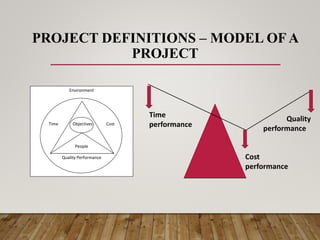
PROJECT DEFINITIONS – MODEL OF A
PROJECT
Environment
Time Objectives Cost
People
Quality Performance
Time
performance
Cost
performance
Quality
performance
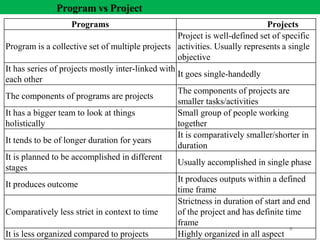
Program vs Project
6
Programs Projects
Program is a collective set of multiple projects
Project is well-defined set of specific
activities. Usually represents a single
objective
It has series of projects mostly inter-linked with
each other
It goes single-handedly
The components of programs are projects
The components of projects are
smaller tasks/activities
It has a bigger team to look at things
holistically
Small group of people working
together
It tends to be of longer duration for years
It is comparatively smaller/shorter in
duration
It is planned to be accomplished in different
stages
Usually accomplished in single phase
It produces outcome
It produces outputs within a defined
time frame
Comparatively less strict in context to time
Strictness in duration of start and end
of the project and has definite time
frame
It is less organized compared to projects Highly organized in all aspect
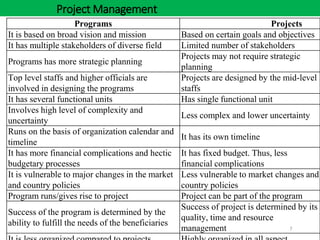
Project Management
7
Programs Projects
It is based on broad vision and mission Based on certain goals and objectives
It has multiple stakeholders of diverse field Limited number of stakeholders
Programs has more strategic planning
Projects may not require strategic
planning
Top level staffs and higher officials are
involved in designing the programs
Projects are designed by the mid-level
staffs
It has several functional units Has single functional unit
Involves high level of complexity and
uncertainty
Less complex and lower uncertainty
Runs on the basis of organization calendar and
timeline
It has its own timeline
It has more financial complications and hectic
budgetary processes
It has fixed budget. Thus, less
financial complications
It is vulnerable to major changes in the market
and country policies
Less vulnerable to market changes and
country policies
Program runs/gives rise to project Project can be part of the program
Success of the program is determined by the
ability to fulfill the needs of the beneficiaries
Success of project is determined by its
quality, time and resource
management
Characteristics of Project
 S: Specific, clearly defined, not vague.
 M: Measurable, so that the project achievement can be
measured, compared and controlled.
 A: Agree, by all the members of the team. Agreed goals raise the
sense and commitment.
 R: Realistic considering the given possible resources,
experience, knowledge and time available.
 T: Time bound, if there is no time to complete the process it will
never be completed.
Project Characteristics
 Specific Objective: A project clearly defines objectives, on achievement of which a
project succeeds. Objects are the deliverables of a project and the end results.
Objectives are predetermined and outputs are measurable.
 Temporary (Life Span): A project cannot continue endlessly. It is a temporary
endeavor. It has beginning and end from its birth to death. It passes through various
stages i.e. formulation, planning, design, construction, operation and termination.
 Non-routine and Non-repetitive: A project is non routine and non- repetitive in
nature.
Project Characteristics
 Constraints: A project operates within constraints of time, cost and quality.
 Uniqueness: No two projects are exactly similar. There are complex set of
activities involved within a project which doesn’t go with some other case.
 Flexibility: A project operates in a dynamic environment, so project needs
flexibility to provide rapid response to changing environment. Risks and changes
are inevitable and project needs to address these issues for which a project needs
to be flexible.
Project Characteristics
 Resource Integration: Every project uses resources such as man, machine,
money and minutes. So, integration of these resources is necessary for
efficient use of these resources.
 Team Work: A project normally consists of diversified personnel
specialized in their respective area. They work from a various discipline so
the coordination among them is called team work. A manager leads the team
to accomplish the goal of the project.
 Planning and Control: each project has an effective planning and control
system in order to efficient and effective completion of the project.
Project Characteristics
 Contracting and Subcontracting: Most projects are contract
based. Complexity of a project increases the need of contracting
and subcontracting. Contract may be of various types such as,
lump-sum contract, unit price contract, negotiated cost plus fixed
fee contract and turnkey contract.
 Beneficiaries: The ultimate users of the project are the project
beneficiaries. Each project has certain community of beneficiaries
who are directly associated with the project outputs.
Project Financing/Source
 International Project Finance Association (IPFA) defined project financing
as: “The financing of long-term infrastructure, industrial projects and public
services based upon a limited recourse financial structure where project debt and
equity used to finance the project are paid back from the cash flows generated by
the project.”
 Project finance is especially attractive to the private sector because they can fund
major projects off balance sheet.
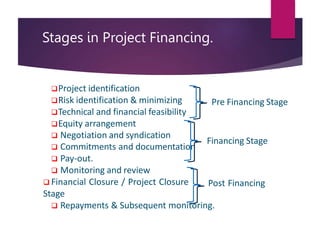
Stages in Project Financing.
Pre Financing Stage
Financing Stage
Post Financing
Project identification
Risk identification & minimizing
Technical and financial feasibility
Equity arrangement
 Negotiation and syndication
 Commitments and documentation
 Pay-out.
 Monitoring and review
 Financial Closure / Project Closure
Stage
 Repayments & Subsequent monitoring.
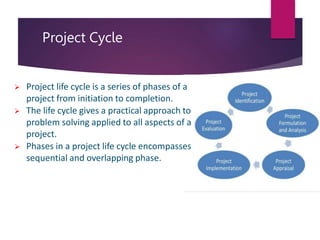
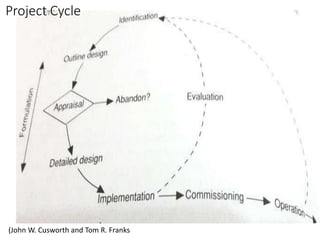
Project Cycle
 Project life cycle is a series of phases of a
project from initiation to completion.
 The life cycle gives a practical approach to
problem solving applied to all aspects of a
project.
 Phases in a project life cycle encompasses
sequential and overlapping phase.
Project Cycle
(John W. Cusworth and Tom R. Franks
Project Cycle
17
1. Identification:
• This is the stage in which a project is defined as an idea
or possibility worthy of further investigation and study.
• This may come as the result of the discovery of a
resource, need or demand to be satisfied. For example,
(A valuable mineral deposit in a remote region)
needs to be extracted in a project.
Project Cycle
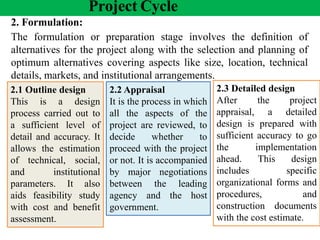
2. Formulation:
The formulation or preparation stage involves the definition of
alternatives for the project along with the selection and planning of
optimum alternatives covering aspects like size, location, technical
details, markets, and institutional arrangements.
2.2 Appraisal
It is the process in which
all the aspects of the
project are reviewed, to
decide whether to
proceed with the project
or not. It is accompanied
by major negotiations
between the leading
agency and the host
government.
2.1 Outline design
This is a design
process carried out to
a sufficient level of
detail and accuracy. It
allows the estimation
of technical, social,
and institutional
parameters. It also
aids feasibility study
with cost and benefit
assessment.
2.3 Detailed design
After the project
appraisal, a detailed
design is prepared with
sufficient accuracy to go
the implementation
ahead. This design
includes specific
organizational forms and
procedures, and
construction documents
with the cost estimate.
3. Implementation
• Through the re-appraisal and negotiation of design to finalize details of the
plan Implementation can be commenced. It is the stage that involves the
disbursement of the largest portion of the project fund and time. The
activities of mining excavation are carried out in the field.
4. Commissioning
• It is the process executed between Implementation and Operation. It leads
to the successful operation of the assets.
5. Operation
• This is the phase when the assets created by the project implementation
are put into work and yield a flow of benefits. The project phase is by the
time operations are commenced. The mine is producing minerals that
can be processed further.
6. Evaluation
• Evaluation is the investigating and reviewing of the effects of the
completed project, to see whether the benefits which were planned to flow
from it have been achieved or these benefits have had their intended
consequences. Is the mine excavation project completed in allocated
time and budget, and fulfilled its envisioned objectives i.e livelihood
enhancement of locals, economic gain, etc.
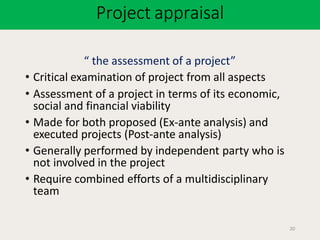
Project appraisal
20
“ the assessment of a project”
• Critical examination of project from all aspects
• Assessment of a project in terms of its economic,
social and financial viability
• Made for both proposed (Ex-ante analysis) and
executed projects (Post-ante analysis)
• Generally performed by independent party who is
not involved in the project
• Require combined efforts of a multidisciplinary
team
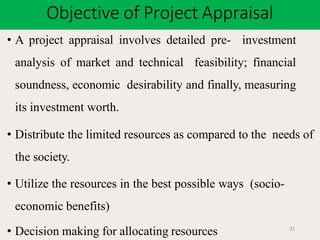
Objective of Project Appraisal
21
• A project appraisal involves detailed pre- investment
analysis of market and technical feasibility; financial
soundness, economic desirability and finally, measuring
its investment worth.
• Distribute the limited resources as compared to the needs of
the society.
• Utilize the resources in the best possible ways (socio-
economic benefits)
• Decision making for allocating resources
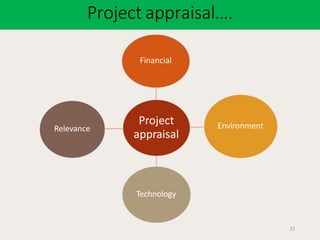
Project appraisal….
Project
appraisal
22
Financial
Environment
Technology
Relevance
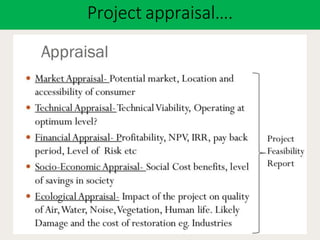
Project appraisal….
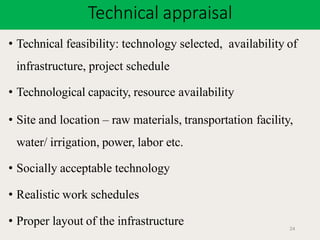
Technical appraisal
24
• Technical feasibility: technology selected, availability of
infrastructure, project schedule
• Technological capacity, resource availability
• Site and location – raw materials, transportation facility,
water/ irrigation, power, labor etc.
• Socially acceptable technology
• Realistic work schedules
• Proper layout of the infrastructure
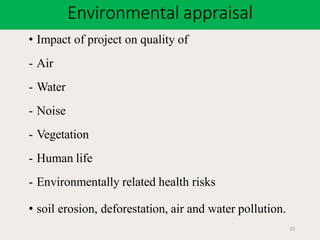
Environmental appraisal
25
• Impact of project on quality of
- Air
- Water
- Noise
- Vegetation
- Human life
- Environmentally related health risks
• soil erosion, deforestation, air and water pollution.
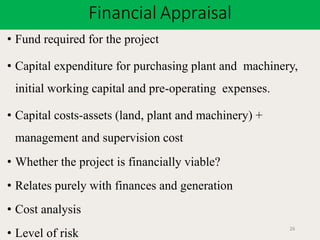
Financial Appraisal
26
• Fund required for the project
• Capital expenditure for purchasing plant and machinery,
initial working capital and pre-operating expenses.
• Capital costs-assets (land, plant and machinery) +
management and supervision cost
• Whether the project is financially viable?
• Relates purely with finances and generation
• Cost analysis
• Level of risk
Present Value (PV)
27
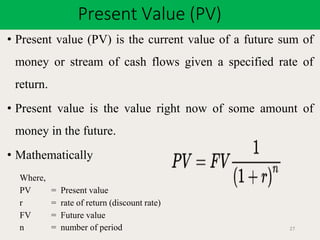
• Present value (PV) is the current value of a future sum of
money or stream of cash flows given a specified rate of
return.
• Present value is the value right now of some amount of
money in the future.
• Mathematically
Where,
PV = Present value
r = rate of return (discount rate)
FV = Future value
n = number of period
Net Present Value (NPV)
28
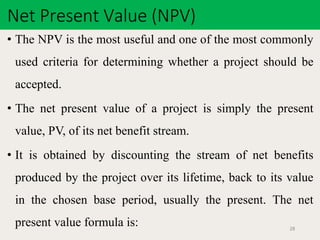
• The NPV is the most useful and one of the most commonly
used criteria for determining whether a project should be
accepted.
• The net present value of a project is simply the present
value, PV, of its net benefit stream.
• It is obtained by discounting the stream of net benefits
produced by the project over its lifetime, back to its value
in the chosen base period, usually the present. The net
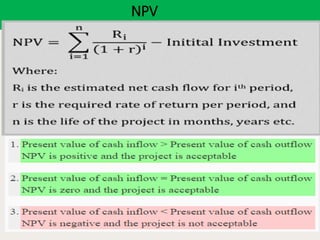
present value formula is:
NPV
29
Internal Rate of Return
30
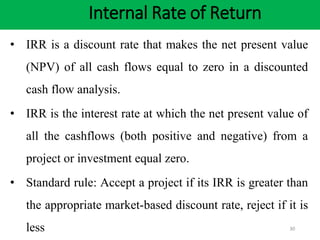
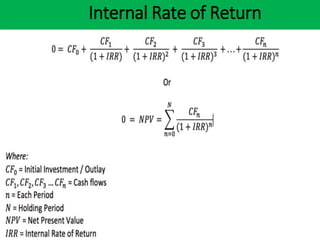
• IRR is a discount rate that makes the net present value
(NPV) of all cash flows equal to zero in a discounted
cash flow analysis.
• IRR is the interest rate at which the net present value of
all the cashflows (both positive and negative) from a
project or investment equal zero.
• Standard rule: Accept a project if its IRR is greater than
the appropriate market-based discount rate, reject if it is
less
Internal Rate of Return
31
Profitability index / Benefit Cost Ratio (B/C ratio)
32
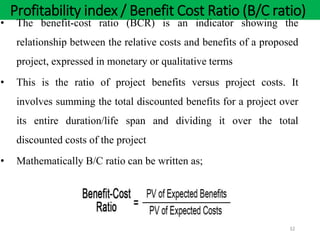
• The benefit-cost ratio (BCR) is an indicator showing the
relationship between the relative costs and benefits of a proposed
project, expressed in monetary or qualitative terms
• This is the ratio of project benefits versus project costs. It
involves summing the total discounted benefits for a project over
its entire duration/life span and dividing it over the total
discounted costs of the project
• Mathematically B/C ratio can be written as;
Profitability index / Benefit Cost Ratio (B/C ratio)
33
Understanding the results of B/C ratio
• If B/C ratio is less than 1 (B/C ratio < 1.0): In economic terms,
the costs exceed the benefits. Solely on this criterion, the project
should not proceed.
• If B/C ratio is equal to 1 (B/C ratio = 1.0): Costs equal the
benefits, which means the project should be allowed to proceed,
but with little viability.
• If B/C ratio is greater than 1 (B/C ratio > 1.0): The benefits
exceed the costs, and the project should be allowed to proceed.
Pay Back Period:
34
• The payback period is the length of time it takes to recover the
cost of an investment or the length of time an investor needs to
reach a breakeven point (neither loss nor gain).
• The payback period refers to the length of time it takes to recover
the cost of an investment.
• Payback Period is the duration of time required to equal the
cumulative cash inflows to its cash outflows.
• The shortest payback period is generally considered to be the most
acceptable. The reason being, the longer the money is tied up, the
less opportunity there is to invest it elsewhere.
Project planning
35
Project plan is a concrete output of project
plannning, which presents all essential information
about the project: who, what, where, how, by
whom and with what resources.
The relevance, feasibility, sustainability and internal
and external risks of the project can be analysed with
the help of the appraisal.
Project planning
36
• Guides the execution of the project, coordinates the
activities.
• Facilitates better communication between the
project stakeholders.
• Provides a means of tracking and monitoring the
progress
• Provides a detailed documentation regarding
planning decisions
Project planning….
37
• Project planning is of significant importance for the
success of the project
- Careful planning helps prevent costly mistakes.
- Good planning is the key to meet the project
objectives within defined time and budget.
• Different techniques can be used for project
planning.
Project planning….
38
• Any planning approach should have the following
elements:
- The establishment of project objectives
- The analysis of the characteristics of the project
- The establishment of an infrastructure consisting of an
appropriate organization and set of standards, methods
and tools
- The identification of the products of the project and
the activities needed to generate those projects
- The allocation of resources to activities
Project planning….
39
Project planning involves:
• Develop and define scope, quality requirements,
budget, schedule
• Plan procurements, risk management and project
integration
• Define organizational needs, acquire key staff
• Identify stakeholders’ power/interest/concern
Project planning….
40
Planning different activities
• When to start and when to finish
• Which activity to prioritize
• Bottlenecks for implementation (Staffing, resource),
• Resource allocations
Project planning process
41
• Budget planning – specifying the budgeted cost to be
incurred at the completion of the project
• Procurement planning – focusing on vendors outside
your company and subcontracting
• Risk management – planning for possible risks and
considering optional contingency plans and mitigation
strategies
• Quality planning – assessing quality criteria to be used
for the project
• Communication planning – designing the
communication strategy with all project stakeholders
Limitation
42
• Quality of project analysis depends on the quality
of data and forecast made about the costs and
benefits.
• In the view of uncertainty about the future, it is
difficult to quantify completely the risk.
• project analysis is a useful tool only if major apart
of benefits are quantifiable.

Unit-4.pptx

  • 1.
    Unit 4: Plan,planning Programme and Project 1
  • 2.
    Project 2 • Latin wordprojectum from the Latin verb proicere, "to throw something forward“ • pro-, which denotes something that precedes the action of the next part of the word in time and • iacere, "to throw" Project is a specific job which is non routine and temporary job with specific objective which serves a certain purpose uniquely.
  • 3.
    Project 3 • According toCleland and King, a project is a combination of human and non human resources pulled together in a temporary organization to achieve a specified purpose • According to Harold Kerzner, a project is any series of activities and tasks that have a specific objective to be completed within certain specifications, have defined start and end dates, have funding limits and consume resources
  • 4.
    Project Management 4 • Dr.Govinda Ram Agrawal in his book, “Project Management in Nepal” describes project as, a set of activities designed to attain specific objectives within the constraints of time, cost and quality performance in a dynamic environment, through the planning use and control of a variety of resources to create a unique product or service within a temporary life span in a dynamic environment. • Project management is the discipline of planning, organizing, controlling and managing every aspect of the project to bring about the successful completion of specific project goals and objectives
  • 5.
    PROJECT DEFINITIONS –MODEL OF A PROJECT Environment Time Objectives Cost People Quality Performance Time performance Cost performance Quality performance
  • 6.
    Program vs Project 6 ProgramsProjects Program is a collective set of multiple projects Project is well-defined set of specific activities. Usually represents a single objective It has series of projects mostly inter-linked with each other It goes single-handedly The components of programs are projects The components of projects are smaller tasks/activities It has a bigger team to look at things holistically Small group of people working together It tends to be of longer duration for years It is comparatively smaller/shorter in duration It is planned to be accomplished in different stages Usually accomplished in single phase It produces outcome It produces outputs within a defined time frame Comparatively less strict in context to time Strictness in duration of start and end of the project and has definite time frame It is less organized compared to projects Highly organized in all aspect
  • 7.
    Project Management 7 Programs Projects Itis based on broad vision and mission Based on certain goals and objectives It has multiple stakeholders of diverse field Limited number of stakeholders Programs has more strategic planning Projects may not require strategic planning Top level staffs and higher officials are involved in designing the programs Projects are designed by the mid-level staffs It has several functional units Has single functional unit Involves high level of complexity and uncertainty Less complex and lower uncertainty Runs on the basis of organization calendar and timeline It has its own timeline It has more financial complications and hectic budgetary processes It has fixed budget. Thus, less financial complications It is vulnerable to major changes in the market and country policies Less vulnerable to market changes and country policies Program runs/gives rise to project Project can be part of the program Success of the program is determined by the ability to fulfill the needs of the beneficiaries Success of project is determined by its quality, time and resource management
  • 8.
    Characteristics of Project S: Specific, clearly defined, not vague.  M: Measurable, so that the project achievement can be measured, compared and controlled.  A: Agree, by all the members of the team. Agreed goals raise the sense and commitment.  R: Realistic considering the given possible resources, experience, knowledge and time available.  T: Time bound, if there is no time to complete the process it will never be completed.
  • 9.
    Project Characteristics  SpecificObjective: A project clearly defines objectives, on achievement of which a project succeeds. Objects are the deliverables of a project and the end results. Objectives are predetermined and outputs are measurable.  Temporary (Life Span): A project cannot continue endlessly. It is a temporary endeavor. It has beginning and end from its birth to death. It passes through various stages i.e. formulation, planning, design, construction, operation and termination.  Non-routine and Non-repetitive: A project is non routine and non- repetitive in nature.
  • 10.
    Project Characteristics  Constraints:A project operates within constraints of time, cost and quality.  Uniqueness: No two projects are exactly similar. There are complex set of activities involved within a project which doesn’t go with some other case.  Flexibility: A project operates in a dynamic environment, so project needs flexibility to provide rapid response to changing environment. Risks and changes are inevitable and project needs to address these issues for which a project needs to be flexible.
  • 11.
    Project Characteristics  ResourceIntegration: Every project uses resources such as man, machine, money and minutes. So, integration of these resources is necessary for efficient use of these resources.  Team Work: A project normally consists of diversified personnel specialized in their respective area. They work from a various discipline so the coordination among them is called team work. A manager leads the team to accomplish the goal of the project.  Planning and Control: each project has an effective planning and control system in order to efficient and effective completion of the project.
  • 12.
    Project Characteristics  Contractingand Subcontracting: Most projects are contract based. Complexity of a project increases the need of contracting and subcontracting. Contract may be of various types such as, lump-sum contract, unit price contract, negotiated cost plus fixed fee contract and turnkey contract.  Beneficiaries: The ultimate users of the project are the project beneficiaries. Each project has certain community of beneficiaries who are directly associated with the project outputs.
  • 13.
    Project Financing/Source  InternationalProject Finance Association (IPFA) defined project financing as: “The financing of long-term infrastructure, industrial projects and public services based upon a limited recourse financial structure where project debt and equity used to finance the project are paid back from the cash flows generated by the project.”  Project finance is especially attractive to the private sector because they can fund major projects off balance sheet.
  • 14.
    Stages in ProjectFinancing. Pre Financing Stage Financing Stage Post Financing Project identification Risk identification & minimizing Technical and financial feasibility Equity arrangement  Negotiation and syndication  Commitments and documentation  Pay-out.  Monitoring and review  Financial Closure / Project Closure Stage  Repayments & Subsequent monitoring.
  • 15.
    Project Cycle  Projectlife cycle is a series of phases of a project from initiation to completion.  The life cycle gives a practical approach to problem solving applied to all aspects of a project.  Phases in a project life cycle encompasses sequential and overlapping phase.
  • 16.
    Project Cycle (John W.Cusworth and Tom R. Franks
  • 17.
    Project Cycle 17 1. Identification: •This is the stage in which a project is defined as an idea or possibility worthy of further investigation and study. • This may come as the result of the discovery of a resource, need or demand to be satisfied. For example, (A valuable mineral deposit in a remote region) needs to be extracted in a project.
  • 18.
    Project Cycle 2. Formulation: Theformulation or preparation stage involves the definition of alternatives for the project along with the selection and planning of optimum alternatives covering aspects like size, location, technical details, markets, and institutional arrangements. 2.2 Appraisal It is the process in which all the aspects of the project are reviewed, to decide whether to proceed with the project or not. It is accompanied by major negotiations between the leading agency and the host government. 2.1 Outline design This is a design process carried out to a sufficient level of detail and accuracy. It allows the estimation of technical, social, and institutional parameters. It also aids feasibility study with cost and benefit assessment. 2.3 Detailed design After the project appraisal, a detailed design is prepared with sufficient accuracy to go the implementation ahead. This design includes specific organizational forms and procedures, and construction documents with the cost estimate.
  • 19.
    3. Implementation • Throughthe re-appraisal and negotiation of design to finalize details of the plan Implementation can be commenced. It is the stage that involves the disbursement of the largest portion of the project fund and time. The activities of mining excavation are carried out in the field. 4. Commissioning • It is the process executed between Implementation and Operation. It leads to the successful operation of the assets. 5. Operation • This is the phase when the assets created by the project implementation are put into work and yield a flow of benefits. The project phase is by the time operations are commenced. The mine is producing minerals that can be processed further. 6. Evaluation • Evaluation is the investigating and reviewing of the effects of the completed project, to see whether the benefits which were planned to flow from it have been achieved or these benefits have had their intended consequences. Is the mine excavation project completed in allocated time and budget, and fulfilled its envisioned objectives i.e livelihood enhancement of locals, economic gain, etc.
  • 20.
    Project appraisal 20 “ theassessment of a project” • Critical examination of project from all aspects • Assessment of a project in terms of its economic, social and financial viability • Made for both proposed (Ex-ante analysis) and executed projects (Post-ante analysis) • Generally performed by independent party who is not involved in the project • Require combined efforts of a multidisciplinary team
  • 21.
    Objective of ProjectAppraisal 21 • A project appraisal involves detailed pre- investment analysis of market and technical feasibility; financial soundness, economic desirability and finally, measuring its investment worth. • Distribute the limited resources as compared to the needs of the society. • Utilize the resources in the best possible ways (socio- economic benefits) • Decision making for allocating resources
  • 22.
  • 23.
  • 24.
    Technical appraisal 24 • Technicalfeasibility: technology selected, availability of infrastructure, project schedule • Technological capacity, resource availability • Site and location – raw materials, transportation facility, water/ irrigation, power, labor etc. • Socially acceptable technology • Realistic work schedules • Proper layout of the infrastructure
  • 25.
    Environmental appraisal 25 • Impactof project on quality of - Air - Water - Noise - Vegetation - Human life - Environmentally related health risks • soil erosion, deforestation, air and water pollution.
  • 26.
    Financial Appraisal 26 • Fundrequired for the project • Capital expenditure for purchasing plant and machinery, initial working capital and pre-operating expenses. • Capital costs-assets (land, plant and machinery) + management and supervision cost • Whether the project is financially viable? • Relates purely with finances and generation • Cost analysis • Level of risk
  • 27.
    Present Value (PV) 27 •Present value (PV) is the current value of a future sum of money or stream of cash flows given a specified rate of return. • Present value is the value right now of some amount of money in the future. • Mathematically Where, PV = Present value r = rate of return (discount rate) FV = Future value n = number of period
  • 28.
    Net Present Value(NPV) 28 • The NPV is the most useful and one of the most commonly used criteria for determining whether a project should be accepted. • The net present value of a project is simply the present value, PV, of its net benefit stream. • It is obtained by discounting the stream of net benefits produced by the project over its lifetime, back to its value in the chosen base period, usually the present. The net present value formula is:
  • 29.
  • 30.
    Internal Rate ofReturn 30 • IRR is a discount rate that makes the net present value (NPV) of all cash flows equal to zero in a discounted cash flow analysis. • IRR is the interest rate at which the net present value of all the cashflows (both positive and negative) from a project or investment equal zero. • Standard rule: Accept a project if its IRR is greater than the appropriate market-based discount rate, reject if it is less
  • 31.
  • 32.
    Profitability index /Benefit Cost Ratio (B/C ratio) 32 • The benefit-cost ratio (BCR) is an indicator showing the relationship between the relative costs and benefits of a proposed project, expressed in monetary or qualitative terms • This is the ratio of project benefits versus project costs. It involves summing the total discounted benefits for a project over its entire duration/life span and dividing it over the total discounted costs of the project • Mathematically B/C ratio can be written as;
  • 33.
    Profitability index /Benefit Cost Ratio (B/C ratio) 33 Understanding the results of B/C ratio • If B/C ratio is less than 1 (B/C ratio < 1.0): In economic terms, the costs exceed the benefits. Solely on this criterion, the project should not proceed. • If B/C ratio is equal to 1 (B/C ratio = 1.0): Costs equal the benefits, which means the project should be allowed to proceed, but with little viability. • If B/C ratio is greater than 1 (B/C ratio > 1.0): The benefits exceed the costs, and the project should be allowed to proceed.
  • 34.
    Pay Back Period: 34 •The payback period is the length of time it takes to recover the cost of an investment or the length of time an investor needs to reach a breakeven point (neither loss nor gain). • The payback period refers to the length of time it takes to recover the cost of an investment. • Payback Period is the duration of time required to equal the cumulative cash inflows to its cash outflows. • The shortest payback period is generally considered to be the most acceptable. The reason being, the longer the money is tied up, the less opportunity there is to invest it elsewhere.
  • 35.
    Project planning 35 Project planis a concrete output of project plannning, which presents all essential information about the project: who, what, where, how, by whom and with what resources. The relevance, feasibility, sustainability and internal and external risks of the project can be analysed with the help of the appraisal.
  • 36.
    Project planning 36 • Guidesthe execution of the project, coordinates the activities. • Facilitates better communication between the project stakeholders. • Provides a means of tracking and monitoring the progress • Provides a detailed documentation regarding planning decisions
  • 37.
    Project planning…. 37 • Projectplanning is of significant importance for the success of the project - Careful planning helps prevent costly mistakes. - Good planning is the key to meet the project objectives within defined time and budget. • Different techniques can be used for project planning.
  • 38.
    Project planning…. 38 • Anyplanning approach should have the following elements: - The establishment of project objectives - The analysis of the characteristics of the project - The establishment of an infrastructure consisting of an appropriate organization and set of standards, methods and tools - The identification of the products of the project and the activities needed to generate those projects - The allocation of resources to activities
  • 39.
    Project planning…. 39 Project planninginvolves: • Develop and define scope, quality requirements, budget, schedule • Plan procurements, risk management and project integration • Define organizational needs, acquire key staff • Identify stakeholders’ power/interest/concern
  • 40.
    Project planning…. 40 Planning differentactivities • When to start and when to finish • Which activity to prioritize • Bottlenecks for implementation (Staffing, resource), • Resource allocations
  • 41.
    Project planning process 41 •Budget planning – specifying the budgeted cost to be incurred at the completion of the project • Procurement planning – focusing on vendors outside your company and subcontracting • Risk management – planning for possible risks and considering optional contingency plans and mitigation strategies • Quality planning – assessing quality criteria to be used for the project • Communication planning – designing the communication strategy with all project stakeholders
  • 42.
    Limitation 42 • Quality ofproject analysis depends on the quality of data and forecast made about the costs and benefits. • In the view of uncertainty about the future, it is difficult to quantify completely the risk. • project analysis is a useful tool only if major apart of benefits are quantifiable.