Chapter one
Introduction to Project
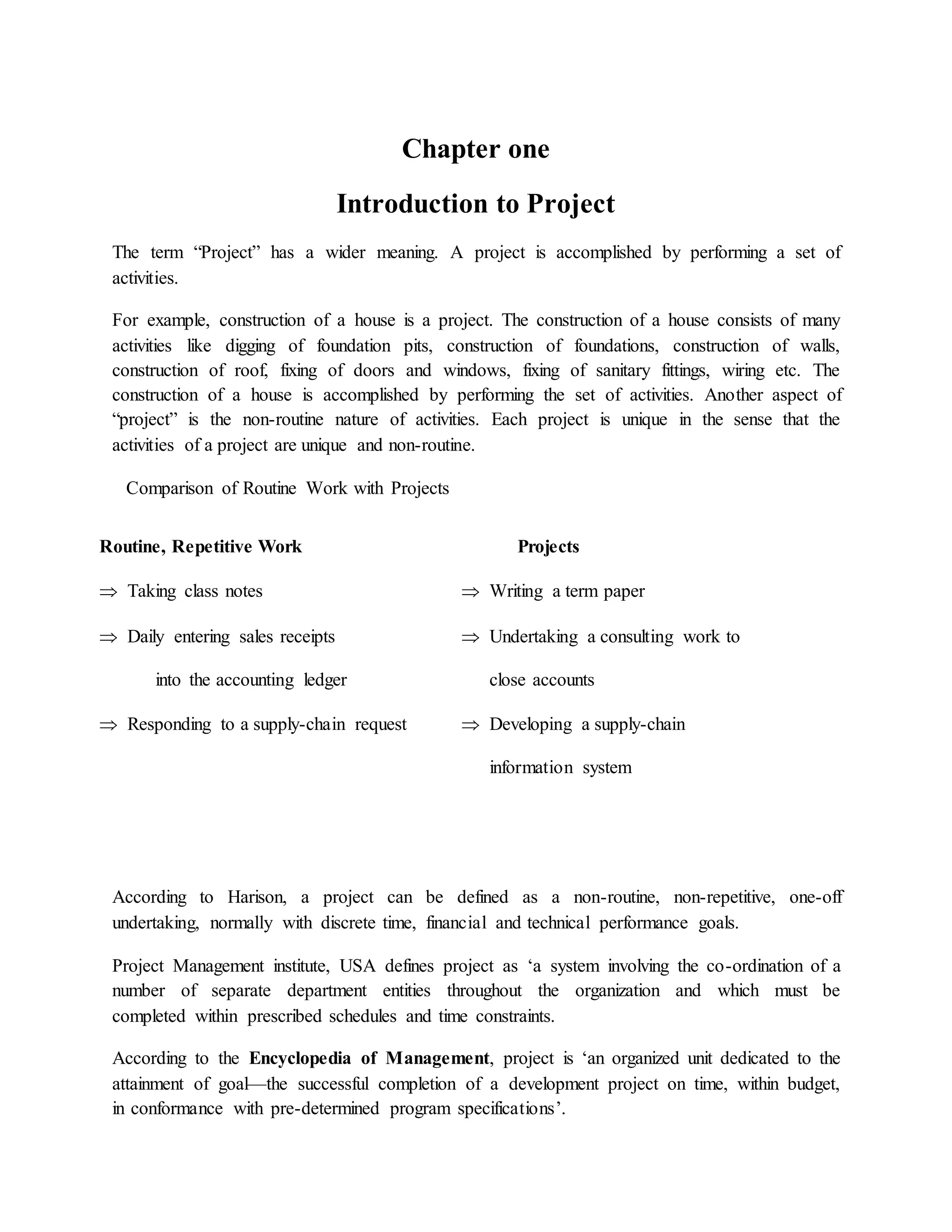
The term “Project” has a wider meaning. A project is accomplished by performing a set of
activities.
For example, construction of a house is a project. The construction of a house consists of many
activities like digging of foundation pits, construction of foundations, construction of walls,
construction of roof, fixing of doors and windows, fixing of sanitary fittings, wiring etc. The
construction of a house is accomplished by performing the set of activities. Another aspect of
“project” is the non-routine nature of activities. Each project is unique in the sense that the
activities of a project are unique and non-routine.
Comparison of Routine Work with Projects
Routine, Repetitive Work
 Taking class notes
 Daily entering sales receipts
into the accounting ledger
 Responding to a supply-chain request
Projects
 Writing a term paper
 Undertaking a consulting work to
close accounts
 Developing a supply-chain
information system
According to Harison, a project can be defined as a non-routine, non-repetitive, one-off
undertaking, normally with discrete time, financial and technical performance goals.
Project Management institute, USA defines project as ‘a system involving the co-ordination of a
number of separate department entities throughout the organization and which must be
completed within prescribed schedules and time constraints.
According to the Encyclopedia of Management, project is ‘an organized unit dedicated to the
attainment of goal—the successful completion of a development project on time, within budget,
in conformance with pre-determined program specifications’.
Project is non routine, non- repetitive, which normally undertaken with in discrete time, with
financial and technical performance goal.
This definition is descriptive and because of the endless variety of projects most of the
definitions are of this nature.
A project can be considered as a series f tasks or activities that have:
a. Specified objectives to be completed within a certain specifications.
b. Have defined start date and end date
c. Have funding limits.
d. Consume resources ( i.e. Money, time and human resource.)
Program Vs Project
The terms program and project are often used interchangeably in practice, which sometimes
causes confusion. Programs and projects are similar in the sense that they both are directed
toward goals and require plans and resources to reach their goals. Both use similar tools,
methods, and policies. The differences lie primarily in scope and time horizon. A program is a
series of coordinated, related; multiple projects that continue over extended time intended to
achieve a goal. A program is a higher level group of projects targeted at a common goal. The
classic example is the U.S. space program to place a space station on the moon to serve as a
springboard to other space explorations.
1.2. Characteristics of project
A project has the following characteristics:
1. Objectives
A project has a set of objectives or a mission. Once the objectives are achieved, the project is
treated as completed. For example the objective of a project may be construction of a highway
connecting two cities ‘A’ & ‘B’, covering a distance of 20 kilometers. Once the construction of
the highway is completed the project comes to an end.
2. Life cycle
A project has a life cycle. The life cycle consists of the following stages:
 Conception stage: Where project ideas are conceived.
 Design stage: Where detailed design of different project areas are worked out.
 Implementation stage: Where the project is implemented as per the design.
 Commissioning stage: Where the project is commissioned after implementation
Commissioning of a project indicates the end of its life cycle.
3. Definite Time Limit
A project has a definite time limit. It cannot continue forever. Construction of a highway
connecting two cities is a project which is to be completed within a given time limit.
Maintenance of the highway is an ongoing process and it will continue forever. Hence highway
maintenance will not come under the purview of project.
4. Uniqueness
Every project is unique and no two projects are similar. Setting up a Cement plant and
construction of a highway are no doubt two different projects having unique characteristics.
Constructing a highway between cities A&B and constructing another highway between cities
C&D are also unique in themselves, in view of the differences existing in the organization,
infrastructure, location, technical specifications and the people behind the projects.
5. Team work
A project normal consists of diverse areas. There will be personnel specialized in their respective
areas. Any project calls for the services of experts from a host of disciplines. Co-ordination
among the diverse areas calls for teamwork. Hence a project can be implemented only with
teamwork.
6. Complexity
A project is a complex set of activities relating to diverse areas. Technology survey, choosing the
appropriate technology, procuring the appropriate machinery and equipment, hiring the right
kind of people, arranging for financial resources, execution of the project in time by proper
scheduling of the different activities etc. contribute to the complexity of the project.
7. Sub-contracting
This characteristic stems forth in view of the complexity of functions and activities of a project.
Some of the activities are entrusted to sub-contractors to reduce the complexity of the project.
Subcontracting will be advantageous if it reduces the complexity of the project so that the project
manager can coordinate the remaining activities of the project more effectively. In general, the
greater the complexity of the project, the larger will be the extent to which sub-contracting will
be resorted to. Sub-contracting is also helpful if the sub-contractors are specialized in their field
of activity since this will improve the quality of the project.
8. Risk and Uncertainty
Risk and uncertainty go hand in hand with project. A risk free project cannot be thought of. Even
if a project appears to be risk free, it only means that the risk element is not apparently visible on
the surface and it will be hidden underneath. The risk factor will come to surface when
conditions become conducive to it. Some of the risk elements can be foreseen and the project can
be strengthened to encounter the risk as and when it emerges. Some other risk elements cannot
be foreseen.
9. Customer Specific Nature
A project is always customer specific. This is because the products produced or services offered
by the project are necessarily to be customer oriented. It is the customer who decides upon the
product to be produced or services to be offered and hence it is the responsibility of any
organization to go for projects/services that are suited to customer needs.
10. Change
A project is not rigid in its life span. Changes occur throughout the life span of a project as a
natural outcome of many environmental factors. The changes may vary from minor changes
which may have very little impact on the project to major changes which may have a big impact
or even may change the very nature of the project.
During the course of implementation, the technology would have improved further and
equipments with the latest technology would have already started arriving. In such a case, if the
equipment originally planned had not yet been procured, it would be wise to switch over to the
equipment with the latest technology. There could also be latest technological innovations in the
manufacturing process which may deserve a switch over. All such changes are necessitated in
order to keep the project update.
11. Rational Choice
Since a project is a scheme for investing resources, the choice of a project is done after making a
Study of all the available avenues for investing resources and a rational choice among the
available avenues is made.
12. Optimality
A project is always aimed at optimum utilization of resources for the overall development of the
organization. Resources are scarce and resources have a cost. Hence, optimum utilization of
resources is a must for any project. Many project management concepts have evolved with the
aim of achieving optimum utilization of available resources.
13. Control Mechanism
All projects will have pre-designed control mechanisms in order to ensure completion of projects
within the time schedule, within the estimated cost and at the same time achieving the desired
level of quality and reliability.
1.3. Classification of project
Projects can be classified under different heads, some of which are explained below.
1. Based on the Type of Activity
Under this category, projects can be classified as industrial projects and non-industrial projects.
Industrial projects are set up for the production of some goods. Projects like health care projects,
educational projects, irrigation projects, soil conservation projects, pollution control projects;
highway projects, water supply projects etc. come under the category of non-industrial projects.
Investments in non-industrial projects are made by the Government and the benefits from such
projects are enjoyed by the entire society of people. It is difficult to quantify the benefits enjoyed
by the society out of non-industrial projects.
Based on the Location of the Project
Under the category, projects can be classified as national projects and international projects.
a. National projects are those set up within the national boundaries of a country, while
international projects are set up in other countries.
b. International: projects may be either project set up by the Government or by the private
sector. The following are the major forms of international projects.
Handling of international projects needs more expertise and greater efforts in view of higher risk
proportion and procedural formalities involved.
2. Based on Project Completion Time
Based on the constraints on project completion time, projects can be classified into two types,
normal projects and crash projects.
a. Normal projects: are those for which there is no constraint on time.
b. Crash projects: are those which are to be completed within a stipulated time, even at the
cost of ending up with a higher project cost. For example, construction of canal lining
with the condition that the work should be completed before the monsoon starts is a crash
project.
3. Based on Ownership
Based on ownership, projects can be classified into private sector projects, public sector projects
and joint sector projects.
a. A private sector project: is one in which the ownership is completely in the hands of
the project promoters and investors. Profit maximization is the prime objective of private
sector projects since the investors invest their money in such projects only with the sole
idea of earning better returns.
b. Public sector projects: are those that are owned by the state. The evolution and growth
of public sector enterprises is the natural consequences of the efforts of Governments for
undertaking development in a country. The growth of public sector enterprises varies
from country to country. An enterprise is considered as public enterprise when the state
or any other national, regional or local authority holds at least 51% of its capital and the
enterprise is under the control of the state.
c. Joint sector projects: are those in which the ownership is shared by the Government
and by private entrepreneurs. The main consideration for the Government’s investment in
joint sector projects is to make use of the managerial talents, entrepreneurial capabilities
and marketing skills of the private entrepreneurs. Joint sector offers hope to the private
entrepreneurs since the Government shares the investment required for the project.
4. Based on Size
Projects can be classified based on the size into three categories, viz., small projects, medium
sized projects and large projects. The size is normally expressed in terms of the amount of
investment required. The investment limit for the different categories of projects are announced
by the Government and this undergoes periodical changes keeping in view the inflation, the
decision to offer certain incentives to projects categorized as ‘small’ scale projects etc.
5. Based on Need
Projects can be classified under the following groups, based on the need for project.
New project Replacement project.
Expansion project Diversification project
Modernization project
a. New project: A new project idea is conceived and implemented to meet customer needs.
The whole concept of business can be viewed as under: Finding a gap in terms of
customer needs for goods and services and Filling the gap.
A new project can be one that identifies a new product for which there is demand from the
customers or it can be a project for the production of a product that is already in the market but
the demand for which is in excess of the supply, leaving a gap to be filled in. Identification and
formulation of a new project requires special knowledge and skill.
b. Expansion project: An expansion project is one that is aimed at increasing the plant
capacity for the current product range.
c. Modernization project: Technological innovation is a continuous process. When a new
technology is evolved and becomes commercially operative, the existing technology
becomes obsolete. Any project is set up with the latest available technology. However
with, the passage of time in view of continuing technological upgrade, the projects,
become obsolete in technology.
d. Replacement project: Replacement project involves replacing some of the old
machinery with new machinery of the same capacity. Due to ageing and wear and tear of
machinery, the maintenance-cost starts mounting up and a stage will come when it will
be no more advantageous to keep the worn-out machinery in the production line in view
of abnormally high maintenance costs, poor quality of output, reduction in capacity of
output, break-down etc.
e. Diversification project: When a manufacturer wants to offer more than one product, it is
described as product diversification and the project meant for this purpose is the
diversification project. Diversification is generally of two types viz.,
(i) Related diversification.
(ii) Unrelated diversification.
Related diversification means making closely related diversifications to the product line. A
manufacturer in the line of manufacturing wrist watches may go for adding manufacturing
facilities meant for the manufacture of time pieces and alarm clocks, which is an example for
related diversification.
1.4 THE ROLE OF THE PROJECT MANAGER
A project manager is a person who has the overall responsibility for the successful initiation,
planning, design, execution, monitoring, controlling and closure of a project. Construction,
petrochemical, architecture, information technology and many different industries that produce
products and services use this job title.
The project manager must have a combination of skills including an ability to ask penetrating
questions, detect unstated assumptions and resolve conflicts, as well as more general
management skills.
Key among a project manager's duties is the recognition that risk directly impacts the likelihood
of success and that this risk must be both formally and informally measured throughout the
lifetime of a project.
A project manager is a person who is responsible for making decisions, both large and small. The
project manager should make sure they control risk and minimize uncertainty. Every decision the
project manager makes must directly benefit their project.
The role of the project manager encompasses many activities including:
 Planning and Defining Scope
 Activity Planning and Sequencing
 Resource Planning
 Developing Schedules
 Time Estimating
 Cost Estimating
 Developing a Budget
 Documentation
 Creating Charts and Schedules
 Risk Analysis
 Team Leadership
 Controlling Quality
 Benefits Realization
1.5 Project Management Environment
Project management is an activity which involves Project initiation, planning, execution,
Monitoring and control, and closure.
1. Initiating
This is the starting phase. Initiating involves identification of projects, generation and
development of project ideas, formulating a project proposal, appraisal of the project proposal
chosen and getting the organization’s commitment and authorization to commence the project.
2. Project planning
Planning is the process of deciding in advance about the future course of actions to be taken. In
project environment, planning consists of defining all the works required to be carried out so that
all the project participants will understand their role in the project team and carry out the work
assigned to them. Planning acquires greater relevance to projects since projects consist of non-
routine, non repetitive tasks.
 Defining the scope of the project in terms of the product/services to be delivered.
 Forecasting and estimating the resources (men, material, money, machines etc.,) required
for the project.
 Breaking down the project into manageable activities and arriving at the logical sequence
between the different activities. The logical sequence between the activities is arrived at
starting from the terminal activity of the project and working backwards towards the
initial activity, deciding in the process, the activities that must be completed before the
succeeding activities can be taken up for execution.
 Arriving at an appropriate organizational structure to implement the project .
 Planning for the tentative project completion time. This is done by preparing a master
program schedule that gives the critical dates of major events and control points.
 Scheduling the activities in such a way that the project is completed within the least
possible time.
3. Organizing
Organizing is the process of defining and analyzing the activities of the enterprise, grouping the
activities into distinct areas / departments and establishing the authority-responsibility
relationships among them. It also involves organizing the resources required for the
accomplishment of organizational objectives. In project environment, organizing consists of the
following sub-processes.
Arranging for financial resources
The financial resources required are to be arranged. This shall be done in such a way that
availability of financial resources for the execution of the project are timely and adequate.
Building up a project organization
A project that is well formulated can be of use only if the project is implemented as per the plans
proposed. To facilitate execution of projects, the responsibility must be entrusted to a project
manager, who must be responsible for coordinating, directing and controlling the implementation
of the project. A suitable organizational structure is to be chosen for implementing any project.
Personnel required for the project can be drafted from the different functional departments of the
organization. From among the employees of the organization, those with the required expertise
and skill for managing projects can be diverted from their respective functional departments to
the project department to look after project related works. When the in-house expertise is not
adequate, the work, either in part or full can be entrusted to contractors. Even when the work is
entrusted to contractors, the responsibility of getting the work done through the contractors rests
with the project team of the organization. Since projects require time bound completion of
activities, a suitable organizational structure to handle the project / projects at hand shall be
devised, clearly establishing the authority relationship among the project team members.
Team building
As mentioned above, the personnel required for the project can be drafted from within the
organization or the work can be entrusted to contractors as the nature of the project demands.
Sometimes, experts from outside the organization may be engaged and their services utilized on
contract basis. Since execution of projects requires special and unique skills, the personnel are to
be given the required training, counseling etc., with a view to improving upon their individual
and group skills so that they will function as a team for accomplishing the project objectives.
Tying up of material resources, service providers, contractors
The choice of material resources, suppliers of materials, specifications of materials, service
providers, contractors etc., is be done by the Project Directorate with the approval of the
competent authority (who may the Project Manager, Project Director or the General Manager of
the organization according to the powers entrusted by the organizational set up). These are to be
defined in clear terms and documented and circulated among the project executives so that
execution of project can proceed smoothly without any hiccup.
Dissemination of information
Effective communication of information among the members of the project team and other
project stake holders is vital for the successful execution of a project. A suitable information
system should be designed and implemented that is cost effective in collecting and disseminating
all relevant information. Apart from being cost effective, the information system should also be
accurate and should offer timely information.
4. Executing
Executing is the process of carrying out the project activities as per the plans. Though the project
execution shall as far as possible be done according to the plans originally envisaged, changes /
modifications required, if any, are to be incorporated wherever necessary. Since projects are
dynamic in nature, flexibility is essential in execution of projects so that the overall objectives of
the project are achieved.
5. Directing and Controlling
Directing is the process of guiding the subordinates towards achieving the organizational goals.
It involves issuing orders, directives, instructions and commands. Directing aids the subordinates
to know what they are expected to do. In a project environment, the project manager is expected
to direct his subordinates through the tools of instructions, orders, requests, guidance,
supervision, coaching, advice etc.,
In other words, it is checking up whether the project progresses exactly in line with what were
planned and discovering deviations, if any. (The deviations are often called ‘variances’). Once
deviations in terms of time, resource and quality parameters are noticed, they must be analyzed,
the reasons for the deviations are to be identified and suitable remedial measures are to be taken
to correct the deviations and to put the project back on the right track. It must be noted that the
three important factors over which control is exercised are time, resource and quality.
6. Closing
Projects are temporary endeavors. Hence, they have a beginning and an end. A project comes to
an end when the execution is completed and the project objectives are fulfilled. For every project
there must be a formal process called ‘closing’ for declaring the closure of the project. This
formal process of closing consists of the following sub-processes.
 Studying and ensuring that the project gives the planned output.
 Closure of contracts, settlement of amounts due to contractors and resolution of any
outstanding issues with them.
 Administrative closure which includes passing of information about closure of the project
to all the stake holders, employees, executives and to all others who are involved in the
project.
 Reallocating men and available material resources, if any to other projects or departments
as the case may be.
1.6. Organizational structure of project
Project management structure is very vital for a success any project team. Non-structured
project team often lacks guidance. A guided teams drives a successful project. In order to
successfully achieve a goals, the project manager needs to formalize himself with project
management office structures.
Depending on the environment the organization is operating the organization could structured as
follows.
a. Functional organization structure
In Functional organization structure there is a component of hierarchy system where authority
driven decision on budget, schedule, and equipment rests on the shoulder of functional manager.
In this type of organizational structure the project manager has a little or no authority. Work is
breakdown in to functional departments such as Human resources, Finance, Sales department,
public relation… e.t.c.
One of the fascinating aspects of functional organizational structures is that employees appeared
to be more skilled in their respective specialization which leads to greater work efficiency.
But in functional organizational structure the work may prove to be monotonous overtime which
reduces loyalty and high level of bureaucracy.
b. Projectized organizational structure
It is a complete opposite to Functional organization structure. A project manager has a project
authority. He has jurisdiction over the budget, schedule, and team. He is at the top and
employees play supportive roles.
One the advantage of this type of organizational structure is that there is clear and established
line of authority which leads to faster decision making and approval. Communication becomes
easier.
The shortcoming of projectized organizational structure is that the employee would be under a
lot of pressures if they work in a multiple projects as the same time.
C. Matrix organizational structure
It lies between the above two structures. In balanced organizational structure the project
manager and functional manager share equal authority.
1.7 National Development Planning & Project Analysis
National planning is the mechanism by which governments set up their proprieties, objectives
and demonstrates their intension. Project analysis and national development planning are closely
related;
 The best economic appraisal of projects cannot be made without referring to such plans
and policies of the country.
 A sound plan requires a great deal of knowledge about existing and potential projects.
The more elaborate the plans and policies of the government, the easier becomes the
work of the project planner. It is obvious that the successful formulation and
implementation of a project.

Chapter 1

  • 1.
    Chapter one Introduction toProject The term “Project” has a wider meaning. A project is accomplished by performing a set of activities. For example, construction of a house is a project. The construction of a house consists of many activities like digging of foundation pits, construction of foundations, construction of walls, construction of roof, fixing of doors and windows, fixing of sanitary fittings, wiring etc. The construction of a house is accomplished by performing the set of activities. Another aspect of “project” is the non-routine nature of activities. Each project is unique in the sense that the activities of a project are unique and non-routine. Comparison of Routine Work with Projects Routine, Repetitive Work  Taking class notes  Daily entering sales receipts into the accounting ledger  Responding to a supply-chain request Projects  Writing a term paper  Undertaking a consulting work to close accounts  Developing a supply-chain information system According to Harison, a project can be defined as a non-routine, non-repetitive, one-off undertaking, normally with discrete time, financial and technical performance goals. Project Management institute, USA defines project as ‘a system involving the co-ordination of a number of separate department entities throughout the organization and which must be completed within prescribed schedules and time constraints. According to the Encyclopedia of Management, project is ‘an organized unit dedicated to the attainment of goal—the successful completion of a development project on time, within budget, in conformance with pre-determined program specifications’.
  • 2.
    Project is nonroutine, non- repetitive, which normally undertaken with in discrete time, with financial and technical performance goal. This definition is descriptive and because of the endless variety of projects most of the definitions are of this nature. A project can be considered as a series f tasks or activities that have: a. Specified objectives to be completed within a certain specifications. b. Have defined start date and end date c. Have funding limits. d. Consume resources ( i.e. Money, time and human resource.) Program Vs Project The terms program and project are often used interchangeably in practice, which sometimes causes confusion. Programs and projects are similar in the sense that they both are directed toward goals and require plans and resources to reach their goals. Both use similar tools, methods, and policies. The differences lie primarily in scope and time horizon. A program is a series of coordinated, related; multiple projects that continue over extended time intended to achieve a goal. A program is a higher level group of projects targeted at a common goal. The classic example is the U.S. space program to place a space station on the moon to serve as a springboard to other space explorations. 1.2. Characteristics of project A project has the following characteristics: 1. Objectives A project has a set of objectives or a mission. Once the objectives are achieved, the project is treated as completed. For example the objective of a project may be construction of a highway connecting two cities ‘A’ & ‘B’, covering a distance of 20 kilometers. Once the construction of the highway is completed the project comes to an end.
  • 3.
    2. Life cycle Aproject has a life cycle. The life cycle consists of the following stages:  Conception stage: Where project ideas are conceived.  Design stage: Where detailed design of different project areas are worked out.  Implementation stage: Where the project is implemented as per the design.  Commissioning stage: Where the project is commissioned after implementation Commissioning of a project indicates the end of its life cycle. 3. Definite Time Limit A project has a definite time limit. It cannot continue forever. Construction of a highway connecting two cities is a project which is to be completed within a given time limit. Maintenance of the highway is an ongoing process and it will continue forever. Hence highway maintenance will not come under the purview of project. 4. Uniqueness Every project is unique and no two projects are similar. Setting up a Cement plant and construction of a highway are no doubt two different projects having unique characteristics. Constructing a highway between cities A&B and constructing another highway between cities C&D are also unique in themselves, in view of the differences existing in the organization, infrastructure, location, technical specifications and the people behind the projects. 5. Team work A project normal consists of diverse areas. There will be personnel specialized in their respective areas. Any project calls for the services of experts from a host of disciplines. Co-ordination among the diverse areas calls for teamwork. Hence a project can be implemented only with teamwork. 6. Complexity A project is a complex set of activities relating to diverse areas. Technology survey, choosing the appropriate technology, procuring the appropriate machinery and equipment, hiring the right kind of people, arranging for financial resources, execution of the project in time by proper scheduling of the different activities etc. contribute to the complexity of the project.
  • 4.
    7. Sub-contracting This characteristicstems forth in view of the complexity of functions and activities of a project. Some of the activities are entrusted to sub-contractors to reduce the complexity of the project. Subcontracting will be advantageous if it reduces the complexity of the project so that the project manager can coordinate the remaining activities of the project more effectively. In general, the greater the complexity of the project, the larger will be the extent to which sub-contracting will be resorted to. Sub-contracting is also helpful if the sub-contractors are specialized in their field of activity since this will improve the quality of the project. 8. Risk and Uncertainty Risk and uncertainty go hand in hand with project. A risk free project cannot be thought of. Even if a project appears to be risk free, it only means that the risk element is not apparently visible on the surface and it will be hidden underneath. The risk factor will come to surface when conditions become conducive to it. Some of the risk elements can be foreseen and the project can be strengthened to encounter the risk as and when it emerges. Some other risk elements cannot be foreseen. 9. Customer Specific Nature A project is always customer specific. This is because the products produced or services offered by the project are necessarily to be customer oriented. It is the customer who decides upon the product to be produced or services to be offered and hence it is the responsibility of any organization to go for projects/services that are suited to customer needs. 10. Change A project is not rigid in its life span. Changes occur throughout the life span of a project as a natural outcome of many environmental factors. The changes may vary from minor changes which may have very little impact on the project to major changes which may have a big impact or even may change the very nature of the project. During the course of implementation, the technology would have improved further and equipments with the latest technology would have already started arriving. In such a case, if the equipment originally planned had not yet been procured, it would be wise to switch over to the equipment with the latest technology. There could also be latest technological innovations in the manufacturing process which may deserve a switch over. All such changes are necessitated in order to keep the project update.
  • 5.
    11. Rational Choice Sincea project is a scheme for investing resources, the choice of a project is done after making a Study of all the available avenues for investing resources and a rational choice among the available avenues is made. 12. Optimality A project is always aimed at optimum utilization of resources for the overall development of the organization. Resources are scarce and resources have a cost. Hence, optimum utilization of resources is a must for any project. Many project management concepts have evolved with the aim of achieving optimum utilization of available resources. 13. Control Mechanism All projects will have pre-designed control mechanisms in order to ensure completion of projects within the time schedule, within the estimated cost and at the same time achieving the desired level of quality and reliability. 1.3. Classification of project Projects can be classified under different heads, some of which are explained below. 1. Based on the Type of Activity Under this category, projects can be classified as industrial projects and non-industrial projects. Industrial projects are set up for the production of some goods. Projects like health care projects, educational projects, irrigation projects, soil conservation projects, pollution control projects; highway projects, water supply projects etc. come under the category of non-industrial projects. Investments in non-industrial projects are made by the Government and the benefits from such projects are enjoyed by the entire society of people. It is difficult to quantify the benefits enjoyed by the society out of non-industrial projects. Based on the Location of the Project Under the category, projects can be classified as national projects and international projects. a. National projects are those set up within the national boundaries of a country, while international projects are set up in other countries.
  • 6.
    b. International: projectsmay be either project set up by the Government or by the private sector. The following are the major forms of international projects. Handling of international projects needs more expertise and greater efforts in view of higher risk proportion and procedural formalities involved. 2. Based on Project Completion Time Based on the constraints on project completion time, projects can be classified into two types, normal projects and crash projects. a. Normal projects: are those for which there is no constraint on time. b. Crash projects: are those which are to be completed within a stipulated time, even at the cost of ending up with a higher project cost. For example, construction of canal lining with the condition that the work should be completed before the monsoon starts is a crash project. 3. Based on Ownership Based on ownership, projects can be classified into private sector projects, public sector projects and joint sector projects. a. A private sector project: is one in which the ownership is completely in the hands of the project promoters and investors. Profit maximization is the prime objective of private sector projects since the investors invest their money in such projects only with the sole idea of earning better returns. b. Public sector projects: are those that are owned by the state. The evolution and growth of public sector enterprises is the natural consequences of the efforts of Governments for undertaking development in a country. The growth of public sector enterprises varies from country to country. An enterprise is considered as public enterprise when the state or any other national, regional or local authority holds at least 51% of its capital and the enterprise is under the control of the state. c. Joint sector projects: are those in which the ownership is shared by the Government and by private entrepreneurs. The main consideration for the Government’s investment in joint sector projects is to make use of the managerial talents, entrepreneurial capabilities and marketing skills of the private entrepreneurs. Joint sector offers hope to the private entrepreneurs since the Government shares the investment required for the project.
  • 7.
    4. Based onSize Projects can be classified based on the size into three categories, viz., small projects, medium sized projects and large projects. The size is normally expressed in terms of the amount of investment required. The investment limit for the different categories of projects are announced by the Government and this undergoes periodical changes keeping in view the inflation, the decision to offer certain incentives to projects categorized as ‘small’ scale projects etc. 5. Based on Need Projects can be classified under the following groups, based on the need for project. New project Replacement project. Expansion project Diversification project Modernization project a. New project: A new project idea is conceived and implemented to meet customer needs. The whole concept of business can be viewed as under: Finding a gap in terms of customer needs for goods and services and Filling the gap. A new project can be one that identifies a new product for which there is demand from the customers or it can be a project for the production of a product that is already in the market but the demand for which is in excess of the supply, leaving a gap to be filled in. Identification and formulation of a new project requires special knowledge and skill. b. Expansion project: An expansion project is one that is aimed at increasing the plant capacity for the current product range. c. Modernization project: Technological innovation is a continuous process. When a new technology is evolved and becomes commercially operative, the existing technology becomes obsolete. Any project is set up with the latest available technology. However with, the passage of time in view of continuing technological upgrade, the projects, become obsolete in technology.
  • 8.
    d. Replacement project:Replacement project involves replacing some of the old machinery with new machinery of the same capacity. Due to ageing and wear and tear of machinery, the maintenance-cost starts mounting up and a stage will come when it will be no more advantageous to keep the worn-out machinery in the production line in view of abnormally high maintenance costs, poor quality of output, reduction in capacity of output, break-down etc. e. Diversification project: When a manufacturer wants to offer more than one product, it is described as product diversification and the project meant for this purpose is the diversification project. Diversification is generally of two types viz., (i) Related diversification. (ii) Unrelated diversification. Related diversification means making closely related diversifications to the product line. A manufacturer in the line of manufacturing wrist watches may go for adding manufacturing facilities meant for the manufacture of time pieces and alarm clocks, which is an example for related diversification. 1.4 THE ROLE OF THE PROJECT MANAGER A project manager is a person who has the overall responsibility for the successful initiation, planning, design, execution, monitoring, controlling and closure of a project. Construction, petrochemical, architecture, information technology and many different industries that produce products and services use this job title. The project manager must have a combination of skills including an ability to ask penetrating questions, detect unstated assumptions and resolve conflicts, as well as more general management skills. Key among a project manager's duties is the recognition that risk directly impacts the likelihood of success and that this risk must be both formally and informally measured throughout the lifetime of a project. A project manager is a person who is responsible for making decisions, both large and small. The project manager should make sure they control risk and minimize uncertainty. Every decision the project manager makes must directly benefit their project.
  • 9.
    The role ofthe project manager encompasses many activities including:  Planning and Defining Scope  Activity Planning and Sequencing  Resource Planning  Developing Schedules  Time Estimating  Cost Estimating  Developing a Budget  Documentation  Creating Charts and Schedules  Risk Analysis  Team Leadership  Controlling Quality  Benefits Realization 1.5 Project Management Environment Project management is an activity which involves Project initiation, planning, execution, Monitoring and control, and closure. 1. Initiating This is the starting phase. Initiating involves identification of projects, generation and development of project ideas, formulating a project proposal, appraisal of the project proposal chosen and getting the organization’s commitment and authorization to commence the project. 2. Project planning Planning is the process of deciding in advance about the future course of actions to be taken. In project environment, planning consists of defining all the works required to be carried out so that all the project participants will understand their role in the project team and carry out the work assigned to them. Planning acquires greater relevance to projects since projects consist of non- routine, non repetitive tasks.  Defining the scope of the project in terms of the product/services to be delivered.  Forecasting and estimating the resources (men, material, money, machines etc.,) required for the project.
  • 10.
     Breaking downthe project into manageable activities and arriving at the logical sequence between the different activities. The logical sequence between the activities is arrived at starting from the terminal activity of the project and working backwards towards the initial activity, deciding in the process, the activities that must be completed before the succeeding activities can be taken up for execution.  Arriving at an appropriate organizational structure to implement the project .  Planning for the tentative project completion time. This is done by preparing a master program schedule that gives the critical dates of major events and control points.  Scheduling the activities in such a way that the project is completed within the least possible time. 3. Organizing Organizing is the process of defining and analyzing the activities of the enterprise, grouping the activities into distinct areas / departments and establishing the authority-responsibility relationships among them. It also involves organizing the resources required for the accomplishment of organizational objectives. In project environment, organizing consists of the following sub-processes. Arranging for financial resources The financial resources required are to be arranged. This shall be done in such a way that availability of financial resources for the execution of the project are timely and adequate. Building up a project organization A project that is well formulated can be of use only if the project is implemented as per the plans proposed. To facilitate execution of projects, the responsibility must be entrusted to a project manager, who must be responsible for coordinating, directing and controlling the implementation of the project. A suitable organizational structure is to be chosen for implementing any project. Personnel required for the project can be drafted from the different functional departments of the organization. From among the employees of the organization, those with the required expertise and skill for managing projects can be diverted from their respective functional departments to the project department to look after project related works. When the in-house expertise is not adequate, the work, either in part or full can be entrusted to contractors. Even when the work is entrusted to contractors, the responsibility of getting the work done through the contractors rests with the project team of the organization. Since projects require time bound completion of activities, a suitable organizational structure to handle the project / projects at hand shall be devised, clearly establishing the authority relationship among the project team members.
  • 11.
    Team building As mentionedabove, the personnel required for the project can be drafted from within the organization or the work can be entrusted to contractors as the nature of the project demands. Sometimes, experts from outside the organization may be engaged and their services utilized on contract basis. Since execution of projects requires special and unique skills, the personnel are to be given the required training, counseling etc., with a view to improving upon their individual and group skills so that they will function as a team for accomplishing the project objectives. Tying up of material resources, service providers, contractors The choice of material resources, suppliers of materials, specifications of materials, service providers, contractors etc., is be done by the Project Directorate with the approval of the competent authority (who may the Project Manager, Project Director or the General Manager of the organization according to the powers entrusted by the organizational set up). These are to be defined in clear terms and documented and circulated among the project executives so that execution of project can proceed smoothly without any hiccup. Dissemination of information Effective communication of information among the members of the project team and other project stake holders is vital for the successful execution of a project. A suitable information system should be designed and implemented that is cost effective in collecting and disseminating all relevant information. Apart from being cost effective, the information system should also be accurate and should offer timely information. 4. Executing Executing is the process of carrying out the project activities as per the plans. Though the project execution shall as far as possible be done according to the plans originally envisaged, changes / modifications required, if any, are to be incorporated wherever necessary. Since projects are dynamic in nature, flexibility is essential in execution of projects so that the overall objectives of the project are achieved. 5. Directing and Controlling Directing is the process of guiding the subordinates towards achieving the organizational goals. It involves issuing orders, directives, instructions and commands. Directing aids the subordinates to know what they are expected to do. In a project environment, the project manager is expected
  • 12.
    to direct hissubordinates through the tools of instructions, orders, requests, guidance, supervision, coaching, advice etc., In other words, it is checking up whether the project progresses exactly in line with what were planned and discovering deviations, if any. (The deviations are often called ‘variances’). Once deviations in terms of time, resource and quality parameters are noticed, they must be analyzed, the reasons for the deviations are to be identified and suitable remedial measures are to be taken to correct the deviations and to put the project back on the right track. It must be noted that the three important factors over which control is exercised are time, resource and quality. 6. Closing Projects are temporary endeavors. Hence, they have a beginning and an end. A project comes to an end when the execution is completed and the project objectives are fulfilled. For every project there must be a formal process called ‘closing’ for declaring the closure of the project. This formal process of closing consists of the following sub-processes.  Studying and ensuring that the project gives the planned output.  Closure of contracts, settlement of amounts due to contractors and resolution of any outstanding issues with them.  Administrative closure which includes passing of information about closure of the project to all the stake holders, employees, executives and to all others who are involved in the project.  Reallocating men and available material resources, if any to other projects or departments as the case may be. 1.6. Organizational structure of project Project management structure is very vital for a success any project team. Non-structured project team often lacks guidance. A guided teams drives a successful project. In order to successfully achieve a goals, the project manager needs to formalize himself with project management office structures. Depending on the environment the organization is operating the organization could structured as follows. a. Functional organization structure In Functional organization structure there is a component of hierarchy system where authority driven decision on budget, schedule, and equipment rests on the shoulder of functional manager. In this type of organizational structure the project manager has a little or no authority. Work is breakdown in to functional departments such as Human resources, Finance, Sales department, public relation… e.t.c.
  • 13.
    One of thefascinating aspects of functional organizational structures is that employees appeared to be more skilled in their respective specialization which leads to greater work efficiency. But in functional organizational structure the work may prove to be monotonous overtime which reduces loyalty and high level of bureaucracy. b. Projectized organizational structure It is a complete opposite to Functional organization structure. A project manager has a project authority. He has jurisdiction over the budget, schedule, and team. He is at the top and employees play supportive roles. One the advantage of this type of organizational structure is that there is clear and established line of authority which leads to faster decision making and approval. Communication becomes easier. The shortcoming of projectized organizational structure is that the employee would be under a lot of pressures if they work in a multiple projects as the same time. C. Matrix organizational structure It lies between the above two structures. In balanced organizational structure the project manager and functional manager share equal authority. 1.7 National Development Planning & Project Analysis National planning is the mechanism by which governments set up their proprieties, objectives and demonstrates their intension. Project analysis and national development planning are closely related;  The best economic appraisal of projects cannot be made without referring to such plans and policies of the country.  A sound plan requires a great deal of knowledge about existing and potential projects. The more elaborate the plans and policies of the government, the easier becomes the work of the project planner. It is obvious that the successful formulation and implementation of a project.