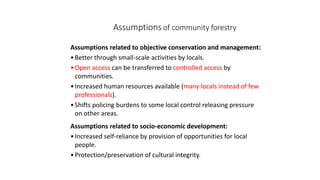
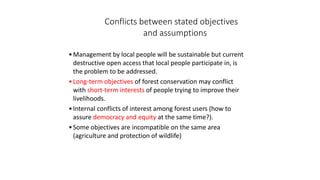
Key informants such as village elders and teachers are valuable sources of information who can provide insights into local forest issues and needs in a short period of time. This information can be used to develop tools to further investigate using RRA and PRA tools. Interest groups are determined by differences in age, gender, ethnicity, wealth, or occupation, such as women collecting forest products or poorer farmers. Assumptions of community forestry include that small-scale local management is better than large-scale, open access can transition to controlled community access, and more human resources are available through local involvement instead of only professionals.


![[Challenge:Future] Need some green intervention??? what about community fores...](https://cdn.slidesharecdn.com/ss_thumbnails/challengefuture-need-some-green-intervention-what-about-community-forestry1025-130227121355-phpapp02-thumbnail.jpg?width=640&height=640&fit=bounds)


![ONFH[AVN HIP] -TRIPLE REGIME -A NOVAL SURGICAL CONCEPT .pptx](https://cdn.slidesharecdn.com/ss_thumbnails/onfhavnhip2026koaconcalicutdrgokuldevdrmashraf-260210064517-213ec005-thumbnail.jpg?width=640&height=640&fit=bounds)


