This document provides an overview of string manipulation in C programming, including definitions, declarations, and predefined string functions such as strlen, strcpy, and strcmp. It contains example programs demonstrating string length calculation, reversal, copying, and palindrome checking, as well as handling command-line arguments. It also covers methods for converting string case and deleting characters from a string.
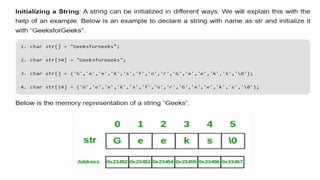
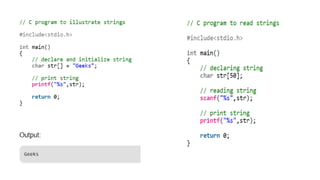
![• Strings are defined as an array of characters.
• The difference between a character array and a string is the string is
terminated with a special character ‘0’.
Declaration of strings:
• Declaring a string is as simple as declaring a one dimensional array.
• char str_name[size];
•](https://image.slidesharecdn.com/unit4c-strings-241116191322-d6389661/85/UNIT-4C-Strings-pptx-for-c-language-and-basic-knowledge-2-320.jpg)
![/* C program to find the length of a string without using the built-in function */
void main()
{
char string[50];
int i, length = 0;
printf("Enter a string n");
gets(string);
for (i = 0; string[i] != '0'; i++) /* keep going through each character of the string till its end */
{
length++;
}
printf("The length of a string is the number of characters in it n");
printf("So, the length of %s = %dn", string, length);
}](https://image.slidesharecdn.com/unit4c-strings-241116191322-d6389661/85/UNIT-4C-Strings-pptx-for-c-language-and-basic-knowledge-19-320.jpg)
![Program : Reverse String Without Using Library Function [ Strrev ]
#include<stdio.h>
#include<string.h>
int main() {
char str[100], temp;
int i, j = 0;
printf("nEnter the string :");
gets(str);
i = 0;
j = strlen(str) - 1;
while (i < j)
{
temp = str[i];
str[i] = str[j];
str[j] = temp;
i++;
j--;
}
printf("nReverse string is :%s", str);
return (0); }](https://image.slidesharecdn.com/unit4c-strings-241116191322-d6389661/85/UNIT-4C-Strings-pptx-for-c-language-and-basic-knowledge-20-320.jpg)
![Program : Copy One String into Other Without Using Library Function.
#include<stdio.h>
int main() {
char s1[100], s2[100];
int i;
printf("nEnter the string :");
gets(s1);
i = 0;
while (s1[i] != '0’)
{ s2[i] = s1[i];
i++;
}
s2[i] = '0';
printf("nCopied String is %s ", s2);
return (0);
}](https://image.slidesharecdn.com/unit4c-strings-241116191322-d6389661/85/UNIT-4C-Strings-pptx-for-c-language-and-basic-knowledge-23-320.jpg)
![//lower to upper case without using string function
int main()
{ char str[10];
int i=0;
printf("enter string");
scanf("%s",str);
while(str[i]!='0')
{
str[i]=str[i]-32; // change in case of upper to lower
i++;
}
printf("upper string is %s",str);
getch();
return 0;
}](https://image.slidesharecdn.com/unit4c-strings-241116191322-d6389661/85/UNIT-4C-Strings-pptx-for-c-language-and-basic-knowledge-24-320.jpg)
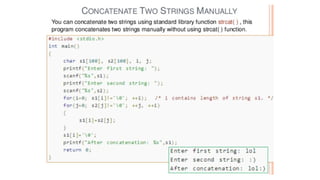
![//program to concatenate two strings
#include<stdio.h>
#include<string.h>
void concat(char[], char[]);
int main()
{
char s1[50], s2[30];
printf("nEnter String 1 :");
gets(s1);
printf("nEnter String 2 :");
gets(s2);
concat(s1, s2);
printf("nConcated string is :%s", s1);
return (0);
}
void concat(char s1[], char s2[])
{
int i, j;
i = strlen(s1);
for (j = 0; s2[j] != '0'; i++, j++) {
s1[i] = s2[j];
}
s1[i] = '0';
}](https://image.slidesharecdn.com/unit4c-strings-241116191322-d6389661/85/UNIT-4C-Strings-pptx-for-c-language-and-basic-knowledge-25-320.jpg)
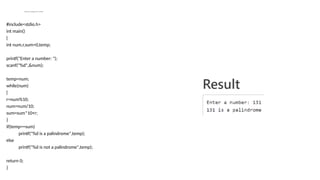
![//program to find string is palindrome or not using string function
What is Palindrome Number ?
• a word, phrase, or sequence that
reads the same backwards as
forwards
• Some palindrome strings
examples are "dad", "radar",
"madam" etc.
How check given string is
palindrome number or not ?
•
This program works as follows :-
at first we copy the entered string
into a new string, and then we
reverse the new string and then
compares it with original string. If
both of them have same
sequence of characters i.e. they
are identical then the entered
string is a palindrome otherwise
not.
#include <stdio.h>
#include <conio.h>
void main() {
char *a;
int i,len,flag=0;
clrscr();
printf("nENTER A STRING: ");
gets(a);
len=strlen(a);
for (i=0;i<len;i++) {
if(a[i]==a[len-i-1])
flag=flag+1;
}
if(flag==len)
printf("nTHE STRING IS PALINDROM"); else
printf("nTHE STRING IS NOT PALINDROM");
getch();
}](https://image.slidesharecdn.com/unit4c-strings-241116191322-d6389661/85/UNIT-4C-Strings-pptx-for-c-language-and-basic-knowledge-27-320.jpg)
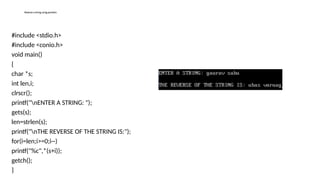
![//program to find string is palindrome or not without using string function
What is Palindrome Number ?
• a word, phrase, or sequence that
reads the same backwards as
forwards
• Some palindrome strings
examples are "dad", "radar",
"madam" etc.
How check given string is
palindrome number or not ?
•
This program works as follows :-
at first we copy the entered string
into a new string, and then we
reverse the new string and then
compares it with original string. If
both of them have same
sequence of characters i.e. they
are identical then the entered
string is a palindrome otherwise
not.
#include <stdio.h>
#include <string.h>
int main() {
char text[100];
int begin, middle, end, length = 0;
gets(text);
while ( text[length] != '0' )
length++;
end = length - 1;
middle = length/2;
for ( begin = 0 ; begin < middle ; begin++ ) {
if ( text[begin] != text[end] ) {
printf("Not a palindrome.n");
break;
}
end--;
}
if( begin == middle )
printf("Palindrome.n");
return 0;
}](https://image.slidesharecdn.com/unit4c-strings-241116191322-d6389661/85/UNIT-4C-Strings-pptx-for-c-language-and-basic-knowledge-28-320.jpg)
![//To Delete all occurrences of Character from the String
Method Used
1.we have accepted one
string from the user and
character to be deleted
from the user.
2. Now we have passed
these two parameters to
function which will delete
all occurrences of given
character from the string.
3. Whole String will be
displayed as output
except given Character.
#include<string.h>
void del(char str[], char ch);
void main()
{ char str[10];
char ch;
printf("nEnter the string : ");
gets(str);
printf("nEnter character which you want to delete : ");
scanf("%ch", &ch);
del(str, ch);
getch();
}
void del(char str[], char ch)
{ int i, j = 0;
int size;
char ch1;
char str1[10];
size = strlen(str);
for (i = 0; i < size; i++)
{ if (str[i] != ch)
{ ch1 = str[i];
str1[j] = ch1;
j++;
}
}
str1[j] = '0';
printf("ncorrected string is : %s", str1);
}](https://image.slidesharecdn.com/unit4c-strings-241116191322-d6389661/85/UNIT-4C-Strings-pptx-for-c-language-and-basic-knowledge-30-320.jpg)
![• The arguments passed from command line are called command line arguments. These arguments
are handled by main() function.
• To support command line argument, you need to change the structure of main() function as given
below.
int main(int argc, char *argv[] )
Here, argc is an integer value that specifies number of command line arguments passed into the
program, including the name of the program.
The argv[] contains the total number of arguments. The first argument is the file name always.
The array of character pointers, argv contains the list of all the arguments. argv[0] is the name of
the program or an empty string if the name is not available.
Argv[1] to argv[argc-1] specifies the command line argument.](https://image.slidesharecdn.com/unit4c-strings-241116191322-d6389661/85/UNIT-4C-Strings-pptx-for-c-language-and-basic-knowledge-33-320.jpg)
![#include <stdio.h>
void main(int argc, char *argv[] )
{
printf("Program name is: %sn", argv[0]);
if(argc < 2)
{
printf("No argument passed through command line.n");
}
else
{
printf("First argument is: %sn", argv[1]);
}
}](https://image.slidesharecdn.com/unit4c-strings-241116191322-d6389661/85/UNIT-4C-Strings-pptx-for-c-language-and-basic-knowledge-34-320.jpg)


![[ITP - Lecture 17] Strings in C/C++](https://cdn.slidesharecdn.com/ss_thumbnails/lecture-2627strings-171215173858-thumbnail.jpg?width=640&height=640&fit=bounds)


