an array is a collection of data items, all having the
same data type and accessed using a common
name and integer index into the collection.
.
A struct is also a collection of data items,
except with a struct the data items can
have different data types, and the
individual fields within the struct are
accessed by name instead of an integer
index. Structs are very powerful for
bundling together data items that
collectively describe a thing, or are in
some other way related to each other
A structure allows you to wrap one or more
variables that may be in different data
It can contain any valid data type like int
,char, float, array, pointer or even
structures. Each variable in the structure is
called a structure member.
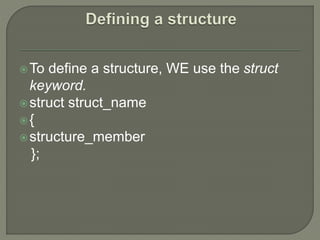
To define a structure, WE use the struct
keyword.
struct struct_name
{
structure_member
};
 struct person
 {
 char first[32]; //first field an array of chars
 char last[32]; //second field an array of chars
 int age; //third field an int
 };
 Note that the above code is only defining a
person structure. There are two ways
 to declare a structure variable:
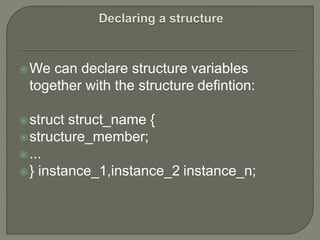
We can declare structure variables
together with the structure defintion:
struct struct_name {
structure_member;
...
} instance_1,instance_2 instance_n;
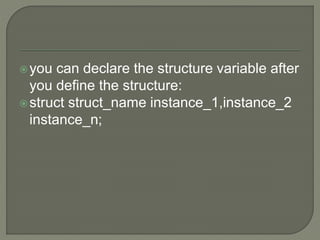
you can declare the structure variable after
you define the structure:
struct struct_name instance_1,instance_2
instance_n;
For more concise code, you can use the
typedef
structure.
when you want to create a strucuture
variable, you can omit the
keyword struct.
 typedef struct
 {
 char first[32]; //first field an array of chars
 char last[32]; //second field an array of chars
 int age; //third field an int
 }
 person;
 person student;
 person teacher;
 A structure allows you to wrap one or more
variables that may be in different data
 It can contain any valid data type like int ,char,
float, array, pointer or
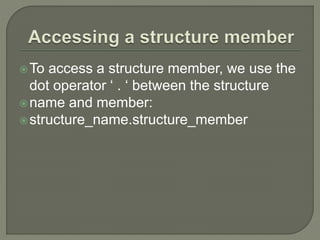
To access a structure member, we use the
dot operator ‘ . ‘ between the structure
name and member:
structure_name.structure_member
 person:
 person student;
 student.first = "Richard";
 We can also use the dot operator to access a nested structure
and its members:
 typedef struct
 {
 person teacher[0];
 person students[50];
 }
 course;
 course COMP2401;
 COMP2401.students[0].first = "Richard";
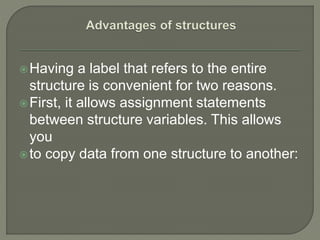
Having a label that refers to the entire
structure is convenient for two reasons.
First, it allows assignment statements
between structure variables. This allows
you
to copy data from one structure to another:
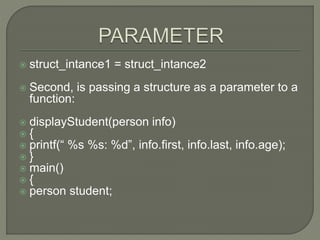
 struct_intance1 = struct_intance2
 Second, is passing a structure as a parameter to a
function:
 displayStudent(person info)
 {
 printf(“ %s %s: %d”, info.first, info.last, info.age);
 }
 main()
 {
 person student;
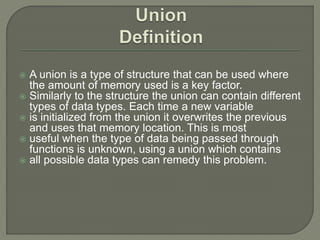
 A union is a type of structure that can be used where
the amount of memory used is a key factor.
 Similarly to the structure the union can contain different
types of data types. Each time a new variable
 is initialized from the union it overwrites the previous
and uses that memory location. This is most
 useful when the type of data being passed through
functions is unknown, using a union which contains
 all possible data types can remedy this problem.
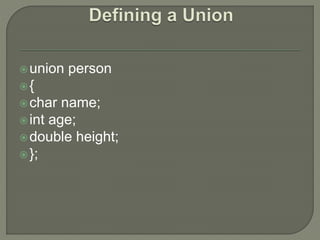
union person
{
char name;
int age;
double height;
};
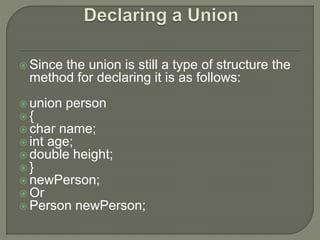
 Since the union is still a type of structure the
method for declaring it is as follows:
 union person
 {
 char name;
 int age;
 double height;
 }
 newPerson;
 Or
 Person newPerson;
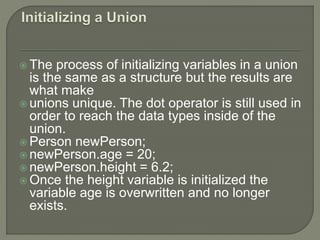
 The process of initializing variables in a union
is the same as a structure but the results are
what make
 unions unique. The dot operator is still used in
order to reach the data types inside of the
union.
 Person newPerson;
 newPerson.age = 20;
 newPerson.height = 6.2;
 Once the height variable is initialized the
variable age is overwritten and no longer
exists.
 Defining an Enumeration:
 An enumeration provides the data type with a set
of values. An enumeration constant is a type
 of an integer. A variable type takes and stores the
values of the enumeration set defined by that type.
 Enumerations can be used with indexing
expressions also as operands with arithmetic and
relational operators.
 Enumerations can be also be used as an alternate
way to use “#define”.

Unit 1_ADC.pptx

  • 1.
    an array isa collection of data items, all having the same data type and accessed using a common name and integer index into the collection. .
  • 2.
    A struct isalso a collection of data items, except with a struct the data items can have different data types, and the individual fields within the struct are accessed by name instead of an integer index. Structs are very powerful for bundling together data items that collectively describe a thing, or are in some other way related to each other
  • 3.
    A structure allowsyou to wrap one or more variables that may be in different data It can contain any valid data type like int ,char, float, array, pointer or even structures. Each variable in the structure is called a structure member.
  • 4.
    To define astructure, WE use the struct keyword. struct struct_name { structure_member };
  • 5.
     struct person {  char first[32]; //first field an array of chars  char last[32]; //second field an array of chars  int age; //third field an int  };  Note that the above code is only defining a person structure. There are two ways  to declare a structure variable:
  • 6.
    We can declarestructure variables together with the structure defintion: struct struct_name { structure_member; ... } instance_1,instance_2 instance_n;
  • 7.
    you can declarethe structure variable after you define the structure: struct struct_name instance_1,instance_2 instance_n;
  • 8.
    For more concisecode, you can use the typedef structure. when you want to create a strucuture variable, you can omit the keyword struct.
  • 9.
     typedef struct {  char first[32]; //first field an array of chars  char last[32]; //second field an array of chars  int age; //third field an int  }  person;  person student;  person teacher;  A structure allows you to wrap one or more variables that may be in different data  It can contain any valid data type like int ,char, float, array, pointer or
  • 10.
    To access astructure member, we use the dot operator ‘ . ‘ between the structure name and member: structure_name.structure_member
  • 11.
     person:  personstudent;  student.first = "Richard";  We can also use the dot operator to access a nested structure and its members:  typedef struct  {  person teacher[0];  person students[50];  }  course;  course COMP2401;  COMP2401.students[0].first = "Richard";
  • 12.
    Having a labelthat refers to the entire structure is convenient for two reasons. First, it allows assignment statements between structure variables. This allows you to copy data from one structure to another:
  • 13.
     struct_intance1 =struct_intance2  Second, is passing a structure as a parameter to a function:  displayStudent(person info)  {  printf(“ %s %s: %d”, info.first, info.last, info.age);  }  main()  {  person student;
  • 14.
     A unionis a type of structure that can be used where the amount of memory used is a key factor.  Similarly to the structure the union can contain different types of data types. Each time a new variable  is initialized from the union it overwrites the previous and uses that memory location. This is most  useful when the type of data being passed through functions is unknown, using a union which contains  all possible data types can remedy this problem.
  • 15.
    union person { char name; intage; double height; };
  • 16.
     Since theunion is still a type of structure the method for declaring it is as follows:  union person  {  char name;  int age;  double height;  }  newPerson;  Or  Person newPerson;
  • 17.
     The processof initializing variables in a union is the same as a structure but the results are what make  unions unique. The dot operator is still used in order to reach the data types inside of the union.  Person newPerson;  newPerson.age = 20;  newPerson.height = 6.2;  Once the height variable is initialized the variable age is overwritten and no longer exists.
  • 18.
     Defining anEnumeration:  An enumeration provides the data type with a set of values. An enumeration constant is a type  of an integer. A variable type takes and stores the values of the enumeration set defined by that type.  Enumerations can be used with indexing expressions also as operands with arithmetic and relational operators.  Enumerations can be also be used as an alternate way to use “#define”.