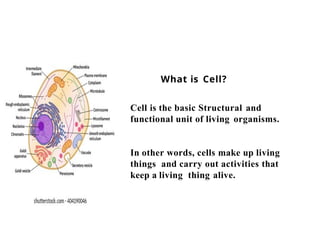
What is Cell?
Cellis the basic Structural and
functional unit of living organisms.
In other words, cells make up living
things and carry out activities that
keep a living thing alive.
3.
Cell
Theory
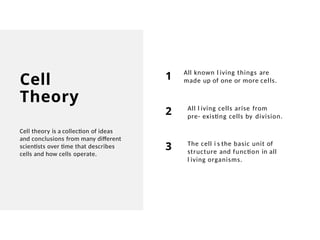
Cell theory isa collection of ideas
and conclusions from many different
scientists over time that describes
cells and how cells operate.
1
2
3
All known l iving things are
made up of one or more cells.
All l iving cells arise from
pre- existing cells by division.
The cell i s the basic unit of
structure and function in all
l iving organisms.
4.
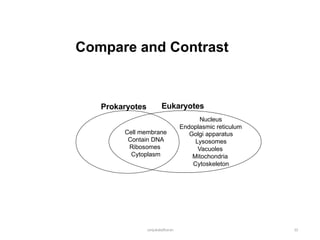
Cells have evolvedtwo different
architectures:
• Prokaryote “style”
• Eukaryote “style”
5.
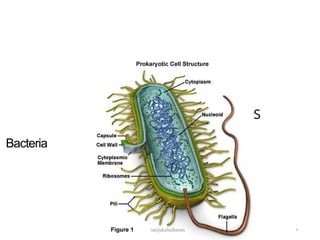
Prokaryotic cells werehere first and for billions of
years were the only form of life on Earth. All
prokaryotic organisms are unicellular
Eukaryotic cells appeared on earth long after
prokaryotic cells.
6.
Characteristics of Prokaryotes
•Prokaryotes are the simplest type of cell.
• Oldest type of cell appeared about four billion years
ago.
• Prokaryotes are the largest group of organisms
• Prokaryotes unicellular organisms that are found in
all environments.
7.
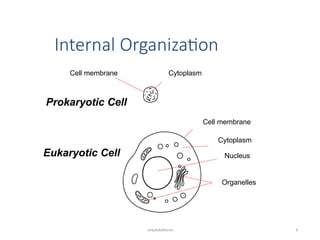
• Prokaryotes donot have a nuclear membrane.
Their circular shaped genetic material dispersed
throughout cytoplasm.
• Prokaryotes do not have membrane-bound
organelles.
• Prokaryotes have a simple internal
structure.
• Prokaryotes are smaller in size when compared to
Eukaryotes.
sanjukaladharan 18
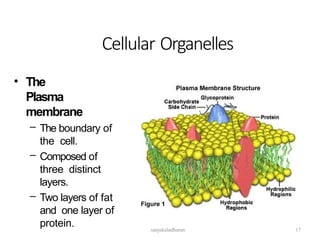
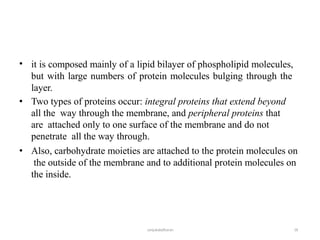
• itis composed mainly of a lipid bilayer of phospholipid molecules,
but with large numbers of protein molecules bulging through the
layer.
Two types of proteins occur: integral proteins that extend beyond
all the way through the membrane, and peripheral proteins that
are attached only to one surface of the membrane and do not
penetrate all the way through.
Also, carbohydrate moieties are attached to the protein molecules on
the outside of the membrane and to additional protein molecules on
the inside.
•
•
19.
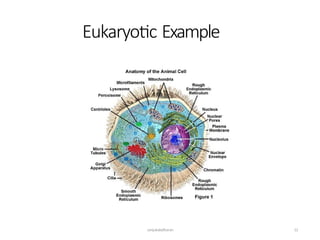
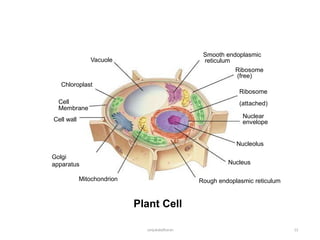
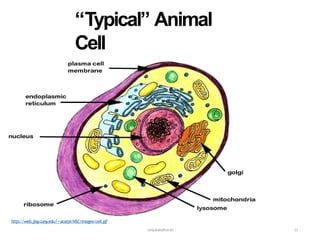
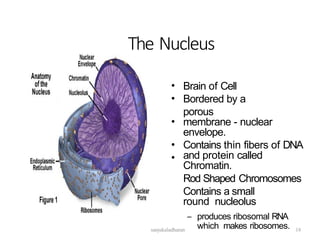
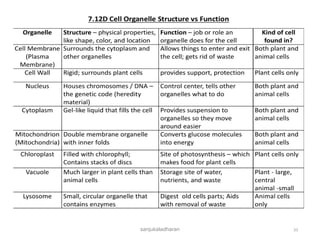
The Nucleus
•
•
Brain ofCell
Bordered by a
porous
membrane - nuclear
envelope.
Contains thin fibers of DNA
and protein called
Chromatin.
Rod Shaped Chromosomes
Contains a small
round nucleolus
– produces ribosomal RNA
which makes ribosomes.
•
•
•
18
sanjukaladharan
20.
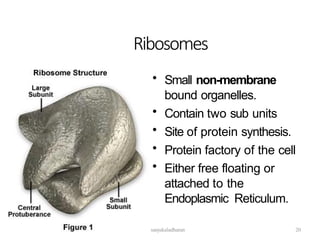
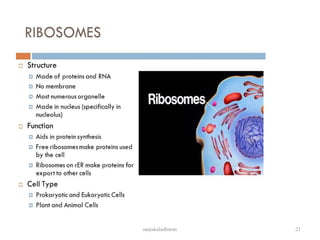
Ribosomes
• Small non-membrane
boundorganelles.
• Contain two sub units
• Site of protein synthesis.
• Protein factory of the cell
• Either free floating or
attached to the
Endoplasmic Reticulum.
20
sanjukaladharan
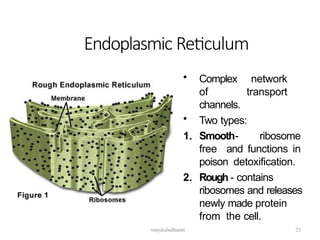
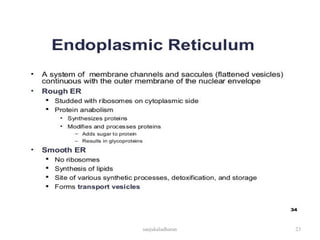
Endoplasmic Reticulum
• Complexnetwork
of transport
channels.
• Two types:
1. Smooth- ribosome
free and functions in
poison detoxification.
2. Rough - contains
ribosomes and releases
newly made protein
from the cell.
22
sanjukaladharan
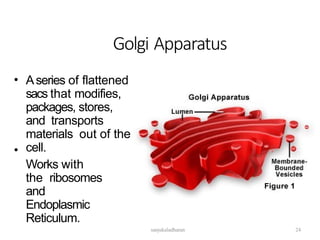
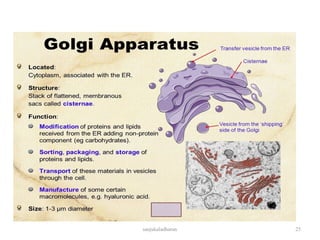
Golgi Apparatus
• Aseriesof flattened
sacs that modifies,
packages, stores,
and transports
materials out of the
cell.
Works with
the ribosomes
and
Endoplasmic
Reticulum.
•
24
sanjukaladharan
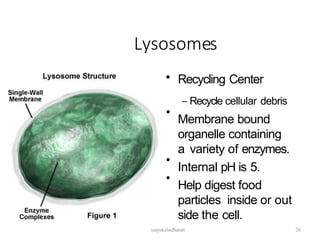
Lysosomes
•
•
•
• Recycling Center
–Recycle cellular debris
Membrane bound
organelle containing
a variety of enzymes.
Internal pH is 5.
Help digest food
particles inside or out
side the cell.
sanjukaladharan 26
27.
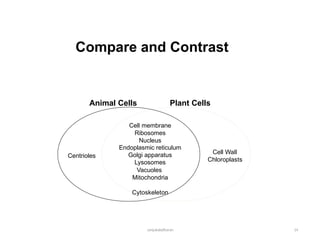
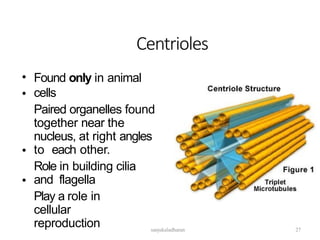
Centrioles
•
•
Found only inanimal
cells
Paired organelles found
together near the
nucleus, at right angles
to each other.
Role in building cilia
and flagella
Play a role in
cellular
reproduction
•
•
sanjukaladharan 27
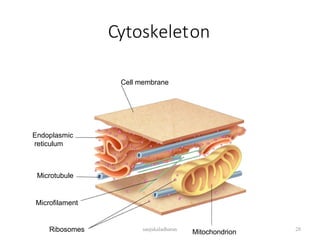
Cytoskeleton
•
•
•
Framework of thecell
Contains small microfilaments and larger microtubules.
They support the cell, giving its shape and help with
the movement of its organelles.
The fibrillar proteins of the cell are usually organized
into filaments or tubules.
These originate as precursor protein molecules
synthesized by ribosomes in the cytoplasm.
The precursor molecules then polymerize to form
filaments.
Eg microtubules
•
•
•
•
29
sanjukaladharan
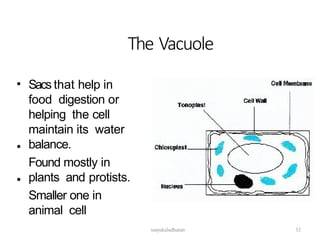
The Vacuole
• Sacsthat help in
food digestion or
helping the cell
maintain its water
balance.
Found mostly in
plants and protists.
Smaller one in
animal cell
•
•
32
sanjukaladharan
sanjukaladharan
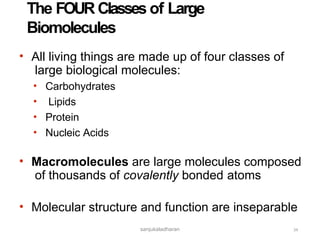
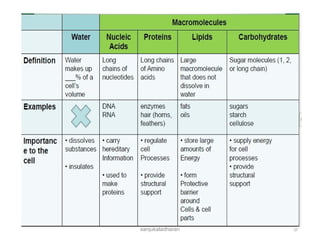
The FOUR Classesof Large
Biomolecules
34
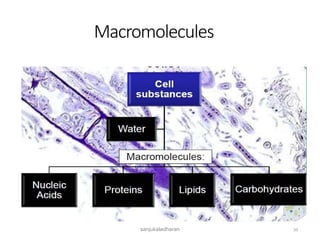
• All living things are made up of four classes of
large biological molecules:
•
•
•
•
Carbohydrates
Lipids
Protein
Nucleic Acids
• Macromolecules are large molecules composed
of thousands of covalently bonded atoms
• Molecular structure and function are inseparable