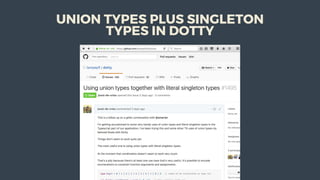
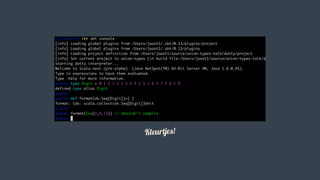
The document discusses union types and literal singleton types in Scala and Dotty. It begins by explaining what union and intersection types are, and how they can be modeled in Scala using implicit evidence. It then shows how to define union types in 3 lines of code in Scala. The document also discusses how union types are currently implemented in Dotty, including some bugs when combining union types with literal singleton types. It concludes by noting that Dotty is still pre-beta.


![LITERAL SINGLETON
TYPES
But what we'd like to express is literals in types. For
instance in Spire
forAll { x: Ranged[Int, 1, 100] =>
val n: Int = x.value // guaranteed to be 1 to 100
}](https://image.slidesharecdn.com/union-types-and-literal-singleton-types-in-scala-160909063612/85/Union-Types-and-Literal-Singleton-Types-in-Scala-and-Typescript-5-320.jpg)
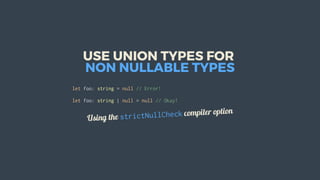
![UNION TYPES ARE
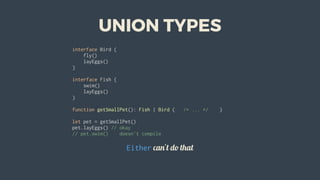
USEFUL
It's Either[A,B]
for any nr of types
without boxing
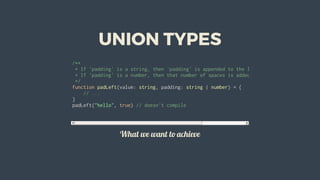
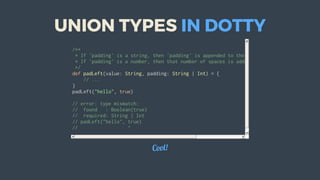
/**
* If 'padding' is a string, then 'padding' is appended to the left side.
* If 'padding' is a number, then that number of spaces is added to the left side.
*/
function padLeft(value: string, padding: string | number) = {
// ...
}
padLeft("hello", true) // doesn't compile](https://image.slidesharecdn.com/union-types-and-literal-singleton-types-in-scala-160909063612/85/Union-Types-and-Literal-Singleton-Types-in-Scala-and-Typescript-11-320.jpg)
![UNION OF LITERAL TYPES
What an awesome way
to express enumerations!
type Digit = 0 | 1 | 2 | 3 | 4 | 5 | 6 | 7 | 8 | 9;
let nums: Digit[] = [1, 2, 4, 8];
nums.push(16) // Doesn't compile](https://image.slidesharecdn.com/union-types-and-literal-singleton-types-in-scala-160909063612/85/Union-Types-and-Literal-Singleton-Types-in-Scala-and-Typescript-14-320.jpg)
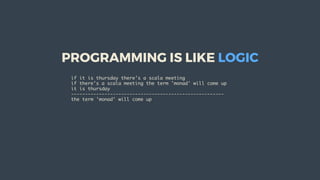
![CREATING OR
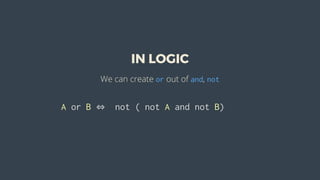
FROM AND, NOT
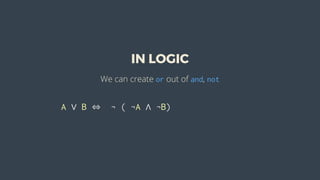
(A ∨ B) ⇔ ¬(¬A ∧ ¬B)
becomes
(A ∨ B) =:= ¬[¬[A] with ¬[B]]
So where do we get not?](https://image.slidesharecdn.com/union-types-and-literal-singleton-types-in-scala-160909063612/85/Union-Types-and-Literal-Singleton-Types-in-Scala-and-Typescript-24-320.jpg)
![UNION TYPES
IN 3 LINES OF CODE
Is Miles Sabin cool or what?
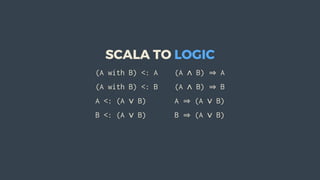
An instance of A <:< B witnesses that A is a subtype of B
type ¬[A] = A => Nothing
type ∨[T, U] = ¬[¬[T] with ¬[U]]
type ¬¬[A] = ¬[¬[A]]
implicitly[¬¬[Int] <:< (Int ∨ String)]
// res0: <:<[¬¬[Int],∨[Int,String]] = <function1>
implicitly[¬¬[Double] <:< (Int ∨ String)]
// error: Cannot prove that ¬¬[Double] <:< ∨[Int,String].](https://image.slidesharecdn.com/union-types-and-literal-singleton-types-in-scala-160909063612/85/Union-Types-and-Literal-Singleton-Types-in-Scala-and-Typescript-25-320.jpg)

(implicit ev: ¬¬[T] <:< (Int ∨ String)) = "some string"
padLeft("hello", 3) //compiles
// padLeft("hello", true) doesn't compile:
// error: Cannot prove that Test5.¬[Test5.¬[Boolean']] <:< Test5.∨[Int, String].
// padLeft("hello", true)](https://image.slidesharecdn.com/union-types-and-literal-singleton-types-in-scala-160909063612/85/Union-Types-and-Literal-Singleton-Types-in-Scala-and-Typescript-26-320.jpg)
![UNION TYPES
IN 3 LINES OF CODE
Put the evidence in a path dependent type λ
specific to our types T and U
type |∨|[T, U] = { type λ[X] = ¬¬[X] <:< (T ∨ U) }
def padLeft2[T](value:String, padding:T)
(implicit ev: (Int |∨| String)#λ[T]) = "some string"](https://image.slidesharecdn.com/union-types-and-literal-singleton-types-in-scala-160909063612/85/Union-Types-and-Literal-Singleton-Types-in-Scala-and-Typescript-27-320.jpg)
![UNION TYPES PLUS SINGLETON
TYPES IN DOTTY
object Monday
object Tuesday
// ...
type Weekday = Monday.type | Tuesday.type | Wednesday.type | Thursday.type | Friday.type
type Weekend = Saturday.type | Sunday.type
type AnyDay = Weekday | Weekend
println("Monday is weekday: " + Monday.isInstanceOf[Weekday])
println("Saturday is weekend: " + Saturday.isInstanceOf[Weekend])
println("Sunday is weekday: " + Sunday.isInstanceOf[Weekday])
(Monday: AnyDay) match {
case _: Weekend => println("shouldn't match")
}
Works again since 7 days ago](https://image.slidesharecdn.com/union-types-and-literal-singleton-types-in-scala-160909063612/85/Union-Types-and-Literal-Singleton-Types-in-Scala-and-Typescript-34-320.jpg)
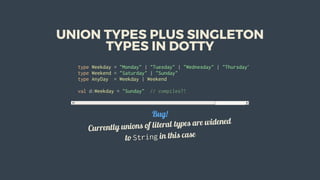
![UNION TYPES PLUS SINGLETON
TYPES IN DOTTY
Same problem
type Digit = 0 | 1 | 2 | 3 | 4 | 5 | 6 | 7 | 8 | 9
def format(ds:Seq[Digit])={ }
format(Seq(4,9,13)) // shouldn't compile](https://image.slidesharecdn.com/union-types-and-literal-singleton-types-in-scala-160909063612/85/Union-Types-and-Literal-Singleton-Types-in-Scala-and-Typescript-36-320.jpg)