THE U N I VE R S I T Y 
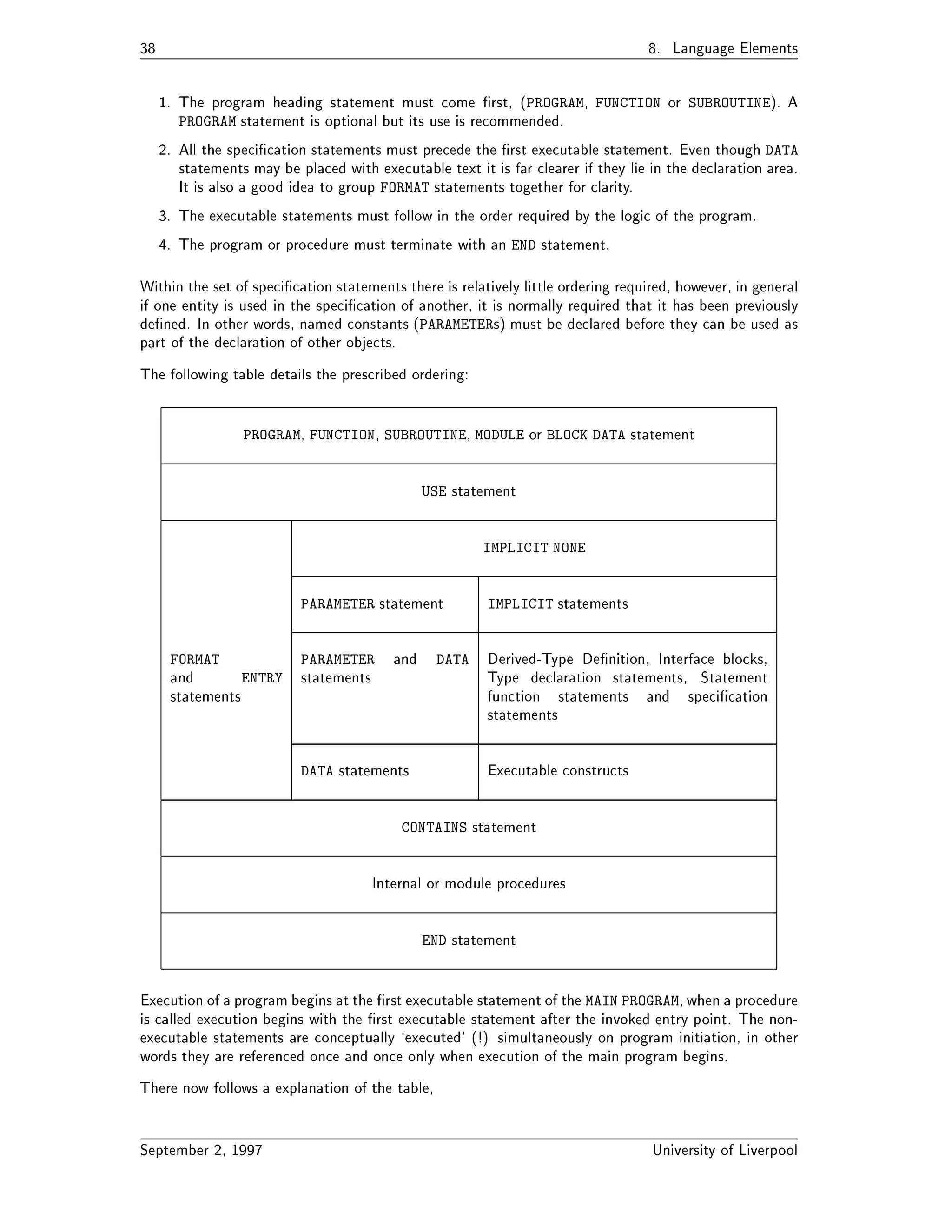
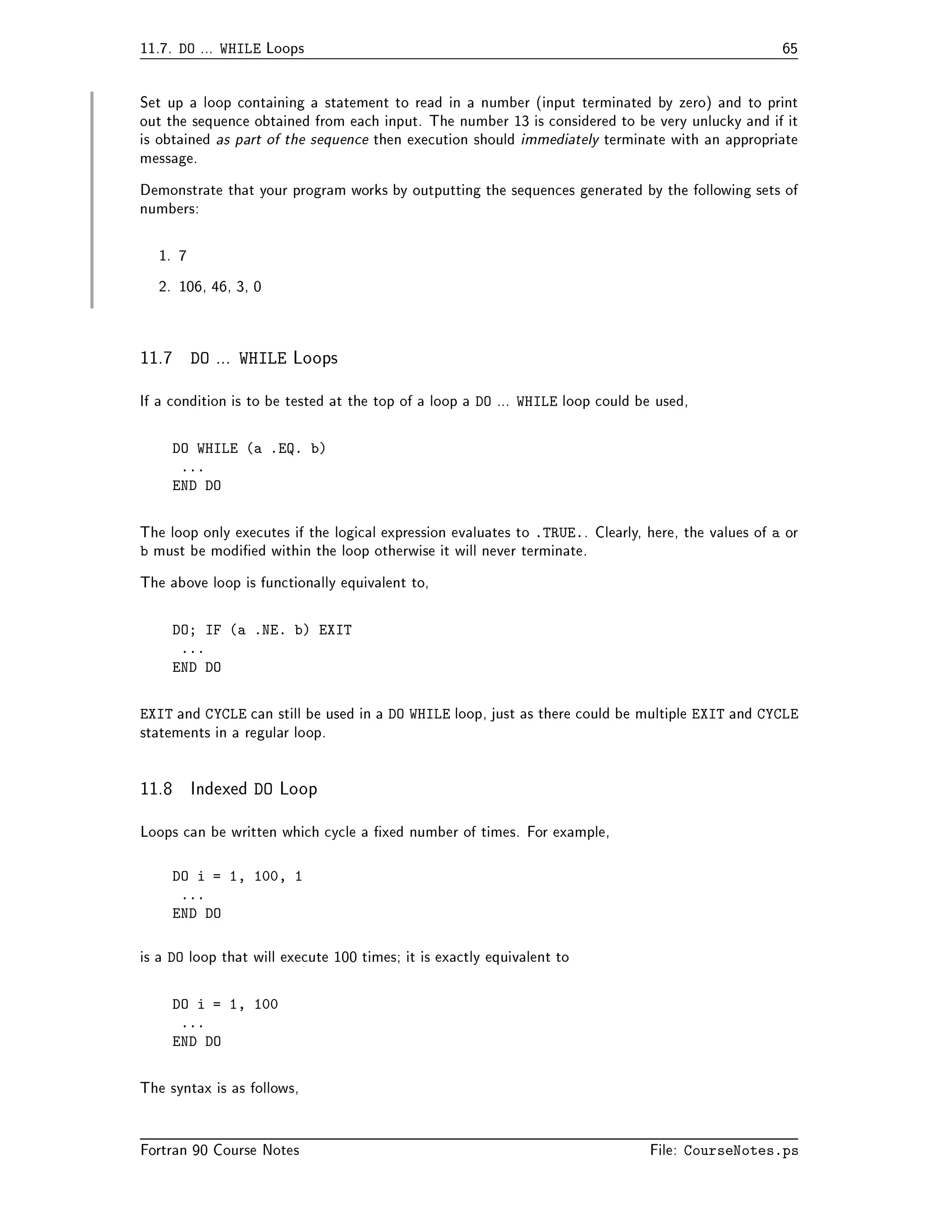
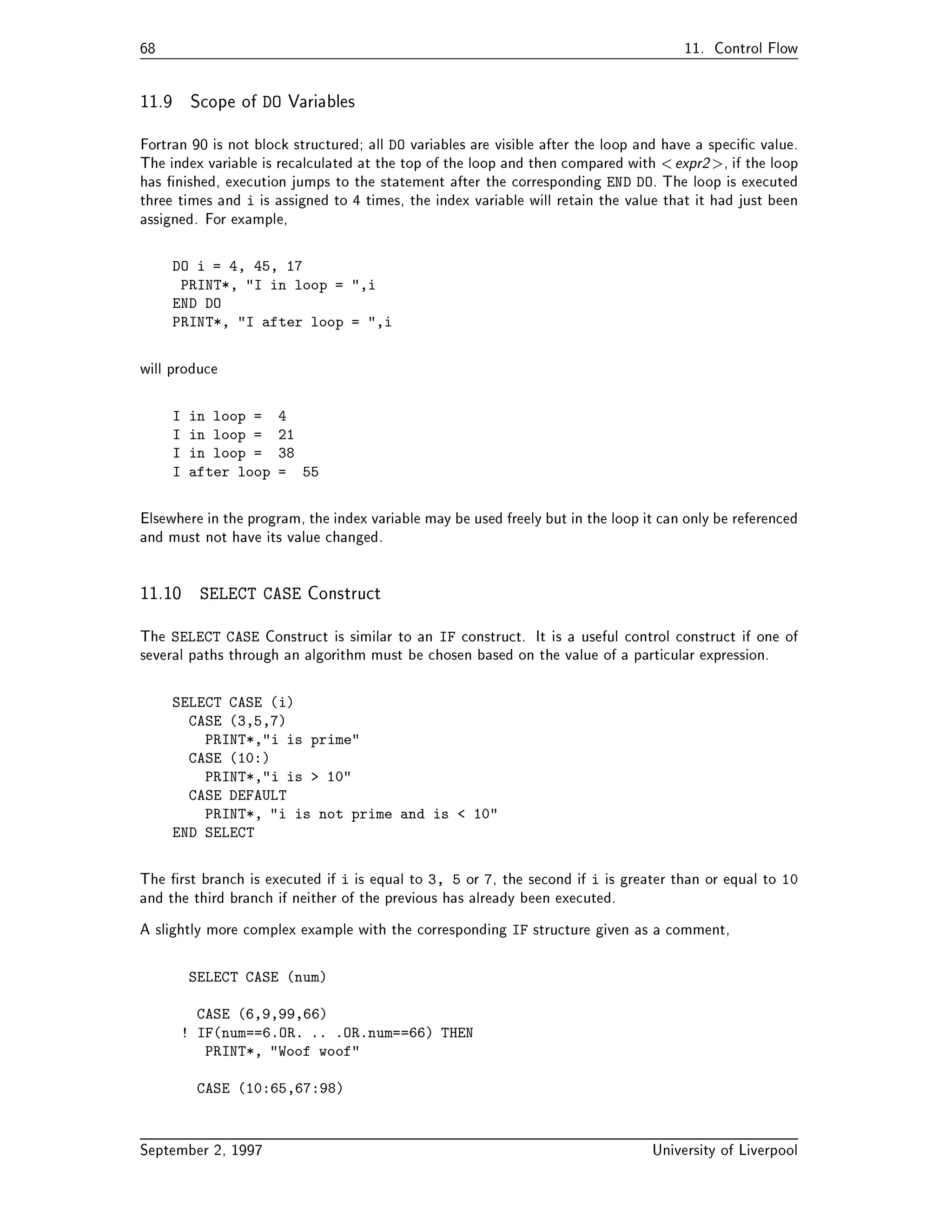
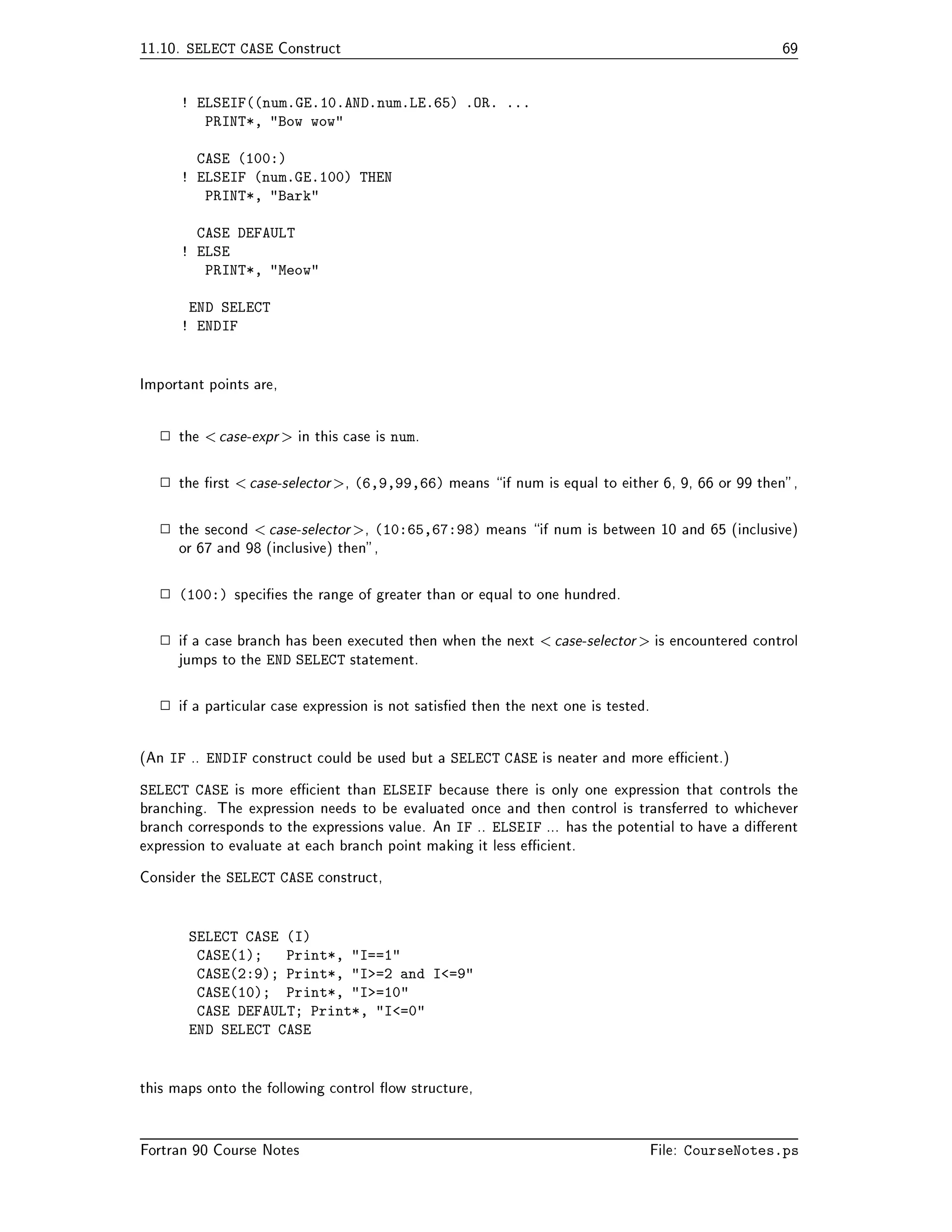
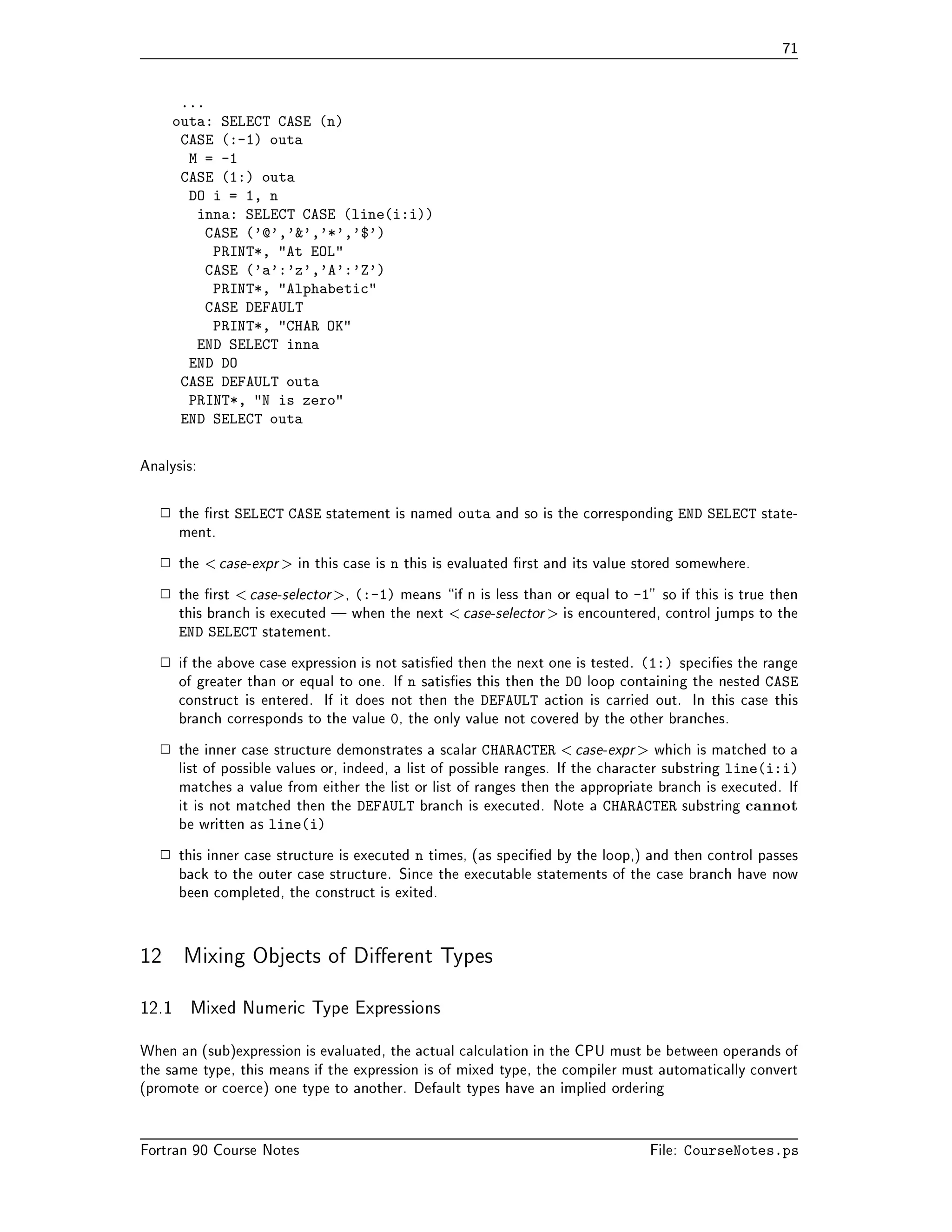
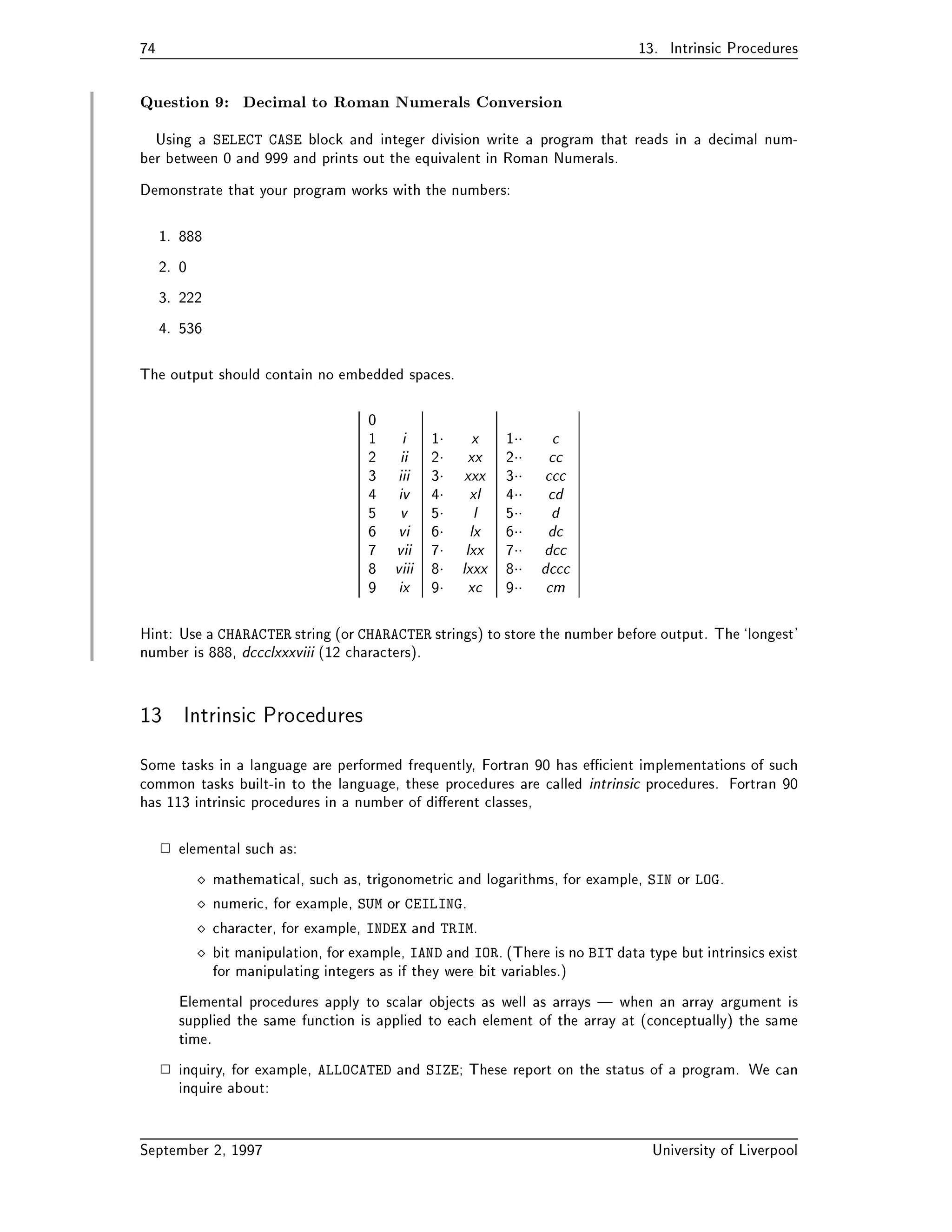
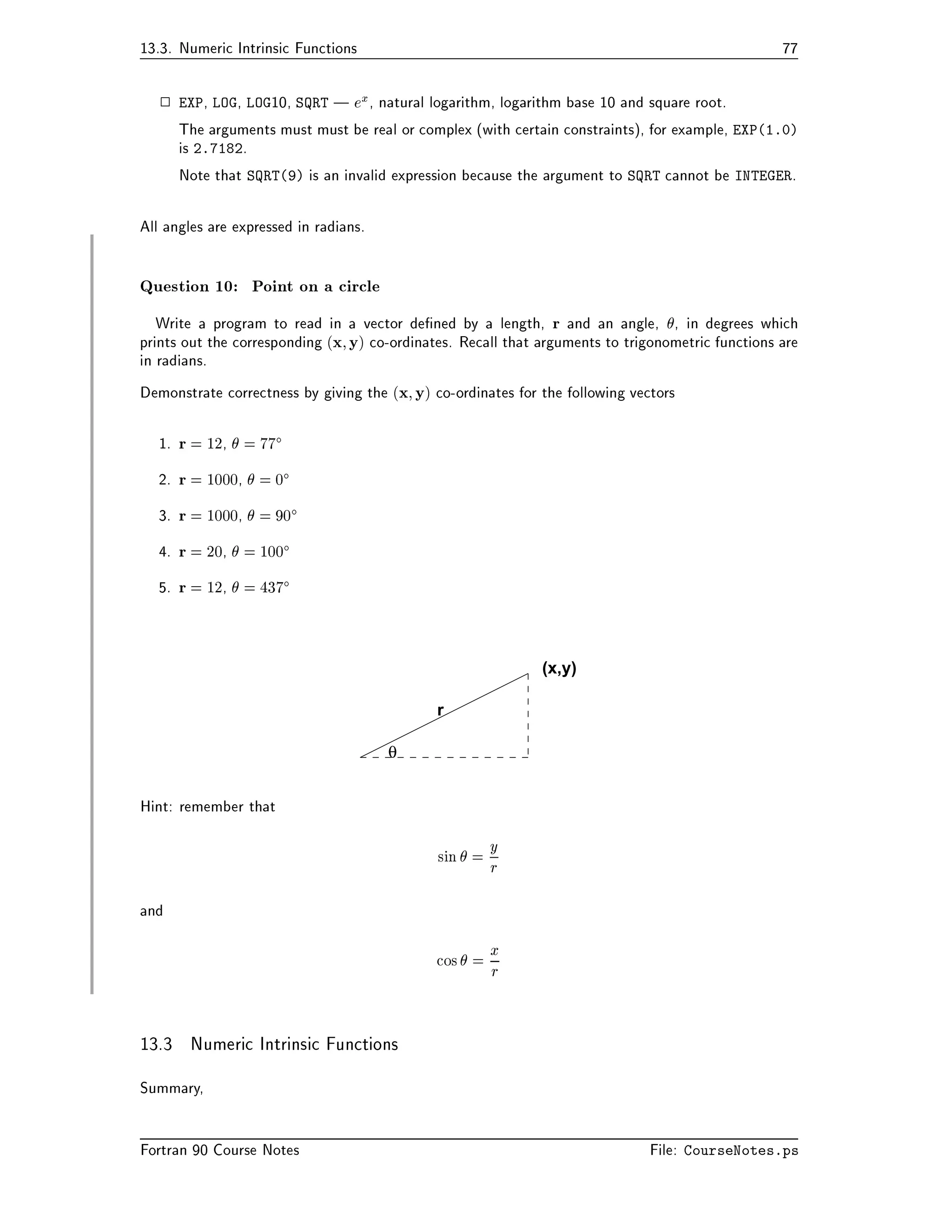
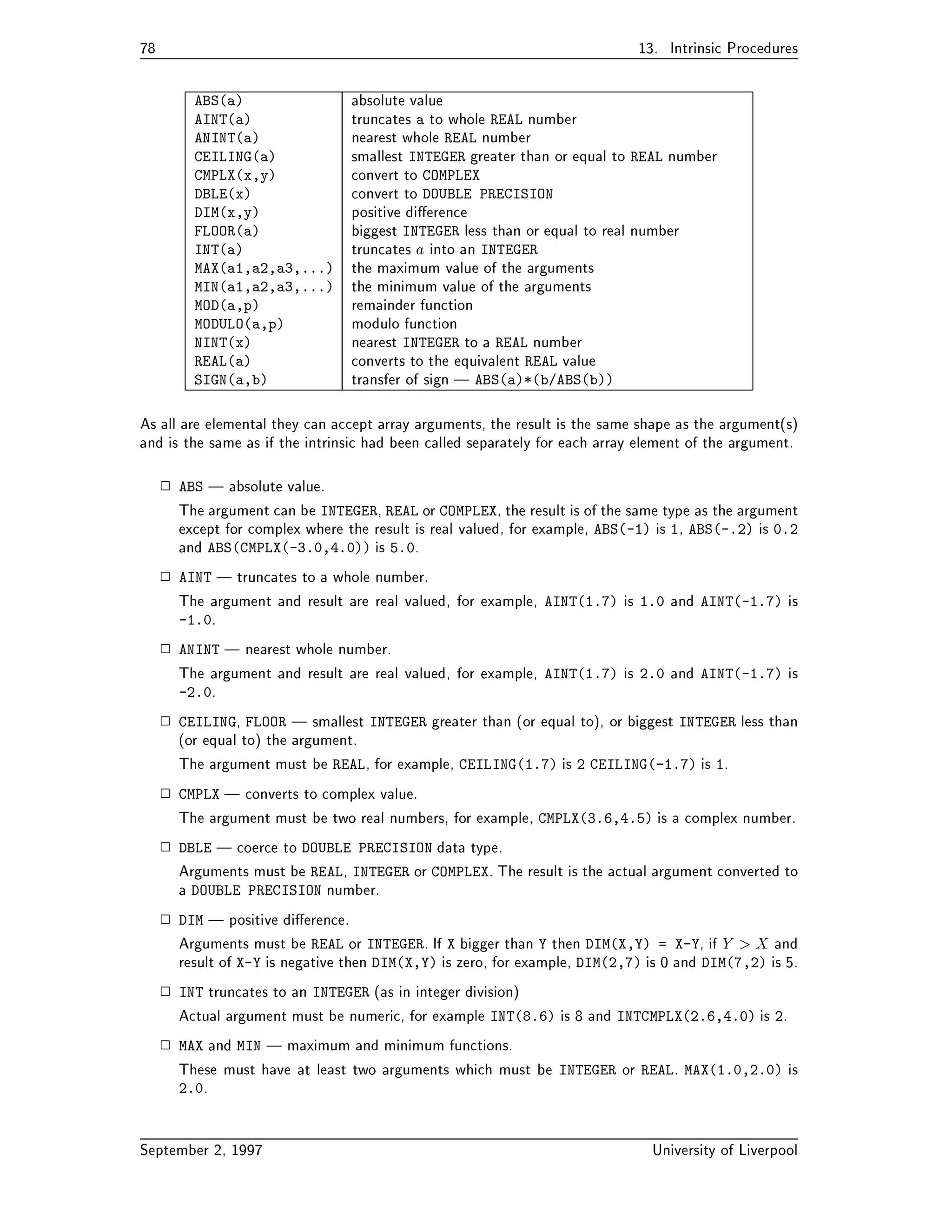
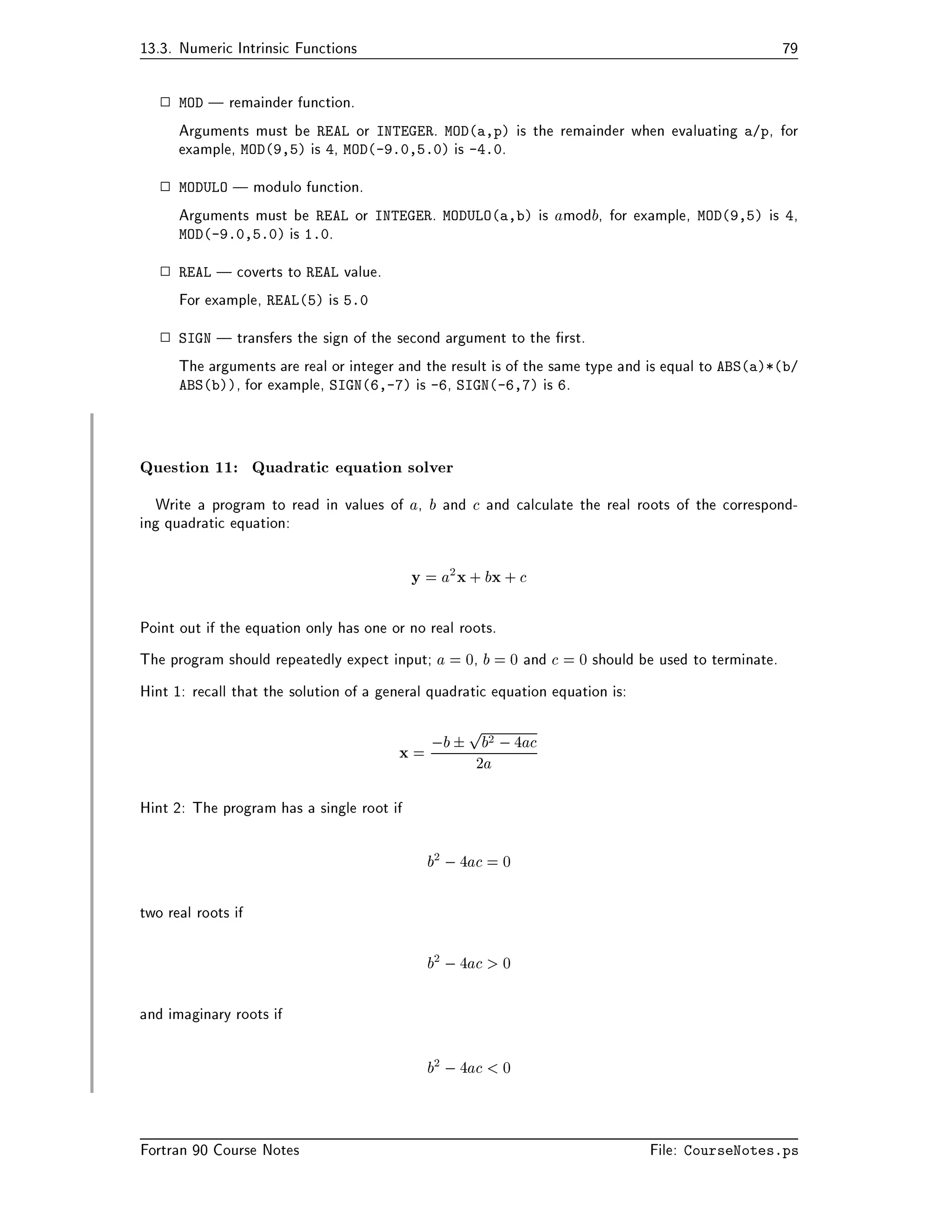
L IVERPOOL 
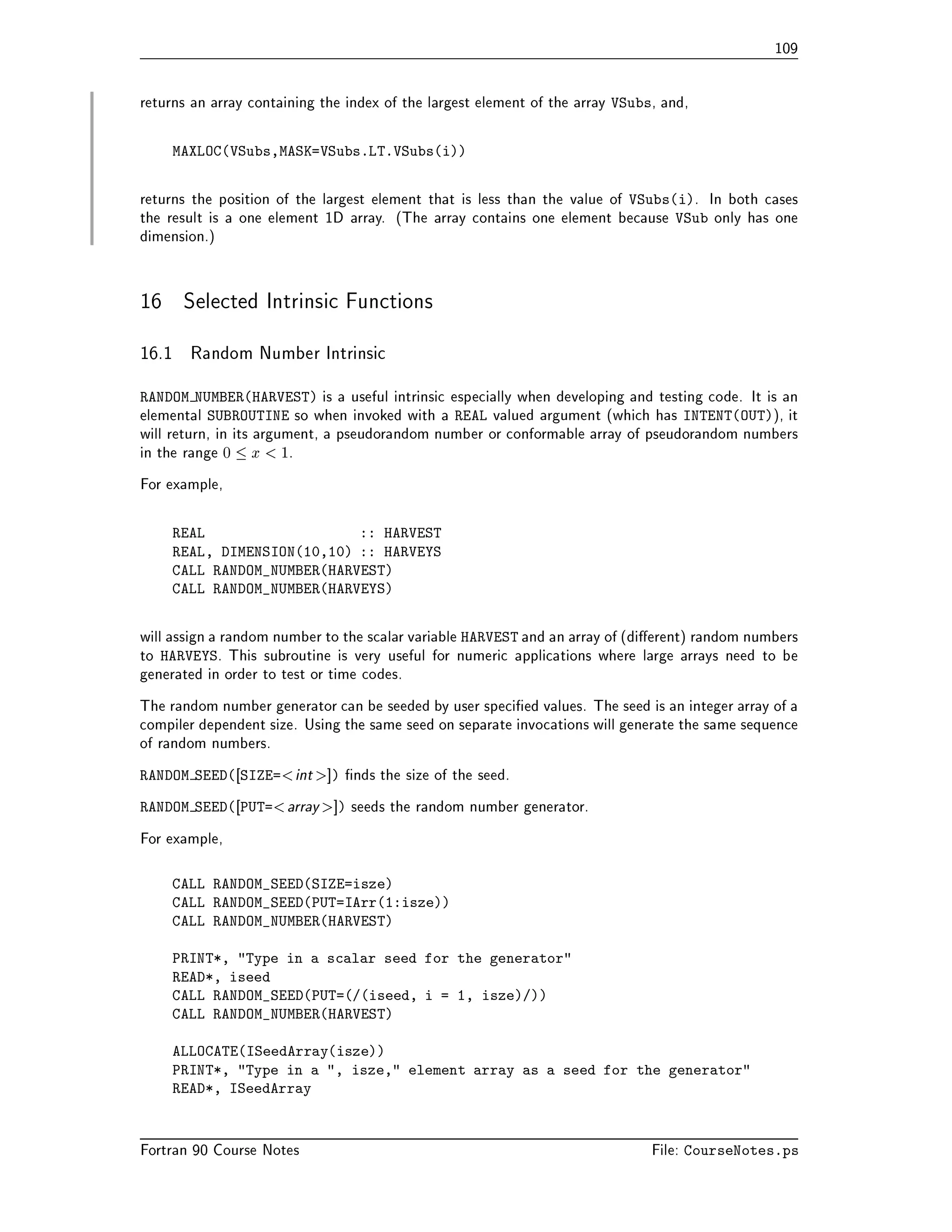
Fortran  Course Notes 
   
AC Marshall with help from JS Morgan and JL Schonfelder 
Thanks to Paddy OBrien 
c University of Liverpool
Contents 
 Introduction to Computer Systems  
 What is a Computer                                     
 What is Hardware and Software                               
 Telling a Computer What To Do                               
 Some Basic Terminology                                   
 How Does Computer Memory Work                             
 Numeric Storage                                        
 What Are Computer Programs  
 Programming Languages                                   
 Highlevel Programming Languages                              
 An Example Problem                                     
 An Example Program                                     
 Analysis of Temperature Program                               
 A Closer Look at the Speci	cation Part                       
 A Closer Look at the Execution Part                         
 How to Write a Computer Program                             

 A Quadratic Equation Solver                                 

 The Problem Speci	cation                              

 The Algorithm                                    	 

 The Program                                    	 
 The Testing Phase                                       
 Discussion
Software Errors
Compiletime Errors
Runtime Errors                                    

 The Compilation Process                                   
 Compiler Switches                                       
 Introduction  
 The Course                                          
i
Fortran Evolution  
 A Brief History of Fortran                                
 Drawbacks of Fortran                                   
 New Fortran
Features                                   
 Advantages of Additions                                   
 Language Obsolescence  
 Obsolescent Features                                     
 Arithmetic IF Statement                               
 ASSIGN Statement                                  
 ASSIGNed GOTO Statement                              
 ASSIGNed FORMAT Statement                             
 Hollerith Format Strings                               
 PAUSE Statement                                   

 REAL and DOUBLE PRECISION DOloop Variables                  
 Shared DOloop Termination
Alternate RETURN                                   

 Branching to an END IF                               
 Undesirable Features                                     
 Fixed Source Form                                  
 Implicit Declaration of Variables                           
 COMMON Blocks                                    
 Assumed Size Arrays                                 
 EQUIVALENCE Statement                               
 ENTRY Statement                                   
 Object Oriented Programming  
 Fortran
s Object Oriented Facilities                            
 Data Abstraction                                   
 Data Hiding                                      
 Encapsulation                                     
 Inheritance and Extensibility                             
ii
Polymorphism                                     
 Reusability                                       
 Comparisons with C                                    
 Fortran  Programming  

 Example of a Fortran
Program                             	 

 Coding Style                                          
	 Language Elements  
 Source Form                                          
 Free Format Code                                       
 Character Set                                         
 Signi	cant Blanks                                       
 Comments                                           
 Names                                             

 Statement Ordering                                      
 Data Objects
Intrinsic Types
Literal Constants
Implicit Typing
Numeric and Logical Declarations
Character Declarations
Constants Parameters
Initialisation
Examples of Declarations                                   
 Expressions and Assignment  

 Expressions                                           

 Assignment                                          

 Intrinsic Numeric Operations                                 

 Relational Operators                                      

 Intrinsic Logical Operations                                 	 

 Intrinsic Character Operations                                
iii
Character Substrings                                 

 Concatenation                                     


 Operator Precedence                                     

 Precedence Example
Precision Errors                                        
 Control Flow  
 IF Statement                                         
 IF Construct                                          
 Nested and Named IF Constructs                              
 Conditional Exit Loops                                    
 Conditional Cycle Loops                                    
 Named and Nested Loops                                   

 DO  WHILE Loops                                      
 Indexed DO Loop                                        
 Examples of Loop Counts
Scope of DO Variables                                     

SELECT CASE Construct                                    
 Mixing Objects of Di
erent Types  
 Mixed Numeric Type Expressions                               
 Mixed Type Assignment                                    
 Integer Division                                        
 Intrinsic Procedures  
 Type Conversion Functions                                  
 Mathematical Intrinsic Functions                               
 Numeric Intrinsic Functions                                  
 Character Intrinsic Functions                                	 
 Simple Input  Output 	 
 PRINT Statement                                       
 READ Statement                                        
iv
Arrays 	 
 Array Terminology                                       
 Declarations                                          
 Array Conformance                                      
 Array Element Ordering                                    
 Array Syntax                                         	 
 Whole Array Expressions                                   

 Visualising Array Sections                                   
 Array Sections
Printing Arrays                                        

Input of Arrays                                         

 Array IO Example                                  
Array Inquiry Intrinsics                                    
Array Constructors                                       
The RESHAPE Intrinsic Function                                
Array Constructors in Initialisation Statements                       	 
Allocatable Arrays                                      	 
Deallocating Arrays                                     	 

Masked Assignment  Where Statement                         	 
Masked Assignment  Where Construct
Vectorvalued Subscripts                                  	 
 Selected Intrinsic Functions  
 Random Number Intrinsic                                  	 
 Vector and Matrix Multiply Intrinsics                            	 
 Maximum and Minimum Intrinsics                              
 Array Location Intrinsics                                   
 Array Reduction Intrinsics                                   
 Program Units  

 Main Program Syntax                                     

 Main Program Example                                
v
Procedures                                           

 Subroutines                                          

 Functions                                           

 Argument Association                                     

 Local Objects                                         


 Argument Intent                                        

 Scope                                             

 Host Association                                   

 Example of Scoping Issues
SAVE Attribute                                         


Keyword Arguments                                      

Optional Arguments                                      

 Optional Arguments Example                             
	 Procedures and Array Arguments  
 Explicitshape Arrays                                     
 Assumedshape Arrays                                     
 Automatic Arrays                                       
 SAVE Attribute and Arrays                                  
 Explicit Length Character Dummy Arguments                        
 Assumed Length Character Dummy Arguments                      	 

 Arrayvalued Functions                                   	 
 Charactervalued Functions
Side Eect Functions                                     

Recursive Procedures                                     

 Recursive Function Example                             

 Recursive Subroutine Example                            
 Object Orientation
Stack Simulation Example
Stack Example Program
Reusability  Modules                                    
vi
Restricting Visibility
The USE Renames Facility
USE ONLY Statement                                     
 Modules  

 Modules  General Form                                   
 Pointers and Targets  
 Pointer Status                                         
 Pointer Declaration                                      
 Target Declaration                                       
 Pointer Manipulation                                     
 Pointer Assignment                                      
 Pointer Assignment Example                             
 Association with Arrays                                   	 

 Dynamic Targets                                        
 Automatic Pointer Attributing
Association Status                                       

Pointer Disassociation                                     
Pointers to Arrays vs Allocatable Arrays                           
Practical Use of Pointers                                   
Pointers and Procedures                                    
Pointer Valued Functions                                   
Pointer I  O                                          
 Derived Types  
 Supertypes                                          	 
 Derived Type Assignment                                   
 Arrays and Derived Types                                   
 Derived Type IO                                       
 Derived Types and Procedures                                
 Derived Type Valued Functions                                

 POINTER Components of Derived Types                           
vii
Pointers and Lists                                       
 Linked List Example
Arrays of Pointers                                       
 Modules
Type and Procedure Packaging 	 
 Derived Type Constructors                                  
 Generic Procedures                                      
 Generic Interfaces  Commentary                              
 Derived Type IO                                       
 Overloading Intrinsic Procedures                               
 Overloading Operators                                    	 
 Operator Overloading Example                           	 

 De	ning New Operators                                    

 De	ned Operator Example                              

 Precedence                                      
 Userde	ned Assignment                                   
 De	ned Assignment Example                             
 Semantic Extension Example                             
 Yet Another Example                                 
 More on Object Oriented Programming by J S Morgan
Semantic Extension Modules
Semantic Extension Example                            	 
 Complex Data Type  
 Complex Intrinsics                                      	 
 Parameterised Intrinsic Types  
 Integer Data Type by Kind                                  
 Constants of Selected Integer Kind                              
 Real KIND Selection                                      
 Kind Functions                                        
 Expression Evaluation                                     
 Logical KIND Selection                                    
viii
Character KIND Selection                                   
 Kinds and Procedure Arguments
Kinds and Generic Interfaces                                	 
 More Intrinsics  
 Bit Manipulation Intrinsic Functions                             
 Array Construction Intrinsics                                 
 MERGE Intrinsic                                    
 SPREAD Intrinsic                                    
 PACK Intrinsic                                     
 UNPACK Intrinsic                                   	 
 TRANSFER Intrinsic                                       
 Input  Output  

 OPEN Statement                                        

 READ Statement                                        

 WRITE Statement                                       

 FORMAT Statement  FMT Speci	er                             

 Edit Descriptors                                        

 Other IO Statements                                     
	 External Procedures  
 External Subroutine Syntax                                  
 External Subroutine Example                             
 External Function Syntax                                   
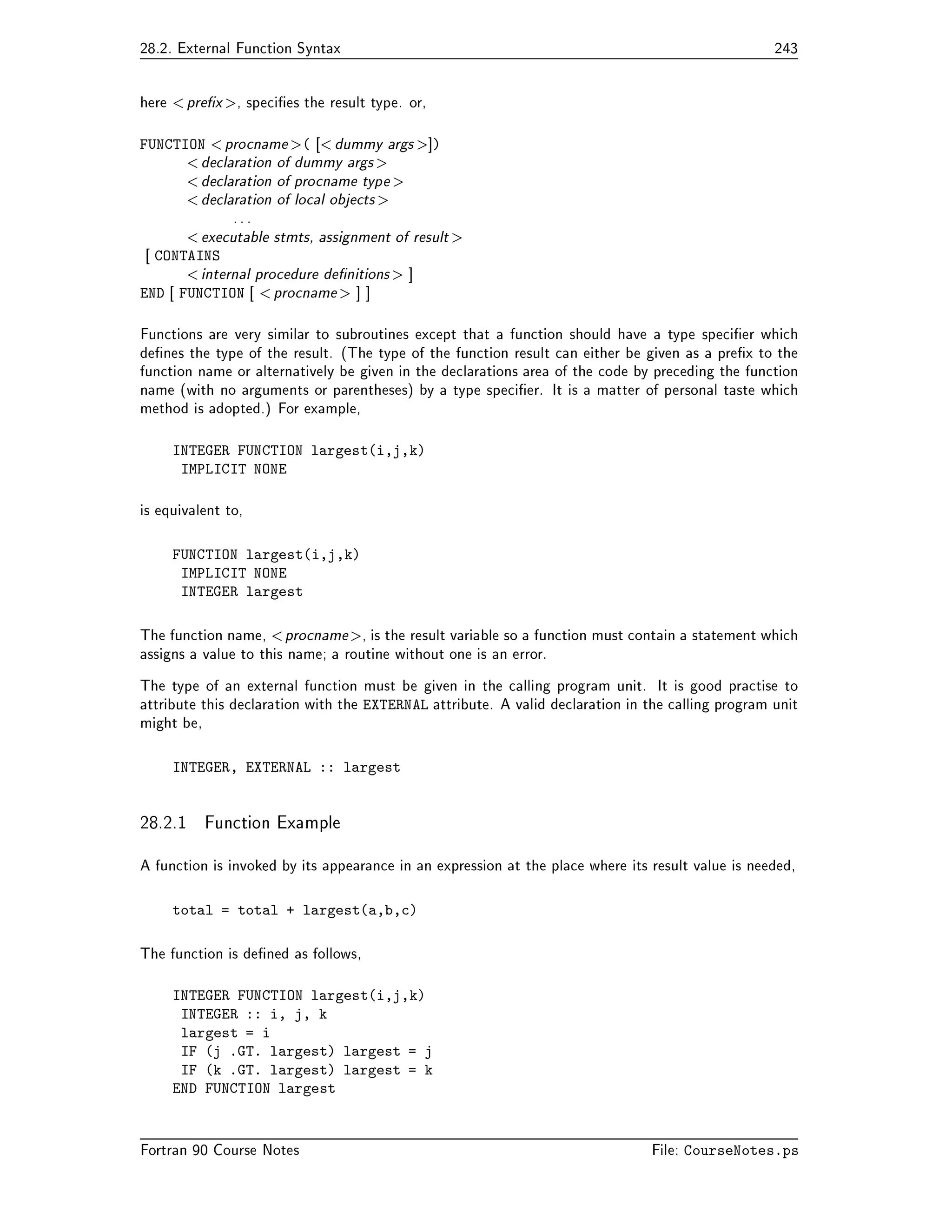
 Function Example                                   
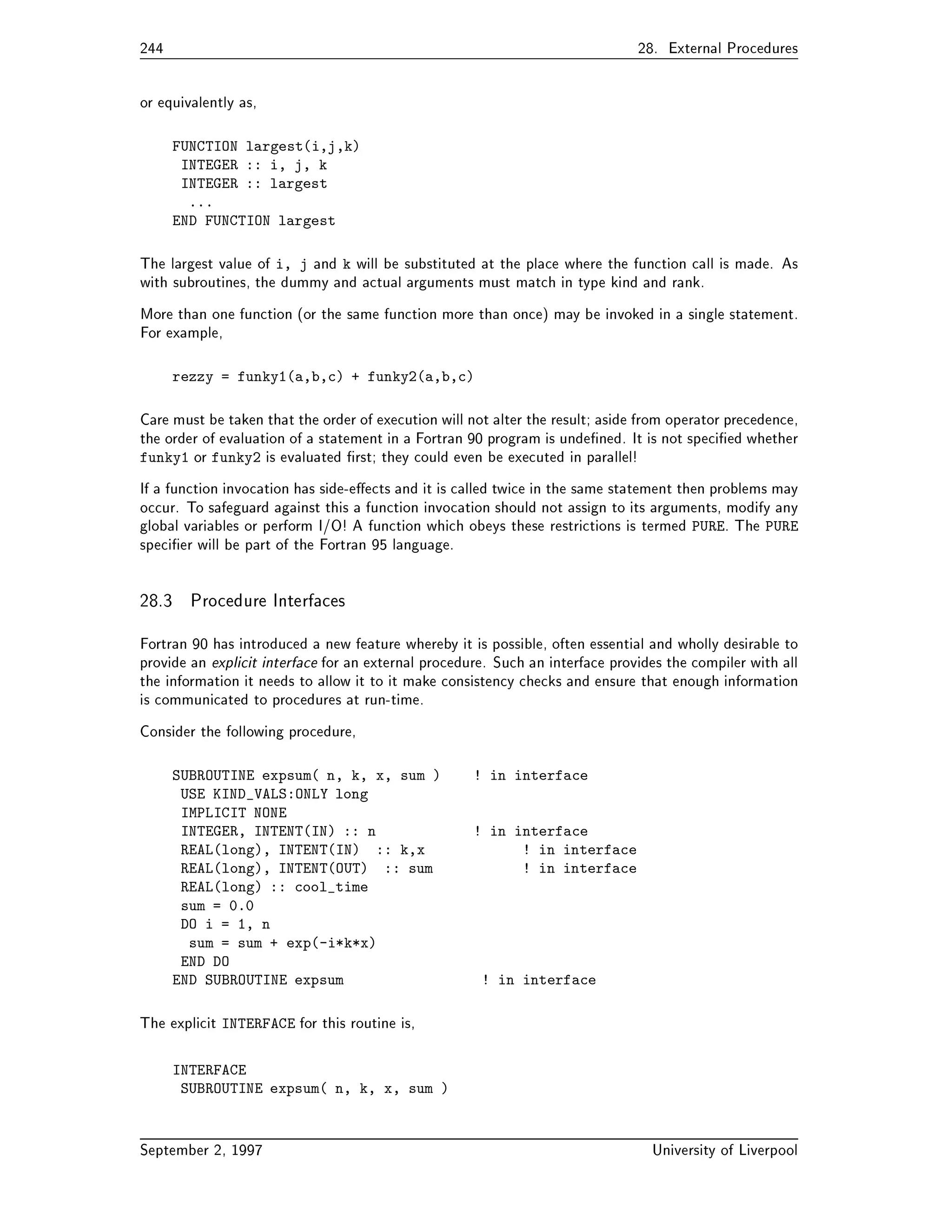
 Procedure Interfaces                                      
 Interface Example                                   
 Required Interfaces                                      
 Procedure Arguments                                     
 The INTRINSIC Attribute                               
 The EXTERNAL Attribute                               
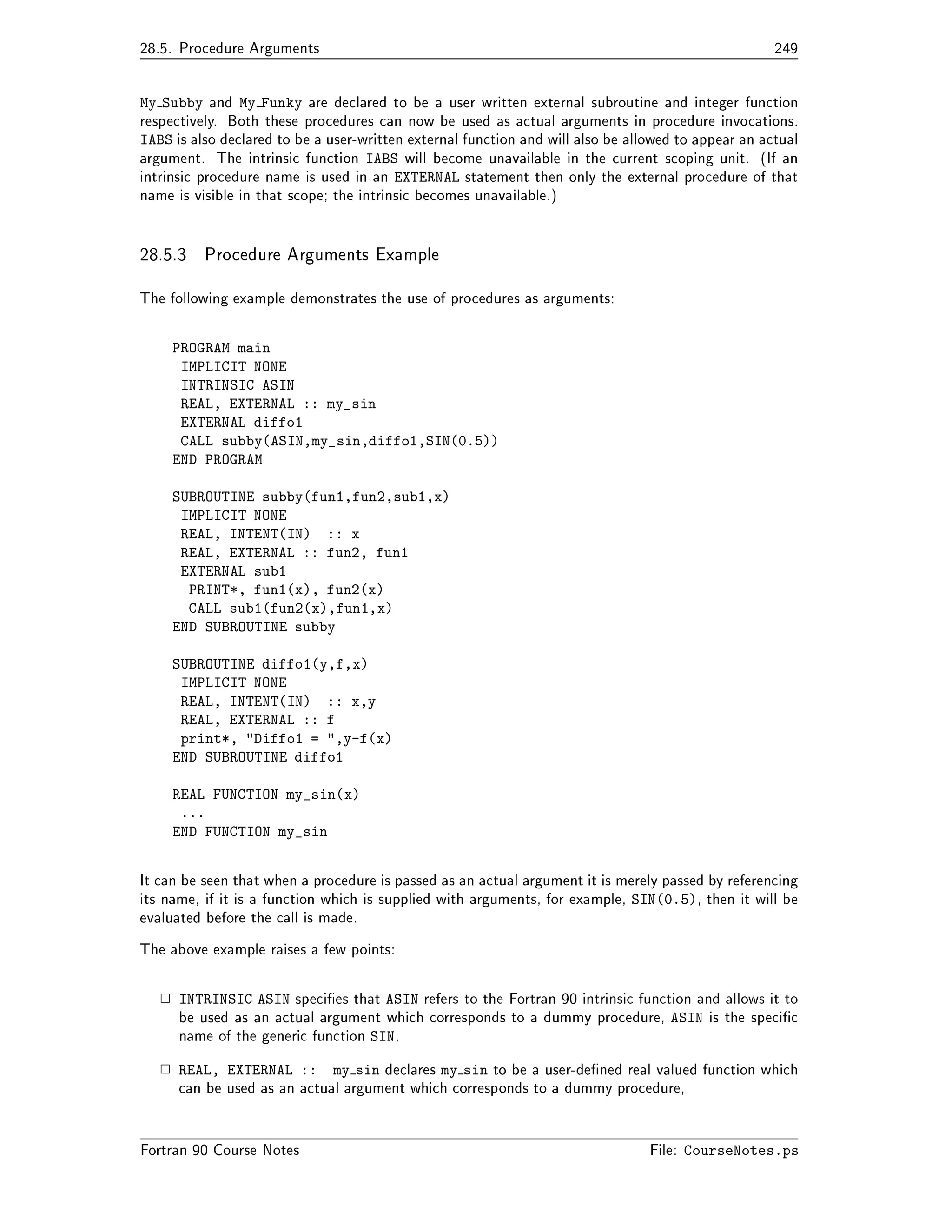
 Procedure Arguments Example                            
ix
Object Initialisation
DATA Statement
DATA Statement Example
Data Statement  Implied DO Loop                             
 Handling Exceptions  

 GOTO Statement                                        

 GOTO Statement Example                               

 RETURN and STOP Statements                                 
 Fortran   
 Rationale by Craig Dedo                                  
 FORALL                                        
 Nested WHERE Construct                               
 PURE Procedures                                   
 Elemental Procedures                                 
 Improved Initialisations                                
 Automatic Deallocation                                

 New Initialisation Features                              
 Remove Conicts With IEC
Minimum Width Editing                               

 Namelist                                        
CPU TIME Intrinsic Subroutine                            
MAXLOC and MINLOC Intrinsics                            
 Deleted Features                                   
New Obsolescent Features                              
Language Tidyups                                  
 High Performance Fortran 	 
 Compiler Directives                                      
 Visualisation of Data Directives                               	 
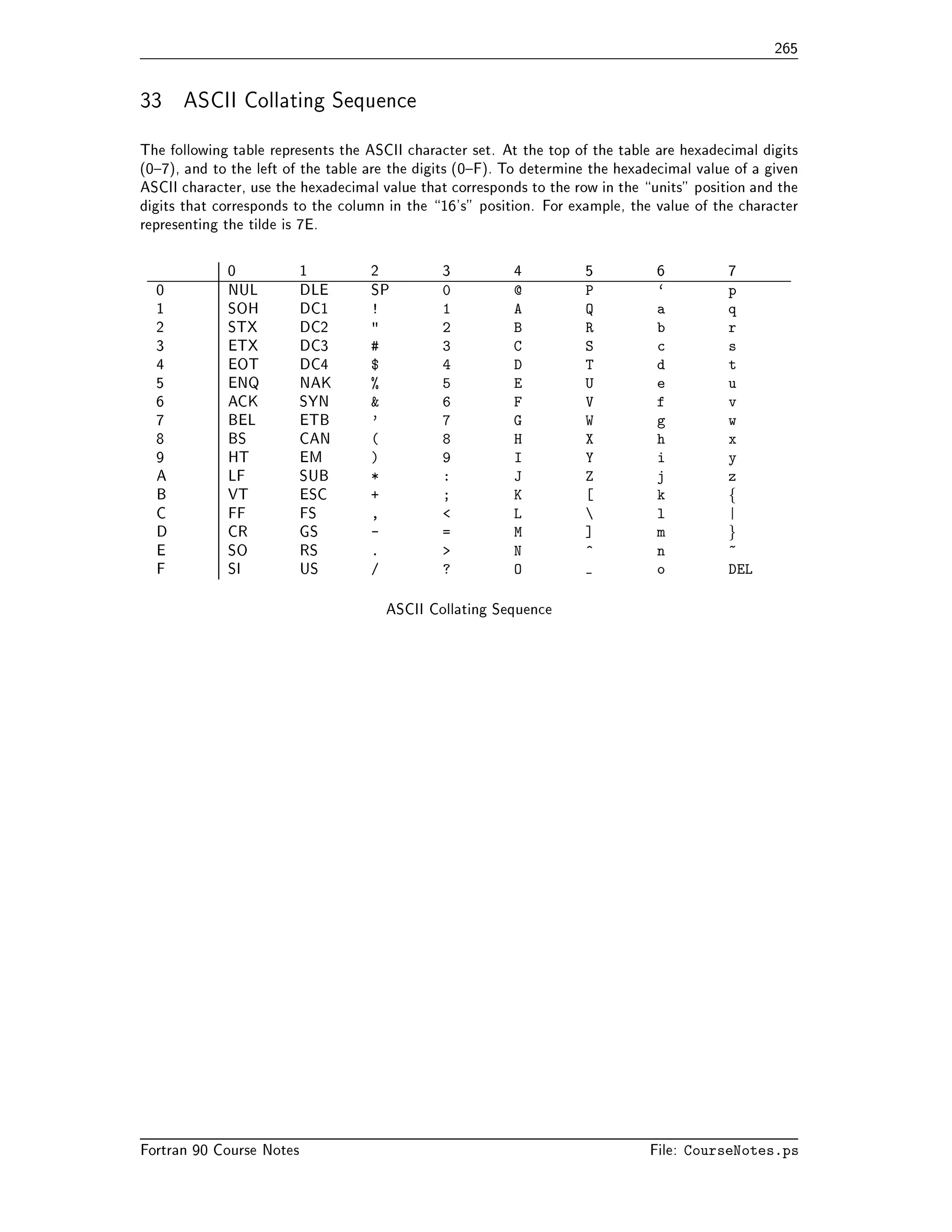
 ASCII Collating Sequence  
x
References  
xi
Module  
Fundamentals Of Computer 
Programming 
 Introduction to Computer Systems 
 What is a Computer 
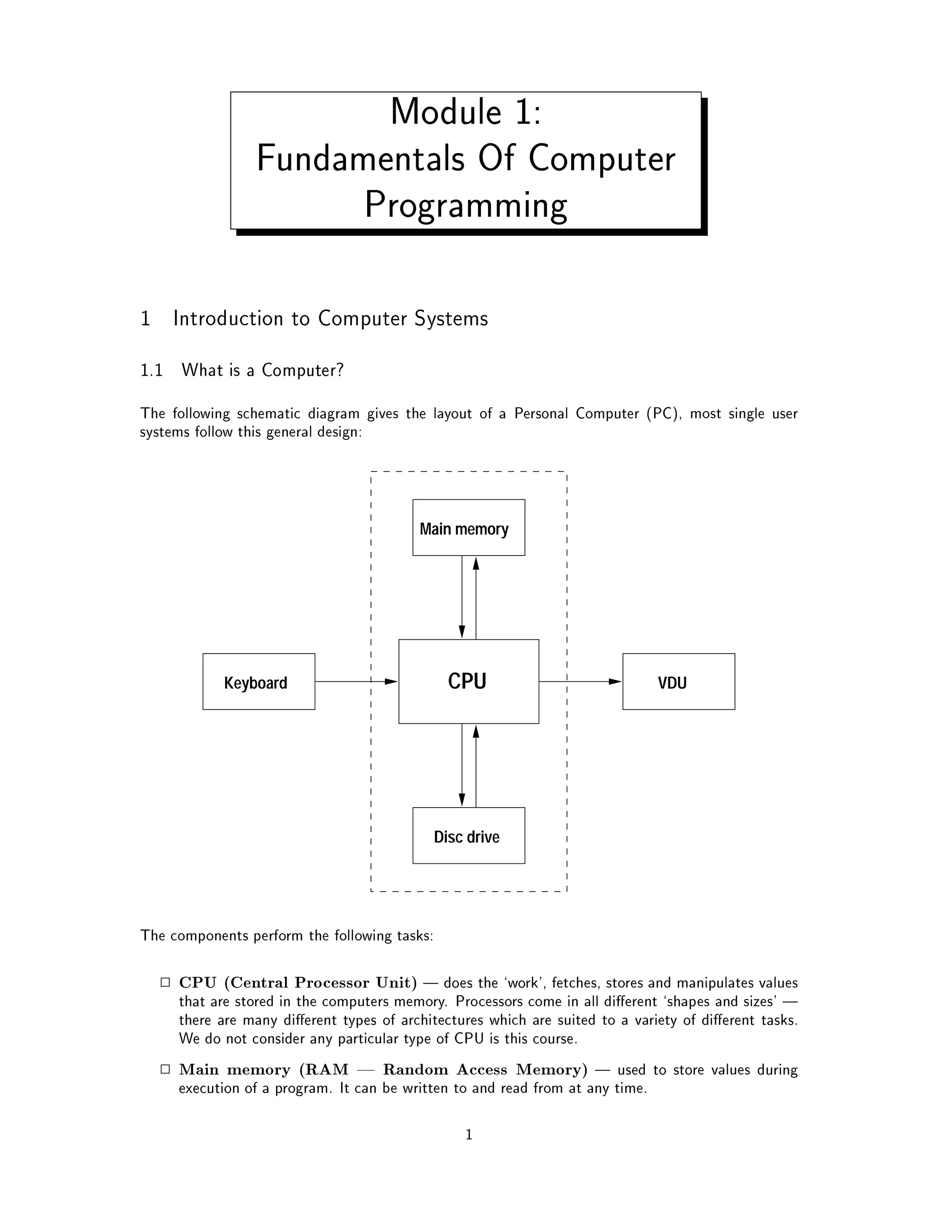
The following schematic diagram gives the layout of a Personal Computer PC most single user 
systems follow this general design 
VDU 
Main memory 
CPU 
Disc drive 
Keyboard 
The components perform the following tasks 
 CPU Central Processor Unit  does the work fetches stores and manipulates values 
that are stored in the computers memory Processors come in all dierent shapes and sizes  
there are many dierent types of architectures which are suited to a variety of dierent tasks 
We do not consider any particular type of CPU is this course 
 Main memory RAM  Random Access Memory  used to store values during 
execution of a program It can be written to and read from at any time
Introduction to Computer Systems 
 Disc drive hard or oppy  permanently stores 	les programs and data Hard discs 
are generally located inside the machine and come in a variety of dierent sizes and speeds 
They do not in fact store 	les permanently  they often go wrong and so must undergo a 
backup at regular intervals The oppy disc drive allows a user to make his or her own back 
up of important 	les and data It is very important to keep backups Do not be caught out  
you may well lose all your work 
 Keyboard  allows user to input information Nowadays most keyboards have more or less 
the same functionality 
 VDU Visual Display Unit  visually outputs data There are numerous types of VDU 
diering in the resolution dots per inch and the number of colours that can be represented 
 Printer  allows a hard copy to be made Again there are many dierent types of printers 
available for example line printers dotmatrix printers bubble jet printers and laser printers 
These also dier in their resolution and colour palette 
The last four are known as peripheral devices 
A good PC could contain 
 Intel Pentium P CPU 
 MBytes RAM main memory 
 GByte hard disc 
 SVGA monitor 
 IBM PC keyboard 
In addition a system may include 
 printer for example an HP LaserJet 
 soundcard and speakers 
 CD ROM drive Read Only Memory 
 SCSI scuzzy disc fast 
 oppy disc drive for backing up data 
 network card 
 What is Hardware and Software 
A computer system is made up from hardware and software 
Hardware is the physical medium for example 
 circuit boards 
 processors 
September
University of Liverpool
Telling a Computer What To Do  
 keyboard 
A piece of software is a computer program for example 
 an operating system 
 an editor 
 a compiler 
 a Fortran
program 
The software allows the hardware to be used Programs vary enormously in size and complexity 
 Telling a Computer What To Do 
To get a computer to perform a speci	c task it must be given a sequence of unambiguous instructions 
or a program 
We meet many examples of programs in everyday life for example instructions on how to assemble a 
bedside cabinet These instructions are generally numbered meaning that there is a speci	c order to 
be followed they are also supposed to be precise so that there is no confusion about what is intended 
 insert the spigot into hole A 
 apply glue along the edge of side panel 
 press together side and top panels 
 attach toggle pin B to gromit C 
  and so on 
If these instructions are not followed to the letter then the cabinet would turn out wonky 
 Some Basic Terminology 
It is necessary to cover some terminology Hopefully much of it will be familiar  you will hear many 
of the terms used throughout the course 
 Bit is short for Binary Digit Bits have value of  or  or on or o or true or false 
  Bits make up  Byte 

 Bytes make up  KByte  KiloByte or K Why 
 I hear you ask Because 


 KBytes make up  MByte  MagaByte or M 

 MBytes make up  GByte  GigaByte or G 
 all machines have a wordsize  a fundamental unit of storage for example bits bits etc 
The size of a word in Bytes diers between machines A Pentium based machine is bit 
Fortran
Course Notes File CourseNotesps
Introduction to Computer Systems 
 a op is a oating point operation per second A oating point operation occurs when two real 
numbers are added Today we talk of megaops or even gigaops 
 parallel processing occurs when two or more CPUs work on solution of the same problem at 
the same time 
 How Does Computer Memory Work 
In this hypothetical example wordsize is taken to be bits 
3F29 1 0 1 0 1 1 1 0 
3F2A 
3F2B 3F2C 
A computers memory is addressable Each location is given a speci	c number which is often repre 
sented in hexadecimal base for example FC Hexadecimal digits are as follows
A B C D E F
A B  F 
  The CPU is able to read to and write from 
a speci	ed memory location at will Groups of memory locations can be treated as a whole to allow 
more information to be stored Using the cryptic hexadecimal identi	ers for memory locations is very 
awkward so Fortran
allows English names to be used instead this allows programs to make sense 
to a casual reader 
Even when the computer has just been turned on each memory location will contain some sort of 
value In this case the values will be random In the general case the values will be those that remain 
from the previous program that used the memory For this reason it is very important to initialise 
memory locations before trying to use the values that they are storing 
All CPUs have an instruction set or language that they understand Eventually all Fortran
programs must be translated or compiled into instructions from this set Roughly speaking all 
processors have the same sort of instructions available to them The CPU can say things like fetch 
me the contents of memory location FC or write this value to location AF This is the basis of 
how all programs work 
Consider the following sequence of assembler code instructions 
LDA FC load fetch the contents of FC 
ADD F add to this the contents of F 
STO FA store the value in location FA 
The sequence of instructions which is meant only for illustrative purposes eectively adds two numbers 
together and stores the result in a separate memory location Until
when the 	rst dialect of Fortran 
was developed all computer programs were written using assembler code It was John Backus then 
working for IBM who proposed that a more economical and ecient method of programming their 
computer should be developed The idea was to design a language that made it possible to express 
mathematical formulae in a more natural way than that currently supported by assembler languages 
The result of their experiment was Fortran short for IBM Mathematical Formula Translation System 
This new language allowed the above assembler instructions to be written less cryptically as for 
example 
K  I 	 J 
September
University of Liverpool
Numeric Storage  
A compiler would then translate the above assignment statement into something that looks like the 
assembler code given above 
 Numeric Storage 
In general there are two types of numbers used in Fortran
programs INTEGERs whole numbers 
and REALs oating point numbers 
INTEGERs are stored exactly usually in range 


 however they are not stored in the 
format hinted at in the previous section but in a special way that allows addition and subtraction to 
be performed in a straightforward way 
REALs are stored approximately and the space they occupy is partitioned into a mantissa and an 
exponent In the following number 	 	 the mantissa is 	 and the exponent is  
In a REAL number the exponent can only take a small range of values  if the exponent is expected 
to be large then it may be necessary to use a numeric storage unit that is capable of representing larger 
values for example DOUBLE PRECISION values 
It is possible for a program to throw a numeric exception such as overow which occurs when 
number is outside of supported range for example a real number where exponent is too big or 
underow which is the opposite the number is too close to zero for representation for example a 
real number where the exponent is too small 
In Fortran
the KIND mechanism allows the user to specify what numeric range is to be supported 
This allows programs to be numerically portable Dierent computer systems will allow numbers of 
diering sizes to be represented by one word It is possible that when a program has been moved from 
one computer system to another it may fail to execute correctly on the new system because underow 
or overow exceptions are generated The KIND mechanism combats this serious problem 
CHARACTERs variables are stored dierently 
 What Are Computer Programs 
 Programming Languages 
Computers only understand binary codes so the 	rst programs were written using this notation This 
form of programming was soon seen to be extremely complex and error prone so assembler languages 
were developed Soon it was realised that even assembler languages could be improved on Today a 
good programming language must be 
 totally unambiguous unlike natural languages for example English  old women and men 
suck eggs does this mean that men or old men suck eggs 
 expressive  it must be fairly easy to program common tasks 
 practical  it must be an easy language for the compiler to translate 
 simple to use 
All programming languages have a very precise syntax or grammar This will ensure that a 
syntacticallycorrect program only has a single meaning 
Fortran
Course Notes File CourseNotesps
What Are Computer Programs 
 Highlevel Programming Languages 
Assembler code is a LowLevel Language It is socalled because the structure of the language 
reects the instruction set and architecture of the CPU A programmer can get very close to the 
physical hardware Lowlevel languages allow very ecient use of the machine but are dicult to use 
Fortran
Fortran  ADA C and Java are examples of HighLevel Languages They provide a 
much higher degree of abstraction from the physical hardware They also allow for portable programs 
to be written ie programs that will run on a variety of dierent systems and which will produce the 
same results regardless of the platform As well as having the above bene	ts highlevel languages are 
more expressive and secure and are much quicker to use than lowlevel languages In general however 
a well written assembler program will run faster than a highlevel program that performs the same task 
At the end of the day an executable program that runs on a CPU must still be represented as a 
series of binary digits This is achieved by compiling translating a highlevel program with a special 
piece of software called a compiler Compilers are incredibly complicated programs that accept other 
programs as input and generate a binary executable object 	le as output 
 An Example Problem 
Consider the following problem which is suitable for solution by computer 
To convert from oF Fahrenheit to oC Centigrade we can use the following formula 
c 
  f
To convert from oC to K Kelvin we add  
A speci	cation of the program could be that it would prompt the user for a temperature expressed in 
degrees Fahrenheit perform the necessary calculations and print out the equivalent temperatures in 
Centigrade and Kelvin 
 An Example Program 
A program which follows the above speci	cation is given below 
PROGRAM Temp
Conversion 
IMPLICIT NONE 
INTEGER  Deg
F
Deg
C
K 
PRINT
Please type in the temp in F 
READ
Deg
F 
Deg
C  
Deg
F 
PRINT
This is equal to
Deg
C
C 
K  Deg
C 	  
PRINT
and
K
K 
END PROGRAM Temp
Conversion 
This program in this case called Tempf can be compiled using the NAg v Fortran
compiler 
The compiler is invoked on the Unix command line as follows 
September
University of Liverpool
Analysis of Temperature Program 
 
chadadamm  f Tempf 
NAg Fortran  compiler v New Debugger dbx 
If the program has been written exactly as above then there will not be any error messages or diag 
nostics The case where a program contains mistakes will be covered later The compiler produces 
executable code which is stored by default in a 	le called aout It is possible to give this 	le a 
dierent name this is discussed later The executable 	le can be run by typing its name at the Unix 
prompt 
chadadamm  aout 
Please type in the temp in F 
 
This is equal to  C 
and  K 
The program will start executing and will print out Please type in the temp in F on the screen 
the computer will then wait for a value to be entered via the keyboard As soon as the required input 
has been supplied and the Return key pressed the program will continue Almost instantaneously the 
equivalent values in Centigrade and Kelvin will appear on the screen 
 Analysis of Temperature Program 
The code is delimited by PROGRAM  END PROGRAM statements in other words these two lines mark 
the beginning and end of the code Between these lines there are two distinct areas 
 Specication Part 
This is the area of the program that is set aside for the declarations of the named memory locations 
or variables that are used in the executable area of the program As well as supplying variable 
names it is also necessary to specify the type of data that a particular variable will hold This 
is important so that the compiler can work out how store the value held by a variable It is also 
possible to assign an initial values to a variable or specify that a particular memory location holds 
a constant value a readonly value that will not change whilst the program is executing These 
techniques are very useful 
 Execution Part 
This is the area of code that performs the useful work In this case the program does the 
following 
 prompts the user for input 
 reads input data Deg F 
 calculates the temperature in oC 
 prints out this value 
 calculates the temperature in Kelvin and 
 prints out this value 
Fortran
Course Notes File CourseNotesps
What Are Computer Programs 
 A Closer Look at the Speci	cation Part 
There are a couple more points that should be raised The IMPLICIT NONE statement should always 
be present in every Fortran
program unit Its presence means that all variables mentioned in the 
program must be declared in the speci	cation part A common mistake whilst coding is to mistype a 
variable name if the IMPLICIT NONE statement is not present then the compiler will assume that the 
mistyped variable name is a new hitherto unmentioned variable and will use whatever value happened 
to be in the memory location that the variable refers to An error such as this caused the US Space 
Shuttle to crash 
The third line of the program declares three INTEGER whole number variables there are a number of 
other variable types that can be used in dierent situations 
 REAL  real numbers ie no whole numbers eg  	 	 REAL variables can 
hold larger numbers than INTEGERs 
 LOGICAL  can only take one of two vaules TRUE or FALSE 
 CHARACTER  contains single alphanumeric character eg a 
 CHARACTERLENcontains  alphanumeric characters A number of consecutive alphanu 
meric characters are known as a string 
 user de	ned types  combination of the above see later 
Fortran
is not case sensitive K is the same as k 
 A Closer Look at the Execution Part 
Let us now look at the part of the program that does the actual work 
 PRINT
Please type in the temp in F  writes the string between the quotes to the 
VDU screen 
 READ
Deg F  reads a value from the keyboard and assigns it to the INTEGER variable Deg F 
 Deg C  
Deg F  this is an assignment statement The expression on the 
RHS is evaluated and then assigned to the INTEGER variable Deg C This statement contains a 
number of operators 
 
 is the multiplication operator 
  is the subtraction operator 
  is the assignment operator 
The Fortran
language also contains 	 and  operators for addition and division 
Division is much harder than any other operation for a CPU to perform  it takes longer so uses 
more resources for example if there is a choice between dividing by  or multiplying by  
the latter should be selected 
 PRINT
This is equal to
Deg C
C  displays a string on the screen followed by 
the value of a variable Deg C followed by a second string C 
By default input is from the keyboard and output to the screen 
September
University of Liverpool
How to Write a Computer Program
How to Write a Computer Program 
There are four general phases during the development of any computer program 
 specify the problem 
 analyse and break down into a series of steps towards solution ie design an algorithm 
 write the Fortran
code 
 compile and run ie test the program 
When writing a computer program it is absolutely vital that the problem to be solved is fully understood 
A good percentage of large programming projects run into trouble owing to a misunderstanding of what 
is actually required The speci	cation of the problem is crucial It is usual to write a detailed spec 
of the problem using a natural language eg English Unfortunately it is very easy to write an 
ambiguous speci	cation which can be interpreted in a number of ways by dierent people In order to 
combat this a number of Formal Methods of speci	cation have been developed These methods are 
often highlevel abstract mathematical languages which are relatively simple to convert to highlevel 
programs in some cases this can be done automatically Examples of such languages are Z and VDM 
We do not propose to cover such speci	cation languages here For the purposes of learning Fortran
a simple natural language speci	cation is adequate 
Once the problem has been speci	ed it needs to be broken down into small steps towards the solution 
in other words an algorithm should be designed It is perfectly reasonable to use English to specify 
each step This is known as pseudocode 
The next two phases go handinhand they are often known as the codetestdebug cycle and it is 
often necessary to perform the cycle a number of times It is very rare that a program is written 
correctly on the 	rst attempt It is common to make typographical errors which are usually unearthed 
by the compiler Once the typos have been removed the program will be able to be compiled and an 
executable image generated Again it is not uncommon for execution to expose more errors or bugs 
Execution may either highlight runtime errors which occur when the program tries to perform illegal 
operations eg divide by zero or may reveal that the program is generating the wrong answers The 
program must be thoroughly tested to demonstrate that it is indeed correct The most basic goal 
should be to supply test data that executes every line of code There are many software tools that 
generate statistical reports of code coverage such as the Unix tcov utility or the more comprehensive 
LDRA Testbed 

 A Quadratic Equation Solver 
This section shows the various steps that are needed when designing and writing a computer program 
to generate the roots of a quadratic equation 

 The Problem Speci	cation 
Write a program to calculate the roots of a quadratic equation of the form 
ax 
 bx 
 c 
 	 
Fortran
Course Notes File CourseNotesps
What Are Computer Programs 
The roots are given by the following formula 
x 
 b  pb  ac 
a 

 The Algorithm 
 READ the values of the coecients a b and c from the keyboard 
 if a is zero then stop as we do not have a quadratic equation 
 calculate value of discriminant D 
 b  ac 
 if D is zero then there is one root b 
a  
 if D is  
 then there are two real roots bpD 
pD 
a  
a and b 
 if D is  
 there are two complex roots bip 
D 
and bip 
a D 
a  

 PRINT solution 

 The Program 
The following program is one solution to the problem 
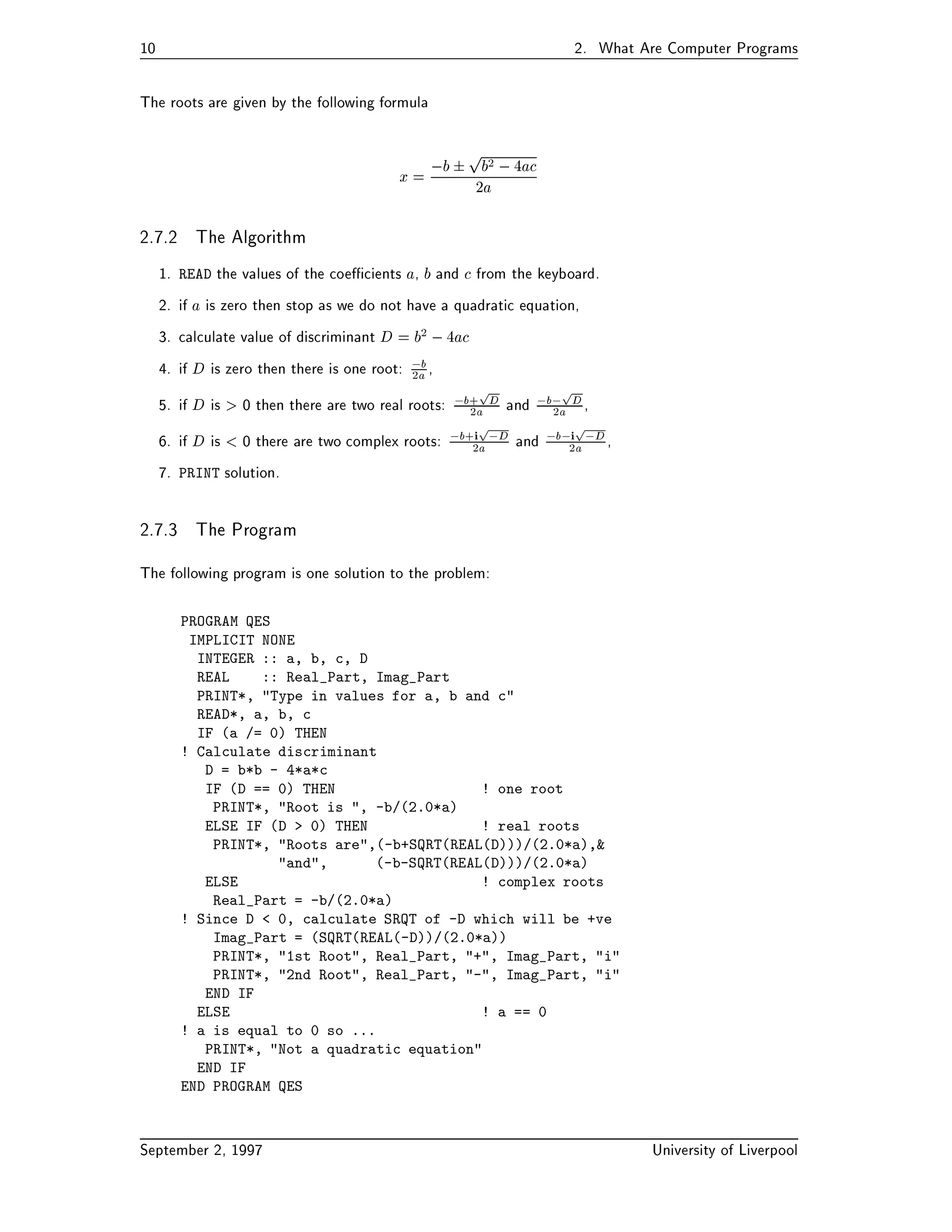
PROGRAM QES 
IMPLICIT NONE 
INTEGER  a
b
c
D 
REAL  Real
Part
Imag
Part 
PRINT
Type in values for a
b and c 
READ
a
b
c 
IF a   THEN 
 Calculate discriminant 
D  b
b  
a
c 
IF D   THEN  one root 
PRINT
Root is
b
a 
ELSE IF D   THEN  real roots 
PRINT
Roots are
b	SQRTREALD
a
and
bSQRTREALD
a 
ELSE  complex roots 
Real
Part  b
a 
 Since D
calculate SRQT of D which will be 	ve 
Imag
Part  SQRTREALD
a 
PRINT
st Root
Real
Part
Imag
Part
i 
PRINT
nd Root
Real
Part
Imag
Part
i 
END IF 
ELSE  a   
 a is equal to  so  
PRINT
Not a quadratic equation 
END IF 
END PROGRAM QES 
September
University of Liverpool
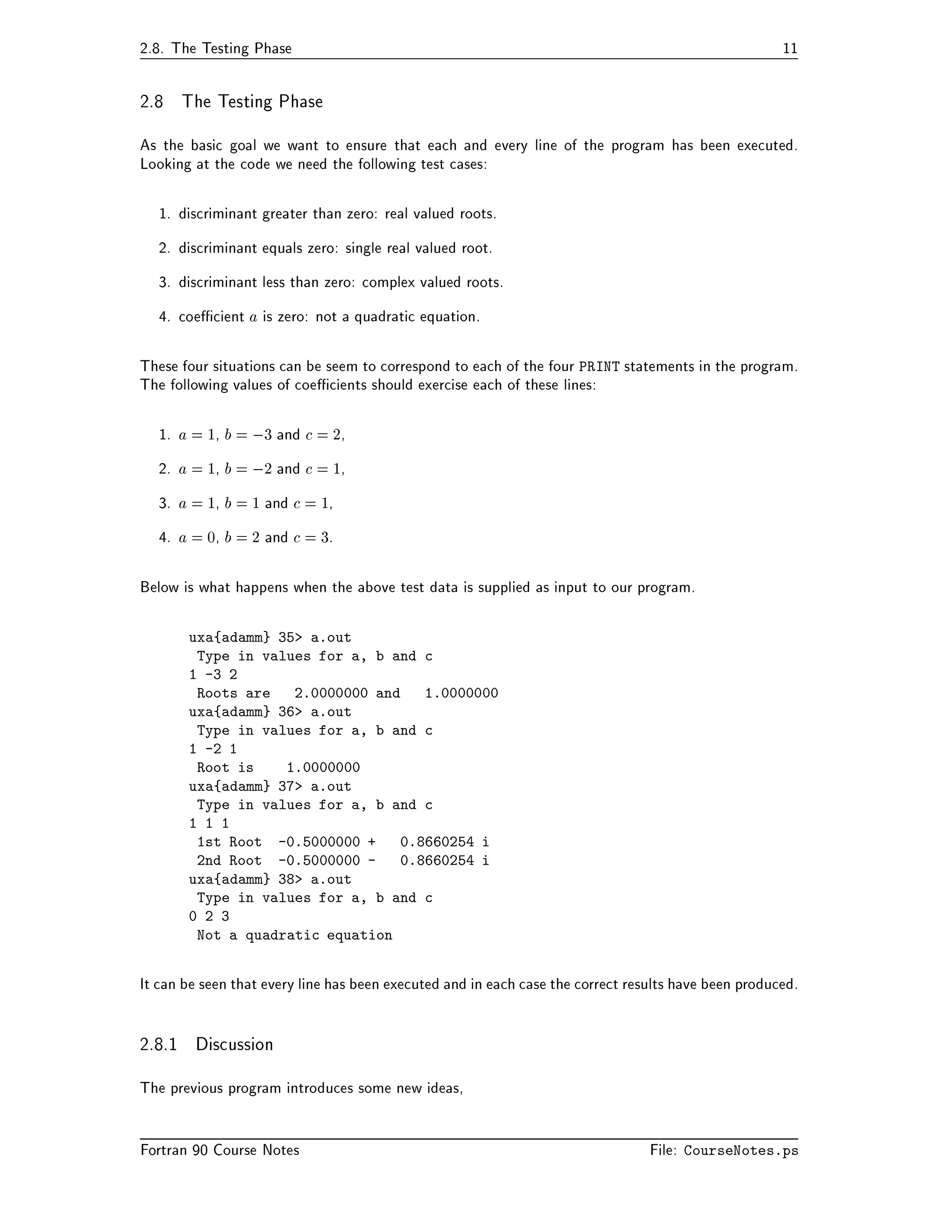
The Testing Phase  
 The Testing Phase 
As the basic goal we want to ensure that each and every line of the program has been executed 
Looking at the code we need the following test cases 
 discriminant greater than zero real valued roots 
 discriminant equals zero single real valued root 
 discriminant less than zero complex valued roots 
 coecient a is zero not a quadratic equation 
These four situations can be seem to correspond to each of the four PRINT statements in the program 
The following values of coecients should exercise each of these lines 
 a 
  b 
  and c 
  
 a 
  b 
  and c 
  
 a 
  b 
  and c 
  
 a 
 	 b 
  and c 
  
Below is what happens when the above test data is supplied as input to our program 
uxaadamm  aout 
Type in values for a
b and c 
   
Roots are  and  
uxaadamm  aout 
Type in values for a
b and c 
   
Root is  
uxaadamm  aout 
Type in values for a
b and c 
   
st Root  	  i 
nd Root    i 
uxaadamm  aout 
Type in values for a
b and c 
   
Not a quadratic equation 
It can be seen that every line has been executed and in each case the correct results have been produced 
 Discussion 
The previous program introduces some new ideas 
Fortran
Course Notes File CourseNotesps
What Are Computer Programs 
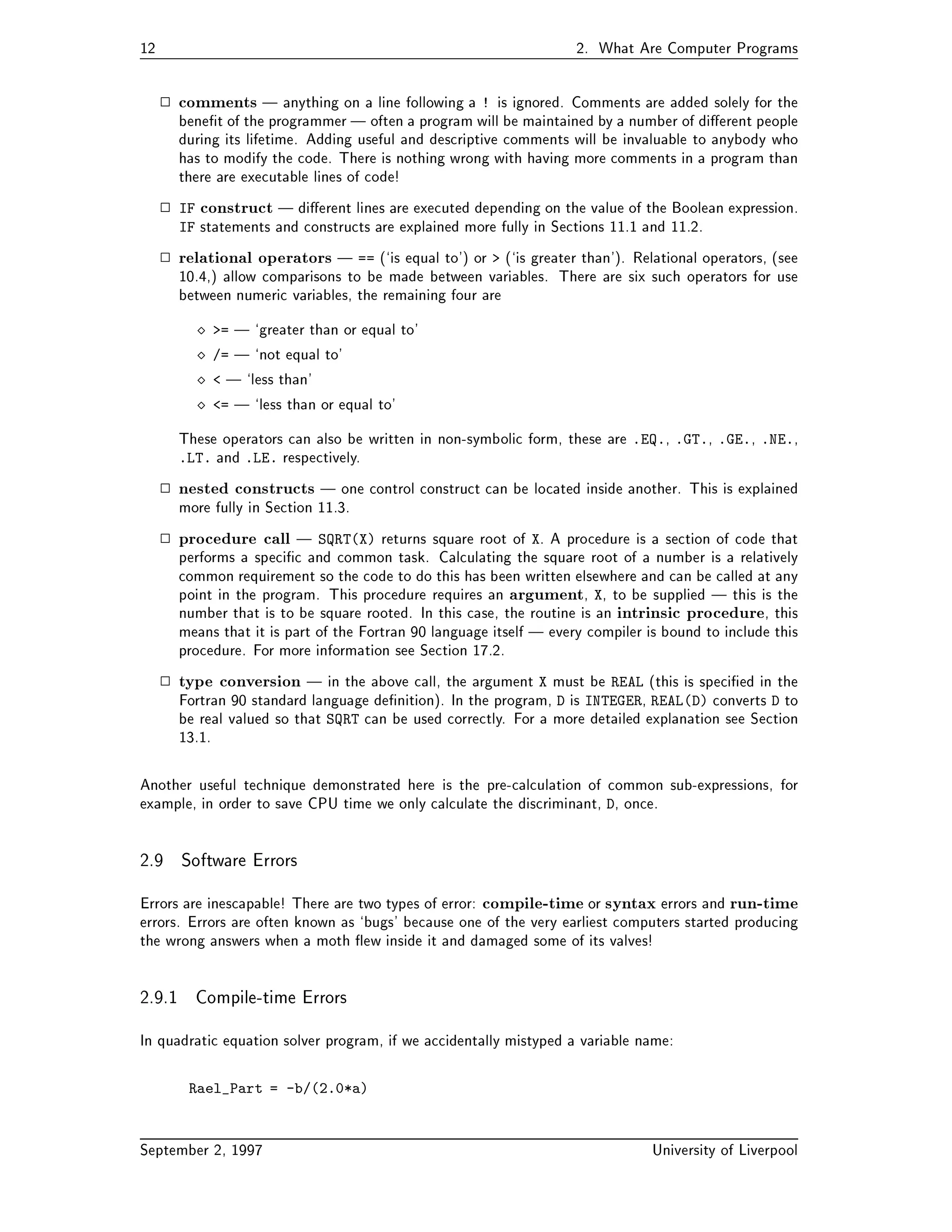
 comments  anything on a line following a  is ignored Comments are added solely for the 
bene	t of the programmer  often a program will be maintained by a number of dierent people 
during its lifetime Adding useful and descriptive comments will be invaluable to anybody who 
has to modify the code There is nothing wrong with having more comments in a program than 
there are executable lines of code 
 IF construct  dierent lines are executed depending on the value of the Boolean expression 
IF statements and constructs are explained more fully in Sections  and  
 relational operators   is equal to or  is greater than Relational operators see 

 allow comparisons to be made between variables There are six such operators for use 
between numeric variables the remaining four are 
   greater than or equal to 
   not equal to 
   less than 
   less than or equal to 
These operators can also be written in nonsymbolic form these are EQ GT GE NE 
LT and LE respectively 
 nested constructs  one control construct can be located inside another This is explained 
more fully in Section  
 procedure call  SQRTX returns square root of X A procedure is a section of code that 
performs a speci	c and common task Calculating the square root of a number is a relatively 
common requirement so the code to do this has been written elsewhere and can be called at any 
point in the program This procedure requires an argument X to be supplied  this is the 
number that is to be square rooted In this case the routine is an intrinsic procedure this 
means that it is part of the Fortran
language itself  every compiler is bound to include this 
procedure For more information see Section 
 
 type conversion  in the above call the argument X must be REAL this is speci	ed in the 
Fortran
standard language de	nition In the program D is INTEGER REALD converts D to 
be real valued so that SQRT can be used correctly For a more detailed explanation see Section 
 
Another useful technique demonstrated here is the precalculation of common subexpressions for 
example in order to save CPU time we only calculate the discriminant D once
Software Errors 
Errors are inescapable There are two types of error compiletime or syntax errors and runtime 
errors Errors are often known as bugs because one of the very earliest computers started producing 
the wrong answers when a moth ew inside it and damaged some of its valves
Compiletime Errors 
In quadratic equation solver program if we accidentally mistyped a variable name 
Rael
Part  b
a 
September
University of Liverpool
The Compilation Process  
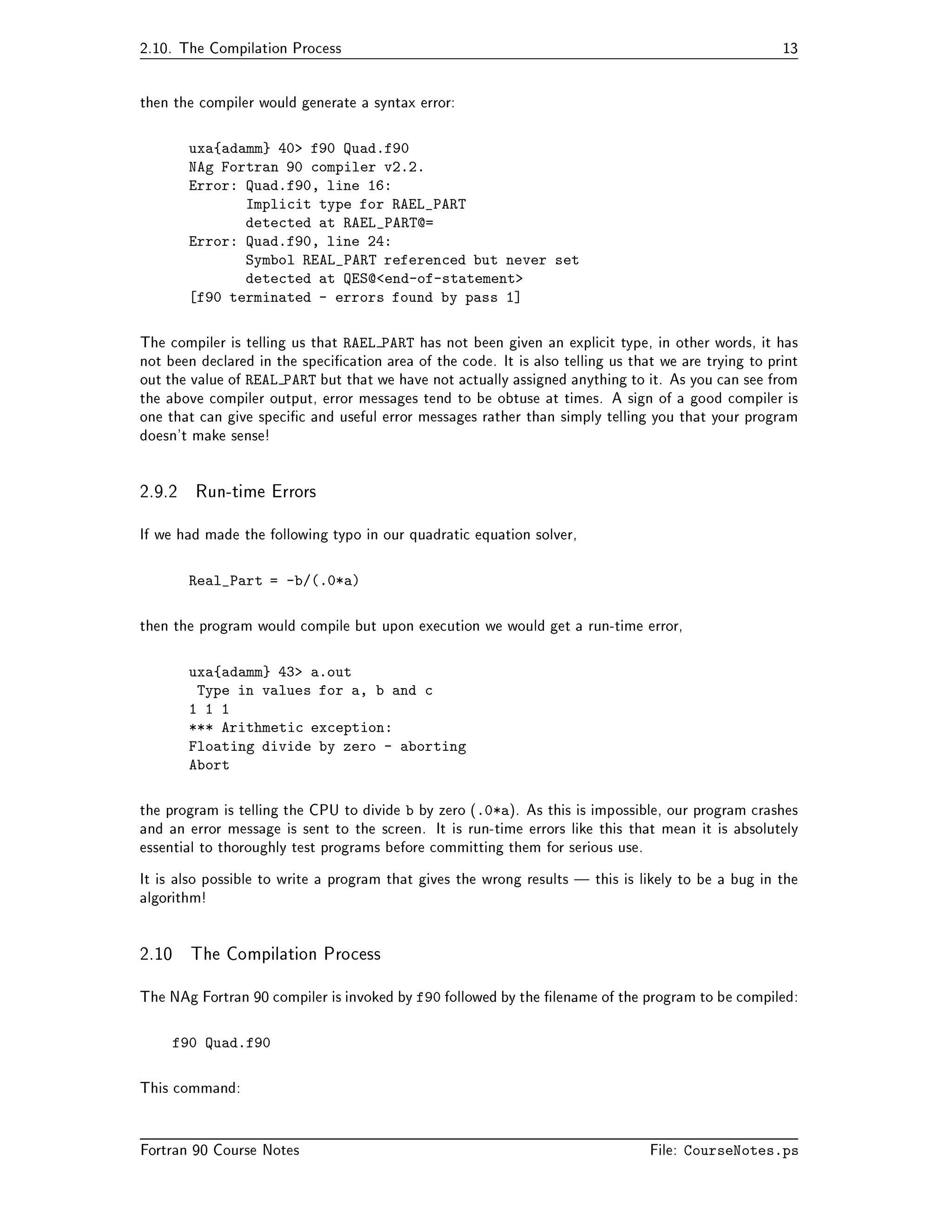
then the compiler would generate a syntax error 
uxaadamm  f Quadf 
NAg Fortran  compiler v 
Error Quadf
line  
Implicit type for RAEL
PART 
detected at RAEL
PART 
Error Quadf
line  
Symbol REAL
PART referenced but never set 
detected at QESendofstatement 
f terminated  errors found by pass  
The compiler is telling us that RAEL PART has not been given an explicit type in other words it has 
not been declared in the speci	cation area of the code It is also telling us that we are trying to print 
out the value of REAL PART but that we have not actually assigned anything to it As you can see from 
the above compiler output error messages tend to be obtuse at times A sign of a good compiler is 
one that can give speci	c and useful error messages rather than simply telling you that your program 
doesnt make sense
Runtime Errors 
If we had made the following typo in our quadratic equation solver 
Real
Part  b
a 
then the program would compile but upon execution we would get a runtime error 
uxaadamm  aout 
Type in values for a
b and c 


 Arithmetic exception 
Floating divide by zero  aborting 
Abort 
the program is telling the CPU to divide b by zero 
a As this is impossible our program crashes 
and an error message is sent to the screen It is runtime errors like this that mean it is absolutely 
essential to thoroughly test programs before committing them for serious use 
It is also possible to write a program that gives the wrong results  this is likely to be a bug in the 
algorithm 

 The Compilation Process 
The NAg Fortran
compiler is invoked by f followed by the 	lename of the program to be compiled 
f Quadf 
This command 
Fortran
Course Notes File CourseNotesps
What Are Computer Programs 
 checks the program syntax 
 generates object code 
 passes object code to linker which attached libraries system IO etc and generates executable 
code in a 	le called aout 
Step  attaches code which deals with amongst other things mathematical calculations and input from 
the keyboard and output to the screen This code which is resident in a system library is used with all 
available compilers in other words the same IO library will be used with C ADA or C programs 
This alleviates the need for each compiler to include a separate instance of these IO routines It is 
possible that this step may give a linker error if procedures used in the code cannot be found in a 
library 
Executable code is processor speci	c Code complied for an Intel Pentium will not run an a Sun SPARC 
and viceversa If a program is moved to a dierent platform then it will need to be recompiled If 
the program conforms to the Fortran
standard then the source code will not need editing at all 
Some compilers accept extensions to the Fortran
standard If any of these extensions are used 
the program will be nonstandard conforming and may need signi	cant rewriting when compiled on a 
dierent platform or by a dierent compiler 
 Compiler Switches 
All compilers can be invoked with a number of dierent options The eect of these options is explained 
in the man pages or in the compiler manual The NAg compiler has a number for example 
 o outputlename gives executable a dierent name for example Quad 
f Quadf o Quad 
 dryrun show but do not execute commands constructed by the compiler 
 hpf accept the extensions to Fortran
as speci	ed by the High Performance Fortran Forum 
 info level set level of information messages generated by the compiler from 
 to
time report execution times 
f Quadf o Quad time 
For more information about the compiler type 
man f 
Question  Compilation and Editing 
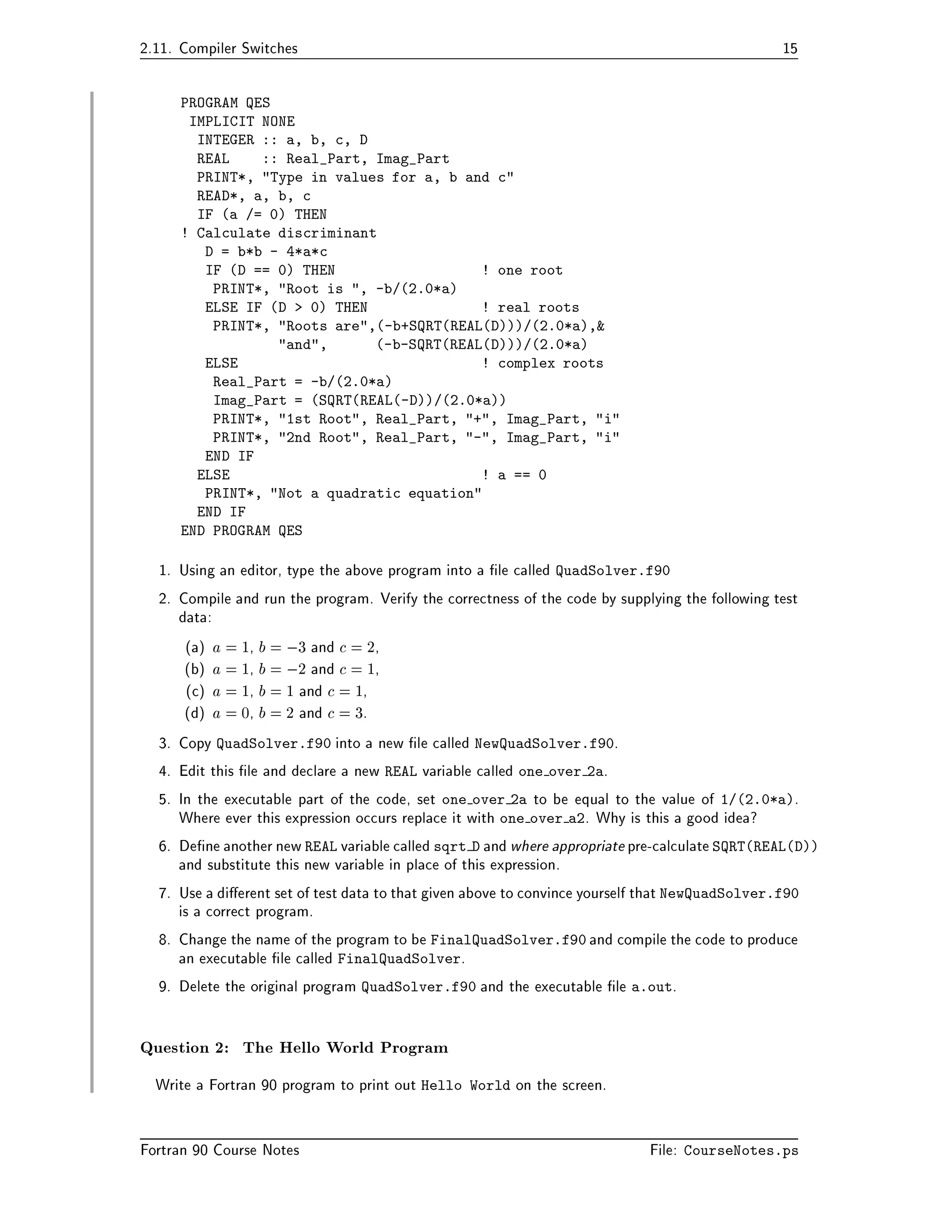
The following program calculates the roots of a quadratic equation 
September
University of Liverpool
Compiler Switches  
PROGRAM QES 
IMPLICIT NONE 
INTEGER  a
b
c
D 
REAL  Real
Part
Imag
Part 
PRINT
Type in values for a
b and c 
READ
a
b
c 
IF a   THEN 
 Calculate discriminant 
D  b
b  
a
c 
IF D   THEN  one root 
PRINT
Root is
b
a 
ELSE IF D   THEN  real roots 
PRINT
Roots are
b	SQRTREALD
a
and
bSQRTREALD
a 
ELSE  complex roots 
Real
Part  b
a 
Imag
Part  SQRTREALD
a 
PRINT
st Root
Real
Part
Imag
Part
i 
PRINT
nd Root
Real
Part
Imag
Part
i 
END IF 
ELSE  a   
PRINT
Not a quadratic equation 
END IF 
END PROGRAM QES 
 Using an editor type the above program into a 	le called QuadSolverf 
 Compile and run the program Verify the correctness of the code by supplying the following test 
data 
a a 
  b 
  and c 
  
b a 
  b 
  and c 
  
c a 
  b 
  and c 
  
d a 
 	 b 
  and c 
  
 Copy QuadSolverf into a new 	le called NewQuadSolverf 
 Edit this 	le and declare a new REAL variable called one over a 
 In the executable part of the code set one over a to be equal to the value of 
a 
Where ever this expression occurs replace it with one over a Why is this a good idea 
 De	ne another new REAL variable called sqrt D and where appropriate precalculate SQRTREALD 
and substitute this new variable in place of this expression 

 Use a dierent set of test data to that given above to convince yourself that NewQuadSolverf 
is a correct program 
 Change the name of the program to be FinalQuadSolverf and compile the code to produce 
an executable 	le called FinalQuadSolver
Delete the original program QuadSolverf and the executable 	le aout 
Question  The Hello World Program 
Write a Fortran
program to print out Hello World on the screen 
Fortran
Course Notes File CourseNotesps
Module  
Introduction to Fortran  
 Introduction 
Fortran  has been widely used by scientists and engineers for a number of years now It has been a 
very successful language but is now showing signs of age in the last few years there has been a tendency 
for people to drift away from Fortran  and begin to use C Ada or C The Fortran standard has 
now been revised to bring it up to date with a new improved language known informally as Fortran
being de	ned Comparisons have been rightly drawn between the new Fortran standard and APL 
ADA and C All three languages contain elements which make them the avour of the month 
they are to some degree object oriented The criteria for what makes a language actually object 
oriented is debatable but the new operator overloading user de	ned typing and MODULE packaging 
features of Fortran
certainly help to forward its case Along with ADA and APL it uses the concept 
of array operations and reduction operators Fortran
also supports user de	ned generic procedures 
to enhance usability but these are implemented in a simpler and more ecient way than in ADA 
Here we highlight the new Fortran
features which make language more robust and usable for 
example of those mentioned above many are objectbased facilities which make it more dicult to 
make mistakes or do daft things Fortran
is also comparable to ADA in the sense that it too has 
many restrictions detailed in the standard document meaning that mistakes which in other languages 
such as C C and Fortran  would be syntactically correct but cause an odd action to be 
taken are ruled out at compile time As an example of this if explicit interfaces are used then it 
is not possible to associate dummy and actual arguments of dierent types  this was possible in 
Fortran  and was sometimes used in anger but generally indicated an error 
 The Course 
Throughout the course it is assumed that the user has experience of Fortran  or least one other 
high level programming language such as Modula Pascal APL Ada Cor Algol and understands terms 
like bits real numbers precision and data structures 
 Fortran Evolution 
 A Brief History of Fortran  
Fortran which originally stood for IBM Mathematical FORmula TRANslation System but has been 
abbreviated to FORmula TRANslation is the oldest of the established highlevel languages having 
been designed by a group in IBM during the late
s The language became so popular in the early
s that other vendors started to produce their own versions and this led to a growing divergence of 
dialects by
there were 
 dierent compilers It was recognised that such divergence was not in 
the interests of either the computer users or the computer vendors and so Fortran  became the 
	rst language to be ocially standardised in
it is quite common for the Fortran version number 
to be out of step with the standardisation year The publication of the standard meant that Fortran
A Brief History of Fortran  
 
became more widely implemented than any other language By the mid
s virtually every computer 
mini or mainframe was supplied with a standardconforming Fortran  language processing system 
It was therefore possible to write programs in Fortran on any one system and be reasonably con	dent 
that these could be moved fairly easily to work on any other system This and the fact that Fortran 
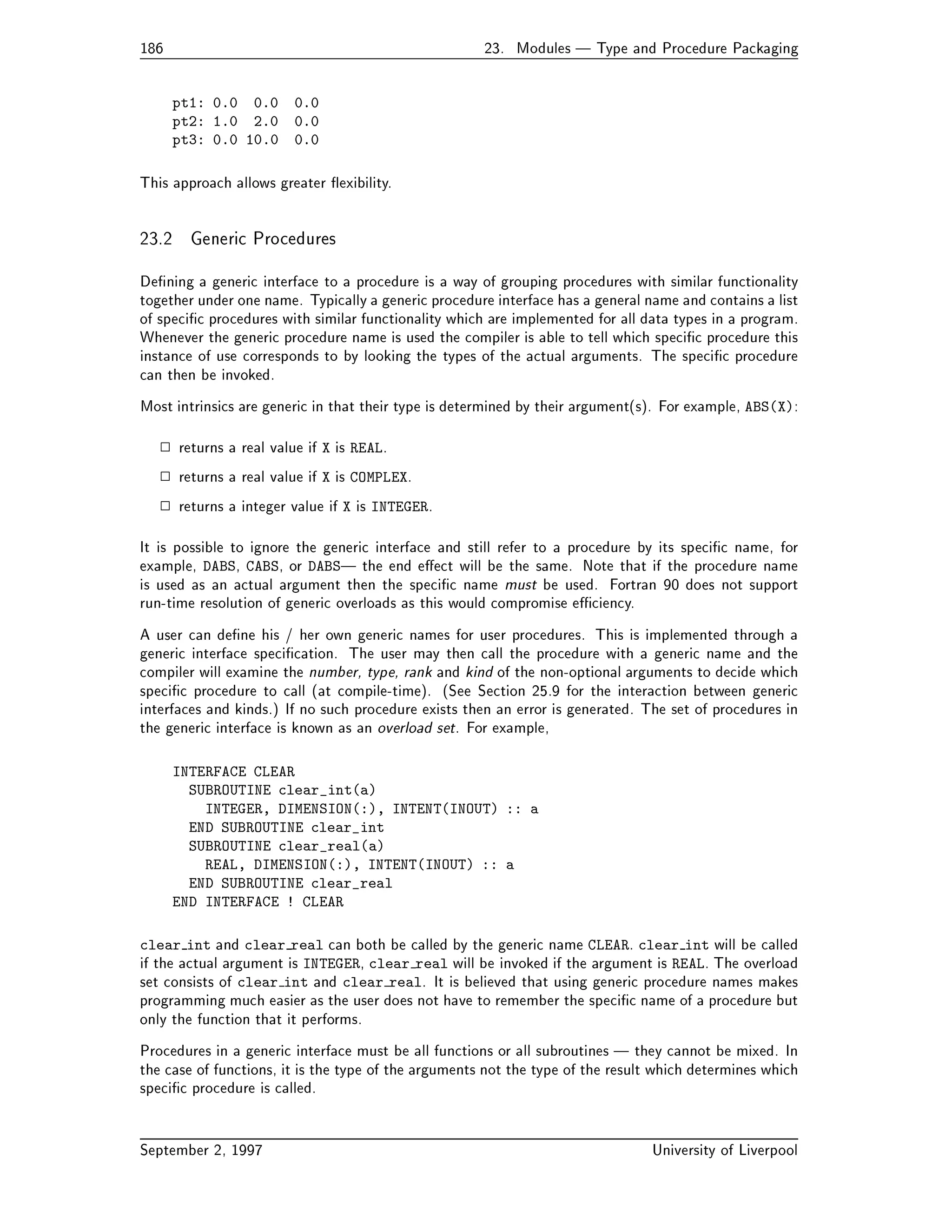
programs could be processed very eciently led to Fortran being the most heavilyused programming 
language for noncommercial applications 
The standard de	nition of Fortran was updated in the late
s and a new standard ANSI X
was published by the American National Standards Institute This standard was subsequently 
in
adopted by the International Standards Organisation ISO as an International Standard IS
The language is commonly known as Fortran  since the 	nal draft was actually 
completed in
and is the version of the language now in widespread use Compilers which usually 
support a small number of extensions have over the years become very ecient The technology 
which has been developed during the implementation of these compilers will not be wasted as it can 
still be applied to Fortran
programs 
The venerable nature of Fortran and the rather conservative character of the
standard revision 
left Fortran  with a number of oldfashioned facilities that might be termed de	ciencies or at 
least infelicities Many desirable features were not available for example in Fortran  it is very 
dicult to represent data structures succinctly and the lack of any dynamic storage means that all 
arrays must have a 	xed size which can not be exceeded it was clear from a very early stage that a 
new more modern language needed to be developed Work began in early 
s on a language known 
as Fortran x x was expected to be  in keeping with the previous names for Fortran The work 
took  years partly because of the desire to keep Fortran  a strict subset and also to ensure that 
eciency one of the bonuss of a simple language was not compromised Languages such as Pascal 
ADA and Algol are a treat to use but cannot match Fortran for eciency 
Fortran
is a major development of the language but nevertheless it includes all of Fortran  
as a strict subset and so any standard conforming Fortran  program will continue to be a valid 
Fortran
program The main reason for this is due to the vast amount of socalled dusty deck 
programs that populate Scienti	c installations all over the world Many manyears have been put into 
writing these programs which after so many years of use ie inthe	eld testing are very reliable 
Most of the dusty deck codes will be Fortran  but there are doubtless many lines of Fortran  
too 
In addition to the old Fortran  constructs Fortran
allows programs to be expressed in ways 
that are more suited to a modern computing environment and has rendered obsolete many of the 
mechanisms that were appropriate in Fortran  Here we have tried to present an approach to 
programming which uses the new features of Fortran
to good eect and which will result in portable 
ecient safe and maintainable code We do not intended to present a complete description of every 
possible feature of the language 
In Fortran
some features of Fortran  have been replaced by better safer and more ecient 
features Many of these features are to be labelled as depracated and should not be used in new 
programs Tools exist to eect automatic removal of such obsolescent features examples of these 
are Paci	c Sierra Researchs VAST
and NA Softwares LOFT
In addition these tools perform 
diering amounts of vectorisation transliteration of serial structures to equivalent parallel structures 
As the Fortran
standard is very large and complex there are inevitably a small number of ambiguities 
 conicts  grey areas Such anomalies often only come to light when compliers are developed Since 
standardisation many compilers have been under development and a number of these anomalies have 
been identi	ed A new standard Fortran
will recitify these faults and extend the language in the 
appropriate areas In the last couple of years the Fortran
based language known as High Performance 
Fortran HPF has been developed This language contains the whole of Fortran
and also includes 
other desirable extensions Fortran
will include many of the new features from HPF  
Fortran
Course Notes File CourseNotesps
Fortran Evolution 
HPF is intended for programming distributed memory machines and introduced directives For 
tran
structured comments to give hints on how to distribute data arrays amongst grids of non 
homogeneous processors The idea is to relieve the programmer of the burden of writing explicit 
messagepassing code the compilation system does this instead HPF also introduced a small number 
of executable statements parallel assignments side eect free PURE procedures which have been 
adopted by Fortran
Drawbacks of Fortran  
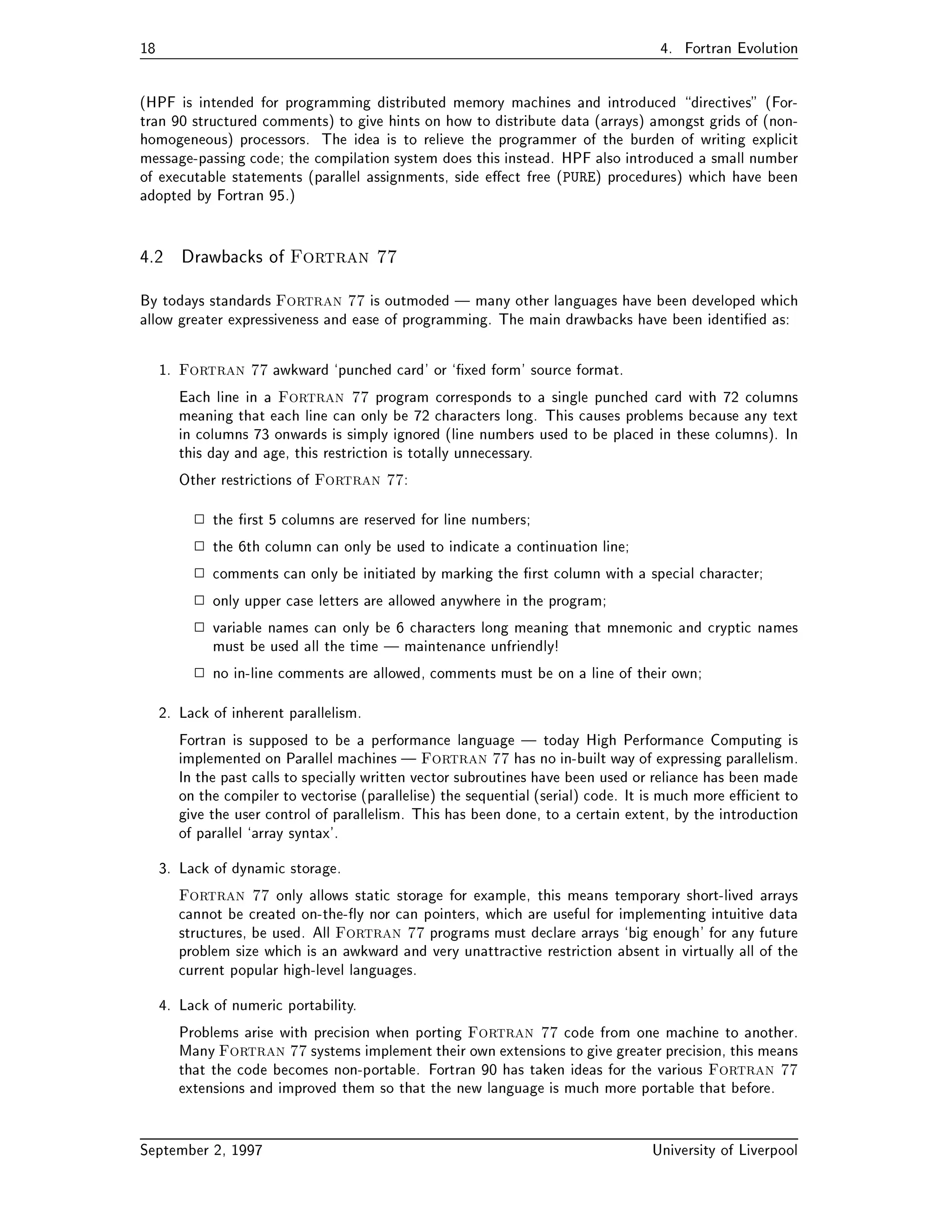
By todays standards Fortran  is outmoded  many other languages have been developed which 
allow greater expressiveness and ease of programming The main drawbacks have been identi	ed as 
 Fortran  awkward punched card or 	xed form source format 
Each line in a Fortran  program corresponds to a single punched card with 
 columns 
meaning that each line can only be 
 characters long This causes problems because any text 
in columns 
 onwards is simply ignored line numbers used to be placed in these columns In 
this day and age this restriction is totally unnecessary 
Other restrictions of Fortran  
 the 	rst  columns are reserved for line numbers 
 the th column can only be used to indicate a continuation line 
 comments can only be initiated by marking the 	rst column with a special character 
 only upper case letters are allowed anywhere in the program 
 variable names can only be  characters long meaning that mnemonic and cryptic names 
must be used all the time  maintenance unfriendly 
 no inline comments are allowed comments must be on a line of their own 
 Lack of inherent parallelism 
Fortran is supposed to be a performance language  today High Performance Computing is 
implemented on Parallel machines  Fortran  has no inbuilt way of expressing parallelism 
In the past calls to specially written vector subroutines have been used or reliance has been made 
on the compiler to vectorise parallelise the sequential serial code It is much more ecient to 
give the user control of parallelism This has been done to a certain extent by the introduction 
of parallel array syntax 
 Lack of dynamic storage 
Fortran  only allows static storage for example this means temporary shortlived arrays 
cannot be created onthey nor can pointers which are useful for implementing intuitive data 
structures be used All Fortran  programs must declare arrays big enough for any future 
problem size which is an awkward and very unattractive restriction absent in virtually all of the 
current popular highlevel languages 
 Lack of numeric portability 
Problems arise with precision when porting Fortran  code from one machine to another 
Many Fortran  systems implement their own extensions to give greater precision this means 
that the code becomes nonportable Fortran
has taken ideas for the various Fortran  
extensions and improved them so that the new language is much more portable that before 
September
University of Liverpool
New Fortran
Features
Lack of userde	ned data structures 
In Fortran  intuitive userde	ned data types were not available as they are in ADA 
Algol C Pascal etc Their presence would make programming more robust and simpler In 
Fortran  there is no way of de	ning compound objects 
 Lack of explicit recursion 
Fortran  does not support recursion which is a very useful and succinct mathematical 
technique In the past this had to be simulated using a user de	ned stack and access routines 
to manipulate stack entries Recursion is a fairly simple and a code ecient concept and was 
to all intents and purposes unavailable 

 Reliance on unsafe storage and sequence association features 
In Fortran  global data is only accessible via the notoriously opentoabuse COMMON block 
The rules which applied to COMMON blocks are very lax and the user could inadvertently do 
quite horrendous things Fortran
presents a new method of obtaining global data Another 
technique which is equally as open to abuse as COMMON blocks is that a user is allowed to alias 
an array using an EQUIVALENCE statement A great deal of errors stem for mistakes in these two 
areas which are generally regarded as unsafe however there is no real alternative in Fortran  
 New Fortran
Features 
Fortran
is a major revision of its predecessor many of the inadequacies of Fortran  have been 
addressed 
 Fortran
de	nes a new code format which is much more like every other language 
 free format  no reliance on speci	c positioning of special characters 
 upto  columns per line 
 more than one statement per line 
 inline comments allowed this makes it easier to annotate code 
 upper and lower case letters allowed makes code more readable 
 it is virtually impossible to misplace a character now 
 longer and more descriptive object names upto  characters 
 names can be punctuated by underscores making then more readable 
 Parallelism can now be expressed using whole array operations which include extensive slicing 
and sectioning facilities Arithmetic may now be performed on whole arrays and array sections 
Operations in an array valued expression are conceptually performed in parallel 
To support this feature many parallel intrinsic functions have been introduced including reduction 
operations such as SUM add all elements in an array and return one value  the sum and MAX 
VAL scan all elements in an array and return one value  the biggest This concept comes 
from APL 
The masked parallel assignment WHERE statement is also a new feature 
 The introduction of dynamic heap storage means that pointers and allocatable arrays can be 
implemented Temporary arrays can now be created onthey pointers can be used for aliasing 
arrays or sections of arrays and implementing dynamic data structures such as linked lists and 
trees 
Fortran
Course Notes File CourseNotesps
Fortran Evolution 
 To combat nonportability the KIND facility has been introduced This mechanism allows the 
user to specify the desired precision of an object in a portable way Type speci	cations can be 
parameterised meaning that the precision of a particular type can be changed by altering the 
value of one constant Appropriate intrinsic inquiry functions are de	ned to query the precision 
of given objects 
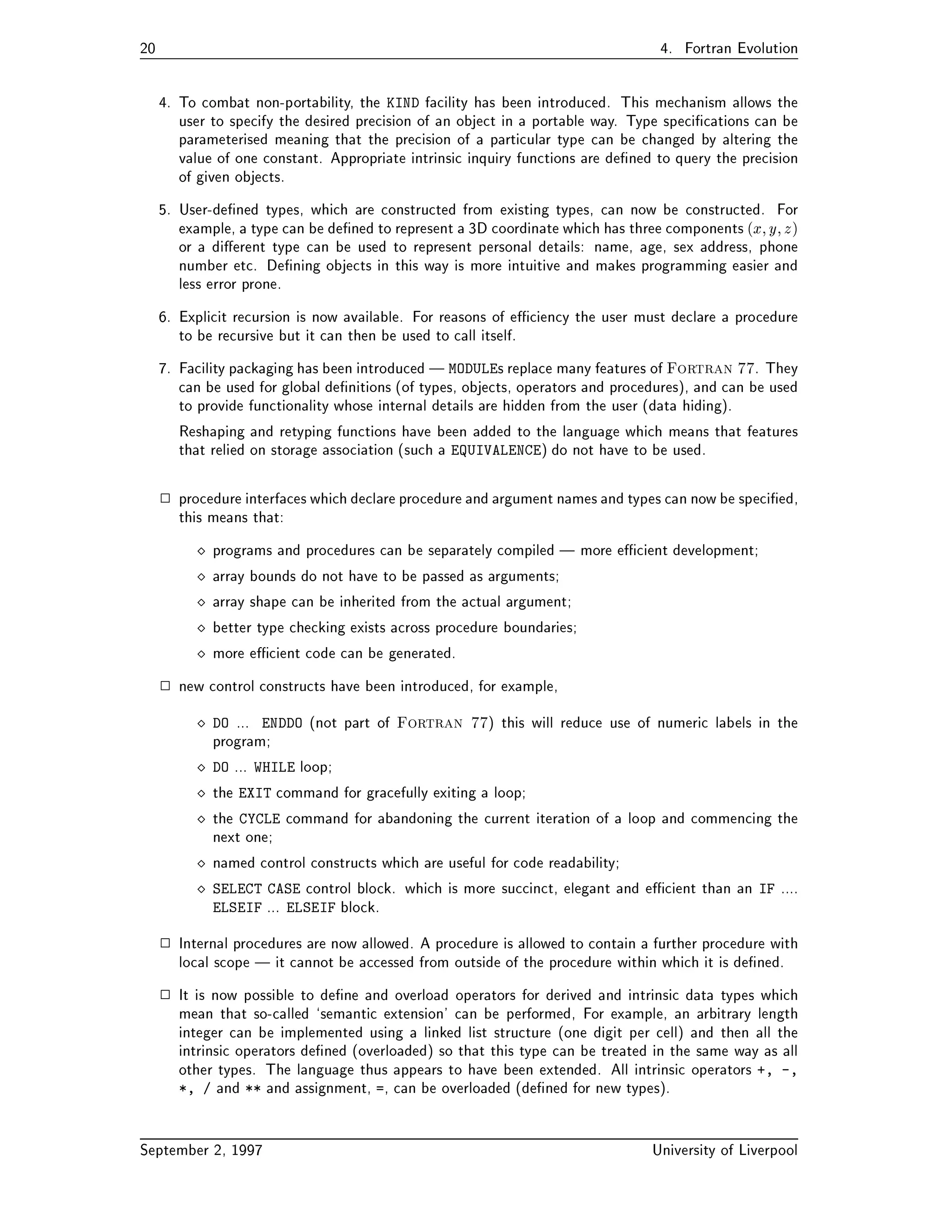
 Userde	ned types which are constructed from existing types can now be constructed For 
example a type can be de	ned to represent a D coordinate which has three components x y z
or a dierent type can be used to represent personal details name age sex address phone 
number etc De	ning objects in this way is more intuitive and makes programming easier and 
less error prone 
 Explicit recursion is now available For reasons of eciency the user must declare a procedure 
to be recursive but it can then be used to call itself 

 Facility packaging has been introduced  MODULEs replace many features of Fortran  They 
can be used for global de	nitions of types objects operators and procedures and can be used 
to provide functionality whose internal details are hidden from the user data hiding 
Reshaping and retyping functions have been added to the language which means that features 
that relied on storage association such a EQUIVALENCE do not have to be used 
 procedure interfaces which declare procedure and argument names and types can now be speci	ed 
this means that 
 programs and procedures can be separately compiled  more ecient development 
 array bounds do not have to be passed as arguments 
 array shape can be inherited from the actual argument 
 better type checking exists across procedure boundaries 
 more ecient code can be generated 
 new control constructs have been introduced for example 
 DO  ENDDO not part of Fortran  this will reduce use of numeric labels in the 
program 
 DO  WHILE loop 
 the EXIT command for gracefully exiting a loop 
 the CYCLE command for abandoning the current iteration of a loop and commencing the 
next one 
 named control constructs which are useful for code readability 
 SELECT CASE control block which is more succinct elegant and ecient than an IF  
ELSEIF  ELSEIF block 
 Internal procedures are now allowed A procedure is allowed to contain a further procedure with 
local scope  it cannot be accessed from outside of the procedure within which it is de	ned 
 It is now possible to de	ne and overload operators for derived and intrinsic data types which 
mean that socalled semantic extension can be performed For example an arbitrary length 
integer can be implemented using a linked list structure one digit per cell and then all the 
intrinsic operators de	ned overloaded so that this type can be treated in the same way as all 
other types The language thus appears to have been extended All intrinsic operators
and 

 and assignment  can be overloaded de	ned for new types 
September
University of Liverpool
Advantages of Additions  
 MODULEs also provide object based facilities for Fortran
for example it is possible to use a 
module to implement the abovementioned long integer data type  all required facilities for 
example de	nitions objects operators overloaded intrinsics and manipulation procedures may 
be packaged together in a MODULE the user simple has to USE this module to have all the features 
instantly available The module can now be used like a library unit 
 An ancillary standard The varying strings module has been de	ned and is implemented in 
a module When using this module the user can simply declare an object of the appropriate 
type VARYING STRING which can be manipulated in exactly the same fashion as the intrinsic 
character type All intrinsic operations and procedures are included in the module and are 
therefore available for all objects of this type All the implementation details are hidden from the 
user 
 useful libraries can be written and placed in a module 
 BLOCK DATA subprograms are now redundant since a MODULE can be used for the same purpose 
 Advantages of Additions 
The introduction of the previously mentioned new features have had an impact on the general standing 
of the language Fortran
can be thought of as being more natural more exible more expressive 
more usable more portable and above all safer 
Even though Fortran  is a subset of Fortran
the user should steer away from unsafe features 
of the new language Many dangerous features have been superseeded by new features of Fortran
for example 
 COMMON blocks  use a module 
 EQUIVALENCE  use TRANSFER using EQUIVALENCE also reduces portability 
 reshaping of arrays across procedure boundaries this used to be possible when using assumed 
sized arrays  use the RESHAPE function at the call site 
 retyping of arrays across procedure boundaries  use TRANSFER 
 reliance on labels has been decreased 
 	xed form source  use free form 
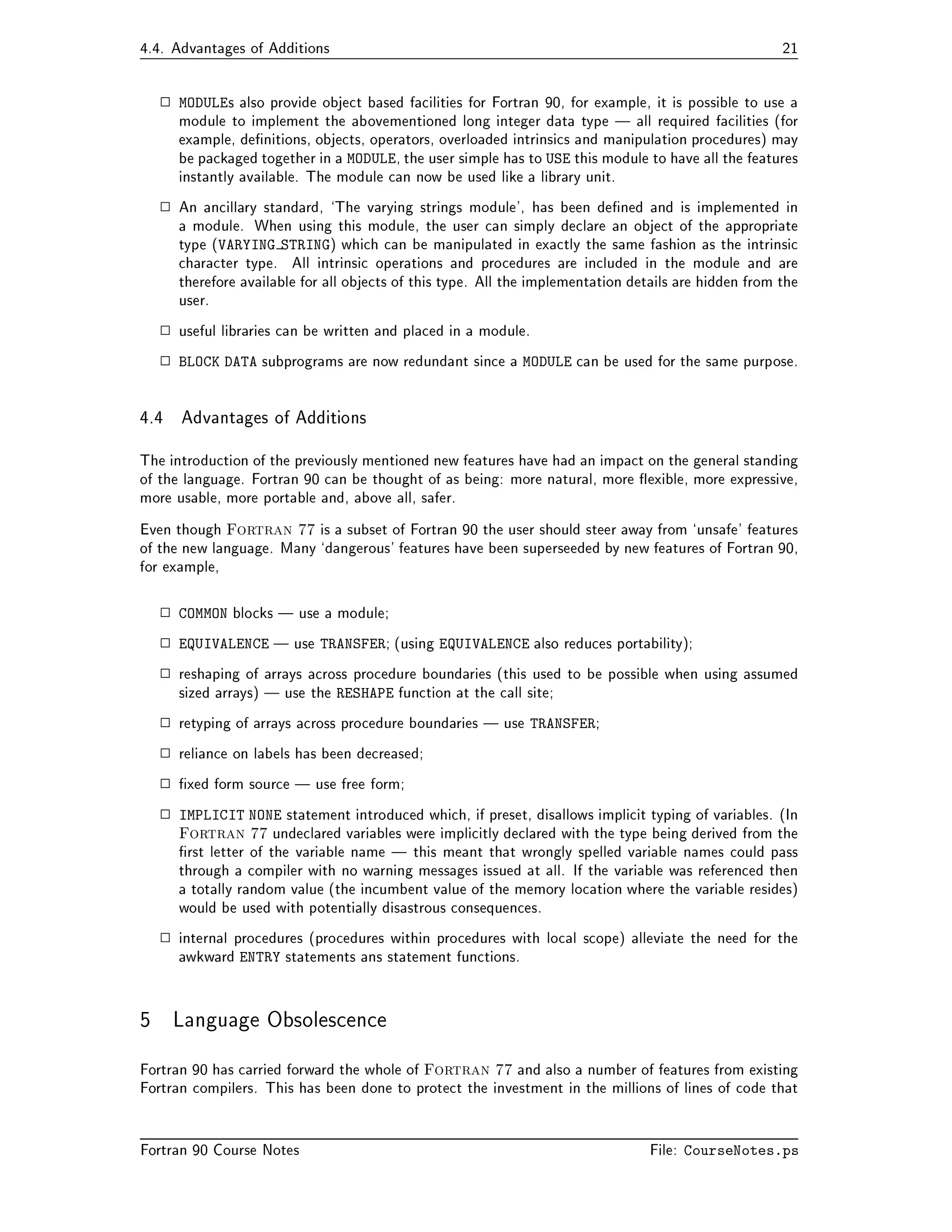
 IMPLICIT NONE statement introduced which if preset disallows implicit typing of variables In 
Fortran  undeclared variables were implicitly declared with the type being derived from the 
	rst letter of the variable name  this meant that wrongly spelled variable names could pass 
through a compiler with no warning messages issued at all If the variable was referenced then 
a totally random value the incumbent value of the memory location where the variable resides 
would be used with potentially disastrous consequences 
 internal procedures procedures within procedures with local scope alleviate the need for the 
awkward ENTRY statements ans statement functions 
 Language Obsolescence 
Fortran
has carried forward the whole of Fortran  and also a number of features from existing 
Fortran compilers This has been done to protect the investment in the millions of lines of code that 
Fortran
Course Notes File CourseNotesps
Language Obsolescence 
have been written in Fortran since it was 	rst developed Inevitably as modern features have been 
added many of the older features have become redundant and programmers especially those using 
Fortran
for the 	rst time need to be aware of the possible pitfalls in using them 
Fortran
has a number of features marked as obsolescent this means 
 they are already redundant in Fortran  
 better methods of programming already existed in the Fortran  standard 
 programmers should stop using them 
 the standards committees intention is that many of these features will be removed from the next 
revision of the language Fortran
Obsolescent Features 
Fortran
includes the whole of Fortran  as a subset warts and all but the speci	cation also 
agged some facilities as obsolescent The following features may well be removed from the next revision 
of Fortran and should not be used when writing new programs Fortran
retains the functionality of 
these features which can all be better expressed using new syntax 
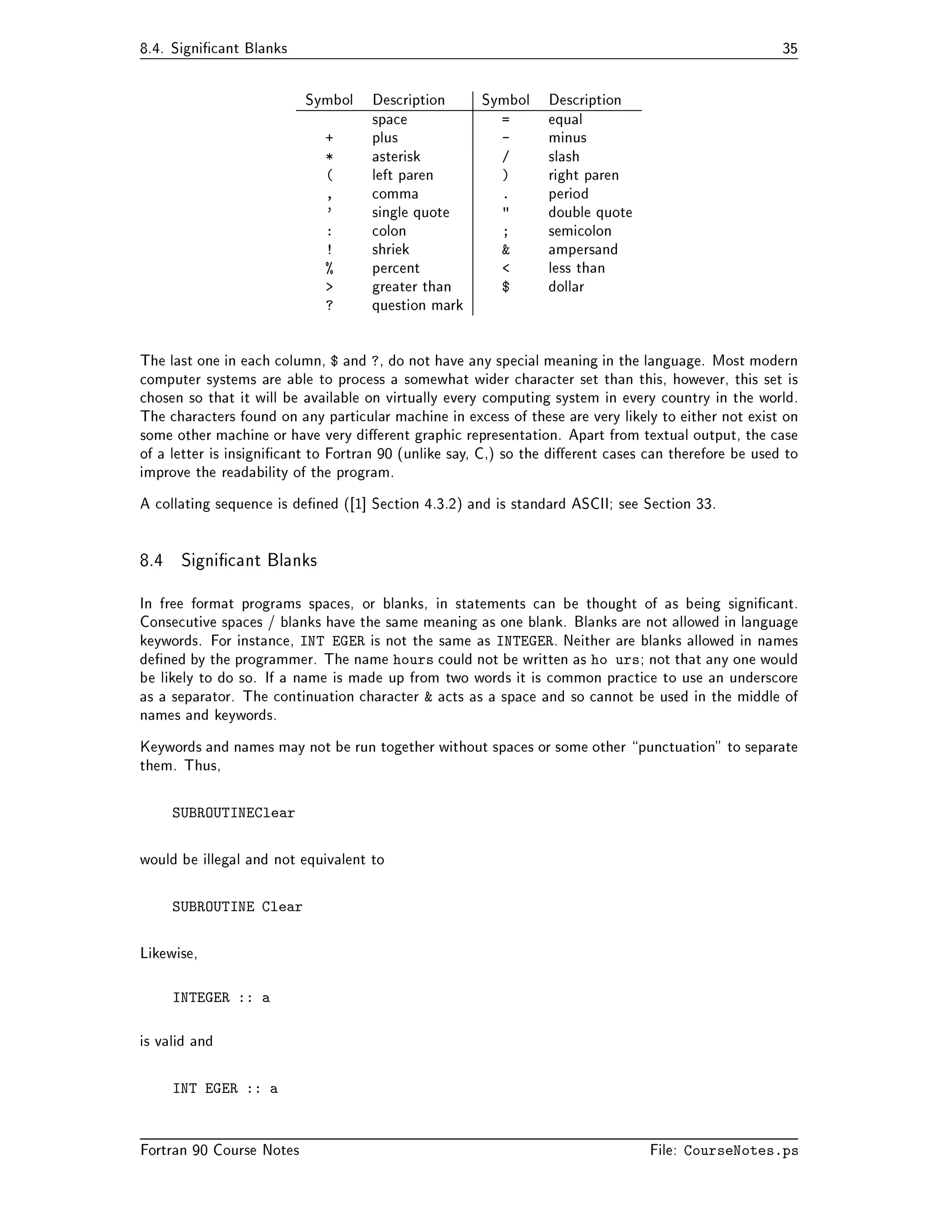
 Arithmetic IF Statement 
It is a three way branch statement of the form 
IFexpression labellabellabel 
Here expression is any expression producing a result of type INTEGER REAL or DOUBLE PRECISION 
and the three labels are statement labels of executable statements If the value of the expression is 
negative execution transfers to the statement labelled  label  If the expression is zero transfer 
is to the statement labelled label and a positive result causes transfer to label The same 
label can be repeated 
This relic of the original Fortran has been redundant since the early
s when the logical IF and 
computed GOTO were introduced and it should be replaced by an equivalent CASE or IF construct 
 ASSIGN Statement 
Used to assign a statement label to an INTEGER variable the label cannot be used as an integer though 
it is generally used in a GOTO or FORMAT statement 
ASSIGN label TO integervariable 
 ASSIGNed GOTO Statement 
Historically this was used to simulate a procedure call before Fortran had procedures  its use should 
be replaced by either an IF statement or by a procedure call 
September
University of Liverpool
Obsolescent Features  
 ASSIGNed FORMAT Statement 
The ASSIGN statement can be used to assign a label to an integer which is subsequently referred to in 
an inputoutput statement 
The same functionality can be obtained by using CHARACTER strings to hold FORMAT speci	cations 
The FORMAT speci	cation can either be this string or a pointer to this string 
 Hollerith Format Strings 
Used to represent strings in a format statement like this 
WRITE
FORMATH TITLE OF PROGRAM 
The use of Hollerith strings is outofdate as strings can now be delimited by single or double quotes 
WRITE
FORMATTITLE OF PROGRAM 
 PAUSE Statement 
PAUSE was used to suspend execution until a key was pressed on the keyboard 
PAUSE stop code 
The stop code is written out at the PAUSE new code should use a PRINT statement for the stop 
code and a READ statement which waits for input to signify that execution should recommence 

 REAL and DOUBLE PRECISION DOloop Variables 
In Fortran  REAL and DOUBLE PRECISION variables can be used in DOloop control expressions 
and index variables This is unsafe because a loop with real valued DOloop control expressions could 
easily iterate a dierent number of times on dierent machines  a loop with control expression
may loop once or twice because real valued numbers are only stored approximately  
	  could equal say  or  The 	rst evaluation would execute  times whereas the second 
would only give  execution The solution to this problem is to use INTEGER variables and construct 
REAL or DOUBLE PRECISION variables within the loop 
The following loop is obsolescent 
DO x
PRINT
INTx 
END DO 
PRINT
x 
Fortran
Course Notes File CourseNotesps
Language Obsolescence 
 Shared DOloop Termination 
A number of DO loops can currently be terminated on the same possibly executable statement  
this causes all sorts of confusion when programs are changed so that the loops do not logically end on 
a single statement any more 
IF N   GOTO  
DO  K
N 
DO  J
N 
DO  I
N 
 
 AI
J
KAI
J
K 
The simple solution is to use END DO instead
Alternate RETURN 
This allows a calling program unit to specify labels as arguments to a called procedure as shown The 
called procedure can then return control to dierent points in the calling program unit by specifying 
an integer parameter to the RETURN statement which corresponds to a set of labels speci	ed in the 
argument list 
 
CALL SUBx
y
CONTINUE 
 
 CONTINUE 
 
SUBROUTINE SUBX
Y
RETURN  
 
RETURN  
END 
Use an INTEGER return code and a GOTO statement or some equivalent control structure 

 Branching to an END IF 
Fortran  allowed branching to an END IF from outside its block this feature is deemed obsolete 
so instead control should be transferred to the next statement instead or alternatively a CONTINUE 
statement could be inserted 
 Undesirable Features 
The following features are not marked as obsolescent yet can and indeed should be expressed using 
new syntax 
September
University of Liverpool
Fixed Source Form 
Use free form source form as this is less error prone and more intuitive 
 Implicit Declaration of Variables 
Always use the IMPLICIT NONE statement in each program unit any undeclared variables will be 
reported at compile time 
 COMMON Blocks 
One of the functions of modules is to provide global data this will be expanded upon later 
 Assumed Size Arrays 
It is recommended that instead of assumedsize arrays assumedshape arrays be used in new programs 
instead With this class of array it is not necessary to explicitly communicate any information regarding 
bounds to a procedure however in this case an explicit interface must be provided If an array is to be 
reshaped or retyped across a procedure boundary then the new intrinsics RESHAPE TRANSFER PACK 
and UNPACK should be used to achieve the desired eect 
 EQUIVALENCE Statement 
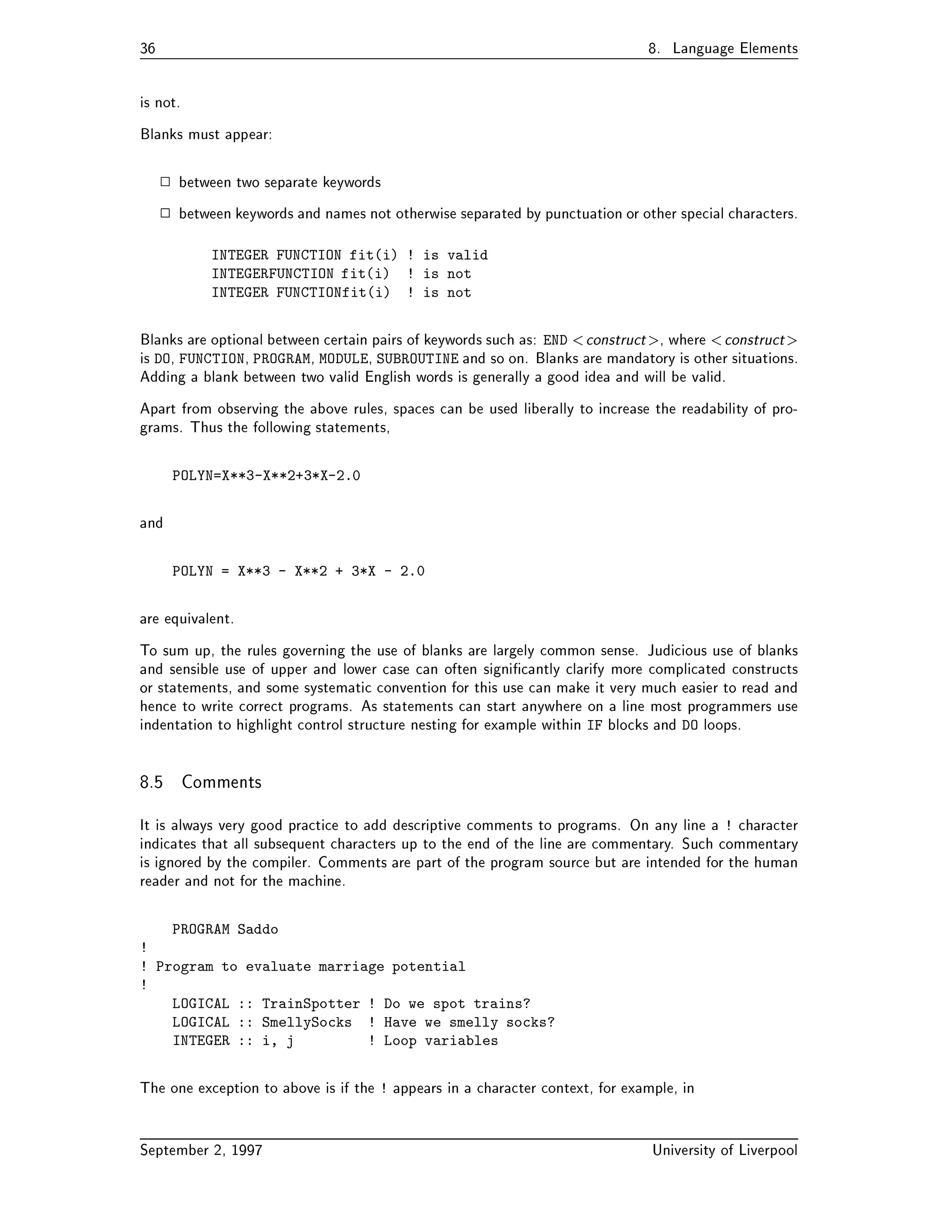
EQUIVALENCE is often used for retyping or aliasing and sometimes for simulating dynamic workspace 
This feature is considered to be unsafe and nonportable and should not be used Fortran

Uni liverpool

  • 1.
    THE U NI VE R S I T Y L IVERPOOL Fortran Course Notes AC Marshall with help from JS Morgan and JL Schonfelder Thanks to Paddy OBrien c University of Liverpool
  • 2.
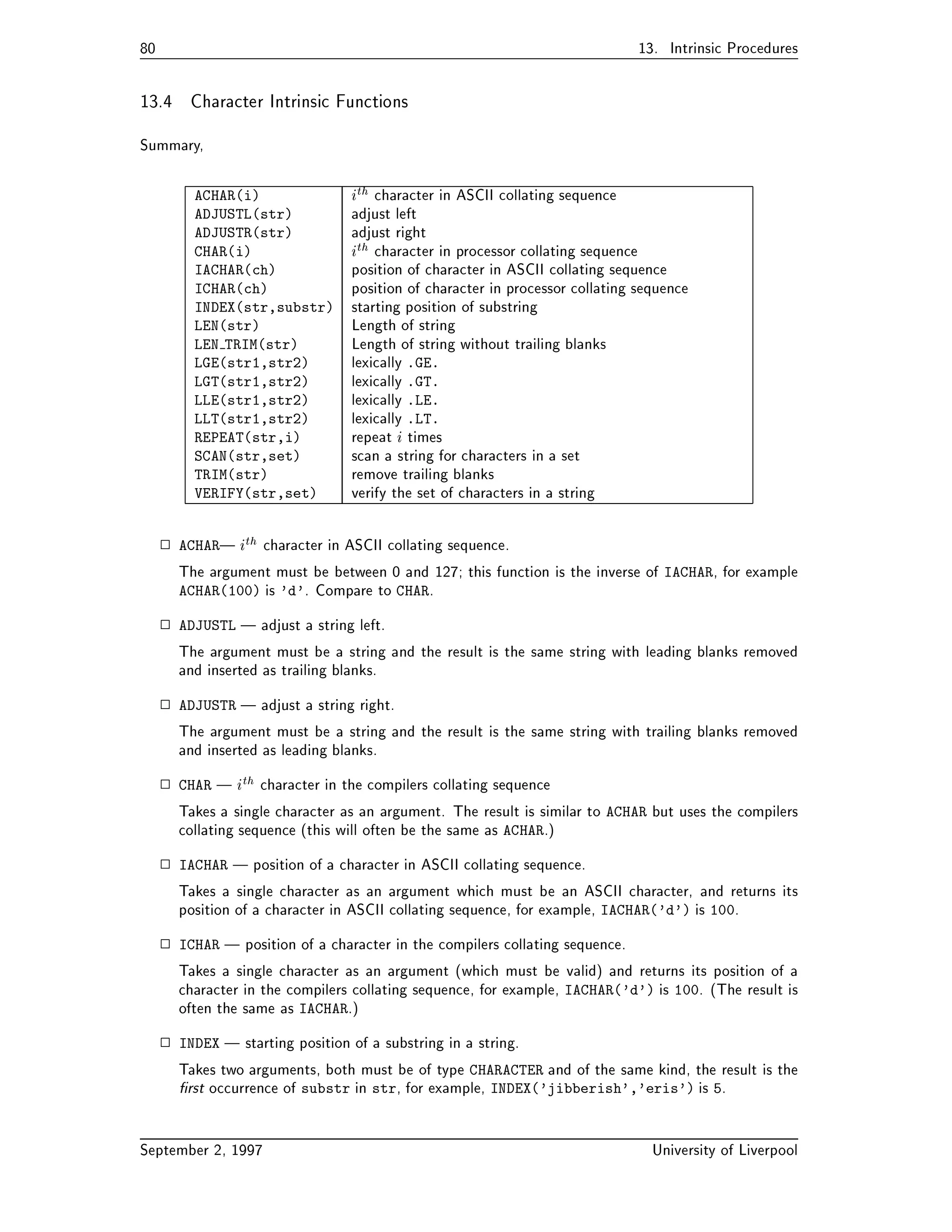
    Contents Introductionto Computer Systems What is a Computer What is Hardware and Software Telling a Computer What To Do Some Basic Terminology How Does Computer Memory Work Numeric Storage What Are Computer Programs Programming Languages Highlevel Programming Languages An Example Problem An Example Program Analysis of Temperature Program A Closer Look at the Speci cation Part A Closer Look at the Execution Part How to Write a Computer Program A Quadratic Equation Solver The Problem Speci cation The Algorithm The Program The Testing Phase Discussion
  • 3.
  • 4.
  • 5.
    Runtime Errors The Compilation Process Compiler Switches Introduction The Course i
  • 6.
    Fortran Evolution A Brief History of Fortran Drawbacks of Fortran New Fortran
  • 7.
    Features Advantages of Additions Language Obsolescence Obsolescent Features Arithmetic IF Statement ASSIGN Statement ASSIGNed GOTO Statement ASSIGNed FORMAT Statement Hollerith Format Strings PAUSE Statement REAL and DOUBLE PRECISION DOloop Variables Shared DOloop Termination
  • 8.
    Alternate RETURN Branching to an END IF Undesirable Features Fixed Source Form Implicit Declaration of Variables COMMON Blocks Assumed Size Arrays EQUIVALENCE Statement ENTRY Statement Object Oriented Programming Fortran
  • 9.
    s Object OrientedFacilities Data Abstraction Data Hiding Encapsulation Inheritance and Extensibility ii
  • 10.
    Polymorphism Reusability Comparisons with C Fortran Programming Example of a Fortran
  • 11.
    Program Coding Style Language Elements Source Form Free Format Code Character Set Signi cant Blanks Comments Names Statement Ordering Data Objects
  • 12.
  • 13.
  • 14.
  • 15.
    Numeric and LogicalDeclarations
  • 16.
  • 17.
  • 18.
  • 19.
    Examples of Declarations Expressions and Assignment Expressions Assignment Intrinsic Numeric Operations Relational Operators Intrinsic Logical Operations Intrinsic Character Operations iii
  • 20.
    Character Substrings Concatenation Operator Precedence Precedence Example
  • 21.
    Precision Errors Control Flow IF Statement IF Construct Nested and Named IF Constructs Conditional Exit Loops Conditional Cycle Loops Named and Nested Loops DO WHILE Loops Indexed DO Loop Examples of Loop Counts
  • 22.
    Scope of DOVariables SELECT CASE Construct Mixing Objects of Di erent Types Mixed Numeric Type Expressions Mixed Type Assignment Integer Division Intrinsic Procedures Type Conversion Functions Mathematical Intrinsic Functions Numeric Intrinsic Functions Character Intrinsic Functions Simple Input Output PRINT Statement READ Statement iv
  • 23.
    Arrays Array Terminology Declarations Array Conformance Array Element Ordering Array Syntax Whole Array Expressions Visualising Array Sections Array Sections
  • 24.
    Printing Arrays Input of Arrays Array IO Example Array Inquiry Intrinsics Array Constructors The RESHAPE Intrinsic Function Array Constructors in Initialisation Statements Allocatable Arrays Deallocating Arrays Masked Assignment Where Statement Masked Assignment Where Construct
  • 25.
    Vectorvalued Subscripts Selected Intrinsic Functions Random Number Intrinsic Vector and Matrix Multiply Intrinsics Maximum and Minimum Intrinsics Array Location Intrinsics Array Reduction Intrinsics Program Units Main Program Syntax Main Program Example v
  • 26.
    Procedures Subroutines Functions Argument Association Local Objects Argument Intent Scope Host Association Example of Scoping Issues
  • 27.
    SAVE Attribute Keyword Arguments Optional Arguments Optional Arguments Example Procedures and Array Arguments Explicitshape Arrays Assumedshape Arrays Automatic Arrays SAVE Attribute and Arrays Explicit Length Character Dummy Arguments Assumed Length Character Dummy Arguments Arrayvalued Functions Charactervalued Functions
  • 28.
    Side Eect Functions Recursive Procedures Recursive Function Example Recursive Subroutine Example Object Orientation
  • 29.
  • 30.
  • 31.
  • 33.
  • 34.
  • 35.
    USE ONLY Statement Modules Modules General Form Pointers and Targets Pointer Status Pointer Declaration Target Declaration Pointer Manipulation Pointer Assignment Pointer Assignment Example Association with Arrays Dynamic Targets Automatic Pointer Attributing
  • 36.
    Association Status Pointer Disassociation Pointers to Arrays vs Allocatable Arrays Practical Use of Pointers Pointers and Procedures Pointer Valued Functions Pointer I O Derived Types Supertypes Derived Type Assignment Arrays and Derived Types Derived Type IO Derived Types and Procedures Derived Type Valued Functions POINTER Components of Derived Types vii
  • 37.
    Pointers and Lists Linked List Example
  • 38.
  • 39.
    Type and ProcedurePackaging Derived Type Constructors Generic Procedures Generic Interfaces Commentary Derived Type IO Overloading Intrinsic Procedures Overloading Operators Operator Overloading Example De ning New Operators De ned Operator Example Precedence Userde ned Assignment De ned Assignment Example Semantic Extension Example Yet Another Example More on Object Oriented Programming by J S Morgan
  • 40.
  • 41.
    Semantic Extension Example Complex Data Type Complex Intrinsics Parameterised Intrinsic Types Integer Data Type by Kind Constants of Selected Integer Kind Real KIND Selection Kind Functions Expression Evaluation Logical KIND Selection viii
  • 42.
    Character KIND Selection Kinds and Procedure Arguments
  • 43.
    Kinds and GenericInterfaces More Intrinsics Bit Manipulation Intrinsic Functions Array Construction Intrinsics MERGE Intrinsic SPREAD Intrinsic PACK Intrinsic UNPACK Intrinsic TRANSFER Intrinsic Input Output OPEN Statement READ Statement WRITE Statement FORMAT Statement FMT Speci er Edit Descriptors Other IO Statements External Procedures External Subroutine Syntax External Subroutine Example External Function Syntax Function Example Procedure Interfaces Interface Example Required Interfaces Procedure Arguments The INTRINSIC Attribute The EXTERNAL Attribute Procedure Arguments Example ix
  • 44.
  • 45.
  • 46.
  • 47.
    Data Statement Implied DO Loop Handling Exceptions GOTO Statement GOTO Statement Example RETURN and STOP Statements Fortran Rationale by Craig Dedo FORALL Nested WHERE Construct PURE Procedures Elemental Procedures Improved Initialisations Automatic Deallocation New Initialisation Features Remove Conicts With IEC
  • 48.
    Minimum Width Editing Namelist CPU TIME Intrinsic Subroutine MAXLOC and MINLOC Intrinsics Deleted Features New Obsolescent Features Language Tidyups High Performance Fortran Compiler Directives Visualisation of Data Directives ASCII Collating Sequence x
  • 49.
  • 50.
    Module FundamentalsOf Computer Programming Introduction to Computer Systems What is a Computer The following schematic diagram gives the layout of a Personal Computer PC most single user systems follow this general design VDU Main memory CPU Disc drive Keyboard The components perform the following tasks CPU Central Processor Unit does the work fetches stores and manipulates values that are stored in the computers memory Processors come in all dierent shapes and sizes there are many dierent types of architectures which are suited to a variety of dierent tasks We do not consider any particular type of CPU is this course Main memory RAM Random Access Memory used to store values during execution of a program It can be written to and read from at any time
  • 51.
    Introduction to ComputerSystems Disc drive hard or oppy permanently stores les programs and data Hard discs are generally located inside the machine and come in a variety of dierent sizes and speeds They do not in fact store les permanently they often go wrong and so must undergo a backup at regular intervals The oppy disc drive allows a user to make his or her own back up of important les and data It is very important to keep backups Do not be caught out you may well lose all your work Keyboard allows user to input information Nowadays most keyboards have more or less the same functionality VDU Visual Display Unit visually outputs data There are numerous types of VDU diering in the resolution dots per inch and the number of colours that can be represented Printer allows a hard copy to be made Again there are many dierent types of printers available for example line printers dotmatrix printers bubble jet printers and laser printers These also dier in their resolution and colour palette The last four are known as peripheral devices A good PC could contain Intel Pentium P CPU MBytes RAM main memory GByte hard disc SVGA monitor IBM PC keyboard In addition a system may include printer for example an HP LaserJet soundcard and speakers CD ROM drive Read Only Memory SCSI scuzzy disc fast oppy disc drive for backing up data network card What is Hardware and Software A computer system is made up from hardware and software Hardware is the physical medium for example circuit boards processors September
  • 53.
  • 54.
    Telling a ComputerWhat To Do keyboard A piece of software is a computer program for example an operating system an editor a compiler a Fortran
  • 55.
    program The softwareallows the hardware to be used Programs vary enormously in size and complexity Telling a Computer What To Do To get a computer to perform a speci c task it must be given a sequence of unambiguous instructions or a program We meet many examples of programs in everyday life for example instructions on how to assemble a bedside cabinet These instructions are generally numbered meaning that there is a speci c order to be followed they are also supposed to be precise so that there is no confusion about what is intended insert the spigot into hole A apply glue along the edge of side panel press together side and top panels attach toggle pin B to gromit C and so on If these instructions are not followed to the letter then the cabinet would turn out wonky Some Basic Terminology It is necessary to cover some terminology Hopefully much of it will be familiar you will hear many of the terms used throughout the course Bit is short for Binary Digit Bits have value of or or on or o or true or false Bits make up Byte Bytes make up KByte KiloByte or K Why I hear you ask Because KBytes make up MByte MagaByte or M MBytes make up GByte GigaByte or G all machines have a wordsize a fundamental unit of storage for example bits bits etc The size of a word in Bytes diers between machines A Pentium based machine is bit Fortran
  • 56.
    Course Notes FileCourseNotesps
  • 57.
    Introduction to ComputerSystems a op is a oating point operation per second A oating point operation occurs when two real numbers are added Today we talk of megaops or even gigaops parallel processing occurs when two or more CPUs work on solution of the same problem at the same time How Does Computer Memory Work In this hypothetical example wordsize is taken to be bits 3F29 1 0 1 0 1 1 1 0 3F2A 3F2B 3F2C A computers memory is addressable Each location is given a speci c number which is often repre sented in hexadecimal base for example FC Hexadecimal digits are as follows
  • 58.
    A B CD E F
  • 59.
    A B F The CPU is able to read to and write from a speci ed memory location at will Groups of memory locations can be treated as a whole to allow more information to be stored Using the cryptic hexadecimal identi ers for memory locations is very awkward so Fortran
  • 60.
    allows English namesto be used instead this allows programs to make sense to a casual reader Even when the computer has just been turned on each memory location will contain some sort of value In this case the values will be random In the general case the values will be those that remain from the previous program that used the memory For this reason it is very important to initialise memory locations before trying to use the values that they are storing All CPUs have an instruction set or language that they understand Eventually all Fortran
  • 61.
    programs must betranslated or compiled into instructions from this set Roughly speaking all processors have the same sort of instructions available to them The CPU can say things like fetch me the contents of memory location FC or write this value to location AF This is the basis of how all programs work Consider the following sequence of assembler code instructions LDA FC load fetch the contents of FC ADD F add to this the contents of F STO FA store the value in location FA The sequence of instructions which is meant only for illustrative purposes eectively adds two numbers together and stores the result in a separate memory location Until
  • 62.
    when the rstdialect of Fortran was developed all computer programs were written using assembler code It was John Backus then working for IBM who proposed that a more economical and ecient method of programming their computer should be developed The idea was to design a language that made it possible to express mathematical formulae in a more natural way than that currently supported by assembler languages The result of their experiment was Fortran short for IBM Mathematical Formula Translation System This new language allowed the above assembler instructions to be written less cryptically as for example K I J September
  • 64.
  • 65.
    Numeric Storage A compiler would then translate the above assignment statement into something that looks like the assembler code given above Numeric Storage In general there are two types of numbers used in Fortran
  • 66.
    programs INTEGERs wholenumbers and REALs oating point numbers INTEGERs are stored exactly usually in range however they are not stored in the format hinted at in the previous section but in a special way that allows addition and subtraction to be performed in a straightforward way REALs are stored approximately and the space they occupy is partitioned into a mantissa and an exponent In the following number the mantissa is and the exponent is In a REAL number the exponent can only take a small range of values if the exponent is expected to be large then it may be necessary to use a numeric storage unit that is capable of representing larger values for example DOUBLE PRECISION values It is possible for a program to throw a numeric exception such as overow which occurs when number is outside of supported range for example a real number where exponent is too big or underow which is the opposite the number is too close to zero for representation for example a real number where the exponent is too small In Fortran
  • 67.
    the KIND mechanismallows the user to specify what numeric range is to be supported This allows programs to be numerically portable Dierent computer systems will allow numbers of diering sizes to be represented by one word It is possible that when a program has been moved from one computer system to another it may fail to execute correctly on the new system because underow or overow exceptions are generated The KIND mechanism combats this serious problem CHARACTERs variables are stored dierently What Are Computer Programs Programming Languages Computers only understand binary codes so the rst programs were written using this notation This form of programming was soon seen to be extremely complex and error prone so assembler languages were developed Soon it was realised that even assembler languages could be improved on Today a good programming language must be totally unambiguous unlike natural languages for example English old women and men suck eggs does this mean that men or old men suck eggs expressive it must be fairly easy to program common tasks practical it must be an easy language for the compiler to translate simple to use All programming languages have a very precise syntax or grammar This will ensure that a syntacticallycorrect program only has a single meaning Fortran
  • 68.
    Course Notes FileCourseNotesps
  • 69.
    What Are ComputerPrograms Highlevel Programming Languages Assembler code is a LowLevel Language It is socalled because the structure of the language reects the instruction set and architecture of the CPU A programmer can get very close to the physical hardware Lowlevel languages allow very ecient use of the machine but are dicult to use Fortran
  • 70.
    Fortran ADAC and Java are examples of HighLevel Languages They provide a much higher degree of abstraction from the physical hardware They also allow for portable programs to be written ie programs that will run on a variety of dierent systems and which will produce the same results regardless of the platform As well as having the above bene ts highlevel languages are more expressive and secure and are much quicker to use than lowlevel languages In general however a well written assembler program will run faster than a highlevel program that performs the same task At the end of the day an executable program that runs on a CPU must still be represented as a series of binary digits This is achieved by compiling translating a highlevel program with a special piece of software called a compiler Compilers are incredibly complicated programs that accept other programs as input and generate a binary executable object le as output An Example Problem Consider the following problem which is suitable for solution by computer To convert from oF Fahrenheit to oC Centigrade we can use the following formula c f
  • 71.
    To convert fromoC to K Kelvin we add A speci cation of the program could be that it would prompt the user for a temperature expressed in degrees Fahrenheit perform the necessary calculations and print out the equivalent temperatures in Centigrade and Kelvin An Example Program A program which follows the above speci cation is given below PROGRAM Temp Conversion IMPLICIT NONE INTEGER Deg F
  • 72.
  • 73.
  • 74.
    Please type inthe temp in F READ
  • 75.
    Deg F Deg C Deg F PRINT
  • 76.
  • 77.
  • 78.
    C K Deg C PRINT
  • 79.
  • 80.
  • 81.
    K END PROGRAMTemp Conversion This program in this case called Tempf can be compiled using the NAg v Fortran
  • 82.
    compiler The compileris invoked on the Unix command line as follows September
  • 84.
  • 85.
    Analysis of TemperatureProgram chadadamm f Tempf NAg Fortran compiler v New Debugger dbx If the program has been written exactly as above then there will not be any error messages or diag nostics The case where a program contains mistakes will be covered later The compiler produces executable code which is stored by default in a le called aout It is possible to give this le a dierent name this is discussed later The executable le can be run by typing its name at the Unix prompt chadadamm aout Please type in the temp in F This is equal to C and K The program will start executing and will print out Please type in the temp in F on the screen the computer will then wait for a value to be entered via the keyboard As soon as the required input has been supplied and the Return key pressed the program will continue Almost instantaneously the equivalent values in Centigrade and Kelvin will appear on the screen Analysis of Temperature Program The code is delimited by PROGRAM END PROGRAM statements in other words these two lines mark the beginning and end of the code Between these lines there are two distinct areas Specication Part This is the area of the program that is set aside for the declarations of the named memory locations or variables that are used in the executable area of the program As well as supplying variable names it is also necessary to specify the type of data that a particular variable will hold This is important so that the compiler can work out how store the value held by a variable It is also possible to assign an initial values to a variable or specify that a particular memory location holds a constant value a readonly value that will not change whilst the program is executing These techniques are very useful Execution Part This is the area of code that performs the useful work In this case the program does the following prompts the user for input reads input data Deg F calculates the temperature in oC prints out this value calculates the temperature in Kelvin and prints out this value Fortran
  • 86.
    Course Notes FileCourseNotesps
  • 87.
    What Are ComputerPrograms A Closer Look at the Speci cation Part There are a couple more points that should be raised The IMPLICIT NONE statement should always be present in every Fortran
  • 88.
    program unit Itspresence means that all variables mentioned in the program must be declared in the speci cation part A common mistake whilst coding is to mistype a variable name if the IMPLICIT NONE statement is not present then the compiler will assume that the mistyped variable name is a new hitherto unmentioned variable and will use whatever value happened to be in the memory location that the variable refers to An error such as this caused the US Space Shuttle to crash The third line of the program declares three INTEGER whole number variables there are a number of other variable types that can be used in dierent situations REAL real numbers ie no whole numbers eg REAL variables can hold larger numbers than INTEGERs LOGICAL can only take one of two vaules TRUE or FALSE CHARACTER contains single alphanumeric character eg a CHARACTERLENcontains alphanumeric characters A number of consecutive alphanu meric characters are known as a string user de ned types combination of the above see later Fortran
  • 89.
    is not casesensitive K is the same as k A Closer Look at the Execution Part Let us now look at the part of the program that does the actual work PRINT
  • 90.
    Please type inthe temp in F writes the string between the quotes to the VDU screen READ
  • 91.
    Deg F reads a value from the keyboard and assigns it to the INTEGER variable Deg F Deg C Deg F this is an assignment statement The expression on the RHS is evaluated and then assigned to the INTEGER variable Deg C This statement contains a number of operators is the multiplication operator is the subtraction operator is the assignment operator The Fortran
  • 92.
    language also contains and operators for addition and division Division is much harder than any other operation for a CPU to perform it takes longer so uses more resources for example if there is a choice between dividing by or multiplying by the latter should be selected PRINT
  • 93.
  • 94.
  • 95.
    C displaysa string on the screen followed by the value of a variable Deg C followed by a second string C By default input is from the keyboard and output to the screen September
  • 97.
  • 98.
    How to Writea Computer Program
  • 99.
    How to Writea Computer Program There are four general phases during the development of any computer program specify the problem analyse and break down into a series of steps towards solution ie design an algorithm write the Fortran
  • 100.
    code compileand run ie test the program When writing a computer program it is absolutely vital that the problem to be solved is fully understood A good percentage of large programming projects run into trouble owing to a misunderstanding of what is actually required The speci cation of the problem is crucial It is usual to write a detailed spec of the problem using a natural language eg English Unfortunately it is very easy to write an ambiguous speci cation which can be interpreted in a number of ways by dierent people In order to combat this a number of Formal Methods of speci cation have been developed These methods are often highlevel abstract mathematical languages which are relatively simple to convert to highlevel programs in some cases this can be done automatically Examples of such languages are Z and VDM We do not propose to cover such speci cation languages here For the purposes of learning Fortran
  • 101.
    a simple naturallanguage speci cation is adequate Once the problem has been speci ed it needs to be broken down into small steps towards the solution in other words an algorithm should be designed It is perfectly reasonable to use English to specify each step This is known as pseudocode The next two phases go handinhand they are often known as the codetestdebug cycle and it is often necessary to perform the cycle a number of times It is very rare that a program is written correctly on the rst attempt It is common to make typographical errors which are usually unearthed by the compiler Once the typos have been removed the program will be able to be compiled and an executable image generated Again it is not uncommon for execution to expose more errors or bugs Execution may either highlight runtime errors which occur when the program tries to perform illegal operations eg divide by zero or may reveal that the program is generating the wrong answers The program must be thoroughly tested to demonstrate that it is indeed correct The most basic goal should be to supply test data that executes every line of code There are many software tools that generate statistical reports of code coverage such as the Unix tcov utility or the more comprehensive LDRA Testbed A Quadratic Equation Solver This section shows the various steps that are needed when designing and writing a computer program to generate the roots of a quadratic equation The Problem Speci cation Write a program to calculate the roots of a quadratic equation of the form ax bx c Fortran
  • 102.
    Course Notes FileCourseNotesps
  • 103.
    What Are ComputerPrograms The roots are given by the following formula x b pb ac a The Algorithm READ the values of the coecients a b and c from the keyboard if a is zero then stop as we do not have a quadratic equation calculate value of discriminant D b ac if D is zero then there is one root b a if D is then there are two real roots bpD pD a a and b if D is there are two complex roots bip D and bip a D a PRINT solution The Program The following program is one solution to the problem PROGRAM QES IMPLICIT NONE INTEGER a
  • 104.
  • 105.
  • 106.
    D REAL Real Part
  • 107.
  • 108.
  • 109.
    b and c READ
  • 110.
  • 111.
  • 112.
    c IF a THEN Calculate discriminant D b b a c IF D THEN one root PRINT
  • 113.
  • 114.
    b a ELSE IFD THEN real roots PRINT
  • 115.
  • 116.
  • 117.
  • 118.
    bSQRTREALD a ELSE complex roots Real Part b a Since D
  • 119.
    calculate SRQT ofD which will be ve Imag Part SQRTREALD a PRINT
  • 120.
  • 121.
  • 122.
  • 123.
  • 124.
  • 125.
  • 126.
  • 127.
    i END IF ELSE a a is equal to so PRINT
  • 128.
    Not a quadraticequation END IF END PROGRAM QES September
  • 130.
  • 131.
    The Testing Phase The Testing Phase As the basic goal we want to ensure that each and every line of the program has been executed Looking at the code we need the following test cases discriminant greater than zero real valued roots discriminant equals zero single real valued root discriminant less than zero complex valued roots coecient a is zero not a quadratic equation These four situations can be seem to correspond to each of the four PRINT statements in the program The following values of coecients should exercise each of these lines a b and c a b and c a b and c a b and c Below is what happens when the above test data is supplied as input to our program uxaadamm aout Type in values for a
  • 132.
    b and c Roots are and uxaadamm aout Type in values for a
  • 133.
    b and c Root is uxaadamm aout Type in values for a
  • 134.
    b and c st Root i nd Root i uxaadamm aout Type in values for a
  • 135.
    b and c Not a quadratic equation It can be seen that every line has been executed and in each case the correct results have been produced Discussion The previous program introduces some new ideas Fortran
  • 136.
    Course Notes FileCourseNotesps
  • 137.
    What Are ComputerPrograms comments anything on a line following a is ignored Comments are added solely for the bene t of the programmer often a program will be maintained by a number of dierent people during its lifetime Adding useful and descriptive comments will be invaluable to anybody who has to modify the code There is nothing wrong with having more comments in a program than there are executable lines of code IF construct dierent lines are executed depending on the value of the Boolean expression IF statements and constructs are explained more fully in Sections and relational operators is equal to or is greater than Relational operators see allow comparisons to be made between variables There are six such operators for use between numeric variables the remaining four are greater than or equal to not equal to less than less than or equal to These operators can also be written in nonsymbolic form these are EQ GT GE NE LT and LE respectively nested constructs one control construct can be located inside another This is explained more fully in Section procedure call SQRTX returns square root of X A procedure is a section of code that performs a speci c and common task Calculating the square root of a number is a relatively common requirement so the code to do this has been written elsewhere and can be called at any point in the program This procedure requires an argument X to be supplied this is the number that is to be square rooted In this case the routine is an intrinsic procedure this means that it is part of the Fortran
  • 138.
    language itself every compiler is bound to include this procedure For more information see Section type conversion in the above call the argument X must be REAL this is speci ed in the Fortran
  • 139.
    standard language de nitionIn the program D is INTEGER REALD converts D to be real valued so that SQRT can be used correctly For a more detailed explanation see Section Another useful technique demonstrated here is the precalculation of common subexpressions for example in order to save CPU time we only calculate the discriminant D once
  • 140.
    Software Errors Errorsare inescapable There are two types of error compiletime or syntax errors and runtime errors Errors are often known as bugs because one of the very earliest computers started producing the wrong answers when a moth ew inside it and damaged some of its valves
  • 141.
    Compiletime Errors Inquadratic equation solver program if we accidentally mistyped a variable name Rael Part b a September
  • 143.
  • 144.
    The Compilation Process then the compiler would generate a syntax error uxaadamm f Quadf NAg Fortran compiler v Error Quadf
  • 145.
    line Implicittype for RAEL PART detected at RAEL PART Error Quadf
  • 146.
    line SymbolREAL PART referenced but never set detected at QESendofstatement f terminated errors found by pass The compiler is telling us that RAEL PART has not been given an explicit type in other words it has not been declared in the speci cation area of the code It is also telling us that we are trying to print out the value of REAL PART but that we have not actually assigned anything to it As you can see from the above compiler output error messages tend to be obtuse at times A sign of a good compiler is one that can give speci c and useful error messages rather than simply telling you that your program doesnt make sense
  • 147.
    Runtime Errors Ifwe had made the following typo in our quadratic equation solver Real Part b a then the program would compile but upon execution we would get a runtime error uxaadamm aout Type in values for a
  • 148.
    b and c Arithmetic exception Floating divide by zero aborting Abort the program is telling the CPU to divide b by zero a As this is impossible our program crashes and an error message is sent to the screen It is runtime errors like this that mean it is absolutely essential to thoroughly test programs before committing them for serious use It is also possible to write a program that gives the wrong results this is likely to be a bug in the algorithm The Compilation Process The NAg Fortran
  • 149.
    compiler is invokedby f followed by the lename of the program to be compiled f Quadf This command Fortran
  • 150.
    Course Notes FileCourseNotesps
  • 151.
    What Are ComputerPrograms checks the program syntax generates object code passes object code to linker which attached libraries system IO etc and generates executable code in a le called aout Step attaches code which deals with amongst other things mathematical calculations and input from the keyboard and output to the screen This code which is resident in a system library is used with all available compilers in other words the same IO library will be used with C ADA or C programs This alleviates the need for each compiler to include a separate instance of these IO routines It is possible that this step may give a linker error if procedures used in the code cannot be found in a library Executable code is processor speci c Code complied for an Intel Pentium will not run an a Sun SPARC and viceversa If a program is moved to a dierent platform then it will need to be recompiled If the program conforms to the Fortran
  • 152.
    standard then thesource code will not need editing at all Some compilers accept extensions to the Fortran
  • 153.
    standard If anyof these extensions are used the program will be nonstandard conforming and may need signi cant rewriting when compiled on a dierent platform or by a dierent compiler Compiler Switches All compilers can be invoked with a number of dierent options The eect of these options is explained in the man pages or in the compiler manual The NAg compiler has a number for example o outputlename gives executable a dierent name for example Quad f Quadf o Quad dryrun show but do not execute commands constructed by the compiler hpf accept the extensions to Fortran
  • 154.
    as speci ed bythe High Performance Fortran Forum info level set level of information messages generated by the compiler from to
  • 155.
    time report executiontimes f Quadf o Quad time For more information about the compiler type man f Question Compilation and Editing The following program calculates the roots of a quadratic equation September
  • 157.
  • 158.
    Compiler Switches PROGRAM QES IMPLICIT NONE INTEGER a
  • 159.
  • 160.
  • 161.
    D REAL Real Part
  • 162.
  • 163.
  • 164.
    b and c READ
  • 165.
  • 166.
  • 167.
    c IF a THEN Calculate discriminant D b b a c IF D THEN one root PRINT
  • 168.
  • 169.
    b a ELSE IFD THEN real roots PRINT
  • 170.
  • 171.
  • 172.
  • 173.
    bSQRTREALD a ELSE complex roots Real Part b a Imag Part SQRTREALD a PRINT
  • 174.
  • 175.
  • 176.
  • 177.
  • 178.
  • 179.
  • 180.
  • 181.
    i END IF ELSE a PRINT
  • 182.
    Not a quadraticequation END IF END PROGRAM QES Using an editor type the above program into a le called QuadSolverf Compile and run the program Verify the correctness of the code by supplying the following test data a a b and c b a b and c c a b and c d a b and c Copy QuadSolverf into a new le called NewQuadSolverf Edit this le and declare a new REAL variable called one over a In the executable part of the code set one over a to be equal to the value of a Where ever this expression occurs replace it with one over a Why is this a good idea De ne another new REAL variable called sqrt D and where appropriate precalculate SQRTREALD and substitute this new variable in place of this expression Use a dierent set of test data to that given above to convince yourself that NewQuadSolverf is a correct program Change the name of the program to be FinalQuadSolverf and compile the code to produce an executable le called FinalQuadSolver
  • 183.
    Delete the originalprogram QuadSolverf and the executable le aout Question The Hello World Program Write a Fortran
  • 184.
    program to printout Hello World on the screen Fortran
  • 185.
    Course Notes FileCourseNotesps
  • 186.
    Module Introductionto Fortran Introduction Fortran has been widely used by scientists and engineers for a number of years now It has been a very successful language but is now showing signs of age in the last few years there has been a tendency for people to drift away from Fortran and begin to use C Ada or C The Fortran standard has now been revised to bring it up to date with a new improved language known informally as Fortran
  • 187.
    being de ned Comparisonshave been rightly drawn between the new Fortran standard and APL ADA and C All three languages contain elements which make them the avour of the month they are to some degree object oriented The criteria for what makes a language actually object oriented is debatable but the new operator overloading user de ned typing and MODULE packaging features of Fortran
  • 188.
    certainly help toforward its case Along with ADA and APL it uses the concept of array operations and reduction operators Fortran
  • 189.
    also supports userde ned generic procedures to enhance usability but these are implemented in a simpler and more ecient way than in ADA Here we highlight the new Fortran
  • 190.
    features which makelanguage more robust and usable for example of those mentioned above many are objectbased facilities which make it more dicult to make mistakes or do daft things Fortran
  • 191.
    is also comparableto ADA in the sense that it too has many restrictions detailed in the standard document meaning that mistakes which in other languages such as C C and Fortran would be syntactically correct but cause an odd action to be taken are ruled out at compile time As an example of this if explicit interfaces are used then it is not possible to associate dummy and actual arguments of dierent types this was possible in Fortran and was sometimes used in anger but generally indicated an error The Course Throughout the course it is assumed that the user has experience of Fortran or least one other high level programming language such as Modula Pascal APL Ada Cor Algol and understands terms like bits real numbers precision and data structures Fortran Evolution A Brief History of Fortran Fortran which originally stood for IBM Mathematical FORmula TRANslation System but has been abbreviated to FORmula TRANslation is the oldest of the established highlevel languages having been designed by a group in IBM during the late
  • 192.
    s The languagebecame so popular in the early
  • 193.
    s that othervendors started to produce their own versions and this led to a growing divergence of dialects by
  • 194.
    there were dierent compilers It was recognised that such divergence was not in the interests of either the computer users or the computer vendors and so Fortran became the rst language to be ocially standardised in
  • 195.
    it is quitecommon for the Fortran version number to be out of step with the standardisation year The publication of the standard meant that Fortran
  • 196.
    A Brief Historyof Fortran became more widely implemented than any other language By the mid
  • 197.
    s virtually everycomputer mini or mainframe was supplied with a standardconforming Fortran language processing system It was therefore possible to write programs in Fortran on any one system and be reasonably con dent that these could be moved fairly easily to work on any other system This and the fact that Fortran programs could be processed very eciently led to Fortran being the most heavilyused programming language for noncommercial applications The standard de nition of Fortran was updated in the late
  • 198.
    s and anew standard ANSI X
  • 199.
    was published bythe American National Standards Institute This standard was subsequently in
  • 200.
    adopted by theInternational Standards Organisation ISO as an International Standard IS
  • 201.
    The language iscommonly known as Fortran since the nal draft was actually completed in
  • 202.
    and is theversion of the language now in widespread use Compilers which usually support a small number of extensions have over the years become very ecient The technology which has been developed during the implementation of these compilers will not be wasted as it can still be applied to Fortran
  • 203.
    programs The venerablenature of Fortran and the rather conservative character of the
  • 204.
    standard revision leftFortran with a number of oldfashioned facilities that might be termed de ciencies or at least infelicities Many desirable features were not available for example in Fortran it is very dicult to represent data structures succinctly and the lack of any dynamic storage means that all arrays must have a xed size which can not be exceeded it was clear from a very early stage that a new more modern language needed to be developed Work began in early s on a language known as Fortran x x was expected to be in keeping with the previous names for Fortran The work took years partly because of the desire to keep Fortran a strict subset and also to ensure that eciency one of the bonuss of a simple language was not compromised Languages such as Pascal ADA and Algol are a treat to use but cannot match Fortran for eciency Fortran
  • 205.
    is a majordevelopment of the language but nevertheless it includes all of Fortran as a strict subset and so any standard conforming Fortran program will continue to be a valid Fortran
  • 206.
    program The mainreason for this is due to the vast amount of socalled dusty deck programs that populate Scienti c installations all over the world Many manyears have been put into writing these programs which after so many years of use ie inthe eld testing are very reliable Most of the dusty deck codes will be Fortran but there are doubtless many lines of Fortran too In addition to the old Fortran constructs Fortran
  • 207.
    allows programs tobe expressed in ways that are more suited to a modern computing environment and has rendered obsolete many of the mechanisms that were appropriate in Fortran Here we have tried to present an approach to programming which uses the new features of Fortran
  • 208.
    to good eectand which will result in portable ecient safe and maintainable code We do not intended to present a complete description of every possible feature of the language In Fortran
  • 209.
    some features ofFortran have been replaced by better safer and more ecient features Many of these features are to be labelled as depracated and should not be used in new programs Tools exist to eect automatic removal of such obsolescent features examples of these are Paci c Sierra Researchs VAST
  • 210.
  • 211.
    In addition thesetools perform diering amounts of vectorisation transliteration of serial structures to equivalent parallel structures As the Fortran
  • 212.
    standard is verylarge and complex there are inevitably a small number of ambiguities conicts grey areas Such anomalies often only come to light when compliers are developed Since standardisation many compilers have been under development and a number of these anomalies have been identi ed A new standard Fortran
  • 213.
    will recitify thesefaults and extend the language in the appropriate areas In the last couple of years the Fortran
  • 214.
    based language knownas High Performance Fortran HPF has been developed This language contains the whole of Fortran
  • 215.
    and also includes other desirable extensions Fortran
  • 216.
    will include manyof the new features from HPF Fortran
  • 217.
    Course Notes FileCourseNotesps
  • 218.
    Fortran Evolution HPFis intended for programming distributed memory machines and introduced directives For tran
  • 219.
    structured comments togive hints on how to distribute data arrays amongst grids of non homogeneous processors The idea is to relieve the programmer of the burden of writing explicit messagepassing code the compilation system does this instead HPF also introduced a small number of executable statements parallel assignments side eect free PURE procedures which have been adopted by Fortran
  • 220.
    Drawbacks of Fortran By todays standards Fortran is outmoded many other languages have been developed which allow greater expressiveness and ease of programming The main drawbacks have been identi ed as Fortran awkward punched card or xed form source format Each line in a Fortran program corresponds to a single punched card with columns meaning that each line can only be characters long This causes problems because any text in columns onwards is simply ignored line numbers used to be placed in these columns In this day and age this restriction is totally unnecessary Other restrictions of Fortran the rst columns are reserved for line numbers the th column can only be used to indicate a continuation line comments can only be initiated by marking the rst column with a special character only upper case letters are allowed anywhere in the program variable names can only be characters long meaning that mnemonic and cryptic names must be used all the time maintenance unfriendly no inline comments are allowed comments must be on a line of their own Lack of inherent parallelism Fortran is supposed to be a performance language today High Performance Computing is implemented on Parallel machines Fortran has no inbuilt way of expressing parallelism In the past calls to specially written vector subroutines have been used or reliance has been made on the compiler to vectorise parallelise the sequential serial code It is much more ecient to give the user control of parallelism This has been done to a certain extent by the introduction of parallel array syntax Lack of dynamic storage Fortran only allows static storage for example this means temporary shortlived arrays cannot be created onthey nor can pointers which are useful for implementing intuitive data structures be used All Fortran programs must declare arrays big enough for any future problem size which is an awkward and very unattractive restriction absent in virtually all of the current popular highlevel languages Lack of numeric portability Problems arise with precision when porting Fortran code from one machine to another Many Fortran systems implement their own extensions to give greater precision this means that the code becomes nonportable Fortran
  • 221.
    has taken ideasfor the various Fortran extensions and improved them so that the new language is much more portable that before September
  • 223.
  • 224.
  • 225.
  • 226.
    Lack of userde neddata structures In Fortran intuitive userde ned data types were not available as they are in ADA Algol C Pascal etc Their presence would make programming more robust and simpler In Fortran there is no way of de ning compound objects Lack of explicit recursion Fortran does not support recursion which is a very useful and succinct mathematical technique In the past this had to be simulated using a user de ned stack and access routines to manipulate stack entries Recursion is a fairly simple and a code ecient concept and was to all intents and purposes unavailable Reliance on unsafe storage and sequence association features In Fortran global data is only accessible via the notoriously opentoabuse COMMON block The rules which applied to COMMON blocks are very lax and the user could inadvertently do quite horrendous things Fortran
  • 227.
    presents a newmethod of obtaining global data Another technique which is equally as open to abuse as COMMON blocks is that a user is allowed to alias an array using an EQUIVALENCE statement A great deal of errors stem for mistakes in these two areas which are generally regarded as unsafe however there is no real alternative in Fortran New Fortran
  • 228.
  • 229.
    is a majorrevision of its predecessor many of the inadequacies of Fortran have been addressed Fortran
  • 230.
    de nes a newcode format which is much more like every other language free format no reliance on speci c positioning of special characters upto columns per line more than one statement per line inline comments allowed this makes it easier to annotate code upper and lower case letters allowed makes code more readable it is virtually impossible to misplace a character now longer and more descriptive object names upto characters names can be punctuated by underscores making then more readable Parallelism can now be expressed using whole array operations which include extensive slicing and sectioning facilities Arithmetic may now be performed on whole arrays and array sections Operations in an array valued expression are conceptually performed in parallel To support this feature many parallel intrinsic functions have been introduced including reduction operations such as SUM add all elements in an array and return one value the sum and MAX VAL scan all elements in an array and return one value the biggest This concept comes from APL The masked parallel assignment WHERE statement is also a new feature The introduction of dynamic heap storage means that pointers and allocatable arrays can be implemented Temporary arrays can now be created onthey pointers can be used for aliasing arrays or sections of arrays and implementing dynamic data structures such as linked lists and trees Fortran
  • 231.
    Course Notes FileCourseNotesps
  • 232.
    Fortran Evolution To combat nonportability the KIND facility has been introduced This mechanism allows the user to specify the desired precision of an object in a portable way Type speci cations can be parameterised meaning that the precision of a particular type can be changed by altering the value of one constant Appropriate intrinsic inquiry functions are de ned to query the precision of given objects Userde ned types which are constructed from existing types can now be constructed For example a type can be de ned to represent a D coordinate which has three components x y z
  • 233.
    or a dierenttype can be used to represent personal details name age sex address phone number etc De ning objects in this way is more intuitive and makes programming easier and less error prone Explicit recursion is now available For reasons of eciency the user must declare a procedure to be recursive but it can then be used to call itself Facility packaging has been introduced MODULEs replace many features of Fortran They can be used for global de nitions of types objects operators and procedures and can be used to provide functionality whose internal details are hidden from the user data hiding Reshaping and retyping functions have been added to the language which means that features that relied on storage association such a EQUIVALENCE do not have to be used procedure interfaces which declare procedure and argument names and types can now be speci ed this means that programs and procedures can be separately compiled more ecient development array bounds do not have to be passed as arguments array shape can be inherited from the actual argument better type checking exists across procedure boundaries more ecient code can be generated new control constructs have been introduced for example DO ENDDO not part of Fortran this will reduce use of numeric labels in the program DO WHILE loop the EXIT command for gracefully exiting a loop the CYCLE command for abandoning the current iteration of a loop and commencing the next one named control constructs which are useful for code readability SELECT CASE control block which is more succinct elegant and ecient than an IF ELSEIF ELSEIF block Internal procedures are now allowed A procedure is allowed to contain a further procedure with local scope it cannot be accessed from outside of the procedure within which it is de ned It is now possible to de ne and overload operators for derived and intrinsic data types which mean that socalled semantic extension can be performed For example an arbitrary length integer can be implemented using a linked list structure one digit per cell and then all the intrinsic operators de ned overloaded so that this type can be treated in the same way as all other types The language thus appears to have been extended All intrinsic operators
  • 235.
    and andassignment can be overloaded de ned for new types September
  • 237.
  • 238.
    Advantages of Additions MODULEs also provide object based facilities for Fortran
  • 239.
    for example itis possible to use a module to implement the abovementioned long integer data type all required facilities for example de nitions objects operators overloaded intrinsics and manipulation procedures may be packaged together in a MODULE the user simple has to USE this module to have all the features instantly available The module can now be used like a library unit An ancillary standard The varying strings module has been de ned and is implemented in a module When using this module the user can simply declare an object of the appropriate type VARYING STRING which can be manipulated in exactly the same fashion as the intrinsic character type All intrinsic operations and procedures are included in the module and are therefore available for all objects of this type All the implementation details are hidden from the user useful libraries can be written and placed in a module BLOCK DATA subprograms are now redundant since a MODULE can be used for the same purpose Advantages of Additions The introduction of the previously mentioned new features have had an impact on the general standing of the language Fortran
  • 240.
    can be thoughtof as being more natural more exible more expressive more usable more portable and above all safer Even though Fortran is a subset of Fortran
  • 241.
    the user shouldsteer away from unsafe features of the new language Many dangerous features have been superseeded by new features of Fortran
  • 242.
    for example COMMON blocks use a module EQUIVALENCE use TRANSFER using EQUIVALENCE also reduces portability reshaping of arrays across procedure boundaries this used to be possible when using assumed sized arrays use the RESHAPE function at the call site retyping of arrays across procedure boundaries use TRANSFER reliance on labels has been decreased xed form source use free form IMPLICIT NONE statement introduced which if preset disallows implicit typing of variables In Fortran undeclared variables were implicitly declared with the type being derived from the rst letter of the variable name this meant that wrongly spelled variable names could pass through a compiler with no warning messages issued at all If the variable was referenced then a totally random value the incumbent value of the memory location where the variable resides would be used with potentially disastrous consequences internal procedures procedures within procedures with local scope alleviate the need for the awkward ENTRY statements ans statement functions Language Obsolescence Fortran
  • 243.
    has carried forwardthe whole of Fortran and also a number of features from existing Fortran compilers This has been done to protect the investment in the millions of lines of code that Fortran
  • 244.
    Course Notes FileCourseNotesps
  • 245.
    Language Obsolescence havebeen written in Fortran since it was rst developed Inevitably as modern features have been added many of the older features have become redundant and programmers especially those using Fortran
  • 246.
    for the rsttime need to be aware of the possible pitfalls in using them Fortran
  • 247.
    has a numberof features marked as obsolescent this means they are already redundant in Fortran better methods of programming already existed in the Fortran standard programmers should stop using them the standards committees intention is that many of these features will be removed from the next revision of the language Fortran
  • 248.
  • 249.
    includes the wholeof Fortran as a subset warts and all but the speci cation also agged some facilities as obsolescent The following features may well be removed from the next revision of Fortran and should not be used when writing new programs Fortran
  • 250.
    retains the functionalityof these features which can all be better expressed using new syntax Arithmetic IF Statement It is a three way branch statement of the form IFexpression labellabellabel Here expression is any expression producing a result of type INTEGER REAL or DOUBLE PRECISION and the three labels are statement labels of executable statements If the value of the expression is negative execution transfers to the statement labelled label If the expression is zero transfer is to the statement labelled label and a positive result causes transfer to label The same label can be repeated This relic of the original Fortran has been redundant since the early
  • 251.
    s when thelogical IF and computed GOTO were introduced and it should be replaced by an equivalent CASE or IF construct ASSIGN Statement Used to assign a statement label to an INTEGER variable the label cannot be used as an integer though it is generally used in a GOTO or FORMAT statement ASSIGN label TO integervariable ASSIGNed GOTO Statement Historically this was used to simulate a procedure call before Fortran had procedures its use should be replaced by either an IF statement or by a procedure call September
  • 253.
  • 254.
    Obsolescent Features ASSIGNed FORMAT Statement The ASSIGN statement can be used to assign a label to an integer which is subsequently referred to in an inputoutput statement The same functionality can be obtained by using CHARACTER strings to hold FORMAT speci cations The FORMAT speci cation can either be this string or a pointer to this string Hollerith Format Strings Used to represent strings in a format statement like this WRITE
  • 255.
    FORMATH TITLE OFPROGRAM The use of Hollerith strings is outofdate as strings can now be delimited by single or double quotes WRITE
  • 256.
    FORMATTITLE OF PROGRAM PAUSE Statement PAUSE was used to suspend execution until a key was pressed on the keyboard PAUSE stop code The stop code is written out at the PAUSE new code should use a PRINT statement for the stop code and a READ statement which waits for input to signify that execution should recommence REAL and DOUBLE PRECISION DOloop Variables In Fortran REAL and DOUBLE PRECISION variables can be used in DOloop control expressions and index variables This is unsafe because a loop with real valued DOloop control expressions could easily iterate a dierent number of times on dierent machines a loop with control expression
  • 257.
    may loop onceor twice because real valued numbers are only stored approximately could equal say or The rst evaluation would execute times whereas the second would only give execution The solution to this problem is to use INTEGER variables and construct REAL or DOUBLE PRECISION variables within the loop The following loop is obsolescent DO x
  • 258.
  • 259.
  • 260.
  • 261.
    Course Notes FileCourseNotesps
  • 262.
    Language Obsolescence Shared DOloop Termination A number of DO loops can currently be terminated on the same possibly executable statement this causes all sorts of confusion when programs are changed so that the loops do not logically end on a single statement any more IF N GOTO DO K
  • 263.
  • 264.
  • 265.
    N AI
  • 266.
  • 267.
  • 268.
  • 269.
    K The simplesolution is to use END DO instead
  • 270.
    Alternate RETURN Thisallows a calling program unit to specify labels as arguments to a called procedure as shown The called procedure can then return control to dierent points in the calling program unit by specifying an integer parameter to the RETURN statement which corresponds to a set of labels speci ed in the argument list CALL SUBx
  • 271.
  • 272.
    CONTINUE CONTINUE SUBROUTINE SUBX
  • 273.
  • 275.
    RETURN RETURN END Use an INTEGER return code and a GOTO statement or some equivalent control structure Branching to an END IF Fortran allowed branching to an END IF from outside its block this feature is deemed obsolete so instead control should be transferred to the next statement instead or alternatively a CONTINUE statement could be inserted Undesirable Features The following features are not marked as obsolescent yet can and indeed should be expressed using new syntax September
  • 277.
  • 278.
    Fixed Source Form Use free form source form as this is less error prone and more intuitive Implicit Declaration of Variables Always use the IMPLICIT NONE statement in each program unit any undeclared variables will be reported at compile time COMMON Blocks One of the functions of modules is to provide global data this will be expanded upon later Assumed Size Arrays It is recommended that instead of assumedsize arrays assumedshape arrays be used in new programs instead With this class of array it is not necessary to explicitly communicate any information regarding bounds to a procedure however in this case an explicit interface must be provided If an array is to be reshaped or retyped across a procedure boundary then the new intrinsics RESHAPE TRANSFER PACK and UNPACK should be used to achieve the desired eect EQUIVALENCE Statement EQUIVALENCE is often used for retyping or aliasing and sometimes for simulating dynamic workspace This feature is considered to be unsafe and nonportable and should not be used Fortran
  • 279.
    oers theTRANSFER intrinsic for retyping a POINTER variable for aliasing the ALLOCATABLE attribute for temporary workspace arrays ENTRY Statement ENTRY statements allow procedures to be entered at points other than the rst line This facility can be very confusing if this eect is desired then the code should be reorganised to take advantage of internal procedures Object Oriented Programming In the last ten years Object Oriented Design and Object Oriented Programming has become increasingly popular languages such as C and Eiel have been hailed as the programming languages of the future but how does Fortran
  • 280.
    compare Programming paradigmshave evolved over the years With each successive re nement of program ming style have come improvements in readability maintainability reliability testability complexity Fortran
  • 281.
    Course Notes FileCourseNotesps
  • 282.
    Object Oriented Programming power structure and reusability The rst computer programs were written in assembler languages and primitive languages such as the original Fortran which possessed only the single statement IF and GOTO statement to control the ow of execution even procedures had to be simulated using a cunning combination of ASSIGN and GOTO Clearly the directed graphs of these early programs resembled a bowl of spaghetti with a vast number of logical paths passing through the code in an unstructured fashion Each path of a program represents a unique combination of predicates which some argue must all be tested in order to gain con dence that the program will function correctly In Davis presents some estimations of the possible number of paths through such an unstructured program a line program can have up to possible paths The next phase of programming style introduced the concept of a function code modules could be written and the program partitioned into logical and to some extent reusable blocks This had the eect of reducing the complexity of the program less paths and improving the maintainability readability and overall structure A good example of an advanced functional language is Fortran If the line program of above could be split into four separate functions then the number of paths would be reduced to Functional programming forced the user to adopt better programming practises however there still existed many dimly lit back alleys where programmers can perform dirty tricks In Fortran use of the COMMON block is one classic example Due to the absence of high level data structures see next paragraph users were often reluctant to supply seemingly endless lists of objects as arguments to func tions it was much easier to hide things behindthescenes in a COMMON block which allows contiguous areas of memory to be available to procedures In Fortran it is also easy to inadvertently retype parts of the memory leading to all sort of problems For example the following program was supplied to the Sun f compiler which generated one warning PROGRAM Duffer DOUBLE PRECISION INIT COMMON GOOF INIT
  • 283.
  • 284.
  • 285.
  • 286.
  • 287.
  • 288.
  • 289.
  • 290.
    B END SUBROUTINEWHOOPS COMMON GOOF INIT
  • 291.
  • 292.
    B INIT A B END the following output was generated INIT A B With the introduction of Algol the concept of structured programming was born chaotic jumps around the code were replaced by compact and succinct blocks with a rigidly de ned structure Ex amples of such structures are loops and if blocks Data was also allowed to be structured through the use of pointers and structures Both these features allowed for greater modularity clarity and more compact code Fortran missed the boat with regards to structured data however Fortran
  • 293.
    has corrected thisoversight With this new structure applied our line program will now have a maximum of paths The latest and most fashionable programming paradigm is objectoriented programming This style of programming promotes software reusability modularity and precludes certain error conditions September
  • 295.
  • 296.
  • 297.
    s Object OrientedFacilities by packaging together type de nitions and procedures for the manipulation of objects of that type Fortran
  • 298.
    does not havesuch an extensive range of objectoriented capabilities as say C but is comparable to original ADA and provides enough to be of great use to the programmer Fortran
  • 299.
    s Object OrientedFacilities Fortran
  • 300.
    has some degreeof object oriented facilities such as data abstraction userde ned types data hiding PRIVATE and PUBLIC attributes encapsulation Modules and data hiding facilities inheritance and extensibility supertypes operator overloading and generic procedures polymorphism users can program their own polymorphism by generic overloading reusability Modules Fortran had virtually no object oriented features at all Fortran
  • 301.
    adds much butby no means all the required functionality As usual there is a trade o with eciency One of the ultimate goals of Fortran
  • 302.
    is that thecode must be ecient Data Abstraction It is convenient to use objects which mirror the structure of the entities which they model In Fortran
  • 303.
    user derived typesprovide a certain degree of abstraction and the availability of pointers allows fairly complex data structures to be de ned Pointers are implemented in a dierent way from many languages and are considerably less exible but more ecient than say pointers in C As Fortran
  • 304.
    pointers are stronglytyped their targets are limited but this leads to more secure and faster code Fortran
  • 305.
    does not supportenumerated types but these can be simulated in a semantic extension module without too much trouble Two main problems are the lack of parameterised derived types and the lack of subtypes Parameterised derived types are userde ned types where the individual type components have selectable kinds The idea would be to de ne a skeleton type which could be supplied with KIND values in such a way that the individual components are declared with these KINDs As currently de ned derived types can have kind values for the components but they are xed for example the following two types are totally separate TYPE T INTEGERKIND sun zoom REALKIND spock END TYPE T TYPE T INTEGERKIND sun zoom REALKIND spock END TYPE T Fortran
  • 306.
    Course Notes FileCourseNotesps
  • 307.
    Object Oriented Programming If the kind selection could be deferred until object declaration then they could be considered to be parameterised Subtypes are as their name suggests a subclass of a parent type A common example may be a positive integer type which has exactly the same properties as an intrinsic INTEGER type but with a restricted range Subtypes are expensive to implement but provide range checking security Data Hiding Fortran
  • 308.
    supports fairly advanceddata hiding Any object or procedure can have its accessibility de ned in a MODULE by being given a PRIVATE or PUBLIC attribute There is however a drawback in that MODULEs may inherit functionality from previously written MODULEs by using them but objects and functionality that are PRIVATE in the useassociated module cannot be seen in the new module There really needs to be a third type of accessibility which allows PRIVATE objects to be accessible outside their module under certain circumstances This would allow for much greater extensibility Encapsulation Encapsulation refers to bundling related functionality into a library or other such self contained package whilst shielding the user from any worries about the internal structure Encapsulation very closely aligned with data hiding and is available through MODULEs MODULE PROC EDUREs and USE statements and backed up by the ability to rename module entities or to selectively import only speci ed objects Inheritance and Extensibility Fortran
  • 309.
    supports supertypes meaningthat userde ned types can include other de ned types and a hierarchy can be built up however this does not apply in the other direction Fortran
  • 310.
    does not havesubtypes Due to the lack of subtyping functional and object inheritance cannot be transmitted in this fashion however ADA has subtypes but is still not considered to be an object oriented language Being able to de ne subtypes which inherit access functions from the parent type is a very important aspect of object oriented programming and Fortran
  • 311.
    does not supportthis Polymorphism The generic capabilities of Fortran
  • 312.
    are very advancedhowever polymorphism is not inherent in the language and must be programmed by the user Speci c procedures must always be userwritten and added to the generic interface In addition Fortran
  • 313.
    does not supportdynamic binding an example of this is the inability to resolve generic procedure calls at runtime The standard forbids generic procedure names to be used as actual procedure arguments the speci c name must be used instead Dynamic binding is generally thought to be an expensive feature to have in the language and is not included owing to eciency concerns Many instances of polymorphism are ruled out because of the lack of subtypes September
  • 315.
  • 316.
  • 317.
    Reusability MODULEs providean easy method to access reusable code Modules can contain libraries of types object declarations and functions which can be used by other modules Use of the module facility must be encouraged and traditional Fortran programmers must try hard to program in this new way Comparisons with C In a paper Fortran and Computational Science available on the World Wide Web httpcsepphyornlgovcsephtml C and Fortran
  • 318.
    are compared andcontrasted in their suitability for computational scienti c work Fortran
  • 319.
    Course Notes FileCourseNotesps
  • 320.
    Module Elementsof Fortran Fortran Programming Example of a Fortran
  • 321.
    Program Consider thefollowing example Fortran
  • 322.
    program MODULE Triangle Operations IMPLICIT NONE CONTAINS FUNCTION Areax
  • 323.
  • 324.
    z REAL Area function type REAL
  • 325.
  • 326.
  • 327.
    z REAL theta
  • 328.
    height theta ACOSx y z x y height x SINtheta Area y height END FUNCTION Area END MODULE Triangle Operations PROGRAM Triangle USE Triangle Operations IMPLICIT NONE REAL a
  • 329.
  • 330.
  • 331.
  • 332.
  • 333.
    please enter the lengths of the sides READ
  • 334.
  • 335.
  • 336.
  • 337.
  • 338.
  • 339.
  • 340.
    c END PROGRAMTriangle The program highlights the following free format source code Executable statements do not have to start in or after column as they do in Fortran MODULE Triangle Operations A program unit used to house procedures Similar to a C class IMPLICIT NONE Makes declaration of variables compulsory throughout the module It applies globally within the MODULE CONTAINS Speci es that the rest of the MODULE consists of procedure de nitions
  • 341.
    Example of aFortran
  • 342.
    Program FUNCTION Areax
  • 343.
  • 344.
    z This declaresthe function name and the number and name of its dummy arguments REAL Area function type FUNCTIONs return a result in a variable which has the same name as the function in this case Area The type of the function result must be declared in either the header or in the declarations The initiates a comment everything after this character on the same line is ignored by the compiler REAL
  • 345.
  • 346.
  • 347.
    z The typeof the dummy arguments must always be declared they must be of the same type as the actual arguments The INTENT attribute says how the arguments are to be used IN means the arguments are used but not rede ned OUT says they are de ned and not used INOUT says that they are used and then rede ned Specifying the INTENT of an argument is not compulsory but is good practise as it allows the compiler to detect argument usage errors REAL theta
  • 348.
    height The nalREAL declaration statement declares local variables for use in the FUNCTION Such variables cannot be accessed in the calling program as they are out of scope not visible to the calling program theta ACOSx y z x y This statement assigns a value to theta and uses some mathematical operators multiplication exponentiation division addition subtraction The brackets parenthesis are used to group calculations as on a calculator and also to specify the argument to the intrinsic function reference ACOS Intrinsic functions are part of the Fortran
  • 349.
    language and covermany areas the simplest and most common are mathematical functions such as SIN and COS or MIN and MAX Many are designed to act elementally on an array argument in other words they will perform the same function to every element of an array at the same time height x SINtheta Area y height This highlights two statements on one line The indicates that a new statement follows on the same line Normally only one statement per line is allowed The function variable Area must be assigned a value or else the function will be in error END MODULE this signi es the end of the module PROGRAM Triangle The PROGRAM statement is not strictly necessary but its inclusion is good practice There may only be one per program Fortran
  • 350.
    Course Notes FileCourseNotesps
  • 351.
  • 352.
    Programming USETriangle Operations tells the program to attach the speci ed module This will allow the Area function to be called from within the Triangle program IMPLICIT NONE An IMPLICIT NONE statement turns o implicit typing making the declaration of variables com pulsory REAL a
  • 353.
  • 354.
  • 355.
    Area Declaration ofreal valued objects a
  • 356.
    b and care variables and Area is a function name This function must be declared because its name contains a value PRINT
  • 357.
  • 358.
    please enter the This PRINT statement writes the string in quotes to the standard output channel the screen The at the end of the line tells compiler that the line continues and the at the start of the text tells the compiler to insert one space and continue the previous line at the character following the If the were at the start of the line or if there were no on the second line then the string would have a large gap in it as the indentation would be considered as part of the string READ
  • 359.
  • 360.
  • 361.
    c This READstatement waits for three things to be input from the standard input keyboard The entities should be separated by a space Digits will be accepted and interpreted as real numbers things other than valid numbers will cause the program to crash PRINT
  • 362.
  • 363.
  • 364.
  • 365.
    c This PRINTstatement contains a function reference Area and the output of a string The is an escaped character and is transformed on output to a single Typing just a single quote here would generate an error because the compiler would think it had encountered the end of the string and would ag the character s as an error The whole string could be enclosed by double quotes which would allow a single quote to be used within the string without confusion The same delimiter must be used at each end of the string The function call invokes the FUNCTION with the values of a
  • 366.
    b and cbeing substituted for x
  • 367.
  • 368.
    b and care known as actualarguments x
  • 369.
    y and zare known as dummyarguments a
  • 370.
    b and cand x
  • 371.
    y and zare said to be argument associated cannot refer to a
  • 372.
    b and cin the function they are not in scope END PROGRAM Triangle An END PROGRAM statement terminates the main program Coding Style It is recommended that the following coding convention is adopted Fortran
  • 373.
    keywords intrinsic functionsand user de ned type names and operators should be in upper case and user entities should be in lower case but may start with a capital letter indentation should be or spaces and should be applied to the bodies of program units control blocks INTERFACE blocks etc September
  • 375.
  • 376.
    the names ofprogram units are always included in their END statements argument keywords are always used for optional arguments always use IMPLICIT NONE Please note In order that a program ts onto a page these rules are sometimes relaxed here Adopting a speci c and documented coding style will make the code easier to read and will allow other people to be instantly familiar with the style of code Language Elements Source Form The most basic rules in any programming language are those which govern the source form These rules determine exactly how statements in a program are entered into the computer and how they are displayed The source form rules are analogous to those fundamentals of natural language which de ne the alphabet used to express the words in the language the punctuation symbols to be used how sentences are to be written left to right up and down right to left etc These are the rules we are going to describe here Free Format Code Fortran
  • 377.
    supports the newfree format source form characters per line extended character set line continuation character comment initiator statement separator signi cant blanks Fortran
  • 378.
    has two basicallyincompatible source forms an old form compatible with that used in Fortran xed format and a new form more suited to the modern computing environment free format The old form used a very strictly de ned layout of program statements on lines This was well suited to the expression of programs when the main method of entering programs into a computer was by the use of stacks of cards with holes punched in them to represent the characters of the program statements Such punched card systems also worked with a very restricted set of characters only uppercase letters for example were allowed The new form is designed to be easier to prepare and to read using the sort of keyboard display that is now ubiquitous This new form uses a much wider character set and it allows much greater freedom in laying out statements on a line It is this new form that we are going to describe here since this is the form we would expect any new programmer to employ The old form will not be described in any great detail The old character in column method of line continuation is replaced by an at the end of a line Only one is essential however if a string is to be split then there should also be an at the beginning Fortran
  • 379.
    Course Notes FileCourseNotesps
  • 380.
    Language Elements ofthe text on the next line in order to preserve the spacing The continued line eectively begins from the character after the PRINT
  • 381.
    This is along constant continued from line to line by use of the continuation mark at both the end of the continued line and at the start of the continuation line is ineective within a comment and cannot be on a line on its own INTEGER SQUASHED
  • 382.
    UP REALCLOSE Two for the price of one The allows two statements or more to occupy the same line and signi es that the following text is a comment In free format blanks become signi cant The rules are fairly straightforward blanks cannot occur in the middle of names keywords or literals and in general blanks must appear between keywords and between keywords and names See Section for more details Question Reformatting Code The following program which is available by anonymous ftp from ftplivacuk in the direc tory pubfcoursesprogs lename BasicReformatQuestionf has been badly laid out Reformat it so its is neat and readable but performs exactly the same function PROGRAM MAIN INTEGERdegreesfahrenheit
  • 383.
  • 384.
  • 385.
    degreesCENtiGrAde END Character Set The statements of a Fortran
  • 386.
    program are expressedusing a carefully de ned restricted character set This character set has been chosen so that it is available on almost every machine currently in use The Fortran
  • 387.
    character set canbe reproduced by virtually every display printer or other input output device which uses characters It consists of the set of alphanumeric characters and a limited set of punctuation marks and other special symbols The alphanumeric characters are the upper case letters AZ the lower case letters az the digits and the underscore character There is no dierence between upper and lower case letters in Fortran
  • 388.
    The allowed punctuationand other special symbols are shown in the following table September
  • 390.
  • 391.
    Signi cant Blanks Symbol Description Symbol Description space equal plus minus asterisk slash left paren right paren
  • 392.
    comma period single quote double quote colon semicolon shriek ampersand ! percent less than greater than dollar # question mark The last one in each column and # do not have any special meaning in the language Most modern computer systems are able to process a somewhat wider character set than this however this set is chosen so that it will be available on virtually every computing system in every country in the world The characters found on any particular machine in excess of these are very likely to either not exist on some other machine or have very dierent graphic representation Apart from textual output the case of a letter is insigni cant to Fortran
  • 393.
    unlike say Cso the dierent cases can therefore be used to improve the readability of the program A collating sequence is de ned Section and is standard ASCII see Section Signi cant Blanks In free format programs spaces or blanks in statements can be thought of as being signi cant Consecutive spaces blanks have the same meaning as one blank Blanks are not allowed in language keywords For instance INT EGER is not the same as INTEGER Neither are blanks allowed in names de ned by the programmer The name hours could not be written as ho urs not that any one would be likely to do so If a name is made up from two words it is common practice to use an underscore as a separator The continuation character acts as a space and so cannot be used in the middle of names and keywords Keywords and names may not be run together without spaces or some other punctuation to separate them Thus SUBROUTINEClear would be illegal and not equivalent to SUBROUTINE Clear Likewise INTEGER a is valid and INT EGER a Fortran
  • 394.
    Course Notes FileCourseNotesps
  • 395.
    Language Elements isnot Blanks must appear between two separate keywords between keywords and names not otherwise separated by punctuation or other special characters INTEGER FUNCTION fiti is valid INTEGERFUNCTION fiti is not INTEGER FUNCTIONfiti is not Blanks are optional between certain pairs of keywords such as END construct where construct is DO FUNCTION PROGRAM MODULE SUBROUTINE and so on Blanks are mandatory is other situations Adding a blank between two valid English words is generally a good idea and will be valid Apart from observing the above rules spaces can be used liberally to increase the readability of pro grams Thus the following statements POLYNX X X and POLYN X X X are equivalent To sum up the rules governing the use of blanks are largely common sense Judicious use of blanks and sensible use of upper and lower case can often signi cantly clarify more complicated constructs or statements and some systematic convention for this use can make it very much easier to read and hence to write correct programs As statements can start anywhere on a line most programmers use indentation to highlight control structure nesting for example within IF blocks and DO loops Comments It is always very good practice to add descriptive comments to programs On any line a character indicates that all subsequent characters up to the end of the line are commentary Such commentary is ignored by the compiler Comments are part of the program source but are intended for the human reader and not for the machine PROGRAM Saddo Program to evaluate marriage potential LOGICAL TrainSpotter Do we spot trains# LOGICAL SmellySocks Have we smelly socks# INTEGER i
  • 396.
    j Loopvariables The one exception to above is if the appears in a character context for example in September
  • 398.
  • 399.
  • 400.
    No chance ofever marrying the does not initiate a comment A comment can contain any of the characters available on the computer being used A comment is not restricted to use the Fortran character set A program containing comments using characters outside this set may still be portable but the comments may look somewhat odd if the program is moved to another system with a dierent extended set of characters With modern compilation systems it is often possible to give the compiler hints by annotating programs with speci cally structured comments which are interpreted and acted upon to produce ecient code The HPF High Performance Fortran language is implemented in this way Next line is an HPF directive HPF PROCESSORS P
  • 401.
    Switch to fixedformat DIR FIXED FORM Names The Fortran language de nes a number of names or keywords such as PRINT INTEGER MAX etc The spelling of these names is de ned by the language There are a number of entities that must be named by the programmer such as variables procedures etc These names must be chosen to obey a few simple rules A name can consist of up to alphanumeric characters letters or digits plus underscore The rst character in any name must be a letter In names upper and lower case letters are equivalent The following are valid Fortran names A
  • 402.
  • 403.
  • 404.
  • 405.
  • 406.
    under score The followingdeclarations are incorrect statements owing to invalid names INTEGER A does not begin with a letter INTEGER A name made up of more than letters too long
  • 407.
    characters INTEGER Depth contains an illegal character INTEGER A subtract from A is meaningless here The underscore should be used to separate words in long names CHARACTERLEN user name valid name CHARACTERLEN username different valid name With this and the new long names facility in Fortran
  • 408.
    symbolic names shouldbe readable signi cant and descriptive It is worth spending a minute or so choosing a good name which other programmers will be able to understand Statement Ordering Fortran has some quite strict rules about the order of statements Basically in any program or procedure the following rules must be used Fortran
  • 409.
    Course Notes FileCourseNotesps
  • 410.
    Language Elements The program heading statement must come rst PROGRAM FUNCTION or SUBROUTINE A PROGRAM statement is optional but its use is recommended All the speci cation statements must precede the rst executable statement Even though DATA statements may be placed with executable text it is far clearer if they lie in the declaration area It is also a good idea to group FORMAT statements together for clarity The executable statements must follow in the order required by the logic of the program The program or procedure must terminate with an END statement Within the set of speci cation statements there is relatively little ordering required however in general if one entity is used in the speci cation of another it is normally required that it has been previously de ned In other words named constants PARAMETERs must be declared before they can be used as part of the declaration of other objects The following table details the prescribed ordering PROGRAM FUNCTION SUBROUTINE MODULE or BLOCK DATA statement USE statement IMPLICIT NONE PARAMETER statement IMPLICIT statements FORMAT and ENTRY statements PARAMETER and DATA statements DerivedType De nition Interface blocks Type declaration statements Statement function statements and speci cation statements DATA statements Executable constructs CONTAINS statement Internal or module procedures END statement Execution of a program begins at the rst executable statement of the MAIN PROGRAM when a procedure is called execution begins with the rst executable statement after the invoked entry point The non executable statements are conceptually executed simultaneously on program initiation in other words they are referenced once and once only when execution of the main program begins There now follows a explanation of the table September
  • 412.
  • 413.
  • 414.
    There can beonly main PROGRAM there may be many uniquely named FUNCTIONs and SUBROUTINEs program units procedures there may be any number of uniquely named MODULEs which are associated with a program through a USE statement Modules are very exible program units and are used to package a number of facilities for example procedures type de nitions object declarations or semantic extensions Their use is very much encouraged and they replace a number of unsafe features of Fortran There can be only one BLOCK DATA subprogram these will not be described as part of this course their purpose is to de ne global constants or global initialisation and this is best done by a MODULE and USE statement USE statement This attaches a module whose entities become useassociated with the program unit When a module is used its public contents are accessible as if they had been declared explicitly in the program unit Modules may be precompiled like a library or may be written by the programmer Any global entities should be placed in a module and then used whenever access is required The IMPLICIT NONE statement should be placed after a USE statement Its use is implored FORMAT and ENTRY statements Format statements should be grouped together somewhere in the code ENTRY statements provide a mechanism to drop into a procedure halfway through the executable code Their use is outmoded and strongly discouraged owing to its dangerous nature PARAMETER statement and IMPLICIT statement IMPLICIT statements should not be used IMPLICIT NONE should be the only form of implicit typing considered IMPLICIT statements allow the user to rede ne the implication of an objects rst letter in determining what its implicit type will be if it is not declared Cannot have an IMPLICIT statement if there is an IMPLICIT NONE line PARAMETER statements it is suggested that the attributed Fortran
  • 415.
    style of PARAMETER declaration be used DATA statements should but do not have to be placed in the declaration common practice puts them after the declarations and before the executables Interface blocks are generally placed at the head of the declarations and are grouped together Statement functions are a form of inline statement de nition internal procedures should be used instead executable statements are things like DO statements IF constructs and assignment statements CONTAINS separates the main program unit from any locally visible internal procedures the internal procedures follow the same layout as a normal procedure except that they cannot contain a second level of internal procedure the END statement is essential to delimit the current program unit Fortran
  • 416.
    Course Notes FileCourseNotesps
  • 417.
    Data Objects Data Objects
  • 418.
  • 419.
    has three broadclasses of object type character boolean numeric these give rise to ve simple intrinsic types known a default types CHARACTER for strings of one or more characters LOGICAL for objects which have the values true or false REAL and DOUBLE PRECISION for approximate possibly fractional numbers INTEGER for exact whole numbers COMPLEX for representing numbers of the form x iy For example CHARACTER sex letter CHARACTERLEN name string LOGICAL wed married# REAL height DOUBLE PRECISION pi INTEGER age whole No COMPLEX val x iy Each type has a name a set of valid values a means to denote values a set of operators Note Most programming languages have the same broad classes of objects The three broad classes cannot be intermixed without some sort of type coercion being performed REAL and DOUBLE PRECISION objects are approximate DOUBLE PRECISION should not now be used In Fortran an object of this type had greater precision than REAL in Fortran
  • 420.
    the precision ofa REAL object may be speci ed making the DOUBLE PRECISION data type redundant All numeric types have nite range A default type is not parameterised by a kind value September
  • 422.
  • 424.
  • 425.
    Literal Constants Aliteral constant is an entity with a xed value INTEGER REAL REAL E REAL D DOUBLE PRECISION FALSE LOGICAL Maudib CHARACTER Maudib CHARACTER Note there are only two LOGICAL values integers are represented by a sequence of digits with a or sign signs are optional REAL constants contain a decimal point or an exponentiation symbol INTEGER constants do not character literals are delimited by the double or single quote symbols and two occurrences of the delimiter inside a string produce one occurrence on output for example Maudib but not Maudib because of the diering delimiters there is only a nite range of values that numeric literals can take constants may also include a kind speci er
  • 426.
    Implicit Typing Ifa variable is referenced but not declared in its scoping unit then by default it is implicitly declared The type that it assumes depends on the rst letter I
  • 427.
  • 428.
  • 429.
  • 430.
    M and Nrepresent integers all other letters de ne real variables This short cut is potentially very dangerous as a misspelling of a variable name can declare and assign to a brand new variable with the user being totally unaware Implicit typing should always be turned o by adding IMPLICIT NONE as the rst line after any USE statements In this way the user will be informed of any undeclared variables used in the program Consider Fortran
  • 431.
    Course Notes FileCourseNotesps
  • 432.
    Data Objects DO I CONTINUE in xed format with implicit typing this declares a REAL variable DOI and sets it to instead of performing a loop times Legend has it that the example sighted caused the crash of the American Space Shuttle An expensive missing comma
  • 433.
    Numeric and LogicalDeclarations Variables of a given type should be declared in type declaration statements at the start of a program unit A simpli ed syntax follows type
  • 434.
    attributelist variablelist value The is actually optional however it does no harm to use it moreover if attributelist or value are present then the is obligatory The following are all valid declarations REAL x INTEGER i
  • 435.
  • 436.
  • 437.
  • 438.
  • 439.
  • 440.
  • 441.
    w The DIMENSIONattribute declares a array this can be overridden as with z which is declared as a D array with elements attributelist represents a list of attributes such as PARAMETER SAVE INTENT POINTER TARGET DIMENSION for arrays or visibility attributes An object may be given more than one attribute per declaration but some cannot be mixed such as PARAMETER and POINTER
  • 442.
    Character Declarations Charactervariables can be declared in a similar way to numeric types using a CHARACTER statement CHARACTER variables can refer to one character refer to a string of characters which is achieved by adding a length speci er to the object declaration A simpli ed syntax follows typeLENlengthspec
  • 443.
    attributelist variablelist value If attributelist or value are present then so must be The following are all valid declarations September
  • 445.
  • 447.
    Constants Parameters CHARACTERLEN name CHARACTER sex CHARACTERLEN str In the same way as the DIMENSION attribute was overridden in the example of Section
  • 448.
    so can the string length declaration speci ed by LEN this is achieved using the notation If a DIMENSION speci er is present it can also be overridden The length speci er must come after the dimension if both are being overridden CHARACTERLEN name
  • 449.
  • 450.
  • 451.
  • 452.
  • 453.
  • 454.
  • 455.
  • 456.
    POINTER Pch The rst line is exactly the same as the previous declaration There is a substantial dierence between a character variable of characters CHARACTERLEN or CHARACTER and an array of elements the rst is scalar and the second is nonscalar Other attributes can be added in the same way as for numeric types see Section
  • 457.
    Constants Parameters Symbolicconstants oddly known as parameters in Fortran can easily be set up either in an attributed declaration or in a PARAMETER statement it is recommended that the attributed form be used INTEGER price of fags F style not recommended PARAMETER price of fags F style not recommended REAL
  • 458.
    PARAMETER pi F style CHARACTER constants can assume their length from the associated literal LEN they can also be declared to be xed length CHARACTERLEN
  • 459.
  • 460.
    dad Homer Parameters should be used if it is known that a variable will only take one value The variable is forced to be unchanged throughout the program If any statement tries to change the value an error will result for legibility where a magic value occurs in a program such as Symbolic names are easier to understand than a meaningless number for maintainability when a constant value could feasibly be changed The value of the constant can be adjusted throughout the program by changing line Fortran
  • 461.
    Course Notes FileCourseNotesps
  • 462.
  • 463.
    Initialisation When aprogram is loaded into the computers memory the contents of declared variables are normally unde ned it is clearly useful to override this and give variables useful initial values For example INTEGER i
  • 464.
    j REAL max D CHARACTERLEN light Amber CHARACTERLEN gumboot Wellie LOGICAL on TRUE
  • 465.
    off FALSE For CHARACTER variables if the object and initialisation expression are of dierent lengths then either the object will be padded with blanks on the RHS or the initialisation expression will be truncated on the right so it will t Variables can be initialised in a number of ways PARAMETER statements DATA statements type declaration statements with an expression clause Limited expressions known as initialisation expressions can also be used in type declaration statements These expression must be able to be evaluated when the program is compiled if you cant work out the values then neither can the compiler Initialisation expressions can contain PARAMETERs or literals Arrays may be initialised by specifying a scalar value or by using a conformable array constructor REAL
  • 466.
    PARAMETER pi REAL radius REAL circum pi radius INTEGER a
  • 467.
    In general intrinsicfunctions cannot be used in initialisation expressions however the following intrin sics may be used REPEAT RESHAPE SELECTED INT KIND SELECTED REAL KIND TRANSFER TRIM LBOUND September
  • 469.
  • 471.
    Examples of Declarations UBOUND SHAPE SIZE KIND LEN BIT SIZE numeric inquiry intrinsics for example HUGE TINY EPSILON In this context the arguments to these functions must be initialisation expressions
  • 472.
    Examples of Declarations The following declarations show how careful choice of data type name and inclusion of comments can help readability CHARACTERLEN Location Name of hospital CHARACTER Ward Ward
  • 473.
  • 474.
  • 475.
  • 476.
    C etc INTEGER NumBabiesBorn Sum total of births REAL TimeElapsed Time since st birth hours REAL MaxTimeTwixtBirths longest gap between births REAL AveTimeTwixtBirths average gap between births REAL TimeSinceLastBirth gap since the last birth LOGICAL NHS Is it an NHS hospital There is nothing wrong with using verbose variable names and augmenting declarations with comments explaining their use It is important to use an appropriate data type for an object for example the above variable Location is the name of a hospital it is clearly appropriate to use a CHARACTER string here We have assumed that the name can be represented in letters The second variable Ward only needs to contain one letter of the alphabet this is reected in its declaration It is also a good idea to initialise any variables that are used to hold some sort of counter In the above code fragment we have such examples NumBabiesBorn is incremented by one each time there is a new birth this value must always be a whole number so INTEGER is the appropriate data type TimeElapsed measures the time in hours since the rst birth in order to be accurate we need to be able to represent fractions of hours so a REAL variable is in order when the program begins to run zero time will have elapsed which explains the initialisation the nal example is MaxTimeTwixtBirths the longest spell of time between births again it is a good idea to initialise the variable to a sensible value owing to the way it will probably be used in the program It is likely that the following will appear IF TimeSinceLastBirth MaxTimeTwixtBirths THEN MaxTimeTwixtBirths TimeSinceLastBirth END IF The AveTimeTwixtBirths variable will also have to represent a nonwhole number so REAL is the obvious choice The variable TimeSinceLastBirth is used to store the current time gap between births and is in this sense a temporary variable LOGICAL variables are ideal when one of two values needs to be stored here we wish to know whether the hospital is NHSfunded or not Fortran
  • 477.
    Course Notes FileCourseNotesps
  • 478.
    Data Objects Question Declaration Format Which of the following are incorrect declarations and why If you think a declaration may be correct in a given situation then say what the situation would be ReAl x CHARACTER name CHARACTERLEN name REAL var INTEGER a BOOLEAN loji DOUBLE X CHARACTERLEN town Glasgow
  • 479.
    CHARACTERLEN town Glasgow CHARACTERLEN
  • 480.
    PARAMETER city Glasgow INTEGER pi LOGICAL wibble TRUE CHARACTERLEN
  • 481.
  • 482.
    PARAMETER pye REAL two pie pye REAL a
  • 483.
    b LOGICALLEN frisnet CHARACTERLEN you know yknow
  • 484.
    CHARACTERLEN youknow yknow INTEGER ia ib ic id in free format source form DOUBLE PRECISION pattie D DOUBLE PRECISION pattie E LOGICAL
  • 485.
    DIMENSION bool REAL poie atan declare the following objects Name Status Type Initial Value feet variable integer miles variable real town variable character letters home town constant character your home town in uk constant logical is your home town in UK sin half constant real sin
  • 486.
  • 488.
  • 489.
    Expressions and Assignment Expressions Each of the three broad type classes has its own set of intrinsic inbuilt operators these are combined with operands to form expressions Expressions are made from one operator eg and and at least one operand Operands are also expressions Expressions have types derived from their operands they are either of intrinsic type or a user de ned type For example NumBabiesBorn numeric valued Ward Ward character valued TimeSinceLastBirth GT MaxTimeTwixtBirths logical valued In addition to the intrinsic operations operators may be de ned by the user for example INVERSE These de ned operators with or operands are speci ed in a procedure and can be applied to any type or combination of types The operator functionality is given in a procedure which must then be mentioned in an interface block Such operators are very powerful when used in conjunction with derived types and modules as a package of objects and operators intrinsic operators may be overloaded when using a derived type the user can specify exactly what each existing operator means in the context of this new type Assignment Expressions are often used in conjunction with the assignment operator to give values to objects This operator is de ned between all intrinsic numeric types The two operands of the LHS and RHS do not have to be the same type is de ned between two objects of the same userde ned type may be explicitly overloaded so that assignment is meaningful in situations other than those above Examples a b c SIN name initialssurname bool aEQbORcNEd The LHS is an object and the RHS is an expression Fortran
  • 490.
    Course Notes FileCourseNotesps
  • 491.
    Expressions and Assignment Intrinsic Numeric Operations The following operators are valid for numeric expressions exponentiation a dyadic takes two operands operator for example evaluated right to left and multiply and divide dyadic operators for example and plus and minus or add and subtract a monadic takes one operand and dyadic operators for example and All the above operators can be applied to numeric literals constants scalar and array objects with the only restriction being that the RHS of the exponentiation operator must be scalar Example a b c f Note that operators have a prede ned precedence which de nes the order that they are evaluated in see Section Question Area Of a Circle Write a simple program to read in the radius and calculate the area of the corresponding circle and volume of the sphere Demonstrate correctness by calculating the area and volume using radii of and Area of a circle area r
  • 492.
    Volume of asphere volume r
  • 493.
    Hint placethe READ the area calculation and the PRINT statement in a loop as follows A program template which is available by anonymous ftp from ftplivacuk in the directory pubfcoursesprogs lename BasicAreaOfCircleQuestionf is given below PROGRAM Area DO PRINT
  • 494.
  • 495.
    a negative valuewill terminate READ
  • 496.
    radius IF radiusLT EXIT area calculation PRINT
  • 497.
    Area of circlewith radius
  • 498.
  • 499.
  • 500.
  • 501.
    Volume of spherewith radius
  • 502.
  • 503.
  • 504.
  • 506.
  • 507.
  • 508.
    END DO ENDPROGRAM Area In this way when a negative radius is supplied the program will terminate Hint use the value for Relational Operators The following relational operators deliver a logical result GT greater than GE greater than or equal to LE less than or equal to LT less than NE not equal to EQ equal to for example i GT is an expression delivering a TRUE or FALSE result These above operators are equivalent to the following greater than greater than or equal to less than or equal to less than not equal to equal to for example i Both sets of symbols may be used in a single statement Relational operators compare the values of two operands Fortran
  • 509.
    Course Notes FileCourseNotesps
  • 510.
    Expressions and Assignment deliver a logical result can be applied to numeric operands restrictions on COMPLEX which can only use EQ and NE can be applied to default CHARACTER objects both objects are made to be the same length by padding the shorter with blanks Operators refer to ASCII order see Appendix cannot be applied to LOGICAL objects for example bool NE TRUE is not a valid expression but NOTbool is are used in scalar form in IF statements see Section and elementally in the WHERE statement see Section Consider bool iGTj IF iEQj c D IF i j c D The example demonstrates simple logical assignment using a relational operator IF statements using both forms of relational operators When using realvalued expressions which are approximate EQ and NE have no real meaning REAL Tol IF ABSab LT Tol same TRUE Intrinsic Logical Operations A LOGICAL or boolean expression returns a TRUE FALSE result The following operators are valid with LOGICAL operands NOT monadic negation operator which gives TRUE if operand is FALSE for example NOTa LT b AND logical and operator TRUE if both operands are TRUE OR logical or operator TRUE if at least one operand is TRUE EQV TRUE if both operands are the same NEQV TRUE if both operands are dierent September
  • 512.
  • 513.
    Intrinsic Character Operations The following are examples of logical expressions REAL a
  • 514.
  • 515.
  • 516.
  • 517.
    l l NOTxEQyANDaEQb l lEQVxGTaORyLTbNEQVaEQb Intrinsic Character Operations Character Substrings Consider CHARACTERLEN
  • 518.
    PARAMETER string abcdefgh substrings can be taken string is abcdefgh the whole string string is a the rst character string is bcd nd rd and th characters string is an error the substring must be speci ed from a position to a position a single subscript is no good string is abcdefgh string is a Concatenation There is only one intrinsic character operator the concatenation operator Most string manipulation is performed using intrinsic functions CHARACTERLEN
  • 519.
    PARAMETER name Coal CHARACTERLEN song Firey name PRINT
  • 520.
  • 521.
    songname would produce Rowche Rumble Foal The example joins together two strings and then the rst character of song and the nd rd and th of name Note that cannot be mixed with other types or kinds Fortran
  • 522.
    Course Notes FileCourseNotesps
  • 523.
    Expressions and Assignment Operator Precedence The following table depicts the order in which operators are evaluated Operator Precedence Example userde ned monadic Highest INVERSEA or monadic or dyadic or strstr GT LE etc A B NOT NOTBool AND AANDB OR AORB EQV or NEQV AEQVB userde ned dyadic Lowest XDOTY In an expression with no parentheses the highest precedence operator is combined with its operands rst In contexts of equal precedence left to right evaluation is performed except for Other relevant points are that the intrinsically de ned order cannot be changed which means that user de ned operators have a xed precedence at the top and bottom of the table depending on the operator type The operator with the highest precedence has the tightest binding from the table userde ned monadic operators can be seen to be the most tightly binding The ordering of the operators is intuitive and is comparable to the ordering of other languages The evaluation order can be altered by using parenthesis expressions in parentheses are evaluated rst In the context of equal precedence left to right evaluation is performed except for where the expression is evaluated from right to left This is important when teetering around the limits of the machines representation Consider AB C and A CB if A were the largest representable number and C is positive and smaller than B the rst expression is OK but the second will crash the program with an overow error One of the most common pitfalls occurs with the division operator it is good practice to put numerator and denominator in parentheses Note A BC is not the same as A BC but September
  • 525.
  • 526.
    Precedence Example A BC is equivalent to A BC This is because the multiplication operator binds tighter than the addition operator however AB C is not equivalent to AB C because of left to right evaluation The syntax is such that two operators cannot be adjacent one times minus one is written and not This is the same as in most languages Precedence Example The precedence is worked out as follows in an expression nd the operators with the tightest binding if there are more than one occurrence of this operator then the separate instances are evaluated left to right place the rst executed subexpression in brackets to signify this continue with the second and subsequent subexpressions move to next most tightly binding operator and follow the same procedure It is easy to make mistakes by forgetting the implications of precedence The following expression x a bc d e is equivalent to x a bc d e The following procedure has been followed to parenthesise the expression tightest binding operator is This means c d is the rst executed subexpression so should be surrounded by brackets and are the second most tightly binding operators and expressions involving them will be evaluated next put b and e in brackets Fortran
  • 527.
    Course Notes FileCourseNotesps
  • 528.
    Expressions and Assignment and have the next highest precedence Since they are of equal precedence occurrences are evaluated from left at last the assignment is made Likewise the following expression NOTAORBEQVCANDDORNOTE is equivalent to NOTAORBEQVCANDDORNOTE here the tightest binding operator is NOT followed by AND followed by OR the two subexpressions containing the monadic NOT are eectively evaluated rst as there are two of these the leftmost NOTA is done rst followed by NOTE the subexpression CANDD is evaluated next followed by OR left to right nally the EQV is executed Parentheses can be added to any expression to modify the order of evaluation Question
  • 529.
    Operator Precedence Rewritethe following expression so that it contains the equivalent symbolic relational operators and then add parenthesis to indicate the order of evaluation NOTAANDBEQVCORDANDEORxGTyANDyeqz Add parenthesis to this expression to indicate the order of evaluation a bcd ef g h jk
  • 530.
    Precision Errors Eachtime two real numbers are combined there is a slight loss of accuracy in the result After many such operations such roundo errors become noticeable Catastrophic accuracy loss often arises because two values that are almost equal are subtracted the subtraction may cancel the leading digits and promotes errors very rapidly from low order digits to high order ones For example consider the numbers and these may be approximated in memory as and respectively whereas the true dierence is D the representation may give D a error September
  • 532.
  • 533.
  • 534.
  • 535.
  • 536.
  • 537.
  • 538.
  • 539.
  • 540.
    but should bed May produce x y xy d but should be d A whole branch of Numerical Analysis is dedicated to minimising this class of errors in algorithms Fortran
  • 541.
    Course Notes FileCourseNotesps
  • 542.
    Module ControlConstructs Intrinsics and Basic IO Control Flow All structured programming languages need constructs which provide a facility for conditional execu tion The simplest method of achieving this functionality is by using a combination of IF and GOTO which is exactly what Fortran supported Fortran has progressed since then and now includes a comprehensive basket of useful control constructs Fortran
  • 543.
    supports conditionalexecution statements and constructs IF statements and IF THEN ELSEIF ELSE END IF These are the basic conditional execution units They are useful if a section of code needs to be executed depending on a series of logical conditions being satis ed If the rst condition in the IF statement is evaluated to be true then the code between the IF and the next ELSE ELSEIF or ENDIF is executed If the predicate is false then the second branch of the construct is entered This branch could be either null an ELSE or an ELSEIF corresponding to no action the default action or another evaluation of a dierent predicate with execution being dependent upon the result of the current logical expression Each IF statement has at least one branch and at most one ELSE branch and may contain any number of ELSEIF branches Very complex control structures can be built up using multiply nested IF constructs Before using an IF statement a programmer should be convinced that a SELECT CASE block or a WHERE assignment block would not be more appropriate loops DO END DO This is the basic form of iteration mechanism This structure allows the body of the loop to be executed a number of times The number of iterations can be a constant a variable expression or can be dependent on a particular condition being satis ed DO loops can be nested multiway choice construct SELECT CASE A particular branch is selected depending upon the value of the case expression Due to the nature of this construct it very often works out computationally cheaper than an IF block with equivalent functionality This is because in a SELECT CASE block a single control expression is evaluated once and then its single result is compared with each branch With an IF ELSEIF block a dierent control expression must be evaluated at each branch Even if all control expressions in an IF construct were the same and were simply compared with dierent values the general case would dictate that the SELECT CASE block is more ecient and less importantly unconditional jump statements GOTO Direct jump to a labelled line This is a very powerful statement it is very useful and very open to abuse Unstructured jumps can make a program virtually impossible to follow the GOTO must
  • 544.
    IF Statement be used with care It is particularly useful for handling exceptions that is to say when emergency action is needed to be taken owing to the discovery of an unexpected error IO exception branching ERR END EOR This is a slightly oddball feature of Fortran in the sense that there is currently no other form of exception handling in the language The feature originated from Fortran It is possible to add quali ers to IO statements to specify a jump in control should there be an unexpected IO data error end of record or should the end of a le be encountered It is always good practice to use at least the ERR quali er in IO statements IF Statement This is the most basic form of conditional execution in that there is only an option to execute one statement or not the general IF construct allows a block of code to be executed The basic form is IFlogicalexpressionexecstmt If the TRUE FALSE valued expression logicalexpression evaluates to TRUE then the execstmt is executed otherwise control of the program passes to the next line This type of IF statement still has its use as it is a lot less verbose than a blockIF with a single executable statement For example IF logical val A If logical val is TRUE then A gets set to otherwise it does not A logical expression is often expressed as expressionrelationaloperatorexpression For example IF x GT y Maxi x IF i NE AND j NE k i j IF i AND j k i j same As REAL numbers are represented approximately it makes little sense to use the EQ and NE relational operators between realvalued expressions For example there is no guarantee that and are equal If two REAL numbers expressions are to be tested for equality then one should look at the size of the dierence between the numbers and see if this is less than some sort of tolerance REAL Tol IF ABSab LT Tol same TRUE Consider the IF statement Fortran
  • 545.
    Course Notes FileCourseNotesps
  • 546.
  • 547.
    I this maps onto the following control ow structure I 17 IF (I 17) PRINT*, I 17 I = 17 ! Next statement Figure Schematic Diagram of an IF Statement IF Construct The blockIF is more exible than the single statement IF since there can be a number of alternative mutually exclusive branches guarded by dierent predicates The control ow is a lot more structured than if a single statement IF plus GOTO statements were used The scenario is that the predicates in the IF or ELSEIF lines are tested in turn the rst one which evaluates as true transfers control to the appropriate inner block of code when this has been completed control passes to the ENDIF statement and thence out of the block If none of the predicates are true then the elseblock if present is executed The simplest form of the IF construct is equivalent to the IF statement in other words if a predicate is TRUE then an action is performed Consider the IF THEN construct IF I THEN Print
  • 548.
    I END IF this maps onto the following control ow structure September
  • 550.
  • 551.
  • 552.
    I 17 IF (I 17) THEN I = 17 END IF PRINT*, I 17 Figure Visualisation of an IF THEN Construct It is a matter of personal taste whether the above construct or just the simple IF statement is used for this sort of case The IF construct may contain an ELSE branch a simple example could be IF I THEN Print
  • 553.
    I ELSE Print
  • 554.
    I END IF this maps onto the following control ow structure IF (I17) THEN I 17 ELSE PRINT*, I17 PRINT*, I=17 END IF Figure Visualisation of an IF THEN ELSE Construct The construct may also have an ELSEIF branch IF I THEN Fortran
  • 555.
    Course Notes FileCourseNotesps
  • 556.
  • 557.
    I ELSEIF I Print
  • 558.
    I ELSE Print
  • 559.
    I END IF Both ELSE and ELSEIF are optional and there can be any number of ELSEIF branches The above maps to the following control ow structure I 17 I = 17 PRINT*, I17 IF (I 17) THEN ENDIF ELSEIF(I==17)THEN I == 17 ELSE PRINT*, I==17 PRINT*, I17 Figure Visualisation of an IF THEN ELSEIF Construct The formal syntax is nameIFlogicalexpressionTHEN thenblock ELSEIFlogicalexpressionTHEN name elseifblock ELSE name elseblock END IF name The rst branch to have a TRUE valued logicalexpression is the one that is executed If none are found then the elseblock if present is executed For example IF x GT THEN CALL SUB ELSEIF x EQ THEN CALL SUB September
  • 561.
  • 562.
    Nested and NamedIF Constructs ELSEIF x EQ THEN CALL SUB ELSE CALL SUB ENDIF A further IF construct may appear in the thenblock the elseblock or the elseifblock This is now a nested IF structure Statements in either the thenblock the elseblock or the elseifblock may be labelled but jumps to such labelled statements are permitted only from within the block containing them Entry into a blockIF construct is allowed only via the initial IF statement Transfer out of either the thenblock the elseblock or the elseifblock is permitted but only to a statement entirely outside of the whole block de ned by the IFEND IF statements A transfer within the same blockIF between any of the blocks is not permitted Certain types of statement eg END SUBROUTINE END FUNCTION or END PROGRAM statement are not allowed in the thenblock the elseblock or the elseifblock Nested and Named IF Constructs All control constructs can be both named and nested for example outa IF a NE THEN PRINT
  • 563.
    a IF c NE THEN PRINT
  • 564.
    a AND c ELSE PRINT
  • 565.
    a BUT c ENDIF ELSEIF a GT THEN outa PRINT
  • 566.
    a ELSE outa PRINT
  • 567.
    a must be ENDIF outa Here the names are only cosmetic and are intended to make the code clearer cf DOloop names which do If a name is given to the IF statement then it must be present on the ENDIF statement but not necessarily on the ELSE or ELSEIF statement If a name is present on the ELSE or ELSEIF then it must be present on the IF statement The example has two nested and one named IF block Nesting can be to any depth unless the compiler prohibits this even if it does the limit will almost certainly be con gurable Even though construct names are only valid within the block that they apply to their scope is the whole program unit This means that a name may only be used once in a scoping unit even though no confusion would arise if it were reused See Section for a discussion of scope Question The Triangle Program Write a program to accept three INTEGER lengths and report back on whether these lengths Fortran
  • 568.
    Course Notes FileCourseNotesps
  • 569.
    Control Flow couldde ne an equilateral isosoles or scalene triangle or equal length sides or whether they cannot form a triangle Demonstrate that the program works by classifying the following Hint If three lengths form a triangle then times the longest side must be less than the sum of all three sides In Fortran
  • 570.
    terms the followingmust be true MAXside
  • 571.
  • 572.
    side side side side Conditional Exit Loops A loop comprises a block of statements that are executed cyclically When the end of the loop is reached the block is repeated from the start of the loop Loops are dierentiated by the way they are terminated Obviously it would not be reasonable to continue cycling a loop forever There must be some mechanism for a program to exit from a loop and carry on with the instructions following the Endofloop The block of statements making up the loop is delimited by DO and END DO statements This block is executed as many times as is required Each time through the loop the condition is evaluated and the rst time it is true the EXIT is performed and processing continues from the statement following the next END DO Consider i DO i i IF i GT EXIT PRINT
  • 573.
  • 574.
    i END DO if i control jumps here PRINT
  • 575.
    Loop finished Inow equals
  • 576.
    i this willgenerate I is I is September
  • 578.
  • 579.
    Conditional Cycle Loops I is I is Loop finished I now equals This type of conditionalexit loop is useful for dealing with situations when we want input data to control the number of times the loop is executed The statements between the DO and its corresponding END DO must constitute a proper block The statements may be labelled but no transfer of control to such a statement is permitted from outside the loopblock The loopblock may contain other block constructs for example DO IF or CASE but they must be contained completely that is they must be properly nested An EXIT statement which is not within a loop is an error Conditional Cycle Loops Situations often arise in practice when for some exceptional reason it is desirable to terminate a particular pass through a loop and continue immediately with the next repetition or cycle this can be achieved in Fortran
  • 580.
    by arranging thata CYCLE statement is executed at an appropriate point in the loop For example i DO i i IF i AND i CYCLE IF i EXIT PRINT
  • 581.
  • 582.
    i END DO PRINT
  • 583.
    Loop finished Inow equals
  • 584.
    i this willgenerate I is I is I is I is I is Loop finished I now equals Here CYCLE forces control to the innermost DO statement the one that contains the CYCLE statement and the loop begins a new iteration In the example the statement IF i AND i CYCLE Fortran
  • 585.
    Course Notes FileCourseNotesps
  • 586.
    Control Flow ifexecuted will transfer control to the DO statement The loop must still contain an EXIT statement in order that it can terminate A CYCLE statement which is not within a loop is an error Named and Nested Loops Sometimes it is necessary to jump out of more than the innermost DO loop To allow this loops can be given names and then the EXIT statement can be made to refer to a particular loop An analogous situation also exists for CYCLE $ outa DO $ inna DO $ $ IF aGTb EXIT outa jump to line $ IF aEQb CYCLE outa jump to line $ IF cGTd EXIT inna jump to line $ IF cEQa CYCLE jump to line $ END DO inna $ END DO outa $ The optional name following the EXIT or CYCLE highlights which loop the statement refers to For example IF aEQb CYCLE outa causes a jump to the rst DO loop named outa line Likewise IF cGTd EXIT inna jumps to line If the name is missing then the directive is applied as usual to the next outermost loop so IF cEQa CYCLE causes control to jump to line The scope of a loop name is the same as that of any construct name Question Mathematical Magic If you take a positive integer halve it if it is even or triple it and add one if it is odd and re peat then the number will eventually become one September
  • 588.
  • 589.
    DO WHILELoops Set up a loop containing a statement to read in a number input terminated by zero and to print out the sequence obtained from each input The number is considered to be very unlucky and if it is obtained as part of the sequence then execution should immediately terminate with an appropriate message Demonstrate that your program works by outputting the sequences generated by the following sets of numbers DO WHILE Loops If a condition is to be tested at the top of a loop a DO WHILE loop could be used DO WHILE a EQ b END DO The loop only executes if the logical expression evaluates to TRUE Clearly here the values of a or b must be modi ed within the loop otherwise it will never terminate The above loop is functionally equivalent to DO IF a NE b EXIT END DO EXIT and CYCLE can still be used in a DO WHILE loop just as there could be multiple EXIT and CYCLE statements in a regular loop Indexed DO Loop Loops can be written which cycle a xed number of times For example DO i
  • 590.
    END DO isa DO loop that will execute times it is exactly equivalent to DO i
  • 591.
    END DO Thesyntax is as follows Fortran
  • 592.
    Course Notes FileCourseNotesps
  • 593.
    Control Flow DODOvarexpr
  • 594.
  • 595.
    expr execstmts END DO The loop can be named and the execstmts could contain EXIT or CYCLE statements however a WHILE clause cannot be used but this can be simulated with an EXIT statement if desired The number of iterations which is evaluated before execution of the loop begins is calculated as MAXINTexprexprexprexpr in other words the loop runs from expr to expr in steps of expr If this gives a zero or negative count then the loop is not executed It seems to be a common misconception that Fortran loops always have to be executed once this came from Fortran and is now totally incorrect Zero executed loops are useful for programming degenerate cases If expr is absent it is assumed to be The iteration count is worked out as follows adapted from the standard expr is calculated expr is calculated expr if present is calculated the DO variable is assigned the value of expr the iteration count is established using the formula given above The execution cycle is performed as follows adapted from the standard the iteration count is tested and if it is zero then the loop terminates if it is non zero the loop is executed conceptually at the END DO the iteration count is decreased by one and the DO variable is incremented by expr Note how the DO variable can be greater than expr control passes to the top of the loop again and the cycle begins again More complex examples may involve expressions and loops running from high to low DO i
  • 596.
  • 597.
  • 598.
  • 599.
    jk ENDDO END DO An indexed loop could be achieved using an induction variable and EXIT statement however the indexed DO loop is better suited as there is less scope for error The DO variable cannot be assigned to within the loop September
  • 601.
  • 602.
    Indexed DO Loop Examples of Loop Counts There now follows a few examples of dierent loops upper bound not exact loopy DO i
  • 603.
    iterations END DOloopy According to the rules given earlier the fact that the upper bound is not exact is not relevant The iteration count is INT
  • 604.
    ! soi will take the values
  • 605.
    and nally although the loop is not executed when i holds this value this is its nal value negative stride DO j
  • 606.
    iterations END DO similar to above except the loop runs the other way high to low j will begin with the value and will end up being equal to a zerotrip loop DO k
  • 607.
    iterations loop skipped END DO This is a false example in the sense that the loop bounds are literals and there would be no point in coding a loop of this fashion as it would never ever be executed The execution is as follows rstly k is set to and then the iteration count would be evaluated and set to This would mean that the loop is skipped the only consequence of its existence being that k holds the value missing stride assume it is DO l
  • 608.
  • 609.
    iterations END DO As the stride is missing it must take its default value which is This loop runs from to so the implied stride means that the loop is executed times missing stride DO l
  • 610.
    zerotrip END DO As the stride is missing it must take its default value which is This loop runs from high to low to so the implied stride means that the loop is not executed The nal value of l will be Fortran
  • 611.
    Course Notes FileCourseNotesps
  • 612.
  • 613.
    Scope of DOVariables Fortran
  • 614.
    is not blockstructured all DO variables are visible after the loop and have a speci c value The index variable is recalculated at the top of the loop and then compared with expr if the loop has nished execution jumps to the statement after the corresponding END DO The loop is executed three times and i is assigned to times the index variable will retain the value that it had just been assigned For example DO i
  • 615.
  • 616.
  • 617.
    i END DO PRINT
  • 618.
  • 619.
    i will produce I in loop I in loop I in loop I after loop Elsewhere in the program the index variable may be used freely but in the loop it can only be referenced and must not have its value changed SELECT CASE Construct The SELECT CASE Construct is similar to an IF construct It is a useful control construct if one of several paths through an algorithm must be chosen based on the value of a particular expression SELECT CASE i CASE
  • 620.
  • 621.
    i is prime CASE PRINT
  • 622.
    i is CASE DEFAULT PRINT
  • 623.
    i is notprime and is END SELECT The rst branch is executed if i is equal to
  • 624.
    or thesecond if i is greater than or equal to and the third branch if neither of the previous has already been executed A slightly more complex example with the corresponding IF structure given as a comment SELECT CASE num CASE
  • 625.
    IFnumOR ORnumTHEN PRINT
  • 626.
  • 627.
  • 629.
  • 630.
  • 631.
  • 632.
    Bow wow CASE ELSEIF numGE THEN PRINT
  • 633.
    Bark CASE DEFAULT ELSE PRINT
  • 634.
    Meow END SELECT ENDIF Important points are the caseexpr in this case is num the rst caseselector
  • 635.
    means if numis equal to either
  • 636.
  • 638.
    then thesecond caseselector
  • 639.
    means if numis between and inclusive or and
  • 640.
    inclusive then speci es the range of greater than or equal to one hundred if a case branch has been executed then when the next caseselector is encountered control jumps to the END SELECT statement if a particular case expression is not satis ed then the next one is tested An IF ENDIF construct could be used but a SELECT CASE is neater and more ecient SELECT CASE is more ecient than ELSEIF because there is only one expression that controls the branching The expression needs to be evaluated once and then control is transferred to whichever branch corresponds to the expressions value An IF ELSEIF has the potential to have a dierent expression to evaluate at each branch point making it less ecient Consider the SELECT CASE construct SELECT CASE I CASE Print
  • 641.
    I CASE Print
  • 642.
    I and I CASE Print
  • 643.
  • 644.
    I END SELECTCASE this maps onto the following control ow structure Fortran
  • 645.
    Course Notes FileCourseNotesps
  • 646.
    Control Flow SELECTCASE (I) CASE(1) CASE(2:9) CASE(10:) CASE DEFAULT PRINT*, PRINT*, I==1 PRINT*, I=10 PRINT*, I=0 I=2 and I=9 END SELECT CASE Figure Visualisation of a SELECT CASE Construct The syntax is as follows name SELECT CASE caseexpr CASE caseselector name execstmts CASE DEFAULT name execstmts END SELECT name Note the caseexpr must be scalar and INTEGER LOGICAL or CHARACTER valued there may be any number of general CASE statements but only one CASE DEFAULT branch the caseselector must be a parenthesised single value or a range section with a stride of one for example TRUE or A range speci er is a lower and upper limit separated by a single colon One or other of the bounds is optional giving an open ended range speci er the caseexpr is evaluated and compared with the caseselectors in turn to see which branch to take if no branches are chosen then the CASE DEFAULT is executed if present when the execstmts in the selected branch have been executed control jumps out of the CASE construct via the END SELECT statement as with other similar structures it is not possible to jump into a CASE construct CASE constructs may be named if the header is named then so must be the END SELECT statement If any of the CASE branches are named then so must be the SELECT statement and the END statement A more complex example is given below this also demonstrates how SELECT CASE constructs may be named September
  • 648.
  • 649.
    outa SELECT CASEn CASE outa M CASE outa DO i
  • 650.
    n inna SELECTCASE lineii CASE
  • 651.
  • 652.
  • 653.
  • 654.
  • 655.
    CHAR OK ENDSELECT inna END DO CASE DEFAULT outa PRINT
  • 656.
    N is zero END SELECT outa Analysis the rst SELECT CASE statement is named outa and so is the corresponding END SELECT state ment the caseexpr in this case is n this is evaluated rst and its value stored somewhere the rst caseselector means if n is less than or equal to so if this is true then this branch is executed when the next caseselector is encountered control jumps to the END SELECT statement if the above case expression is not satis ed then the next one is tested speci es the range of greater than or equal to one If n satis es this then the DO loop containing the nested CASE construct is entered If it does not then the DEFAULT action is carried out In this case this branch corresponds to the value the only value not covered by the other branches the inner case structure demonstrates a scalar CHARACTER caseexpr which is matched to a list of possible values or indeed a list of possible ranges If the character substring lineii matches a value from either the list or list of ranges then the appropriate branch is executed If it is not matched then the DEFAULT branch is executed Note a CHARACTER substring cannot be written as linei this inner case structure is executed n times as speci ed by the loop and then control passes back to the outer case structure Since the executable statements of the case branch have now been completed the construct is exited Mixing Objects of Di erent Types Mixed Numeric Type Expressions When an subexpression is evaluated the actual calculation in the CPU must be between operands of the same type this means if the expression is of mixed type the compiler must automatically convert promote or coerce one type to another Default types have an implied ordering Fortran
  • 657.
    Course Notes FileCourseNotesps
  • 658.
    Mixing Objects ofDierent Types INTEGER lowest REAL DOUBLE PRECISION COMPLEX highest thus if an INTEGER is mixed with a REAL the INTEGER is promoted to a REAL and then the calculation performed the resultant expression is of type REAL For example INTEGER REAL gives a REAL is REAL INTEGER gives a REAL is DOUBLE PRECISION REAL gives DOUBLE PRECISION COMPLEX anytype gives COMPLEX DOUBLE PRECISION REAL INTEGER gives DOUBLE PRECISION Consider the expression int real dp c the types are coerced as follows int to REAL int real to DOUBLE PRECISION int real dp to COMPLEX The above expression is therefore COMPLEX valued Note that numeric and nonnumeric types cannot be mixed using intrinsic operators nor can LOGICAL and CHARACTER In general one must think hard and long about mixed mode arithmetic Mixed Type Assignment When the RHS expression of a mixed type assignment statement has been evaluated it has a speci c type this type must then be converted to t in with the LHS This conversion could be either a promotion or a relegation For example INTEGER REAL or DOUBLE PRECISION The RHS needs relegating to be an INTEGER value The right hand side is evaluated and then the value is truncated all the decimal places lopped o then assigned to the LHS September
  • 660.
  • 661.
    Integer Division REAL or DOUBLE PRECISION INTEGER The INTEGER needs promoting to become a REAL The right hand side expression is simply stored approximately in the LHS For example as real values are stored approximately REAL a
  • 662.
    b INTEGER i
  • 663.
  • 664.
    k i i will be j j will be k a b k will be or Notes since i is INTEGER the value must be truncated integers are always formed by truncating towards zero j an INTEGER would be truncated to the result of a b would be close to it could be or it could be so because of truncation k could contain either or Care must be taken when mixing types Integer Division If one integer divides another in a subexpression then the type of that subexpression is INTEGER Confusion often arises about integer division in short division of two integers produces an integer result by truncation towards zero Consider REAL a
  • 665.
  • 666.
  • 667.
  • 668.
    e a b c d e a is about The integer expression is evaluated and then truncated towards zero to produce an integral value Its says in the Fortran
  • 669.
    standard Psection The result of such an operation integer division is the integer closest to the mathematical quotient and between zero and the mathematical quotient inclusively b is about for the same reasons as above c is about because due to the parentheses is calculated d and e are about because both RHSs are evaluated to be real numbers in and the integers are promoted to real numbers before the division Fortran
  • 670.
    Course Notes FileCourseNotesps
  • 671.
    Intrinsic Procedures Question Decimal to Roman Numerals Conversion Using a SELECT CASE block and integer division write a program that reads in a decimal num ber between and
  • 674.
    and prints outthe equivalent in Roman Numerals Demonstrate that your program works with the numbers The output should contain no embedded spaces i x c ii xx cc iii xxx ccc iv xl cd v l d vi lx dc vii lxx dcc viii lxxx dccc
  • 675.
  • 676.
  • 677.
    cm Hint Usea CHARACTER string or CHARACTER strings to store the number before output The longest number is dccclxxxviii characters Intrinsic Procedures Some tasks in a language are performed frequently Fortran
  • 678.
    has ecient implementationsof such common tasks builtin to the language these procedures are called intrinsic procedures Fortran
  • 679.
    has intrinsicprocedures in a number of dierent classes elemental such as mathematical such as trigonometric and logarithms for example SIN or LOG numeric for example SUM or CEILING character for example INDEX and TRIM bit manipulation for example IAND and IOR There is no BIT data type but intrinsics exist for manipulating integers as if they were bit variables Elemental procedures apply to scalar objects as well as arrays when an array argument is supplied the same function is applied to each element of the array at conceptually the same time inquiry for example ALLOCATED and SIZE These report on the status of a program We can inquire about September
  • 681.
  • 682.
    Type Conversion Functions the status of dynamic objects array bounds shape and size kind parameters of an object and available kind representations useful for portable code the numerical model used to represent types and kinds argument presence for use with OPTIONAL dummy arguments transformational for example REAL and TRANSPOSE The functionality includes repeat for characters repeats strings mathematical reduction procedures ie given an array return an object of less rank array manipulation shift operations RESHAPE PACK type coercion TRANSFER copies bitforbit to an object of a dierent type Stops people doing dirty tricks like changing the type of an object across a procedure boundary which was a popular Fortran trick PRODUCT and DOT PRODUCT arrays miscellaneous nonelemental SUBROUTINEs including timing routines for example SYSTEM CLOCK and DATE AND TIME The procedures vary in what arguments are permitted Some procedures can be applied to scalars and arrays some to only scalars and some to only arrays All intrinsics which take REAL valued arguments also accept DOUBLE PRECISION arguments Type Conversion Functions In Fortran
  • 683.
    it is easyto explicitly transform the type of a constant or variable by using the inbuilt intrinsic functions REALi converts the integer i to the corresponding real approximation the argument to REAL can be INTEGER DOUBLE PRECISION or COMPLEX INTx converts real x to the integer equivalent following the truncation rules given before The argument to INT can be REAL DOUBLE PRECISION or COMPLEX Other functions may form integers from noninteger values CEILINGx smallest integer greater or equal to x FLOORx largest integer less or equal to x NINTx nearest integer to x DBLEa converts a to DOUBLE PRECISION the argument to DBLE can be INTEGER REAL or COMPLEX CMPLXx or CMPLXx
  • 684.
    y convertsx to a complex value x iy IACHARc returns the position of the CHARACTER variable c in the ASCII collating sequence the argument must be a single CHARACTER ACHARi returns the ith character in the ASCII collating sequence see the argument ACHAR must be a single INTEGER Fortran
  • 685.
    Course Notes FileCourseNotesps
  • 686.
  • 687.
  • 688.
  • 689.
  • 690.
  • 691.
    ACHAR would give C Mathematical Intrinsic Functions Summary ACOSx arccosine ASINx arcsine ATANx arctangent ATANy
  • 692.
    x arctangent ofcomplex number x y
  • 693.
    COSx cosine wherex is in radians COSHx hyperbolic cosine where x is in radians EXPx e raised to the power x LOGx natural logarithm of x LOG x logarithm base of x SINx sine where x is in radians SINHx hyperbolic sine where x is in radians SQRTx the square root of x TANx tangent where x is in radians TANHx tangent where x is in radians ASIN ACOS arcsin and arccos The argument to each must be real and jj for example ASIN has value radians ATAN arctan The argument must be real valued for example ATAN is ATAN has value ATAN arctan the principle value of the nonzero complex number X
  • 694.
  • 695.
    has value The two arguments Y
  • 696.
    X note ordermust be real valued if Y is zero then X cannot be These numbers represent the complex value X
  • 697.
    Y TANCOS SIN tangent cosine and sine Their arguments must be real or complex and are measured in radians for example COS is TANH COSH SINH hyperbolic trigonometric functions The actual arguments must be REAL valued for example COSH is September
  • 699.
  • 700.
    Numeric Intrinsic Functions EXP LOG LOG SQRT ex natural logarithm logarithm base and square root The arguments must must be real or complex with certain constraints for example EXP is Note that SQRT is an invalid expression because the argument to SQRT cannot be INTEGER All angles are expressed in radians Question Point on a circle Write a program to read in a vector de ned by a length r and an angle in degrees which prints out the corresponding x y
  • 701.
    coordinates Recall thatarguments to trigonometric functions are in radians Demonstrate correctness by giving the x y
  • 702.
    coordinates for thefollowing vectors r r r r r θ r (x,y) Hint remember that sin y r and cos x r Numeric Intrinsic Functions Summary Fortran
  • 703.
    Course Notes FileCourseNotesps
  • 704.
    Intrinsic Procedures ABSaabsolute value AINTa truncates a to whole REAL number ANINTa nearest whole REAL number CEILINGa smallest INTEGER greater than or equal to REAL number CMPLXx
  • 705.
    y convert toCOMPLEX DBLEx convert to DOUBLE PRECISION DIMx
  • 706.
    y positive dierence FLOORa biggest INTEGER less than or equal to real number INTa truncates a into an INTEGER MAXa
  • 707.
  • 708.
  • 709.
    the maximum valueof the arguments MINa
  • 710.
  • 711.
  • 712.
    the minimum valueof the arguments MODa
  • 713.
  • 714.
    p modulo function NINTx nearest INTEGER to a REAL number REALa converts to the equivalent REAL value SIGNa
  • 715.
    b transfer ofsign ABSa bABSb As all are elemental they can accept array arguments the result is the same shape as the arguments and is the same as if the intrinsic had been called separately for each array element of the argument ABS absolute value The argument can be INTEGER REAL or COMPLEX the result is of the same type as the argument except for complex where the result is real valued for example ABS is ABS is and ABSCMPLX
  • 716.
    is AINT truncates to a whole number The argument and result are real valued for example AINT is and AINT is ANINT nearest whole number The argument and result are real valued for example AINT is and AINT is CEILING FLOOR smallest INTEGER greater than or equal to or biggest INTEGER less than or equal to the argument The argument must be REAL for example CEILING is CEILING is CMPLX converts to complex value The argument must be two real numbers for example CMPLX
  • 717.
    is a complexnumber DBLE coerce to DOUBLE PRECISION data type Arguments must be REAL INTEGER or COMPLEX The result is the actual argument converted to a DOUBLE PRECISION number DIM positive dierence Arguments must be REAL or INTEGER If X bigger than Y then DIMX
  • 718.
    Y XYif Y X and result of XY is negative then DIMX
  • 719.
    Y is zerofor example DIM
  • 720.
    is andDIM
  • 721.
    is INT truncates to an INTEGER as in integer division Actual argument must be numeric for example INT is and INTCMPLX
  • 722.
    is MAX and MIN maximum and minimum functions These must have at least two arguments which must be INTEGER or REAL MAX
  • 723.
  • 725.
  • 726.
  • 727.
    MOD remainderfunction Arguments must be REAL or INTEGER MODa
  • 728.
    p is theremainder when evaluating ap for example MOD
  • 729.
  • 730.
    is MODULO modulo function Arguments must be REAL or INTEGER MODULOa
  • 731.
    b is amodbfor example MOD
  • 732.
  • 733.
    is REAL coverts to REAL value For example REAL is SIGN transfers the sign of the second argument to the rst The arguments are real or integer and the result is of the same type and is equal to ABSa b ABSb for example SIGN
  • 734.
  • 735.
    is Question Quadratic equation solver Write a program to read in values of a b and c and calculate the real roots of the correspond ing quadratic equation y ax bx c Point out if the equation only has one or no real roots The program should repeatedly expect input a b and c should be used to terminate Hint recall that the solution of a general quadratic equation equation is x b pb ac a Hint The program has a single root if b ac two real roots if b ac and imaginary roots if b ac Fortran
  • 736.
    Course Notes FileCourseNotesps
  • 737.
    Intrinsic Procedures Character Intrinsic Functions Summary ACHARi ith character in ASCII collating sequence ADJUSTLstr adjust left ADJUSTRstr adjust right CHARi ith character in processor collating sequence IACHARch position of character in ASCII collating sequence ICHARch position of character in processor collating sequence INDEXstr
  • 738.
    substr starting positionof substring LENstr Length of string LEN TRIMstr Length of string without trailing blanks LGEstr
  • 739.
  • 740.
  • 741.
  • 742.
    str lexically LT REPEATstr
  • 743.
    i repeat itimes SCANstr
  • 744.
    set scan astring for characters in a set TRIMstr remove trailing blanks VERIFYstr
  • 745.
    set verify theset of characters in a string ACHAR ith character in ASCII collating sequence The argument must be between and this function is the inverse of IACHAR for example ACHAR is d Compare to CHAR ADJUSTL adjust a string left The argument must be a string and the result is the same string with leading blanks removed and inserted as trailing blanks ADJUSTR adjust a string right The argument must be a string and the result is the same string with trailing blanks removed and inserted as leading blanks CHAR ith character in the compilers collating sequence Takes a single character as an argument The result is similar to ACHAR but uses the compilers collating sequence this will often be the same as ACHAR IACHAR position of a character in ASCII collating sequence Takes a single character as an argument which must be an ASCII character and returns its position of a character in ASCII collating sequence for example IACHARd is ICHAR position of a character in the compilers collating sequence Takes a single character as an argument which must be valid and returns its position of a character in the compilers collating sequence for example IACHARd is The result is often the same as IACHAR INDEX starting position of a substring in a string Takes two arguments both must be of type CHARACTER and of the same kind the result is the rst occurrence of substr in str for example INDEXjibberish
  • 746.
    eris is September
  • 748.
  • 749.
    LEN LEN TRIMlength of string Both take one string argument the rst function returns the length of the string including the trailing blanks and the second discounts the blanks for example LENWhoosh is LEN TRIMWhoosh is LGE LLT lexical positional operators These functions accept two strings of the same kind the result is comparable to that of relational operators in the sense that a LOGICAL value is returned governed by the lexical position of the string in ASCII order This means there is a dierence between the case of a letter for example LGTTin
  • 750.
  • 751.
  • 752.
    Tin return TRUE REPEAT concatenate string i times The rst argument is a string and the second the number of times it is to be repeated for example REPEATBoutrous
  • 753.
    is Boutrous Boutrous TRIM remove trailing blanks VERIFY verify that a set of characters contains all the letters in a string The two arguments set and string are characters and of the same kind Given a set of characters stored in a string the result is the rst position in the string which is a character that is NOT in the set for example VERIFYABBA
  • 754.
    A is and VERIFYABBA
  • 755.
    BA is Question Concatenate Names Write a program which accepts two names Christian name and Family name a maximum of characters each and outputs a single string containing the full name separated by one space with the rst letter of each name in upper case and the rest of the name in lower case You may assume that all inputs are valid names Hint a comes before A in the ASCII collating sequence This sequence is given in the notes Simple Input Output PRINT Statement This is the simplest form of directing unformatted data to the standard output channel for example PROGRAM Outie CHARACTERLEN
  • 756.
    PARAMETER long name Llanfairphwyllgogogoch REAL x
  • 757.
  • 758.
    z LOGICAL lacigol x y z lacigol y eq x PRINT
  • 759.
  • 760.
  • 761.
    Course Notes FileCourseNotesps
  • 762.
    Simple Input Output Captain PRINT
  • 763.
  • 764.
  • 765.
  • 766.
  • 767.
  • 768.
  • 769.
  • 770.
    lacigol END PROGRAMOutie produces on the screen Llanfairphwyllgogogoch Spock says illogical Captain X Y Z Logical val F As can be seen from the above example the PRINT statement takes a comma separated list of things to print the list can be any printable object including userde ned types as long as they dont contain pointers The indicates the output is in free default format Fortran
  • 771.
    supports a greatwealth of output and input formatting which is not all described here There are a couple of points to raise LOGICAL variables can be printed lacigol y eq x generates an F signifying FALSE Strings can be split across lines PRINT
  • 772.
    Spock says illogical Captain If a CHARACTER string crosses a line indentation can still be used if an is appended to the end of the rst line and the position from where the string is wanted to begin on the second see the Spock line in the example the s act like a single space The double in the string the rst one escapes the second Strings may be delimited by the double or single quote symbols and but these may not be mixed in order to delimit a string The following would produce the same output as the statement in the program PRINT
  • 773.
    Spock says illogical Captain In this case the delimiter does not have to be escaped Notice how the output has many more spaces than the PRINT statement indicates This is because output is unformatted The default formatting is likely to be dierent between compilers Each PRINT statement begins a new line nonadvancing IO is available but we have to specify it in a FORMAT statement September
  • 775.
  • 776.
    READ Statement READ Statement This is the simplest form of reading unformatted data from the standard input channel for example if the type declarations are the same as for the PRINT example READ
  • 777.
  • 778.
  • 779.
  • 780.
  • 781.
    lacigol would readthe following input from the keyboard Llanphairphwyllgogogoch e T Note each READ statement reads from a newline the READ statement can transfer any object of intrinsic type from the standard input The format speci er in the READ statement is comparable to the functionality of PRINT in other words unformatted data is read Actually this is not strictly true formatted data can be read but the format cannot be speci ed As long as each entity to be read in is blank separated then the READ statement simply works through its argument list Each READ statement begins a new line so if there are less arguments to the read statement than there are entries on a line the extra items will be ignored Fortran
  • 782.
    Course Notes FileCourseNotesps
  • 783.
    Module Arrays Arrays Arrays or matrices hold a collection of dierent values at the same time Individual elements are accessed by subscripting the array A element array can be visualised as 1 2 3 13 14 15 Figure A One Dimensional D Array And a array as 1,1 2,1 3,1 4,1 4,2 4,3 5,1 1,2 1,3 2,2 2,3 3,2 5,2 3,3 5,3 Dimension 2 Dimension 1 Figure A Two Dimensional D Array Every array has a type REAL INTEGER etc so each element holds a value of that type
  • 784.
    Array Terminology Array Terminology Examples of declarations REAL
  • 785.
  • 786.
  • 787.
  • 788.
    Z The aboveare explicitshape arrays If the lower bound is not explicitly stated it is taken to be Terminology rank the number of dimensions up to and including dimensions X has rank Y and Z have rank bounds upper and lower limits of indices an unspeci ed bound is X has lower bound and upper bound Y and Z have lower bounds of and with upper bounds and extent number of elements in dimension which can be zero X has extent Y and Z have extents and size either the total number of elements or if particular dimension is speci ed the number of elements in that dimension All arrays have size shape rank and extents X has shape Y and Z have shape
  • 789.
    conformable twoarrays are conformable if they have the same shape for operations between two arrays the shapes of the sections must generally conform just like in mathematics Y and Z have the same shape so they conform there is no storage association for Fortran
  • 790.
    arrays Explicitshape arrayscan have symbolic bounds so long as they are initialisation expressions evalu atable at compile time Question Rank Extents etc Give the rank bounds size and shape of the arrays de ned as follows REAL
  • 791.
  • 792.
  • 793.
  • 794.
  • 795.
  • 796.
  • 797.
    FOUR Declarations As long as the value of lda is known the following are valid Fortran
  • 798.
    Course Notes FileCourseNotesps
  • 799.
  • 800.
  • 801.
  • 802.
  • 803.
  • 804.
    DIMENSION X INTEGER
  • 805.
  • 806.
  • 807.
  • 808.
    Z The aboveexample demonstrates bounds can begin and end anywhere the array X default lower bound is there is a shorthand form of declaration see T arrays can be zerosized If lda were set to be zero INTEGER
  • 809.
    PARAMETER lda then the array Y would be zero sized Zerosized arrays are useful when programming degenerate cases especially when invoking proce dures in this case we would expect lda to be a dummy argument which determines the size of some local or automatic array no extra code has to be added to test for zero extents in any of the dimensions statements including references to zero sized arrays are simply ignored Question Hotel Array Declare an array of rank which might be suitable for representing a hotel with oors and rooms on each oor and two beds in each room How would the second bed in the th room on oor be referenced Consider the following declarations REAL
  • 810.
  • 811.
  • 812.
  • 813.
  • 814.
  • 815.
  • 816.
    D Individual arrayelements are denoted by subscripting the array name by an INTEGER for example A th element of A or C
  • 817.
    elements down across The arrays can be visualised as below The rst dimension runs up and down the page and the second dimensions runs across the page Question Array References Given September
  • 819.
  • 820.
    Array Conformance A(1) A(15) B(-4,0) C(1,1) D(0,0) B(0,0) C(5,1) D(4,0) B(-4,2) C(1,3) D(0,2) B(0,2) C(5,3) D(4,2) Figure Visualisation of Arrays INTEGER i
  • 821.
    j REAL
  • 822.
    DIMENSION A which of the following are valid array references for the array A A AI A AI J A INT ATAN Hint ATAN is Array Conformance If an object or subobject is used directly in an expression then it must conform with all other objects in that expression Note that a scalar conforms to any array with the same value for every element for two array references to conform both objects must be the same shape Using the declarations from before C D is valid A B is not valid Fortran
  • 823.
    Course Notes FileCourseNotesps
  • 824.
    Arrays C =D Valid Invalid B = A Figure Visualisation of conforming Arrays Visualisation A and B have the same size elements but have dierent shapes so cannot be directly equated To force conformance the array must be used as an argument to a transformational intrinsic to change its shape for example B RESHAPEA
  • 825.
  • 826.
  • 827.
  • 828.
    see later A RESHAPEB
  • 829.
  • 830.
  • 831.
  • 832.
    see later Arrayscan have their shapes changed by using transformational intrinsics including MERGE PACK SPREAD UNPACK and RESHAPE Two arrays of dierent types conform and if used in the same expression will have the relevant type coercion performed just like scalars Question
  • 833.
  • 834.
  • 835.
  • 836.
  • 837.
  • 838.
  • 839.
  • 840.
    FOUR Which twoof the arrays are conformable September
  • 842.
  • 843.
  • 844.
    first elt lastelt C(1,1) C(1,3) C(5,1) C(5,3) Figure Visualisation Of Array Element Ordering Array Element Ordering Fortran
  • 845.
    does not haveany storage association meaning that unlike Fortran the standard does not specify how arrays are to be organised in memory This makes passing arrays to a procedure written in a dierent language very dicult indeed The lack of implicit storage association makes it easier to write portable programs and allows compiler writers more freedom to implement local optimisations For example in distributed memory computers an array may be stored over processors with each processor owning only a small section of the whole array the standard will allow this There are certain situations where an ordering is needed for example during input or output and in these circumstances Fortran
  • 846.
    does de ne orderingwhich can be used in such contexts It is de ned in the same manner as the Fortran storage association but it does not imply anything about how array elements are stored The array element ordering is again of column major form C
  • 847.
  • 848.
  • 849.
  • 850.
  • 851.
  • 852.
    This ordering isused in array constructors IO statements certain intrinsics TRANSFER RESHAPE PACK UNPACK and MERGE and any other contexts where an ordering is needed Question Array Element Ordering Given REAL
  • 853.
    DIMENSION ONE Fortran
  • 854.
    Course Notes FileCourseNotesps
  • 856.
  • 857.
  • 858.
  • 859.
  • 860.
  • 861.
  • 862.
    FOUR Write downthe array element order of each array Array Syntax Using the earlier declarations references can be made to whole arrays conformable A This statement will set whole array A to zero Each assignment is performed conceptually at the same time Scalars always conform with arrays B C D This adds the corresponding elements of C and D and then assigns each element if the result to the corresponding element of B For this to be legal Fortran
  • 863.
    both arrays inthe RHS expression must conform B and C must be same shape and size The assignment could have been written B C D demonstrating how a whole array can be referenced by subscripting it with a colon This is shorthand for lower boundupper bound and is exactly equivalent to using only its name with no subscripts or parentheses elements A This statement sets one element the rst element of A A to zero B
  • 864.
  • 865.
  • 866.
    to the sumof two elements If present array subscripts must be integer valued expressions A particular element of an array is accessed by subscripting the array name with an integer which is within the bounds of the declared extent Subscripting directly with a REAL COMPLEX CHARACTER DOUBLE PRECISION or LOGICAL is an error This and indeed the previous example demonstrates how scalars literals and variables conform to arrays scalars can be used in many contexts in place of an array array sections A This assignment sets three elements of A A A and A to zero B
  • 867.
  • 868.
    Adds one tothe subsection of C and assigns to the subsection of B The above examples demonstrate how parts or subsections of arrays can be referenced An array section can be speci ed using the colon range notation rst encountered in the SELECT CASE construct In addition the sequence of elements can also have a stride like DO loops meaning that the section speci cation is denoted by a subscripttriplet which is a linear function Care must be taken when referring to dierent sections of the same array on both sides of an assignment statement for example September
  • 870.
  • 871.
  • 872.
  • 873.
    Ai Ai Ai END DO is not the same as A A A in the rst case a general element i of A has the value Ai Ai Ai A A but in the vectorised statement it has the value Ai Ai Ai The correct vector equivalent to the original DOloop can be achieved by using the SUM intrinsic A SUMi
  • 874.
  • 875.
    In summary bothscalars and arrays can be thought of as objects More or less the same operations can be performed on each with the array operations being performed in parallel It is not possible to have a scalar on the LHS of an assignment and a non scalar array reference on the RHS unless that section is an argument to a reduction function Whole Array Expressions A whole or section of an array can be treated like a single variable in that all intrinsic operators which apply to intrinsic types have their meaning extended to apply to conformable arrays for example B C D B as long as B
  • 876.
    C and Dconform then the above assignment is valid Recall that the RHS of the operator must be scalar Note that in the above example C D is not matrix multiplication MATMULC
  • 877.
    D should beused if this is the desired operation The above assignment is equivalent to PARALLEL B
  • 878.
  • 879.
  • 880.
  • 881.
  • 882.
  • 883.
  • 884.
  • 885.
  • 886.
  • 887.
  • 888.
  • 889.
  • 890.
  • 891.
  • 892.
  • 893.
    in $$ ENDPARALLEL With array assignment there is no implied order of the individual assignments they are performed conceptually in parallel In addition to the above operators the subset of intrinsic functions termed elemental can also be applied for example Fortran
  • 894.
    Course Notes FileCourseNotesps
  • 896.
    Arrays B SINC COSD The functions are also applied element by element thus the above is equivalent to the parallel execution of PARALLEL B
  • 897.
  • 898.
  • 899.
  • 900.
  • 901.
  • 902.
  • 903.
    s intrinsics areelemental including all numeric mathematical bit character and logical intrinsics Again it must be stressed that conceptually there is no order implied in the array statement form each individual assignment can be thought of as being executed in parallel between corresponding elements of the arrays this is dierent from the DOloop Visualising Array Sections Consider the declaration REAL
  • 904.
  • 905.
  • 906.
    is a section the missing stride implies a value of P
  • 907.
    which could bewritten P
  • 908.
    is a section A missing upper bound in the rst dimension means assume the upper bound as declared A missing lower bound is the lower bound as declared P
  • 909.
    is a Darray with elements P
  • 910.
    is a D array P
  • 911.
    is a section This could also be written as P
  • 912.
    here both upper and lower bounds are missing so the values are taken to be the bounds as declared Conformance P
  • 913.
  • 914.
    is a validassignment both LHS and RHS are sections P
  • 915.
    is a validassignment a scalar on the RHS conforms to any array on the LHS of an assignment P
  • 916.
  • 917.
    is not avalid assignment an attempt is made to equate a section with a section the array sections do not conform P
  • 918.
  • 919.
    is not avalid assignment an attempt is made to equate a section with a element D array It is important to recognise the dierence between an n element D array and a n D array September
  • 921.
  • 922.
  • 923.
    P(1:3,1:4) P(2:5,7) P(2:5,7:7) P(2:6:2,1:7:3) P(1:6:2,1:8:2) Figure Visualisation of Array Sections Fortran
  • 924.
    Course Notes FileCourseNotesps
  • 926.
  • 927.
    is a Dsection the scalar in the second dimension collapses the dimension P
  • 928.
    is a Dsection the second dimension is speci ed with a section a range not a scalar so the resultant subobject is still two dimensional Array Sections The general form of a subscripttriplet speci er is boundboundstride The section starts at bound and ends at or before bound stride is the increment by which the locations are selected bound bound and stride must all be scalar integer expressions Thus A the whole array A Am to An in steps of A as above Amn Am to An Amnk Am to An in steps of k A A to A in steps of A A to A step Zero size Am from Am to default UPB An from default LWB to An A from default LWB to UPB step Amm element section Am scalar element not a section are all valid If the upper bound bound is not a combination of the lower bound plus multiples of the stride then the actual upper bound is dierent from that stated this is the same principle that is applied to DOloops Another similarity with the DOloops is that when the stride is not speci ed it is assumed to have a value of In the above example this means that A is the same as A but A is a zero sized section and A is a section that runs backwards Zero strides are not allowed and in any case are pretty meaningless Other bound speci ers can be absent too if bound or bound is absent then the lower or upper bound of the dimension as declared is implied if both are missing then the whole dimension is assumed Let us examine the above sections in detail A This runs from the declared lower bound to the declared upper bound so refers to the whole array A De nes the element section running from A to A The stride is missing therefore is assumed to be September
  • 930.
  • 931.
  • 932.
    A Exactly thesame section as above Amn From element Am to An Amnk The section runs from m to n in strides of k A This section runs from to in steps of A This section runs from to in steps of ie this is a zero sized section Am This section runs from M to the declared upper bound in steps of An This section runs from the declared lower bound to n in steps of A This section runs from the declared lower bound to the upper bound in strides of Amm This is a one element array and is distinct from Am which is a scalar reference Question Array Sections Declare an array which would be suitable for representing draughts board Write a program to set all the white squares to zero and the black squares to unity A draughts board is with alternate black and white squares
  • 933.
    Printing Arrays Theconceptual ordering of array elements is useful for de ning the order in which array elements are output If A is a D array then PRINT
  • 934.
    A would produceoutput in Array Element Order A
  • 935.
  • 936.
  • 937.
  • 938.
  • 939.
    Sections of arrayscan also be output for example PRINT
  • 940.
  • 941.
  • 942.
    Course Notes FileCourseNotesps
  • 944.
  • 945.
  • 946.
  • 947.
  • 948.
  • 949.
  • 950.
    An array ofmore than one dimension is not formatted neatly if it is desired that the array be printed out rowbyrow or indeed column by column then this must be programmed explicitly This order could be changed by using intrinsic functions such as RESHAPE TRANSPOSE or CSHIFT Input of Arrays Elements of an array can be read in and assigned to the array in array element order for example READ
  • 951.
    A would readdata from the standard input and assign to the elements of A The input data may be punctuated by any number of carriage returns which are simply ignored Sections of arrays can also be input for example READ
  • 952.
  • 953.
    is perfectly validand will assign to the indicated subsection of A Array IO Example Consider the matrix A 1 3 4 5 6 8 9 2 7 Figure Visualisation of the array A The PRINT statements in the following program PROGRAM Owt IMPLICIT NONE INTEGER
  • 954.
  • 955.
  • 956.
  • 958.
  • 959.
  • 960.
  • 961.
  • 962.
  • 963.
  • 964.
  • 965.
  • 966.
  • 967.
  • 968.
  • 969.
  • 970.
  • 971.
  • 972.
  • 973.
    TRANSPOSEa END PROGARMOwt produce on the screen Array element Array section Subarray Whole Array Array Transposed Array Inquiry Intrinsics These intrinsics allow the user to quiz arrays about their attributes and status and are most often applied to dummy arguments in procedures Consider the declaration REAL
  • 974.
  • 975.
    A the followinginquiry intrinsics are available LBOUNDSOURCEDIM Returns a one dimensional array containing the lower bounds of an array or if a dimension is speci ed a scalar containing the lower bound in that dimension For example LBOUNDA is
  • 976.
  • 977.
    is scalar UBOUNDSOURCEDIM Returns a one dimensional array containing the upper bounds of an array or if a dimension is speci ed a scalar containing the upper bound in that dimension For example UBOUNDA is
  • 978.
  • 979.
    is SHAPESOURCE Returns a one dimensional array containing the shape of an object For example SHAPEA is
  • 980.
    array SHAPEis array SIZESOURCEDIM Returns a scalar containing the total number of array elements either in the whole array or in an optionally speci ed dimension For example SIZEA
  • 981.
  • 982.
    Course Notes FileCourseNotesps
  • 984.
    Arrays SIZEAis SIZE is an error as the argument must not be scalar ALLOCATEDSOURCE Returns a scalar LOGICAL result indicating whether an array is allocated or not For example PROGRAM Main IMPLICIT NONE INTEGER
  • 985.
  • 986.
  • 987.
  • 988.
  • 989.
    ALLOCATEDVec END PROGRAMMain will produce FALSE TRUE and FALSE in that order Question Inquiry intrinsics etc Given INTEGER
  • 990.
  • 991.
    A Write asmall program which contains intrinsic function calls to show the total number of elements in A the shape of A the lower bound in dimension the upper bound in dimension Array Constructors Array constructors are used to give arrays or sections of arrays speci c values An array constructor is a comma separated list of scalar expressions delimited by and The results of the expressions are placed into the array in array element order with any type conversions being performed in the same manner as for regular assignment The constructor must be of the correct length for the array in other words the section and the constructor must conform For example PROGRAM MAin IMPLICIT NONE INTEGER
  • 992.
    DIMENSION ints CHARACTERlen
  • 993.
  • 994.
  • 996.
  • 997.
  • 999.
  • 1000.
  • 1001.
  • 1002.
    BLUE note padding so strings are chars ints
  • 1003.
  • 1004.
  • 1005.
    END PROGRAM MAin The array and its constructor must conform Notice that all strings in the constructor for colours are characters long This is because the string within the constructor must be the correct length for the variable i
  • 1006.
  • 1007.
    is an impliedDOspecier and may be used in constructors to specify a sequence of constructor values There may be any number of separate implied DOs which may be mixed with other speci cation methods In the above example the vector ints will contain the values
  • 1008.
    Note the formatof the implied DO a DOloop index speci cation surrounded by parentheses There is a restriction that only one dimensional constructors are permitted for higher rank arrays the RESHAPE intrinsic must be used to modify the shape of the result of the RHS so that it conforms to the LHS INTEGER
  • 1009.
  • 1010.
    board board RESHAPE
  • 1011.
    The values arespeci ed as a one dimensional constructor and then the shape is modi ed to be a array which conforms with the declared shape of board Question Array Constructor Write an array constructor for the element rank array BOXES containing the values
  • 1012.
    The RESHAPE IntrinsicFunction RESHAPE is a general intrinsic function which delivers an array of a speci ed shape RESHAPESOURCESHAPEPADORDER Note the RESHAPE intrinsic changes the shape of SOURCE to the speci ed SHAPE SOURCE must be intrinsic typed array it cannot be an array of userde ned types SHAPE is a one dimensional array specifying the target shape It is convenient to use an explicit array constructor for this eld in order to make things clearer PAD is a one dimensional array of values which is used to pad out the resulting array if there are not enough values in SOURCE The PAD constructor is used repeatedly in array element order to provide enough elements for the result PAD is optional Fortran
  • 1013.
    Course Notes FileCourseNotesps
  • 1014.
    Arrays ORDERallows the dimensions to be permuted in other words allows the array element ordering to be modi ed ORDER is optional For example the following statement assigns SOURCE to A A RESHAPE
  • 1015.
    The result ofthe RESHAPE is a array speci ed by the second argument
  • 1016.
    the result is lled in array element order and looks like Visualisation 1 2 3 4 1 2 3 4 RESHAPE Figure Visualisation of the Eect of the RESHAPE Intrinsic Also consider A RESHAPE
  • 1017.
  • 1018.
    This time thearray is lled up in row major form the subscripts of dimension vary the quickest this is speci ed by the ORDER
  • 1019.
    speci er The defaultordering is of course ORDER
  • 1020.
    The ORDER keywordis necessary because some optional arguments are missing A looks like Clearly the result of RESHAPE must conform to the array object on the LHS of the consider RESHAPE
  • 1021.
    this has thevalue The source object has less elements than the LHS so the resulting array is padded with the extra values taken repeatedly from the third array argument PAD Note how this reference does not use keyword arguments it is directly equivalent to September
  • 1023.
  • 1024.
    Array Constructors inInitialisation Statements RESHAPESOURCE
  • 1025.
  • 1026.
  • 1027.
  • 1028.
  • 1029.
  • 1030.
  • 1031.
  • 1032.
    If one ofthe optional arguments is absent then keyword arguments should be used for the other optional argument to make it clear to the compiler and the user which is the missing argument The keywords are the names of the dummy arguments Array Constructors in Initialisation Statements Named array constants of any rank can be created using the RESHAPE function as long as all components can be evaluated at compile time just like in initialisation expressions INTEGER
  • 1033.
  • 1034.
  • 1035.
  • 1036.
  • 1037.
    PARAMETER lights RED
  • 1038.
  • 1039.
  • 1040.
  • 1041.
    PARAMETER unit matrix RESHAPE
  • 1042.
    Note how thestring length of the PARAMETER lights can be assumed from the length of the constructor values The strings in the constructor must all be the same length Previously de ned constants PARAMETERs may also be used to initialise variables consider INTEGER
  • 1043.
  • 1044.
  • 1045.
  • 1046.
    This assigns thetranspose of unit matrix to unit matrix T Question Travelling Salesman Problem A salesman travels between towns A
  • 1047.
  • 1048.
  • 1049.
  • 1050.
    E whose distancesapart are given in the fol lowing table A B C D E A B C
  • 1051.
    D E Which is the shortest route which takes in all the towns Fortran
  • 1052.
    Course Notes FileCourseNotesps
  • 1053.
    Arrays AllocatableArrays Fortran
  • 1054.
    allows arrays tobe created onthey these are known as deferredshape arrays and use dynamic heap storage this means memory can be grabbed used and then put back at any point in the program This facility allows the creation of temporary arrays which can be created used and discarded at will Deferredshape arrays are declared like explicitshape arrays but without the extents and with the ALLOCATABLE attribute INTEGER
  • 1055.
  • 1056.
  • 1057.
  • 1058.
    ALLOCATABLE speed given a size in an ALLOCATE statement which reserves an area of memory for the object ALLOCATEages
  • 1059.
    STATierr IF ierrNE THEN PRINT
  • 1060.
    ages Allocation requestdenied END IF ALLOCATEspeedlwbupb
  • 1061.
    STATierr IF ierrNE THEN PRINT
  • 1062.
    speed Allocation requestdenied END IF In the ALLOCATE statement we could specify a list of objects to create but in general one should only specify one array statement if there is more than one object and the allocation fails it is not immediately possible to tell which allocation was responsible The optional STAT eld reports on the success of the storage request if it is supplied then the keyword must be used to distinguish it from an array that needs allocating If the result ierr is zero the request was successful otherwise it failed This speci er should be used as a matter of course There is a certain overhead in managing dynamic or ALLOCATABLE arrays explicitshape arrays are cheaper and should be used if the size is known and the arrays are persistent are used for most of the life of the program The dynamic or heap storage is also used with pointers and obviously only has a nite size there may be a time when this storage runs out If this happens there may be an option of the compiler to specify increase the size of heap storage Deallocating Arrays Heap storage should be reclaimed using the DEALLOCATE statement IF ALLOCATEDages DEALLOCATEages
  • 1063.
    STATierr As amatter of course the LOGICAL valued intrinsic inquiry function ALLOCATED should be used to check on the status of the array before attempting to DEALLOCATE because it is an error to attempt to deallocate an array that has not previously been allocated space or one which does not have the ALLOCATE attribute Again one should only supply one array per DEALLOCATE statement and the optional STAT eld should always be used ierr holds a value that reports on the success failure of the DEALLOCATE request in an analogous way to the ALLOCATE statement September
  • 1065.
  • 1066.
    Deallocating Arrays Memory leakage will occur if a procedure containing an allocatable array which does not possess the SAVE attribute is exited without the array being DEALLOCATEd this constraint will be relaxed in Fortran
  • 1067.
    The storage associatedwith this array becomes inaccessible for the whole of the life of the program Consider the following sorting program which can handle any number of items PROGRAM sort any number Read numbers into an array
  • 1068.
    sort into ascendingorder and display the sorted list INTEGER
  • 1069.
  • 1070.
    ALLOCATABLE nums INTEGER temp
  • 1071.
  • 1072.
  • 1073.
  • 1074.
  • 1075.
    How many numbersto sort READ
  • 1076.
  • 1077.
    STATierr IF ierrNE THEN PRINT
  • 1078.
    nums Allocation requestdenied STOP halts execution END IF PRINT
  • 1079.
  • 1080.
  • 1081.
    values one lineat a time DO I
  • 1082.
  • 1083.
  • 1084.
  • 1085.
    n to sort IFnumsI numsK THEN temp numsK Store in temporary location numsK numsI Swap the contents over numsI temp END IF END DO END DO DO I
  • 1086.
  • 1087.
  • 1088.
  • 1089.
  • 1090.
    numsI END DO IF ALLOCATEDnums DEALLOCATEnums
  • 1091.
    STATierr IF ierrNE THEN PRINT
  • 1092.
    nums Deallocation requestdenied END IF END PROGRAM sort any number Fortran
  • 1093.
    Course Notes FileCourseNotesps
  • 1094.
    Arrays MaskedAssignment Where Statement The WHERE statement is used when an array assignment is to be performed on a nonregular section of the LHS array elements in other words the whole array assignment is masked so that it only applies to speci ed elements Masked array assignment is achieved using the WHERE statement WHERE I NE A BI the eect of this statement is to perform the assignment Aj
  • 1095.
  • 1096.
  • 1097.
    k for allvalues of j and k where the mask Ij
  • 1098.
    k NE is TRUE In the cases where the mask is FALSE no action is taken For example if B and I then A Only the indicated elements corresponding to the nonzero elements of I have been assigned to Conformable array sections may be used in place of the whole arrays for example WHERE Ijk
  • 1099.
    jk NE Aj k
  • 1100.
  • 1101.
  • 1102.
    jk is perfectlyvalid Question WHERE Statement Write a WHERE statement that will take a D INTEGER array and negate all oddvalued positive numbers Masked Assignment Where Construct Masked assignment may also be performed by a WHERE construct WHEREA B LOGA C SQRTA ELSEWHERE B C is NOT changed ENDWHERE September
  • 1104.
  • 1105.
    Masked Assignment Where Construct the eect of this code block is to perform the assignments Bj
  • 1106.
  • 1107.
  • 1108.
  • 1109.
  • 1110.
    k is TRUE For the cases where the mask is FALSE the assignments in the ELSEWHERE block are made instead Note that the WHERE END WHERE is not a control construct and cannot currently be nested This constraint will be relaxed in Fortran
  • 1111.
    In all theabove examples the mask the logical expression must conform to the implied shape of each assignment in the body in other words in the above example all arrays must all conform The execution sequence is as follows evaluate the mask execute the WHERE block in full then execute the ELSEWHERE block The separate assignment statements are executed sequentially but the individual elemental assignments within each statement are conceptually executed in parallel It is not possible to have a scalar on the LHS in a WHERE and all statements must be array assignments Consider the following example from the Fortran
  • 1112.
  • 1113.
    The code isa D Monte Carlo simulation of state transition Each gridpoint is a logical variable whose value can be interpreted as spinup or spindown The transition between states is governed by a local probabilistic process where all points change state at the same time Each spin either ips to the opposite state or not depending on the state of its six nearest neighbours Gridpoints on the edge of the cube are de ned by cubic periodicity in other words the grid is taken to be replicated in all dimensions in space MODULE Funkt CONTAINS FUNCTION RAND m INTEGER m REAL
  • 1114.
  • 1115.
  • 1116.
    m RAND CALL RANDOM NUMBERHARVEST RAND RETURN END FUNCTION RAND END MODULE Funkt PROGRAM TRANSITION USE Funkt IMPLICIT NONE INTEGER
  • 1117.
    PARAMETER n INTEGER iterations
  • 1118.
  • 1119.
  • 1120.
  • 1121.
  • 1122.
  • 1123.
  • 1124.
  • 1125.
  • 1126.
  • 1127.
  • 1128.
  • 1129.
  • 1130.
  • 1131.
    iterations ising RANDn LE DO i
  • 1132.
    iterations ones WHERE ising ones count CSHIFTones
  • 1133.
  • 1134.
  • 1135.
  • 1136.
  • 1137.
  • 1138.
    WHERE NOTising count count threshold Fortran
  • 1139.
    Course Notes FileCourseNotesps
  • 1140.
    Arrays WHERE count threshold p WHERE count threshold p WHERE count threshold p flips RANDn LE threshold WHERE flips ising NOT ising ENDDO END PROGRAM TRANSITION Note CSHIFT performs a circular shift on an array for example if A then CSHIFTA
  • 1141.
    is A shiftedone place to the left with the leftmost number wrapping around to the right A and is A shifted one place to the right CSHIFTA
  • 1142.
    is A It is also possible to specify a dimension for D and upward arrays If B A then CSHIFTB
  • 1143.
    shifts the arrayone position in dimension downwards B A and September
  • 1145.
  • 1146.
  • 1147.
    B A and so on Question Array Masked Array Assignment Using an array constructor and the WHERE statement implement the following algorithm for nding prime numbers de ne a vector Prime of size n initialise Prime such that Primei i for i
  • 1148.
    n seti for all j i j i n if Primej is exactly divisible by i then set Primej hint use the MOD remainder intrinsic in conjunction with a WHERE statement increment i if i equals n then exit if Primei is zero then goto step goto step Print out all nonzero entries of the vector the prime numbers Hint the WHERE statement is an array assignment statement and not a control construct therefore it cannot contain a PRINT statement The PACK intrinsic can accept an array argument and a conformable MASK and will return a D vector of all the elements of the array where the corresponding mask elements are TRUE Print
  • 1149.
  • 1150.
  • 1151.
    Vectorvalued Subscripts Indexindirection can be introduced by using vectorvalued subscripts A one dimensional vector can be used to subscript an array in a dimension The result of this is that an array section can be speci ed where the order of the elements do not follow a linear pattern Consider INTEGER
  • 1152.
  • 1153.
  • 1154.
  • 1155.
  • 1156.
    Course Notes FileCourseNotesps
  • 1157.
    Arrays then AVis shorthand for the irregular section that contains A A A A and A in that order V 1 4 8 10 12 Figure Subscripting Using a Vector The following statement is a valid assignment to a element section AV Likewise if A contains the elements
  • 1158.
  • 1159.
    AW would setthe subsection C
  • 1160.
  • 1161.
    Vectorvalued subscripts canbe used on either side of the assignment operator however in order to preserve the integrity of parallel array operations it would be invalid to assign values to AW because A would be assigned to twice It must be ensured that subscripts on the LHS of the assignment operator are unique It is only possible to use one dimensional arrays as vector subscripts if a D section is to be de ned then two D vectors must be used for example A SUMCV
  • 1162.
    W Note vectorsubscripting is very inecient and should not be used unless absolutely necessary Question Vector Subscripts MAXLOC Generate an arbitrary D array vector lled with random numbers between and By using the MAXLOC intrinsic with a suitable mask set up an integer array VSubs which contains a permuted index set of vector such that VectorVSubsi VectorVSubsi for all valid i You may nd it useful to use the MAXLOC intrinsic For example MAXLOCVSubs September
  • 1164.
  • 1166.
    returns an arraycontaining the index of the largest element of the array VSubs and MAXLOCVSubs
  • 1167.
    MASKVSubsLTVSubsi returns theposition of the largest element that is less than the value of VSubsi In both cases the result is a one element D array The array contains one element because VSub only has one dimension Selected Intrinsic Functions Random Number Intrinsic RANDOM NUMBERHARVEST is a useful intrinsic especially when developing and testing code It is an elemental SUBROUTINE so when invoked with a REAL valued argument which has INTENTOUT it will return in its argument a pseudorandom number or conformable array of pseudorandom numbers in the range x For example REAL HARVEST REAL
  • 1168.
  • 1169.
    HARVEYS CALL RANDOM NUMBERHARVEST CALL RANDOM NUMBERHARVEYS will assign a random number to the scalar variable HARVEST and an array of dierent random numbers to HARVEYS This subroutine is very useful for numeric applications where large arrays need to be generated in order to test or time codes The random number generator can be seeded by user speci ed values The seed is an integer array of a compiler dependent size Using the same seed on separate invocations will generate the same sequence of random numbers RANDOM SEEDSIZEint nds the size of the seed RANDOM SEEDPUTarray seeds the random number generator For example CALL RANDOM SEEDSIZEisze CALL RANDOM SEEDPUTIArrisze CALL RANDOM NUMBERHARVEST PRINT
  • 1170.
    Type in ascalar seed for the generator READ
  • 1171.
  • 1172.
  • 1173.
    isze CALL RANDOM NUMBERHARVEST ALLOCATEISeedArrayisze PRINT
  • 1174.
  • 1175.
  • 1176.
    element array asa seed for the generator READ
  • 1177.
  • 1178.
    Course Notes FileCourseNotesps
  • 1179.
    Selected Intrinsic Functions CALL RANDOM SEEDPUTISeedArray CALL RANDOM NUMBERHARVEST DEALLOCATEISeedArray Using the same seed on separate executions will generate the same sequence of random numbers There are other optional arguments which can be used to report on which seed is in use and report on how big an array is needed to hold a seed This procedure may also be called with no arguments in order to initialise the random number generator Question Random Number Generation Using the intrinsic subroutine RANDOM NUMBER write a program to simulate the throw of a die Vector and Matrix Multiply Intrinsics There are two types of intrinsic matrix multiplication these should always be used when appropriate as they will be the most ecient method of calculation DOT PRODUCTVEC
  • 1180.
    VEC This isthe inner dot product of two rank arrays Clearly VEC VEC must conform in size and must be one dimensional Care must be taken not to confuse this intrinsic with DPROD the DOUBLE PRECISION product function or PRODUCT the intramatrix product see Section An example of use is DP DOT PRODUCTA
  • 1181.
    B which isequivalent to DP A B A B or DP SUMA B The result is also de ned for COMPLEX and LOGICAL array arguments For COMPLEX the result is DP SUMCONJGA B and for LOGICAL DP LAANDLB OR LAANDLB OR MATMULMAT
  • 1182.
    MAT This isthe traditional matrixmatrix multiplication and is not equivalent to MAT MAT There are certain restrictions placed on the function arguments which say that the arrays must match in speci c dimensions they do not have to be conformable September
  • 1184.
  • 1185.
    Vector and MatrixMultiply Intrinsics if MAT has shape nm
  • 1186.
  • 1187.
    then the resulthas shape n k
  • 1188.
    if MAT hasshape m
  • 1189.
  • 1190.
    then the resulthas shape k
  • 1191.
    if MAT hasshape nm
  • 1192.
  • 1193.
    then the resulthas shape n
  • 1194.
  • 1195.
    j of theresult is SUMMATi
  • 1196.
  • 1197.
    j The resultis also de ned for LOGICAL arguments ANYMATi
  • 1198.
  • 1199.
    j If Aand B are set up as follows A and B BB CCA then the following program PROGRAM DEMO INTEGER A
  • 1200.
  • 1201.
  • 1202.
  • 1203.
  • 1204.
  • 1205.
  • 1206.
  • 1207.
  • 1208.
  • 1209.
  • 1210.
  • 1211.
  • 1212.
  • 1213.
  • 1214.
    B END PROGRAMDEMO gives DOT PRODUCTA
  • 1215.
  • 1216.
  • 1217.
    B Question
  • 1218.
    MATMUL Intrinsic Forthe declarations REAL
  • 1219.
  • 1220.
  • 1221.
  • 1222.
    C what isthe dierence between CMATMULA
  • 1223.
    B and CA B Fortran
  • 1224.
    Course Notes FileCourseNotesps
  • 1225.
    Selected Intrinsic Functions Maximum and Minimum Intrinsics There are two intrinsics in this class MAXSOURCE
  • 1226.
  • 1227.
  • 1228.
    returns the maximumvalues over all source ob jects MINSOURCE
  • 1229.
  • 1230.
  • 1231.
    returns the minimumvalues over all source ob jects For example MAX
  • 1232.
    is MIN
  • 1233.
    is Thelist of source objects are searched from left to right as indicated in the diagram below If two values are equal then it is the rst that is selected as also indicated in the diagram below MAX(X) 7 9 -2 4 8 10 2 7 10 2 1 Figure Visualisation of the MAX Intrinsic The MAX and MIN intrinsics may also accept array arguments The result is the same shape and size as each argument for example MIN
  • 1234.
  • 1235.
  • 1236.
  • 1237.
    Question MAXand MIN What is the value of MAX
  • 1238.
  • 1239.
  • 1241.
  • 1242.
    Array Location Intrinsics Array Location Intrinsics There are two intrinsics in this class MAXLOCSOURCEMASK Returns a one dimensional array containing the location of the rst maximal value in an array under an optional mask If the MASK is present the only elements considered are where the mask is TRUE Note that the result is always array valued The source array is searched from left to right and the position of the rst occurrence of the maximum value is returned MAXLOC(X) = (/6/) 7 9 -2 4 8 10 2 7 10 2 1 Figure Visualisation of MAXLOC When Applied to a D Array Consider this further D example if Array A then MAXLOCArray is
  • 1243.
    corresponding to thelocation of value MAXLOCArray
  • 1244.
  • 1245.
    Only the followingelements are considered Array A the maximal value is at the location indicated MAXLOCMAXLOCArray
  • 1246.
  • 1247.
  • 1248.
    so the overallresult is array valued corresponding to the location that holds the largest element of the array
  • 1249.
    MINLOCSOURCEMASK Returns aone dimensional array containing the location of the rst minimal value in an array under an optional mask MINLOCArray is
  • 1250.
    The minimal value is element A
  • 1251.
  • 1252.
  • 1253.
  • 1254.
    ArrayGE This iseectively MINLOC
  • 1255.
    so the resultis array valued corresponding to the second element of the array
  • 1256.
  • 1257.
    Course Notes FileCourseNotesps
  • 1258.
    Selected Intrinsic Functions Question MAXLOC What is the value of MAXLOC
  • 1259.
  • 1260.
  • 1261.
  • 1262.
    If A A what is MAXLOCA
  • 1263.
    MASK ALT MAXVALA
  • 1264.
    MASK ALT MAXLOCA
  • 1265.
    MASK ALT MAXVALA
  • 1266.
    MASK ALT Array Reduction Intrinsics Reduction functions are aptly named because an array is operated upon and a result obtained which has a smaller rank than the original source array For a rank n array if DIM is absent or n then the result is scalar otherwise the result is of rank n SUMSOURCEDIMMASK SUM returns the sum of array elements along an optionally speci ed dimension under an optionally speci ed mask if DIM is absent the whole array is considered and the result is a scalar September
  • 1268.
  • 1269.
    Array Reduction Intrinsics SUM(W) = 58 7 9 -2 4 8 10 2 7 10 2 1 + + + + + + + + + + = 58 Figure SUM of a D Array If DIM is not speci ed for the SUM of a D array then the result is obtained by adding all the elements together 7 9 -2 4 8 10 2 7 10 2 1 10 7 7 1 10 -2 -2 7 2 9 -2 + + + + + + + + + + + = 105 SUM(X) = 105 Figure SUM of a D Array if DIM is speci ed the result is an array of rank n of sums for example summing down the columns SUM(X,DIM=1) = (/17,16,5,5,8,8,0,14,12,11,-1/) 7 9 -2 4 8 10 2 7 10 2 1 10 7 7 1 10 -2 -2 7 2 9 -2 + Dimension 1 17 16 5 5 8 8 0 14 12 11 -1 Figure
  • 1270.
    Summing along Dimension of a D Array or along the rows Fortran
  • 1271.
    Course Notes FileCourseNotesps
  • 1272.
    Selected Intrinsic Functions SUM(X,DIM=2) = (/58,47/) 7 9 -2 4 8 10 2 7 10 2 1 10 7 7 1 10 -2 -2 7 2 9 -2 + + + + + + + + + + 58 47 Dimension 2 Figure Summing along Dimension of a D Array if MASK is present then the sum only involves elements of SOURCE which correspond to TRUE elements of MASK for example only the elements larger than are considered SUM(W,MASK=W6) = 51 7 9 -2 4 8 2 7 10 2 1 + + + + = 51 + 10 Figure SUM Under the Control of a Mask if the array is zero sized then the sum is PRODUCTSOURCEDIMMASK PRODUCT returns the product of all array elements along an optionally speci ed dimension under an optionally speci ed mask if DIM is absent the whole array is considered and the result is a scalar if DIM is speci ed the result is an array of rank n of products for example if A PRINT
  • 1273.
  • 1274.
  • 1275.
  • 1276.
    DIM gives if MASK is present then the product only involves elements of SOURCE which correspond to TRUE elements of MASK for example September
  • 1278.
  • 1279.
  • 1280.
  • 1281.
    MASKALT gives if the array is zero sized then the product is ALLMASKDIM ALL returns TRUE if all values of the mask are TRUE along an optionally speci ed dimension DIM If DIM is speci ed then the result is an array of rank n otherwise a scalar is returned For example consider a D array if DIM then the function returns a D vector with the result being as if the ALL function has been applied to each column in turn If DIM the result is as if the ALL function had been applied to each row in turn If A is as before and B then the following PRINT
  • 1282.
  • 1283.
    DIM gives TF F recall that dimension runs up and down the page Similarly PRINT
  • 1284.
  • 1285.
    DIM gives FF where dimension run across the page if DIM is absent then the whole array is considered for example PRINT
  • 1286.
    ALLANEB gives thescalar value F if the array is zero sized then ALL returns TRUE ANYMASKDIM ANY returns TRUE if any values of the mask are TRUE along an optionally speci ed dimension DIM If DIM is given then the result is an array of rank n for example PRINT
  • 1287.
  • 1288.
  • 1289.
  • 1290.
    DIM gives TF T T T Fortran
  • 1291.
    Course Notes FileCourseNotesps
  • 1292.
    Selected Intrinsic Functions if DIM is absent then the whole array is considered for example PRINT
  • 1293.
    ANYANEB gives thescalar value T if the array is zero sized then ANY returns FALSE COUNTMASKDIM COUNT returns the number of TRUE elements in a speci ed LOGICAL array along dimension DIM The result is an array of rank n for example PRINT
  • 1294.
  • 1295.
  • 1296.
  • 1297.
    DIM gives if DIM is absent then the whole array is considered for example PRINT
  • 1298.
    COUNTANEB gives thescalar if the array is zero sized then COUNT returns zero MAXVALSOURCEDIMMASK MAXVAL returns the maximum values in an array along an optionally speci ed dimension under an optionally speci ed mask if DIM is speci ed the result is an array of rank n of maximum values in other dimensions for example PRINT
  • 1299.
  • 1300.
  • 1301.
  • 1302.
    DIM gives if DIM is absent the whole array is considered and the result is a scalar if MASK is present then the survey is only performed on elements of SOURCE which correspond to TRUE elements of MASK for example PRINT
  • 1303.
  • 1304.
    MASKALT only considerselements of A that are less than and gives the largest negative number of the appropriate kind is returned if the array is zero sized MINVALSOURCEDIMMASK September
  • 1306.
  • 1307.
  • 1308.
    MINVAL returns theminimum value in an array along an optionally speci ed dimension under an optionally speci ed mask if DIM is speci ed the result is an array of rank n of minimum values in other dimensions for example PRINT
  • 1309.
  • 1310.
  • 1311.
  • 1312.
    DIM gives if DIM is absent the whole array is considered and the result is a scalar if MASK is present then the survey is only performed on elements of SOURCE which correspond to TRUE elements of MASK for example PRINT
  • 1313.
  • 1314.
    MASKAGT gives the smallest positive number of the appropriate kind is returned if the array is zero sized Question Summation Example Which ve consecutive numbers have the greatest sum Question Operations on arrays and array intrinsics Declare constant arrays A and X where A X BBBB CCCCA Using the relevant intrinsics set M and N to be the extents of A Print the array A out row by row Write a Fortran
  • 1315.
    program which useintrinsics to print out the following Fortran
  • 1316.
    Course Notes FileCourseNotesps
  • 1317.
    Selected Intrinsic Functions a The sum of the product of the columns of A use intrinsics b The product of the sum of the row elements of A use intrinsics c The sum of squares of the elements of X d The mean of the elements of X e The sum of the positive elements of X f The in nity norm of X ie the largest of jxi j i n g The one norm of A ie the largest column sum of jaij j Question Salaries Example The salaries received by employees of a company are
  • 1318.
    and the positionin the hierarchy of each employee is indicated by a corresponding category thus Write a program to nd the total cost to the company of increasing the salary of people in categories and by and respectively September
  • 1320.
  • 1321.
    Module Procedures Program Units Fortran
  • 1322.
    has two mainprogram units main PROGRAM The place where execution begins and where control should eventually return before the program terminates The main program may contain any number of procedures MODULE A program unit which can also contain procedures and declarations It is intended to be attached to any other program unit where the entities de ned within it become accessible A module is similar to a C class MODULE program units are new to Fortran
  • 1323.
    and are supposedto replace the unsafe Fortran features such as COMMON INCLUDE BLOCK DATA as well as adding a much needed limited object oriented aspect to the language Their importance cannot be overstressed and they should be used whenever possible There are two classes of procedure SUBROUTINE A parameterised named sequence of code which performs a speci c task and can be invoked from within other program units by the use of a CALL statement for example CALL PrintReportSummaryCurrentFigures Here control will pass into the SUBROUTINE named PrintReportSummary after the SUBROUTINE has terminated control will pass back to the line following the CALL FUNCTION As a SUBROUTINE but returns a result in the function name of any speci ed type and kind This can be compared to a mathematical function say fx
  • 1324.
    An example ofa FUNCTION call could be PRINT
  • 1325.
  • 1326.
    fx Here thevalue of the function f with the argument x is substituted at the appropriate point in the output Procedures are generally contained within a main program or a module It is also possible to have stand alone or EXTERNAL procedures these will be discussed later see Section
  • 1327.
    Program Units Main Program Syntax This is the only compulsory program unit every program must have one PROGRAM main program name declaration of local objects executable stmts CONTAINS internal procedure denitions END PROGRAM main program name The PROGRAM statement and main program name are optional however it is good policy to always use them main program name can be any valid Fortran
  • 1328.
    name The mainprogram contains declarations and executable statements and may also contain internal procedures These internal procedures are separated from the surrounding program unit the host in this case the main program by a CONTAINS statement Internal procedures may only be called from within the surrounding program unit and automatically have access to all the host program units declarations but may also override them Please note that some implementation of HPF may not yet support internal procedures PROGRAM Main ! ... CONTAINS ! Internal Procs SUBROUTINE Sub1(..) ! Executable stmts END SUBROUTINE Sub1 ! etc. FUNCTION Funkyn(...) ! Executable stmts END FUNCTION Funkyn END PROGRAM Main Figure Schematic Diagram of a Main Program Internal procedures may not contain further internal procedures in other words the nesting level is a maximum of The diagram shows two internal procedures Sub and Funkyn however there may be any number of internal procedures subroutines or functions which are wholly contained within the main program The main program may also contain calls to external procedures This will be discussed later see Section September
  • 1330.
  • 1331.
    Procedures Themain program must contain an END statement as its last nonblank line For neatness sake this should really be suxed by PROGRAM so it reads END PROGRAM and should also have the name of the program attached too Using as descriptive as possible END statements helps to reduce confusion Main Program Example The following example demonstrates a main program which calls an intrinsic function FLOOR and an internal procedure Negative PROGRAM Main IMPLICIT NONE REAL x INTRINSIC FLOOR READ
  • 1332.
  • 1333.
  • 1334.
    Negativex CONTAINS REALFUNCTION Negativea REAL
  • 1335.
    INTENTIN a Negative a END FUNCTION Negative END PROGRAM Main Although not totally necessary the intrinsic procedure is declared in an INTRINSIC statement the type is not needed the compiler knows the types of all intrinsic functions The internal procedure is contained within the main program so does not require declaring in the main program The compiler is able to see the procedure and therefore knows its result type number and type of arguments Procedures A procedure such as an intrinsic function is an abstracted block of parameterised code that performs a particular task Procedures should generally be used if a task has to be performed two or more times this will cut down on code duplication Before writing a procedure the rst question should be Do we really need to write this or does a routine already exist Very often a routine with the functionality already exists for example as an intrinsic procedure or in a library somewhere Fortran
  • 1336.
    has intrinsicprocedures covering a variety of functionality and the NAg fl Numerical Library contains over mathematic procedures so there is generally a wide choice The NAg library deals with solving numerical problems and is ideal for engineers and scientists fl the NAg Fortran
  • 1337.
    Mk I libraryhas just been released as a successor to the well respected and popular Fortran library which contains at least routines Other libraries include BLAS Basic Linear Algebra Subroutines for doing vector matrixvector and matrixmatrix calculations these should always be used if possible IMSL Visual Numerics akin to NAg Library LaPACK linear algebra package Uniras graphics routines very comprehensive Many of these packages will be optimised and shipped along with the compiler Fortran
  • 1338.
    Course Notes FileCourseNotesps
  • 1339.
    Program Units Notethat the HPFF de ned a set of routines that should be available as part of an HPF compilation system If the target platform is to be a parallel computer it will be worth investigating further a number of Fortran
  • 1340.
    version of theseprocedures exist for example at LPAC httpwwwlpacacukSELHPCMaterialsHPFlibraryHPFlibraryhtml As the use of Fortran
  • 1341.
    grows many usefulportable library modules will be developed which contain routines that can be USEd by any Fortran
  • 1342.
    program See WorldWide Web Fortran Market httpwwwfortrancomfortranmarkethtml There is also an auxiliary Fortran
  • 1343.
    standard known asthe Varying String module This is to be added to the Fortran
  • 1344.
    standard and willallow users to de ne and use objects of type VARYING STRING where CHARACTER objects would normally be used The Standard has already been realised in a module by Lawrie Schonfelder at Liverpool University All the intrinsic operations and functions for character variables have be overloaded so that VARYING STRING objects can be used in more or less the same way as other intrinsic types which contain routines that can be USEd by any Fortran
  • 1345.
    program See WorldWide Web Fortran Market httpwwwfortrancomfortranmarkethtml If a procedure is to be written from scratch then the following guidelines should be followed It is generally accepted that procedures should be no more than lines long in order to keep the control structure simple and to keep the number of program paths to a minimum Procedures should be as exible as possible to allow for software reuse Try to pass as many of the variable entities referenced in a procedure as actual arguments and do not rely on global storage or host association unless absolutely necessary Try to give procedures meaningful names and initial descriptive comments There is absolutely no point in reinventing the wheel if a procedure or collection of procedures already exist as intrinsic functions or in a library module then they should be used Subroutines Consider the following example PROGRAM Thingy IMPLICIT NONE CALL OutputFiguresNumbers CONTAINS September
  • 1347.
  • 1348.
    Functions SUBROUTINEOutputFiguresNumbers REAL
  • 1349.
  • 1350.
  • 1351.
    Here are thefigures
  • 1352.
    Numbers END SUBROUTINEOutputFigures END PROGRAM Thingy The subroutine here simply prints out its argument Internal procedures can see all variables declared in the main program and the IMPLICIT NONE statement If an internal procedure declares a variable which has the same name as a variable from the main program then this supersedes the variable from the outer scope for the length of the procedure Using a procedure here allows the output format to be changed easily To alter the format of all outputs it is only necessary to change on line within the procedure Internal subroutines lie between CONTAINS and END PROGRAM statements and have the following syntax SUBROUTINE procname dummy args declaration of dummy args declaration of local objects executable stmts END SUBROUTINE procname Recall that not all HPF compilers implement Internal subroutines A SUBROUTINE may include calls to other procedures either from the same main program from an attached module or from an external le Note how in the same way as a main program a SUBROUTINE must terminate with an END statement It is good practice to append SUBROUTINE and the name of the routine to this line as well Fortran
  • 1353.
    also allows recursiveprocedures procedure that call themselves In order to promote optimisation a recursive procedure must be speci ed as such it must have the RECURSIVE keyword at the beginning of the subroutine declaration see Section Question Simple example of Subroutine Write a main program and internal subroutine that returns as its rst argument the sum of two real numbers Functions Consider the following example PROGRAM Thingy IMPLICIT NONE PRINT
  • 1354.
  • 1355.
    b CONTAINS REAL FUNCTION Fx
  • 1356.
  • 1357.
  • 1358.
  • 1359.
    Course Notes FileCourseNotesps
  • 1360.
    Program Units F SQRTx x y y END FUNCTION F END PROGRAM Thingy Functions operate on the same principle as SUBROUTINEs the only dierence being that a function returns a value In the example the line PRINT
  • 1361.
  • 1362.
    b will substitutethe value returned by the function for Fa
  • 1363.
    b in otherwords the value of pa b Just like subroutines functions also lie between CONTAINS and END PROGRAM statements They have the following syntax prex FUNCTION procname dummyargs declaration of dummy args declaration of local objects executable stmts assignment of result END FUNCTION procname It is also possible to declare the function type in the declaration area instead of in the header FUNCTION procname dummy args declaration of dummy args declaration of result type declaration of local objects executable stmts assignment of result END FUNCTION procname This would mean that the above function could be equivalently declared as FUNCTION Fx
  • 1364.
    y REAL F REAL
  • 1365.
  • 1366.
    y F SQRTx x y y END FUNCTION F Recall that not all HPF compilers implement internal functions Functions may also be recursive see Section and may be either scalar or array valued including user de ned types and pointers Note that owing to the possibility of confusion between an array reference and a function reference the parentheses are not optional Question Simple example of a Function Write a main program and an internal function that returns the sum of two real numbers supplied as arguments September
  • 1368.
  • 1369.
    Argument Association Question Random Number Generation Write a function which simulates a throw of two dice and returns the total score Use the in trinsic subroutine RANDOM NUMBER to obtain pseudorandom numbers to simulate the throw of the dice Argument Association Recall in the SUBROUTINE example we had an invocation CALL OutputFiguresNumberSet and a declaration SUBROUTINE OutputFiguresNumbers An argument in a call statement in an invocation for example NumberSet is called an actual argument since it is the true name of the variable An argument in a procedure declaration is called a dummy argument for example Numbers as it is a substitute for the true name A reference to a dummy argument is really a reference to its corresponding actual argument for example changing the value of a dummy argument actually changes the value of the actual argument Dummys and actuals are said to be argument associated Procedures may have any number of such arguments but actuals and dummys must correspond in number type kind and rank Fortran programs which outed this requirement were not standard conforming but there was no way for the compiler to check For the above call Numbers is the dummy argument and NumberSet is the actual argument Consider PRINT
  • 1370.
  • 1371.
    b and REALFUNCTION Fx
  • 1372.
    y here theactual arguments a and b are associated with the dummy arguments x and y If the value of a dummy argument changes then so does the value of the actual argument Local Objects In the following procedure SUBROUTINE Madrasi
  • 1373.
  • 1374.
  • 1375.
    j REAL a REAL
  • 1376.
  • 1377.
  • 1378.
    Course Notes FileCourseNotesps
  • 1379.
    Program Units aand x are known as local objects and x will probably have a dierent size and shape on each call They are created each time a procedure is invoked are destroyed when the procedure completes do not retain their values between calls do not exist in the programs memory between calls So when a procedure is called any local objects are bought into existence for the duration of the call Thus if an object is assigned to on one call the next time the program unit is invoked a totally dierent instance of that object is created with no knowledge of what happened during the last procedure call meaning that all values are lost The space usually comes from the programs stack Argument Intent In order to facilitate ecient compilation and optimisation hints in the form of attributes can be given to the compiler as to whether a given dummy argument will hold a value on procedure entry which remains unchanged on exit INTENTIN not be used until it is assigned a value within the procedure INTENTOUT hold a value on procedure entry which may be modi ed and then passed back to the calling program INTENTINOUT For example SUBROUTINE examplearg
  • 1380.
  • 1381.
  • 1382.
    INTENTIN arg INTEGER
  • 1383.
    INTENTOUT arg CHARACTER
  • 1384.
    INTENTINOUT arg REAL r r arg ICHARarg arg ANINTr arg CHARMOD
  • 1385.
    arg END SUBROUTINEexample It can be seen here that arg is unchanged within the procedure the value of arg is not used until it has been assigned to arg is used and then reassigned a value The use of INTENT attributes is not essential but it allows good compilers to check for coding errors thereby enhancing safety If an INTENTIN object is assigned a value or if an INTENTOUT object is not assigned a value then errors will be generated at compile time September
  • 1387.
  • 1388.
  • 1389.
    Question ErroneousCode What is wrong with the following internal procedure SUBROUTINE MistakenA
  • 1390.
  • 1391.
  • 1392.
  • 1393.
    INTENTOUT C A C END SUBROUTINE Mistaken Scope The scope of an entity is the range of a program within which an entity is visible and accessible Most entities have a scope which is limited to the program unit in which they are declared but in special circumstances some entities can have a scope that is wider than this The best way to provide global data is by implementing a MODULE which contains the required global data declarations and then USEing it wherever required Using COMMON to achieve this is strongly discouraged as this method of global data declaration is considered to be unsafe obtuse and outmoded Host Association In Fortran dierent routines were entirely separate from each other they did not have access to each others variable space and could only communicate through argument lists or by global storage COMMON such procedures are known as external Procedures in Fortran
  • 1394.
    may contain internalprocedures which are only visible within the program unit in which they are declared in other words they have a local scope Consider the following example PROGRAM CalculatePay IMPLICIT NONE REAL Pay
  • 1395.
  • 1396.
    Delta INTEGER NumberCalcsDone Pay Tax Delta CALL PrintPayPay
  • 1397.
    Tax Tax NewTaxTax
  • 1398.
    Delta CONTAINS SUBROUTINE PrintPayPay
  • 1399.
  • 1400.
  • 1401.
    Tax REAL TaxPaid TaxPaid Pay Tax PRINT
  • 1402.
    TaxPaid NumberCalcsDone NumberCalcsDone END SUBROUTINE PrintPay REAL FUNCTION NewTaxTax
  • 1403.
  • 1404.
  • 1405.
    Delta NewTax Tax Delta Tax NumberCalcsDone NumberCalcsDone END FUNCTION NewTax Fortran
  • 1406.
    Course Notes FileCourseNotesps
  • 1407.
    Program Units ENDPROGRAM CalculatePay PrintPay is an internal subroutine of CalculatePay and has access to NumberCalcsDone It can be thought of as a global variable It is said to be available to the procedures by host association The variables Pay and Tax on the other hand are passed as arguments to the procedures This means that they are available by argument association The decision of whether to give visibility to an object by host association or by argument association is tricky there are no hard and fast rules If for example Pay Tax and Delta had not been passed to the procedures as arguments but had been made visible by host association instead then there would be no discernible dierence in the results that the program produces Likewise NumberCalcsDone could have been communicated to both procedures by argument association instead of by host association In a sense the method that is used will depend on personal taste or a speci c inhouse codingstyle Here Pay Tax and Delta are not used in every single procedure in the same way as NumberCalcsDone which acts in a more global way NewTax cannot access any of the local declarations of PrintPay for example TaxPaid and vice versa NewTax and PrintPay can be thought of a resting at the same scoping level whereas the containing program CalculatePay is at an outer higher scoping level see Figure PrintPay can invoke other internal procedures which are contained by the same outer program unit but cannot call itself as it is not recursive see Section for discussion about recursion Upon return from PrintPay the value of NumberCalcsDone will have increased by one owing to the last line of the procedure Question
  • 1408.
    Standard Deviation Writea program which contains an internal function that returns the standard deviation from the mean of an array of real values Note that if the mean of a sequence of values xi i n
  • 1409.
    is denoted bym then the standard deviation s is de ned as s rPn ixi m
  • 1410.
    n Hint InFortran
  • 1411.
    SUMX is thesum of the elements of X To demonstrate correctness print out the standard deviation of the following numbers of em and also for the following Example of Scoping Issues Consider the following example September
  • 1413.
  • 1414.
    Scope PROGRAMProggie scope Proggie IMPLICIT NONE REAL A
  • 1415.
  • 1416.
    C scopeProggie CALL subA scope Proggie CONTAINS SUBROUTINE SubD scope Sub REAL D D is dummy alias for A REAL C local C diff from Proggies C C A A cannot be changed D D C D can be changed B C B from Proggie gets new value END SUBROUTINE Sub SUBROUTINE AnuvvaSub scope AnuvvaSub REAL C another local C unrelated END SUBROUTINE AnuvvaSub END PROGRAM Proggie This demonstrates most of the issues concerning the scope of names in procedures If an internal procedure declares an object with the same name as one in the host containing program unit then this new variable supersedes the one from the outer scope for the duration of the procedure for example Sub accesses B from Proggie but supersedes C by declaring its own local object called C This C in Sub is totally unrelated to the C of Proggie Internal procedures may have dummy arguments however any object used as an actual argument to an internal procedure cannot be changed by referring to it by its original name in that procedure it must be assigned to using its dummy name For example Sub accesses A known locally as D by argument association and is forbidden to assign a value to or modify the availability of A it must be altered through its corresponding dummy argument see P of Fortran
  • 1417.
    standard The variable A can still be referenced in Sub as if it possessed the INTENTIN attribute see Section for the implications of the INTENT attribute A local variable called A could be declared in Sub which would clearly bear no relation to the A which is argument associated with d When Sub is exited and control is returned to Proggie the value that C had before the call to the subroutine is restored The C declared in AnuvvaSub bears no relation to the C from Proggie or the C from Sub Question Local Variables At each of the indicated points in the code give the status local dummy argument host associated or unde ned and if appropriate the values of the variables v
  • 1418.
  • 1419.
  • 1420.
  • 1421.
    r and i PROGRAM PerOg IMPLICIT NONE REAL V
  • 1422.
  • 1423.
    V V V V V Fortran
  • 1424.
    Course Notes FileCourseNotesps
  • 1425.
    Program Units Position CALL InteV
  • 1426.
    V Position CALL ExteV
  • 1427.
    V Position CONTAINS SUBROUTINE Inter
  • 1428.
  • 1429.
    INTENTINOUT r INTEGER
  • 1430.
    INTENTINOUT i INTEGER v Position r i v END SUBROUTINE Inte END PROGRAM PerOg
  • 1431.
    SAVE Attribute TheSAVE attribute can be applied to a speci ed variable In the following example NumInvocations is initialised only on the rst call conceptually at program startup and then retains its new value between calls SUBROUTINE Barmyarg
  • 1432.
  • 1433.
    SAVE NumInvocations NumInvocations NumInvocations applied to the whole procedure by appearing on a line on its own This means that all local objects are SAVEd SUBROUTINE polox
  • 1434.
    y IMPLICIT NONE INTEGER mint
  • 1435.
  • 1436.
    car In theabove example mint neck jumper stick and car all have the SAVE attribute Variables with the SAVE attribute are known as static objects and have static storage class In fact the SAVE attribute is given implicitly if an object which is not a dummy argument or a PARAMETER appears in an initialising declaration in a procedure so September
  • 1438.
  • 1439.
  • 1440.
    SAVE NumInvocations is equivalent to INTEGER NumInvocations however the former is clearer Clearly the SAVE attribute has no meaning in the main program since when it is exited the program has nished executing Objects appearing in COMMON blocks or DATA statements are automatically static Question Save Attribute Write a skeleton procedure that records how many times it has been called Keyword Arguments Normal argument correspondence is performed by position the rst actual argument corresponds to the rst dummy argument and so on Fortran
  • 1441.
    includes a facilityto allow actual arguments to be speci ed in any order At the call site actual arguments may be pre xed by keywords the dummy argument name followed by an equals sign which are used when resolving the argument correspondence If keywords are used then the usual positional correspondence of arguments is replaced by keyword correspondence for example consider the following interface description SUBROUTINE axisx
  • 1442.
  • 1443.
  • 1444.
  • 1445.
  • 1446.
  • 1447.
  • 1448.
  • 1449.
  • 1450.
  • 1451.
  • 1452.
    INTENTIN i END SUBROUTINE axis axis can be invoked as follows using positional argument invocation CALL AXIS
  • 1453.
  • 1454.
  • 1455.
  • 1456.
  • 1457.
    I As soonas one argument is pre xed by a keyword then all subsequent arguments going left to right must also be pre xed Note if an EXTERNAL procedure see is invoked with keyword arguments then the INTERFACE must be explicit at the call site In summary keyword arguments allow actual arguments to be speci ed in any order Fortran
  • 1458.
    Course Notes FileCourseNotesps
  • 1459.
    Program Units help improve the readability of the program when used in conjunction with optional arguments make it easy to add an extra argument without the need to modify each and every invocation in the calling code are the dummy argument names Question Keyword Arguments Write a main program and an internal subroutine that returns as its rst argument the sum of two real numbers Invoke this using keyword arguments What are the important things to remember when using keyword arguments Optional Arguments Dummy arguments with the optional attribute can be used to allow default values to be substituted in place of absent actual arguments Any argument with the OPTIONAL attribute may be omitted from an actual argument list but as soon as one argument has been dropped all subsequent arguments going left to right must be keyword arguments to allow the compiler to resolve the argument correspondence Any use of optional arguments requires the interface of the procedure to be explicit the compiler needs to know the ordering type rank and names of the dummy arguments to work out the correspondence The status of an optional argument can be found using the PRESENT intrinsic function Many of the intrinsic procedures have optional arguments and keywords can be used for these procedures in exactly the same way as for user de ned procedures Optional Arguments Example Consider the following internal subroutine with two optional arguments SUBROUTINE SEEa
  • 1460.
  • 1461.
  • 1462.
    OPTIONAL a INTEGER
  • 1463.
  • 1464.
    OPTIONAL b REAL ay INTEGER bee ay bee IFPRESENTa ay a IFPRESENTb bee b Both a and b have the OPTIONAL attribute so the subroutine SEE can be called in the following ways CALL SEE CALL SEE
  • 1465.
  • 1466.
    a same CALL SEE CALL SEEa same CALL SEEb In the above example of procedure calls the rst call uses both default values the second and third use none and the remaining two both have one missing argument September
  • 1468.
  • 1469.
    Optional Arguments Within the procedure it must be possible to check whether OPTIONAL arguments are missing or not the PRESENT intrinsic function which delivers a scalar LOGICAL result has been designed especially for this purpose If an optional argument is missing then it may not be assigned to for example the following is invalid IF NOTPRESENT up up TRUE WRONG Question Erroneous Code What is wrong with the following internal procedure SUBROUTINE MistakenA
  • 1470.
  • 1471.
  • 1472.
  • 1473.
  • 1474.
  • 1475.
    INTENTIN C A C B IF PRESENTB B A END Question Draw a Circle Write an internal subroutine which draws circles The routine takes two arguments the rst de nes the radius of the circle and the second is optional and de nes the colour by which the circle is shaded The default colour for the circle shading should be green Assume you have two library subroutines available one called Circle which takes one REAL argument the radius and draws the circumfer ence and one called Shade Circle which shades it in and takes one character argument that de nes the colour as a character string eg R for red or G for green Fortran
  • 1476.
    Course Notes FileCourseNotesps
  • 1477.
    Module MoreProcedures Procedures and Array Arguments There are three types of dummy array argument explicitshape all bounds speci ed INTEGER
  • 1478.
  • 1479.
    INTENTIN explicit shape The actual argument that becomes associated with an explicitshape dummy must conform in size and shape An explicit INTERFACE is not required in this case This method of declaring dummy arguments is very inexible as only arrays of one xed size can be passed This form of declaration is only very occasionally appropriate assumedsize all bounds passed except the last INTEGER
  • 1480.
    INTENTIN lda dummy arg INTEGER
  • 1481.
  • 1482.
    assumed size The lastbound of an assumedsize array remains unspeci ed it contains a and can adopt an assumed value An explicit INTERFACE is not required This was the Fortran method of passing arrays but has been totally superseded by the next category assumedshape no bounds speci ed INTEGER
  • 1483.
  • 1484.
    INTENTIN assumed shape All bounds can be inherited from the actual argument The actual array that corresponds to the dummy must match in type kind and rank An explicit INTERFACE must be provided This type of argument should always used in preference to assumedsize arrays Note an actual argument can be an ALLOCATABLE array but a dummy argument cannot be this means eectively that an ALLOCATABLE array must be allocated before being used as an actual argument Explicitshape Arrays A dummy argument that is an explicitshape array must conform in size and shape to the associated actual argument no bound information is passed to the procedure Consider the following examples PROGRAM Main IMPLICIT NONE INTEGER
  • 1485.
  • 1486.
  • 1487.
  • 1488.
    DIMENSION A INTEGER
  • 1489.
  • 1490.
    A CALLsubbyA OK CALL subbyA non conforming CALL subbyA
  • 1491.
  • 1492.
    OK CONTAINS SUBROUTINE subbyexplicit shape IMPLICIT NONE INTEGER
  • 1493.
  • 1494.
    explicit shape ENDSUBROUTINE subby END PROGRAM Main The bottom line is subby can accept any argument as long as it is an default INTEGER array This is clearly a very inexible approach which generally should not be used Assumedshape Arrays Declaring dummy arrays as assumedshape arrays is the recommended method in Fortran
  • 1495.
    Consider PROGRAM TV IMPLICIT NONE REAL
  • 1496.
  • 1497.
  • 1498.
    Y CALLgimletX
  • 1499.
  • 1500.
  • 1501.
  • 1502.
  • 1503.
    invalid CONTAINS SUBROUTINE gimleta
  • 1504.
  • 1505.
  • 1506.
  • 1507.
    END SUBROUTINE gimlet END PROGRAM TV An assumedshape array declaration must have the same type rank and kind as the actual argument The compiler will insist on this Note array sections can be passed so long as they are regular that is not de ned by vector subscripts The reason for this is concerned with eciency A vector subscripted section will be nontrivial to nd in the memory it is likely to be widely scattered and would probably need to be copied on entry to the procedure and then copied back on exit this will create all sorts of runtime penalties the actual argument cannot be an assumedsize array If an actual argument were an assumed size array then the bound extent information of the last dimension would not be known meaning that the relevant information could not be passed on to a further procedure Fortran
  • 1508.
    Course Notes FileCourseNotesps
  • 1509.
    Procedures and ArrayArguments The third call is invalid because the second section reference has one dimensions whereas the declaration of the dummy has two Automatic Arrays Other arrays can depend on dummy arguments these are called automatic arrays and their size is determined by the values of dummy arguments These arrays have local scope and a limited lifespan and as they have their size determined by dummy arguments and are created and destroyed with each invocation of the procedure cannot have the SAVE attribute or be initialised Arrays of this class are traditionally used for workspace Consider PROGRAM Main IMPLICIT NONE INTEGER IX
  • 1510.
    IY CALLune bus riotIX
  • 1511.
  • 1512.
  • 1513.
  • 1514.
  • 1515.
  • 1516.
  • 1517.
  • 1518.
  • 1519.
    N automatic REAL ASIZEA
  • 1520.
  • 1521.
  • 1522.
  • 1523.
    automatic ENDSUBROUTINE END PROGRAM Main The bound speci ers of an automatic array can originate from scalar dummy arguments which are passed as arguments for example A components of other dummy arguments for example A characteristics of other dummy arguments SIZE or LEN intrinsics for example A will be the same shape as A a combination of the above There is currently no way to tell whether an automatic array has been created Typically if there is insucient memory to allocate an automatic array the program will ungracefully crash If this is not desired then the less intuitive allocatable array should be used Question Types of Arrays In the following internal subroutine which are the automatic and which are the assumed shape arrays SUBROUTINE Array TypesA
  • 1524.
  • 1525.
  • 1526.
  • 1528.
  • 1529.
  • 1530.
  • 1531.
  • 1532.
  • 1533.
  • 1534.
  • 1535.
  • 1536.
  • 1537.
  • 1538.
    D F SAVE Attribute and Arrays Consider SUBROUTINE subdim INTEGER
  • 1539.
  • 1540.
  • 1541.
  • 1542.
    SAVE X REAL
  • 1543.
    DIMENSIONdim Y IF NOTALLOCATEDX ALLOCATEX
  • 1544.
    In the sameway that a SAVEd variable persists between procedure calls the array X will remain allocated and its value preserved between separate invocations Dummy arguments or objects which depend on dummy arguments for example automatic objects see Section cannot have the SAVE attribute This is because the dummy arguments could be dierent on each invocation of the procedure As Y depends on a dummy argument it cannot be given the SAVE attribute Explicit Length Character Dummy Arguments This type of dummy argument declaration is comparable to an explicitlength array declaration in that an explicitlength actual CHARACTER array argument must match the corresponding dummy in kind as well as in rank If the actual is a scalar default character variable then the length of the dummy must be less than or equal to the length of the actual This approach is clearly inexible and other methods should really be used consider PROGRAM Main IMPLICIT NONE CHARACTERLEN
  • 1545.
    DIMENSION wurd CALL char examplewurd CALL char examplewurd CONTAINS SUBROUTINE char examplewird
  • 1546.
  • 1547.
    INTENTINOUT wird CHARACTERLEN
  • 1548.
    INTENTINOUT werds END SUBROUTINE char example END PROGRAM Main The example demonstrates that assumedshape arrays or indeed explicitlength arrays if desired can still be used for character dummy array arguments Fortran
  • 1549.
    Course Notes FileCourseNotesps
  • 1550.
    Procedures and ArrayArguments Assumed Length Character Dummy Arguments This is the recommended method of passing strings in Fortran
  • 1551.
    CHARACTER dummy argumentscan inherit the typeparamvalue LEN speci er from the corresponding actual argument however the kind parameter and rank must still match This form of argument declaration is much more exible than using explicitlength strings and is analogous to using assumed shape dummies in that the length information is inherited from the actual argument An argument with this form of inherited size is called an assumedlength character dummy PROGRAM Main IMPLICIT NONE CHARACTERLEN Vera CHARACTERLEN Hilda CHARACTERLEN Mavis CALL char ladyVera CALL char ladyHilda CALL char ladyMavis CONTAINS SUBROUTINE char ladyword CHARACTERLEN
  • 1552.
  • 1553.
  • 1554.
    LENword ENDSUBROUTINE char lady END PROGRAM Main The actual length of a dummy can be acquired by using the LEN inquiry intrinsic which is comparable to the SIZE array inquiry intrinsic Arrayvalued Functions As well as returning conventional scalar results functions can return pointers arrays or derived types For array valued functions the size of the result can be determined in a fashion which is similar to the way that automatic arrays are declared Consider the following example of an array valued function PROGRAM proggie IMPLICIT NONE INTEGER
  • 1555.
    PARAMETER m INTEGER
  • 1556.
  • 1557.
  • 1558.
    im IM funnieIM
  • 1559.
    invoke CONTAINS FUNCTION funnieima
  • 1560.
  • 1561.
  • 1562.
  • 1563.
    INTENTIN scal INTEGER funnieSIZEima
  • 1564.
  • 1565.
  • 1566.
  • 1567.
  • 1569.
  • 1570.
    Charactervalued Functions END FUNCTION funnie END PROGRAM proggie here the bounds of funnie are inherited from the actual argument and used to determine the size of the result array a xed sized result could have been returned by declaring the result to be an explicitshape array but this approach is less exible Question Triangular Numbers Array Valued Function The numbers are called triangular numbers because the number of units in each can be displayed as a triangular pyramid of blobs The ith pi is computed from pi pi i Write an array valued function which takes one argument N and returns a vector of the rst N triangular numbers Make sure to specify the argument INTENT Write a test program to demonstrate the function and print out the sequence where N Question Vector Multiplication Array Valued Function Write a function Outer that forms the outer product of two vectors If A and B are vectors then the outer product is a matrix C such that Cij Ai Bj Write a test program which accepts two integers giving the size of the A and B vectors uses the RANDOM NUMBER function to assign values and then prints the outer product Charactervalued Functions It is clearly useful to have a function that returns a CHARACTER string of a given length The length of the result can either be xed or can be inherited from one of the dummy arguments FUNCTION reverseword CHARACTERLEN
  • 1571.
    INTENTIN word CHARACTERLENLENword reverse INTEGER lw lw LENword reverse characters DO I
  • 1572.
    lw reverselwI lwI wordII END DO END FUNCTION reverse In this case the length of the function result is determined automatically to be the same as that assumed by the dummy argument word Automatic CHARACTER variables could also be created in this way Note that word cannot be used until after its declaration it is for this reason that in this case the function type cannot appear as a pre x to the function header An explicit interface must always be provided if the function uses a LEN length speci cation Fortran
  • 1573.
    Course Notes FileCourseNotesps
  • 1574.
  • 1575.
    Side Eect Functions If in the function invocation rezzy funkya
  • 1576.
  • 1577.
  • 1578.
  • 1579.
    c both funkyand funky modify the value of a and a is used in the calculation of the result then the order of execution would be important Consider the following two internal functions INTEGER FUNCTION funkya
  • 1580.
  • 1581.
  • 1582.
  • 1583.
  • 1584.
    c a a a funky ab END FUNCTION funky and INTEGER FUNCTION funkya
  • 1585.
  • 1586.
  • 1587.
  • 1588.
  • 1589.
    c a a funky ac END FUNCTION funky Notice how both functions modify the value of a this means that the value of rezzy is wholly dependent on the unde ned order of execution With a b and c the following happens if funky executed rst then rezzy in funky a is initially equal to upon exit of funky a is equal to upon exit funky is equal to ! in funky a is initially upon exit of funky a is equal to upon exit funky is equal to ! this means that rezzy is ! and a equals if funky executed rst then rezzy in funky a is initially upon exit of funky a is equal to upon exit funky is equal to ! in funky a is initially equal to September
  • 1591.
  • 1592.
    Recursive Procedures upon exit of funky a is equal to upon exit funky is equal to ! this means that rezzy is ! and a equals A properly constructed function should be such that its result is uniquely determined by the values of its arguments and the values of its arguments should be unchanged by any invocation as should any global entities of the program Fortran
  • 1593.
    will introduce thePURE keyword which when applied to a procedure asserts that the routine is sideeectfree in the sense that it does not change any values behind the scenes For example a PURE function will not change any global data nor will it change the values of any of its arguments If at all possible all functions should be PURE as this will keep the code simpler Recursive Procedures Recursion occurs when procedures call themselves either directly or indirectly Any procedural call chain with a circular component exhibits recursion Even though recursion is a neat and succinct technique to express a wide variety of problems if used incorrectly it may incur certain eciency overheads In Fortran recursion had to be simulated by a user de ned stack and corresponding manipulation functions in Fortran
  • 1594.
    it is supportedas an explicit feature of the language For matters of eciency recursive procedures SUBROUTINEs and FUNCTIONs must be explicitly declared using the RECURSIVE keyword See below Declarations of recursive functions have a slightly dierent syntax to regular declarations the RESULT keyword must be used with recursive functions and speci es a variable name where the result of the function can be stored The RESULT keyword is necessary since it is not possible to use the function name to return the result Array valued recursive functions are allowed and sometimes a recursive function reference would be indistinguishable from an array reference The function name implicitly has the same attributes as the result name The fact that a function exhibits recursion must be declared in the header valid declarations are INTEGER RECURSIVE FUNCTION factN RESULTN Fact or RECURSIVE INTEGER FUNCTION factN RESULTN Fact In the above the INTEGER applieds to both fact and N Fact or RECURSIVE FUNCTION factN RESULTN Fact INTEGER N Fact In the last case INTEGER N Fact implicitly gives a type to fact it is actually illegal to also specify a type for fact Subroutines are declared using the RECURSIVE SUBROUTINE header Fortran
  • 1595.
    Course Notes FileCourseNotesps
  • 1596.
    Procedures and ArrayArguments Recursive Function Example The following program calculates the factorial of a number n and uses n nn
  • 1597.
  • 1598.
    fact etc CONTAINS RECURSIVE FUNCTION factN RESULTN Fact INTEGER
  • 1599.
    INTENTIN N INTEGER N Fact also defines type of fact IF N THEN N Fact N factN ELSE N Fact END IF END function FACT END PROGRAM Mayne The INTEGER keyword in the function header speci es the type for both fact and N fact The recursive function repeatedly calls itself on each call the values of the argument is reduced by one and the function called again Recursion continues until the argument is zero when this happens the recursion begins to unwind and the result is calculated is evaluated as follows is so calculate then multiply by is need to calculate is is and can now work back up the calculation and ll in the missing values Recursive Subroutine Example Subroutines can also be recursive RECURSIVE SUBROUTINE FactorialN
  • 1600.
  • 1601.
    INTENTIN N INTEGER
  • 1602.
    INTENTINOUT Result IF N THEN CALL FactorialN
  • 1603.
    Result Result Result N ELSE Result END IF END SUBROUTINE Factorial September
  • 1605.
  • 1606.
    Question MaggotOnionRecursive Procedure Conundrum An onion with an unknown number of layers contains a maggot at an unknown layer Write a recursive function which will determine the depth of the maggot using the probability of of a maggot being at a particular layer and a random number generator Object Orientation
  • 1607.
    Stack Simulation Example 2 6 1 Push(2) 2 Push(1) Push(6) 6 1 6 2 2 Pop Pop Pop 6 1 6 2 Figure How a Stack Works A stack can be thought of as a pile of things that can only be accessed from the top You can put something on the top of the pile a Push action and you can grab things o the top of the pile a Pop action The diagrams show the conventional visualisation of a stack As elements are pushed onto the top of the stack the previous top elements get pushed down as things are popped o the top the lower stack entries move towards the top Fortran
  • 1608.
    Course Notes FileCourseNotesps
  • 1609.
    Object Orientation Push(2)Push(6) Pos Pos Pos 2 2 6 2 6 1 Push(1) 2 6 1 1 2 6 6 Pop Pop Pos Pos 2 2 Pop Pos Pos Pos Figure How a Stack Could be Implemented These diagrams show how we will simulate the stack using an array with a pointer to indicate where the top of the stack is As elements are pushed onto the stack they are stored in the array and the top position moves right as things are popped o the top of the stack moves left From this description it can be seen that we need three objects to simulate a stack a current position marker the array to hold the data the maximum size of the stack array This data is needed by both the Push and Pop procedures and should be made global
  • 1610.
    Stack Example Program For example the following de nes a very simple element integer stack PROGRAM stack IMPLICIT NONE INTEGER
  • 1611.
  • 1612.
  • 1613.
    pos stuff that uses stack September
  • 1615.
  • 1617.
    Reusability Modules CONTAINS SUBROUTINE pushi INTEGER
  • 1618.
    INTENTIN i IF pos stack size THEN pos pos storepos i ELSE STOP Stack Full error END IF END SUBROUTINE push SUBROUTINE popi INTEGER
  • 1619.
    INTENTOUT i IF pos THEN i storepos pos pos ELSE STOP Stack Empty error END IF END SUBROUTINE pop END PROGRAM stack store and pos do not really need the SAVE attribute as here they are declared in the main program and do not go out of scope The declaration of stack size as a PARAMETER allows the stack size to be easily modi ed it does not need the SAVE attribute because it is a constant The main program can now call push and pop which simulate adding to and removing from a element INTEGER stack The current state of the stack that is the number of elements on the sack and the values of each location are stored as global data Actually this is not the ultimate way of simulating a stack but demonstrates global data See later for an improvement
  • 1620.
    Reusability Modules A stack is a useful data structure which can be applied to many dierent situations In its current state if we wished to use the stack with a dierent program then it would be necessary to retype or cut and paste the existing text into this other program There is a far better way to enable the code to be used elsewhere and that is to convert the existing PROGRAM to a MODULE This technique is called encapsulation MODULE Stack IMPLICIT NONE INTEGER
  • 1621.
  • 1622.
  • 1623.
    pos CONTAINS SUBROUTINE pushi END SUBROUTINE push SUBROUTINE popi END SUBROUTINE pop END MODULE Stack Fortran
  • 1624.
    Course Notes FileCourseNotesps
  • 1625.
    Object Orientation Inthe above module the data structures and access functions that relate to the stack have been encapsulated in a MODULE It is now possible for any other program units that need to utilise a stack to attach this module with a USE statement and access its functionality PROGRAM StackUser USE Stack attaches module IMPLICIT NONE CALL Push CALL Push CALL Popi CALL Popj END PROGRAM StackUser All entities declared in Stack for example push and pop are now available to StackUser This form of software reusability is a cornerstone of object oriented programming in this case the module is like a C or Java class as it contains the de nition of an object the stack and all the access functions used to manipulate it push and pop A point of note is that the SAVE statement in the module behaves as usual The variables store and pos are given the SAVE attribute because objects in a module only exist when the module is being used In the StackUser program the module is in use for the lifetime of the program it has the scope of the program However if the module was not used in a main program but was instead attached to a procedure then when that procedure is exited and control passed back to the main program which does not contain a USE statement the module will go out of scope and any nonstatic objects nonSAVEd objects will disappear from memory The next time the module is brought back into scope a new instance of these variables will be created however any values held by nonstatic objects will be lost This is the same principle as when the SAVE attribute is applied to objects declared in a procedure Within a module functions and subroutines are called module procedures and follow slightly dierent rules from regular procedures The main dierence is that they may contain internal procedures in the same way as PROGRAMs All modules must be compiled before any program unit that uses the module Modules can also be used to replace the functionality of a COMMON block COMMON blocks have long been regarded as an unsafe feature of Fortran In Fortran they were the only way to achieve global storage In Fortran
  • 1626.
    global storage canbe achieved by declaring the required global objects within a module giving these objects the SAVE attribute attaching the module via USE to each program unit which requires access to the global data Wherever the MODULE is used the global objects are visible For example to declare X Y and Z as global declared them in a module MODULE Globby REAL
  • 1627.
  • 1628.
  • 1629.
    Z END MODULEGlobby and use the module September
  • 1631.
  • 1633.
  • 1634.
    PROGRAM YewZing USEGlobby IMPLICIT NONE END PROGRAM YewZing If the use of a COMMON block is absolutely essential then a single instance of it should be placed in a MODULE and then used A COMMON block names a speci c area of memory and splits it up into areas that can be referred to as scalar or array objects for a single COMMON block it is possible to specify a dierent partition of data objects each time the block is accessed each partition can be referred to by any type in other words the storage can be automatically retyped and repartitioned with gay abandon this leads to all sorts of insecurities Putting the block in a MODULE removes any possibility of the above type of misuse This will have the eect of ensuring that each time the COMMON block is accessed it will be laid out in exactly the same way and mimics the techniques of placing COMMON blocks in INCLUDE les a common Fortran technique Question
  • 1635.
    Encapsulation De ne amodule called Simple Stats which contains encapsulated functions for calculating the mean and standard deviation of an arbitrary length REAL vector The functions should have the fol lowing interfaces REAL FUNCTION meanvec REAL
  • 1636.
  • 1637.
    DIMENSION vec END FUNCTION mean REAL FUNCTION Std Devvec REAL
  • 1638.
  • 1639.
    DIMENSION vec END FUNCTION Std Dev Hint In Fortran
  • 1640.
    SIZEX gives thenumber of elements in the array X You may like to utilise your earlier code as a basis for this exercise Add some more code in the module which records how many times each statistical function is called during the lifetime of a program Record these numbers in the variables mean use and std dev use Demonstrate the use of this module in a test program in one execution of the program give the mean and standard deviation of the following sequences of numbers and plus two other sequences Print out the values of mean use and std dev use for this run of the program Fortran
  • 1641.
    Course Notes FileCourseNotesps
  • 1642.
    Object Orientation Question Complex Arithmetic Modules A complex number with solely integer components can be represented as a two element INTEGER array Write a MODULE called Integer Complex Arithmetic which contains FUNCTIONs each ac cepting two integer complex number operands and delivering the result of addition subtraction multiplication and division Where appropriate Fortran
  • 1643.
    integer division rulesshould be followed The following rules for complex arithmetic may be useful a bi
  • 1644.
  • 1645.
  • 1646.
  • 1647.
  • 1648.
  • 1649.
  • 1650.
  • 1651.
  • 1652.
  • 1653.
    a x b y
  • 1654.
    a y b x
  • 1655.
  • 1656.
  • 1657.
  • 1658.
  • 1659.
    x y Also write a procedure to accept one integer complex number and one nonnegative integral exponent which delivers the result of Note for n a bi
  • 1660.
    n a bi
  • 1661.
  • 1662.
  • 1663.
    Restricting Visibility Datahiding has been introduced to Fortran
  • 1664.
    as a safetyfeature it prevents anybody using a module from changing certain module objects such as those used for housekeeping Restricting the visibility of purely internal details also allows the module to be updated modi ed without the user being aware For example the following lines could be added to the stack example PRIVATE pos
  • 1665.
  • 1666.
    stack size hidden PUBLIC pop
  • 1667.
    push nothidden This would ensure that store stack size and pos are hidden from the user whereas pop and push are not This makes the module much safer as the user is unable to accidentally modify the value of pos the index of the top of the stack or modify the contents of store the data structure holding the contents of the stack The default accessibility for an arbitrary module is PUBLIC which means that if accessibility is not speci ced a user will have access to all entities This can be reversed by using a PRIVATE statement directly after the IMPLICIT NONE statement September
  • 1669.
  • 1671.
    The USE RenamesFacility MODULE Blimp IMPLICIT NONE PRIVATE unlessed specified otherwise all other entities are PRIVATE END MODULE Blimp There is also an attributed form of the visibility speci ers In our example we can equivalently use statements and attributes PUBLIC set default visibility INTEGER
  • 1672.
  • 1673.
  • 1674.
  • 1675.
  • 1676.
    PARAMETER stack size Which means in the main PROGRAM CALL Push CALL Popi is perfectly OK but pos storepos would be agged by the compiler as an error Access to the stack is now only possible via the access functions pop and push Question Visibility Attributes Add visibility attributes to your Simple Stats module so that the usage statistics variables mean use and std dev use cannot be accessed directly but must be viewed by calling either of the access sub routines Print Mean Use or Print Std Dev Use In other words CALL Print Mean Use CALL Print Std Dev Use should print out the values of mean use and std dev use What advantage does this approach hold
  • 1677.
    The USE RenamesFacility The USE statement names a module whose public de nitions are to be made accessible It has the following form USE modulename newname usename Fortran
  • 1678.
    Course Notes FileCourseNotesps
  • 1679.
    Modules If alocal entity has the same name as an object in the module then the module object can be renamed as many renames as desired can be made in one USE statement they are just supplied as a comma separated list USE Stack
  • 1680.
    IntegerPop Pop Here the module object Pop is renamed to IntegerPop when used locally This renaming facility is essential otherwise user programs would often require rewriting owing to name clashes in this way the renaming can be done by the compiler Renaming should not be used unless absolutely necessary as it can add a certain amount of confusion to the program It is only permissible to rename an object once in a particular scoping unit
  • 1681.
    USE ONLY Statement It is possible to restrict the availability of objects declared in a module made visible by use association by using the ONLY clause of the USE statement In this way name clashes can be avoided by only using those objects which are necessary It has the following form USE modulename ONLYonlylist The onlylist can also contain renames This method can be used as an alternative to renaming module entities for example a situation may arise where a user wishes to use or objects from a module but discovers that if the module is accessed by use association there are a couple of hundred name clashes The simplest solution to this is to only allow the or objects to be seen by his her program These or objects can be renamed if desired For example USE Stack
  • 1682.
  • 1683.
    IntegerPop Pop Only Pos and Pop are made accessible and the latter is renamed The USE statement with its renaming and restrictive access facilities gives greater user control enabling two modules with similar names to be accessed by the same program with only minor inconvenience In addition the ONLY clause gives the compiler the option of just including the object code associated with the entities speci ed instead of the code for the whole module This has the potential to make the executable code smaller and faster Question USE Renames Statement Write a USE statement that accesses the Simple Stats module This USE statement should specify that only the procedures Mean and Print Mean Use are attached and that they are renamed to be Average and Num Times Average Called Modules Modules are new to Fortran
  • 1684.
    They have avery wide range of applications and their use should be encouraged They allow the user to write object based code which is generally accepted to be more September
  • 1686.
  • 1687.
    Modules GeneralForm reliable reusable and easier the write than regular code A MODULE is a program unit whose functionality can be exploited by any other program unit which attaches it via the USE statement A module can contain the following global object declarations Modules should be used in place of Fortran COMMON and INCLUDE statements If global data is required for example to cut down on argument passing then objects declared in a module can be made visible wherever desired by simply attaching the module Objects in a module can be given a static storage class so will retain their values between uses Sets of variable declarations which are not globally visible can also be placed in a module and used at various places in the code this mimics the functionality of the INCLUDE statement INCLUDE was an extension to Fortran and literally included a speci ed le at the appropriate place in the code interface declarations It is sometimes advantageous to package INTERFACE de nitions into a module and then use the module whenever an explicit interface is needed This should be done in conjunction with the ONLY clause but is only really useful when module procedures cannot be used procedure declarations Procedures can be encapsulated into a module which will make them visible to any program unit which uses the module This approach has the advantage that all the module procedures and hence their interfaces are explicit within the module so there will be no need for any INTERFACE blocks to be written controlled object accessibility Variables procedures and operator declarations can have their visibility controlled by access statements within the module It is possible for speci ed objects to be visible only inside the module This technique is often used to provide security against a user meddling with the values of module objects which are purely internal to the module packages of whole sets of facilities Derived types operators procedures and generic interfaces can be de ned and packaged to provide simple object oriented capabilities semantic extension A semantic extension module is a collection of userde ned type declarations access routines and overloaded operators and intrinsics which when attached to a program unit allow the user to use the functionality as if it were part of the language Modules General Form The syntax of a module program unit is MODULE module name declarations and specications statements CONTAINS denitions of module procedures END MODULE module name Fortran
  • 1688.
    Course Notes FileCourseNotesps
  • 1689.
    Modules module nameis the name that appears in the USE statement it is not necessarily the same as the lename MODULE Nodule ! TYPE Definitions ! Global data ! etc .. CONTAINS SUBROUTINE Sub(..) ! Executable stmts CONTAINS SUBROUTINE Int1(..) END SUBROUTINE Int1 ! etc. SUBROUTINE Intn(..) END SUBROUTINE Int2 END SUBROUTINE Sub ! etc. FUNCTION Funky(..) ! Executable stmts CONTAINS END FUNCTION Funky END MODULE Nodule n ! etc ! .. Figure Schematic Diagram of a Module Program Unit Entities of other modules can be accessed by a USE statement as the rst statement in the speci cation part This is called useassociation Noncircular dependent de nition chains are allowed one module USEs another which USEs another and so on providing a partialinheritance mechanism A module may include the following declarations and speci cations September
  • 1691.
  • 1692.
    Modules GeneralForm USE statements a module inherit the environment of another module either fully or partially by using USE ONLY clause object de nitions any declarations and de nitions that could appear in a main program can also be found here object initialisations type de nitions accessibility statements interface declarations of external procedures MODULE PROCEDURE declarations procedures that appear after the CONTAINS speci er Module procedures are written in exactly the same way as regular external procedures and may also contain internal procedures They can be given visibility attributes so may be private to the module or usable by any program unit that employs the module Fortran
  • 1693.
    Course Notes FileCourseNotesps
  • 1694.
  • 1695.
    Pointers and DerivedTypes Pointers and Targets It is often useful to have variables where the space referenced by the variable can be changed as well as the values stored in that space This is the functionality that a pointer variable provides The space to which a pointer variable points is called its target pointer variables do not hold data they point to scalar or array variables which themselves may contain data Pointers are used in much the same way as nonpointer variables with added functionality and a small number of extra constraints In many situations the pointer has the potential to use less space than the target Target Pointer Target Target Figure The Relationship Between a Pointer and its Target Pointers are very useful as they can be used to access variables indirectly aliasing and provide a more exible alternative to ALLOCATABLE arrays Pointers may also be used in conjunction with userde ned types to create dynamic data structures such as linked lists and trees These structures are useful for example in situations where data is being created and destroyed dynamically and it cannot be predicted in advance how this will occur Fortran
  • 1696.
    pointers are unlikeC pointers as they are much less exible and more highly optimised The need for eciency has implications in the way that they are used declared and what they can point to Pointers are strongly typed in the sense that a pointer to a REAL scalar target may not point to any other data type INTEGER LOGICAL etc nor may it point to an array A pointer to a one dimensional array may not point to an array of a dierent dimensionality unless the array has been sectioned down to the required rank In order to further enhance optimisation anything that is to be pointed at must have the TARGET attribute either explicitly or implicitly In its lifetime a pointer can be made to point at various dierent targets however they all must be correctly attributed and be of the correct type kind and rank At any given time a given pointer may only have one target but a given target may be pointed to by more than one pointer The use of pointers may have a detrimental eect on the performance of code but can be used to actually enhance eciency For example when sorting a set of long database records on one eld it is much more ecient to declare an array of pointers one for each database entry to de ne the sorted set than to physically move copy large database records Pointer variables are typically small probably smaller than the storage required for one default integer variable so can be used to conserve memory Moving arrays about in memory will involve a large and costly copy operation whereas retargeting a couple of pointers is a far less expensive solution
  • 1697.
    Pointer Status In general a reference to the pointer will be a reference to the target Pointers are automatically dereferenced in other words when the pointer is referenced it is actually the value of the space that the pointer references that is used Pointer Status Pointer variables have states undened the initial status of a pointer associated the pointer has a target disassociated the pointer has no target but is de ned Visualisation Pointer Associated Disassociated Undefined Target Null ??????? Figure The Three States of a Pointer There is a scalar LOGICAL intrinsic function ASSOCIATED which returns the association status of a pointer The function returns TRUE if the pointer is associated and FALSE if it is disassociated the result is unde ned if the pointer status is itself unde ned As good practise one should always use the NULLIFY statement to disassociate pointers before any use Since an unassociated pointer has an unde ned status it should not be referenced at all not even in an ASSOCIATED function call Fortran
  • 1698.
    will allow pointersto be nulli ed on declaration Pointer Declaration A POINTER is a variable declared with the POINTER attribute it has static type kind and rank deter mined by its declaration REAL
  • 1699.
  • 1700.
  • 1701.
    POINTER Ptoa The rst declaration speci es that the name Ptor is a pointer to a scalar REAL target the second speci es that Ptoa is a pointer to a rank array of reals Pointers cannot point to literals The above raises three interesting points Fortran
  • 1702.
    Course Notes FileCourseNotesps
  • 1703.
    Pointers and Targets the declaration xes the type kind and rank of any possible target pointers to arrays are always declared with deferredshape array speci cations the rank of a target is xed but the shape may vary A variable with the POINTER attribute may not possess the ALLOCATABLE or PARAMETER attributes Target Declaration If ordinary variables are to become targets of a pointer they must be declared as such and be given the TARGET attribute REAL
  • 1704.
  • 1705.
  • 1706.
  • 1707.
  • 1708.
  • 1709.
  • 1710.
    TARGET c With these declarations and those from Section x or y may become associated with Ptor a
  • 1711.
    b or cmay become associated with Ptoa As Fortran has always been associated with eciency it was felt that pointers should be implemented as eciently as possible and to this end the TARGET attribute was included The Fortran
  • 1712.
    standard says The TARGET attribute is de
  • 1713.
    ned solely primarilyfor optimization purposes It allows the processor to assume that any nonpointer object not explicitly declared as a target may be referred to only by way of its original declared name Fortran
  • 1714.
    Standard The abovetext is to be changed as indicated in Fortran
  • 1715.
    as the wordsolely is felt to be misleading The TARGET attribute is also used at procedure boundaries to say that one of the arguments is a TARGET which clearly means that the TARGET attribute has uses other than for optimisation Pointer Manipulation Pointers have two separate forms of assignment which should not be confused as they have very dierent results pointer assignment is a form of aliasing referring to an object by a dierent name the pointer and its target refer to the same space can take place between a pointer variable and a target variable or between two pointer variables normal assignment September
  • 1717.
  • 1718.
  • 1719.
    can take placebetween a pointer variable and an object of the appropriate type kind and rank the object on the RHS does not need to have the TARGET attribute The TARGET attribute is not needed because the LHS of the assignment is simply an alias for a regular object and the RHS is not being pointed at When an alias is used on the LHS of an assignment statement the reference can be thought of as being a reference to the aliased object sets the space pointed at to the speci ed value If a particular space is pointed at by a number of pointers then changing the values in the space obviously changes the dereferenced value of all associated pointers In summary pointer assignment makes the pointer and the variable reference the same space whilst normal assignment alters the value contained in that space Pointer Assignment Consider Ptor y Ptoa b The rst statement associates a pointer Ptor with a target y Ptor is made an alias for y and the second associates the pointer Ptoa with b Ptoa is an alias for b From now on now Ptor and y and Ptoa and b can be used interchangeably in statements since they both reference the same entity If the value of y or b is changed the value of Ptor or Ptoa also changes but the location of space pointed at does not If Ptor is also a pointer to a scalar real then the pointer assignment Ptor Ptor makes Ptor also point to y meaning that y has two aliases The above statement has exactly the same eect as Ptor y Pointer Assignment Example Consider x Ptor y Ptor x y x Fortran
  • 1720.
    Course Notes FileCourseNotesps
  • 1721.
    Pointers and Targets 3.14159 x 3.14159 y Ptor Figure Visualisation of Pointer Assignment The three statements have the following eect x is a regular assignment x receives a value Ptor y aliass y to be Ptor y does not necessarily have a meaningful value Ptor x sets the space pointed at by Ptor ie y to the value of x any assign ments references to Ptor are really assignments references to y At the end of the above sequence of statements x and Ptor have the same value this is because Ptor is an alias for y so the last statement eectively sets y If the value of x is subsequently changed the value of Ptor and y do not x is not being pointed at by anything so changing its value has no eect However Ptor means that because of aliasing y would also take the value Association with Arrays An array pointer may be associated with the whole of a target or a regular section of a target as long as the section has the correct rank and type and kind A regular section is an array section that can be de ned by a linear function a subscripttriplet de nes a regular section An array pointer cannot be associated with a nonregular vector subscripted array section Assuming the same declarations as before this is valid Ptoa a
  • 1722.
    This pointer assignmentstatement aliases the speci ed section to the name Ptoa for exam ple Ptoa
  • 1723.
  • 1724.
  • 1725.
    refers to toelement a
  • 1726.
    and so on SIZEPtoa gives and SHAPEPtoa gives
  • 1727.
  • 1728.
  • 1730.
  • 1731.
    Association with Arrays This means alias Ptoa to a D array Note that the section speci ers uphold the rank even though they only specify one element these are invalid the targets have the wrong rank Ptoa a
  • 1732.
  • 1733.
  • 1734.
    The ranks ofthe targets must be this is invalid as the target is not a regular section but is de ned by a vector subscript v
  • 1735.
  • 1736.
    v Even ifthe vector subscript v did de ne a regular section the statement would still be invalid as the sectioning is speci ed by a vector subscript For example Ptoa Ptoa(1,2) A(3,3) Ptoa(2,2) A(5,3) A Ptoa(1,1) A(3,1) Ptoa(2,1) A(5,1) Figure
  • 1737.
    A Pointer toa Section of an Array Ptoa a
  • 1738.
    Here the topleft subsection element can be referred to through TWO names A
  • 1739.
  • 1740.
  • 1741.
    Course Notes FileCourseNotesps
  • 1742.
    Pointers and Targets Dynamic Targets Targets for pointers can also be created dynamically by allocation As well as allotting space for allocatable arrays the ALLOCATE statement can reserve space to be the target of a pointer in this case the pointer is not so much an alias of another variable it is more a reference to an unnamed part of the heap storage ALLOCATEPtor
  • 1743.
  • 1744.
  • 1745.
    STATierr The abovestatements allocate new space the rst for a single real and the second for a rank real array These objects are automatically made the targets of Ptor and Ptoa respectively In ALLOCATE statements the status speci er STAT should always be used recall that a zero value means that the allocate request was successful and a positive value means that there was an error and the allocation did not take place There should only be one object per ALLOCATE statement so if the allocation goes wrong it is easy to tell which object is causing the problem In a procedure any allocated space should be deallocated before the procedure is exited otherwise the space will become inaccessible and will be wasted Allocated space that is to be retained between procedure calls should have the SAVE attribute It is not an error to allocate an array pointer that is already associated If an array pointer is already allocated and is then allocated again links with the rst target are automatically broken and a new target installed in its place Care must be taken to ensure that the original target is still accessible by another pointer otherwise its storage will be lost for the duration of the program Automatic Pointer Attributing All pointer variables implicitly have the TARGET attribute This means that any pointer can be associ ated with any other pointer as shown below Ptoa A
  • 1746.
  • 1747.
  • 1748.
    of the targetof Ptoa with Ptor Ptoa Ptor A(5,1) Figure Automatic Attributing of Arrays Here the bottom left subsection element can be referred to through THREE names September
  • 1750.
  • 1751.
    Automatic Pointer Attributing Ptoa Ptor A(5,1) Figure Automatic Attribution of a Pointer Ptor A
  • 1752.
  • 1753.
    This form ofaliasing has advantages in both convenience of expression and eciency For example if a particular element was being used frequently within a nested loop the calculation of the index of particular element need only be done once Subsequent references to the element can then be made through the scalar pointer Question Pointers and Assignment Given the following declarations IMPLICIT NONE REAL
  • 1754.
  • 1755.
  • 1756.
  • 1757.
  • 1758.
  • 1759.
  • 1760.
  • 1761.
  • 1762.
  • 1763.
  • 1764.
  • 1765.
  • 1766.
  • 1767.
  • 1768.
    INTEGER v of the lines below are incorrect Which are they and why are they wrong a h
  • 1769.
  • 1771.
    o s c g
  • 1772.
  • 1773.
    a e b v c g b c
  • 1774.
    e f a f c g
  • 1775.
    b REALr Fortran
  • 1776.
    Course Notes FileCourseNotesps
  • 1777.
  • 1778.
    Association Status Thestatus of a de ned pointer may be tested by a scalar LOGICAL intrinsic function ASSOCIATEDPtoa If Ptoa is de ned and associated then this will return TRUE if it is de ned and disassociated it will return FALSE If it is unde ned the result is also unde ned the Edinburgh and NAg compilers give opposite results if ASSOCIATED is given an unde ned pointer argument neither give an error The target of a de ned pointer may also be tested ASSOCIATEDPtoa
  • 1779.
    arr If Ptoais de ned and currently associated with the speci c target arr then the function will return TRUE otherwise if it will return FALSE The ASSOCIATED intrinsic is also useful to avoid deallocation errors IFASSOCIATEDPtoa DEALLOCATEPtoa
  • 1780.
    STATierr PointerDisassociation Pointers can be disassociated with their targets by nulli cation NULLIFYPtor The NULLIFY statement breaks the connection of its pointer argument with its target if any and leaves the pointer in a disassociated state however it does not deallocate the targets storage This space will be inaccessible until the program terminates unless it is pointed to by at least one more pointer A list of pointers to nullify may be speci ed Immediately after their appearance in a declaration statement nondummy argument pointers are in an unde ned state as a matter of course they should be nulli ed to bring them into a disassociated state Using an unde ned pointer as an argument to the ASSOCIATED statement is an error because an unde ned pointer cannot be referenced anywhere deallocation DEALLOCATEPtoa
  • 1781.
    STATierr The DEALLOCATEstatement breaks the connection between the pointer and its target and returns the space to the heap storage for reuse The statement should be used when the target space is nished with for example at the end of a procedure The target is left in a disassociated or nulli ed state The STAT eld should always be used to report on the success failure of the deallocation request as usual zero indicates success and a positive value means failure It is possible to deallocate ALLOCATABLE arrays and POINTER variables in the same statement however it is recommended that there only be one object per DEALLOCATE statement in case there is an error It is an error to deallocate anything that has not been rst allocated or that is in a disassociated or unde ned state and it is also an error to deallocate an object that has more than one pointer associated with it any other pointers should rst be nulli ed before deallocation is performed September
  • 1783.
  • 1784.
    Pointers to Arraysvs Allocatable Arrays Pointers to Arrays vs Allocatable Arrays In the general case ALLOCATABLE arrays should be used in preference to POINTER arrays in order to facilitate optimisation Arrays which are the target of pointers may be referred to by a number of dierent names aliass whereas ALLOCATABLE arrays may only have one name Clearly if aliasing is desired then POINTERs and TARGETs must be used There are two main restrictions imposed upon allocatable arrays which do not apply to POINTER arrays unallocated ALLOCATABLE arrays cannot be passed as actual arguments to procedures ALLOCATABLE arrays cannot be used as components of derived types In summary ALLOCATABLE arrays are more ecient and POINTER arrays are more exible An interesting discussion about pointer eciency can be found here httpeuclidmathfsuedu pbismuRESEARCHSOFTWAREPOINTERpointerhtml Practical Use of Pointers Pointers can be of great use in iterative problems Iterative methods make guess at required solution use guess as input to equation to produce better approximation use new approximation to obtain better approximation repeat until degree of accuracy is obtained As an example let us nd the square root of a number by iteration Xn Xn YXn A stable and rapidly convergent algorithm which produces acceptable value for square root in small number of iterations The following iterative code segment could be found in a solution REAL Y
  • 1785.
    tolE REAL prev app
  • 1786.
    next app prev app set initial approx DO calculate next approx next app prev app Yprev app IF ABSnext appprev appnext app tol THEN EXIT ELSE prev app next app END IF Fortran
  • 1787.
    Course Notes FileCourseNotesps
  • 1788.
    Pointers and Targets END DO next app now contains the required result This structure is typical of such iterative processes however in general the objects involved are not simple real variables and the update process is not just a simple arithmetic assignment It is frequently the case that the objects which hold the approximations are large arrays and the cost of the copy operation moving the result of one iteration to become the input to the next is a signi cant proportion of the total cost of an iteration In such cases it is much more ecient to use pointers to avoid having to do the copying operations For array problems a more ecient solution can be constructed which uses pointers PROGRAM Solve IMPLICIT NONE REAL tolE REAL
  • 1789.
  • 1790.
  • 1791.
  • 1792.
  • 1793.
  • 1794.
  • 1795.
    swap prev approx approx next approx approx prev approx initial approximation DO next approx iteration function ofprev approx IF ABSMAXVALnext approxprev approx tol EXIT swap prev approx prev approx next approx next approx swap END DO CONTAINS FUNCTION iteration function ofin REAL
  • 1796.
  • 1797.
  • 1798.
  • 1799.
  • 1800.
    iteration function of ENDFUNCTION END PROGRAM Solve The DO loop contains the iteration which gradually moves towards the solution iteration function of is an array valued function uses the values of prev approx and improves them to be closer to the solution Convergence is tested by examining the dierence between the two most recent approxima tions The worst value chosen by MAXVAL is used If this worst value diers from the corresponding value from the previous iteration by more than the tolerance then a further iteration is performed The supposition is that when values remain constant between iterations they have reached their optimum value In other words when all array elements have stabilised the solution has been found The following statements swap prev approx prev approx next approx next approx swap shu#e the arrays around turns the current approximation in to the previous one for the next iteration next approx ends up pointing to the old prev approx which has outlived its usefulness on the next September
  • 1802.
  • 1803.
    Pointers and Procedures iteration this array can be used to hold the next set of approximations Here pointer assignment replaces two potentially expensive copy operations The net eect is that prev approx and next approx are swapped at the cost of pointer assignments which is quite small whereas to swap the actual objects would require real assignments a much more expensive operation Pointers and Procedures Pointer variables may be used as actual and dummy arguments in much the same way as nonpointer variables As with all arguments dummies and actuals must match in type kind and rank Note that a POINTER dummy argument cannot have the INTENT attribute In some areas pointers are slightly more exible than nonpointer arguments for example unallocated ALLOCATABLE arrays cannot be passed as actual arguments to a procedure but unassociated unallocated POINTER arrays can If a pointer is to be used as an actual argument then the interface must be explicit The reason for this is because a pointer argument can be interpreted in two ways immediately dereference and pass the target the corresponding dummy argument does not have the POINTER attribute pass the pointer so it can be manipulated as a pointer in the procedure the corresponding dummy argument does have the POINTER attribute For example PROGRAM Supping IMPLICIT NONE INTEGER
  • 1804.
  • 1805.
    Pint CALLBeerPint
  • 1806.
    Pint CONTAINS SUBROUTINE Beerarg
  • 1807.
  • 1808.
    POINTER arg INTEGER
  • 1809.
    INTENTIN arg END SUBROUTINE Beer END PROGRAM Supping Pint which corresponds to the nonpointer arg is dereferenced before being passed to Beer Pint is not Referring to Pint in the main program references exactly the same space as arg in the subroutine however it is not guaranteed that if an unassociated pointer is associated in a procedure that on return to the call site the pointer will still be associated This is not de ned to be the case in the standard Pointer Valued Functions A function may be pointer valued in the arti cial example below the function ptr returns a pointer to the larger of a and b Fortran
  • 1810.
    Course Notes FileCourseNotesps
  • 1811.
    Pointers and Targets PROGRAM main IMPLICIT NONE REAL x INTEGER
  • 1812.
  • 1813.
  • 1814.
    POINTER largest CALL RANDOM NUMBERx a x CALL RANDOM NUMBERx b x largest ptr print
  • 1815.
  • 1816.
    POINTER ptr IF a GT b THEN ptr a ELSE ptr b END IF END FUNCTION ptr END PROGRAM main It is not possible to have an attribute in the FUNCTION statement so the speci cation that the function is pointer valued must be made amongst the declarations The following declaration would also suce INTEGER FUNCTION ptr POINTER ptr Clearly for the function to return a result the correct type the function name must identify a target by being on the LHS of a pointer assignment The interface of an external pointer valued function must always be explicit see The following illustrates an external pointer valued function PROGRAM main IMPLICIT NONE REAL x INTEGER
  • 1817.
  • 1818.
  • 1819.
    POINTER largest INTERFACE FUNCTION ptra
  • 1820.
  • 1821.
  • 1822.
  • 1823.
  • 1824.
    POINTER ptr END FUNCTION ptr END INTERFACE CALL RANDOM NUMBERx a x CALL RANDOM NUMBERx b x September
  • 1826.
  • 1827.
  • 1828.
  • 1829.
  • 1830.
  • 1831.
  • 1832.
  • 1833.
    largest END PROGRAMmain FUNCTION ptra
  • 1834.
  • 1835.
  • 1836.
  • 1837.
  • 1838.
    POINTER ptr IF a GT b THEN ptr a ELSE ptr b END IF END FUNCTION ptr Pointer I O When pointers appear in I O statements they are always immediately dereferenced so their target is accessed instead Clearly a pointer must not be disassociated as dereferencing would make no sense Consider the following example PROGRAM Eggie IMPLICIT NONE INTEGER ierr REAL
  • 1839.
  • 1840.
  • 1841.
  • 1842.
  • 1843.
  • 1844.
    q p arr PRINT
  • 1845.
  • 1846.
    STATierr IF ierrEQ THEN READ
  • 1847.
  • 1848.
  • 1849.
  • 1850.
    no valid target END IF END PROGRAM Eggie In the rst output statement p is dereferenced and the three real numbers are printed out in array element ordering The READ statement works in a very similar way Once q has been allocated its appearance in the input statement causes the program to expect real numbers to be entered on the standard input channel The last PRINT statement is an error as it is not permissible to attempt to read or write to or from a deallocated pointer It is not possible to print out the address of the target of a pointer Derived Types It is often advantageous to express some objects in terms of aggregate structures for example Fortran
  • 1851.
    Course Notes FileCourseNotesps
  • 1852.
    Derived Types coordinates x y z
  • 1853.
    addresses name numberstreet etc Fortran
  • 1854.
    allows compound entitiesor derived types to be de ned in other languages these may be known as structures or records Programs can be made simpler more maintainable and more robust by judicious choice of data structures Choosing an ecient data structure is a complex process and many books have been written on the subject In Fortran
  • 1855.
    a new typecan be de ned in a derivedtypestatement TYPE COORDS D REAL x
  • 1856.
  • 1857.
    z END TYPECOORDS D The type COORDS D has three REAL components x y and z These could have been declared on three separate lines and the resultant type would have been identical Objects of this new type can be used in much the same way as objects of an intrinsic type for example in assignment statements as procedure arguments or in IO statements however it is not permissible to initialise a component in a derived type declaration statement An object of type COORDS D can be declared in a type declaration statement TYPE COORDS D pt Derived type objects can be attributed in the same way as for regular type declarations for example the DIMENSION TARGET or ALLOCATABLE attributes are all valid subject to a small proviso mentioned later TYPE COORDS D
  • 1858.
  • 1859.
    TARGET pt arr Derived type objects can be used as dummy or actual arguments and so can be given the INTENT or OPTIONAL attributes they cannot however possess the PARAMETER attribute Supertypes A new derived type can be declared that has as one of its components a further derived type This type must have already been declared or must be the type currently being declared The latter is how recursive data structures are formed TYPE SPHERE TYPE COORDS D centre REAL radius END TYPE SPHERE A sphere is characterised by a centre point and a radius a type with these two components is an intuitive way of describing such an object This is better than de ning a type with real components which are all at the same level September
  • 1861.
  • 1862.
    Derived Type Assignment TYPE SPHERE REAL x
  • 1863.
  • 1864.
  • 1865.
    radius END TYPESPHERE Objects of type SPHERE can be declared TYPE SPHERE bubble
  • 1866.
    ball There isno sequence association for derived types in other words there is no reason to suppose that objects of type COORDS D should occupy contiguous REAL storage locations Derived Type Assignment Values can be assigned to derived types in two ways component by component as an object The ! operator can be used to select a single speci c component of a derived type object which allows the object to be given values in a piecewise fashion In order to select a speci c component it is necessary to know the names given to the components when the derived type was initially declared The object bubble is of type SPHERE which we know is composed of two components centre and a radius however centre is itself a derived type component so therefore not of intrinsic type meaning that the individual components must be selected from this component too In order to assign a value an intrinsic typed expression to a derived type component using a regular assignment statement it must be ensured that each component is fully resolved in other words the component selected is of intrinsic type In the following two statements bubble!radius bubble!centre!x bubble!radius is of type REAL so can be assigned a REAL value but bubble!centre is of type COORDS D which must therefore must be further resolved in order to perform assignment of a single intrinsically typed value bubble!centre!x or !y or !z is of intrinsic type so can be given a value using the intrinsic assignment operator During assignments of this type normal type coercion rules still apply for example an INTEGER could be assigned to a REAL component of a derived type with the INTEGER value simply being promoted As an alternative to the abovementioned componentbycomponent selection it is possible to use a derived type constructor to assign values to the whole object This structure constructor takes the form of the derived type name followed by a parenthesised list of values one for each component For example consider bubble!centre COORDS D
  • 1867.
  • 1868.
    Course Notes FileCourseNotesps
  • 1869.
    Derived Types bubble!centreis of type COORDS D so we can use the automatically dened derived type constructor COORDS D to coerce the listed values to the correct type Here as COORDS D has three components the constructor must also be supplied with expressions The object bubble can be set up using the SPHERE constructor this has two components one of type COORDS D and one of type REAL As bubble!centre is of type COORDS D this can be used as one component of the constructor The other component is default REAL bubble SPHEREbubble!centre
  • 1870.
    In the aboveexample COORDS D
  • 1871.
    could be usedin place of bubble!centre bubble SPHERECOORDS D
  • 1872.
    It is notpossible to have bubble SPHERE
  • 1873.
    Even though thetype constructor looks like a function call there is no keyword selection or optional elds Assignment between two objects of the same derived type is intrinsically de ned ball and bubble can be equated ball bubble Arrays and Derived Types It is possible to de ne derived types which contain arrays of intrinsic or derived type objects These arrays cannot be ALLOCATABLE but can have the POINTER attribute Consider TYPE FLOBBLE CHARACTERLEN nom INTEGER
  • 1874.
  • 1875.
    harry END TYPEFLOBBLE TYPE FLOBBLE bill TYPE FLOBBLE
  • 1876.
    DIMENSION ben it is also possible to declare an array of objects where each element of the array also contains an array however it is not permissible to refer to an array of arrays We can refer to an element or subsection of the array component bill!harry
  • 1877.
  • 1878.
  • 1879.
  • 1880.
  • 1881.
  • 1883.
  • 1884.
    Derived Type IO in the above example the ve expressions all de ne a section of some sort there is only one nonscalar index in the reference In a derived type that has more levels of derived type nesting there can still only be sectioning of at most one component level The following two expressions are not allowed because sectioning is in more than one component ben!harry
  • 1885.
  • 1886.
    invalid The rstexpression is invalid because a section is taken from the array of objects and also from one of the components of each object the second expression is invalid for the same reason although slightly more subtle the reference here is a one element subsection of ben not scalar and the whole of the harry component Remember that ben is scalar and ben is non scalar Derived Type IO Derived type objects can be used in IO statements in much the same way as intrinsic objects the only restrictions are that the derived type must not contain a POINTER component this is because the pointer reference may never be resolved If for example a circular list structure were to appear in an output statement the program would never terminate the visibility of the internal type components must not be restricted see Section
  • 1887.
    A derived typeobject is written out or read in as if all the components were explicitly inserted into the output statement in the same order in which they were de ned So PRINT
  • 1888.
    bubble is exactlyequivalent to PRINT
  • 1889.
  • 1890.
  • 1891.
  • 1892.
    bubble!radius Derived typescontaining arrays are handled in the expected way Individual components are input output in order with individual elements of arrays output in array element order Derived Types and Procedures Derived types can be used as arguments to procedures however the type de nition must be made accessible by either use or host association Indeed if the same textual de nition of a nonSEQUENCE type appears in two separate program units the two types which have the same names types and components are not considered to be the same This is because of optimisation the compiler can represent the type however it sees t Fortran
  • 1893.
    Course Notes FileCourseNotesps
  • 1894.
    Derived Types ASEQUENCE type is a special class of derived type which relies on sequence association The compo nents of a sequence type are bound to be stored in contiguous memory locations in the order of the component declarations All type de nitions should be encapsulated in a module MODULE VecDef TYPE vec REAL r REAL theta END TYPE vec END MODULE VecDef To make the type de nitions visible the module must be used PROGRAM Up USE VecDef IMPLICIT NONE TYPEvec north CALL subbynorth CONTAINS SUBROUTINE subbyarg TYPEvec
  • 1895.
    INTENTIN arg END SUBROUTINE subby END PROGRAM Up Type de nitions can only become accessible by host or use association So long as the type de nition is visible derived type arguments behave like intrinsically typed arguments they can be given attributes OPTIONAL INTENT DIMENSION SAVE ALLOCATABLE etc Interfaces are required in the same situations as for intrinsic types Derived Type Valued Functions Functions can return results of an arbitrary de ned type FUNCTION Pookanga
  • 1896.
    roo USE VecDef TYPE vec Poo TYPE vec
  • 1897.
  • 1898.
    roo Poo END FUNCTION Poo Recall that the type de nition must be made available by host or use association Question Complex arithmetic Modify your existing Integer Complex Arithmetic module and de ne a type INTCOMPLEX which is able to represent a complex number with integer components September
  • 1900.
  • 1901.
    Derived Type ValuedFunctions TYPEINTCOMPLEX INTEGER x
  • 1902.
    y END TYPE Modify the module procedures etc to accept this datatype instead of the previously implemented element array Add two functions UPLUS and UMINUS to the module which each take one INTCOMPLEX argument such that UPLUSZI ZI UMINUSZI ZI Write a test program to demonstrate Fortran
  • 1903.
    Course Notes FileCourseNotesps
  • 1904.
    Module Modulesand Object based Programming POINTER Components of Derived Types It is forbidden to include ALLOCATABLE arrays as components of derived types however complex data structures can be constructed by including POINTER variables instead These components can point to scalar or array valued intrinsic or derived types which means that dynamically sized structures can be created and manipulated As an example consider TYPE VSTRING CHARACTER
  • 1905.
  • 1906.
    POINTER chars END TYPE VSTRING Objects of this type have a component which is a pointer to a dynamically sized D array of characters This data type is useful for storing strings of dierent lengths TYPEVSTRING Pvs
  • 1907.
  • 1908.
  • 1909.
  • 1910.
  • 1911.
    o Pvs1 He l l o Figure A Ponter to a Variable Length String There is a restriction concerning IO of userde ned types which contain pointer components see Section the object must be resolved to an intrinsic type component If TYPEVSTRING nom print
  • 1912.
  • 1913.
    nom!chars fine the composite object nom cannot be output but since nom!chars is a pointer to a CHARACTER array it can be written
  • 1914.
    Pointers and Lists Pointers and Lists The use of pointers with derived types also provides support for structures such as linked lists Derived types may contain pointers to any other type including the type being currently de ned It is not possible to point to a type which has yet to be de ned the target type must be de ned or be being de ned In the following example CELL contains a pointer to another object also of type CELL TYPE CELL INTEGER val TYPE CELL
  • 1915.
    POINTER next END TYPE CELL this de nes a single linked list of the following schematic structure 27 3458 Val next Val next Figure A Linked List With Elements the above diagram represents two cells each cell contains a value INTEGER and a link to the next cell The last cell in the list should have a null target use the NULLIFY command As long as something points to the head of the structure the whole of the list can be traversed Intrinsic assignment between structures containing pointer components is subtlely dierent from nor mal assignment is always intrinsically de ned for assignment between two objects of the same derived type so when the type contains a pointer component must behave sensibly in other words it does what the user would expect it to do nonpointer components are assigned by copying the value from the RHS to the corresponding component on the LHS pointer components are pointer assigned using the operator So TYPECELL A TYPECELL
  • 1916.
    TARGET B A B is equivalent to A!val B!val A!next B!next Other recursive structures can be built up such as singly or doubly linked lists or nary trees Fortran
  • 1917.
    Course Notes FileCourseNotesps
  • 1918.
    Derived Types Linked List Example The following fragment would create a linked list of cells starting at head and terminating with a cell whose next pointer is null disassociated PROGRAM Thingy IMPLICIT NONE TYPE CELL
  • 1919.
    TARGET head TYPE CELL
  • 1920.
  • 1921.
    temp INTEGER k head!val listhead default NULLIFYhead!next unundefine curr head curr head of list DO READ
  • 1922.
    k getvalue of k ALLOCATEtemp create new cell temp!valk assign k to new cell NULLIFYtemp!next set disassociated curr!next temp attach new cell to end of list curr temp curr points to new end of list END DO END PROGRAM Thingy There now follows a linebyline dissection of the example TYPE CELL
  • 1923.
    TARGET head this is a cell which anchors the list This is the starting point for traversal of the list TYPE CELL
  • 1924.
  • 1925.
    temp declarepointers to two cells curr points to the current position in the list this will tell us where the next list cell is to be added temp is used for receiving a newly allocated cell before it gets tagged onto the list INTEGER k variable used when reading the data head!val set the value of the list anchor to be zero null NULLIFYhead!next disassociate nullify the head of the list curr head curr marks the position in the list where the next cell is to be added As we havent really started yet this is at the head of the list DO END DO a loop where the input is read and the list is built up READ read value of k ALLOCATEtemp creates a new cell called temp if the loop is not on its rst iteration the previously created cell will have been attached to the end of the list The ALLOCATE statement will create a new temp elsewhere in the memory which can then eventually be attached to the linked list temp!valk set the value part of the cell to the previous input value NULLIFYtemp!next initialise disassociate nullify the pointer component of the new cell This cell will be the end of the list for at least one loop iteration September
  • 1927.
  • 1928.
  • 1929.
    curr!next temp attach the new cell to the end of the list The list is anchored by head and the last cell in the list is nulli ed and pointed to by curr Adding a new cell to the end of the list is achieved by simply making the last list item point to the new cell The pointer component of the new cell has already been nulli ed ready for the next iteration of the loop curr temp reassign the pointer which indicates the end of the list temp is now the last item in the list so curr should be made to point to this cell To summarise head!val NULLIFYhead!next curr head 0 Null curr head Figure Initialisation of the List This rst set of statements take a TARGET cell head the head of the list and initialise it Here initialisation involves setting the numeric component to zero head!val and NULLIFYing the pointer component The pointer curr is set to point a the current insert point in the list as the list has no members the current insert point is at the head of the list ALLOCATEtemp temp!val k NULLIFYtemp!next Null temp k Figure Initialisation of a New Cell The second sequence of statements creates a new cell from the heap storage called temp This cell has its value component set to the most recent input value k and is then given the disassociated status using NULLIFY curr!next temp curr temp Fortran
  • 1930.
    Course Notes FileCourseNotesps
  • 1931.
    Derived Types kNull head 0 curr Figure The Addition of a New List Member The third sequence of statements take the new cell an insert it in the list at the current insert point The insert point pointed to by curr is then moved to reect the addition head curr 0 k Null Figure The General Structure of the List When the list is completed it will have a structure similar to that given in the above diagram The list can be traversed by starting at the head cell and following the pointer links It is no good having a linked list if it cannot be navigated A walkthrough which prints each cell value out could be programmed as follows curr head DO PRINT
  • 1932.
    curr!val IFNOTASSOCIATEDcurr!next EXIT curr curr!next END DO curr head the variable curr is used as a placemarker Since we do not need to know where the end of the list is there is no need to keep curr pointing at it We can always nd the end by starting at the head and traversing the list until we reach a null pointer Thus curr is being reused DO END DO the list traversal is performed within this loop The criterion for exiting is that the pointer component of the current cell is disassociated null PRINT
  • 1933.
    curr!val print outthe value of the current cell this rst time around the loop this will be the value of the list head which was set to the default value of if this is not required then it should be skipped September
  • 1935.
  • 1936.
    Arrays of Pointers IFNOTASSOCIATEDcurr!next EXIT if the pointer is not associated with a target then the loop is exited This can be thought of as if the pointer component is null then EXIT curr curr!next move to the next cell the statement says make curr point to the target of curr!next curr!next is immediately dereferenced Question Dened Types and Pointers Write a program to implement a tree sort The program should read in textual names from standard input and place each name in a binary tree The algorithm is read in a name IF name ! end EXIT add the name to the tree print the tree Steps and should be implemented with recursive procedures The algorithm for Step is for each node if the node is null add the name to the node and return if the name is earlier in the alphabet than the node name recursively go down the left branch otherwise recursively go down the right branch The algorithm for Step is if the node is null return recursively print the left branch print the node name recursively print the right branch
  • 1937.
    Arrays of Pointers As it is possible to create arrays of objects of derived types so is possible to create what are in eect arrays of pointers TYPE iPTR INTEGER
  • 1938.
    POINTER compon END TYPE iPTR TYPEiPTR
  • 1939.
  • 1940.
    Course Notes FileCourseNotesps
  • 1941.
    Derived Types ints Figure Visualisation of an Array Of Pointers Visualisation Here we have an array of elements each of which can point to an INTEGER It is not possible to refer to ints as there is no context where a whole array or subarray of pointers like this can be used dereferencing can only be used on a scalar pointer ints!compon valid ints!compon not valid ints!compon not valid If desired ints could have been ALLOCATABLE TYPE iPTR INTEGER
  • 1942.
    POINTER compon END TYPE iPTR TYPEiPTR
  • 1943.
  • 1944.
    ALLOCATABLE ints ALLOCATEints The following is also acceptable and de nes and array of pointers to integer arrays TYPE iaPTR INTEGER
  • 1945.
  • 1946.
    DIMENSION acompon END TYPE iaPTR TYPEiaPTR
  • 1947.
    DIMENSION intsarrays Each pointer component can be made to point to an unnamed part of the heap storage or to an existing array INTEGER ierr ALLOCATEintsarrays!acompon
  • 1948.
  • 1949.
  • 1951.
  • 1952.
    Arrays of Pointers or INTEGER
  • 1953.
  • 1954.
  • 1955.
    Ic intsarrays!acompon Ia intsarrays!acompon Ib intsarrays!acompon Ic ALLOCATABLE arrays cannot be components of derived types Question Arrays of Pointers Rewrite the MAXLOC sorting example using an array of pointers instead of a vector subscript to hold the order of the numbers Question Sorting Using Pointers Using derived types and pointers to minimise storage write a program to set up a userspeci ed number of element arrays and ll them with random numbers between and and then using your SimpleStats MODULE sort them rstly on the basis of their mean and secondly on the basis of their standard deviation Print out the results of the sorting so that the array with the greatest mean is printed out rst alongside the actual value of its mean to demonstrate correctness and the array with the smallest mean is printed out last Do the same with the sorted list of standard deviations viz Position Mean Array is Position Mean Array is Position Mean Array is and so on Hint Use an array of the following user de ned type TYPE ARRAY INFO REAL
  • 1956.
  • 1957.
    POINTER Array REAL ArrayMean REAL ArrayDev END TYPE ARRAY INFO to hold the array its mean and its standard deviation You should create two arrays where each element can point to objects of type ARRAY INFO these arrays can be used to represent the sorted mean and standard deviation lists You may nd it useful to employ other data structures to aid the solution Do not worry about implementing an ecient sorting mechanism Fortran
  • 1958.
    Course Notes FileCourseNotesps
  • 1959.
    Modules Typeand Procedure Packaging Modules
  • 1960.
    Type and ProcedurePackaging In a proper program it would be very useful to use derived types in the same way as intrinsic types and even use them interchangeably with intrinsic types To do this we must for each derived type de nition provide the same functionality that is provided for intrinsic types For example there are no intrinsic functions de ned for userde ned types and operations between derived and intrinsic types are very limited however procedure arguments can be derived types functions can return results of derived types operators can be overloaded to apply to derived types So we can write a package which contains type de nitions constructors overloaded intrinsics an overload set of operators generic overload set de nitions other useful procedures This form of bundling is known as encapsulation There are many advantages to including the above functionality in a module derived type de nitions must be placed in a module so that their structure can be made visible by use association in non MODULE program units the interfaces for generic procedures user de ned operators operator overloads and assignment overloads must all be explicit following the same logic it makes excellent sense to put the actual overloaded intrinsic procedures and intrinsic operators in this module too any other relevant procedures should also be placed in the module to provide an encapsulated package of type de nitions operator de nitions intrinsic procedures and access routines This module when USEd would provide an almost transparent semantic extension to Fortran
  • 1961.
    An example ofthis kind of module is the varying string module which is to be an ancillary standard to Fortran
  • 1962.
    An implementation ofthis module has been written at Liverpool and includes all the relevant intrinsic functions for example LEN INDEX and operators for example LGE which have been de ned for the new VARYING STRING type This means that objects of type VARYING STRING can be used almost transparently with objects of the same and intrinsic CHARACTER type September
  • 1964.
  • 1965.
    Derived Type Constructors Derived Type Constructors Derived types have their inbuilt constructors however it is often a good idea to write a speci c routine instead These should always be used instead of the default constructor Purpose written constructors can support default values optional and keyword arguments and will not have to be modi ed if the internal structure of the type is changed It is also possible to hide the internal details of the type by placing a PRIVATE statement with the type de nition MODULE ThreeDee IMPLICIT NONE TYPE Coords D PRIVATE REAL x
  • 1966.
  • 1967.
    z END TYPECoords D CONTAINS TYPECoords D FUNCTION Init Coords Dx
  • 1968.
  • 1969.
  • 1970.
  • 1971.
  • 1972.
  • 1973.
    z SetDefaults Init Coords D Coords D
  • 1974.
    IF PRESENTx Init Coords D!x x IF PRESENTy Init Coords D!y y IF PRESENTz Init Coords D!z z END FUNCTION Init Coords D END MODULE ThreeDee If an argument is not supplied then the corresponding component of Coords D is set to zero The following calls are all valid PROGRAM TestoD USE ThreeDee IMPLICIT NONE TYPECoords D pt
  • 1975.
  • 1976.
    pt pt Init Coords D pt Init Coords D
  • 1977.
  • 1978.
  • 1979.
  • 1980.
  • 1981.
  • 1982.
  • 1983.
    pt END PROGRAMTestoD This program will produce Fortran
  • 1984.
    Course Notes FileCourseNotesps
  • 1985.
    Modules Typeand Procedure Packaging pt pt pt This approach allows greater exibility Generic Procedures De ning a generic interface to a procedure is a way of grouping procedures with similar functionality together under one name Typically a generic procedure interface has a general name and contains a list of speci c procedures with similar functionality which are implemented for all data types in a program Whenever the generic procedure name is used the compiler is able to tell which speci c procedure this instance of use corresponds to by looking the types of the actual arguments The speci c procedure can then be invoked Most intrinsics are generic in that their type is determined by their arguments For example ABSX returns a real value if X is REAL returns a real value if X is COMPLEX returns a integer value if X is INTEGER It is possible to ignore the generic interface and still refer to a procedure by its speci c name for example DABS CABS or DABS the end eect will be the same Note that if the procedure name is used as an actual argument then the speci c name must be used Fortran
  • 1986.
    does not support runtime resolution of generic overloads as this would compromise eciency A user can de ne his her own generic names for user procedures This is implemented through a generic interface speci cation The user may then call the procedure with a generic name and the compiler will examine the number type rank and kind of the nonoptional arguments to decide which speci c procedure to call at compiletime See Section
  • 1987.
    for the interactionbetween generic interfaces and kinds If no such procedure exists then an error is generated The set of procedures in the generic interface is known as an overload set For example INTERFACE CLEAR SUBROUTINE clear inta INTEGER
  • 1988.
  • 1989.
    INTENTINOUT a END SUBROUTINE clear int SUBROUTINE clear reala REAL
  • 1990.
  • 1991.
    INTENTINOUT a END SUBROUTINE clear real END INTERFACE CLEAR clear int and clear real can both be called by the generic name CLEAR clear int will be called if the actual argument is INTEGER clear real will be invoked if the argument is REAL The overload set consists of clear int and clear real It is believed that using generic procedure names makes programming much easier as the user does not have to remember the speci c name of a procedure but only the function that it performs Procedures in a generic interface must be all functions or all subroutines they cannot be mixed In the case of functions it is the type of the arguments not the type of the result which determines which speci c procedure is called September
  • 1993.
  • 1994.
    Generic Interfaces Commentary In order to use user de ned generic procedure names the interfaces must be explicit The best way to do this is to put the generic interface into a module and attach it by USE association Note currently the END INTERFACE statement cannot contain the interface name This is a language anomaly and is due to be corrected in Fortran
  • 1995.
    It is likelythat many compilers will accept code with the name present Given MODULE schmodule INTERFACE CLEAR generic int MODULE PROCEDURE clear int MODULE PROCEDURE clear real END INTERFACE CLEAR CONTAINS SUBROUTINE clear inta INTEGER
  • 1996.
  • 1997.
    INTENTINOUT a actual code END SUBROUTINE clear int SUBROUTINE clear reala REAL
  • 1998.
  • 1999.
    INTENTINOUT a actual code END SUBROUTINE clear real END MODULE schmodule PROGRAM Main IMPLICIT NONE USE schmodule REAL prices INTEGER counts CALL CLEARprices generic call CALL CLEARcounts generic call END PROGRAM Main prices is a realvalued array so the corresponding speci c procedure from the overload set is the one with a single realvalued array as a dummy argument clear real counts is integervalued so the second call will be resolved to clear int In order for the compiler to be able to resolve the reference both module procedures must be unique with respect to their nonoptional arguments Generic Interfaces Commentary In order for a call to a generic interface to be resolved the overload set must be unambiguous In other words the speci ed procedures must all be unique in at least one of type kind or rank in their nonoptional arguments In other words by examining the arguments the compiler calculates which speci c procedure to invoke When parametrised types are being used in a program default intrinsic types should not be used for arguments in procedures that occur in generic interfaces This is because the default type corresponds to a particular kind which varies from processor to processor See Section Fortran
  • 2000.
    Course Notes FileCourseNotesps
  • 2001.
    Modules Typeand Procedure Packaging Derived Type IO Derived types with PRIVATE components need special procedures for IO They cannot be used in a simple PRINT or WRITE statement MODULE ThreeDee IMPLICIT NONE TYPE Coords D PRIVATE REAL x
  • 2002.
  • 2003.
    z END TYPECoords D INTERFACE Print MODULE PROCEDURE Print Coords D END INTERFACE Print CONTAINS SUBROUTINE Print Coords DCoord TYPECoords D
  • 2004.
  • 2005.
  • 2006.
  • 2007.
    Coord!z END SUBROUTINEPrint Coords D TYPECoords D FUNCTION Init Coords Dx
  • 2008.
  • 2009.
  • 2010.
  • 2011.
  • 2012.
  • 2013.
    z SetDefaults Init Coords D Coords D
  • 2014.
    IF PRESENTx Init Coords D!x x IF PRESENTy Init Coords D!y y IF PRESENTz Init Coords D!z z END FUNCTION Init Coords D END MODULE ThreeDee Coords D may only be output via the generic interface Print which calls the Print Coords D procedure A generic Print interface can be extended for each and every derived type de ned CALL Printinit Coords D
  • 2015.
    Using this approachfurther abstracts the type de nition from the users program If the internal structure of the type is changed then the output routine can be changed accordingly the users program can remain untouched Overloading Intrinsic Procedures When a new type is added it is a simple process to add a new overload to any relevant intrinsic procedures A generic interface is de ned with the same name as the existing generic intrinsic name September
  • 2017.
  • 2018.
  • 2019.
    Any procedures includedin this interface speci cation are added to the overload set Note The body of the procedures should be PURE in the sense that they should not alter any global data or produce output Existing intrinsics may be actually be redened by including a procedure with the same argument types as the original intrinsic When the generic name is supplied the new procedure is called instead of the Fortran
  • 2020.
    intrinsic of thesame name As an example assume that we wish to extend the LEN TRIM intrinsic to return the number of letters in the owners name when applied to objects of type HOUSE MODULE new house defs IMPLICIT NONE TYPE HOUSE CHARACTERLEN owner INTEGER residents REAL value END TYPE HOUSE INTERFACE LEN TRIM MODULE PROCEDURE owner len trim END INTERFACE CONTAINS FUNCTION owner len trimho TYPEHOUSE
  • 2021.
    INTENTIN ho INTEGER owner len trim owner len LEN TRIMho!owner END FUNCTION owner len trim other encapsulated stuff END MODULE new house defs The user de ned procedures are added to the existing generic overload set whenever the above module is USEd Intrinsic function overloading is used in the VARYING STRING module All the intrinsic functions that apply to CHARACTER variables have been overloaded to apply to object of type VARYING STRING Thus VARYING STRING objects may be used in exactly the same way as CHARACTER objects Question Complex Arithmetic Generic Interfaces Enhance your Integer Complex Arithmetic module by adding the overload sets for the following intrinsics REAL returns INTEGER result the real part of a complex number Eg REALx
  • 2022.
    y is x INT returns INTEGER result as above AIMAG returns INTEGER result the imaginary part of a complex numberEg AIMAGx
  • 2023.
    y is y CONJG returns INTCOMPLEX result the conjugate of a complex number Eg CONJGx
  • 2024.
  • 2025.
    y ABSreturnsREAL result absolute value of a complex number Eg ABSx
  • 2026.
    y is SQRTx x y y so that they accept arguments of type INTCOMPLEX REAL and INT should have the same functionality ie return the rst nonimaginary component of the number Fortran
  • 2027.
    Course Notes FileCourseNotesps
  • 2029.
    Modules Typeand Procedure Packaging Demonstrate that the whole module works by USEing it with the following test program which is available by anonymous ftp from ftplivacuk in the directory pubfcoursesprogs lename IntegerComplexzProgramf PROGRAM Testo USE Integer Complex Arithmetic IMPLICIT NONE PRINT
  • 2030.
  • 2031.
  • 2032.
  • 2033.
  • 2034.
  • 2035.
  • 2036.
  • 2037.
  • 2038.
  • 2039.
  • 2040.
  • 2041.
  • 2042.
  • 2043.
  • 2044.
  • 2045.
  • 2046.
  • 2047.
  • 2048.
  • 2049.
    END PROGRAM Testo Overloading Operators Intrinsic operators such as and can be overloaded to apply to all types in a program This should be encapsulated in a module specify the generic operator symbol in parentheses in an INTERFACE OPERATOR statement specify the overload set in a generic interface declare the MODULE PROCEDUREs FUNCTIONs which de ne how the operations are implemented These functions have one or two nonoptional arguments with INTENTIN which correspond to monadic and dyadic operators For a dyadic operator the function has two arguments the rst corresponds to the LHS operand and the second to the RHS operand For example to de ne addition between an integer and say a representation of a rational number there would have to be two procedures de ned one for the integerrational combination and one for for the rationalinteger combination A monadic operator has a corresponding procedure with only one argument As usual overloads are resolved by examining the number type rank and kind of the arguments so the overload set must be unambiguous The body of the procedures should be PURE in the sense that they should not alter any arguments global data or produce output Operator Overloading Example The operator can be extended to apply to the rational number data type as follows MODULE rational arithmetic September
  • 2051.
  • 2052.
  • 2053.
    IMPLICIT NONE TYPERATNUM INTEGER num
  • 2054.
    den END TYPERATNUM INTERFACE OPERATOR MODULE PROCEDURE rat rat
  • 2055.
  • 2056.
    rat int END INTERFACE CONTAINS FUNCTION rat ratl
  • 2057.
    r rat rat TYPERATNUM
  • 2058.
  • 2059.
    r ENDFUNCTION rat rat FUNCTION int ratl
  • 2060.
    r int rat INTEGER
  • 2061.
    INTENTIN l TYPERATNUM
  • 2062.
    INTENTIN r END FUNCTION int rat FUNCTION rat intl
  • 2063.
    r rat int TYPERATNUM
  • 2064.
    INTENTIN l INTEGER
  • 2065.
    INTENTIN r END FUNCTION rat int END MODULE rational arithmetic In order for multiplication to be de ned between all combinations of integer and rational numbers three new combinations must be de ned Obviously integerinteger multiplication already is de ned the remaining three combinations integerrational rationalinteger and rationalrational are de ned in the procedures int rat rat int and rat rat respectively These three new procedures are added to the operator overload set of the operator It is not possible to modify the operator precedence when an operator is overloaded it retains its place in the pecking order of operators With the following type declarations in force USE rational arithmetic TYPE RATNUM ra
  • 2066.
  • 2067.
    rc the followingspeci c function references would be valid rc rat ratint rat
  • 2068.
  • 2069.
    rb however usingoverloaded intrinsic operators is clearer and should be encouraged rc ra rb And even better still add visibility attributes to force user into good coding MODULE rational arithmetic TYPE RATNUM PRIVATE Fortran
  • 2070.
    Course Notes FileCourseNotesps
  • 2072.
    Modules Typeand Procedure Packaging INTEGER num
  • 2073.
    den END TYPERATNUM INTERFACE OPERATOR MODULE PROCEDURE rat rat
  • 2074.
  • 2075.
    rat int END INTERFACE PRIVATE rat rat
  • 2076.
  • 2077.
    rat int itis now not possible to use rat rat etc Every intrinsic operator can be overloaded Some operators exist in both monadic and dyadic forms for example and and if they are both to be overloaded they must be handled as separate cases Question
  • 2078.
    Complex Arithmetic Overloading Operators Modify your Integer Complex Arithmetic module so that the procedures which perform the ve basic arithmetic operations overload the intrinsic operators Do the same with the procedures that perform unary plus and unary minus De ning New Operators As well as overloading existing intrinsic operators new operators can be de ned They follow the dot notation of Fortrans nonsymbolic operators such as AND or OR They have the form name where name can only contain letters Operator names can be the same as object names with no conict For all operator de nitions there must be one or two INTENTIN arguments corresponding to the de nition of a monadic or dyadic operator As with generic procedure interfaces there must be a unique set of overloads no duplicity is allowed Of all operators a userde ned monadic has the highest precedence and a userde ned dyadic has the lowest It is not possible to rede ne the meanings of intrinsic operators such as NOT and GE De ned Operator Example Consider the following module containing the de nition of the TWIDDLE operator in both monadic and dyadic forms MODULE twiddle op INTERFACE OPERATOR TWIDDLE MODULE PROCEDURE itwiddle
  • 2079.
    iitwiddle END INTERFACE TWIDDLE CONTAINS FUNCTION itwiddlei INTEGER itwiddle INTEGER
  • 2080.
    INTENTIN i September
  • 2082.
  • 2083.
  • 2084.
    itwiddle i i END FUNCTION FUNCTION iitwiddlei
  • 2085.
  • 2086.
  • 2087.
    j iitwiddle i j END FUNCTION END MODULE The following program PROGRAM main USE twiddle op print
  • 2088.
  • 2089.
  • 2090.
  • 2091.
    TWIDDLETWIDDLE END PROGRAM produces Note the INTENT attribute which is mandatory and that the END INTERFACE statement cannot contain the operator name The above example highlights how operator precedence inuences the results of TWIDDLETWIDDLE and TWIDDLETWIDDLE The parentheses modify the execution order so that in the rst case TWIDDLE is evaluated rst the second expression uses intrinsic operator precedence meaning that the rst expression to be evaluated is the monadic occurrence of TWIDDLE Question Series and Parallel Resistance Dened Operators De ne a module called LECCY OPS containing two operators PARALLEL and SERIES which given two default REAL resistance values as operands will deliver the resistance obtained by connecting them in parallel or series For series resistance R R R and for parallel R R R Use the following test program which is available by anonymous ftp from ftplivacuk in the di rectory pubfcoursesprogs lename DefinedOperatorResistanceQuestionf to demon strate correctness of the module PROGRAM Testo USE Resistance Print
  • 2092.
  • 2093.
  • 2094.
  • 2095.
    PARALLEL ENDPROGRAM Testo Fortran
  • 2096.
    Course Notes FileCourseNotesps
  • 2098.
    Modules Typeand Procedure Packaging Precedence There is an intrinsic ordering of operators see Every operator in Fortran
  • 2099.
    has a precedence the operator with the highest precedence is combined with its operands rst User de ned monadic operators have the highest precedence of all operators and user de ned dyadic operators have the lowest precedence User de ned operators which have the same name as intrinsic operators retain the same precedence For example assume that there are two user de ned operators one monadic the other dyadic then the expression TWIDDLEe jaTWIDDLEb cANDd is equivalent to TWIDDLEe jaTWIDDLEb cANDd The monadic TWIDDLE operator is combined with its operand rst whereas the dyadic TWIDDLE will be the last operator to be considered Userde ned Assignment Assignment between two objects of intrinsic type and between the same user de ned type is intrinsically de ned however assignment between two dierent userde ned types or between an intrinsic and a userde ned type must be explicitly programmed Assignment overloading is done in much the same way as operator overloading except that the procedure which de nes the assignment process is a SUBROUTINE with two arguments The body of the procedure should be PURE in the sense that it should not alter any arguments global data or produce output Speci cation of the subroutines which describe how the assignment is performed are given in an INTER FACE ASSIGNMENT block these subroutines must have the following properties the rst argument is the variable which receives the assigned value the LHS It must have the INTENTOUT attribute the second actual argument is the expression whose value is converted and assigned to the result the RHS expression The corresponding dummy argument must have the INTENTIN attribute De ned Assignment Example Take the rational numbers example de ning the mathematical operators and is of little use if the assignment operator is unde ned A module should be written which speci es an interface giving the overload set for the assignment operator the rules should be explicitly de ned in module procedures for assignment between LHS REAL RHS RATNUM LHS RATNUM RHS INTEGER September
  • 2101.
  • 2102.
  • 2103.
    The following interfacespeci es which procedures should be employed for assignment involving rational numbers INTERFACE ASSIGNMENT MODULE PROCEDURE rat ass int
  • 2104.
    real ass rat END INTERFACE PRIVATE rat ass int
  • 2105.
    real ass rat The speci cprocedures will be given in the CONTAINS block of the module SUBROUTINE rat ass intvar
  • 2106.
  • 2107.
    INTENTOUT var INTEGER
  • 2108.
    INTENTIN exp var!num exp var!den END SUBROUTINE rat ass int SUBROUTINE real ass ratvar
  • 2109.
  • 2110.
    INTENTOUT var TYPE RATNUM
  • 2111.
    INTENTIN exp var exp!num exp!den END SUBROUTINE real ass rat the body of each subroutine must contain an assignment to the rst argument Wherever the module is used the following is valid ra i rb rc If i is declared as an INTEGER and all other objects are of type RATNUM then the rst assignment follows the rules that are laid out in the procedure rat ass int and the second accesses real ass rat Question Complex Arithmetic Overloading the Assignment Operator Modify your Integer Complex Arithmetic module so that the assignment operator is overloaded to allow objects of type INTEGER and REAL to be assigned to INTCOMPLEX objects REAL values should be truncated before use Semantic Extension Example The visibility speci ers can be applied to all objects including type de nitions procedures and operators It is a particularly good idea to deny access to the module procedures which de ne what overloading a certain operator actually means For example consider the rational arithmetic module we clearly want the operator to be visible by use association PUBLIC but there is no advantage to be gained by allowing rat rat int rat and rat int to be visible to the user An analogous situation arises for the assignment operator For example Fortran
  • 2112.
    Course Notes FileCourseNotesps
  • 2114.
    Modules Typeand Procedure Packaging MODULE rational arithmetic IMPLICIT NONE PUBLIC OPERATOR PUBLIC ASSIGNMENT TYPE RATNUM PRIVATE INTEGER num
  • 2115.
    den END TYPERATNUM TYPE
  • 2116.
    PRIVATE INTERNAL INTEGER lhs
  • 2117.
    rhs END TYPEINTERNAL INTERFACE OPERATOR MODULE PROCEDURE rat rat
  • 2118.
  • 2119.
    rat int END INTERFACE OPERATOR INTERFACE ASSIGNMENT MODULE PROCEDURE rat ass int
  • 2120.
    real ass rat END INTERFACE ASSIGNMENT PRIVATE rat rat
  • 2121.
  • 2122.
  • 2123.
  • 2124.
  • 2125.
    exp and so on END SUBROUTINE rat ass int etc END MODULE rational arithmetic The type INTERNAL is only accessible from within the module The following entities are PUBLIC RATNUM type no internal access the rest are PRIVATE rat rat int rat rat int rat ass int real ass rat and the type INTERNAL Note that the visibility statements for named entities must come after their declaration after the MODULE PROC EDURE statements To build a complete class should also add constructors for RATNUM init RATNUM output procedure for RATNUM Print overloaded intrinsics REAL CEILING FLOOR etc Yet Another Example De ne a module September
  • 2127.
  • 2128.
  • 2129.
    MODULE circles IMPLICITNONE PRIVATE TYPE
  • 2130.
    PUBLIC POINT REAL x
  • 2131.
    y END TYPEPOINT TYPE
  • 2132.
    PUBLIC CIRCLE TYPEPOINT centre REAL radius END TYPE CIRCLE INTERFACE OPERATOR CROSSES MODULE PROCEDURE circle crosses END INTERFACE PUBLIC OPERATOR CROSSES CONTAINS LOGICAL FUNCTION circle crosses c
  • 2133.
  • 2134.
  • 2135.
    c REAL d d c!centre!x c!centre!x c!centre!y c!centre!y IF d c!radius c!radius OR d c!radius c!radius THEN circle crosses TRUE ELSE circle crosses FALSE END IF END FUNCTION circle crosses END MODULE circles This is an example demonstrating the visibility attributes operator de nition encapsulation and de rived type de nitions internal components of POINT and CIRCLE are not visible the operator CROSSES can be seen but the procedure circle crosses cannot Program calls module PROGRAM Example USE circles TYPECIRCLE
  • 2136.
    DIMENSION c INTEGER Xings read in data c DO I
  • 2137.
  • 2138.
    I IF cICROSSES cJ THEN PRINT
  • 2139.
  • 2140.
  • 2141.
    J Xings Xings END IF END DO END DO PRINT
  • 2142.
  • 2143.
  • 2144.
    Course Notes FileCourseNotesps
  • 2146.
    Modules Typeand Procedure Packaging When the module appears in a USE statement the type de nition and operator can safely be used however any reference to the type components or the procedure circle crosses would be an error Question Complex Arithmetic Accessibility control Modify your Integer Complex Arithmetic module to take advantage of the accessibility state ments Use accessibility statements to restrict visibility of the module procedures and type structure Write a constructor function and I O subroutines for the INTCOMPLEX type which have the following interfaces construction TYPEINTCOMPLEX FUNCTION Setup INTCOMPLEXi
  • 2147.
  • 2148.
  • 2149.
    i END FUNCTIONSetup INTCOMPLEX output SUBROUTINE Put INTCOMPLEXic TYPEINTCOMPLEX
  • 2150.
    INTENTIN ic END SUBROUTINE Put INTCOMPLEX input SUBROUTINE Get INTCOMPLEXic TYPEINTCOMPLEX
  • 2151.
    INTENTOUT ic END SUBROUTINE Get INTCOMPLEX Demonstrate that the whole module works by USEing it with the following test program which is available by anonymous ftp from ftplivacuk in the directory pubfcoursesprogs lename IntegerComplexcProgramf PROGRAM Testo USE Integer Complex Arithmetic IMPLICIT NONE TYPEINTCOMPLEX var
  • 2152.
  • 2153.
    ans var PRINT
  • 2154.
    var CALL Put INTCOMPLEXvar PRINT
  • 2155.
    var PRINT
  • 2156.
    var CALL Put INTCOMPLEXvar PRINT
  • 2157.
    var PRINT
  • 2158.
    var CALL Put INTCOMPLEXvar September
  • 2160.
  • 2161.
  • 2163.
  • 2164.
    var PRINT
  • 2165.
    var CALL Put INTCOMPLEXvar PRINT
  • 2166.
  • 2167.
  • 2168.
  • 2169.
    ans var var CALL Put INTCOMPLEXans PRINT
  • 2170.
  • 2171.
    ans var var CALL Put INTCOMPLEXans PRINT
  • 2172.
  • 2173.
    ans var var CALL Put INTCOMPLEXans PRINT
  • 2174.
  • 2175.
    ans var var CALL Put INTCOMPLEXans PRINT
  • 2176.
  • 2177.
    ans var var CALL Put INTCOMPLEXans PRINT
  • 2178.
  • 2179.
    ans var var CALL Put INTCOMPLEXans PRINT
  • 2180.
  • 2181.
    ans var CALL Put INTCOMPLEXans PRINT
  • 2182.
  • 2183.
    ans var CALL Put INTCOMPLEXans PRINT
  • 2184.
  • 2185.
    ans var CALL Put INTCOMPLEXans PRINT
  • 2186.
  • 2187.
    Course Notes FileCourseNotesps
  • 2188.
    Modules Typeand Procedure Packaging PRINT
  • 2189.
    Type in thetwo INTCOMPLEX components CALL Get INTCOMPLEXvar PRINT
  • 2190.
  • 2191.
    This is whatwas typed in CALL Put INTCOMPLEXvar PRINT
  • 2192.
  • 2193.
  • 2194.
    ans var var CALL Put INTCOMPLEXans PRINT
  • 2195.
  • 2196.
  • 2197.
  • 2198.
  • 2199.
  • 2200.
  • 2201.
  • 2202.
  • 2203.
  • 2204.
  • 2205.
  • 2206.
  • 2207.
  • 2208.
  • 2209.
  • 2210.
  • 2211.
  • 2212.
  • 2213.
    ABSvar END PROGRAMTesto More on Object Oriented Programming by J S Morgan Many Fortran programmers may not realise that it is possible to implement a C style of object oriented programming OOP methodology using the features already extant in Fortran
  • 2214.
  • 2215.
    OO programming isa little more verbose and arguably less elegant than C but nevertheless OO Fortran
  • 2216.
    programs are quiteeasily implemented This section is based on a paper How to express C Concepts in Fortran
  • 2217.
    httpwwwcsrpiedu nortoncoofhtml byV K Dec yk C D Norton and B K Szymanski at the Jet Propulsion Laboratory California Institute of Technology For those wishing to understand the essentials of OOP the article is a good read September
  • 2219.
  • 2220.
    Userde ned Assignment They demonstrated OO programming using a database example Here I have used an example related to graphics to illustrate the same principles Basically a class in OOP terms is a type in Fortran
  • 2221.
    terms which hasPRIVATE components together with a constructor for creating instances of a class a destructor which destroys instances of a class and a series of methods which perform various manipulations of instances of the class In the following I have ignored destructors to keep the code fragments down to a minimum Thus to create a class such as a point class for use in graphics applications a Fortran
  • 2222.
    module can beused For example MODULE point class PRIVATE TYPE point PRIVATE REAL x
  • 2223.
    y coordinatesof the point ENDTYPE point INTERFACE new MODULE PROCEDURE new this END INTERFACE INTERFACE draw MODULE PROCEDURE draw this END INTERFACE PUBLIC point
  • 2224.
  • 2225.
    draw CONTAINS SUBROUTINEdraw thisthis TYPEpoint this WRITE
  • 2226.
  • 2227.
  • 2228.
    this!y END SUBROUTINEdraw this SUBROUTINE new thisthis
  • 2229.
  • 2230.
    y TYPEpoint this REAL x
  • 2231.
    y this!x x this!y y END SUBROUTINE new this END MODULE point class Note that the PRIVATE statement makes all names in the module private by default The PRIVATE statement in the TYPE de nition makes the components of the type private The public statement makes only those names which the user is allowed access to visible to the user of the module The use of the generic names for new draw etc allows us to then use the same names for the methods Fortran
  • 2232.
    Course Notes FileCourseNotesps
  • 2233.
    Modules Typeand Procedure Packaging procedures in Fortran
  • 2234.
    parlance of otherclasses It allows new classes to inherit the types and procedures of other classes Thus a line class can be created as MODULE line class USE point class inherit the public entities of point class PRIVATE TYPE line PRIVATE TYPEPOINT p
  • 2235.
    p ENDTYPE line INTERFACE new overrides new for this object MODULE PROCEDURE new this END INTERFACE INTERFACE draw MODULE PROCEDURE draw this END INTERFACE PUBLIC line
  • 2236.
  • 2237.
    draw CONTAINS SUBROUTINEdraw thisthis TYPEline this WRITE
  • 2238.
  • 2239.
    this END SUBROUTINEdraw this SUBROUTINE new thisthis
  • 2240.
  • 2241.
    p TYPEline this TYPEpoint p
  • 2242.
    p this!p p this!p p END SUBROUTINE new this END MODULE line class Note that the line class is a superclass of the point class Inheritance in OO programming is usually associated with subclassing We can then write statements such as TYPEpoint p
  • 2243.
    p TYPEline a line create objects CALL newp
  • 2244.
  • 2245.
  • 2247.
  • 2248.
    Userde ned Assignment CALL newa line
  • 2249.
  • 2250.
    p drawthem CALL drawp CALL drawa line Frequently in graphics programs it is necessary to create structures consisting of objects of dierent classes For example a drawing can be modelled as an array whose elements can contain points or lines or other graphical objects To achieve this in C it is possible to use its socalled dynamic binding features which are accessed via virtual functions Fortran
  • 2251.
    does not supportthese features directly and so a little extra work is needed The approach taken is to create eectively a supertype which handles the housekeeping associated with manipulating the dierent subtypes and keeps this hidden from the user Thus we create a graphic object class which can manifest itself in instances of points or lines Thus MODULE graphic object class USE point class USE line class PRIVATE TYPE graphic object PRIVATE TYPEpoint
  • 2252.
    POINTER pp TYPEline
  • 2253.
    POINTER lp ENDTYPE graphic object INTERFACE create graphic object MODULE PROCEDURE create point
  • 2254.
    create line END INTERFACE PUBLIC graphic object
  • 2255.
  • 2256.
  • 2257.
  • 2258.
  • 2259.
  • 2260.
    p TYPEgraphic object this TYPEpoint
  • 2261.
    TARGET p this!pp p NULLIFYthis!lp END SUBROUTINE create point SUBROUTINE create linethis
  • 2262.
    l TYPEgraphic object this TYPEline
  • 2263.
    TARGET l Fortran
  • 2264.
    Course Notes FileCourseNotesps
  • 2265.
    Modules Typeand Procedure Packaging NULLIFYthis!pp this!lp l END SUBROUTINE create line SUBROUTINE draw graphic objectthis TYPEgraphic object this IFASSOCIATEDthis!ppTHEN CALL drawthis!pp ELSEIFASSOCIATEDthis!lpTHEN CALL drawthis!lp ENDIF END SUBROUTINE draw graphic object END MODULE graphic object class The above uses a type with pointers to the dierent objects When an object of a type is cre ated the appropriate pointer is pointed to that object The other pointer is NULL At runtime the draw graphic object checks which object is being referenced and calls the appropriate routine Finally putting all this together we can now write programs such as the following PROGRAM use graphic objects USE graphic object class IMPLICIT NONE TYPEgraphic object g
  • 2266.
    g TYPEpoint a point
  • 2267.
  • 2268.
  • 2269.
    c TYPEline a line REAL x
  • 2270.
  • 2271.
    r setsome specific values x y r create objects CALL newa point
  • 2272.
  • 2273.
    y OOequivalent a point new a pointx
  • 2274.
    y CALLnewp
  • 2275.
  • 2276.
  • 2277.
  • 2278.
  • 2279.
    p OOequivalent a line new a linep
  • 2280.
    p create generic objects CALL create graphic objectg
  • 2281.
  • 2282.
    a line drawthem CALL draw graphic objectg OO equiv gdraw graphic object CALL draw graphic objectg September
  • 2284.
  • 2285.
    Semantic Extension Modules END PROGRAM use graphic objects The above I hope has demonstrated how in Fortran
  • 2286.
    by using awell disciplined methodology and including a disciplined naming scheme it is possible to mimic the object oriented style of programming to quite a large degree The main drawback with the above code can be seen when one tries to add an extra object type class to the scheme It is fairly straightforward to create a new object such as a circle by writing a module using one of the other modules as a template However adding in the necessary code to the use graphic objects module is much more tricky since changes have to be made in several dierent places and this can be error prone This is where the expressibility of a true objectoriented language scores over Fortran
  • 2287.
    Semantic Extension Modules In summary modules can be de ned which provide a semantic extensions to the language Such modules require a mechanism for de ning new types a method for de ning operations on those types a method of overloading the operations so users can use them in a natural way a way of encapsulating all these features in such a way that users can access them as a combined set details of underlying data representation in the implementation of the associated operations to be kept hidden Semantic extension allows the user to express a problem in terms of the natural objects and operations relating to that problem This philosophy is used in socalled object oriented programming Fortran
  • 2288.
    does provide manyfeatures desirable for OOP but falls short of providing all of them The VARYING STRING module is a good example of semantic extension it has has
  • 2289.
    module proce dureswhich are used to extend generic intrinsic procedures intrinsic relational operators and the concatenation operator Most entities in the VARYING STRING module are PRIVATE except the type and intrinsic entities such as the extended operators and functions
  • 2290.
    Semantic Extension Example The use of semantic extension modules is not restricted to types which are analogous to the intrinsic types such other forms of numbers The technique can be used to build extensions in a vast range of areas The following example illustrates this It de nes a module that provides facilities for handling straight line segments as single objects Lines are assumed to be de ned by the x and y coordinates of their endpoints For simplicity only two functions are de ned ie a function to create a line given its endpoints and a logical binary operator which can be used to check whether two lines intersect The latter is implemented as a function with two arguments of type LINE returning a logical result However it would be possible to build up a complete module de ning a wide variety of facilities for manipulating lines Fortran
  • 2291.
    Course Notes FileCourseNotesps
  • 2292.
    Modules Typeand Procedure Packaging MODULE Lines IMPLICIT NONE Definition of derived type for lines TYPE LINE PRIVATE REAL X
  • 2293.
  • 2294.
  • 2295.
  • 2296.
  • 2297.
    Y are theendpoints of the line END TYPE LINE Interface Definitions for Generic names INTERFACE Create Line This Procedure creates a line between two points The arguments of the function will be X
  • 2298.
  • 2299.
  • 2300.
    Y andthey can be either all REAL or all INTEGER MODULE PROCEDURE Real Line Constructor
  • 2301.
    Integer Line Constructor END INTERFACE INTERFACE OPERATORCROSSES This operator tests if two lines intersect MODULE PROCEDURE Line Line Crosses END INTERFACE CONTAINS Definitions of specific procedure bodies FUNCTION Integer Line ConstructorX
  • 2302.
  • 2303.
  • 2304.
  • 2305.
  • 2306.
  • 2307.
    Y TYPELINE Integer Line Constructor Integer Line Constructor!X X Integer Line Constructor!Y Y Integer Line Constructor!X X Integer Line Constructor!Y Y END FUNCTION Integer Line Constructor FUNCTION Real Line ConstructorX
  • 2308.
  • 2309.
  • 2310.
  • 2311.
  • 2312.
  • 2313.
    Y TYPELINE Real Line Constructor Integer Line Constructor!X X Integer Line Constructor!Y Y Integer Line Constructor!X X Integer Line Constructor!Y Y END FUNCTION Real Line Constructor FUNCTION Line Line CrossesL
  • 2314.
  • 2315.
    L LOGICAL Line Line Crosses REAL XL
  • 2316.
  • 2317.
  • 2318.
  • 2319.
  • 2320.
  • 2321.
  • 2322.
  • 2323.
  • 2324.
    PARAMETER tol E a small number angle L makes with xaxis IF L!X L!X tol THEN th pi September
  • 2326.
  • 2327.
    Semantic Extension Modules ELSE th ATAN L!YL!YL!XL!X END IF Cth COSth Sth SINth Find x coordinates of L in new axis system XL L!X Cth L!Y Sth XL L!X Sth L!Y Cth Find coords of endpoints of L in new axis system XL L!X Cth L!Y Sth YL L!X Sth L!Y Cth XL L!X Cth L!Y Sth YL L!X Sth L!Y Cth find m and c for equation of new line Line Line Crosses FALSE IF XL XL tol THEN lines not parallel m YLYLXLXL c YL m XL xcross cm Test if crossing point is inside line segment IF XL xcross AND XL xcross THEN Line Line Crosses TRUE END IF END IF END FUNCTION Line Line Crosses END MODULE Lines The module can be used in a program such as the one below PROGRAM Using Lines USE Lines IMPLICIT NONE TYPELINE L
  • 2328.
    L Declaretwo objects of type Line Create two lines
  • 2329.
    one using theINTEGER interface and one using the REAL interface L Create Line
  • 2330.
  • 2331.
  • 2332.
    line crossesline ELSE PRINT
  • 2333.
    line doesnot cross line END IF END PROGRAM We could modify the module by changing the internal representation of a line because of the judiciously chosen object accessibility the change in representation is totally hidden from the user MODULE Lines Fortran
  • 2334.
    Course Notes FileCourseNotesps
  • 2335.
    Modules Typeand Procedure Packaging IMPLICIT NONE TYPE LINE PRIVATE REAL X
  • 2336.
  • 2337.
  • 2338.
  • 2339.
    Y is thestart of the line END TYPE LINE Interface Definitions for Generic names INTERFACE Create Line This Procedure creates a line between two points The arguments of the function will be X
  • 2340.
  • 2341.
  • 2342.
    Y andthey can be either all REAL or all INTEGER MODULE PROCEDURE Real Line Constructor
  • 2343.
    Integer Line Constructor END INTERFACE INTERFACE OPERATORCROSSES This operator tests if two lines intersect MODULE PROCEDURE Line Line Crosses END INTERFACE CONTAINS Definitions of specific procedure bodies FUNCTION Integer Line ConstructorX
  • 2344.
  • 2345.
  • 2346.
  • 2347.
  • 2348.
  • 2349.
    Y TYPELINE Line Constructor Line Constructor!X X Line Constructor!Y Y Line Constructor!slope REALYYXX Line Constructor!length SQRTREALYY XX END FUNCTION Integer Line Constructor FUNCTION Real Line ConstructorX
  • 2350.
  • 2351.
  • 2352.
  • 2353.
  • 2354.
  • 2355.
    Y TYPELINE Line Constructor Line Constructor!X X Line Constructor!Y Y Line Constructor!slope YYXX Line Constructor!length SQRTYY XX END FUNCTION Real Line Constructor rewrite of the whole module to use the new structure END MODULE Lines The main program given above could use either of the two Lines modules without modi cation September
  • 2357.
  • 2358.
    Module ParametrisedIntrinsic Types Plus Complex Data Type This intrinsic data type has the same precision as default REAL and has comparable properties to other intrinsic data types A COMPLEX object is made up from two default REAL cells and is declared as follows COMPLEX z
  • 2359.
  • 2360.
    za Symbolic constantsare expressed as a coordinate pair COMPLEX
  • 2361.
  • 2362.
    Realvalued literals andsymbolic constants and complex valued literals and symbolic constants can all be used in a COMPLEX object initialisation statement for example PARAMETER statement but it is not permissible to allow a constructed value containing realvalued symbolic constants as components So INTEGER
  • 2363.
  • 2364.
    a COMPLEX
  • 2365.
  • 2366.
  • 2367.
    PARAMETER ii i COMPLEX
  • 2368.
    PARAMETER iii a is OK but COMPLEX
  • 2369.
  • 2370.
    a is nogood The CMPLX constructor cannot be used in initialisation expressions Complex values can be constructed elsewhere using the CMPLX intrinsic function z CMPLXx
  • 2371.
    y This formatmust be used if the RHS is not a literal constant It is recommended that the CMPLX intrinsic be used even when the RHS is a literal value except in PARAMETER statements as this makes the program more consistent and highlights the type conversion z CMPLX
  • 2373.
    Complex Data Type Type coercion behaves exactly as for the REAL data type for example if a COMPLEX literal contained integers these would be promoted to REAL values before assignment to the COMPLEX variable Complex expressions can be used in the same way as other types REAL x COMPLEX a
  • 2374.
  • 2375.
  • 2376.
  • 2377.
    b The real value x will be promoted to the complex value CMPLXx
  • 2378.
    b will beset to CMPLX
  • 2379.
    If necessary allother data types are promoted to complex values When a noncomplex value is coerced a is placed in the complex part of the coordinate pair Complex Intrinsics The following intrinsic are relevant to the COMPLEX data type AIMAGz imaginary part of a complex number When supplied with a COMPLEX argument this function returns the imaginary part for example AIMAG
  • 2380.
    is REAL or DBLE real part of a complex number When applied to a complex argument returns the real part of the complex value as a REAL or DOUBLE PRECISION number For example DBLE
  • 2381.
    is D CONJGz conjugate of a complex number When applied to a complex argument returns the complex conjugate of a complex number for example CONJGCMPLXx
  • 2382.
  • 2383.
    y ABSz absolute value of a complex number When applied to a complex argument returns the real valued absolute value for example ABSCMPLXx
  • 2384.
    y equals SQRTx y SIN etc mathematical functions The set of mathematical intrinsic functions is de ned generically for complex arguments The result type will generally be complex For example SINz will calculate the complex function result as would be expected if z x iy then real part of sinz
  • 2385.
  • 2386.
  • 2387.
  • 2388.
  • 2389.
  • 2390.
    As a ruleof thumb if the mathematical function can be applied to complex arguments then it will be implemented as such in Fortran
  • 2391.
  • 2393.
  • 2394.
  • 2395.
    Complex Arithmetic Mixing Types Enhance your Integer Complex Arithmetic module by adding the overload sets for operations between REAL and INTCOMPLEX operands and INTEGER and INTCOMPLEX operands these should be implemented for dyadic and Clearly the result of an operation between a REAL and INTCOMPLEX expression and an INTEGER and INTCOMPLEX expression should be of type INTCOMPLEX REAL numbers should be truncated before use Recall that if a is integer or real valued then a x yi
  • 2396.
  • 2397.
    yi and a x yi
  • 2398.
  • 2399.
    yi and a x yi
  • 2400.
  • 2401.
  • 2402.
    i and a x yi
  • 2403.
    a x x y a y x yi so i
  • 2404.
  • 2405.
    i Demonstrate thatthe whole module works by USEing it in the following test program which is avail able by anonymous ftp from ftplivacuk in the directory pubfcoursesprogs lename IntegerComplexProgramf PROGRAM Testo USE Integer Complex Arithmetic IMPLICIT NONE TYPEINTCOMPLEX var
  • 2406.
  • 2407.
    ans var PRINT
  • 2408.
    var CALL Put INTCOMPLEXvar var PRINT
  • 2409.
    var Fortran
  • 2410.
    Course Notes FileCourseNotesps
  • 2411.
    Complex Data Type CALL Put INTCOMPLEXvar var PRINT
  • 2412.
    var CALL Put INTCOMPLEXvar var Setup INTCOMPLEX
  • 2413.
  • 2414.
  • 2415.
    ans var var CALL Put INTCOMPLEXans PRINT
  • 2416.
    ans var var CALL Put INTCOMPLEXans PRINT
  • 2417.
    ans var var CALL Put INTCOMPLEXans PRINT
  • 2418.
    ans var var CALL Put INTCOMPLEXans PRINT
  • 2419.
    ans var var CALL Put INTCOMPLEXans PRINT
  • 2420.
    ans var var CALL Put INTCOMPLEXans PRINT
  • 2421.
    ans var CALL Put INTCOMPLEXans PRINT
  • 2422.
    ans var CALL Put INTCOMPLEXans PRINT
  • 2423.
    ans var CALL Put INTCOMPLEXans PRINT
  • 2424.
    Type in thetwo INTCOMPLEX components CALL Get INTCOMPLEXvar PRINT
  • 2425.
    This is whatwas typed in CALL Put INTCOMPLEXvar PRINT
  • 2426.
  • 2427.
    ans var var CALL Put INTCOMPLEXans September
  • 2429.
  • 2430.
    Complex Intrinsics Intrinsics PRINT
  • 2431.
  • 2432.
  • 2433.
  • 2434.
  • 2435.
  • 2436.
  • 2437.
  • 2438.
  • 2439.
  • 2440.
  • 2441.
  • 2442.
  • 2443.
  • 2444.
    ABSvar REAL$ INTEGER OP INTCOMPLEX PRINT
  • 2445.
    ans var CALL Put INTCOMPLEXans PRINT
  • 2446.
    ans var CALL Put INTCOMPLEXans PRINT
  • 2447.
    ans var CALL Put INTCOMPLEXans PRINT
  • 2448.
    ans var CALL Put INTCOMPLEXans var Setup INTCOMPLEX
  • 2449.
  • 2450.
    ans var CALL Put INTCOMPLEXans PRINT
  • 2451.
    ans var CALL Put INTCOMPLEXans PRINT
  • 2452.
    ans var CALL Put INTCOMPLEXans PRINT
  • 2453.
    ans var CALL Put INTCOMPLEXans PRINT
  • 2454.
    ans var CALL Put INTCOMPLEXans PRINT
  • 2455.
    ans var Fortran
  • 2456.
    Course Notes FileCourseNotesps
  • 2457.
    Complex Data Type CALL Put INTCOMPLEXans PRINT
  • 2458.
    ans var CALL Put INTCOMPLEXans PRINT
  • 2459.
    ans var CALL Put INTCOMPLEXans PRINT
  • 2460.
    ans var CALL Put INTCOMPLEXans PRINT
  • 2461.
    ans var CALL Put INTCOMPLEXans PRINT
  • 2462.
    ans var CALL Put INTCOMPLEXans INTCOMPLEX OP INTEGER $ REAL PRINT
  • 2463.
    ans var CALL Put INTCOMPLEXans PRINT
  • 2464.
    ans var CALL Put INTCOMPLEXans PRINT
  • 2465.
    ans var CALL Put INTCOMPLEXans PRINT
  • 2466.
    ans var CALL Put INTCOMPLEXans PRINT
  • 2467.
    ans var CALL Put INTCOMPLEXans PRINT
  • 2468.
    ans var CALL Put INTCOMPLEXans PRINT
  • 2469.
    ans var CALL Put INTCOMPLEXans PRINT
  • 2470.
  • 2472.
  • 2473.
    ans var CALL Put INTCOMPLEXans PRINT
  • 2474.
    ans var CALL Put INTCOMPLEXans PRINT
  • 2475.
    ans var CALL Put INTCOMPLEXans PRINT
  • 2476.
    ans var CALL Put INTCOMPLEXans PRINT
  • 2477.
    ans var CALL Put INTCOMPLEXans PRINT
  • 2478.
    ans var CALL Put INTCOMPLEXans PRINT
  • 2479.
    ans var CALL Put INTCOMPLEXans END PROGRAM Testo Parameterised Intrinsic Types Fortran had a problem with numeric portability the precision and exponent range of a data type on one processor would not necessarily be the same on another For example a default REAL may be able to support numbers up to say on one machine and up to on another One of the goals of Fortran
  • 2480.
    was to overcomethis portability problem Fortran
  • 2481.
    implements a portableprecision selecting mechanism it supports types which can be parameterised by a kind value an integer The kind value is used to select a representation model for a type and for numeric types can be speci ed in terms of the required precision A processor can support dierent precisions or representations of INTEGER REAL and COMPLEX dierent CHARACTER sets for example arabic musical notation and cryllic script and dierent ways of representing LOGICAL objects DOUBLE PRECISION does not have dierent precisions and its use is not recommended use a parameterised REAL type instead An example of the parameterisation of an intrinsic type is INTEGERKIND ik REAL rk The kind parameters correspond to diering precisions supported by the compiler details in the compiler manual Fortran
  • 2482.
    Course Notes FileCourseNotesps
  • 2483.
    Parameterised Intrinsic Types Objects of dierent kinds can be mixed in arithmetic expressions and rules exist for type coercion procedure arguments however must match in type and kind There is no type coercion across procedure boundaries Integer Data Type by Kind Selecting kind parameters by an explicit integer is still not portable the explicit integer will correspond to dierent precisions on dierent machines a mechanism is needed to select a kind value on the basis of the desired precision For integers this can only be achieved by using the SELECTED INT KIND intrinsic function For example SELECTED INT KIND returns an integer which corresponds to the kind representation capable of expressing numbers in the range
  • 2484.
    In the caseof SELECT ED INT KIND the argument speci es the minimum decimal exponent range for the desired model For example INTEGER short
  • 2485.
  • 2486.
  • 2487.
    vlong PARAMETER short SELECTED INT KIND
  • 2488.
  • 2489.
  • 2490.
    vlong SELECTED INT KIND INTEGERshort a
  • 2491.
  • 2492.
  • 2493.
  • 2494.
  • 2495.
  • 2496.
    i The abovedeclarations specify that precision should be at least
  • 2497.
  • 2498.
  • 2499.
  • 2500.
    vlong If amodel with at least the stated precision is not available then the function will return and any declaration using this kind value will give an error at compile time Constants of Selected Integer Kind Constants of a selected kind are denoted by appending underscore followed by the kind number or an integer constant name better
  • 2501.
    long Be verycareful not to type a minus sign instead of an underscore There are other pitfalls too the constant short may not be valid as KIND short may not be able to represent numbers greater than Be very careful as the number may overow September
  • 2503.
  • 2504.
    Real KIND Selection Real KIND Selection This works on a similar principle to integer kind selection the intrinsic SELECTED REAL KIND can be parameterised with two values the minimum precision and the minimum decimal exponent range the corresponding kind value will be returned or if the desired range cannot be supported the result will be SELECTED REAL KIND
  • 2505.
    will return akind value that supports numbers with a precision of digits and decimal exponent range between and Declarations are made in the same way as for INTEGERs for example INTEGER
  • 2506.
    PARAMETER r SELECTED REAL KIND
  • 2507.
  • 2508.
  • 2509.
  • 2510.
  • 2511.
    PARAMETER diff r COMPLEX variables are speci ed in the same way COMPLEXKINDr cinema COMPLEXr inferiority r
  • 2512.
    r Both partsof the complex number have the same numeric range It can also be seen how the literal kind speci cation is achieved by the use of the underscore Kind Functions It is often useful to be able to interrogate an object to see what kind parameter it has KIND is an intrinsic function that returns the integer which corresponds to the KIND of the argument The argument can be a variable or a literal For example KINDa will return the integer which corresponds to the kind of a and KIND returns the kind value chosen for the representation used for the default integer type The type conversion functions INT NINT REAL DBLE etc have an optional KIND argument for specifying the representation of the result of the function for example INTEGERKIND ik REAL x INTEGER i ik REALx
  • 2513.
    KIND orbetter ik REALx
  • 2514.
    KINDik Retaining therepresentation precision is important note the dierence between the following two assignments INTEGER ia
  • 2515.
  • 2516.
    Course Notes FileCourseNotesps
  • 2517.
    Parameterised Intrinsic Types REALKIND rk rk rk REALia
  • 2518.
  • 2519.
    KIND and rk rk REALiaREALib In the second example the RHS operand is less accurate than in the rst Question
  • 2520.
    Kind Functions andAvailable Representations Write a program which quizzes a processor and prints out the available kinds for the INTEGER data type For each available kind give the maximum exponent range that is supported Also give the kind number corresponding to the default INTEGER If an exponent is too large to be supported then SELECTED INT KIND will return You can assume that no number greater than will be supported Expression Evaluation If the two operands of any intrinsic operation have the same type and kind then the result also has this type and kind If the kinds are dierent then the operand with the lower range is promoted before the operation is performed For example with the following declarations INTEGERshort members
  • 2521.
  • 2522.
    costs the expression members attendees is of kind short salaries costs is of kind long members costs is also of kind long Care must be taken to ensure the LHS is able to hold numbers returned by the RHS The rules for normal type coercion still hold in mixed type expressions INTEGERs are promoted to REALs REALs to DOUBLE PRECISION and so on Logical KIND Selection LOGICAL objects follow exactly the same principle as for numeric data types Even though a LOGICAL variable can only hold one of two values it can still be represented in a number of dierent ways For example September
  • 2524.
  • 2525.
  • 2526.
    LOGICALKIND yorn TRUE LOGICALKIND
  • 2527.
    DIMENSION mask IF yorn EQ LOGICALmask
  • 2528.
    KINDyorn KINDcould mean that only one byte is used to store each element of mask which would conserve space Must refer to the compiler manual 1 byte LOGICAL(KIND=1) LOGICAL(KIND=4) 4 bytes Figure
  • 2529.
    Possible Sizes ofDierent Logical Kind Variables There is no SELECTED LOGICAL KIND intrinsic however the KIND intrinsic can be used to inquire about the representation and as demonstrated above the LOGICAL intrinsic which has an optional KIND argument can be used to convert between representations Character KIND Selection Every compiler must support at least one character set which must include all the Fortran characters A compiler may also support other character sets INTEGER
  • 2530.
    PARAMETER greek CHARACTERKINDgreek zeus
  • 2531.
    athena greek CHARACTERKIND
  • 2532.
    LEN mohammed arabic Normal operations apply individually but characters of dierent kinds cannot be mixed For example print
  • 2533.
  • 2534.
  • 2535.
  • 2536.
    greek Recall thatCHAR gives the character in the given position in the collating sequence ICHAR and CHAR must be used when converting between character sets which means that only one character at a time can be converted Literals can also be speci ed greek Notice how the kind is speci ed rst this is so the compiler has advanced knowledge that some funny characters are about to appear and is able to warn the lexical analyser of this fact Fortran
  • 2537.
    Course Notes FileCourseNotesps
  • 2538.
    Parameterised Intrinsic Types Kinds and Procedure Arguments Dummy and actual arguments must match exactly in kind type and rank this is how generic overloads are resolved In the following example it is assumed that the kind parameters are initialised in a module good practice SUBROUTINE subbiea
  • 2539.
  • 2540.
  • 2541.
  • 2542.
  • 2543.
    INTENTOUT b Any dummy arguments to an invocation of subbie must have matching arguments for example USE kind defs REALr arg REALr arg CALL subbie r
  • 2544.
  • 2545.
    arg Using instead of r will not be correct on all compilers The default kind always corresponds to a speci c kind Which kind it corresponds to depends on the compiler this means that in the example on one processor may be identical and have identical kind value to r but on another processor it may be equivalent to r this would mean that the above program would compile OK sometimes the rst case and other times would fail owing to the procedure arguments not matching in type rank and kind A truly portable program should NOT use intrinsic default types
  • 2546.
    Kinds and GenericInterfaces Note that if a procedure is de ned with an argument of default intrinsic type then it is also de ned for one parameterised instance of that type Consider INTERFACE blob MODULE PROCEDURE a MODULE PROCEDURE b END INTERFACE blob CONTAINS SUBROUTINE ai INTEGERKIND
  • 2547.
    INTENTIN i END SUBROUTINE a SUBROUTINE bi INTEGERKIND
  • 2548.
    INTENTIN i END SUBROUTINE b here both procedures have a unique interface as the kinds of the two dummy arguments are dierent Consider September
  • 2550.
  • 2551.
    Kinds and GenericInterfaces INTERFACE blob MODULE PROCEDURE a MODULE PROCEDURE c END INTERFACE blob CONTAINS SUBROUTINE ai INTEGERKIND
  • 2552.
    INTENTIN i END SUBROUTINE a SUBROUTINE ci INTEGER
  • 2553.
    INTENTIN i END SUBROUTINE c here if the default integer type corresponds to a kind value of then the generic interfaces for blob and blob are the same however if the default integer type corresponds to a kind value of the module will be in error because the overload set is non unique In summary default intrinsic types should not appear in generic interface speci cations if any parameterised types appear as arguments to other procedures in the overloads set This will ensure that the program is more portable Question
  • 2554.
    Dierent precision INTCOMPLEX Enhance your Integer Complex Arithmetic module by converting the code to a portable sys tem which can represent INTCOMPLEX values say in the range Expressions containing INTCOMPLEXs may involve integers of two kinds of INTEGERs short int and long int which correspond to ranges of and respectively so the overload set for numeric operators must be extended There is still only one kind of REAL and COMPLEX data type Modify your program so that Setup INTCOMPLEX is a generic function which constructs values for all combinations of short int and long int Demonstrate that the whole module works by USEing it in the following test program which is avail able by anonymous ftp from ftplivacuk in the directory pubfcoursesprogs lename IntegerComplexProgramf PROGRAM Testo USE Integer Complex Arithmetic IMPLICIT NONE TYPEINTCOMPLEX var
  • 2555.
  • 2556.
    ans var PRINT
  • 2557.
    var CALL Put INTCOMPLEXvar var PRINT
  • 2558.
    var CALL Put INTCOMPLEXvar var Fortran
  • 2559.
    Course Notes FileCourseNotesps
  • 2560.
  • 2561.
    var CALL Put INTCOMPLEXvar var Setup INTCOMPLEX
  • 2562.
  • 2563.
  • 2564.
    ans var var CALL Put INTCOMPLEXans PRINT
  • 2565.
    ans var var CALL Put INTCOMPLEXans PRINT
  • 2566.
    ans var var CALL Put INTCOMPLEXans PRINT
  • 2567.
    ans var var CALL Put INTCOMPLEXans PRINT
  • 2568.
    ans var var CALL Put INTCOMPLEXans PRINT
  • 2569.
    ans var var CALL Put INTCOMPLEXans PRINT
  • 2570.
    ans var CALL Put INTCOMPLEXans PRINT
  • 2571.
    ans var CALL Put INTCOMPLEXans PRINT
  • 2572.
    ans var CALL Put INTCOMPLEXans PRINT
  • 2573.
    Type in thetwo INTCOMPLEX components CALL Get INTCOMPLEXvar PRINT
  • 2574.
    This is whatwas typed in CALL Put INTCOMPLEXvar PRINT
  • 2575.
  • 2576.
    ans var var CALL Put INTCOMPLEXans Intrinsics PRINT
  • 2577.
  • 2578.
  • 2580.
  • 2581.
    Kinds and GenericInterfaces PRINT
  • 2582.
  • 2583.
  • 2584.
  • 2585.
  • 2586.
  • 2587.
  • 2588.
  • 2589.
  • 2590.
  • 2591.
  • 2592.
  • 2593.
    ABSvar REAL$ INTEGER OP INTCOMPLEX PRINT
  • 2594.
    ans var CALL Put INTCOMPLEXans PRINT
  • 2595.
    ans var CALL Put INTCOMPLEXans PRINT
  • 2596.
    ans var CALL Put INTCOMPLEXans PRINT
  • 2597.
    ans var CALL Put INTCOMPLEXans var Setup INTCOMPLEX
  • 2598.
  • 2599.
    ans var CALL Put INTCOMPLEXans PRINT
  • 2600.
    ans var CALL Put INTCOMPLEXans PRINT
  • 2601.
    ans var CALL Put INTCOMPLEXans PRINT
  • 2602.
    ans var CALL Put INTCOMPLEXans PRINT
  • 2603.
    ans var CALL Put INTCOMPLEXans PRINT
  • 2604.
    ans var CALL Put INTCOMPLEXans Fortran
  • 2605.
    Course Notes FileCourseNotesps
  • 2606.
  • 2607.
    ans var CALL Put INTCOMPLEXans PRINT
  • 2608.
    ans var CALL Put INTCOMPLEXans PRINT
  • 2609.
    ans var CALL Put INTCOMPLEXans PRINT
  • 2610.
    ans var CALL Put INTCOMPLEXans PRINT
  • 2611.
    ans var CALL Put INTCOMPLEXans INTCOMPLEX OP INTEGER $ REAL PRINT
  • 2612.
    ans var CALL Put INTCOMPLEXans PRINT
  • 2613.
    ans var CALL Put INTCOMPLEXans PRINT
  • 2614.
    ans var CALL Put INTCOMPLEXans PRINT
  • 2615.
    ans var CALL Put INTCOMPLEXans PRINT
  • 2616.
    ans var CALL Put INTCOMPLEXans PRINT
  • 2617.
    ans var CALL Put INTCOMPLEXans PRINT
  • 2618.
    ans var CALL Put INTCOMPLEXans PRINT
  • 2619.
    ans var CALL Put INTCOMPLEXans September
  • 2621.
  • 2622.
    Kinds and GenericInterfaces PRINT
  • 2623.
    ans var CALL Put INTCOMPLEXans PRINT
  • 2624.
    ans var CALL Put INTCOMPLEXans PRINT
  • 2625.
    ans var CALL Put INTCOMPLEXans PRINT
  • 2626.
    ans var CALL Put INTCOMPLEXans PRINT
  • 2627.
    ans var CALL Put INTCOMPLEXans PRINT
  • 2628.
    ans var CALL Put INTCOMPLEXans Extended precision var Setup INTCOMPLEX short int
  • 2629.
  • 2630.
  • 2631.
    long int CALL Put INTCOMPLEXvar var Setup INTCOMPLEX short int
  • 2632.
  • 2633.
  • 2634.
    short int CALL Put INTCOMPLEXvar var Setup INTCOMPLEX long int
  • 2635.
  • 2636.
  • 2637.
  • 2638.
  • 2639.
    long int var Setup INTCOMPLEX long int
  • 2640.
  • 2641.
  • 2642.
    long int ans short int var CALL Put INTCOMPLEXans PRINT
  • 2643.
  • 2644.
    long int short int ans var short int CALL Put INTCOMPLEXans PRINT
  • 2645.
  • 2646.
    long int short int ans var short int CALL Put INTCOMPLEXans Fortran
  • 2647.
    Course Notes FileCourseNotesps
  • 2648.
  • 2649.
    var long int ans var long int CALL Put INTCOMPLEXans PRINT
  • 2650.
  • 2651.
    long int var Setup INTCOMPLEX long int
  • 2652.
  • 2653.
  • 2654.
    long int ans long int var CALL Put INTCOMPLEXans PRINT
  • 2655.
  • 2656.
    long int ans var long int CALL Put INTCOMPLEXans END PROGRAM Testo More Intrinsics Bit Manipulation Intrinsic Functions Summary BTESTi
  • 2657.
  • 2658.
  • 2659.
  • 2660.
  • 2661.
  • 2662.
  • 2663.
  • 2664.
  • 2665.
  • 2666.
    shft circular shift NOTi complement MVBITSifr
  • 2667.
  • 2668.
  • 2669.
  • 2670.
    itopos move bitsSUBROUTINE Variables used as bit arguments must be INTEGER valued The model for bit representation is that of an integer so would have a bit representation of all s would have all zeros except for a in the last position position zero The positions are numbered from zero and go from right to left just like regular binary numbers The model for bit representation is that of an unsigned integer for example The number of bits in a single variable depends on the compiler parameterised integers should be used to x the number of bytes The intrinsic BIT SIZE gives the number of bits in a variable Here is a summary of the bit intrinsics and examples of their use assume that A has the value and B the value in the following BTEST bit value September
  • 2672.
  • 2673.
    Array Construction Intrinsics 1 0 .. 0 0 0 0 value = 0 0 0 1 0 1 value = 5 s-1 3 2 0 s-1 3 2 1 0 .. s-1 3 2 1 0 0 0 0 1 1 value = 3 Figure Visualisation of Bit Variables TRUE if the bit in position pos of INTEGER i is FALSE otherwise for example BTESTA
  • 2674.
    has value TRUEand BTESTA
  • 2675.
    is FALSE IAND bitwise AND The two arguments are INTEGER the result is an INTEGER obtained by doing a logical AND on each bit of arguments for example IANDA
  • 2676.
    B is IBCLR bit clear Set bit in position pos to for example IBCLRA
  • 2677.
    is IBITS extract sequence of bits IBITSA
  • 2678.
    is in binary or eectively IBSET set bit Set bit in position pos to for example IBSETA
  • 2679.
    is IEOR IOR bitwise OR exclusive or inclusive For example IEORA
  • 2680.
    B is and IORA
  • 2681.
    B is ISHFT ISHFTC logical and circular shift Shift the bits shft positions left if shft is negative move bits to the right ISHFT lls vacated positions by zeros ISHFTC wraps around for example ISHFTA
  • 2682.
    is ISHFTA
  • 2683.
    is ISHFTCA
  • 2684.
    is ISHFTCA
  • 2685.
    is NOT compliment of whole word NOTA is MVBITS SUBROUTINE copy a sequence of bits between objects For example MVBITSA
  • 2686.
  • 2687.
    says move bits beginning at position in A to B position the bits are counted from right to left this gives B the value Array Construction Intrinsics There are four intrinsics in this class Fortran
  • 2688.
    Course Notes FileCourseNotesps
  • 2689.
    More Intrinsics MERGETSOURCEFSOURCEMASK This function has the eect of merging two arrays under a mask whether to include TSOURCE or FSOURCE in the result depends on LOGICAL array MASK where it is TRUE the element from TSOURCE is included otherwise the element from FSOURCE is used instead SPREADSOURCEDIMNCOPIES This function replicates an array by adding NCOPIES along a dimension The eect is analogous to taking a single page and replicating it to form a book with multiple copies of the same page The result has one more dimension that the source array SPREAD is useful during vectorisation of DOloops PACKSOURCEMASKVECTOR This function packs an arbitrary dimensioned array into a onedimensional vector under a mask PACK is useful for compressing data UNPACKVECTORMASKFIELD This function unpacks a vector into an array under a mask UNPACK is a complementary function to PACK and is therefore useful for uncompressing data MERGE Intrinsic MERGETSOURCE
  • 2690.
  • 2691.
    MASK This functionmerges two arrays under mask control TSOURCE FSOURCE and MASK must all conform and the result is TSOURCE where MASK is TRUE and FSOURCE where it is FALSE Consider INTEGER
  • 2692.
  • 2693.
  • 2694.
  • 2695.
  • 2696.
  • 2697.
    PARAMETER T TRUE LOGICAL
  • 2698.
    PARAMETER F FALSE TSOURCE RESHAPE
  • 2699.
  • 2700.
  • 2701.
  • 2702.
  • 2703.
  • 2704.
  • 2705.
  • 2706.
    Now as MASK T T F F F T the highlighted elements are selected from the two source arrays TSOURCE and FSOURCE September
  • 2708.
  • 2709.
  • 2710.
  • 2711.
    SPREAD Intrinsic SPREADSOURCEDIMNCOPIES This function replicates an array by adding NCOPIES of in the direction of a stated dimension For example if A is
  • 2712.
  • 2713.
    As DIM the vector
  • 2714.
    is spread alongdimension the direction of a row SPREADA
  • 2715.
    BB CCA In this case DIM so the vector
  • 2716.
    is spread alongdimension the direction of a column A good use for this intrinsic is during vectorisation when say a doubly nested DO loop is combining a vector with each column of an array at the centre of the loop the statement can be rewritten as a D array assignment by creating a copy of the vector for each column of the array For example DO i
  • 2717.
  • 2718.
  • 2719.
    j Bi END DO END DO can be transformed to A
  • 2720.
  • 2721.
  • 2722.
    array syntax PACK Intrinsic PACKSOURCEMASKVECTOR This function packs a arbitrary shaped array into a onedimensional array under a mask VECTOR if present must be D and must be of same type and kind as SOURCE Element i of the result is the element of SOURCE that corresponds to the ith TRUE element of MASK in array element order for i t where t is the number TRUE elements in MASK Fortran
  • 2723.
    Course Notes FileCourseNotesps
  • 2724.
    More Intrinsics IfVECTOR is present the result size is that of VECTOR otherwise the result size is t unless MASK is scalar with the value TRUE in which case the result size is the size of SOURCE If VECTOR has size n t element i of the result has the value VECTORi for i t n For example if MASK T T F F F T and A then PACKA
  • 2725.
  • 2726.
    VECTOR is absentmeaning that size of the result is the number of TRUE elements in MASK The elements of A which correspond to the TRUE elements of MASK are A It can be seen that the highlighted elements are taken from A in array element order and packed into the result PACKA
  • 2727.
  • 2728.
  • 2729.
    Here VECTOR ispresent so the result is of size The rst t elements of the results are as before corresponding to the TRUE elements of the mask The remaining values are taken from VECTOR the th value of the result is the t th element of VECTOR Hence the result
  • 2730.
  • 2731.
  • 2732.
  • 2733.
    Here the maskis scalar so the rst elements are A and the rest from the end of VECTOR UNPACK Intrinsic UNPACKVECTORMASKFIELD This function unpacks a vector into an array under a mask FIELD must conform to MASK and and must be of same type and kind as VECTOR The result is the same shape as MASK If FIELD and MASK T T F F F T then UNPACK
  • 2734.
  • 2735.
  • 2737.
  • 2738.
    TRANSFER Intrinsic The highlighted elements originate from VECTOR and correspond to the TRUE values of MASK the other values are from the corresponding elements of FIELD Also UNPACK
  • 2739.
  • 2740.
    again highlighted elementscorrespond to the TRUE values of NOTMASK the other values are from the corresponding elements of FIELD TRANSFER Intrinsic Most languages have a facility to change the type of an area of storage in Fortran people used EQUIVALENCE Fortran
  • 2741.
    adds a dierentfacility The TRANSFER intrinsic converts not coerces a physical representation between data types it is a retyping facility The intrinsic takes the bit pattern of the underlying representation and interprets it as a dierent type The intrinsic has the following syntax TRANSFERSOURCEMOLD where SOURCE is the object to be retyped and MOLD is an object of the target type For example REAL
  • 2742.
  • 2743.
  • 2744.
    DIMENSION B COMPLEX
  • 2745.
    DIMENSION C A TRANSFERB
  • 2746.
  • 2747.
  • 2748.
    The same bitpattern is used for each variable type 0 .. 0 0 1 1 .. 0 0 1 0 1 B 0 .. 0 1 0 1 A AA .. 0 1 0 1 C INTEGER REAL REAL COMPLEX .. Figure Visualisation of the TRANSFER Intrinsic Fortran
  • 2749.
    Course Notes FileCourseNotesps
  • 2750.
    More Intrinsics thevariable will take on the number de ned by its bit pattern The above example highlights the following points SOURCE can be array or scalar valued of any type MOLD can be array or scalar valued of any type and speci es the result type which is the same shape as SOURCE in the example there is a big dierence between MOLD being array valued and scalar the result of TRANSFERB
  • 2751.
    is an arraythis is assigned elementbyelement to A the result of TRANSFERB
  • 2752.
    is a scalarthis scalar is assigned to every element of AA The rst half of B bytes is interpreted as a REAL number
  • 2753.
    represents an arrayvalued COMPLEX variable September
  • 2755.
  • 2756.
    Module Oddsand Ends Input Output Fortran
  • 2757.
    has a wealthof IO too much to cover here It has many statements for example READ WRITE OPEN CLOSE REWIND and BACKSPACE built in to the language and also has very powerful formatting commands for pretty printing or formatted output So far all examples have performed IO with a terminal Fortran
  • 2758.
    allows a numberof dierent streams les to be connected to a program for both reading and writing In Fortran
  • 2759.
    a le is connected to a logical unit denoted by a number This number must be positive and is often limited to be between and the exact number will be given in the compiler manual Each logical unit can have many properties for example le the name of the le connected to the unit The name is speci ed in the OPEN statement action read write read and write If a le is opened for one sort of action and another is attempted then an error will be generated for example it is not permissible to write to a le opened solely for reading status old new replace etc similar to above if we open a new le but the le already exists then an error results access method sequential direct sequential is normal access each write read causes a pointer to move down the le the next line which is written read appears after the previous line direct each line is accessed by a number a record number which must be speci ed in the read write statement made The maximum number of les which can be open at any one time will also be speci ed in the compiler manual OPEN Statement The OPEN statement is used to connect a named le to a logical unit It is often possible to preconnect a le before the program has begun if this is the case then there is no need for an OPEN statement however there are many default IO settings many of which are processor dependent Its good practice not to rely on defaults but to specify exactly what is required in an explicit OPEN statement This will make the program more portable The syntax is
  • 2760.
    Input Output OPENUNITinteger FILElename ERRlabel STATUSstatus ACCESSmethod ACTIONmode RECLintexpr where UNIT integer speci es a numeric reference for the named le The number must be one that is not currently in use FILElename gives the lename to be associated with the logical unit The name must match exactly with the actual le sometimes this means that the lename needs to contain a speci c number of blanks ERRlabel speci es a numeric label where control should be transferred if there is an error opening the named le STATUSstatus speci es the status of the named le the status may be one of the following OLD le exists NEW le does not exist REPLACE le will be overwritten SCRATCH le is temporary and will be deleted when closed UNKNOWN unknown ACCESSmethod speci es the access method DIRECT the le consists of tagged records accessed by an ID number in this case the record length must be speci ed RECL Individual records can be speci ed and updated without altering the rest of the le SEQUENTIAL the le is written read sequentially line by line ACTIONmode speci es what can be done to the le the mode may be one of the following READ open for reading WRITE open for writing READWRITE open for both reading and writing There are other less important speci ers which are not covered here There now follows an example of use OPEN
  • 2761.
  • 2762.
  • 2763.
  • 2764.
  • 2765.
    ACTIONWRITE A leoutputdat is opened for writing it is connected to logical unit number The le is accessed on a line by line basis and already exists but is to be replaced The label must pertain to a valid executable statement OPEN
  • 2766.
  • 2767.
  • 2768.
  • 2769.
  • 2770.
  • 2771.
    ACTIONREAD Here a le is opened for input only on unit The le is directly accessed and clearly already exists September
  • 2773.
  • 2774.
    READ Statement READ Statement Syntax not all the speci ers can be used at the same time READUNITunit FMTformat IOSTATintvariable ERRlabel ENDlabel EORlabel ADVANCEadvancemode RECintexpr SIZEnumchars outputlist where UNITunit is a valid logical unit number or for the default standard output if it is the rst eld then the speci er is optional FMTformat is a string of formatting characters a valid FORMAT statement label or a for free format If this is the second eld then the speci er is optional IOSTATintvariable speci es an integer variable to hold a return code as usual zero means no error label in ERR is a valid label to where control jumps if there is a read error label in END is a valid label to where control jumps if an endof le is encountered this can only be present in a READ statement advancemode speci es whether each READ should start a new record or not setting the speci er to NO initiates nonadvancing IO The default is YES If nonadvancing IO is used then the le must be connected for sequential access and the format must be explicitly stated EOR will jump to the speci ed label if an endofrecord is encountered This can only be present in a READ statement and only if ADVANCENO is also present RECintexpr is the record number for direct access the SIZE speci er is used in conjunction with an integer variable in this case nch The variable will hold the number of characters read This can only be present in a READ statement and only if ADVANCENO is also present Consider READ
  • 2775.
  • 2776.
  • 2777.
  • 2778.
  • 2779.
    c here therecord speci ed by the integer iexp is read this record should contain real numbers separated by a space with column and decimal places The values will be placed in a
  • 2780.
    b and c READ
  • 2781.
  • 2782.
  • 2783.
  • 2784.
    SIZEnch str Sincenonadvancing output has been speci ed the cursor will remain on the same line as the string is read Under normal circumstances default advancing output the cursor would be positioned at the start of the next line Note the explicit format descriptor SIZE reurns the length of the string and EOR speci es an destination if an endofrecord is encountered Fortran
  • 2785.
    Course Notes FileCourseNotesps
  • 2786.
    Input Output WRITE Statement READ and WRITE can be interchanged in the following not all the speci ers can be used at the same time WRITEUNITunit FMTformat IOSTATintvariable ERRlabel ADVANCEadvancemode RECintexpr outputlist where UNITunit is a valid logical unit number or for the default standard output If it is the rst eld then the speci er is optional FMTformat is a string of formatting characters a valid FORMAT statement label or a for free format If this is the second eld then the speci er is optional IOSTATintvariable speci es an integer variable to hold a return code as usual zero means no error label in ERR is a valid label to where control jumps if there is an WRITE error ADVANCE advancemode speci es whether each WRITE should start a new record or not setting the speci er advancemode to NO initiates nonadvancing IO The default is YES If nonadvancing IO is used then the le must be connected for sequential access and the format must be explicitly stated RECintexpr is the record number for direct access Consider WRITE
  • 2787.
  • 2788.
  • 2789.
  • 2790.
  • 2791.
    EOR ival hereI means INTEGER with digits the labels and are statements where control can jump on an I O exception ival is an INTEGER variable whose value is written out WRITE
  • 2792.
  • 2793.
    ADVANCENO Input Since nonadvancing output has been speci ed the cursor will remain on the same line as the string Input under normal circumstances default advancing output the cursor would be positioned at the start of the next line Note the explicit format descriptor See later for a more detailed explanation of the format edit descriptors FORMAT Statement FMT Speci er The FMT speci er in a READ or WRITE statement can give either a line number of a FORMAT statement an actual format string or a Consider WRITE
  • 2794.
  • 2795.
  • 2796.
  • 2797.
  • 2798.
  • 2799.
  • 2800.
  • 2802.
  • 2803.
    Edit Descriptors This writes out to the le outputdat the three variables i j and str according to the speci ed format spaces X integer valued objects of digits with no gaps I one space X the string name and then letters of a character object A The variables are taken from the IO list at the end of the line Note the double single quotes escaped quote around name A single could have been used here instead Consider READ
  • 2804.
  • 2805.
    y This readstwo values from inputdat using free format and assigns the values to x and y Further consider WRITE
  • 2806.
  • 2807.
  • 2808.
  • 2809.
    X The WRITEstatement uses the format speci ed in statement to write to the standard output channel The format is instances of a real valued object spanning columns with an accuracy of decimal places F followed by two spaces X Given WRITE
  • 2810.
  • 2811.
  • 2812.
  • 2813.
  • 2814.
  • 2815.
  • 2816.
  • 2817.
  • 2818.
  • 2819.
    X the followingis written name Philip Edit Descriptors Fortran contains a large number of output edit descriptors which means that very complex IO patterns can be speci ed it is only intended that a summary be presented here Any good textbook will elaborate Editor Meaning Iw w chars of integer data Fw d w chars of real data d dec pl Ew d w chars of real data d dec pl Lw w chars of logical data Aw w chars of CHARACTER data nX skip n chars n spaces Where w determines the number of the total number of characters column width that the data spans on output if there are insucient columns for the data then numeric data will not cannot be printed CHARACTER data will be truncated Fortran
  • 2820.
    Course Notes FileCourseNotesps
  • 2821.
    Input Output d speci es the number of decimal places that the data contains and is contained in the total number of characters The number will be rounded not truncated to the desired accuracy and I speci es that the data is of INTEGER type E writes REAL using exponent form E F uses decimal point form for F and E the sign is included in the total number of characters by default plus signs are not output L speci es LOGICAL data TRUE and FALSE are output as a single character T or F If w is greater that one them the single character is padded to the left with blanks A speci es CHARACTER data If w is speci ed strings which are too long more than w characters will be truncated If w is not speci ed any length of string is appropriate X skips the speci ed number of characters n blanks are output Descriptors or groups of descriptors can be repeated by pre xing or parenthesesing and pre xing with the number of repeats for example I can be repeated twice by specifying I and I
  • 2822.
    X can be repeated twice by specifying I
  • 2823.
    X Many ofthe above edit descriptors can be demonstrated WRITE
  • 2824.
  • 2825.
  • 2826.
  • 2827.
  • 2828.
  • 2829.
  • 2830.
  • 2831.
  • 2832.
  • 2833.
    gives bb bbbbbnamebABCDbbbbbbbbE wherethe b signi es a blank In the above example the rst INTEGER is unable to be written as the number is too long and the last REAL number is rounded to t into the spaces available The string is truncated to t into the space available A READ statement could use the same format editor Type coercion is not performed so INTEGERs cannot be written out as REALs Other IO Statements CLOSE unattaches the unit number speci ed in the statement This should always be used to add an end of le mark at the closure point It is an error to close a le that is not open REWIND simply puts the le pointer back to the start BACKSPACE moves the le pointer is moved back one record however it often puts the le pointer back to the start and then fast forwards ENDFILE forces an endof le to be written into the le but the le remains open September
  • 2835.
  • 2836.
  • 2837.
    The above statementshave other speci ers such as IOSTAT For example REWIND UNIT BACKSPACE UNIT ENDFILE CLOSE
  • 2838.
  • 2839.
    File IO Writea program to open a new sequential le on unit called marksdat The program should then read a students name followed by hisher marks for four exams from the keyboard the default unit and write these to the le on a single line Repeat the readwrite process until a student with the name END is entered Close the output le Question
  • 2840.
    Formatted IO Giventhe statement READ
  • 2841.
  • 2842.
  • 2843.
  • 2844.
  • 2845.
    L what wouldthe variables A a real C a character of length L a logical contain when given the following input Note b signi ed a blank space bbbbbbNObTRUE bbbbbbYbbFbbbbb bbbbbbbbbbbbbT bbbbbbbbbbbbbbbbbbF Question
  • 2846.
    Formatted IO Givethe formats which would be suitable for use with the statements REAL A CHARACTERLEN B INTEGER C READ
  • 2847.
  • 2848.
  • 2849.
    C if therecord to be read is b is blank bbbbbINTRODUCTORYb and values to be assigned to A
  • 2850.
    B and Care given in the following table Fortran
  • 2851.
    Course Notes FileCourseNotesps
  • 2852.
    External Procedures AB C INTRODUCTORY
  • 2854.
  • 2855.
  • 2856.
  • 2858.
  • 2860.
    More Formatted IO Given that A is an array declared with the statement INTEGER
  • 2861.
    DIMENSION A give a formatted input statement which will read in the values to A to A etc from the following records Question
  • 2862.
    Formatted File IO A le personneldat contains records of peoples name up to characters age digit in teger height in metres to the nearest centimetre telephone number digit integer Write a program to read the le and print out the details in the following format Height Name Age metres Tel No Bloggs J G Clinton P J etc Question
  • 2863.
    More File IO Write a program to read the le produced by the exam marks program and to print a list of students and their average marks External Procedures Fortran
  • 2864.
    allows a classof procedure that is not contained within a PROGRAM or a MODULE an EXTERNAL procedure This is the old Fortran style of programming and is more clumsy than the Fortran
  • 2865.
  • 2867.
  • 2868.
    External Subroutine Syntax they may be compiled separately may need an explicit INTERFACE to be supplied to the calling program can be used as arguments in addition to intrinsics should contain the IMPLICIT NONE speci er External Subroutine Syntax Syntax of a nonrecursive subroutine declaration SUBROUTINE procname dummy args declaration of dummy args declaration of local objects executable stmts CONTAINS internal procedure denitions END SUBROUTINE procname SUBROUTINEs may contain internal procedures but only if they themselves are not already internal SUBROUTINE Ext_1(...) ! ... CONTAINS ! Internal Procs SUBROUTINE Int_1(...) ! Executable stmts END SUBROUTINE Int_1 ! etc. FUNCTION Int_n(...) ! Executable stmts END FUNCTION Int_n END SUBROUTINE Ext_1 SUBROUTINE Ext_2(...) ! etc END SUBROUTINE Ext_2 Figure Schematic Diagram of a Subroutine Fortran
  • 2869.
    Course Notes FileCourseNotesps
  • 2870.
    External Procedures Thestructure is similar to that of the main PROGRAM unit except a SUBROUTINE can be parameterised with arguments and the type and kind of these must be speci ed in the declarations section A SUB ROUTINE may include calls to other program units either internal external or visible by USE association de ned in a module and USEd in the procedure External Subroutine Example An external procedure may invoke a further external procedure SUBROUTINE suba
  • 2871.
  • 2872.
    c IMPLICIT NONE EXTERNAL sum sq REAL a
  • 2873.
  • 2874.
  • 2875.
    s CALLsum sqa
  • 2876.
  • 2877.
  • 2878.
    s ENDSUBROUTINE sub calls SUBROUTINE sum sqaa
  • 2879.
  • 2880.
  • 2881.
  • 2882.
  • 2883.
  • 2884.
  • 2885.
    INTENTOUT ss ss aa aa bb bb cc cc END SUBROUTINE sum sq The principle is the same as for calling an internal procedure except that whereas an internal procedure has access to the hosts declarations and so inherits amongst other things the IMPLICIT NONE external procedures do not An IMPLICIT NONE is needed in every external procedure the external procedure should be declared in an EXTERNAL statement This is optional but is good practise External Function Syntax Syntax of a nonrecursive function prex FUNCTION procname dummy args declaration of dummy args declaration of local objects executable stmts assignment of result CONTAINS internal procedure denitions END FUNCTION procname September
  • 2887.
  • 2888.
    External Function Syntax here prex speci es the result type or FUNCTION procname dummy args declaration of dummy args declaration of procname type declaration of local objects executable stmts assignment of result CONTAINS internal procedure denitions END FUNCTION procname Functions are very similar to subroutines except that a function should have a type speci er which de nes the type of the result The type of the function result can either be given as a pre x to the function name or alternatively be given in the declarations area of the code by preceding the function name with no arguments or parentheses by a type speci er It is a matter of personal taste which method is adopted For example INTEGER FUNCTION largesti
  • 2889.
  • 2890.
    k IMPLICIT NONE is equivalent to FUNCTION largesti
  • 2891.
  • 2892.
    k IMPLICIT NONE INTEGER largest The function name procname is the result variable so a function must contain a statement which assigns a value to this name a routine without one is an error The type of an external function must be given in the calling program unit It is good practise to attribute this declaration with the EXTERNAL attribute A valid declaration in the calling program unit might be INTEGER
  • 2893.
    EXTERNAL largest Function Example A function is invoked by its appearance in an expression at the place where its result value is needed total total largesta
  • 2894.
  • 2895.
    c The functionis de ned as follows INTEGER FUNCTION largesti
  • 2896.
  • 2897.
  • 2898.
  • 2899.
    k largest i IF j GT largest largest j IF k GT largest largest k END FUNCTION largest Fortran
  • 2900.
    Course Notes FileCourseNotesps
  • 2901.
    External Procedures orequivalently as FUNCTION largesti
  • 2902.
  • 2903.
  • 2904.
  • 2905.
    k INTEGER largest END FUNCTION largest The largest value of i
  • 2906.
    j and kwill be substituted at the place where the function call is made As with subroutines the dummy and actual arguments must match in type kind and rank More than one function or the same function more than once may be invoked in a single statement For example rezzy funkya
  • 2907.
  • 2908.
  • 2909.
  • 2910.
    c Care mustbe taken that the order of execution will not alter the result aside from operator precedence the order of evaluation of a statement in a Fortran
  • 2911.
    program is unde nedIt is not speci ed whether funky or funky is evaluated rst they could even be executed in parallel If a function invocation has sideeects and it is called twice in the same statement then problems may occur To safeguard against this a function invocation should not assign to its arguments modify any global variables or perform IO A function which obeys these restrictions is termed PURE The PURE speci er will be part of the Fortran
  • 2912.
    language ProcedureInterfaces Fortran
  • 2913.
    has introduced anew feature whereby it is possible often essential and wholly desirable to provide an explicit interface for an external procedure Such an interface provides the compiler with all the information it needs to allow it to it make consistency checks and ensure that enough information is communicated to procedures at runtime Consider the following procedure SUBROUTINE expsum n
  • 2914.
  • 2915.
  • 2916.
    sum in interface USE KIND VALSONLY long IMPLICIT NONE INTEGER
  • 2917.
    INTENTIN n in interface REALlong
  • 2918.
  • 2919.
    x ininterface REALlong
  • 2920.
    INTENTOUT sum in interface REALlong cool time sum DO i
  • 2921.
    n sum sum expi k x END DO END SUBROUTINE expsum in interface The explicit INTERFACE for this routine is INTERFACE SUBROUTINE expsum n
  • 2922.
  • 2923.
  • 2924.
  • 2926.
  • 2927.
    Procedure Interfaces USE KIND VALSONLY long INTEGER n REALlong
  • 2928.
  • 2929.
  • 2930.
    INTENTOUT sum END SUBROUTINE expsum END INTERFACE An interface declaration which is initiated with the INTERFACE statement and terminated by END INTERFACE gives the characteristics attributes of both the dummy arguments for example the name type kind and rank and the procedure for example name class and type for functions The INTENT attribute should also be given this has not been covered yet see Section for details The USE statement is necessary so that the meaning of long can be established An interface cannot be used for a procedure speci ed in an EXTERNAL statement and viceversa The declaration can be thought of as being the whole procedure without the local declarations for example cool time and executable code If this interface is included in the declarations part of a program unit which calls expsum then the interface is said to be explicit Clearly an interface declaration must match the procedure that it refers to It is is generally a good idea to make all interfaces explicit An interface is only relevant for external procedures the interface to an internal procedure is always visible as it is already contained within the host Interfaces to intrinsic procedures are also explicit within the language An interface only contains the SUBROUTINE or FUNCTION header if not included in the header the FUNCTION type declarations of the dummy arguments including attributes the END SUBROUTINE or END FUNCTION statement Interfaces are only ever needed for EXTERNAL procedures Question
  • 2931.
    Interfaces What isthe interface of the following procedure SUBROUTINE SGETRI FA
  • 2932.
  • 2933.
    INFO USELA PRECISION
  • 2934.
  • 2935.
  • 2936.
  • 2937.
  • 2938.
  • 2939.
  • 2940.
  • 2941.
  • 2942.
  • 2943.
    INTENTOUT INFO INTEGER N INTEGER ILAENV EXTERNAL ILAENV INTRINSIC MIN
  • 2944.
    MATMUL INFO Fortran
  • 2945.
    Course Notes FileCourseNotesps
  • 2946.
  • 2947.
  • 2948.
    N THEN INFO ELSE IF SIZEIPIV
  • 2949.
    N THEN INFO ENDIF IF NEQ RETURN END SUBROUTINE SGETRI F Interface Example The following program includes an explicit interface PROGRAM interface example IMPLICIT NONE INTERFACE SUBROUTINE expsumN
  • 2950.
  • 2951.
  • 2952.
  • 2953.
  • 2954.
  • 2955.
  • 2956.
    INTENTOUT sum END SUBROUTINE expsum END INTERFACE REAL sum CALL expsum
  • 2957.
    sum ENDPROGRAM interface example The above interface includes information about the number type kind and rank of the dummy argu ments of the procedure expsum Using an INTERFACE provides for better optimisation and type checking and allows separate compila tion to be performed Required Interfaces Explicit interfaces are mandatory if an EXTERNAL procedure has dummy arguments that are assumedshape arrays pointers or targets This is so the compiler can gure out what information needs to be passed to the procedure for example the rank type and bounds of an array whose corresponding dummy argument is an assumedshape array see Section or the types and attributes of pointers or targets has OPTIONAL arguments The compiler needs to knows the names of the arguments so it can gure out the correct association when any of the optional arguments are missing is an array or pointer valued result functions The compiler needs to know to pass back the function result in a dierent form from usual September
  • 2959.
  • 2960.
    Procedure Arguments contains an inherited LEN length speci er character functions The compiler needs to know to pass string length information to and from the procedure and when the reference has a keyword argument Same reasons as optional case above is a de ned assignment Extra information is required is a call to the generic name Extra information is required is a call to a de ned operator functions Extra information is required Recall that a procedure cannot appear both in an INTERFACE block and in an EXTERNAL statement in the same scoping unit Question Simple External Procedure Write a program that lls an array of a user speci ed size with random real numbers in the range This program should then call an EXTERNAL procedure which reports on the frequency of numbers less than in this array Use assumedshape arrays in the procedure You may nd the COUNT intrinsic useful in this question Procedure Arguments If an external procedure is to be used as an argument it needs to be declared at the call site with an INTRINSIC or EXTERNAL attribute INTRINSIC attribute for inbuilt external procedures EXTERNAL attribute for external or dummy procedures Internal procedures are forbidden to appear as arguments The INTRINSIC Attribute A name with the intrinsic attribute represents an intrinsic procedure and allows it to be used as an actual argument Note the specic not generic procedure name should be used Many intrinsic functions can be referred to be two dierent names the specic and the generic names The Fortran
  • 2961.
    intrinsic functions aremultiply de ned one for each argument of a dierent intrinsic type for example REAL INTEGER and COMPLEX Each of these dierent functions has a dierent name for example ABS IABS and CABS corresponding to the dierent argument types All of these specic names also belongs to a generic name class in this case ABS and can be accessed by using the generic name instead of the speci c name The compiler is able to look at the type of the argument and decide which Fortran
  • 2962.
    Course Notes FileCourseNotesps
  • 2963.
    External Procedures speci cfunction should be referenced this is called generic resolution If a procedure is to be passed as an actual procedure argument the speci c name must be used because the procedure reference will not have any arguments at the point where it is passed so the generic reference will not be able to be resolved A procedure may be attributed as part of a type declaration or in an INTRINSIC statement For example INTRINSIC MVBITS REAL
  • 2964.
    INTRINSIC ASIN declares ASIN to be an intrinsic function and will allow it to be used as an actual argument INTRIN SIC and EXTERNAL statements cannot currently contain the separator This is a language anomily and will be removed in Fortran
  • 2965.
    The following procedurecall would be valid CALL subboMVBITS
  • 2966.
    ASIN where thede nition of subbo is as follows SUBROUTINE subbosub
  • 2967.
    fun IMPLICIT NONE EXTERNAL sub REAL
  • 2968.
  • 2969.
    fun CALL sub END SUBROUTINE subbo It can be seen that the dummy procedure arguments can be invoked in the same way as regular procedures Note how dummy procedure argument are always declared as EXTERNAL even if they are intrinsic functions This is because in the above case fun is not the name of an intrinsic procedure The EXTERNAL Attribute A name with the external attribute represents an external procedure or a dummy procedure and allows it to be used as an actual argument Note the specic not generic procedure name should be used As Fortran
  • 2970.
    allows EXTERNAL userde ned procedures to have the same names as INTRIN SIC procedures it is often necessary to be able to dierentiate between two references If an intrinsic procedure name is used in an EXTERNAL statement then only the external procedure is visible in that scope the intrinsic becomes unavailable A procedure may be attributed as part of a type declaration or in an EXTERNAL statement For example EXTERNAL My Subby INTEGER
  • 2971.
  • 2972.
    EXTERNAL IABS September
  • 2974.
  • 2975.
  • 2976.
    My Subby andMy Funky are declared to be a user written external subroutine and integer function respectively Both these procedures can now be used as actual arguments in procedure invocations IABS is also declared to be a userwritten external function and will also be allowed to appear an actual argument The intrinsic function IABS will become unavailable in the current scoping unit If an intrinsic procedure name is used in an EXTERNAL statement then only the external procedure of that name is visible in that scope the intrinsic becomes unavailable Procedure Arguments Example The following example demonstrates the use of procedures as arguments PROGRAM main IMPLICIT NONE INTRINSIC ASIN REAL
  • 2977.
    EXTERNAL my sin EXTERNAL diffo CALL subbyASIN
  • 2978.
  • 2979.
  • 2980.
    SIN END PROGRAM SUBROUTINE subbyfun
  • 2981.
  • 2982.
  • 2983.
  • 2984.
  • 2985.
  • 2986.
  • 2987.
  • 2988.
  • 2989.
  • 2990.
    x END SUBROUTINEsubby SUBROUTINE diffoy
  • 2991.
  • 2992.
  • 2993.
  • 2994.
  • 2995.
    EXTERNAL f print
  • 2996.
  • 2997.
    yfx END SUBROUTINEdiffo REAL FUNCTION my sinx END FUNCTION my sin It can be seen that when a procedure is passed as an actual argument it is merely passed by referencing its name if it is a function which is supplied with arguments for example SIN then it will be evaluated before the call is made The above example raises a few points INTRINSIC ASIN speci es that ASIN refers to the Fortran
  • 2998.
    intrinsic function andallows it to be used as an actual argument which corresponds to a dummy procedure ASIN is the speci c name of the generic function SIN REAL
  • 2999.
    EXTERNAL mysin declares my sin to be a userde ned real valued function which can be used as an actual argument which corresponds to a dummy procedure Fortran
  • 3000.
    Course Notes FileCourseNotesps
  • 3001.
    Object Initialisation EXTERNAL diffo declares diffo to be an external subroutine and allows it to be used as an actual argument which corresponds to a dummy procedure diffo is argument associated with sub when sub is invoked it is really diffo that is being invoked when sub diffo is called the rst argument is evaluated funx and the second and third arguments are passed across dummy and actual procedure arguments must match in type kind rank and number of argu ments some intrinsic functions cannot be used as dummy procedure arguments these include LLT and type conversion functions such as REAL see the Fortran
  • 3002.
    standard for afull list must always use the specic name of any intrinsic procedure ie must use ASIN and not SIN Question Functions as dummy arguments Write a subroutine that accepts a function with one real argument user de ned or intrinsic a start value i end value i and stride i and prints out the value of the function at each point de ned by the sequence i i i i i Demonstrate its functionality by producing tables for two intrinsic and two user de ned functions Object Initialisation
  • 3003.
  • 3004.
    the main useof the DATA statement is to allow initialisation of sections of arrays where the facilities of array constructors and assignment in the array declaration make this dicult A DATA statement can be placed anywhere in the relevant program unit but its is common practice to place it amongst the declarations It is executed once conceptually in parallel on the rst invocation of the procedure just before the rst executable statement DATA statements are good for initialising odd shaped sections of arrays The syntax is as follows DATA varlistdatalist varnlistdatanlist The number of constants in each datalist must be equal to the number of variables array elements in the corresponding varlist Each datalist can only contain constants or structure userde ned type constructors plus implieddo loop speci ers and repetition speci ers Any object initialised by the DATA statement has the SAVE attribute
  • 3005.
    DATA Statement Example As an example consider initialising a array with all the edge values equal to and with the rest of the array zero This is very hard to do in an initialisation statement it can be done using a September
  • 3007.
  • 3008.
    Data Statement Implied DO Loop RESHAPE and a series of implieddo loops but the whole array must be initialised in one go The DATA statement allows this operation to be spread over a number of lines REAL matrix
  • 3009.
  • 3010.
  • 3011.
  • 3012.
  • 3013.
  • 3014.
    interior The expression means occurrences of the is the repetition speci er and the number of repeats must be a scalar integer literal not a variable In this context it cannot be confused with the multiplication operator because such operators are not allowed in a DATA statement A list of comma separated initialisations is also allowed for example DATA matrix
  • 3015.
    top row Afurther example shows how initialisation in an assignment statement when it can be done is neater than a DATA statement INTEGER count
  • 3016.
  • 3017.
  • 3018.
  • 3019.
    min CHARACTERLEN light LOGICAL red
  • 3020.
  • 3021.
  • 3022.
  • 3023.
  • 3024.
  • 3025.
  • 3026.
  • 3027.
    E DATA lightAmber DATA redTRUE
  • 3028.
  • 3029.
  • 3030.
    FALSE is thesame as INTEGER count
  • 3031.
  • 3032.
    J REAL incE
  • 3033.
  • 3034.
    minE CHARACTERLEN lightAmber LOGICAL redTRUE
  • 3035.
  • 3036.
  • 3037.
    Data Statement Implied DO Loop In a DATA statement the varlist may be speci ed by means of an impliedDO Initialising a matrix to have a given constant value say on the diagonal and zero everywhere else is simple to do using this method The object section can be speci ed by a tight loop which is more expressive than array syntax would allow REAL diag
  • 3038.
  • 3039.
  • 3040.
  • 3041.
  • 3042.
  • 3043.
  • 3044.
  • 3045.
  • 3046.
  • 3047.
    sets the upperand lower triangles Fortran
  • 3048.
    Course Notes FileCourseNotesps
  • 3049.
    Handling Exceptions The rst DATA statement containing the following impliedDO diagi
  • 3050.
  • 3051.
  • 3052.
    has the same eect as if diagi
  • 3053.
    i were nestedin a DO i
  • 3054.
    DOloop The secondcontains a nested impliedDO and behaves as if the second loop expression i is the outermost DO of a set of two nested loops in other words its is like DO i
  • 3055.
  • 3056.
  • 3057.
    j diagj
  • 3058.
    i END DO END DO so the j loop varies the quickest meaning that the following elements are selected in the given order diag
  • 3059.
  • 3060.
  • 3061.
  • 3062.
  • 3063.
  • 3064.
    Handling Exceptions GOTO Statement The GOTO statement is a powerful but undisciplined branching statement can be used to create jumps to almost anywhere in a program unit can be dangerous can lead to unstructured code logical spaghetti is very useful in exceptional circumstances such as jumping out of heavily nested structures The basic syntax is GOTO numericlabel The label must exist be in the same scoping unit as the statement and be executable This label cannot be a construct name GOTO should not be used for simulating other available control structure such as loops use the purposedesigned syntax GOTO Statement Example Consider the following example of an atrocious use of the GOTO statement September
  • 3066.
  • 3067.
    RETURN and STOPStatements GOTO jump forward CONTINUE i i IF i eq GOTO PRINT
  • 3068.
    Line j j loop IF j ne GOTO GOTO jump back CONTINUE The code fragment demonstrates forward and backward transfer of control and the simulation of a loop The whole example could be be rewritten in a far neater and structured way The best use of GOTO statements is in jumping out of a heavily nested structure when an unexpected event occurs such as a potential divide by zero RETURN and STOP Statements The RETURN and STOP statements can be used to program exceptions in procedures RETURN transfers control to the last line of the procedure and then back to the calling program unit and serves as a quick exit from the middle of a procedure It is especially useful when things have gone wrong and the procedure execution needs to be aborted STOP causes the program to terminate immediately A string or number may be written to the standard output when this happens STOP is again useful for exceptions however this statement could cause great problems on a distributed memory machine if some processors just stop without cleaning up STOP is often used as status report which comments on the success or failure of a program execution For example the following will exit from the subroutine if there is insucient space to allocate the array A SUBROUTINE subierror INTEGER
  • 3069.
    INTENTOUT ierror ALLOCATEA
  • 3070.
  • 3071.
    memory fault RETURN END IF END SUBROUTINE The same eect as that of the RETURN statement could be obtained by putting a label on the END statement and using a GOTO statement to pass control directly to this label In the above example STOP could be used instead of RETURN STOP stopped in sub the string is optional or can be a literal integer constant of up to digits It is output upon execution of STOP at which time execution of the program terminates Fortran
  • 3072.
    Course Notes FileCourseNotesps
  • 3073.
  • 3074.
  • 3075.
    will be thenew Fortran Standard It will include the following FORALL statement and construct FORALLin
  • 3076.
  • 3077.
    j i j END FORALL simultaneously assigns i j to each array element Ai
  • 3078.
    j nestedWHERE constructs user de ned ELEMENTAL procedures this will allow the ELEMENTAL keyword to be added to procedure de nitions PURE procedures this will allow the PURE keyword to be added to procedure de nitions and states that the procedure is sideeect free ELEMENTAL procedures are PURE userde ned functions in initialisation expressions automatic deallocation of arrays no need to deallocate arrays before leaving a procedure improved object initialisation pointers can be initialised to be disassociated remove conicts with IEC
  • 3079.
    IEEE oatingpoint arithmetic standard more obsolescent features for example xed source form assumed sized arrays CHARACTER len declarations statement functions language tidyups and ambiguities mistakes The full content of Fortran
  • 3080.
    is not yet nalised and may change Rationale by Craig Dedo The reasons for the changes are laid out below FORALL The FORALL statement and construct and PURE procedures were added to Fortran
  • 3081.
  • 3082.
    programs to executeeciently in parallel on multiprocessor systems These features allow the majority of programs coded in High Performance Fortran HPF to run on a standard conforming Fortran
  • 3083.
    processor with littlechange Adding these features to Fortran
  • 3084.
    does not implythat a particular Fortran
  • 3085.
    processor is multiprocessor The purpose of the FORALL statement and construct is to provide a convenient syntax for simultaneous assignments to large groups of array elements The multiple assignment functionality it provides is very similar to that provided by the array assignment statement and the WHERE construct in Fortran
  • 3086.
    FORALL diers fromthese constructs in its syntax which is intended to be more suggestive of local operations on each element of an array and in its generality which allows a larger class of array sections September
  • 3088.
  • 3089.
    Rationale by CraigDedo to be speci ed In addition a FORALL may invoke userde ned functions on the elements of an array simulating Fortran
  • 3090.
    elemental function invocationalbeit with a dierent syntax FORALL is not intended to be a completely general parallel construct for example it does not express pipelined computations or multipleinstruction multipledata MIMD computation well This was an explicit design decision made in order to simplify the construct and promote agreement on the statements semantics Nested WHERE Construct The WHERE construct was extended in order to provide for syntactic regularity with the FORALL con struct The FORALL construct allows for nested FORALL constructs Early implementation of some High Performance Fortran HPF processors included the nested WHERE construct Use of these processors showed that the feature provided real value to customers PURE Procedures The purpose of PURE procedures is to allow a processor to know when it is safe to implement a section of code as a parallel operation The freedom from side eects of a pure function assists the ecient implementation of concurrent execution and allows the function to be invoked concurrently in a FORALL without such undesirable consequences as nondeterminism It also forces some error checking on functions used in a FORALL construct Elemental Procedures ELEMENTAL procedures provide the programmer with more powerful expressive capabilities and the processor with additional opportunities for ecient parallelisation Extending the concept of elemental procedures from intrinsic to userde ned procedures is very much analogous to but simpler than extending the concept of generic procedures from intrinsic to user de ned procedures Generic procedures were introduced for intrinsic procedures in Fortran and extended to userde ned procedures in Fortran
  • 3091.
    Elemental procedures wereintroduced for intrinsic procedures in Fortran
  • 3092.
    and because oftheir usefulness in parallel processing it is quite natural that they be extended to userde ned procedures in Fortran
  • 3093.
    ELEMENTAL procedures arePURE Improved Initialisations A signi cant number of useful applications will be facilitated by the ability to perform more complicated calculations when specifying data objects Allowing a restricted class of nonintrinsic functions in certain speci cation expressions achieves this goal Automatic Deallocation Automatic deallocation of allocatable arrays provides a more convenient and less error prone method of avoiding memory leaks by removing the burden of manual storage deallocation for allocatable arrays Fortran
  • 3094.
    Course Notes FileCourseNotesps
  • 3095.
  • 3096.
    The unde ned allocationstatus of Fortran
  • 3097.
    meant that anallocatable array could easily get into a state where it could not be further used in any way whatsoever It could not be allocated deallocated referenced or de ned The result was unde ned if the array was used as the argument to the ALLOCATED function Removal of this status provides the user with a safe way of handling unSAVEd allocatable arrays and permits use of the ALLOCATED intrinsic function to discover the current allocation status of the array at any time New Initialisation Features The prime motivation for adding a means to specify default initialisation for objects of derived type is a desire to eliminate memory leakage ie situations in which allocated memory becomes inaccessible This can occur in applications which manipulate objects of derived type with pointer components Most memory leakage can be avoided if it is possible to specify that pointers be created with an initial status of disassociated This standard provides a new intrinsic function NULL with a single optional argument NULL allows the initial status of a pointer to be speci ed as disassociated in declarations structure constructors or type de nitions Several alternatives were considered and rejected for a variety of reasons Most of these reasons involve the problem of disambiguating references to generic procedures ie when a program invokes a generic procedure which speci c procedure is supposed to be invoked Completely de ning a pointer object before using it does not help with the disambiguation problem Creating a NULL constant does not provide any way to specify the type and type parameters of the pointer that is returned A NULL function with a MOLD argument provides these needed capabilities This language extension does not completely solve the memory leakage problem for that an automatic destructor is needed which would be invoked for local pointers and structures with pointer components when the procedure in which they are created terminates Such a facility is not included in this standard it could be provided automatically by a processor that strove to conserve allocatable memory Automatic pointer destructors were not included in this standard because the consequences of inac cessible pointers are not as serious as they are with allocatable arrays which become inaccessible If a local unSAVEd pointer is not deallocated and the program exits the procedure in which it is de ned the storage is not recoverable but the pointer is reusable For reasons of determinacy and portability an object for which default initialisation is speci ed is not allowed to appear in a DATA statement In traditional implementations a compiler passes initialisation information for nondynamic variables to a loader which is frequently designed to handle object code from several dierent languages It would be dicult to guarantee that initialisation in a DATA statement would override the default initialisation speci ed in a type de nition Remove Conicts With IEC
  • 3098.
    Edits to sections and removed conicts in Fortran
  • 3099.
  • 3100.
    IEEE standardPrevious Fortran standards appeared to prohibit certain numeric values and numeric opera tions which were valid when using IEC
  • 3101.
  • 3102.
    requires that thevalue of a positive zero be the same as that of a negative zero whereas IEC
  • 3103.
    requires that theybe dierent Fortran
  • 3104.
    prohibits any mathematicallyinvalid operation whereas IEC
  • 3105.
  • 3106.
    Inf or NaNs These conicts were removed to allow processors the ability to implement more of the IEC
  • 3107.
    arithmetic model withoutviolating the Fortran standard September
  • 3109.
  • 3110.
  • 3111.
    Minimum Width Editing Certain edit descriptors have been extended to allow formatted output of numeric values while minimis ing the amount of white space produced This extension permits more information to be presented on a limited width display device eg terminal without concern about overowing a user speci ed eld width Allowing a zero eld width to be speci ed for the I
  • 3112.
  • 3113.
  • 3114.
    Z and Fedit descriptors provides this functionality A eld width speci cation of zero always speci es a minimum eld width it never speci es suppression of data output or an actual eld width of zero Namelist Although not described here namelist input has been extended to allow comments to follow one or more object name value pairs on a line This allows users to document how a namelist input le is structured which values are valid and the meaning of certain values Each line in the namelist input may contain information about name value pairs This additional information may improve the documentation of the input le CPU TIME Intrinsic Subroutine A new intrinsic subroutine CPU TIME has been added This feature is provided to allow the assessment of which processor resources a piece of code consumes during execution This could be the execution of the whole program or only a small part of it Additional purposes could be comparing dierent algorithms on the same computer or trying to discover which parts of a calculation on a computer are most expensive MAXLOC and MINLOC Intrinsics Fortran
  • 3115.
    speci ed the MAXLOCand MINLOC intrinsics with only ARRAY and MASK arguments The High Performance Fortran HPF group added the DIM argument between the original two arguments for consistency with the MAXVAL and MINVAL intrinsics An incompatibility between Fortran
  • 3116.
    and HPF resultsunless MAXLOC and MINLOC are speci ed as generic interfaces each with two speci c interfaces the rst matching Fortran
  • 3117.
    and the secondadding a nonoptional DIM argument as the second argument The Fortran Standards Committee decided that Fortran
  • 3118.
    should allow theDIM and MASK arguments to be speci ed in either order For consistency this provision for DIM and MASK to be speci ed in either order was extended to the other intrinsics which have the same arguments These intrinsics are MAXVAL MINVAL PRODUCT and SUM Deleted Features Any deleted features will appear in an Annex to the standard The current list of deleted features is real and double precision DO control variables branching to an END IF from outside its block PAUSE statement ASSIGN assigned GOTO assigned FORMAT speci ers Fortran
  • 3119.
    Course Notes FileCourseNotesps
  • 3120.
    High Performance Fortran cH edit descriptor CHARACTER len style declarations New Obsolescent Features There are some new obsolescent features to be added to those brought over from Fortran
  • 3121.
    computed GOTO statement functions DATA statements amongst executables assumedlength character functions xed form source assumedsize arrays ie with $ in the last dimension Language Tidyups Language tidyups are mainly concerned with ironing out ambiguities in the Fortran
  • 3122.
    standard and addingextra text to make matters clearer High Performance Fortran Some of this section has been taken from the High Performace Fortran Forum Draft Speci cation v Using sections of this report is encouraged by the HPF so long as the following notice is published c
  • 3124.
    Rice University HoustonTexas Permission to copy without fee all or part of this material is granted provided the Rice University copyright notice and the title of this document appear and notice is given that copying is by permission of Rice University It is widely recognised that parallel computing represents the only plausible way to continue to increase the processor power that is available to programmers and engineers In order that this power be embraced by the whole scienti c community the method by which the power is harnessed must be made much more accessible On current parallel distributed memory architectures the language systems provided require the pro grammer to insert explicit message passing between communicating programs each of which knows only about a subset of the data even if this data represents a single logical entity such as an array This approach has often been compared to programming early digital computers in the days before high level languages were developed it is awkward time consuming and error prone Put succinctly Message Passing is the assembler language of parallel programming September
  • 3126.
  • 3127.
  • 3128.
    High Performance FortranHPF was developed to help bring distributed memory systems into the general scienti c community Using HPF programmers can write data parallel programs in much the same way as they write normal sequential high level programs Loosely HPF contains by data distribution directives which allow the user to specify to the compiler how to distribute a single object across the available processors This distribution is done by the compiler transparently to the programmer who can manipulate distributed objects as a whole even though they may be partitioned between say processors Thus HPF programs are much easier to write than are messagepassing programs HPF is an extension of Fortran
  • 3129.
    The array calculationand dynamic storage allocation features of Fortran
  • 3130.
    make it anatural base for HPF The new HPF language features fall into four categories with respect to Fortran
  • 3131.
    New directives Thenew directives are structured comments that suggest implementation strategies or assert facts about a program to the compiler They may aect the eciency of the computation performed but do not change the value computed by the program The form of the HPF directives has been chosen so that a future Fortran standard may choose to include these features as full statements in the language by deleting the initial comment header New language syntax Some new language features for example FORALL WHERE new intrinsics PURE and ELEMENTAL procedures and the intrinsic functions which were made rstclass language constructs rather than comments because they aect the interpretation of a program Library routines The HPF library of computational functions de nes a standard interface to routines that have proven valuable for high performance computing including additional reduction functions com bining scatter functions pre x and sux functions and sorting functions Language restrictions The language has been restricted in a very small number of areas Storage and sequence association is immensly complicated when arrays are stored noncontinuously and even on totally separate processors If an HPF program is being run over a wide area net work WAN then rather than occupying two adjacent storage locations in memory two elements of an array may be separated by s of miles Full support of Fortran sequence and storage association is simply not possible with the data distribution features of HPF Some restrictions on the use of sequence and storage association are de ned These restrictions may in turn re quire insertion of HPF directives into standard Fortran
  • 3132.
    programs in orderto preserve correct semantics Compiler Directives HPF includes features which describe the collocation of data ALIGN and the partitioning of data among memory regions or abstract processors DISTRIBUTE Compilers may interpret these annota tions to improve storage allocation for data subject to the constraint that semantically every data object has a single value at any point in the program In all cases users should expect the compiler to arrange the computation to minimise communication while retaining parallelism The model is that there is a twolevel mapping of data objects to memory regions referred to as abstract processors Data objects typically array elements are rst aligned relative to one another Fortran
  • 3133.
    Course Notes FileCourseNotesps
  • 3134.
    High Performance Fortran this group of arrays is then distributed onto a rectilinear arrangement of abstract processors The implementation then uses the same number or perhaps some smaller number of physical processors to implement these abstract processors This mapping of abstract processors to physical processors is languageprocessor dependent Arrays are aligned with a template that is to say mapped onto a meshed object Any number of arrays can be mapped to a template The idea is to align array elements which are used in the same assignment statement this will minimise communication between processors Once all the arrays have been aligned the template is distributed amongst the processors declared in a PROCESSORS directive In each dimension the distribution can be BLOCK or BLOCKm if the template has t items and these are to be distributed amongst p processors then each processor receives dtedpe elements It is also possible to specify how many elements each processor received by supplying the optional m parameter CYCLIC or CYCLICLBRm the template items are distributed to the processor either one element at a time or m elements at a time in a round robin fashion Thus the rst processor gets the rst m elements of the template If any array elements are aligned with these particular template items then they will be assigned to the processor The second processor will get the next m elements of the template and so on When the last processor has been given template items the whole process wraps around and the rst processor receives more template items until the template is exhausted CYCLIC distribution is often used to ensure load balancing Visualisation of Data Directives Consider the following data layout directives HPF PROCESSORS P
  • 3135.
  • 3136.
  • 3137.
  • 3138.
  • 3139.
  • 3140.
  • 3141.
    BLOCK ONTO P These directives will cause the data distribution depicted in Figure It can be seen that the array A is aligned to the template with a stride in the rst dimension and in the second every processor owns part of the array although it can be seen that owing to the CYCLIC distribution in dimension the set of array items that a particular processor owns cannot be described by a linear function or a subscripttriplet September
  • 3143.
  • 3144.
    Visualisation of DataDirectives Array item A(6,10) A(1,1) A(6,1) Template item 1 Processor 1 1 2 3 4 5 1 2 3 4 5 1 2 3 4 5 6 7 1 2 3 4 5 1 2 3 4 5 1 2 3 4 5 6 7 Figure Alignment of a D Array with a D Template and Distribution onto a D Processor Grid P
  • 3145.
  • 3146.
  • 3147.
  • 3148.
  • 3149.
  • 3150.
  • 3151.
  • 3152.
  • 3153.
  • 3154.
  • 3155.
  • 3156.
  • 3157.
  • 3158.
  • 3159.
  • 3160.
  • 3161.
  • 3162.
    It is forthis reason that CYCLICM distribution results in an inecient implementation the compiler must describe the elements that a particular processor owns by a union of subscript triplets instead of Fortran
  • 3163.
    Course Notes FileCourseNotesps
  • 3164.
    High Performance Fortran the single subscript triplet which can be used for all the other distributions The target code will have an extra nested loop for each for each dimension with a CYCLICM distribution The statement A
  • 3165.
  • 3166.
    causes no communicationbecause both elements are owned by the same processor but ! A
  • 3167.
  • 3168.
    does generate acommunication along a row of processors between P and P on row The directives HPF PROCESSORS P HPF TEMPLATE T
  • 3169.
  • 3170.
  • 3171.
  • 3172.
  • 3173.
  • 3174.
    BLOCK ONTO P demonstrate the collapsing of a template dimension so that a dimensional template can be distributed onto a dimensional processor see Figure September
  • 3176.
  • 3177.
    Visualisation of DataDirectives 1 2 3 4 5 6 7 1 2 3 4 5 6 7 Array item Template item Processor 1 1 A(1,1) A(6,1) A(6,10) Figure Alignment of a D Array with a D Template and Distribution onto a D Processor Chain P owns A
  • 3178.
  • 3179.
  • 3180.
  • 3181.
  • 3182.
  • 3183.
    It is alsopossible to collapse one or more dimensions of an array onto a template see Figure Fortran
  • 3184.
    Course Notes FileCourseNotesps
  • 3185.
    High Performance Fortran 1 2 3 4 5 6 7 1 2 3 4 5 6 7 A(6,1) A(6,10) Array item A(1,1) 1 Template item Processor 1 Figure Alignment of a D Array with a D Template and Distribution onto a D Processor Chain HPF PROCESSORS P HPF TEMPLATE T INTEGER
  • 3186.
  • 3187.
  • 3188.
    K WITH TK HPF DISTRIBUTE T
  • 3189.
    BLOCK ONTO P This data distribution results in the same array elements being present on the same processors as the previous mapping September
  • 3191.
  • 3192.
    ASCII Collating Sequence The following table represents the ASCII character set At the top of the table are hexadecimal digits and to the left of the table are the digits F To determine the hexadecimal value of a given ASCII character use the hexadecimal value that corresponds to the row in the units position and the digits that corresponds to the column in the s position For example the value of the character representing the tilde is E NUL DLE SP P % p SOH DC A Q a q STX DC B R b r ETX DC C S c s EOT DC D T d t ENQ NAK ! E U e u ACK SYN F V f v BEL ETB G W g w BS CAN H X h x
  • 3193.
    HT EM I Y i y A LF SUB J Z j z B VT ESC K k f C FF FS
  • 3194.
    L ' l$ D CR GS M m g E SO RS N ( n ) F SI US # O o DEL ASCII Collating Sequence Fortran
  • 3195.
    Course Notes FileCourseNotesps
  • 3196.
    REFERENCES where NULNull DLE Data link Escape SOH Start of Heading DC Device Control STX Start of Text DC Device Control ETX End of Text DC Device Control EOT End of Transmission DC Device Control ENQ Enquiry NAK Negative Acknowledgement ACK Acknowledge SYN Synchronous Idle BEL Bell ETB End of Transmission Block BS Backspace CAN Cancel HT Horizontal Tab EM End of medium LF Line Feed SUB Substitute VT Vertical Tab ESC Escape FF Form Feed FS File Separator CR Carriage Return GS Group Separator SO Shift Out RS Record Separator SI Shift In US Unit Separator SP Space DEL Delete References Anonymous Fortran ISOIEC
  • 3198.
  • 3199.
    and Computational ScienceTechnical report Oak Ridge National Laboratory
  • 3201.
    S Davis CProgrammer s Companion AddisonWesley
  • 3203.
    High Performance ForumHigh Performance Fortran language speci cation version Technical report Rice University May
  • 3205.
  • 3207.