UNET: Massive Scale DNN on
Spark
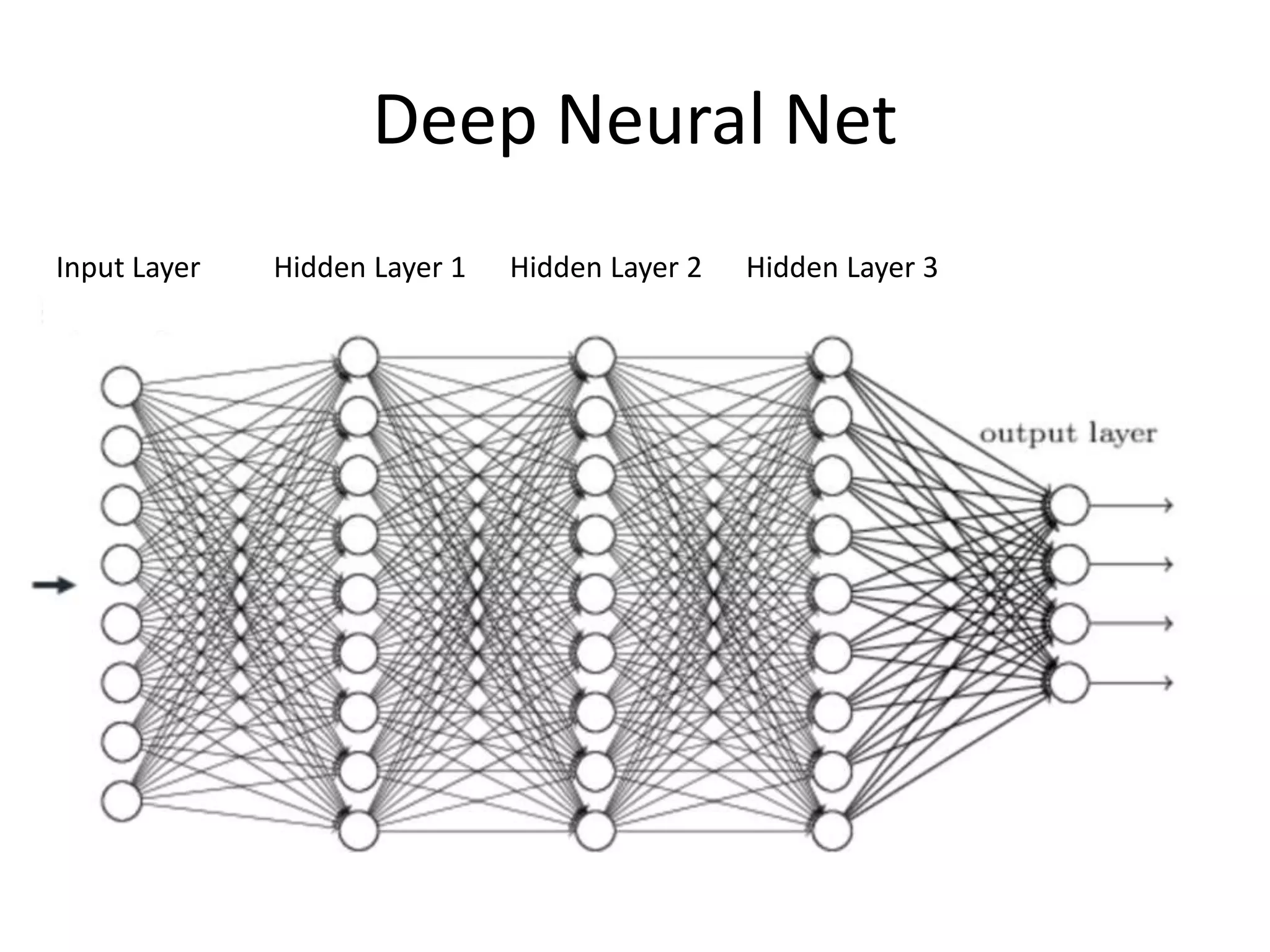
Deep Neural Net
Input Layer Hidden Layer 1 Hidden Layer 2 Hidden Layer 3
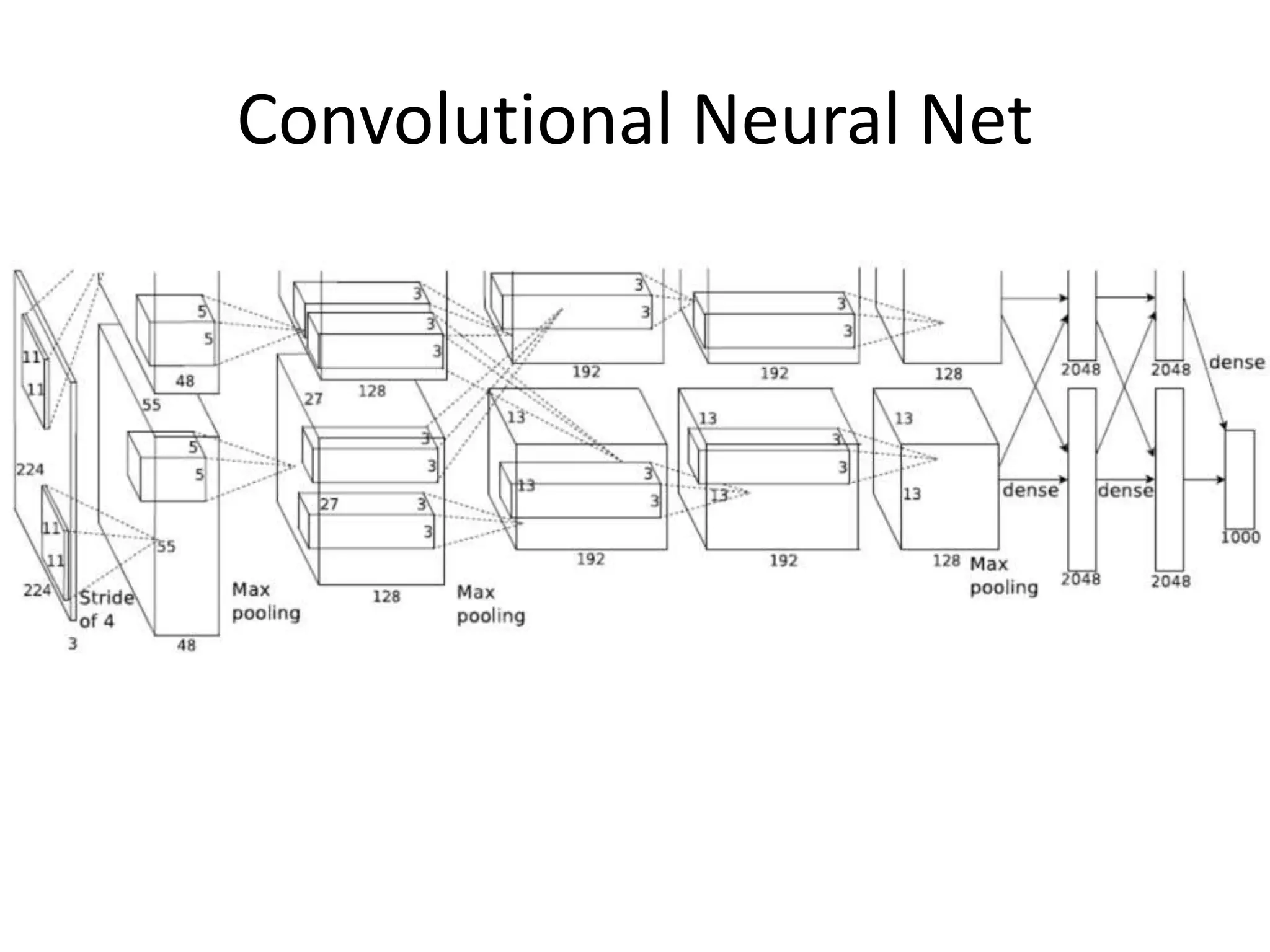
Convolutional Neural Net
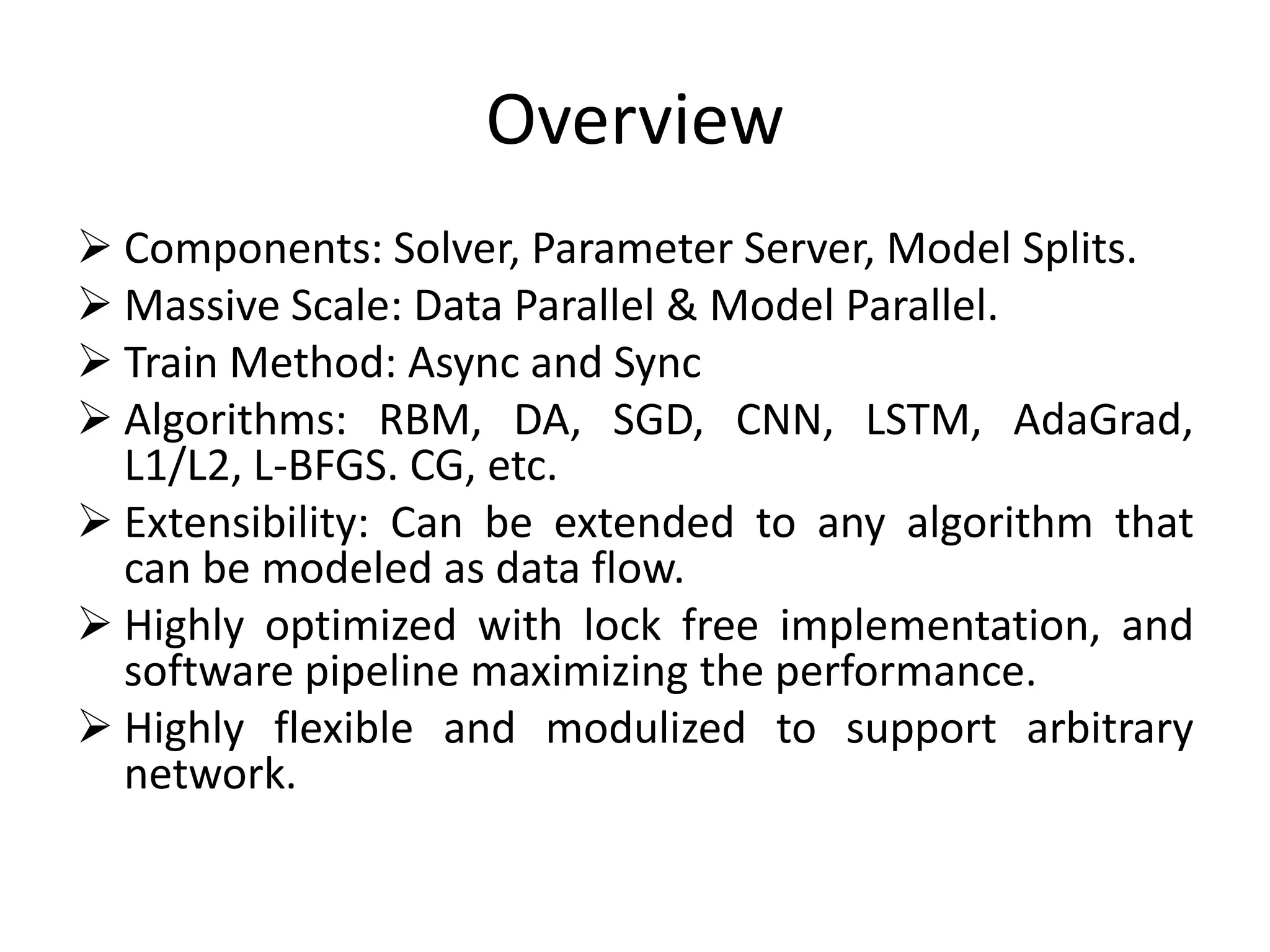
Overview
 Components: Solver, Parameter Server, Model Splits.
 Massive Scale: Data Parallel & Model Parallel.
 Train Method: Async and Sync
 Algorithms: RBM, DA, SGD, CNN, LSTM, AdaGrad,
L1/L2, L-BFGS. CG, etc.
 Extensibility: Can be extended to any algorithm that
can be modeled as data flow.
 Highly optimized with lock free implementation, and
software pipeline maximizing the performance.
 Highly flexible and modulized to support arbitrary
network.
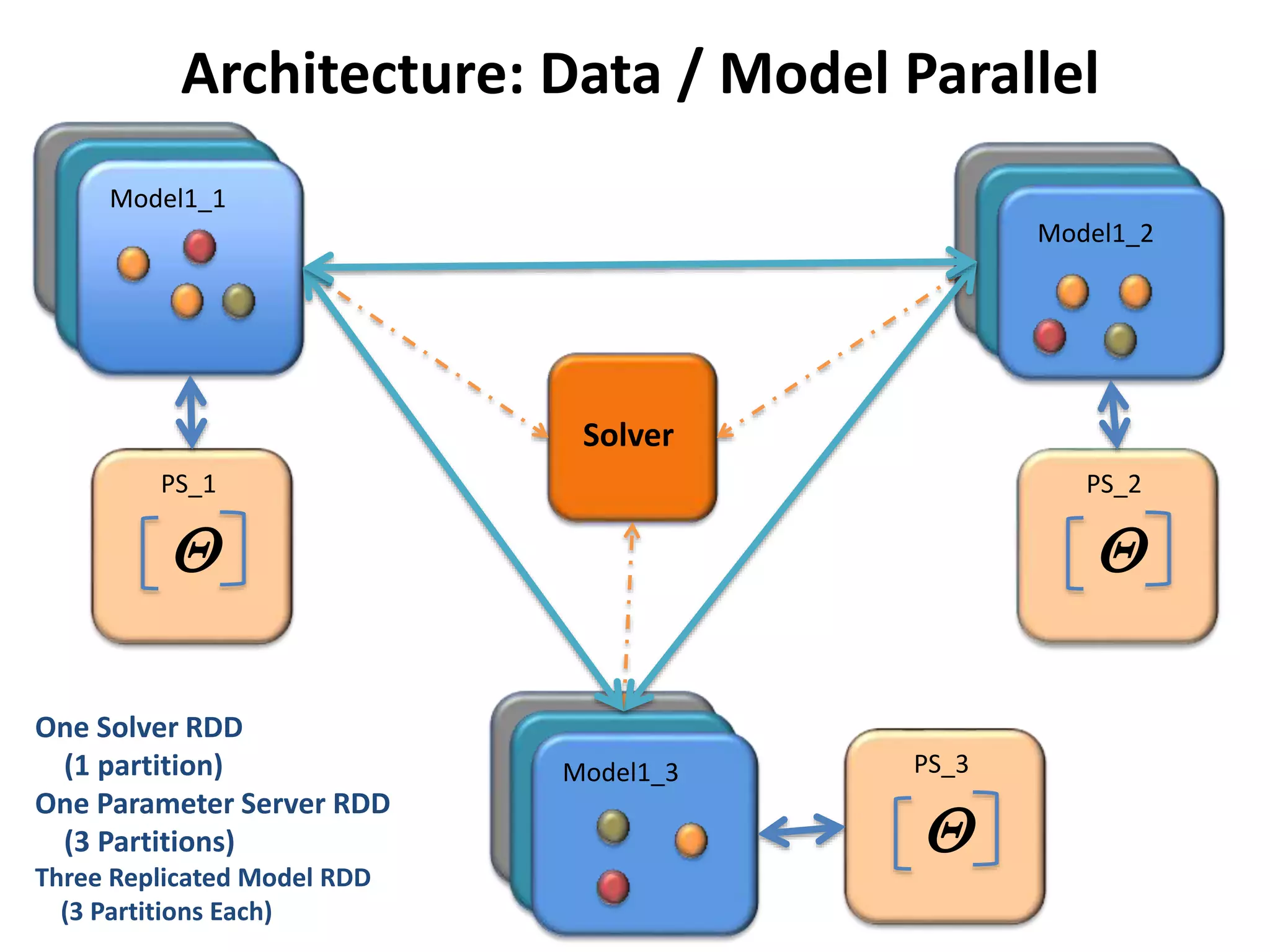
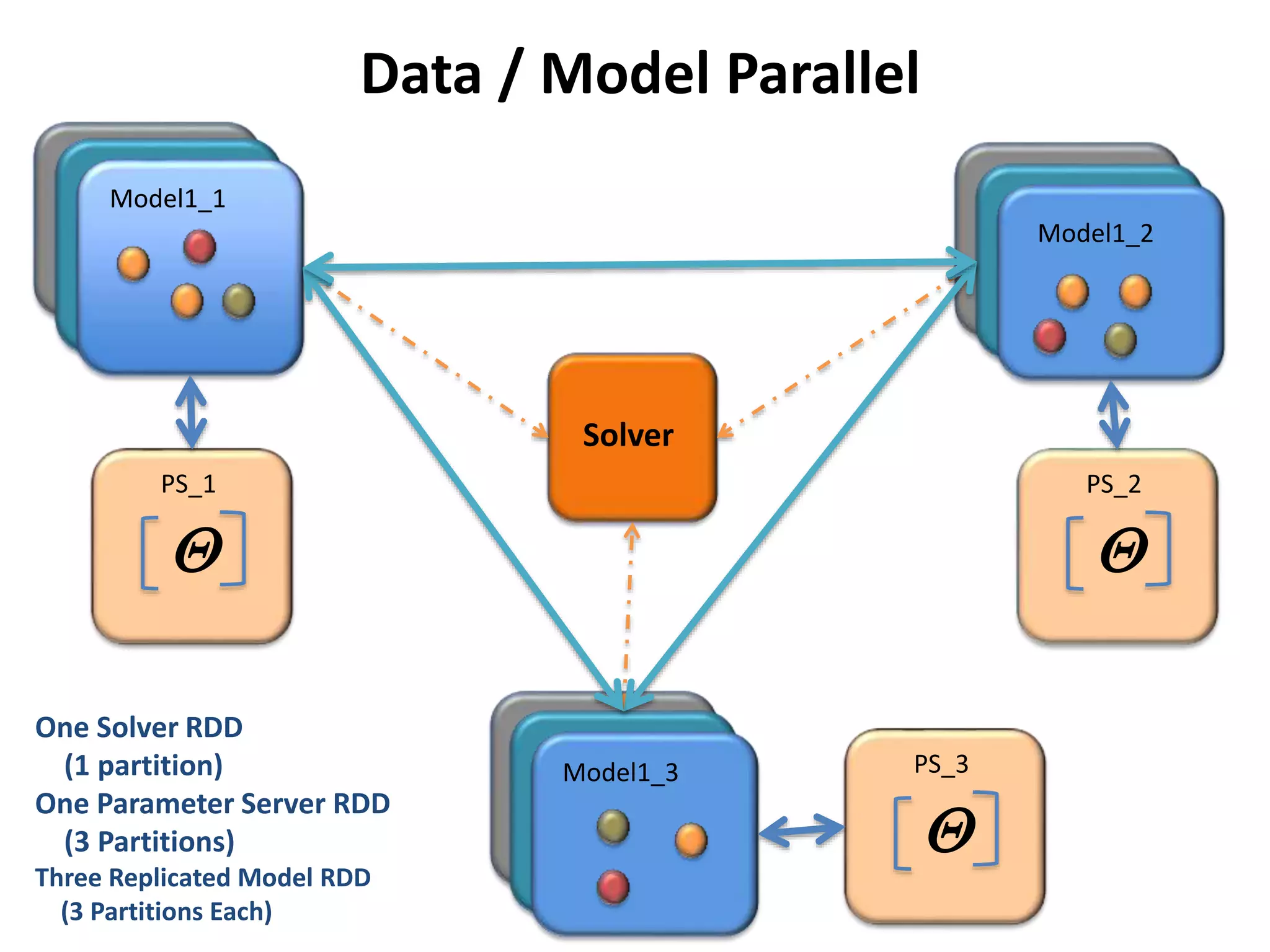
Architecture: Data / Model Parallel
Solver
Model1_3
Model1_2
Model1_1
Q
PS_2
Q
PS_3
Q
PS_1
One Solver RDD
(1 partition)
One Parameter Server RDD
(3 Partitions)
Three Replicated Model RDD
(3 Partitions Each)
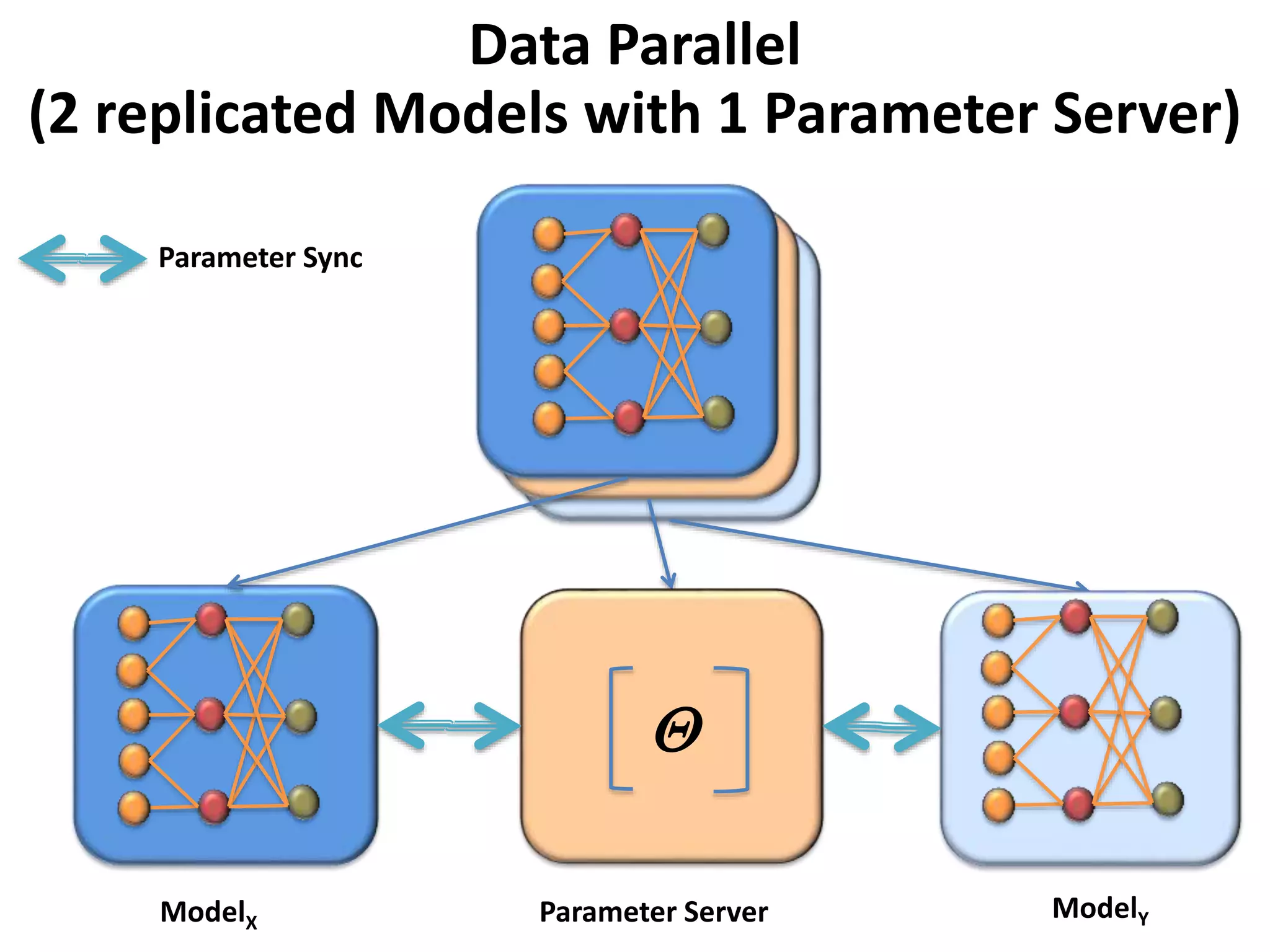
Data Parallel
Component: Models & Parameter server
Multiple models trained independently
Each model fits one splits of training data, and
calculates the sub-gradient
Asynchronously, each model update/retrieve
parameters to/from parameter server
Data Parallel
(2 replicated Models with 1 Parameter Server)
Parameter Server
Q
ModelYModelX
Parameter Sync
Model Parallel
Model is huge, and cannot be hold in one
machine.
Training is computational heavy
Model partitioned into multiple splits.
Each split may located in different physical
machines.
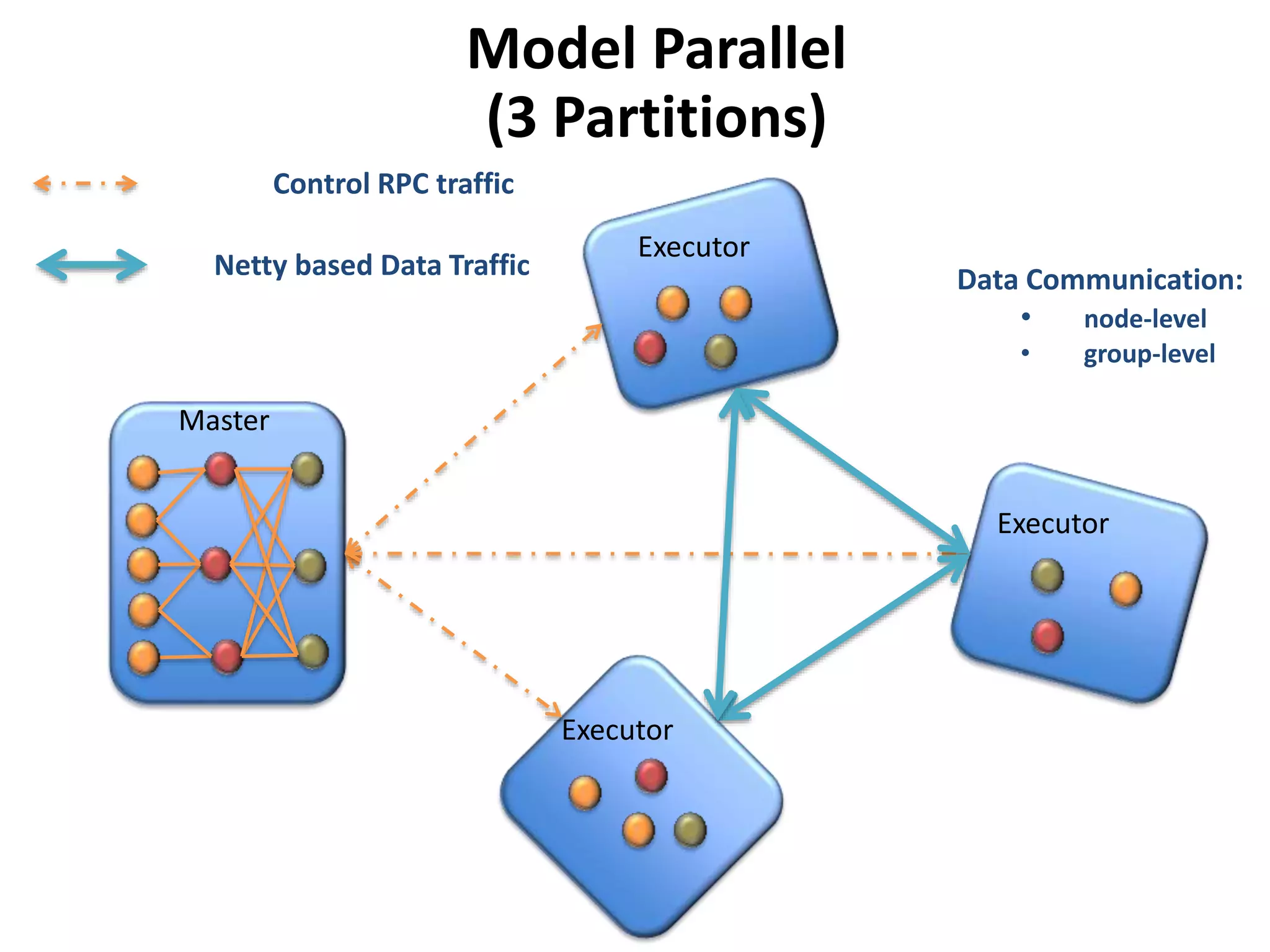
Model Parallel
(3 Partitions)
Data Communication:
• node-level
• group-level
Control RPC traffic
Netty based Data Traffic
Master
Executor
Executor
Executor
Data / Model Parallel
Solver
Model1_3
Model1_2
Model1_1
Q
PS_2
Q
PS_3
Q
PS_1
One Solver RDD
(1 partition)
One Parameter Server RDD
(3 Partitions)
Three Replicated Model RDD
(3 Partitions Each)
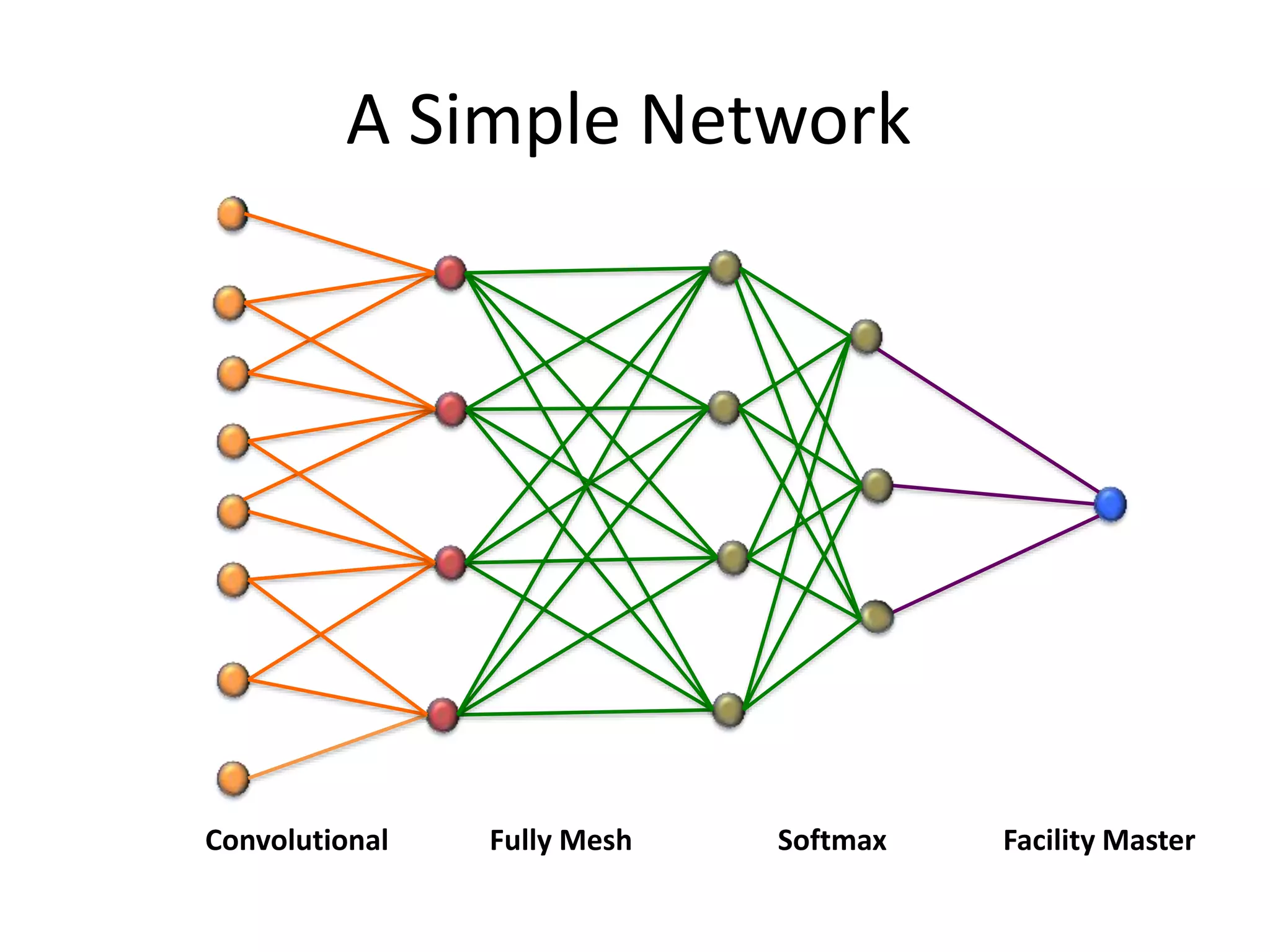
A Simple Network
Convolutional Fully Mesh Softmax Facility Master
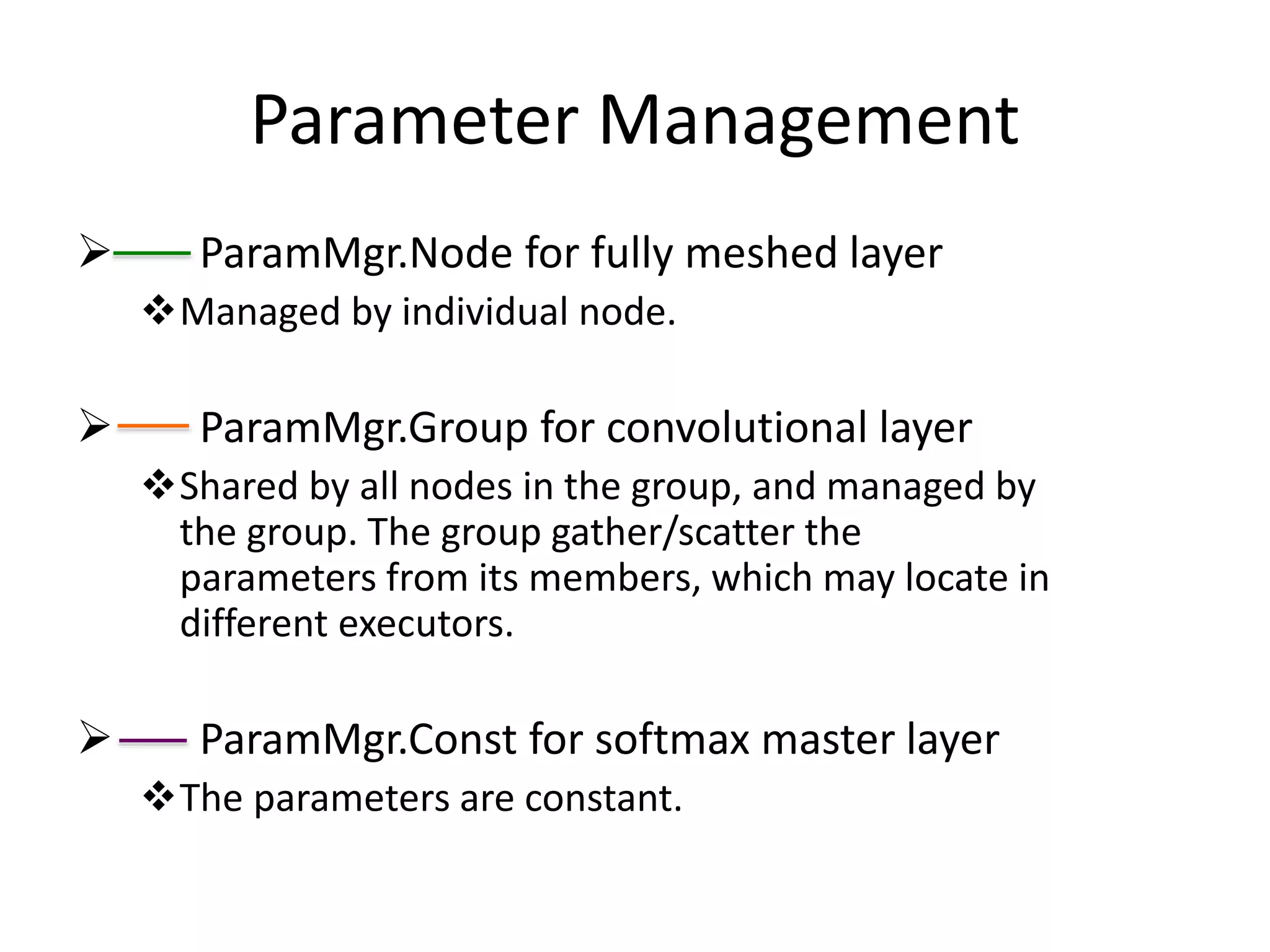
Parameter Management
 ParamMgr.Node for fully meshed layer
Managed by individual node.
 ParamMgr.Group for convolutional layer
Shared by all nodes in the group, and managed by
the group. The group gather/scatter the
parameters from its members, which may locate in
different executors.
 ParamMgr.Const for softmax master layer
The parameters are constant.
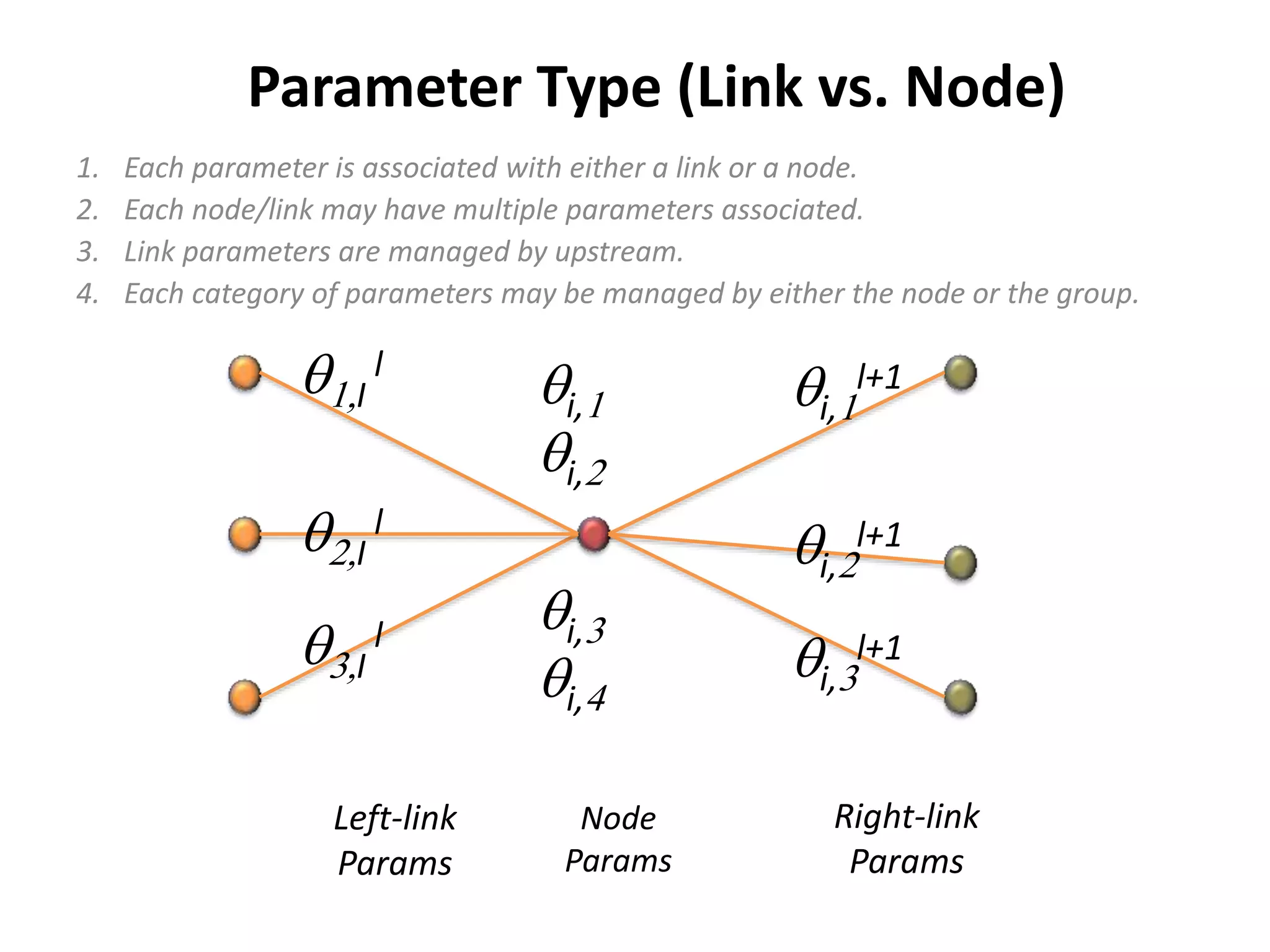
qi,1
qi,2
qi,3
qi,4
Node
Params
Parameter Type (Link vs. Node)
q1,I
l
q2,I
l
q3,I
l
Left-link
Params
qi,1
l+1
qi,2
l+1
qi,3
l+1
Right-link
Params
1. Each parameter is associated with either a link or a node.
2. Each node/link may have multiple parameters associated.
3. Link parameters are managed by upstream.
4. Each category of parameters may be managed by either the node or the group.
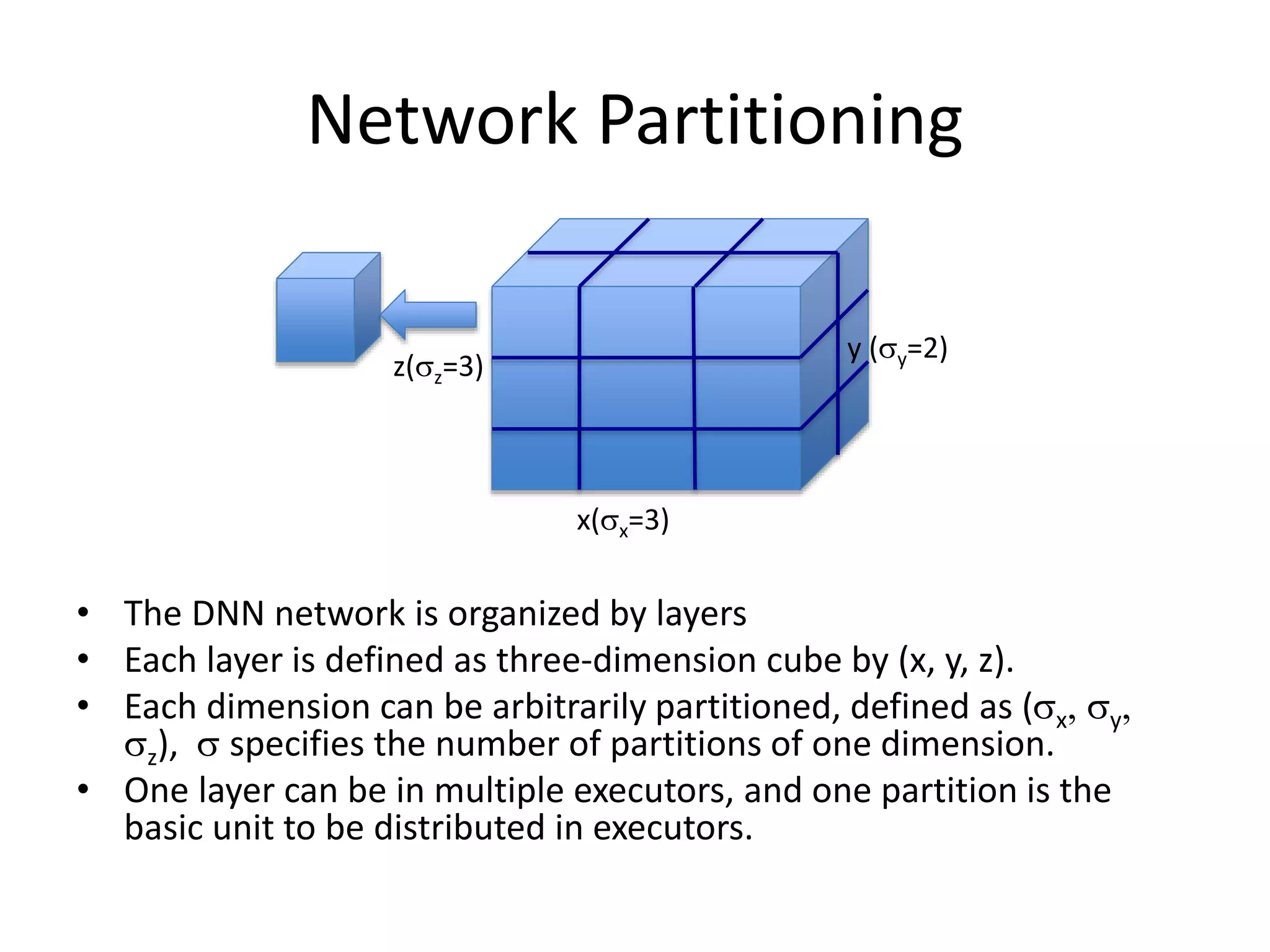
Network Partitioning
• The DNN network is organized by layers
• Each layer is defined as three-dimension cube by (x, y, z).
• Each dimension can be arbitrarily partitioned, defined as (sx, sy,
sz), s specifies the number of partitions of one dimension.
• One layer can be in multiple executors, and one partition is the
basic unit to be distributed in executors.
x(sx=3)
z(sz=3)
y (sy=2)
Software Components
 Layer: logical group in deep neuron net.
 Group: logical unit having similar input/output topology and
functionality. A group can further have subgroups.
 Node: the basic computation unit provide neuron functionality.
 Connection: define the network topology between layers, such as
fully meshed, convolutional, tiled convolutional, etc.
 Adaptors: mapping the remote upstream/down stream neuron to
local neuron in the topology defined by connections.
 Function: define the activation of each neuron.
 Master: provide central aggregation and scatter for softmax neuron.
 Solver: central place to drive the model training and monitoring.
 Parameter Server: the server used by neuron to update/retrieve
parameters.
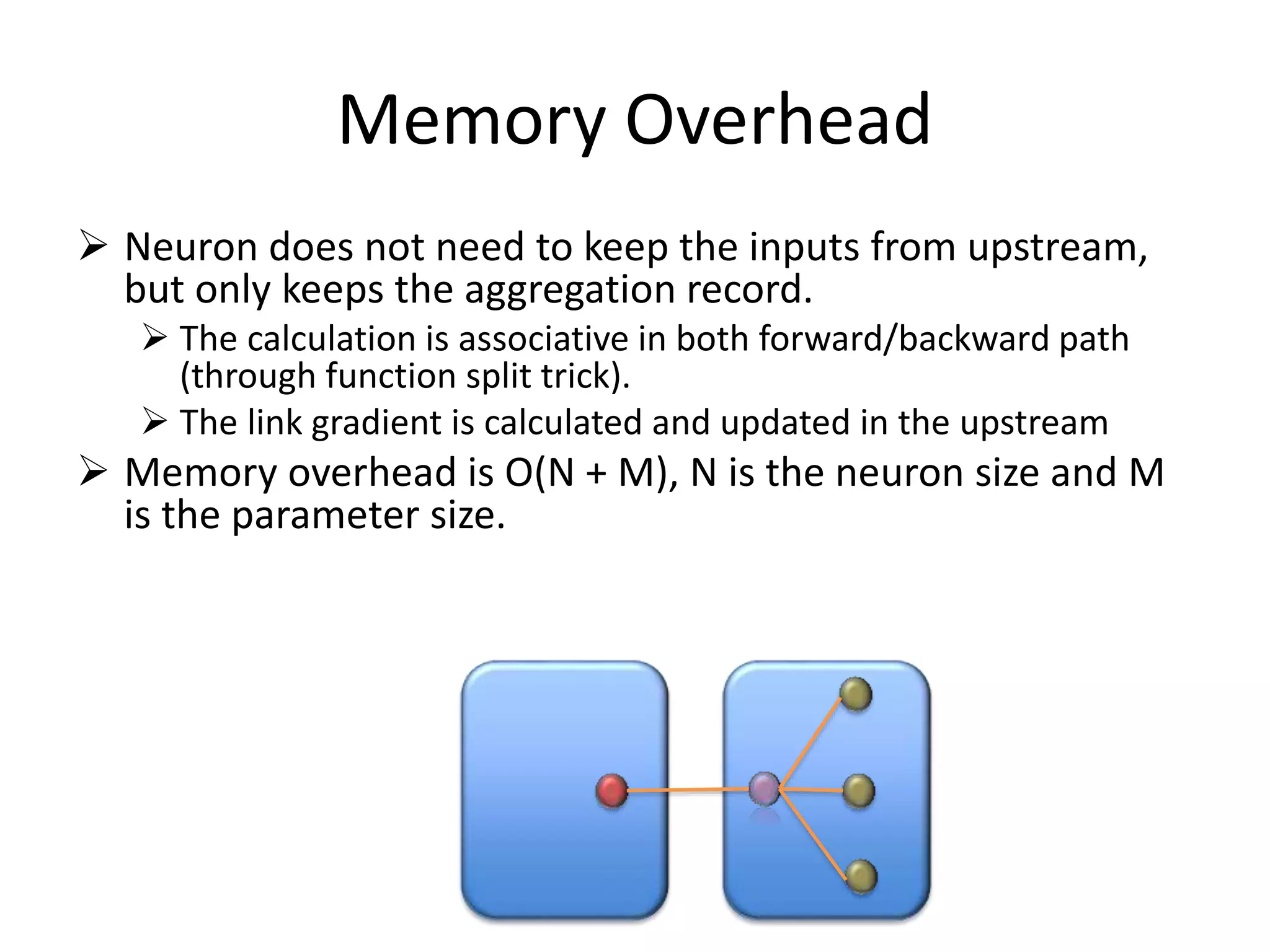
Memory Overhead
 Neuron does not need to keep the inputs from upstream,
but only keeps the aggregation record.
 The calculation is associative in both forward/backward path
(through function split trick).
 The link gradient is calculated and updated in the upstream
 Memory overhead is O(N + M), N is the neuron size and M
is the parameter size.
Network Overhead
 Neuron forwards same output to its upstream/downstream
neurons.
 Receiving neurons compute the input or update the gradient.
 Neuron forwards its output to the executors only if it hosts
neurons requesting it.
 Neuron forwards its output to an executor only once
regardless of the number of neurons requesting it.
Complexity
Memory: O(M+N) independent of network
partition mechanism.
M: the number of parameters
N: The number of nodes.
Communication: O(N)
Realized by
 Each node managing its outgoing link parameter
instead of incoming link parameter
 The trick to split the function across the layers
Distributed Pipeline
 MicroBatch: The number of training examples in one pipeline stage
 max_buf: the length of the pipleline.
 Batch algorithms: Significantly improve the performance when the
training data set is big enough to fully populate the pipeline.
 SGD: the improvement is limited, because the pipeline cannot be fully
populated if the miniBatch size is not big enough.
Executor 4
Executor 3
Executor 2
Executor 1 Micro Batch i +4
Micro Batch i +3
Micro Batch i +2
Micro Batch i +1
Micro Batch i +1
Micro Batch i +1
Micro Batch i +1
Micro Batch i +2
Micro Batch i +2 Micro Batch i +3
T1 T2 T3 T4
Connections
 Easy extensible through Adaptors.
 Adaptor is used to mapping global status to its local status.
 Fully Meshed
 (Tiled) Convolutional
 NonShared Convolutional

UNET: Massive Scale DNN on Spark

  • 1.
    UNET: Massive ScaleDNN on Spark
  • 2.
    Deep Neural Net InputLayer Hidden Layer 1 Hidden Layer 2 Hidden Layer 3
  • 3.
  • 4.
    Overview  Components: Solver,Parameter Server, Model Splits.  Massive Scale: Data Parallel & Model Parallel.  Train Method: Async and Sync  Algorithms: RBM, DA, SGD, CNN, LSTM, AdaGrad, L1/L2, L-BFGS. CG, etc.  Extensibility: Can be extended to any algorithm that can be modeled as data flow.  Highly optimized with lock free implementation, and software pipeline maximizing the performance.  Highly flexible and modulized to support arbitrary network.
  • 5.
    Architecture: Data /Model Parallel Solver Model1_3 Model1_2 Model1_1 Q PS_2 Q PS_3 Q PS_1 One Solver RDD (1 partition) One Parameter Server RDD (3 Partitions) Three Replicated Model RDD (3 Partitions Each)
  • 6.
    Data Parallel Component: Models& Parameter server Multiple models trained independently Each model fits one splits of training data, and calculates the sub-gradient Asynchronously, each model update/retrieve parameters to/from parameter server
  • 7.
    Data Parallel (2 replicatedModels with 1 Parameter Server) Parameter Server Q ModelYModelX Parameter Sync
  • 8.
    Model Parallel Model ishuge, and cannot be hold in one machine. Training is computational heavy Model partitioned into multiple splits. Each split may located in different physical machines.
  • 9.
    Model Parallel (3 Partitions) DataCommunication: • node-level • group-level Control RPC traffic Netty based Data Traffic Master Executor Executor Executor
  • 10.
    Data / ModelParallel Solver Model1_3 Model1_2 Model1_1 Q PS_2 Q PS_3 Q PS_1 One Solver RDD (1 partition) One Parameter Server RDD (3 Partitions) Three Replicated Model RDD (3 Partitions Each)
  • 11.
    A Simple Network ConvolutionalFully Mesh Softmax Facility Master
  • 12.
    Parameter Management  ParamMgr.Nodefor fully meshed layer Managed by individual node.  ParamMgr.Group for convolutional layer Shared by all nodes in the group, and managed by the group. The group gather/scatter the parameters from its members, which may locate in different executors.  ParamMgr.Const for softmax master layer The parameters are constant.
  • 13.
    qi,1 qi,2 qi,3 qi,4 Node Params Parameter Type (Linkvs. Node) q1,I l q2,I l q3,I l Left-link Params qi,1 l+1 qi,2 l+1 qi,3 l+1 Right-link Params 1. Each parameter is associated with either a link or a node. 2. Each node/link may have multiple parameters associated. 3. Link parameters are managed by upstream. 4. Each category of parameters may be managed by either the node or the group.
  • 14.
    Network Partitioning • TheDNN network is organized by layers • Each layer is defined as three-dimension cube by (x, y, z). • Each dimension can be arbitrarily partitioned, defined as (sx, sy, sz), s specifies the number of partitions of one dimension. • One layer can be in multiple executors, and one partition is the basic unit to be distributed in executors. x(sx=3) z(sz=3) y (sy=2)
  • 15.
    Software Components  Layer:logical group in deep neuron net.  Group: logical unit having similar input/output topology and functionality. A group can further have subgroups.  Node: the basic computation unit provide neuron functionality.  Connection: define the network topology between layers, such as fully meshed, convolutional, tiled convolutional, etc.  Adaptors: mapping the remote upstream/down stream neuron to local neuron in the topology defined by connections.  Function: define the activation of each neuron.  Master: provide central aggregation and scatter for softmax neuron.  Solver: central place to drive the model training and monitoring.  Parameter Server: the server used by neuron to update/retrieve parameters.
  • 16.
    Memory Overhead  Neurondoes not need to keep the inputs from upstream, but only keeps the aggregation record.  The calculation is associative in both forward/backward path (through function split trick).  The link gradient is calculated and updated in the upstream  Memory overhead is O(N + M), N is the neuron size and M is the parameter size.
  • 17.
    Network Overhead  Neuronforwards same output to its upstream/downstream neurons.  Receiving neurons compute the input or update the gradient.  Neuron forwards its output to the executors only if it hosts neurons requesting it.  Neuron forwards its output to an executor only once regardless of the number of neurons requesting it.
  • 18.
    Complexity Memory: O(M+N) independentof network partition mechanism. M: the number of parameters N: The number of nodes. Communication: O(N) Realized by  Each node managing its outgoing link parameter instead of incoming link parameter  The trick to split the function across the layers
  • 19.
    Distributed Pipeline  MicroBatch:The number of training examples in one pipeline stage  max_buf: the length of the pipleline.  Batch algorithms: Significantly improve the performance when the training data set is big enough to fully populate the pipeline.  SGD: the improvement is limited, because the pipeline cannot be fully populated if the miniBatch size is not big enough. Executor 4 Executor 3 Executor 2 Executor 1 Micro Batch i +4 Micro Batch i +3 Micro Batch i +2 Micro Batch i +1 Micro Batch i +1 Micro Batch i +1 Micro Batch i +1 Micro Batch i +2 Micro Batch i +2 Micro Batch i +3 T1 T2 T3 T4
  • 20.
    Connections  Easy extensiblethrough Adaptors.  Adaptor is used to mapping global status to its local status.  Fully Meshed  (Tiled) Convolutional  NonShared Convolutional