Chapter 4Chapter 4
Basic CommunicationBasic Communication
OperationsOperations
Dr. Muhammad Hanif Durad
Department of Computer and Information Sciences
Pakistan Institute Engineering and Applied Sciences
hanif@pieas.edu.pk
Some slides have bee adapted with thanks from some other
lectures available on Internet
2
Lecture Outline
Introduction
4.1 One-to-All Broadcast and All-to-One Reduction
4.2 All-to-All Broadcast and Reduction
4.3 All-Reduce and Prefix-Sum Operations
4.4 Scatter and Gather
4.5 All-to-All Personalized Communication
4.6 Circular Shift
4.7 Improving the Speed of Some Communication
Operation
4.8 Summary
Basic Communication
Operations: Introduction (1/2)
 Many interactions in practical parallel programs occur in
well-defined patterns involving groups of processors.
 Efficient implementations of these operations can
improve performance, reduce development effort and
cost, and improve software quality.
 Efficient implementations must leverage underlying
architecture. For this reason, we refer to specific
architectures here.
 We select a descriptive set of architectures to illustrate
the process of algorithm design. 3
Basic Communication
Operations: Introduction (2/2)
 Group communication operations are built using point-
to-point messaging primitives.
 Recall from our discussion of architectures that
communicating a message of size m over an non-
congested network takes time ts +mtw.
 We use this as the basis for our analyses. Where
necessary, we take congestion into account explicitly by
scaling the tw term.
 We assume that the network is bidirectional and that
communication is single-ported. 4
4.1 One-to-All Broadcast and
All-to-One Reduction (1/2)
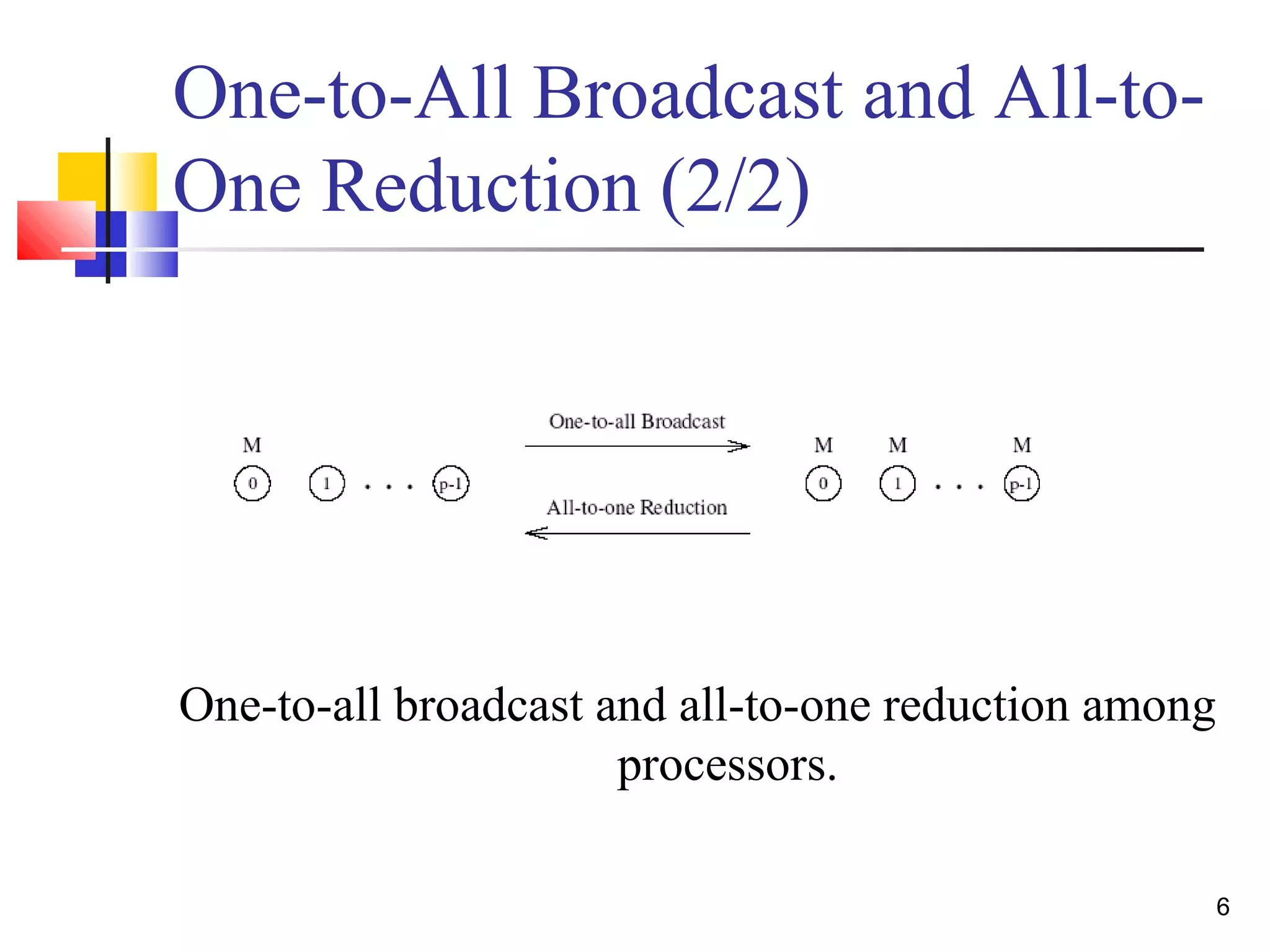
 One processor has a piece of data (of size m) it
needs to send to everyone.
 The dual of one-to-all broadcast is all-to-one
reduction.
 In all-to-one reduction, each processor has m units
of data. These data items must be combined piece-
wise (using some associative operator, such as
addition or min), and the result made available at a
target processor. 5
One-to-All Broadcast and All-to-
One Reduction (2/2)
One-to-all broadcast and all-to-one reduction among
processors.
6
4.1.1.1 One-to-All Broadcast on
Rings (1/3)
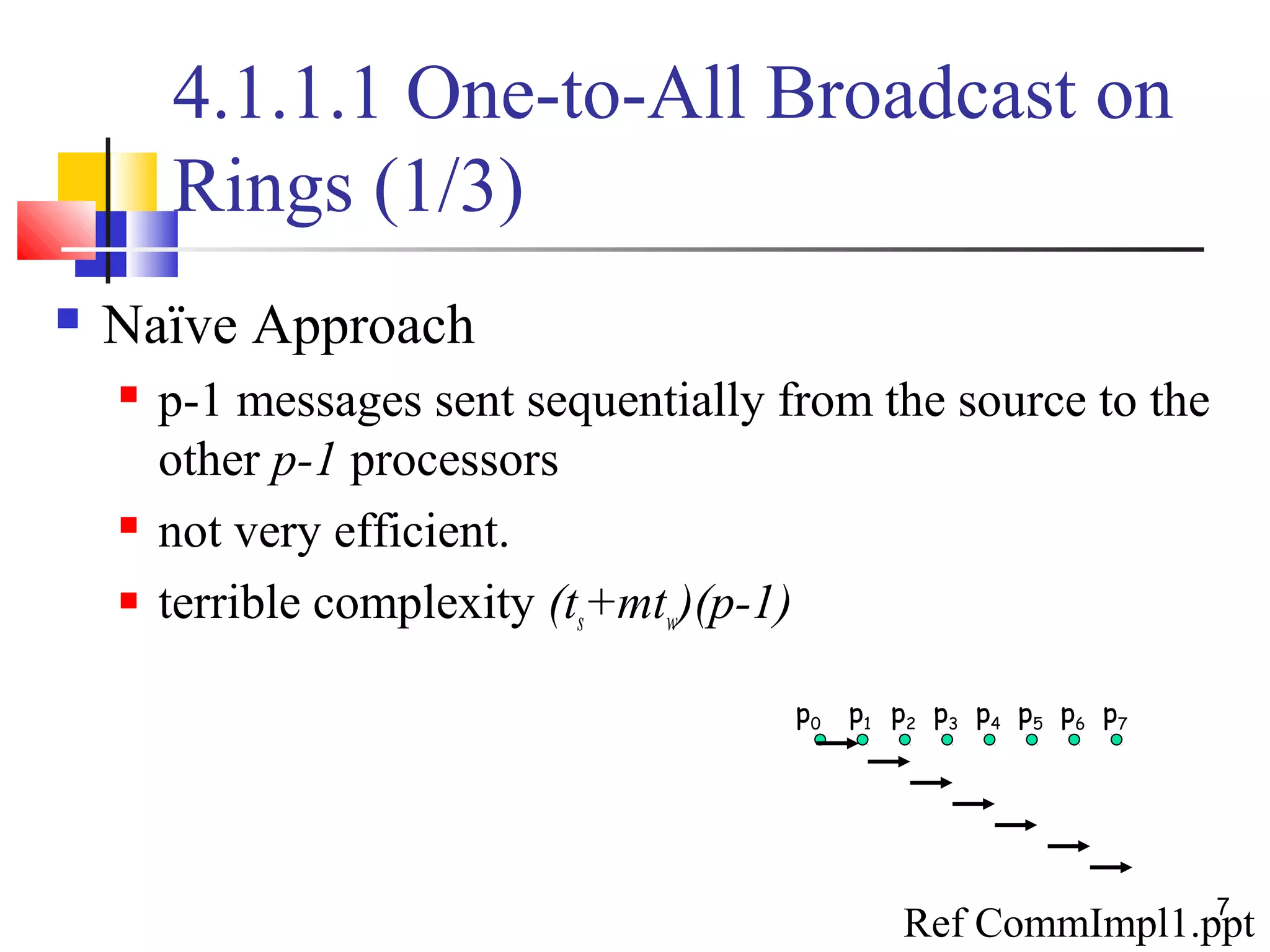
 Naïve Approach
 p-1 messages sent sequentially from the source to the
other p-1 processors
 not very efficient.
 terrible complexity (ts+mtw)(p-1)
p0 p1 p2 p3 p4 p5 p6 p7
Ref CommImpl1.ppt
7
One-to-All Broadcast on Rings
(2/3)
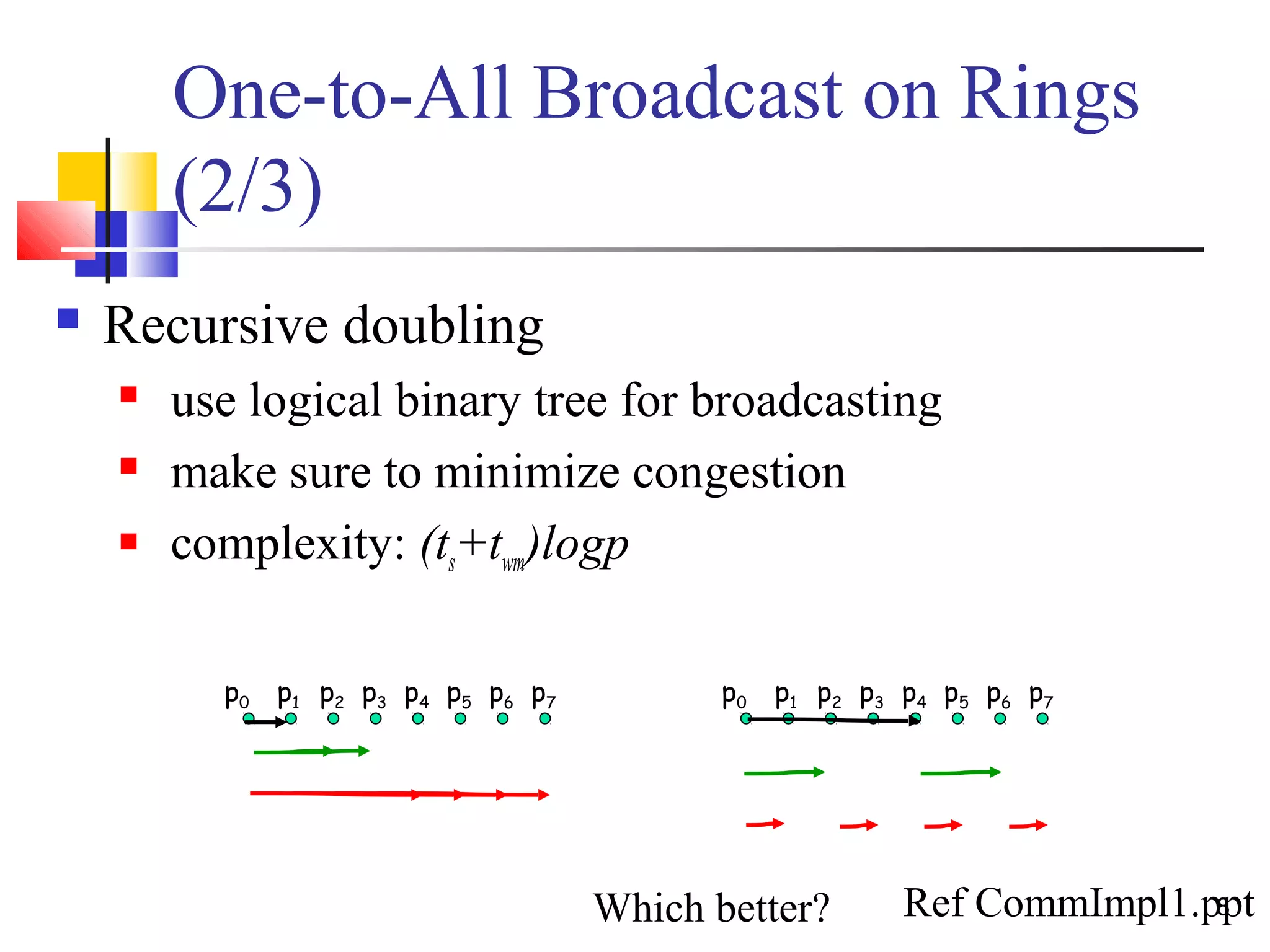
 Recursive doubling
 use logical binary tree for broadcasting
 make sure to minimize congestion
 complexity: (ts+twm)logp
p0 p1 p2 p3 p4 p5 p6 p7 p0 p1 p2 p3 p4 p5 p6 p7
Which better? Ref CommImpl1.ppt8
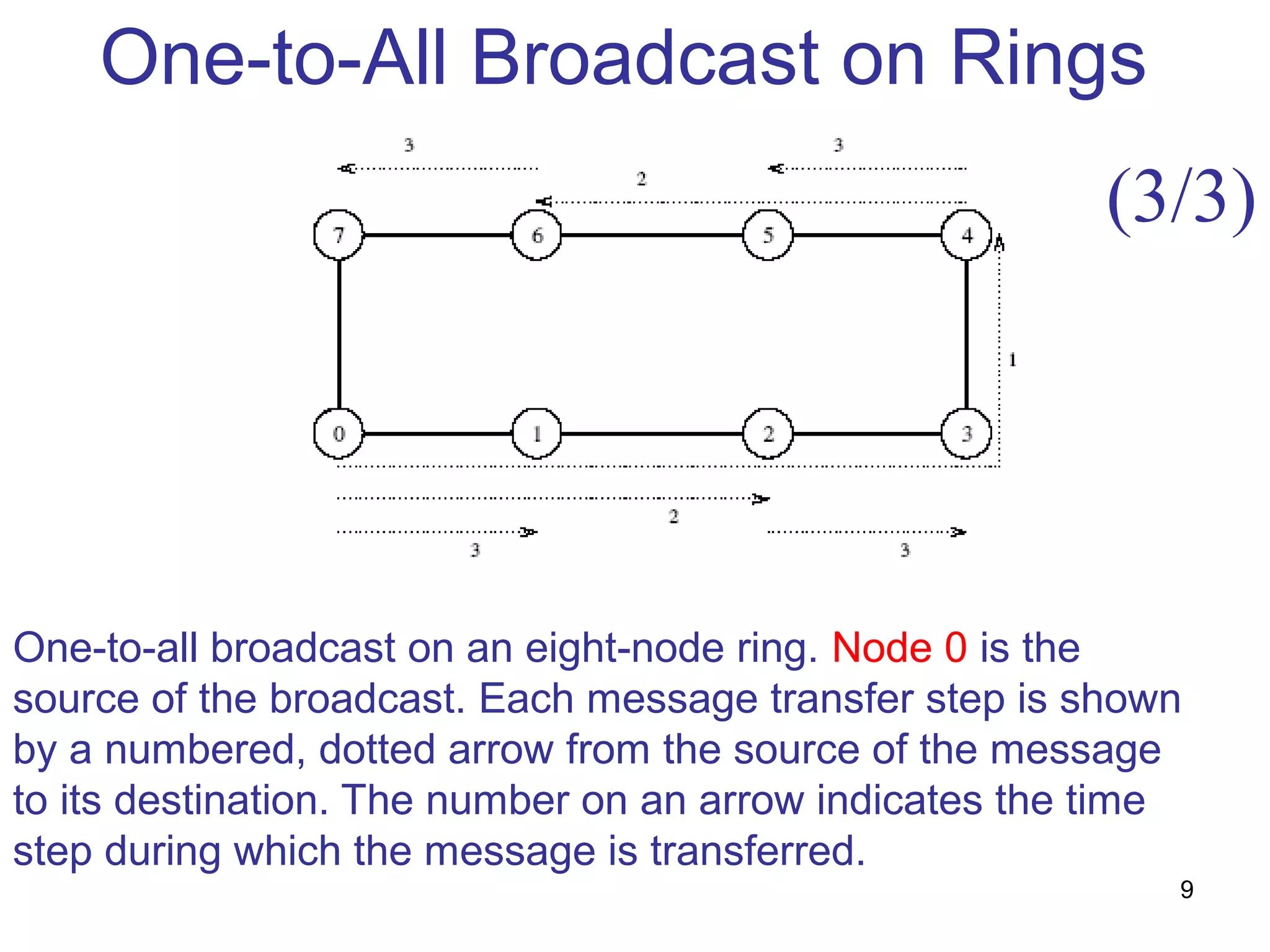
One-to-All Broadcast on Rings
One-to-all broadcast on an eight-node ring. Node 0 is the
source of the broadcast. Each message transfer step is shown
by a numbered, dotted arrow from the source of the message
to its destination. The number on an arrow indicates the time
step during which the message is transferred.
(3/3)
9
4.1.1.2 All-to-One Reduction on
Rings (1/2)
 Reduction can be performed in an identical
fashion by inverting the process.
10
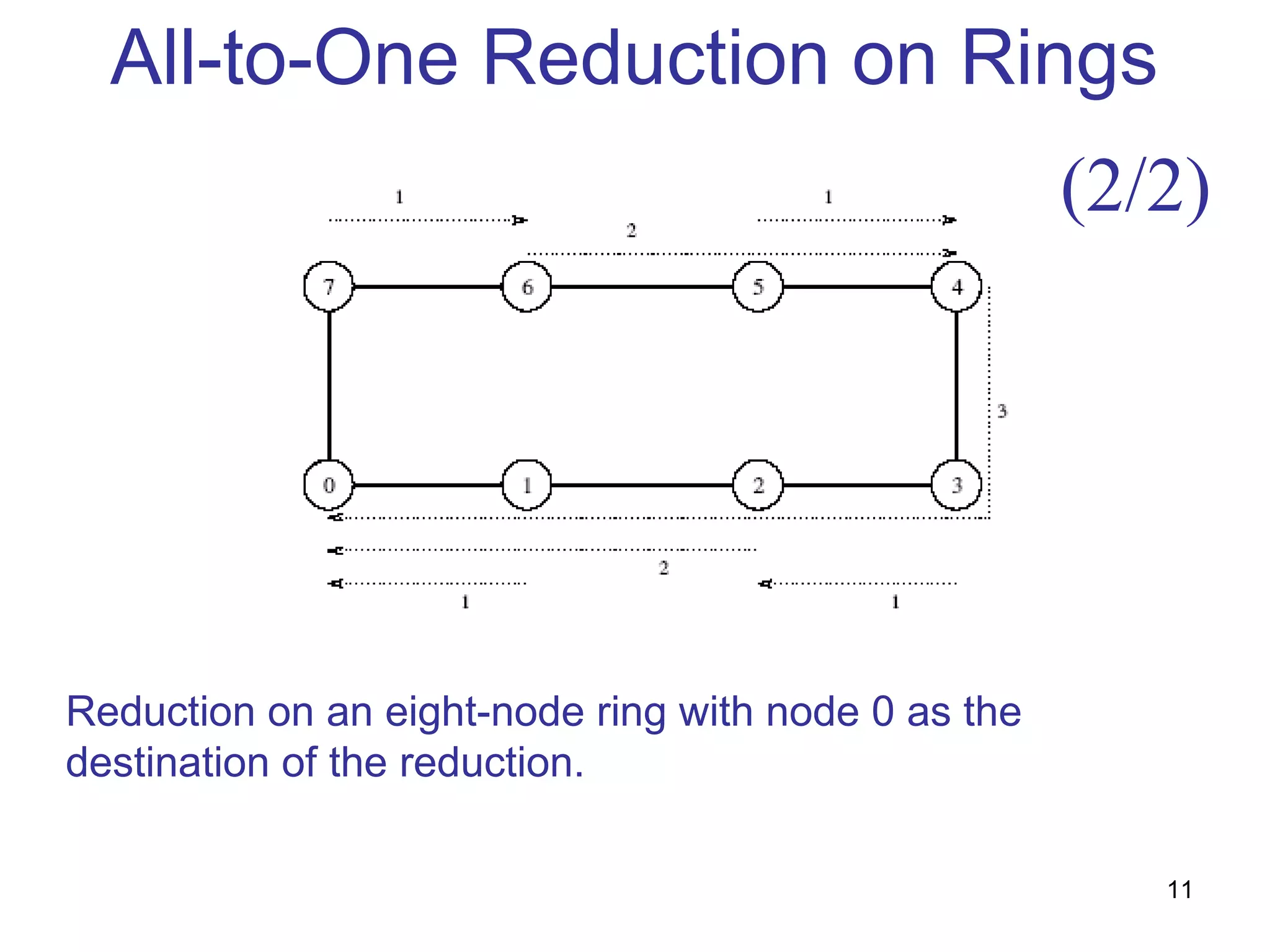
All-to-One Reduction on Rings
Reduction on an eight-node ring with node 0 as the
destination of the reduction.
(2/2)
11
Broadcast and Reduction on
Rings : Example (1/2)
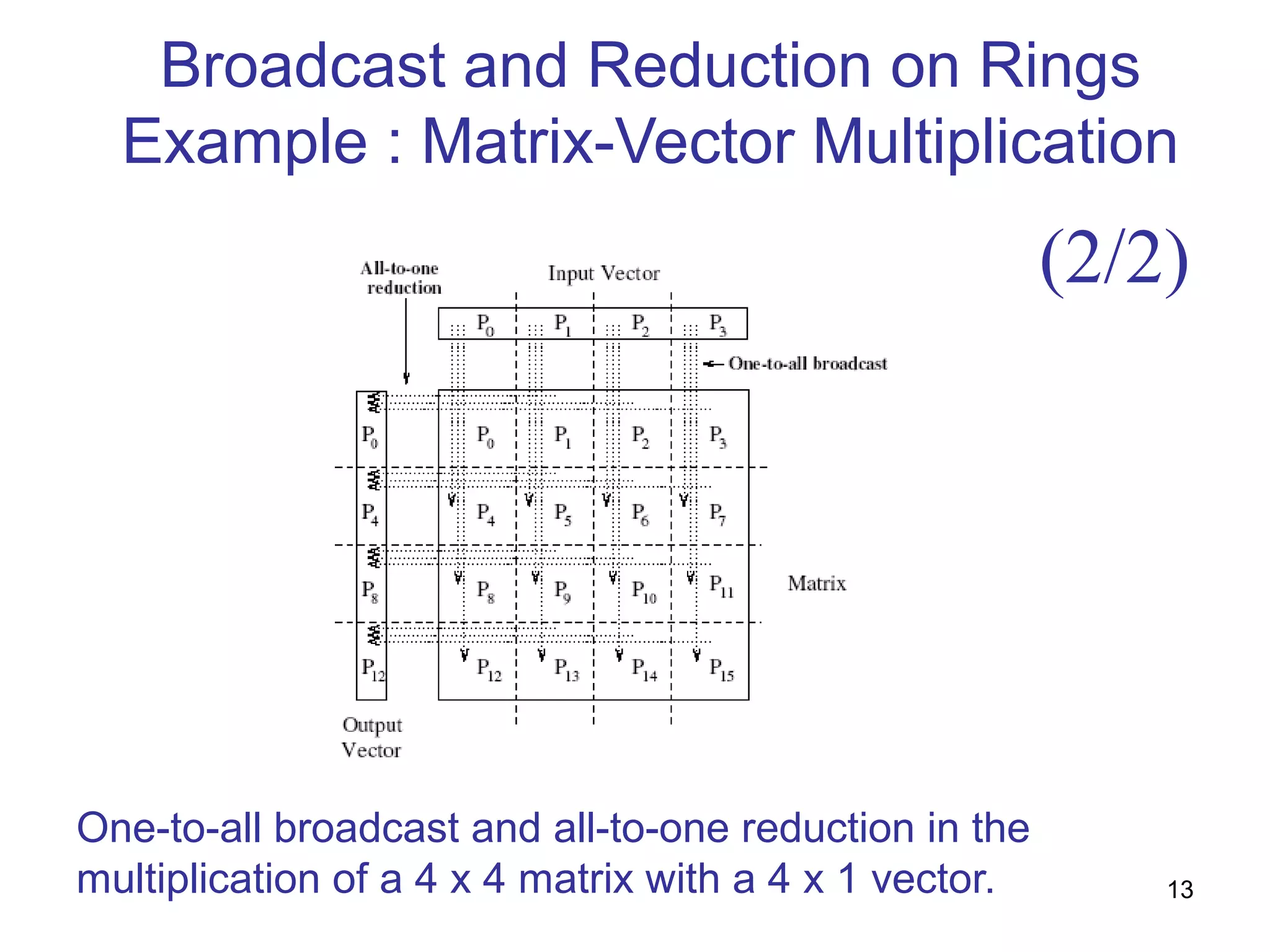
Consider the problem of multiplying a matrix with a vector.
 The n x n matrix is assigned to an n x n (virtual) processor grid.
The vector is assumed to be on the first row of processors.
 The first step of the product requires a one-to-all broadcast of the
vector element along the corresponding column of processors.
This can be done concurrently for all n columns.
 The processors compute local product of the vector element and
the local matrix entry.
 In the final step, the results of these products are accumulated to
the first row using n concurrent all-to-one reduction operations
along the columns (using the sum operation).
12
Broadcast and Reduction on Rings
Example : Matrix-Vector Multiplication
One-to-all broadcast and all-to-one reduction in the
multiplication of a 4 x 4 matrix with a 4 x 1 vector.
(2/2)
13
4.1.2 Broadcast and Reduction on
a Mesh (1/2)
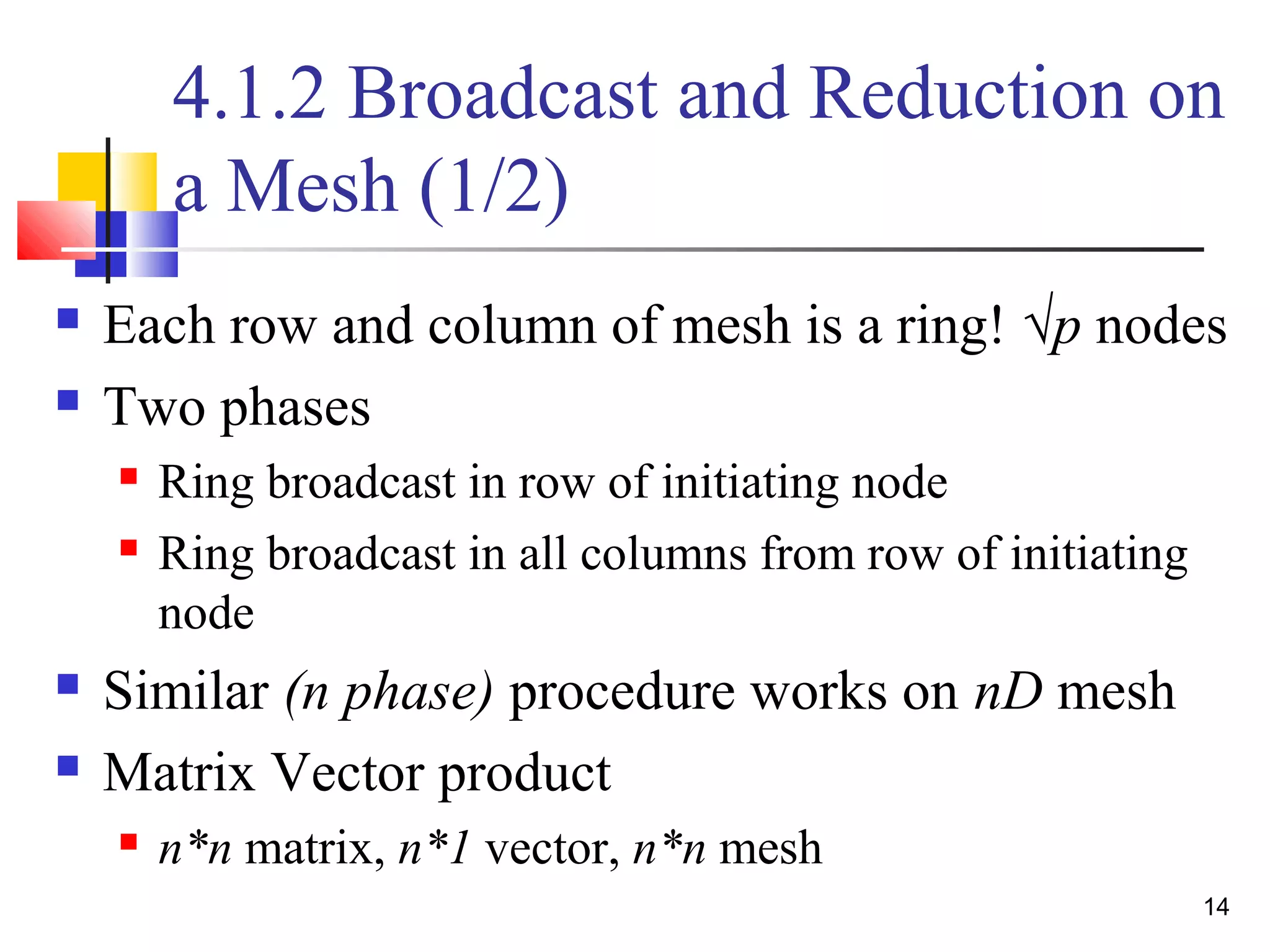
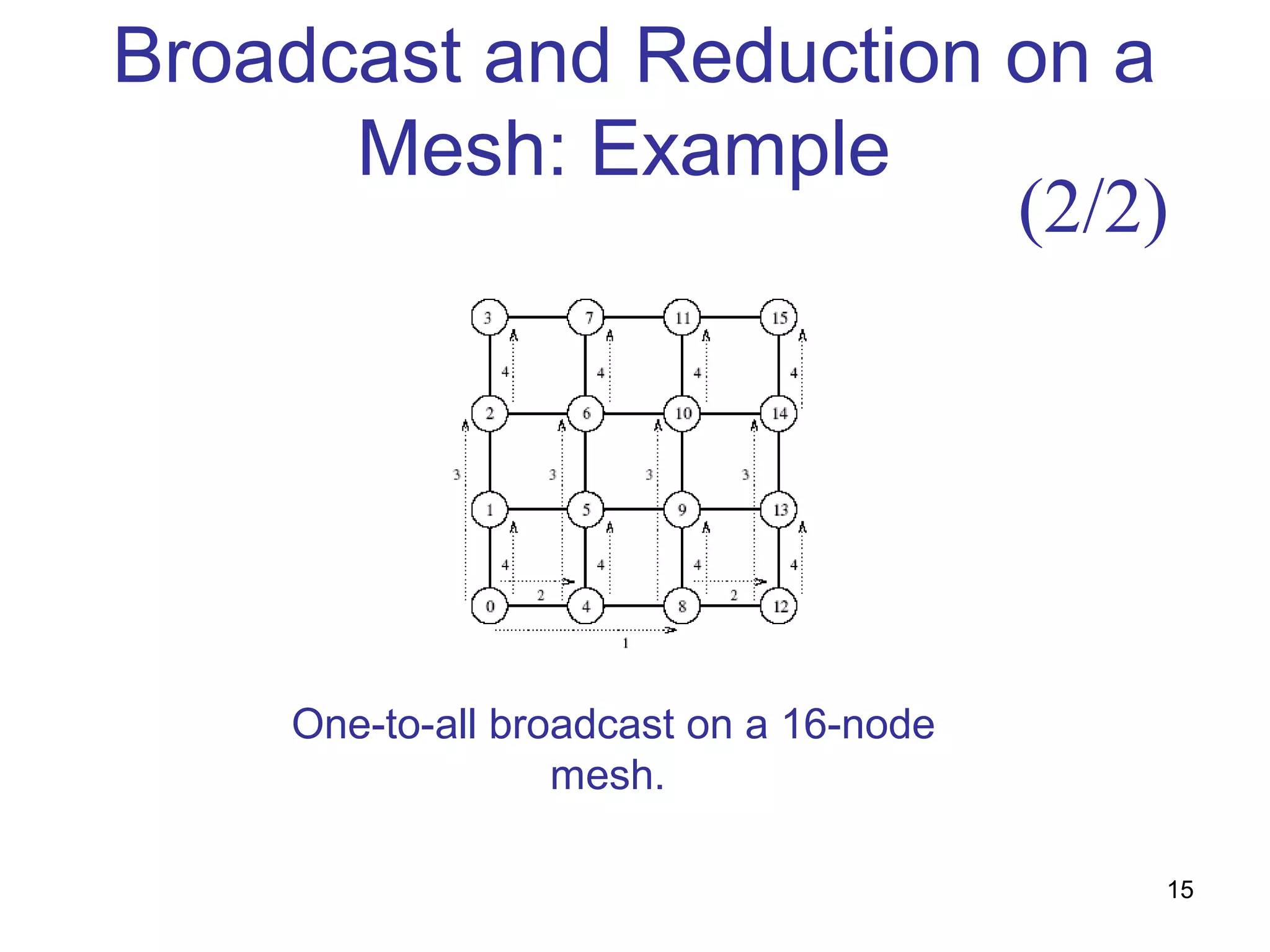
 Each row and column of mesh is a ring! √p nodes
 Two phases
 Ring broadcast in row of initiating node
 Ring broadcast in all columns from row of initiating
node
 Similar (n phase) procedure works on nD mesh
 Matrix Vector product
 n*n matrix, n*1 vector, n*n mesh
14
Broadcast and Reduction on a
Mesh: Example
One-to-all broadcast on a 16-node
mesh.
(2/2)
15
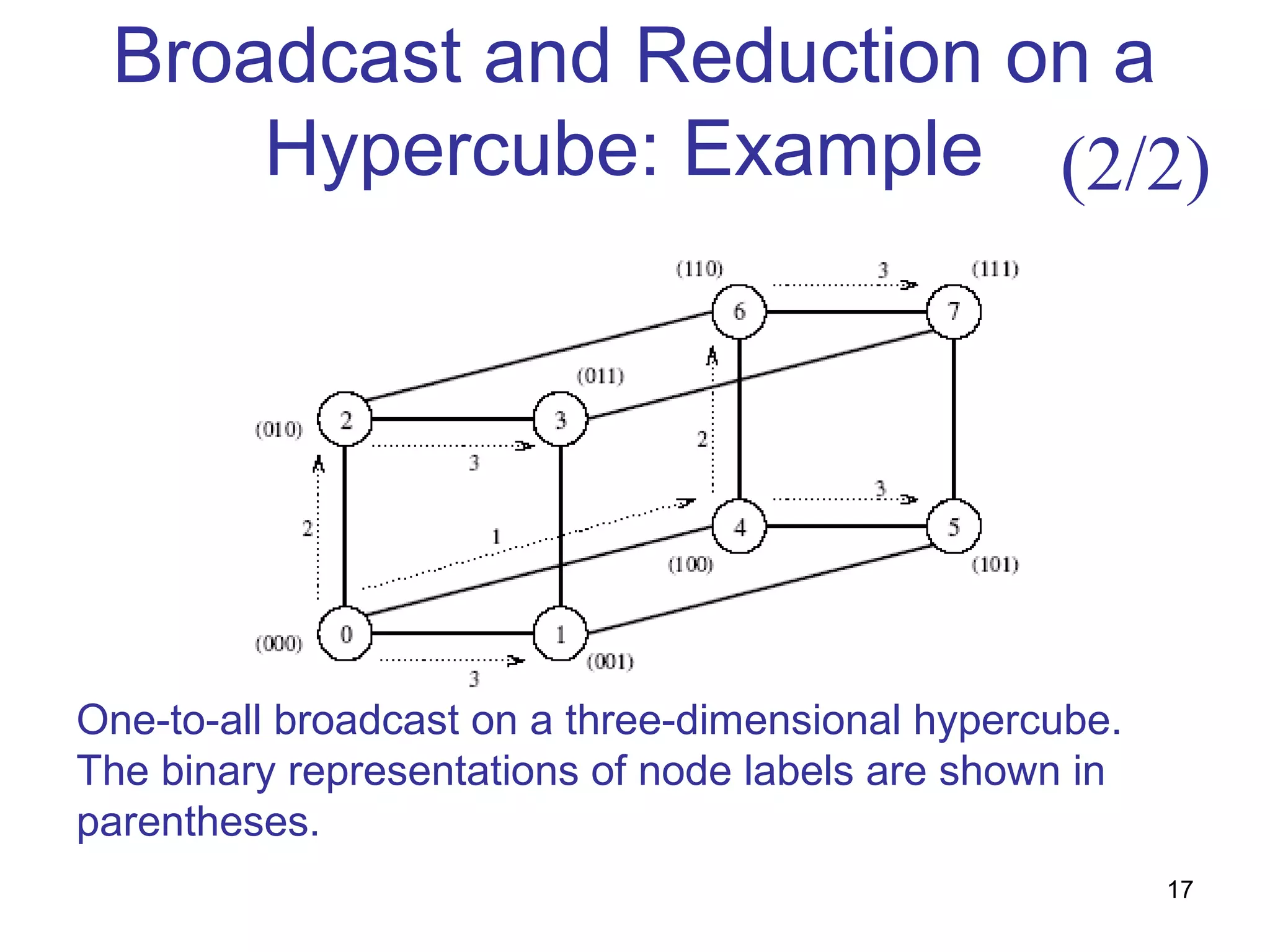
4.1.3 Broadcast and Reduction on
a Hypercube (1/2)
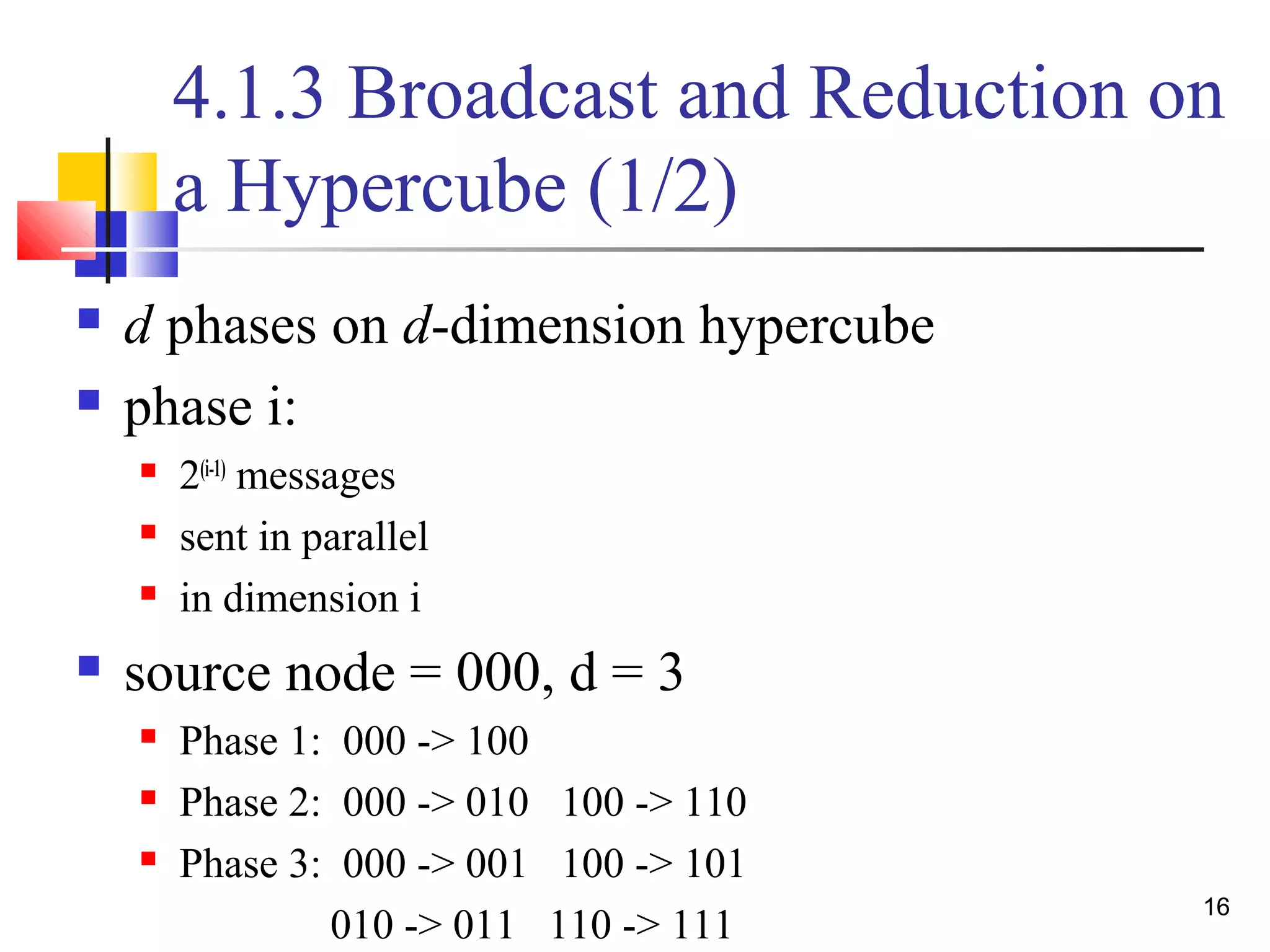
 d phases on d-dimension hypercube
 phase i:
 2(i-1)
messages
 sent in parallel
 in dimension i
 source node = 000, d = 3
 Phase 1: 000 -> 100
 Phase 2: 000 -> 010 100 -> 110
 Phase 3: 000 -> 001 100 -> 101
010 -> 011 110 -> 111
16
Broadcast and Reduction on a
Hypercube: Example
One-to-all broadcast on a three-dimensional hypercube.
The binary representations of node labels are shown in
parentheses.
(2/2)
17
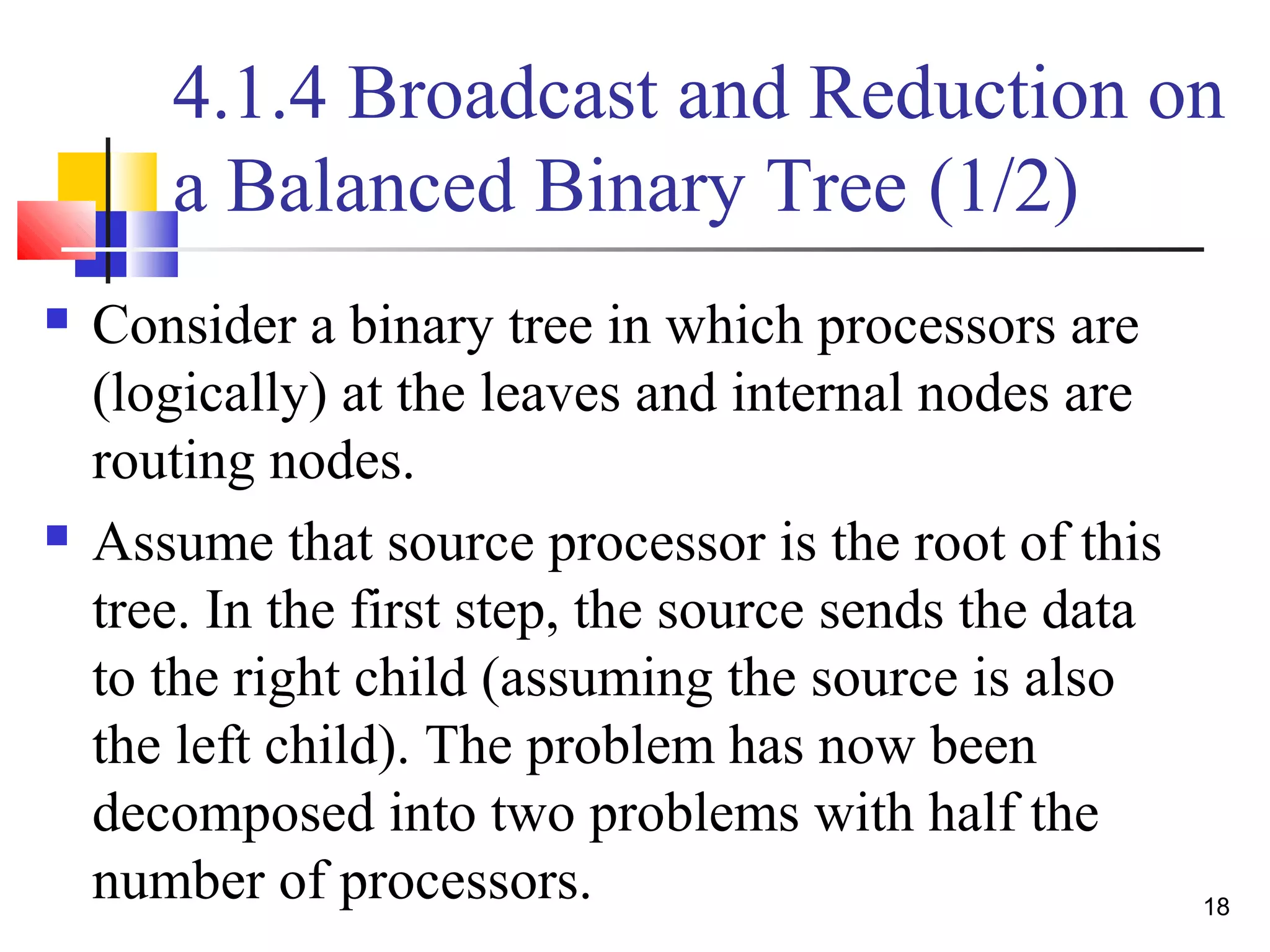
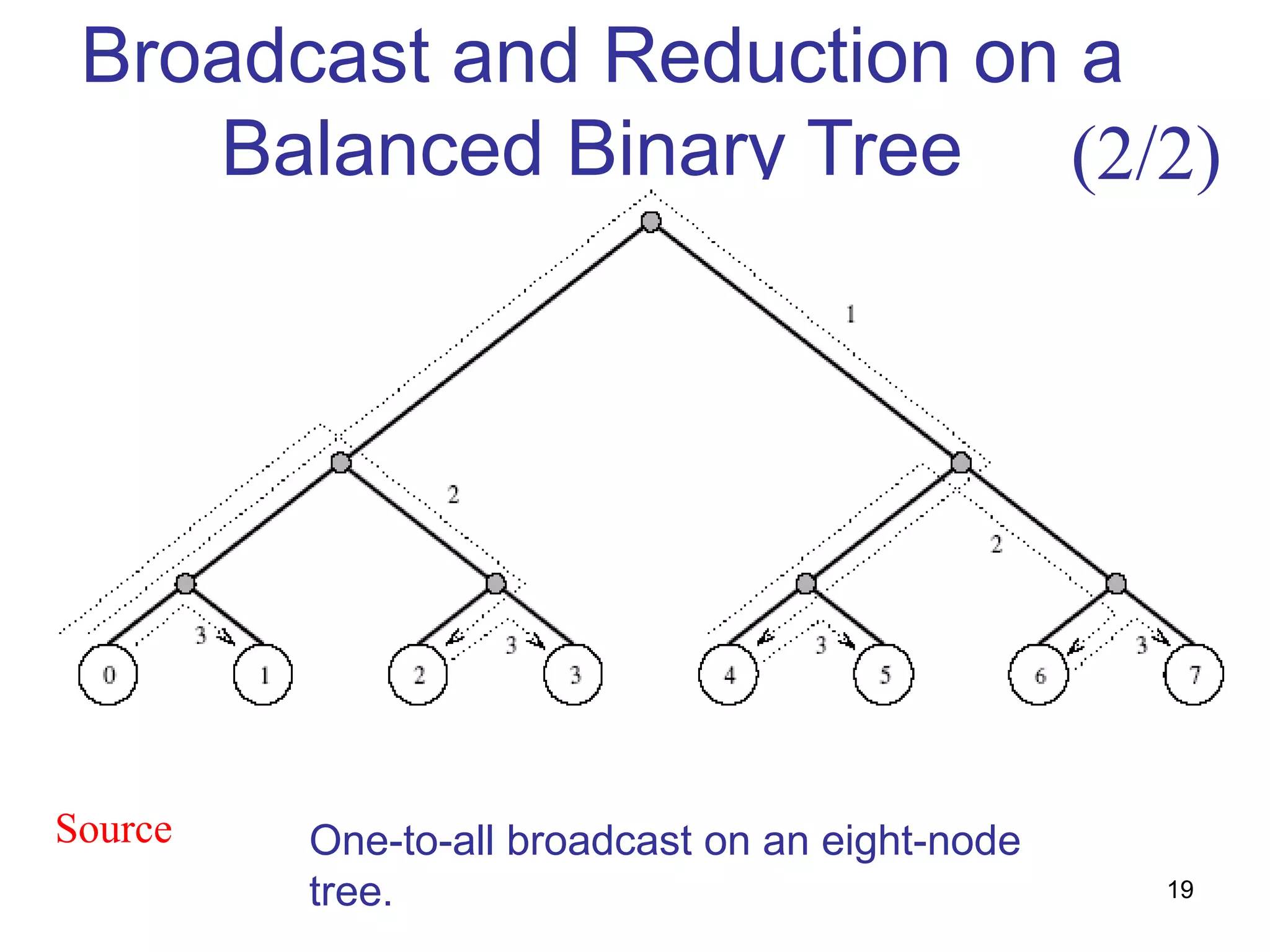
4.1.4 Broadcast and Reduction on
a Balanced Binary Tree (1/2)
 Consider a binary tree in which processors are
(logically) at the leaves and internal nodes are
routing nodes.
 Assume that source processor is the root of this
tree. In the first step, the source sends the data
to the right child (assuming the source is also
the left child). The problem has now been
decomposed into two problems with half the
number of processors. 18
Broadcast and Reduction on a
Balanced Binary Tree
One-to-all broadcast on an eight-node
tree.
(2/2)
Source
19
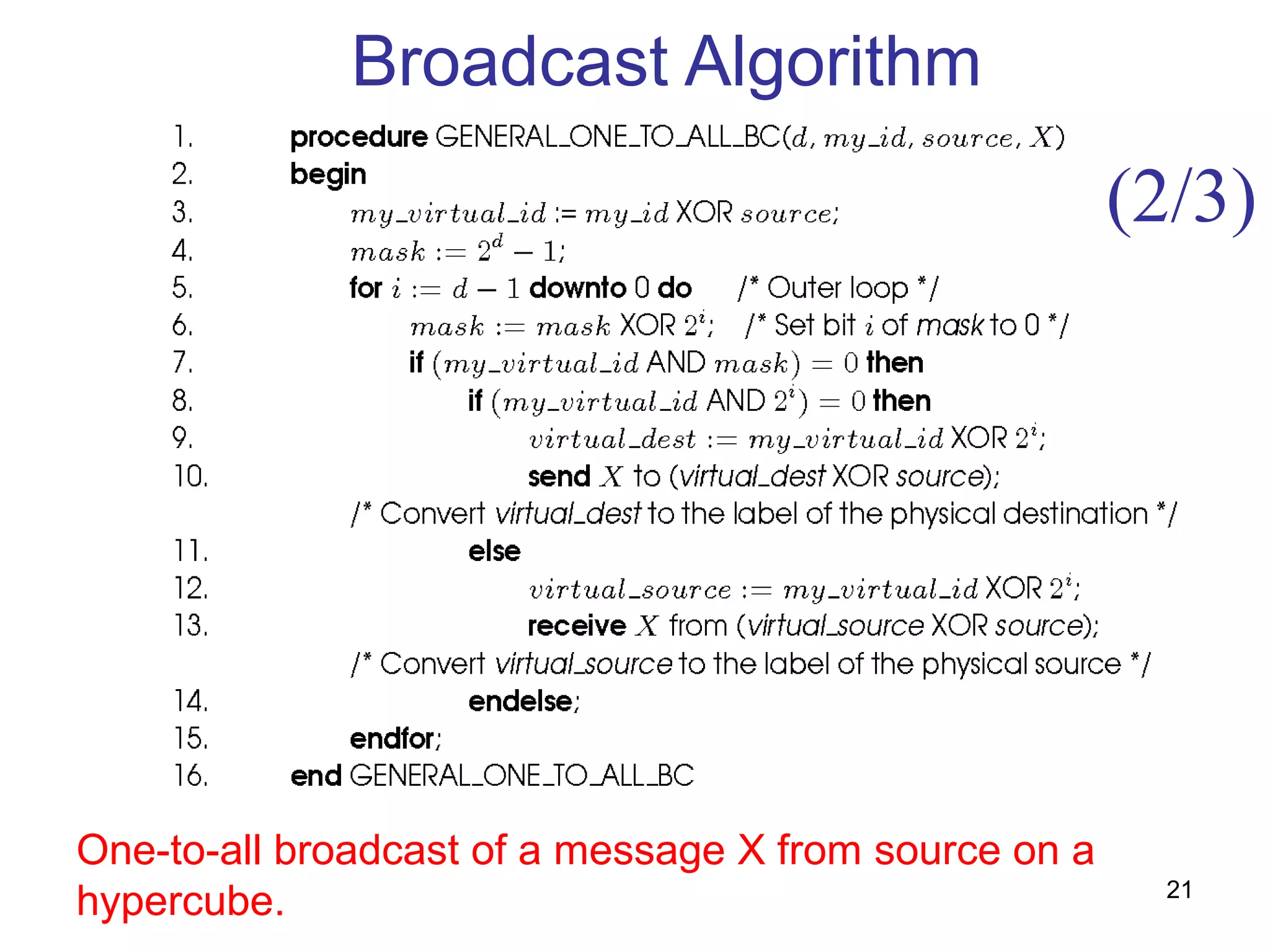
4.1.4 Broadcast and Reduction
Algorithms (1/3)
 All of the algorithms described above are
adaptations of the same algorithmic template.
 We illustrate the algorithm for a hypercube, but
the algorithm, as has been seen, can be adapted
to other architectures.
 The hypercube has 2d
nodes and my_id is the
label for a node.
 X is the message to be broadcast, which initially
resides at the source node 0. 20
Broadcast Algorithm
One-to-all broadcast of a message X from source on a
hypercube.
(2/3)
21
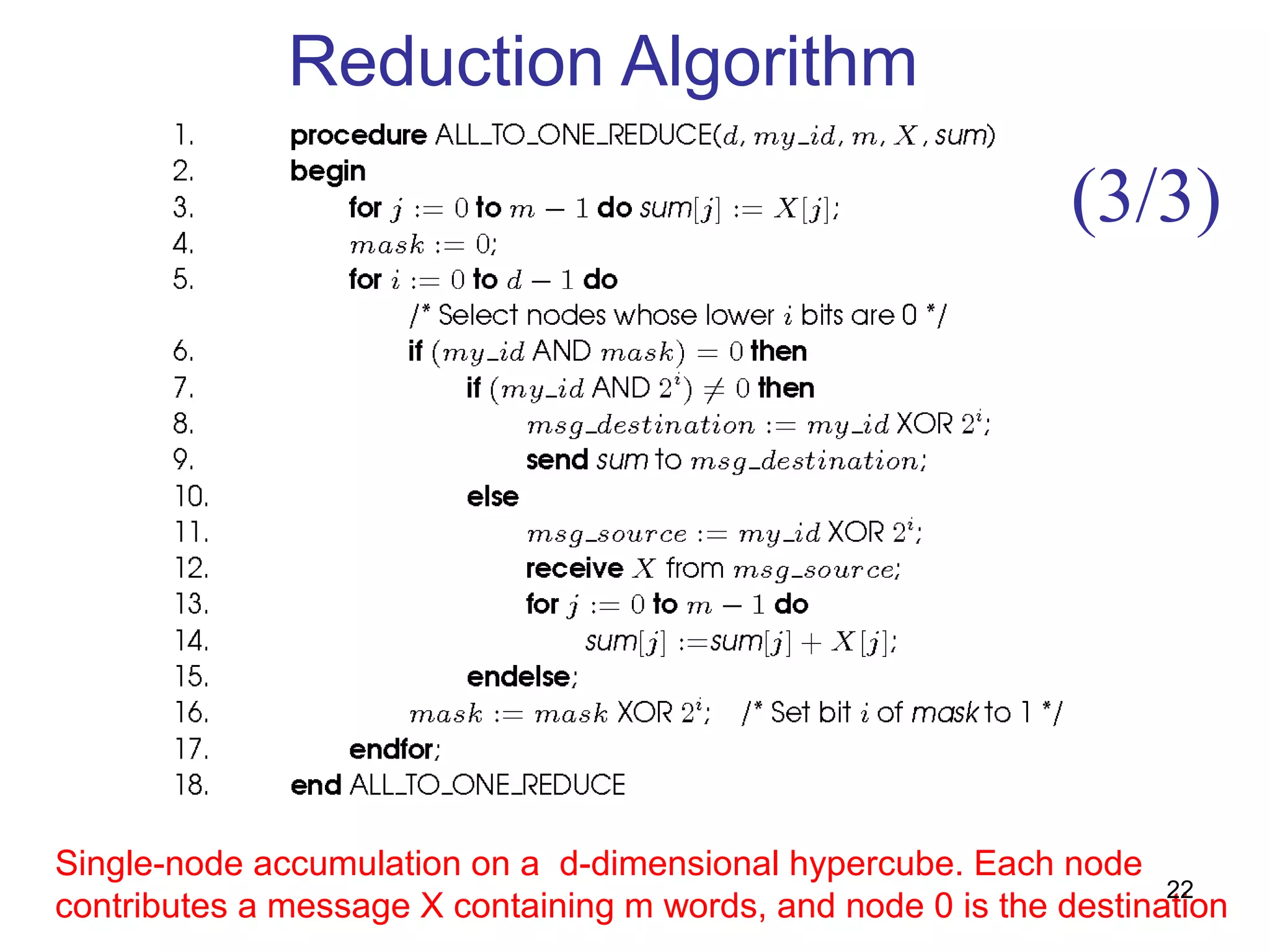
Reduction Algorithm
Single-node accumulation on a d-dimensional hypercube. Each node
contributes a message X containing m words, and node 0 is the destination
(3/3)
22
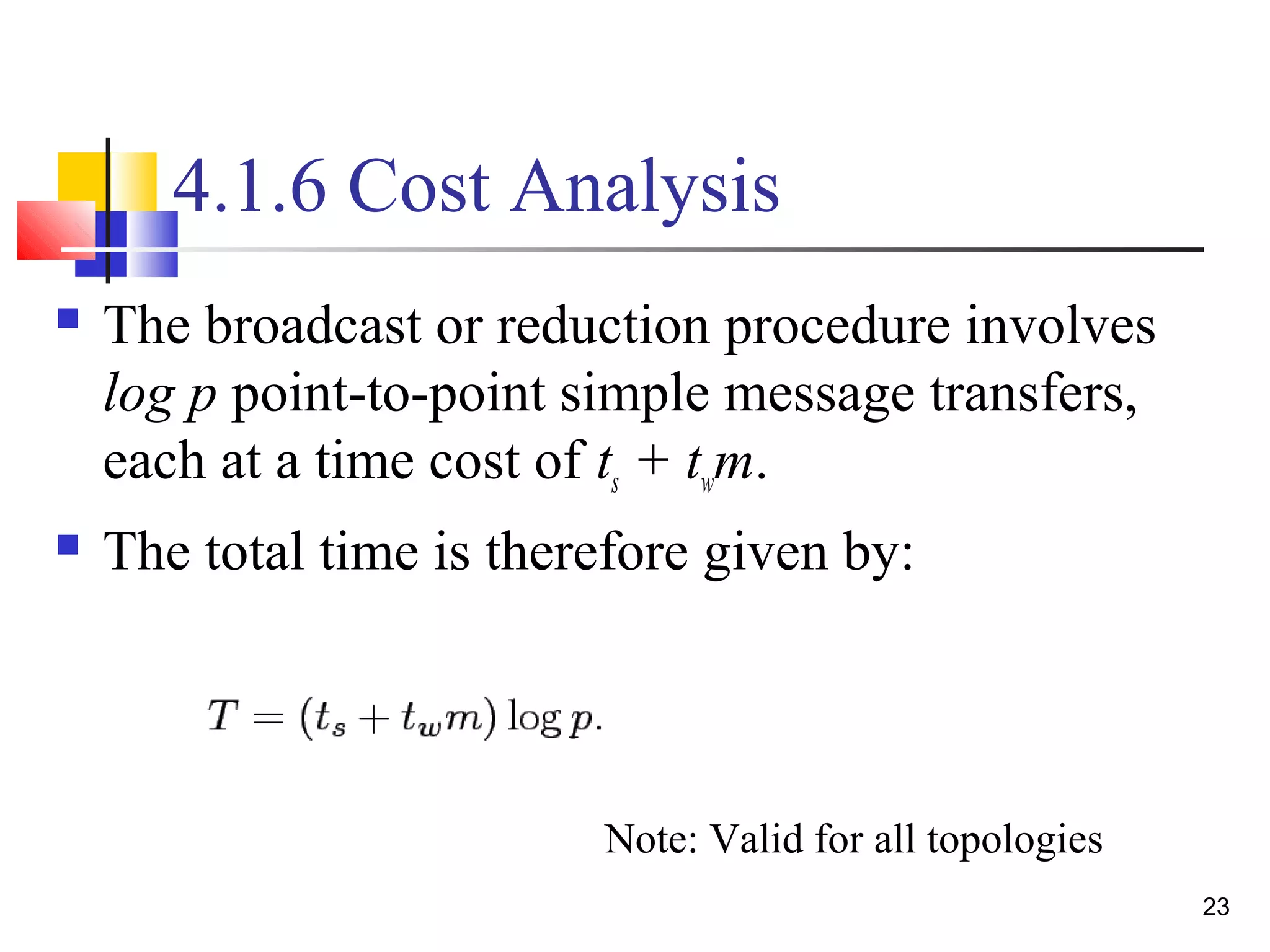
4.1.6 Cost Analysis
 The broadcast or reduction procedure involves
log p point-to-point simple message transfers,
each at a time cost of ts + twm.
 The total time is therefore given by:
Note: Valid for all topologies
23
4.2 All-to-All Broadcast and
Reduction (1/4)
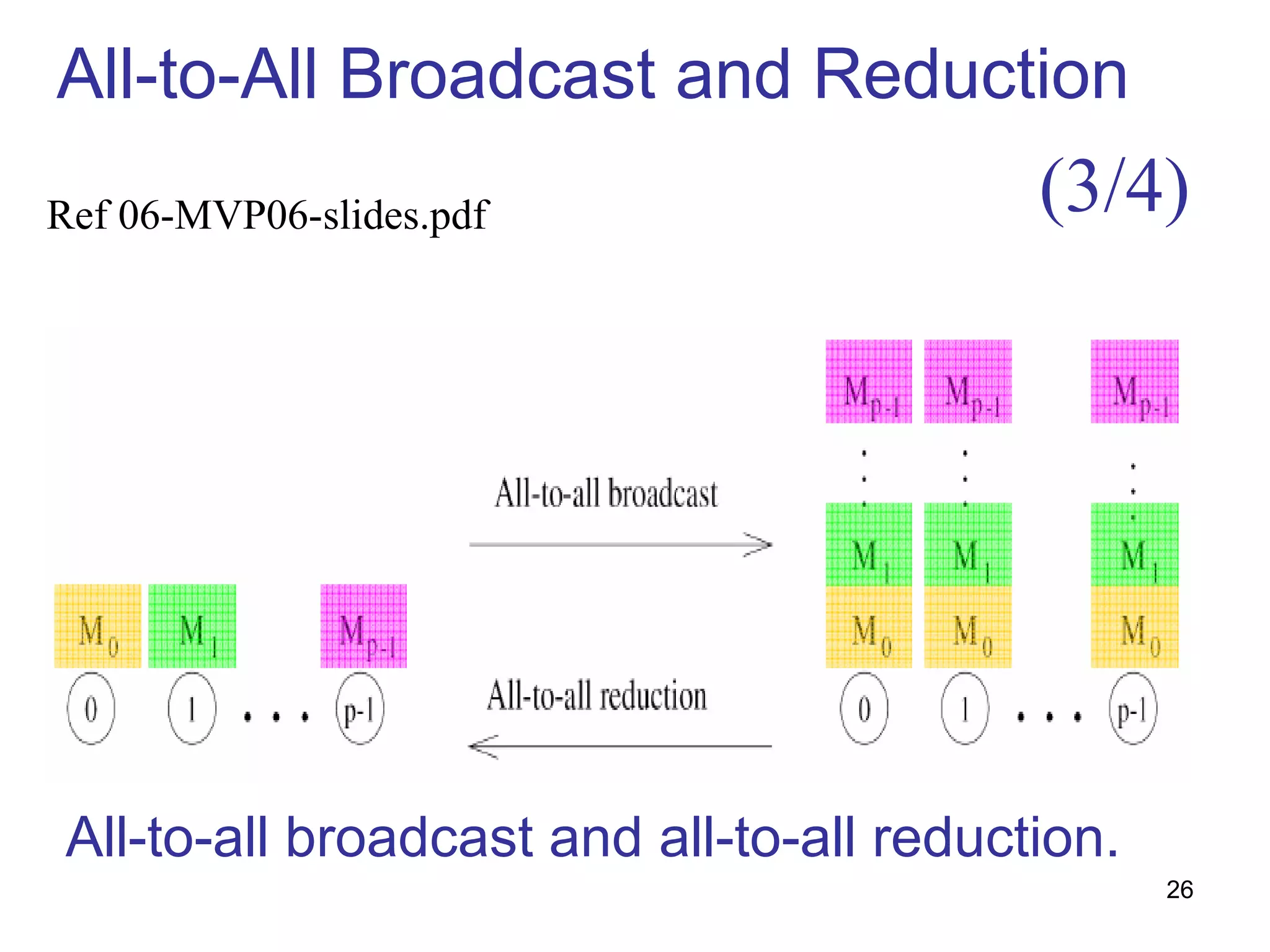
 All-to-all broadcast can be viewed as a generalization of one-to-all
broadcast
 All p nodes simultaneously initiate a broadcast
 Each node sends the same m-word message to every other nodes
 Different node may broadcast different messages
 The dual of all-to-all broadcast is all-to-all reduction
 Every node is the destination of an all-to-one reduction
 Also known multi node broadcast
 Applications
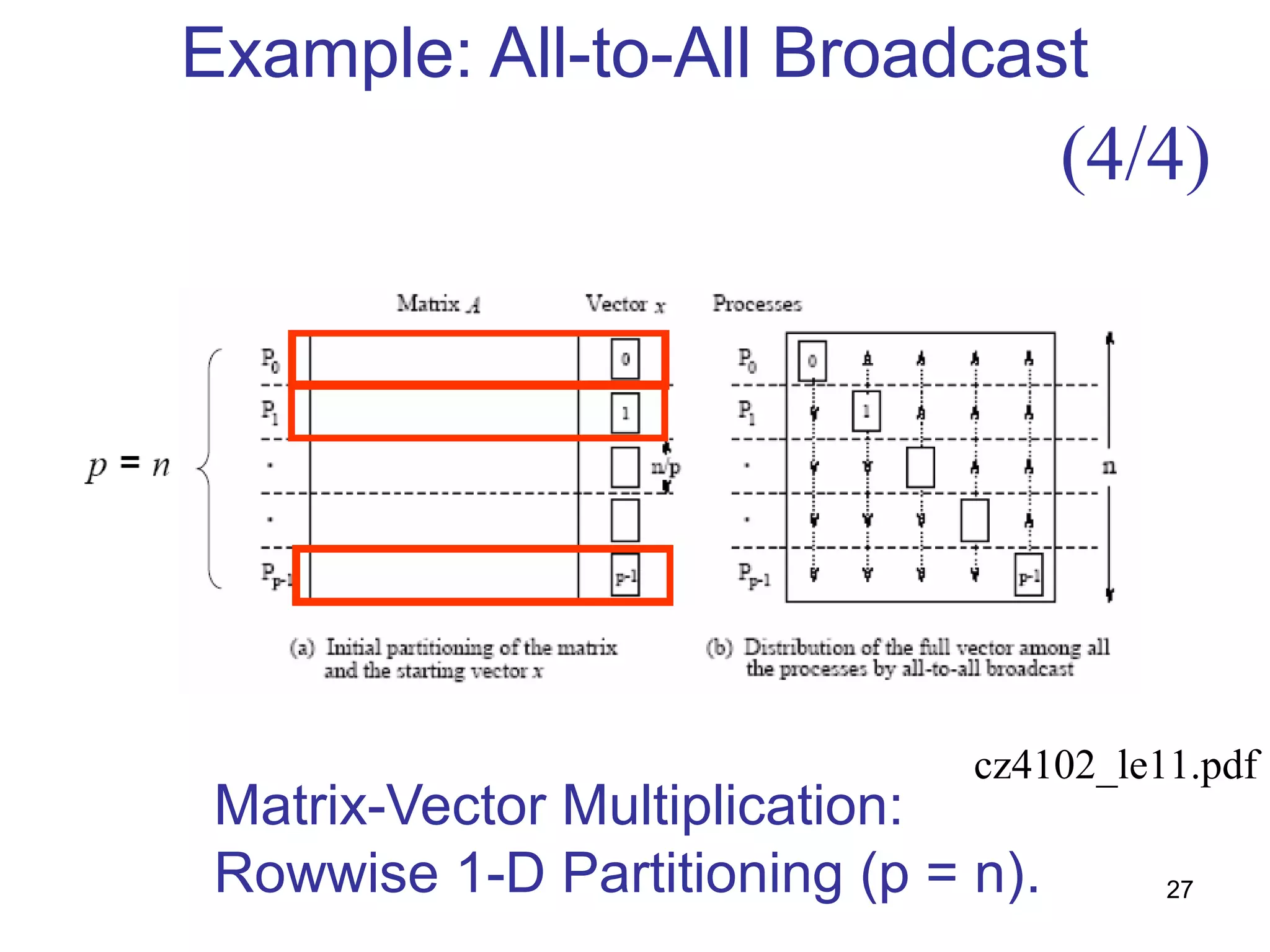
 Matrix-Vector Multiplication
 Matrix-Matrix Multiplication
24
All-to-All Broadcast and
Reduction (2/4)
 Naïve approach:
 sequentially execute p broadcasts/reductions
 Better approach:
 pipeline the broadcasts
 be careful not to overload/congest the links
25
All-to-All Broadcast and Reduction
All-to-all broadcast and all-to-all reduction.
(3/4)Ref 06-MVP06-slides.pdf
26
Example: All-to-All Broadcast
Matrix-Vector Multiplication:
Rowwise 1-D Partitioning (p = n).
cz4102_le11.pdf
(4/4)
27
4.2.1.1 All-to-All Broadcast on a
Ring (1/3)
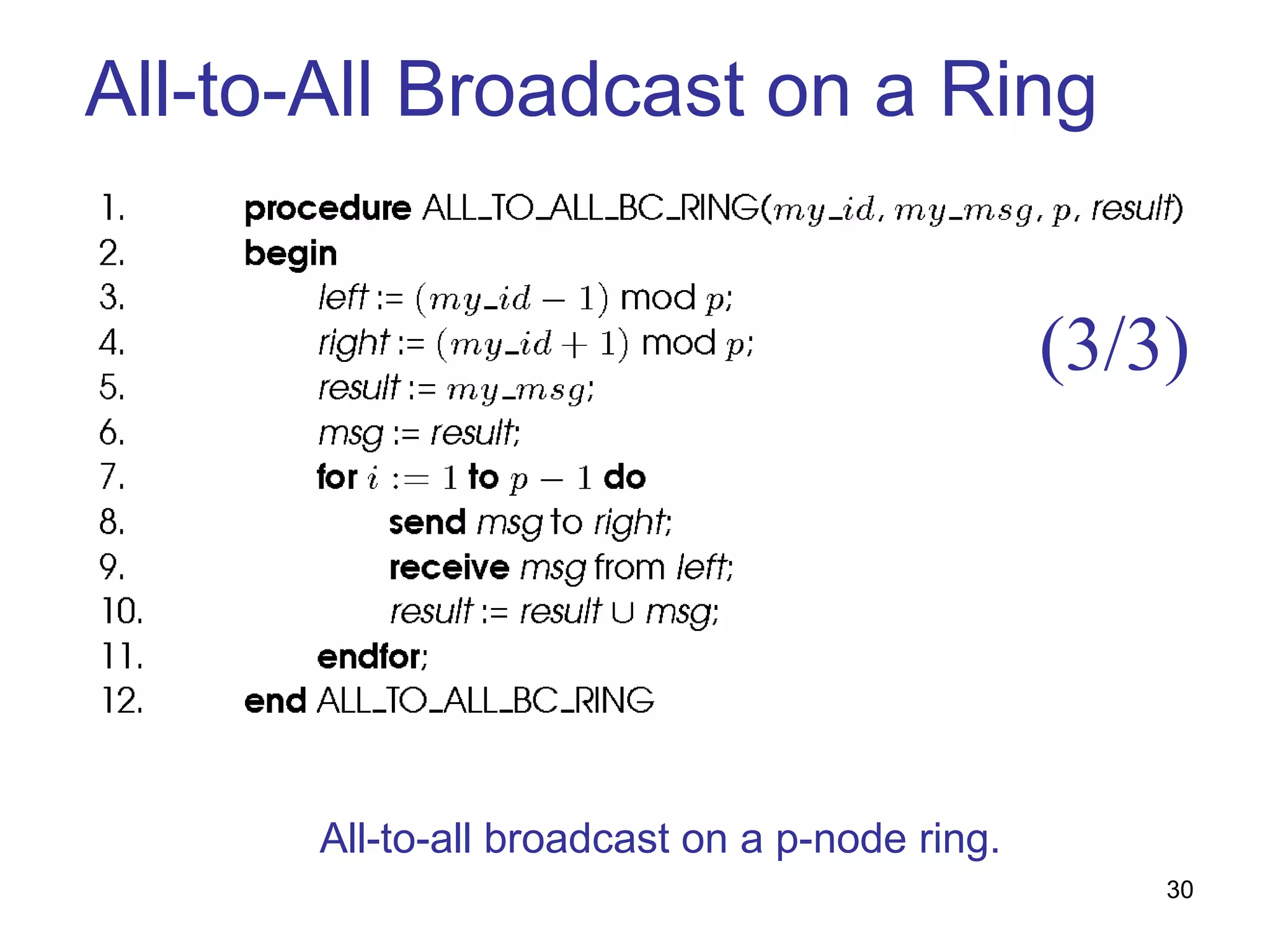
 All-to-all broadcast is achieved by a pipelined
point-to-point nearest neighbor communication
 For linear array, bi-directional link is necessary
 Step one:
 node i sends its data to node (i+1)mod p
 Step 2 .. (p-1)
 node i sends the data it received in the previous step
to node (i+1)mod p
28
All-to-All Broadcast on a Ring
All-to-all broadcast on an eight-node ring.
(2/3)
29
All-to-All Broadcast on a Ring
All-to-all broadcast on a p-node ring.
(3/3)
30
4.2.1.2 All-to-All Reduction on a
Ring (1/2)
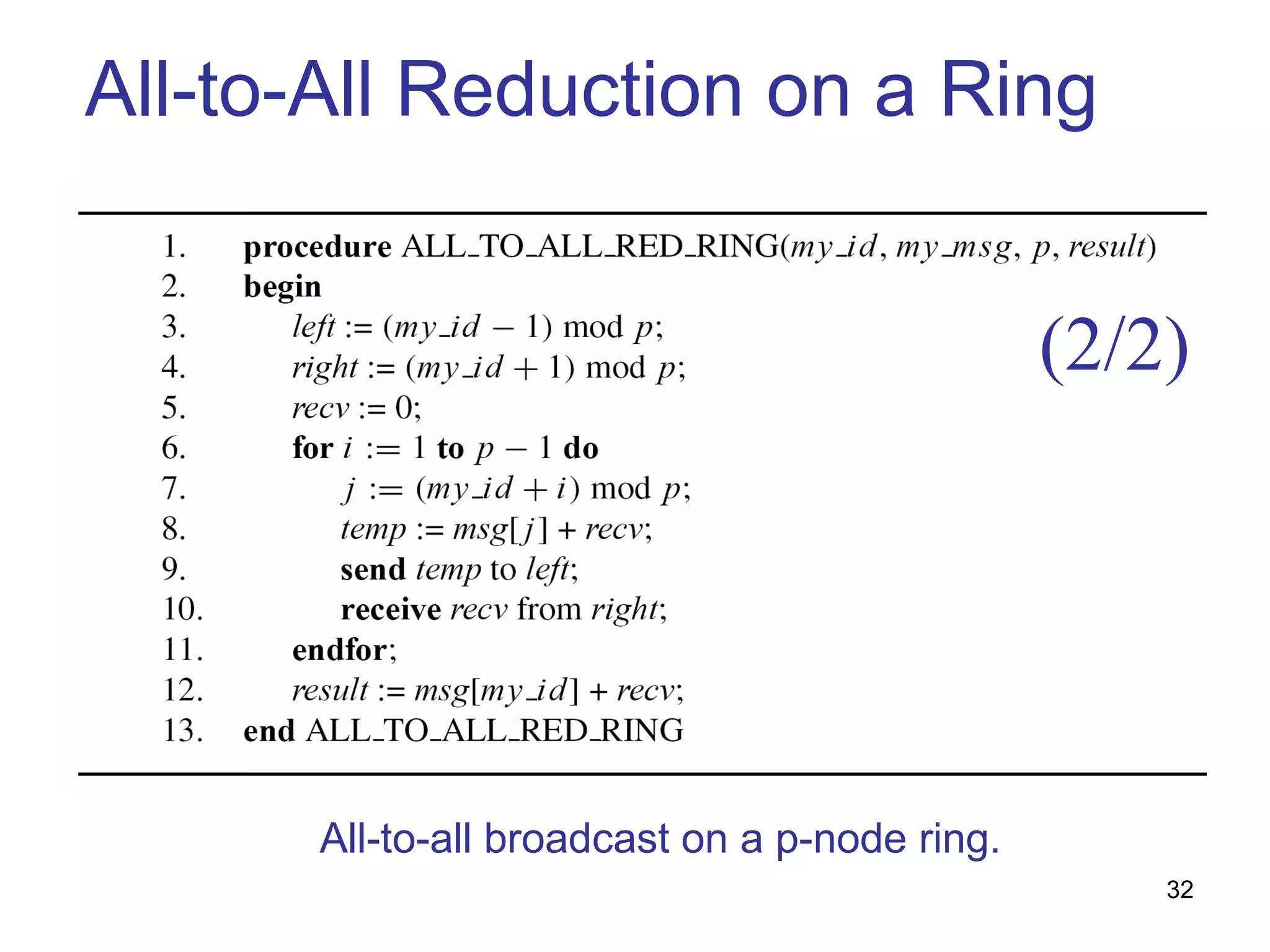
 For all-to-all reduction, the procedure is
reversed, each node needs to perform the
operation at each step
 The only additional step required is that upon
receiving a message, a node must combine it
with the local copy that has the same destination
 As the received message before forwarding the
combined message
31
All-to-All Reduction on a Ring
All-to-all broadcast on a p-node ring.
(2/2)
32
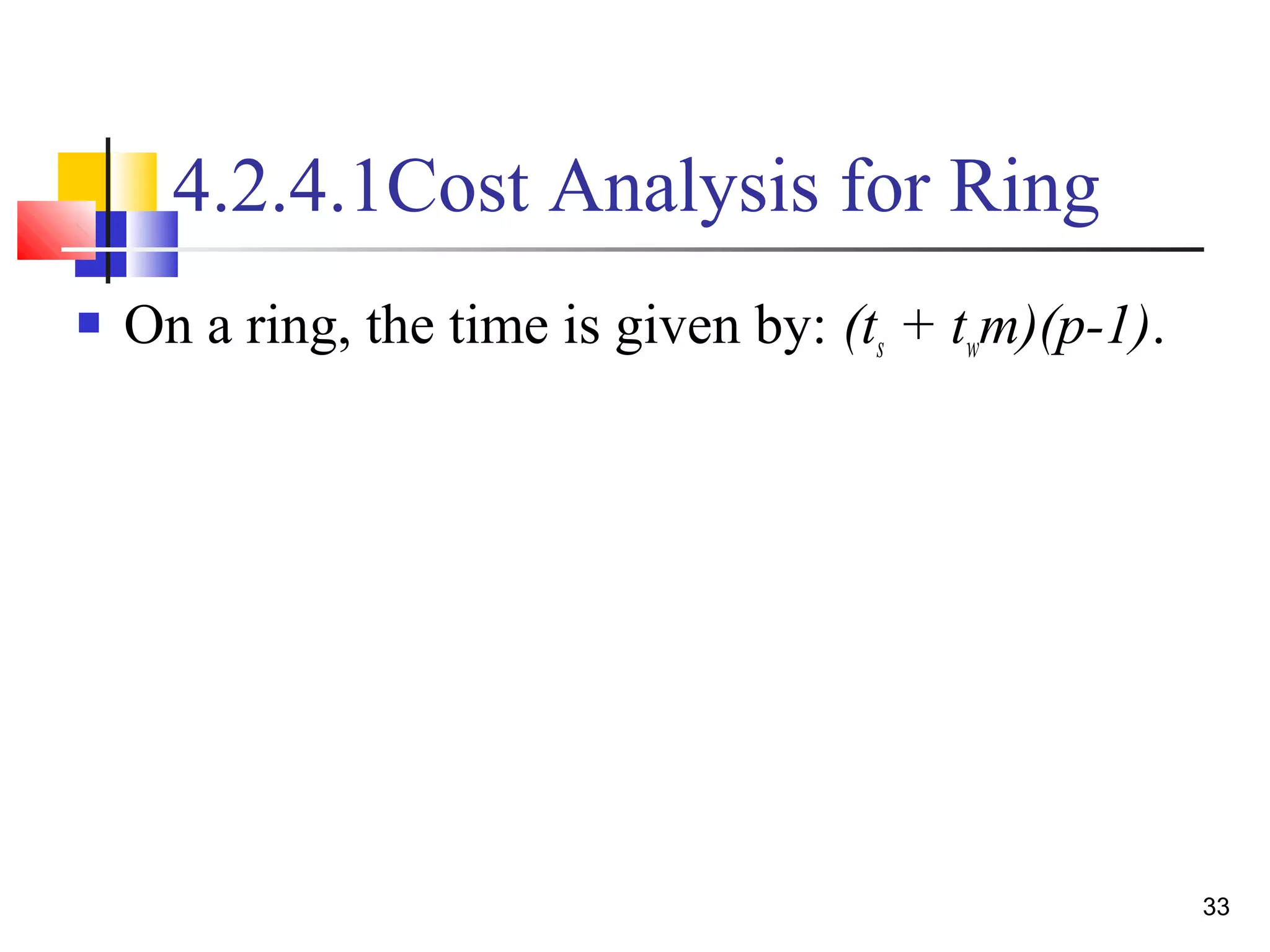
4.2.4.1Cost Analysis for Ring
 On a ring, the time is given by: (ts + twm)(p-1).
33
4.2.2 All-to-all Broadcast on a
Mesh (1/4)
 All-to-all broadcast algorithm for the 2D mesh is
based on the ring algorithm
 The rows and columns of the mesh are treated as
rings in two steps:
 First, each row of the mesh performs an all-to-all
broadcast using the ring algorithm, collecting √p
messages corresponding to the √p nodes of their
respective rows
 Second, each column performs an all-to-all broadcast,
with a single message of size m.√p 34
All-to-all Broadcast on a Mesh
All-to-all broadcast on a 3 x 3 mesh. The groups of nodes
communicating with each other in each phase are enclosed by
dotted boundaries. By the end of the second phase, all nodes get
(0,1,2,3,4,5,6,7) (that is, a message from each node).
(2/4)
35
All-to-all Broadcast on a Mesh
All-to-all broadcast on a square mesh of p nodes.
(3/4)
36
4.2.4.2 Cost Analysis for Mesh
(4/4)
 In the first phase, the message size is m, the
number of steps is (√p-1)
 In the second phase, the message size is m (√p) ,
and the number of steps is (√p-1)
 The total communication cost is the sum of both
phases:
=(ts+ twm)(√p -1)+ (ts+ twm√p ) (√p -1)
=2ts(√p – 1) + twm(p-1).
37
4.2.3 All-to-all broadcast on a
Hypercube (1/4)
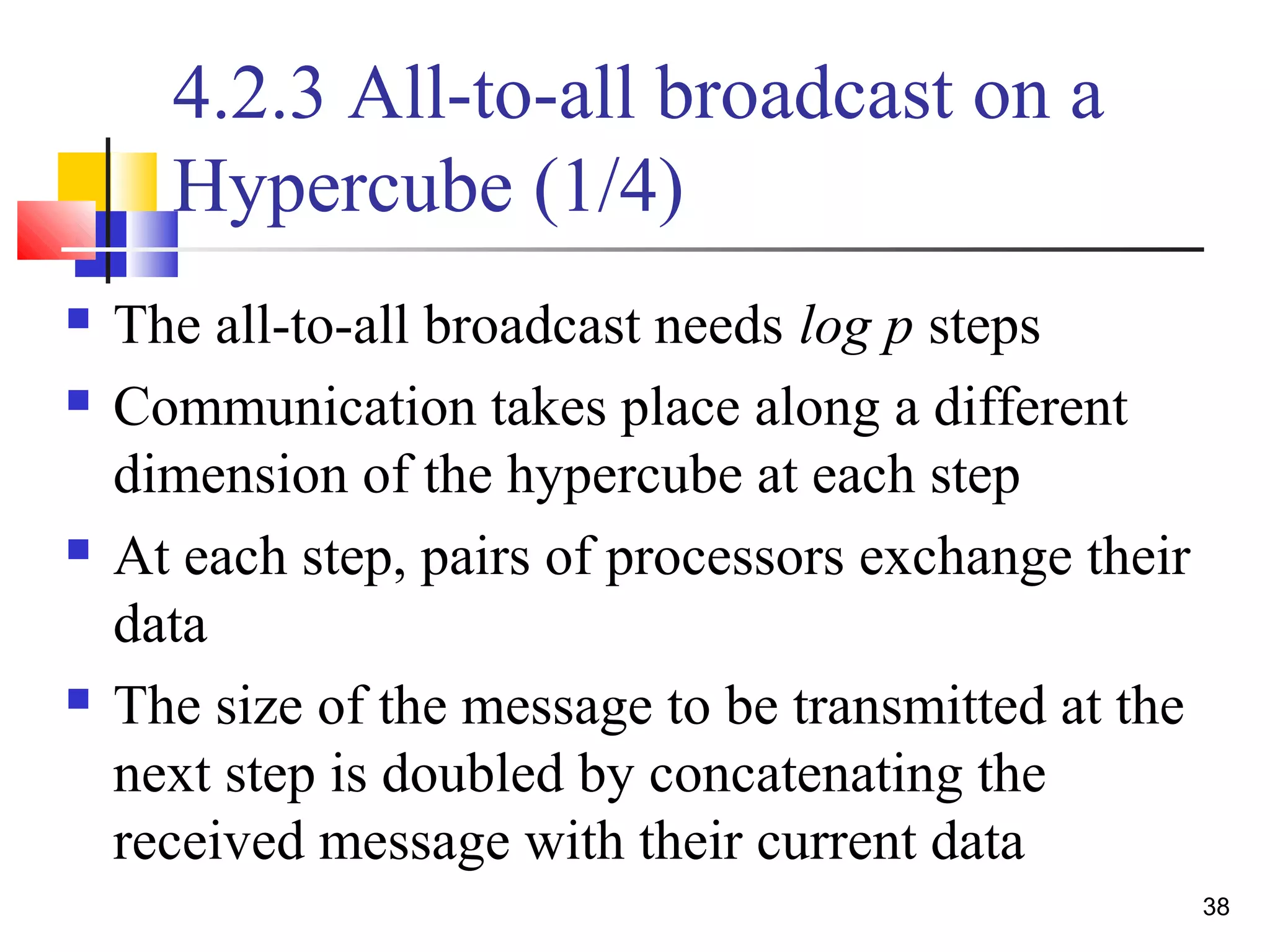
 The all-to-all broadcast needs log p steps
 Communication takes place along a different
dimension of the hypercube at each step
 At each step, pairs of processors exchange their
data
 The size of the message to be transmitted at the
next step is doubled by concatenating the
received message with their current data
38
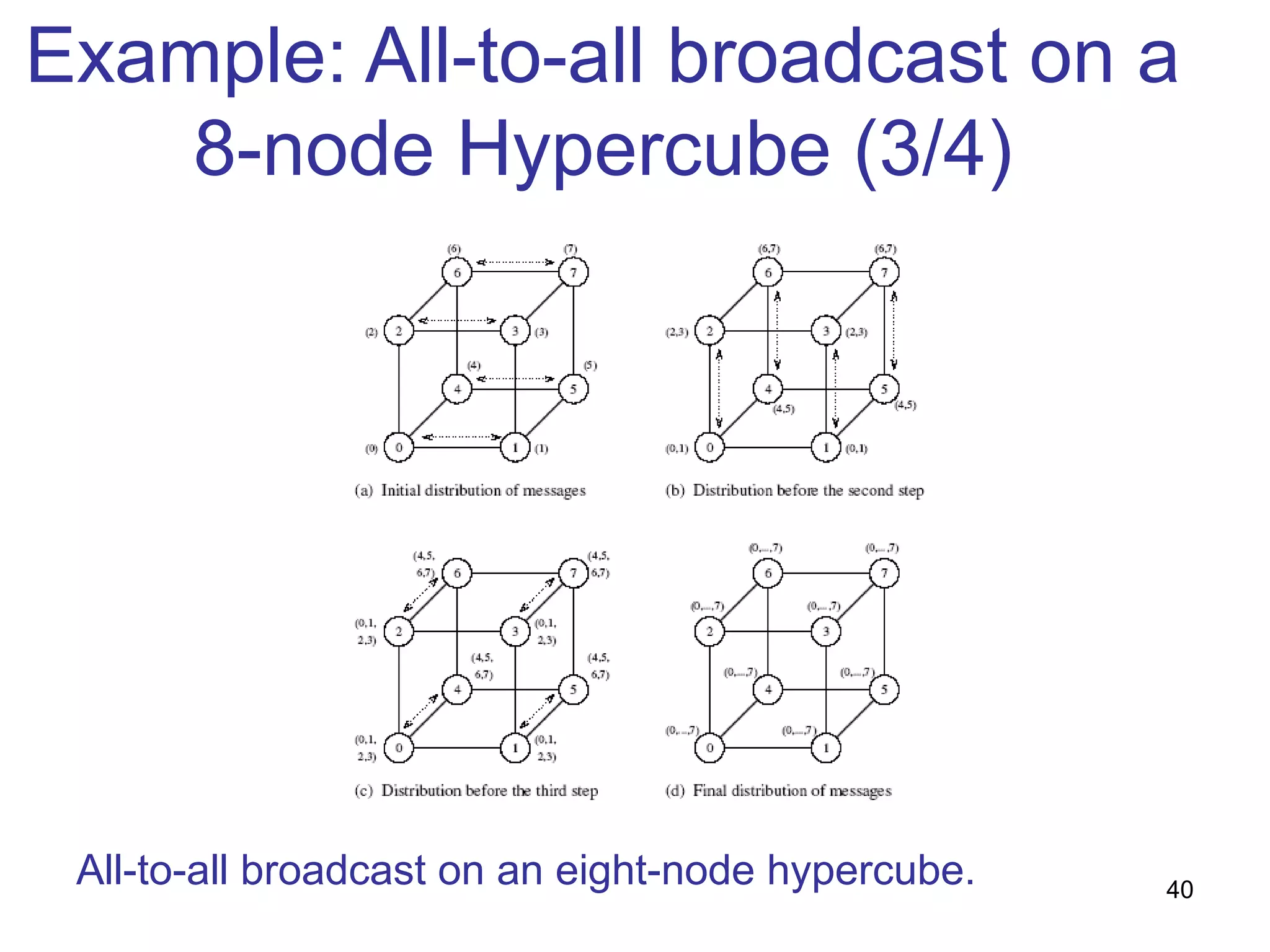
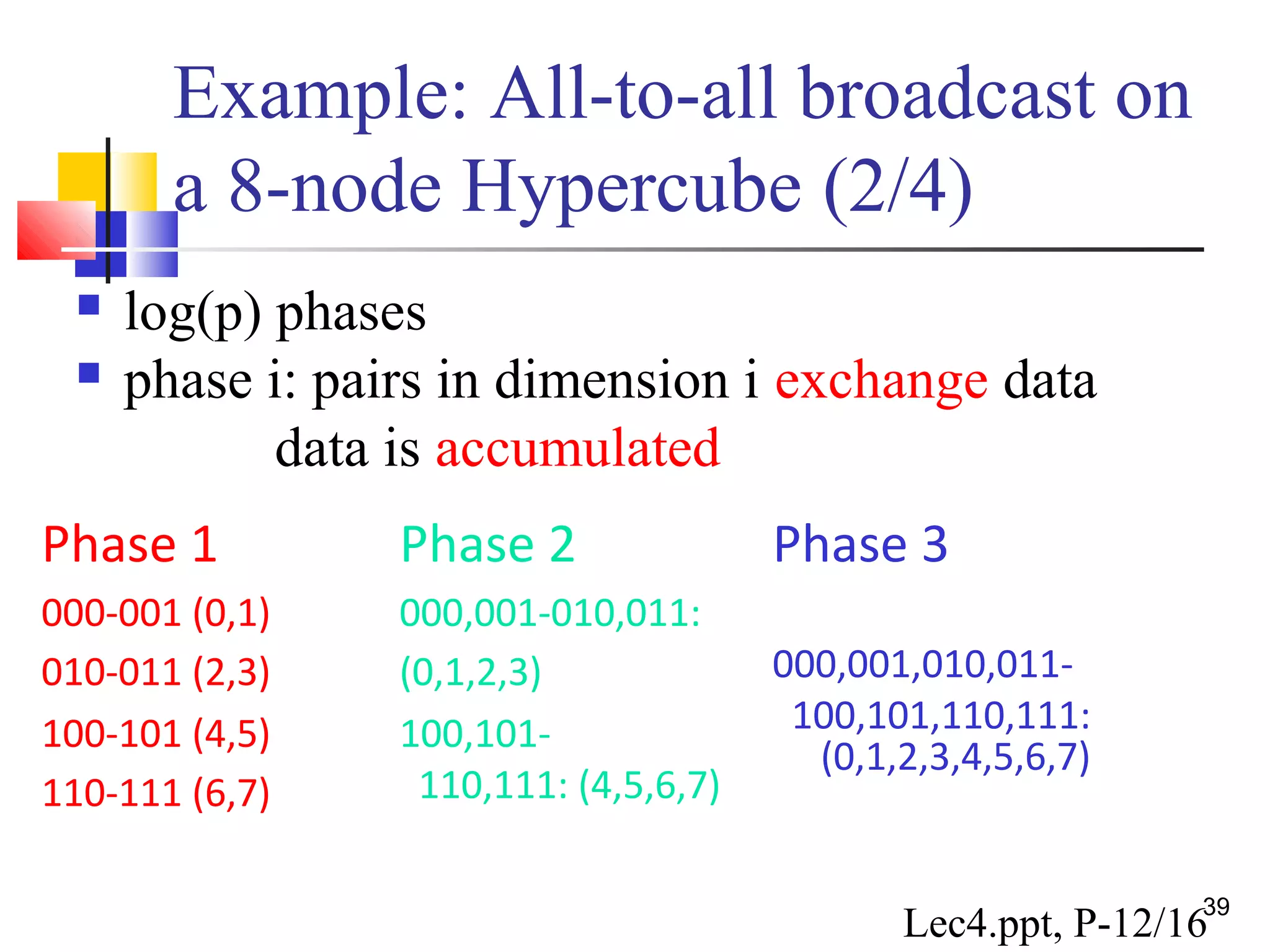
Example: All-to-all broadcast on
a 8-node Hypercube (2/4)
 log(p) phases
 phase i: pairs in dimension i exchange data
data is accumulated
Phase 1 Phase 2 Phase 3
000-001 (0,1)
010-011 (2,3)
000,001-010,011:
(0,1,2,3) 000,001,010,011-
100,101,110,111:
(0,1,2,3,4,5,6,7)
100-101 (4,5)
110-111 (6,7)
100,101-
110,111: (4,5,6,7)
Lec4.ppt, P-12/16
39
Example: All-to-all broadcast on a
8-node Hypercube (3/4)
All-to-all broadcast on an eight-node hypercube. 40
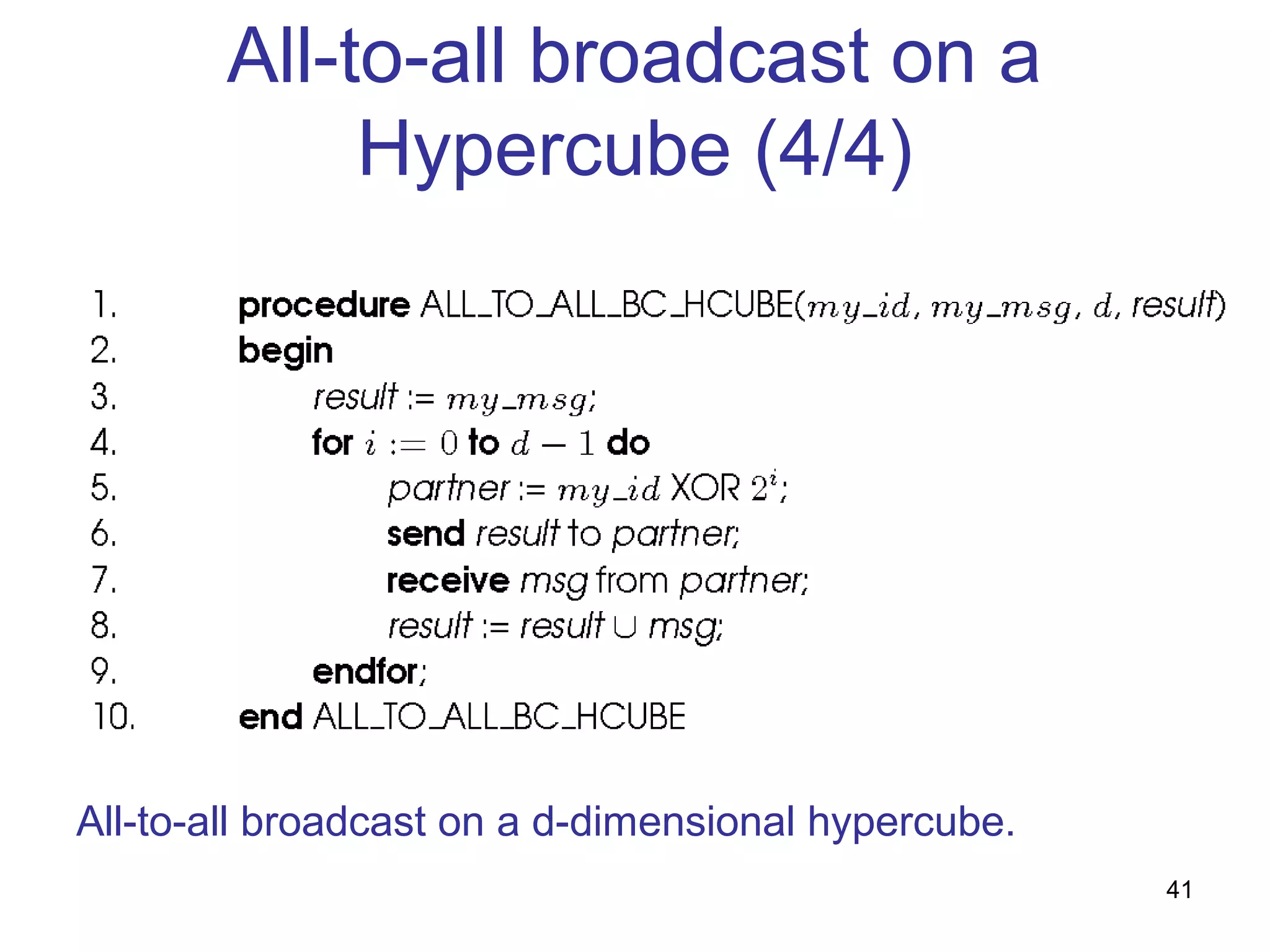
All-to-all broadcast on a
Hypercube (4/4)
All-to-all broadcast on a d-dimensional hypercube.
41
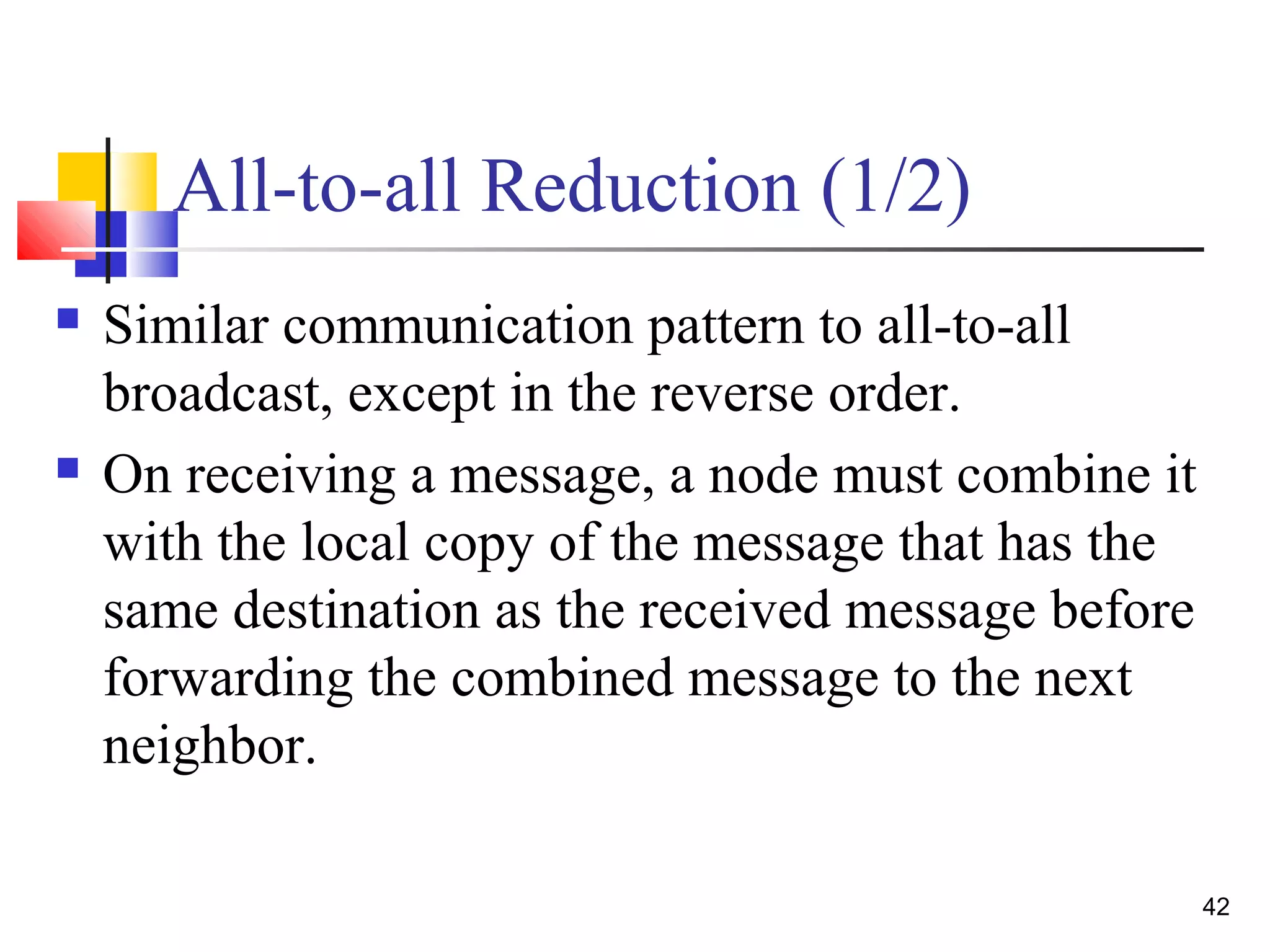
All-to-all Reduction (1/2)
 Similar communication pattern to all-to-all
broadcast, except in the reverse order.
 On receiving a message, a node must combine it
with the local copy of the message that has the
same destination as the received message before
forwarding the combined message to the next
neighbor.
42
All-to-all Reduction on a
Hypercube (2/2)
All-to-all reduction on a d-dimensional hypercube. 43
4.2.4.3 Cost Analysis for a
Hypercube
 log n communication rounds
 messages of size 2(i-1)
m are exchanged in
round i
44
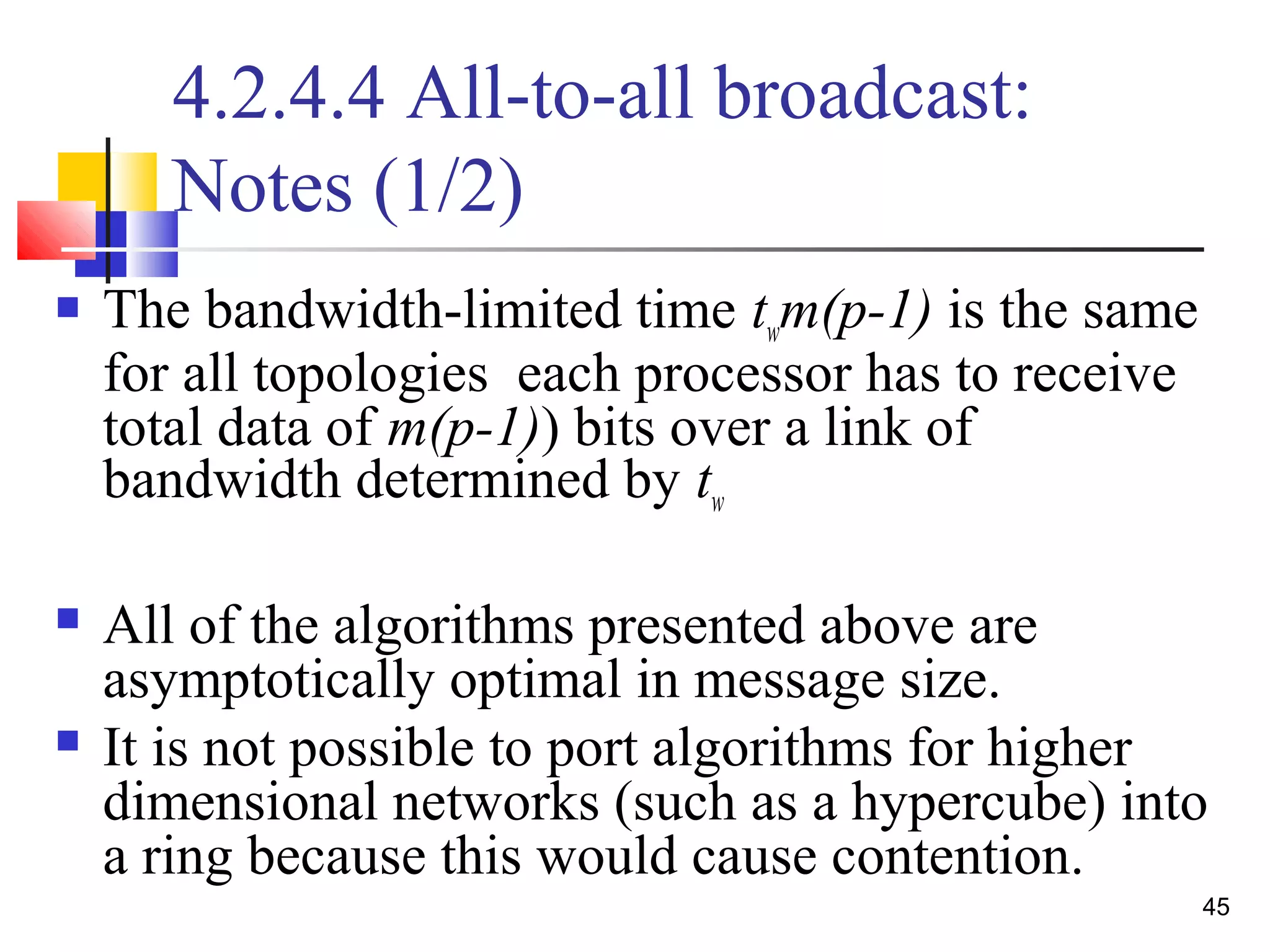
4.2.4.4 All-to-all broadcast:
Notes (1/2)
 The bandwidth-limited time twm(p-1) is the same
for all topologies each processor has to receive
total data of m(p-1)) bits over a link of
bandwidth determined by tw
 All of the algorithms presented above are
asymptotically optimal in message size.
 It is not possible to port algorithms for higher
dimensional networks (such as a hypercube) into
a ring because this would cause contention.
45
All-to-all broadcast: Notes (2/2)
Contention for a channel when the hypercube is
mapped onto a ring.
Ref 06-MVP06-slides.pdf
46
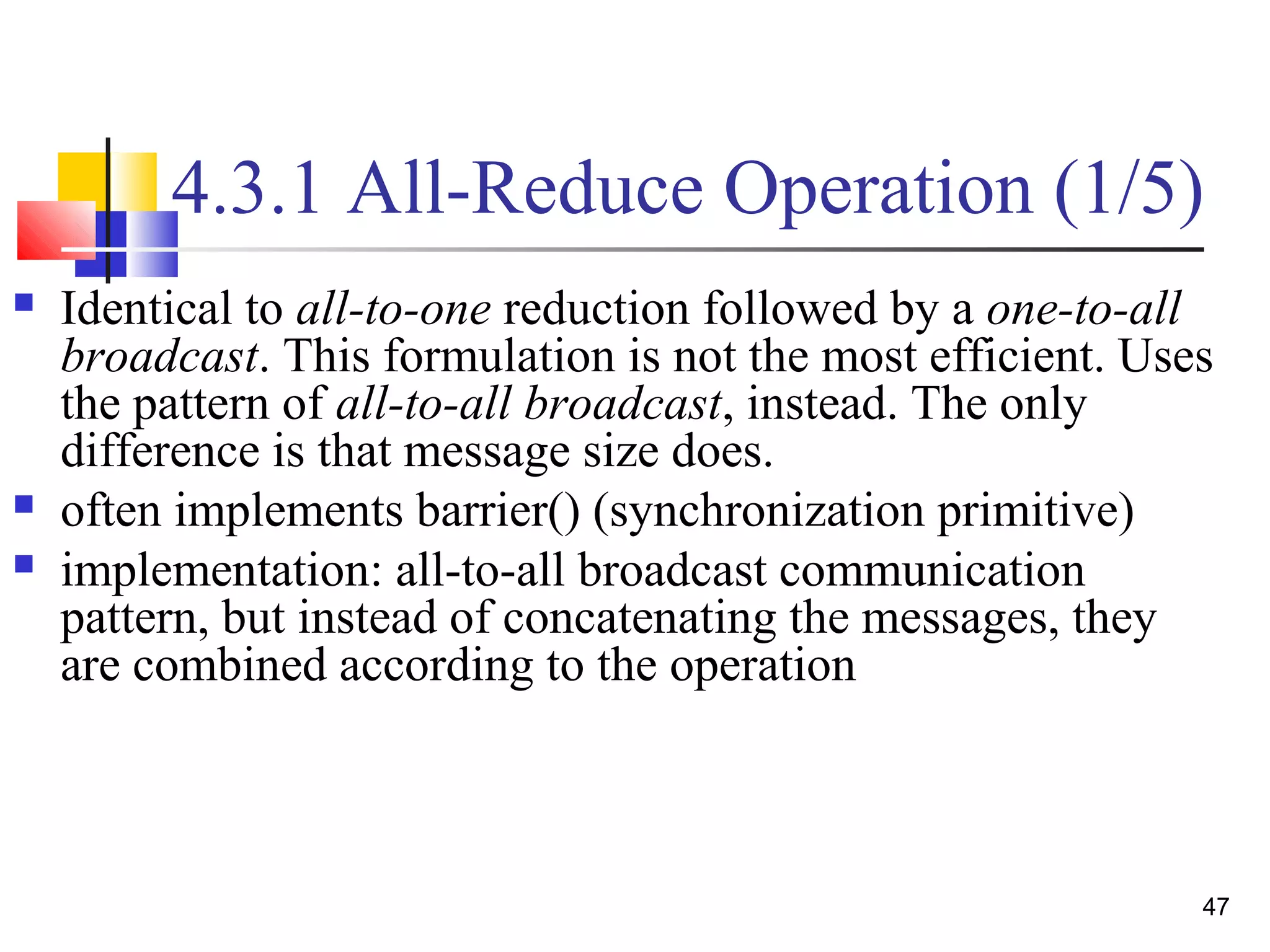
4.3.1 All-Reduce Operation (1/5)
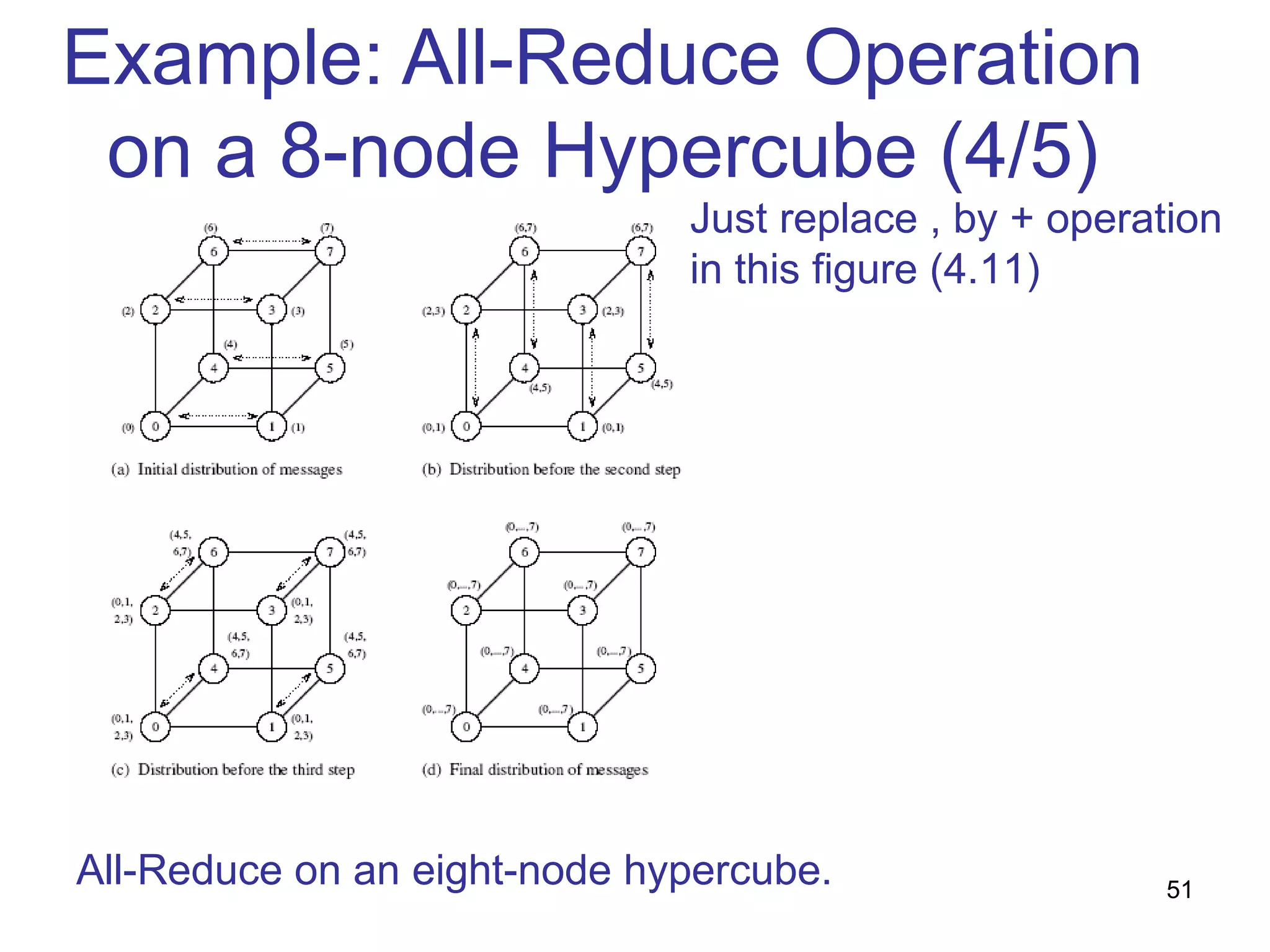
 Identical to all-to-one reduction followed by a one-to-all
broadcast. This formulation is not the most efficient. Uses
the pattern of all-to-all broadcast, instead. The only
difference is that message size does.
 often implements barrier() (synchronization primitive)
 implementation: all-to-all broadcast communication
pattern, but instead of concatenating the messages, they
are combined according to the operation
47
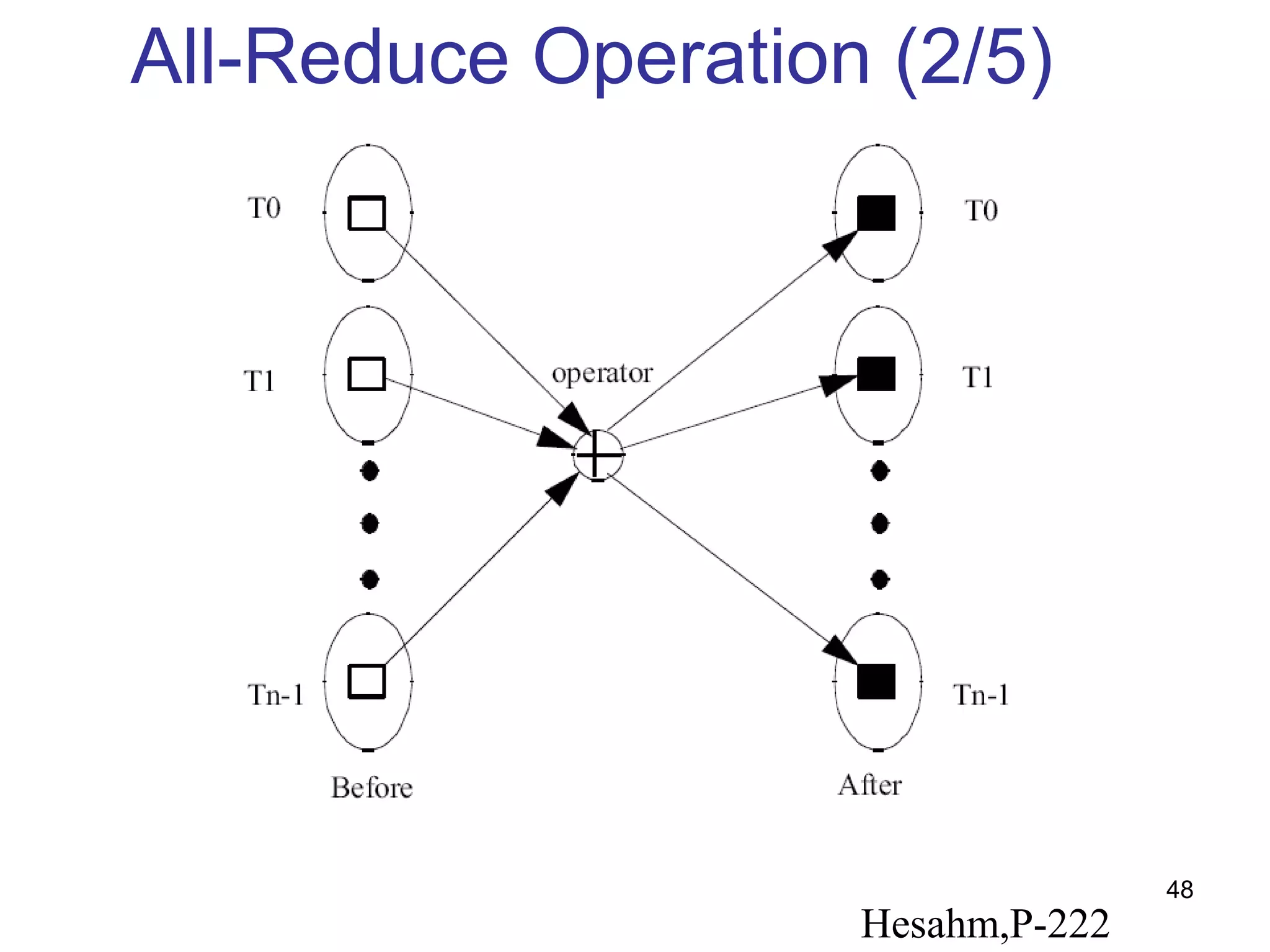
All-Reduce Operation (2/5)
Hesahm,P-222
48
All-Reduce Operation (3/5)
 In all-reduce, each node starts with a buffer of size
m and the final results of the operation are
identical buffers of size m on each node that are
formed by combining the original p buffers using
an associative operator.
 Different from all-to-all reduction, in which p
simultaneous all-to-one reductions take place,
each with a different destination for the result.
49
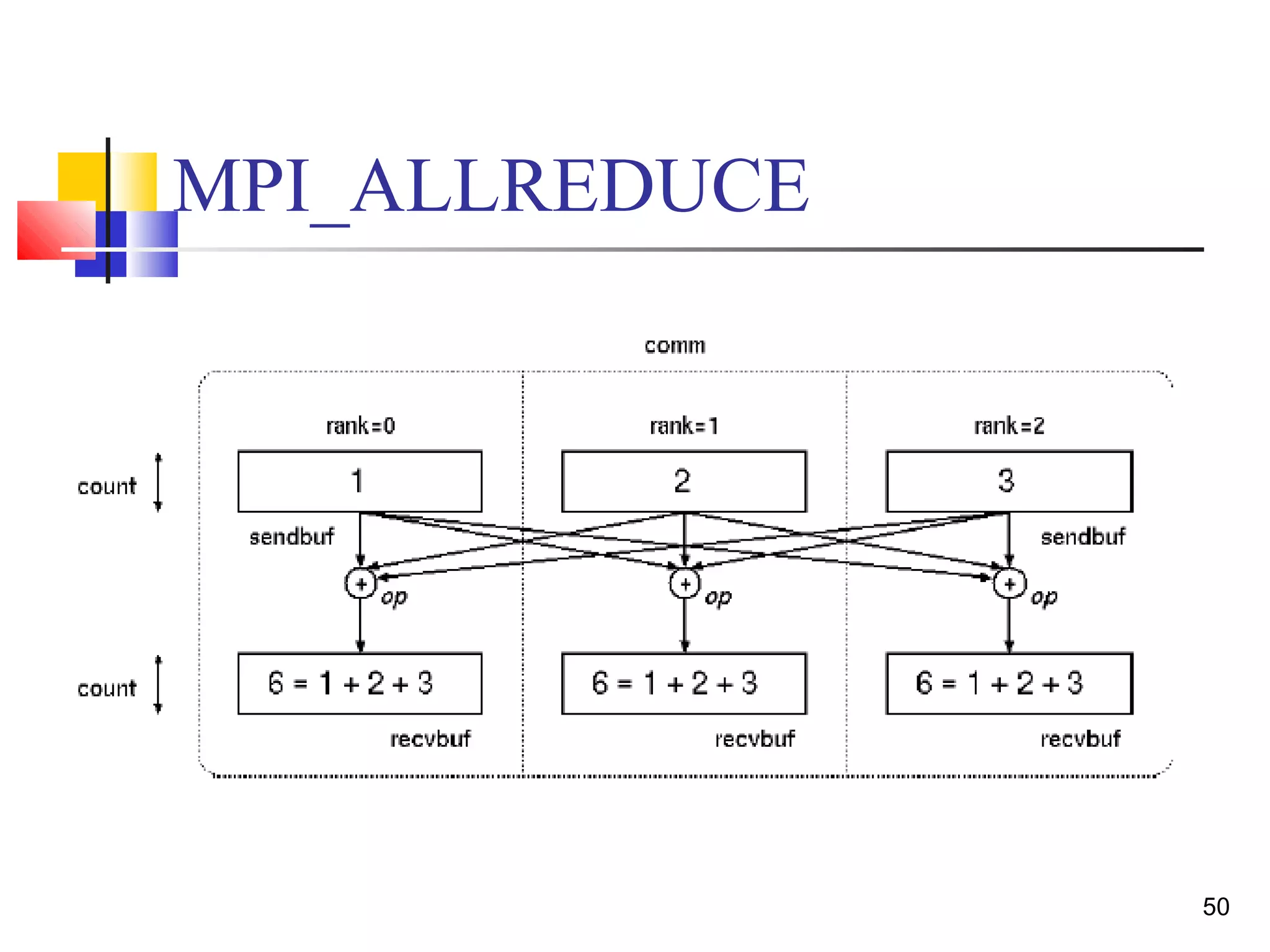
MPI_ALLREDUCE
50
Example: All-Reduce Operation
on a 8-node Hypercube (4/5)
All-Reduce on an eight-node hypercube.
Just replace , by + operation
in this figure (4.11)
51
Cost Analysis for All-Reduce
Operation using Hypercube (5/5)
 Since the message size does not increase here.
 Time for this operation is (ts + twm) log p.
52
4.3.2 The Prefix-Sum Operation
 Also known as scan operation
 Used for associative operations other than addition for
finding like maximum, minimum, string concatenations
and Boolean operations
 Example:
 Given p numbers n0,n1,…,np-1 (one on each node), the problem
is to compute the sums sk = ∑i
k
= 0 ni for all k between 0 and p-1 .
 Initially, nk resides on the node labeled k, and at the end of the
procedure, the same node holds Sk.
[Wilkinson, P-172]
53
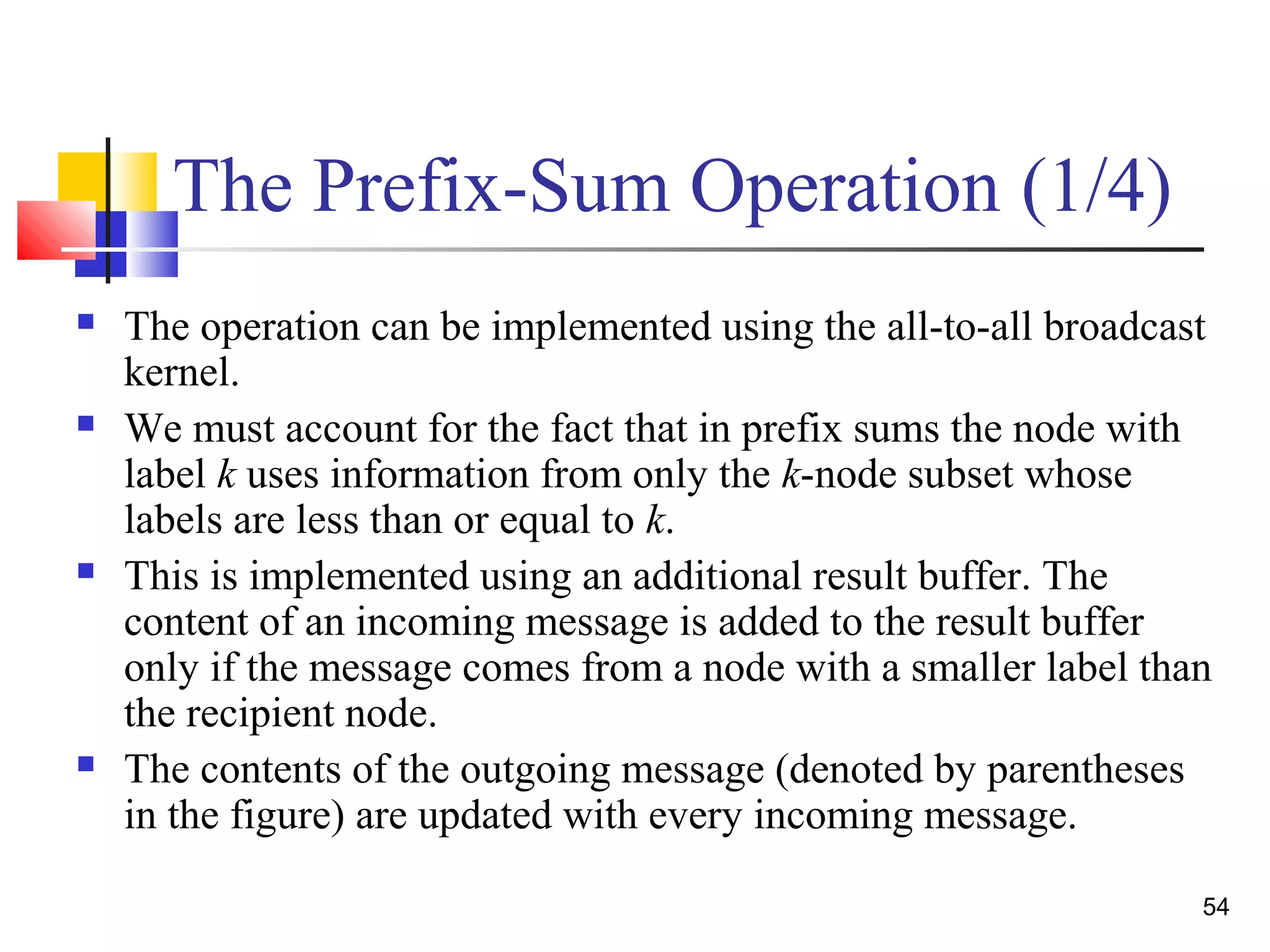
The Prefix-Sum Operation (1/4)
 The operation can be implemented using the all-to-all broadcast
kernel.
 We must account for the fact that in prefix sums the node with
label k uses information from only the k-node subset whose
labels are less than or equal to k.
 This is implemented using an additional result buffer. The
content of an incoming message is added to the result buffer
only if the message comes from a node with a smaller label than
the recipient node.
 The contents of the outgoing message (denoted by parentheses
in the figure) are updated with every incoming message.
54
scan(sendBuf, recvBuf,‘*’, group_id, …);
- group members
sendBuf4 104-1321
*
recvBuf4 8 -8 -32 -32
* * * *
Prefix-Sum
Comm.ppt
Dr. Hanif Durad
The Prefix-Sum Operation (2/4)
Computing prefix sums on an eight-node hypercube. At each
node, square brackets show the local prefix sum accumulated in
the result buffer and parentheses enclose the contents of the
outgoing message buffer for the next step.
56
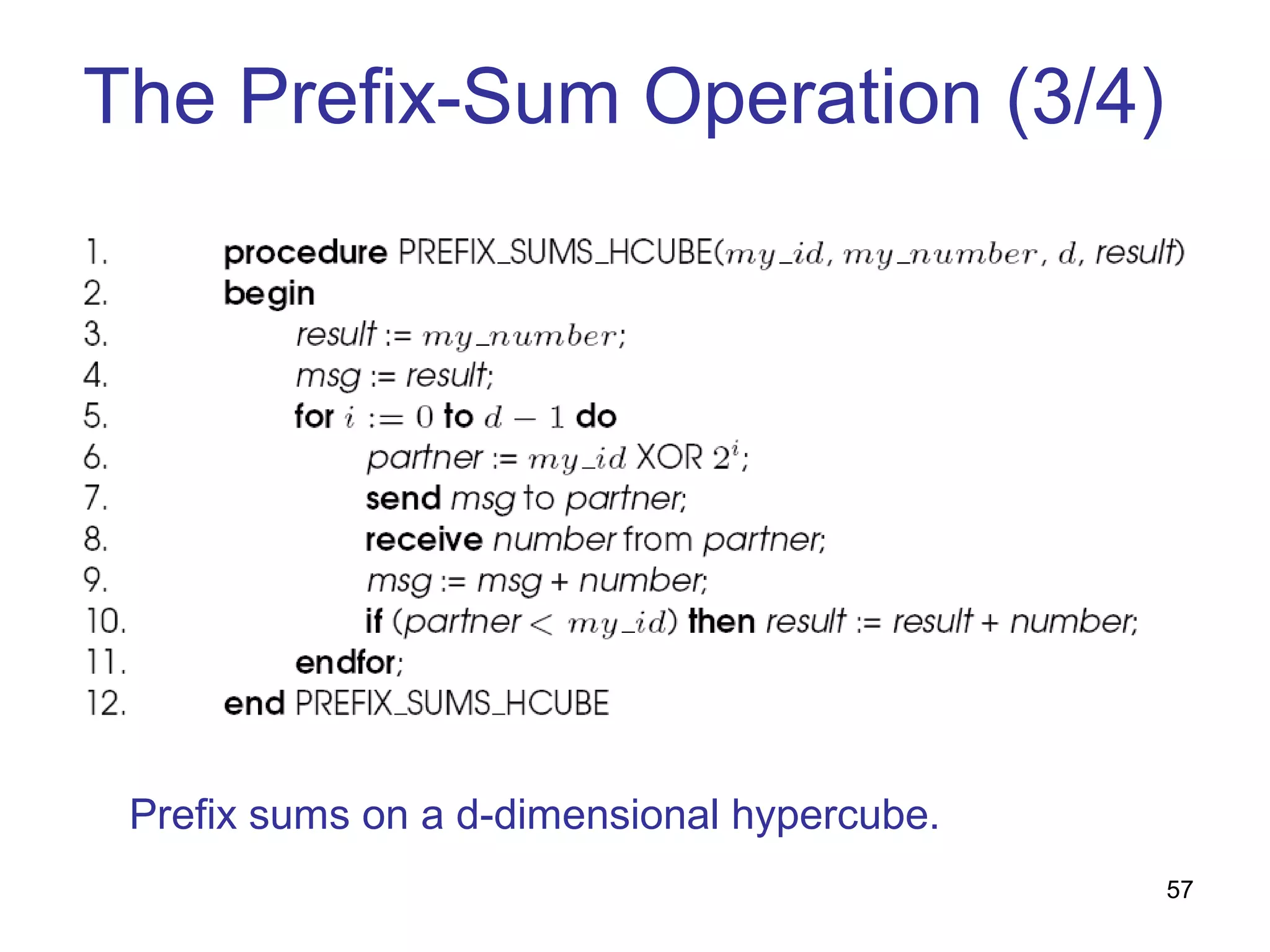
The Prefix-Sum Operation (3/4)
Prefix sums on a d-dimensional hypercube.
57
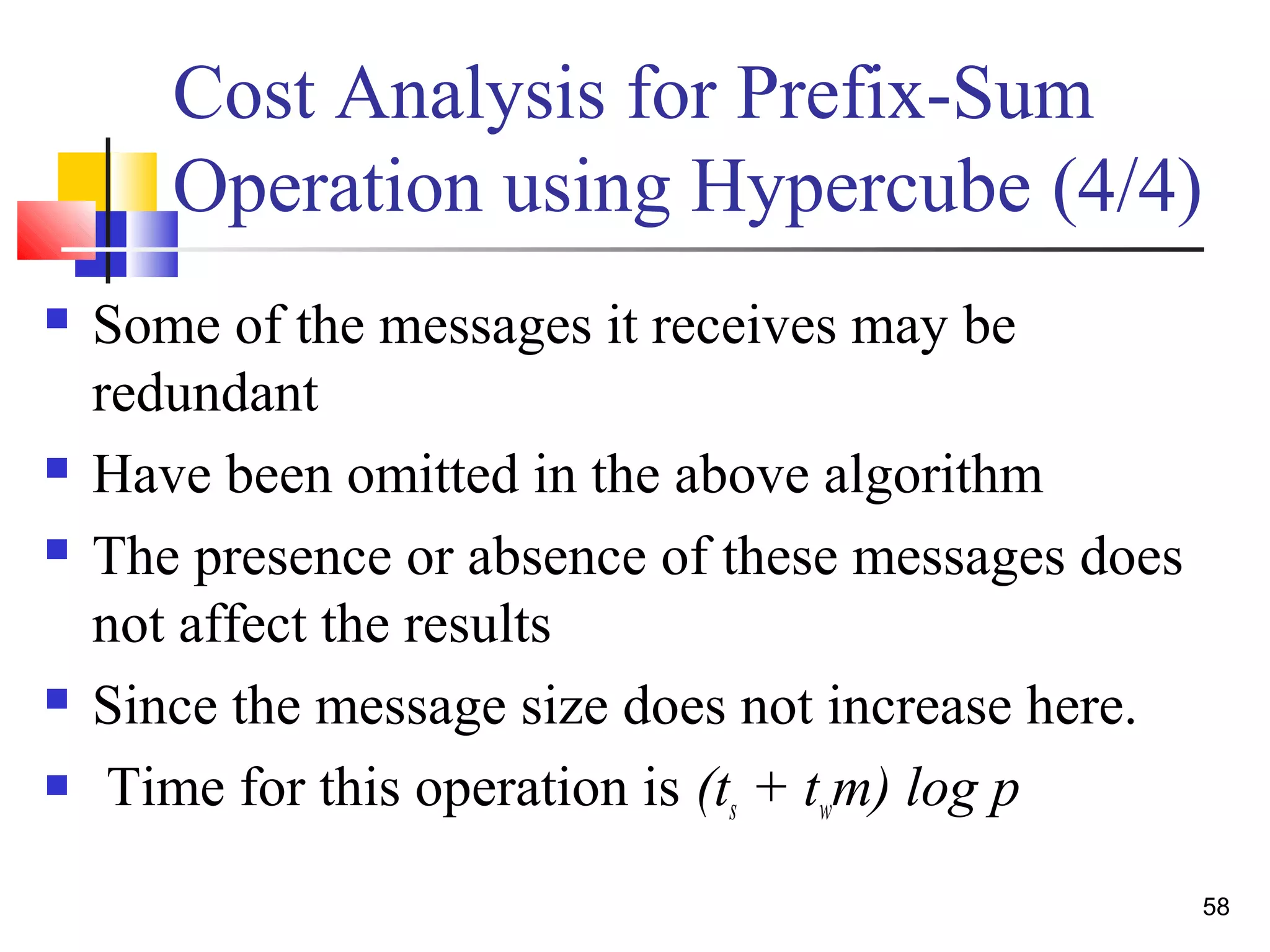
Cost Analysis for Prefix-Sum
Operation using Hypercube (4/4)
 Some of the messages it receives may be
redundant
 Have been omitted in the above algorithm
 The presence or absence of these messages does
not affect the results
 Since the message size does not increase here.
 Time for this operation is (ts + twm) log p
58
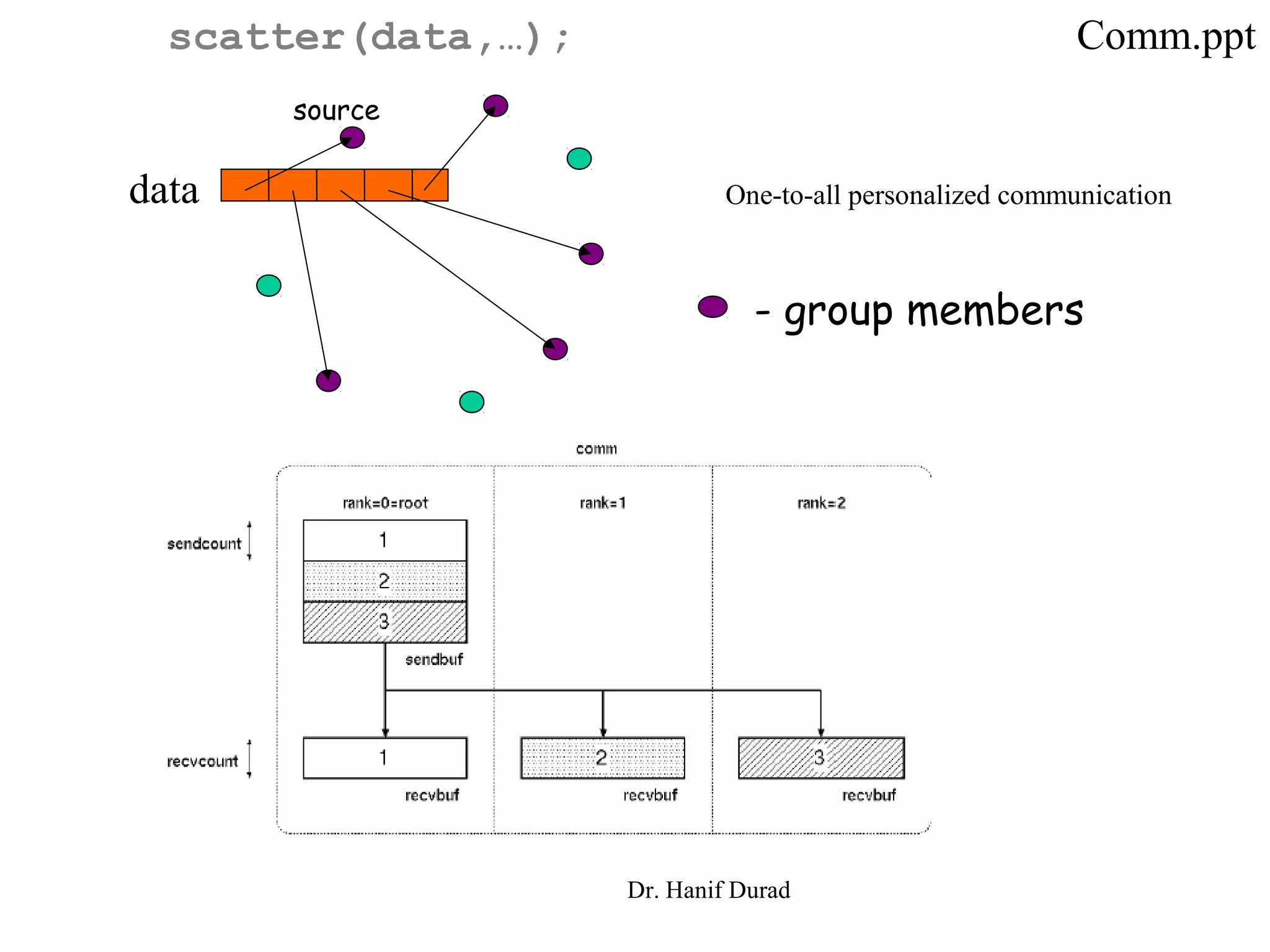
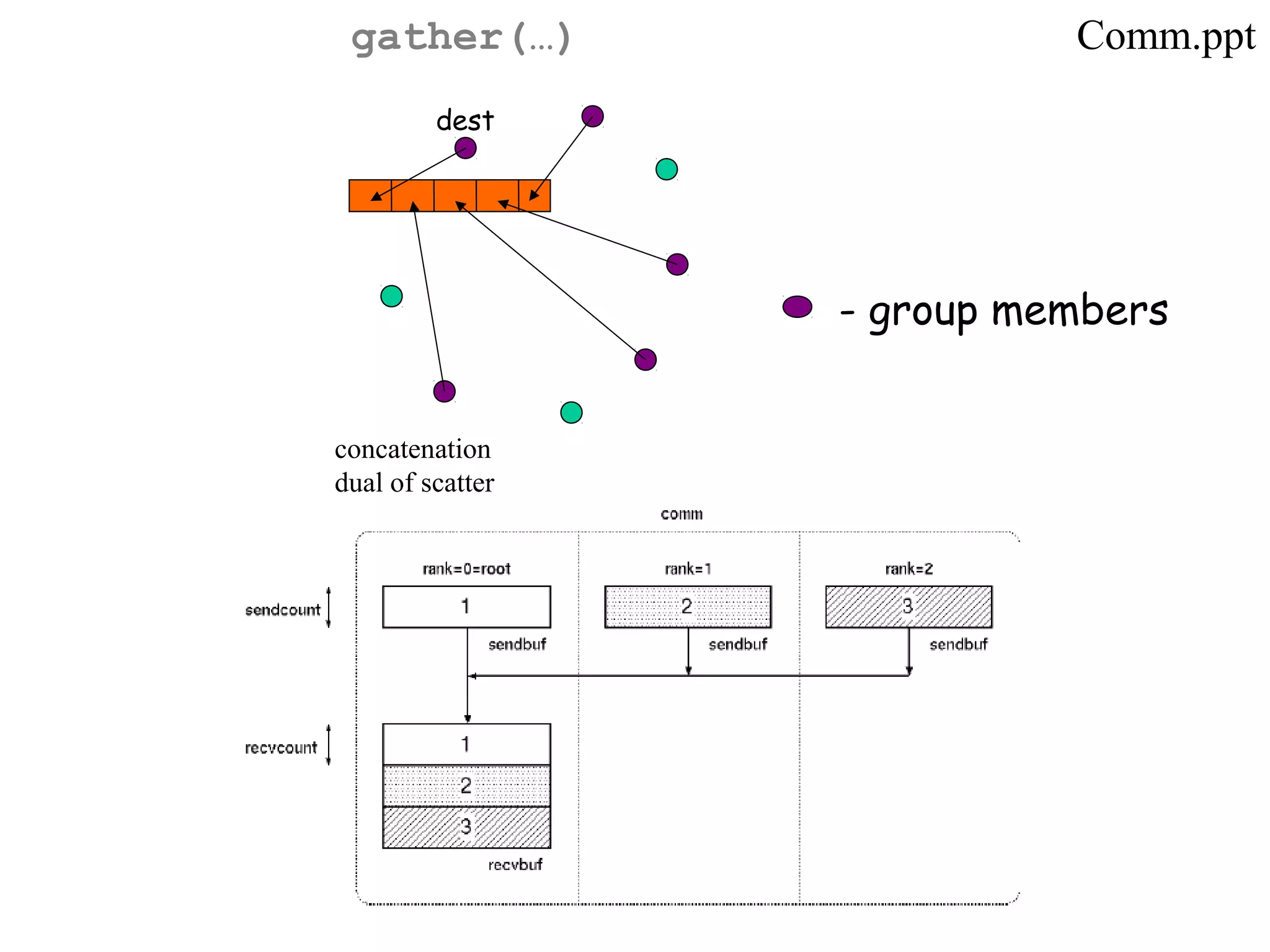
4.4 Scatter and Gather (1/4)
 In the scatter operation, a single node sends a unique
message of size m to every other node (also called a one-to-
all personalized communication).
 In the gather or concatenation operation, a single node
collects a unique message from each node.
 While the scatter operation is fundamentally different from
broadcast, the algorithmic structure is similar, except for
differences in message sizes (messages get smaller in scatter
and stay constant in broadcast).
 The gather operation is exactly the inverse of the scatter
operation and can be executed as such. 59
- group members
source
data
scatter(data,…);
One-to-all personalized communication
Comm.ppt
Dr. Hanif Durad
gather(…)
dest
concatenation
dual of scatter
Comm.ppt
- group members
Scatter and gather operations
62
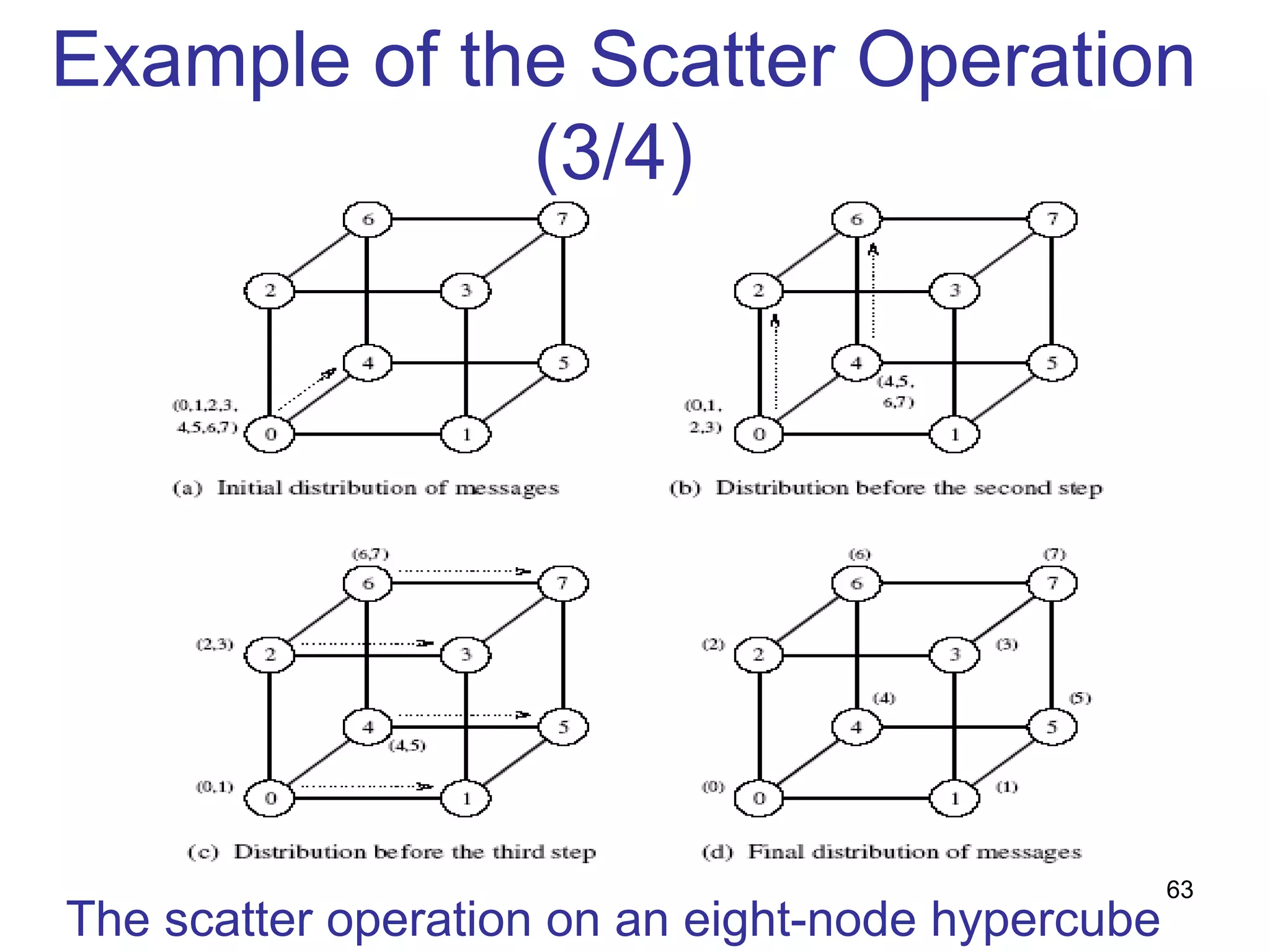
Example of the Scatter Operation
(3/4)
The scatter operation on an eight-node hypercube
63
Cost of Scatter and Gather (4/4)
 There are log p steps, in each step, the machine size
halves and the data size halves.
 We have the time for this operation to be:
 This time holds for a linear array as well as a 2-D
mesh.
 These times are asymptotically optimal in message
size.
Ref 06-MVP06-slides.pdf for explanation
64
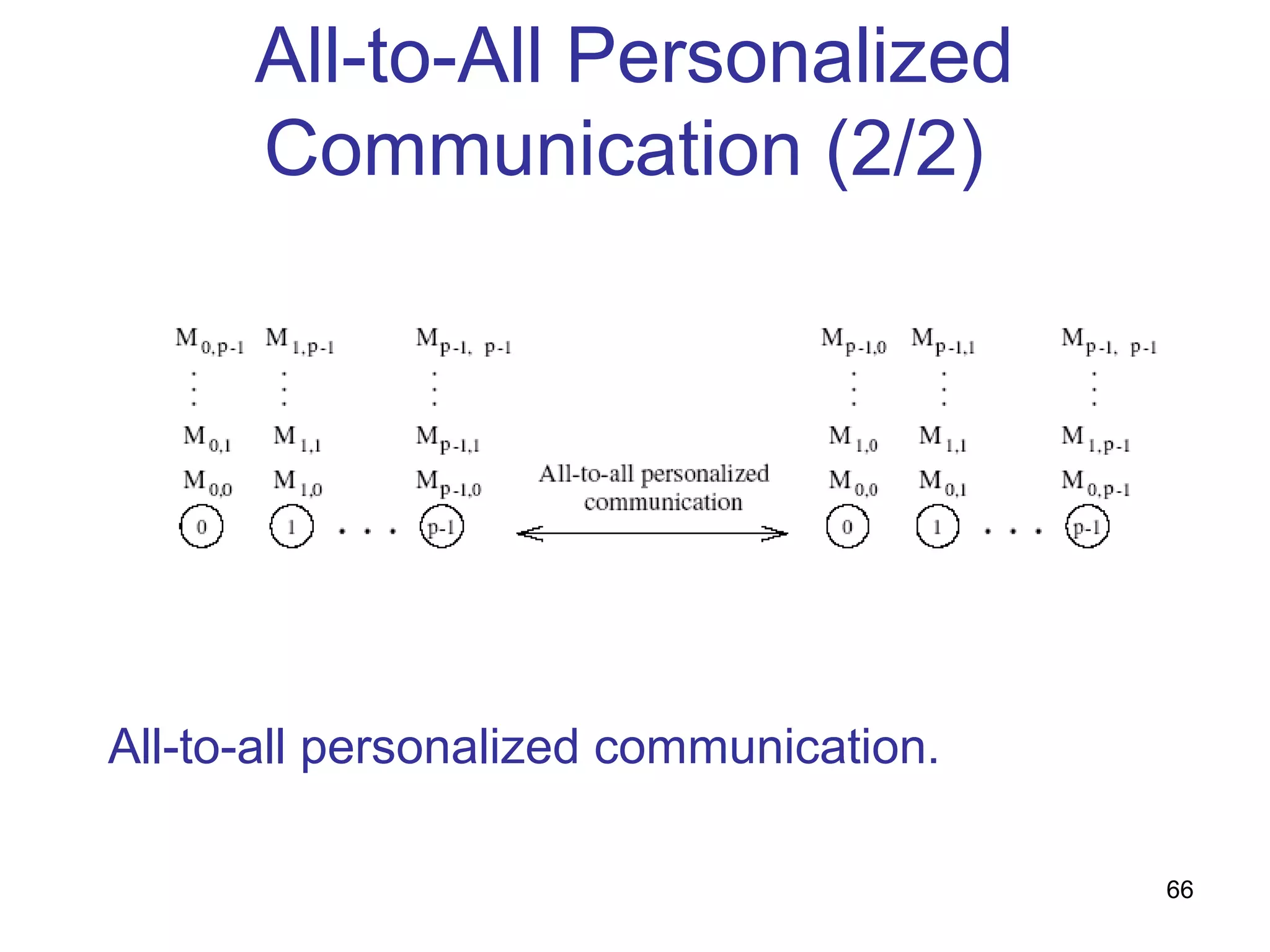
4.5 All-to-All Personalized
Communication (1/2)
 Each node has a distinct message of size m for every
other node.
 This is unlike all-to-all broadcast, in which each node
sends the same message to all other nodes.
 All-to-all personalized communication is also known as
total exchange.
 Used in a variety of parallel algorithms such as fast
Fourier transform, matrix transpose, sample sort, and
some parallel database join operations
65
All-to-All Personalized
Communication (2/2)
All-to-all personalized communication.
66
All-to-All Personalized
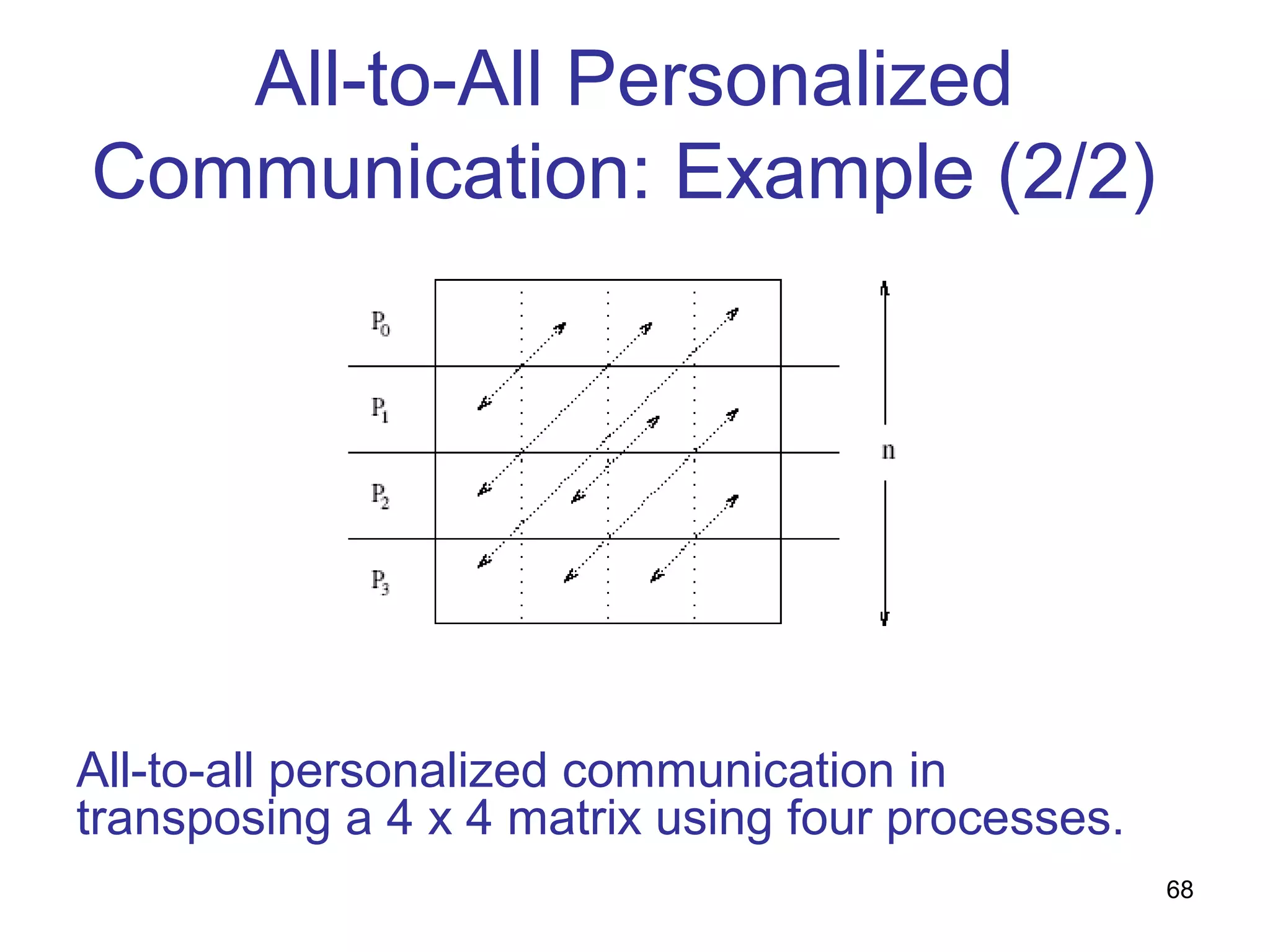
Communication: Example (1/2)
 Consider the problem of transposing a matrix.
 Each processor contains one full row of the
matrix.
 The transpose operation in this case is identical to
an all-to-all personalized communication
operation.
67
All-to-All Personalized
Communication: Example (2/2)
All-to-all personalized communication in
transposing a 4 x 4 matrix using four processes.
68
4.5.1 All-to-All Personalized
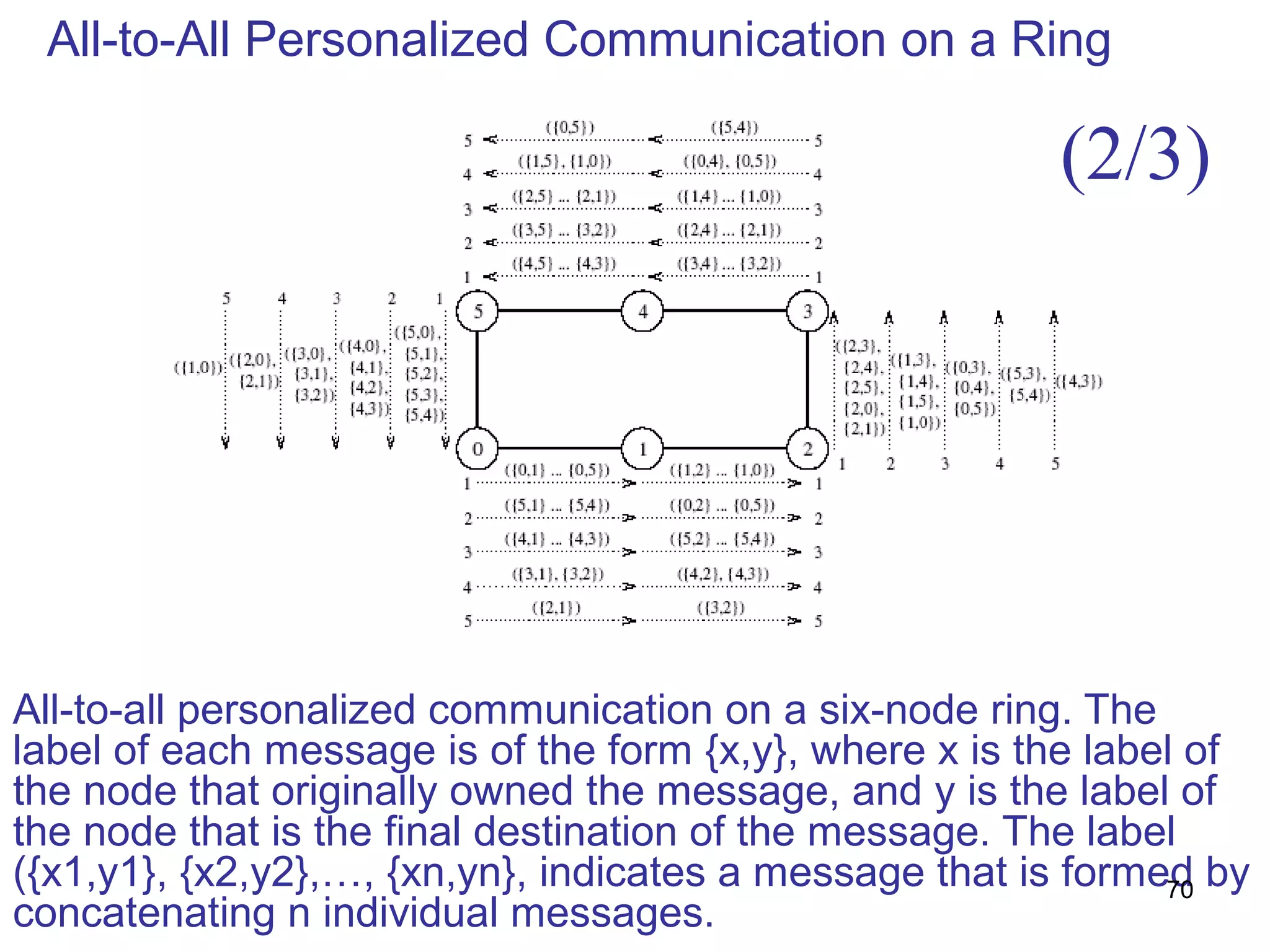
Communication on a Ring (1/3)
 Each node sends all pieces of data as one
consolidated message of size m(p – 1) to one of its
neighbors.
 Each node extracts the information meant for it
from the data received, and forwards the
remaining (p – 2) pieces of size m each to the next
node.
 The algorithm terminates in p – 1 steps.
 The size of the message reduces by m at each step.69
All-to-All Personalized Communication on a Ring
All-to-all personalized communication on a six-node ring. The
label of each message is of the form {x,y}, where x is the label of
the node that originally owned the message, and y is the label of
the node that is the final destination of the message. The label
({x1,y1}, {x2,y2},…, {xn,yn}, indicates a message that is formed by
concatenating n individual messages.
(2/3)
70
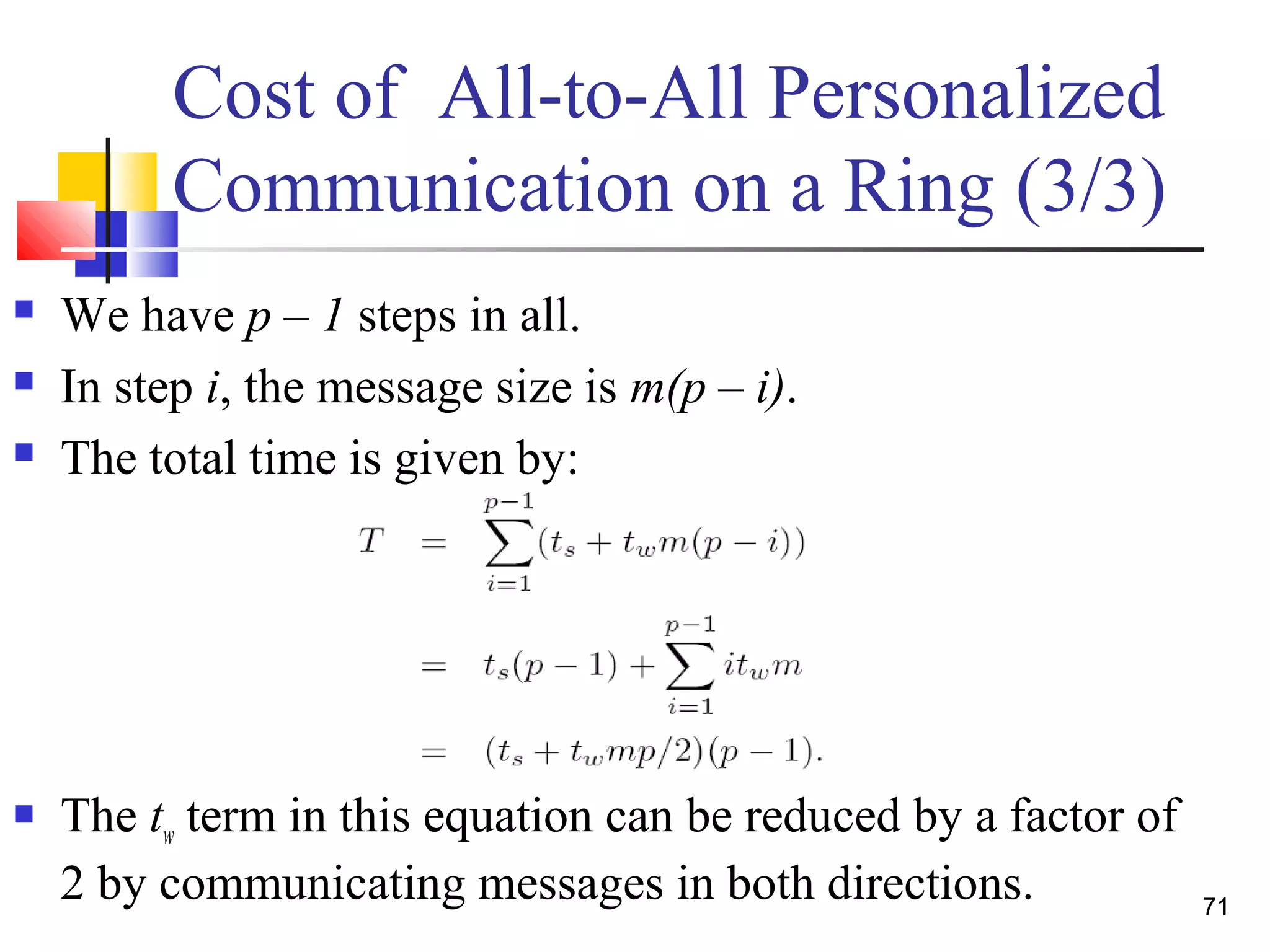
Cost of All-to-All Personalized
Communication on a Ring (3/3)
 We have p – 1 steps in all.
 In step i, the message size is m(p – i).
 The total time is given by:
 The tw term in this equation can be reduced by a factor of
2 by communicating messages in both directions. 71
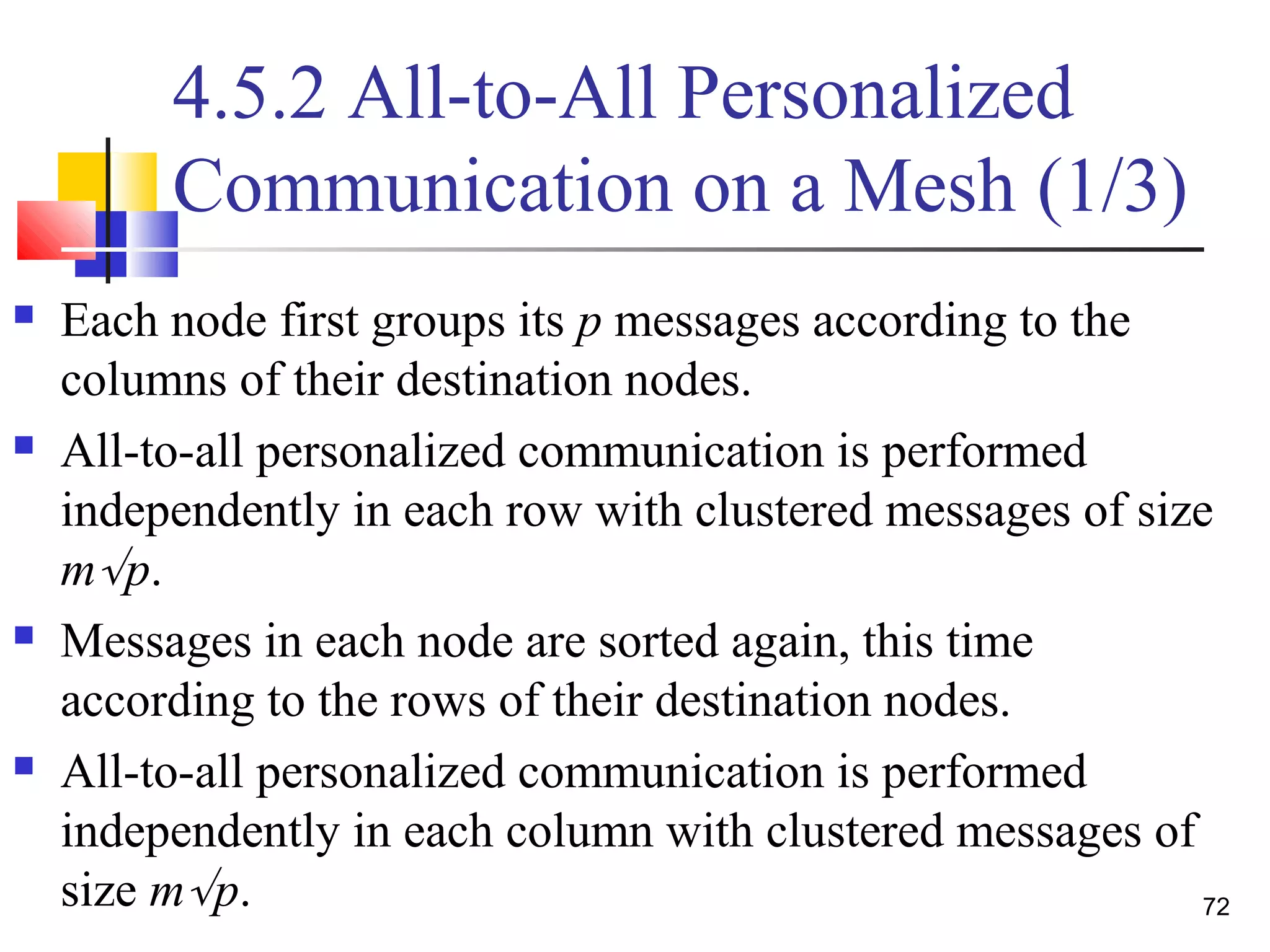
4.5.2 All-to-All Personalized
Communication on a Mesh (1/3)
 Each node first groups its p messages according to the
columns of their destination nodes.
 All-to-all personalized communication is performed
independently in each row with clustered messages of size
m√p.
 Messages in each node are sorted again, this time
according to the rows of their destination nodes.
 All-to-all personalized communication is performed
independently in each column with clustered messages of
size m√p. 72
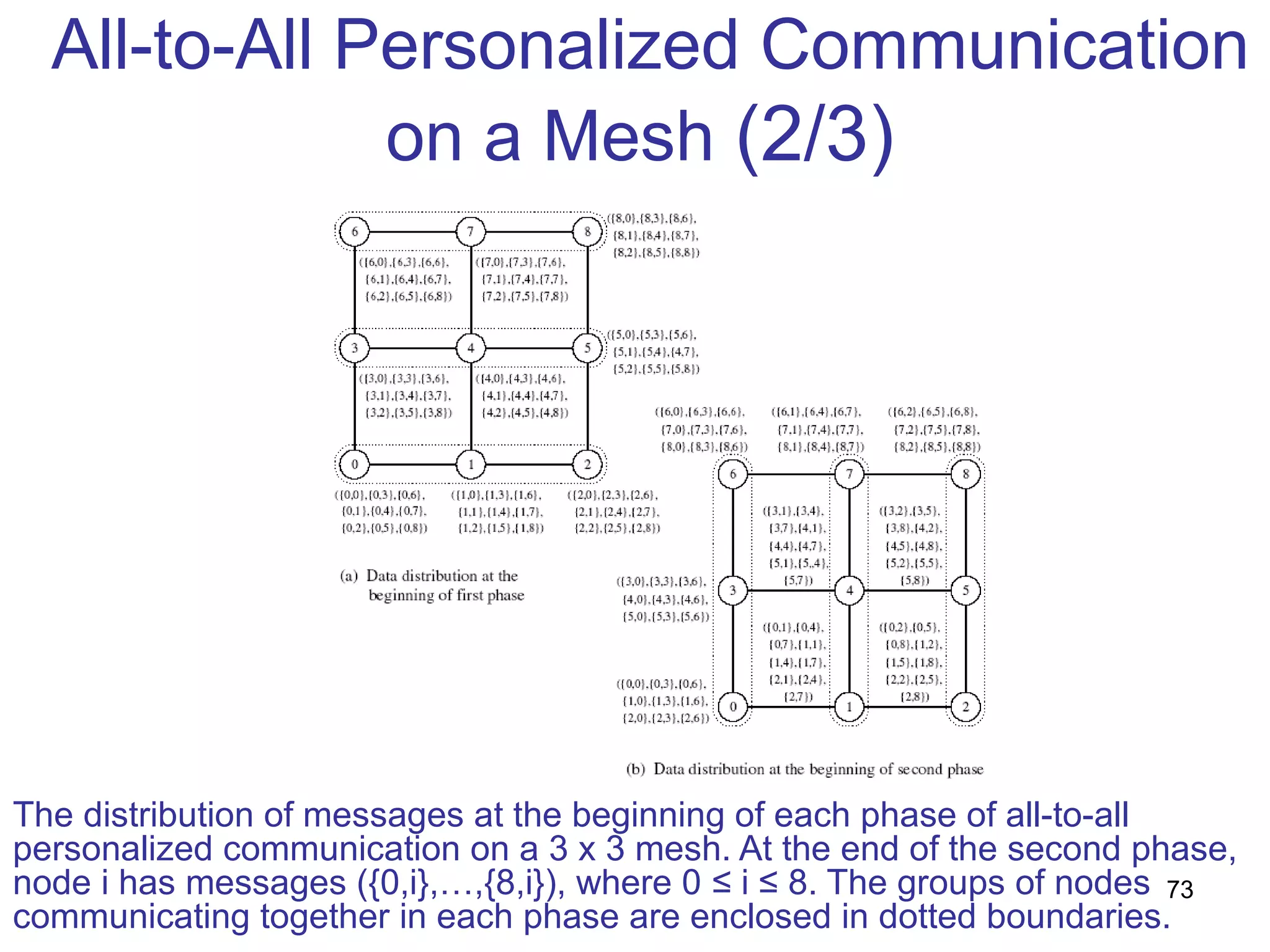
All-to-All Personalized Communication
on a Mesh (2/3)
The distribution of messages at the beginning of each phase of all-to-all
personalized communication on a 3 x 3 mesh. At the end of the second phase,
node i has messages ({0,i},…,{8,i}), where 0 ≤ i ≤ 8. The groups of nodes
communicating together in each phase are enclosed in dotted boundaries.
73
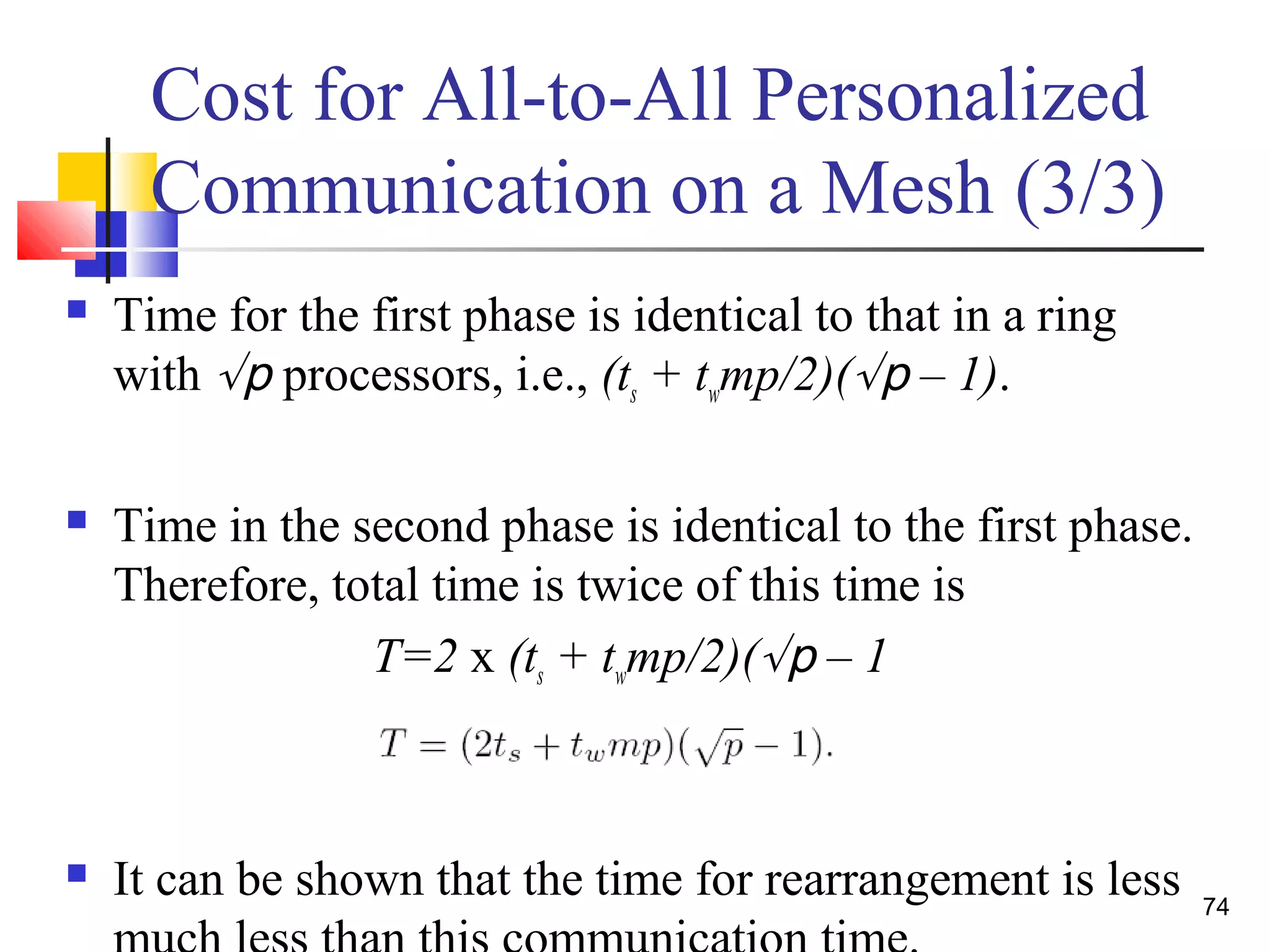
Cost for All-to-All Personalized
Communication on a Mesh (3/3)
 Time for the first phase is identical to that in a ring
with √p processors, i.e., (ts + twmp/2)(√p – 1).
 Time in the second phase is identical to the first phase.
Therefore, total time is twice of this time is
T=2 x (ts + twmp/2)(√p – 1
 It can be shown that the time for rearrangement is less 74
4.5.3 All-to-All Personalized
Communication on a Hypercube (1/4)
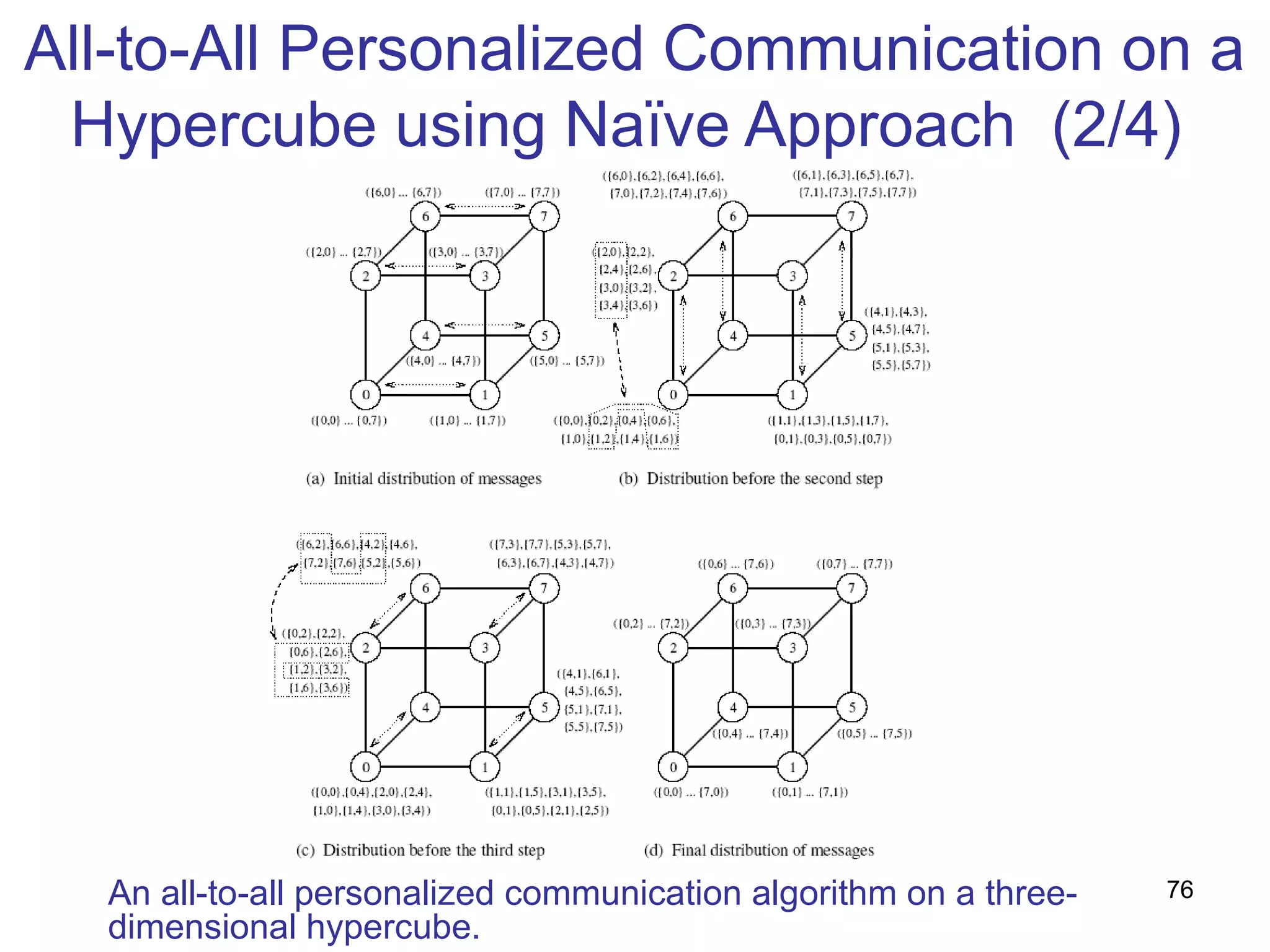
 4.5.3.1 Naïve Approach
 Generalize the mesh algorithm to log p steps.
 At any stage in all-to-all personalized communication,
every node holds p packets of size m each.
 While communicating in a particular dimension, every
node sends p/2 of these packets (consolidated as one
message).
 A node must rearrange its messages locally before each
of the log p communication steps.
75
All-to-All Personalized Communication on a
Hypercube using Naïve Approach (2/4)
An all-to-all personalized communication algorithm on a three-
dimensional hypercube.
76
Cost for All-to-All Personalized
Communication on Hypercube using Naïve
Approach (3/4)
 We have log p iterations and mp/2 words are
communicated in each iteration. Therefore, the
cost is:
 This is not optimal!
77
Non-optimality in Hypercube
algorithm(4/4)
 Each node send m(p-1) words of data
 Average distance of communication (log p)/2
 Total network traffic is pxm(p-1)x(log p)/2
 Total number of links is (p log p)/2
 The lower bound for communication time is
T= [twpxm(p-1)x(log p)/2]/ (p log p)/2
=twm(p-1)
78
4.5.3.2 All-to-All Personalized
Communication on a Hypercube: Optimal
Algorithm (1/4)
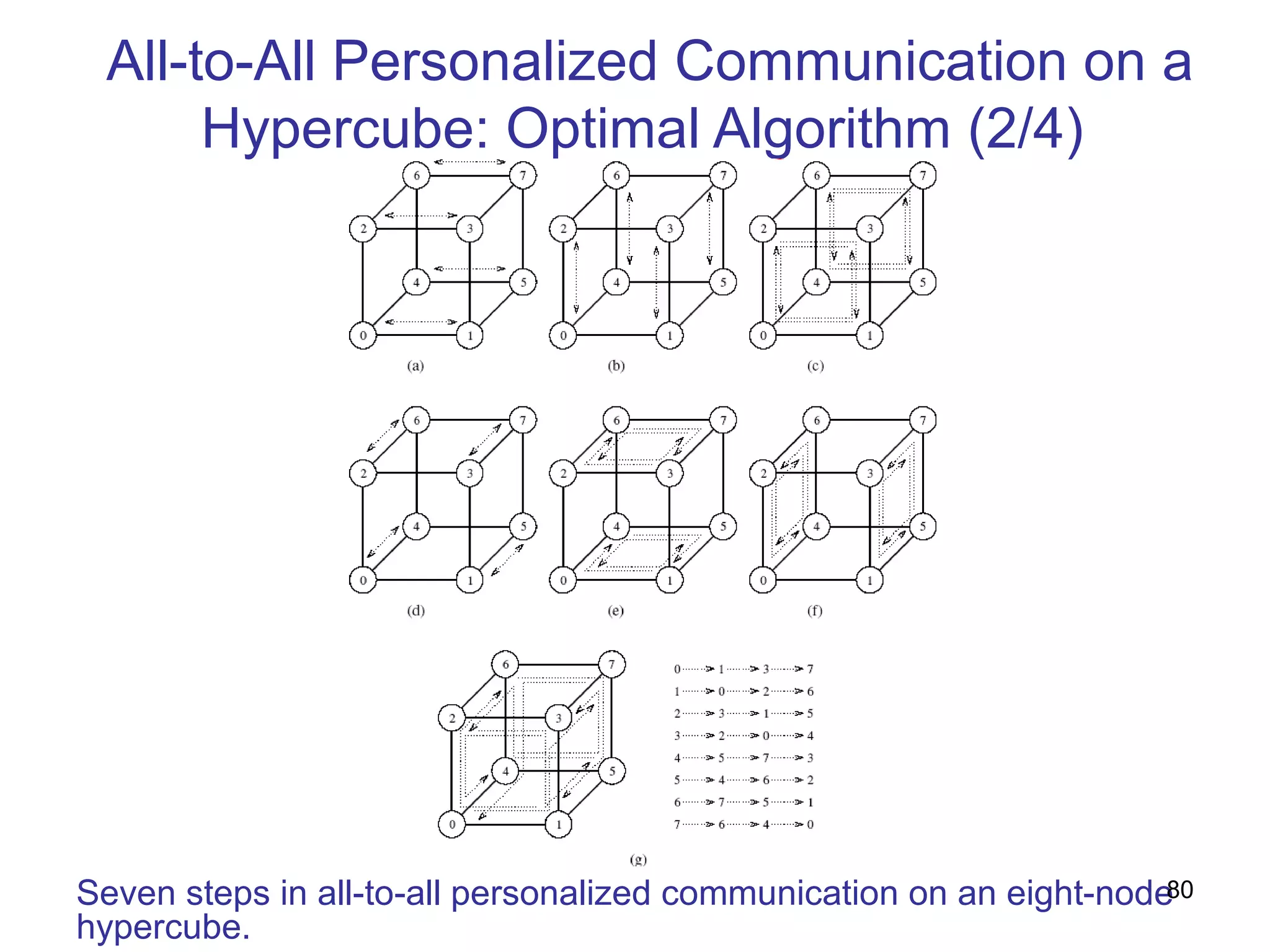
 Each node simply performs p – 1 communication steps,
exchanging m words of data with a different node in every
step.
 A node must choose its communication partner in each
step so that the hypercube links do not suffer congestion.
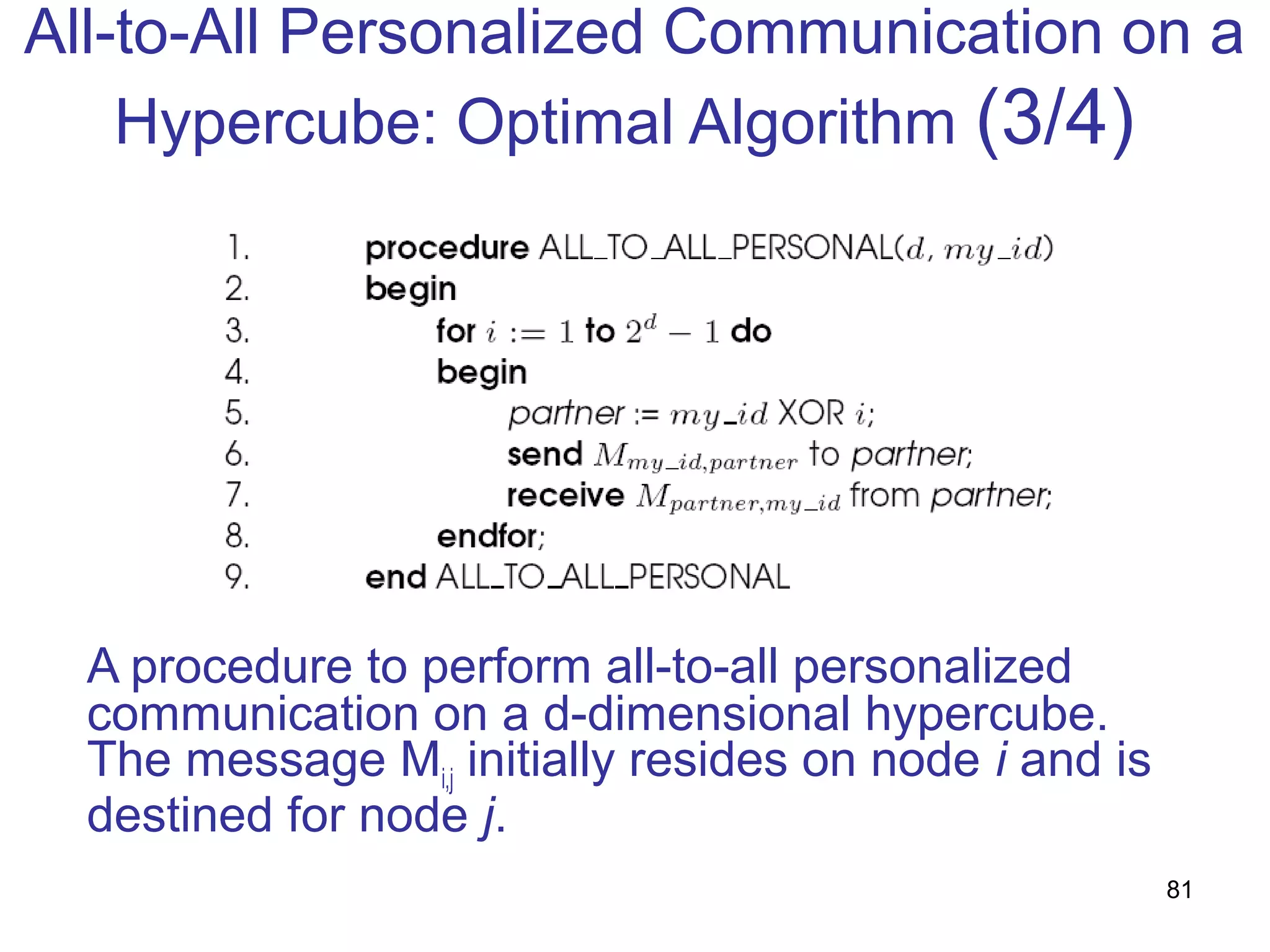
 Processor i communicates with processor iXORj during
the jth communication step.
 In this schedule, all paths in every communication step
are congestion-free, and none of the bidirectional links
carry more than one message in the same direction. 79
All-to-All Personalized Communication on a
Hypercube: Optimal Algorithm (2/4)
Seven steps in all-to-all personalized communication on an eight-node
hypercube.
80
All-to-All Personalized Communication on a
Hypercube: Optimal Algorithm (3/4)
A procedure to perform all-to-all personalized
communication on a d-dimensional hypercube.
The message Mi,j initially resides on node i and is
destined for node j.
81
All-to-All Personalized Communication
on a Hypercube: Cost Analysis of
Optimal Algorithm (4/4)
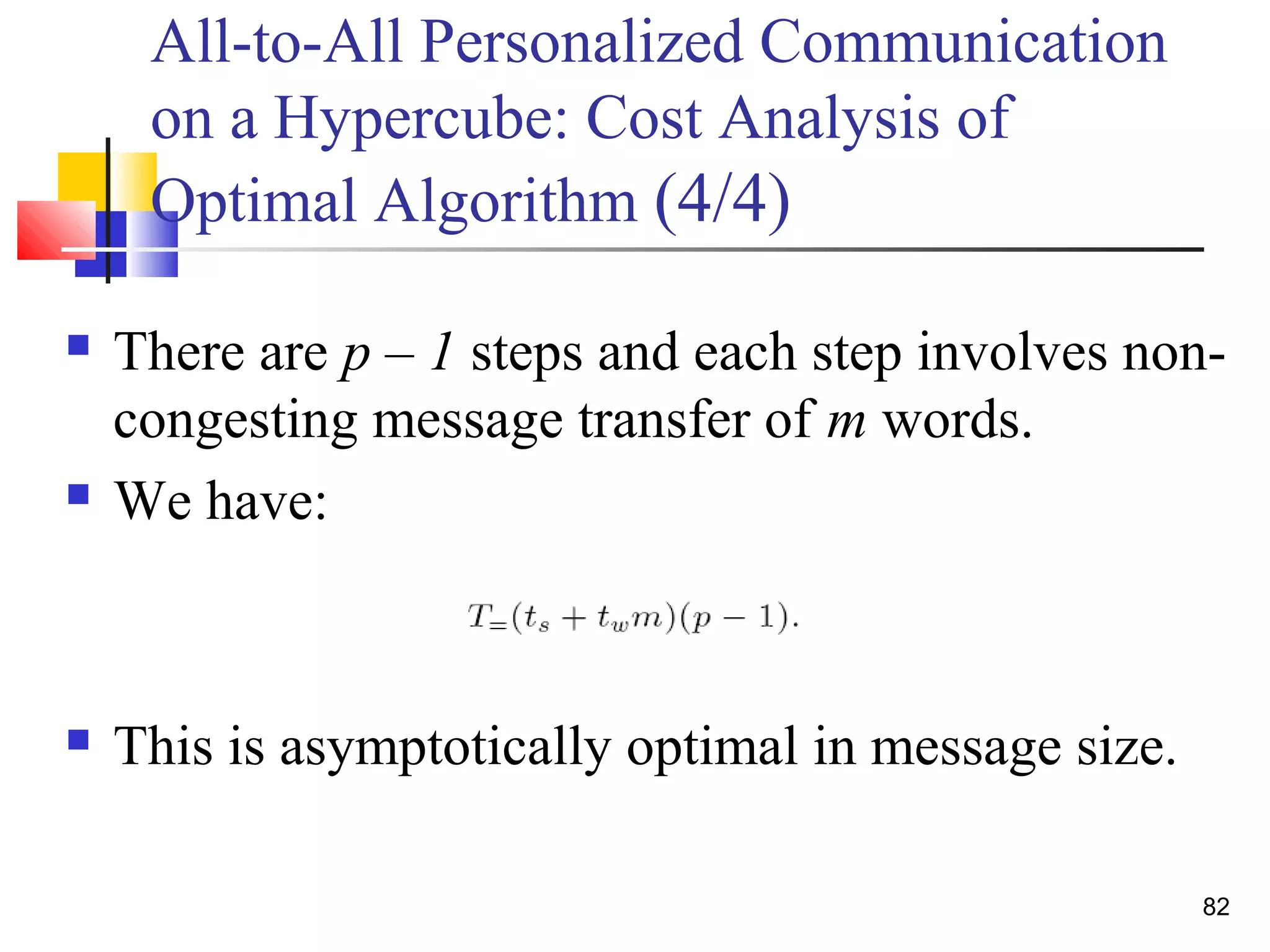
 There are p – 1 steps and each step involves non-
congesting message transfer of m words.
 We have:
 This is asymptotically optimal in message size.
82
4.6 Circular Shift
 Has application in some matrix computations
and in string and image pattern matching
 A special permutation in which node i sends a
data packet to node (i + q) mod p in a p-node
ensemble
(0 ≤ q ≤ p).
83
4.6.1 Circular Shift on a Mesh
(1/2)
 The implementation on a ring is rather intuitive.
It can be performed in min {q,p – q} neighbor
communications.
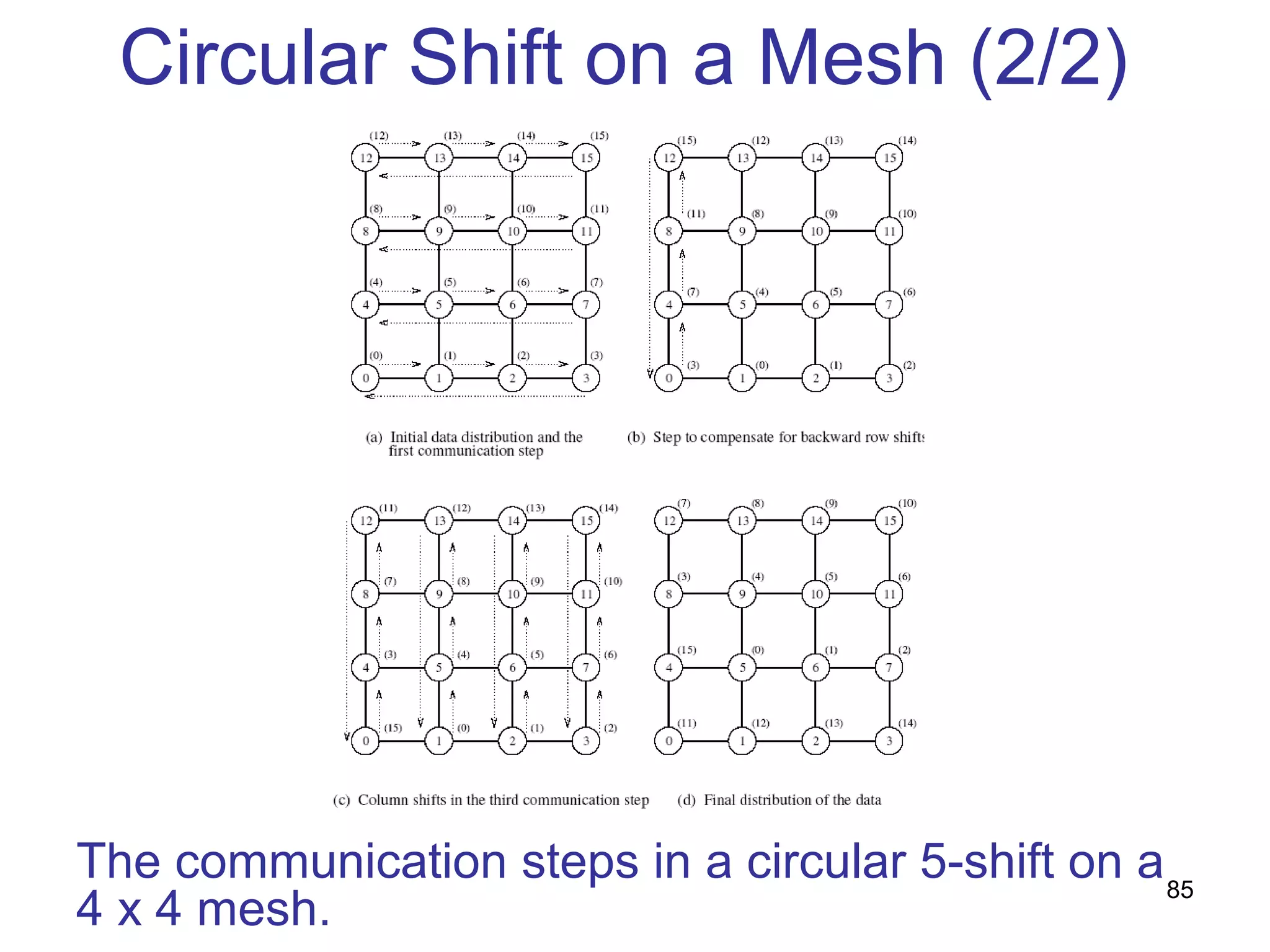
 Mesh algorithms follow from this as well. We
shift in one direction (all processors) followed
by the next direction.
 The associated time has an upper bound of:
84
Circular Shift on a Mesh (2/2)
The communication steps in a circular 5-shift on a
4 x 4 mesh.
85
4.6.2 Circular Shift on a
Hypercube
 Map a linear array with 2d
nodes onto a d-dimensional
hypercube.
 To perform a q-shift, we expand q as a sum of distinct
powers of 2.
 If q is the sum of s distinct powers of 2, then the circular q-
shift on a hypercube is performed in s phases.
 The time for this is upper bounded by:
 If E-cube routing is used, this time can be reduced to
upperbound
86
Circular Shift on a Hypercube
The mapping of an eight-node linear array onto a
three-dimensional hypercube to perform a circular
5-shift as a combination of a 4-shift and a 1-shift.
87
Circular Shift on a Hypercube
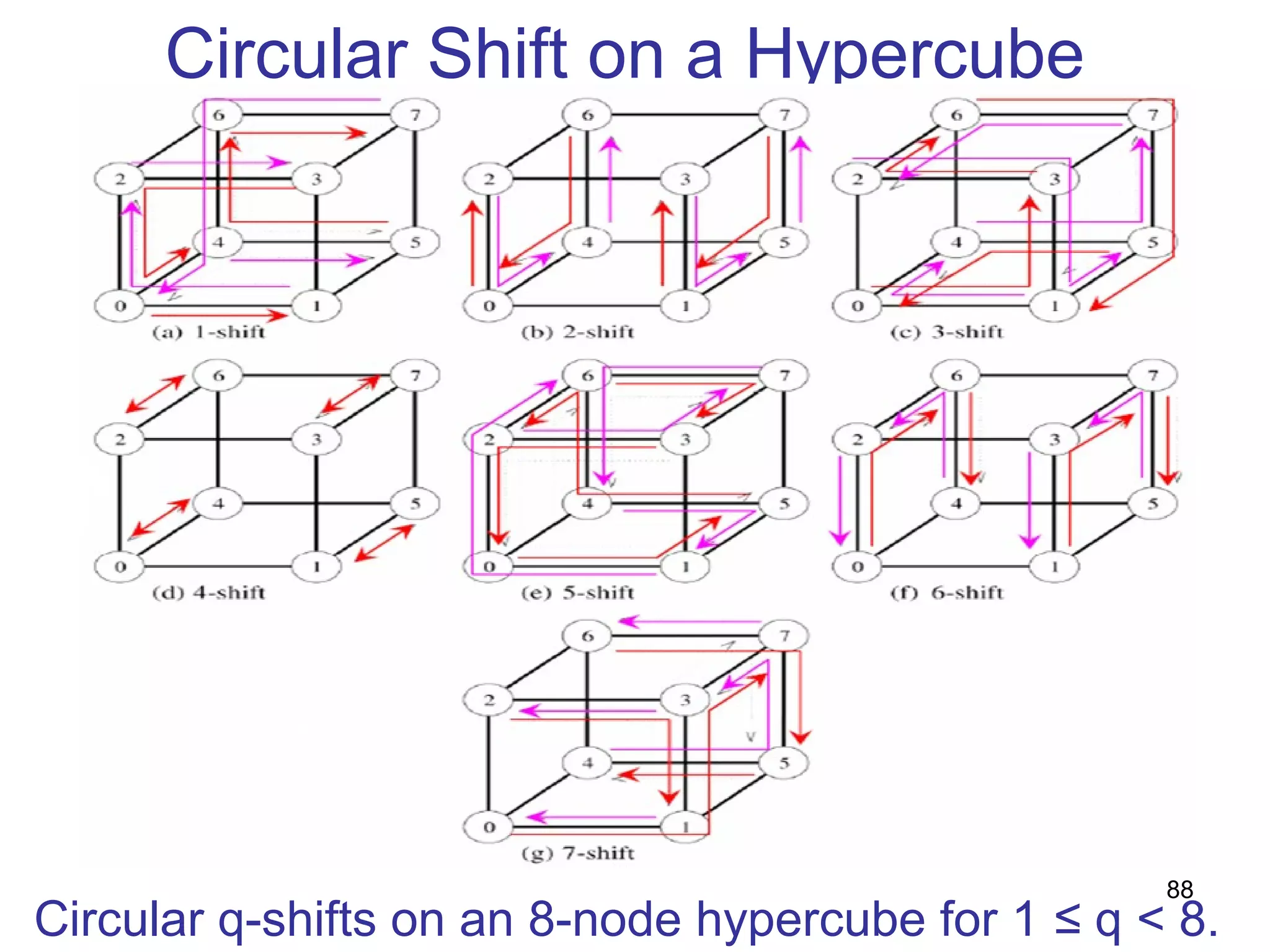
Circular q-shifts on an 8-node hypercube for 1 ≤ q < 8.
88
4.7 Improving Performance of
Operations
 In all previous derivations in this chapter we
assumed that
 the original messages could not be split into smaller
parts and
 that each node had a single port for sending and
receiving data.
 Here we briefly discuss the impact of relaxing
these assumptions
89
4.7.1 Splitting and routing
messages into parts
 All discussed operations with exception to one-to-all
broadcast, all-to-one reduction and all-reduce are
bandwidth optimal
 We can reduce bandwidth complexity of these
operations by splitting the message and routing the
messages in parts
 m must be big enough
 the factor of ts increases and the factor of twdecreases,
whether that really speeds up execution depends on ts, tw
and m 90
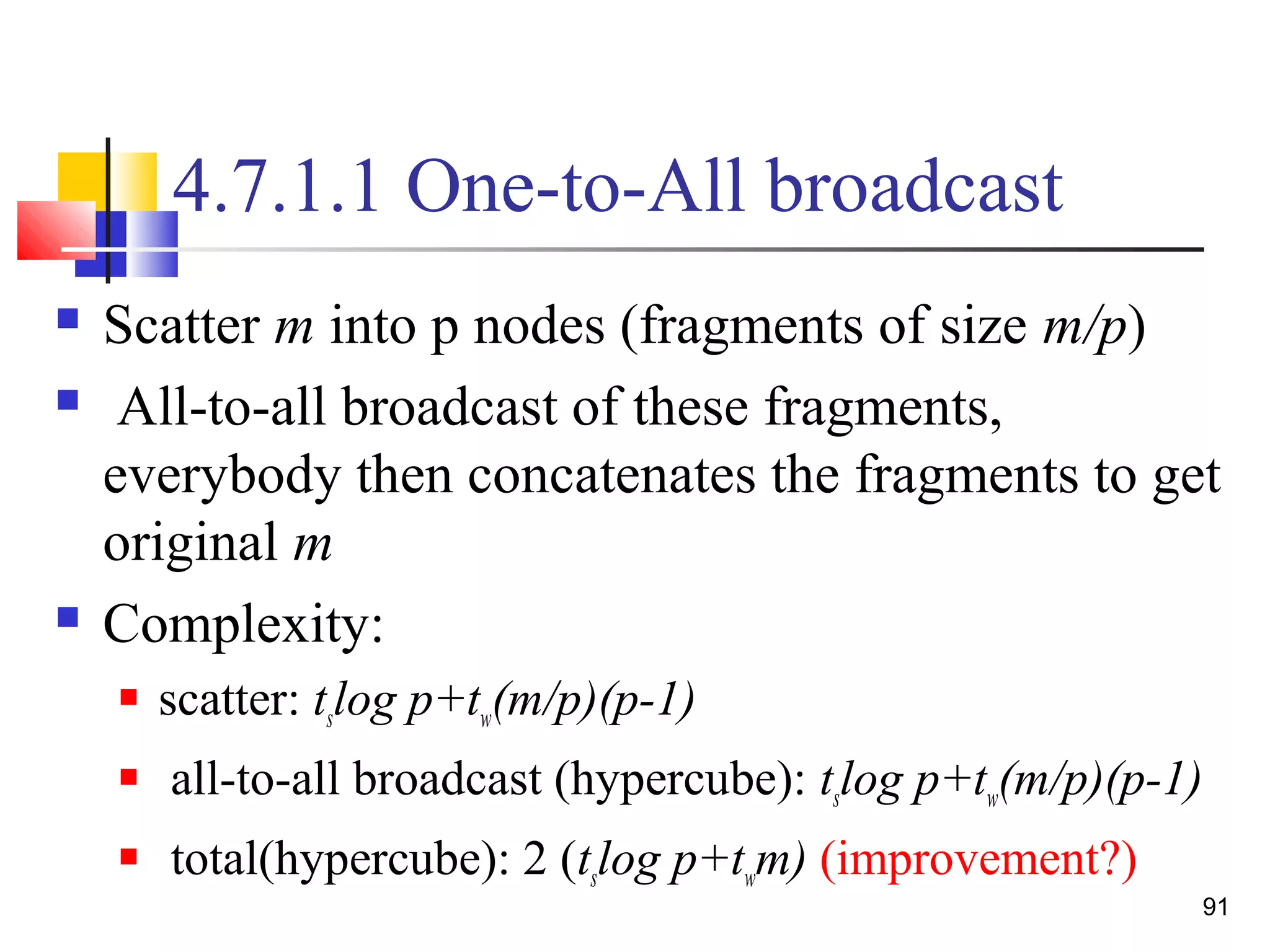
4.7.1.1 One-to-All broadcast
 Scatter m into p nodes (fragments of size m/p)
 All-to-all broadcast of these fragments,
everybody then concatenates the fragments to get
original m
 Complexity:
 scatter: tslog p+tw(m/p)(p-1)
 all-to-all broadcast (hypercube): tslog p+tw(m/p)(p-1)
 total(hypercube): 2 (tslog p+twm) (improvement?)
91
4.7.1.2 All-to-One Reduction
 All-to-one reduction is dual of One-to-All
broadcast can be performed
 All-to-all reduction followed by gather
92
4.7.1.3 All Reduce
 equals All-to-One reduce followed by One-to-All broadcast
 All-to-One Reduce = All-to-All reduce followed by gather
 One-to-All broadcast = scatter followed by All-to-All
broadcast
 inner gather and scatter cancel each other (i.e. the data are
already where we wanted them to be)
 = All-to-All reduce followed by All-to-All broadcast
 Complexity= 2 (tslog p+twm) (improvement?)
93
4.7.2 All-Port Communication
(1/2)
 We assumed single-port communication where as
all port communication possible
 On a p-node hypercube with all-port there may be
improvement by a factor of log p.
 Despite the apparent speedup in several parallel
algorithms, an increase in the size of messages
means a corresponding increase in the granularity
of computation at the nodes
94
All-Port Communication (2/2)
 While working on large data sets, inter-node
communication time is dominated by the computation time
 e.g. for matrix multiplication, n3
computations for n2
words of data
transferred among the nodes so not much advantageous
 All-port comm. can be effective only if data can be fetched
and stored in memory at a rate sufficient to sustain all the
parallel communication
 on a p-node hypercube, the memory b/w must be greater than the
communication b/w of a single channel by a factor log p
 Special hardware
 e.g. for reduction (switches combine messages)
;
Ref lec4.ppt95
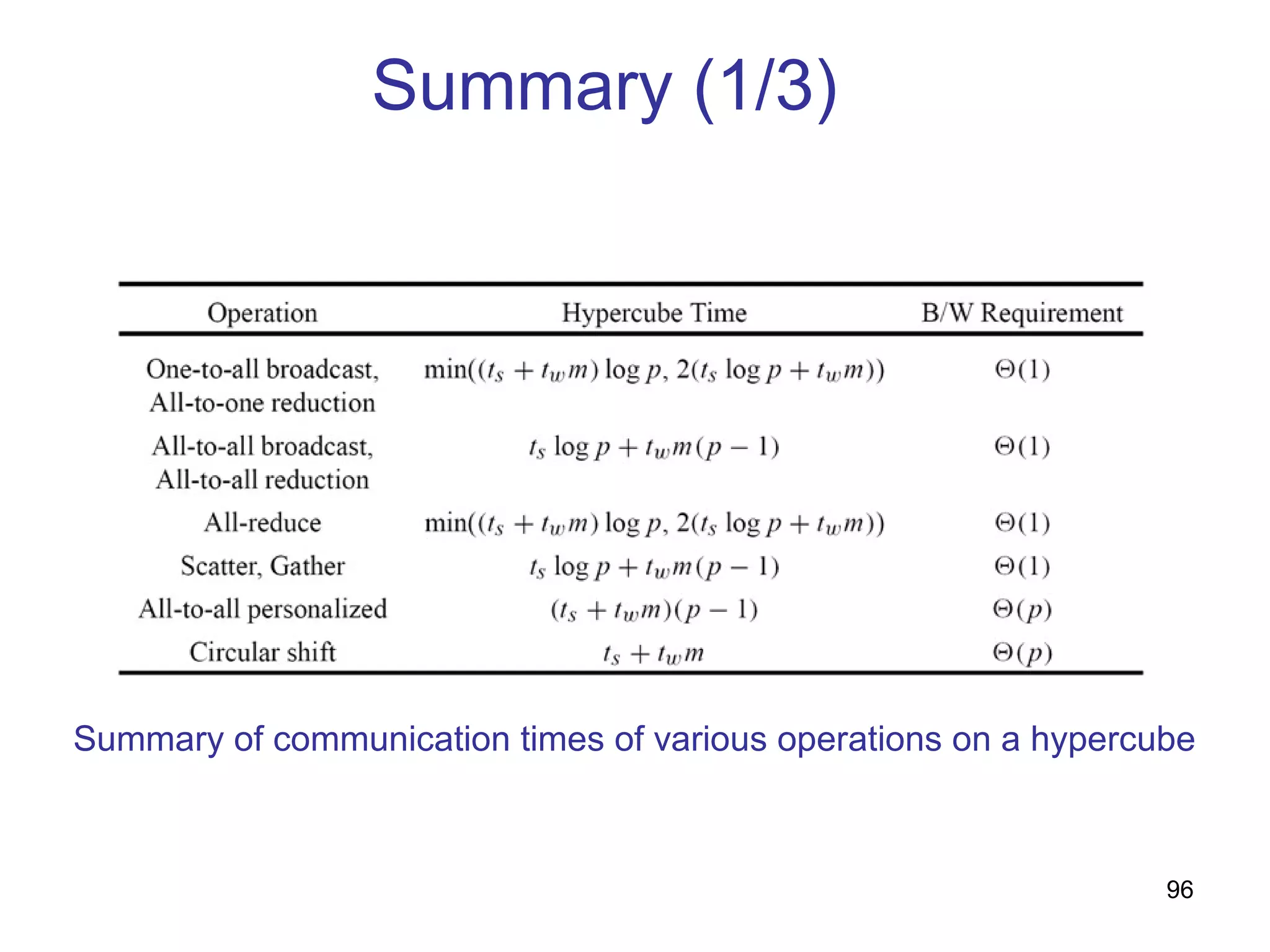
Summary of communication times of various operations on a hypercube
Summary (1/3)
96
Summary (2/3)
 They represent regular communication patterns that are
performed by parallel algorithms.
 Collective: Involve groups of processors
 Used extensively in most data-parallel algorithms.
 The parallel efficiency of these algorithms depends on
efficient implementation of these operations.
 They are equally applicable to distributed and shared
address space architectures
 Most parallel libraries provide functions to perform them
 They are extremely useful for “getting started” in parallel
processing!
Ref chap4.karypis.pdf
97
MPI Names of various Operations
Summary (2/3)
98

Chapter 4 pc

  • 1.
    Chapter 4Chapter 4 BasicCommunicationBasic Communication OperationsOperations Dr. Muhammad Hanif Durad Department of Computer and Information Sciences Pakistan Institute Engineering and Applied Sciences hanif@pieas.edu.pk Some slides have bee adapted with thanks from some other lectures available on Internet
  • 2.
    2 Lecture Outline Introduction 4.1 One-to-AllBroadcast and All-to-One Reduction 4.2 All-to-All Broadcast and Reduction 4.3 All-Reduce and Prefix-Sum Operations 4.4 Scatter and Gather 4.5 All-to-All Personalized Communication 4.6 Circular Shift 4.7 Improving the Speed of Some Communication Operation 4.8 Summary
  • 3.
    Basic Communication Operations: Introduction(1/2)  Many interactions in practical parallel programs occur in well-defined patterns involving groups of processors.  Efficient implementations of these operations can improve performance, reduce development effort and cost, and improve software quality.  Efficient implementations must leverage underlying architecture. For this reason, we refer to specific architectures here.  We select a descriptive set of architectures to illustrate the process of algorithm design. 3
  • 4.
    Basic Communication Operations: Introduction(2/2)  Group communication operations are built using point- to-point messaging primitives.  Recall from our discussion of architectures that communicating a message of size m over an non- congested network takes time ts +mtw.  We use this as the basis for our analyses. Where necessary, we take congestion into account explicitly by scaling the tw term.  We assume that the network is bidirectional and that communication is single-ported. 4
  • 5.
    4.1 One-to-All Broadcastand All-to-One Reduction (1/2)  One processor has a piece of data (of size m) it needs to send to everyone.  The dual of one-to-all broadcast is all-to-one reduction.  In all-to-one reduction, each processor has m units of data. These data items must be combined piece- wise (using some associative operator, such as addition or min), and the result made available at a target processor. 5
  • 6.
    One-to-All Broadcast andAll-to- One Reduction (2/2) One-to-all broadcast and all-to-one reduction among processors. 6
  • 7.
    4.1.1.1 One-to-All Broadcaston Rings (1/3)  Naïve Approach  p-1 messages sent sequentially from the source to the other p-1 processors  not very efficient.  terrible complexity (ts+mtw)(p-1) p0 p1 p2 p3 p4 p5 p6 p7 Ref CommImpl1.ppt 7
  • 8.
    One-to-All Broadcast onRings (2/3)  Recursive doubling  use logical binary tree for broadcasting  make sure to minimize congestion  complexity: (ts+twm)logp p0 p1 p2 p3 p4 p5 p6 p7 p0 p1 p2 p3 p4 p5 p6 p7 Which better? Ref CommImpl1.ppt8
  • 9.
    One-to-All Broadcast onRings One-to-all broadcast on an eight-node ring. Node 0 is the source of the broadcast. Each message transfer step is shown by a numbered, dotted arrow from the source of the message to its destination. The number on an arrow indicates the time step during which the message is transferred. (3/3) 9
  • 10.
    4.1.1.2 All-to-One Reductionon Rings (1/2)  Reduction can be performed in an identical fashion by inverting the process. 10
  • 11.
    All-to-One Reduction onRings Reduction on an eight-node ring with node 0 as the destination of the reduction. (2/2) 11
  • 12.
    Broadcast and Reductionon Rings : Example (1/2) Consider the problem of multiplying a matrix with a vector.  The n x n matrix is assigned to an n x n (virtual) processor grid. The vector is assumed to be on the first row of processors.  The first step of the product requires a one-to-all broadcast of the vector element along the corresponding column of processors. This can be done concurrently for all n columns.  The processors compute local product of the vector element and the local matrix entry.  In the final step, the results of these products are accumulated to the first row using n concurrent all-to-one reduction operations along the columns (using the sum operation). 12
  • 13.
    Broadcast and Reductionon Rings Example : Matrix-Vector Multiplication One-to-all broadcast and all-to-one reduction in the multiplication of a 4 x 4 matrix with a 4 x 1 vector. (2/2) 13
  • 14.
    4.1.2 Broadcast andReduction on a Mesh (1/2)  Each row and column of mesh is a ring! √p nodes  Two phases  Ring broadcast in row of initiating node  Ring broadcast in all columns from row of initiating node  Similar (n phase) procedure works on nD mesh  Matrix Vector product  n*n matrix, n*1 vector, n*n mesh 14
  • 15.
    Broadcast and Reductionon a Mesh: Example One-to-all broadcast on a 16-node mesh. (2/2) 15
  • 16.
    4.1.3 Broadcast andReduction on a Hypercube (1/2)  d phases on d-dimension hypercube  phase i:  2(i-1) messages  sent in parallel  in dimension i  source node = 000, d = 3  Phase 1: 000 -> 100  Phase 2: 000 -> 010 100 -> 110  Phase 3: 000 -> 001 100 -> 101 010 -> 011 110 -> 111 16
  • 17.
    Broadcast and Reductionon a Hypercube: Example One-to-all broadcast on a three-dimensional hypercube. The binary representations of node labels are shown in parentheses. (2/2) 17
  • 18.
    4.1.4 Broadcast andReduction on a Balanced Binary Tree (1/2)  Consider a binary tree in which processors are (logically) at the leaves and internal nodes are routing nodes.  Assume that source processor is the root of this tree. In the first step, the source sends the data to the right child (assuming the source is also the left child). The problem has now been decomposed into two problems with half the number of processors. 18
  • 19.
    Broadcast and Reductionon a Balanced Binary Tree One-to-all broadcast on an eight-node tree. (2/2) Source 19
  • 20.
    4.1.4 Broadcast andReduction Algorithms (1/3)  All of the algorithms described above are adaptations of the same algorithmic template.  We illustrate the algorithm for a hypercube, but the algorithm, as has been seen, can be adapted to other architectures.  The hypercube has 2d nodes and my_id is the label for a node.  X is the message to be broadcast, which initially resides at the source node 0. 20
  • 21.
    Broadcast Algorithm One-to-all broadcastof a message X from source on a hypercube. (2/3) 21
  • 22.
    Reduction Algorithm Single-node accumulationon a d-dimensional hypercube. Each node contributes a message X containing m words, and node 0 is the destination (3/3) 22
  • 23.
    4.1.6 Cost Analysis The broadcast or reduction procedure involves log p point-to-point simple message transfers, each at a time cost of ts + twm.  The total time is therefore given by: Note: Valid for all topologies 23
  • 24.
    4.2 All-to-All Broadcastand Reduction (1/4)  All-to-all broadcast can be viewed as a generalization of one-to-all broadcast  All p nodes simultaneously initiate a broadcast  Each node sends the same m-word message to every other nodes  Different node may broadcast different messages  The dual of all-to-all broadcast is all-to-all reduction  Every node is the destination of an all-to-one reduction  Also known multi node broadcast  Applications  Matrix-Vector Multiplication  Matrix-Matrix Multiplication 24
  • 25.
    All-to-All Broadcast and Reduction(2/4)  Naïve approach:  sequentially execute p broadcasts/reductions  Better approach:  pipeline the broadcasts  be careful not to overload/congest the links 25
  • 26.
    All-to-All Broadcast andReduction All-to-all broadcast and all-to-all reduction. (3/4)Ref 06-MVP06-slides.pdf 26
  • 27.
    Example: All-to-All Broadcast Matrix-VectorMultiplication: Rowwise 1-D Partitioning (p = n). cz4102_le11.pdf (4/4) 27
  • 28.
    4.2.1.1 All-to-All Broadcaston a Ring (1/3)  All-to-all broadcast is achieved by a pipelined point-to-point nearest neighbor communication  For linear array, bi-directional link is necessary  Step one:  node i sends its data to node (i+1)mod p  Step 2 .. (p-1)  node i sends the data it received in the previous step to node (i+1)mod p 28
  • 29.
    All-to-All Broadcast ona Ring All-to-all broadcast on an eight-node ring. (2/3) 29
  • 30.
    All-to-All Broadcast ona Ring All-to-all broadcast on a p-node ring. (3/3) 30
  • 31.
    4.2.1.2 All-to-All Reductionon a Ring (1/2)  For all-to-all reduction, the procedure is reversed, each node needs to perform the operation at each step  The only additional step required is that upon receiving a message, a node must combine it with the local copy that has the same destination  As the received message before forwarding the combined message 31
  • 32.
    All-to-All Reduction ona Ring All-to-all broadcast on a p-node ring. (2/2) 32
  • 33.
    4.2.4.1Cost Analysis forRing  On a ring, the time is given by: (ts + twm)(p-1). 33
  • 34.
    4.2.2 All-to-all Broadcaston a Mesh (1/4)  All-to-all broadcast algorithm for the 2D mesh is based on the ring algorithm  The rows and columns of the mesh are treated as rings in two steps:  First, each row of the mesh performs an all-to-all broadcast using the ring algorithm, collecting √p messages corresponding to the √p nodes of their respective rows  Second, each column performs an all-to-all broadcast, with a single message of size m.√p 34
  • 35.
    All-to-all Broadcast ona Mesh All-to-all broadcast on a 3 x 3 mesh. The groups of nodes communicating with each other in each phase are enclosed by dotted boundaries. By the end of the second phase, all nodes get (0,1,2,3,4,5,6,7) (that is, a message from each node). (2/4) 35
  • 36.
    All-to-all Broadcast ona Mesh All-to-all broadcast on a square mesh of p nodes. (3/4) 36
  • 37.
    4.2.4.2 Cost Analysisfor Mesh (4/4)  In the first phase, the message size is m, the number of steps is (√p-1)  In the second phase, the message size is m (√p) , and the number of steps is (√p-1)  The total communication cost is the sum of both phases: =(ts+ twm)(√p -1)+ (ts+ twm√p ) (√p -1) =2ts(√p – 1) + twm(p-1). 37
  • 38.
    4.2.3 All-to-all broadcaston a Hypercube (1/4)  The all-to-all broadcast needs log p steps  Communication takes place along a different dimension of the hypercube at each step  At each step, pairs of processors exchange their data  The size of the message to be transmitted at the next step is doubled by concatenating the received message with their current data 38
  • 39.
    Example: All-to-all broadcaston a 8-node Hypercube (2/4)  log(p) phases  phase i: pairs in dimension i exchange data data is accumulated Phase 1 Phase 2 Phase 3 000-001 (0,1) 010-011 (2,3) 000,001-010,011: (0,1,2,3) 000,001,010,011- 100,101,110,111: (0,1,2,3,4,5,6,7) 100-101 (4,5) 110-111 (6,7) 100,101- 110,111: (4,5,6,7) Lec4.ppt, P-12/16 39
  • 40.
    Example: All-to-all broadcaston a 8-node Hypercube (3/4) All-to-all broadcast on an eight-node hypercube. 40
  • 41.
    All-to-all broadcast ona Hypercube (4/4) All-to-all broadcast on a d-dimensional hypercube. 41
  • 42.
    All-to-all Reduction (1/2) Similar communication pattern to all-to-all broadcast, except in the reverse order.  On receiving a message, a node must combine it with the local copy of the message that has the same destination as the received message before forwarding the combined message to the next neighbor. 42
  • 43.
    All-to-all Reduction ona Hypercube (2/2) All-to-all reduction on a d-dimensional hypercube. 43
  • 44.
    4.2.4.3 Cost Analysisfor a Hypercube  log n communication rounds  messages of size 2(i-1) m are exchanged in round i 44
  • 45.
    4.2.4.4 All-to-all broadcast: Notes(1/2)  The bandwidth-limited time twm(p-1) is the same for all topologies each processor has to receive total data of m(p-1)) bits over a link of bandwidth determined by tw  All of the algorithms presented above are asymptotically optimal in message size.  It is not possible to port algorithms for higher dimensional networks (such as a hypercube) into a ring because this would cause contention. 45
  • 46.
    All-to-all broadcast: Notes(2/2) Contention for a channel when the hypercube is mapped onto a ring. Ref 06-MVP06-slides.pdf 46
  • 47.
    4.3.1 All-Reduce Operation(1/5)  Identical to all-to-one reduction followed by a one-to-all broadcast. This formulation is not the most efficient. Uses the pattern of all-to-all broadcast, instead. The only difference is that message size does.  often implements barrier() (synchronization primitive)  implementation: all-to-all broadcast communication pattern, but instead of concatenating the messages, they are combined according to the operation 47
  • 48.
  • 49.
    All-Reduce Operation (3/5) In all-reduce, each node starts with a buffer of size m and the final results of the operation are identical buffers of size m on each node that are formed by combining the original p buffers using an associative operator.  Different from all-to-all reduction, in which p simultaneous all-to-one reductions take place, each with a different destination for the result. 49
  • 50.
  • 51.
    Example: All-Reduce Operation ona 8-node Hypercube (4/5) All-Reduce on an eight-node hypercube. Just replace , by + operation in this figure (4.11) 51
  • 52.
    Cost Analysis forAll-Reduce Operation using Hypercube (5/5)  Since the message size does not increase here.  Time for this operation is (ts + twm) log p. 52
  • 53.
    4.3.2 The Prefix-SumOperation  Also known as scan operation  Used for associative operations other than addition for finding like maximum, minimum, string concatenations and Boolean operations  Example:  Given p numbers n0,n1,…,np-1 (one on each node), the problem is to compute the sums sk = ∑i k = 0 ni for all k between 0 and p-1 .  Initially, nk resides on the node labeled k, and at the end of the procedure, the same node holds Sk. [Wilkinson, P-172] 53
  • 54.
    The Prefix-Sum Operation(1/4)  The operation can be implemented using the all-to-all broadcast kernel.  We must account for the fact that in prefix sums the node with label k uses information from only the k-node subset whose labels are less than or equal to k.  This is implemented using an additional result buffer. The content of an incoming message is added to the result buffer only if the message comes from a node with a smaller label than the recipient node.  The contents of the outgoing message (denoted by parentheses in the figure) are updated with every incoming message. 54
  • 55.
    scan(sendBuf, recvBuf,‘*’, group_id,…); - group members sendBuf4 104-1321 * recvBuf4 8 -8 -32 -32 * * * * Prefix-Sum Comm.ppt Dr. Hanif Durad
  • 56.
    The Prefix-Sum Operation(2/4) Computing prefix sums on an eight-node hypercube. At each node, square brackets show the local prefix sum accumulated in the result buffer and parentheses enclose the contents of the outgoing message buffer for the next step. 56
  • 57.
    The Prefix-Sum Operation(3/4) Prefix sums on a d-dimensional hypercube. 57
  • 58.
    Cost Analysis forPrefix-Sum Operation using Hypercube (4/4)  Some of the messages it receives may be redundant  Have been omitted in the above algorithm  The presence or absence of these messages does not affect the results  Since the message size does not increase here.  Time for this operation is (ts + twm) log p 58
  • 59.
    4.4 Scatter andGather (1/4)  In the scatter operation, a single node sends a unique message of size m to every other node (also called a one-to- all personalized communication).  In the gather or concatenation operation, a single node collects a unique message from each node.  While the scatter operation is fundamentally different from broadcast, the algorithmic structure is similar, except for differences in message sizes (messages get smaller in scatter and stay constant in broadcast).  The gather operation is exactly the inverse of the scatter operation and can be executed as such. 59
  • 60.
    - group members source data scatter(data,…); One-to-allpersonalized communication Comm.ppt Dr. Hanif Durad
  • 61.
  • 62.
    Scatter and gatheroperations 62
  • 63.
    Example of theScatter Operation (3/4) The scatter operation on an eight-node hypercube 63
  • 64.
    Cost of Scatterand Gather (4/4)  There are log p steps, in each step, the machine size halves and the data size halves.  We have the time for this operation to be:  This time holds for a linear array as well as a 2-D mesh.  These times are asymptotically optimal in message size. Ref 06-MVP06-slides.pdf for explanation 64
  • 65.
    4.5 All-to-All Personalized Communication(1/2)  Each node has a distinct message of size m for every other node.  This is unlike all-to-all broadcast, in which each node sends the same message to all other nodes.  All-to-all personalized communication is also known as total exchange.  Used in a variety of parallel algorithms such as fast Fourier transform, matrix transpose, sample sort, and some parallel database join operations 65
  • 66.
  • 67.
    All-to-All Personalized Communication: Example(1/2)  Consider the problem of transposing a matrix.  Each processor contains one full row of the matrix.  The transpose operation in this case is identical to an all-to-all personalized communication operation. 67
  • 68.
    All-to-All Personalized Communication: Example(2/2) All-to-all personalized communication in transposing a 4 x 4 matrix using four processes. 68
  • 69.
    4.5.1 All-to-All Personalized Communicationon a Ring (1/3)  Each node sends all pieces of data as one consolidated message of size m(p – 1) to one of its neighbors.  Each node extracts the information meant for it from the data received, and forwards the remaining (p – 2) pieces of size m each to the next node.  The algorithm terminates in p – 1 steps.  The size of the message reduces by m at each step.69
  • 70.
    All-to-All Personalized Communicationon a Ring All-to-all personalized communication on a six-node ring. The label of each message is of the form {x,y}, where x is the label of the node that originally owned the message, and y is the label of the node that is the final destination of the message. The label ({x1,y1}, {x2,y2},…, {xn,yn}, indicates a message that is formed by concatenating n individual messages. (2/3) 70
  • 71.
    Cost of All-to-AllPersonalized Communication on a Ring (3/3)  We have p – 1 steps in all.  In step i, the message size is m(p – i).  The total time is given by:  The tw term in this equation can be reduced by a factor of 2 by communicating messages in both directions. 71
  • 72.
    4.5.2 All-to-All Personalized Communicationon a Mesh (1/3)  Each node first groups its p messages according to the columns of their destination nodes.  All-to-all personalized communication is performed independently in each row with clustered messages of size m√p.  Messages in each node are sorted again, this time according to the rows of their destination nodes.  All-to-all personalized communication is performed independently in each column with clustered messages of size m√p. 72
  • 73.
    All-to-All Personalized Communication ona Mesh (2/3) The distribution of messages at the beginning of each phase of all-to-all personalized communication on a 3 x 3 mesh. At the end of the second phase, node i has messages ({0,i},…,{8,i}), where 0 ≤ i ≤ 8. The groups of nodes communicating together in each phase are enclosed in dotted boundaries. 73
  • 74.
    Cost for All-to-AllPersonalized Communication on a Mesh (3/3)  Time for the first phase is identical to that in a ring with √p processors, i.e., (ts + twmp/2)(√p – 1).  Time in the second phase is identical to the first phase. Therefore, total time is twice of this time is T=2 x (ts + twmp/2)(√p – 1  It can be shown that the time for rearrangement is less 74
  • 75.
    4.5.3 All-to-All Personalized Communicationon a Hypercube (1/4)  4.5.3.1 Naïve Approach  Generalize the mesh algorithm to log p steps.  At any stage in all-to-all personalized communication, every node holds p packets of size m each.  While communicating in a particular dimension, every node sends p/2 of these packets (consolidated as one message).  A node must rearrange its messages locally before each of the log p communication steps. 75
  • 76.
    All-to-All Personalized Communicationon a Hypercube using Naïve Approach (2/4) An all-to-all personalized communication algorithm on a three- dimensional hypercube. 76
  • 77.
    Cost for All-to-AllPersonalized Communication on Hypercube using Naïve Approach (3/4)  We have log p iterations and mp/2 words are communicated in each iteration. Therefore, the cost is:  This is not optimal! 77
  • 78.
    Non-optimality in Hypercube algorithm(4/4) Each node send m(p-1) words of data  Average distance of communication (log p)/2  Total network traffic is pxm(p-1)x(log p)/2  Total number of links is (p log p)/2  The lower bound for communication time is T= [twpxm(p-1)x(log p)/2]/ (p log p)/2 =twm(p-1) 78
  • 79.
    4.5.3.2 All-to-All Personalized Communicationon a Hypercube: Optimal Algorithm (1/4)  Each node simply performs p – 1 communication steps, exchanging m words of data with a different node in every step.  A node must choose its communication partner in each step so that the hypercube links do not suffer congestion.  Processor i communicates with processor iXORj during the jth communication step.  In this schedule, all paths in every communication step are congestion-free, and none of the bidirectional links carry more than one message in the same direction. 79
  • 80.
    All-to-All Personalized Communicationon a Hypercube: Optimal Algorithm (2/4) Seven steps in all-to-all personalized communication on an eight-node hypercube. 80
  • 81.
    All-to-All Personalized Communicationon a Hypercube: Optimal Algorithm (3/4) A procedure to perform all-to-all personalized communication on a d-dimensional hypercube. The message Mi,j initially resides on node i and is destined for node j. 81
  • 82.
    All-to-All Personalized Communication ona Hypercube: Cost Analysis of Optimal Algorithm (4/4)  There are p – 1 steps and each step involves non- congesting message transfer of m words.  We have:  This is asymptotically optimal in message size. 82
  • 83.
    4.6 Circular Shift Has application in some matrix computations and in string and image pattern matching  A special permutation in which node i sends a data packet to node (i + q) mod p in a p-node ensemble (0 ≤ q ≤ p). 83
  • 84.
    4.6.1 Circular Shifton a Mesh (1/2)  The implementation on a ring is rather intuitive. It can be performed in min {q,p – q} neighbor communications.  Mesh algorithms follow from this as well. We shift in one direction (all processors) followed by the next direction.  The associated time has an upper bound of: 84
  • 85.
    Circular Shift ona Mesh (2/2) The communication steps in a circular 5-shift on a 4 x 4 mesh. 85
  • 86.
    4.6.2 Circular Shifton a Hypercube  Map a linear array with 2d nodes onto a d-dimensional hypercube.  To perform a q-shift, we expand q as a sum of distinct powers of 2.  If q is the sum of s distinct powers of 2, then the circular q- shift on a hypercube is performed in s phases.  The time for this is upper bounded by:  If E-cube routing is used, this time can be reduced to upperbound 86
  • 87.
    Circular Shift ona Hypercube The mapping of an eight-node linear array onto a three-dimensional hypercube to perform a circular 5-shift as a combination of a 4-shift and a 1-shift. 87
  • 88.
    Circular Shift ona Hypercube Circular q-shifts on an 8-node hypercube for 1 ≤ q < 8. 88
  • 89.
    4.7 Improving Performanceof Operations  In all previous derivations in this chapter we assumed that  the original messages could not be split into smaller parts and  that each node had a single port for sending and receiving data.  Here we briefly discuss the impact of relaxing these assumptions 89
  • 90.
    4.7.1 Splitting androuting messages into parts  All discussed operations with exception to one-to-all broadcast, all-to-one reduction and all-reduce are bandwidth optimal  We can reduce bandwidth complexity of these operations by splitting the message and routing the messages in parts  m must be big enough  the factor of ts increases and the factor of twdecreases, whether that really speeds up execution depends on ts, tw and m 90
  • 91.
    4.7.1.1 One-to-All broadcast Scatter m into p nodes (fragments of size m/p)  All-to-all broadcast of these fragments, everybody then concatenates the fragments to get original m  Complexity:  scatter: tslog p+tw(m/p)(p-1)  all-to-all broadcast (hypercube): tslog p+tw(m/p)(p-1)  total(hypercube): 2 (tslog p+twm) (improvement?) 91
  • 92.
    4.7.1.2 All-to-One Reduction All-to-one reduction is dual of One-to-All broadcast can be performed  All-to-all reduction followed by gather 92
  • 93.
    4.7.1.3 All Reduce equals All-to-One reduce followed by One-to-All broadcast  All-to-One Reduce = All-to-All reduce followed by gather  One-to-All broadcast = scatter followed by All-to-All broadcast  inner gather and scatter cancel each other (i.e. the data are already where we wanted them to be)  = All-to-All reduce followed by All-to-All broadcast  Complexity= 2 (tslog p+twm) (improvement?) 93
  • 94.
    4.7.2 All-Port Communication (1/2) We assumed single-port communication where as all port communication possible  On a p-node hypercube with all-port there may be improvement by a factor of log p.  Despite the apparent speedup in several parallel algorithms, an increase in the size of messages means a corresponding increase in the granularity of computation at the nodes 94
  • 95.
    All-Port Communication (2/2) While working on large data sets, inter-node communication time is dominated by the computation time  e.g. for matrix multiplication, n3 computations for n2 words of data transferred among the nodes so not much advantageous  All-port comm. can be effective only if data can be fetched and stored in memory at a rate sufficient to sustain all the parallel communication  on a p-node hypercube, the memory b/w must be greater than the communication b/w of a single channel by a factor log p  Special hardware  e.g. for reduction (switches combine messages) ; Ref lec4.ppt95
  • 96.
    Summary of communicationtimes of various operations on a hypercube Summary (1/3) 96
  • 97.
    Summary (2/3)  Theyrepresent regular communication patterns that are performed by parallel algorithms.  Collective: Involve groups of processors  Used extensively in most data-parallel algorithms.  The parallel efficiency of these algorithms depends on efficient implementation of these operations.  They are equally applicable to distributed and shared address space architectures  Most parallel libraries provide functions to perform them  They are extremely useful for “getting started” in parallel processing! Ref chap4.karypis.pdf 97
  • 98.
    MPI Names ofvarious Operations Summary (2/3) 98