UNDER WATER 
ACOUSTIC CHANNEL 
PRESENTED BY 
SAROJ KUMAR 
RIGVENDRA KUMARR VARDHAN 
M.TECH ECE 
PONDICHERRY UNIVERSITY
Why Underwater? 
The Earth is a water planet 
About 2/3 of the Earth covered by oceans 
•Uninhabited, largely unexplored 
•A huge amount of (natural) resources to discover 
Many potential applications 
Long-term aquatic monitoring 
•Oceanography, marine biology, deep-sea archaeology, 
seismic predictions, pollution detection, oil/gas field 
monitoring … 
Short-term aquatic exploration 
•Underwater natural resource discovery, hurricane 
disaster recovery, anti-submarine mission, loss treasure 
discovery …
Underwater acoustic communication is a technique of 
sending and receiving message below water. 
There are several ways of employing such 
communication but the most common is 
using hydrophones. 
Under water communication is difficult due to factors 
like multi-path propagation, time variations of the 
channel, small available bandwidth and strong signal 
attenuation, especially over long ranges. 
In underwater communication there are low data rates 
compared to terrestrial communication, since underwater 
communication uses acoustic waves instead 
of electromagnetic waves.
underwater video? Real-time 
Underwater image transmission: sequence of images (JPEG) at < 1 
frame/sec 
MPEG-4 : 64 kbps (video conferencing) 
Can we achieve 100 kbps over an acoustic channel? 
Compression to 
reduce bit rate 
needed for video 
representation 
High-level 
modulation to 
increase the bit 
rate supported by 
acoustic channel 
?
depth 
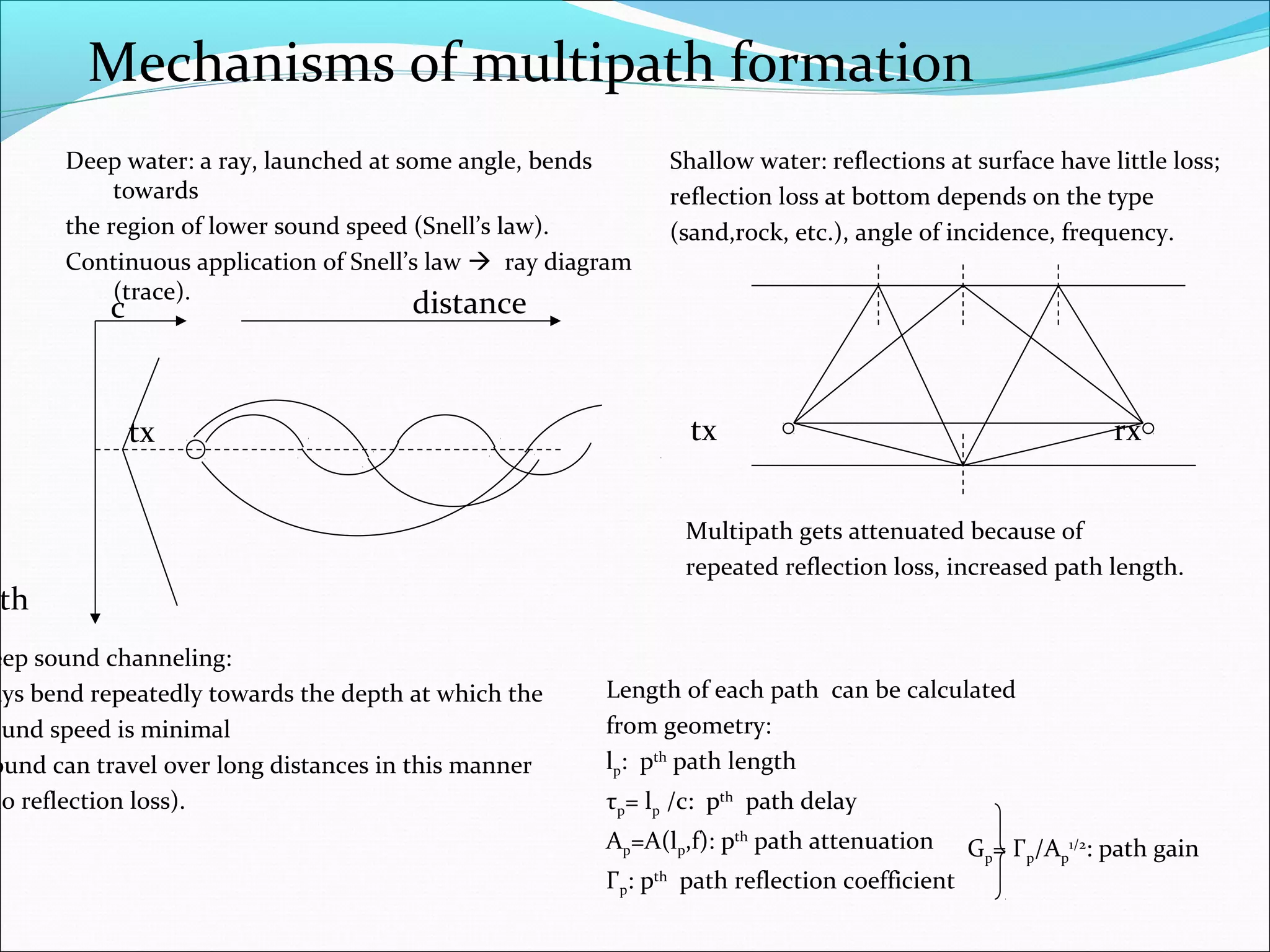
Deep water: a ray, launched at some angle, bends 
towards 
the region of lower sound speed (Snell’s law). 
Continuous application of Snell’s law  ray diagram 
(trace). 
c distance 
tx 
Deep sound channeling: 
rays bend repeatedly towards the depth at which the 
sound speed is minimal 
sound can travel over long distances in this manner 
no reflection loss). 
Shallow water: reflections at surface have little loss; 
reflection loss at bottom depends on the type 
(sand,rock, etc.), angle of incidence, frequency. 
tx rx 
Multipath gets attenuated because of 
repeated reflection loss, increased path length. 
Length of each path can be calculated 
from geometry: 
lp: pth path length 
τp= lp /c: pth path delay 
Ap=A(lp,f): pth path attenuation 
Γp: pth path reflection coefficient 
Gp= Γp/Ap 
1/2: path gain 
Mechanisms of multipath formation
SCATTERING
VARIATION IN SPPED OF SOUND 
continental shelf (~100 m) 
continental slice 
continental rise 
abyssal 
plain 
land sea 
c 
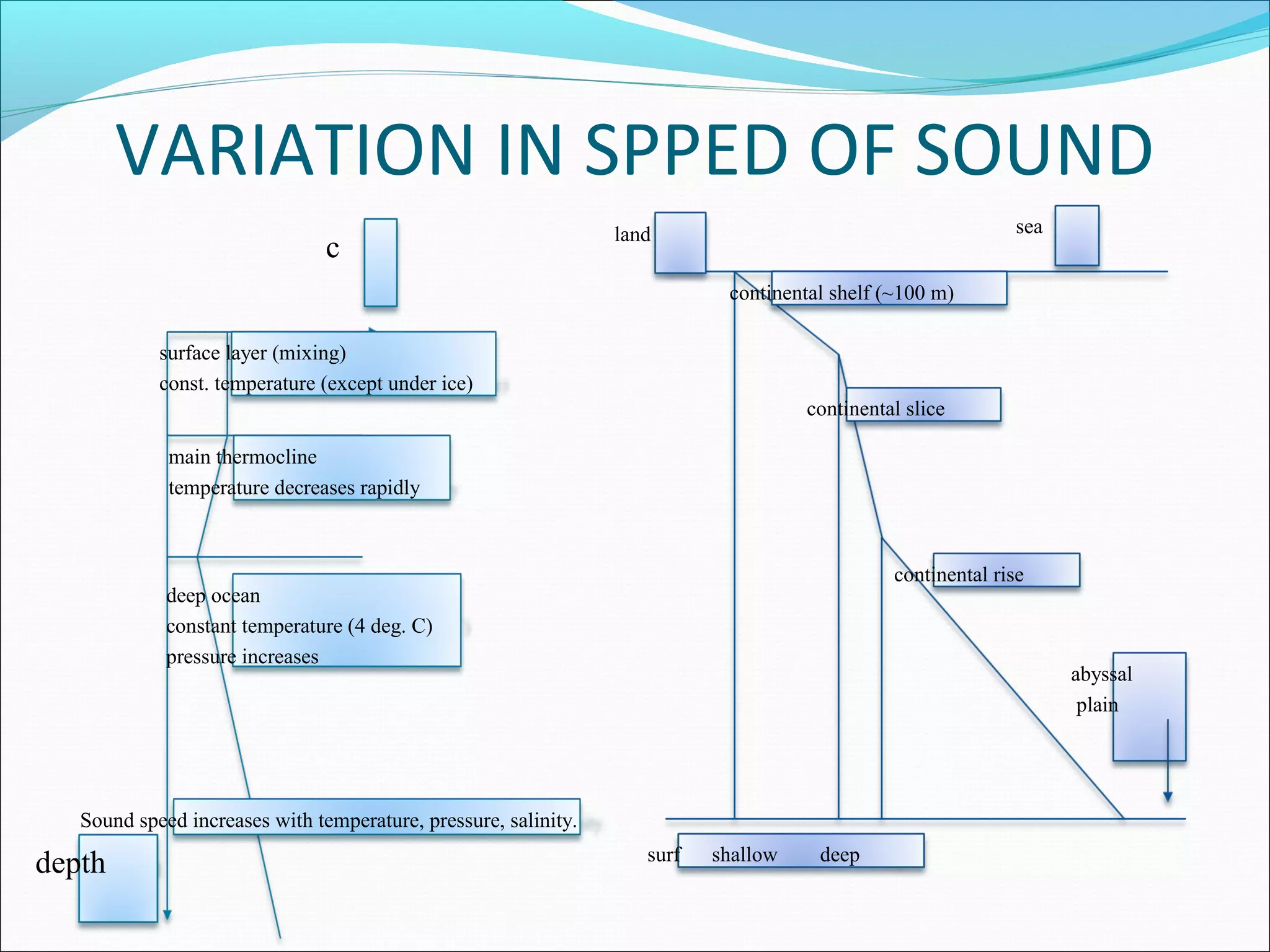
surface layer (mixing) 
const. temperature (except under ice) 
main thermocline 
temperature decreases rapidly 
deep ocean 
constant temperature (4 deg. C) 
pressure increases 
Sound speed increases with temperature, pressure, salinity. 
depth surf shallow deep
Communication channel / summary 
Physical constraints of acoustic 
propagation: 
• limited, range-dependent bandwidth 
• time-varying multipath 
• low speed of sound (1500 m/s) 
Worst of both radio 
worlds 
(land mobile / satellite) 
System constraints: 
• transducer bandwidth 
• battery power 
• half-duplex 
A(d,f)~dka(f)d 
N(f)~Kf-b 
tt(1±v/c) 
ff(1±v/c) 
B>1/Tmp 
frequency-selective 
fading
Underwater applications 
• Seismic monitoring. 
• Pollution monitoring 
• Ocean currents monitoring 
• Equipment monitoring and control 
• Autonomous Underwater Vehicles (AUV) 
To make these applications viable, there is a 
need to enable underwater communications 
among underwater devices -> Wireless 
underwater networking 
Use sound as the wireless communication 
medium.

Underwater acoustic channel cocnept

  • 1.
    UNDER WATER ACOUSTICCHANNEL PRESENTED BY SAROJ KUMAR RIGVENDRA KUMARR VARDHAN M.TECH ECE PONDICHERRY UNIVERSITY
  • 3.
    Why Underwater? TheEarth is a water planet About 2/3 of the Earth covered by oceans •Uninhabited, largely unexplored •A huge amount of (natural) resources to discover Many potential applications Long-term aquatic monitoring •Oceanography, marine biology, deep-sea archaeology, seismic predictions, pollution detection, oil/gas field monitoring … Short-term aquatic exploration •Underwater natural resource discovery, hurricane disaster recovery, anti-submarine mission, loss treasure discovery …
  • 4.
    Underwater acoustic communicationis a technique of sending and receiving message below water. There are several ways of employing such communication but the most common is using hydrophones. Under water communication is difficult due to factors like multi-path propagation, time variations of the channel, small available bandwidth and strong signal attenuation, especially over long ranges. In underwater communication there are low data rates compared to terrestrial communication, since underwater communication uses acoustic waves instead of electromagnetic waves.
  • 6.
    underwater video? Real-time Underwater image transmission: sequence of images (JPEG) at < 1 frame/sec MPEG-4 : 64 kbps (video conferencing) Can we achieve 100 kbps over an acoustic channel? Compression to reduce bit rate needed for video representation High-level modulation to increase the bit rate supported by acoustic channel ?
  • 8.
    depth Deep water:a ray, launched at some angle, bends towards the region of lower sound speed (Snell’s law). Continuous application of Snell’s law  ray diagram (trace). c distance tx Deep sound channeling: rays bend repeatedly towards the depth at which the sound speed is minimal sound can travel over long distances in this manner no reflection loss). Shallow water: reflections at surface have little loss; reflection loss at bottom depends on the type (sand,rock, etc.), angle of incidence, frequency. tx rx Multipath gets attenuated because of repeated reflection loss, increased path length. Length of each path can be calculated from geometry: lp: pth path length τp= lp /c: pth path delay Ap=A(lp,f): pth path attenuation Γp: pth path reflection coefficient Gp= Γp/Ap 1/2: path gain Mechanisms of multipath formation
  • 9.
  • 10.
    VARIATION IN SPPEDOF SOUND continental shelf (~100 m) continental slice continental rise abyssal plain land sea c surface layer (mixing) const. temperature (except under ice) main thermocline temperature decreases rapidly deep ocean constant temperature (4 deg. C) pressure increases Sound speed increases with temperature, pressure, salinity. depth surf shallow deep
  • 11.
    Communication channel /summary Physical constraints of acoustic propagation: • limited, range-dependent bandwidth • time-varying multipath • low speed of sound (1500 m/s) Worst of both radio worlds (land mobile / satellite) System constraints: • transducer bandwidth • battery power • half-duplex A(d,f)~dka(f)d N(f)~Kf-b tt(1±v/c) ff(1±v/c) B>1/Tmp frequency-selective fading
  • 12.
    Underwater applications •Seismic monitoring. • Pollution monitoring • Ocean currents monitoring • Equipment monitoring and control • Autonomous Underwater Vehicles (AUV) To make these applications viable, there is a need to enable underwater communications among underwater devices -> Wireless underwater networking Use sound as the wireless communication medium.