Trypanosomiasis
Distribution
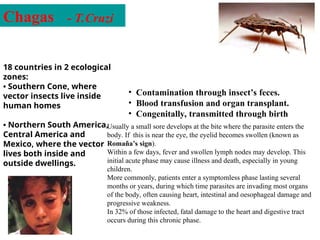
18 countries in 2 ecological
zones:
• Southern Cone, where
vector insects live inside
human homes
• Northern South America,
Central America and
Mexico, where the vector
lives both inside and
outside dwellings.
Chagas
Transmission
Parasites are transmitted to humans in 3 ways:
• Contamination through insect’s feces.
• Blood transfusion and organ transplant.
• Congenitally, transmitted through birth
Usually a small sore develops at the bite where the parasite enters the
body. If this is near the eye, the eyelid becomes swollen (known as
Romaña’s sign).
Within a few days, fever and swollen lymph nodes may develop. This
initial acute phase may cause illness and death, especially in young
children.
More commonly, patients enter a symptomless phase lasting several
months or years, during which time parasites are invading most organs
of the body, often causing heart, intestinal and oesophageal damage and
progressive weakness.
In 32% of those infected, fatal damage to the heart and digestive tract
occurs during this chronic phase.
- T.Cruzi
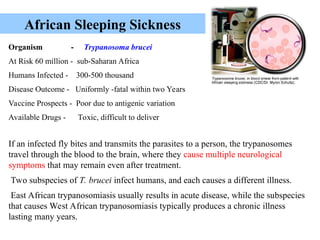
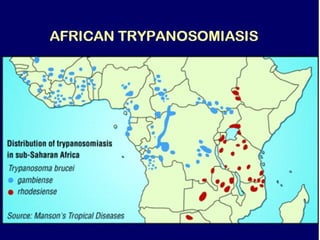
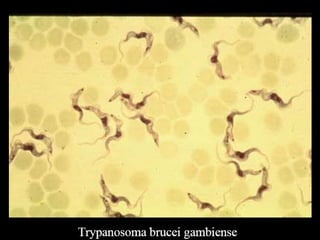
Organism - Trypanosoma brucei
At Risk 60 million - sub-Saharan Africa
Humans Infected - 300-500 thousand
Disease Outcome - Uniformly -fatal within two Years
Vaccine Prospects - Poor due to antigenic variation
Available Drugs - Toxic, difficult to deliver
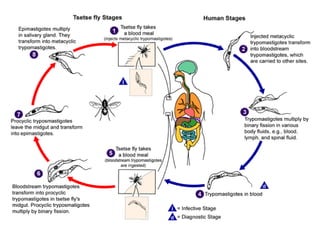
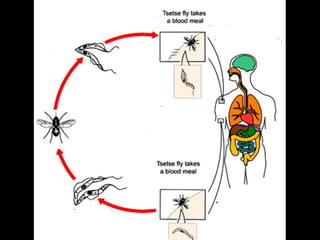
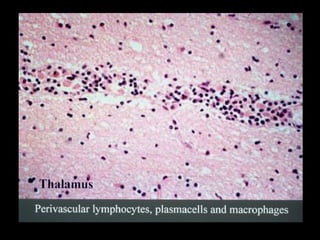
If an infected fly bites and transmits the parasites to a person, the trypanosomes
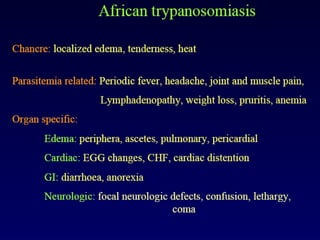
travel through the blood to the brain, where they cause multiple neurological
symptoms that may remain even after treatment.
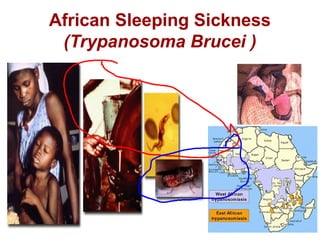
Two subspecies of T. brucei infect humans, and each causes a different illness.
East African trypanosomiasis usually results in acute disease, while the subspecies
that causes West African trypanosomiasis typically produces a chronic illness
lasting many years.
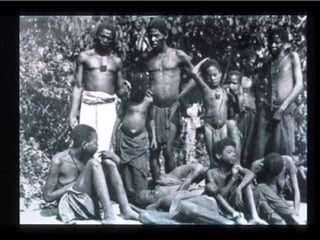
African Sleeping Sickness
Examples of important systemic
protozoa
Detected in the blood
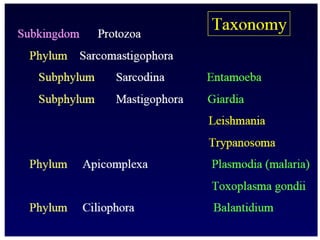
• Plasmodium: the cause of malaria.
There are 4 species that infect man: P.
falciparum, P. vivax, P. ovale and P.
malariae
• Toxoplasma gondi: transmitted by the
ingestion of oocysts from cat faeces.
Infection can lead to ocular problems
and is also a cause of neonatal
toxoplasmosis
• Leishmania: transmitted by sand flies,
can lead to visceral, cutaneous and
mucocutaneous leishmaniasis
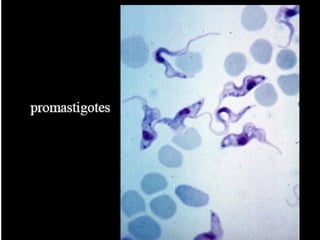
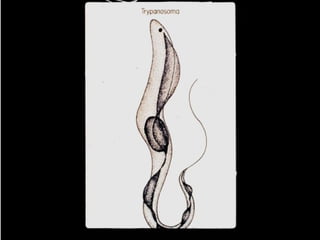
• Trypanosoma: haemoflagellates which
cause
– In Africa - sleeping sickness
(transmitted by the Tsetse fly)
– In South America - Chagas disease
(transmitted by the Reduviid bug)
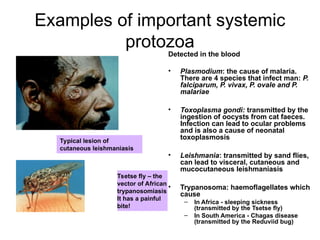
Typical lesion of
cutaneous leishmaniasis
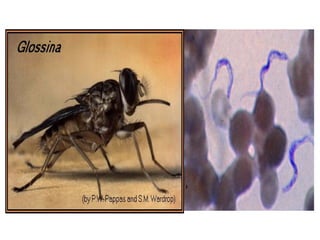
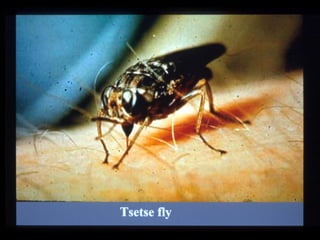
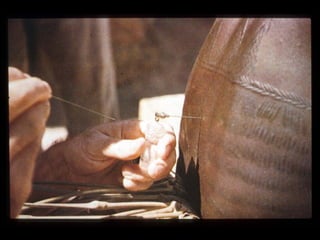
Tsetse fly – the
vector of African
trypanosomiasis
It has a painful
bite!
African Sleeping Sickness
(Trypanosoma Brucei )
Understanding Trypanosomiasis and causes

Understanding Trypanosomiasis and causes

  • 1.
  • 5.
    Distribution 18 countries in2 ecological zones: • Southern Cone, where vector insects live inside human homes • Northern South America, Central America and Mexico, where the vector lives both inside and outside dwellings. Chagas Transmission Parasites are transmitted to humans in 3 ways: • Contamination through insect’s feces. • Blood transfusion and organ transplant. • Congenitally, transmitted through birth Usually a small sore develops at the bite where the parasite enters the body. If this is near the eye, the eyelid becomes swollen (known as Romaña’s sign). Within a few days, fever and swollen lymph nodes may develop. This initial acute phase may cause illness and death, especially in young children. More commonly, patients enter a symptomless phase lasting several months or years, during which time parasites are invading most organs of the body, often causing heart, intestinal and oesophageal damage and progressive weakness. In 32% of those infected, fatal damage to the heart and digestive tract occurs during this chronic phase. - T.Cruzi
  • 6.
    Organism - Trypanosomabrucei At Risk 60 million - sub-Saharan Africa Humans Infected - 300-500 thousand Disease Outcome - Uniformly -fatal within two Years Vaccine Prospects - Poor due to antigenic variation Available Drugs - Toxic, difficult to deliver If an infected fly bites and transmits the parasites to a person, the trypanosomes travel through the blood to the brain, where they cause multiple neurological symptoms that may remain even after treatment. Two subspecies of T. brucei infect humans, and each causes a different illness. East African trypanosomiasis usually results in acute disease, while the subspecies that causes West African trypanosomiasis typically produces a chronic illness lasting many years. African Sleeping Sickness
  • 7.
    Examples of importantsystemic protozoa Detected in the blood • Plasmodium: the cause of malaria. There are 4 species that infect man: P. falciparum, P. vivax, P. ovale and P. malariae • Toxoplasma gondi: transmitted by the ingestion of oocysts from cat faeces. Infection can lead to ocular problems and is also a cause of neonatal toxoplasmosis • Leishmania: transmitted by sand flies, can lead to visceral, cutaneous and mucocutaneous leishmaniasis • Trypanosoma: haemoflagellates which cause – In Africa - sleeping sickness (transmitted by the Tsetse fly) – In South America - Chagas disease (transmitted by the Reduviid bug) Typical lesion of cutaneous leishmaniasis Tsetse fly – the vector of African trypanosomiasis It has a painful bite!
  • 9.