Lesson 15:B. Setting Goals for
Success
ARASOF- Nasugbu Campus
Intended Learning Outcomes
I. Know the Importance of Goal
II. The Goal–Setting Theory of Edwin Locke
III.The Effective Goal-Setting Theory
Principles
IV.Golden Rules of Goal Setting
THE IMPORTANCE OF GOALS
• A goal is the desired outcome anticipated by a person or
organization. It may be a long term vision or a
short term outcome which can be achieved through careful
planning, execution and evaluation.
• Goals help us to concentrate our energy, arrange strategies,
consciously having a purpose-centered life, and
provide us a sense of accomplishment.
Difference of Goal and Goal setting
Goal
• A goal is a desired result that a
person plans and commits to
achieve.
Goal setting
• Goal setting involves the
development of an action plan
designed to motivate and guide
a person or group toward a goal.
• Establishes a standard or
objective to serve as target of
one’s actions.
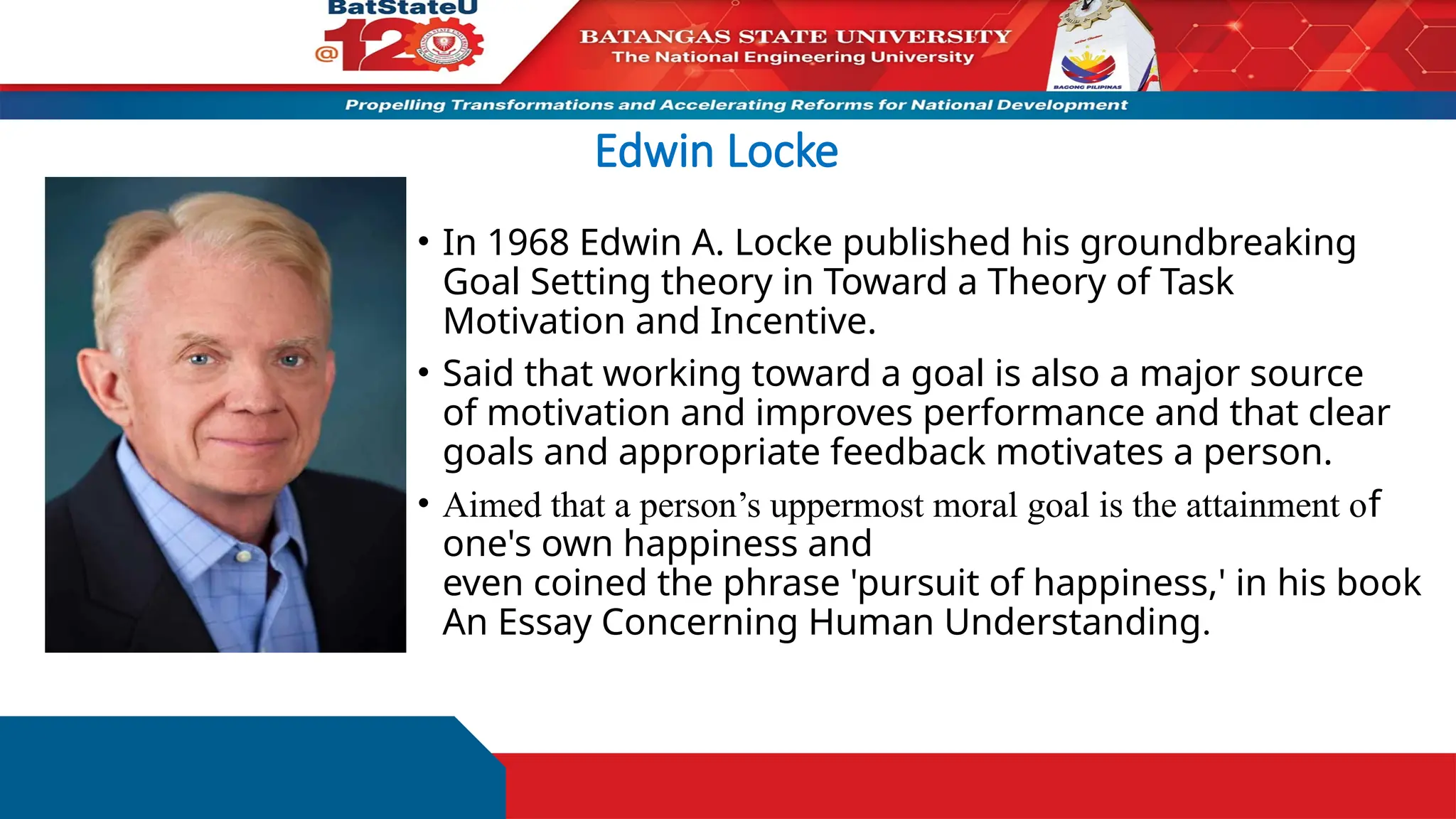
Edwin Locke
• In 1968 Edwin A. Locke published his groundbreaking
Goal Setting theory in Toward a Theory of Task
Motivation and Incentive.
• Said that working toward a goal is also a major source
of motivation and improves performance and that clear
goals and appropriate feedback motivates a person.
• Aimed that a person’s uppermost moral goal is the attainment of
one's own happiness and
even coined the phrase 'pursuit of happiness,' in his book
An Essay Concerning Human Understanding.
GOAL- SETTING THEORY
•Goal-setting theory refers to the effects of
setting goals on subsequent performance.
• Edwin Locke found that individuals who set
specific, difficult goals performed better than
those who set general, easy goals.
•Locke proposed five basic principles of goal-
setting: clarity, challenge,
commitment, feedback, and task complexity
Goal setting Tools
•Goal setting tools are a great way to help
you set goals, keep track of, and stay focused
on what you’re trying to achieve.
•These tools and can be informal or they
can be formalized.
Tools that can be Informal
• A handwritten diary or journal tracking your goals and smaller
daily achievements.
• Using your mobile phone to set daily reminders or countdown
apps for when you want to achieve certain things by
• Motivational notes and posters set around your home or
work desk as friendly reminders
• Telling friends and family what you’re working towards so they can
offer support
• Visualization activities including meditation, positive
affirmations, and mindfulness
Tools that can be Formalized
• Regular meetings/reviews with your line manager at work to keep you
accountable (if your goals are work related)
• Joining groups or meet-ups with individuals trying to achieve the same
goals (such as weight loss,or athletic groups/fitness classes)
• Working with a peer coach or mentor to help motivate you to stay on
track
• Utilizing goal setting software tools and apps to help keep you on track (Milestone
Planner and Goal Scape to name a few)
GOLDEN RULES OF GOAL SETTING
• If you want to succeed, you need to set goals. Without goals you lack focus and
direction. Goal setting notonly allows you to take control of your life's direction; it
also provides you a benchmark for determining whether you are actually succeeding.
• To accomplish your goals, however, you need to know how to set them. You can't
simply say, "I want" and expect it to happen. Goal setting is a process that starts with
careful consideration of what you want to
achieve, and ends with a lot of hard work to actually do it. In between, there are
some very well-definedsteps that transcend the specifics of each goal. Knowing
these steps will allow you to formulate goals that
you can accomplish
The Five Golden Rules
1. Set Goals That Motivate You
• When you set goals for yourself, it is important that they motivate
you: this means making sure that they
are important to you, and that there is value in achieving them. If you
have little interest in the outcome, or
they are irrelevant given the larger picture, then the chances of you
putting in the work to make them happen
are slim. Motivation is key to achieving goals.
The Five Golden Rules
2. Set SMART Goals
You have probably heard of SMART goals already. But do you
always apply the rule? The simple fact is
that for goals to be powerful, they should be designed to be SMART.
There are many variations of what
SMART stands for, but the essence is this – goals should be:
 Specific.
 Measurable.
 Attainable.
 Relevant.
 Time Bound
The Five Golden Rules
3. Set Goals in Writing
The physical act of writing down a goal makes it real and tangible. You
have no excuse for forgetting about
it. As you write, use the word "will" instead of "would like to" or
"might." For example, "I will reduce my
operating expenses by 10 percent this year," not "I would like to reduce
my operating expenses by 10
percent this year." The first goal statement has power and you can
"see" yourself reducing expenses, the
second lacks passion and gives you an excuse if you get side tracked.
Tip 1:
• Frame your goal statement positively. If you want to improve your
retention rates say, "I will hold on to all
existing employees for the next quarter" rather than "I will reduce
employee turnover." The first one is
motivating; the second one still has a get-out clause "allowing" you to
succeed even if some employees
leave.
Tip 2:
• If you use a To-Do List , make yourself a To-Do List template that has
your goals at the top of it. If you
use an Action Program , then your goals should be at the top of your
Project Catalog.
Post your goals in visible places to remind yourself every day of what
it is you intend to do. Put them on
your walls, desk, computer monitor, bathroom mirror or refrigerator
as a constant reminder.
The Five Golden Rules
4. Make an Action Plan
• This step is often missed in the process of goal setting. You get so
focused on the outcome that you forget
to plan all of the steps that are needed along the way. By writing out the
individual steps, and then crossing
each one off as you complete it, you'll realize that you are making
progress towards your ultimate goal.
This is especially important if your goal is big and demanding, or long-
term.
The Five Golden Rules
5. Stick With It!
• Remember, goal setting is an ongoing activity, not just a means to an
end. Build in reminders to keep
yourself on track, and make regular time-slots available to review your
goals. Your end destination may
remain quite similar over the long term, but the action plan you set for
yourself along the way can change
significantly. Make sure the relevance, value, and necessity remain high
Summary
• Goal setting is much more than simply saying you want something to
happen. Unless you clearly define
exactly what you want and understand why you want it the first place,
your odds of success are considerably
reduced. By following the Five Golden Rules of Goal Setting you can
set goals with confidence and enjoy
the satisfaction that comes along with knowing you achieved what
you set out to do.
THANK YOU FOR LISTENING!
ARASOF- Nasugbu Campus

Understanding the self REPORT.ppt lesson 15

  • 1.
    Lesson 15:B. SettingGoals for Success ARASOF- Nasugbu Campus
  • 2.
    Intended Learning Outcomes I.Know the Importance of Goal II. The Goal–Setting Theory of Edwin Locke III.The Effective Goal-Setting Theory Principles IV.Golden Rules of Goal Setting
  • 3.
    THE IMPORTANCE OFGOALS • A goal is the desired outcome anticipated by a person or organization. It may be a long term vision or a short term outcome which can be achieved through careful planning, execution and evaluation. • Goals help us to concentrate our energy, arrange strategies, consciously having a purpose-centered life, and provide us a sense of accomplishment.
  • 4.
    Difference of Goaland Goal setting Goal • A goal is a desired result that a person plans and commits to achieve. Goal setting • Goal setting involves the development of an action plan designed to motivate and guide a person or group toward a goal. • Establishes a standard or objective to serve as target of one’s actions.
  • 5.
    Edwin Locke • In1968 Edwin A. Locke published his groundbreaking Goal Setting theory in Toward a Theory of Task Motivation and Incentive. • Said that working toward a goal is also a major source of motivation and improves performance and that clear goals and appropriate feedback motivates a person. • Aimed that a person’s uppermost moral goal is the attainment of one's own happiness and even coined the phrase 'pursuit of happiness,' in his book An Essay Concerning Human Understanding.
  • 6.
    GOAL- SETTING THEORY •Goal-settingtheory refers to the effects of setting goals on subsequent performance. • Edwin Locke found that individuals who set specific, difficult goals performed better than those who set general, easy goals. •Locke proposed five basic principles of goal- setting: clarity, challenge, commitment, feedback, and task complexity
  • 8.
    Goal setting Tools •Goalsetting tools are a great way to help you set goals, keep track of, and stay focused on what you’re trying to achieve. •These tools and can be informal or they can be formalized.
  • 9.
    Tools that canbe Informal • A handwritten diary or journal tracking your goals and smaller daily achievements. • Using your mobile phone to set daily reminders or countdown apps for when you want to achieve certain things by • Motivational notes and posters set around your home or work desk as friendly reminders • Telling friends and family what you’re working towards so they can offer support • Visualization activities including meditation, positive affirmations, and mindfulness
  • 10.
    Tools that canbe Formalized • Regular meetings/reviews with your line manager at work to keep you accountable (if your goals are work related) • Joining groups or meet-ups with individuals trying to achieve the same goals (such as weight loss,or athletic groups/fitness classes) • Working with a peer coach or mentor to help motivate you to stay on track • Utilizing goal setting software tools and apps to help keep you on track (Milestone Planner and Goal Scape to name a few)
  • 11.
    GOLDEN RULES OFGOAL SETTING • If you want to succeed, you need to set goals. Without goals you lack focus and direction. Goal setting notonly allows you to take control of your life's direction; it also provides you a benchmark for determining whether you are actually succeeding. • To accomplish your goals, however, you need to know how to set them. You can't simply say, "I want" and expect it to happen. Goal setting is a process that starts with careful consideration of what you want to achieve, and ends with a lot of hard work to actually do it. In between, there are some very well-definedsteps that transcend the specifics of each goal. Knowing these steps will allow you to formulate goals that you can accomplish
  • 12.
    The Five GoldenRules 1. Set Goals That Motivate You • When you set goals for yourself, it is important that they motivate you: this means making sure that they are important to you, and that there is value in achieving them. If you have little interest in the outcome, or they are irrelevant given the larger picture, then the chances of you putting in the work to make them happen are slim. Motivation is key to achieving goals.
  • 13.
    The Five GoldenRules 2. Set SMART Goals You have probably heard of SMART goals already. But do you always apply the rule? The simple fact is that for goals to be powerful, they should be designed to be SMART. There are many variations of what SMART stands for, but the essence is this – goals should be:  Specific.  Measurable.  Attainable.  Relevant.  Time Bound
  • 15.
    The Five GoldenRules 3. Set Goals in Writing The physical act of writing down a goal makes it real and tangible. You have no excuse for forgetting about it. As you write, use the word "will" instead of "would like to" or "might." For example, "I will reduce my operating expenses by 10 percent this year," not "I would like to reduce my operating expenses by 10 percent this year." The first goal statement has power and you can "see" yourself reducing expenses, the second lacks passion and gives you an excuse if you get side tracked.
  • 16.
    Tip 1: • Frameyour goal statement positively. If you want to improve your retention rates say, "I will hold on to all existing employees for the next quarter" rather than "I will reduce employee turnover." The first one is motivating; the second one still has a get-out clause "allowing" you to succeed even if some employees leave.
  • 17.
    Tip 2: • Ifyou use a To-Do List , make yourself a To-Do List template that has your goals at the top of it. If you use an Action Program , then your goals should be at the top of your Project Catalog. Post your goals in visible places to remind yourself every day of what it is you intend to do. Put them on your walls, desk, computer monitor, bathroom mirror or refrigerator as a constant reminder.
  • 18.
    The Five GoldenRules 4. Make an Action Plan • This step is often missed in the process of goal setting. You get so focused on the outcome that you forget to plan all of the steps that are needed along the way. By writing out the individual steps, and then crossing each one off as you complete it, you'll realize that you are making progress towards your ultimate goal. This is especially important if your goal is big and demanding, or long- term.
  • 19.
    The Five GoldenRules 5. Stick With It! • Remember, goal setting is an ongoing activity, not just a means to an end. Build in reminders to keep yourself on track, and make regular time-slots available to review your goals. Your end destination may remain quite similar over the long term, but the action plan you set for yourself along the way can change significantly. Make sure the relevance, value, and necessity remain high
  • 20.
    Summary • Goal settingis much more than simply saying you want something to happen. Unless you clearly define exactly what you want and understand why you want it the first place, your odds of success are considerably reduced. By following the Five Golden Rules of Goal Setting you can set goals with confidence and enjoy the satisfaction that comes along with knowing you achieved what you set out to do.
  • 21.
    THANK YOU FORLISTENING! ARASOF- Nasugbu Campus