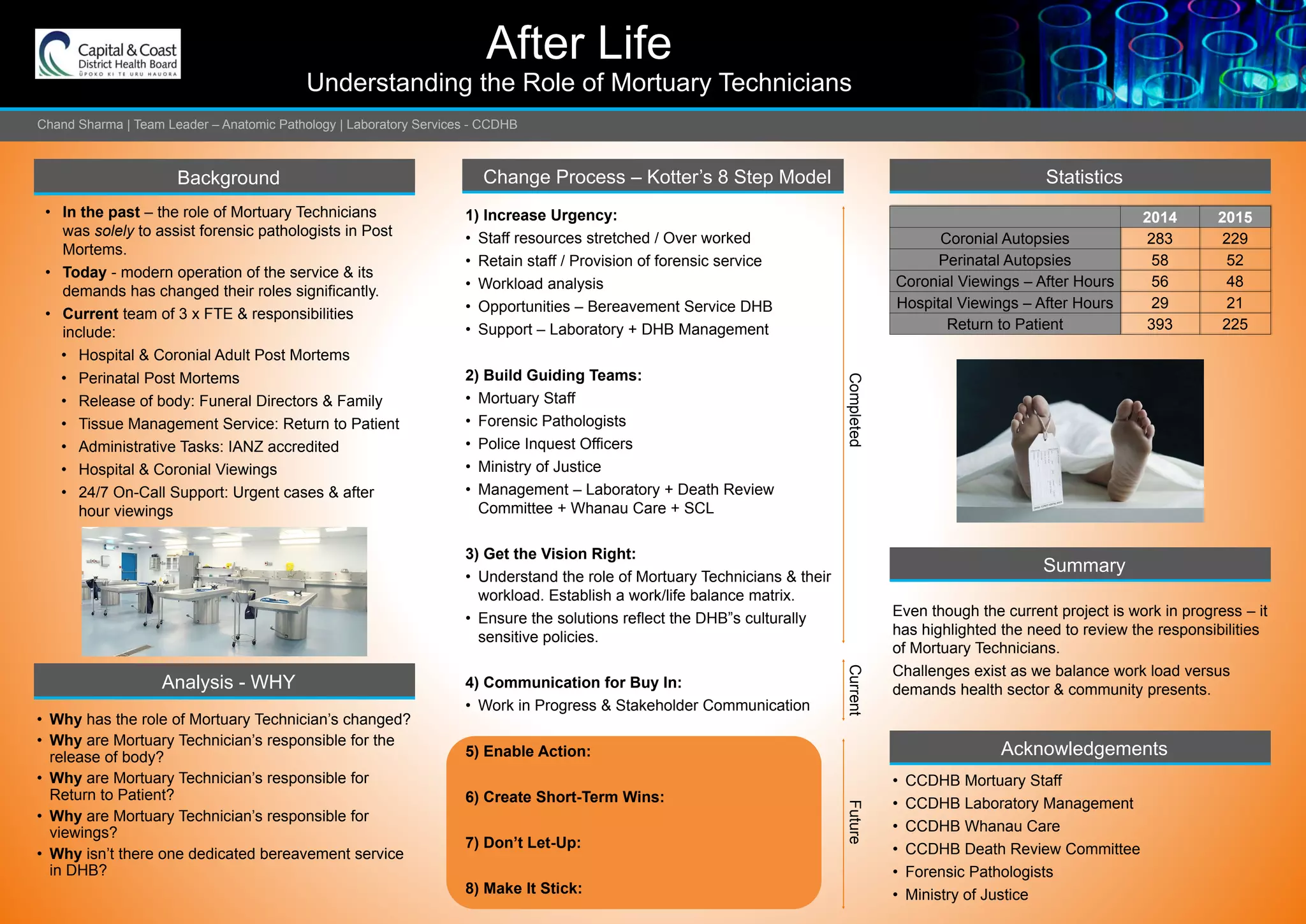
After Life
Understanding the Role of Mortuary Technicians
Chand Sharma | Team Leader – Anatomic Pathology | Laboratory Services - CCDHB
• In the past – the role of Mortuary Technicians
was solely to assist forensic pathologists in Post
Mortems.
• Today - modern operation of the service & its
demands has changed their roles significantly.
• Current team of 3 x FTE & responsibilities
include:
• Hospital & Coronial Adult Post Mortems
• Perinatal Post Mortems
• Release of body: Funeral Directors & Family
• Tissue Management Service: Return to Patient
• Administrative Tasks: IANZ accredited
• Hospital & Coronial Viewings
• 24/7 On-Call Support: Urgent cases & after
hour viewings
Analysis - WHY
• Why has the role of Mortuary Technician’s changed?
• Why are Mortuary Technician’s responsible for the
release of body?
• Why are Mortuary Technician’s responsible for
Return to Patient?
• Why are Mortuary Technician’s responsible for
viewings?
• Why isn’t there one dedicated bereavement service
in DHB?
Change Process – Kotter’s 8 Step Model Statistics
Summary
Even though the current project is work in progress – it
has highlighted the need to review the responsibilities
of Mortuary Technicians.
Challenges exist as we balance work load versus
demands health sector & community presents.
Acknowledgements
• CCDHB Mortuary Staff
• CCDHB Laboratory Management
• CCDHB Whanau Care
• CCDHB Death Review Committee
• Forensic Pathologists
• Ministry of Justice
1) Increase Urgency:
• Staff resources stretched / Over worked
• Retain staff / Provision of forensic service
• Workload analysis
• Opportunities – Bereavement Service DHB
• Support – Laboratory + DHB Management
2) Build Guiding Teams:
• Mortuary Staff
• Forensic Pathologists
• Police Inquest Officers
• Ministry of Justice
• Management – Laboratory + Death Review
Committee + Whanau Care + SCL
3) Get the Vision Right:
• Understand the role of Mortuary Technicians & their
workload. Establish a work/life balance matrix.
• Ensure the solutions reflect the DHB”s culturally
sensitive policies.
4) Communication for Buy In:
• Work in Progress & Stakeholder Communication
5) Enable Action:
6) Create Short-Term Wins:
7) Don’t Let-Up:
8) Make It Stick:
2014 2015
Coronial Autopsies 283 229
Perinatal Autopsies 58 52
Coronial Viewings – After Hours 56 48
Hospital Viewings – After Hours 29 21
Return to Patient 393 225
Background
CompletedCurrentFuture

Understanding the role of Mortuary Technicians

  • 1.
    After Life Understanding theRole of Mortuary Technicians Chand Sharma | Team Leader – Anatomic Pathology | Laboratory Services - CCDHB • In the past – the role of Mortuary Technicians was solely to assist forensic pathologists in Post Mortems. • Today - modern operation of the service & its demands has changed their roles significantly. • Current team of 3 x FTE & responsibilities include: • Hospital & Coronial Adult Post Mortems • Perinatal Post Mortems • Release of body: Funeral Directors & Family • Tissue Management Service: Return to Patient • Administrative Tasks: IANZ accredited • Hospital & Coronial Viewings • 24/7 On-Call Support: Urgent cases & after hour viewings Analysis - WHY • Why has the role of Mortuary Technician’s changed? • Why are Mortuary Technician’s responsible for the release of body? • Why are Mortuary Technician’s responsible for Return to Patient? • Why are Mortuary Technician’s responsible for viewings? • Why isn’t there one dedicated bereavement service in DHB? Change Process – Kotter’s 8 Step Model Statistics Summary Even though the current project is work in progress – it has highlighted the need to review the responsibilities of Mortuary Technicians. Challenges exist as we balance work load versus demands health sector & community presents. Acknowledgements • CCDHB Mortuary Staff • CCDHB Laboratory Management • CCDHB Whanau Care • CCDHB Death Review Committee • Forensic Pathologists • Ministry of Justice 1) Increase Urgency: • Staff resources stretched / Over worked • Retain staff / Provision of forensic service • Workload analysis • Opportunities – Bereavement Service DHB • Support – Laboratory + DHB Management 2) Build Guiding Teams: • Mortuary Staff • Forensic Pathologists • Police Inquest Officers • Ministry of Justice • Management – Laboratory + Death Review Committee + Whanau Care + SCL 3) Get the Vision Right: • Understand the role of Mortuary Technicians & their workload. Establish a work/life balance matrix. • Ensure the solutions reflect the DHB”s culturally sensitive policies. 4) Communication for Buy In: • Work in Progress & Stakeholder Communication 5) Enable Action: 6) Create Short-Term Wins: 7) Don’t Let-Up: 8) Make It Stick: 2014 2015 Coronial Autopsies 283 229 Perinatal Autopsies 58 52 Coronial Viewings – After Hours 56 48 Hospital Viewings – After Hours 29 21 Return to Patient 393 225 Background CompletedCurrentFuture