Understanding The Earth System Global Change
Science For Application Draft Cornell Se
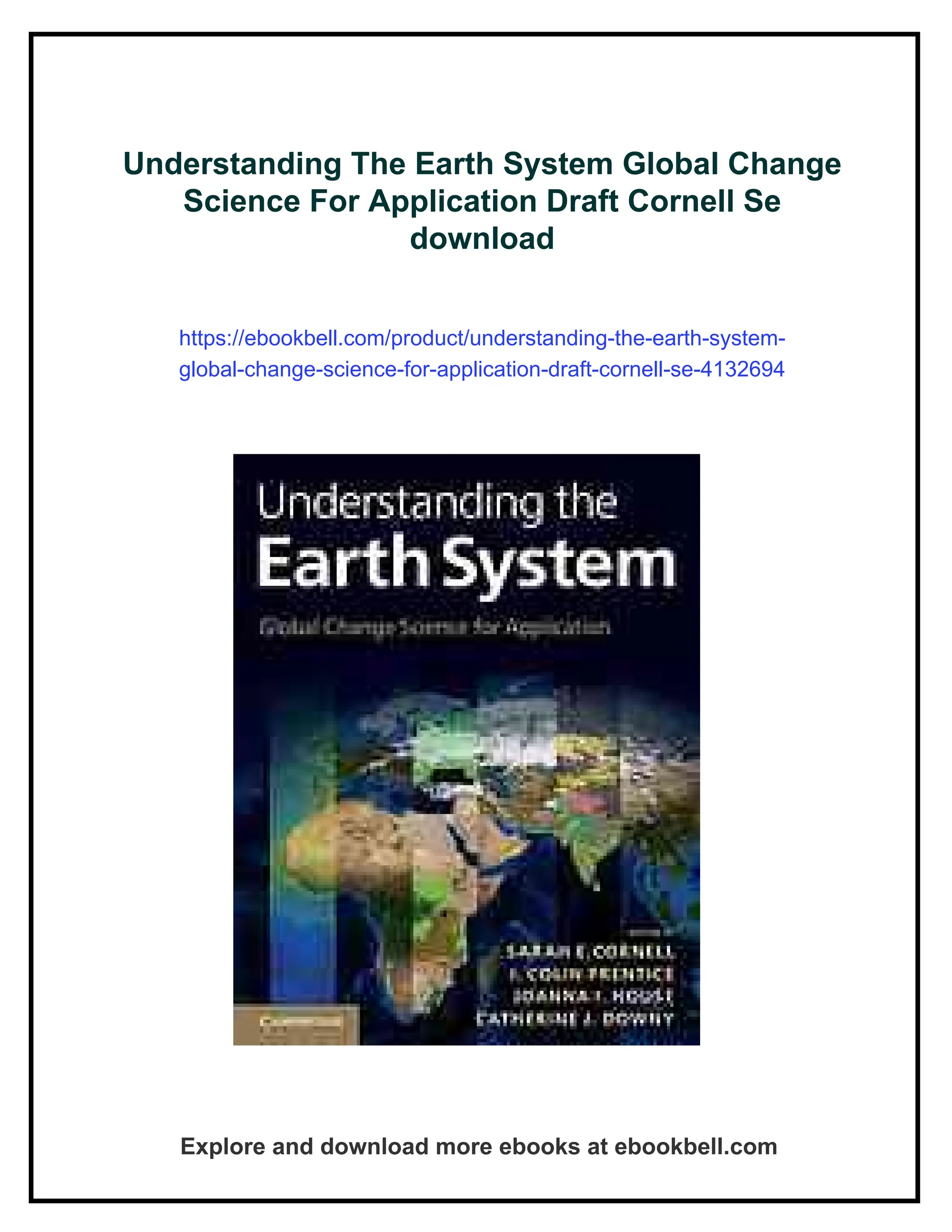
download
https://ebookbell.com/product/understanding-the-earth-system-
global-change-science-for-application-draft-cornell-se-4132694
Explore and download more ebooks at ebookbell.com
Here are some recommended products that we believe you will be
interested in. You can click the link to download.
Monitoring Climate Change Impacts Metrics At The Intersection Of The
Human And Earth Systems Committee On Indicators For Understanding
Global Climate Change
https://ebookbell.com/product/monitoring-climate-change-impacts-
metrics-at-the-intersection-of-the-human-and-earth-systems-committee-
on-indicators-for-understanding-global-climate-change-5068194
Understanding The Earth System Compartments Processes And Interactions
1st Edition Eckart Ehlers
https://ebookbell.com/product/understanding-the-earth-system-
compartments-processes-and-interactions-1st-edition-eckart-
ehlers-4180504
Understanding Climates Influence On Human Evolution National Research
Council Waszyngton Committee On The Earth System Context For Hominin
Evolution
https://ebookbell.com/product/understanding-climates-influence-on-
human-evolution-national-research-council-waszyngton-committee-on-the-
earth-system-context-for-hominin-evolution-11902854
Volcanic And Igneous Plumbing Systems Understanding Magma Transport
Storage And Evolution In The Earths Crust Steffi Burchardt
https://ebookbell.com/product/volcanic-and-igneous-plumbing-systems-
understanding-magma-transport-storage-and-evolution-in-the-earths-
crust-steffi-burchardt-7119910
Cities Demanding The Earth A New Understanding Of The Climate
Emergency Peter Taylor Geoff Obrien Phil Okeefe
https://ebookbell.com/product/cities-demanding-the-earth-a-new-
understanding-of-the-climate-emergency-peter-taylor-geoff-obrien-phil-
okeefe-51810290
Exploring Space Exploring Earth New Understanding Of The Earth From
Space Research 1st Edition Paul D Lowman
https://ebookbell.com/product/exploring-space-exploring-earth-new-
understanding-of-the-earth-from-space-research-1st-edition-paul-d-
lowman-2205118
Song Of The Earth Understanding Geology And Why It Matters Elisabeth
Ervinblankenheim
https://ebookbell.com/product/song-of-the-earth-understanding-geology-
and-why-it-matters-elisabeth-ervinblankenheim-43334810
Cosmic Impact Understanding The Threat To Earth From Asteroids And
Comets Andrew May
https://ebookbell.com/product/cosmic-impact-understanding-the-threat-
to-earth-from-asteroids-and-comets-andrew-may-10531006
Stars And Their Purpose Understanding The Origin Of Earths Nightlights
Werner Gitt Gitt
https://ebookbell.com/product/stars-and-their-purpose-understanding-
the-origin-of-earths-nightlights-werner-gitt-gitt-33522762
Understandingthe
EarthSystem
Global Change Science for Application
Earth system science has been described as ‘a science struggling with
problems too large for its participants, but too important to ignore’. This
exciting new book provides an overview of this enormous, rapidly growing
field, tackling current scientific debates and policy-relevant questions on the
global environment.
The multi-disciplinary author team explains the what, the how and the
why of climate science, providing a review of research from the last decade,
illustrated with cutting-edge data and observations. A key focus is the
development of analysis tools that can be used to demonstrate society’s options
for mitigating and adapting to increasing climate risks. Emphasis is given to
the importance of Earth system feedback mechanisms and the role of the
biosphere. The book explains advances in modelling, process understanding,
and observations, and the development of consistent and coherent studies of
past, present and ‘possible’ climates.
This highly illustrated, data-rich book is written both for those who use
Earth system model outputs and need to know more about the science behind
them, and those who develop Earth system models and need to know more
about the broader context of their research. The author team is made up of
leading scientists involved in QUEST, a major recently completed, UK-led
research programme. The book forms a concise and up-to-date reference for
academic researchers or students in the fields of climatology, Earth system
science and ecology. By highlighting the application of scientific results to
contemporary policy issues, the book is also a vital resource for professionals
and policy-makers working on any aspect of global change.
9781107009363pre_pi-xxvi.indd 1 4/2/2012 6:41:05 PM
9781107009363pre_pi-xxvi.indd 2 4/2/2012 6:41:05 PM
Understandingthe
EarthSystem
Global Change Science for Application
SarahCornell
StockholmResilienceCentre
I.ColinPrentice
MacquarieUniversity
JoannaHouse
UniversityofBristol
CatherineDowny
EuropeanSpaceAgencyClimateOffice,Harwell
Editedby
9781107009363pre_pi-xxvi.indd 3 4/2/2012 6:41:06 PM
cambridge university press
Cambridge, New York, Melbourne, Madrid, Cape Town,
Singapore, São Paulo, Delhi, Mexico City
Cambridge University Press
The Edinburgh Building, Cambridge CB2 8RU, UK
Published in the United States of America by Cambridge University Press, New York
www.cambridge.org
Information on this title: www.cambridge.org/9781107009363
© Cambridge University Press 2012
This publication is in copyright. Subject to statutory exception
and to the provisions of relevant collective licensing agreements,
no reproduction of any part may take place without the written
permission of Cambridge University Press.
First published 2012
Printed in the United Kingdom at the University Press, Cambridge
A catalogue record for this publication is available from the British Library
Library of Congress Cataloguing in Publication data
ISBN 978-1-107-00936-3 Hardback
Additional resources for this publication at www.cambridge.org/QUEST
Cambridge University Press has no responsibility for the persistence or
accuracy of URLs for external or third-party internet websites referred to in
this publication, and does not guarantee that any content on such websites is,
or will remain, accurate or appropriate.
9781107009363pre_pi-xxvi.indd 4 4/2/2012 6:41:06 PM
v
Contents
List of editorsâ•… page vii
List of scientific editorial team membersâ•… viii
List of contributing authorsâ•… x
Forewordâ•… xiii
Prefaceâ•… xv
Acknowledgementsâ•… xxiii
List of unitsâ•… xxv
1 Earth system science and society: a focus on
the anthroposphereâ•… 1
Sarah E. Cornell, Catherine J. Downy, Evan D. G.
Fraser and Emily Boyd
1.1 The Earth system and the‘problematic
human’â•… 1
1.2 Conceptualizing the‘human dimension’from
an Earth system perspectiveâ•… 6
1.3 Social science perspectives on the Earth
systemâ•… 16
1.4 Creating usable and useful integrated research
about the Earth systemâ•… 30
2 Fundamentals of climate change scienceâ•… 39
I. Colin Prentice, Peter G. Baines, Marko Scholze
and Martin J. Wooster
2.1 Observing and studying climateâ•… 39
2.2 Fundamentals of climatologyâ•… 42
2.3 Fundamentals of terrestrial ecosystem
scienceâ•… 53
2.4 The global carbon cycleâ•… 60
2.5 Prognosisâ•… 64
3 How has climate responded to natural
perturbations?â•… 72
Eric W. Wolff, Sandy P. Harrison, Reto Knutti,
Maria Fernanda Sanchez-Goñi, Oliver Wild,
Anne-Laure Daniau, Valérie Masson-Delmotte,
I. Colin Prentice and Renato Spahni
3.1 Introductionâ•… 72
3.2 Climate perturbationsâ•… 72
3.3 Methods for observing and understanding the
pastâ•… 74
3.4 How climate has altered in the pastâ•… 78
3.5 Response of climate change to forcingâ•… 79
3.6 Case studies of climate perturbations and
responsesâ•… 85
3.7 Natural perturbations as a guide to the future
behaviour of the Earth systemâ•… 94
4 The Earth system feedbacks that matter
for contemporary climateâ•… 102
Pierre Friedlingstein, Angela V.
Gallego-Sala, Eleanor M. Blyth, Fiona E. Hewer,
Sonia I. Seneviratne, Allan Spessa, Parvadha
Suntharalingam and Marko Scholze
4.1 Introductionâ•… 102
4.2 Land–atmosphere biogeophysical
feedbacksâ•… 105
4.3 Carbon-cycle feedbacksâ•… 108
4.4 Nitrous oxide feedbacksâ•… 110
4.5 Methane feedbacksâ•… 111
4.6 Fire feedbacksâ•… 115
4.7 Human feedbacksâ•… 119
5 Earth system models: a tool to understand
changes in the Earth systemâ•… 129
Marko Scholze, J. Icarus Allen, William J. Collins,
Sarah E. Cornell, Chris Huntingford, Manoj
M. Joshi, Jason A. Lowe, Robin S. Smith and
Oliver Wild
5.1 Introductionâ•… 129
5.2 Horses for courses: no model is‘best’â•… 132
9781107009363pre_pi-xxvi.indd 5 4/2/2012 6:41:06 PM
Contents
vi
5.3 Understanding observationsâ•… 139
5.4 Predicting future global changeâ•… 145
5.5 A perspective on future model
developmentsâ•… 151
5.6 The outlook for Earth system scienceâ•… 153
6 Climate change impacts and adaptation: an
Earth system viewâ•… 160
Richard A. Betts, Nigel W. Arnell, Penelope M.
Boorman, Sarah E. Cornell, Joanna I. House, Neil
R. Kaye, Mark P. McCarthy, Douglas J. McNeall,
Michael G. Sanderson and Andrew J. Wiltshire
6.1 Introductionâ•… 160
6.2 Measuring and modelling potential impacts of
climate changeâ•… 163
6.3 Evidence for impacts of climate change in the
recent pastâ•… 180
6.4 Global-scale impacts of future climate
changeâ•… 184
6.5 Adaptation in practiceâ•… 192
6.6 Key messagesâ•… 194
7 The role of the land biosphere in climate-
change mitigationâ•… 202
Joanna I. House, Jessica Bellarby, Hannes
Böttcher, Matthew Brander, Nicole Kalas, Pete
Smith, Richard Tipper and Jeremy Woods
7.1 Introduction: from human perturbation to
biosphere managementâ•… 202
7.2 How big a mitigation effort is required?â•… 204
7.3 How has the biosphere influenced climate
change in the recent past?â•… 209
7.4 Mitigation potential in the forest sectorâ•… 214
7.5 Mitigation potential in the agricultural
sectorâ•… 217
7.6 Mitigation in the bioenergy sectorâ•… 219
7.7 Critical issues in land-based mitigationâ•… 225
7.8 Opportunities and priorities for actionâ•… 236
8 Society’s responses and knowledge
gapsâ•… 245
Sarah E. Cornell and I. Colin Prentice
8.1 Introductionâ•… 245
8.2 Some unresolved issuesâ•… 245
8.3 Envisioning the futureâ•… 250
8.4 Concluding remarksâ•… 254
List of acronymsâ•… 257
Glossaryâ•… 261
Indexâ•… 263
9781107009363pre_pi-xxvi.indd 6 4/2/2012 6:41:06 PM
vii
Sarah Cornell (executive editor) works on integra-
tive socio-environmental research at the Stockholm
ResilienceCentre.InherpreviousroleattheUniversity
of Bristol, she was responsible for the science man-
agement and the synthesis phase of QUEST, the UK
NaturalEnvironmentResearchCouncil’sresearchpro-
gramme for Earth system science. Her research back-
ground is in marine and atmospheric chemistry, and
her interdisciplinary interests are in the anthropogenic
changes in global biogeochemistry, socio-economics,
environmental management, and the philosophy and
methodology of integrative research. Dr Cornell was
a founding member of the UK Human Dimensions
Committee on Global Change. She established the
University of Bristol’s MSc in Earth System Science,
the UK’s first post-graduate programme on this topic,
and is active in promoting education for sustainability.
In recent years, she has become more engaged in use-
oriented transdisciplinary research, with a particular
focus on conceptualizations of humans in the Earth
system.
Colin Prentice (senior editor and chair of the scien-
tific editorial team) served as the scientific leader and
chair of the QUEST research programme. He is now
a professor at both Macquarie University, Sydney and
Imperial College, London, where he and his collabo-
rators are developing a ‘next-generation’ biosphere
model combining Earth system observations with
developments in plant functional ecology. His over-
all research goal is to understand the interplay of the
biosphere and its physical environment, including the
causesandconsequencesofnaturalandhuman-caused
changes in climate and the global carbon and nitro-
gen cycles. He was awarded the Milutin Milankovitch
medal in 2002, and shared in the award of the Nobel
Peace Prize to the Intergovernmental Panel on Climate
Change in 2007. Professor Prentice co-chaired the
International Geosphere–Biosphere Programme’s
(IGBP’s) Analysis, Integration and Modelling of the
Earth System (AIMES) project until 2010, and now
directs the Australian Terrestrial Ecosystem Research
Network’s modelling facility, and jointly co-ordinates
thebiodiversitythemeforMacquarie’sClimateFutures
Centre.
Joanna House (policy editor) has been working in the
fieldofclimatescienceforover20years.Asscienceand
policy officer for QUEST, her role was to coordinate
the liaison between researchers and the policy/prac-
tice user communities. Now a Leverhulme Research
Fellow in the Cabot Institute at the University of
Bristol, her research focuses on the carbon cycle;
land-use change and greenhouse-gas emissions; miti-
gation of climate change through avoided deforest-
ation, forestry and bioenergy; emissions scenarios;
and policy implications. Dr House was a contribut-
ing author for the Nobel Prize-winning IPCC Third
Assessment Report, and a convening lead author
on the Millennium Ecosystem Assessment, which
received the Zayeed Prize for Environmental Science.
She has also contributed her expertise to reports
such as the Stern Review on the Economics of Climate
Change (2006) and the Eliasch Review of Forests and
Climate Change (2008).
Catherine Downy (technical editor) has a background
in science management and liaison, working to bring
scientists together under the growing banner of ‘Earth
system science’. She ran the UK’s first open conference
in this field, Earth System Science 2010, in Edinburgh,
successfully uniting natural scientists from a range of
disciplines,togetherwiththosefromthesocialsciences
and humanities. She now holds the post of liaison offi-
cer for the IGBP and European Space Agency (ESA),
based at the Climate Office in ESA Harwell.
Editors
9781107009363pre_pi-xxvi.indd 7 4/2/2012 6:41:06 PM
viii
Project(C4
MIP).Heisamemberofthesciencesteering
committee of AIMES and of the Earth System Science
Partnership’s Global Carbon Project. Since 1994, he has
participated in the IPCC’s climate assessments, and is
currently a lead author in Working Group I of the IPCC
Fifth Assessment Report.
Marko Scholze is a Natural Environment Research
Council (NERC) Advanced Research Fellow in the
School of Earth Sciences, University of Bristol, and
a visiting fellow at the University of Hamburg. His
research focuses on the dynamics of terrestrial ecosys-
tems and their interactions with the climate system.
The responses of the terrestrial biosphere and carbon
fluxes to changes in climate can be seen over various
timescales. Dr Scholze’s research therefore spans pal-
aeo glacial–interglacial transitions, interannual vari-
ability and future global warming. His research goal
is to quantify the anthropogenic perturbation of the
carbon cycle, including the detection of measures to
mitigate climate change. He uses observational data
anddataassimilationtechniquestooptimizemodelsof
theEarthsystem.Hisresearchalsoaddressesthepress-
ing question of what constitutes ‘dangerous climate
change’andhowtoassesstherisksofclimatechangeon
ecosystems. Dr Scholze contributed to the Millennium
Ecosystem Assessment.
Richard Betts is Head of Climate Impacts at the Met
OfficeHadleyCentre.Hisresearchspecialismisineco-
system–hydrology–climate interactions, extending to
climate impacts on urbanization, health, industry and
finance. He is particularly interested in climate-change
impactsonwaterresourcesandtheroleofvegetationin
modifying this impact, and in climate-change impacts
on large-scale ecosystems and interactions with defor-
estation (with a particular interest in Amazonia). He
leads the Met Office’s climate consultancy area, which
worksdirectlywithend-usersinawiderangeofsectors,
toensureclimate-changeinformationisusedeffectively
for decision-making. Dr Betts leads the impacts theme
Eric Wolff is the science leader of the Chemistry and
Past Climate programme, at the British Antarctic
Survey. He also holds an honorary visiting professor-
ship at Southampton University’s School of Ocean and
Earth Science. Professor Wolff’s career has centred on
investigations of Quaternary and recent climate using
ice cores. His areas of interest bridge the physical and
chemical characteristics of ice, informing understand-
ing of palaeoclimate and polar atmospheric chemistry.
Professor Wolff has served on many polar science field
seasons, both in Antarctica and Greenland. He was the
science chair of the European Project for Ice Coring in
Antarctica(EPICA),amajorresearchinitiativethathas
produced detailed records of climate and atmospheric
composition spanning the last 800,000 years, provid-
ingunprecedentedinsightsintotheworkingsofEarth’s
climate system. He now co-chairs the international
ice-core co-ordinating group IPICS, and its European
counterpart, EuroPICS. He is a member of the steer-
ing committee of the IGBP’s Past Global Changes
(PAGES) project, and a former committee member
for the International Global Atmospheric Chemistry
(IGAC) project. He was the 2009 Agassiz medallist of
the European Geosciences Union (EGU) cryosphere
division, and was elected Fellow of the Royal Society
in 2010.
Pierre Friedlingstein is Professor of Mathematical
Modelling of Climate Systems at Exeter University.
His research interests are in the field of global carbon
cycle and global biogeochemical cycles, with particu-
lar interest in the interactions between climate and bio-
geochemistry over timescales ranging from the glacial
cycles to future IPCC-like projections. His research
contributedtotheidentificationofthepositivefeedback
betweenclimatechangeandcarboncycle,aprocessthat
profoundly alters our perspectives on future climate
change. This work drives his interest in the evaluation
of land surface models and Earth system models over
the last millennium. He coordinates the IGBP/WCRP’s
Coupled Climate Carbon Cycle Intercomparison
Scientificeditorialteammembers
9781107009363pre_pi-xxvi.indd 8 4/2/2012 6:41:06 PM
Scientific editorial team
ix
of the Joint UK Land Environment Simulator (JULES)
community land surface modelling programme. He
was a lead author for Working Group I and a con-
tributing author for Working Group II of the IPCC’s
Fourth Assessment Report, and is a Working Group II
lead author for the IPCC Fifth Assessment Report. He
was also a lead author in the Millennium Ecosystem
Assessment, and a reviewer for the UK Government-
commissioned Stern Review on Economics of Climate
Change.
9781107009363pre_pi-xxvi.indd 9 4/2/2012 6:41:07 PM
x
International Institute for Applied Systems Analysis.
He is a forest scientist with particular interest in sys-
tems analysis and integrated modelling, specializing
on the impact of forestry on the carbon cycle.
Emily Boyd is a reader in environmental change and
human communities at the University of Reading,
also affiliated to the Stockholm Resilience Centre. Her
research focus is on the governance and politics of
natural resource management in the context of global
environmental change.
Matthew Brander is a senior analyst at Ecometrica,
providing expert advice on greenhouse-gas account-
ing and ecosystem services, with particular interests in
bioenergy generation.
Bill Collins leads research into the interactions
between atmospheric composition and climate at the
UK Met Office, where he led the development of the
Hadley Centre Earth system model HadGEM2.
Sarah Cornell coordinates the Planetary Boundaries
research initiative at the Stockholm Resilience Centre.
Her research background is in global biogeochemistry
and in interdisciplinary approaches to environmental
management.
Anne-Laure Daniau is a palaeoclimatologist, explor-
ing the palaeorecord to understand the nature of the
relationships between fire, climate, land and ocean
changes, and human perturbation. Formerly at the
School of Geographical Sciences, University of Bristol,
she now works at University of Bordeaux.
Cat Downy works at the European Space Agency’s
Climate Office in Harwell. She has a background in
science management and liaison, working to bring
scientists together under the growing banner of Earth
system science.
Evan Fraser holds the Canada Research Chair in
Global Human Security and is an associate professor
in geography at the University of Guelph. He is also an
Icarus Allen is Head of Science (Today’s Models,
Tomorrow’s Futures) at the Plymouth Marine
Laboratory. He specialises in the numerical modelling
and operational forecasting of marine systems from
individual cells to shelf-wide ecosystems.
Nigel Arnell is the director of the Walker Institute for
Climate Change Research and Professor of Climate
System Science at Reading University. His research
focusesontheimpactsofclimatechangeonriverflows,
water resources and their management.
Peter Baines is a professorial fellow in the Department
of Infrastructure Engineering at the University of
Melbourne. He is a meteorologist and oceanographer
interested in climate dynamics on decadal timescales
and on the effects of topography on atmospheric flows.
Jessica Bellarby is a research fellow at the University
of Aberdeen. Her background is in bioremediation
and environmental microbiology. She now works on
improving process understanding of soil carbon and
organic matter.
Richard Betts leads the Climate Impacts strategic
area of the Met Office Hadley Centre. His interests
are in large-scale modelling of ecosystem-hydrology-
climate interactions and integrated impacts model-
ling, with particular interest in land use change and
deforestation.
Eleanor Blyth leads the Land Surface Processes mod-
elling group at the NERC Centre for Ecology and
Hydrology.Herresearchinvolvesrepresentingtheland
surface in meteorological and hydrological models.
PenelopeBoormanisascientistintheClimateImpacts
strategic area of the UK Met Office Hadley Centre. Her
work focuses on improving the understanding and
assessment of dangerous regional impacts of global cli-
mate change.
Hannes Böttcher is a research scholar with the
Ecosystem Services and Management Program at the
Contributingauthors
9781107009363pre_pi-xxvi.indd 10 4/2/2012 6:41:07 PM
Contributing authors
xi
Neil Kaye is a GIS specialist working at the UK Met
Office Hadley Centre, where he has developed a range
of techniques to visualize and analyse climate-model
output, with the aim of facilitating the assessment of
climate impacts and improving the communication of
climate model uncertainty.
Reto Knutti is a professor at the Institute for
Atmospheric and Climate Science at ETH Zurich.
He is a climate modeller, interested in scenarios for
anthropogenic climate change and using observations
to improve climate models.
Jason Lowe is Head of Climate Knowledge Integration
and Mitigation Advice at the UK Met Office Hadley
Centre. He is the chief scientist for the Avoiding
Dangerous Climate Change programme, providing
key advice to the UK government.
Valérie Masson-Delmotte is a senior scientist at the
Commissariat à l’Energie Atomique et aux Energies
Alternatives (LSCE–CEA), where she heads the
Climate Dynamics and Archives team, researching cli-
mate variability using palaeoclimate reconstructions
and model simulations.
Mark McCarthy is a climate scientist at the UK Met
Office Hadley Centre, where he is currently working
on improving understanding of urban microclimates
and their interactions with regional and global climate
change.
Doug McNeall is a physical scientist at the UK Met
Office Hadley Centre, developing and applying statis-
tical and analytical techniques for use with model out-
put and observational data, to improve understanding
of climate impacts.
Colin Prentice is a biologist and a pioneer of global
ecosystem modelling, with interests in the carbon
cycle and biosphere–climate interactions. He served
as the scientific leader of QUEST. He is now Professor
in Ecology and Evolution at Macquarie University,
Sydney and Professor in Biosphere and Atmosphere
Interactions at Imperial College, London.
Andy Ridgwell is Professor of Earth System Modelling
at the University of Bristol. His main research question
is what causes carbon dioxide to vary through geo-
logical time, but he has also used Earth system mod-
els to explore cooling the climate with high-albedo
crops, and the contemporary consequences of ocean
acidification.
author writing on sustainability and food. His research
interests are in climate change, food security, farmer
responses to environmental change, landscape and
history.
Pierre Friedlingstein is Professor of Mathematical
Modelling of Climate Systems at the University of
Exeter. He is interested in the interactions and feed-
backs of the climate system and global biogeochemical
cycles.
Angela Gallego-Sala is a research scientist at Lund
University and the University of Bristol. Her back-
ground is in microbial biogeochemistry. She investi-
gates the effects of climate change on carbon storage in
high-latitude peatlands.
Sandy Harrison is Professor of Ecology and Evolution
at Macquarie University. She is a palaeoclimatolo-
gist, reconstructing past climates and landscapes
using regional to global syntheses of palaeoenviron-
mental observations and dynamic models of the land
biosphere.
Fiona Hewer has a background in meteorology and
consultancy,andnowleadsherownenvironmentalcon-
sultancy, Fiona’s Red Kite, working on climate change,
knowledge exchange and business development.
Joanna House is a Leverhulme research fellow in the
School of Geographical Sciences, University of Bristol.
Her research addresses land-use change, greenhouse-
gas emissions and climate mitigation.
Chris Huntingford is a climate modeller at NERC’s
Centre for Ecology and Hydrology. His research inter-
estsincludedetectionandattributionofclimatechange,
climate impacts in Amazonia, large-scale land–atmos-
phere interactions and characterizing uncertainty in
future predictions for differing emissions scenarios.
Manoj Joshi is a senior researcher at the National
Centre for Atmospheric Science (Climate) at Reading
University. In addition to his research into various
mechanisms of forcing and response of the climate
system he project-managed the development of the
QUEST Earth system model.
Nicole Kalas is a researcher at the Centre for
Environmental Policy at Imperial College, London.
Her interests include land-use change and climate, life-
cycle analysis for biofuels, and mitigation practice and
policy.
9781107009363pre_pi-xxvi.indd 11 4/2/2012 6:41:07 PM
Contributing authors
xii
developer of the SPITFIRE (Spread and InTensity of
FIRes and Emissions) model.
Parv Suntharalingam is an Research Council UK
Academic Fellow at the University of East Anglia,
researching the biogeochemical cycles of climatically
important species (carbon, nitrogen and sulfur) in the
atmosphere and ocean.
Richard Tipper is the managing director of Eco�
metrica, a company developing and applying stand-
ards for greenhouse-gas accounting for climate
mitigation and the assessment of ecosystem services.
Oliver Wild, a reader in atmospheric science at
Lancaster University, develops and applies models of
atmospheric composition and chemistry, with a par-
ticular focus on the distribution of ozone in the tropo-
sphere and the role of tropospheric chemistry in the
Earth System.
Andrew Wiltshire is a climate impacts scientist at
the Met Office Hadley Centre, where his interests
include glacier melting, changing water resources, and
impacts on agriculture and forests. He is also a science
communicator.
Eric Wolff leads the British Antarctic Survey’s sci-
entific research on chemistry and past climate. He
led the EPICA ice-core drilling project at Dome C in
Antarctica, which produced detailed records of eight
glacialcyclesinthepast800,000yearsofEarth’sclimate
history.
Jeremy Woods, a lecturer in bioenergy at Imperial
College, London, researches the links between climate
mitigation, development and land use, with particular
interests in advanced biorenewables and their implica-
tions for food security.
Martin Wooster is Professor of Earth Observation
Science at Kings College, London, heading the
Environmental Monitoring and Modelling research
group, which develops climate-relevant products from
satellitedata.Heapplieshisremote-sensingapproaches
toresearchasdiverseasfires,lakeandmarinemonitor-
ing, vegetation and food supply.
Maria Fernanda Sanchez Goñi is Professor of
Palaeoclimatology at the Ecole Pratique des Hautes
Etudes (EPHE, Paris-Bordeaux) with expertise in veg-
etation–climate interactions and, in particular, in tra-
cing abrupt climate changes using pollen and charcoal
preserved in marine records..
Michael Sanderson works in the Climate Impacts
groupoftheMetOfficeHadleyCentre.Hisbackground
is in atmospheric chemistry, and his current research
interests are in future changes in extreme temperature
and precipitation, and urban climates.
Marko Scholze is a research fellow at the University
of Bristol, also affiliated to the University of Hamburg.
His interests are in data assimilation techniques for
climate–carbon-cycle models, and climate risk.
Sonia Seneviratne is Professor of Land-Climate
Interactions at ETH Zurich, where she leads a research
groupfocusingonquantifyingland–climatefeedbacks,
modelling extreme events and developing reference
data sets for benchmarking models.
Pete Smith is Professor of Soils and Global Change at
the University of Aberdeen. He models greenhouse-
gas (carbon) mitigation, bioenergy for fossil fuel off-
sets and biological carbon sequestration. He is also the
science director of Scotland’s Climate Change Centre
of Expertise.
Robin Smith is a research fellow at NCAS-Climate,
Reading University. He develops and works with Earth
system models, addressing large-scale coupled climate
processes and also exploring all kinds of imagined
Earth-like worlds.
RenatoSpahniisaclimatologistatthePhysicsInstitute
at the University of Bern. He researches past and future
climate change, investigating the behaviour of the
greenhouse gases methane and nitrous oxide trapped
in polar ice cores.
Allan Spessa is a research scientist at the Max Planck
Institute for Chemistry in Mainz, where he is working
on a new Earth system model. His research focuses on
vegetation–climate–fire interactions. He is the joint
9781107009363pre_pi-xxvi.indd 12 4/2/2012 6:41:07 PM
xiii
Foreword
It is an amazing piece of work. When I was running
the NERC I was in the fortunate position of being sur-
rounded by colleagues working on all aspects of envir-
onmental science. If I wanted to know something, all I
had to do was ask the experts, which I frequently did.
One of the things I missed most when I retired was los-
ing touch with major developments in environmental
research outside my own immediate areas of expertise.
Earthsystemscienceisagoodexample.Butnowhereis
the next best thing! A truly wonderful, up-to-date syn-
thesis of the major links that exist between our climate
system and the biosphere. The contributing authors
and the scientific editorial team read like Europe’s
‘who’s who’ of Earth system science, writing with great
clarity about not only what we know about the scale of
the impacts of the human enterprise on our planet, but
also what we don’t know.
There can be no more important scientific endeav-
our than to show policy-makers what we are doing to
theplanet,andwhatitmeansforourfuture.Iamunder
no illusion that explaining to policy-makers what the
science says will necessarily get them to ‘do the right
thing’; the translation of science into policy is a messy,
iterative, slow process, fraught with difficulties and
frustrations. But a work of this quality must make a
difference, and I feel privileged to have been in at the
beginning.
Professor Sir John Lawton
York
February 2012
In 1999, as the new chief executive of the UK Natural
Environment Research Council (NERC), I was strug-
gling to find a simple, high-level description of what
the NERC did, to use in discussions with our political
masters. A conversation with Professor Chris Rapley
(then the director of the British Antarctic Survey, part
of the NERC) struck a chord; the Medical Research
Council is about understanding how the human body
works, NERC is about understanding how the planet
works. The NERC does Earth system science. Simple,
but was it actually true? Certainly, NERC-funded sci-
entists studied all the components that make up the
Earth system, but by and large what we were not doing
was studying the interactions between these key com-
ponents€– between the biosphere and the atmosphere
for example€– and whilst “NERC strives to understand
how the planet works” was a convincing argument
to use in negotiations with government, in reality we
needed to do better. So QUEST was born.
I don’t remember who first suggested a NERC-
directed programme in Earth system science (it wasn’t
me), but once the idea was floated it seemed blindingly
obvious, and Quantifying and Understanding the Earth
System emerged from some intense and scientifically
excitingdiscussionsamongthemembersoftheresearch
community in 2002. I had the privilege of appointing
Colin Prentice to be the scientific leader and chair of
the QUEST research programme, and the programme
itself started in 2003. I retired from NERC in 2005, and
lost touch with what the NERC was doing in general,
and with QUEST in particular. So it was with pleasure
and surprise that I received Sarah Cornell’s e-mail out
oftheblueinDecemberlastyear,askingmetowritethe
foreword to this book.
9781107009363pre_pi-xxvi.indd 13 4/2/2012 6:41:07 PM
9781107009363pre_pi-xxvi.indd 14 4/2/2012 6:41:07 PM
xv
Box 1– About QUEST
Quantifying and Understanding the Earth System
(QUEST), the UK Natural Environment Research
Council’s directed research programme for Earth
system science, ran from 2003 until 2011. Nearly 300
scientists from over 50 institutions were involved in
QUEST through its collaborative research projects and
related activities. Their mission was to quantify Earth
system processes and feedbacks for better-informed
assessments of alternative futures of the global envir-
onment.Theprogramme’sresearchobjectiveswereto
make substantial progress in resolving the following
scientific questions:
How important are biotic feedbacks
to contemporary climate change?
QUEST investigated the contemporary carbon cycle
and its interactions with climate and atmospheric
chemistry. New modelling and data-analysis tools
were developed, incorporating a broader suite of the
biogeochemical processes that occur on land and in
the oceans. This new breadth enables Earth system
models to be used to assess the feedbacks among
physical, chemical and biological processes that have
contributed to determining the contemporary atmos-
pheric greenhouse-gas content.
How are climate and atmospheric
composition naturally regulated?
Palaeoclimate records compiled from diverse marine
and terrestrial proxy data sets give a richer picture of
landscapes, ecosystems and environmental changes
in the past. These reconstructions of past climates
have been compared with simulations made using cli-
mateandbiogeochemistrymodels,toimproveunder-
standing of the interactions between atmospheric
composition and climate, primarily on timescales of
up to a million years.
Preface
Why have we written this book?
In 2001, the former chief executive of the UK Natural
Environment Research Council (NERC), Sir John
Lawton (Lawton, 2001), wrote:
One of the great scientific challenges of the 21st century
is to forecast the future of planet Earth. …We find our-
selves, literally, in uncharted territory, performing an
uncontrolled experiment with planet Earth that is terri-
fying in its scale and complexity.
In the year that followed, the research council con-
sulted widely among its scientists, policy stakehold-
ers and the international research community about
how to address that challenge. By the autumn of 2002,
a plan of action was in place. The research council
had earmarked a very substantial research budget for
‘Quantifying and Understanding the Earth System’,
matchedbyanambitiousvisionforthesciencethatthis
research programme€– QUEST€– would address:
QUEST will seek to provide a more robust understand-
ing of the global carbon cycle. QUEST will require part-
nerships, both within the UK, and between colleagues
in Europe and the USA. NERC’s planned investment in
QUEST is substantial. It has to be if we are really to make
a difference. It is difficult to think of a more important
thing to search for (NERC, 2002).
We, the authors of this book, have worked together
over several years under the auspices of QUEST (Box
1). QUEST ran from 2003 to 2011, as one of several
initiatives worldwide aligned with the internationally
developed Earth system science agenda for collabora-
tive research. The research programme sought to do
more than ‘just’ provide a more robust understand-
ing of the global carbon cycle, although interactions
between biogeochemical cycles and climate have been
at the heart of the programme.
9781107009363pre_pi-xxvi.indd 15 4/2/2012 6:41:08 PM
Preface
xvi
How much climate change is
‘dangerous’? And how much
difference could managing the
biosphere make?
Climate change is likely to have serious consequences
for ecosystems, and for the societies that depend on
them. QUEST carried out interdisciplinary, multi-sec-
toral studies that provide information about potential
global and regional impacts of different degrees of
environmental change. QUEST has also assessed the
potential for biosphere management to mitigate cli-
matechangeinawaythataccountsfortheconstraints
of land availability and environmental change.
Addressing these‘big-picture’scientific questions
abouttheEarthsystempresentsnewoperationalchal-
lenges for research. QUEST explicitly set out to tackle
the problematic interfaces between diverse science
areas, notably those between the land, atmospheric
and marine domains; modelling and observations;
palaeoclimate and the contemporary Earth; and the
naturalandhumansciences.Makingadvancestowards
integrating knowledge across these component areas
of the Earth system requires sustained cooperation by
scientists from different specialist backgrounds, insti-
tutions and cultures. QUEST was set up explicitly to
encourage such cooperation, operating a programme
of collaborative interdisciplinary research, investing
in carefully designed multi-institution consortium
projects,andsupportingcross-cuttingsynthesisactiv-
ities to respond to today’s scientific challenges. QUEST
scientists were also active in international collabora-
tive networks and agenda-shaping assessments.
Notably, QUEST included a very strong international
programme of collaboration, supported by the CNRS
of France. Also, through the life of the programme,
project scientists maintained active engagement with
policy stakeholders, recognizing the societal signifi-
cance of the research.
One major theme QUEST addressed was feed-
backs between climate and the biosphere (see Box 2),
with the development of new dynamic global mod-
els of land and marine ecosystems and atmospheric
chemistry for coupling into climate models. Together
with improved approaches to link them with obser-
vational data obtained from satellite remote sensing
and field and laboratory experimental and empirical
studies, these are the tools that allow Earth system
interactions to be identified and explored in the con-
temporary world.
Another key research question is: ‘What are the
natural controls that regulate Earth’s climate and
atmospheric composition over much longer times-
cales?’ Society is concerned about human-induced,
or anthropogenic, changes to climate, associated with
accelerated emissions of greenhouse gases into the
atmosphere and changes to the land surface. These
changes are taking place in the context of a great deal of
natural variability, particularly when set into the con-
text of geological timescales. Understanding the driv-
ers of these changes, and assessing the consequences
to ecosystems and landscapes of warming and cooling
events is a major challenge that QUEST has sought to
address.
Improving our understanding of the intercon-
nected physical, ecological and biogeochemical
dimensions of climate change opens opportunities
to ‘forecast’ planet Earth, or rather, to make robust
predictions of what consequences would be likely to
result from different climatic conditions. This under-
standing has implications for human society, which
is increasingly recognizing the vital need to adapt to
climate change and mitigate by reducing emissions
of carbon dioxide (CO2) and other greenhouse gases.
Earth system science can be deployed in assessing
the potential impact of different degrees of climate
warming on key socio-economic sectors (such as
agriculture, fisheries, water resources, biodiversity,
human health). Improved understanding of the role
of the biosphere in climate also offers the potential for
managing land ecosystems (forests, farmlands and
biomass for energy use) differently to optimise their
mitigation potential.
Sir John Lawton was right in that this research
effort has been an international enterprise. Nations
recognise the strategic importance of research into
the dynamic processes of planet Earth and, as con-
cern about global change grows, more effort is being
directed in many countries towards research that
integrates knowledge about all the sub-systems of our
world. With the UK investment in this area, QUEST
was able to build strong collaborative relationships,
particularly with a large team of Earth system scien-
tists supported by the French Centre national de la
recherche scientifique (CNRS), Swiss scientists at
the University of Bern and Zürich’s Eidgenössische
TechnischeHochschule(ETHZürich)andwithscien-
tists from many nations who participated in QUEST’s
extensive programme of working groups. Overall,
QUEST has been a major initiative in global-change
9781107009363pre_pi-xxvi.indd 16 4/2/2012 6:41:08 PM
Preface
xvii
Box 2– The ‘spheres’ of the Earth system
WhenweconceptualizeEarthasasystem,ouranalysis
focuses on the characteristics and interactions of a set
of interdependent components. These components
are often referred to as‘spheres’(see Figure P1), which
have different intrinsic rates and patterns of dynamic
change:
• Atmosphere€– the fluid layer of air that surrounds
Earth, bound by gravity. The atmosphere plays
a vital role in Earth’s energy balance. It receives
solar radiation, the energy that drives life on
Earth. It is characterized by relatively rapid
physical and chemical processes that shape heat
transfer, weather patterns and the long-range
transport of dust and aerosol on timescales of
hours to seasons.
• Hydrosphere€– all water on Earth, including the
oceans, freshwater and groundwater as well
as the water cycling through the atmosphere.
Over 95% of the volume of water on Earth
is found in the oceans, while the rest is split
between ice, groundwater, lakes, soil moisture,
the atmosphere, rivers and the biosphere. The
hydrological cycle describes the processes
associated with the movement of water
through these different reservoirs, powered
by solar radiation. Processes that affect the
hydrosphere are generally slower than those of
the atmosphere, but vary greatly in time and
scale; the residence time of water in the oceans
is 37,000 years but only 10 days for water vapour
in the atmosphere. Because the heat capacity of
water is greater than that of air, the hydrosphere
is particularly important for the global
redistribution of heat.
• Cryosphere€– although often classed as part
of the hydrosphere, Earth’s areas of ice cover
are climatically important for other reasons.
Residence times for ice and snow vary much
more than the hydrosphere, from seasonal up to
one million years for the ancient ice in eastern
Antarctica. The reflection of incoming solar
radiation off ice surfaces has a cooling effect,
so their high albedo makes them an important
factor in geophysical feedback processes. Another
key process that determines the extent of the
cryosphere and its interaction with other spheres
is the thermal diffusivity of snow and ice. This
is much lower than air, meaning that it cannot
transfer heat very quickly, and therefore any
land or ocean covered with snow and ice are
research, so we draw substantially on our collective
experience in this book.
Our motivation in writing this book is to provide
an overview of the current state of knowledge of Earth
system science, a very rapidly developing field of
research. We have highlighted the areas where there
is scientific consensus, but perhaps the more import-
ant motivation for us is our desire to explain the
many areas where there are misconceptions, active
debates and open questions still to be addressed. We
are not making a detailed scientific assessment of glo-
bal change; that enormous synthesis process is the
domain of the Intergovernmental Panel on Climate
Change (although several members of the author
team are involved in the IPCC as authors or review-
ers). The IPCC’s in-depth worldwide peer-review and
political-approval process means that it tends not to
highlight debated and contested areas of the science.
These contested areas are of particular interest to us,
in fact, because a clear understanding of the issues,
including the arguments and uncertainties, is needed
by policy- and decision-makers.
The origins and evolution of Earth
system science
The concept of Earth€– the whole planet€– as a complex
interactingsystemwassetoutinthelate1960sbyJames
Lovelock whose provocative ideas about planetary-
scale feedbacks developed into the Gaia hypothesis
(Lovelock, 1979). Although the idea of Earth operat-
ing like a living organism, with its dynamic processes
acting in concert for self-stabilization, was and still is
controversial, it has also been a fruitful source of new
thinking.
The period from the late 1960s onwards saw
remarkable technological developments in space
exploration, new Earth observation technologies,
and the development of computers capable of hand-
ling and storing very large data sets and running
calculations at unprecedented rates. The Bretherton
Report (Earth System Sciences Committee, 1988)
was a landmark document setting out the scope for
an Earth system research agenda that would make the
most of these opportunities. This new field of study
would integrate studies of Earth’s ‘spheres’ (Box 2)€–
the atmosphere, oceans, ice sheets, land surfaces, and
marine and terrestrial ecosystems, explicitly looking
at the interactions between the spheres at various
timescales.
9781107009363pre_pi-xxvi.indd 17 4/2/2012 6:41:08 PM
Preface
xviii
decoupled from their normal interactions with
the atmosphere.
• Lithosphere€– the rocky component of Earth,
usually extending from the crust to the upper
mantle, although in the context of Earth system
science it can also include the mantle and core.
This provides the ultimate control on supply of
essential elements to the biosphere, and the
variations in topography and landscape are key
physical controls on climate. With exceptions
such as earthquakes and volcanic eruptions, the
Earth system processes of the lithosphere are
generally slow. Processes like erosion, tectonics
and geological uplift operate on timescales of
centuries to millions of years.
Together,thesecomponentscomprisethegeosphere,
or the physical climate system. Earth system science
also is concerned with the processes of life itself:
• Biosphere€– comprised of all of Earth’s living
organisms, on land and in water bodies, the
ecosystem processes of this sphere operate at
multiple timeframes, but diurnal and seasonal
cyclic processes are particularly important
features for the Earth system. Energy is obtained
mainly through photosynthesis and is used by
the organisms on Earth up through the trophic
levels. Important processes include the cycling
of nutrients such as carbon, nitrogen and
phosphorus.
The interdependence of these spheres means that an
event can trigger consequences through the whole
system. Earth system analysis explores these causal
chainsofinteractions,thepatternsofeffectsinthedif-
ferent spheres, and the explanatory mechanisms for
changes.
In an extension of the concept of Earth’s spheres,
the anthroposphere is seen as a distinctive subset of
the biosphere, capable of disproportionate impacts
on all the other spheres of the Earth system through
thedeploymentoftechnology.Theexpansionofcom-
munication technologies has driven a much more
rapid connectivity on a global scale. In earlier phases
of human history, new discoveries or inventions that
led to greater efficiency in human transformation of
landscapes or appropriation of natural resources were
spatiallyindependent.Now,ideascanhaveglobalcon-
sequenceswithinveryshorttimescales,whereverthey
arise. Proponents of the idea of the anthroposphere,
and the related concept of the cybersphere, argue
that incorporating understanding of the dynamics
of human activities€– including information flows€– is
essential for explaining and predicting the behaviour
of the Earth system.
The two vital strands to this work€– Earth observa-
tion and global modelling€– are both enormous enter-
prises, and right from the start it was recognized that
international efforts would be needed to pull together
the fundamental knowledge of Earth’s processes and
the infrastructure to support an Earth system research
effort. Because these research networks, institutional
structures and policy-dialogue mechanisms fea-
ture throughout this book, we describe them briefly
here. Box 3 sets these developments in their historic
context
Scientific institutions in Earth system
research
Scientific institutional developments to support
the global Earth system research effort included
the establishment by the International Council of
Science Unions (ICSU) of a set of international col-
laborative global-change programmes. These have
the remit to agree on scientific priorities and help
coordinate collaborative international activities
funded by national research agencies. The World
Climate Research Programme was the first of these
programmes to be set up by ICSU, in partnership
with the World Meteorological Organisation (and
later also with support from UNESCO’s International
Oceanographic Commission). The International
Geosphere–Biosphere Programme (IGBP) followed
in 1987, to address biogeochemical interactions on a
global scale. Diversitas was set up in 1991 to address
biodiversity and ecosystem change, with the support
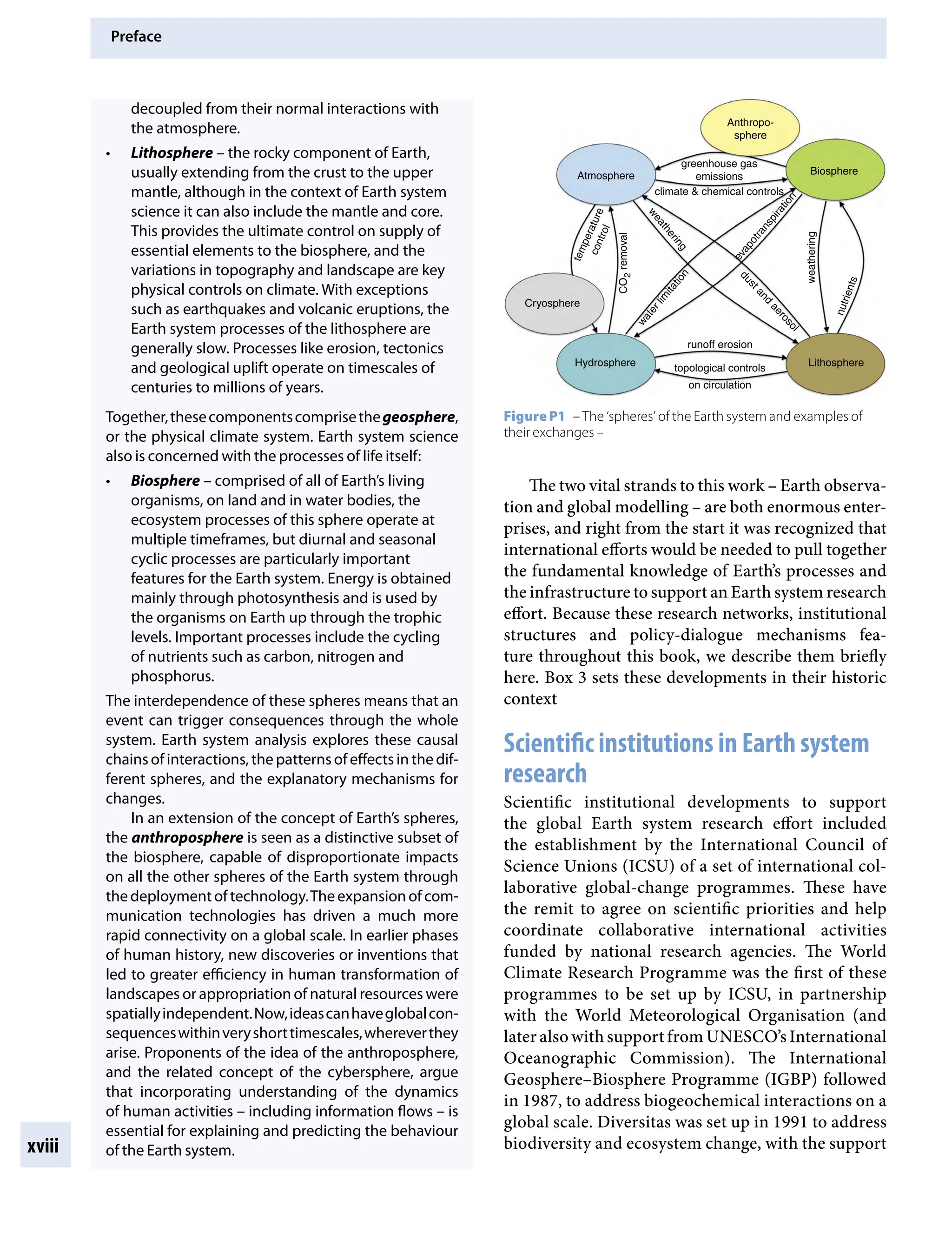
Anthropo-
sphere
greenhouse gas
emissions
e
v
a
p
o
t
r
a
n
s
p
i
r
a
t
i
o
n
runoff erosion
CO
2
removal
topological controls
on circulation
Hydrosphere
Cryosphere
Atmosphere
w
a
t
e
r
l
i
m
i
t
a
t
i
o
n
Lithosphere
climate & chemical controls
t
e
m
p
e
r
a
t
u
r
e
c
o
n
t
r
o
l
w
e
a
t
h
e
r
i
n
g
d
u
s
t
a
n
d
a
e
r
o
s
o
l
Biosphere
weathering
n
u
t
r
ie
n
t
s
Figure P1╇ – The ‘spheres’ of the Earth system and examples of
their exchanges€–
9781107009363pre_pi-xxvi.indd 18 4/2/2012 6:41:10 PM
Preface
xix
Institutions at the science–policy
interface in Earth system research
Another area where institutional change has been
required is in the interface between science and policy.
ThemostvisibleoftheseinterfacesisIPCC,2
established
in 1989 by the UN Environment Programme and the
WMO to provide the world’s governments with a con-
sensus scientific view of climate change, its economic
and social impacts, and a scientifically and techno-
logically informed assessment of possible responses.
At the time of writing, the IPCC is now working on
its fifth comprehensive assessment report. Since its
creation, it has expanded the range of climate-linked
topics it addresses through special reports and tech-
nical guidelines. Yet even this is not enough for today’s
challenges of environmental change. Recognizing the
global scale of ecosystem change, and the import-
ance for human society of biodiversity and ecosystem
health, another international body is being created
using similar scientific assessment and worldwide pol-
icy engagement mechanisms as the IPCC: the newly
approved Intergovernmental Platform on Biodiversity
and Ecosystem Services,3
which will provide synthesis
reports targeted for policy-users in the area of con-
servation and sustainable use of natural resources.
Alongside these global-scale activities, there are many
mechanisms and processes for information exchange
atthescience–policyinterfaceatboththenationallevel
(such as research centres linked to government depart-
ments, and forums linked to national academies of sci-
ence) and the international level (notably the technical
and scientific advisory bodies associated with global
environmental conventions and treaties).
Box 3 – A history of Earth system science
The foundations of Earth system science lie in physical
climate science, but the field has developed as a result
of its particular focus on the nature of the interactions
between the many components of the Earth system,
the human controls of system processes, and of course
the global scale of inquiry. As in many other fields of
study, Earth system science began with the collec-
tion of empirical or observational data, shifting from
the anecdotal towards more coordinated, systematic
inquiry, coupled with the development of explanatory
theory. These developments in the field of knowledge
of UNESCO, the International Union of Biological
Sciences and the Scientific Committee on Problems
of the Environment; and the International Human
Dimensions Programme on Global Change was
established in 1996 as a partnership of ICSU and
the International Social Sciences Council. (It is now
also sponsored by the United Nations University.)
Together, these four programmes cover the key fields
of global-change research, from the physical climate
system, through biogeochemical cycles, ecosystems
and human society. But even this level of integra-
tion of knowledge reached its limits. The challenges
of bridging all these fields of knowledge are huge.
In 2001, the four programmes collectively formed
the Earth System Science Partnership,1
to provide
another level of international coordination and
cooperation in research and societal engagement.
This structure is still evolving as society’s needs, and
the perceived opportunities for technological innov-
ation, change.
It was evident from the start of these programmes
that although there was excellent scientific under-
standing of environmental processes at a small scale,
there was a dearth of basic information at the glo-
bal scale. There was a need for long-term time-series
studies so that the dynamics of key processes could
be observed. Global budgets were needed for the
major biogeochemical cycles of water, carbon, nitro-
gen, sulphur and other elements, with a better under-
standingoftheirenvironmental(andhuman)sources
and sinks. Together with partner organizations at the
national level, the programmes coordinated studies
linking space and detailed in-situ process studies in
land and marine environments, and of the atmos-
phere. Early examples include NASA’s ‘Mission to
Planet Earth’ (Wickland, 1991); ‘Global Change
and Terrestrial Ecosystems’ (Walker and Steffen,
1996); ‘Past Global Changes’ (Alverson, 1998); and
the ‘Joint Global Ocean Flux Study’ (Fasham et al.,
2001). As each project reached completion, the new
data and models opened new vistas and raised new
questions, so the processofinternationalobservation
and collaborative networking has continued. QUEST
was actively engaged in this process from its incep-
tion. Together, all this effort has combined to give
unprecedented insight into workings of Earth as a
system.
1
www.essp.org
2
www.ipcc.ch
3
www.iucn.org/about/work/programmes/
ecosystem_management/ipbes
9781107009363pre_pi-xxvi.indd 19 4/2/2012 6:41:10 PM
Preface
xx
have taken place in the context of increasingly formal-
ized scientific cooperation, and the creation of inter-
governmental organizations to support research and
science policy dialogues. Fuller treatments of the his-
tory of climate and Earth system science are given in
Weart (2008), Liverman etal. (2002) and Cornell (2010).
~1700s The foundations were set for climate science
in its‘parent disciplines’of meteorology and
oceanography.These foundations included the
development of observational data sets from
around the world, such as surface temperature,
ocean currents and atmospheric dynamics; a
systematization of study; and the development
of theory to explain climatic phenomena such
as the tides, winds and monsoon systems.
~1800s Many fundamentals of the climate system were
determined: Earth’s greenhouse effect was
calculated by Joseph Fourier.The properties
of greenhouse gases were identified by
JohnTyndall. Svante Arrhenius noted the
anthropogenic greenhouse effect of CO2,
including projections for the extent of future
warming.
Structures were established for formalized
scientific cooperation, including major
oceanographic expeditions and the creation
of organizations to support climate research.
The International Meteorological Organization
was formed as a specialist intergovernmental
agency for scientific exchange and cooperation
between national research bodies.
Early
1900s
The‘Great Acceleration’in human activity was
enabled as oil fields were first exploited on
a large€– and rapidly expanding€– scale. G. S.
Callendar made early measurements of the
warming trend, having calculated the‘artificial
production of carbon dioxide’through fuel
combustion.The natural controls were also
being explained: Milutin Milanković explained
the role of solar orbital changes on climate.
The USA led a major post-war research
investment in climate science and Earth
observation technology.
1950s Numerical modelling emerged as a powerful
tool for global-change science, with the
quantification of feedbacks, global atmospheric
modelling (including the GCMs) and the
explanation of the links between atmospheric
structure, chemical composition and radiative
forcing.
The first observations of Earth were made
from space.
1960s Charles Keeling’s high-precision measurements
in Hawai’i showed that the atmospheric CO2
concentration was increasing with time with a
pronounced seasonal signal.
Key concepts relating to climate as a system
were explained and accepted, including
positive and negative feedbacks, the role of
ice and albedo changes, and the evidence
of orbital changes in palaeorecords. Syukuro
Manabe and RichardWetherald made the first
model calculations of climate sensitivity to a
doubling of CO2.
The international Global Atmospheric
Research Program was established, linking
governmental (UN) and scientific institutions
in ways that set the pattern for subsequent
international collaboration and science–policy
interactions.
1970s Key Earth system insights were obtained
into episodes of comparatively rapid climate
changes in the past, including feedback
processes; the biosphere’s effects on climate;
and the role of atmospheric aerosols and dust.
Space exploration gave information about the
‘system behaviour’(and past climates) of other
planets.The first weather satellite (NASA GOES,
launched in 1975) provided data that could be
used for model validation.
The recognition that human-induced
changes, including aerosol production and
deforestation, have climate consequences
fed into growing societal concern about the
environment. A coherent environmental
movement emerged and strengthened.
1980s Essentially, this was a decade of consolidation of
evidence addressing debates that had begun
earlier: Greenland ice cores showed that very
rapid (century-scale) climatic changes were
possible; theVostok ice core showed the very
strong coupling of CO2 and temperature over
several glacial cycles; the strong warming trend
over the previous decade was observed, and
the cooling effect of anthropogenic aerosol that
partiallydisguisedthewarmingwasdetermined.
This was also a period of scientist
mobilization, with the creation of the IPCC for
the science–policy interface; and the evolution
of Global Atmospheric Research Programme
(GARP) into the global-change programmes
IGBP andWCRP, supporting strategic research
cooperation.The Bretherton Diagram mapped
out an international collaborative scientific
agenda for Earth system science.
9781107009363pre_pi-xxvi.indd 20 4/2/2012 6:41:11 PM
Preface
xxi
understanding of physical, chemical and biological
processes, which we have summarized in Chapter
2. It also requires many key gaps in climate models
to be filled. We address those gaps and progress in
Earth system modelling in Chapter 5.
• Finding independent ways to verify or constrain
this dynamic process understanding. Chapters
3 and 4 describe how we use the palaeorecord
(fossils and other measures from the past)
together with contemporary science, and combine
Earth observation from space with ground-level
observations. Very often, the picture has to be
pieced together from many strands of evidence,
so we give particular attention to data synthesis
and comparisons of models and data involving
multiple data sources.
• Bringing computer modellers, ‘ground-up’ field
and laboratory experimentalists and ‘top-down’
Earth observational researchers together. This
has proved to be a surprizingly big challenge.
As science has become ever more specialized,
bigger differences have developed between
different knowledge communities, who may have
very different ideas of what counts as scientific
evidence, what are the best ways to present
research findings, how best to share and store
data, and so on (described humorously in Randall
and Wielicki, 1997). Moss and Schneider (2000)
suggested that increasing confidence in a scientific
finding requires coherence in the quality and
amount of theoretical underpinning, observations,
model results and expert consensus. Achieving
‘joined-up’ Earth system science requires careful
meshing of very different gears across different
physical scales. This integrative effort is a key
theme throughout the remainder of this book, but
is addressed particularly in Chapter 5.
In turn, these new insights demand new dialogues that
are currently developing worldwide (these are summa-
rized briefly here; research in these areas is addressed
in more detail in Chapter 1):
• Improved academic interaction between the
natural and social sciences. Many ‘environmental
issues’ of the last few decades are now seen as
socio-environmental issues, such as air and water
pollution, the over-exploitation of land and
natural resources, and even wildlife and natural-
habitat conservation. The cross-disciplinary
challenges of delivering integrated knowledge in
1990s The UN Framework Convention on
Climate Change was agreed.The first IPCC
Assessment Reports were published, refining
research questions and driving progressive
improvements in global-change models and
process-based research.
Two new international, non-governmental
global-change programmes were formed:
Diversitas provided an umbrella programme
for biodiversity research, and the IHDP
addressed social science research on global
environmental change.The Human Interaction
Working Group’s Social Process Diagram
identified key research areas for the social
sciences concerned with global environmental
change.
2000s A strong scientific consensus now exists on the
anthropogenic control on climate.
Stronger warming has been observed,
increasing fairly steadily since the 1970s.
The effects on ice sheets are a growing
concern, because of sea-level rise and poorly
understood physical feedbacks. Understanding
biophysical and biogeochemical feedbacks
is a research priority, because they shape the
timeframes and scope for society’s adaptive
responses to climate change. A key focus
remains in bridging and integrating the
knowledge of the natural and social sciences in
the Earth system context.
The aims of Earth system science
Earth’s climate history has been subject to enormous
changes, and our growing understanding of these
changes indicates that the interactive Earth system is
astonishingly complex and an exceeding rich subject
for research. By gaining a better understanding of the
processes and control mechanisms that make up the
climate system, the aim of today’s research effort is to
provide society with knowledge about how the system
might respond to future perturbations.
Developing this kind of predictive
power means:
• Bringing together the best available
understanding of Earth’s living and non-
living components, or€– using the ‘spheres’
terminology, linking the biosphere (including the
anthroposphere) with the geosphere, atmosphere
and hydrosphere. This requires much improved
9781107009363pre_pi-xxvi.indd 21 4/2/2012 6:41:11 PM
Preface
xxii
sciences. In R. Bhaskar, C. Frank, K. G. Høyer, P. Næss
and J. Parker, eds. Interdisciplinarity and Climate
Change: Transforming Knowledge and Practice. London:
Routledge, pp.€116–134.
Earth System Sciences Committee (The Bretherton
Report) (1988). Earth System Sciences: A Closer View.
Washington, DC: NASA.
Fasham, M. J., Balino B. M. and Bowles M. C., eds. (2001). A
new vision of ocean biogeochemistry after a decade of
the Joint Global Ocean Flux Study (JGOFS). AMBIO,
Special Report 10.
Lawton, J. (2001). Earth System Science. Science, 292(5524),
1965.
Liverman, D., Yarnal, B. and Turner II, B. L. (2002). Origins
and institutional setting of Human Dimensions of
Global Change research. In Geography in America at
the Dawn of the 21st Century: The Human Dimensions
of Global Change, eds. G. L. Gaile and C. J. Willmott.
Oxford: Oxford University Press, pp.€267–282.
Lovelock, J. E. (1979). Gaia: A New Look at Life on Earth.
Oxford: Oxford University Press.
Moss, R. H. and Schneider, S. H. (2000). Uncertainties in
the IPCC TAR: Recommendations to Lead Authors
for more consistent assessment and reporting.
In Guidance Papers on the Cross-Cutting Issues of
the Third Assessment Report of the IPCC, eds. R.
Pachauri, T. Taniguchi and K. Tanaka. Geneva: World
Meteorological Organization, pp.€33–51.
NERC (2002). Editorial: John Lawton. Planet Earth,
Autumn edition. UK Natural Environment Research
Council, Swindon, UK. Available at: www.nerc.ac.uk/
research/programmes/quest/resources/editorial.asp.
Randall, D. A. and Wielicki, B. A. (1997). Measurements,
models, and hypotheses in the atmospheric sciences.
Bulletin of the American Meteorological Society, 78,
399–406.
Walker, B. H. and Steffen, W.L., eds. (1996). Global Change
and Terrestrial Ecosystems. IGBP Book Series No. 2,
Cambridge: Cambridge University Press.
Wickland, D. E. (1991). Mission to Planet Earth: the
ecological perspective. Ecology, 72(6), 1923–1933.
Weart, S. (2008). The Discovery of Global warming, 2nd edn.
Boston, MA: Harvard University Press.
this area are evidently even greater than linking
across the difference knowledge communities in
the biogeochemical and physical sciences, but the
need to do so is no less pressing. Chapters 6 and 7
show how Earth system science offers important
tools for assessing and mitigating the impacts of
changing climate on ecosystems and the human
societal systems that depend on them.
• Deeper, more responsive interaction between
science and policy communities. The whole
history of Earth system science as a field of study
has taken place in a context of awareness of the
societal importance of its research findings and
engagement with policy in the co-development
of research priorities. In common with previous
global environmental challenges, the trans-
boundary and multicultural issues in Earth system
science require societal engagement and response
mechanisms that operate across the science–
policy interface. However, as our knowledge
develops more explanatory and predictive power,
the nature of this interface changes, with different
policy areas becoming engaged, and at different
levels of governance. In other words, the deeper
the scientific understanding, the more complex
the policy terrain for engagement. And the
dialogue is emphatically not a one-way provision
of science for decision-makers. Many argue for
more ‘democratization of science’, both in terms of
scientists engaging directly in informing society’s
responses to environmental change challenges,
and in terms of opening up more transparent
deliberative processes about the science that
is used in the policy process. Our final chapter
sets the scientific issues described in the earlier
chapters back in its social context.
The Editors on behalf of the Author Team
References
Alverson, K. (1998). PAGES: Past Global Changes. JOIDES
Journal, 24(2), 34–35.
Cornell, S. (2010). Climate change: brokering
interdisciplinarity across the physical and social
9781107009363pre_pi-xxvi.indd 22 4/2/2012 6:41:11 PM
xxiii
Acknowledgements
Cycle Modelling, Analysis and Prediction. Figure 2.1
was provided by Andrew Manning. Figure 2.7(a) was
supplied by Rick Lumpkin. Josh Fisher processed the
data for Figure 2.12. Pru Foster developed the codes to
produce Figures 2.12, 2.16 and 2.17. Wang Han proc-
essed the data for Figure 2.13.
Chapter 3 includes research carried out under
QUEST’s Theme 3 (How are climate and atmos-
pheric composition regulated on timescales up to a
million years?), particularly the project Dynamics
of the Ice Core Record (DESIRE), the Working
Groups on Abrupt Climate Change and Fire and the
PinatuboInterdisciplinaryMulti-ModelStudy,andthe
Palaeoclimate Model Intercomparison Project, which
received support from QUEST.
Chapter 4 draws on research and discussions sup-
ported by several activities in QUEST’s Theme 1 (How
important are biotic feedbacks for 21st century climate
change?), notably the QUEST Earth System Model
and Climate-Carbon Modelling, Assimilation and
Predictionprojects,andthejointQUEST/Environment
Agency project on carbon in peatlands and uplands.
In Chapter 5, Figure 5.3 was provided by Chris
Jones. The chapter draws on scientific discussions
that informed QUEST’s development of its Earth sys-
tem model, QESM, and the research projects Marine
Biogeochemistry and Ecosystem Initiative in QUEST;
Carbon Cycle Modelling, Analysis and Prediction;
and the Working Group on Earth System Model
Benchmarking.
Chapter 6 includes research findings from the
QUEST project Global Scale Impacts of Climate
Change, and collaborative activities with the UK
Government funded project AVOID.
Chapter 7 includes research carried out under
the QUEST projects QUATERMASS (QUAntifying
the potential of TERrestrial bioMASS to mitigate cli-
mate change) and the Joint Implementation Initiative
for Forestry-based Climate Mitigation (JIFor). We
are very grateful for the enjoyable, challenging and
We gratefully acknowledge the financial support of the
UK Natural Environment Research Council (NERC),
which has funded the QUEST programme from 2003–
2011, and has generously supported the development
of this book.
We are grateful to the extensive community of
QUEST scientists, external advisors and policy col-
leagues whose contributions to the strategic develop-
ment and the delivery of the programme’s ambitious
and innovative research have provided the vital scien-
tific underpinning to this book.
Many individuals also made important contribu-
tions: Julie Shackleford helped QUEST run smoothly
from its outset. Pru Foster and Wolfgang Knorr, our
colleagues in QUEST’s core science team, contributed
scientific insights, model code and output, and good
company.Matt Fortnam and Jenneth Parker provided
research synthesis and editorial support at various
stages in the development of the book. Alistair Seddon,
Steve Murray and Helen Thomas combined scientific
knowledge, technical expertise and an artistic eye in
producing many of the graphics and images in this
book. We are also grateful to the many people and
organizations who gave consent for their images to
be reproduced or data to be used in order to generate
images published here.
The issues explored in Chapter 1 were informed
by science carried out in QUEST’s Research Theme
3 (How much climate change is dangerous?), discus-
sions under the aegis of the QUEST Working Group
on Humans and the Earth System, and by debates led
by Diana Liverman at the post-graduate Earth System
Science Summer School (ES4). Reina Mashimo con-
tributed input to the discussions made in Chapters 1, 5
and 6 of uncertainty in socio-environmental systems.
Chapter2benefitedfromdiscussionswithmanycli-
matescientists,especiallythoseinvolvedintheQUEST
WorkingGroupontheHydrologicalCycle(Dartington
Hall, May 2007) including Mike Raupach, Julia Slingo
and Graeme Stephens, and the QUEST project Carbon
9781107009363pre_pi-xxvi.indd 23 4/2/2012 6:41:11 PM
Acknowledgements
xxiv
we collectively face the challenges of global change. We
have already thanked NERC for their vision and sup-
port in this regard. We are also enormously grateful to
the wider research community, and the collaborative
international global-change projects IGBP, WCRP,
IHDP and Diversitas for their support of these fields
of inquiry and for continually pressing for new know-
ledge about the Earth system of which we are part.
constructive discussions with Robert Matthews from
Forest Research, who was involved in both these
projects. The chapter also includes work carried out as
part of the UK Government funded project AVOID.
The inspiration for Chapter 8 came from our own
internal discussions about what we do and what it is
for€– but of course it resonates with contemporary con-
cerns that are being addressed much more widely as
9781107009363pre_pi-xxvi.indd 24 4/2/2012 6:41:11 PM
xxv
Units
Many of these units require prefixes in order to
avoid presenting very big numbers, which are taxing
on the eye when reading! The prefixes we use are:
Name Factor Symbol
kilo 1000, or 103
k
mega 106
M
giga 109
G
tera 1012
T
peta
exa
1015
1018
P
E
One petagram (Pg) is equivalent to a gigatonne, an
alternative unit often used in global-change science
because of the magnitudes of processes like the carbon
cycle. A tonne is 1000 kg.
We also refer to atmospheric concentrations in
terms of mixing ratios, as parts per million (ppm), and
parts per billion (ppb, that is 10–9
).
We have followed international scientifically agreed
standards for the units in this book, most of which are
definedbytheInternationalSystemofUnits(SI).Many
of the basic units are very familiar:
mass gram g
length metre m
temperature kelvin K
quantity of substance mole mol
time second s
hour h
year a
We also use scientific notation and exponents for
quantities, so for example:
cubic metres per second is denoted as m
• 3
s–1
watts per square metre is denoted as W m
• –2
per year is denoted as a
• –1
9781107009363pre_pi-xxvi.indd 25 4/2/2012 6:41:11 PM
9781107009363pre_pi-xxvi.indd 26 4/2/2012 6:41:11 PM
Chapter
1
1 Earthsystemscienceandsociety:afocus
ontheanthroposphere
Sarah E. Cornell, Catherine J. Downy, Evan D.€G. Fraser and Emily Boyd
1.1╇ The Earth system and the
‘problematic human’1
1.1.1╇ The state of play and our position
The great scientific challenge faced by today’s global
change scientists is to understand the Earth system.
Part of this is knowing that we ourselves, as human
beings, are an influential component of that sys-
tem and that the understanding we develop shapes
our responses to the environmental changes we see
around us. In scientific terms, most of the fundamen-
tal workings of our planet, including the processes
that change climate and landscapes on short and long
timescales, were already well understood by the end
of the twentieth century. Earth system science is the
field of study that has brought these areas of know-
ledge together. It has not just provided insight into
the phenomena of global environmental change, but
also explained the ‘hows’ and ‘whys’ behind them,
bringing insights into the future prospects for our
planet. The enormity of the challenge lies in the real-
ization that we are seeking to understand and predict
the properties of a complex adaptive system of which
we are a part, recognizing that our choices and our
agency as human beings are important controls on its
workings. More than that, our ability to deploy our
knowledge and make choices about our actions is an
important facet, perhaps even a characterizing trait,
of our existence.
Forscientistsinallthecontributingfieldsofinquiry,
this development marks a shift from the pursuit of
knowledge largely for its own sake to robust predictive
knowledge that is required€– urgently, many argue€–
for application in the real world. The prediction of any
system where humans play a part has long challenged
both scientists and philosophers. Without venturing
into those debates here, the prediction of socio-envi-
ronmentalsystemsneverthelesspresentsuswithavery
practicalconundrum:ourcurrentunderstanding,even
theknowledgecodifiedinthemostsophisticatedmod-
els, is a partial and simplified picture of reality. Our
predictionsbasedonthisunderstandingmaybewrong
and the unintended consequences of action based on
those predictions may be severe. However, not to use
the available understanding would be to take a per-
verse and unhelpful position.
Inthischapter,weoftentakethehistoricview,look-
ing at past scientific efforts in global change research,
particularly those efforts framed in terms of global sys-
tems. Quantitative models of human dynamics, such
as Thomas Malthus’ eighteenth-century calculations
of Earth’s carrying capacity for human population, and
the Club of Rome’s efforts in the 1970s to measure the
limits to socio-economic growth, have generally done
a poor job. Nevertheless, it is important to learn from
these efforts. One reason they failed is that they did not
1
With thanks to Lesley Head, University of Wollongong,
for this expression. See Head, L. (2007) Cultural ecology:
the problematic human and the terms of engagement,
Progress in Human Geography, 31, 837.
Inthischapter,weexplorethechallengesthatEarthsystemresearchersfaceinaddressinghuman-inducedglobal
environmentalchangesandthesocietalconsequencesofglobalchangewithintheirresearchtoolkit.Wefocuson
areas of research that have particular resonance with today’s social and political demands.
Understanding the Earth System: Global Change Science for Application, eds. Sarah Cornell, I. Colin Prentice,
Joanna House and Catherine Downy. Published by Cambridge University Press © Cambridge University Press 2012.
9781107009363c01_p1-38.indd 1 4/2/2012 6:41:54 PM
Chapter 1: Earth system science and society: a focus on the anthroposphere
2
involve new structures and dialogues between scien-
tists and other members of society, for participation in
collective decision-making about the future.
1.1.2╇ The human dimensions of
global environmental change: controls,
consequences and context
TherapidlyexpandingscienceofEarth’sclimate,biogeo-
chemical processes, and their interconnections is com-
plex, yet it needs to be understood much more widely
if society is to respond to current environmental pres-
sures and projected future changes in an informed way.
Althoughourmainfocusinthisbookisonsummarizing
andexplainingthebiophysicalscienceofglobalchange,a
deepunderstandingoftheEarthsystemwillalsoinclude
insights from the study of human behaviour.
First of all, human activities, more than ever before,
are important controls on Earth’s biophysical processes.
The trajectory of human population, especially
since the Industrial Revolution, has been one of steady
and rapid growth. In the early nineteenth century, the
political economist Thomas Malthus famously argued
thatunconstrainedpopulationgrowthwouldnaturally
follow a ‘geometric ratio’, or exponential growth, while
the supply of life-sustaining resources would not. The
result would be an overshoot of the human population
and a catastrophic check (famine, disease, conflict)
on human numbers. Although Malthus was plausibly
describingthetrendsheobserved,bysimplyextending
them into the future, his predictions were very wrong.
Earth’s population has shown some periods of expo-
nentialgrowth€–forinstance,doublingfrom1.5billion
to 3 billion inhabitants between about 1880 and 1960
(80years),andthenagainto6billionbetween1960and
2000(40years).ButitisunlikelythattheEarth’shuman
population will double again, so both the unfolding of
history and a more sophisticated understanding of the
dynamics of population have now removed the spectre
of catastrophic overpopulation (Cohen 1998). In 2011,
worldpopulationreached7billioninhabitants(United
Nations, 2011), and current estimates suggest that our
numbers will peak at approximately 9 billion some-
time over the next century (Lutz et€al., 2008; United
Nations,2011).Malthuswaswrongbecausehefailedto
predict the ‘demographic transition’, a widely observed
phenomenon where birth and death rates both fall
as economic development progresses (e.g. Chesnais,
1992), halting the exponential pattern of growth. Rates
adequatelytakeintoaccounthumanagency.Inshort,we
have continually underestimated the role of the social
and economic context when we have tried to model the
impact of global change. Even where features of socio-
economic change evident at the global level allow
for a measure of scientific generalization to be made,
they are often not included nor examined in models.
For example, below we mention the widely observed
demographic transition in human population growth:
this is just as good and precise a ‘law of nature’ as most
in biology. At the opposite end of the spectrum, there
are models of the Earth system that omit human activ-
ity altogether. Contemporary physical climate mod-
els work as effectively (which is to say, very effectively
indeed in describing climate dynamics) for all planets
with an atmosphere, ocean and land surface. They
reach the limits of their predictive power when they
need to bring people into the equation. One challenge
we face is that the climate modelling enterprise has
defined contemporary climate change in strictly phys-
ical terms, i.e. as a physical change driven by increas-
ing amounts of greenhouse gases in the atmosphere.
However, from a socio-environmental perspective,
there are many ways of looking at and defining climate
change. There is a risk that using one dominant way of
looking at the problem can drive the policy agenda to
the exclusion of other important approaches for find-
ing practically useful solutions. Predictive power alone
is not synonymous with usefulness.
What do we require from Earth system science,
defined broadly as the science of both the climate
system and the human dimension (or the ‘anthropo-
sphere’)? Ideally, we would like to develop a science
that addresses both the human and the natural-envi-
ronmental components of the system, and that can tell
us something about how this complex, coupled socio-
ecologicalsystemworks(Younget€al.,2006).Modelling
is an essential part of this process. uch of the remain-
der of this book tries to describe the present state of
the models (conceptual and numerical) that underpin
both the science and the political decision-making
process relating to global environmental change. Earth
system science should also be informed by an effect-
ive understanding of how society steers itself, so that
thescientificprocesscanbebothmoretransparentand
more responsive to the needs of society. In the context
of the unprecedented magnitude and rate of global
environmental changes, many people consider that
major social changes are needed to cope with, man-
age or avert the worst impacts. These changes should
9781107009363c01_p1-38.indd 2 4/2/2012 6:41:54 PM
Sarah E. Cornell et€al.
3
equation was simply multiplicative (I = P × A × T). This
is a useful heuristic for linking impact and socio-eco-
nomic development, and many nations in the world
have shown increasing impacts as they developed in
the past, but it is not a predictive law. Empirical stud-
ies show strongly non-linear relationships between
the terms (Dietz and Rosa, 1997, Dietz et€al., 2007).
Recent studies (e.g. Pitcher 2009, Davis and Caldeira
2010)highlightthefactthatconsumptionlevels(theA
and T dimensions) are the‘thermostats’on impact, not
population itself, warning against the errors of simple
Malthusianism and using the formulation in ‘green-
revolution’arguments for technological innovation to
reduce impact.
A close relative of the IPAT equation, the Kaya
Identity (Kaya and Yokobori, 1993) has been devel-
oped in the context of energy and greenhouse-gas
emissions.IthasbeenappliedinIPCCemissionstudies
and scenario development (IPCC, 2001).
CO2 emissions = Population × 
Consumption
intensity
(goods consumed
per capita)
× Energy intensity × Carbon intensity
(energy input â•…â•… (CO2 output per
per unit goods) unit energy)
These formulations show that multi-pronged res�
ponses to environmental impact can€– and should€–
beexplored.Thus,forclimatechange,responsescould
includesocietallearningandchange,economicincen-
tives and instruments, improved efficiency, energy
substitution, CO2 sequestration.
The impact of the human endeavour is now manifest
at the global scale (Figure 1.2). Only the most hostile
environments€–deserts,ice-coveredlandsandseas,and
someofthedensestareasofforestremotefrompopula-
tion centres€– can still be regarded as near-pristine. The
rates of human-induced changes to land, marine and
atmospheric environments and the fact that they have
become discernible at the global scale, have prompted
a proposal for the adoption of the term ‘Anthropocene’
asageologicalperiod.Thisisnotmerelyalight-hearted
neologism to describe contemporary environmental
change: stratigraphers are engaging in international
discussions about the merit and feasibility of defining
a period of human perturbation of the global environ-
ment, and designating the Anthropocene as a formal
unit of geological time (Zalasiewicz et€al. 2010).
The second important reason that Earth system
science needs to give attention to knowledge from
of growth of global population have declined in the
last two or three decades (US Census Bureau, 2011).
MalthusalsofailedtopredicttheHaber–Boschprocess
for nitrogenous fertilizer production and the hybrid-
ization of seeds (along with other technological inno-
vations and transformations in agricultural systems),
which have made it possible for the world to produce
enoughfoodfortoday’spopulation.Today,theproblem
of hunger is primarily one of economics and politics
affecting food supplies, not one of Earth’s capacity for
food production. So, while some argue that the world
will need to produce considerably more food by mid-
century (Bruinsma, 2009), others point out that using
the food we currently have more efficiently should be
enough to continue feeding the world (Smil, 2001).
Steffenet€al.(2004)reviewedtheimpactsonEarthof
this rapid population growth, finding similar rapid rises
innaturalresourceuse(Figure1.1),bringingunintended
consequences for ecosystems such as rising levels of air
and water pollution and environmental degradation.
However, the impact of human activity on the natural
environmentisfarfrombeingasimplelinearfunctionof
population. The widely quoted ‘IPAT equation’ (Ehrlich
andHoldren,1971;Commoner,1972;Box1)framesthe
environmental impact of human activities as a function
of technological change and economic growth as well as
population: impact = f(population × affluence × tech-
nology). It highlights the fact that society’s increasing
technological capability (the T in the equation) means
people can access more of Earth’s natural resources and
transform them for their use more effectively, and also
that increased affluence (A) enables individuals in the
population to use and consume more resources. The
analysis conducted by Steffen et€al. (2004) shows how
affluence and technology are often much more influen-
tial on impact than population numbers.
Box 1.1╇ The IPAT equation
A simple formulation that has widely been used in
Earth system science describes the impact of human
activity on the natural environment as a function of
population, affluence and technology. The interactions
of these three terms have been explored empirically
in a range of socio-environmental contexts, includ-
ing resource consumption, food security and energy-
�
systems analysis.
Impact = fâ•›(Population, Affluence, Technology)
The relationship between impact and the PAT
terms is not simple (Chertow 2001). The original
9781107009363c01_p1-38.indd 3 4/2/2012 6:41:54 PM
Chapter 1: Earth system science and society: a focus on the anthroposphere
4
the social sciences is that humans experience the con-
sequences of global environmental change.
The fact that the natural environment presents
hazards to people is nothing new Newspapers are
full of reports of humanitarian disasters caused by
droughts, floods, storms and other geological and
climatic events. Similarly, it is widely recognized that
human society has the capability to create serious
environmental risks for itself. Communities, societies
and, arguably, entire empires, have done so in the past
with catastrophic consequences (Ponting, 2007). In
this context, Earth system science provides powerful
concepts and tools that can be used in assessing and
predicting the risks to people and society of climate
change and other global environmental changes, and
in informing responses to these potential changes.
Understanding human vulnerability in the context of
these changes is as essential as understanding their
biophysical dynamics.
Bringing a systems perspective to bear on these
issues also allows the interplay of causes and con-
sequences to be addressed. An iconic example of
human-causedenvironmentaldisaster,oftenusedasa
warning metaphor for society’s current unsustainable
(a) (b)
(c) (d)
Figure 1.1╇ Some global socio-environmental trends since industrialization.
(a)╇ World human population (US Bureau of the Census International Database, www.census.gov/ipc/www/worldpop.html; solid line) and the
aggregate world gross domestic product indexed against 1960 world GDP (dashed line; data up to 2005 from the Earth Policy Institute,
www.earth-policy.org/indicators/C53; updated to 2010 with data from the International Monetary Fund World Economic Outlook, www.
imf.org/external/pubs/ft/weo).
(b) Global land use as cropland (Ramankutty and Foley, 1999; fraction of total land area multiplied by 10 for convenient scaling).
(c) Number of dams larger than 15 m on the world’s rivers (data from World Commission on Dams (2000), including estimates for 2000 shown
in the annex of that report).
(d) Percentage of global fisheries that are fully exploited, overfished or depleted (data from 1974 to present from FAO (2010); earlier data from
FAOSTAT (2002) statistical databases, cited in Steffen et€al., 2004).
9781107009363c01_p1-38.indd 4 4/2/2012 6:41:56 PM
Sarah E. Cornell et€al.
5
The third reason for explicitly addressing human
society and its activities within the field of Earth
system science is that society is the context in which
Earth system research actually happens, and where
the knowledge produced is directed towards prac-
tical action. The knowledge that scientists produce
will go into the public and policy domains, where
it faces many possible fates: this knowledge can be
debated, reconfigured and developed in the context
of other fields of knowledge, and naturally it can be
used in decision-making processes. Earth system sci-
ence is now deeply embedded in the processes and
institutions that inform society’s planning for climate
adaptation and mitigation, and for many other pol-
icy responses to global environmental change. This
situation represents a marked change in the way that
science is done and, in our view, it brings new respon-
sibilities and challenges along with new academic
insights into our Earth.
situation, is the total deforestation of Easter Island
in the eighteenth and nineteenth centuries, and the
linked socio-political turbulence. It is also an example
of the need to take a deeper and more critical look
at the human dimensions of change: the balance of
social science research (summarized in Rainbird,
2002) indicates that, apart from tree-felling, other, yet
very familiar, human factors played a major role in
the degeneration of Easter Island’s society and envir-
onment. Population collapsed, and social structures
with them, following contact with European explor-
ers who introduced new diseases and destructive ani-
mals, and raided repeatedly for slaves. In Section 1.3
below, we summarize areas of social science research
that are actively exploring global environmental
change issues. These fields of research enable a fuller
perspective to be taken, necessary to prevent over-
simplification or the proliferation of modern myths
of environmental threats.
Very low impact (1.4)
low impact (1.4–4.95)
Medium impact (4.95–8.47)
Medium high impact (8.47–12)
High impact (12–15.52)
Very high impact (15.52)
(a)
Impact Boreal/high altitude forests
Deciduous forests
Grasslands/savanna
Croplands
Water
Tundra/salt desert
Semi-deserts and deserts
Wetlands
Tropical forests
(b)
Figure 1.2╇ The scale of
global anthropogenic impact
(a) Human perturbation of
marine ecosystems This
map was constructed
by overlaying 17 global
data sets of drivers of
ecosystem change,
such as fishing activity,
shipping, and riverine
and long-range
pollution. Reproduced
with permission from
Halpern et€al., 2008.
(b) Human impact on the
land environment,
modelled using
GLOBIO-2 (image
by Hugo Ahlenius,
UNEP/GRID-Arendal,
2002; reproduced
with permission). The
GLOBIO model (www.
globio.info) makes
spatial assessments
of the consequences
for land biodiversity
of human drivers like
land use, pollution and
infrastructure.
9781107009363c01_p1-38.indd 5 4/2/2012 6:41:59 PM
Chapter 1: Earth system science and society: a focus on the anthroposphere
6
Sciences Council, to foster social-science research on
global environmental change and to support collab-
orative research efforts across the social and natural
sciences. In 2001, the four international global change
research programmes jointly issued the Amsterdam
Declaration on Global Change, which included a
description of how this more integrative research
should develop:
The scientific communities of [the] international global
change research programmes … recognise that, in add-
ition to the threat of significant climate change, there is
growing concern over the ever-increasing human modi-
fication of other aspects of the global environment and
the consequent implications for human wellbeing. A new
system of global environmental science is required. This
is beginning to evolve from complementary approaches
of the international global change research programmes
and needs strengthening and further development. It will
draw strongly on the existing and expanding disciplinary
base of global change science; integrate across disciplines,
environment and development issues and the natural and
social sciences; collaborate across national boundaries on
the basis of shared and secure infrastructure; intensify
efforts to enable the full involvement of developing coun-
try scientists; and employ the complementary strengths
of nations and regions to build an efficient international
system of global environmental science’.2
Box 1.2╇ The current research and policy focus on
‘understanding the Anthropocene’
Many organizations involved in the research process
are currently orienting themselves towards better
transdisciplinary integrated knowledge of global
change, recognizing the importance of delivering this
knowledge in a timely way to decision-makers in soci-
ety in order to meet the growing sustainability chal-
lenge. This emphasis on better interaction between
naturalandhumansciences,andontheurgencyofthe
knowledge need, is evident at all levels€– international
and intergovernmental, regional and national:
The United Nations Education, Scientific and
•
Cultural Organisation (UNESCO) launched its
Climate Change Initiative in 2009. It supports
interdisciplinary integration of knowledge about
climate, promoting the use of its biosphere
reserves and World Heritage sites for research
and implementation of climate risk management
policies. A core programme focuses on ensuring
that environmental ethics, social and human
1.2╇ Conceptualizing the‘human
dimension’from an Earth system
perspective
Given the importance of people in causing and being
affected by global environmental change, the research
community interested in these issues faces a serious
challenge: how to conceptualize and embed human
agency and socio-economic context in our under-
standing of the Earth system.
This challenge is highlighted by a debate that has
been simmering between scholars for at least 350
years. To a very large extent, a primary activity in post-
Enlightenmentsciencehasbeenanalysis€–thebreaking
up of the complex world into comprehensible pieces
for in-depth investigation. Established by the likes of
René Descartes, whose famous maxim Cogito ergo sum
reflected an attempt to explain the human experience
rationally, by reducing it to fundamental truths, ana-
lysis through reductionism has been the basis for many
(if not most) of our scientific discoveries in the mod-
ern era. This point is highlighted by futurist and social
commentator Alvin Toffler (1984) who wrote,
One of the most highly developed skills in contemporary
Western civilization is dissection: the split-up of prob-
lems into their smallest possible components. We are
good at it. So good, we often forget to put the pieces back
together again.
Without denying the immense value of reductionist
research in both the biophysical and human domains,
Toffler, and many others since, have argued that to
address the global challenges that face us today, the
balance needs to shift back towards synthesis: bring-
ing our collective perspective back up to the better-
rendered ‘big picture’ of our world. This world is a
complex world, and it is inescapable that improving
understanding requires the integration of multiple
perspectives. If Earth system science is to be a part of
this integration process, it requires a much fuller rec-
ognitionoftheinterconnectivityofitssocialandenvir-
onmental components.
There have been many calls for more such inte-
grated knowledge from environmental research
funders, government bodies and the research com-
munity itself (Box€1.2), in response to the challenges
posed by global social and environmental changes.
The International Human Dimensions Programme
on Global Environmental Change came into existence
in the mid 1990s, sponsored by both the International
Council of Science Unions and the International Social
2
Text in full available on the Earth System Science
Partnership website, www.essp.org/index.php?id=41
9781107009363c01_p1-38.indd 6 4/2/2012 6:41:59 PM
Sarah E. Cornell et€al.
7
Recognizing the strategic and practical challenges
•
of integrated research on global change, the four
global change programmes (IHDP, IGBP, WCRP
and Diversitas) set up the Earth System Science
Partnership to provide enabling mechanisms
for the science community. It has supported
joint projects on cross-cutting issues such as
water, carbon, food and human health, as well as
regional studies.
In Europe, the European Commission’s Research
•
Advisory Board (EURAB) in 2004 spelled out
some necessary improvements to enable
Europe’s research systems to better meet the
transdisciplinary challenges presented by
complex environmental systems (European
Research Advisory Board, 2004). Its successor,
the European Research Area Board envisions a
‘New Renaissance’, where new ways of thinking
will emerge from better linkages between
the natural and human sciences. See: http://
ec.europa.eu/research/erab/pdf/erab-first-annual-
report-06102009_en.pdf.
The European Science Foundation (ESF) reported
•
on its first Forward Look activity on Earth system
science in 2003. That study focused primarily
on biophysical changes, informing subsequent
research, modelling and observation programmes
(including the UK’s QUEST programme). In 2009,
the ESF launched a second Earth system science
Forward Look, this time explicitly concerned
with global change and the Anthropocene. This
activity, Responses to Environmental and Societal
Challenges for our Unstable Earth, also grappled
less with the science base itself than with the
need for new integrative structures and processes
in research that are capable of addressing the
socio-environmental issues of greatest concern.
See: www.esf.org/index.php?id=6198.
Many, many national projects and programmes
•
have been developed recently to address the
interlinked human and biophysical dimensions
of global change. One example in the UK is Living
with Environmental Change (www.lwec.org.
uk), which is a multi-partner initiative involving
research councils, government departments
and agencies and businesses. Nordic Strategic
Adaptation Research (www.nord-star.info) links
interdisciplinary researchers across the Nordic
nations with decision-makers in policy and
business, and provides a model (and resources)
for similar networks elsewhere in the world.
td-Net (www.transdisciplinarity.ch) is a network
for transdisciplinary research, which shares
sciences are entrained in responding to climate.
Also, UNESCO has designated 2005–2014
as the Decade for Education for Sustainable
Development, in which climate change,
biodiversity and sustainable lifestyles are key
themes. See: www.unesco.org/new/en/natural-
sciences/special-themes/global-climate-change
and www.unesco.org/new/en/education/themes/
leading-the-international-agenda/education-for-
sustainable-development/about-us/.
The International Council of Science Unions (ICSU)
•
and the International Social Sciences Council
(ISSC) identified a set of‘Grand Challenges’in Earth
system science for global sustainability (Reid et€al.,
2010). They acknowledge the huge advances made
in understanding the functioning of the Earth
system, but issue a call to action to researchers
from the full range of sciences and humanities. The
ICSU and the ISSC are also alert to the difficulties of
this new mode of working, in terms of institutional
structures, research methods and the incentives for
participation in this evolving area. See: www.icsu-
visioning.org/grand-challenges/
The Belmont Forum is made up of representatives
•
of funders of global change research from many
countries around the world, many of which have
supported socio-environmental research since
questions of global environmental change first
arose in the research agenda. As funders, they
are influential in dealing practically with many of
the difficulties that ICSU/ISSC identified in their
Grand Challenges Visioning initiative. In 2011, the
Belmont members made a shared commitment
to supporting research that yields knowledge for
action to avoid the detrimental impacts of climate
change, explicitly requiring interaction of the
natural and social sciences. See: www.igfagcr.org/
index.php/challenge
The IPCC itself, as the key organization providing
•
scientific synthesis for decision-makers, has been
criticized in the past for having a physical-sciences
bias but, since it was formed, its reports have
both reflected and shaped moves in the research
community towards greater integration in order
to better understand the human dimensions
of global change. The Fifth Assessment Report
currently being prepared puts more emphasis
than any previous report on the interplay of
socio-economics and biophysical changes, as
well as on sustainability and risk management
in the adaptation and mitigation responses. See
the brochure on www.ipcc.ch/organization/
organization_history.shtml
9781107009363c01_p1-38.indd 7 4/2/2012 6:42:00 PM
Chapter 1: Earth system science and society: a focus on the anthroposphere
8
information about methods and good practice in
this frontier area of study. The Grupo de Pesquisa
em Mudanças Climáticas, the climate change
research group of Brazil’s national space research
institute INPE (mudancasclimaticas.cptec.inpe.
br) is engaged in socio-environmental research
involving multiple government, business and
academic partners in Brazil and worldwide, but
it also seeks to engage directly with journalism
forums and organized civil society groups, and
it provides a regional focus for other national
research and societal engagement efforts across
Latin America.
All these groups have recognized the evident need for
new kinds of knowledge to equip society better for
responding to the many linked challenges of global
change. They have set out some institutional and oper-
ational principles for working. However, the nature of
this newly integrated knowledge is still open to debate.
Despite near-universal acknowledgment of the com-
plexity of the Earth system, we still tend to deploy
discipline-based approaches to the identification of
the research problem. For instance, climate scientists
define climate change as a physicochemical problem,
the consequence of perturbed atmospheric chemistry,
planetary albedo and the like. The Summary for Policy
MakersoftheIPCC’sFourthAssessmentReport(IPPC,
2007)states,‘CausesofChange:Changesinatmospheric
concentrations of greenhouse gases and aerosols, land
cover and solar radiation alter the energy balance of
the climate system.’ In contrast, a leading sociologist,
Anthony Giddens, addressed climate change entirely
as a political problem in his recent book on the topic
(Giddens, 2009); while for economists, it is seen as the
‘biggest market failure’ (e.g. van Ierland et€al., 2002;
Stern, 2007). Of course, climate change is a conse-
quence of all of these things together. The challenge
remains in how we understand all of these aspects
together, including their interactions.
Various tools have been proposed and tried out.
Figure 1.3 shows one of the iconic conceptualizations
of the Earth system, known as the Bretherton diagram.
It was included in the NASA-sponsored Bretherton
Report, ‘Earth System Science: A Closer View’ (NASA
Advisory Council, 1988), which set out a scientific
research agenda for the emerging field of Earth system
science. The Bretherton Report was profoundly influ-
ential. The development of Earth system models in the
periodsinceitwaspublishedcanbeseenastheprogres-
sive inclusion of sub-models representing the different
boxes and arrows in the diagram, drawing on the find-
ings of many international collaborative research pro-
grammes for biogeochemistry and climate science.
The figure shows how scientists viewed the Earth
system as a set of interactions between the physical cli-
mate system and the biosphere mediated through vari-
ous global biogeochemical cycles. The dynamics of the
system are ‘forced’ by energy changes associated with
naturalvariationsinsolarintensityandwiththereduc-
tions of incoming solar radiation reaching Earth’s sur-
face caused by volcanic eruptions shooting ash and
sulphate aerosol into the upper layers of the atmos-
phere.Peoplefeatureinthisdiagramasasemi-external
forcing on an intricately coupled biogeophysical sys-
tem. Human activities cause land-use change and are
a source of CO2 and pollutants. These human activities
are clearly affected by climate change and dependent
on (land) ecosystems.
The Bretherton diagram was an important first step
indemonstratingthelinksbetweenhumanactivityand
environmental processes. Overall, however, people
were not presented in this approach as being a fully
endogenous part of the system. In this framework, the
few elements representing all human activity contrast
sharply with the more richly resolved processes of the
natural world. This asymmetry has been reflected in
research investments and international research infra-
structure in the area of global environmental change
until comparatively recently.
Social research at the global scale emerging at
around the same period reflected these growing con-
cerns about societal and environmental change linked
to globalization and economic development. The pri-
ority research questions articulated in the late 1980s
still look very topical today, but they do not fit easily
into the Bretherton schema:
Whatarethepersistent,broad-scalesocialstructuresand
processesthatunderliethesechanges?Inparticular,what
are the relative roles of the amount and concentration of
human population, the character and use of technol-
ogy, the changing relation between places of production
and consumption, and the ‘reach’ and power of state and
other institutional structures? How does the relative
importance of these roles for environmental change vary
across cultures, and through history? (SSRC, 1988, cited
in Clark, 1988)
These questions involve structures, processes, chan-
ging dynamics, and causalities€ – all terms common
to systems analysis and familiar to Earth system sci-
entists, but they also address important social con-
cepts, such as power, culture and institutions, that
9781107009363c01_p1-38.indd 8 4/2/2012 6:42:00 PM
Sarah E. Cornell et€al.
9
visualization of a set of priority areas for research into
environmental and climate processes, but there is a
growing discussion in the global change research com-
munity of the limitations of thinking of the Earth sys-
tem in this particular way. Major questions for today’s
Earth system scientists are how far we have progressed
fromBretherton’searlyconceptualization,andwhether
and how human activities might be better represented
using the next generations of models. ‘Structuring sup-
portforhumandimensionsresearchonlyaroundthemes
defined by natural science is inadequate’ (as stated by
the Human Dimensions of Global Environmental
Change committee, NRC, 1999, p. 62), but what might
a consideration of the key processes and interconnec-
tions look like from other perspectives? In particular,
what can now be gained in terms of understanding the
Earth system if it is viewed from more than the just the
physical-sciences perspective? This effort must draw
on the existing knowledge resources available in a wide
range of disciplines, so the focus is increasingly on the
do not translate well into quantitative measurements
or computer models. Thus, research exploring these
issues developed alongside the biophysical and climate
studies, despite the recognition of the inextricable link
between human development and the natural environ-
ment. Gro Harlem Brundtland, the chair of the World
Commission on Environment and Development,
wrote in the foreword of Our Common Future, the
Brundtland Report (1987): ‘Environment is where we
all live; and development is what we all do in attempting
to improve our lot within that abode. The two are insep-
arable’. Yet in terms of the research that has informed
environmental and development policy, and the fram-
ingoftheresearchquestions,thesocialandnaturalsci-
ences have largely followed separate paths.
Many still regard the complexity and the inter-
disciplinarity of the research effort now needed as
an enormous challenge. The Bretherton diagram is a
representation of the Earth system from a physical-
sciences perspective. It has been a very important
Deep-sea
sediment
cores
Land and ice Continents and topography
Mapping
Atmospheric Physics/Dynamics
Dynamics
Tropospheric
forcing
n(O3)
Transports,
cloudiness
SST, mixed layer depth,
upwelling, circulation
Ocean Dynamics
Sea ice
open ocean
Mixed layer
marginal seas
Holding
capacity,
slopes
Energy
Plant transpiration/Photosynthesis
Terrestrial Surface Moisture/Energy Balance
Snow
Dynamics
Volcanism
Solar/
space
plasmas
Deep-sea
sediment
cores
Troposphere
Tropospheric chemistry
Cloud processes Urban boundary layer
Pollen (vegetation)
Bog/Lake
cores
BIOGEOCHEMICAL
CYCLES
Production Particle flux
Decomposition/storage
Open ocean Marginal seas
Nutrient
Stock
Soil
development
Excess
water
Groundwater, river runoff
Textremes, GPP,
soil moisture
Vegetation amount
type, stress
n(CO2), n
(GHG)
Maximum
sustainable
yield
Land use
Human
activities
Impacts
Human
activities
φ(CO2, N2O, CH4, NH4)
φ(CO2)
φ(CFMs)
φ(SOx,NOx),
φ(N2O,CO)
n(CO2),pH(precip)
n(CO2)
Ice
cores
Vegetation
Decomposers
Insolube/solube
Plant/stand dynamics
Nutrient recycling
Terrestrial Ecosystems
Marine Biogeochemistry
Stratosphere/Mesosphere
φ(C, N, P,)
φ(CFMs)
φ(N2O)
φ(CH4)
φ(CO2),
φ(S,NH4)
φ(H
2
O)
φ(S,N
,...
)
UV
φ(O3,
NOx) n(CO2,)
UV,
Particles
Foraminifera
(T)
Chemistry
Stress,
heat
flux
Albedo
extent
leads
SST Wind stress,
heat flux,
net fresh water
PHYSICAL
CLIMATE
SYSTEM
Precip, Tair,
insolation, n
(CO2)
Tair,
precip
Albedo
Evaporation,
heat flux,
albedo, dust
Cloudiness Radiation
Climate
change
Impacts
Insolation (Milankovitch)
Solar
System
Figure 1.3╇ The Bretherton diagram (redrawn with permission from NASA; original figure published in EarthSystemScience:ACloserView,
Report of the Earth System Science Committee of the NASA Advisory Council (1988), pp.€29–30).
This conceptual model, developed as part of a strategic research plan by the Earth System Science Committee of the NASA Advisory
Council, represents Earth system processes occurring at timescales from decades to centuries. The ovals show exchanges with the external
environment, or processes that operate over much longer timescales. The arrows connecting the sub-systems represent quantifiable
measures that can be included in Earth system models. Contemporary Earth system models now include most of these processes.
9781107009363c01_p1-38.indd 9 4/2/2012 6:42:02 PM
Chapter 1: Earth system science and society: a focus on the anthroposphere
10
itself’ (p. 306). The risks arising from this situation,
where embedded assumptions and judgments are not
acknowledged, include the messy battles of climate
skepticism, opacity in what should be democratic
processes of decision-making, and, Demeritt suggests,
the problem that people simply are turned off by an
overly technical and globally undifferentiated scien-
tific line, precisely when there is a need to engage the
global citizenry fully in the societal changes that are
needed. The response to public doubts and scientific
uncertainty is not merely to provide more and more
technical knowledge about the Earth system. There
is also a pressing need to recognize, reflect upon and
work with the social context of this science, to build
the social trust and solidarity that are needed for any
effective response to the challenges.
Hulme (2008) explores a different perspective,
but also one that is a major concern for social scien-
tists dealing with environmental change: the fact that
climate means different things to different people in
diverse cultures. He argues that climate needs to be
conceptualized and presented as a ‘manifestation of
both Nature and Culture’. From this starting point, it
follows that scientific insights about climate change,
although it is a global phenomenon, need to be com-
municated at the level at which they are experienced:
in terms of local weather, and also of how that weather
relates to local environments and cultural practices.
Like Demeritt, Hulme also gives pause for thought
about the position of power€– in academic and policy
debates€– of physical climate science. The failure con-
sciously and deliberately to recognize the cultural con-
text and dimensions of Earth system science means its
researchproductscanbeappropriatedbyanyofagrow-
ing range of ideologies when they are channelled into
thepolicyprocess:‘Climatechangebecomesamalleable
envoy enlisted in support of too many rulers’ (Hulme,
2008, p. 10). Hulme also points out that the language
of the natural sciences, with their complex models,
graphs,mapsandsoon,hasmorepower€–whathecalls
universality and authority€– than the generally more
context-dependentandcontext-specificfindingsofthe
social sciences, resulting in a narrowed climate policy
agenda that excludes other approaches.
Both Hulme (2008) and Demeritt (2001) address
the context in which more integrative research is
needed,butthecontentofthisresearchisalsoafocusof
debate. At times, it can feel like an impasse between the
different methods of the human and physical sciences.
The debate is often framed rather bluntly in terms of
the contrast between the physical science’s focus on
‘integration’ of knowledge, in ways that accommodate
the multiple perspectives and insights from these dif-
ferent fields.
1.2.1╇ Towards an integrated
understanding of the Earth system
The physical-sciences community has been making
the most visible and vocal calls for the wider engage-
ment and entrainment of knowledge from other fields,
in large part because of the increasing demand for sci-
entific insights to inform policy on climate and glo-
bal environmental change. The changing interaction
between Earth system science and policy is explored
more fully later in this chapter; for now, the point is that
Earth system science has recognized some important
limitations in the deployment of its outputs in the real-
world context, with many of these constraints relating
to its interface with the human sciences. This recogni-
tion is what drives the desire to expand the scope of the
field.
However,themethodsandapproachesofEarthsys-
tem science are seen by many scholars in other fields as
not entirely fit for these purposes, without some kind
oftransformation.Intheviewofmanysocialscientists,
Earth system science has followed a scientific tradition
based on the search for universal laws and principles.
In fields with more descriptive and interpretative tra-
ditions, there is a concern that the dynamics of the
planet and its human inhabitants cannot be adequately
described by reductive analysis of the components.
Fortunately, many disciplines€– and ‘interdisciplines’€–
have well-established approaches to understanding the
complex dynamics of a changing world that Earth sys-
tem science can combine and draw upon.
Another well-debated theme from the social sci-
ences that is beginning to resonate in contemporary
Earth system science is their intensely critical concern
with how the position of the researcher influences the
outcome of the research.
For example, Demeritt (2001) explores the tacit
social, cultural and political commitments of climate
science, which shape the ways in which particular
issues are defined as worthy of research, and determine
the methods and techniques for the research inquiry
itself. He argues that there is a tendency to ‘concentrate
upon the uses of scientific knowledge “downstream” in
the political process’, and ‘discount the ways in which a
politics€– involving particular cultural understandings,
social commitments, and power relations€ – gets built
“upstream” through the technical practices of science
9781107009363c01_p1-38.indd 10 4/2/2012 6:42:02 PM
Sarah E. Cornell et€al.
11
early years of global change research, human activities
and impacts have been flagged as important Earth sys-
tem processes, but they have also been comparatively
under-specified. The Bretherton diagram of physical
and biogeochemical processes maps conceptually and
structurally onto the Earth system models and Earth
observation programmes that have subsequently and
progressively been developed. At the time that the
Bretherton Report was published, the human dimen-
sions research community noted the power and value
of having such an over-arching representation of their
research fields, ‘to convey visually the interconnections
among diverse cultural, economic, political, social and
institutional phenomena and to begin to relate these
theoretically’ (Balstad Miller and Jacobson, 1992,
p. 175). Figure 1.4, known as the Social Process dia-
gram (Kuhn et€al., 1992), was drawn up by the Human
Interaction Working Group of the Consortium for
International Earth Science Information Network
(CIESIN), prompted by and developed in response
to the Bretherton diagram, with these objectives in
mind.
In the last two decades, the international human
dimensions research agenda (as outlined, for example,
by the IHDP (2007) and its previous strategic plans)
has indeed been shaped broadly around the diagram’s
setofdrivingforcesrelatingtotheinteractionsbetween
human activities and global environmental change.
However, this diagram has not developed into a social
science modelling and observation programme that
slots seamlessly into the ‘human activities’ box of the
Bretherton diagram. This is at least in part because of
the very great diversity within the social sciences, in
terms of concepts, theories and methodologies. The
requirements in Earth system modelling for categor-
ization and the fixed (quantitative, computational)
representation of causal processes do not marry well
with many of the fields of social inquiry. Another obs-
tacle to wider social science engagement with this
approach is that our impacts models make the same
mistake as the tradition of environmental determin-
ism, namely that they embed an assumption that all the
world’s societies react in a similar way to environmen-
tal conditions. Later in this chapter, we explore poten-
tial developments in this area.
Integrated assessment models
Modelling that combines scientific and economic
aspects of global change is one area of integration
that already has a very well-established track record.
Integrated assessment models (IAMs; Figure 1.5) are
quantifiable and generalizable laws about objective
phenomena, and the social sciences, where approaches
are frequently less concerned with identifying general
causalities, but instead can be narrative, interpretative
or idiographic, seeking out the idiosyncrasies and spe-
cificities of a situation as a means of arriving at an in-
depth understanding. In reality, the current situation
in global change research is not so simply polarized:
many areas of the social sciences have rich traditions
of quantification, including the definition of precise
formalisms, and of the identification of ‘social mecha-
nisms’. Causal relationships can be investigated ‘scien-
tifically’ in the human domain, just as in the natural
world. And Earth system science is not a rigid frame-
work of the immutable laws of physics; its methods and
approaches are supposed to allow the investigation
and understanding of complex causalities, contingent
behaviours, adaptive responses, and a wide range of
other interdependencies, including those between the
human and natural domains.
1.2.2╇ Current approaches to integration
We can now see a continuum of efforts for this integra-
tion in global change research, ranging from ‘meeting in
aconceptualmiddle’,mediatedbyasharedsetoftoolsand
approachesinwhichmodellingplaysakeypart,through
to a ‘rich-portfolio’ approach that is more focused on the
processofknowledgeproductionandsharing,including
dialogue and reflexivity. Before we move on to explore
thekeysocial,economicandpolicyconcernsincontem-
porary global change research, we will describe some of
theseapproachestointegrationmorefully.
Impacts modelling
One active area of development in Earth system science
involvestheinclusionofmoreprocessesandconnections
within existing Earth system models. This more com-
prehensive simulation, together with rapidly improving
spatial resolution in the models and techniques for scal-
ingdownfromglobaltoregionalandlocalscales,allows
for a more robust assessment of the interactions among
climate, vegetation and hydrology, and other domains.
This improved understanding in turn provides invalu-
able insights to questions about future water supplies,
crops, some environmental hazards€– and hence pro-
jectedimpactsonhumansociety.Thisareaofresearchis
a key theme in later chapters of this book.
The steadily expanding scope of mainstream Earth
system modelling increasingly looks towards proc-
esses relating directly to human activities. Since the
9781107009363c01_p1-38.indd 11 4/2/2012 6:42:02 PM
Chapter 1: Earth system science and society: a focus on the anthroposphere
12
in Meadows et€al., 1982). By the 1980s, several differ-
ent models of different types, complexity, underlying
methodologies and purpose had been developed
worldwide to address issues like energy, food security,
and environmental change, and a long-standing series
of symposia for information exchange on the develop-
ments in global modelling had been established by the
International Institute of Applied Systems Analysis
(Bruckmann, 1981).
In their delightful and thoughtful reflection on
the first decade of global system modelling, Meadows
et€al. (1982) made the perhaps obvious point that ‘as
longasthereareglobalproblems,therewillbeaneedfor
globalmodels’(p.xxiii).Nevertheless,theyrecognized
the profound methodological challenges required to
increase the understanding of the ‘complex, interlock-
ing, interdisciplinary sorts of issues’ that typify global
environmentalchange.Manyofthesemethodological
challenges still remain. Kelly and Kolstad (1999) have
reviewedIAMsintheclimatecontext,explainingtheir
designed to explore or optimize policy options, and
have been developed for a wide range of contexts
where the interactions of technology, environment
and the economy have societal consequences, includ-
ing air pollution, land-use change, energy security and
so on. They underpin contemporary climate change
science and policy because of their application in the
development of quantitative scenarios of potential
future emissions of greenhouse gases (e.g. the SRES
scenarios described in IPCC, 2000; and the new sce-
narios for the IPCC’s Fifth Assessment Report based
on Representative Concentration Pathways outlined in
Mosset€al.,2010).Amongtheearliestintegrativeefforts
ofthiskindweretheClubofRome’sglobalmodelsused
in World Dynamics (Forrester, 1971) and The Limits to
Growth (Meadows et€al., 1972), which linked represen-
tations of population, natural resources, the economy
and pollution, with an explicit intention to ‘clarify the
course of human events in a way that can be transmit-
ted to governments and peoples’ (Forrester, 1971, cited
Education, socialization
Adaptation of
cultural norms
Negotiation, lobbying,
bargaining, election
International or
inter-regional
bargaining
Distribution
of pressure
groups
Supply of labour
Demographic rates
Demographic rates
Demand for labour
Migration
Environmental changes
Size; age and sex distribution;
social categories: class, clan,
ethnicity; health parameters
Modification of environment
Creation
of
uncertainty
Choice
of
valued
goods
Taxation,
regulation
Technological evolution
Land use
Manufacturing
Agriculture services
Transporation
Communication
Choice of
particular
production
processes
Transformation
Resources:
Labour
Land,
Capital,
Raw Material,
Energy
Trade flows
Production, distribution
and consumption
of goods and services
Harvests
Global-Scale
Environmental Processes
Economic
System
Population and
Social Structure
Political Systems
and Institutions
Preferences and
Expectations
Fund of Knowledge
and Experience
Factors of Production
and Technology
Emission, pollution
Change in expectations
Revenues
Policy
Figure 1.4╇ The Social Process diagram (redrawn with permission from CIESIN; original figure published in Kuhn et€al. (1992) Pathwaysof
Understanding:TheInteractionsofHumanityandGlobalEnvironmentalChange. University Center, MI: The Consortium for International Earth
Science Information Network, pp.€32–33).
This diagram developed from discussions of the Human Interactions Working Group of CIESIN, which had been funded by NASA to forge
a link between the natural and social sciences in the context of global change research. The diagram represents the human system as a
structure consisting of seven ‘building blocks’ connected by driving forces of change.
9781107009363c01_p1-38.indd 12 4/2/2012 6:42:04 PM
Sarah E. Cornell et€al.
13
value judgments in ways that deserve close and critical
scrutiny’ (p. 299).
Transdisciplinary inquiry
The critical scrutiny of methodological and theoretical
aspects of research is arguably the distinguishing char-
acteristicofthesocialsciences.Ironically,thismaywell
have been a significant part of the barrier to interdis-
ciplinary working and knowledge integration in global
change research over recent decades: it marks a sharp
contrast with most natural science, which stakes its
claimson‘objectivity’,designingitsmethodsaroundan
ideal of independence from context, values and world
views. Gilbert and Ahrweiler (2009) explore this diffe-
rence in depth, reviewing the philosophical and his-
torical reasons why the social sciences have generally
not focused on simulation modelling for their research
questions. Because the ultimate theoretical interest
in many of the social sciences is the individually sig-
nificant, contingent and particular aspects of human
experienceandsocialreality,thestartingpointforinte-
grationwithEarthsystemscience,withitsemphasison
systematization and computer modelling, was initially
a very small potential intellectual meeting ground. The
growing focus on the environment in the social sci-
ences and humanities (ISSC, 2010) is now expanding
the scope for integration across disciplinary divides.
This expansion of collaborative, transdisciplinary
working is also now opening up debates about what
constitutes ‘good’ integrated research and knowledge,
and how it should be carried out. Brown (2009) points
out that these debates are ‘not essential for the conduct
ofoutstandingresearch,aslongastheresearcheriseither
lucky, highly instinctive, or able to slavishly follow a suit-
able model from previous work’. Many people, in both
the natural and social science communities, are now
arguingstronglythatresearchintoadynamicallychan-
ging world, that bridges disciplines and, most import-
antly, informs real-world decision-making, falls into
the category of research that requires close and critical
scrutiny at all its stages. There are many terms for these
debates, reflecting their emergence in various different
fields of research. Transdisciplinarity is a useful over-
archingterm;itcarrieswithinitthenotionsofbringing
together empirical knowledge from different contrib-
uting disciplines, addressing questions that may well
lie beyond the scope of any one individual discipline,
and being directed to some purposive action in a real-
world problem situation. There is a growing consen-
sus (e.g. Thompson Klein et€al., 2001; Max-Neef, 2005;
assumptions and applications. Tol (2006) explains the
challenges of integration in terms of issues in model
coupling.Janetoset€al.(2009)presentaperspectiveon
recent developments in integrated assessment model-
ling,arguingthatIAMsareevolvingtowardsthestruc-
tural comprehensiveness and simulation capability of
Earth system models. Much of the literature relating
to IAMs focuses on issues of uncertainty (e.g. Visser
et€al., 2000; Mastrandrea and Schneider, 2004; Tavoni
and Tol, 2010). Uncertainty in integrated modelling
arises from the necessarily simplified models of both
the economy and the environment that are combined
in these models; the assumptions made about the
drivers of change, and about the nature of the rela-
tionship between the economy and the environment;
the quality of the data available for input to the model;
andincreasingly€–asmodelsareusedinmorepredict-
ive ways, rather than as heuristic, exploratory tools€–
the variability of model output and the divergence
between models. Different approaches are needed
for the assessment and management of the various
dimensions of uncertainty. Adding to the challenge,
the linking together of very different kinds of model
in integrated assessment modelling mean that mul-
tiple kinds of uncertainty are at play, and they are not
always teased apart for systematic attention, despite
concerns that IAMs should not be ‘black boxes’ (Kelly
and Kolstad, 1999). Ackerman et€al. (2009) set out
some of these methodological concerns. In particu-
lar, they ‘maintain that IAMs enjoy an epistemic sta-
tus different from their natural science counterparts,
and that economic models mix descriptive analysis and
Energy
Economy
Population
Technological change
Agriculture
Transport
Human systems
Climate
Carbon cycling
Atmospheric chemistry
Ecosystems
Hydrological cycle
Nitrogen cycle
Regionally resolved greenhouse-gas emissions, land-use
projections, socio-economic development pathways,
information about sectoral impacts
Integrated
assessment
model
(greenhouse gases other than CO2)
Biophysical systems
Figure 1.5╇ A generic representation of integrated assessment
models.
9781107009363c01_p1-38.indd 13 4/2/2012 6:42:05 PM
Chapter 1: Earth system science and society: a focus on the anthroposphere
14
integrate or assimilate the outputs of scholarly inquiry.
There is often a tacit presumption that integration for
Earth system science is merely a question of quantifying
the qualitative, but many social scientists argue emphat-
ically, like Gilbert and Ahrweiler (2009), that ‘the social
sciences are not a ‘pre-science’ waiting to approximate the
state of the natural sciences via more and more discovery
and mathematisation of the laws of the social realm’. The
early social theorist Weber described where law-finding
strategies could be useful (e.g. Weber, 1988; p. 12ff), but
argued that they need to be complemented with detailed
investigation and description in order to provide the
requisite knowledge. Nevertheless, recurrent assump-
tions about social science and the role of social scientists
continue to appear in the ‘… sometimes colonising and
patronising rhetoric of “good science”’ (using the words of
GilbertandAhrweileragain),andtheyneedtoberecog-
nizedandconfrontedwhentheyappear(Box1.3).Steady
progressisbeingmadeinbringingtogetherthebestavail-
able knowledge from all disciplines to inform responses
to global change, but for the time being it is still vital to
bear in mind that ‘for interactions between the social and
earth sciences to succeed, a certain level of tolerance and
mutual understanding will be needed’ (Liverman and
Roman-Cuesta, 2008).
Box 1.3╇ Debunking myths about human dimen­
sions research
Humans matter in global environmental change
•
…
… And not just because of population pressures
•
Human behaviour may not be predictable …
•
… And predicting even the predictable human
•
behaviour may not be socially desirable
Economists are not the only social scientists that
•
are needed
Social science is
• science€– not politics or
journalism
Social scientists are smart enough to understand
•
equations
Social scientists can do large-scale research
•
Social science is not always cheaper
•
Social scientists can help with stakeholder
•
engagement
Social science may enhance the chances of
•
environmental research being relevant, and of
getting funded.
(Adapted with permission from presentations by Diana
Liverman.)
Pohl, 2010) that this kind of research should engage
actively with the stakeholders involved in and affected
by the problem or research question, and this in turn
prompts the growing focus on values and responsi-
bilities in research that we have already mentioned.
Other related areas include post-normal science (e.g.
Funtowicz and Ravetz, 1993), which focuses on the
democratic dimensions of how to deal with situations
where there is a high degree of system uncertainty
and the decision stakes are high, and ‘Mode 2’ science
(e.g. Gibbons et€al., 1994; Nowotny et€al., 2003), which
emphasizes the process of co-development of know-
ledge between academics, practitioners, and other
stakeholders, particularly considering the institutional
andepistemologicalchangesthatthisformofsocietally
engaged research requires. A common theme in these
debates is the attention they give to the role of the citi-
zenry in science and environmental governance, and
their emphasis on transparency and accountability in
science, particularly when knowledge from different
specialist fields needs to be combined in order to pre-
sent a more integrated picture of a complex world.
These debates may not have radically transformed
the content of Earth system models, but they are
increasinglyinfluencingthewayinwhichEarthsystem
models are deployed in the policy context, and the way
that Earth system research is being designed at a stra-
tegiclevel(Section1.4).Nevertheless,itisimportantto
recognize the extent and depth of academic concerns,
particularly in the social science research community,
about the process and approaches for the integration
of knowledge. Debates about methodologies are tak-
ing place together with a more explicit questioning of
the underlying assumptions in socio-environmental
research, and there is often a tangible tension in meet-
ings and in the transdisciplinary academic literature.
In the context of global change, knowledge needs are
urgent, but sensitive and supportive approaches to
research integration are nevertheless needed.
‘Integrationofknowledge’fromthesocialandnatural
sciencesisinmanywaysanefforttosquareacircle,which
unsurprisingly presents persistent problems. Disciplines
can be regarded rather like cultures, characterized by
theirsharedlanguageandpractices(Strathern,2006).As
with any encounter between long-established cultures,
effortsatinterdisciplinaryengagementcanbehampered
by profound and sometimes bewildering differences in
behaviours and motivations. Where one knowledge cul-
ture is dominant€– as is currently the case for the quanti-
tative sciences (e.g. Demeritt, 2001; Bjurström and Polk,
2011), there is even greater sensitivity around efforts to
9781107009363c01_p1-38.indd 14 4/2/2012 6:42:05 PM
Sarah E. Cornell et€al.
15
Box 1.4╇ DPSIR€ – a simple systems framework in
practice?
Humans causing damage to their environment also
ultimately cause damage to themselves as a result of
being part of that degraded environment. At the prac-
ticallevel,manydecision-makersinvolvedinreal-world
responsestosocio-ecologicalproblemsusetheDriver–
Pressure–State–Impact–Response framework for ana-
lysing the cause–effect behaviour (DPSIR; OECD, 1993;
EEA 1999). Unlike environmental impact assessments,
which attempt to identify and quantify the impacts on
the natural environment of human activities (develop-
ment), and risk or hazard assessments, which identify
and quantify the consequences for people of a given
environmental change, the DPSIR framework (see
Figure1.6)allowsfortheconceptualanalysisofinterac-
tions in both directions, on multiple scales and indeed
over a cyclic or recurrent process of changing human
activities and changing environment.
The DPSIR framework highlights that effective
responses may need to tackle issues at the multiple
levels. Remediation of the state-change evident in
the environment is one level, but response options
also include interventions to reduce the impacts felt
by society, changing sector policy and the behaviour
of members of society. Contexts where the framework
has been used extensively include coastal-zone man-
agement,thedeliveryofaidprogrammesand,increas-
ingly, in global-scale changes. The analysis reported
in the Millennium Ecosystem Assessment (2005) was
structured in this way.The outline for the forthcoming
Working Group 2 contribution to the Fifth Assessment
Report of the IPCC differs from previous assessment
reports in being more oriented towards adaptation
options in a state–impacts–response framework.
Perhaps a more serious concern than the potential
intellectual sensitivity of scientists in the interdiscip-
linary fray is the fact that the divisions of academic
life into disciplines have resulted in a discouragement
to asking questions that require combining modes of
investigation that may be derived from more than one
discipline, or even in developing fundamentally new
modes and new conceptualizations. So for example, we
still face huge gaps in understanding climate adapta-
tion from a practical, policy-relevant point of view, in
part because until recently it has not been in the inter-
est of any (discipline-bounded) kind of academic to
study it.
Promising new areas for transdisciplinary integra-
tion include the conceptualization of society and the
natural environment as a linked, mutually adaptive
system, recognizing the complexity of the interac-
tions between humans and the natural world. These
new approaches bring prospects of entraining know-
ledge from very diverse fields; most scholars now agree
that understanding global change over multiple scales
of space and time involves historical and cultural and
even philosophical perspectives in addition to the bio-
logical, physical and (geo)chemical. Wittrock (2010)
emphasizes the need to take a critical, reflective view
on these integrations:
It is a great challenge for the future to maintain and
strengthen intellectual sites in research and academic
landscapes which are both open to cooperation across
the divide between the cultural and the natural sciences
and yet characterized by a measure of organized scep-
ticism against proposals that entail that the social and
humansciencesshouldrapidlyabandoncoreelementsof
their own theoretical traditions.
In the next sections, some of these ‘core elem-
ents’ are outlined, for the social sciences, econom-
ics and policy studies. It is not our objective, even
if it were possible, to present a comprehensive
review and meta-analysis of these fields of study.
(Suggestions of some books that provide fuller treat-
ments in these areas are given in Box 1.4.) In each
case, a few seminal issues or areas of research have
been selected to illustrate the corpus of research on
human dimensions of global change. The basis for
the selection is either that the dialogues for inte-
gration in Earth system science are already mature,
or that there are particular areas of debate or con-
troversy that currently impede the integration of
knowledge.
Driving forces
in society
D P S I
Pressures
State change
in environment
Impacts
on society
Environmental
goods and
services
Physical,
chemical and
ecological
degradation
Land and
resource use
Emissions
Technological
risks
Agriculture
Industry
Energy
Transport
Services
Households
Sector
policy
Environmental
policy
Statement of
objectives
Social
prioritisation
Compensation
Remediation
Mitigation
Response
Adaptation
Human
wellbeing
Figure 1.6╇ The DPSIR framework.
9781107009363c01_p1-38.indd 15 4/2/2012 6:42:06 PM
Chapter 1: Earth system science and society: a focus on the anthroposphere
16
to gauge policies and initiatives, “and to determine what
works and what does not” (ISSC, 2010; p. 9).
Thelistsbelowshowtheprioritystrategicissuesthatthe
IHDP and ISSC have identified. Several of them have
an intrinsic environmental dimension; mutual gains
in knowledge€– and a better-founded expectation of
overcoming the real-world challenges€– can arise from
interaction between social scientists and natural scien-
tists. For other issues (such as social learning, institu-
tions, equity), Earth system science may not be geared
towards contributing to those bodies of empirical or
theoreticalknowledge,butitcanstillengagewiththem
and draw from them in the effort to better understand
global changes. Gudmund Hernes, President of the
ISSC, called for this broadened engagement, issuing
‘a plea for integrated research where the humanities
and the natural and social sciences jointly address nat-
ural phenomena, social processes, institutional design,
cultural interpretations, ethical norms and mindsets’
(ISSC, 2010; p. ix).
ISSC global challenges: IHDP cross-cutting
themes:
global environmental
•
change
poverty
•
equity, inequalities and
•
the global economy
population and
•
demographics
social unrest and
•
violence
urbanization
•
vulnerability, adaptation
•
and resilience
governments and
•
institutions
social learning and
•
knowledge
thresholds and transitions
•
1.3.2╇ The shared language of systems
Understanding the social phenomena listed above
requires understanding not just of social structures but
also of social processes. These might include cooper-
ation, conflict and the myriad transactions between
socialgroups.Thisprocessorientationinthesocialsci-
ences is shared with Earth system science, and offers
one point for intellectual convergence between these
disparate academic fields. But how can we understand
the ‘dynamics’ of individuals, institutions, communi-
ties and society?
An immediate challenge is that there are many very
different schools of thought within the social sciences,
bringing sharply different theoretical perspectives to
1.3╇ Social science perspectives on
the Earth system
1.3.1╇ Social science priorities
In order to map out the scope of contemporary social
sciences and identify the key areas where research pri-
orities are aligned with the interests of Earth system
science, we have turned to two international bodies
that represent social scientists’ interests and shape
research strategies and agendas. The first of these is
the UNESCO-supported International Social Sciences
Council (www.worldsocialscience.org), which high-
lighted several global challenges in its 2010 World
Social Science Report (ISSC, 2010). The second is the
IHDP, which has an explicit remit to frame worldwide
social science research within the context of global
environmental change (IHDP, 2007).
Both these international bodies emphasize the
essential importance of the contributions social sci-
ence can make in understanding societal trends and
overcoming global challenges:
ResearchconductedundertheauspicesofIHDPispredi-
cated on the premises that global change research should
address major social and economic science concerns,
shape a social science of global change, and contribute
knowledge to meet a number of major challenges cur-
rently facing societies (IHDP, 2007; p. 4).
The social sciences are concerned with providing the
main classificatory, descriptive and analytical tools and
narrativesthatallowustosee,nameandexplainthedevel-
opments that confront human societies. They allow us to
decode underlying conceptions, assumptions and men-
tal maps in the debates surrounding these developments.
They may assist decision-making processes by attempt-
ingtosurmountthem.Andtheyprovidetheinstruments
Reorganization
Exploitation
Potential
Conservation
Release
Connectedness
crisis
growt
h
stability
change
Figure 1.7╇ The resilience cycle in socio-ecological systems.
Adapted from the panarchy model of Holling and Gunderson (2001).
9781107009363c01_p1-38.indd 16 4/2/2012 6:42:07 PM
Sarah E. Cornell et€al.
17
attention to knowledge for action, where the goal of
science–policy interaction is to deliver evidence for
interventions in society. This goal drives a demand for
predictive power in the findings of social theory, which
mirrors and is reinforced by the same demands of the
natural sciences. Global change research is the impetus
for a major strand of integrative socio-environmental
research that leans towards more ‘mechanismic’ nat-
uralistic approaches (seeking ‘how–possibly’ expla-
nations), if not necessarily mechanistic ones (that
provide actual causal explanation). This includes work
on impacts assessment and the development of quan-
titative socio-economic scenarios for use in climate
change modelling.
For many other fields in the social sciences, giving
anadequateaccountofasocialprocessorphenomenon
means providing as full and coherent as possible an
explanation, rather than necessarily seeking to identify
the causal mechanisms (that is, by eliminating alterna-
tive possible causes) and providing predictive power.
What constitutes explanation is itself a long-standing
debate in the social sciences. In an early but still sound
contributiontothedebate,Jarvie(1964)givesexamples
of the kinds of explanation that might be deployed for
social events. To ‘explain’ a lynching, for instance, he
notes that a social scientist might trace the origin of the
habit of mobs summarily executing prisoners; investi-
gate the intentions of the participants in the mob; note
the particular dispositions in certain regions at certain
times for this kind of dispensation of justice; identify
the reasons for an individual’s participation in this par-
ticular lynching; consider the ‘social function’ of such
events (which is in part an explanation of the practice
in society in terms of its effects, rather than its causes);
assess the extent to which a description of an event fits
pre-existing theory; and of course make empirical gen-
eralizations (‘all lynch mobs get out of control’).
Jarvie’s vignette shows several features of social
explanation that present challenges to those seeking
greater integration in global change science. First, for
the vast majority of social research, explaining social
events and phenomena is not a simple process of elim-
inating ‘false’ causes through experiment or obser-
vation and narrowing down to the ‘true’ one. The
objective of the research is often precisely to obtain
a richly textured and fine-grained picture. Where
social events or mechanisms have a multiplicity of
causal processes acting in conjunction, the outcome€–
and the explanation€– will be contingent on all those
contributory processes. This is a feature of complex
the questions of social structures, processes and cap-
abilities for bringing about social change (often termed
‘agency’). Indeed, the theme of the 2010 ISSC report
(p.€3) was ‘knowledge divides’, acknowledging the dif-
ficulties that this multiplicity presents, but also fram-
ing this diversity as an asset: it potentially offers a much
richer picture of humans and their social interactions.
Many fundamental social theories have addressed
human society within the natural environment to some
extent. The most important factor in a social phenom-
enonmightbeevaluatedverydifferentlybythesediffer-
ent perspectives (e.g. Goldman and Schurman, 2000).
It is important to look back at the experiences and,
in some cases, the pitfalls of these various approaches
as we seek to develop new integrative approaches.
Table 1.1 shows examples, in cartoon outline, of sev-
eral social theories that have dealt with nature–society
interactions, using the links between climatic changes
and famine to illustrate the kinds of causal explanation
that these different fields proffer. These examples have
been selected not because they are broadly representa-
tive of all the social sciences, but because they are some
of the socio-environmental discourses that have been
influential beyond the academic field, and that con-
tinue to be debated now.
Within the various approaches in the social sci-
ences,therearealsoverydifferent,andoftencontested,
ways of understanding social processes. Some theor-
etical framings have been oriented towards describing
the dynamics of society through the identification of
direct causality. Underpinning these framings is the
view that a social phenomenon can be explained in
terms of cause/effect relationships, which can be sub-
jected to the same kind of scientific investigation as
is used in the natural sciences (e.g. Outhwaite, 1998).
The focus of these fields of study, rather like the natural
sciences, is the ‘mechanism’, and their ideal endpoint
is the abstraction from observed cause/effect relation-
ships into generalizable laws about society and social
processes.Forexample,bothMalthusianismandenvir-
onmental determinism tend to take this kind of posi-
tivist, reductive stance. Broadly speaking, these social
theories were most prevalent in the past, and have
largely been discredited, falling out of favour in the
latter half of the twentieth century. However, causality
and mechanism are again rising in the discourse of the
mainstream social sciences (a sample of the debate can
be seen in Hedström and Ylikoski (2010) and Abbot,
2007) and in philosophy of social science (e.g. Bhaskar,
1998). This is in part because of the growing academic
9781107009363c01_p1-38.indd 17 4/2/2012 6:42:07 PM
Chapter 1: Earth system science and society: a focus on the anthroposphere
18
Table 1.1╇ Examples of different theoretical framings applied to the same socio-environmental phenomenon
This table shows why adaptation, vulnerability and impacts research follows different strands, and also why social scientists hold some
deep-seated concerns about quantification of human and social phenomena. This table has been developed from a list of different social
science framings first devised by Diana Liverman.
Theory: key features Explanation of causal sequence Current debates
Malthusianism
Malthus (1798) argued for the need
to control population growth or face
a‘positive check’(warfare, disease
or other catastrophe) as population
returns to sustainable level.
Climatic changes
cause
population growth
beyond carrying capacity
causes
famine
Does population growth need to be
tackled?
‘Failingtoconfrontadequatelyquestions
ofsocialscarcity,orconfusedregarding
whetherthescarcityinquestionissocialor
naturalincharacter…isamistake.’(Shantz,
2003);
‘We…alertedpeopletotheimportanceof
environmentalissuesandbroughthuman
numbersintothedebateonthehuman
future.’(Ehrlich and Ehrlich, 2009)
Environmentaldeterminism
The idea that physical environment
determines cultural development
was prominent in the late nineteenth/
early twentieth centuries (e.g.
Huntington, 1913). It was strongly
discredited by the mid-twentieth
century, for its conflation with racism
and imperialism.
Climatic changes
cause
reduced crop yields
cause
famine
Where will the‘winners’and‘losers’be in
climate change?
‘Thecurrentglobalenvironmentalcrisis
isnowsosevereandpressingthat…the
deterministicroleoftheenvironmentis
relevantagain.…Thisenvironmental
determinismdistortsrealitiesaswellas
resultsinunintendedconsequences,
frequentlywithnegativeimpactsonthe
leastpowerful.’(Radcliffe et€al., 2010)
Cultural/humanecology
Features of social organization are
explained in terms of interacting
ecological and social historical factors
(e.g. Sauer, 1925; Steward, 1955).The
field has a strong focus on process
(adaptation), and also on the fusion of
the ideas of ecology and the human
sciences.
Climatic changes
cause
adaptive responses shaping
social organization
cause
changed agricultural systems
cause
famine
How can the conceptual division
of society from‘external’nature be
overcome?
Descola and Pálsson (1996) reviewed the
field,‘emphasisingtheproblemsposedby
thenature–culturedualism,somemisguided
attemptstorespondtotheseproblems,and
potentialavenuesoutofthecurrentdilemmas
ofecologicaldiscourse.’
Head (2007) sets the debates in
contemporary context:‘Itisprecisely
becauseofthepervasivenessofhuman
activitythatweneedtocriticallyre-examine
theworkthatthemetaphorof‘human
impacts’isdoing.Humanimpactsisa
hard-wonconceptthathasmadeacrucial
contributiontoourunderstandingofthe
long-termhumanroleinearthprocesses.Yet
…itisneitherconceptuallynorempirically
strongenoughforthecomplexnetworksof
humansandnon-humansnowevident.’
9781107009363c01_p1-38.indd 18 4/2/2012 6:42:07 PM
Sarah E. Cornell et€al.
19
systems: even if the ‘initial conditions’ were able to be
identified and well specified, determining the cover-
ing laws for social processes remains an impracticable
task. Without venturing into the rich philosophical
debates on this topic, Bhaskar (2008) emphasizes that
causality includes both the antecedent conditions
that trigger mechanisms, and the mechanisms them-
selves. This sets a phenomenon or event into a specific
context; understanding the event entails understand-
ing that context.
In addition, whereas functional explanations (that
is, those that explain a structure or phenomenon
in terms of what it does) predominate in natural sci-
ence, many explanations of human action relate to
human intentions, or human choice. In these cases,
Theory: key features Explanation of causal sequence Current debates
Mainstream(neoclassical)economics
Key elements of theory are rational
actors, basing allocation decisions
under conditions of perfect
information to maximize utility, with
the system achieving equilibrium
between supply and demand.
The founding thinkers in this large and
hegemonic field include Adam Smith,
William Stanley Jevons, Maynard
Keynes and Milton Friedman.
Market demand
determines
factors of production (in part
subject to climatic changes)
determine
supply
determines
price
causes
decline in food availability
causes
famine
Are markets the best€– or only€– approach
for managing the global environment
sustainably?
‘Aneffective,efficientandequitablecollective
responsetoclimatechangewillrequiredeeper
internationalco-operationinareasincluding
thecreationofpricesignalsandmarketsfor
carbon.’(Stern, 2007)
‘Thedebateoverwhetherandhow
environmentaleconomistsoughttomeasure
noninstrumentalandnonanthropocentric
values,suchastheworthofaplantunseenby
andofnoapparentusetohumans,willnotbe
settledsoon.’(McAfee, 1999)
Politicaleconomy/politicalecology
Social, political and economic
conditions are seen as the dominant
determinants of the consequences
of environmental changes. A key
concern in this field is understanding
and illuminating power relations that
shape access to resources (e.g. Blaikie
and Brookfield, 1987).
Poverty
causes
vulnerability (to climatic changes)
causes
famine
Who is responsible for the climate problem,
and who should respond to it?
‘Whatcountsasnatureandwhatworksas
naturepoliticsaretwoarenasthatarebeing
effectivelyremade.’(Goldman and Schurman,
2000)
‘Startingwith a priori judgments,theories,or
biasesabouttheimportanceorevenprimacy
ofcertainkindsofpoliticalfactorsinthe
explanationofenvironmentalchanges,self-
styledpoliticalecologistshavefocusedtheir
researchonenvironmentalornaturalresource
politicsandhavemissedorscantedthe
complexandcontingentinteractionsoffactors
wherebyactualenvironmentalchangesoften
areproduced.’(Vayda andWalters, 1999)
the outcome is ‘contingent’ upon a future goal or end at
which the action is directed, not just on the past stages
in the process leading up to the event. In many social
scientists’ view, that intentionality puts a kink in the
‘arrow of time’: history is not and cannot be a simple
predictor of the future.
Another major challenge for integration relates to
the way in which knowledge is acquired about social
phenomena. The scholar’s cognitive interests influence
the structure of the explanations sought and made (for
instance, in terms of one of the theoretical framings
described in Table 1.1). The conditions under which
knowledge is acquired provide a particular context to
each inquiry. More importantly, the interpretation of
this context by the scholar is a vital dimension of some
9781107009363c01_p1-38.indd 19 4/2/2012 6:42:08 PM
Chapter 1: Earth system science and society: a focus on the anthroposphere
20
help counter the over-specialized and over-simplified
views that are widely seen as a barrier to the produc-
tion of useful and usable knowledge in the context
of real-world complexity and uncertainty. A strong
argument for a systems approach is that it recognizes
the importance of the system’s context, which cannot
be excluded from the scope of investigation. However,
determining the boundaries of the system for investi-
gation is far from straightforward, as both the Social
Process diagram and the Bretherton diagram show.
Arguably, these iconic representations of global
change processes reached their limits as research-
framing tools because they both incorporated their
contexts as components (the human dimensions box
in the Bretherton diagram and the environmental
processes box in the Social Process diagram).
Despite the proliferation of systems concepts in
many academic fields, there is the alarming possibil-
ity that global change research could inadvertently
be divided by its common systems language (see also
Park, 2011). The shared terminology often hides fun-
damental differences in underpinning theories or
world views. Of particular relevance to global change
research and Earth system modelling is the social sci-
ence debate relating to methodological individualism
versus‘emergentism’.Forthemethodologicalindividu-
alist, if the motivations and behaviour of one individ-
ual can be observed and explained, then society can be
explained as the simple aggregate of individuals. Other
thinkersarguethattherearefactsaboutthesocialworld
that are not reducible to facts about individuals. They
argue for the distinct reality and integrity of the social
world, which impresses itself on individual behaviour.
Are social structures ‘real’ (and thus capable of being
modelled and theorized in their own right)? If society
anditsdynamicscannotbeexplainedorpredictedsim-
ply as the aggregate of individual actions, this implies
emergent social phenomena arising from complex
interactions at the individual level€– and complexity
of this sort is needed to explain many aspects of social
change (e.g. Elder-Vass, 2007). Adding textures to this
debate is the fact that modernity has brought many dif-
ferentconceptualizationsof‘theindividual’€–variously
as rational, as autonomous, as social and so on (Simon,
1957). To date, a mishmash of divergent assump-
tions about social and individual dynamics have been
embedded in global models, notably in IAMs. To cli-
mate modellers, this pragmatic approach may look like
it produces useful outputs. To researchers in the other
fields whose knowledge is needed for understanding
fields of the social sciences. From this perspective, the
understandingofsocialinteractions,inthepresentand
in history, depends on the meanings that people attrib-
ute to their actions, to their social context and, indeed,
to the natural environment.
The complex causalities and the interdependence
of the system in question with its context both suggest
that a systems-oriented research approach is needed
for an integrative understanding of global change.
In the systems approach, the system€– a part of real-
ity€– is conceptualized in terms of a set of components
that interact with each other and with their context.
The behaviour of the system as a whole depends upon
the connectedness and interrelationships of its com-
ponents. Fraser et€al. (2007) provide a brief review of
studies that demonstrate how the social and ecological
context in which climatic problems occur is likely to
be as important in determining the outcomes, if not
more so, than the nature and magnitude of the climatic
shock itself. They also draw attention to the meth-
odological challenges of understanding the system
dynamics, and demonstrate the use of relatively sim-
ple modelling frameworks that capture institutional,
socio-economicandecosystemcomponents.However,
systemic research is still the exception in modern sci-
ence (Gallopín et€al., 2001).
The development of theory for systems is compara-
tively recent. An early approach was von Bertalanffy’s
(1968) development of ‘general systems theory’. Von
Bertalanffy, a biologist, was interested in generic pat-
terns of system behaviour seen in wider social issues,
and recognized the need to look at the subject as an
interactive and adaptive system. His theories have
been developed into widely used integrative methods
that extend into cybernetics, information systems and
complexity science, and that find application in fields
as diverse as engineering, business, biomedical sci-
ences and ecological conservation.
The concepts and terminology of both systems
and complexity theory have proliferated in interdis-
ciplinary and integrated research, but does systems
theory provide the right tools for integrated global
change research? Especially in the field of socio-
�
environmental research, there is still a great deal of
experimentation and debate about the rigorous appli-
cation of systems theory. Systems analysis poten-
tially provides frameworks for bridging the ‘cultural
divide’ (e.g. Newell et€al., 2005; van der Leeuw et€al.,
2011), offering scope for richer, more nuanced expla-
nations than any single discipline can provide. It can
9781107009363c01_p1-38.indd 20 4/2/2012 6:42:08 PM
Sarah E. Cornell et€al.
21
andrun.Fraser(2007)emphasizethatratherthandriv-
ingtowardsevermorespuriouslyprecise‘prediction’of
socio-environmental systems, the modelling process
should attempt both to incorporate and to expose the
potential feedbacks and different assumptions brought
by the scientists and stakeholders. Allison et€al. (2009)
are also explicit that large-scale analyses, like their
national-level analysis of economic vulnerability to the
impacts of climate change on fisheries, need to be com-
plemented by local, site-specific assessments involving
the individuals affected by the changes.
1.3.3╇ Resilience, adaptation and
vulnerability
Since the 1990s, there has been a growing focus on
coupled socio-ecological systems and their resilience.
The resilience framework was developed by Holling
and Gunderson (2001), both biologists (like von
Bertalanffy) who extended to the social world their
insights from ecological processes. The framework
emerged from a deliberate process to develop theor-
ies of socio-environmental change. Change is viewed
in terms of oscillations between phases of growth and
stability, and of crisis and reconfiguration (Figure 1.6).
Holling (2001) reviews the key concepts of resilience
for linked social, economic and ecological systems.
Several properties shape the transformations or future
states of a complex adaptive socio-ecological system.
Its sparseness or richness sets the system’s potential
(or ‘wealth’), determining the number of alternative
options for the future. The connectedness of the elem-
ents in the system shapes the extent to which a system
can control its destiny. The adaptive capacity of the
system determines how vulnerable it is to disturbances
that can exceed or break that control.
Resilience research emphasizes some key charac-
teristicsofcomplexsystemsthatinformhumandimen-
sions research with an Earth systems perspective:
• Emergence has already been mentioned briefly.
It implies that the properties of the parts of the
system can be understood only within the context
of the larger whole€– and that the whole cannot
be adequately be analyzed only in terms of its
parts. Irreducibility is its corollary: true novelty
can emerge from the interactions between the
elements of the system.
• Multiple interacting scales: resilience theory posits
that socio-ecological systems are hierarchic, with
strong coupling between the different levels. This
theEarthsystem,itcanresultinunverifiableconfusion
or academic dead-ends.
Nevertheless, significant progress is being made in
exploring the dynamics of social systems, in the grow-
ing sub-field of social systems theory. Social simula-
tion is a rapidly growing field (Gilbert and Ahrweiler,
2009; Heckbert et€al., 2010); there are efforts to cap-
ture both the biological imperatives and the cultural
dimensions that shape human life (e.g. Ziervogel et€al.,
2005; Saqalli et€al., 2010). Agent-based modelling is a
particularly powerful technique in this context. After
all, social systems can be defined as those that involve
multiple agents with varying intentions and incentives.
Using models and observations together€– also a core
feature of Earth system science€– means that concepts
of emergence in social systems can be explored more
systematically (e.g. Sawyer, 2005; Vogel, 2009; Read,
2010). To date, however, not much of this work has
had a well-articulated environmental dimension, and
the application of models of social dynamics in Earth
system science is still relatively novel. Knowledge
that has so far developed disparately now needs to be
consolidated.
An ambitious conceptual application of socio-eco-
logical system ideas that explicitly aims to deliver that
consolidation was articulated at a Dahlem workshop
held in 2005 (Costanza et€al., 2007), tracing the long-
term historical timeline of human societies, focusing
in on the long-term multi-scale dynamics of socio-
�
environmental change. This initiative is developing
into a deeply interdisciplinary international research
project, linking palaeoclimatologists, archaeologists,
climate scientists and historians, anthropologists,
economists and ecologists and more. This project,
IntegratedHistoryandfutureofPeopleonEarth(IHOPE,
www.stockholmresilience.org/ihope; see Cornell et€al.
(2010a) and van der Leeuw et€al., 2011) aims to recast
the narratives of human history in ways that incorpor-
ate what we know of the history of the natural environ-
ment and its interactions with society.
Another area of significance for global change
research is the focus that the social sciences now bring
tothemodellingprocessitself€–fromconceptualization
through to application. Given that systems representa-
tions are necessarily simplifications of complex real-
ities, for knowledge integration there is no substitute
fordeliberationanddiscussions€–amongthecontribu-
tors and with the users of the knowledge. Rademaker
(1982) expressed this as the vital need for ‘pondering
the imponderables’ once a model has been constructed
9781107009363c01_p1-38.indd 21 4/2/2012 6:42:08 PM
Chapter 1: Earth system science and society: a focus on the anthroposphere
22
infrastructure, coastal zones, and so on. It frames the
challenges of responding to climate change largely
in terms of the financial costs of adaptation, the lim-
its that these costs impose and the barriers to their
implementation. The adaptation plans prepared by the
world’s poorer countries under their commitments to
the national adaptation programme of action3
of the
UN Framework Convention on Climate Change are
predominantly focused on sector policy. Swart et€al.
(2009) review Europe’s climate adaptation strategies,
which are similarly framed in sectoral terms. They rec-
ognize that cross-sectoral conflicts present a threat to
successful adaptation, with several countries identify-
ingtheneedtoenhanceresiliencethroughflexibility in
strategic planning.
Adaptive capacity is increasingly defined as syn-
onymous with resilience. Following from the growing
acceptanceoftheideaofacoupledsocio-ecologicalsys-
tem, the recognition of ecological constraints on social
activities and of the role of the natural environment in
maintainingsocialresilienceisbecomingprominentin
policydiscourse.Italsobringsnewchallengesforpolicy
integration (e.g. Swart et€al., 2009; Berrang-Ford et€al.,
2011). Examples of policy documents that emphasize
environmental limits and thresholds include the 2005
UK Sustainable Development strategy (Defra, 2005),
theUKDepartmentforFoodandRuralAffair’sreports
on ecosystem services (Defra, 2007), the TEEB report
(Kumar,2010),andtheUNDevelopmentProgramme’s
Human Development Reports of 2007/2008 and 2010
(UNDP, 2008, 2010).
Vulnerability€– of the individual, household, com-
munity or nation€– has previously been framed very
much in terms of situated social research, drawing
on the fields of development and international rela-
tions. Vulnerability research often uses the language of
hazard and risk, rather than of economics and sector
policy. Again, the structuring of the IPCC’s synthesis
reports show this: vulnerability research has generally
been reported in regional terms, rather than sectoral,
using specific case studies or events as its evidence
base. Increasingly, there is recognition that issues
experienced in a particular place are likely to have
complex interactions across different geographical
makes it impossible to have a unique, correct, all-
encompassing (adequate) perspective on a system
from any single level; plurality and uncertainty are
inherent in systems behaviour. The system must
therefore be analyzed or managed at more than
one scale simultaneously. The concept of adaptive
management (e.g. Peterson et€al., 1997; Folke et€al.,
2002; Olssen et€al., 2004; Dearing et€al., 2010) is
being developed in response to this challenge. The
presence of global phenomena that society wants
to manage raises questions about the structures
and processes of global governance. This has also
become a focal area for research and science–
policy dialogue (e.g. Biermann, 2001; Biermann
and Pattberg, 2008; Hulme, 2010 and the IHDP’s
project www.earthsystemgovernance.org).
• Non-linearity: many relations between the
elements of a complex adaptive system do
not show linear behaviour. The magnitude of
the effects are not proportional€– or even in
the same direction€– as the magnitude of the
causes. Counterintuitive behaviour is typical of
many complex systems. Accordingly, there is a
strong focus in current research on thresholds,
discontinuities and ‘explosions’ or ‘collapses’ of
growth.
• Multiple legitimate perspectives: understanding an
adaptive system demands a consideration of its
context, and, where social systems are concerned,
this means a consideration of the many social
groupings with an interest in the issue. If these
voices are to be considered in decision-making
about global change, then this characteristic of
socio-ecological systems also has implications for
the ways in which global governance can operate.
Other fields of socio-environmental research in the
climate context appear to be converging on the lan-
guage and concepts, if not necessarily the full theoret-
ical underpinnings, of resilience and socio-ecological
systems.
Adaptation studies have conventionally been
underpinned by economics and policy analysis, gener-
ally taking a sectoral perspective on society. Reflecting
current lines of academic specialism and policy struc-
tures, these analyses have generally considered sectors
separately. The Working Group II report of the IPCC’s
Fourth Assessment Report (2007) demonstrates
this emphasis. Its synthesis of adaptation research is
divided into chapters for agriculture, transport and
3
National adaptation programmes of action (NAPAs) are
the process whereby least developed countries (LDCs)
identify priority activities in responding to climate
change. http://unfccc.int/national_reports
9781107009363c01_p1-38.indd 22 4/2/2012 6:42:08 PM
Sarah E. Cornell et€al.
23
faced less of a methodological hurdle in integration in
global change research than many fields of social sci-
ence. Integrated assessment models that typically link
modules of climate, land use, energy and economics
(already mentioned briefly in Section 1.2) are widely
used in global climate science and policy, as well as in
many regional environmental contexts.
In the global change context, many IAMs embed
macroeconomic global trade models (as discussed in
Grubb et€al., 2002) that apply these concepts of sup-
ply and demand. They tend to draw on statistical and
empirical analysis of national accounts and of the
worldwide flows of raw materials. Typically, they use
computable general equilibrium methods to simulate
the reallocation of resources through different sectors
following an imposed change, such as a policy inter-
ventionaffectinglanduseorenergysystems.Integrated
assessment models have therefore become important
tools for the assessment of the implications of such
changes, informing decisions about policy and pricing
intheemergenceofmarketsforcarbon,andpotentially
also for ecosystem services (the benefits that human
society obtains from natural processes and functions
of ecosystems). However, as Warren (2011) argues, this
area of application of models requires a step change in
their treatment of sectors and regions to address the
global interconnections. With regard to decision sup-
portaboutecosystemservices,Naidooet€al.(2008)and
Carpenter et€al. (2009) emphasize that improvement
is needed in the treatment of both the economic and
ecological dynamics in models. While full-complex-
ity Earth system models do now represent the linked
dynamics of ecosystems and climate well, so far they
have not incorporated economic modules. However,
progress in this area is being made with some inter-
mediate complexity ESMs and some spatially explicit
multi-component IAMs (reviewed in Tol, 2006).
A discussion of the representation of economics in
modelsisoutsideourscopehere.4
Ouraimistoexplore
howeconomicsconceptsaredeployedinglobalchange
scienceandpolicy.Itisnosurprisethatadisciplinecon-
cerned with the supply and demand of money meshes
easily and fundamentally with politics but, mirroring
scales, and that vulnerability can be exacerbated by the
simultaneous action of multiple stressors.
Resilience theory has been deployed in bringing
vulnerability into a global framework. Turner et€ al.
(2003) explain how vulnerability can be regarded as a
function of three factors: the exposure to the hazard;
the sensitivity of the system, in terms of both human
and environmental conditions; and the resilience of
the system. This is not necessarily promoting a ‘global
vulnerability analysis’ as such (although Allison et€al.
2009 show how the framework can be used in a multi-
country approach) but it offers new ways to build up a
robust picture of human vulnerability to environmen-
tal change worldwide, and to devise governance struc-
tures to address the problems.
1.3.4╇ Economics and Earth system science
Economics textbooks describe the discipline simply
enough as the study of resource allocation. ‘Oikos’, the
Greek root word, means home or house or holdings,
making economics the ‘management of the holdings’.
Key concepts in economics relate to stocks and capital,
material throughput and transformation, value and
income€– in other words, the holdings themselves, the
processes, and the drivers in the economic system.
Most mainstream economic theory has been predi-
cated on the idea of equilibrium: the assumption that,
unperturbed, the economic system tends towards a
stable state. The transactions of exchange of goods and
services in markets are shaped by people’s preferences
and values, and determine prices, ceteris paribus (‘all
other things being equal’). At equilibrium, the supply
of goods and services efficiently meets demand. Where
there is inefficiency in allocation, the price mechanism
iswhatshiftsdemandorsupply.Severalotheridealized
assumptions are embedded in mainstream (classical
and neoclassical) economic theory. Within resource
constraints, utility maximization is the determinant
of wellbeing. Decisions about resource allocation are
made by a hypothetical unitary rational actor (this is
one of the fields underpinned by methodological indi-
vidualism).Economicdemandandsupplyrelationships
dependontheassumptionofperfectinformationflows
about the goods and services available. Many fields of
economics have long traditions of critique of all these
assumptions, but it is this idealized body of economic
theory that dominates in Earth system science.
Economics shares the language of quantifica-
tion with environmental science. In that regard it has
4
Books providing an overview of the technical aspects of
economic modelling include Nordhaus (1994), which
explains the economic theory embedded in the DICE
IAM, and Tol et€al. (2009) which describes the theoretical
and empirical foundations for modelling the economics
of land use at the global scale.
9781107009363c01_p1-38.indd 23 4/2/2012 6:42:09 PM
Chapter 1: Earth system science and society: a focus on the anthroposphere
24
constraints. Early proponents were Daly (1974, 2009),
a World Bank economist, and the ecologist Ehrlich
(1989). Ecological economists base their arguments
on the idea that the economy and social activity need
to be seen as sub-systems of a global ecosystem. They
call for an explicit recognition of ecological ‘limits’, and
the maintenance of critical natural capital (reviewed
in Ekins et€al., 2003). A landmark paper for this field
was the assessment by Costanza et€al. (1997) of the glo-
bal total annual value of the services that nature pro-
vides to society, such as storm-surge attenuation by
marshlands, nutrient cycling, the regulation of atmos-
pheric composition and so on. Until this analysis of
the ‘value of nature’, the magnitude of the opportun-
ity costs of human development had never been totted
up. Damage to the environment was largely incremen-
tal and€– as Pearce and his colleagues had argued€– it
was rather invisible to the policy process, even if it was
starkly evident in other ways. In this paper, this fact
was pointed out in ways commensurate with other
decision-making processes. In practice, of course, the
notional ‘total world value’ of nature has little imme-
diate relevance to policy-making. In most day-to-day
practice about environmental-resource use, decision-
making is done on a local level, and global-aggregate
analysis misses the mark. In a rigorous environmen-
tal economic analysis prepared in response to short-
comings in the Costanza et€al. article, Balmford et€al.
(2002) calculate a benefit:cost ratio of 100:1 for the glo-
bal conservation of ecosystems. Despite the conclusive
magnitude of the net economic benefit in the Balmford
et€al.analysis,developmentandconservationpriorities
have not been transformed on that basis, which sug-
gests that decision-makers do not use esoteric global
assessment numbers like these.
What caught policy-makers’ attention in this
debate was the articulation of the concept of ecosys-
tem services in economic terms, which could form
the basis for the creation of real markets in previously
‘invisible’ natural resources, and thus provide a differ-
ent set of institutional levers to promote and incentiv-
ize resource conservation. Daily et€al. (2000) described
early developments in the creation of markets for eco-
system services, envisaging the trading of ‘new envir-
onmental products, such as credits for clean water…’
on the stock exchange. The Millennium Ecosystem
Assessment (MA, 2005) brought ideas from ecological
economics into mainstream policy by emphasizing the
dependenceofhumansocietyonwell-functioningeco-
systems. The MA framed environmental processes and
the theoretical diversity in the other social sciences
already discussed, a wide range of schools of economic
thoughtexistthataddressthesameissuesthroughvery
different lenses.
A marker of the emergence of the field of environ-
mental economics was the publication of Blueprint for
a Green Economy (Pearce et€al., 1989). Perhaps the sin-
gle most influential idea of this popular book was its
focusonenvironmentalexternalities€–costsorbenefits
to society that are not captured within markets. Pearce
and his colleagues pointed out that a consequence of
the fact that nobody owns the natural environment can
be that it is valued at zero in decision-making proc-
esses, even though both environmental costs and ben-
efitscanbeverysignificantindeed.Thebookdescribed
a strand of research into ways of quantifying environ-
mental values in monetary terms and incorporating
these environmental costs and benefits into decision-
making processes, which already often operated on the
basis of cost/benefit analysis.
Inrecentdecades,methodshavebeendevelopedfor
assessingthevalueofenvironmentalgoodsandservices
whenmarketpricesdonotexist(e.g.PearceandTurner,
1990; Defra, 2007). These valuation and value-transfer
approaches were initially applied to decisions in local
contexts such as waste management and conservation-
site selection, and are now accepted inputs to more
complex and regional concerns like river-catchment
planning and integrated coastal zone management.
ThethinkingoutlinedinBlueprintforaGreenEconomy
has informed a wide range of policy measures, such as
the UK’s landfill disposal charge, urban congestion
charges and carbon emissions trading. Its neoclassical
perspective has had a lasting influence, traceable in the
emphasis on environmental assets, the definition and
allocation of property rights, the development of mar-
kets for environmental goods and services, and a lean-
ing towards economic incentives rather than, say, taxes
or regulatory control as preferred policy instruments.
The UK Government-commissioned Stern Review
(Stern, 2007) that quantified the costs of responding to
climate change was a product of this tradition. Thus, its
key recommendations were strongly oriented towards
market mechanisms: in identifying a collective global
way forward, ‘policy must promote sound market sig-
nals, overcome market failures’ (Stern, 2007, executive
summary).
Another strand that has developed in recent dec-
ades is ‘ecological economics’, a radical project to re-
write (macro) economics integrating natural-resource
9781107009363c01_p1-38.indd 24 4/2/2012 6:42:09 PM
Another Random Scribd Document
with Unrelated Content
'Oh, Miles, 'tis the savages come for
us!'
stooping to dig them. A dozen were enough for two, he concluded,
so when he had that number disposed securely in his doublet, which
he had twisted into a bag, he splashed shoreward.
Dolly had patiently fetched
a mass of slippery seaweed,
and, while he drew on his
shoes and stockings, she
arranged stones with the
clams on top, and the
seaweed all about them.
And now I'll light the
fire, Miles said soberly, as he
rose up and stamped his feet
in his wet shoes. Taking a
smooth stone, he knelt over
the seaweed, and, striking
the stone with his whittle,
sought to get a spark. But it
seemed not a proper flint, for
though he struck and struck,
no spark came, and Dolly,
cold and hungry, grew
impatient, whereat Miles
rebuked her sternly: 'Tis like
a girl. I'm doing the best I
can. Hush, will you, Dolly?
Then he forgot his petty
wrangling, for, at a growl from Trug, he looked to the bluff, and
there, between him and the safe inland forest, he saw a little group
of people coming toward him. The look on his face made Dolly, who
knelt opposite him, glance back over her shoulder. Oh, Miles, she
gasped, 'tis the savages come for us!
Miles stood up and held Dolly close to him with one arm, while he
grasped Trug's collar with the other hand. They're all friendly, Dolly,
all friendly, he repeated, and wondered that his voice was so dry
and faint.
A little up the sand the Indians stopped; several who kept to the
rear were squaws, with hoes of clam-shell and baskets, but at the
front were two warriors, who now came noiselessly down the beach.
Quiet, Trug, Miles said, stoutly as he could, and, as the savages
drew near, greeted them boldly with the Indian salutation he had
learnt of Squanto: Cowompaum sin; good morrow to you.
They halted close to him, though evidently a bit uncertain as to
the snarling Trug; they spoke, but he could make out no word of
their rapid utterance. I'm a friend, he repeated, hopeless of getting
any good of his little store of Indian words, almost too alarmed even
to recall them. I come from Plymouth,— he pointed up the shore
where the settlement lay,—and I want to go back thither.
He made a movement as if to start up the shore, when one of the
Indians laid a hand on his arm and pointed southward. Miles shook
his head, while dumb terror griped his heart; these were none of
King Massasoit's friendly Indians, but people from the Cape, such as
had fought the Englishmen in the winter. Let me go home, he
repeated unsteadily.
But without heeding him one loosed his arm from about Dolly's
waist. Thereat Trug, with his hair a-bristle, gathered himself to
spring, and the other warrior gripped the club he carried in his hand.
You shan't kill my dog! screamed Miles, seizing Trug's collar to hold
him back; and at that the savage, taking Dolly from beside him,
lifted her in his arms.
The other Indian would have picked up Miles, but he dodged his
hand, and, dragging Trug with him, ran up alongside the warrior
who held Dolly. The little girl lay perfectly quiet, her eyes round with
terror, and her lips trembling. Don't be afraid, Dolly, quavered
Miles, in what he tried to make a stout voice, no matter where they
take us. They shan't hurt you; Trug and I won't let them hurt you.
I
CHAPTER XVI
THE HOUSE OF BONDAGE
T does not become an Englishman to make a weak showing
before unclad savages; so presently Miles swallowed the sob that
was fighting a way up his throat, mastered the other shaky signs of
his terror, and put his whole attention to keeping pace with his
captors. They were now well in among the trees, where the
undergrowth, after the Indian custom, had been thinned by fire, so
between the great blackened trunks opened wide vistas, as in an
English park.
To Miles each open glade looked like every other one, but the
Indians found amid the trees a distinct trail along which they
hastened, single file, with the tall warrior who bore Dolly in the lead.
Miles kept persistently at his heels, though the breath was short in
his throat, and his whole body reeked with perspiration. The sun, all
unobscured and yellow, was climbing steadily upward, and, by the
fact that it shone on the left hand, he knew that they were going
southward ever, southward into the hostile country.
About mid-morning they descended a sandy slope, where pine
trees grew, to a brook with a white bottom. Miles gathered his
strength, and, making a little spurt ahead, flung himself down by the
stream to drink; he felt cooler for the draught, but, when he dragged
himself to his feet, he found that, after his little rest, his tired legs
ached the more unbearably, so he made no objection when the
Indian with the club, lifting him unceremoniously to his back, carried
him dry-shod through the brook.
Even on the other side, Miles made no struggle to get down; it
would be useless, he judged, and then he was too worn out to
tramp farther at such speed. He settled himself comfortably against
his bearer's naked shoulders, and offered not half so much protest
as Trug, who, trotting at the Indian's side, now and again looked to
his master and whined anxiously.
As soon as he was a bit rested, Miles began to take closer note of
the country through which they were passing,—a country of spicy
pine thickets and of white dust, that powdered beneath the feet of
the Indians. From his lofty perch he could pluck tufts of glossy pine
needles as they brushed under the lower branches of the trees, and,
hungry as he was, he did not find them ill to chew. Presently he tried
to converse with his Indian. Tonokete naum? he questioned.
Whither go you?
The savage answered in a pithy phrase, of which Miles made out
only the word Ma-no-met. That, he had a vague remembrance of
hearing the men say, was a place somewhere to the southward; but,
at least, it was not Nauset, where the Indians who had fought the
English lived. In quite a cheerful tone, Miles called out to Dolly their
destination, and, with something of his former confidence, set
himself to watch for the town; he could not help imagining it would
be a row of log cabins in a clearing, just like Plymouth.
But, for what to him seemed long hours, he saw no sign of a
house, just the monotonous sheen of the pine trees where the sun
struck upon them, and the dust that burst whitely through its
sprinkling of pine needles. Now and again, through the branches, he
caught the glimmer of sunny water, where some little pond lay; and
once, when the trail led down into a hollow, sand gave place to the
clogging mire of a bog, and the scrub pines yielded to cedars.
The slope beyond, with its pines thickening in again, was like all
the rest of the wood, so like that Miles had suffered his eyes to close
against the weary glare and the hot dust, when a sudden note of
shrill calling made him fling up his head. They were just breasting
the ridge that had been before them, and the trees, dwindling down,
gave a sight of what lay at the farther side.
Unbroken sunlight, Miles was first aware of,—sunlight dazzling
from the hot sky, beating upward from blue water, glaring on green
pines that spread away beyond; and then, as the dissonant calls that
made his whole body quiver drew his eyes to the right, he saw in
the stretch of meadow-land between the creek and the ridge a
squalid group of unkempt bark wigwams. The smoke that curled
upward from their cone-like summits seemed to waver in the heat,
and for an instant Miles blinked stupidly at the smoke, because he
dared not look lower where he must see the varied company of
coppery people who were flocking noisily forth from their shelters.
Of a sudden, as if starting from a bad dream, he writhed out of
his captor's hold and dropped to his feet in the sand. The Indian's
grasp tightened instantly on his arm; but in any case, whatever they
meant to do to him, even to kill him, it was better to walk into
Manomet than to be carried thither like a little child. Where there
might be other lads, too, it went through Miles's head, even in the
midst of his sick fear.
Other boys there were, certainly, squaws and warriors too, all
thronging jabbering round him, so that, with a poor hope that he at
least might prove friendly, Miles clung tight to the hand of the Indian
who had carried him. Wolfish yelp of dogs, shrill, frightened cries of
children, clatter of the curious squaws,—all deafened and bewildered
him. Close about him he beheld crowding figures,—bare bodies that
gleamed in the sunlight, swarthy, grim faces, eyes alert with
curiosity,—and, overarching them all, the hot, blue sky that blinded
him.
Along with their Indian masters ran dogs, prick-eared, fox-like
curs, one of which suddenly darted upon Trug. Above the chatter of
the curious folk Miles heard the currish yelp, the answering snarl;
but ere he could cry out or move, the old civilized mastiff caught the
savage cur by the scruff, and, shaking the life out of his mangy body,
flung him on the sand.
Miles let go the Indian's hand, and cast himself upon his dog,
while his mind rushed back to a dreadful day in England, when Trug
had slain a farmer's tike, whose owner had threatened to brain the
curst brute; people did not like to have your dog kill their dog, Miles
remembered with terror; so, catching Trug by the collar, he buffeted
his head, a punishment which the old fellow, with his tushes still
gleaming, endured meekly.
The Indians, who had been pressing round him, had shrunk back
a little, Miles perceived, as he paused for breath; they could not be
used to big mastiffs. The dog will not worry you, he addressed the
company in a propitiating voice. That is, he won't worry you unless
you harm Dolly and me.
They could not understand his words, he realized, but they could
understand gestures, so with a bold front he gripped Trug's collar,
and urged the old dog, still grumbling, along with him. He walked
bravely too, with his chin high and his neck stiff, for all there was a
fluttering sensation up and down his legs. He was not afraid, he
assured himself, while he pressed his hand upon Trug's warm neck
for comfort, and fixed his eyes on the tall warrior striding before him
who still bore Dolly.
Suddenly Miles perceived the press about him to give way a little,
and out from amidst the people an old man came gravely toward
him. He was a tall old man, with a wrinkly face, and his dress was
squalid and scanty as that of the others, but by the many beads of
white bone that hung on his bare breast, Miles judged him to be the
chief of Manomet, Canacum. So he made his most civil bow, though
he could not keep his knees from trembling a bit; but he looked up
courageously into the old Indian's face, and, as he did not speak
first, at length politely bade him Cowompaum sin.
He could not understand—indeed, apprehensive as he was, he
scarcely had the wit to try to understand—what was said to him in
reply, but he knew the old man took him by the hand, so in
tremulous obedience he went whither he was led.
The blue sky was all blurred out, as he passed through the
opening of one of the black wigwams; an intolerable smoky odor
half choked him; and his eyes were blinded with the dimness all
about him. But out of the dusk he heard Dolly call his name, and,
stumbling toward the sound, he put his arms about his sister.
As he grew more accustomed to the dim light, he saw the old
Chief, squatting on a mat at the back of the wigwam, and saw the
shadowy gesture that bade him sit beside him. Almost cheerfully,
since he held Dolly's hand in his, Miles obeyed; and for the moment,
as Trug stretched himself at his feet, and Dolly snuggled close to his
side, felt secure and whispered his sister not to fear.
There was no time to say more, for, amidst the confusion of folk
that crowded the dusky wigwam, he now made out two squaws,
who drew near, and, with their curious eyes fixed on him, set before
him food—a kind of bread of the pounded maize and ears of young
corn roasted.
It did not need the Chief's gesture to bid Miles fall to; he might be
more than a little frightened, but he was also very hungry, for it was
near eight-and-forty hours since he had tasted heartier food than
raspberries. He now ate with such good will that nothing was left of
the victuals but the corn-cobs, and he persuaded Dolly to eat too,
though it was hard work to coax the child to lift her head from his
shoulder. I do not like to look on the Indians, she murmured
tearfully, between two hungry mouthfuls of corn. I would they did
not so stare at us.
They were not over-civil, Miles thought, though, after all, they
scarcely stared at their white guests more rudely than Miles himself
had gazed at Massasoit, when the latter visited Plymouth. He might
not have minded their staring, if there had not been so many of
them,—squatting and lying all through the wigwam, on the floor, or
on the mats, or on a broad, shelf-like couch which ran all about the
lodge,—and if the bolder ones had not been curious to feel of his
shirt,—his doublet was left behind on the beach where he had taken
the clams,—and of his shoes, and of Dolly's gown, though no one
cared to put a hand upon the bristling and growling Trug.
They chattered a wearisome deal too, till Miles's head ached with
the clamor, the squaws very shrilly, and the men in guttural tones;
the old Chief seemed to be questioning the Indians who had found
the children on the beach, but presently he turned and addressed
Miles.
The boy fixed his eyes on the speaker's face and tried to
understand, but, while all things about him were so strange and
ominous, it was hard to keep his thoughts on the hasty sounds. He
did make out that the Chief asked him whence he came, and,
answering Patuxet, he pointed whither he judged the Plymouth
plantation lay. I should like to go back thither, he suggested, and
endeavored, with signs and his few poor words of the Indian
language, to explain that, if they took Dolly to the settlement, the
people would give them knives and beads. He started to make the
same arrangement for himself, but he judged it useless; he doubted
if Master Hopkins would think him worth buying back.
But, even in Dolly's case, no one made a movement to grant
Miles's request, and though the old Chief spoke, for an Indian, at
some length and in a civil tone, he did not mention Patuxet nor a
return thither. Miles swallowed down a lump in his throat, and said
bravely to Dolly that he guessed they'd have to spend the night with
the savages, but they seemed kindly intentioned.
Through the low opening that formed the door of the wigwam he
could see now that a long, gray shadow from the pine ridge lay upon
the trodden sand; the afternoon must be wearing to a close.
Moment by moment he watched the shadow stretch itself out, till all
was shadow and a thicker dimness filled the wigwam, and on the bit
of sky, which he could see through the smoke-hole in the roof,
brooded a purplish shade. It was evening in earnest, and it should
be supper time, Miles told Dolly; but Dolly, resting half-asleep
against his arm, made no answer.
Miles himself, for all his apprehensions, was heavy with the
weariness of the last two days, so, whatever the morrow might have
in store, he was glad when, one by one, the Indians slipped away
like shadows, and he judged it bedtime. He and his sister were to
sleep on the couch-like structure by the wall, he interpreted the
Chief's gestures, so willingly he bade Dolly and Trug lie down; then
stretched himself beside them. A comfortable resting place it was,
very springy and soft with skins; but, ere Miles could reassure Dolly
and settle himself for the night, Trug began to growl, and the great
couch to groan, as what seemed an endless family of Indians cast
themselves down alongside them.
I—I wish I were home in my own bed, Dolly protested, with a
stifled sob.
Miles hushed her, in some alarm lest the savages might not
approve of people who cried; but his Indian bedfellows never
heeded Dolly's tears, for they were lulling themselves to sleep by
singing in a high, monotonous strain that drowned every other
noise. After the little girl was quieted, they still droned on, and,
when they were at last silent, there sounded the notes of swarms of
mosquitoes that tortured Miles, for all he was so tired, into semi-
wakefulness.
A snatch of feverish slumber once and again, and then, of a
sudden, he was aware of the round moon peering in at him through
the smoke-hole. That same light would now be whitening the quiet
fields of Plymouth, and slipping through the little windows across the
clean floor of Master Hopkins's living room; Miles remembered just
how the patch of light rested on the wall of his own chamber.
He sat up on his comfortless bed and hid his face against his
knee. I wish I hadn't run away; I wish I were home—were home,
he groaned aloud. But, save for the heavy snoring of the Chief of
Manomet and his warriors, he got no answer.
A
CHAPTER XVII
HOW THEY KEPT THE SABBATH
LITTLE daylight works a mighty change in the look of things.
When in the morning Miles rose at length from the stupor of
sleep into which he had fallen, the sky was clouded filmily to
westward, but in the east, above the pines, hung a yellow sun. The
river that curved through the meadow was half bright with the
stroke of the sun, and, where the trees of the opposite bank grew
low, half a lucid green; the strip of sandy beach shone white, and
the coarse herbage of the level space all was gleaming.
Miles looked forth from the doorway of Chief Canacum's wigwam,
and, sniffing the breeze with the tang of brine in it, decided that,
after all, Manomet might prove a pleasant place in which to spend a
day. He said as much to Dolly, but she held her poppet closer and
shook her head. There were fleas in that bed, she answered
sorrowfully. Let's go home now, Miles.
An easy thing to say, but to do it would have puzzled an older
head than Miles's, for not only did leagues of forest stretch between
him and the English settlement, but, even had he known the direct
road to Plymouth, there was no chance to follow it, since, wherever
he turned, the watchful eyes of the savages were upon him.
Now the first novelty had worn off, the warriors limited
themselves to staring at their visitors as they sauntered through the
camp, but the squaws and children still wished to press close, and
feel their clothes and touch their hands. However, no one meant to
harm him, Miles decided, though he only half realized how awe of
their white faces and strange garments and of their great, ugly dog
was protecting him and his sister; and, having once concluded he
was to be left unhurt, he took pleasure in being a centre of interest;
it was his first experience of this sort in all his much-snubbed life.
So, though Dolly would scarce look on the dark people about
them, Miles sought presently to talk to them, just as he tried to talk
to the Indians who came to Plymouth. So well did he impress it upon
them that he wanted his breakfast, that one of the squaws, who had
bright eyes, though her face was very dirty, led the children into her
wigwam, where she brought them food,—roasted crab fish and
bread. Miles thanked her and ate, and bade Trug and Dolly eat too,
while the little Indians and the squaws, squatting in the sand about
the wigwam door, watched as if they had never before seen two
hungry children.
Presently, as he wished to divide a morsel with Dolly, Miles drew
out his whittle, whereat the onlookers crowded closer to gaze. Miles
showed them his knife, though he took care not to let it go out of his
hands, and he exhibited the other treasures he carried in his
breeches pockets,—several nails, a button or two, some beads, and
an English farthing piece. Indians always looked for presents, he
knew, so, before he went out of the wigwam, he gave a button to
the squaw who had fed him.
With his Indian followers eying him the more admiringly, he now
went journeying through the warm sand, past the dingy bark
houses, to the farther verge of the camp, where, beyond a lusty
patch of rank weeds, the corn-field of the savages shimmered in the
heat. The tillage of the Indians seemed to him of an untidy sort;
they had cleared away the trees with fire, never troubling to dig up
the roots, so blackened stumps dotted the field, and here and there
lay the greater bulk of a charred and fallen trunk. In between, the
green corn straggled up, and several squaws were tending it with
hoes made of great clam-shells. They cast aside their tools to stare
on Miles and Dolly, but Miles stared in return only a short space; he
had seen corn-fields before.
Only to think, Dolly, he burst out, as he turned his back on the
hoers, there's no one to bid me weed or fetch water or aught else
that displeases me. After all, 'tis a merry life the Indians lead; I'm
willing to dwell here with them.
I do not wish to be a dirty Indian, Dolly answered decidedly, but
in a whisper, as if she thought these attentive people must be able
to understand her words. Do you not think the men from Plymouth
will come to seek us soon and take us home?
I do not want them to come, Miles replied calmly. Maybe they
would hang me for that Ned fought in the duel, and surely they
would beat me for running away. I shall have to stay here always,
he added cheerfully.
At this Dolly's lips quivered, but Miles, intent now on an Indian lad
with a little bow in his hand, who had just come near, gave his sister
no heed. I'm minded to ask that boy to let me play with his bow,
he spoke out, as they arrived once more within the lee of Chief
Canacum's wigwam. You sit here, and Trug shall watch you.
A protest or two from Dolly, after the unreasonable fashion of
women-folk, but Miles, leaving her seated on the sand, walked away
to the coppery lad he had singled out. For a time the two boys
stared at each other gravely, then Miles, smiling affably, touched the
bow, saying, Cossaquot? Nenmia, till presently the other yielded it
into his hands.
Then they strolled away, with several other beady-eyed
youngsters, into the weeds on the outskirts of the camp, where
Miles tried his skill at shooting. Though in England he had often
handled a bow, here the best showing he could make set the little
Indians laughing; and when the owner of the bow, taking it from
him, shot an arrow and fetched down a pine cone from a tree many
feet distant, Miles understood their merriment at his awkwardness.
But then he stepped up to a young sumach, and, pulling out his
whittle, hacked off a small branch in a manner to make his new
friends marvel; so, each party respectful of the other's arts, they
were speedily on a sound enough footing to race away together to
the river bank.
On the shore, half in water and half on land, lay three Indian
boats, light, tricky things, all built of birch bark. Miles had never seen
such craft, so he set to examining them, but his new comrades
splashed into the water. On the sunny beach it was hot, but across
the stream, whither they swam, the trees that pressed close to the
margin darkened the shallows with a deep green, so cool and
tempting that Miles, dusty with travel, longed to bathe in it too.
In the end he flung off his clothes, and prepared to join in the
splashing, when his Indian acquaintances paddled shoreward to
study his garments. Miles suffered the youngster who had lent him
the bow to try on his shoes, whereat all grew so clamorous he
feared a little lest his wardrobe disappear among them, for he
remembered how Thievish Harbor took its first name from the
pilfering habits of the Indians. Fortunately Trug, forsaking Dolly,
arrived just then, and when he stretched his great bulk on his
master's clothes, none cared to disturb them.
With his mind set at rest, Miles plunged into the tepid water,
where he frolicked about with his new comrades, who swam like
dogs, paw over paw, and dived in a way that bewildered him. But
speedily he was doing his share in the ducking and splashing and
whooping, till, before he knew it, the afternoon was half spent, and
his shoulders smarted with the burning of the sun.
The little Indians followed him, when he spattered out of the river,
and, with no more than a shaking of their ears, like puppies, were
ready to run about, but Miles, as a penalty of civilization, had to stay
to drag on his clothes. He felt chilly now, he found, and hungry too,
and he guessed he and Trug were best go seek Dolly.
But when he came into the lee of Chief Canacum's wigwam, he
saw there just scuffled, empty sand, so, with a big fright laying hold
on him, he ran out into the straggling street and called his sister's
name aloud. Just then Trug's bark told him all was well, and,
hastening after the dog, he found, in the shade of a distant wigwam,
a squaw weaving a mat of flags, some children sprawling, and Dolly
herself, who was eating raspberries from a birch bark basket. Why
did you run away and frighten me? Miles demanded crossly, as he
flung himself on the ground beside her.
I may go away and make friends as well as thou, Dolly
answered loftily. But you shall have some of my berries, Miles. They
fetched me them, and I can eat these— her voice sank—because
they must be clean. But their other victuals are not, I know. I
watched, and the women do never wash their kettles.
Miles had no such scruples of cleanliness, so when, some two
hours later, he scented the odor of cooking, he rose eagerly and,
thinking on supper, sought Canacum's wigwam. There were four
dark boats upon the white beach now, he saw, so he judged that a
fishing party had come in.
When he passed through the low door into the wigwam, he found
a fire alight and a great pot of clay hung on small sticks that were
laid over it. Into the pot the drudging squaws were putting fresh
fish, and acorns, and the meat of squirrels, and kernels of corn, and
whatever else they had of edibles,—a loathsome mash, Dolly
whispered Miles, but he was so hungry that it did not take away his
appetite.
So soon as the broth was done, near half the village squatted
round the pot, the men in an inner circle, while on the outskirts,
eager for any morsel their masters might fling to them, waited the
poor squaws. But Dolly, because she was a little white squaw, was
suffered to sit down with her brother beside the old Chief, who
scooped up pieces of the fish and hot broth in a wooden bowl and
gave it to Miles.
Dolly looked askance at the food, but Miles and Trug ate
ravenously; neither his queer table mates nor their queer table
manners troubled the boy, since he himself was licking his fingers
and wiping them on Trug's fur contentedly. I like to eat with my
fingers, he chattered to his venerable host. At home they make me
to eat tidily with a napkin, but I like it better thus.
But, even at his hungriest, he could not match the Indians in
trencher work; for, long after Miles had done eating and lain back
against Trug, the savages still champed on, till nothing but scattered
bones was left of the fare. By then the sun was quite down, so the
lodge was black, save for the flashes of the sinking fire. Out-of-doors
an owl hooted, and speedily the Indian guests withdrew to their own
lodges, and the Chief's household went to their common bed. Little
comfort did Miles and his two companions find there, for the singing
Indians and the mosquitoes pestered them as on the preceding
night.
I'll not endure this a third time, Miles fretted, when he awoke in
the chilly morning. Look you, Dolly, why should I not build us a little
wigwam? I make no doubt they'll suffer us go sleep there by
ourselves.
Full of this new plan, he bustled forth from the wigwam, but
outside the doorway halted in surprise. He could see no river nor
more than the tips of the pines for a thick white fog that drifted
through the village and struck rawly to his very marrow. For a
moment he had a mind to slip back to Dolly in the close wigwam,
but, spying his Indian allies, he kept to his first manly resolve and
began chatting to them of his intentions. Though they could
understand nothing of his talk, they came with him readily, through
the clammy fog, out beyond the camp, where the sand, sloping up
to the pine ridge, offered, as Miles remembered, a good location for
a wigwam.
The Indian houses, so far as he could judge, were built by
bending over young saplings and securing both ends in the ground,
then covering the frame with mats or great pieces of bark. Miles
decided that poles, bound together at the top, would serve him as
well, so he went to cut them in a growth of young oaks at some
distance from the camp. The trees, all laden with fog moisture,
drenched him as he worked, and the task took him a long time with
his small whittle,—would have taken him longer, had not the Indian
boys helped him to break the poles.
They were all intent on his proceedings, and, when he returned to
the site he had chosen, settled themselves in the sand to watch him,
an action which pleased him little. For, when he stuck his poles into
the sand, at the circumference of a rough circle, and bent them all
together at the top, the ends that were thrust into the sand would
fly up, and 'twas annoying to have other people see his failure. It
took him some minutes to make all secure, and by then he was so
breathless and tired that he was glad to run tell Dolly of his
progress, and, at the same time, rest a bit.
Spite of the fog, he found his sister had come out from the
choking atmosphere of the wigwam. She was sitting a little up the
pine ridge, behind the lodges, on a fallen tree trunk that was all a-
drip; the sand, too, Miles noted, when he lay down at her feet, was
damp and sticky to the touch.
They have left us alone, haven't they, Dolly? he said in some
surprise, as he glanced about him and saw no Indians near. But
Trug, he has not followed; very like they think we'll not run away
and leave him behind. Then he perceived that his sister's arms were
empty. Where's the old red poppet? he cried.
My poppet Priscilla, Dolly replied seriously. I did put her away
carefully. For 'tis the Sabbath to-day, Miles.
Is it? the boy questioned, with some misgivings. I'd lost count
of the days. Why, I have been cutting poles and begun my wigwam
—
Then you are a Sabbath-breaker, Dolly said relentlessly. If you
be so wicked, I doubt if ever God let us go back to Plymouth. And
I've been praying Him earnestly. Miles, have you said your prayers o'
nights?
N—no, the boy faltered, last night I forgot 'em, and night
before I was weary.
Come, we'll say them now, Dolly announced, and fell on her
knees in the wet sand.
Miles obediently knelt beside her; his father had looked somewhat
askance at this practice, but Miles's mother had first taught the
children to say their evening prayer on their knees, and, for her
sake, the boy held obstinately to that usage.
The thought of her came clearly to him now, and how she had
bidden him be good to Dolly, so, when he had prayed Our Father,
he added an extemporaneous appeal, that the English folk might
soon come in search of them. Not for my sake, O Lord, he
explained carefully, but Thou knowest Dolly is but a wench and
were better at Plymouth, perhaps. And, O Lord, I'd near be willing to
go thither myself, if Thou wouldst put it in their minds not to flog
me.
Indeed, as he prayed, his heart grew very tender toward the tiny
settlement; he would have liked well to open his eyes and see the
sandy street of the little village stretching away up the hillside, the
ordered cottages, the grave men about their tasks, even Master
Hopkins—perhaps.
Rather subdued, he set himself by Dolly on the wet log. Now I'll
tell you somewhat out of the Bible, since there is no one to preach
us a discourse, he said, and set forth to her what he remembered
of the last portion of the Scriptures which Master Hopkins had made
him read. It was all about how Moses let loose the plagues upon the
wicked king of Egypt, flies and boils and frogs,—Miles was not quite
sure of the order of events, but he detailed them with much gusto.
I do not think there is a great deal of doctrine therein, Dolly
commented, with a mournful shake of the head. Elder Brewster, he
did not discourse thus; and Mistress Brewster and Priscilla and the
boys will have bread for dinner to-day, and maybe butter, and
lobster, and, if I were home, I should sleep in my own bed with
Priscilla, and put on a clean gown in the morning. I wish I were
home now.
Miles squeezed Dolly's fingers, and sat staring away from her into
the fleecy fog that still shivered through the camp. So intent was he
on gulping down his home-sickness that he started in surprise when
a hand was laid on his shoulder, and he looked up into the face of
one of Canacum's warriors.
He was to come to the Chief's wigwam, he interpreted the
Indian's signs, so he rose and, leading Dolly, followed his guide
down the sandy slope. Maybe 'tis that they have meetings too on
the Sabbath, Dolly whispered him.
Inside the lodge, where a fire smoked, many warriors were
gathered, true enough, but no one preached to them. Instead all
puffed at their pipes and, with long pauses, spoke together, till Miles,
sitting with Dolly by the Chief, grew weary. Understanding nothing of
their talk, he thought on his new wigwam and scarcely heeded
them, till a warrior, whom he had a vague idea he had not seen
before about the camp, rose up and, coming to him, lifted him to his
feet.
What will you do? Miles cried, with a quick pang of fright as he
found his arm fast in the other's grip. Are we to go with you? And
then, with a sudden, overwhelming hope, To Patuxet?
Nauset, grunted the imperturbable Chief.
They set upon the English there! gasped Miles. I will not go, I
will not!
After that, all passed so quickly he remembered nothing clearly,
just the confusion of bronzed figures in the smoky lodge, the
choking odor of the fire, the sight of Dolly's blanched face, as one of
the Indians drew her back from him. He had a scattered
remembrance of crying out that they should not dare take his sister
from him, Captain Standish would punish them for it; and then of a
helpless, childish struggle, wherein he kicked and struck unavailingly
at the savage who held him.
The chill fog stung against his face, as he was dragged forth from
the wigwam. He seemed to come to his senses again, and, ceasing
to struggle, called over his shoulder to Dolly not to be afraid, no one
would dare hurt her. Something pressed feebly against his knees,
and he looked down at Trug, with a broken thong hanging at his
neck and his head bleeding. He caught the old dog by the collar. Go
in unto Dolly, sirrah, he bade in his sternest voice. And guard her,
guard her!
He had a last glimpse of his sister, crouching in the door of the
wigwam, with her arms clasped close about the mastiff's neck and
her frightened eyes fixed on him. Then the grasp on his wrist
tightened, and stumblingly he followed along with his new captors,
past the dripping wigwams with their staring people, past his own
unfinished lodge, and into the chill silence of the moist woods.
E
CHAPTER XVIII
AT NAUSET VILLAGE
ASTWARD of Nauset, unchecked by headlands, as was Plymouth
Harbor, but sweeping away into the very sky line, lay the ocean.
The tide was now rolling in; far out at sea the water all was ridged,
and, as the waves pressed shoreward, their crests, heaving up, burst
into white foam. With each inward swell the water crept nearer, till
now it reached the bare rock where Miles Rigdale, his knees level
with his chin and his arms cast round them, was perched.
Overhead, Miles knew the sky was bright, and the dazzle of the
water was ever present to his eyes. He strove to think on naught but
the barren glare before him, yet beneath, in his heart, he was
conscious all the time of an aching weight of misery and sick fear.
For this was Nauset; he had but to turn his head, and, far up the
sandy beach, where the storm-swept pines began, he could see the
cluster of wigwams, and, nearer, squatting upon the shore, the stolid
Indian folk who had dogged him thither.
Only that morning he had reached Nauset. There had been more
than four and twenty hours of journeying, through unknown villages,
and by sea in a frail bark canoe, the pitching of which, under the
stroke of the waves, had frightened him sorely. All, indeed, had been
fright and confusion and the wearying effort to hide his terror. For
the Indians of Manomet doubtless would beat Trug over the head
again till he was dead, and they would send Dolly far away, as they
had sent him, perhaps do worse. Miles buried his face against his
knees, and bit his lips hard.
Of a sudden, he was lifted bodily from the rock where he sat. The
white water eddied all round it, he noted, and the warrior who held
him had stepped through it to fetch him ashore. For a moment after
he was set upon his feet, he stood staring out upon the dazzling sea,
then turned and passed slowly up the sand, through a patch of
sparse beach grass, to the village.
Slowly though he loitered, he came at last to the sunny cluster of
wigwams; in their scant shadow the men—the warriors of Nauset,
and those who had fetched Miles hither—lay smoking, and, liking
their surly looks little, he stepped presently into the Chief's great
wigwam, where the squaws were cooking.
He was hungry, for he had not eaten since last evening, so he
stood waiting and watching the women, though he no longer sought
to talk to them. For they did not show a friendly curiosity, such as
the squaws at Manomet had shown, but rather scowled upon him,
as if they already knew enough of white folk. It was from this place
that the trader Hunt, who stole Squanto, had kidnapped seven
Indians, and it was here—Miles remembered only too clearly every
scrap of his elders' tales—that only the last summer, in revenge for
Hunt's dealings, three Englishmen trading thither had been slain.
So the heart within him was heavy indeed, when at length he set
himself down amongst the warriors at the noon meal. His place was
next the chief of the village, whom men called Aspinet, just as it had
been at every village where he had sat to eat, but this chieftain was
not friendly, as the others had seemed. What few gutturals he
uttered were directed to his warriors, not to Miles, nor did he offer to
give the boy food.
Of necessity, Miles imitated the others by thrusting his hands into
the kettle and laying hold on the great claw of a lobster; it was so
hot it burned his fingers sharply, but, mindful that he was watched,
he held it fast till he could lay it on the trampled sand at his side. His
fingers smarted, and he dared not raise his eyes from the lobster,
lest the tears of pain that were gathering in them be seen.
Fumblingly he drew forth his whittle and was making a clumsy effort
to dig the meat from the shell, when a dusky hand suddenly closed
on his wrist, and the whittle was wrenched from his grasp.
For one nightmare-like instant the world seemed struck from
under him; then Miles was aware of the reality of the smoky walls of
the wigwam and of those grim-faced savages who sat round him. He
stood up slowly, with his knees a-tremble, but he thrust out his hand
bravely, and, in a stout voice, spoke to Chief Aspinet: That whittle is
mine. Give it back to me.
A moment he stood fronting the Chief and his warriors, then, with
a sudden feeling that for sheer alarm he would presently burst out
crying, he turned and walked slowly from the circle of the feasters.
I shall not eat of your food nor come into your house till you give
back my whittle, he flung over his shoulder in a quavering voice.
With that he passed out at the doorway and set himself down
cross-legged in the deep sand in the lee of the wigwam. The sun of
early afternoon poured scorchingly upon him, and the sand, as he
sifted it between his fingers, was warm. Out above the ocean he
could see a great white gull that flashed in the strong light.
A little shadow from the wigwam fell upon him, and bit by bit
broadened, while he stupidly watched the strip of dark advance
across the white sand. It must be mid-afternoon, he reasoned out,
when the warriors, crammed with food, sauntered from the wigwam,
and several came leisurely to squat in the shade close by him.
Among them was Aspinet himself, Miles's whittle thrust defiantly
in his leathern girdle, and the sight of that braced the boy's
resolution in soldierly fashion; he must not seem afraid or willing to
bear an affront from a savage, he knew. So, with a steady face, he
addressed the Chief again, seeking this time to find the Indian
words: When your people come to us at Patuxet we do not rob
them. And you were best not rob me, else Captain Standish will burn
your wigwams.
For an instant the Chief puffed slowly at his tobacco pipe, and
impassively eyed Miles's face; then he spoke, with some broken
words of English and his native words so slowly uttered that Miles
could half comprehend the import of his speech: We do not fear the
coat-men. Thus did we to them. There was a ship broken by a
storm. They saved most of their goods and hid it in the ground. We
made them tell us where it was. Then we made them our servants.
They wept much when we parted them. We gave them such meat as
our dogs eat. We took away their clothes. They lived but a little
while.
Miles's eyes were wide and his lips parted with frank horror; only
for a moment, then he recalled the hint of such a happening that
had drifted to Plymouth, and the very reiteration of the story made it
a little less shocking. That was a French ship, and they are a
different race from us, he said slowly. An Englishman would not 'a'
wept for you. And I shall not. He drove his hands hard into the
sand and blinked fast; the rough dirt hurt his burnt fingers, and he
did not doubt the English folk, even the Captain, were so glad to be
rid of him that they would leave him there forever, to the mercies of
Chief Aspinet.
Squalid though the Indian wigwams were, he was faintly glad
when the shadows had so lengthened on the land and so darkened
the sky and sea that it was time to go to rest, for at least the
blackness would screen his face from the peering eyes of his
captors. It was to Aspinet's wigwam they led him, but the courage to
refuse the Chief's dubious hospitality no longer endured in Miles; he
would forgive their taking his knife, if they did not use him as they
had used the luckless French sailors.
Obediently he snuggled down in one corner of the bed that ran
round the wigwam, crowded and comfortless as was his bed at
Manomet, but here neither Trug nor Dolly lay beside him. The sound
of the sea, too, was strange; out-of-doors he could hear it,—the
slow crash of the incoming tide that grew fainter and fainter.
Dolly and Trug, taken from him, he knew not to what, and the
safe little town of Plymouth whence he had fled,—all were present to
him. He thought that he and Dolly, with the old dog beside them,
were trudging up the path from the landing, only there were trees all
along the path, like the limes along the church lane at home in
England, and the houses were not log cabins, but English cottages.
He knocked at the door of Stephen Hopkins's house, and at the
same time it was the English farmhouse where his father had dwelt,
and, when they opened the door to him, it was his mother who,
coming across the hall, took him in her arms and drew him in.
The blackness of the wigwam and the heavy breathing of the
savages came once more to his consciousness. He dragged himself
wearily up on one elbow. Through the opening in the side of the
wigwam he saw the sky quite dark, and he heard the receding
swash of the ebbing tide. Yonder was the ocean, and a few miles
westward lay Cape Cod Bay, and across it snug Plymouth. If he only
walked along the shore, followed the coast line, he would come
home.
There was no plan, scarce any hope in him, only he knew the
English had forgotten him, and he could not endure it longer with a
stolid face among the Indians. Almost ere he thought it out, yet with
instinctive precaution, he slipped off the bed, and, holding his
breath, crouched listening on the floor.
Slowly and carefully, with the trodden dirt firm beneath his hands,
he writhed his way to the door-opening. The morning air struck
coldly on his cheeks, so that for an instant he shrank back, but there
was in it something free that emboldened him to press on.
Out through the door into the chilly morning, which to his more
accustomed eyes seemed so pale, he felt detection was certain. But
no cry alarmed him, no motion betrayed him. The soft sand
deadened every sound, as he crept through it, hands and knees. The
debris of twigs, higher up at the verge of the pine woods, pressed
cruelly against his palms, but, for all the pain, he still crawled on, till
darkness thickened about him, and above him the pine branches
stirred.
Springing to his feet, Miles ran forward, fast as two frightened
legs could bear him. Brambles that plucked at his tattered sleeves
made him halt, with heart a-jump; tougher young shoots near
tripped him; but pantingly he held on his way. Through the branches
he could catch a glimpse of the dull sky and one very bright star that
he judged shone in the west, so he headed toward it.
Little by little the star faded from before his eyes, and the sky
lightened, whereat Miles ran the faster. A swamp, thick with juniper,
barred his course, and fearfully he turned southward to pick his way
about it. When once more he turned westward, the sky was pale as
lead, and the birds were beginning to sing. But though the coming
of dawn might well alarm him, he did not heed it now, as, through
the trees before him, he caught the pounding note of waves, and, a
little later, broke forth upon a broad expanse of meadow, beyond
which rumbled the great sea.
Yonder, very far to west, lay Plymouth, Miles told himself, and,
with a foolish happiness springing in his heart, he stumbled briskly
along through the sparse growth at the edge of the wood. The
morning light now was sprinkling the sea on his right hand, and the
sky was changing from lead-color to clear blue. Out from the forest a
brook, all awake with the dawning, came gurgling, so Miles stopped
to drink, and tarried to empty the sand from his shoes; he guessed
he must have run leagues, for he was very tired.
But up he got and tramped on pluckily at his stoutest pace,
through the coarse grass of a great salt marsh, where the new-risen
sun struck hot upon him. At the verge of the marsh an arm of the
sea reached into the land, so Miles had no course but to wade in,
shoes and all. The water was cold as the sun before had been hot.
He clambered forth on the far side all a-shiver and, with his head
bent, began to run for warmth's sake, across another bit of marsh
and up a little wooded slope of sand. Headlong he plunged down the
opposite slope, and there, in the hollow, by a brookside, unmoved as
the pine trees themselves, stood two of the Nauset Indians.
He trudged back to the camp with them,—there was no other
way. One of them, when they came up to him, as he stood numb
with the surprise, uncertain whether to run or front them boldly,
struck him a buffet in the face, but the other, catching his arm,
muttered something that made him desist. So Miles stole round and
walked beside the second Indian on the trip back. They did not offer
to carry him nor to slacken their pace, and he feared to vex them
with lagging behind. His shoes, where he had waded through the
salt water, were stiffening, so they hurt his feet sorely; by the time
he came into the camp he was fairly limping, yet that was but a little
pain beside what might be before him.
Yet no one did him hurt. A throng of people gathered scowlingly
about him and talked among themselves, while he waited, with his
flesh a-quiver, but his chin thrust bravely upward. But, in the end,
they only hustled him into a wigwam, where they left him with two
squaws who were pounding corn. Miles flung himself upon the
couch, in the farthest corner, and hid his face in his arms, but rigidly
he held himself from crying. The stone pestles that ground the corn
went thud, thud, till his head so ached it seemed as if they beat
upon his very temples.
He had come to count the rhythmic strokes in a sort of stupor,
wherein he knew only that the pestles beat, when suddenly they
ceased. Out-of-doors he heard a whooping and a scuffling of many
naked feet in the sand. He pressed himself closer against the wall of
the wigwam; they were coming to deal with him now. He shut his
eyes tightly and buried his head deeper between his arms.
They had come into the wigwam. He ought to stand up and show
them he was not afraid, but he could not, and, when some one
grasped him by the arm, spite of himself, he cried out in nervous
terror.
Me friend. You not know Squanto? grumbled a voice he
remembered.
Miles made out the figures of the
men in the shallop.
Miles sprang to his feet. The lodge was full of savages, Aspinet
and a score of other hostile faces, but he gave them no heed, for
over him stood his old Plymouth acquaintance, the interpreter
Squanto. With a great cry of relief, Miles flung his arms about him.
Oh, Squanto, take me home, quick, quick! he begged; and in the
next breath, Where's Dolly? You must find Dolly.
The little squaw and the
puppy dog were safe, Squanto
explained leisurely; the
Captain and his warriors had
come in the big canoe and
taken them, and now they
waited yonder for Miles
himself. I'll go to him
straightway, cried Miles, with
a laugh that caught in his
throat.
But, like it or no, he must
wait yet a time, for Chief
Aspinet and his warriors
would feast Squanto and the
Indians who came with him,
and the savages ate long and
deliberately. Miles, unable to
swallow a morsel, sat
between his friend Squanto
and one who came with him
called Iyanough, the Sachem
of Cummaquid, a young
Indian with so gentle a
bearing that the boy felt near as safe with him as with an
Englishman.
He could not help a little movement of repulsion, though, as they
rose from the feast at last, when Aspinet came up to him, but the
Chief was in a humble mood now and merely handed back the
whittle, which Miles clapped promptly into his pocket. Aspinet would
have put round his neck a chain of white beads too, but Miles shook
his head disapprovingly; he wanted no presents of the uncivil Chief.
Yet when Squanto said, Take um, he thought well to obey the
interpreter.
They came forth at length from the wigwam, under a twilight sky,
and, in some semblance of order, the whole throng of Aspinet's
warriors took up their march across the Cape. One of them lifted
Miles in his arms, and, though the boy would have preferred some
other bearer than a Nauset man, he contented himself, since
Squanto and Iyanough walked close by.
At a good pace they passed up into the scrub pines of the sand
hills, and turned westward, where, in the dull sky, the restful stars
were beginning to show, just as Miles had seen them come out
above the piny hills of Plymouth. The branches bent noiselessly
apart, as the swift train pressed forward through the woods. The
moon was up now; Miles, glancing back, saw it gleam amid the
boughs, and at first its staring light startled him. Then they came
through the trees out on broad sand again; the tide was far down,
and out yonder, where the line of moonlit water began, lay the
English shallop, with its sails all white.
Down the beach the naked feet of the Indians pattered; now the
water splashed noisily beneath their tread, knee high, waist high.
Clearly and more clearly Miles made out the figures of the men in
the shallop, erect and musket in hand, the gleam of the corselets
and helmets, their faces almost.
It was Captain Standish himself, who, slipping his ready musket to
one hand, reached over the gunwale and, grasping Miles by the
waistband, dropped him down into the bottom of the shallop. As he
did so he uttered something that sounded like a fervent Thank
God!
Miles neither heard nor heeded that, but he did remember of a
sudden that he was a wretched, little fugitive criminal, now delivered
into the hands of English justice, and even his hero, who had been
his friend, had thought fit to take him up roughly and drop him down
against his boots. He rolled a little out of the way, and, crouching
against the side of the boat, buried his face in his arms.
A
CHAPTER XIX
FALLEN AMONG FRIENDS
T last the shallop had put off from the Nauset shore. The babel
of clamorous Indians sank down, and, in its stead, sounded the
thud of muskets laid by and the clatter of sweeps fitting to the
rowlocks. Sharp English commands Miles heard too, but still he did
not raise his head, till some one lifted him to his feet.
All about him gleamed the hard whiteness of moonlight, under
which the idle sail looked vast and ghostly and the faces of the men
around him seemed unfamiliar. But he heard Captain Standish's
voice: Come, Miles, clamber forward with you. Your sister is fair sick
for the sight of you.
He saw it was the Captain who had lifted him up, and he caught
the arm that held him. I'm sorry, sir, oh, I'm mighty sorry; I won't
fight another duel nor run away, he whispered huskily.
Don't cry, my man, the Captain spoke hurriedly. It's well over
and you're safe with us now. Here, Gilbert Winslow, help him
forward; and, Stephen Hopkins, draw you nearer; I've a word to
say.
Dumbly obedient, Miles clambered forward over the thwarts.
Young Gilbert Winslow, one of the rowers, put out a hand to steady
him, and, to the boy's thinking, grasped his arm roughly. They need
not begin punishing him at once, he reflected miserably; he was
sorry for all he had done, but when he tried to tell them so, even the
Captain had thought him whimpering because he had been afraid.
Then for a moment he forgot his wretchedness, as he reached
the forward thwart where Alden sat, and from beside him heard
Dolly's voice pipe up. Miles slipped upon the reeling bottom of the
shallop, and, stumbling closer to his sister, put his arms about her.
You're here, Dolly? he asked, in a whisper, half afraid to let his
voice sound out. You're safe, you and Trug?
Such a ragged, tousled Dolly as she was, half hidden in the folds
of Alden's cloak, and almost too weary even to talk. She was quite
safe, though, she found energy to tell him, and Trug was there
behind her, tied in the peak of the bow. He was sore with his
bruises, but Goodman Cooke said he would live, for all that. The
Indians of Manomet had done neither of them further hurt, but had
sent them to the Sachem Iyanough, who was a good man and had
delivered them to the English that very morning. So it was all well,
but for the poppet.
Did they take it from you? questioned Miles, mindful of his own
experience with the whittle.
N—no, answered Dolly, beginning to sniffle. I—I did give her to
a little maid at Manomet. Because she ground the corn and fetched
wood all day, and she had no poppet. I gave it to her, and—and the
bad old Chief, he took her away from the little maid—he did tear her
up and make red cloth of her—and he tied her in his hair, my poppet
Priscilla. Dolly curled herself up against Alden's arm and wept
wearily.
Very like Priscilla Mullins can make you another, the young man
suggested kindly, though his face, in the moonlight, looked amused.
'Twould not be she, wailed Dolly, provoked at such stupidity,
and went on to cry as only a very tired little girl can cry.
But Miles, quite tearless, leaned back against Alden's knees, and,
without daring to look at the men about him, gazed up into the
shimmery sky. All the time, though, he was conscious that yonder in
the stern sat Master Stephen Hopkins, and he thought of him and
tormented himself with wondering what punishment he would inflict
Welcome to our website – the perfect destination for book lovers and
knowledge seekers. We believe that every book holds a new world,
offering opportunities for learning, discovery, and personal growth.
That’s why we are dedicated to bringing you a diverse collection of
books, ranging from classic literature and specialized publications to
self-development guides and children's books.
More than just a book-buying platform, we strive to be a bridge
connecting you with timeless cultural and intellectual values. With an
elegant, user-friendly interface and a smart search system, you can
quickly find the books that best suit your interests. Additionally,
our special promotions and home delivery services help you save time
and fully enjoy the joy of reading.
Join us on a journey of knowledge exploration, passion nurturing, and
personal growth every day!
ebookbell.com

Understanding The Earth System Global Change Science For Application Draft Cornell Se
  • 1.
    Understanding The EarthSystem Global Change Science For Application Draft Cornell Se download https://ebookbell.com/product/understanding-the-earth-system- global-change-science-for-application-draft-cornell-se-4132694 Explore and download more ebooks at ebookbell.com
  • 2.
    Here are somerecommended products that we believe you will be interested in. You can click the link to download. Monitoring Climate Change Impacts Metrics At The Intersection Of The Human And Earth Systems Committee On Indicators For Understanding Global Climate Change https://ebookbell.com/product/monitoring-climate-change-impacts- metrics-at-the-intersection-of-the-human-and-earth-systems-committee- on-indicators-for-understanding-global-climate-change-5068194 Understanding The Earth System Compartments Processes And Interactions 1st Edition Eckart Ehlers https://ebookbell.com/product/understanding-the-earth-system- compartments-processes-and-interactions-1st-edition-eckart- ehlers-4180504 Understanding Climates Influence On Human Evolution National Research Council Waszyngton Committee On The Earth System Context For Hominin Evolution https://ebookbell.com/product/understanding-climates-influence-on- human-evolution-national-research-council-waszyngton-committee-on-the- earth-system-context-for-hominin-evolution-11902854 Volcanic And Igneous Plumbing Systems Understanding Magma Transport Storage And Evolution In The Earths Crust Steffi Burchardt https://ebookbell.com/product/volcanic-and-igneous-plumbing-systems- understanding-magma-transport-storage-and-evolution-in-the-earths- crust-steffi-burchardt-7119910
  • 3.
    Cities Demanding TheEarth A New Understanding Of The Climate Emergency Peter Taylor Geoff Obrien Phil Okeefe https://ebookbell.com/product/cities-demanding-the-earth-a-new- understanding-of-the-climate-emergency-peter-taylor-geoff-obrien-phil- okeefe-51810290 Exploring Space Exploring Earth New Understanding Of The Earth From Space Research 1st Edition Paul D Lowman https://ebookbell.com/product/exploring-space-exploring-earth-new- understanding-of-the-earth-from-space-research-1st-edition-paul-d- lowman-2205118 Song Of The Earth Understanding Geology And Why It Matters Elisabeth Ervinblankenheim https://ebookbell.com/product/song-of-the-earth-understanding-geology- and-why-it-matters-elisabeth-ervinblankenheim-43334810 Cosmic Impact Understanding The Threat To Earth From Asteroids And Comets Andrew May https://ebookbell.com/product/cosmic-impact-understanding-the-threat- to-earth-from-asteroids-and-comets-andrew-may-10531006 Stars And Their Purpose Understanding The Origin Of Earths Nightlights Werner Gitt Gitt https://ebookbell.com/product/stars-and-their-purpose-understanding- the-origin-of-earths-nightlights-werner-gitt-gitt-33522762
  • 5.
    Understandingthe EarthSystem Global Change Sciencefor Application Earth system science has been described as ‘a science struggling with problems too large for its participants, but too important to ignore’. This exciting new book provides an overview of this enormous, rapidly growing field, tackling current scientific debates and policy-relevant questions on the global environment. The multi-disciplinary author team explains the what, the how and the why of climate science, providing a review of research from the last decade, illustrated with cutting-edge data and observations. A key focus is the development of analysis tools that can be used to demonstrate society’s options for mitigating and adapting to increasing climate risks. Emphasis is given to the importance of Earth system feedback mechanisms and the role of the biosphere. The book explains advances in modelling, process understanding, and observations, and the development of consistent and coherent studies of past, present and ‘possible’ climates. This highly illustrated, data-rich book is written both for those who use Earth system model outputs and need to know more about the science behind them, and those who develop Earth system models and need to know more about the broader context of their research. The author team is made up of leading scientists involved in QUEST, a major recently completed, UK-led research programme. The book forms a concise and up-to-date reference for academic researchers or students in the fields of climatology, Earth system science and ecology. By highlighting the application of scientific results to contemporary policy issues, the book is also a vital resource for professionals and policy-makers working on any aspect of global change. 9781107009363pre_pi-xxvi.indd 1 4/2/2012 6:41:05 PM
  • 6.
  • 7.
    Understandingthe EarthSystem Global Change Sciencefor Application SarahCornell StockholmResilienceCentre I.ColinPrentice MacquarieUniversity JoannaHouse UniversityofBristol CatherineDowny EuropeanSpaceAgencyClimateOffice,Harwell Editedby 9781107009363pre_pi-xxvi.indd 3 4/2/2012 6:41:06 PM
  • 8.
    cambridge university press Cambridge,New York, Melbourne, Madrid, Cape Town, Singapore, São Paulo, Delhi, Mexico City Cambridge University Press The Edinburgh Building, Cambridge CB2 8RU, UK Published in the United States of America by Cambridge University Press, New York www.cambridge.org Information on this title: www.cambridge.org/9781107009363 © Cambridge University Press 2012 This publication is in copyright. Subject to statutory exception and to the provisions of relevant collective licensing agreements, no reproduction of any part may take place without the written permission of Cambridge University Press. First published 2012 Printed in the United Kingdom at the University Press, Cambridge A catalogue record for this publication is available from the British Library Library of Congress Cataloguing in Publication data ISBN 978-1-107-00936-3 Hardback Additional resources for this publication at www.cambridge.org/QUEST Cambridge University Press has no responsibility for the persistence or accuracy of URLs for external or third-party internet websites referred to in this publication, and does not guarantee that any content on such websites is, or will remain, accurate or appropriate. 9781107009363pre_pi-xxvi.indd 4 4/2/2012 6:41:06 PM
  • 9.
    v Contents List of editorsâ•…page vii List of scientific editorial team membersâ•… viii List of contributing authorsâ•… x Forewordâ•… xiii Prefaceâ•… xv Acknowledgementsâ•… xxiii List of unitsâ•… xxv 1 Earth system science and society: a focus on the anthroposphereâ•… 1 Sarah E. Cornell, Catherine J. Downy, Evan D. G. Fraser and Emily Boyd 1.1 The Earth system and the‘problematic human’â•… 1 1.2 Conceptualizing the‘human dimension’from an Earth system perspectiveâ•… 6 1.3 Social science perspectives on the Earth systemâ•… 16 1.4 Creating usable and useful integrated research about the Earth systemâ•… 30 2 Fundamentals of climate change scienceâ•… 39 I. Colin Prentice, Peter G. Baines, Marko Scholze and Martin J. Wooster 2.1 Observing and studying climateâ•… 39 2.2 Fundamentals of climatologyâ•… 42 2.3 Fundamentals of terrestrial ecosystem scienceâ•… 53 2.4 The global carbon cycleâ•… 60 2.5 Prognosisâ•… 64 3 How has climate responded to natural perturbations?â•… 72 Eric W. Wolff, Sandy P. Harrison, Reto Knutti, Maria Fernanda Sanchez-Goñi, Oliver Wild, Anne-Laure Daniau, Valérie Masson-Delmotte, I. Colin Prentice and Renato Spahni 3.1 Introductionâ•… 72 3.2 Climate perturbationsâ•… 72 3.3 Methods for observing and understanding the pastâ•… 74 3.4 How climate has altered in the pastâ•… 78 3.5 Response of climate change to forcingâ•… 79 3.6 Case studies of climate perturbations and responsesâ•… 85 3.7 Natural perturbations as a guide to the future behaviour of the Earth systemâ•… 94 4 The Earth system feedbacks that matter for contemporary climateâ•… 102 Pierre Friedlingstein, Angela V. Gallego-Sala, Eleanor M. Blyth, Fiona E. Hewer, Sonia I. Seneviratne, Allan Spessa, Parvadha Suntharalingam and Marko Scholze 4.1 Introductionâ•… 102 4.2 Land–atmosphere biogeophysical feedbacksâ•… 105 4.3 Carbon-cycle feedbacksâ•… 108 4.4 Nitrous oxide feedbacksâ•… 110 4.5 Methane feedbacksâ•… 111 4.6 Fire feedbacksâ•… 115 4.7 Human feedbacksâ•… 119 5 Earth system models: a tool to understand changes in the Earth systemâ•… 129 Marko Scholze, J. Icarus Allen, William J. Collins, Sarah E. Cornell, Chris Huntingford, Manoj M. Joshi, Jason A. Lowe, Robin S. Smith and Oliver Wild 5.1 Introductionâ•… 129 5.2 Horses for courses: no model is‘best’â•… 132 9781107009363pre_pi-xxvi.indd 5 4/2/2012 6:41:06 PM
  • 10.
    Contents vi 5.3 Understanding observationsâ•…139 5.4 Predicting future global changeâ•… 145 5.5 A perspective on future model developmentsâ•… 151 5.6 The outlook for Earth system scienceâ•… 153 6 Climate change impacts and adaptation: an Earth system viewâ•… 160 Richard A. Betts, Nigel W. Arnell, Penelope M. Boorman, Sarah E. Cornell, Joanna I. House, Neil R. Kaye, Mark P. McCarthy, Douglas J. McNeall, Michael G. Sanderson and Andrew J. Wiltshire 6.1 Introductionâ•… 160 6.2 Measuring and modelling potential impacts of climate changeâ•… 163 6.3 Evidence for impacts of climate change in the recent pastâ•… 180 6.4 Global-scale impacts of future climate changeâ•… 184 6.5 Adaptation in practiceâ•… 192 6.6 Key messagesâ•… 194 7 The role of the land biosphere in climate- change mitigationâ•… 202 Joanna I. House, Jessica Bellarby, Hannes Böttcher, Matthew Brander, Nicole Kalas, Pete Smith, Richard Tipper and Jeremy Woods 7.1 Introduction: from human perturbation to biosphere managementâ•… 202 7.2 How big a mitigation effort is required?â•… 204 7.3 How has the biosphere influenced climate change in the recent past?â•… 209 7.4 Mitigation potential in the forest sectorâ•… 214 7.5 Mitigation potential in the agricultural sectorâ•… 217 7.6 Mitigation in the bioenergy sectorâ•… 219 7.7 Critical issues in land-based mitigationâ•… 225 7.8 Opportunities and priorities for actionâ•… 236 8 Society’s responses and knowledge gapsâ•… 245 Sarah E. Cornell and I. Colin Prentice 8.1 Introductionâ•… 245 8.2 Some unresolved issuesâ•… 245 8.3 Envisioning the futureâ•… 250 8.4 Concluding remarksâ•… 254 List of acronymsâ•… 257 Glossaryâ•… 261 Indexâ•… 263 9781107009363pre_pi-xxvi.indd 6 4/2/2012 6:41:06 PM
  • 11.
    vii Sarah Cornell (executiveeditor) works on integra- tive socio-environmental research at the Stockholm ResilienceCentre.InherpreviousroleattheUniversity of Bristol, she was responsible for the science man- agement and the synthesis phase of QUEST, the UK NaturalEnvironmentResearchCouncil’sresearchpro- gramme for Earth system science. Her research back- ground is in marine and atmospheric chemistry, and her interdisciplinary interests are in the anthropogenic changes in global biogeochemistry, socio-economics, environmental management, and the philosophy and methodology of integrative research. Dr Cornell was a founding member of the UK Human Dimensions Committee on Global Change. She established the University of Bristol’s MSc in Earth System Science, the UK’s first post-graduate programme on this topic, and is active in promoting education for sustainability. In recent years, she has become more engaged in use- oriented transdisciplinary research, with a particular focus on conceptualizations of humans in the Earth system. Colin Prentice (senior editor and chair of the scien- tific editorial team) served as the scientific leader and chair of the QUEST research programme. He is now a professor at both Macquarie University, Sydney and Imperial College, London, where he and his collabo- rators are developing a ‘next-generation’ biosphere model combining Earth system observations with developments in plant functional ecology. His over- all research goal is to understand the interplay of the biosphere and its physical environment, including the causesandconsequencesofnaturalandhuman-caused changes in climate and the global carbon and nitro- gen cycles. He was awarded the Milutin Milankovitch medal in 2002, and shared in the award of the Nobel Peace Prize to the Intergovernmental Panel on Climate Change in 2007. Professor Prentice co-chaired the International Geosphere–Biosphere Programme’s (IGBP’s) Analysis, Integration and Modelling of the Earth System (AIMES) project until 2010, and now directs the Australian Terrestrial Ecosystem Research Network’s modelling facility, and jointly co-ordinates thebiodiversitythemeforMacquarie’sClimateFutures Centre. Joanna House (policy editor) has been working in the fieldofclimatescienceforover20years.Asscienceand policy officer for QUEST, her role was to coordinate the liaison between researchers and the policy/prac- tice user communities. Now a Leverhulme Research Fellow in the Cabot Institute at the University of Bristol, her research focuses on the carbon cycle; land-use change and greenhouse-gas emissions; miti- gation of climate change through avoided deforest- ation, forestry and bioenergy; emissions scenarios; and policy implications. Dr House was a contribut- ing author for the Nobel Prize-winning IPCC Third Assessment Report, and a convening lead author on the Millennium Ecosystem Assessment, which received the Zayeed Prize for Environmental Science. She has also contributed her expertise to reports such as the Stern Review on the Economics of Climate Change (2006) and the Eliasch Review of Forests and Climate Change (2008). Catherine Downy (technical editor) has a background in science management and liaison, working to bring scientists together under the growing banner of ‘Earth system science’. She ran the UK’s first open conference in this field, Earth System Science 2010, in Edinburgh, successfully uniting natural scientists from a range of disciplines,togetherwiththosefromthesocialsciences and humanities. She now holds the post of liaison offi- cer for the IGBP and European Space Agency (ESA), based at the Climate Office in ESA Harwell. Editors 9781107009363pre_pi-xxvi.indd 7 4/2/2012 6:41:06 PM
  • 12.
    viii Project(C4 MIP).Heisamemberofthesciencesteering committee of AIMESand of the Earth System Science Partnership’s Global Carbon Project. Since 1994, he has participated in the IPCC’s climate assessments, and is currently a lead author in Working Group I of the IPCC Fifth Assessment Report. Marko Scholze is a Natural Environment Research Council (NERC) Advanced Research Fellow in the School of Earth Sciences, University of Bristol, and a visiting fellow at the University of Hamburg. His research focuses on the dynamics of terrestrial ecosys- tems and their interactions with the climate system. The responses of the terrestrial biosphere and carbon fluxes to changes in climate can be seen over various timescales. Dr Scholze’s research therefore spans pal- aeo glacial–interglacial transitions, interannual vari- ability and future global warming. His research goal is to quantify the anthropogenic perturbation of the carbon cycle, including the detection of measures to mitigate climate change. He uses observational data anddataassimilationtechniquestooptimizemodelsof theEarthsystem.Hisresearchalsoaddressesthepress- ing question of what constitutes ‘dangerous climate change’andhowtoassesstherisksofclimatechangeon ecosystems. Dr Scholze contributed to the Millennium Ecosystem Assessment. Richard Betts is Head of Climate Impacts at the Met OfficeHadleyCentre.Hisresearchspecialismisineco- system–hydrology–climate interactions, extending to climate impacts on urbanization, health, industry and finance. He is particularly interested in climate-change impactsonwaterresourcesandtheroleofvegetationin modifying this impact, and in climate-change impacts on large-scale ecosystems and interactions with defor- estation (with a particular interest in Amazonia). He leads the Met Office’s climate consultancy area, which worksdirectlywithend-usersinawiderangeofsectors, toensureclimate-changeinformationisusedeffectively for decision-making. Dr Betts leads the impacts theme Eric Wolff is the science leader of the Chemistry and Past Climate programme, at the British Antarctic Survey. He also holds an honorary visiting professor- ship at Southampton University’s School of Ocean and Earth Science. Professor Wolff’s career has centred on investigations of Quaternary and recent climate using ice cores. His areas of interest bridge the physical and chemical characteristics of ice, informing understand- ing of palaeoclimate and polar atmospheric chemistry. Professor Wolff has served on many polar science field seasons, both in Antarctica and Greenland. He was the science chair of the European Project for Ice Coring in Antarctica(EPICA),amajorresearchinitiativethathas produced detailed records of climate and atmospheric composition spanning the last 800,000 years, provid- ingunprecedentedinsightsintotheworkingsofEarth’s climate system. He now co-chairs the international ice-core co-ordinating group IPICS, and its European counterpart, EuroPICS. He is a member of the steer- ing committee of the IGBP’s Past Global Changes (PAGES) project, and a former committee member for the International Global Atmospheric Chemistry (IGAC) project. He was the 2009 Agassiz medallist of the European Geosciences Union (EGU) cryosphere division, and was elected Fellow of the Royal Society in 2010. Pierre Friedlingstein is Professor of Mathematical Modelling of Climate Systems at Exeter University. His research interests are in the field of global carbon cycle and global biogeochemical cycles, with particu- lar interest in the interactions between climate and bio- geochemistry over timescales ranging from the glacial cycles to future IPCC-like projections. His research contributedtotheidentificationofthepositivefeedback betweenclimatechangeandcarboncycle,aprocessthat profoundly alters our perspectives on future climate change. This work drives his interest in the evaluation of land surface models and Earth system models over the last millennium. He coordinates the IGBP/WCRP’s Coupled Climate Carbon Cycle Intercomparison Scientificeditorialteammembers 9781107009363pre_pi-xxvi.indd 8 4/2/2012 6:41:06 PM
  • 13.
    Scientific editorial team ix ofthe Joint UK Land Environment Simulator (JULES) community land surface modelling programme. He was a lead author for Working Group I and a con- tributing author for Working Group II of the IPCC’s Fourth Assessment Report, and is a Working Group II lead author for the IPCC Fifth Assessment Report. He was also a lead author in the Millennium Ecosystem Assessment, and a reviewer for the UK Government- commissioned Stern Review on Economics of Climate Change. 9781107009363pre_pi-xxvi.indd 9 4/2/2012 6:41:07 PM
  • 14.
    x International Institute forApplied Systems Analysis. He is a forest scientist with particular interest in sys- tems analysis and integrated modelling, specializing on the impact of forestry on the carbon cycle. Emily Boyd is a reader in environmental change and human communities at the University of Reading, also affiliated to the Stockholm Resilience Centre. Her research focus is on the governance and politics of natural resource management in the context of global environmental change. Matthew Brander is a senior analyst at Ecometrica, providing expert advice on greenhouse-gas account- ing and ecosystem services, with particular interests in bioenergy generation. Bill Collins leads research into the interactions between atmospheric composition and climate at the UK Met Office, where he led the development of the Hadley Centre Earth system model HadGEM2. Sarah Cornell coordinates the Planetary Boundaries research initiative at the Stockholm Resilience Centre. Her research background is in global biogeochemistry and in interdisciplinary approaches to environmental management. Anne-Laure Daniau is a palaeoclimatologist, explor- ing the palaeorecord to understand the nature of the relationships between fire, climate, land and ocean changes, and human perturbation. Formerly at the School of Geographical Sciences, University of Bristol, she now works at University of Bordeaux. Cat Downy works at the European Space Agency’s Climate Office in Harwell. She has a background in science management and liaison, working to bring scientists together under the growing banner of Earth system science. Evan Fraser holds the Canada Research Chair in Global Human Security and is an associate professor in geography at the University of Guelph. He is also an Icarus Allen is Head of Science (Today’s Models, Tomorrow’s Futures) at the Plymouth Marine Laboratory. He specialises in the numerical modelling and operational forecasting of marine systems from individual cells to shelf-wide ecosystems. Nigel Arnell is the director of the Walker Institute for Climate Change Research and Professor of Climate System Science at Reading University. His research focusesontheimpactsofclimatechangeonriverflows, water resources and their management. Peter Baines is a professorial fellow in the Department of Infrastructure Engineering at the University of Melbourne. He is a meteorologist and oceanographer interested in climate dynamics on decadal timescales and on the effects of topography on atmospheric flows. Jessica Bellarby is a research fellow at the University of Aberdeen. Her background is in bioremediation and environmental microbiology. She now works on improving process understanding of soil carbon and organic matter. Richard Betts leads the Climate Impacts strategic area of the Met Office Hadley Centre. His interests are in large-scale modelling of ecosystem-hydrology- climate interactions and integrated impacts model- ling, with particular interest in land use change and deforestation. Eleanor Blyth leads the Land Surface Processes mod- elling group at the NERC Centre for Ecology and Hydrology.Herresearchinvolvesrepresentingtheland surface in meteorological and hydrological models. PenelopeBoormanisascientistintheClimateImpacts strategic area of the UK Met Office Hadley Centre. Her work focuses on improving the understanding and assessment of dangerous regional impacts of global cli- mate change. Hannes Böttcher is a research scholar with the Ecosystem Services and Management Program at the Contributingauthors 9781107009363pre_pi-xxvi.indd 10 4/2/2012 6:41:07 PM
  • 15.
    Contributing authors xi Neil Kayeis a GIS specialist working at the UK Met Office Hadley Centre, where he has developed a range of techniques to visualize and analyse climate-model output, with the aim of facilitating the assessment of climate impacts and improving the communication of climate model uncertainty. Reto Knutti is a professor at the Institute for Atmospheric and Climate Science at ETH Zurich. He is a climate modeller, interested in scenarios for anthropogenic climate change and using observations to improve climate models. Jason Lowe is Head of Climate Knowledge Integration and Mitigation Advice at the UK Met Office Hadley Centre. He is the chief scientist for the Avoiding Dangerous Climate Change programme, providing key advice to the UK government. Valérie Masson-Delmotte is a senior scientist at the Commissariat à l’Energie Atomique et aux Energies Alternatives (LSCE–CEA), where she heads the Climate Dynamics and Archives team, researching cli- mate variability using palaeoclimate reconstructions and model simulations. Mark McCarthy is a climate scientist at the UK Met Office Hadley Centre, where he is currently working on improving understanding of urban microclimates and their interactions with regional and global climate change. Doug McNeall is a physical scientist at the UK Met Office Hadley Centre, developing and applying statis- tical and analytical techniques for use with model out- put and observational data, to improve understanding of climate impacts. Colin Prentice is a biologist and a pioneer of global ecosystem modelling, with interests in the carbon cycle and biosphere–climate interactions. He served as the scientific leader of QUEST. He is now Professor in Ecology and Evolution at Macquarie University, Sydney and Professor in Biosphere and Atmosphere Interactions at Imperial College, London. Andy Ridgwell is Professor of Earth System Modelling at the University of Bristol. His main research question is what causes carbon dioxide to vary through geo- logical time, but he has also used Earth system mod- els to explore cooling the climate with high-albedo crops, and the contemporary consequences of ocean acidification. author writing on sustainability and food. His research interests are in climate change, food security, farmer responses to environmental change, landscape and history. Pierre Friedlingstein is Professor of Mathematical Modelling of Climate Systems at the University of Exeter. He is interested in the interactions and feed- backs of the climate system and global biogeochemical cycles. Angela Gallego-Sala is a research scientist at Lund University and the University of Bristol. Her back- ground is in microbial biogeochemistry. She investi- gates the effects of climate change on carbon storage in high-latitude peatlands. Sandy Harrison is Professor of Ecology and Evolution at Macquarie University. She is a palaeoclimatolo- gist, reconstructing past climates and landscapes using regional to global syntheses of palaeoenviron- mental observations and dynamic models of the land biosphere. Fiona Hewer has a background in meteorology and consultancy,andnowleadsherownenvironmentalcon- sultancy, Fiona’s Red Kite, working on climate change, knowledge exchange and business development. Joanna House is a Leverhulme research fellow in the School of Geographical Sciences, University of Bristol. Her research addresses land-use change, greenhouse- gas emissions and climate mitigation. Chris Huntingford is a climate modeller at NERC’s Centre for Ecology and Hydrology. His research inter- estsincludedetectionandattributionofclimatechange, climate impacts in Amazonia, large-scale land–atmos- phere interactions and characterizing uncertainty in future predictions for differing emissions scenarios. Manoj Joshi is a senior researcher at the National Centre for Atmospheric Science (Climate) at Reading University. In addition to his research into various mechanisms of forcing and response of the climate system he project-managed the development of the QUEST Earth system model. Nicole Kalas is a researcher at the Centre for Environmental Policy at Imperial College, London. Her interests include land-use change and climate, life- cycle analysis for biofuels, and mitigation practice and policy. 9781107009363pre_pi-xxvi.indd 11 4/2/2012 6:41:07 PM
  • 16.
    Contributing authors xii developer ofthe SPITFIRE (Spread and InTensity of FIRes and Emissions) model. Parv Suntharalingam is an Research Council UK Academic Fellow at the University of East Anglia, researching the biogeochemical cycles of climatically important species (carbon, nitrogen and sulfur) in the atmosphere and ocean. Richard Tipper is the managing director of EcoÂ� metrica, a company developing and applying stand- ards for greenhouse-gas accounting for climate mitigation and the assessment of ecosystem services. Oliver Wild, a reader in atmospheric science at Lancaster University, develops and applies models of atmospheric composition and chemistry, with a par- ticular focus on the distribution of ozone in the tropo- sphere and the role of tropospheric chemistry in the Earth System. Andrew Wiltshire is a climate impacts scientist at the Met Office Hadley Centre, where his interests include glacier melting, changing water resources, and impacts on agriculture and forests. He is also a science communicator. Eric Wolff leads the British Antarctic Survey’s sci- entific research on chemistry and past climate. He led the EPICA ice-core drilling project at Dome C in Antarctica, which produced detailed records of eight glacialcyclesinthepast800,000yearsofEarth’sclimate history. Jeremy Woods, a lecturer in bioenergy at Imperial College, London, researches the links between climate mitigation, development and land use, with particular interests in advanced biorenewables and their implica- tions for food security. Martin Wooster is Professor of Earth Observation Science at Kings College, London, heading the Environmental Monitoring and Modelling research group, which develops climate-relevant products from satellitedata.Heapplieshisremote-sensingapproaches toresearchasdiverseasfires,lakeandmarinemonitor- ing, vegetation and food supply. Maria Fernanda Sanchez Goñi is Professor of Palaeoclimatology at the Ecole Pratique des Hautes Etudes (EPHE, Paris-Bordeaux) with expertise in veg- etation–climate interactions and, in particular, in tra- cing abrupt climate changes using pollen and charcoal preserved in marine records.. Michael Sanderson works in the Climate Impacts groupoftheMetOfficeHadleyCentre.Hisbackground is in atmospheric chemistry, and his current research interests are in future changes in extreme temperature and precipitation, and urban climates. Marko Scholze is a research fellow at the University of Bristol, also affiliated to the University of Hamburg. His interests are in data assimilation techniques for climate–carbon-cycle models, and climate risk. Sonia Seneviratne is Professor of Land-Climate Interactions at ETH Zurich, where she leads a research groupfocusingonquantifyingland–climatefeedbacks, modelling extreme events and developing reference data sets for benchmarking models. Pete Smith is Professor of Soils and Global Change at the University of Aberdeen. He models greenhouse- gas (carbon) mitigation, bioenergy for fossil fuel off- sets and biological carbon sequestration. He is also the science director of Scotland’s Climate Change Centre of Expertise. Robin Smith is a research fellow at NCAS-Climate, Reading University. He develops and works with Earth system models, addressing large-scale coupled climate processes and also exploring all kinds of imagined Earth-like worlds. RenatoSpahniisaclimatologistatthePhysicsInstitute at the University of Bern. He researches past and future climate change, investigating the behaviour of the greenhouse gases methane and nitrous oxide trapped in polar ice cores. Allan Spessa is a research scientist at the Max Planck Institute for Chemistry in Mainz, where he is working on a new Earth system model. His research focuses on vegetation–climate–fire interactions. He is the joint 9781107009363pre_pi-xxvi.indd 12 4/2/2012 6:41:07 PM
  • 17.
    xiii Foreword It is anamazing piece of work. When I was running the NERC I was in the fortunate position of being sur- rounded by colleagues working on all aspects of envir- onmental science. If I wanted to know something, all I had to do was ask the experts, which I frequently did. One of the things I missed most when I retired was los- ing touch with major developments in environmental research outside my own immediate areas of expertise. Earthsystemscienceisagoodexample.Butnowhereis the next best thing! A truly wonderful, up-to-date syn- thesis of the major links that exist between our climate system and the biosphere. The contributing authors and the scientific editorial team read like Europe’s ‘who’s who’ of Earth system science, writing with great clarity about not only what we know about the scale of the impacts of the human enterprise on our planet, but also what we don’t know. There can be no more important scientific endeav- our than to show policy-makers what we are doing to theplanet,andwhatitmeansforourfuture.Iamunder no illusion that explaining to policy-makers what the science says will necessarily get them to ‘do the right thing’; the translation of science into policy is a messy, iterative, slow process, fraught with difficulties and frustrations. But a work of this quality must make a difference, and I feel privileged to have been in at the beginning. Professor Sir John Lawton York February 2012 In 1999, as the new chief executive of the UK Natural Environment Research Council (NERC), I was strug- gling to find a simple, high-level description of what the NERC did, to use in discussions with our political masters. A conversation with Professor Chris Rapley (then the director of the British Antarctic Survey, part of the NERC) struck a chord; the Medical Research Council is about understanding how the human body works, NERC is about understanding how the planet works. The NERC does Earth system science. Simple, but was it actually true? Certainly, NERC-funded sci- entists studied all the components that make up the Earth system, but by and large what we were not doing was studying the interactions between these key com- ponents€– between the biosphere and the atmosphere for example€– and whilst “NERC strives to understand how the planet works” was a convincing argument to use in negotiations with government, in reality we needed to do better. So QUEST was born. I don’t remember who first suggested a NERC- directed programme in Earth system science (it wasn’t me), but once the idea was floated it seemed blindingly obvious, and Quantifying and Understanding the Earth System emerged from some intense and scientifically excitingdiscussionsamongthemembersoftheresearch community in 2002. I had the privilege of appointing Colin Prentice to be the scientific leader and chair of the QUEST research programme, and the programme itself started in 2003. I retired from NERC in 2005, and lost touch with what the NERC was doing in general, and with QUEST in particular. So it was with pleasure and surprise that I received Sarah Cornell’s e-mail out oftheblueinDecemberlastyear,askingmetowritethe foreword to this book. 9781107009363pre_pi-xxvi.indd 13 4/2/2012 6:41:07 PM
  • 18.
  • 19.
    xv Box 1– AboutQUEST Quantifying and Understanding the Earth System (QUEST), the UK Natural Environment Research Council’s directed research programme for Earth system science, ran from 2003 until 2011. Nearly 300 scientists from over 50 institutions were involved in QUEST through its collaborative research projects and related activities. Their mission was to quantify Earth system processes and feedbacks for better-informed assessments of alternative futures of the global envir- onment.Theprogramme’sresearchobjectiveswereto make substantial progress in resolving the following scientific questions: How important are biotic feedbacks to contemporary climate change? QUEST investigated the contemporary carbon cycle and its interactions with climate and atmospheric chemistry. New modelling and data-analysis tools were developed, incorporating a broader suite of the biogeochemical processes that occur on land and in the oceans. This new breadth enables Earth system models to be used to assess the feedbacks among physical, chemical and biological processes that have contributed to determining the contemporary atmos- pheric greenhouse-gas content. How are climate and atmospheric composition naturally regulated? Palaeoclimate records compiled from diverse marine and terrestrial proxy data sets give a richer picture of landscapes, ecosystems and environmental changes in the past. These reconstructions of past climates have been compared with simulations made using cli- mateandbiogeochemistrymodels,toimproveunder- standing of the interactions between atmospheric composition and climate, primarily on timescales of up to a million years. Preface Why have we written this book? In 2001, the former chief executive of the UK Natural Environment Research Council (NERC), Sir John Lawton (Lawton, 2001), wrote: One of the great scientific challenges of the 21st century is to forecast the future of planet Earth. …We find our- selves, literally, in uncharted territory, performing an uncontrolled experiment with planet Earth that is terri- fying in its scale and complexity. In the year that followed, the research council con- sulted widely among its scientists, policy stakehold- ers and the international research community about how to address that challenge. By the autumn of 2002, a plan of action was in place. The research council had earmarked a very substantial research budget for ‘Quantifying and Understanding the Earth System’, matchedbyanambitiousvisionforthesciencethatthis research programme€– QUEST€– would address: QUEST will seek to provide a more robust understand- ing of the global carbon cycle. QUEST will require part- nerships, both within the UK, and between colleagues in Europe and the USA. NERC’s planned investment in QUEST is substantial. It has to be if we are really to make a difference. It is difficult to think of a more important thing to search for (NERC, 2002). We, the authors of this book, have worked together over several years under the auspices of QUEST (Box 1). QUEST ran from 2003 to 2011, as one of several initiatives worldwide aligned with the internationally developed Earth system science agenda for collabora- tive research. The research programme sought to do more than ‘just’ provide a more robust understand- ing of the global carbon cycle, although interactions between biogeochemical cycles and climate have been at the heart of the programme. 9781107009363pre_pi-xxvi.indd 15 4/2/2012 6:41:08 PM
  • 20.
    Preface xvi How much climatechange is ‘dangerous’? And how much difference could managing the biosphere make? Climate change is likely to have serious consequences for ecosystems, and for the societies that depend on them. QUEST carried out interdisciplinary, multi-sec- toral studies that provide information about potential global and regional impacts of different degrees of environmental change. QUEST has also assessed the potential for biosphere management to mitigate cli- matechangeinawaythataccountsfortheconstraints of land availability and environmental change. Addressing these‘big-picture’scientific questions abouttheEarthsystempresentsnewoperationalchal- lenges for research. QUEST explicitly set out to tackle the problematic interfaces between diverse science areas, notably those between the land, atmospheric and marine domains; modelling and observations; palaeoclimate and the contemporary Earth; and the naturalandhumansciences.Makingadvancestowards integrating knowledge across these component areas of the Earth system requires sustained cooperation by scientists from different specialist backgrounds, insti- tutions and cultures. QUEST was set up explicitly to encourage such cooperation, operating a programme of collaborative interdisciplinary research, investing in carefully designed multi-institution consortium projects,andsupportingcross-cuttingsynthesisactiv- ities to respond to today’s scientific challenges. QUEST scientists were also active in international collabora- tive networks and agenda-shaping assessments. Notably, QUEST included a very strong international programme of collaboration, supported by the CNRS of France. Also, through the life of the programme, project scientists maintained active engagement with policy stakeholders, recognizing the societal signifi- cance of the research. One major theme QUEST addressed was feed- backs between climate and the biosphere (see Box 2), with the development of new dynamic global mod- els of land and marine ecosystems and atmospheric chemistry for coupling into climate models. Together with improved approaches to link them with obser- vational data obtained from satellite remote sensing and field and laboratory experimental and empirical studies, these are the tools that allow Earth system interactions to be identified and explored in the con- temporary world. Another key research question is: ‘What are the natural controls that regulate Earth’s climate and atmospheric composition over much longer times- cales?’ Society is concerned about human-induced, or anthropogenic, changes to climate, associated with accelerated emissions of greenhouse gases into the atmosphere and changes to the land surface. These changes are taking place in the context of a great deal of natural variability, particularly when set into the con- text of geological timescales. Understanding the driv- ers of these changes, and assessing the consequences to ecosystems and landscapes of warming and cooling events is a major challenge that QUEST has sought to address. Improving our understanding of the intercon- nected physical, ecological and biogeochemical dimensions of climate change opens opportunities to ‘forecast’ planet Earth, or rather, to make robust predictions of what consequences would be likely to result from different climatic conditions. This under- standing has implications for human society, which is increasingly recognizing the vital need to adapt to climate change and mitigate by reducing emissions of carbon dioxide (CO2) and other greenhouse gases. Earth system science can be deployed in assessing the potential impact of different degrees of climate warming on key socio-economic sectors (such as agriculture, fisheries, water resources, biodiversity, human health). Improved understanding of the role of the biosphere in climate also offers the potential for managing land ecosystems (forests, farmlands and biomass for energy use) differently to optimise their mitigation potential. Sir John Lawton was right in that this research effort has been an international enterprise. Nations recognise the strategic importance of research into the dynamic processes of planet Earth and, as con- cern about global change grows, more effort is being directed in many countries towards research that integrates knowledge about all the sub-systems of our world. With the UK investment in this area, QUEST was able to build strong collaborative relationships, particularly with a large team of Earth system scien- tists supported by the French Centre national de la recherche scientifique (CNRS), Swiss scientists at the University of Bern and Zürich’s Eidgenössische TechnischeHochschule(ETHZürich)andwithscien- tists from many nations who participated in QUEST’s extensive programme of working groups. Overall, QUEST has been a major initiative in global-change 9781107009363pre_pi-xxvi.indd 16 4/2/2012 6:41:08 PM
  • 21.
    Preface xvii Box 2– The‘spheres’ of the Earth system WhenweconceptualizeEarthasasystem,ouranalysis focuses on the characteristics and interactions of a set of interdependent components. These components are often referred to as‘spheres’(see Figure P1), which have different intrinsic rates and patterns of dynamic change: • Atmosphere€– the fluid layer of air that surrounds Earth, bound by gravity. The atmosphere plays a vital role in Earth’s energy balance. It receives solar radiation, the energy that drives life on Earth. It is characterized by relatively rapid physical and chemical processes that shape heat transfer, weather patterns and the long-range transport of dust and aerosol on timescales of hours to seasons. • Hydrosphere€– all water on Earth, including the oceans, freshwater and groundwater as well as the water cycling through the atmosphere. Over 95% of the volume of water on Earth is found in the oceans, while the rest is split between ice, groundwater, lakes, soil moisture, the atmosphere, rivers and the biosphere. The hydrological cycle describes the processes associated with the movement of water through these different reservoirs, powered by solar radiation. Processes that affect the hydrosphere are generally slower than those of the atmosphere, but vary greatly in time and scale; the residence time of water in the oceans is 37,000 years but only 10 days for water vapour in the atmosphere. Because the heat capacity of water is greater than that of air, the hydrosphere is particularly important for the global redistribution of heat. • Cryosphere€– although often classed as part of the hydrosphere, Earth’s areas of ice cover are climatically important for other reasons. Residence times for ice and snow vary much more than the hydrosphere, from seasonal up to one million years for the ancient ice in eastern Antarctica. The reflection of incoming solar radiation off ice surfaces has a cooling effect, so their high albedo makes them an important factor in geophysical feedback processes. Another key process that determines the extent of the cryosphere and its interaction with other spheres is the thermal diffusivity of snow and ice. This is much lower than air, meaning that it cannot transfer heat very quickly, and therefore any land or ocean covered with snow and ice are research, so we draw substantially on our collective experience in this book. Our motivation in writing this book is to provide an overview of the current state of knowledge of Earth system science, a very rapidly developing field of research. We have highlighted the areas where there is scientific consensus, but perhaps the more import- ant motivation for us is our desire to explain the many areas where there are misconceptions, active debates and open questions still to be addressed. We are not making a detailed scientific assessment of glo- bal change; that enormous synthesis process is the domain of the Intergovernmental Panel on Climate Change (although several members of the author team are involved in the IPCC as authors or review- ers). The IPCC’s in-depth worldwide peer-review and political-approval process means that it tends not to highlight debated and contested areas of the science. These contested areas are of particular interest to us, in fact, because a clear understanding of the issues, including the arguments and uncertainties, is needed by policy- and decision-makers. The origins and evolution of Earth system science The concept of Earth€– the whole planet€– as a complex interactingsystemwassetoutinthelate1960sbyJames Lovelock whose provocative ideas about planetary- scale feedbacks developed into the Gaia hypothesis (Lovelock, 1979). Although the idea of Earth operat- ing like a living organism, with its dynamic processes acting in concert for self-stabilization, was and still is controversial, it has also been a fruitful source of new thinking. The period from the late 1960s onwards saw remarkable technological developments in space exploration, new Earth observation technologies, and the development of computers capable of hand- ling and storing very large data sets and running calculations at unprecedented rates. The Bretherton Report (Earth System Sciences Committee, 1988) was a landmark document setting out the scope for an Earth system research agenda that would make the most of these opportunities. This new field of study would integrate studies of Earth’s ‘spheres’ (Box 2)€– the atmosphere, oceans, ice sheets, land surfaces, and marine and terrestrial ecosystems, explicitly looking at the interactions between the spheres at various timescales. 9781107009363pre_pi-xxvi.indd 17 4/2/2012 6:41:08 PM
  • 22.
    Preface xviii decoupled from theirnormal interactions with the atmosphere. • Lithosphere€– the rocky component of Earth, usually extending from the crust to the upper mantle, although in the context of Earth system science it can also include the mantle and core. This provides the ultimate control on supply of essential elements to the biosphere, and the variations in topography and landscape are key physical controls on climate. With exceptions such as earthquakes and volcanic eruptions, the Earth system processes of the lithosphere are generally slow. Processes like erosion, tectonics and geological uplift operate on timescales of centuries to millions of years. Together,thesecomponentscomprisethegeosphere, or the physical climate system. Earth system science also is concerned with the processes of life itself: • Biosphere€– comprised of all of Earth’s living organisms, on land and in water bodies, the ecosystem processes of this sphere operate at multiple timeframes, but diurnal and seasonal cyclic processes are particularly important features for the Earth system. Energy is obtained mainly through photosynthesis and is used by the organisms on Earth up through the trophic levels. Important processes include the cycling of nutrients such as carbon, nitrogen and phosphorus. The interdependence of these spheres means that an event can trigger consequences through the whole system. Earth system analysis explores these causal chainsofinteractions,thepatternsofeffectsinthedif- ferent spheres, and the explanatory mechanisms for changes. In an extension of the concept of Earth’s spheres, the anthroposphere is seen as a distinctive subset of the biosphere, capable of disproportionate impacts on all the other spheres of the Earth system through thedeploymentoftechnology.Theexpansionofcom- munication technologies has driven a much more rapid connectivity on a global scale. In earlier phases of human history, new discoveries or inventions that led to greater efficiency in human transformation of landscapes or appropriation of natural resources were spatiallyindependent.Now,ideascanhaveglobalcon- sequenceswithinveryshorttimescales,whereverthey arise. Proponents of the idea of the anthroposphere, and the related concept of the cybersphere, argue that incorporating understanding of the dynamics of human activities€– including information flows€– is essential for explaining and predicting the behaviour of the Earth system. The two vital strands to this work€– Earth observa- tion and global modelling€– are both enormous enter- prises, and right from the start it was recognized that international efforts would be needed to pull together the fundamental knowledge of Earth’s processes and the infrastructure to support an Earth system research effort. Because these research networks, institutional structures and policy-dialogue mechanisms fea- ture throughout this book, we describe them briefly here. Box 3 sets these developments in their historic context Scientific institutions in Earth system research Scientific institutional developments to support the global Earth system research effort included the establishment by the International Council of Science Unions (ICSU) of a set of international col- laborative global-change programmes. These have the remit to agree on scientific priorities and help coordinate collaborative international activities funded by national research agencies. The World Climate Research Programme was the first of these programmes to be set up by ICSU, in partnership with the World Meteorological Organisation (and later also with support from UNESCO’s International Oceanographic Commission). The International Geosphere–Biosphere Programme (IGBP) followed in 1987, to address biogeochemical interactions on a global scale. Diversitas was set up in 1991 to address biodiversity and ecosystem change, with the support Anthropo- sphere greenhouse gas emissions e v a p o t r a n s p i r a t i o n runoff erosion CO 2 removal topological controls on circulation Hydrosphere Cryosphere Atmosphere w a t e r l i m i t a t i o n Lithosphere climate & chemical controls t e m p e r a t u r e c o n t r o l w e a t h e r i n g d u s t a n d a e r o s o l Biosphere weathering n u t r ie n t s Figure P1╇ – The ‘spheres’ of the Earth system and examples of their exchanges€– 9781107009363pre_pi-xxvi.indd 18 4/2/2012 6:41:10 PM
  • 23.
    Preface xix Institutions at thescience–policy interface in Earth system research Another area where institutional change has been required is in the interface between science and policy. ThemostvisibleoftheseinterfacesisIPCC,2 established in 1989 by the UN Environment Programme and the WMO to provide the world’s governments with a con- sensus scientific view of climate change, its economic and social impacts, and a scientifically and techno- logically informed assessment of possible responses. At the time of writing, the IPCC is now working on its fifth comprehensive assessment report. Since its creation, it has expanded the range of climate-linked topics it addresses through special reports and tech- nical guidelines. Yet even this is not enough for today’s challenges of environmental change. Recognizing the global scale of ecosystem change, and the import- ance for human society of biodiversity and ecosystem health, another international body is being created using similar scientific assessment and worldwide pol- icy engagement mechanisms as the IPCC: the newly approved Intergovernmental Platform on Biodiversity and Ecosystem Services,3 which will provide synthesis reports targeted for policy-users in the area of con- servation and sustainable use of natural resources. Alongside these global-scale activities, there are many mechanisms and processes for information exchange atthescience–policyinterfaceatboththenationallevel (such as research centres linked to government depart- ments, and forums linked to national academies of sci- ence) and the international level (notably the technical and scientific advisory bodies associated with global environmental conventions and treaties). Box 3 – A history of Earth system science The foundations of Earth system science lie in physical climate science, but the field has developed as a result of its particular focus on the nature of the interactions between the many components of the Earth system, the human controls of system processes, and of course the global scale of inquiry. As in many other fields of study, Earth system science began with the collec- tion of empirical or observational data, shifting from the anecdotal towards more coordinated, systematic inquiry, coupled with the development of explanatory theory. These developments in the field of knowledge of UNESCO, the International Union of Biological Sciences and the Scientific Committee on Problems of the Environment; and the International Human Dimensions Programme on Global Change was established in 1996 as a partnership of ICSU and the International Social Sciences Council. (It is now also sponsored by the United Nations University.) Together, these four programmes cover the key fields of global-change research, from the physical climate system, through biogeochemical cycles, ecosystems and human society. But even this level of integra- tion of knowledge reached its limits. The challenges of bridging all these fields of knowledge are huge. In 2001, the four programmes collectively formed the Earth System Science Partnership,1 to provide another level of international coordination and cooperation in research and societal engagement. This structure is still evolving as society’s needs, and the perceived opportunities for technological innov- ation, change. It was evident from the start of these programmes that although there was excellent scientific under- standing of environmental processes at a small scale, there was a dearth of basic information at the glo- bal scale. There was a need for long-term time-series studies so that the dynamics of key processes could be observed. Global budgets were needed for the major biogeochemical cycles of water, carbon, nitro- gen, sulphur and other elements, with a better under- standingoftheirenvironmental(andhuman)sources and sinks. Together with partner organizations at the national level, the programmes coordinated studies linking space and detailed in-situ process studies in land and marine environments, and of the atmos- phere. Early examples include NASA’s ‘Mission to Planet Earth’ (Wickland, 1991); ‘Global Change and Terrestrial Ecosystems’ (Walker and Steffen, 1996); ‘Past Global Changes’ (Alverson, 1998); and the ‘Joint Global Ocean Flux Study’ (Fasham et al., 2001). As each project reached completion, the new data and models opened new vistas and raised new questions, so the processofinternationalobservation and collaborative networking has continued. QUEST was actively engaged in this process from its incep- tion. Together, all this effort has combined to give unprecedented insight into workings of Earth as a system. 1 www.essp.org 2 www.ipcc.ch 3 www.iucn.org/about/work/programmes/ ecosystem_management/ipbes 9781107009363pre_pi-xxvi.indd 19 4/2/2012 6:41:10 PM
  • 24.
    Preface xx have taken placein the context of increasingly formal- ized scientific cooperation, and the creation of inter- governmental organizations to support research and science policy dialogues. Fuller treatments of the his- tory of climate and Earth system science are given in Weart (2008), Liverman etal. (2002) and Cornell (2010). ~1700s The foundations were set for climate science in its‘parent disciplines’of meteorology and oceanography.These foundations included the development of observational data sets from around the world, such as surface temperature, ocean currents and atmospheric dynamics; a systematization of study; and the development of theory to explain climatic phenomena such as the tides, winds and monsoon systems. ~1800s Many fundamentals of the climate system were determined: Earth’s greenhouse effect was calculated by Joseph Fourier.The properties of greenhouse gases were identified by JohnTyndall. Svante Arrhenius noted the anthropogenic greenhouse effect of CO2, including projections for the extent of future warming. Structures were established for formalized scientific cooperation, including major oceanographic expeditions and the creation of organizations to support climate research. The International Meteorological Organization was formed as a specialist intergovernmental agency for scientific exchange and cooperation between national research bodies. Early 1900s The‘Great Acceleration’in human activity was enabled as oil fields were first exploited on a large€– and rapidly expanding€– scale. G. S. Callendar made early measurements of the warming trend, having calculated the‘artificial production of carbon dioxide’through fuel combustion.The natural controls were also being explained: Milutin Milanković explained the role of solar orbital changes on climate. The USA led a major post-war research investment in climate science and Earth observation technology. 1950s Numerical modelling emerged as a powerful tool for global-change science, with the quantification of feedbacks, global atmospheric modelling (including the GCMs) and the explanation of the links between atmospheric structure, chemical composition and radiative forcing. The first observations of Earth were made from space. 1960s Charles Keeling’s high-precision measurements in Hawai’i showed that the atmospheric CO2 concentration was increasing with time with a pronounced seasonal signal. Key concepts relating to climate as a system were explained and accepted, including positive and negative feedbacks, the role of ice and albedo changes, and the evidence of orbital changes in palaeorecords. Syukuro Manabe and RichardWetherald made the first model calculations of climate sensitivity to a doubling of CO2. The international Global Atmospheric Research Program was established, linking governmental (UN) and scientific institutions in ways that set the pattern for subsequent international collaboration and science–policy interactions. 1970s Key Earth system insights were obtained into episodes of comparatively rapid climate changes in the past, including feedback processes; the biosphere’s effects on climate; and the role of atmospheric aerosols and dust. Space exploration gave information about the ‘system behaviour’(and past climates) of other planets.The first weather satellite (NASA GOES, launched in 1975) provided data that could be used for model validation. The recognition that human-induced changes, including aerosol production and deforestation, have climate consequences fed into growing societal concern about the environment. A coherent environmental movement emerged and strengthened. 1980s Essentially, this was a decade of consolidation of evidence addressing debates that had begun earlier: Greenland ice cores showed that very rapid (century-scale) climatic changes were possible; theVostok ice core showed the very strong coupling of CO2 and temperature over several glacial cycles; the strong warming trend over the previous decade was observed, and the cooling effect of anthropogenic aerosol that partiallydisguisedthewarmingwasdetermined. This was also a period of scientist mobilization, with the creation of the IPCC for the science–policy interface; and the evolution of Global Atmospheric Research Programme (GARP) into the global-change programmes IGBP andWCRP, supporting strategic research cooperation.The Bretherton Diagram mapped out an international collaborative scientific agenda for Earth system science. 9781107009363pre_pi-xxvi.indd 20 4/2/2012 6:41:11 PM
  • 25.
    Preface xxi understanding of physical,chemical and biological processes, which we have summarized in Chapter 2. It also requires many key gaps in climate models to be filled. We address those gaps and progress in Earth system modelling in Chapter 5. • Finding independent ways to verify or constrain this dynamic process understanding. Chapters 3 and 4 describe how we use the palaeorecord (fossils and other measures from the past) together with contemporary science, and combine Earth observation from space with ground-level observations. Very often, the picture has to be pieced together from many strands of evidence, so we give particular attention to data synthesis and comparisons of models and data involving multiple data sources. • Bringing computer modellers, ‘ground-up’ field and laboratory experimentalists and ‘top-down’ Earth observational researchers together. This has proved to be a surprizingly big challenge. As science has become ever more specialized, bigger differences have developed between different knowledge communities, who may have very different ideas of what counts as scientific evidence, what are the best ways to present research findings, how best to share and store data, and so on (described humorously in Randall and Wielicki, 1997). Moss and Schneider (2000) suggested that increasing confidence in a scientific finding requires coherence in the quality and amount of theoretical underpinning, observations, model results and expert consensus. Achieving ‘joined-up’ Earth system science requires careful meshing of very different gears across different physical scales. This integrative effort is a key theme throughout the remainder of this book, but is addressed particularly in Chapter 5. In turn, these new insights demand new dialogues that are currently developing worldwide (these are summa- rized briefly here; research in these areas is addressed in more detail in Chapter 1): • Improved academic interaction between the natural and social sciences. Many ‘environmental issues’ of the last few decades are now seen as socio-environmental issues, such as air and water pollution, the over-exploitation of land and natural resources, and even wildlife and natural- habitat conservation. The cross-disciplinary challenges of delivering integrated knowledge in 1990s The UN Framework Convention on Climate Change was agreed.The first IPCC Assessment Reports were published, refining research questions and driving progressive improvements in global-change models and process-based research. Two new international, non-governmental global-change programmes were formed: Diversitas provided an umbrella programme for biodiversity research, and the IHDP addressed social science research on global environmental change.The Human Interaction Working Group’s Social Process Diagram identified key research areas for the social sciences concerned with global environmental change. 2000s A strong scientific consensus now exists on the anthropogenic control on climate. Stronger warming has been observed, increasing fairly steadily since the 1970s. The effects on ice sheets are a growing concern, because of sea-level rise and poorly understood physical feedbacks. Understanding biophysical and biogeochemical feedbacks is a research priority, because they shape the timeframes and scope for society’s adaptive responses to climate change. A key focus remains in bridging and integrating the knowledge of the natural and social sciences in the Earth system context. The aims of Earth system science Earth’s climate history has been subject to enormous changes, and our growing understanding of these changes indicates that the interactive Earth system is astonishingly complex and an exceeding rich subject for research. By gaining a better understanding of the processes and control mechanisms that make up the climate system, the aim of today’s research effort is to provide society with knowledge about how the system might respond to future perturbations. Developing this kind of predictive power means: • Bringing together the best available understanding of Earth’s living and non- living components, or€– using the ‘spheres’ terminology, linking the biosphere (including the anthroposphere) with the geosphere, atmosphere and hydrosphere. This requires much improved 9781107009363pre_pi-xxvi.indd 21 4/2/2012 6:41:11 PM
  • 26.
    Preface xxii sciences. In R.Bhaskar, C. Frank, K. G. Høyer, P. Næss and J. Parker, eds. Interdisciplinarity and Climate Change: Transforming Knowledge and Practice. London: Routledge, pp.€116–134. Earth System Sciences Committee (The Bretherton Report) (1988). Earth System Sciences: A Closer View. Washington, DC: NASA. Fasham, M. J., Balino B. M. and Bowles M. C., eds. (2001). A new vision of ocean biogeochemistry after a decade of the Joint Global Ocean Flux Study (JGOFS). AMBIO, Special Report 10. Lawton, J. (2001). Earth System Science. Science, 292(5524), 1965. Liverman, D., Yarnal, B. and Turner II, B. L. (2002). Origins and institutional setting of Human Dimensions of Global Change research. In Geography in America at the Dawn of the 21st Century: The Human Dimensions of Global Change, eds. G. L. Gaile and C. J. Willmott. Oxford: Oxford University Press, pp.€267–282. Lovelock, J. E. (1979). Gaia: A New Look at Life on Earth. Oxford: Oxford University Press. Moss, R. H. and Schneider, S. H. (2000). Uncertainties in the IPCC TAR: Recommendations to Lead Authors for more consistent assessment and reporting. In Guidance Papers on the Cross-Cutting Issues of the Third Assessment Report of the IPCC, eds. R. Pachauri, T. Taniguchi and K. Tanaka. Geneva: World Meteorological Organization, pp.€33–51. NERC (2002). Editorial: John Lawton. Planet Earth, Autumn edition. UK Natural Environment Research Council, Swindon, UK. Available at: www.nerc.ac.uk/ research/programmes/quest/resources/editorial.asp. Randall, D. A. and Wielicki, B. A. (1997). Measurements, models, and hypotheses in the atmospheric sciences. Bulletin of the American Meteorological Society, 78, 399–406. Walker, B. H. and Steffen, W.L., eds. (1996). Global Change and Terrestrial Ecosystems. IGBP Book Series No. 2, Cambridge: Cambridge University Press. Wickland, D. E. (1991). Mission to Planet Earth: the ecological perspective. Ecology, 72(6), 1923–1933. Weart, S. (2008). The Discovery of Global warming, 2nd edn. Boston, MA: Harvard University Press. this area are evidently even greater than linking across the difference knowledge communities in the biogeochemical and physical sciences, but the need to do so is no less pressing. Chapters 6 and 7 show how Earth system science offers important tools for assessing and mitigating the impacts of changing climate on ecosystems and the human societal systems that depend on them. • Deeper, more responsive interaction between science and policy communities. The whole history of Earth system science as a field of study has taken place in a context of awareness of the societal importance of its research findings and engagement with policy in the co-development of research priorities. In common with previous global environmental challenges, the trans- boundary and multicultural issues in Earth system science require societal engagement and response mechanisms that operate across the science– policy interface. However, as our knowledge develops more explanatory and predictive power, the nature of this interface changes, with different policy areas becoming engaged, and at different levels of governance. In other words, the deeper the scientific understanding, the more complex the policy terrain for engagement. And the dialogue is emphatically not a one-way provision of science for decision-makers. Many argue for more ‘democratization of science’, both in terms of scientists engaging directly in informing society’s responses to environmental change challenges, and in terms of opening up more transparent deliberative processes about the science that is used in the policy process. Our final chapter sets the scientific issues described in the earlier chapters back in its social context. The Editors on behalf of the Author Team References Alverson, K. (1998). PAGES: Past Global Changes. JOIDES Journal, 24(2), 34–35. Cornell, S. (2010). Climate change: brokering interdisciplinarity across the physical and social 9781107009363pre_pi-xxvi.indd 22 4/2/2012 6:41:11 PM
  • 27.
    xxiii Acknowledgements Cycle Modelling, Analysisand Prediction. Figure 2.1 was provided by Andrew Manning. Figure 2.7(a) was supplied by Rick Lumpkin. Josh Fisher processed the data for Figure 2.12. Pru Foster developed the codes to produce Figures 2.12, 2.16 and 2.17. Wang Han proc- essed the data for Figure 2.13. Chapter 3 includes research carried out under QUEST’s Theme 3 (How are climate and atmos- pheric composition regulated on timescales up to a million years?), particularly the project Dynamics of the Ice Core Record (DESIRE), the Working Groups on Abrupt Climate Change and Fire and the PinatuboInterdisciplinaryMulti-ModelStudy,andthe Palaeoclimate Model Intercomparison Project, which received support from QUEST. Chapter 4 draws on research and discussions sup- ported by several activities in QUEST’s Theme 1 (How important are biotic feedbacks for 21st century climate change?), notably the QUEST Earth System Model and Climate-Carbon Modelling, Assimilation and Predictionprojects,andthejointQUEST/Environment Agency project on carbon in peatlands and uplands. In Chapter 5, Figure 5.3 was provided by Chris Jones. The chapter draws on scientific discussions that informed QUEST’s development of its Earth sys- tem model, QESM, and the research projects Marine Biogeochemistry and Ecosystem Initiative in QUEST; Carbon Cycle Modelling, Analysis and Prediction; and the Working Group on Earth System Model Benchmarking. Chapter 6 includes research findings from the QUEST project Global Scale Impacts of Climate Change, and collaborative activities with the UK Government funded project AVOID. Chapter 7 includes research carried out under the QUEST projects QUATERMASS (QUAntifying the potential of TERrestrial bioMASS to mitigate cli- mate change) and the Joint Implementation Initiative for Forestry-based Climate Mitigation (JIFor). We are very grateful for the enjoyable, challenging and We gratefully acknowledge the financial support of the UK Natural Environment Research Council (NERC), which has funded the QUEST programme from 2003– 2011, and has generously supported the development of this book. We are grateful to the extensive community of QUEST scientists, external advisors and policy col- leagues whose contributions to the strategic develop- ment and the delivery of the programme’s ambitious and innovative research have provided the vital scien- tific underpinning to this book. Many individuals also made important contribu- tions: Julie Shackleford helped QUEST run smoothly from its outset. Pru Foster and Wolfgang Knorr, our colleagues in QUEST’s core science team, contributed scientific insights, model code and output, and good company.Matt Fortnam and Jenneth Parker provided research synthesis and editorial support at various stages in the development of the book. Alistair Seddon, Steve Murray and Helen Thomas combined scientific knowledge, technical expertise and an artistic eye in producing many of the graphics and images in this book. We are also grateful to the many people and organizations who gave consent for their images to be reproduced or data to be used in order to generate images published here. The issues explored in Chapter 1 were informed by science carried out in QUEST’s Research Theme 3 (How much climate change is dangerous?), discus- sions under the aegis of the QUEST Working Group on Humans and the Earth System, and by debates led by Diana Liverman at the post-graduate Earth System Science Summer School (ES4). Reina Mashimo con- tributed input to the discussions made in Chapters 1, 5 and 6 of uncertainty in socio-environmental systems. Chapter2benefitedfromdiscussionswithmanycli- matescientists,especiallythoseinvolvedintheQUEST WorkingGroupontheHydrologicalCycle(Dartington Hall, May 2007) including Mike Raupach, Julia Slingo and Graeme Stephens, and the QUEST project Carbon 9781107009363pre_pi-xxvi.indd 23 4/2/2012 6:41:11 PM
  • 28.
    Acknowledgements xxiv we collectively facethe challenges of global change. We have already thanked NERC for their vision and sup- port in this regard. We are also enormously grateful to the wider research community, and the collaborative international global-change projects IGBP, WCRP, IHDP and Diversitas for their support of these fields of inquiry and for continually pressing for new know- ledge about the Earth system of which we are part. constructive discussions with Robert Matthews from Forest Research, who was involved in both these projects. The chapter also includes work carried out as part of the UK Government funded project AVOID. The inspiration for Chapter 8 came from our own internal discussions about what we do and what it is for€– but of course it resonates with contemporary con- cerns that are being addressed much more widely as 9781107009363pre_pi-xxvi.indd 24 4/2/2012 6:41:11 PM
  • 29.
    xxv Units Many of theseunits require prefixes in order to avoid presenting very big numbers, which are taxing on the eye when reading! The prefixes we use are: Name Factor Symbol kilo 1000, or 103 k mega 106 M giga 109 G tera 1012 T peta exa 1015 1018 P E One petagram (Pg) is equivalent to a gigatonne, an alternative unit often used in global-change science because of the magnitudes of processes like the carbon cycle. A tonne is 1000 kg. We also refer to atmospheric concentrations in terms of mixing ratios, as parts per million (ppm), and parts per billion (ppb, that is 10–9 ). We have followed international scientifically agreed standards for the units in this book, most of which are definedbytheInternationalSystemofUnits(SI).Many of the basic units are very familiar: mass gram g length metre m temperature kelvin K quantity of substance mole mol time second s hour h year a We also use scientific notation and exponents for quantities, so for example: cubic metres per second is denoted as m • 3 s–1 watts per square metre is denoted as W m • –2 per year is denoted as a • –1 9781107009363pre_pi-xxvi.indd 25 4/2/2012 6:41:11 PM
  • 30.
  • 31.
    Chapter 1 1 Earthsystemscienceandsociety:afocus ontheanthroposphere Sarah E.Cornell, Catherine J. Downy, Evan D.€G. Fraser and Emily Boyd 1.1╇ The Earth system and the ‘problematic human’1 1.1.1╇ The state of play and our position The great scientific challenge faced by today’s global change scientists is to understand the Earth system. Part of this is knowing that we ourselves, as human beings, are an influential component of that sys- tem and that the understanding we develop shapes our responses to the environmental changes we see around us. In scientific terms, most of the fundamen- tal workings of our planet, including the processes that change climate and landscapes on short and long timescales, were already well understood by the end of the twentieth century. Earth system science is the field of study that has brought these areas of know- ledge together. It has not just provided insight into the phenomena of global environmental change, but also explained the ‘hows’ and ‘whys’ behind them, bringing insights into the future prospects for our planet. The enormity of the challenge lies in the real- ization that we are seeking to understand and predict the properties of a complex adaptive system of which we are a part, recognizing that our choices and our agency as human beings are important controls on its workings. More than that, our ability to deploy our knowledge and make choices about our actions is an important facet, perhaps even a characterizing trait, of our existence. Forscientistsinallthecontributingfieldsofinquiry, this development marks a shift from the pursuit of knowledge largely for its own sake to robust predictive knowledge that is required€– urgently, many argue€– for application in the real world. The prediction of any system where humans play a part has long challenged both scientists and philosophers. Without venturing into those debates here, the prediction of socio-envi- ronmentalsystemsneverthelesspresentsuswithavery practicalconundrum:ourcurrentunderstanding,even theknowledgecodifiedinthemostsophisticatedmod- els, is a partial and simplified picture of reality. Our predictionsbasedonthisunderstandingmaybewrong and the unintended consequences of action based on those predictions may be severe. However, not to use the available understanding would be to take a per- verse and unhelpful position. Inthischapter,weoftentakethehistoricview,look- ing at past scientific efforts in global change research, particularly those efforts framed in terms of global sys- tems. Quantitative models of human dynamics, such as Thomas Malthus’ eighteenth-century calculations of Earth’s carrying capacity for human population, and the Club of Rome’s efforts in the 1970s to measure the limits to socio-economic growth, have generally done a poor job. Nevertheless, it is important to learn from these efforts. One reason they failed is that they did not 1 With thanks to Lesley Head, University of Wollongong, for this expression. See Head, L. (2007) Cultural ecology: the problematic human and the terms of engagement, Progress in Human Geography, 31, 837. Inthischapter,weexplorethechallengesthatEarthsystemresearchersfaceinaddressinghuman-inducedglobal environmentalchangesandthesocietalconsequencesofglobalchangewithintheirresearchtoolkit.Wefocuson areas of research that have particular resonance with today’s social and political demands. Understanding the Earth System: Global Change Science for Application, eds. Sarah Cornell, I. Colin Prentice, Joanna House and Catherine Downy. Published by Cambridge University Press © Cambridge University Press 2012. 9781107009363c01_p1-38.indd 1 4/2/2012 6:41:54 PM
  • 32.
    Chapter 1: Earthsystem science and society: a focus on the anthroposphere 2 involve new structures and dialogues between scien- tists and other members of society, for participation in collective decision-making about the future. 1.1.2╇ The human dimensions of global environmental change: controls, consequences and context TherapidlyexpandingscienceofEarth’sclimate,biogeo- chemical processes, and their interconnections is com- plex, yet it needs to be understood much more widely if society is to respond to current environmental pres- sures and projected future changes in an informed way. Althoughourmainfocusinthisbookisonsummarizing andexplainingthebiophysicalscienceofglobalchange,a deepunderstandingoftheEarthsystemwillalsoinclude insights from the study of human behaviour. First of all, human activities, more than ever before, are important controls on Earth’s biophysical processes. The trajectory of human population, especially since the Industrial Revolution, has been one of steady and rapid growth. In the early nineteenth century, the political economist Thomas Malthus famously argued thatunconstrainedpopulationgrowthwouldnaturally follow a ‘geometric ratio’, or exponential growth, while the supply of life-sustaining resources would not. The result would be an overshoot of the human population and a catastrophic check (famine, disease, conflict) on human numbers. Although Malthus was plausibly describingthetrendsheobserved,bysimplyextending them into the future, his predictions were very wrong. Earth’s population has shown some periods of expo- nentialgrowth€–forinstance,doublingfrom1.5billion to 3 billion inhabitants between about 1880 and 1960 (80years),andthenagainto6billionbetween1960and 2000(40years).ButitisunlikelythattheEarth’shuman population will double again, so both the unfolding of history and a more sophisticated understanding of the dynamics of population have now removed the spectre of catastrophic overpopulation (Cohen 1998). In 2011, worldpopulationreached7billioninhabitants(United Nations, 2011), and current estimates suggest that our numbers will peak at approximately 9 billion some- time over the next century (Lutz et€al., 2008; United Nations,2011).Malthuswaswrongbecausehefailedto predict the ‘demographic transition’, a widely observed phenomenon where birth and death rates both fall as economic development progresses (e.g. Chesnais, 1992), halting the exponential pattern of growth. Rates adequatelytakeintoaccounthumanagency.Inshort,we have continually underestimated the role of the social and economic context when we have tried to model the impact of global change. Even where features of socio- economic change evident at the global level allow for a measure of scientific generalization to be made, they are often not included nor examined in models. For example, below we mention the widely observed demographic transition in human population growth: this is just as good and precise a ‘law of nature’ as most in biology. At the opposite end of the spectrum, there are models of the Earth system that omit human activ- ity altogether. Contemporary physical climate mod- els work as effectively (which is to say, very effectively indeed in describing climate dynamics) for all planets with an atmosphere, ocean and land surface. They reach the limits of their predictive power when they need to bring people into the equation. One challenge we face is that the climate modelling enterprise has defined contemporary climate change in strictly phys- ical terms, i.e. as a physical change driven by increas- ing amounts of greenhouse gases in the atmosphere. However, from a socio-environmental perspective, there are many ways of looking at and defining climate change. There is a risk that using one dominant way of looking at the problem can drive the policy agenda to the exclusion of other important approaches for find- ing practically useful solutions. Predictive power alone is not synonymous with usefulness. What do we require from Earth system science, defined broadly as the science of both the climate system and the human dimension (or the ‘anthropo- sphere’)? Ideally, we would like to develop a science that addresses both the human and the natural-envi- ronmental components of the system, and that can tell us something about how this complex, coupled socio- ecologicalsystemworks(Younget€al.,2006).Modelling is an essential part of this process. uch of the remain- der of this book tries to describe the present state of the models (conceptual and numerical) that underpin both the science and the political decision-making process relating to global environmental change. Earth system science should also be informed by an effect- ive understanding of how society steers itself, so that thescientificprocesscanbebothmoretransparentand more responsive to the needs of society. In the context of the unprecedented magnitude and rate of global environmental changes, many people consider that major social changes are needed to cope with, man- age or avert the worst impacts. These changes should 9781107009363c01_p1-38.indd 2 4/2/2012 6:41:54 PM
  • 33.
    Sarah E. Cornellet€al. 3 equation was simply multiplicative (I = P × A × T). This is a useful heuristic for linking impact and socio-eco- nomic development, and many nations in the world have shown increasing impacts as they developed in the past, but it is not a predictive law. Empirical stud- ies show strongly non-linear relationships between the terms (Dietz and Rosa, 1997, Dietz et€al., 2007). Recent studies (e.g. Pitcher 2009, Davis and Caldeira 2010)highlightthefactthatconsumptionlevels(theA and T dimensions) are the‘thermostats’on impact, not population itself, warning against the errors of simple Malthusianism and using the formulation in ‘green- revolution’arguments for technological innovation to reduce impact. A close relative of the IPAT equation, the Kaya Identity (Kaya and Yokobori, 1993) has been devel- oped in the context of energy and greenhouse-gas emissions.IthasbeenappliedinIPCCemissionstudies and scenario development (IPCC, 2001). CO2 emissions = Population × Consumption intensity (goods consumed per capita) × Energy intensity × Carbon intensity (energy input â•…â•… (CO2 output per per unit goods) unit energy) These formulations show that multi-pronged resÂ� ponses to environmental impact can€– and should€– beexplored.Thus,forclimatechange,responsescould includesocietallearningandchange,economicincen- tives and instruments, improved efficiency, energy substitution, CO2 sequestration. The impact of the human endeavour is now manifest at the global scale (Figure 1.2). Only the most hostile environments€–deserts,ice-coveredlandsandseas,and someofthedensestareasofforestremotefrompopula- tion centres€– can still be regarded as near-pristine. The rates of human-induced changes to land, marine and atmospheric environments and the fact that they have become discernible at the global scale, have prompted a proposal for the adoption of the term ‘Anthropocene’ asageologicalperiod.Thisisnotmerelyalight-hearted neologism to describe contemporary environmental change: stratigraphers are engaging in international discussions about the merit and feasibility of defining a period of human perturbation of the global environ- ment, and designating the Anthropocene as a formal unit of geological time (Zalasiewicz et€al. 2010). The second important reason that Earth system science needs to give attention to knowledge from of growth of global population have declined in the last two or three decades (US Census Bureau, 2011). MalthusalsofailedtopredicttheHaber–Boschprocess for nitrogenous fertilizer production and the hybrid- ization of seeds (along with other technological inno- vations and transformations in agricultural systems), which have made it possible for the world to produce enoughfoodfortoday’spopulation.Today,theproblem of hunger is primarily one of economics and politics affecting food supplies, not one of Earth’s capacity for food production. So, while some argue that the world will need to produce considerably more food by mid- century (Bruinsma, 2009), others point out that using the food we currently have more efficiently should be enough to continue feeding the world (Smil, 2001). Steffenet€al.(2004)reviewedtheimpactsonEarthof this rapid population growth, finding similar rapid rises innaturalresourceuse(Figure1.1),bringingunintended consequences for ecosystems such as rising levels of air and water pollution and environmental degradation. However, the impact of human activity on the natural environmentisfarfrombeingasimplelinearfunctionof population. The widely quoted ‘IPAT equation’ (Ehrlich andHoldren,1971;Commoner,1972;Box1)framesthe environmental impact of human activities as a function of technological change and economic growth as well as population: impact = f(population × affluence × tech- nology). It highlights the fact that society’s increasing technological capability (the T in the equation) means people can access more of Earth’s natural resources and transform them for their use more effectively, and also that increased affluence (A) enables individuals in the population to use and consume more resources. The analysis conducted by Steffen et€al. (2004) shows how affluence and technology are often much more influen- tial on impact than population numbers. Box 1.1╇ The IPAT equation A simple formulation that has widely been used in Earth system science describes the impact of human activity on the natural environment as a function of population, affluence and technology. The interactions of these three terms have been explored empirically in a range of socio-environmental contexts, includ- ing resource consumption, food security and energy- Â� systems analysis. Impact = fâ•›(Population, Affluence, Technology) The relationship between impact and the PAT terms is not simple (Chertow 2001). The original 9781107009363c01_p1-38.indd 3 4/2/2012 6:41:54 PM
  • 34.
    Chapter 1: Earthsystem science and society: a focus on the anthroposphere 4 the social sciences is that humans experience the con- sequences of global environmental change. The fact that the natural environment presents hazards to people is nothing new Newspapers are full of reports of humanitarian disasters caused by droughts, floods, storms and other geological and climatic events. Similarly, it is widely recognized that human society has the capability to create serious environmental risks for itself. Communities, societies and, arguably, entire empires, have done so in the past with catastrophic consequences (Ponting, 2007). In this context, Earth system science provides powerful concepts and tools that can be used in assessing and predicting the risks to people and society of climate change and other global environmental changes, and in informing responses to these potential changes. Understanding human vulnerability in the context of these changes is as essential as understanding their biophysical dynamics. Bringing a systems perspective to bear on these issues also allows the interplay of causes and con- sequences to be addressed. An iconic example of human-causedenvironmentaldisaster,oftenusedasa warning metaphor for society’s current unsustainable (a) (b) (c) (d) Figure 1.1╇ Some global socio-environmental trends since industrialization. (a)╇ World human population (US Bureau of the Census International Database, www.census.gov/ipc/www/worldpop.html; solid line) and the aggregate world gross domestic product indexed against 1960 world GDP (dashed line; data up to 2005 from the Earth Policy Institute, www.earth-policy.org/indicators/C53; updated to 2010 with data from the International Monetary Fund World Economic Outlook, www. imf.org/external/pubs/ft/weo). (b) Global land use as cropland (Ramankutty and Foley, 1999; fraction of total land area multiplied by 10 for convenient scaling). (c) Number of dams larger than 15 m on the world’s rivers (data from World Commission on Dams (2000), including estimates for 2000 shown in the annex of that report). (d) Percentage of global fisheries that are fully exploited, overfished or depleted (data from 1974 to present from FAO (2010); earlier data from FAOSTAT (2002) statistical databases, cited in Steffen et€al., 2004). 9781107009363c01_p1-38.indd 4 4/2/2012 6:41:56 PM
  • 35.
    Sarah E. Cornellet€al. 5 The third reason for explicitly addressing human society and its activities within the field of Earth system science is that society is the context in which Earth system research actually happens, and where the knowledge produced is directed towards prac- tical action. The knowledge that scientists produce will go into the public and policy domains, where it faces many possible fates: this knowledge can be debated, reconfigured and developed in the context of other fields of knowledge, and naturally it can be used in decision-making processes. Earth system sci- ence is now deeply embedded in the processes and institutions that inform society’s planning for climate adaptation and mitigation, and for many other pol- icy responses to global environmental change. This situation represents a marked change in the way that science is done and, in our view, it brings new respon- sibilities and challenges along with new academic insights into our Earth. situation, is the total deforestation of Easter Island in the eighteenth and nineteenth centuries, and the linked socio-political turbulence. It is also an example of the need to take a deeper and more critical look at the human dimensions of change: the balance of social science research (summarized in Rainbird, 2002) indicates that, apart from tree-felling, other, yet very familiar, human factors played a major role in the degeneration of Easter Island’s society and envir- onment. Population collapsed, and social structures with them, following contact with European explor- ers who introduced new diseases and destructive ani- mals, and raided repeatedly for slaves. In Section 1.3 below, we summarize areas of social science research that are actively exploring global environmental change issues. These fields of research enable a fuller perspective to be taken, necessary to prevent over- simplification or the proliferation of modern myths of environmental threats. Very low impact (1.4) low impact (1.4–4.95) Medium impact (4.95–8.47) Medium high impact (8.47–12) High impact (12–15.52) Very high impact (15.52) (a) Impact Boreal/high altitude forests Deciduous forests Grasslands/savanna Croplands Water Tundra/salt desert Semi-deserts and deserts Wetlands Tropical forests (b) Figure 1.2╇ The scale of global anthropogenic impact (a) Human perturbation of marine ecosystems This map was constructed by overlaying 17 global data sets of drivers of ecosystem change, such as fishing activity, shipping, and riverine and long-range pollution. Reproduced with permission from Halpern et€al., 2008. (b) Human impact on the land environment, modelled using GLOBIO-2 (image by Hugo Ahlenius, UNEP/GRID-Arendal, 2002; reproduced with permission). The GLOBIO model (www. globio.info) makes spatial assessments of the consequences for land biodiversity of human drivers like land use, pollution and infrastructure. 9781107009363c01_p1-38.indd 5 4/2/2012 6:41:59 PM
  • 36.
    Chapter 1: Earthsystem science and society: a focus on the anthroposphere 6 Sciences Council, to foster social-science research on global environmental change and to support collab- orative research efforts across the social and natural sciences. In 2001, the four international global change research programmes jointly issued the Amsterdam Declaration on Global Change, which included a description of how this more integrative research should develop: The scientific communities of [the] international global change research programmes … recognise that, in add- ition to the threat of significant climate change, there is growing concern over the ever-increasing human modi- fication of other aspects of the global environment and the consequent implications for human wellbeing. A new system of global environmental science is required. This is beginning to evolve from complementary approaches of the international global change research programmes and needs strengthening and further development. It will draw strongly on the existing and expanding disciplinary base of global change science; integrate across disciplines, environment and development issues and the natural and social sciences; collaborate across national boundaries on the basis of shared and secure infrastructure; intensify efforts to enable the full involvement of developing coun- try scientists; and employ the complementary strengths of nations and regions to build an efficient international system of global environmental science’.2 Box 1.2╇ The current research and policy focus on ‘understanding the Anthropocene’ Many organizations involved in the research process are currently orienting themselves towards better transdisciplinary integrated knowledge of global change, recognizing the importance of delivering this knowledge in a timely way to decision-makers in soci- ety in order to meet the growing sustainability chal- lenge. This emphasis on better interaction between naturalandhumansciences,andontheurgencyofthe knowledge need, is evident at all levels€– international and intergovernmental, regional and national: The United Nations Education, Scientific and • Cultural Organisation (UNESCO) launched its Climate Change Initiative in 2009. It supports interdisciplinary integration of knowledge about climate, promoting the use of its biosphere reserves and World Heritage sites for research and implementation of climate risk management policies. A core programme focuses on ensuring that environmental ethics, social and human 1.2╇ Conceptualizing the‘human dimension’from an Earth system perspective Given the importance of people in causing and being affected by global environmental change, the research community interested in these issues faces a serious challenge: how to conceptualize and embed human agency and socio-economic context in our under- standing of the Earth system. This challenge is highlighted by a debate that has been simmering between scholars for at least 350 years. To a very large extent, a primary activity in post- Enlightenmentsciencehasbeenanalysis€–thebreaking up of the complex world into comprehensible pieces for in-depth investigation. Established by the likes of René Descartes, whose famous maxim Cogito ergo sum reflected an attempt to explain the human experience rationally, by reducing it to fundamental truths, ana- lysis through reductionism has been the basis for many (if not most) of our scientific discoveries in the mod- ern era. This point is highlighted by futurist and social commentator Alvin Toffler (1984) who wrote, One of the most highly developed skills in contemporary Western civilization is dissection: the split-up of prob- lems into their smallest possible components. We are good at it. So good, we often forget to put the pieces back together again. Without denying the immense value of reductionist research in both the biophysical and human domains, Toffler, and many others since, have argued that to address the global challenges that face us today, the balance needs to shift back towards synthesis: bring- ing our collective perspective back up to the better- rendered ‘big picture’ of our world. This world is a complex world, and it is inescapable that improving understanding requires the integration of multiple perspectives. If Earth system science is to be a part of this integration process, it requires a much fuller rec- ognitionoftheinterconnectivityofitssocialandenvir- onmental components. There have been many calls for more such inte- grated knowledge from environmental research funders, government bodies and the research com- munity itself (Box€1.2), in response to the challenges posed by global social and environmental changes. The International Human Dimensions Programme on Global Environmental Change came into existence in the mid 1990s, sponsored by both the International Council of Science Unions and the International Social 2 Text in full available on the Earth System Science Partnership website, www.essp.org/index.php?id=41 9781107009363c01_p1-38.indd 6 4/2/2012 6:41:59 PM
  • 37.
    Sarah E. Cornellet€al. 7 Recognizing the strategic and practical challenges • of integrated research on global change, the four global change programmes (IHDP, IGBP, WCRP and Diversitas) set up the Earth System Science Partnership to provide enabling mechanisms for the science community. It has supported joint projects on cross-cutting issues such as water, carbon, food and human health, as well as regional studies. In Europe, the European Commission’s Research • Advisory Board (EURAB) in 2004 spelled out some necessary improvements to enable Europe’s research systems to better meet the transdisciplinary challenges presented by complex environmental systems (European Research Advisory Board, 2004). Its successor, the European Research Area Board envisions a ‘New Renaissance’, where new ways of thinking will emerge from better linkages between the natural and human sciences. See: http:// ec.europa.eu/research/erab/pdf/erab-first-annual- report-06102009_en.pdf. The European Science Foundation (ESF) reported • on its first Forward Look activity on Earth system science in 2003. That study focused primarily on biophysical changes, informing subsequent research, modelling and observation programmes (including the UK’s QUEST programme). In 2009, the ESF launched a second Earth system science Forward Look, this time explicitly concerned with global change and the Anthropocene. This activity, Responses to Environmental and Societal Challenges for our Unstable Earth, also grappled less with the science base itself than with the need for new integrative structures and processes in research that are capable of addressing the socio-environmental issues of greatest concern. See: www.esf.org/index.php?id=6198. Many, many national projects and programmes • have been developed recently to address the interlinked human and biophysical dimensions of global change. One example in the UK is Living with Environmental Change (www.lwec.org. uk), which is a multi-partner initiative involving research councils, government departments and agencies and businesses. Nordic Strategic Adaptation Research (www.nord-star.info) links interdisciplinary researchers across the Nordic nations with decision-makers in policy and business, and provides a model (and resources) for similar networks elsewhere in the world. td-Net (www.transdisciplinarity.ch) is a network for transdisciplinary research, which shares sciences are entrained in responding to climate. Also, UNESCO has designated 2005–2014 as the Decade for Education for Sustainable Development, in which climate change, biodiversity and sustainable lifestyles are key themes. See: www.unesco.org/new/en/natural- sciences/special-themes/global-climate-change and www.unesco.org/new/en/education/themes/ leading-the-international-agenda/education-for- sustainable-development/about-us/. The International Council of Science Unions (ICSU) • and the International Social Sciences Council (ISSC) identified a set of‘Grand Challenges’in Earth system science for global sustainability (Reid et€al., 2010). They acknowledge the huge advances made in understanding the functioning of the Earth system, but issue a call to action to researchers from the full range of sciences and humanities. The ICSU and the ISSC are also alert to the difficulties of this new mode of working, in terms of institutional structures, research methods and the incentives for participation in this evolving area. See: www.icsu- visioning.org/grand-challenges/ The Belmont Forum is made up of representatives • of funders of global change research from many countries around the world, many of which have supported socio-environmental research since questions of global environmental change first arose in the research agenda. As funders, they are influential in dealing practically with many of the difficulties that ICSU/ISSC identified in their Grand Challenges Visioning initiative. In 2011, the Belmont members made a shared commitment to supporting research that yields knowledge for action to avoid the detrimental impacts of climate change, explicitly requiring interaction of the natural and social sciences. See: www.igfagcr.org/ index.php/challenge The IPCC itself, as the key organization providing • scientific synthesis for decision-makers, has been criticized in the past for having a physical-sciences bias but, since it was formed, its reports have both reflected and shaped moves in the research community towards greater integration in order to better understand the human dimensions of global change. The Fifth Assessment Report currently being prepared puts more emphasis than any previous report on the interplay of socio-economics and biophysical changes, as well as on sustainability and risk management in the adaptation and mitigation responses. See the brochure on www.ipcc.ch/organization/ organization_history.shtml 9781107009363c01_p1-38.indd 7 4/2/2012 6:42:00 PM
  • 38.
    Chapter 1: Earthsystem science and society: a focus on the anthroposphere 8 information about methods and good practice in this frontier area of study. The Grupo de Pesquisa em Mudanças Climáticas, the climate change research group of Brazil’s national space research institute INPE (mudancasclimaticas.cptec.inpe. br) is engaged in socio-environmental research involving multiple government, business and academic partners in Brazil and worldwide, but it also seeks to engage directly with journalism forums and organized civil society groups, and it provides a regional focus for other national research and societal engagement efforts across Latin America. All these groups have recognized the evident need for new kinds of knowledge to equip society better for responding to the many linked challenges of global change. They have set out some institutional and oper- ational principles for working. However, the nature of this newly integrated knowledge is still open to debate. Despite near-universal acknowledgment of the com- plexity of the Earth system, we still tend to deploy discipline-based approaches to the identification of the research problem. For instance, climate scientists define climate change as a physicochemical problem, the consequence of perturbed atmospheric chemistry, planetary albedo and the like. The Summary for Policy MakersoftheIPCC’sFourthAssessmentReport(IPPC, 2007)states,‘CausesofChange:Changesinatmospheric concentrations of greenhouse gases and aerosols, land cover and solar radiation alter the energy balance of the climate system.’ In contrast, a leading sociologist, Anthony Giddens, addressed climate change entirely as a political problem in his recent book on the topic (Giddens, 2009); while for economists, it is seen as the ‘biggest market failure’ (e.g. van Ierland et€al., 2002; Stern, 2007). Of course, climate change is a conse- quence of all of these things together. The challenge remains in how we understand all of these aspects together, including their interactions. Various tools have been proposed and tried out. Figure 1.3 shows one of the iconic conceptualizations of the Earth system, known as the Bretherton diagram. It was included in the NASA-sponsored Bretherton Report, ‘Earth System Science: A Closer View’ (NASA Advisory Council, 1988), which set out a scientific research agenda for the emerging field of Earth system science. The Bretherton Report was profoundly influ- ential. The development of Earth system models in the periodsinceitwaspublishedcanbeseenastheprogres- sive inclusion of sub-models representing the different boxes and arrows in the diagram, drawing on the find- ings of many international collaborative research pro- grammes for biogeochemistry and climate science. The figure shows how scientists viewed the Earth system as a set of interactions between the physical cli- mate system and the biosphere mediated through vari- ous global biogeochemical cycles. The dynamics of the system are ‘forced’ by energy changes associated with naturalvariationsinsolarintensityandwiththereduc- tions of incoming solar radiation reaching Earth’s sur- face caused by volcanic eruptions shooting ash and sulphate aerosol into the upper layers of the atmos- phere.Peoplefeatureinthisdiagramasasemi-external forcing on an intricately coupled biogeophysical sys- tem. Human activities cause land-use change and are a source of CO2 and pollutants. These human activities are clearly affected by climate change and dependent on (land) ecosystems. The Bretherton diagram was an important first step indemonstratingthelinksbetweenhumanactivityand environmental processes. Overall, however, people were not presented in this approach as being a fully endogenous part of the system. In this framework, the few elements representing all human activity contrast sharply with the more richly resolved processes of the natural world. This asymmetry has been reflected in research investments and international research infra- structure in the area of global environmental change until comparatively recently. Social research at the global scale emerging at around the same period reflected these growing con- cerns about societal and environmental change linked to globalization and economic development. The pri- ority research questions articulated in the late 1980s still look very topical today, but they do not fit easily into the Bretherton schema: Whatarethepersistent,broad-scalesocialstructuresand processesthatunderliethesechanges?Inparticular,what are the relative roles of the amount and concentration of human population, the character and use of technol- ogy, the changing relation between places of production and consumption, and the ‘reach’ and power of state and other institutional structures? How does the relative importance of these roles for environmental change vary across cultures, and through history? (SSRC, 1988, cited in Clark, 1988) These questions involve structures, processes, chan- ging dynamics, and causalities€ – all terms common to systems analysis and familiar to Earth system sci- entists, but they also address important social con- cepts, such as power, culture and institutions, that 9781107009363c01_p1-38.indd 8 4/2/2012 6:42:00 PM
  • 39.
    Sarah E. Cornellet€al. 9 visualization of a set of priority areas for research into environmental and climate processes, but there is a growing discussion in the global change research com- munity of the limitations of thinking of the Earth sys- tem in this particular way. Major questions for today’s Earth system scientists are how far we have progressed fromBretherton’searlyconceptualization,andwhether and how human activities might be better represented using the next generations of models. ‘Structuring sup- portforhumandimensionsresearchonlyaroundthemes defined by natural science is inadequate’ (as stated by the Human Dimensions of Global Environmental Change committee, NRC, 1999, p. 62), but what might a consideration of the key processes and interconnec- tions look like from other perspectives? In particular, what can now be gained in terms of understanding the Earth system if it is viewed from more than the just the physical-sciences perspective? This effort must draw on the existing knowledge resources available in a wide range of disciplines, so the focus is increasingly on the do not translate well into quantitative measurements or computer models. Thus, research exploring these issues developed alongside the biophysical and climate studies, despite the recognition of the inextricable link between human development and the natural environ- ment. Gro Harlem Brundtland, the chair of the World Commission on Environment and Development, wrote in the foreword of Our Common Future, the Brundtland Report (1987): ‘Environment is where we all live; and development is what we all do in attempting to improve our lot within that abode. The two are insep- arable’. Yet in terms of the research that has informed environmental and development policy, and the fram- ingoftheresearchquestions,thesocialandnaturalsci- ences have largely followed separate paths. Many still regard the complexity and the inter- disciplinarity of the research effort now needed as an enormous challenge. The Bretherton diagram is a representation of the Earth system from a physical- sciences perspective. It has been a very important Deep-sea sediment cores Land and ice Continents and topography Mapping Atmospheric Physics/Dynamics Dynamics Tropospheric forcing n(O3) Transports, cloudiness SST, mixed layer depth, upwelling, circulation Ocean Dynamics Sea ice open ocean Mixed layer marginal seas Holding capacity, slopes Energy Plant transpiration/Photosynthesis Terrestrial Surface Moisture/Energy Balance Snow Dynamics Volcanism Solar/ space plasmas Deep-sea sediment cores Troposphere Tropospheric chemistry Cloud processes Urban boundary layer Pollen (vegetation) Bog/Lake cores BIOGEOCHEMICAL CYCLES Production Particle flux Decomposition/storage Open ocean Marginal seas Nutrient Stock Soil development Excess water Groundwater, river runoff Textremes, GPP, soil moisture Vegetation amount type, stress n(CO2), n (GHG) Maximum sustainable yield Land use Human activities Impacts Human activities φ(CO2, N2O, CH4, NH4) φ(CO2) φ(CFMs) φ(SOx,NOx), φ(N2O,CO) n(CO2),pH(precip) n(CO2) Ice cores Vegetation Decomposers Insolube/solube Plant/stand dynamics Nutrient recycling Terrestrial Ecosystems Marine Biogeochemistry Stratosphere/Mesosphere φ(C, N, P,) φ(CFMs) φ(N2O) φ(CH4) φ(CO2), φ(S,NH4) φ(H 2 O) φ(S,N ,... ) UV φ(O3, NOx) n(CO2,) UV, Particles Foraminifera (T) Chemistry Stress, heat flux Albedo extent leads SST Wind stress, heat flux, net fresh water PHYSICAL CLIMATE SYSTEM Precip, Tair, insolation, n (CO2) Tair, precip Albedo Evaporation, heat flux, albedo, dust Cloudiness Radiation Climate change Impacts Insolation (Milankovitch) Solar System Figure 1.3╇ The Bretherton diagram (redrawn with permission from NASA; original figure published in EarthSystemScience:ACloserView, Report of the Earth System Science Committee of the NASA Advisory Council (1988), pp.€29–30). This conceptual model, developed as part of a strategic research plan by the Earth System Science Committee of the NASA Advisory Council, represents Earth system processes occurring at timescales from decades to centuries. The ovals show exchanges with the external environment, or processes that operate over much longer timescales. The arrows connecting the sub-systems represent quantifiable measures that can be included in Earth system models. Contemporary Earth system models now include most of these processes. 9781107009363c01_p1-38.indd 9 4/2/2012 6:42:02 PM
  • 40.
    Chapter 1: Earthsystem science and society: a focus on the anthroposphere 10 itself’ (p. 306). The risks arising from this situation, where embedded assumptions and judgments are not acknowledged, include the messy battles of climate skepticism, opacity in what should be democratic processes of decision-making, and, Demeritt suggests, the problem that people simply are turned off by an overly technical and globally undifferentiated scien- tific line, precisely when there is a need to engage the global citizenry fully in the societal changes that are needed. The response to public doubts and scientific uncertainty is not merely to provide more and more technical knowledge about the Earth system. There is also a pressing need to recognize, reflect upon and work with the social context of this science, to build the social trust and solidarity that are needed for any effective response to the challenges. Hulme (2008) explores a different perspective, but also one that is a major concern for social scien- tists dealing with environmental change: the fact that climate means different things to different people in diverse cultures. He argues that climate needs to be conceptualized and presented as a ‘manifestation of both Nature and Culture’. From this starting point, it follows that scientific insights about climate change, although it is a global phenomenon, need to be com- municated at the level at which they are experienced: in terms of local weather, and also of how that weather relates to local environments and cultural practices. Like Demeritt, Hulme also gives pause for thought about the position of power€– in academic and policy debates€– of physical climate science. The failure con- sciously and deliberately to recognize the cultural con- text and dimensions of Earth system science means its researchproductscanbeappropriatedbyanyofagrow- ing range of ideologies when they are channelled into thepolicyprocess:‘Climatechangebecomesamalleable envoy enlisted in support of too many rulers’ (Hulme, 2008, p. 10). Hulme also points out that the language of the natural sciences, with their complex models, graphs,mapsandsoon,hasmorepower€–whathecalls universality and authority€– than the generally more context-dependentandcontext-specificfindingsofthe social sciences, resulting in a narrowed climate policy agenda that excludes other approaches. Both Hulme (2008) and Demeritt (2001) address the context in which more integrative research is needed,butthecontentofthisresearchisalsoafocusof debate. At times, it can feel like an impasse between the different methods of the human and physical sciences. The debate is often framed rather bluntly in terms of the contrast between the physical science’s focus on ‘integration’ of knowledge, in ways that accommodate the multiple perspectives and insights from these dif- ferent fields. 1.2.1╇ Towards an integrated understanding of the Earth system The physical-sciences community has been making the most visible and vocal calls for the wider engage- ment and entrainment of knowledge from other fields, in large part because of the increasing demand for sci- entific insights to inform policy on climate and glo- bal environmental change. The changing interaction between Earth system science and policy is explored more fully later in this chapter; for now, the point is that Earth system science has recognized some important limitations in the deployment of its outputs in the real- world context, with many of these constraints relating to its interface with the human sciences. This recogni- tion is what drives the desire to expand the scope of the field. However,themethodsandapproachesofEarthsys- tem science are seen by many scholars in other fields as not entirely fit for these purposes, without some kind oftransformation.Intheviewofmanysocialscientists, Earth system science has followed a scientific tradition based on the search for universal laws and principles. In fields with more descriptive and interpretative tra- ditions, there is a concern that the dynamics of the planet and its human inhabitants cannot be adequately described by reductive analysis of the components. Fortunately, many disciplines€– and ‘interdisciplines’€– have well-established approaches to understanding the complex dynamics of a changing world that Earth sys- tem science can combine and draw upon. Another well-debated theme from the social sci- ences that is beginning to resonate in contemporary Earth system science is their intensely critical concern with how the position of the researcher influences the outcome of the research. For example, Demeritt (2001) explores the tacit social, cultural and political commitments of climate science, which shape the ways in which particular issues are defined as worthy of research, and determine the methods and techniques for the research inquiry itself. He argues that there is a tendency to ‘concentrate upon the uses of scientific knowledge “downstream” in the political process’, and ‘discount the ways in which a politics€– involving particular cultural understandings, social commitments, and power relations€ – gets built “upstream” through the technical practices of science 9781107009363c01_p1-38.indd 10 4/2/2012 6:42:02 PM
  • 41.
    Sarah E. Cornellet€al. 11 early years of global change research, human activities and impacts have been flagged as important Earth sys- tem processes, but they have also been comparatively under-specified. The Bretherton diagram of physical and biogeochemical processes maps conceptually and structurally onto the Earth system models and Earth observation programmes that have subsequently and progressively been developed. At the time that the Bretherton Report was published, the human dimen- sions research community noted the power and value of having such an over-arching representation of their research fields, ‘to convey visually the interconnections among diverse cultural, economic, political, social and institutional phenomena and to begin to relate these theoretically’ (Balstad Miller and Jacobson, 1992, p. 175). Figure 1.4, known as the Social Process dia- gram (Kuhn et€al., 1992), was drawn up by the Human Interaction Working Group of the Consortium for International Earth Science Information Network (CIESIN), prompted by and developed in response to the Bretherton diagram, with these objectives in mind. In the last two decades, the international human dimensions research agenda (as outlined, for example, by the IHDP (2007) and its previous strategic plans) has indeed been shaped broadly around the diagram’s setofdrivingforcesrelatingtotheinteractionsbetween human activities and global environmental change. However, this diagram has not developed into a social science modelling and observation programme that slots seamlessly into the ‘human activities’ box of the Bretherton diagram. This is at least in part because of the very great diversity within the social sciences, in terms of concepts, theories and methodologies. The requirements in Earth system modelling for categor- ization and the fixed (quantitative, computational) representation of causal processes do not marry well with many of the fields of social inquiry. Another obs- tacle to wider social science engagement with this approach is that our impacts models make the same mistake as the tradition of environmental determin- ism, namely that they embed an assumption that all the world’s societies react in a similar way to environmen- tal conditions. Later in this chapter, we explore poten- tial developments in this area. Integrated assessment models Modelling that combines scientific and economic aspects of global change is one area of integration that already has a very well-established track record. Integrated assessment models (IAMs; Figure 1.5) are quantifiable and generalizable laws about objective phenomena, and the social sciences, where approaches are frequently less concerned with identifying general causalities, but instead can be narrative, interpretative or idiographic, seeking out the idiosyncrasies and spe- cificities of a situation as a means of arriving at an in- depth understanding. In reality, the current situation in global change research is not so simply polarized: many areas of the social sciences have rich traditions of quantification, including the definition of precise formalisms, and of the identification of ‘social mecha- nisms’. Causal relationships can be investigated ‘scien- tifically’ in the human domain, just as in the natural world. And Earth system science is not a rigid frame- work of the immutable laws of physics; its methods and approaches are supposed to allow the investigation and understanding of complex causalities, contingent behaviours, adaptive responses, and a wide range of other interdependencies, including those between the human and natural domains. 1.2.2╇ Current approaches to integration We can now see a continuum of efforts for this integra- tion in global change research, ranging from ‘meeting in aconceptualmiddle’,mediatedbyasharedsetoftoolsand approachesinwhichmodellingplaysakeypart,through to a ‘rich-portfolio’ approach that is more focused on the processofknowledgeproductionandsharing,including dialogue and reflexivity. Before we move on to explore thekeysocial,economicandpolicyconcernsincontem- porary global change research, we will describe some of theseapproachestointegrationmorefully. Impacts modelling One active area of development in Earth system science involvestheinclusionofmoreprocessesandconnections within existing Earth system models. This more com- prehensive simulation, together with rapidly improving spatial resolution in the models and techniques for scal- ingdownfromglobaltoregionalandlocalscales,allows for a more robust assessment of the interactions among climate, vegetation and hydrology, and other domains. This improved understanding in turn provides invalu- able insights to questions about future water supplies, crops, some environmental hazards€– and hence pro- jectedimpactsonhumansociety.Thisareaofresearchis a key theme in later chapters of this book. The steadily expanding scope of mainstream Earth system modelling increasingly looks towards proc- esses relating directly to human activities. Since the 9781107009363c01_p1-38.indd 11 4/2/2012 6:42:02 PM
  • 42.
    Chapter 1: Earthsystem science and society: a focus on the anthroposphere 12 in Meadows et€al., 1982). By the 1980s, several differ- ent models of different types, complexity, underlying methodologies and purpose had been developed worldwide to address issues like energy, food security, and environmental change, and a long-standing series of symposia for information exchange on the develop- ments in global modelling had been established by the International Institute of Applied Systems Analysis (Bruckmann, 1981). In their delightful and thoughtful reflection on the first decade of global system modelling, Meadows et€al. (1982) made the perhaps obvious point that ‘as longasthereareglobalproblems,therewillbeaneedfor globalmodels’(p.xxiii).Nevertheless,theyrecognized the profound methodological challenges required to increase the understanding of the ‘complex, interlock- ing, interdisciplinary sorts of issues’ that typify global environmentalchange.Manyofthesemethodological challenges still remain. Kelly and Kolstad (1999) have reviewedIAMsintheclimatecontext,explainingtheir designed to explore or optimize policy options, and have been developed for a wide range of contexts where the interactions of technology, environment and the economy have societal consequences, includ- ing air pollution, land-use change, energy security and so on. They underpin contemporary climate change science and policy because of their application in the development of quantitative scenarios of potential future emissions of greenhouse gases (e.g. the SRES scenarios described in IPCC, 2000; and the new sce- narios for the IPCC’s Fifth Assessment Report based on Representative Concentration Pathways outlined in Mosset€al.,2010).Amongtheearliestintegrativeefforts ofthiskindweretheClubofRome’sglobalmodelsused in World Dynamics (Forrester, 1971) and The Limits to Growth (Meadows et€al., 1972), which linked represen- tations of population, natural resources, the economy and pollution, with an explicit intention to ‘clarify the course of human events in a way that can be transmit- ted to governments and peoples’ (Forrester, 1971, cited Education, socialization Adaptation of cultural norms Negotiation, lobbying, bargaining, election International or inter-regional bargaining Distribution of pressure groups Supply of labour Demographic rates Demographic rates Demand for labour Migration Environmental changes Size; age and sex distribution; social categories: class, clan, ethnicity; health parameters Modification of environment Creation of uncertainty Choice of valued goods Taxation, regulation Technological evolution Land use Manufacturing Agriculture services Transporation Communication Choice of particular production processes Transformation Resources: Labour Land, Capital, Raw Material, Energy Trade flows Production, distribution and consumption of goods and services Harvests Global-Scale Environmental Processes Economic System Population and Social Structure Political Systems and Institutions Preferences and Expectations Fund of Knowledge and Experience Factors of Production and Technology Emission, pollution Change in expectations Revenues Policy Figure 1.4╇ The Social Process diagram (redrawn with permission from CIESIN; original figure published in Kuhn et€al. (1992) Pathwaysof Understanding:TheInteractionsofHumanityandGlobalEnvironmentalChange. University Center, MI: The Consortium for International Earth Science Information Network, pp.€32–33). This diagram developed from discussions of the Human Interactions Working Group of CIESIN, which had been funded by NASA to forge a link between the natural and social sciences in the context of global change research. The diagram represents the human system as a structure consisting of seven ‘building blocks’ connected by driving forces of change. 9781107009363c01_p1-38.indd 12 4/2/2012 6:42:04 PM
  • 43.
    Sarah E. Cornellet€al. 13 value judgments in ways that deserve close and critical scrutiny’ (p. 299). Transdisciplinary inquiry The critical scrutiny of methodological and theoretical aspects of research is arguably the distinguishing char- acteristicofthesocialsciences.Ironically,thismaywell have been a significant part of the barrier to interdis- ciplinary working and knowledge integration in global change research over recent decades: it marks a sharp contrast with most natural science, which stakes its claimson‘objectivity’,designingitsmethodsaroundan ideal of independence from context, values and world views. Gilbert and Ahrweiler (2009) explore this diffe- rence in depth, reviewing the philosophical and his- torical reasons why the social sciences have generally not focused on simulation modelling for their research questions. Because the ultimate theoretical interest in many of the social sciences is the individually sig- nificant, contingent and particular aspects of human experienceandsocialreality,thestartingpointforinte- grationwithEarthsystemscience,withitsemphasison systematization and computer modelling, was initially a very small potential intellectual meeting ground. The growing focus on the environment in the social sci- ences and humanities (ISSC, 2010) is now expanding the scope for integration across disciplinary divides. This expansion of collaborative, transdisciplinary working is also now opening up debates about what constitutes ‘good’ integrated research and knowledge, and how it should be carried out. Brown (2009) points out that these debates are ‘not essential for the conduct ofoutstandingresearch,aslongastheresearcheriseither lucky, highly instinctive, or able to slavishly follow a suit- able model from previous work’. Many people, in both the natural and social science communities, are now arguingstronglythatresearchintoadynamicallychan- ging world, that bridges disciplines and, most import- antly, informs real-world decision-making, falls into the category of research that requires close and critical scrutiny at all its stages. There are many terms for these debates, reflecting their emergence in various different fields of research. Transdisciplinarity is a useful over- archingterm;itcarrieswithinitthenotionsofbringing together empirical knowledge from different contrib- uting disciplines, addressing questions that may well lie beyond the scope of any one individual discipline, and being directed to some purposive action in a real- world problem situation. There is a growing consen- sus (e.g. Thompson Klein et€al., 2001; Max-Neef, 2005; assumptions and applications. Tol (2006) explains the challenges of integration in terms of issues in model coupling.Janetoset€al.(2009)presentaperspectiveon recent developments in integrated assessment model- ling,arguingthatIAMsareevolvingtowardsthestruc- tural comprehensiveness and simulation capability of Earth system models. Much of the literature relating to IAMs focuses on issues of uncertainty (e.g. Visser et€al., 2000; Mastrandrea and Schneider, 2004; Tavoni and Tol, 2010). Uncertainty in integrated modelling arises from the necessarily simplified models of both the economy and the environment that are combined in these models; the assumptions made about the drivers of change, and about the nature of the rela- tionship between the economy and the environment; the quality of the data available for input to the model; andincreasingly€–asmodelsareusedinmorepredict- ive ways, rather than as heuristic, exploratory tools€– the variability of model output and the divergence between models. Different approaches are needed for the assessment and management of the various dimensions of uncertainty. Adding to the challenge, the linking together of very different kinds of model in integrated assessment modelling mean that mul- tiple kinds of uncertainty are at play, and they are not always teased apart for systematic attention, despite concerns that IAMs should not be ‘black boxes’ (Kelly and Kolstad, 1999). Ackerman et€al. (2009) set out some of these methodological concerns. In particu- lar, they ‘maintain that IAMs enjoy an epistemic sta- tus different from their natural science counterparts, and that economic models mix descriptive analysis and Energy Economy Population Technological change Agriculture Transport Human systems Climate Carbon cycling Atmospheric chemistry Ecosystems Hydrological cycle Nitrogen cycle Regionally resolved greenhouse-gas emissions, land-use projections, socio-economic development pathways, information about sectoral impacts Integrated assessment model (greenhouse gases other than CO2) Biophysical systems Figure 1.5╇ A generic representation of integrated assessment models. 9781107009363c01_p1-38.indd 13 4/2/2012 6:42:05 PM
  • 44.
    Chapter 1: Earthsystem science and society: a focus on the anthroposphere 14 integrate or assimilate the outputs of scholarly inquiry. There is often a tacit presumption that integration for Earth system science is merely a question of quantifying the qualitative, but many social scientists argue emphat- ically, like Gilbert and Ahrweiler (2009), that ‘the social sciences are not a ‘pre-science’ waiting to approximate the state of the natural sciences via more and more discovery and mathematisation of the laws of the social realm’. The early social theorist Weber described where law-finding strategies could be useful (e.g. Weber, 1988; p. 12ff), but argued that they need to be complemented with detailed investigation and description in order to provide the requisite knowledge. Nevertheless, recurrent assump- tions about social science and the role of social scientists continue to appear in the ‘… sometimes colonising and patronising rhetoric of “good science”’ (using the words of GilbertandAhrweileragain),andtheyneedtoberecog- nizedandconfrontedwhentheyappear(Box1.3).Steady progressisbeingmadeinbringingtogetherthebestavail- able knowledge from all disciplines to inform responses to global change, but for the time being it is still vital to bear in mind that ‘for interactions between the social and earth sciences to succeed, a certain level of tolerance and mutual understanding will be needed’ (Liverman and Roman-Cuesta, 2008). Box 1.3╇ Debunking myths about human dimen­ sions research Humans matter in global environmental change • … … And not just because of population pressures • Human behaviour may not be predictable … • … And predicting even the predictable human • behaviour may not be socially desirable Economists are not the only social scientists that • are needed Social science is • science€– not politics or journalism Social scientists are smart enough to understand • equations Social scientists can do large-scale research • Social science is not always cheaper • Social scientists can help with stakeholder • engagement Social science may enhance the chances of • environmental research being relevant, and of getting funded. (Adapted with permission from presentations by Diana Liverman.) Pohl, 2010) that this kind of research should engage actively with the stakeholders involved in and affected by the problem or research question, and this in turn prompts the growing focus on values and responsi- bilities in research that we have already mentioned. Other related areas include post-normal science (e.g. Funtowicz and Ravetz, 1993), which focuses on the democratic dimensions of how to deal with situations where there is a high degree of system uncertainty and the decision stakes are high, and ‘Mode 2’ science (e.g. Gibbons et€al., 1994; Nowotny et€al., 2003), which emphasizes the process of co-development of know- ledge between academics, practitioners, and other stakeholders, particularly considering the institutional andepistemologicalchangesthatthisformofsocietally engaged research requires. A common theme in these debates is the attention they give to the role of the citi- zenry in science and environmental governance, and their emphasis on transparency and accountability in science, particularly when knowledge from different specialist fields needs to be combined in order to pre- sent a more integrated picture of a complex world. These debates may not have radically transformed the content of Earth system models, but they are increasinglyinfluencingthewayinwhichEarthsystem models are deployed in the policy context, and the way that Earth system research is being designed at a stra- tegiclevel(Section1.4).Nevertheless,itisimportantto recognize the extent and depth of academic concerns, particularly in the social science research community, about the process and approaches for the integration of knowledge. Debates about methodologies are tak- ing place together with a more explicit questioning of the underlying assumptions in socio-environmental research, and there is often a tangible tension in meet- ings and in the transdisciplinary academic literature. In the context of global change, knowledge needs are urgent, but sensitive and supportive approaches to research integration are nevertheless needed. ‘Integrationofknowledge’fromthesocialandnatural sciencesisinmanywaysanefforttosquareacircle,which unsurprisingly presents persistent problems. Disciplines can be regarded rather like cultures, characterized by theirsharedlanguageandpractices(Strathern,2006).As with any encounter between long-established cultures, effortsatinterdisciplinaryengagementcanbehampered by profound and sometimes bewildering differences in behaviours and motivations. Where one knowledge cul- ture is dominant€– as is currently the case for the quanti- tative sciences (e.g. Demeritt, 2001; Bjurström and Polk, 2011), there is even greater sensitivity around efforts to 9781107009363c01_p1-38.indd 14 4/2/2012 6:42:05 PM
  • 45.
    Sarah E. Cornellet€al. 15 Box 1.4╇ DPSIR€ – a simple systems framework in practice? Humans causing damage to their environment also ultimately cause damage to themselves as a result of being part of that degraded environment. At the prac- ticallevel,manydecision-makersinvolvedinreal-world responsestosocio-ecologicalproblemsusetheDriver– Pressure–State–Impact–Response framework for ana- lysing the cause–effect behaviour (DPSIR; OECD, 1993; EEA 1999). Unlike environmental impact assessments, which attempt to identify and quantify the impacts on the natural environment of human activities (develop- ment), and risk or hazard assessments, which identify and quantify the consequences for people of a given environmental change, the DPSIR framework (see Figure1.6)allowsfortheconceptualanalysisofinterac- tions in both directions, on multiple scales and indeed over a cyclic or recurrent process of changing human activities and changing environment. The DPSIR framework highlights that effective responses may need to tackle issues at the multiple levels. Remediation of the state-change evident in the environment is one level, but response options also include interventions to reduce the impacts felt by society, changing sector policy and the behaviour of members of society. Contexts where the framework has been used extensively include coastal-zone man- agement,thedeliveryofaidprogrammesand,increas- ingly, in global-scale changes. The analysis reported in the Millennium Ecosystem Assessment (2005) was structured in this way.The outline for the forthcoming Working Group 2 contribution to the Fifth Assessment Report of the IPCC differs from previous assessment reports in being more oriented towards adaptation options in a state–impacts–response framework. Perhaps a more serious concern than the potential intellectual sensitivity of scientists in the interdiscip- linary fray is the fact that the divisions of academic life into disciplines have resulted in a discouragement to asking questions that require combining modes of investigation that may be derived from more than one discipline, or even in developing fundamentally new modes and new conceptualizations. So for example, we still face huge gaps in understanding climate adapta- tion from a practical, policy-relevant point of view, in part because until recently it has not been in the inter- est of any (discipline-bounded) kind of academic to study it. Promising new areas for transdisciplinary integra- tion include the conceptualization of society and the natural environment as a linked, mutually adaptive system, recognizing the complexity of the interac- tions between humans and the natural world. These new approaches bring prospects of entraining know- ledge from very diverse fields; most scholars now agree that understanding global change over multiple scales of space and time involves historical and cultural and even philosophical perspectives in addition to the bio- logical, physical and (geo)chemical. Wittrock (2010) emphasizes the need to take a critical, reflective view on these integrations: It is a great challenge for the future to maintain and strengthen intellectual sites in research and academic landscapes which are both open to cooperation across the divide between the cultural and the natural sciences and yet characterized by a measure of organized scep- ticism against proposals that entail that the social and humansciencesshouldrapidlyabandoncoreelementsof their own theoretical traditions. In the next sections, some of these ‘core elem- ents’ are outlined, for the social sciences, econom- ics and policy studies. It is not our objective, even if it were possible, to present a comprehensive review and meta-analysis of these fields of study. (Suggestions of some books that provide fuller treat- ments in these areas are given in Box 1.4.) In each case, a few seminal issues or areas of research have been selected to illustrate the corpus of research on human dimensions of global change. The basis for the selection is either that the dialogues for inte- gration in Earth system science are already mature, or that there are particular areas of debate or con- troversy that currently impede the integration of knowledge. Driving forces in society D P S I Pressures State change in environment Impacts on society Environmental goods and services Physical, chemical and ecological degradation Land and resource use Emissions Technological risks Agriculture Industry Energy Transport Services Households Sector policy Environmental policy Statement of objectives Social prioritisation Compensation Remediation Mitigation Response Adaptation Human wellbeing Figure 1.6╇ The DPSIR framework. 9781107009363c01_p1-38.indd 15 4/2/2012 6:42:06 PM
  • 46.
    Chapter 1: Earthsystem science and society: a focus on the anthroposphere 16 to gauge policies and initiatives, “and to determine what works and what does not” (ISSC, 2010; p. 9). Thelistsbelowshowtheprioritystrategicissuesthatthe IHDP and ISSC have identified. Several of them have an intrinsic environmental dimension; mutual gains in knowledge€– and a better-founded expectation of overcoming the real-world challenges€– can arise from interaction between social scientists and natural scien- tists. For other issues (such as social learning, institu- tions, equity), Earth system science may not be geared towards contributing to those bodies of empirical or theoreticalknowledge,butitcanstillengagewiththem and draw from them in the effort to better understand global changes. Gudmund Hernes, President of the ISSC, called for this broadened engagement, issuing ‘a plea for integrated research where the humanities and the natural and social sciences jointly address nat- ural phenomena, social processes, institutional design, cultural interpretations, ethical norms and mindsets’ (ISSC, 2010; p. ix). ISSC global challenges: IHDP cross-cutting themes: global environmental • change poverty • equity, inequalities and • the global economy population and • demographics social unrest and • violence urbanization • vulnerability, adaptation • and resilience governments and • institutions social learning and • knowledge thresholds and transitions • 1.3.2╇ The shared language of systems Understanding the social phenomena listed above requires understanding not just of social structures but also of social processes. These might include cooper- ation, conflict and the myriad transactions between socialgroups.Thisprocessorientationinthesocialsci- ences is shared with Earth system science, and offers one point for intellectual convergence between these disparate academic fields. But how can we understand the ‘dynamics’ of individuals, institutions, communi- ties and society? An immediate challenge is that there are many very different schools of thought within the social sciences, bringing sharply different theoretical perspectives to 1.3╇ Social science perspectives on the Earth system 1.3.1╇ Social science priorities In order to map out the scope of contemporary social sciences and identify the key areas where research pri- orities are aligned with the interests of Earth system science, we have turned to two international bodies that represent social scientists’ interests and shape research strategies and agendas. The first of these is the UNESCO-supported International Social Sciences Council (www.worldsocialscience.org), which high- lighted several global challenges in its 2010 World Social Science Report (ISSC, 2010). The second is the IHDP, which has an explicit remit to frame worldwide social science research within the context of global environmental change (IHDP, 2007). Both these international bodies emphasize the essential importance of the contributions social sci- ence can make in understanding societal trends and overcoming global challenges: ResearchconductedundertheauspicesofIHDPispredi- cated on the premises that global change research should address major social and economic science concerns, shape a social science of global change, and contribute knowledge to meet a number of major challenges cur- rently facing societies (IHDP, 2007; p. 4). The social sciences are concerned with providing the main classificatory, descriptive and analytical tools and narrativesthatallowustosee,nameandexplainthedevel- opments that confront human societies. They allow us to decode underlying conceptions, assumptions and men- tal maps in the debates surrounding these developments. They may assist decision-making processes by attempt- ingtosurmountthem.Andtheyprovidetheinstruments Reorganization Exploitation Potential Conservation Release Connectedness crisis growt h stability change Figure 1.7╇ The resilience cycle in socio-ecological systems. Adapted from the panarchy model of Holling and Gunderson (2001). 9781107009363c01_p1-38.indd 16 4/2/2012 6:42:07 PM
  • 47.
    Sarah E. Cornellet€al. 17 attention to knowledge for action, where the goal of science–policy interaction is to deliver evidence for interventions in society. This goal drives a demand for predictive power in the findings of social theory, which mirrors and is reinforced by the same demands of the natural sciences. Global change research is the impetus for a major strand of integrative socio-environmental research that leans towards more ‘mechanismic’ nat- uralistic approaches (seeking ‘how–possibly’ expla- nations), if not necessarily mechanistic ones (that provide actual causal explanation). This includes work on impacts assessment and the development of quan- titative socio-economic scenarios for use in climate change modelling. For many other fields in the social sciences, giving anadequateaccountofasocialprocessorphenomenon means providing as full and coherent as possible an explanation, rather than necessarily seeking to identify the causal mechanisms (that is, by eliminating alterna- tive possible causes) and providing predictive power. What constitutes explanation is itself a long-standing debate in the social sciences. In an early but still sound contributiontothedebate,Jarvie(1964)givesexamples of the kinds of explanation that might be deployed for social events. To ‘explain’ a lynching, for instance, he notes that a social scientist might trace the origin of the habit of mobs summarily executing prisoners; investi- gate the intentions of the participants in the mob; note the particular dispositions in certain regions at certain times for this kind of dispensation of justice; identify the reasons for an individual’s participation in this par- ticular lynching; consider the ‘social function’ of such events (which is in part an explanation of the practice in society in terms of its effects, rather than its causes); assess the extent to which a description of an event fits pre-existing theory; and of course make empirical gen- eralizations (‘all lynch mobs get out of control’). Jarvie’s vignette shows several features of social explanation that present challenges to those seeking greater integration in global change science. First, for the vast majority of social research, explaining social events and phenomena is not a simple process of elim- inating ‘false’ causes through experiment or obser- vation and narrowing down to the ‘true’ one. The objective of the research is often precisely to obtain a richly textured and fine-grained picture. Where social events or mechanisms have a multiplicity of causal processes acting in conjunction, the outcome€– and the explanation€– will be contingent on all those contributory processes. This is a feature of complex the questions of social structures, processes and cap- abilities for bringing about social change (often termed ‘agency’). Indeed, the theme of the 2010 ISSC report (p.€3) was ‘knowledge divides’, acknowledging the dif- ficulties that this multiplicity presents, but also fram- ing this diversity as an asset: it potentially offers a much richer picture of humans and their social interactions. Many fundamental social theories have addressed human society within the natural environment to some extent. The most important factor in a social phenom- enonmightbeevaluatedverydifferentlybythesediffer- ent perspectives (e.g. Goldman and Schurman, 2000). It is important to look back at the experiences and, in some cases, the pitfalls of these various approaches as we seek to develop new integrative approaches. Table 1.1 shows examples, in cartoon outline, of sev- eral social theories that have dealt with nature–society interactions, using the links between climatic changes and famine to illustrate the kinds of causal explanation that these different fields proffer. These examples have been selected not because they are broadly representa- tive of all the social sciences, but because they are some of the socio-environmental discourses that have been influential beyond the academic field, and that con- tinue to be debated now. Within the various approaches in the social sci- ences,therearealsoverydifferent,andoftencontested, ways of understanding social processes. Some theor- etical framings have been oriented towards describing the dynamics of society through the identification of direct causality. Underpinning these framings is the view that a social phenomenon can be explained in terms of cause/effect relationships, which can be sub- jected to the same kind of scientific investigation as is used in the natural sciences (e.g. Outhwaite, 1998). The focus of these fields of study, rather like the natural sciences, is the ‘mechanism’, and their ideal endpoint is the abstraction from observed cause/effect relation- ships into generalizable laws about society and social processes.Forexample,bothMalthusianismandenvir- onmental determinism tend to take this kind of posi- tivist, reductive stance. Broadly speaking, these social theories were most prevalent in the past, and have largely been discredited, falling out of favour in the latter half of the twentieth century. However, causality and mechanism are again rising in the discourse of the mainstream social sciences (a sample of the debate can be seen in Hedström and Ylikoski (2010) and Abbot, 2007) and in philosophy of social science (e.g. Bhaskar, 1998). This is in part because of the growing academic 9781107009363c01_p1-38.indd 17 4/2/2012 6:42:07 PM
  • 48.
    Chapter 1: Earthsystem science and society: a focus on the anthroposphere 18 Table 1.1╇ Examples of different theoretical framings applied to the same socio-environmental phenomenon This table shows why adaptation, vulnerability and impacts research follows different strands, and also why social scientists hold some deep-seated concerns about quantification of human and social phenomena. This table has been developed from a list of different social science framings first devised by Diana Liverman. Theory: key features Explanation of causal sequence Current debates Malthusianism Malthus (1798) argued for the need to control population growth or face a‘positive check’(warfare, disease or other catastrophe) as population returns to sustainable level. Climatic changes cause population growth beyond carrying capacity causes famine Does population growth need to be tackled? ‘Failingtoconfrontadequatelyquestions ofsocialscarcity,orconfusedregarding whetherthescarcityinquestionissocialor naturalincharacter…isamistake.’(Shantz, 2003); ‘We…alertedpeopletotheimportanceof environmentalissuesandbroughthuman numbersintothedebateonthehuman future.’(Ehrlich and Ehrlich, 2009) Environmentaldeterminism The idea that physical environment determines cultural development was prominent in the late nineteenth/ early twentieth centuries (e.g. Huntington, 1913). It was strongly discredited by the mid-twentieth century, for its conflation with racism and imperialism. Climatic changes cause reduced crop yields cause famine Where will the‘winners’and‘losers’be in climate change? ‘Thecurrentglobalenvironmentalcrisis isnowsosevereandpressingthat…the deterministicroleoftheenvironmentis relevantagain.…Thisenvironmental determinismdistortsrealitiesaswellas resultsinunintendedconsequences, frequentlywithnegativeimpactsonthe leastpowerful.’(Radcliffe et€al., 2010) Cultural/humanecology Features of social organization are explained in terms of interacting ecological and social historical factors (e.g. Sauer, 1925; Steward, 1955).The field has a strong focus on process (adaptation), and also on the fusion of the ideas of ecology and the human sciences. Climatic changes cause adaptive responses shaping social organization cause changed agricultural systems cause famine How can the conceptual division of society from‘external’nature be overcome? Descola and Pálsson (1996) reviewed the field,‘emphasisingtheproblemsposedby thenature–culturedualism,somemisguided attemptstorespondtotheseproblems,and potentialavenuesoutofthecurrentdilemmas ofecologicaldiscourse.’ Head (2007) sets the debates in contemporary context:‘Itisprecisely becauseofthepervasivenessofhuman activitythatweneedtocriticallyre-examine theworkthatthemetaphorof‘human impacts’isdoing.Humanimpactsisa hard-wonconceptthathasmadeacrucial contributiontoourunderstandingofthe long-termhumanroleinearthprocesses.Yet …itisneitherconceptuallynorempirically strongenoughforthecomplexnetworksof humansandnon-humansnowevident.’ 9781107009363c01_p1-38.indd 18 4/2/2012 6:42:07 PM
  • 49.
    Sarah E. Cornellet€al. 19 systems: even if the ‘initial conditions’ were able to be identified and well specified, determining the cover- ing laws for social processes remains an impracticable task. Without venturing into the rich philosophical debates on this topic, Bhaskar (2008) emphasizes that causality includes both the antecedent conditions that trigger mechanisms, and the mechanisms them- selves. This sets a phenomenon or event into a specific context; understanding the event entails understand- ing that context. In addition, whereas functional explanations (that is, those that explain a structure or phenomenon in terms of what it does) predominate in natural sci- ence, many explanations of human action relate to human intentions, or human choice. In these cases, Theory: key features Explanation of causal sequence Current debates Mainstream(neoclassical)economics Key elements of theory are rational actors, basing allocation decisions under conditions of perfect information to maximize utility, with the system achieving equilibrium between supply and demand. The founding thinkers in this large and hegemonic field include Adam Smith, William Stanley Jevons, Maynard Keynes and Milton Friedman. Market demand determines factors of production (in part subject to climatic changes) determine supply determines price causes decline in food availability causes famine Are markets the best€– or only€– approach for managing the global environment sustainably? ‘Aneffective,efficientandequitablecollective responsetoclimatechangewillrequiredeeper internationalco-operationinareasincluding thecreationofpricesignalsandmarketsfor carbon.’(Stern, 2007) ‘Thedebateoverwhetherandhow environmentaleconomistsoughttomeasure noninstrumentalandnonanthropocentric values,suchastheworthofaplantunseenby andofnoapparentusetohumans,willnotbe settledsoon.’(McAfee, 1999) Politicaleconomy/politicalecology Social, political and economic conditions are seen as the dominant determinants of the consequences of environmental changes. A key concern in this field is understanding and illuminating power relations that shape access to resources (e.g. Blaikie and Brookfield, 1987). Poverty causes vulnerability (to climatic changes) causes famine Who is responsible for the climate problem, and who should respond to it? ‘Whatcountsasnatureandwhatworksas naturepoliticsaretwoarenasthatarebeing effectivelyremade.’(Goldman and Schurman, 2000) ‘Startingwith a priori judgments,theories,or biasesabouttheimportanceorevenprimacy ofcertainkindsofpoliticalfactorsinthe explanationofenvironmentalchanges,self- styledpoliticalecologistshavefocusedtheir researchonenvironmentalornaturalresource politicsandhavemissedorscantedthe complexandcontingentinteractionsoffactors wherebyactualenvironmentalchangesoften areproduced.’(Vayda andWalters, 1999) the outcome is ‘contingent’ upon a future goal or end at which the action is directed, not just on the past stages in the process leading up to the event. In many social scientists’ view, that intentionality puts a kink in the ‘arrow of time’: history is not and cannot be a simple predictor of the future. Another major challenge for integration relates to the way in which knowledge is acquired about social phenomena. The scholar’s cognitive interests influence the structure of the explanations sought and made (for instance, in terms of one of the theoretical framings described in Table 1.1). The conditions under which knowledge is acquired provide a particular context to each inquiry. More importantly, the interpretation of this context by the scholar is a vital dimension of some 9781107009363c01_p1-38.indd 19 4/2/2012 6:42:08 PM
  • 50.
    Chapter 1: Earthsystem science and society: a focus on the anthroposphere 20 help counter the over-specialized and over-simplified views that are widely seen as a barrier to the produc- tion of useful and usable knowledge in the context of real-world complexity and uncertainty. A strong argument for a systems approach is that it recognizes the importance of the system’s context, which cannot be excluded from the scope of investigation. However, determining the boundaries of the system for investi- gation is far from straightforward, as both the Social Process diagram and the Bretherton diagram show. Arguably, these iconic representations of global change processes reached their limits as research- framing tools because they both incorporated their contexts as components (the human dimensions box in the Bretherton diagram and the environmental processes box in the Social Process diagram). Despite the proliferation of systems concepts in many academic fields, there is the alarming possibil- ity that global change research could inadvertently be divided by its common systems language (see also Park, 2011). The shared terminology often hides fun- damental differences in underpinning theories or world views. Of particular relevance to global change research and Earth system modelling is the social sci- ence debate relating to methodological individualism versus‘emergentism’.Forthemethodologicalindividu- alist, if the motivations and behaviour of one individ- ual can be observed and explained, then society can be explained as the simple aggregate of individuals. Other thinkersarguethattherearefactsaboutthesocialworld that are not reducible to facts about individuals. They argue for the distinct reality and integrity of the social world, which impresses itself on individual behaviour. Are social structures ‘real’ (and thus capable of being modelled and theorized in their own right)? If society anditsdynamicscannotbeexplainedorpredictedsim- ply as the aggregate of individual actions, this implies emergent social phenomena arising from complex interactions at the individual level€– and complexity of this sort is needed to explain many aspects of social change (e.g. Elder-Vass, 2007). Adding textures to this debate is the fact that modernity has brought many dif- ferentconceptualizationsof‘theindividual’€–variously as rational, as autonomous, as social and so on (Simon, 1957). To date, a mishmash of divergent assump- tions about social and individual dynamics have been embedded in global models, notably in IAMs. To cli- mate modellers, this pragmatic approach may look like it produces useful outputs. To researchers in the other fields whose knowledge is needed for understanding fields of the social sciences. From this perspective, the understandingofsocialinteractions,inthepresentand in history, depends on the meanings that people attrib- ute to their actions, to their social context and, indeed, to the natural environment. The complex causalities and the interdependence of the system in question with its context both suggest that a systems-oriented research approach is needed for an integrative understanding of global change. In the systems approach, the system€– a part of real- ity€– is conceptualized in terms of a set of components that interact with each other and with their context. The behaviour of the system as a whole depends upon the connectedness and interrelationships of its com- ponents. Fraser et€al. (2007) provide a brief review of studies that demonstrate how the social and ecological context in which climatic problems occur is likely to be as important in determining the outcomes, if not more so, than the nature and magnitude of the climatic shock itself. They also draw attention to the meth- odological challenges of understanding the system dynamics, and demonstrate the use of relatively sim- ple modelling frameworks that capture institutional, socio-economicandecosystemcomponents.However, systemic research is still the exception in modern sci- ence (Gallopín et€al., 2001). The development of theory for systems is compara- tively recent. An early approach was von Bertalanffy’s (1968) development of ‘general systems theory’. Von Bertalanffy, a biologist, was interested in generic pat- terns of system behaviour seen in wider social issues, and recognized the need to look at the subject as an interactive and adaptive system. His theories have been developed into widely used integrative methods that extend into cybernetics, information systems and complexity science, and that find application in fields as diverse as engineering, business, biomedical sci- ences and ecological conservation. The concepts and terminology of both systems and complexity theory have proliferated in interdis- ciplinary and integrated research, but does systems theory provide the right tools for integrated global change research? Especially in the field of socio- Â� environmental research, there is still a great deal of experimentation and debate about the rigorous appli- cation of systems theory. Systems analysis poten- tially provides frameworks for bridging the ‘cultural divide’ (e.g. Newell et€al., 2005; van der Leeuw et€al., 2011), offering scope for richer, more nuanced expla- nations than any single discipline can provide. It can 9781107009363c01_p1-38.indd 20 4/2/2012 6:42:08 PM
  • 51.
    Sarah E. Cornellet€al. 21 andrun.Fraser(2007)emphasizethatratherthandriv- ingtowardsevermorespuriouslyprecise‘prediction’of socio-environmental systems, the modelling process should attempt both to incorporate and to expose the potential feedbacks and different assumptions brought by the scientists and stakeholders. Allison et€al. (2009) are also explicit that large-scale analyses, like their national-level analysis of economic vulnerability to the impacts of climate change on fisheries, need to be com- plemented by local, site-specific assessments involving the individuals affected by the changes. 1.3.3╇ Resilience, adaptation and vulnerability Since the 1990s, there has been a growing focus on coupled socio-ecological systems and their resilience. The resilience framework was developed by Holling and Gunderson (2001), both biologists (like von Bertalanffy) who extended to the social world their insights from ecological processes. The framework emerged from a deliberate process to develop theor- ies of socio-environmental change. Change is viewed in terms of oscillations between phases of growth and stability, and of crisis and reconfiguration (Figure 1.6). Holling (2001) reviews the key concepts of resilience for linked social, economic and ecological systems. Several properties shape the transformations or future states of a complex adaptive socio-ecological system. Its sparseness or richness sets the system’s potential (or ‘wealth’), determining the number of alternative options for the future. The connectedness of the elem- ents in the system shapes the extent to which a system can control its destiny. The adaptive capacity of the system determines how vulnerable it is to disturbances that can exceed or break that control. Resilience research emphasizes some key charac- teristicsofcomplexsystemsthatinformhumandimen- sions research with an Earth systems perspective: • Emergence has already been mentioned briefly. It implies that the properties of the parts of the system can be understood only within the context of the larger whole€– and that the whole cannot be adequately be analyzed only in terms of its parts. Irreducibility is its corollary: true novelty can emerge from the interactions between the elements of the system. • Multiple interacting scales: resilience theory posits that socio-ecological systems are hierarchic, with strong coupling between the different levels. This theEarthsystem,itcanresultinunverifiableconfusion or academic dead-ends. Nevertheless, significant progress is being made in exploring the dynamics of social systems, in the grow- ing sub-field of social systems theory. Social simula- tion is a rapidly growing field (Gilbert and Ahrweiler, 2009; Heckbert et€al., 2010); there are efforts to cap- ture both the biological imperatives and the cultural dimensions that shape human life (e.g. Ziervogel et€al., 2005; Saqalli et€al., 2010). Agent-based modelling is a particularly powerful technique in this context. After all, social systems can be defined as those that involve multiple agents with varying intentions and incentives. Using models and observations together€– also a core feature of Earth system science€– means that concepts of emergence in social systems can be explored more systematically (e.g. Sawyer, 2005; Vogel, 2009; Read, 2010). To date, however, not much of this work has had a well-articulated environmental dimension, and the application of models of social dynamics in Earth system science is still relatively novel. Knowledge that has so far developed disparately now needs to be consolidated. An ambitious conceptual application of socio-eco- logical system ideas that explicitly aims to deliver that consolidation was articulated at a Dahlem workshop held in 2005 (Costanza et€al., 2007), tracing the long- term historical timeline of human societies, focusing in on the long-term multi-scale dynamics of socio- Â� environmental change. This initiative is developing into a deeply interdisciplinary international research project, linking palaeoclimatologists, archaeologists, climate scientists and historians, anthropologists, economists and ecologists and more. This project, IntegratedHistoryandfutureofPeopleonEarth(IHOPE, www.stockholmresilience.org/ihope; see Cornell et€al. (2010a) and van der Leeuw et€al., 2011) aims to recast the narratives of human history in ways that incorpor- ate what we know of the history of the natural environ- ment and its interactions with society. Another area of significance for global change research is the focus that the social sciences now bring tothemodellingprocessitself€–fromconceptualization through to application. Given that systems representa- tions are necessarily simplifications of complex real- ities, for knowledge integration there is no substitute fordeliberationanddiscussions€–amongthecontribu- tors and with the users of the knowledge. Rademaker (1982) expressed this as the vital need for ‘pondering the imponderables’ once a model has been constructed 9781107009363c01_p1-38.indd 21 4/2/2012 6:42:08 PM
  • 52.
    Chapter 1: Earthsystem science and society: a focus on the anthroposphere 22 infrastructure, coastal zones, and so on. It frames the challenges of responding to climate change largely in terms of the financial costs of adaptation, the lim- its that these costs impose and the barriers to their implementation. The adaptation plans prepared by the world’s poorer countries under their commitments to the national adaptation programme of action3 of the UN Framework Convention on Climate Change are predominantly focused on sector policy. Swart et€al. (2009) review Europe’s climate adaptation strategies, which are similarly framed in sectoral terms. They rec- ognize that cross-sectoral conflicts present a threat to successful adaptation, with several countries identify- ingtheneedtoenhanceresiliencethroughflexibility in strategic planning. Adaptive capacity is increasingly defined as syn- onymous with resilience. Following from the growing acceptanceoftheideaofacoupledsocio-ecologicalsys- tem, the recognition of ecological constraints on social activities and of the role of the natural environment in maintainingsocialresilienceisbecomingprominentin policydiscourse.Italsobringsnewchallengesforpolicy integration (e.g. Swart et€al., 2009; Berrang-Ford et€al., 2011). Examples of policy documents that emphasize environmental limits and thresholds include the 2005 UK Sustainable Development strategy (Defra, 2005), theUKDepartmentforFoodandRuralAffair’sreports on ecosystem services (Defra, 2007), the TEEB report (Kumar,2010),andtheUNDevelopmentProgramme’s Human Development Reports of 2007/2008 and 2010 (UNDP, 2008, 2010). Vulnerability€– of the individual, household, com- munity or nation€– has previously been framed very much in terms of situated social research, drawing on the fields of development and international rela- tions. Vulnerability research often uses the language of hazard and risk, rather than of economics and sector policy. Again, the structuring of the IPCC’s synthesis reports show this: vulnerability research has generally been reported in regional terms, rather than sectoral, using specific case studies or events as its evidence base. Increasingly, there is recognition that issues experienced in a particular place are likely to have complex interactions across different geographical makes it impossible to have a unique, correct, all- encompassing (adequate) perspective on a system from any single level; plurality and uncertainty are inherent in systems behaviour. The system must therefore be analyzed or managed at more than one scale simultaneously. The concept of adaptive management (e.g. Peterson et€al., 1997; Folke et€al., 2002; Olssen et€al., 2004; Dearing et€al., 2010) is being developed in response to this challenge. The presence of global phenomena that society wants to manage raises questions about the structures and processes of global governance. This has also become a focal area for research and science– policy dialogue (e.g. Biermann, 2001; Biermann and Pattberg, 2008; Hulme, 2010 and the IHDP’s project www.earthsystemgovernance.org). • Non-linearity: many relations between the elements of a complex adaptive system do not show linear behaviour. The magnitude of the effects are not proportional€– or even in the same direction€– as the magnitude of the causes. Counterintuitive behaviour is typical of many complex systems. Accordingly, there is a strong focus in current research on thresholds, discontinuities and ‘explosions’ or ‘collapses’ of growth. • Multiple legitimate perspectives: understanding an adaptive system demands a consideration of its context, and, where social systems are concerned, this means a consideration of the many social groupings with an interest in the issue. If these voices are to be considered in decision-making about global change, then this characteristic of socio-ecological systems also has implications for the ways in which global governance can operate. Other fields of socio-environmental research in the climate context appear to be converging on the lan- guage and concepts, if not necessarily the full theoret- ical underpinnings, of resilience and socio-ecological systems. Adaptation studies have conventionally been underpinned by economics and policy analysis, gener- ally taking a sectoral perspective on society. Reflecting current lines of academic specialism and policy struc- tures, these analyses have generally considered sectors separately. The Working Group II report of the IPCC’s Fourth Assessment Report (2007) demonstrates this emphasis. Its synthesis of adaptation research is divided into chapters for agriculture, transport and 3 National adaptation programmes of action (NAPAs) are the process whereby least developed countries (LDCs) identify priority activities in responding to climate change. http://unfccc.int/national_reports 9781107009363c01_p1-38.indd 22 4/2/2012 6:42:08 PM
  • 53.
    Sarah E. Cornellet€al. 23 faced less of a methodological hurdle in integration in global change research than many fields of social sci- ence. Integrated assessment models that typically link modules of climate, land use, energy and economics (already mentioned briefly in Section 1.2) are widely used in global climate science and policy, as well as in many regional environmental contexts. In the global change context, many IAMs embed macroeconomic global trade models (as discussed in Grubb et€al., 2002) that apply these concepts of sup- ply and demand. They tend to draw on statistical and empirical analysis of national accounts and of the worldwide flows of raw materials. Typically, they use computable general equilibrium methods to simulate the reallocation of resources through different sectors following an imposed change, such as a policy inter- ventionaffectinglanduseorenergysystems.Integrated assessment models have therefore become important tools for the assessment of the implications of such changes, informing decisions about policy and pricing intheemergenceofmarketsforcarbon,andpotentially also for ecosystem services (the benefits that human society obtains from natural processes and functions of ecosystems). However, as Warren (2011) argues, this area of application of models requires a step change in their treatment of sectors and regions to address the global interconnections. With regard to decision sup- portaboutecosystemservices,Naidooet€al.(2008)and Carpenter et€al. (2009) emphasize that improvement is needed in the treatment of both the economic and ecological dynamics in models. While full-complex- ity Earth system models do now represent the linked dynamics of ecosystems and climate well, so far they have not incorporated economic modules. However, progress in this area is being made with some inter- mediate complexity ESMs and some spatially explicit multi-component IAMs (reviewed in Tol, 2006). A discussion of the representation of economics in modelsisoutsideourscopehere.4 Ouraimistoexplore howeconomicsconceptsaredeployedinglobalchange scienceandpolicy.Itisnosurprisethatadisciplinecon- cerned with the supply and demand of money meshes easily and fundamentally with politics but, mirroring scales, and that vulnerability can be exacerbated by the simultaneous action of multiple stressors. Resilience theory has been deployed in bringing vulnerability into a global framework. Turner et€ al. (2003) explain how vulnerability can be regarded as a function of three factors: the exposure to the hazard; the sensitivity of the system, in terms of both human and environmental conditions; and the resilience of the system. This is not necessarily promoting a ‘global vulnerability analysis’ as such (although Allison et€al. 2009 show how the framework can be used in a multi- country approach) but it offers new ways to build up a robust picture of human vulnerability to environmen- tal change worldwide, and to devise governance struc- tures to address the problems. 1.3.4╇ Economics and Earth system science Economics textbooks describe the discipline simply enough as the study of resource allocation. ‘Oikos’, the Greek root word, means home or house or holdings, making economics the ‘management of the holdings’. Key concepts in economics relate to stocks and capital, material throughput and transformation, value and income€– in other words, the holdings themselves, the processes, and the drivers in the economic system. Most mainstream economic theory has been predi- cated on the idea of equilibrium: the assumption that, unperturbed, the economic system tends towards a stable state. The transactions of exchange of goods and services in markets are shaped by people’s preferences and values, and determine prices, ceteris paribus (‘all other things being equal’). At equilibrium, the supply of goods and services efficiently meets demand. Where there is inefficiency in allocation, the price mechanism iswhatshiftsdemandorsupply.Severalotheridealized assumptions are embedded in mainstream (classical and neoclassical) economic theory. Within resource constraints, utility maximization is the determinant of wellbeing. Decisions about resource allocation are made by a hypothetical unitary rational actor (this is one of the fields underpinned by methodological indi- vidualism).Economicdemandandsupplyrelationships dependontheassumptionofperfectinformationflows about the goods and services available. Many fields of economics have long traditions of critique of all these assumptions, but it is this idealized body of economic theory that dominates in Earth system science. Economics shares the language of quantifica- tion with environmental science. In that regard it has 4 Books providing an overview of the technical aspects of economic modelling include Nordhaus (1994), which explains the economic theory embedded in the DICE IAM, and Tol et€al. (2009) which describes the theoretical and empirical foundations for modelling the economics of land use at the global scale. 9781107009363c01_p1-38.indd 23 4/2/2012 6:42:09 PM
  • 54.
    Chapter 1: Earthsystem science and society: a focus on the anthroposphere 24 constraints. Early proponents were Daly (1974, 2009), a World Bank economist, and the ecologist Ehrlich (1989). Ecological economists base their arguments on the idea that the economy and social activity need to be seen as sub-systems of a global ecosystem. They call for an explicit recognition of ecological ‘limits’, and the maintenance of critical natural capital (reviewed in Ekins et€al., 2003). A landmark paper for this field was the assessment by Costanza et€al. (1997) of the glo- bal total annual value of the services that nature pro- vides to society, such as storm-surge attenuation by marshlands, nutrient cycling, the regulation of atmos- pheric composition and so on. Until this analysis of the ‘value of nature’, the magnitude of the opportun- ity costs of human development had never been totted up. Damage to the environment was largely incremen- tal and€– as Pearce and his colleagues had argued€– it was rather invisible to the policy process, even if it was starkly evident in other ways. In this paper, this fact was pointed out in ways commensurate with other decision-making processes. In practice, of course, the notional ‘total world value’ of nature has little imme- diate relevance to policy-making. In most day-to-day practice about environmental-resource use, decision- making is done on a local level, and global-aggregate analysis misses the mark. In a rigorous environmen- tal economic analysis prepared in response to short- comings in the Costanza et€al. article, Balmford et€al. (2002) calculate a benefit:cost ratio of 100:1 for the glo- bal conservation of ecosystems. Despite the conclusive magnitude of the net economic benefit in the Balmford et€al.analysis,developmentandconservationpriorities have not been transformed on that basis, which sug- gests that decision-makers do not use esoteric global assessment numbers like these. What caught policy-makers’ attention in this debate was the articulation of the concept of ecosys- tem services in economic terms, which could form the basis for the creation of real markets in previously ‘invisible’ natural resources, and thus provide a differ- ent set of institutional levers to promote and incentiv- ize resource conservation. Daily et€al. (2000) described early developments in the creation of markets for eco- system services, envisaging the trading of ‘new envir- onmental products, such as credits for clean water…’ on the stock exchange. The Millennium Ecosystem Assessment (MA, 2005) brought ideas from ecological economics into mainstream policy by emphasizing the dependenceofhumansocietyonwell-functioningeco- systems. The MA framed environmental processes and the theoretical diversity in the other social sciences already discussed, a wide range of schools of economic thoughtexistthataddressthesameissuesthroughvery different lenses. A marker of the emergence of the field of environ- mental economics was the publication of Blueprint for a Green Economy (Pearce et€al., 1989). Perhaps the sin- gle most influential idea of this popular book was its focusonenvironmentalexternalities€–costsorbenefits to society that are not captured within markets. Pearce and his colleagues pointed out that a consequence of the fact that nobody owns the natural environment can be that it is valued at zero in decision-making proc- esses, even though both environmental costs and ben- efitscanbeverysignificantindeed.Thebookdescribed a strand of research into ways of quantifying environ- mental values in monetary terms and incorporating these environmental costs and benefits into decision- making processes, which already often operated on the basis of cost/benefit analysis. Inrecentdecades,methodshavebeendevelopedfor assessingthevalueofenvironmentalgoodsandservices whenmarketpricesdonotexist(e.g.PearceandTurner, 1990; Defra, 2007). These valuation and value-transfer approaches were initially applied to decisions in local contexts such as waste management and conservation- site selection, and are now accepted inputs to more complex and regional concerns like river-catchment planning and integrated coastal zone management. ThethinkingoutlinedinBlueprintforaGreenEconomy has informed a wide range of policy measures, such as the UK’s landfill disposal charge, urban congestion charges and carbon emissions trading. Its neoclassical perspective has had a lasting influence, traceable in the emphasis on environmental assets, the definition and allocation of property rights, the development of mar- kets for environmental goods and services, and a lean- ing towards economic incentives rather than, say, taxes or regulatory control as preferred policy instruments. The UK Government-commissioned Stern Review (Stern, 2007) that quantified the costs of responding to climate change was a product of this tradition. Thus, its key recommendations were strongly oriented towards market mechanisms: in identifying a collective global way forward, ‘policy must promote sound market sig- nals, overcome market failures’ (Stern, 2007, executive summary). Another strand that has developed in recent dec- ades is ‘ecological economics’, a radical project to re- write (macro) economics integrating natural-resource 9781107009363c01_p1-38.indd 24 4/2/2012 6:42:09 PM
  • 55.
    Another Random ScribdDocument with Unrelated Content
  • 56.
    'Oh, Miles, 'tisthe savages come for us!' stooping to dig them. A dozen were enough for two, he concluded, so when he had that number disposed securely in his doublet, which he had twisted into a bag, he splashed shoreward. Dolly had patiently fetched a mass of slippery seaweed, and, while he drew on his shoes and stockings, she arranged stones with the clams on top, and the seaweed all about them. And now I'll light the fire, Miles said soberly, as he rose up and stamped his feet in his wet shoes. Taking a smooth stone, he knelt over the seaweed, and, striking the stone with his whittle, sought to get a spark. But it seemed not a proper flint, for though he struck and struck, no spark came, and Dolly, cold and hungry, grew impatient, whereat Miles rebuked her sternly: 'Tis like a girl. I'm doing the best I can. Hush, will you, Dolly? Then he forgot his petty wrangling, for, at a growl from Trug, he looked to the bluff, and there, between him and the safe inland forest, he saw a little group of people coming toward him. The look on his face made Dolly, who knelt opposite him, glance back over her shoulder. Oh, Miles, she gasped, 'tis the savages come for us!
  • 57.
    Miles stood upand held Dolly close to him with one arm, while he grasped Trug's collar with the other hand. They're all friendly, Dolly, all friendly, he repeated, and wondered that his voice was so dry and faint. A little up the sand the Indians stopped; several who kept to the rear were squaws, with hoes of clam-shell and baskets, but at the front were two warriors, who now came noiselessly down the beach. Quiet, Trug, Miles said, stoutly as he could, and, as the savages drew near, greeted them boldly with the Indian salutation he had learnt of Squanto: Cowompaum sin; good morrow to you. They halted close to him, though evidently a bit uncertain as to the snarling Trug; they spoke, but he could make out no word of their rapid utterance. I'm a friend, he repeated, hopeless of getting any good of his little store of Indian words, almost too alarmed even to recall them. I come from Plymouth,— he pointed up the shore where the settlement lay,—and I want to go back thither. He made a movement as if to start up the shore, when one of the Indians laid a hand on his arm and pointed southward. Miles shook his head, while dumb terror griped his heart; these were none of King Massasoit's friendly Indians, but people from the Cape, such as had fought the Englishmen in the winter. Let me go home, he repeated unsteadily. But without heeding him one loosed his arm from about Dolly's waist. Thereat Trug, with his hair a-bristle, gathered himself to spring, and the other warrior gripped the club he carried in his hand. You shan't kill my dog! screamed Miles, seizing Trug's collar to hold him back; and at that the savage, taking Dolly from beside him, lifted her in his arms. The other Indian would have picked up Miles, but he dodged his hand, and, dragging Trug with him, ran up alongside the warrior who held Dolly. The little girl lay perfectly quiet, her eyes round with terror, and her lips trembling. Don't be afraid, Dolly, quavered
  • 58.
    Miles, in whathe tried to make a stout voice, no matter where they take us. They shan't hurt you; Trug and I won't let them hurt you.
  • 59.
    I CHAPTER XVI THE HOUSEOF BONDAGE T does not become an Englishman to make a weak showing before unclad savages; so presently Miles swallowed the sob that was fighting a way up his throat, mastered the other shaky signs of his terror, and put his whole attention to keeping pace with his captors. They were now well in among the trees, where the undergrowth, after the Indian custom, had been thinned by fire, so between the great blackened trunks opened wide vistas, as in an English park. To Miles each open glade looked like every other one, but the Indians found amid the trees a distinct trail along which they hastened, single file, with the tall warrior who bore Dolly in the lead. Miles kept persistently at his heels, though the breath was short in his throat, and his whole body reeked with perspiration. The sun, all unobscured and yellow, was climbing steadily upward, and, by the fact that it shone on the left hand, he knew that they were going southward ever, southward into the hostile country. About mid-morning they descended a sandy slope, where pine trees grew, to a brook with a white bottom. Miles gathered his strength, and, making a little spurt ahead, flung himself down by the stream to drink; he felt cooler for the draught, but, when he dragged himself to his feet, he found that, after his little rest, his tired legs ached the more unbearably, so he made no objection when the Indian with the club, lifting him unceremoniously to his back, carried him dry-shod through the brook. Even on the other side, Miles made no struggle to get down; it would be useless, he judged, and then he was too worn out to tramp farther at such speed. He settled himself comfortably against
  • 60.
    his bearer's nakedshoulders, and offered not half so much protest as Trug, who, trotting at the Indian's side, now and again looked to his master and whined anxiously. As soon as he was a bit rested, Miles began to take closer note of the country through which they were passing,—a country of spicy pine thickets and of white dust, that powdered beneath the feet of the Indians. From his lofty perch he could pluck tufts of glossy pine needles as they brushed under the lower branches of the trees, and, hungry as he was, he did not find them ill to chew. Presently he tried to converse with his Indian. Tonokete naum? he questioned. Whither go you? The savage answered in a pithy phrase, of which Miles made out only the word Ma-no-met. That, he had a vague remembrance of hearing the men say, was a place somewhere to the southward; but, at least, it was not Nauset, where the Indians who had fought the English lived. In quite a cheerful tone, Miles called out to Dolly their destination, and, with something of his former confidence, set himself to watch for the town; he could not help imagining it would be a row of log cabins in a clearing, just like Plymouth. But, for what to him seemed long hours, he saw no sign of a house, just the monotonous sheen of the pine trees where the sun struck upon them, and the dust that burst whitely through its sprinkling of pine needles. Now and again, through the branches, he caught the glimmer of sunny water, where some little pond lay; and once, when the trail led down into a hollow, sand gave place to the clogging mire of a bog, and the scrub pines yielded to cedars. The slope beyond, with its pines thickening in again, was like all the rest of the wood, so like that Miles had suffered his eyes to close against the weary glare and the hot dust, when a sudden note of shrill calling made him fling up his head. They were just breasting the ridge that had been before them, and the trees, dwindling down, gave a sight of what lay at the farther side.
  • 61.
    Unbroken sunlight, Mileswas first aware of,—sunlight dazzling from the hot sky, beating upward from blue water, glaring on green pines that spread away beyond; and then, as the dissonant calls that made his whole body quiver drew his eyes to the right, he saw in the stretch of meadow-land between the creek and the ridge a squalid group of unkempt bark wigwams. The smoke that curled upward from their cone-like summits seemed to waver in the heat, and for an instant Miles blinked stupidly at the smoke, because he dared not look lower where he must see the varied company of coppery people who were flocking noisily forth from their shelters. Of a sudden, as if starting from a bad dream, he writhed out of his captor's hold and dropped to his feet in the sand. The Indian's grasp tightened instantly on his arm; but in any case, whatever they meant to do to him, even to kill him, it was better to walk into Manomet than to be carried thither like a little child. Where there might be other lads, too, it went through Miles's head, even in the midst of his sick fear. Other boys there were, certainly, squaws and warriors too, all thronging jabbering round him, so that, with a poor hope that he at least might prove friendly, Miles clung tight to the hand of the Indian who had carried him. Wolfish yelp of dogs, shrill, frightened cries of children, clatter of the curious squaws,—all deafened and bewildered him. Close about him he beheld crowding figures,—bare bodies that gleamed in the sunlight, swarthy, grim faces, eyes alert with curiosity,—and, overarching them all, the hot, blue sky that blinded him. Along with their Indian masters ran dogs, prick-eared, fox-like curs, one of which suddenly darted upon Trug. Above the chatter of the curious folk Miles heard the currish yelp, the answering snarl; but ere he could cry out or move, the old civilized mastiff caught the savage cur by the scruff, and, shaking the life out of his mangy body, flung him on the sand.
  • 62.
    Miles let gothe Indian's hand, and cast himself upon his dog, while his mind rushed back to a dreadful day in England, when Trug had slain a farmer's tike, whose owner had threatened to brain the curst brute; people did not like to have your dog kill their dog, Miles remembered with terror; so, catching Trug by the collar, he buffeted his head, a punishment which the old fellow, with his tushes still gleaming, endured meekly. The Indians, who had been pressing round him, had shrunk back a little, Miles perceived, as he paused for breath; they could not be used to big mastiffs. The dog will not worry you, he addressed the company in a propitiating voice. That is, he won't worry you unless you harm Dolly and me. They could not understand his words, he realized, but they could understand gestures, so with a bold front he gripped Trug's collar, and urged the old dog, still grumbling, along with him. He walked bravely too, with his chin high and his neck stiff, for all there was a fluttering sensation up and down his legs. He was not afraid, he assured himself, while he pressed his hand upon Trug's warm neck for comfort, and fixed his eyes on the tall warrior striding before him who still bore Dolly. Suddenly Miles perceived the press about him to give way a little, and out from amidst the people an old man came gravely toward him. He was a tall old man, with a wrinkly face, and his dress was squalid and scanty as that of the others, but by the many beads of white bone that hung on his bare breast, Miles judged him to be the chief of Manomet, Canacum. So he made his most civil bow, though he could not keep his knees from trembling a bit; but he looked up courageously into the old Indian's face, and, as he did not speak first, at length politely bade him Cowompaum sin. He could not understand—indeed, apprehensive as he was, he scarcely had the wit to try to understand—what was said to him in reply, but he knew the old man took him by the hand, so in tremulous obedience he went whither he was led.
  • 63.
    The blue skywas all blurred out, as he passed through the opening of one of the black wigwams; an intolerable smoky odor half choked him; and his eyes were blinded with the dimness all about him. But out of the dusk he heard Dolly call his name, and, stumbling toward the sound, he put his arms about his sister. As he grew more accustomed to the dim light, he saw the old Chief, squatting on a mat at the back of the wigwam, and saw the shadowy gesture that bade him sit beside him. Almost cheerfully, since he held Dolly's hand in his, Miles obeyed; and for the moment, as Trug stretched himself at his feet, and Dolly snuggled close to his side, felt secure and whispered his sister not to fear. There was no time to say more, for, amidst the confusion of folk that crowded the dusky wigwam, he now made out two squaws, who drew near, and, with their curious eyes fixed on him, set before him food—a kind of bread of the pounded maize and ears of young corn roasted. It did not need the Chief's gesture to bid Miles fall to; he might be more than a little frightened, but he was also very hungry, for it was near eight-and-forty hours since he had tasted heartier food than raspberries. He now ate with such good will that nothing was left of the victuals but the corn-cobs, and he persuaded Dolly to eat too, though it was hard work to coax the child to lift her head from his shoulder. I do not like to look on the Indians, she murmured tearfully, between two hungry mouthfuls of corn. I would they did not so stare at us. They were not over-civil, Miles thought, though, after all, they scarcely stared at their white guests more rudely than Miles himself had gazed at Massasoit, when the latter visited Plymouth. He might not have minded their staring, if there had not been so many of them,—squatting and lying all through the wigwam, on the floor, or on the mats, or on a broad, shelf-like couch which ran all about the lodge,—and if the bolder ones had not been curious to feel of his shirt,—his doublet was left behind on the beach where he had taken
  • 64.
    the clams,—and ofhis shoes, and of Dolly's gown, though no one cared to put a hand upon the bristling and growling Trug. They chattered a wearisome deal too, till Miles's head ached with the clamor, the squaws very shrilly, and the men in guttural tones; the old Chief seemed to be questioning the Indians who had found the children on the beach, but presently he turned and addressed Miles. The boy fixed his eyes on the speaker's face and tried to understand, but, while all things about him were so strange and ominous, it was hard to keep his thoughts on the hasty sounds. He did make out that the Chief asked him whence he came, and, answering Patuxet, he pointed whither he judged the Plymouth plantation lay. I should like to go back thither, he suggested, and endeavored, with signs and his few poor words of the Indian language, to explain that, if they took Dolly to the settlement, the people would give them knives and beads. He started to make the same arrangement for himself, but he judged it useless; he doubted if Master Hopkins would think him worth buying back. But, even in Dolly's case, no one made a movement to grant Miles's request, and though the old Chief spoke, for an Indian, at some length and in a civil tone, he did not mention Patuxet nor a return thither. Miles swallowed down a lump in his throat, and said bravely to Dolly that he guessed they'd have to spend the night with the savages, but they seemed kindly intentioned. Through the low opening that formed the door of the wigwam he could see now that a long, gray shadow from the pine ridge lay upon the trodden sand; the afternoon must be wearing to a close. Moment by moment he watched the shadow stretch itself out, till all was shadow and a thicker dimness filled the wigwam, and on the bit of sky, which he could see through the smoke-hole in the roof, brooded a purplish shade. It was evening in earnest, and it should be supper time, Miles told Dolly; but Dolly, resting half-asleep against his arm, made no answer.
  • 65.
    Miles himself, forall his apprehensions, was heavy with the weariness of the last two days, so, whatever the morrow might have in store, he was glad when, one by one, the Indians slipped away like shadows, and he judged it bedtime. He and his sister were to sleep on the couch-like structure by the wall, he interpreted the Chief's gestures, so willingly he bade Dolly and Trug lie down; then stretched himself beside them. A comfortable resting place it was, very springy and soft with skins; but, ere Miles could reassure Dolly and settle himself for the night, Trug began to growl, and the great couch to groan, as what seemed an endless family of Indians cast themselves down alongside them. I—I wish I were home in my own bed, Dolly protested, with a stifled sob. Miles hushed her, in some alarm lest the savages might not approve of people who cried; but his Indian bedfellows never heeded Dolly's tears, for they were lulling themselves to sleep by singing in a high, monotonous strain that drowned every other noise. After the little girl was quieted, they still droned on, and, when they were at last silent, there sounded the notes of swarms of mosquitoes that tortured Miles, for all he was so tired, into semi- wakefulness. A snatch of feverish slumber once and again, and then, of a sudden, he was aware of the round moon peering in at him through the smoke-hole. That same light would now be whitening the quiet fields of Plymouth, and slipping through the little windows across the clean floor of Master Hopkins's living room; Miles remembered just how the patch of light rested on the wall of his own chamber. He sat up on his comfortless bed and hid his face against his knee. I wish I hadn't run away; I wish I were home—were home, he groaned aloud. But, save for the heavy snoring of the Chief of Manomet and his warriors, he got no answer.
  • 67.
    A CHAPTER XVII HOW THEYKEPT THE SABBATH LITTLE daylight works a mighty change in the look of things. When in the morning Miles rose at length from the stupor of sleep into which he had fallen, the sky was clouded filmily to westward, but in the east, above the pines, hung a yellow sun. The river that curved through the meadow was half bright with the stroke of the sun, and, where the trees of the opposite bank grew low, half a lucid green; the strip of sandy beach shone white, and the coarse herbage of the level space all was gleaming. Miles looked forth from the doorway of Chief Canacum's wigwam, and, sniffing the breeze with the tang of brine in it, decided that, after all, Manomet might prove a pleasant place in which to spend a day. He said as much to Dolly, but she held her poppet closer and shook her head. There were fleas in that bed, she answered sorrowfully. Let's go home now, Miles. An easy thing to say, but to do it would have puzzled an older head than Miles's, for not only did leagues of forest stretch between him and the English settlement, but, even had he known the direct road to Plymouth, there was no chance to follow it, since, wherever he turned, the watchful eyes of the savages were upon him. Now the first novelty had worn off, the warriors limited themselves to staring at their visitors as they sauntered through the camp, but the squaws and children still wished to press close, and feel their clothes and touch their hands. However, no one meant to harm him, Miles decided, though he only half realized how awe of their white faces and strange garments and of their great, ugly dog was protecting him and his sister; and, having once concluded he
  • 68.
    was to beleft unhurt, he took pleasure in being a centre of interest; it was his first experience of this sort in all his much-snubbed life. So, though Dolly would scarce look on the dark people about them, Miles sought presently to talk to them, just as he tried to talk to the Indians who came to Plymouth. So well did he impress it upon them that he wanted his breakfast, that one of the squaws, who had bright eyes, though her face was very dirty, led the children into her wigwam, where she brought them food,—roasted crab fish and bread. Miles thanked her and ate, and bade Trug and Dolly eat too, while the little Indians and the squaws, squatting in the sand about the wigwam door, watched as if they had never before seen two hungry children. Presently, as he wished to divide a morsel with Dolly, Miles drew out his whittle, whereat the onlookers crowded closer to gaze. Miles showed them his knife, though he took care not to let it go out of his hands, and he exhibited the other treasures he carried in his breeches pockets,—several nails, a button or two, some beads, and an English farthing piece. Indians always looked for presents, he knew, so, before he went out of the wigwam, he gave a button to the squaw who had fed him. With his Indian followers eying him the more admiringly, he now went journeying through the warm sand, past the dingy bark houses, to the farther verge of the camp, where, beyond a lusty patch of rank weeds, the corn-field of the savages shimmered in the heat. The tillage of the Indians seemed to him of an untidy sort; they had cleared away the trees with fire, never troubling to dig up the roots, so blackened stumps dotted the field, and here and there lay the greater bulk of a charred and fallen trunk. In between, the green corn straggled up, and several squaws were tending it with hoes made of great clam-shells. They cast aside their tools to stare on Miles and Dolly, but Miles stared in return only a short space; he had seen corn-fields before.
  • 69.
    Only to think,Dolly, he burst out, as he turned his back on the hoers, there's no one to bid me weed or fetch water or aught else that displeases me. After all, 'tis a merry life the Indians lead; I'm willing to dwell here with them. I do not wish to be a dirty Indian, Dolly answered decidedly, but in a whisper, as if she thought these attentive people must be able to understand her words. Do you not think the men from Plymouth will come to seek us soon and take us home? I do not want them to come, Miles replied calmly. Maybe they would hang me for that Ned fought in the duel, and surely they would beat me for running away. I shall have to stay here always, he added cheerfully. At this Dolly's lips quivered, but Miles, intent now on an Indian lad with a little bow in his hand, who had just come near, gave his sister no heed. I'm minded to ask that boy to let me play with his bow, he spoke out, as they arrived once more within the lee of Chief Canacum's wigwam. You sit here, and Trug shall watch you. A protest or two from Dolly, after the unreasonable fashion of women-folk, but Miles, leaving her seated on the sand, walked away to the coppery lad he had singled out. For a time the two boys stared at each other gravely, then Miles, smiling affably, touched the bow, saying, Cossaquot? Nenmia, till presently the other yielded it into his hands. Then they strolled away, with several other beady-eyed youngsters, into the weeds on the outskirts of the camp, where Miles tried his skill at shooting. Though in England he had often handled a bow, here the best showing he could make set the little Indians laughing; and when the owner of the bow, taking it from him, shot an arrow and fetched down a pine cone from a tree many feet distant, Miles understood their merriment at his awkwardness. But then he stepped up to a young sumach, and, pulling out his whittle, hacked off a small branch in a manner to make his new
  • 70.
    friends marvel; so,each party respectful of the other's arts, they were speedily on a sound enough footing to race away together to the river bank. On the shore, half in water and half on land, lay three Indian boats, light, tricky things, all built of birch bark. Miles had never seen such craft, so he set to examining them, but his new comrades splashed into the water. On the sunny beach it was hot, but across the stream, whither they swam, the trees that pressed close to the margin darkened the shallows with a deep green, so cool and tempting that Miles, dusty with travel, longed to bathe in it too. In the end he flung off his clothes, and prepared to join in the splashing, when his Indian acquaintances paddled shoreward to study his garments. Miles suffered the youngster who had lent him the bow to try on his shoes, whereat all grew so clamorous he feared a little lest his wardrobe disappear among them, for he remembered how Thievish Harbor took its first name from the pilfering habits of the Indians. Fortunately Trug, forsaking Dolly, arrived just then, and when he stretched his great bulk on his master's clothes, none cared to disturb them. With his mind set at rest, Miles plunged into the tepid water, where he frolicked about with his new comrades, who swam like dogs, paw over paw, and dived in a way that bewildered him. But speedily he was doing his share in the ducking and splashing and whooping, till, before he knew it, the afternoon was half spent, and his shoulders smarted with the burning of the sun. The little Indians followed him, when he spattered out of the river, and, with no more than a shaking of their ears, like puppies, were ready to run about, but Miles, as a penalty of civilization, had to stay to drag on his clothes. He felt chilly now, he found, and hungry too, and he guessed he and Trug were best go seek Dolly. But when he came into the lee of Chief Canacum's wigwam, he saw there just scuffled, empty sand, so, with a big fright laying hold
  • 71.
    on him, heran out into the straggling street and called his sister's name aloud. Just then Trug's bark told him all was well, and, hastening after the dog, he found, in the shade of a distant wigwam, a squaw weaving a mat of flags, some children sprawling, and Dolly herself, who was eating raspberries from a birch bark basket. Why did you run away and frighten me? Miles demanded crossly, as he flung himself on the ground beside her. I may go away and make friends as well as thou, Dolly answered loftily. But you shall have some of my berries, Miles. They fetched me them, and I can eat these— her voice sank—because they must be clean. But their other victuals are not, I know. I watched, and the women do never wash their kettles. Miles had no such scruples of cleanliness, so when, some two hours later, he scented the odor of cooking, he rose eagerly and, thinking on supper, sought Canacum's wigwam. There were four dark boats upon the white beach now, he saw, so he judged that a fishing party had come in. When he passed through the low door into the wigwam, he found a fire alight and a great pot of clay hung on small sticks that were laid over it. Into the pot the drudging squaws were putting fresh fish, and acorns, and the meat of squirrels, and kernels of corn, and whatever else they had of edibles,—a loathsome mash, Dolly whispered Miles, but he was so hungry that it did not take away his appetite. So soon as the broth was done, near half the village squatted round the pot, the men in an inner circle, while on the outskirts, eager for any morsel their masters might fling to them, waited the poor squaws. But Dolly, because she was a little white squaw, was suffered to sit down with her brother beside the old Chief, who scooped up pieces of the fish and hot broth in a wooden bowl and gave it to Miles.
  • 72.
    Dolly looked askanceat the food, but Miles and Trug ate ravenously; neither his queer table mates nor their queer table manners troubled the boy, since he himself was licking his fingers and wiping them on Trug's fur contentedly. I like to eat with my fingers, he chattered to his venerable host. At home they make me to eat tidily with a napkin, but I like it better thus. But, even at his hungriest, he could not match the Indians in trencher work; for, long after Miles had done eating and lain back against Trug, the savages still champed on, till nothing but scattered bones was left of the fare. By then the sun was quite down, so the lodge was black, save for the flashes of the sinking fire. Out-of-doors an owl hooted, and speedily the Indian guests withdrew to their own lodges, and the Chief's household went to their common bed. Little comfort did Miles and his two companions find there, for the singing Indians and the mosquitoes pestered them as on the preceding night. I'll not endure this a third time, Miles fretted, when he awoke in the chilly morning. Look you, Dolly, why should I not build us a little wigwam? I make no doubt they'll suffer us go sleep there by ourselves. Full of this new plan, he bustled forth from the wigwam, but outside the doorway halted in surprise. He could see no river nor more than the tips of the pines for a thick white fog that drifted through the village and struck rawly to his very marrow. For a moment he had a mind to slip back to Dolly in the close wigwam, but, spying his Indian allies, he kept to his first manly resolve and began chatting to them of his intentions. Though they could understand nothing of his talk, they came with him readily, through the clammy fog, out beyond the camp, where the sand, sloping up to the pine ridge, offered, as Miles remembered, a good location for a wigwam. The Indian houses, so far as he could judge, were built by bending over young saplings and securing both ends in the ground,
  • 73.
    then covering theframe with mats or great pieces of bark. Miles decided that poles, bound together at the top, would serve him as well, so he went to cut them in a growth of young oaks at some distance from the camp. The trees, all laden with fog moisture, drenched him as he worked, and the task took him a long time with his small whittle,—would have taken him longer, had not the Indian boys helped him to break the poles. They were all intent on his proceedings, and, when he returned to the site he had chosen, settled themselves in the sand to watch him, an action which pleased him little. For, when he stuck his poles into the sand, at the circumference of a rough circle, and bent them all together at the top, the ends that were thrust into the sand would fly up, and 'twas annoying to have other people see his failure. It took him some minutes to make all secure, and by then he was so breathless and tired that he was glad to run tell Dolly of his progress, and, at the same time, rest a bit. Spite of the fog, he found his sister had come out from the choking atmosphere of the wigwam. She was sitting a little up the pine ridge, behind the lodges, on a fallen tree trunk that was all a- drip; the sand, too, Miles noted, when he lay down at her feet, was damp and sticky to the touch. They have left us alone, haven't they, Dolly? he said in some surprise, as he glanced about him and saw no Indians near. But Trug, he has not followed; very like they think we'll not run away and leave him behind. Then he perceived that his sister's arms were empty. Where's the old red poppet? he cried. My poppet Priscilla, Dolly replied seriously. I did put her away carefully. For 'tis the Sabbath to-day, Miles. Is it? the boy questioned, with some misgivings. I'd lost count of the days. Why, I have been cutting poles and begun my wigwam —
  • 74.
    Then you area Sabbath-breaker, Dolly said relentlessly. If you be so wicked, I doubt if ever God let us go back to Plymouth. And I've been praying Him earnestly. Miles, have you said your prayers o' nights? N—no, the boy faltered, last night I forgot 'em, and night before I was weary. Come, we'll say them now, Dolly announced, and fell on her knees in the wet sand. Miles obediently knelt beside her; his father had looked somewhat askance at this practice, but Miles's mother had first taught the children to say their evening prayer on their knees, and, for her sake, the boy held obstinately to that usage. The thought of her came clearly to him now, and how she had bidden him be good to Dolly, so, when he had prayed Our Father, he added an extemporaneous appeal, that the English folk might soon come in search of them. Not for my sake, O Lord, he explained carefully, but Thou knowest Dolly is but a wench and were better at Plymouth, perhaps. And, O Lord, I'd near be willing to go thither myself, if Thou wouldst put it in their minds not to flog me. Indeed, as he prayed, his heart grew very tender toward the tiny settlement; he would have liked well to open his eyes and see the sandy street of the little village stretching away up the hillside, the ordered cottages, the grave men about their tasks, even Master Hopkins—perhaps. Rather subdued, he set himself by Dolly on the wet log. Now I'll tell you somewhat out of the Bible, since there is no one to preach us a discourse, he said, and set forth to her what he remembered of the last portion of the Scriptures which Master Hopkins had made him read. It was all about how Moses let loose the plagues upon the wicked king of Egypt, flies and boils and frogs,—Miles was not quite sure of the order of events, but he detailed them with much gusto.
  • 75.
    I do notthink there is a great deal of doctrine therein, Dolly commented, with a mournful shake of the head. Elder Brewster, he did not discourse thus; and Mistress Brewster and Priscilla and the boys will have bread for dinner to-day, and maybe butter, and lobster, and, if I were home, I should sleep in my own bed with Priscilla, and put on a clean gown in the morning. I wish I were home now. Miles squeezed Dolly's fingers, and sat staring away from her into the fleecy fog that still shivered through the camp. So intent was he on gulping down his home-sickness that he started in surprise when a hand was laid on his shoulder, and he looked up into the face of one of Canacum's warriors. He was to come to the Chief's wigwam, he interpreted the Indian's signs, so he rose and, leading Dolly, followed his guide down the sandy slope. Maybe 'tis that they have meetings too on the Sabbath, Dolly whispered him. Inside the lodge, where a fire smoked, many warriors were gathered, true enough, but no one preached to them. Instead all puffed at their pipes and, with long pauses, spoke together, till Miles, sitting with Dolly by the Chief, grew weary. Understanding nothing of their talk, he thought on his new wigwam and scarcely heeded them, till a warrior, whom he had a vague idea he had not seen before about the camp, rose up and, coming to him, lifted him to his feet. What will you do? Miles cried, with a quick pang of fright as he found his arm fast in the other's grip. Are we to go with you? And then, with a sudden, overwhelming hope, To Patuxet? Nauset, grunted the imperturbable Chief. They set upon the English there! gasped Miles. I will not go, I will not!
  • 76.
    After that, allpassed so quickly he remembered nothing clearly, just the confusion of bronzed figures in the smoky lodge, the choking odor of the fire, the sight of Dolly's blanched face, as one of the Indians drew her back from him. He had a scattered remembrance of crying out that they should not dare take his sister from him, Captain Standish would punish them for it; and then of a helpless, childish struggle, wherein he kicked and struck unavailingly at the savage who held him. The chill fog stung against his face, as he was dragged forth from the wigwam. He seemed to come to his senses again, and, ceasing to struggle, called over his shoulder to Dolly not to be afraid, no one would dare hurt her. Something pressed feebly against his knees, and he looked down at Trug, with a broken thong hanging at his neck and his head bleeding. He caught the old dog by the collar. Go in unto Dolly, sirrah, he bade in his sternest voice. And guard her, guard her! He had a last glimpse of his sister, crouching in the door of the wigwam, with her arms clasped close about the mastiff's neck and her frightened eyes fixed on him. Then the grasp on his wrist tightened, and stumblingly he followed along with his new captors, past the dripping wigwams with their staring people, past his own unfinished lodge, and into the chill silence of the moist woods.
  • 77.
    E CHAPTER XVIII AT NAUSETVILLAGE ASTWARD of Nauset, unchecked by headlands, as was Plymouth Harbor, but sweeping away into the very sky line, lay the ocean. The tide was now rolling in; far out at sea the water all was ridged, and, as the waves pressed shoreward, their crests, heaving up, burst into white foam. With each inward swell the water crept nearer, till now it reached the bare rock where Miles Rigdale, his knees level with his chin and his arms cast round them, was perched. Overhead, Miles knew the sky was bright, and the dazzle of the water was ever present to his eyes. He strove to think on naught but the barren glare before him, yet beneath, in his heart, he was conscious all the time of an aching weight of misery and sick fear. For this was Nauset; he had but to turn his head, and, far up the sandy beach, where the storm-swept pines began, he could see the cluster of wigwams, and, nearer, squatting upon the shore, the stolid Indian folk who had dogged him thither. Only that morning he had reached Nauset. There had been more than four and twenty hours of journeying, through unknown villages, and by sea in a frail bark canoe, the pitching of which, under the stroke of the waves, had frightened him sorely. All, indeed, had been fright and confusion and the wearying effort to hide his terror. For the Indians of Manomet doubtless would beat Trug over the head again till he was dead, and they would send Dolly far away, as they had sent him, perhaps do worse. Miles buried his face against his knees, and bit his lips hard. Of a sudden, he was lifted bodily from the rock where he sat. The white water eddied all round it, he noted, and the warrior who held him had stepped through it to fetch him ashore. For a moment after
  • 78.
    he was setupon his feet, he stood staring out upon the dazzling sea, then turned and passed slowly up the sand, through a patch of sparse beach grass, to the village. Slowly though he loitered, he came at last to the sunny cluster of wigwams; in their scant shadow the men—the warriors of Nauset, and those who had fetched Miles hither—lay smoking, and, liking their surly looks little, he stepped presently into the Chief's great wigwam, where the squaws were cooking. He was hungry, for he had not eaten since last evening, so he stood waiting and watching the women, though he no longer sought to talk to them. For they did not show a friendly curiosity, such as the squaws at Manomet had shown, but rather scowled upon him, as if they already knew enough of white folk. It was from this place that the trader Hunt, who stole Squanto, had kidnapped seven Indians, and it was here—Miles remembered only too clearly every scrap of his elders' tales—that only the last summer, in revenge for Hunt's dealings, three Englishmen trading thither had been slain. So the heart within him was heavy indeed, when at length he set himself down amongst the warriors at the noon meal. His place was next the chief of the village, whom men called Aspinet, just as it had been at every village where he had sat to eat, but this chieftain was not friendly, as the others had seemed. What few gutturals he uttered were directed to his warriors, not to Miles, nor did he offer to give the boy food. Of necessity, Miles imitated the others by thrusting his hands into the kettle and laying hold on the great claw of a lobster; it was so hot it burned his fingers sharply, but, mindful that he was watched, he held it fast till he could lay it on the trampled sand at his side. His fingers smarted, and he dared not raise his eyes from the lobster, lest the tears of pain that were gathering in them be seen. Fumblingly he drew forth his whittle and was making a clumsy effort to dig the meat from the shell, when a dusky hand suddenly closed on his wrist, and the whittle was wrenched from his grasp.
  • 79.
    For one nightmare-likeinstant the world seemed struck from under him; then Miles was aware of the reality of the smoky walls of the wigwam and of those grim-faced savages who sat round him. He stood up slowly, with his knees a-tremble, but he thrust out his hand bravely, and, in a stout voice, spoke to Chief Aspinet: That whittle is mine. Give it back to me. A moment he stood fronting the Chief and his warriors, then, with a sudden feeling that for sheer alarm he would presently burst out crying, he turned and walked slowly from the circle of the feasters. I shall not eat of your food nor come into your house till you give back my whittle, he flung over his shoulder in a quavering voice. With that he passed out at the doorway and set himself down cross-legged in the deep sand in the lee of the wigwam. The sun of early afternoon poured scorchingly upon him, and the sand, as he sifted it between his fingers, was warm. Out above the ocean he could see a great white gull that flashed in the strong light. A little shadow from the wigwam fell upon him, and bit by bit broadened, while he stupidly watched the strip of dark advance across the white sand. It must be mid-afternoon, he reasoned out, when the warriors, crammed with food, sauntered from the wigwam, and several came leisurely to squat in the shade close by him. Among them was Aspinet himself, Miles's whittle thrust defiantly in his leathern girdle, and the sight of that braced the boy's resolution in soldierly fashion; he must not seem afraid or willing to bear an affront from a savage, he knew. So, with a steady face, he addressed the Chief again, seeking this time to find the Indian words: When your people come to us at Patuxet we do not rob them. And you were best not rob me, else Captain Standish will burn your wigwams. For an instant the Chief puffed slowly at his tobacco pipe, and impassively eyed Miles's face; then he spoke, with some broken words of English and his native words so slowly uttered that Miles
  • 80.
    could half comprehendthe import of his speech: We do not fear the coat-men. Thus did we to them. There was a ship broken by a storm. They saved most of their goods and hid it in the ground. We made them tell us where it was. Then we made them our servants. They wept much when we parted them. We gave them such meat as our dogs eat. We took away their clothes. They lived but a little while. Miles's eyes were wide and his lips parted with frank horror; only for a moment, then he recalled the hint of such a happening that had drifted to Plymouth, and the very reiteration of the story made it a little less shocking. That was a French ship, and they are a different race from us, he said slowly. An Englishman would not 'a' wept for you. And I shall not. He drove his hands hard into the sand and blinked fast; the rough dirt hurt his burnt fingers, and he did not doubt the English folk, even the Captain, were so glad to be rid of him that they would leave him there forever, to the mercies of Chief Aspinet. Squalid though the Indian wigwams were, he was faintly glad when the shadows had so lengthened on the land and so darkened the sky and sea that it was time to go to rest, for at least the blackness would screen his face from the peering eyes of his captors. It was to Aspinet's wigwam they led him, but the courage to refuse the Chief's dubious hospitality no longer endured in Miles; he would forgive their taking his knife, if they did not use him as they had used the luckless French sailors. Obediently he snuggled down in one corner of the bed that ran round the wigwam, crowded and comfortless as was his bed at Manomet, but here neither Trug nor Dolly lay beside him. The sound of the sea, too, was strange; out-of-doors he could hear it,—the slow crash of the incoming tide that grew fainter and fainter. Dolly and Trug, taken from him, he knew not to what, and the safe little town of Plymouth whence he had fled,—all were present to him. He thought that he and Dolly, with the old dog beside them,
  • 81.
    were trudging upthe path from the landing, only there were trees all along the path, like the limes along the church lane at home in England, and the houses were not log cabins, but English cottages. He knocked at the door of Stephen Hopkins's house, and at the same time it was the English farmhouse where his father had dwelt, and, when they opened the door to him, it was his mother who, coming across the hall, took him in her arms and drew him in. The blackness of the wigwam and the heavy breathing of the savages came once more to his consciousness. He dragged himself wearily up on one elbow. Through the opening in the side of the wigwam he saw the sky quite dark, and he heard the receding swash of the ebbing tide. Yonder was the ocean, and a few miles westward lay Cape Cod Bay, and across it snug Plymouth. If he only walked along the shore, followed the coast line, he would come home. There was no plan, scarce any hope in him, only he knew the English had forgotten him, and he could not endure it longer with a stolid face among the Indians. Almost ere he thought it out, yet with instinctive precaution, he slipped off the bed, and, holding his breath, crouched listening on the floor. Slowly and carefully, with the trodden dirt firm beneath his hands, he writhed his way to the door-opening. The morning air struck coldly on his cheeks, so that for an instant he shrank back, but there was in it something free that emboldened him to press on. Out through the door into the chilly morning, which to his more accustomed eyes seemed so pale, he felt detection was certain. But no cry alarmed him, no motion betrayed him. The soft sand deadened every sound, as he crept through it, hands and knees. The debris of twigs, higher up at the verge of the pine woods, pressed cruelly against his palms, but, for all the pain, he still crawled on, till darkness thickened about him, and above him the pine branches stirred.
  • 82.
    Springing to hisfeet, Miles ran forward, fast as two frightened legs could bear him. Brambles that plucked at his tattered sleeves made him halt, with heart a-jump; tougher young shoots near tripped him; but pantingly he held on his way. Through the branches he could catch a glimpse of the dull sky and one very bright star that he judged shone in the west, so he headed toward it. Little by little the star faded from before his eyes, and the sky lightened, whereat Miles ran the faster. A swamp, thick with juniper, barred his course, and fearfully he turned southward to pick his way about it. When once more he turned westward, the sky was pale as lead, and the birds were beginning to sing. But though the coming of dawn might well alarm him, he did not heed it now, as, through the trees before him, he caught the pounding note of waves, and, a little later, broke forth upon a broad expanse of meadow, beyond which rumbled the great sea. Yonder, very far to west, lay Plymouth, Miles told himself, and, with a foolish happiness springing in his heart, he stumbled briskly along through the sparse growth at the edge of the wood. The morning light now was sprinkling the sea on his right hand, and the sky was changing from lead-color to clear blue. Out from the forest a brook, all awake with the dawning, came gurgling, so Miles stopped to drink, and tarried to empty the sand from his shoes; he guessed he must have run leagues, for he was very tired. But up he got and tramped on pluckily at his stoutest pace, through the coarse grass of a great salt marsh, where the new-risen sun struck hot upon him. At the verge of the marsh an arm of the sea reached into the land, so Miles had no course but to wade in, shoes and all. The water was cold as the sun before had been hot. He clambered forth on the far side all a-shiver and, with his head bent, began to run for warmth's sake, across another bit of marsh and up a little wooded slope of sand. Headlong he plunged down the opposite slope, and there, in the hollow, by a brookside, unmoved as the pine trees themselves, stood two of the Nauset Indians.
  • 83.
    He trudged backto the camp with them,—there was no other way. One of them, when they came up to him, as he stood numb with the surprise, uncertain whether to run or front them boldly, struck him a buffet in the face, but the other, catching his arm, muttered something that made him desist. So Miles stole round and walked beside the second Indian on the trip back. They did not offer to carry him nor to slacken their pace, and he feared to vex them with lagging behind. His shoes, where he had waded through the salt water, were stiffening, so they hurt his feet sorely; by the time he came into the camp he was fairly limping, yet that was but a little pain beside what might be before him. Yet no one did him hurt. A throng of people gathered scowlingly about him and talked among themselves, while he waited, with his flesh a-quiver, but his chin thrust bravely upward. But, in the end, they only hustled him into a wigwam, where they left him with two squaws who were pounding corn. Miles flung himself upon the couch, in the farthest corner, and hid his face in his arms, but rigidly he held himself from crying. The stone pestles that ground the corn went thud, thud, till his head so ached it seemed as if they beat upon his very temples. He had come to count the rhythmic strokes in a sort of stupor, wherein he knew only that the pestles beat, when suddenly they ceased. Out-of-doors he heard a whooping and a scuffling of many naked feet in the sand. He pressed himself closer against the wall of the wigwam; they were coming to deal with him now. He shut his eyes tightly and buried his head deeper between his arms. They had come into the wigwam. He ought to stand up and show them he was not afraid, but he could not, and, when some one grasped him by the arm, spite of himself, he cried out in nervous terror. Me friend. You not know Squanto? grumbled a voice he remembered.
  • 84.
    Miles made outthe figures of the men in the shallop. Miles sprang to his feet. The lodge was full of savages, Aspinet and a score of other hostile faces, but he gave them no heed, for over him stood his old Plymouth acquaintance, the interpreter Squanto. With a great cry of relief, Miles flung his arms about him. Oh, Squanto, take me home, quick, quick! he begged; and in the next breath, Where's Dolly? You must find Dolly. The little squaw and the puppy dog were safe, Squanto explained leisurely; the Captain and his warriors had come in the big canoe and taken them, and now they waited yonder for Miles himself. I'll go to him straightway, cried Miles, with a laugh that caught in his throat. But, like it or no, he must wait yet a time, for Chief Aspinet and his warriors would feast Squanto and the Indians who came with him, and the savages ate long and deliberately. Miles, unable to swallow a morsel, sat between his friend Squanto and one who came with him called Iyanough, the Sachem of Cummaquid, a young Indian with so gentle a bearing that the boy felt near as safe with him as with an Englishman. He could not help a little movement of repulsion, though, as they rose from the feast at last, when Aspinet came up to him, but the
  • 85.
    Chief was ina humble mood now and merely handed back the whittle, which Miles clapped promptly into his pocket. Aspinet would have put round his neck a chain of white beads too, but Miles shook his head disapprovingly; he wanted no presents of the uncivil Chief. Yet when Squanto said, Take um, he thought well to obey the interpreter. They came forth at length from the wigwam, under a twilight sky, and, in some semblance of order, the whole throng of Aspinet's warriors took up their march across the Cape. One of them lifted Miles in his arms, and, though the boy would have preferred some other bearer than a Nauset man, he contented himself, since Squanto and Iyanough walked close by. At a good pace they passed up into the scrub pines of the sand hills, and turned westward, where, in the dull sky, the restful stars were beginning to show, just as Miles had seen them come out above the piny hills of Plymouth. The branches bent noiselessly apart, as the swift train pressed forward through the woods. The moon was up now; Miles, glancing back, saw it gleam amid the boughs, and at first its staring light startled him. Then they came through the trees out on broad sand again; the tide was far down, and out yonder, where the line of moonlit water began, lay the English shallop, with its sails all white. Down the beach the naked feet of the Indians pattered; now the water splashed noisily beneath their tread, knee high, waist high. Clearly and more clearly Miles made out the figures of the men in the shallop, erect and musket in hand, the gleam of the corselets and helmets, their faces almost. It was Captain Standish himself, who, slipping his ready musket to one hand, reached over the gunwale and, grasping Miles by the waistband, dropped him down into the bottom of the shallop. As he did so he uttered something that sounded like a fervent Thank God!
  • 86.
    Miles neither heardnor heeded that, but he did remember of a sudden that he was a wretched, little fugitive criminal, now delivered into the hands of English justice, and even his hero, who had been his friend, had thought fit to take him up roughly and drop him down against his boots. He rolled a little out of the way, and, crouching against the side of the boat, buried his face in his arms.
  • 87.
    A CHAPTER XIX FALLEN AMONGFRIENDS T last the shallop had put off from the Nauset shore. The babel of clamorous Indians sank down, and, in its stead, sounded the thud of muskets laid by and the clatter of sweeps fitting to the rowlocks. Sharp English commands Miles heard too, but still he did not raise his head, till some one lifted him to his feet. All about him gleamed the hard whiteness of moonlight, under which the idle sail looked vast and ghostly and the faces of the men around him seemed unfamiliar. But he heard Captain Standish's voice: Come, Miles, clamber forward with you. Your sister is fair sick for the sight of you. He saw it was the Captain who had lifted him up, and he caught the arm that held him. I'm sorry, sir, oh, I'm mighty sorry; I won't fight another duel nor run away, he whispered huskily. Don't cry, my man, the Captain spoke hurriedly. It's well over and you're safe with us now. Here, Gilbert Winslow, help him forward; and, Stephen Hopkins, draw you nearer; I've a word to say. Dumbly obedient, Miles clambered forward over the thwarts. Young Gilbert Winslow, one of the rowers, put out a hand to steady him, and, to the boy's thinking, grasped his arm roughly. They need not begin punishing him at once, he reflected miserably; he was sorry for all he had done, but when he tried to tell them so, even the Captain had thought him whimpering because he had been afraid. Then for a moment he forgot his wretchedness, as he reached the forward thwart where Alden sat, and from beside him heard
  • 88.
    Dolly's voice pipeup. Miles slipped upon the reeling bottom of the shallop, and, stumbling closer to his sister, put his arms about her. You're here, Dolly? he asked, in a whisper, half afraid to let his voice sound out. You're safe, you and Trug? Such a ragged, tousled Dolly as she was, half hidden in the folds of Alden's cloak, and almost too weary even to talk. She was quite safe, though, she found energy to tell him, and Trug was there behind her, tied in the peak of the bow. He was sore with his bruises, but Goodman Cooke said he would live, for all that. The Indians of Manomet had done neither of them further hurt, but had sent them to the Sachem Iyanough, who was a good man and had delivered them to the English that very morning. So it was all well, but for the poppet. Did they take it from you? questioned Miles, mindful of his own experience with the whittle. N—no, answered Dolly, beginning to sniffle. I—I did give her to a little maid at Manomet. Because she ground the corn and fetched wood all day, and she had no poppet. I gave it to her, and—and the bad old Chief, he took her away from the little maid—he did tear her up and make red cloth of her—and he tied her in his hair, my poppet Priscilla. Dolly curled herself up against Alden's arm and wept wearily. Very like Priscilla Mullins can make you another, the young man suggested kindly, though his face, in the moonlight, looked amused. 'Twould not be she, wailed Dolly, provoked at such stupidity, and went on to cry as only a very tired little girl can cry. But Miles, quite tearless, leaned back against Alden's knees, and, without daring to look at the men about him, gazed up into the shimmery sky. All the time, though, he was conscious that yonder in the stern sat Master Stephen Hopkins, and he thought of him and tormented himself with wondering what punishment he would inflict
  • 89.
    Welcome to ourwebsite – the perfect destination for book lovers and knowledge seekers. We believe that every book holds a new world, offering opportunities for learning, discovery, and personal growth. That’s why we are dedicated to bringing you a diverse collection of books, ranging from classic literature and specialized publications to self-development guides and children's books. More than just a book-buying platform, we strive to be a bridge connecting you with timeless cultural and intellectual values. With an elegant, user-friendly interface and a smart search system, you can quickly find the books that best suit your interests. Additionally, our special promotions and home delivery services help you save time and fully enjoy the joy of reading. Join us on a journey of knowledge exploration, passion nurturing, and personal growth every day! ebookbell.com