Pauline Rutter Understanding Sustainability Oct 2013
Pauline Rutter
Understanding Sustainability
What inspires?
Pauline Rutter Understanding Sustainability Oct 2013
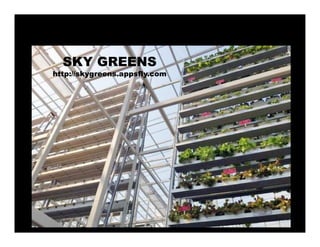
SKY GREENS
http://skygreens.appsfly.com
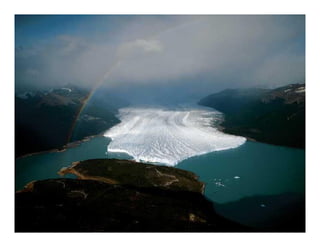
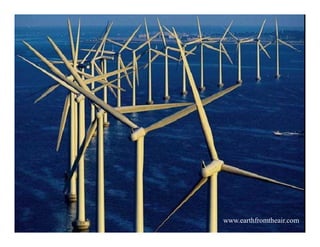
www.earthfromtheair.com
Ruth Clements
Food Animal Initiative
www.europeanfarmersnetwork.org
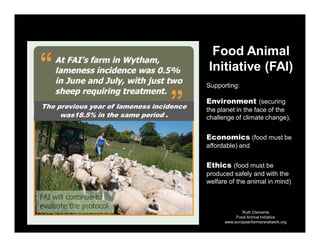
The previous year of lameness incidence
was18.5% in the same period .
Food Animal
Initiative (FAI)
Supporting:
Environment (securing
the planet in the face of the
challenge of climate change),
Economics (food must be
affordable) and
Ethics (food must be
produced safely and with the
welfare of the animal in mind)
What are the challenges?
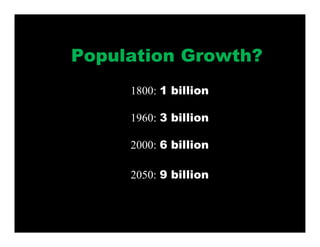
Population Growth?
1800: 1 billion
1960: 3 billion
2000: 6 billion
2050: 9 billion
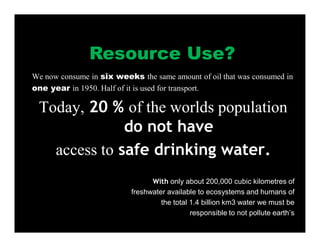
We now consume in six weeks the same amount of oil that was consumed in
one year in 1950. Half of it is used for transport.
Today, 20 % of the worlds population
do not have
access to safe drinking water.
With only about 200,000 cubic kilometres of
freshwater available to ecosystems and humans of
the total 1.4 billion km3 water we must be
responsible to not pollute earth’s
Resource Use?
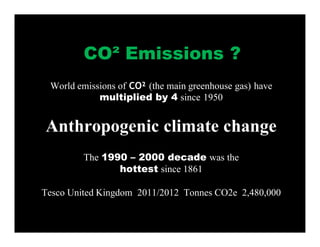
World emissions of CO² (the main greenhouse gas) have
multiplied by 4 since 1950
Anthropogenic climate change
The 1990 – 2000 decade was the
hottest since 1861
Tesco United Kingdom 2011/2012 Tonnes CO2e 2,480,000
CO² Emissions ?
WRAP: Estimates of waste in the food and drink supply chain (2012:8)
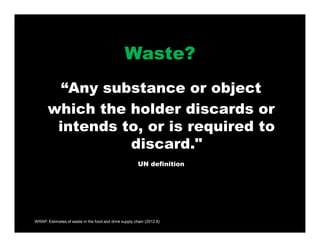
Waste?
“Any substance or object
which the holder discards or
intends to, or is required to
discard."
UN definition
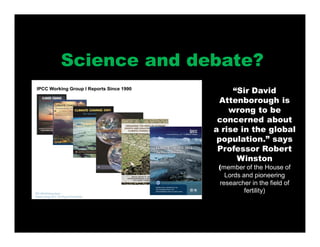
Science and debate?
“Sir David
Attenborough is
wrong to be
concerned about
a rise in the global
population.” says
Professor Robert
Winston
(member of the House of
Lords and pioneering
researcher in the field of
fertility)
Earth from the Air
A photographic portrait of our planet
towards a sustainable future
by Yann Arthus-Bertrand
The National Tour Exhibition
The exhibition presented by Wecommunic8
www.earthfromtheair.com
• C
Good business has a positive
and dynamic role to play.
What concerns me?
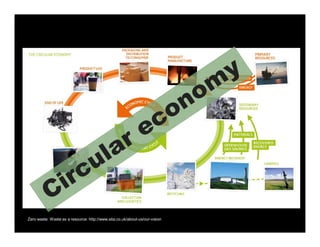
Zero waste: Waste as a resource: http://www.sita.co.uk/about-us/our-vision
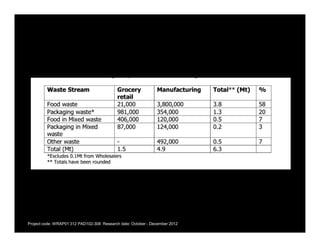
Project code: WRAP01 312 PAD102-308 Research date: October - December 2012
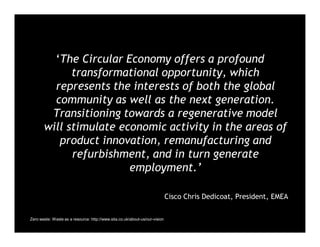
‘The Circular Economy offers a profound
transformational opportunity, which
represents the interests of both the global
community as well as the next generation.
Transitioning towards a regenerative model
will stimulate economic activity in the areas of
product innovation, remanufacturing and
refurbishment, and in turn generate
employment.’
Cisco Chris Dedicoat, President, EMEA
Zero waste: Waste as a resource: http://www.sita.co.uk/about-us/our-vision
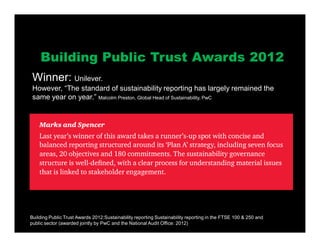
Building Public Trust Awards 2012:Sustainability reporting Sustainability reporting in the FTSE 100 & 250 and
public sector (awarded jointly by PwC and the National Audit Office: 2012)
Winner: Unilever.
However, “The standard of sustainability reporting has largely remained the
same year on year.” Malcolm Preston, Global Head of Sustainability, PwC
Building Public Trust Awards 2012
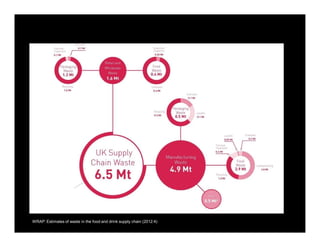
WRAP: Estimates of waste in the food and drink supply chain (2012:4)
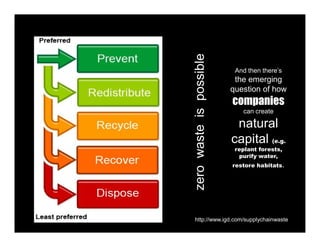
http://www.igd.com/supplychainwaste
zerowasteispossible
And then there’s
the emerging
question of how
companies
can create
natural
capital (e.g.
replant forests,
purify water,
restore habitats.
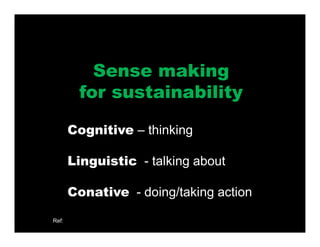
Sense making
for sustainability
Cognitive – thinking
Linguistic - talking about
Conative - doing/taking action
Ref:
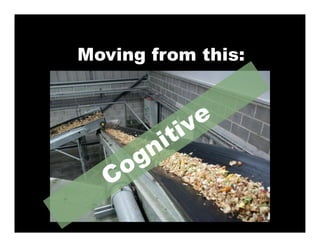
Moving from this:
To this
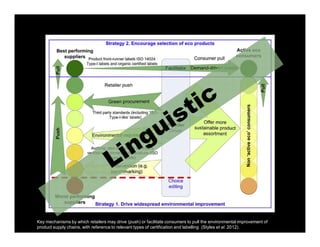
Key mechanisms by which retailers may drive (push) or facilitate consumers to pull the environmental improvement of
product supply chains, with reference to relevant types of certification and labelling (Styles et al. 2012).
Via this
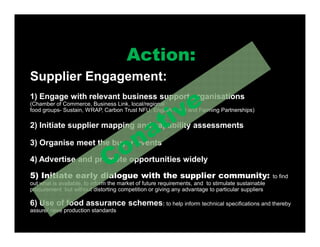
Supplier Engagement:
1) Engage with relevant business support organisations
(Chamber of Commerce, Business Link, local/regional
food groups- Sustain, WRAP, Carbon Trust NFU, English Food and Farming Partnerships)
2) Initiate supplier mapping and capability assessments
3) Organise meet the buyer events
4) Advertise and promote opportunities widely
5) Initiate early dialogue with the supplier community: to find
out what is available, to inform the market of future requirements, and to stimulate sustainable
procurement but without distorting competition or giving any advantage to particular suppliers
6) Use of food assurance schemes: to help inform technical specifications and thereby
assure/ raise production standards
Action:
Via this
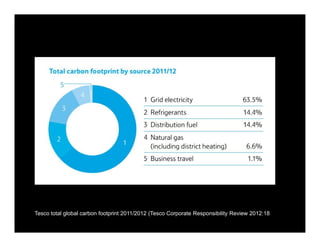
Tesco total global carbon footprint 2011/2012 (Tesco Corporate Responsibility Review 2012:18
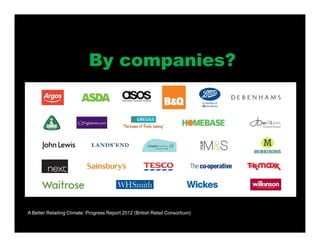
By companies?
A Better Retailing Climate: Progress Report 2012 (British Retail Consortium)
Understanding
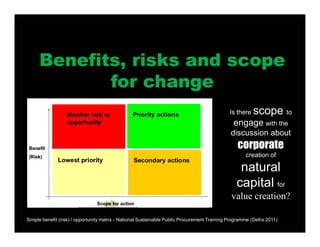
Benefits, risks and scope
for change
Is there scope to
engage with the
discussion about
corporate
creation of
natural
capital for
value creation?
Simple benefit (risk) / opportunity matrix - National Sustainable Public Procurement Training Programme (Defra:2011)
Thank You
Pauline Rutter
M: 0781 7566536
E: pauline.rutter@gmail.com
References:
• Yann Arthus-Bertrand Exhibition www.earthfromtheair.com
• Sky Greens http://skygreens.appsfly.com
• Food Animal Initiative (FAI) www.europeanfarmersnetwork.org
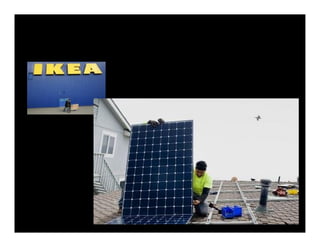
• IKEA ?
• WRAP01 312 PAD102-308 Research date: October - December 2012
• WRAP: Estimates of waste in the food and drink supply chain (2012:4)
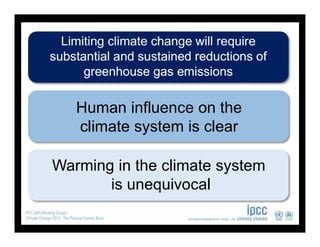
• Inter Governmental Panel on Climate Change (IPCC) AR5 Working Group 1 Climate Change 2013 The Physical
Basis
• SITA, Zero waste: Waste as a resource: http://www.sita.co.uk/about-us/our-vision
• SITA, Emissions savings of recycling. Source ‘ Managing Carbon at SITA’ 2011:5
• http://www.igd.com/supplychainwast
• Styles D., Schoenberger H., and Galvez-Martos J. (2012) Environmental improvement of product supply chains:
Proposed best practice techniques, quantitative indicators and benchmarks of excellence for retailers. Journal of
Environmental Management 110 (2012) 135:150

Understanding sustainability

  • 1.
    Pauline Rutter UnderstandingSustainability Oct 2013 Pauline Rutter Understanding Sustainability
  • 2.
    What inspires? Pauline RutterUnderstanding Sustainability Oct 2013
  • 4.
  • 5.
  • 6.
    Ruth Clements Food AnimalInitiative www.europeanfarmersnetwork.org The previous year of lameness incidence was18.5% in the same period . Food Animal Initiative (FAI) Supporting: Environment (securing the planet in the face of the challenge of climate change), Economics (food must be affordable) and Ethics (food must be produced safely and with the welfare of the animal in mind)
  • 8.
    What are thechallenges?
  • 9.
    Population Growth? 1800: 1billion 1960: 3 billion 2000: 6 billion 2050: 9 billion
  • 10.
    We now consumein six weeks the same amount of oil that was consumed in one year in 1950. Half of it is used for transport. Today, 20 % of the worlds population do not have access to safe drinking water. With only about 200,000 cubic kilometres of freshwater available to ecosystems and humans of the total 1.4 billion km3 water we must be responsible to not pollute earth’s Resource Use?
  • 11.
    World emissions ofCO² (the main greenhouse gas) have multiplied by 4 since 1950 Anthropogenic climate change The 1990 – 2000 decade was the hottest since 1861 Tesco United Kingdom 2011/2012 Tonnes CO2e 2,480,000 CO² Emissions ?
  • 12.
    WRAP: Estimates ofwaste in the food and drink supply chain (2012:8) Waste? “Any substance or object which the holder discards or intends to, or is required to discard." UN definition
  • 13.
    Science and debate? “SirDavid Attenborough is wrong to be concerned about a rise in the global population.” says Professor Robert Winston (member of the House of Lords and pioneering researcher in the field of fertility)
  • 14.
    Earth from theAir A photographic portrait of our planet towards a sustainable future by Yann Arthus-Bertrand The National Tour Exhibition The exhibition presented by Wecommunic8 www.earthfromtheair.com
  • 15.
    • C Good businesshas a positive and dynamic role to play.
  • 16.
    What concerns me? Zerowaste: Waste as a resource: http://www.sita.co.uk/about-us/our-vision
  • 17.
    Project code: WRAP01312 PAD102-308 Research date: October - December 2012
  • 18.
    ‘The Circular Economyoffers a profound transformational opportunity, which represents the interests of both the global community as well as the next generation. Transitioning towards a regenerative model will stimulate economic activity in the areas of product innovation, remanufacturing and refurbishment, and in turn generate employment.’ Cisco Chris Dedicoat, President, EMEA Zero waste: Waste as a resource: http://www.sita.co.uk/about-us/our-vision
  • 19.
    Building Public TrustAwards 2012:Sustainability reporting Sustainability reporting in the FTSE 100 & 250 and public sector (awarded jointly by PwC and the National Audit Office: 2012) Winner: Unilever. However, “The standard of sustainability reporting has largely remained the same year on year.” Malcolm Preston, Global Head of Sustainability, PwC Building Public Trust Awards 2012
  • 20.
    WRAP: Estimates ofwaste in the food and drink supply chain (2012:4)
  • 21.
    http://www.igd.com/supplychainwaste zerowasteispossible And then there’s theemerging question of how companies can create natural capital (e.g. replant forests, purify water, restore habitats.
  • 22.
    Sense making for sustainability Cognitive– thinking Linguistic - talking about Conative - doing/taking action Ref:
  • 23.
  • 24.
  • 25.
    Key mechanisms bywhich retailers may drive (push) or facilitate consumers to pull the environmental improvement of product supply chains, with reference to relevant types of certification and labelling (Styles et al. 2012).
  • 26.
  • 27.
    Supplier Engagement: 1) Engagewith relevant business support organisations (Chamber of Commerce, Business Link, local/regional food groups- Sustain, WRAP, Carbon Trust NFU, English Food and Farming Partnerships) 2) Initiate supplier mapping and capability assessments 3) Organise meet the buyer events 4) Advertise and promote opportunities widely 5) Initiate early dialogue with the supplier community: to find out what is available, to inform the market of future requirements, and to stimulate sustainable procurement but without distorting competition or giving any advantage to particular suppliers 6) Use of food assurance schemes: to help inform technical specifications and thereby assure/ raise production standards Action:
  • 28.
    Via this Tesco totalglobal carbon footprint 2011/2012 (Tesco Corporate Responsibility Review 2012:18
  • 29.
    By companies? A BetterRetailing Climate: Progress Report 2012 (British Retail Consortium)
  • 30.
  • 31.
    Benefits, risks andscope for change Is there scope to engage with the discussion about corporate creation of natural capital for value creation? Simple benefit (risk) / opportunity matrix - National Sustainable Public Procurement Training Programme (Defra:2011)
  • 32.
    Thank You Pauline Rutter M:0781 7566536 E: pauline.rutter@gmail.com
  • 33.
    References: • Yann Arthus-BertrandExhibition www.earthfromtheair.com • Sky Greens http://skygreens.appsfly.com • Food Animal Initiative (FAI) www.europeanfarmersnetwork.org • IKEA ? • WRAP01 312 PAD102-308 Research date: October - December 2012 • WRAP: Estimates of waste in the food and drink supply chain (2012:4) • Inter Governmental Panel on Climate Change (IPCC) AR5 Working Group 1 Climate Change 2013 The Physical Basis • SITA, Zero waste: Waste as a resource: http://www.sita.co.uk/about-us/our-vision • SITA, Emissions savings of recycling. Source ‘ Managing Carbon at SITA’ 2011:5 • http://www.igd.com/supplychainwast • Styles D., Schoenberger H., and Galvez-Martos J. (2012) Environmental improvement of product supply chains: Proposed best practice techniques, quantitative indicators and benchmarks of excellence for retailers. Journal of Environmental Management 110 (2012) 135:150