Understanding Skinner’s Operant Conditioning_ A Foundation for Behavior-Based Learning.pdf
1.
Understanding Skinner’s OperantConditioning: A
Foundation for Behavior-Based Learning
Skinner’s Theory of Operant Conditioning: The Behavioral
Science Behind Effective Learning
In the ever-evolving field of corporate training and education, it’s easy to get swept up in
the latest trends—AI-powered platforms, gamification, microlearning, and more. But
beneath these innovations lies a foundation of well-established psychological theories
that continue to inform how we learn. One such cornerstone is B.F. Skinner’s Theory
of Operant Conditioning—a framework that has deeply influenced modern learning
systems, including platforms like MaxLearn.
Understanding the principles of operant conditioning isn’t just an academic exercise. For
training professionals, instructional designers, and L&D leaders, it provides a powerful
2.
lens through whichto craft learning experiences that actually change behavior—the
ultimate goal of any training initiative.
What Is Operant Conditioning?
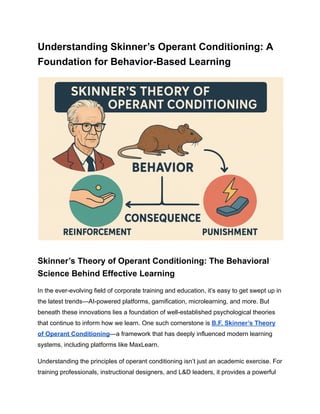
Developed by renowned psychologist B.F. Skinner in the mid-20th century, operant
conditioning is a learning process through which the strength of a behavior is modified
by reinforcement or punishment. Unlike classical conditioning (pioneered by Pavlov),
which links stimuli to reflexive responses, operant conditioning focuses on voluntary
behaviors—the ones people choose to perform based on past consequences.
At the heart of the theory lies a simple but profound idea: behavior is shaped and
maintained by its consequences. Skinner argued that we learn not just through
association, but through feedback loops that reward or discourage our actions.
The Core Components of Operant Conditioning
To understand how operant conditioning works, it’s essential to break it down into its
basic components:
1. Reinforcement
Reinforcement increases the likelihood that a behavior will occur again in the future. It
comes in two forms:
● Positive Reinforcement: Introducing a favorable outcome after a desired
behavior (e.g., giving praise, rewards, or points).
● Negative Reinforcement: Removing an unfavorable outcome to encourage
behavior (e.g., removing a tedious task once a training module is completed).
2. Punishment
Punishment aims to decrease the occurrence of a behavior. Like reinforcement, it has
two forms:
3.
● Positive Punishment:Adding an undesirable outcome following an unwanted
behavior (e.g., extra tasks for failing to complete training).
● Negative Punishment: Taking away a desirable outcome to discourage behavior
(e.g., loss of access to a reward system).
3. Extinction
If a behavior that was previously reinforced stops receiving reinforcement, it may
gradually diminish or “go extinct.” For example, if learners stop receiving feedback on
their performance, they may lose motivation to continue engaging.
4. Schedules of Reinforcement
Skinner also discovered that the timing and frequency of reinforcement can significantly
impact behavior. For instance, intermittent reinforcement (rewards given occasionally
rather than every time) can be more effective in maintaining long-term behaviors than
continuous reinforcement.
Why Skinner’s Theory Matters in Corporate Training
Today’s corporate learning landscape is data-driven, digital, and fast-paced. Yet the
core question remains the same: How do we get people to learn new behaviors and
retain them over time?
Operant conditioning offers a science-backed answer:
● Behavior change is possible when the right consequences are in place.
● Feedback, rewards, and reinforcement strategies matter.
● Learning isn’t just about knowledge—it’s about action.
Modern learning platforms like MaxLearn have integrated these insights into their very
design. By combining operant conditioning principles with cutting-edge technology, they
enable businesses to develop training that is not only informative but transformative.
Operant Conditioning in Action: How MaxLearn Applies It
4.
1. Gamified Microlearning
MaxLearn’smicrolearning platform breaks content into bite-sized modules that
encourage consistent engagement. Through positive reinforcement—such as badges,
leaderboards, and instant feedback—learners are more motivated to complete modules
and perform well.
2. AI-Powered Personalization
Using behavioral data, MaxLearn identifies what motivates each learner and adapts
content delivery accordingly. This aligns with Skinner’s view on individualized
reinforcement: what works as a reward for one person may not work for another.
3. Adaptive Assessments
Assessment tools within MaxLearn are designed to reinforce correct behavior and
gently correct incorrect responses without discouraging the learner. This mirrors the
delicate balance of reinforcement and punishment that Skinner emphasized for
optimal learning.
4. Streaks and Consistency Rewards
MaxLearn encourages consistency through features like streaks and learning calendars,
implementing variable reinforcement schedules that Skinner found to be highly
effective in maintaining habits.
Real-World Applications of Operant Conditioning in Training
Skinner’s principles can be applied across various industries to enhance learning
outcomes:
● Sales Training: Use positive reinforcement (bonuses, recognition) to encourage
role-play participation or course completion.
● Compliance Training: Introduce negative punishment (revoked access to perks)
for failure to complete mandatory modules.
5.
● Onboarding: Usecontinuous reinforcement early on to help new hires develop
key skills and behaviors.
From Theory to Transformation
Skinner’s theory is more than a classroom concept. It’s a behavioral toolkit that, when
integrated into digital learning platforms like MaxLearn, becomes a driver of real
organizational change.
Training programs built on operant conditioning principles don’t just inform—they
transform. They turn passive learners into active participants. They replace
disengagement with motivation. And most importantly, they close the gap between
knowledge and behavior.
Final Thoughts
In the age of artificial intelligence and personalized learning, B.F. Skinner’s theory of
operant conditioning remains remarkably relevant. It serves as the behavioral backbone
of effective training programs—both digital and traditional. MaxLearn brings this theory
to life by turning abstract concepts into actionable training experiences that engage,
motivate, and deliver results.
As organizations seek to future-proof their workforce and optimize learning ROI, it’s
worth remembering: sometimes the key to innovation lies in revisiting timeless
principles. And Skinner’s theory is one that continues to reward us—just like the
behaviors it aims to reinforce.
Ready to apply Skinner’s theory to your training strategy? Explore how
MaxLearn’s behavior-driven microlearning platform can help you deliver training
that sticks.
Visit MaxLearn