Ignite presentation – Understanding Risk Forum 2016, Venice
Nyree Pinder, Global Strategic Partnerships Manager, Met Office
Impact-based forecasting
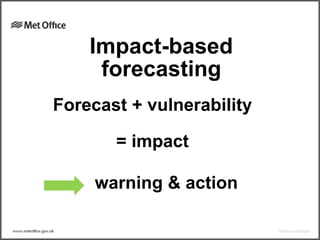
Forecast + vulnerability
= impact
Impact-based
forecasting
warning & action
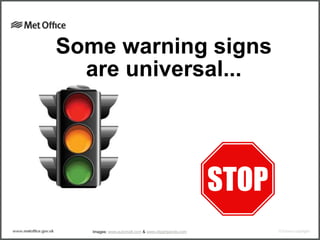
Some warning signs
are universal...
Images: www.automall.com & www.clipartpanda.com
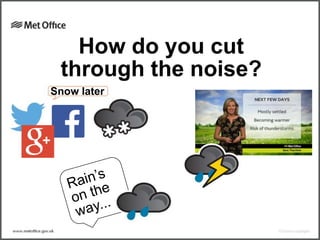
How do you cut
through the noise?
Snow later
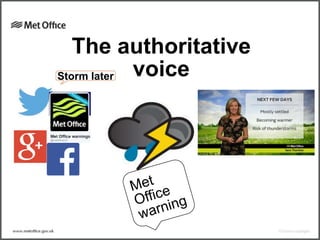
The authoritative
voiceStorm later
Work in partnership
– the hazards
Work in partnership
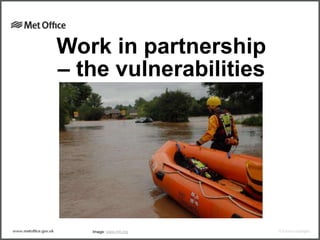
– the vulnerabilities
Image: www.rnli.org
Work in partnership to
communicate risk/impact
Who is the
audience?
Image: www.clipartpanda.com
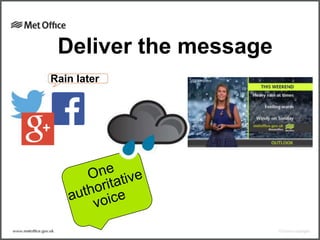
Deliver the message
Rain later
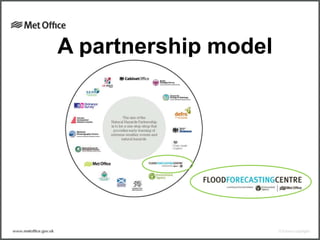
A partnership model
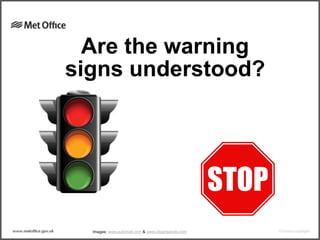
Are the warning
signs understood?
Images: www.automall.com & www.clipartpanda.com
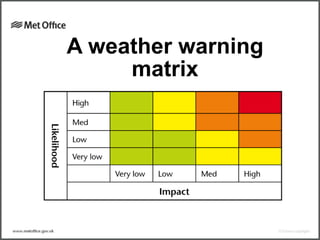
A weather warning
matrix
The final mile: connecting an
impact-based warning service to
decision making
Paul Davies - Met Office
Lydia Cumiskey - Deltares
Rick Murnane - GFDRR
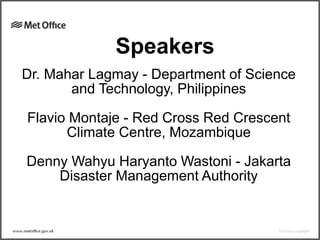
Dr. Mahar Lagmay - Department of Science
and Technology, Philippines
Flavio Montaje - Red Cross Red Crescent
Climate Centre, Mozambique
Denny Wahyu Haryanto Wastoni - Jakarta
Disaster Management Authority
Speakers
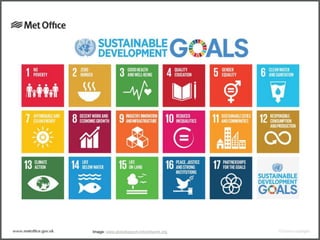
Image: www.globalopportunitynetwork.org
Thank you
Friday 9:00 – 10:30
Room: Stanza London

Understanding Risk Forum 2016 - Impact-based forecasting

Editor's Notes

  • #3 What is impact-based forecasting? Taking the weather forecast, considering the vulnerabilities and potential impacts and informing people that action may need to be taken.
  • #4 Warning signs are everywhere and there are plenty that are universal such as traffic lights. It is critical to ensure that those the warning signs are aimed at understand what action needs to be taken.
  • #5 Weather information (including warnings) can come from many sources....word of mouth....TV....radio....social media etc. That weather information could have come from different sources e.g. the national meteorological service, a commercial met service, local meteorologists/hydrologists... Who should people listen to and when should they take action?
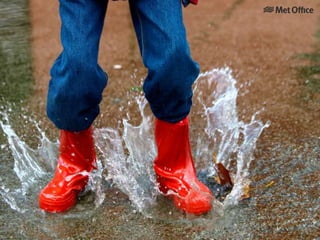
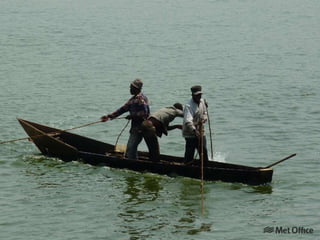
  • #6 There’s the everyday weather. In the UK this could mean wear your wellies, don’t hang the washing out, remember the suncream.... In the case of Lake Victoria fishermen, this would mean that it’s ok to go out and fish.
  • #7 Then there’s more severe weather. In the UK this could mean changing your route to work, tieing down outdoor furniture, take animals inside, changing your plans. On Lake Victoria the fishermen will need to take a life vest.
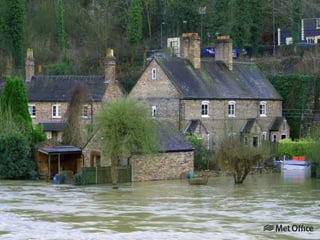
  • #8 And then there is very severe weather which has far-reaching consequences such as loss of livelihoods (farming etc.), flooding/damage to property, loss of life. On Lake Victoria the message would be clear that fishermen should not go out on the lake.
  • #9 Becoming the authoritative voice on weather and warnings is key to getting the message across. Having a national mandate makes a met service the ‘go to’ source for weather warnings. In the UK the Met Office has a mandate to issue weather warnings.
  • #10 It is important to working in partnership to understand the hazards. The national met service and national hydrology service working together ensures hazards are fully understood. In the UK the Met Office works in partnership with the Environment Agency.
  • #11 Working in partnership to understand the vulnerabilities is also key. Rain on already saturated ground could cause greater problems than in a different scenario. These partners could include government departments, civil contingency agencies, the first responder community, humanitarian organisations...
  • #12 You then need to working in partnership to evaluate the risk and potential impacts, deciding if and what warnings required. This needs to be done in a way which people will respond to – the public need to respond and government etc. need to plan/support
  • #13 Being the one authoritative voice is critical at this stage. Different channels will be appropriate in different places – you need to understand which are appropriate – but all should be delivering the same message
  • #14 The right partnerships will ensure that the right information feeds into the impact-based forecasts to make them as accurate as possible Examples – Review in 2007 led to formation of Flood Forecasting Centre – partnership between met service and hydrologists (Met Office and Environment Agency) Natural Hazards Partnership – government departments, met service, geologists etc... Partnerships with media outlets will ensure your message gets out in a timely, consistent manner
  • #15 Finding the right ways to visualise warnings is critical. Take the time to understand what your audience will understand and respond best to. They must be universally understood by the audience(s) or the message becomes useless. Traffic light system it simple, but it doesn’t stop there!
  • #16 The process needs to be adapted to the local context and potential severe weather events. Having a matrix of likelihood versus impact helps aid understanding of the risk/impact. The audience(s) also needs to understand the uncertainty and that they must take action for every warning.
  • #17 Find out more about dealing with uncertainty in forecasts and ensuring people act next time in Paul’s presentation in a joint session with the World Bank and Deltares on Friday
  • #18 Find out more about dealing with uncertainty in forecasts and ensuring people act next time in Paul’s presentation in joint session with World Bank and Deltares
  • #19 And we all know it’s a hot topic.....are any of these unaffected by weather and climate?!