Understanding Renewable
Energy Benefits
Understanding Renewable Energy Benefits
• Introduction to Renewable Energy
• Environmental Benefits
• Economic Benefits
• Social Benefits
• Technological Advancements
• Global Energy Transition
• Challenges and Solutions
• Conclusion
• Solar Energy Overview
• Wind Energy Development
Understanding Renewable Energy Benefits
• Hydro Power as a Resource
• Geothermal and Biomass Explained
Introduction to Renewable Energy
• Definition of Renewable Energy: Energy sourced from natural processes that regenerate, ensuring a
sustainable power supply for future generations.
• Key Types of Renewable Energy: Includes solar, wind, hydro, geothermal, and biomass, each with unique
characteristics and advantages in sustainability.
• Importance in Climate Change: Critical in reducing greenhouse gas emissions, mitigating climate impacts,
and fostering energy security in vulnerable areas.
Environmental Benefits
• Reduction of Greenhouse Gases: Utilizing
renewable energy sources drastically lowers
carbon emissions, essential for combating
climate change and global warming.
• Mitigation of Pollution: Transitioning to
renewables minimizes air and water pollution,
safeguarding ecosystems and promoting public
health.
• Conservation of Resources: Renewable energy
promotes sustainable resource management,
ensuring the Earth's natural resources are
preserved for future generations.
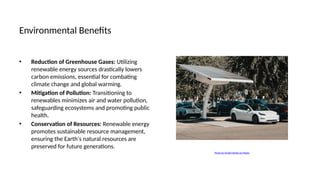
Photo by Kindel Media on Pexels
Economic Benefits
• Job Creation: The renewable energy sector
generates substantial employment opportunities
across solar, wind, and bioenergy industries.
• Long-Term Savings: Renewable energy
investments significantly reduce operational and
fuel costs, yielding lasting financial benefits for
consumers.
• Energy Independence: Expanding renewable
technologies enhances national energy
independence, stabilizing prices against global
market fluctuations effectively.
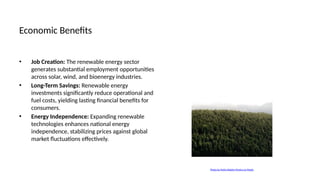
Photo by Pedro Rebelo Pereira on Pexels
Social Benefits
• Public Health Improvements: Reduced reliance on fossil fuels directly correlates with a decline in
pollution-related health diseases and issues.
• Energy Access for Underserved Areas: Renewable energy technologies provide essential access to
electricity, transforming lives and economies in marginalized communities.
• Community-Driven Energy Projects: Empowering local communities through renewable initiatives fosters
social cohesion and enhances sustainable development practices.
Technological Advancements
• Solar Panel Innovations: Recent advancements in photovoltaic materials and designs have increased
efficiency and reduced costs for solar installations.
• Wind Turbine Enhancements: Innovative turbine designs, including larger blades and advanced materials,
significantly boost energy capture and performance metrics.
• Integration with Energy Storage: Combining renewables with energy storage systems and smart grids
optimizes energy usage and reliability during demand fluctuations.
Global Energy Transition
• Combatting Climate Change: Renewable energy
significantly reduces dependency on fossil fuels,
crucial for addressing climate change challenges
effectively.
• Global Initiatives: Countries set ambitious
renewable energy targets, aligning policies to
fulfill commitments under international climate
agreements.
• Case Studies of Success: Regions successfully
transitioning to renewables showcase innovative
strategies and measurable benefits, inspiring
global energy reforms.
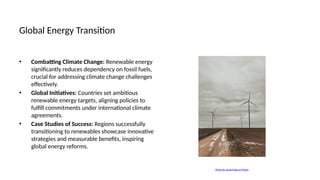
Photo by Jakub Pabis on Pexels
Challenges and Solutions
• Intermittency of Supply: Renewable energy
sources, like solar and wind, face challenges in
consistent power generation due to variability.
• Infrastructure Development Needs: Expanding
renewable energy requires significant upgrades
to transmission networks, ensuring efficient
energy distribution and accessibility.
• Advanced Energy Storage Solutions: Innovations
in battery technology enhance energy storage
capabilities, ensuring reliable supply despite
intermittency of renewables.
Photo by Plato Terentev on Pexels
Conclusion
• Environmental Sustainability: Adoption of renewables preserves ecosystems, mitigates climate change,
and promotes biodiversity through cleaner energy sources.
• Economic Resilience: Investing in renewable energy strengthens economies by creating jobs and reducing
vulnerability to fossil fuel markets.
• Social Equity: Renewable energy initiatives empower communities, ensuring equitable access to
sustainable energy solutions for all populations.
Solar Energy Overview
• Photovoltaic Cell Operation: Photovoltaic cells
convert sunlight directly into electricity using
semiconductor materials, driving solar energy
productivity.
• Concentrated Solar Power: CSP systems utilize
mirrors to focus sunlight, generating heat that
drives turbines for larger-scale electricity
production.
• Trends in Solar Market: The solar market is
rapidly expanding due to decreasing costs and
innovations fostering widespread adoption
globally.
Photo by Pixabay on Pexels
Wind Energy Development
• Wind Turbine Mechanics: Modern wind turbines
convert kinetic energy from wind into mechanical
power, utilizing rotor blades for optimal
efficiency.
• Offshore Wind Potential: Offshore wind farms
offer stronger and more consistent wind
resources, significantly increasing energy output
capacity and stability.
• Investment Trends: Global investments in wind
energy are surging, driven by decreasing costs
and growing commitments to renewable
technologies.
Photo by Pixabay on Pexels
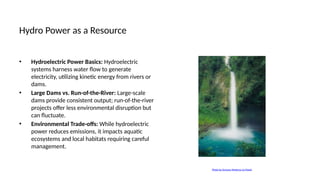
Hydro Power as a Resource
• Hydroelectric Power Basics: Hydroelectric
systems harness water flow to generate
electricity, utilizing kinetic energy from rivers or
dams.
• Large Dams vs. Run-of-the-River: Large-scale
dams provide consistent output; run-of-the-river
projects offer less environmental disruption but
can fluctuate.
• Environmental Trade-offs: While hydroelectric
power reduces emissions, it impacts aquatic
ecosystems and local habitats requiring careful
management.
Photo by Osmany Mederos on Pexels
Geothermal and Biomass Explained
• Geothermal Energy Basics: Utilizes Earth's core heat for power; examples include The Geysers in California
and Hellisheiði in Iceland.
• Biomass Energy Sources: Derives energy from organic materials, such as agricultural waste, wood, and
municipal solid waste conversion.
• Geothermal Plant Types: Includes dry steam, flash steam, and binary cycle plants, each optimized for
specific geothermal resource characteristics.

Understanding Renewable Energy Benefits.pdf

  • 1.
  • 2.
    Understanding Renewable EnergyBenefits • Introduction to Renewable Energy • Environmental Benefits • Economic Benefits • Social Benefits • Technological Advancements • Global Energy Transition • Challenges and Solutions • Conclusion • Solar Energy Overview • Wind Energy Development
  • 3.
    Understanding Renewable EnergyBenefits • Hydro Power as a Resource • Geothermal and Biomass Explained
  • 4.
    Introduction to RenewableEnergy • Definition of Renewable Energy: Energy sourced from natural processes that regenerate, ensuring a sustainable power supply for future generations. • Key Types of Renewable Energy: Includes solar, wind, hydro, geothermal, and biomass, each with unique characteristics and advantages in sustainability. • Importance in Climate Change: Critical in reducing greenhouse gas emissions, mitigating climate impacts, and fostering energy security in vulnerable areas.
  • 5.
    Environmental Benefits • Reductionof Greenhouse Gases: Utilizing renewable energy sources drastically lowers carbon emissions, essential for combating climate change and global warming. • Mitigation of Pollution: Transitioning to renewables minimizes air and water pollution, safeguarding ecosystems and promoting public health. • Conservation of Resources: Renewable energy promotes sustainable resource management, ensuring the Earth's natural resources are preserved for future generations. Photo by Kindel Media on Pexels
  • 6.
    Economic Benefits • JobCreation: The renewable energy sector generates substantial employment opportunities across solar, wind, and bioenergy industries. • Long-Term Savings: Renewable energy investments significantly reduce operational and fuel costs, yielding lasting financial benefits for consumers. • Energy Independence: Expanding renewable technologies enhances national energy independence, stabilizing prices against global market fluctuations effectively. Photo by Pedro Rebelo Pereira on Pexels
  • 7.
    Social Benefits • PublicHealth Improvements: Reduced reliance on fossil fuels directly correlates with a decline in pollution-related health diseases and issues. • Energy Access for Underserved Areas: Renewable energy technologies provide essential access to electricity, transforming lives and economies in marginalized communities. • Community-Driven Energy Projects: Empowering local communities through renewable initiatives fosters social cohesion and enhances sustainable development practices.
  • 8.
    Technological Advancements • SolarPanel Innovations: Recent advancements in photovoltaic materials and designs have increased efficiency and reduced costs for solar installations. • Wind Turbine Enhancements: Innovative turbine designs, including larger blades and advanced materials, significantly boost energy capture and performance metrics. • Integration with Energy Storage: Combining renewables with energy storage systems and smart grids optimizes energy usage and reliability during demand fluctuations.
  • 9.
    Global Energy Transition •Combatting Climate Change: Renewable energy significantly reduces dependency on fossil fuels, crucial for addressing climate change challenges effectively. • Global Initiatives: Countries set ambitious renewable energy targets, aligning policies to fulfill commitments under international climate agreements. • Case Studies of Success: Regions successfully transitioning to renewables showcase innovative strategies and measurable benefits, inspiring global energy reforms. Photo by Jakub Pabis on Pexels
  • 10.
    Challenges and Solutions •Intermittency of Supply: Renewable energy sources, like solar and wind, face challenges in consistent power generation due to variability. • Infrastructure Development Needs: Expanding renewable energy requires significant upgrades to transmission networks, ensuring efficient energy distribution and accessibility. • Advanced Energy Storage Solutions: Innovations in battery technology enhance energy storage capabilities, ensuring reliable supply despite intermittency of renewables. Photo by Plato Terentev on Pexels
  • 11.
    Conclusion • Environmental Sustainability:Adoption of renewables preserves ecosystems, mitigates climate change, and promotes biodiversity through cleaner energy sources. • Economic Resilience: Investing in renewable energy strengthens economies by creating jobs and reducing vulnerability to fossil fuel markets. • Social Equity: Renewable energy initiatives empower communities, ensuring equitable access to sustainable energy solutions for all populations.
  • 12.
    Solar Energy Overview •Photovoltaic Cell Operation: Photovoltaic cells convert sunlight directly into electricity using semiconductor materials, driving solar energy productivity. • Concentrated Solar Power: CSP systems utilize mirrors to focus sunlight, generating heat that drives turbines for larger-scale electricity production. • Trends in Solar Market: The solar market is rapidly expanding due to decreasing costs and innovations fostering widespread adoption globally. Photo by Pixabay on Pexels
  • 13.
    Wind Energy Development •Wind Turbine Mechanics: Modern wind turbines convert kinetic energy from wind into mechanical power, utilizing rotor blades for optimal efficiency. • Offshore Wind Potential: Offshore wind farms offer stronger and more consistent wind resources, significantly increasing energy output capacity and stability. • Investment Trends: Global investments in wind energy are surging, driven by decreasing costs and growing commitments to renewable technologies. Photo by Pixabay on Pexels
  • 14.
    Hydro Power asa Resource • Hydroelectric Power Basics: Hydroelectric systems harness water flow to generate electricity, utilizing kinetic energy from rivers or dams. • Large Dams vs. Run-of-the-River: Large-scale dams provide consistent output; run-of-the-river projects offer less environmental disruption but can fluctuate. • Environmental Trade-offs: While hydroelectric power reduces emissions, it impacts aquatic ecosystems and local habitats requiring careful management. Photo by Osmany Mederos on Pexels
  • 15.
    Geothermal and BiomassExplained • Geothermal Energy Basics: Utilizes Earth's core heat for power; examples include The Geysers in California and Hellisheiði in Iceland. • Biomass Energy Sources: Derives energy from organic materials, such as agricultural waste, wood, and municipal solid waste conversion. • Geothermal Plant Types: Includes dry steam, flash steam, and binary cycle plants, each optimized for specific geothermal resource characteristics.