Understanding Relative
Value inMedicine
Delving into the principles and applications of relative value in healthcare,
this presentation explores its significance for practitioners and
policymakers alike. We will uncover how value is quantified and its
profound impact on medical practice and economics.
2.
What is RelativeValue? A Foundation
Defining Value
Relative value in medicine assesses
the worth of a medical service
compared to other services,
factoring in effort, risk, and
resources.
Standardised Metrics
It provides a standardised, objective
measure, allowing for equitable
comparison and compensation
across diverse medical procedures.
Underlying Principles
The concept aims to ensure fair
compensation for healthcare
providers, reflecting the complexity
and resources involved in patient
care.
3.
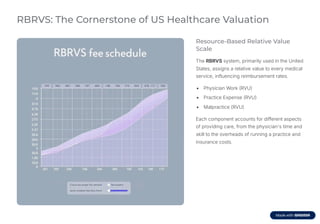
RBRVS: The Cornerstoneof US Healthcare Valuation
Resource-Based Relative Value
Scale
The RBRVS system, primarily used in the United
States, assigns a relative value to every medical
service, influencing reimbursement rates.
Physician Work (RVU)
Practice Expense (RVU)
Malpractice (RVU)
Each component accounts for different aspects
of providing care, from the physician's time and
skill to the overheads of running a practice and
insurance costs.
4.
Beyond Dollars: MeasuringClinical Effort and Resource
Use
Physician Work
This accounts for the intellectual
effort, technical skill, mental effort,
and psychological stress associated
with a procedure or service.
Practice Expense
Covers the non-physician clinical and
administrative staff, office rent,
supplies, and equipment needed to
deliver the service.
Malpractice Expense
Reflects the cost of professional
liability insurance, which varies based
on the risk associated with different
medical specialities.
5.
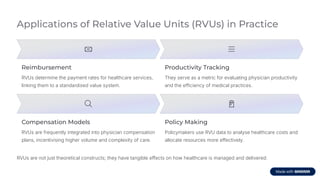
Applications of RelativeValue Units (RVUs) in Practice
Reimbursement
RVUs determine the payment rates for healthcare services,
linking them to a standardised value system.
Productivity Tracking
They serve as a metric for evaluating physician productivity
and the efficiency of medical practices.
Compensation Models
RVUs are frequently integrated into physician compensation
plans, incentivising higher volume and complexity of care.
Policy Making
Policymakers use RVU data to analyse healthcare costs and
allocate resources more effectively.
RVUs are not just theoretical constructs; they have tangible effects on how healthcare is managed and delivered.
6.
Impact on PhysicianCompensation and Practice
Management
Shaping Compensation
RVU-based compensation models aim to reward physicians
based on the intensity and complexity of services provided,
promoting fairness.
Incentives: Encourages efficiency and specialisation.
Fairness: Attempts to balance workload with
remuneration.
Optimising Practice Management
Practices leverage RVU data to assess operational efficiency,
identify areas for improvement, and negotiate payer
contracts.
Operational Efficiency: Streamlining workflows.
Strategic Planning: Better resource allocation.
7.
RVUs and Reimbursement
Models:A UK Perspective?
While RVUs are central to the US healthcare system, the UK's National
Health Service (NHS) operates on different principles.
US Model: Fee-for-
Service
Driven by RBRVS and RVUs.
Focus on individual
procedures.
Market-based compensation.
UK Model: Capitation &
Block Contracts
Primarily state-funded.
Global budgets and capitated
payments.
Focus on population health
and access.
The direct application of RVUs in the UK is limited, yet understanding their
principles can offer insights into resource allocation and workload
assessment within a socialised healthcare system.
8.
Challenges and Criticismsof
Relative Value Systems
"While RVUs provide a valuable framework, they are not without their
imperfections, often drawing criticism for potential biases and
unintended consequences."
Complexity
The intricate nature of RVU calculations can make them difficult to
understand and implement effectively.
Bias Concerns
Critics argue that RVUs may inadvertently favour certain specialities
or procedures over others, leading to imbalances.
Gaming the System
There's a risk of providers focusing on high-RVU procedures,
potentially at the expense of comprehensive patient care.
Administrative Burden
The detailed documentation required for RVU tracking can add
significant administrative overhead to practices.
9.
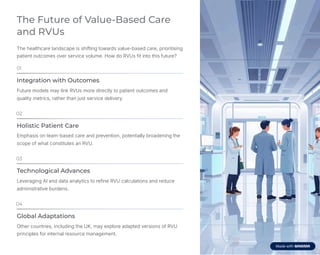
The Future ofValue-Based Care
and RVUs
The healthcare landscape is shifting towards value-based care, prioritising
patient outcomes over service volume. How do RVUs fit into this future?
01
Integration with Outcomes
Future models may link RVUs more directly to patient outcomes and
quality metrics, rather than just service delivery.
02
Holistic Patient Care
Emphasis on team-based care and prevention, potentially broadening the
scope of what constitutes an RVU.
03
Technological Advances
Leveraging AI and data analytics to refine RVU calculations and reduce
administrative burdens.
04
Global Adaptations
Other countries, including the UK, may explore adapted versions of RVU
principles for internal resource management.
10.
Key Takeaways andDiscussion
Relative Value's Core
A crucial tool for standardising the valuation of medical
services, especially in reimbursement.
RBRVS Significance
The dominant model in the US, shaping physician
compensation and practice economics.
Impact on Practice
Affects physician income, productivity measurement, and
strategic management decisions.
Evolution for Value-Based Care
Adapting to new healthcare paradigms that prioritise
outcomes and holistic patient management.
The conversation around relative value is ongoing, constantly evolving to meet the demands of modern healthcare.