Understanding Justification
According tothe Bible
This presentation delves into the concept of justification as depicted in the Bible, highlighting its theological
importance, relevant scriptural passages, and the effects it has on believers. It aims to elucidate how justification
2.
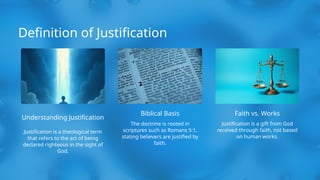
Definition of Justification
UnderstandingJustification
Justification is a theological term
that refers to the act of being
declared righteous in the sight of
God.
Biblical Basis
The doctrine is rooted in
scriptures such as Romans 5:1,
stating believers are justified by
faith.
Faith vs. Works
Justification is a gift from God
received through faith, not based
on human works.
3.
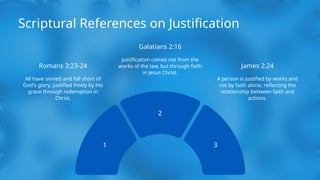
Scriptural References onJustification
Romans 3:23-24
All have sinned and fall short of
God's glory; justified freely by His
grace through redemption in
Christ.
Galatians 2:16
Justification comes not from the
works of the law, but through faith
in Jesus Christ.
1
2
James 2:24
A person is justified by works and
not by faith alone, reflecting the
relationship between faith and
actions.
3
4.
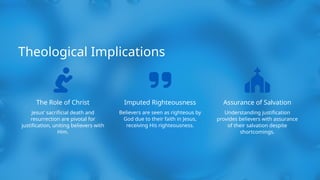
Theological Implications
The Roleof Christ
Jesus’ sacrificial death and
resurrection are pivotal for
justification, uniting believers with
Him.
Imputed Righteousness
Believers are seen as righteous by
God due to their faith in Jesus,
receiving His righteousness.
Assurance of Salvation
Understanding justification
provides believers with assurance
of their salvation despite
shortcomings.
5.
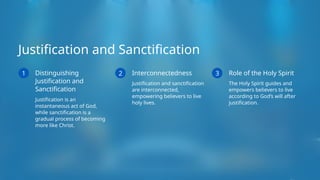
Justification and Sanctification
1Distinguishing
Justification and
Sanctification
Justification is an
instantaneous act of God,
while sanctification is a
gradual process of becoming
more like Christ.
2 Interconnectedness
Justification and sanctification
are interconnected,
empowering believers to live
holy lives.
3 Role of the Holy Spirit
The Holy Spirit guides and
empowers believers to live
according to God’s will after
justification.
6.
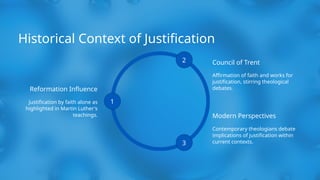
Historical Context ofJustification
Reformation Influence
Justification by faith alone as
highlighted in Martin Luther's
teachings.
1
2 Council of Trent
Affirmation of faith and works for
justification, stirring theological
debates.
3
Modern Perspectives
Contemporary theologians debate
implications of justification within
current contexts.
7.
Practical Applications of
Justification
LivingJustified
Understanding
justification
encourages
believers to live
out their faith
authentically.
Sharing the
Gospel
The doctrine of
justification is
foundational for
evangelism.
Encourageme
nt in Trials
Believers find
comfort in their
justified status,
secure in God's
love.
8.
Understanding Justification inFaith
Summary of Key Points
Justification is a vital doctrine that
underscores the believer's
relationship with God,
emphasizing faith, grace, and the
transformative work of Christ.
Call to Reflection
Believers are encouraged to
reflect on their understanding of
justification and how it influences
their daily lives and faith journeys.
Invitation to Faith
For those exploring faith, the
message of justification invites
them to embrace the grace of God
freely offered through Jesus
Christ.