Bill Adams, FEA, University of Malaya


                                         Organization
                                        Culture Theory
Organization Culture Theory
                                        [Classics book turned to strong advocacy!]


                                         Boomed since the early 1980s reform efforts to
                                        change organizations.


                                         To change orgs must change the culture!
                                         Claims that the rational model rarely works.
Bill Adams, FEA, University of Malaya


                                         Big management reform approaches (like Total
                                        Quality Management) all require changed culture.
Organization Culture Theory


                                        Behavior determined by ingrained values, norms,
                                        and traditions of behavior (“the way we do things”).

                                        Org cultures made by society, type of activity,
                                        personality of the founder/early leaders, past
Bill Adams, FEA, University of Malaya


                                        practices – and other things.


                                        Often use “ethnography” & participant observation.
“Symbolic Management”
                                        [Influenced by “postmodern” philosophy
                                        & “The Social Construction of Reality”]

                                        Lots of uncertainty exits in many organizations.
                                        People use symbols as tools for reducing ambiguity.
                                        [OK, sure, symbols are important.]

                                        “The interpretation of what is happening in organi-
Bill Adams, FEA, University of Malaya


                                        zations is more important than what is actually
                                        happening.”!!!

                                           “If people believe things are real,
                                            they are real in their consequences.”
[Schein]   Organizational Culture

                                         Culture guides our behavior.
                                         Culture = the “personality” of a group.
                                         Culture = “pattern of shared basic assumptions”
                                         Ingrained, unthinking, nonnegotiable assumptions
                                         Group has a shared history, things in common.
Bill Adams, FEA, University of Malaya


                                         Role of leaders in establishing & changing culture.
                                         New members “socialized” into the culture.
                                         In large organizations, may be subcultures.
                                         Importance of learning the culture when new!
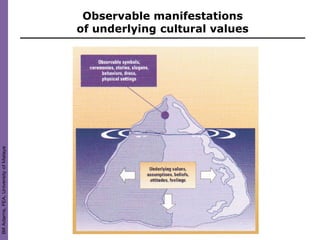
Observable manifestations
                                        of underlying cultural values
Bill Adams, FEA, University of Malaya
[Schein]   Describing aspects of culture
                                           (“Observables associated with culture”)


                                        Behavioral regular-     Group norms           Rules of the game
                                          ities (language,    (implicit standards     (unwritten rules for
                                          customs, rituals)      and values)            “getting along”)


                                        Habits of thinking    Shared meanings         Root metaphors/
                                         (shared paradigms)    (intra-org lingo)       shared symbols


                                         Embedded skills        Formal rituals
Bill Adams, FEA, University of Malaya


                                                                                      Climate (feeling &
                                         (special practices   (group traditions for
                                                                                      group atmosphere)
                                           passed along)          “passages”)


                                                    Espoused values       Formal philosophy
                                                    (announced values)     (broad principles)
[Martin]   Manifestations of Culture: “Cultural Forms”


                                                                  Rituals


                                                       Other
                                                      Content
                                                                             Stories


                                                                  Culture
Bill Adams, FEA, University of Malaya


                                                       Bldg.,
                                                      Décor,                 Jargon
                                                       Dress


                                                                  Humor
[Ouchi “Oh’chi”]   Z Organization   (aka Japanese Mgt.)


                                         Lifetime employment
                                         Low turnover rates
                                         Increased job commitment
                                         Company-specific skills
                                         Slow promotions but “wandering around” moves
                                         Long-range staff development (& generalists)
Bill Adams, FEA, University of Malaya


                                         Use but not obsessed by quantitative analysis
                                         Consensus decision-making & staff cohesion
                                         Importance of warm holistic relationships
                                         Attitude/symbols of egalitarianism and trust
[Ouchi “Oh’chi”]   Z Organization    (aka Japanese Mgt.)


                                        Disadvantages of “Type Z”:


                                        ● The “clan” can be “clanish” toward
                                        “outsiders” (xenophobic, sexist, racist!)


                                        ● Cultural conformity resists valuable innovations
Bill Adams, FEA, University of Malaya


                                        ● Loss of external professionalism (inward looking)
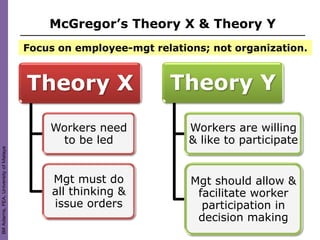
McGregor’s Theory X & Theory Y
                                        Focus on employee-mgt relations; not organization.


                                        Theory X                 Theory Y
                                            Workers need             Workers are willing
                                             to be led               & like to participate
Bill Adams, FEA, University of Malaya


                                             Mgt must do             Mgt should allow &
                                             all thinking &           facilitate worker
                                             issue orders              participation in
                                                                      decision making
Bill Adams, FEA, University of Malaya


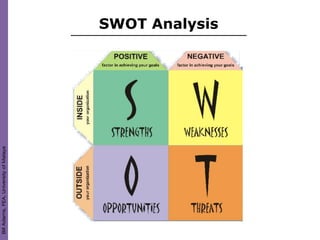
                                        SWOT Analysis
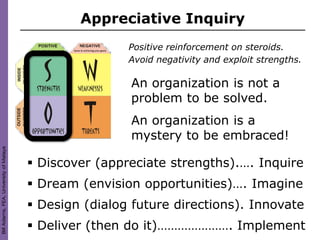
Appreciative Inquiry
                                                        Positive reinforcement on steroids.
                                                        Avoid negativity and exploit strengths.

                                                        An organization is not a
                                                        problem to be solved.
                                                        An organization is a
                                                        mystery to be embraced!
Bill Adams, FEA, University of Malaya


                                         Discover (appreciate strengths).…. Inquire
                                         Dream (envision opportunities)…. Imagine
                                         Design (dialog future directions). Innovate
                                         Deliver (then do it)…………………. Implement
Appreciative Inquiry


                                        Example:
                                        Denver Office of Finance

                                        Saved lots of money by
                                        consolidating, downsizing,
                                        discarding an old program.
Bill Adams, FEA, University of Malaya


                                        Weren’t they asking “where
                                        are we wasting money now?”
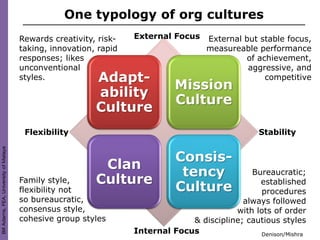
One typology of org cultures
                                        Rewards creativity, risk-   External Focus    External but stable focus,
                                        taking, innovation, rapid                     measureable performance
                                        responses; likes                                       of achievement,
                                        unconventional                                          aggressive, and
                                        styles.            Adapt-                                   competitive
                                                                              Mission
                                                           ability
                                                                              Culture
                                                           Culture
                                         Flexibility                                               Stability
Bill Adams, FEA, University of Malaya


                                                                              Consis-
                                                            Clan
                                                                               tency            Bureaucratic;
                                        Family style,      Culture                                established
                                        flexibility not                       Culture              procedures
                                        so bureaucratic,                                      always followed
                                        consensus style,                                    with lots of order
                                        cohesive group styles                    & discipline; cautious styles
                                                                    Internal Focus                Denison/Mishra
Bill Adams, FEA, University of Malaya


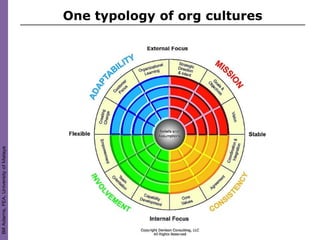
                                        One typology of org cultures

UM 8 Organization Culture

  • 1.
    Bill Adams, FEA,University of Malaya Organization Culture Theory
  • 2.
    Organization Culture Theory [Classics book turned to strong advocacy!]  Boomed since the early 1980s reform efforts to change organizations.  To change orgs must change the culture!  Claims that the rational model rarely works. Bill Adams, FEA, University of Malaya  Big management reform approaches (like Total Quality Management) all require changed culture.
  • 3.
    Organization Culture Theory Behavior determined by ingrained values, norms, and traditions of behavior (“the way we do things”). Org cultures made by society, type of activity, personality of the founder/early leaders, past Bill Adams, FEA, University of Malaya practices – and other things. Often use “ethnography” & participant observation.
  • 4.
    “Symbolic Management” [Influenced by “postmodern” philosophy & “The Social Construction of Reality”] Lots of uncertainty exits in many organizations. People use symbols as tools for reducing ambiguity. [OK, sure, symbols are important.] “The interpretation of what is happening in organi- Bill Adams, FEA, University of Malaya zations is more important than what is actually happening.”!!! “If people believe things are real, they are real in their consequences.”
  • 5.
    [Schein] Organizational Culture  Culture guides our behavior.  Culture = the “personality” of a group.  Culture = “pattern of shared basic assumptions”  Ingrained, unthinking, nonnegotiable assumptions  Group has a shared history, things in common. Bill Adams, FEA, University of Malaya  Role of leaders in establishing & changing culture.  New members “socialized” into the culture.  In large organizations, may be subcultures.  Importance of learning the culture when new!
  • 6.
    Observable manifestations of underlying cultural values Bill Adams, FEA, University of Malaya
  • 7.
    [Schein] Describing aspects of culture (“Observables associated with culture”) Behavioral regular- Group norms Rules of the game ities (language, (implicit standards (unwritten rules for customs, rituals) and values) “getting along”) Habits of thinking Shared meanings Root metaphors/ (shared paradigms) (intra-org lingo) shared symbols Embedded skills Formal rituals Bill Adams, FEA, University of Malaya Climate (feeling & (special practices (group traditions for group atmosphere) passed along) “passages”) Espoused values Formal philosophy (announced values) (broad principles)
  • 8.
    [Martin] Manifestations of Culture: “Cultural Forms” Rituals Other Content Stories Culture Bill Adams, FEA, University of Malaya Bldg., Décor, Jargon Dress Humor
  • 9.
    [Ouchi “Oh’chi”] Z Organization (aka Japanese Mgt.)  Lifetime employment  Low turnover rates  Increased job commitment  Company-specific skills  Slow promotions but “wandering around” moves  Long-range staff development (& generalists) Bill Adams, FEA, University of Malaya  Use but not obsessed by quantitative analysis  Consensus decision-making & staff cohesion  Importance of warm holistic relationships  Attitude/symbols of egalitarianism and trust
  • 10.
    [Ouchi “Oh’chi”] Z Organization (aka Japanese Mgt.) Disadvantages of “Type Z”: ● The “clan” can be “clanish” toward “outsiders” (xenophobic, sexist, racist!) ● Cultural conformity resists valuable innovations Bill Adams, FEA, University of Malaya ● Loss of external professionalism (inward looking)
  • 11.
    McGregor’s Theory X& Theory Y Focus on employee-mgt relations; not organization. Theory X Theory Y Workers need Workers are willing to be led & like to participate Bill Adams, FEA, University of Malaya Mgt must do Mgt should allow & all thinking & facilitate worker issue orders participation in decision making
  • 12.
    Bill Adams, FEA,University of Malaya SWOT Analysis
  • 13.
    Appreciative Inquiry Positive reinforcement on steroids. Avoid negativity and exploit strengths. An organization is not a problem to be solved. An organization is a mystery to be embraced! Bill Adams, FEA, University of Malaya  Discover (appreciate strengths).…. Inquire  Dream (envision opportunities)…. Imagine  Design (dialog future directions). Innovate  Deliver (then do it)…………………. Implement
  • 14.
    Appreciative Inquiry Example: Denver Office of Finance Saved lots of money by consolidating, downsizing, discarding an old program. Bill Adams, FEA, University of Malaya Weren’t they asking “where are we wasting money now?”
  • 15.
    One typology oforg cultures Rewards creativity, risk- External Focus External but stable focus, taking, innovation, rapid measureable performance responses; likes of achievement, unconventional aggressive, and styles. Adapt- competitive Mission ability Culture Culture Flexibility Stability Bill Adams, FEA, University of Malaya Consis- Clan tency Bureaucratic; Family style, Culture established flexibility not Culture procedures so bureaucratic, always followed consensus style, with lots of order cohesive group styles & discipline; cautious styles Internal Focus Denison/Mishra
  • 16.
    Bill Adams, FEA,University of Malaya One typology of org cultures