Ultralearning
S Moosa
A strategy for acquiring
skills and knowledge that
is both self directed and
intense
You must take control of
the learning process
‘You can’t delegate
your learning task to a
school or mentor’.
•‘At end of my learning project, what do I need the skills
for?’
Start by the question:
•develop own learning path
•develop skills they need for the purpose they want to
engage
Student
Fully immerse with
aggressive learning
schedule
How to
rapidly
acquire a
new skill
Meta learning
Focus
Directness
Drill
Retrieval
Feedback
Retention
Intuition
Experimentation
Metalearning
• Think about the learning process
• What are the typical ways to learn this subject?
• Which study method to focus?
• Map out learning before you begin – how what why
• What concepts do I need to understand
• What facts do I need memorize
• What procedures do I need practice
• Research techniques - assess- repeat
• 5-10 %
Focus: the
key to
success
Focus attention vs multitasking
and distraction
Get into a ‘flow state’
Find methods on how to reduce
distraction and procrastination
Components of mental arousal
Directness
‘Am I doing what is important, not what is comfortable’
‘Assess what is necessary to learn, and learning it, don’t
skirt around what is comfortable’
‘Tie the learning project to match the context you want to
use the skill’ – if not, then problem of knowledge transfer
Copy the masters
If you intend to speak French, speak it’ – immersive
methods
‘If you intent to report CT scans, start to report scans’
Drill – attack
your weak
points
‘Break big topics to constituent's parts, identify what you
poor at, study it intensely and drastically improve your
overall performance’
Identify bottlenecks:
‘rate determining step’,
plateaus that hinder progress
Musicians: practice the ‘hard parts’ of a piece separately
Athletes: drill ‘hard skills’ that come in play only a fraction
of time, high yields and dratic impact outcomes.
Identify
drills for
those hard
parts (
bottlenecks)
‘If you want to do pull ups, strengthen the
shoulder muscles’
• Identify the shoulder muscles
• Exercise to strengthen them
Governs overall competence, recognition is key
to progress
‘Direct practice paradox – while you work on
the whole skill set directly, you drill isolated
aspects that’s ‘hard’ for you’
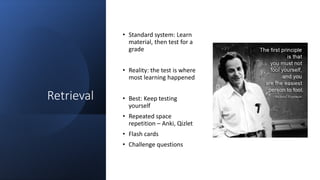
Retrieval
• Standard system: Learn
material, then test for a
grade
• Reality: the test is where
most learning happened
• Best: Keep testing
yourself
• Repeated space
repetition – Anki, Qizlet
• Flash cards
• Challenge questions
Feedback –
don’t dodge
the punches
• Feedback guides future learning
– what you doing wrong and how to fix it.
• Praise ‘You so clever’ is harmful unless linked to improvement
advice. Demotivate
• Harsh and Critical ‘You an idiot’ – no benefit
• Feedback affect ego.
• Intentions of person provide feedback judged: Isolate Signal
from the Noise
• Types:
• Outcome feedback: Pass/Fail
• Informational feedback: what you doing wrong
• Corrective feedback: how to fix the wrong
Retention:
don’t fill a
leaky bucket.
Memory is the
residue of
thought
• Why we forget? New info replace old
• How to retain what we spend so much time
learning
• Spacing: repeat to remember
• Proceduralization: ‘the automatic will
endure’ (riding a bike anology)
• Mnemonics: ‘Pictures retains a thousand
words’
• Overlearn: ‘Practice beyond what’s needed’
Overlearn
Do more than needed –
practice at a higher level
Exceed the requirement
of target performance
Intuition
Intuition and pattern recognition as modes to
solve problems vs general memory
True understanding needs you to go deep, not
wide
• With depth anything can be interesting
• As experience expand, unification of understanding occurs
• End: simpler than looked at beginning
Spending lot of time doing something is not
enough
• Drs with 3 yrs experience vs 20 yr
• Do the hard problems
• Reflect on your errors, fix and grow
Intuition
True understanding and
integration
• Depth get intuition
• Intuition do things naturally
• No struggle in thinking process
• Know the outcome before even deal with
it
‘Know where the ball is going to
be, read the oppsitions next move’
Experimentation
• Beyond beginner
• Copy the masters then create your own style
• Mastery – creativity and genius
• End at limits where no one has been.
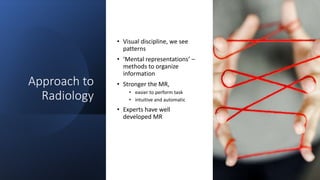
Approach to
Radiology
• Visual discipline, we see
patterns
• ‘Mental representations’ –
methods to organize
information
• Stronger the MR,
• easier to perform task
• intuitive and automatic
• Experts have well
developed MR
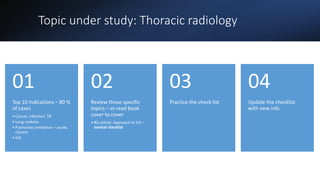
Topic under study: Thoracic radiology
Top 10 indications – 80 %
of cases
• Cancer, infection, TB
• Lung nodules
• Pulmonary embolism – acute,
chronic
• ILD
01
Review those specific
topics – vs read book
cover to cover
• RG article: Approach to ILD –
mental checklist
02
Practice the check list
03
Update the checklist
with new info
04
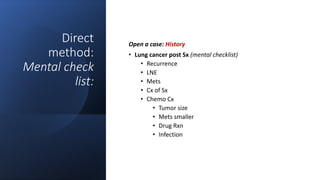
Direct
method:
Mental check
list:
Open a case: History
• Lung cancer post Sx (mental checklist)
• Recurrence
• LNE
• Mets
• Cx of Sx
• Chemo Cx
• Tumor size
• Mets smaller
• Drug Rxn
• Infection
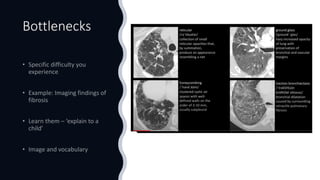
Bottlenecks
Principles
are starting
points ……..
Art of learning projects new challenges to one’s
life
Get fundamentals right, basic substrate solid
Are you ready to engross yourself in the new
skills?
‘True mastery comes not from following the
path trodden by others, but exploring
possibilities they had not yet imagined’
End

Ultralearning and Radiology.pptx

  • 1.
  • 2.
    A strategy foracquiring skills and knowledge that is both self directed and intense
  • 3.
    You must takecontrol of the learning process ‘You can’t delegate your learning task to a school or mentor’. •‘At end of my learning project, what do I need the skills for?’ Start by the question: •develop own learning path •develop skills they need for the purpose they want to engage Student Fully immerse with aggressive learning schedule
  • 4.
    How to rapidly acquire a newskill Meta learning Focus Directness Drill Retrieval Feedback Retention Intuition Experimentation
  • 5.
    Metalearning • Think aboutthe learning process • What are the typical ways to learn this subject? • Which study method to focus? • Map out learning before you begin – how what why • What concepts do I need to understand • What facts do I need memorize • What procedures do I need practice • Research techniques - assess- repeat • 5-10 %
  • 6.
    Focus: the key to success Focusattention vs multitasking and distraction Get into a ‘flow state’ Find methods on how to reduce distraction and procrastination Components of mental arousal
  • 7.
    Directness ‘Am I doingwhat is important, not what is comfortable’ ‘Assess what is necessary to learn, and learning it, don’t skirt around what is comfortable’ ‘Tie the learning project to match the context you want to use the skill’ – if not, then problem of knowledge transfer Copy the masters If you intend to speak French, speak it’ – immersive methods ‘If you intent to report CT scans, start to report scans’
  • 8.
    Drill – attack yourweak points ‘Break big topics to constituent's parts, identify what you poor at, study it intensely and drastically improve your overall performance’ Identify bottlenecks: ‘rate determining step’, plateaus that hinder progress Musicians: practice the ‘hard parts’ of a piece separately Athletes: drill ‘hard skills’ that come in play only a fraction of time, high yields and dratic impact outcomes.
  • 9.
    Identify drills for those hard parts( bottlenecks) ‘If you want to do pull ups, strengthen the shoulder muscles’ • Identify the shoulder muscles • Exercise to strengthen them Governs overall competence, recognition is key to progress ‘Direct practice paradox – while you work on the whole skill set directly, you drill isolated aspects that’s ‘hard’ for you’
  • 10.
    Retrieval • Standard system:Learn material, then test for a grade • Reality: the test is where most learning happened • Best: Keep testing yourself • Repeated space repetition – Anki, Qizlet • Flash cards • Challenge questions
  • 11.
    Feedback – don’t dodge thepunches • Feedback guides future learning – what you doing wrong and how to fix it. • Praise ‘You so clever’ is harmful unless linked to improvement advice. Demotivate • Harsh and Critical ‘You an idiot’ – no benefit • Feedback affect ego. • Intentions of person provide feedback judged: Isolate Signal from the Noise • Types: • Outcome feedback: Pass/Fail • Informational feedback: what you doing wrong • Corrective feedback: how to fix the wrong
  • 12.
    Retention: don’t fill a leakybucket. Memory is the residue of thought • Why we forget? New info replace old • How to retain what we spend so much time learning • Spacing: repeat to remember • Proceduralization: ‘the automatic will endure’ (riding a bike anology) • Mnemonics: ‘Pictures retains a thousand words’ • Overlearn: ‘Practice beyond what’s needed’
  • 13.
    Overlearn Do more thanneeded – practice at a higher level Exceed the requirement of target performance
  • 14.
    Intuition Intuition and patternrecognition as modes to solve problems vs general memory True understanding needs you to go deep, not wide • With depth anything can be interesting • As experience expand, unification of understanding occurs • End: simpler than looked at beginning Spending lot of time doing something is not enough • Drs with 3 yrs experience vs 20 yr • Do the hard problems • Reflect on your errors, fix and grow
  • 15.
    Intuition True understanding and integration •Depth get intuition • Intuition do things naturally • No struggle in thinking process • Know the outcome before even deal with it ‘Know where the ball is going to be, read the oppsitions next move’
  • 16.
    Experimentation • Beyond beginner •Copy the masters then create your own style • Mastery – creativity and genius • End at limits where no one has been.
  • 17.
    Approach to Radiology • Visualdiscipline, we see patterns • ‘Mental representations’ – methods to organize information • Stronger the MR, • easier to perform task • intuitive and automatic • Experts have well developed MR
  • 18.
    Topic under study:Thoracic radiology Top 10 indications – 80 % of cases • Cancer, infection, TB • Lung nodules • Pulmonary embolism – acute, chronic • ILD 01 Review those specific topics – vs read book cover to cover • RG article: Approach to ILD – mental checklist 02 Practice the check list 03 Update the checklist with new info 04
  • 19.
    Direct method: Mental check list: Open acase: History • Lung cancer post Sx (mental checklist) • Recurrence • LNE • Mets • Cx of Sx • Chemo Cx • Tumor size • Mets smaller • Drug Rxn • Infection
  • 20.
  • 21.
    Principles are starting points …….. Artof learning projects new challenges to one’s life Get fundamentals right, basic substrate solid Are you ready to engross yourself in the new skills? ‘True mastery comes not from following the path trodden by others, but exploring possibilities they had not yet imagined’
  • 22.

Editor's Notes

  • #8 Frequently try to improve in a general way, level up in all areas when its a few specific ones holding us back, less effort in short term, waste tme in long run