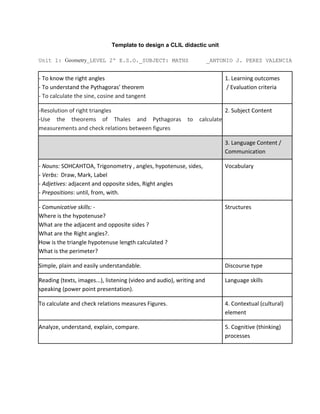
Template to design a CLIL didactic unit
Unit 1: Geometry_LEVEL 2º E.S.O._SUBJECT: MATHS _ANTONIO J. PEREZ VALENCIA
1. Learning outcomes
/ Evaluation criteria
- To know the right angles
- To understand the Pythagoras’ theorem
- To calculate the sine, cosine and tangent
2. Subject Content-Resolution of right triangles
-Use the theorems of Thales and Pythagoras to calculate
measurements and check relations between figures
3. Language Content /
Communication
Vocabulary- Nouns: SOHCAHTOA, Trigonometry , angles, hypotenuse, sides,
- Verbs: Draw, Mark, Label
- Adjetives: adjacent and opposite sides, Right angles
- Prepositions: until, from, with.
Structures- Comunicative skills: -
Where is the hypotenuse?
What are the adjacent and opposite sides ?
What are the Right angles?.
How is the triangle hypotenuse length calculated ?
What is the perimeter?
Discourse typeSimple, plain and easily understandable.
Language skillsReading (texts, images...), listening (video and audio), writing and
speaking (power point presentation).
4. Contextual (cultural)
element
To calculate and check relations measures Figures.
5. Cognitive (thinking)
processes
Analyze, understand, explain, compare.
6. (a) Task(s)The following tasks will be performed:
1. – To calculate the vertical height of object from his shadow.
2. – To calculate the height of a vertical object with a mirror.
3. – To calculate the diagonal of the rectangle.
6. (b) Activitiesa) To prepare, in groups of four, presentations explaining the
Pythagoras’ theorem
b) To work in pairs an example of similarity between triangles
c) To complete different activities like: true or false, crosswords,
quizzes.
7. Methodology
Organization and class
distribution / timing
An active participation of the students will be looked for during the
classes; this will be mainly achieved completing tasks in pairs or groups
using the language resources.
A basic principle about the timing will be the flexibility based on the
different learning rhythms, diversity…
Resources / Materialshttp://es.slideshare.net/Ke4498/pythagorean-theorem-ppt
https://www.youtube.com/watch?v=AhFjfCdG61Y
To start with, the slides will be showed to the students for them to
learn the main vocabulary; after that the video will be reproduced and
discussed in pairs.
Key CompetencesMaths, linguistic, physical world, data processing and digital, social and
civic, cultural and artistic, learning to learn, autonomy and personal
initiative.
8. Evaluation (criteria
and instruments)
It will be an ongoing, comprehensive, educational, unifying, individual
and differentiated evaluation.
Evaluation criteria:
-To estimate and calculate lengths, areas and volumes of shapes and
elementary and composite figures . Use measuring instruments and
precision units in accordance with the situation arising when calculating
these quantities in real situations correctly.
-To get measures it indirectly using the theorems of Thales , Pythagoras
or reasons of similarity and scaling factors.
Evaluation instruments:
An ongoing assessment will be performed during the teaching unit for
each student which will include both oral and written tests, practical
activities, interest, participation, teamwork, behaviour and attendance.
Also, at the end of the topic the students will take a cumulative test.

Ud aicle final

  • 1.
    Template to designa CLIL didactic unit Unit 1: Geometry_LEVEL 2º E.S.O._SUBJECT: MATHS _ANTONIO J. PEREZ VALENCIA 1. Learning outcomes / Evaluation criteria - To know the right angles - To understand the Pythagoras’ theorem - To calculate the sine, cosine and tangent 2. Subject Content-Resolution of right triangles -Use the theorems of Thales and Pythagoras to calculate measurements and check relations between figures 3. Language Content / Communication Vocabulary- Nouns: SOHCAHTOA, Trigonometry , angles, hypotenuse, sides, - Verbs: Draw, Mark, Label - Adjetives: adjacent and opposite sides, Right angles - Prepositions: until, from, with. Structures- Comunicative skills: - Where is the hypotenuse? What are the adjacent and opposite sides ? What are the Right angles?. How is the triangle hypotenuse length calculated ? What is the perimeter? Discourse typeSimple, plain and easily understandable. Language skillsReading (texts, images...), listening (video and audio), writing and speaking (power point presentation). 4. Contextual (cultural) element To calculate and check relations measures Figures. 5. Cognitive (thinking) processes Analyze, understand, explain, compare.
  • 2.
    6. (a) Task(s)Thefollowing tasks will be performed: 1. – To calculate the vertical height of object from his shadow. 2. – To calculate the height of a vertical object with a mirror. 3. – To calculate the diagonal of the rectangle. 6. (b) Activitiesa) To prepare, in groups of four, presentations explaining the Pythagoras’ theorem b) To work in pairs an example of similarity between triangles c) To complete different activities like: true or false, crosswords, quizzes. 7. Methodology Organization and class distribution / timing An active participation of the students will be looked for during the classes; this will be mainly achieved completing tasks in pairs or groups using the language resources. A basic principle about the timing will be the flexibility based on the different learning rhythms, diversity… Resources / Materialshttp://es.slideshare.net/Ke4498/pythagorean-theorem-ppt https://www.youtube.com/watch?v=AhFjfCdG61Y To start with, the slides will be showed to the students for them to learn the main vocabulary; after that the video will be reproduced and discussed in pairs. Key CompetencesMaths, linguistic, physical world, data processing and digital, social and civic, cultural and artistic, learning to learn, autonomy and personal initiative. 8. Evaluation (criteria and instruments) It will be an ongoing, comprehensive, educational, unifying, individual and differentiated evaluation. Evaluation criteria: -To estimate and calculate lengths, areas and volumes of shapes and elementary and composite figures . Use measuring instruments and precision units in accordance with the situation arising when calculating
  • 3.
    these quantities inreal situations correctly. -To get measures it indirectly using the theorems of Thales , Pythagoras or reasons of similarity and scaling factors. Evaluation instruments: An ongoing assessment will be performed during the teaching unit for each student which will include both oral and written tests, practical activities, interest, participation, teamwork, behaviour and attendance. Also, at the end of the topic the students will take a cumulative test.