Market turbulence accelerates diverging fortunes
Billionaires insights 2020
Riding
the storm
A few words about our research
This is the seventh of our reports on billionaire wealth, continuing our investigation into this
historic era of wealth generation. Our research universe covers more than 2,000 billionaires
from 43 markets in the Americas, EMEA and APAC, looking back over more than two decades.
Our database includes the 43 largest billionaire markets, which account for around 98%
of global billionaire wealth. Further, weโ€™ve conducted about 60 conversations with billionaires.
Our research sources include PwC billionaire data and UBS sustainability ratings. Additionally,
reflecting the transformative effect of COVID-19 on billionaire wealth, where relevant we have
extended this yearโ€™s standard annual study period that ends on 7 April 2020 to include
the five extra months to 31 July 2020. UBS and PwC advise a large number of the worldโ€™s
wealthy, and have unique insights into their changing fortunes and needs.
(For more information see our disclaimer on page 42.)
Foreword
Executive summary
Section 1:
The great polarization
Section 2:	
Bringing innovation
to philanthropy
and sustainability
Section 3:	
Turbulence in
an uncertain and
fast-changing
world
Section 4:	
Looking forward:
emerging from
the storm
5
6
11
27
32
39
Content
Josef Stadler
Head Global Family Office
UBS Global Wealth Management
Marcel Tschanz
Head of Banking Advisory
PwC Switzerland
Riding the storm Riding the storm
4 5
Foreword
We have covered a wide range of developments since this report began
in 2015, but some themes have remained prominent: the rise of China,
the โ€œAthena factor,โ€ the growing influence of billionaires on philanthropy
and the polarization of the billionaire community.
	 It is this last theme that we revisited in a year of dramatic and
far-reaching upheaval. It has been remarked that the 2020 pandemic has
created decades of change in just a few months. Billionaires have
been no exception to this.
	 We have seen before how a cohort of billionaire innovators and
disruptors, active in tech, healthcare and industry, have contributed
to reshaping the economy. COVID-19 accelerated this trend dramatically:
by demonstrating the value of the digital world they helped to create,
they were able to decisively pull ahead of the pack as they increased their
wealth while othersโ€™ fell. This is a key moment in economic history,
a time of exceptional, Schumpeterian creative destruction. Scientists,
computer programmers and engineers are revolutionizing industries
at a pace never seen before and they are having a profound impact on
the whole of the global economy.
	 Their influence has ranged well beyond business too. As well
as being some of the most generous donors in the heat of the pandemic,
they are bringing innovation to philanthropy to give it more strategic
impact and raising their game on environmental and social responsibility.
	 But it has not all been outward-facing. According to our survey
of PwC Partners who work with billionaires, like many of us they found time
during lockdown to discuss family arrangements and reflect on mortality
while reassessing their business and investment strategies. There has been
a notable uptick in succession planning as a result.
	 Hinge moments like wars or pandemics tend to speed up change
and leave a lasting impression in all walks of life. As with the aftermath of
a storm they also call for renewal and reinvention. This billionaire
community is likely to show the way in that effort too. The next generation
of entrepreneurs is set to offer its unique perspective on this โ€œnew
normalโ€ and, with that, support a new era of innovation and change.
1

As at 31 July 2020, the number of billionaires was 2,189. The billionaire
population grew by 131 during the period when financial markets
rebounded in 2020. There were 2,058 billionaires just four months earlier on
7 April 2020 which is our standard cut-off date. For this yearโ€™s research
we have extended it to 31 July 2020, to take into account the transformative
effect of COVID-19.
2

UBS and PwC extended their normal 12-month period of research to
take into account the transformative impact of COVID-19.
Riding the storm Riding the storm
6 7
Wealth reaches new heights
Total billionaire wealth reached
USD 10.2 trillion at the end of July
2020, touching a new high after
the yearโ€™s V-shaped rebound in
asset prices. This level surpasses the
previous peak of USD 8.9 trillion,
reached at the end of 2017.
There are now 2,189 billionaires,1
up from 2,158 in 2017.
Philanthropy and sustainability
pioneers
A small group of billionaires is
pioneering innovation in philanthropy,
while pursuing sustainability goals
across their corporate and investment
activities. Increasingly, theyโ€™re
setting a benchmark for others by
bringing their originality to
philanthropy and introducing new
objectives to the companies
theyโ€™re associated with, as well
as their investments.
Polarizing fortunes
Fortunes are polarizing as business
innovators and disruptors deploy
technology to be among the leaders
of todayโ€™s economic revolution.
During 2018, 2019 and the first
seven months of 2020, entrepreneurs
in the tech, healthcare and
industrials sectors pulled ahead.2
The COVID-19 storm accelerated
the divergence.
Record-breaking donations
To tackle the pandemic, billionaires
have given more than ever before
in a space of a few months.
Some 209 billionaires have publicly
committed a total of USD 7.2 billion,
whether in financial donations,
manufactured goods and equipment,
or other commitments.
Innovators on the rise
Scientists, computer programmers
and engineers are revolutionizing
industries at a pace never seen
before. Their sphere of activity is
spreading from the tech and
healthcare sectors to disrupt many
parts of the economy. As they
apply emerging technologies
to drive change, some of them
are becoming billionaires.
Next generation of rebuilders
When the storm passes, a new
generation of billionaire innovators
looks set to play a critical role
in repairing the damage. Using the
growing repertoire of emerging
technologies, tomorrowโ€™s innovators
will digitize, refresh and revolutionize
the economy. Whether intentionally
or not, this has the potential
to help bridge financial, social and
environmental deficits.
Executive
summary
Riding the storm Riding the storm
8 9
โ€œ
The function of entrepreneurs
is to reform or revolutionize
the pattern of production
by exploiting an invention or,
more generally, an untried
technological possibility for
producing a new commodity
or producing an old one
in a new way, by opening up
a new source of supply of
materials or a new outlet for
products, by reorganizing
an industry and so on,โ€
Joseph Schumpeter, the Austrian economist who introduced the
concept of entrepreneurship and theory of creative destruction.
Riding the storm Riding the storm
10 11
Todayโ€™s billionaires live in turbulent but trailblazing times.
While the COVID-19 crisis dominates 2020, the potential for
transformative innovation has never been greater, as the
pipeline of fresh technologies grows by the day. From AI to
3D printing, from nanotechnology to biotechnology,
there is a wealth of emerging technologies that scientists and
serial entrepreneurs are just beginning to apply, to develop
radically new products and services, as well as to leapfrog
incumbent businesses.
The great
polarization
Section 1
3

โ€œProfit is the payment you get when you take advantage of change,โ€
Joseph Schumpeter.
4
 Cut-off date 31 July 2020.
5

Cut-off date 31 July 2020.
Riding the storm Riding the storm
12 13
Itโ€™s a time of accelerating change, reflected in
the polarizing fortunes of billionaires.
Those that are the innovators and
the disruptors, the architects of
creative destruction in the economy,
are still increasing their wealth.3
Other billionaires, on the wrong side of economic,
technological, societal and environmental trends
are becoming less wealthy.
	 Contrast this polarization with most of
the past decade, when steady growth and
buoyant asset prices lifted billionaire wealth in
all sectors. Most of the decade was a time
of exceptional prosperity for billionaires
regardless of sector, but in the last two years
those using technology to change their
business models, products and services have
pulled ahead. The COVID-19 crisis just
accentuated this divergence.
	 While business innovators and disruptors
are deploying technology for competitive
advantage across all sectors, naturally the heart-
land of this activity is the technology, healthcare
and industrial sectors, which clearly signal
the polarization taking place (see page 17, Whatโ€™s
a billionaire โ€œinnovatorโ€ or โ€œdisruptorโ€?).
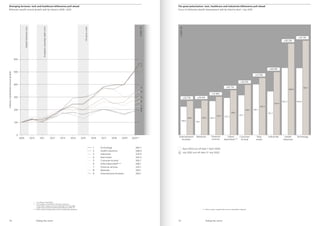
During 2018, 2019 and the first seven months
of 2020,4
technology billionairesโ€™ total wealth rose
by 42.5% to USD 1.8 trillion, supported by
the surge in tech shares. Meanwhile, healthcare
billionairesโ€™ total wealth increased by 50.3%
to USD 658.6 billion, boosted by a new age of
drug discovery and innovations in diagnostics
and medical technology, as well as latterly
COVID-19 treatments and equipment. (Note our
standard analysis period has been extended
to take into account the effects of COVID-19.)
	 Compare this to the smaller increase for
the billionaire class as a whole. It rose by
19.1% to USD 10.2 trillion over 2018, 2019 and
the first seven months of 2020.5
The net wealth of billionaires
in entertainment, financial services,
materials and real estate sectors
lagged the rest of the universe, with
increases of 10% or less.
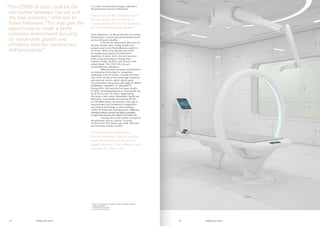
โ€œ
This COVID-19 crisis could be the
real border between the old and
the new economy,โ€reflected an
Italian billionaire.โ€œThis may give the
opportunity to create a better
economic environment focusing
on sustainable growth and
efficiency with less bureaucracy
and procedures.โ€
Oil
price
crash
European
sovereign
debt
crisis
Diverging fortunes: tech and healthcare billionaires pull ahead
Billionaire wealth annual growth split by industry 2009 โ€“2020
The great polarization: tech, healthcare and industrials billionaires pull ahead
Focus on billionaire wealth development split by industry April โ€“ July 2020
0
100
2010 2011 2012 2013 2014 2015 2016 2017 2018 2020**
2019*
2009
600
1
2
3
4
5
6
7
8
9
1	Technology	 565.7
2	 Health industries	 548.0
3	Industrials	 376.9
4	 Real estate	 342.5
5	 Consumer  retail	 300.1
6	Other/diversified***	 268.1
7	 Financial services	 229.1
8	Materials	 206.1
9	 Entertainment  media	 204.1
* Cut-off date 7 April 2020.
** 
Our standard cut-off date for this yearโ€™s research is
7 April 2020. However, we have extended it to 31 July 2020,
to take into account the transformative effect of COVID-19.
*** Other contains conglomerates and non-attributable categories. *** Other contains conglomerates and non-attributable categories.
Global
financial
crisis
COVID-19
COVID-19
400
500
300
200
Industry
standardized
annual
growth
Other/
diversified***
April 2020 (cut-off date 7 April 2020)
July 2020 (cut-off date 31 July 2020)
Entertainment
 media
168.6
204.1
+20.7%
Materials
159.1
206.1
+29.6%
Financial
services
203.5
229.1
+12.8%
222.3
268.1
+20.7%
237.7
300.1
Consumer
 retail
+26.0%
303.1
342.5
Real
estate
+12.9%
261.3
376.9
Industrials
+44.4%
402.3
548.0
Health
industries
+36.3%
400.9
565.7
Technology
+41.1%
Riding the storm Riding the storm
14 15
Whatโ€™s a billionaire
โ€œinnovatorโ€ or โ€œdisruptorโ€?
Drones
Internet
of Things
3D
printing
Robotics
Artificial
intelligence
Augmented
reality
Block
chain
Virtual
reality
Emerging
technologies
Digital experience
Digital infr
a
s
t
r
u
c
t
u
r
e
T
e
c
h
n
o
l
o
g
y
ecosystems
Cloud  big data
C
u
s
t
o
m
e
r
centricity Agile opera
t
i
n
g
m
o
d
e
l
Riding the storm Riding the storm
16 17
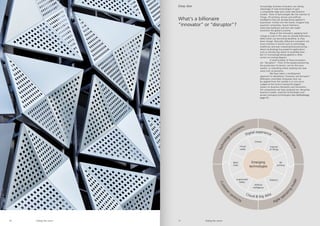
Increasingly, business innovators are taking
advantage of new technologies to gain
a competitive edge and create new business
models. Think of technologies like the Internet of
Things, 3D printing, drones and artificial
intelligence that are already being applied in
businesses. Further into the future, imagine how
quantum computing, neural interfaces,
solid-state batteries and fuel cells might
transform the global economy.
	 Many of the innovators applying tech-
nology at scale in this way are already billionaires,
while others are becoming wealthier as they
drive change. Naturally, billionaire innovators are
most common in sectors such as technology,
healthcare and even industrials/manufacturing โ€“
where technology has powerful applications
such as introducing robots to assembly lines โ€“
but itโ€™s increasingly being applied in other
sectors to varying degrees.
	 A small number of these innovators
are โ€œdisruptorsโ€. Think of the people pioneering
the production of electric cars for the mass
market, or extending online retailing into new
areas such as groceries.
	 We have taken a multilayered
approach to identifying โ€œinnovator and disruptorโ€
billionaire-controlled companies that can
be applied from the outside in or vice versa.
Judged as the factors having the biggest
impact on business disruption and innovation,
the components we have analyzed are: disruptive
business models, essential technologies and
proven emerging technologies (see methodology
page 41).
Deep dive
6

This analysis extends to the 31 July 2020 cut-off date. It goes beyond our
standard 12-month series analysis period in order to include the exceptional
events following the outbreak of the COVID-19 pandemic. See page 41 for
a description of PwCโ€™s methodology for defining innovators and disruptors.
+774 bn
+210 bn
Riding the storm Riding the storm
18 19
Scientists, computer programmers and
engineers revolutionize industries
Scientists, computer programmers and software
engineers are becoming serial entrepreneurs,
as they exploit novel technologies to develop new
products, services and business models. Theyโ€™re
the innovators using a growing warehouse of new
technologies for a business revolution thatโ€™s
beginning to ripple out across sectors, creating
new businesses and new wealth, with benefits
for themselves and broader society.
	 These individuals continued to progress
across 2018, 2019 and the turbulent year of
2020. Over this time, the billionaires falling within
our definition of innovators and disruptors
grew their wealth by 17% to USD 5.3 trillion,
while traditional billionairesโ€™ wealth increased by
a smaller 6% to USD 3.7 trillion.6
(This analysis
only takes into account the people who
were billionaires at the beginning of 2018.)
Looking at this from a sector perspective, naturally
most of the tech (94%) and healthcare (71%)
sector billionaires are among these innovators
and disruptors, according to our analysis.
Even long-established billionaire-controlled
tech companies are revolutionizing their sectors
from within, changing rapidly. For instance,
software giants such as Microsoft and Oracle โ€“
both effectively โ€œbillionaire factories,โ€ having
hatched several billionaires โ€“ are quickly moving
into areas such as AI, cloud computing and
software as a service.
Healthcare billionaires are some
of the past two yearsโ€™ biggest gainers,
especially Mainland Chinaโ€™s health
industry leaders, who have ridden a
surge in the countryโ€™s drug
and medical devices industries.
Notably, Hansoh Pharmaceutical listed on the
Hong Kong Stock Exchange in 2019, propelling its
founder and CEO, Zhong Huijhan, a former
chemistry teacher, to the position of the worldโ€™s
most wealthy healthcare billionaire. Toward
the end of the period, the pandemic boosted the
wealth of healthcare executives holding shares
in drug and medical device companies developing
coronavirus vaccines and therapeutic drugs,
as well as medical devices such as ventilators.
Innovators  disruptors
2019
2018
2019
2018 2020
2020
Traditional billionaires
3,089 bn
3,458 bn
4,080 bn
4,510 bn
5,284 bn
3,668 bn
Innovators and disruptors outperform
Analysis only takes into account the people who were billionaires
at the beginning of 2018 and still are as of 2020
Cut-off date 31 July 2020
Technology 	 94%
Health industries 	 71%
Entertainment  media 	 61%
Industrials 	 54%
Other/diversified 	 48%
Materials 	 43% 	57%
	52%
	46%
	39%
	29%
Financial service	 37% 	63%
Real estate 17% 	83%
Consumer  retail	 41% 	59%
6%
Innovators: common in tech, rare in real estate
Share of innovators and disruptors/traditional billionaires per industry
Cut-off date 31 July 2020
Innovators  disruptors Traditional billionaires
Riding the storm Riding the storm
20 21
Some of the people who have prospered
most in the last few years include well-known
innovators and disruptors from across the
economy. They include Elon Musk, the economist
and physicist behind Tesla and SpaceX. Officially
defined as an industrial sector billionaire,
Muskโ€™s companies are respectively pioneering
the mass-market electric car and private
space travel. In Mainland China, Frank Wang,
an engineer, is the worldโ€™s first drone
billionaire, as founder and CEO of tech company
DJI, the worldโ€™s largest manufacturer of
commercial drones. Finally, one of Europeโ€™s
leading young innovators is Patrick Collison,
an Irish computer programmer who cofounded
the Stripe software platform for internet
businesses with his brother in 2010.
	 Yet this wave of innovation has still
to reach some. Within real estate, for instance,
we have identified just 17% of billionaires as
innovators and disruptors, as the sector has been
especially slow to embrace technology to
boost efficiency. Financial services has the next
lowest share of innovators and disruptors,
at 37%.
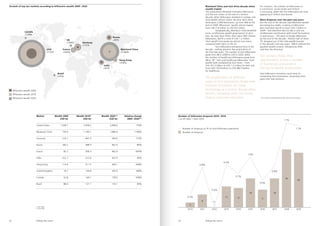
Growth of top ten markets according to billionaire wealth 2009 โ€“2020
Canada
+238%
USA
+170%
Brazil
+99%
India
+90%
France
+439%
UK
+168% Germany
+175%
Billionaire wealth 2009
Billionaire wealth 2019
Billionaire wealth 2020
Russia
+80%
Mainland China
+1146%
Hong Kong
+208%
Market	 Wealth 2009	 Wealth 2019*	 Wealth 2020**	 Relative change
	 USD bn	 USD bn	 USD bn	 2009 โ€“2020**
United States	 1,338.7 	 2,958.2 	 3,608.6 	 170%
Mainland China	 134.9 	 1,190.1 	 1,680.9 	 1146%
Germany	 216.1 	 447.0 	 594.9 	 175%
Russia	 260.2 	 388.9	 467.6 	 80%
France	 82.2 	 304.3 	 442.9 	 439%
India	 222.1 	 312.6 	 422.9	 90%
Hong Kong	 115.6 	 311.5 	 356.1	 208%
United Kingdom	 76.7 	 159.8 	 205.9 	 168%
Canada	 52.8 	 144.1	 178.5 	 238%
Brazil	 88.6 	 127.1 	 176.1 	 99%
7
This analysis excludes billionaires who died during the period.
*
7 April 2020
**
31 July 2020
Riding the storm Riding the storm
22 23
Mainland China and tech drive decade when
wealth tripled
This polarization between innovator billionaires
and the rest comes at the end of a historic
decade, when billionaires doubled in number and
total wealth almost tripled. By early April 2020,
there were 2,058 billionaires, up from 969 at the
end of 2009. Billionairesโ€™ wealth almost tripled,
from USD 2.8 trillion to USD 8.0 trillion.
	 Geographically, Mainland China benefited
most, as billionaire wealth grew fastest of all in
Asia. By early April 2020, there were 389 Chinese
billionaires, worth a total of USD 1.2 trillion.
Their wealth had grown by almost nine times,
compared with twice in the US.
	 Tech billionaires prospered most in the
decade โ€“ pulling ahead in the polarization of
the final two years. The number of tech billionaires
grew from 68 in 2009 to 234 in 2020, while
the number of healthcare billionaires grew from
48 to 167. Tech and healthcare billionairesโ€™ total
wealth both multiplied by four times โ€“ from
USD 321.3 billion to USD 1.3 trillion for tech and
from USD 120.8 billion to USD 482.9 billion
for healthcare.
The proliferation of different
types of tech businesses shows how
business innovators are using
technology as a tool to disrupt other
sectors, including retail, the media,
finance and even education.
For instance, the number of billionaires in
e-commerce, social media and FinTech
is increasing, while the first billionaires are now
appearing in EdTech and drones.
More dropouts over the past two years
But the end of the decade saw billionaire wealth
becoming less stable. Looking at billionaires
who had been worth at least USD 2 billion in
2009 โ€“ and therefore did not dip in and out
of billionaire classification with small fluctuations
in asset prices โ€“ 153 were no longer billionaires
by the end of the decade.7
Almost half of them,
70, dropped out of this elite wealth bracket
in the decadeโ€™s last two years. EMEA suffered the
greatest wealth erosion, followed by APAC
and then the Americas.
Our analysis shows that
diversification across a number
of businesses and assets is
the key to wealth preservation.
Even billionaire innovators must keep on
reinventing their businesses, reinvesting their
gains into new ventures.
Number of billionaire dropouts 2010 โ€“ 2019
Cut-off date 7 April 2020
3
11
13
34
8
18
12
36
18
2010 2011 2012
0
0.0%
0.8%
0.3%
0.9%
0.7%
1.0%
0.6%
0.8%
1.7%
1.7%
2013 2014 2015 2016 2017 2018 2019
Number of dropouts as % of total billionaire population
Number of dropouts
Share of billionaire wealth invested in real estate
Analysis period March to June 2020 (number of observations = 84)
0% 1โ€“20% 21โ€“40% 41โ€“60% 61โ€“80% 81โ€“100%
1.3%
26.3%
48.8%
17.5%
2.5%
3.8%
Real estate plays
a fundamental role
The billionaire class has a love affair with real
estate as a store of value and an asset that can be
transferred to successors. Our 2020 PwC
Partner Survey (see page 37) suggests that
approximately half of all billionaires โ€“
regardless of the business sector they originate
from โ€“ have 21โ€“40% of their net wealth
invested in real estate.
	 Real estate was a profitable place
to be over the last decade, as falling interest rates
and buoyant demand for physical space
supported asset prices generally until the onset
of the COVID-19 crunch.
	 The 64 individuals who were real
estate billionaires in 2009 โ€“ having real estate
businesses or a major part of their assets
in the sector โ€“ went on to double their wealth
over the decade. Their total wealth doubled from
USD 150.4 billion to USD 303.0 billion.
	 APACโ€™s real estate tycoons led the way,
masterminding the decadeโ€™s huge urban
development and riding the regionโ€™s asset price
rises. Their average individual wealth more
than tripled, while that of their US peers more
than doubled, as did that in EMEA although
from a lower base.
	 Within real estateโ€™s subsectors,
developers increased their wealth by more than
156% in the decade. They were closely
followed by builders of capital projects, who
almost doubled their wealth.
	 But by the end of the decade,
challenges were mounting as the global pandemic
undermined demand for commercial real estate,
and an increasingly digital economy undermined
demand for physical space.
	 Real estate billionaires expressed
diverging views. โ€œIf the real estate situation looks
bad from the outside in, itโ€™s actually
worse from the inside,โ€ said a Thai billionaire.
	 However, a German billionaire was
more sanguine. โ€œReal estate got sucker punched
but you have to stay on your feet and swiftly
identify coming opportunities,โ€ he contended.
โ€œThe future of work will look different, and
offices are still a major opportunity for investors.โ€
Riding the storm Riding the storm
24 25
Deep dive
Riding the storm Riding the storm
26 27
Bringing
innovation to
philanthropy
and sustainability
Section 2
Billionaires are becoming more active across philanthropy,
corporate sustainability and sustainable investing.
They are even introducing innovation. Up until fairly recently,
individual billionaires tended to focus on philanthropy alone.
8
From 1850 โ€“1940.
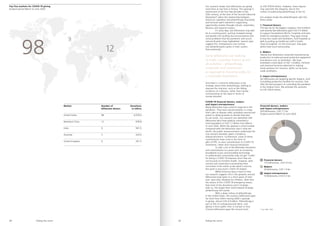
Top five markets for COVID-19 giving
Analysis period March to June 2020
98
2
9
9
12
Market	 Number of	 Donations
	 billionaire donors	 in USD m
United States	 98	 4,578.6
Mainland China	 12	 678.8
India	9	541.0
Australia	2	 324.0
United Kingdom	 9	 297.5
Riding the storm Riding the storm
28 29
Our research shows that billionaires are giving
more than at any time in history. The upsurge is
reminiscent of the first few decades of the
20th century, at the time of the Second Industrial
Revolution8
, when the relationship between
American capitalism and philanthropy flourished,
and fortunes were invested in supporting
opportunity creation through schools, universities,
libraries and research centers.
	 Itโ€™s early days, but billionaires may well
be at a turning point, putting renewed energy
and wealth into tackling the environmental and
social problems that the pandemic and recent
natural disasters have highlighted. Several signs
suggest this. Entrepreneurs are turning
into philanthropists earlier in their careers
than previously.
Some billionaires are seeking
to make a positive impact across
all activities โ€“ philanthropy,
corporate and investment โ€“
as opposed to focusing solely on
a charitable foundation.
And thereโ€™s a trend for billionaires to be
strategic about their philanthropy, seeking to
improve the outcome, such as the falling
incidence of a disease, rather than merely
concentrating on the input in terms of
money donated.
COVID-19 financial donors, makers
and impact entrepreneurs
Many billionaires have acted to respond to the
pandemic. They have reacted quickly, in a way
thatโ€™s akin to disaster relief, providing unrestricted
grants to allow grantees to decide how best
to use funds. Our research has identified 209
billionaires who have publicly committed a
total equivalent to USD 7.2 billion from March
to June 2020. While this appears a small number
compared with the billionaire classโ€™s total net
worth, the public announcements understate the
true amount donated, given a tendency
toward discretion. Furthermore, some of these
commitments have come in the form of
gifts of PPE, or even commitments to COVID-19
treatments, rather than financial donations.
	 To add, a lot of the billionaire donations
and commitments to causes such as increasing
broadband access and providing technology
to underserved communities may not get โ€œcreditโ€
for being a COVID-19 response since they are
not focused on frontline health. However, with
schools and universities transitioning their
curriculum to be online as we await a vaccine,
this work is very much COVID-19 related.
	 While historical data is hard to find,
our research suggests this is the greatest amount
billionaires have given in a short space of time
ever, even after allowing for inflation. Note that
the nature of the COVID-19 emergency means
that most of the donations arenโ€™t strategic โ€“
even so, the longer-term trend toward strategic
philanthropy still stands.
	 With a deep culture of philanthropy
in the United States, the countryโ€™s billionaires gave
far more than others during 2020โ€™s upsurge
in giving, almost USD 4.6 billion. Philanthropy is
part of the US entrepreneurial fabric, and
giving is more public than in Europe or Asia.
Chinese billionaires gave the second most,
at USD 678.8 million. However, these figures
may overstate the disparity, due to the
culture of publicizing philanthropy in the US.
Our analysis shows the philanthropists split into
three camps:
1. Financial donors
This was by far the biggest category. One hundred
and seventy-five billionaires gave USD 5.5 billion
to support foundations/NGOs, hospitals and even
hotels for emergency workers. They gave money
to buy face masks and ventilators, fund hospitals as
well as putting up healthcare staff in hotels
close to hospitals. For the most part, they gave
within their local communities.
2. Makers
Twenty-four billionaires converted manufacturing
production to make personal protective equipment
and devices such as ventilators. We have
estimated a total value of USD 1.4 billion. Perfume
and chemical factories switched to making
hand sanitizers for instance, while car factories
made ventilators.
3. Impact entrepreneurs
Ten billionaires are targeting specific impacts, such
as building production facilities for vaccines, that
offer the best prospect of controlling the pandemic
in the medium term. We estimate this amounts
to USD 336.6 million.
Financial donors, makers
and impact entrepreneurs
209 billionaires, USD 7.2 bn
Analysis period March to June 2020
19%
76%
5%
Financial donors
175 billionaires, USD 5.5 bn
Makers
24 billionaires, USD 1.4 bn
Impact entrepreneurs
10 billionaires, USD 0.3 bn
Riding the storm Riding the storm
30 31
A new cadre optimizes impact across
all activities
Just as billionaires are among the innovators
disrupting traditional business models, so too
a small number appear to be philanthropy
leaders โ€“ often through strategically prioritizing
outputs over inputs โ€“ and at the forefront of
balancing corporate, environmental and social
values with corporate profitability.
	 A small group of them stand out as
maximizing their net impact across all activities โ€“
philanthropy, their business interests and
even their investments. The top ten billionaire-
controlled9
companies ranked by sustainability
performance10
are almost all associated with
billionaires who are also COVID-19 donors and
venture capital investors in clean tech businesses.
Nine of the 10 are COVID-19 donors and
seven also invest in clean tech.
	 Take Azim Premji, Chairman of Wipro,
for instance. Known as the leading figure in
Indiaโ€™s IT industry, heโ€™s behind the Azim Premji
Foundation, dedicated to education in India.
Turning to the Americas, David Duffield is a well-
known software entrepreneur, and the person
behind a foundation dedicated to animal welfare.
And, in EMEA, Anne Beaufour is the grand-
daughter of the founder of Ipsen, one of Franceโ€™s
largest pharmaceutical companies, as well
as a COVID-19 donor. Two of the three invest
in clean tech.
	 They remain exceptions, however,
as not all billionaire-controlled companies fare
well when measured on environmental,
social and governance (ESG) factors. Almost 500
(494) billionaire-controlled publicly listed
companies received a sustainability score from
UBS. Their average score is 3.1 (out of 10)
compared with an average of 5.2 for the MSCI
AC World Index stocks.
	 When it comes to investment, our
analysis focuses on clean tech because the
transparency around clean tech investing allows
us to identify the billionaire investors.
Billionaires are also involved in other areas
of impact investing.
โ€œThis crisis has reiterated
the importance of using our
โ€œpurposeโ€ and โ€œvaluesโ€
as our guiding principles,โ€
asserted a US billionaire. โ€œIt isnโ€™t about what
we could do, but what we should do to assist
those around us. It also has provided a prime
example to our next generation about how to use
these principles for the betterment of society.โ€
	 This may be the beginning of a
new dawn. What are its defining characteristics?
A rise in the amount of philanthropy. More
strategic philanthropy. A drive to do better across
all activities โ€“ philanthropy, the business
and investments. And greater use of technology,
notably through clean tech investing.
From corporate ESG, to COVID-19, to clean tech
Billionaire name	 Company name	 Area	 Sustainability	 Donations	 Investing in
			 Headline Score 	 to COVID-19	 clean tech
			(ESG)
Azim Premji	 Wipro	 APAC	 7.78	 Yes	 Yes
Antti Herlin  Ilkka Herlin	 Kone Corporation	 EMEA	 7.38	 Yes	 Yes
Ludwig Merckle	 Merckle Group	 EMEA	 7.33	 No	 No
Anne Beaufour	 Ipsen	 EMEA	 7.32	 Yes	 Yes
David Duffield	 Workday	 Americas	 7.26	 Yes	 No
Frits Goldschmeding	 Randstad Holding	 EMEA	 7.06	 Yes	 Yes
Stefan Quandt	 BMW	 EMEA	 6.94	 Yes	 Yes
Peter Woo  family	 Wheelock and Company Limited*	 APAC	 6.93	 Yes	 Yes
Bernard Arnault  family	 LVMH	 EMEA	 6.91	 Yes	 Yes
Joe Mansueto	 Morningstar Inc.	 Americas	 6.88	 Yes	 No
Note: the ESG scores refer to companies controlled by billionaires
9
 
For the sake of our analysis, we have assumed holding 30% of the voting
rights and 20% of the shares of a company gives an individual control.
10
 
Using UBS CIO research methodology, see page 41.
* 
Although Wheelock and Company Limited was publicly listed during the time of
analysis, the companyโ€™s shareholders have recently agreed to its privatization.
Riding the storm Riding the storm
32 33
As the pandemic proliferated in the first few months of
2020, it virtually shut down parts of the global economy,
sparking a storm in equity markets. Just a few extraordinary
weeks in February and March 2020 caused billionaire
wealth to fall 6.6% over 2019 and early 2020, by USD 564.0
billion, to USD 8.0 trillion.11
The number of individual
billionaires fell by 43 to 2,058.
Turbulence in
an uncertain and
fast-changing
world
Section 3
11

Cut-off date 7 April 2020.
COVID-19
Billionaires
wealth
in
USD
trn
MSCI
ACWI
Index
Global
financial
crisis
European
sovereign
dept
crisis
Oil
price
crash
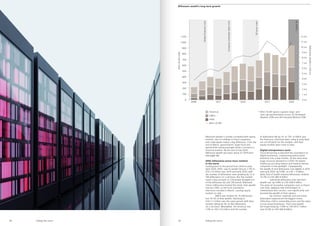
Billionaire wealthโ€™s long-term growth
2008 2011 2014 2017 2020
1,100
1,000
900
800
700
600
500
400
300
200
100
12 trn
11 trn
10 trn
9 trn
8 trn
7 trn
6 trn
5 trn
4 trn
3 trn
2 trn
1 trn
0 trn
0
Americas
EMEA
APAC
MSCI ACWI*
* 
MSCI ACWI (gross) captures large- and
mid-cap representation across 23 Developed
Markets (DM) and 24 Emerging Markets (EM)
Riding the storm Riding the storm
34 35
Billionaire wealth is loosely correlated with equity
markets, due to holdings in listed companies,
and a few weeks makes a big difference. From the
end of March, governmentsโ€™ huge fiscal and
quantitative easing packages drove a recovery in
financial markets. By the end of July 2020,
billionaire wealth was back above its 2019 level
(see page 36).
APAC billionaires prove more resilient
in the storm
Looking back to the period from 2019 to early
April 2020, APAC saw its wealth fall just 2.1% to
USD 2.4 trillion over 2019 and early 2020, with
the number of billionaires even growing by 12 to
766 billionaires on a net basis. But this number
masks a big turnover as 124 people dropped out
of the billionaire list and 136 joined. Mainland
Chinaโ€™s billionaires bucked the trend: their wealth
rose by a fifth, as the local coronavirus
infections receded in March, causing equity
markets to rally.
	 EMEA was hardest hit. Its billionaires
lost 10.1% of their wealth, declining to
USD 2.2 trillion over the same period, with their
number falling by 36, to 562 billionaires,
on a net basis. Meanwhile, the Americas lost
7.4% to USD 3.4 trillion and the number
of billionaires fell by 19, to 730. In EMEA and
the Americas, infections were rising in early April,
our cut-off point for this analysis, and their
equity markets were close to lows.
Digital entrepreneurs excel
Social distancing accelerated the ascendance of
digital businesses, compressing several yearsโ€™
evolution into a few months. At the same time,
huge resources devoted to COVID-19-related
healthcare put drug makers and medical devices
companies in the spotlight. Consequently,
the wealth of tech billionaires rose slightly in 2019
and early 2020, by 0.8%, to USD 1.3 billion,
while that of health industry billionaires climbed
10.2% to USD 482.9 billion.
	 Industrials billionaires also saw their
wealth rise, by 4.8% to USD 638.0 billion.
The value of innovative companies such as Dyson
and Tesla, applying new technologies to
revolutionize their sectors, rose significantly and
boosted the wealth of their owners.
	 By contrast, materials and real estate
billionaires experienced the biggest losses,
reflecting a fall in commodity prices and the value
of real estate businesses. Their total wealth
fell respectively by 17.8% to USD 873.7 billion
and 16.6% to USD 665.8 billion.
Fortunes fluctuate on the rebound
Billionaires wealth split by industry USD bn
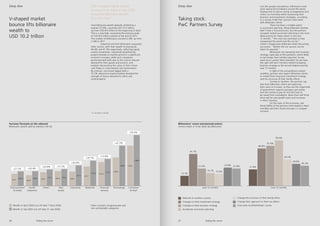
Billionairesโ€™ recent and planned actions
Actions taken or to be taken by billionaires
past 12 months next 12 months
13.1%
41.7%
22.6%
16.7% 15.5%
23.8% 22.6% 21.4%
48.8%
52.4%
59.5%
34.5%
28.6%
26.2%
Wealth in April 2020 (cut-off date 7 April 2020)
Wealth in July 2020 (cut-off date 31 July 2020)
*
Other contains conglomerates and
non-attributable categories
Relocate to another country
Changes to their investment strategy
Changes to their business strategy
Accelerate succession planning
Change the structure of their family office
Change their approach to their tax affairs
Give more to philanthropic causes
V-shaped market
bounce lifts billionaire
wealth to
USD 10.2 trillion
Taking stock:
PwC Partners Survey
The V-shaped equity market
recovery from April to July 2020
propelled billionaire wealth
to a new high.12
Total billionaire wealth globally climbed by a
quarter (27.5%), reaching USD 10.2 trillion,
up from USD 8.0 trillion at the beginning of April.
This is a new high, surpassing the previous peak
of USD 8.9 trillion reached at the end of 2017.
The number of billionaires reached 2,189, up from
2,158 in 2017.
	 Industrial and tech billionaires surpassed
other sectors, with their wealth increasing by
44.4% and 41.3% respectively, reflecting equity
market movements. Industrials benefited dis-
proportionately as markets priced in a significant
economic recovery, while tech companies
performed well both due to the corona-induced
demand for their goods and services, and
markets discounting the value of their future
cash flows in a low interest rate environment.
By contrast, real estate lagged with a
13.2% rebound as equity markets doubted the
strength of future demand for office and
retail property.
Just like people everywhere, billionaires took
stock during the lockdowns around the world,
finding time to discuss family arrangements and
reflect on mortality while reassessing their
business and investment strategies, according
to a survey of 84 PwC partners who work
with billionaire clients.
	 There has been a notable uptick
in succession planning. Many billionaire families
didnโ€™t have a formal process, but the partners
surveyed ranked succession planning as the most
likely priority for these clients in the next
12 months. โ€œThe crisis has reminded us how
unexpected the world and life can be,โ€
noted a Singaporean billionaire when discussing
succession. โ€œNeither life nor success can be
taken for granted.โ€
	 Billionaires are reviewing their business
strategy, especially as the pandemic seems likely
to last longer than initially expected. Do we
need more capital? More liquidity? Do we have
the right skill sets? Partners ranked reviewing
business strategy as the second highest priority
over 12 months.
	 In light of the extraordinary market
volatility, partners also expect billionaire clients
to review their long-term investment strategy
and the structure of their family offices.
	 Turning to taxation, the partners say
that their billionaire clients are expecting
their taxes to increase, as they see the magnitude
of government support packages and realize
that the money to pay for this will have to
be raised from somewhere. More than half think
there will be new wealth taxes and increases
in direct taxation.
	 On the topic of the economy, two
thirds (66%) of the partners interviewed in April
and May said their clients foresaw a U-shaped
recovery.
Deep dive
Deep dive
12

31 July 2020 cut-off date.
Entertainment
 media
1,810.1
2,288.5
Consumer
 retail
+26.4%
638.0
921.4
Industrials
+44.4%
1,280.5
1,809.6
Technology
+41.3%
665.8
753.4
Real
estate
+13.2%
1,074.2
1,211.3
Financial
services
+12.8%
610.5
737.2
Other*
+20.8%
873.7
1,133.0
Materials
+29.7%
482.9
658.6
Health
industries
+36.4%
537.1
650.8
+21.2%
Riding the storm Riding the storm
36 37
Riding the storm Riding the storm
38 39
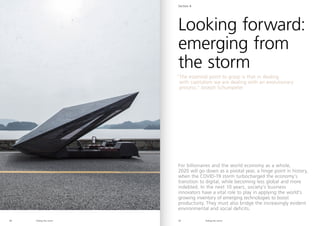
Looking forward:
emerging from
the storm
Section 4
โ€œ
The essential point to grasp is that in dealing
with capitalism we are dealing with an evolutionary
process,โ€ Joseph Schumpeter
For billionaires and the world economy as a whole,
2020 will go down as a pivotal year, a hinge point in history,
when the COVID-19 storm turbocharged the economyโ€™s
transition to digital, while becoming less global and more
indebted. In the next 10 years, societyโ€™s business
innovators have a vital role to play in applying the worldโ€™s
growing inventory of emerging technologies to boost
productivity. They must also bridge the increasingly evident
environmental and social deficits.
Riding the storm Riding the storm
40 41
Innovators and disruptors will expand their
businesses exponentially, using emerging tech-
nologies as raw materials, eventually transporting
disruption to all sectors. Taking data as a
proxy for the magnitude of the digital revolution,
the World Economic Forum forecasts that by
2025 an estimated 463 exabytes of data will be
created every day โ€“ as recently as 2012, the
entire digital universe contained 2,700 exabytes.
But as with any industrial revolution, there
will be billionaire businesses trapped in struggling
sectors. There will be winners and losers โ€“
new billionaires and more dropouts.
	 A less global world will stir headwinds
for some, but it may create opportunities
for others. While global businesses will still sell
their products globally, they are already
localizing production.
	 Another possible headwind is higher
taxes. Will governments levy the superwealthy to
balance budgets? While governments every-
where may be considering wealth taxes, they are
often unpopular with the electorate and
donโ€™t raise significant amounts, as many politicians
understand. Stealth taxes such as financial
repression โ€“ keeping interest rates on savings
below inflation โ€“ seem more effective,
steadily repairing government finances. Further,
itโ€™s more politically expedient to raise existing
taxes such as income and capital gains tax than
to invent a new tax.
More than ever before, societyโ€™s business
innovators will be needed to balance societyโ€™s
books in the 2020s. Higher productivity is needed
to address the huge public financial deficits,
while taking care to reduce social inequality and
to tackle the environmental resource scarcity
by doing more with less. Increasingly billionaires
will seek to do this not just indirectly through
their businessesโ€™ economic contributions,
but directly through strategic philanthropy,
good corporate citizenship and impact investing.
The pandemic has opened their eyes.
As the storm passes, a new
generation of entrepreneurs looks
likely to digitize, refresh
and revolutionize the economy.
Expect continued acceleration.
In the words of a Chinese billionaire: โ€œContinue
innovation; always pursue improvement.โ€
UBS/PwC โ€œinnovators and
disruptorsโ€ framework
The UBS/PwC analysis framework takes a multi-
layered approach to identifying โ€œinnovator
and disruptorโ€ billionaire-controlled companies
that can be applied from the outside in or
vice versa. Judged as the factors having the
biggest impact on business disruption and
innovation, these components are: disruptive
business models, essential technologies
and proven emerging technologies.
1. Disruptive business models
Our research has analyzed companiesโ€™ business
models across four dimensions: customer
centricity, agile operating models, technology
ecosystems and digital infrastructure.
2. The โ€œEssential Eightโ€ technologies
PwCโ€™s technology team has identified what it
calls the โ€œEssential Eightโ€ technologies that
matter most for business over the next three to
five years. These are: (1) artificial intelligence;
(2) augmented reality; (3) blockchain; (4) virtual
reality; (5) drones; (6) Internet of Things;
(7) 3D printing; (8) robotics. The disruptive
potential of these technologies is maximized
when thereโ€™s a convergence between
digital experience, the cloud and big data.
3. โ€œEmergingโ€ technologies
We have additionally selected a further 40
proven โ€œemergingโ€ technologies that companies
are applying to achieve business innovation.
To be included in the innovator or disruptor
universe, a company should have both a disruptive
business model and apply at least one of the
technologies that we focus on. We have analyzed
this from financial statements as well as
publicly available information about research and
development. From this analysis we judge
that these factors either have or will have a
โ€œmaterialโ€ effect on a company.
UBS sustainability scores
UBS has developed an in-house proprietary
methodology to generate sustainability scores.
The process relies on data sourced from
multiple best-in-class ESG data providers, chosen
according to their area of expertise, covering
nearly 11,000 equity and bond issuers and 170
markets. The methodology is in line with
the Sustainability Accounting Standards Board
Materiality Map, which identifies the sustainability
issues that impact value creation and financial
performance. UBS has identified six key
sustainability topics that encompass the major
sustainable development challenges faced
by, and impacted by, both corporations and
governments. These topics have been
defined following a review of current frameworks
and practices in the sustainable investing
industry, the availability of reliable corporate
data on these topics, and feedback received
from investors.
Methodologies
Riding the storm
42
This document has been prepared by UBS AG,
its subsidiary or affiliate (โ€œUBSโ€), with the support
of PricewaterhouseCoopers firms (โ€œPwCโ€).
Certain information and data herein have been
sourced from Forbes Media LLC. This document
is for personal use only.
	 This document and the information
contained herein are provided solely for informa-
tional and/or educational purposes. Nothing
in this document constitutes investment research,
investment advice, a sales prospectus, or an
offer or solicitation to engage in any investment
activities. The document is not a recommendation
to buy or sell any security, investment instru-
ment, or product, and does not recommend any
specific investment program or service.
	 Although all information and opinions
expressed in this document were obtained in
good faith from sources believed to be reliable,
no representation or warranty, express or
implied, is made as to the documentโ€™s accuracy,
sufficiency, completeness or reliability. All infor-
mation and opinions expressed in this document
are subject to change without notice and may
differ from opinions expressed by other business
areas or divisions of UBS or PwC. UBS and PwC
are under no obligation to update or keep current
the information contained herein.
	 Any charts and scenarios contained in
the document are for illustrative purposes only.
Some charts and/or performance figures may not
be based on complete 12-month periods which
may reduce their comparability and significance.
Historical performance is no guarantee for
and is not an indication of future performance.
	 Several sources and methodologies
were utilized to research and profile the character-
istics of billionaires. This information and
data are part of UBSโ€™s proprietary data, and the
undisclosed identities of the individuals
not mentioned by name are protected and
remain confidential.
	 Nothing in this document constitutes
legal or tax advice. UBS and its employees do not
provide legal or tax advice. This document may
not be redistributed or reproduced in whole or in
part without the prior written permission of
UBS and PwC. To the extent permitted by the law,
neither UBS, nor PwC, nor any of their directors,
officers, employees or agents accept or assume
any liability, responsibility or duty of care for
any consequences, including any loss or damage,
of you or anyone else acting, or refraining to act,
in reliance on the information contained in
this document or for any decision based on it.
PwC is not affiliated with UBS.
Important information in the event this
document is distributed to US Persons or into
the United States
Wealth management services in the United
States are provided by UBS Financial Services Inc.
(โ€œUBSFSโ€), a subsidiary of UBS AG. As a firm
providing wealth management services to clients,
UBS-FS offers investment advisory services in
its capacity as an SEC-registered investment adviser
and brokerage services in its capacity as an
SEC-registered broker-dealer. Investment advisory
services and brokerage services are separate and
distinct, differ in material ways and are governed
by different laws and separate arrangements.
It is important that clients understand the ways in
which we conduct business, that they carefully
read the agreements and disclosures that we
provide to them about the products or services
we offer. A small number of our financial advisors
are not permitted to offer advisory services to
you and can only work with you directly as UBS
broker-dealer representatives. Your financial
advisor will let you know if this is the case and,
if you desire advisory services, will be happy
to refer you to another financial advisor who can
help you. Our agreements and disclosures will
inform you about whether we and our financial
advisors are acting in our capacity as an
investment adviser or broker-dealer. For more
information, please review the PDF document
at www.ubs.com/relationshipsummary. UBS-FS is
a member of the Securities Investor Protection
Corp. (SIPC) and the Financial Industry Regulatory
Authority (FINRA).
ยฉ UBS 2020. The key symbol and UBS are among
the registered and unregistered trademarks
of UBS. All rights reserved. UBS Financial Services
Inc. is a subsidiary of UBS AG. Member
FINRA/SIPC.
ยฉ PwC 2020. PwC refers to the PwC network
and/or one or more of its member firms, each of
which is a separate legal entity. Please see
www.pwc.com/structure for further details.
All rights reserved.
For further information
please contact
Oliver Gadney
Media Relations, UBS, +44 20 756 89982,
oliver.gadney@ubs.com
Stรฉphanie Tobler Mucznik
Manager Integrated Communications,
PwC Switzerland, +41 58 792 18 16,
stephanie.tobler.mucznik@ch.pwc.com
Imprint
Disclaimer
Research and project team
UBS
Oliver Gadney
Aline Haerri
Annegret Meier
Romina Peyer
Anthi Spiliakopoulou
Michael Viana
PwC Switzerland
Andrea Colosio
Luzius Etter
Marcel Tschanz
Editor
Rupert Bruce, Clerkenwell Consultancy
Design
Bureau Collective
ubs.com/billionaires
pwc.ch/billionaires
IS2005451
84579E

Ubs billionaires-report-2020-spread

  • 1.
    Market turbulence acceleratesdiverging fortunes Billionaires insights 2020 Riding the storm
  • 2.
    A few wordsabout our research This is the seventh of our reports on billionaire wealth, continuing our investigation into this historic era of wealth generation. Our research universe covers more than 2,000 billionaires from 43 markets in the Americas, EMEA and APAC, looking back over more than two decades. Our database includes the 43 largest billionaire markets, which account for around 98% of global billionaire wealth. Further, weโ€™ve conducted about 60 conversations with billionaires. Our research sources include PwC billionaire data and UBS sustainability ratings. Additionally, reflecting the transformative effect of COVID-19 on billionaire wealth, where relevant we have extended this yearโ€™s standard annual study period that ends on 7 April 2020 to include the five extra months to 31 July 2020. UBS and PwC advise a large number of the worldโ€™s wealthy, and have unique insights into their changing fortunes and needs. (For more information see our disclaimer on page 42.) Foreword Executive summary Section 1: The great polarization Section 2: Bringing innovation to philanthropy and sustainability Section 3: Turbulence in an uncertain and fast-changing world Section 4: Looking forward: emerging from the storm 5 6 11 27 32 39 Content
  • 3.
    Josef Stadler Head GlobalFamily Office UBS Global Wealth Management Marcel Tschanz Head of Banking Advisory PwC Switzerland Riding the storm Riding the storm 4 5 Foreword We have covered a wide range of developments since this report began in 2015, but some themes have remained prominent: the rise of China, the โ€œAthena factor,โ€ the growing influence of billionaires on philanthropy and the polarization of the billionaire community. It is this last theme that we revisited in a year of dramatic and far-reaching upheaval. It has been remarked that the 2020 pandemic has created decades of change in just a few months. Billionaires have been no exception to this. We have seen before how a cohort of billionaire innovators and disruptors, active in tech, healthcare and industry, have contributed to reshaping the economy. COVID-19 accelerated this trend dramatically: by demonstrating the value of the digital world they helped to create, they were able to decisively pull ahead of the pack as they increased their wealth while othersโ€™ fell. This is a key moment in economic history, a time of exceptional, Schumpeterian creative destruction. Scientists, computer programmers and engineers are revolutionizing industries at a pace never seen before and they are having a profound impact on the whole of the global economy. Their influence has ranged well beyond business too. As well as being some of the most generous donors in the heat of the pandemic, they are bringing innovation to philanthropy to give it more strategic impact and raising their game on environmental and social responsibility. But it has not all been outward-facing. According to our survey of PwC Partners who work with billionaires, like many of us they found time during lockdown to discuss family arrangements and reflect on mortality while reassessing their business and investment strategies. There has been a notable uptick in succession planning as a result. Hinge moments like wars or pandemics tend to speed up change and leave a lasting impression in all walks of life. As with the aftermath of a storm they also call for renewal and reinvention. This billionaire community is likely to show the way in that effort too. The next generation of entrepreneurs is set to offer its unique perspective on this โ€œnew normalโ€ and, with that, support a new era of innovation and change.
  • 4.
    1 As at 31July 2020, the number of billionaires was 2,189. The billionaire population grew by 131 during the period when financial markets rebounded in 2020. There were 2,058 billionaires just four months earlier on 7 April 2020 which is our standard cut-off date. For this yearโ€™s research we have extended it to 31 July 2020, to take into account the transformative effect of COVID-19. 2 UBS and PwC extended their normal 12-month period of research to take into account the transformative impact of COVID-19. Riding the storm Riding the storm 6 7 Wealth reaches new heights Total billionaire wealth reached USD 10.2 trillion at the end of July 2020, touching a new high after the yearโ€™s V-shaped rebound in asset prices. This level surpasses the previous peak of USD 8.9 trillion, reached at the end of 2017. There are now 2,189 billionaires,1 up from 2,158 in 2017. Philanthropy and sustainability pioneers A small group of billionaires is pioneering innovation in philanthropy, while pursuing sustainability goals across their corporate and investment activities. Increasingly, theyโ€™re setting a benchmark for others by bringing their originality to philanthropy and introducing new objectives to the companies theyโ€™re associated with, as well as their investments. Polarizing fortunes Fortunes are polarizing as business innovators and disruptors deploy technology to be among the leaders of todayโ€™s economic revolution. During 2018, 2019 and the first seven months of 2020, entrepreneurs in the tech, healthcare and industrials sectors pulled ahead.2 The COVID-19 storm accelerated the divergence. Record-breaking donations To tackle the pandemic, billionaires have given more than ever before in a space of a few months. Some 209 billionaires have publicly committed a total of USD 7.2 billion, whether in financial donations, manufactured goods and equipment, or other commitments. Innovators on the rise Scientists, computer programmers and engineers are revolutionizing industries at a pace never seen before. Their sphere of activity is spreading from the tech and healthcare sectors to disrupt many parts of the economy. As they apply emerging technologies to drive change, some of them are becoming billionaires. Next generation of rebuilders When the storm passes, a new generation of billionaire innovators looks set to play a critical role in repairing the damage. Using the growing repertoire of emerging technologies, tomorrowโ€™s innovators will digitize, refresh and revolutionize the economy. Whether intentionally or not, this has the potential to help bridge financial, social and environmental deficits. Executive summary
  • 5.
    Riding the stormRiding the storm 8 9 โ€œ The function of entrepreneurs is to reform or revolutionize the pattern of production by exploiting an invention or, more generally, an untried technological possibility for producing a new commodity or producing an old one in a new way, by opening up a new source of supply of materials or a new outlet for products, by reorganizing an industry and so on,โ€ Joseph Schumpeter, the Austrian economist who introduced the concept of entrepreneurship and theory of creative destruction.
  • 6.
    Riding the stormRiding the storm 10 11 Todayโ€™s billionaires live in turbulent but trailblazing times. While the COVID-19 crisis dominates 2020, the potential for transformative innovation has never been greater, as the pipeline of fresh technologies grows by the day. From AI to 3D printing, from nanotechnology to biotechnology, there is a wealth of emerging technologies that scientists and serial entrepreneurs are just beginning to apply, to develop radically new products and services, as well as to leapfrog incumbent businesses. The great polarization Section 1
  • 7.
    3 โ€œProfit is thepayment you get when you take advantage of change,โ€ Joseph Schumpeter. 4 Cut-off date 31 July 2020. 5 Cut-off date 31 July 2020. Riding the storm Riding the storm 12 13 Itโ€™s a time of accelerating change, reflected in the polarizing fortunes of billionaires. Those that are the innovators and the disruptors, the architects of creative destruction in the economy, are still increasing their wealth.3 Other billionaires, on the wrong side of economic, technological, societal and environmental trends are becoming less wealthy. Contrast this polarization with most of the past decade, when steady growth and buoyant asset prices lifted billionaire wealth in all sectors. Most of the decade was a time of exceptional prosperity for billionaires regardless of sector, but in the last two years those using technology to change their business models, products and services have pulled ahead. The COVID-19 crisis just accentuated this divergence. While business innovators and disruptors are deploying technology for competitive advantage across all sectors, naturally the heart- land of this activity is the technology, healthcare and industrial sectors, which clearly signal the polarization taking place (see page 17, Whatโ€™s a billionaire โ€œinnovatorโ€ or โ€œdisruptorโ€?). During 2018, 2019 and the first seven months of 2020,4 technology billionairesโ€™ total wealth rose by 42.5% to USD 1.8 trillion, supported by the surge in tech shares. Meanwhile, healthcare billionairesโ€™ total wealth increased by 50.3% to USD 658.6 billion, boosted by a new age of drug discovery and innovations in diagnostics and medical technology, as well as latterly COVID-19 treatments and equipment. (Note our standard analysis period has been extended to take into account the effects of COVID-19.) Compare this to the smaller increase for the billionaire class as a whole. It rose by 19.1% to USD 10.2 trillion over 2018, 2019 and the first seven months of 2020.5 The net wealth of billionaires in entertainment, financial services, materials and real estate sectors lagged the rest of the universe, with increases of 10% or less. โ€œ This COVID-19 crisis could be the real border between the old and the new economy,โ€reflected an Italian billionaire.โ€œThis may give the opportunity to create a better economic environment focusing on sustainable growth and efficiency with less bureaucracy and procedures.โ€
  • 8.
    Oil price crash European sovereign debt crisis Diverging fortunes: techand healthcare billionaires pull ahead Billionaire wealth annual growth split by industry 2009 โ€“2020 The great polarization: tech, healthcare and industrials billionaires pull ahead Focus on billionaire wealth development split by industry April โ€“ July 2020 0 100 2010 2011 2012 2013 2014 2015 2016 2017 2018 2020** 2019* 2009 600 1 2 3 4 5 6 7 8 9 1 Technology 565.7 2 Health industries 548.0 3 Industrials 376.9 4 Real estate 342.5 5 Consumer retail 300.1 6 Other/diversified*** 268.1 7 Financial services 229.1 8 Materials 206.1 9 Entertainment media 204.1 * Cut-off date 7 April 2020. ** Our standard cut-off date for this yearโ€™s research is 7 April 2020. However, we have extended it to 31 July 2020, to take into account the transformative effect of COVID-19. *** Other contains conglomerates and non-attributable categories. *** Other contains conglomerates and non-attributable categories. Global financial crisis COVID-19 COVID-19 400 500 300 200 Industry standardized annual growth Other/ diversified*** April 2020 (cut-off date 7 April 2020) July 2020 (cut-off date 31 July 2020) Entertainment media 168.6 204.1 +20.7% Materials 159.1 206.1 +29.6% Financial services 203.5 229.1 +12.8% 222.3 268.1 +20.7% 237.7 300.1 Consumer retail +26.0% 303.1 342.5 Real estate +12.9% 261.3 376.9 Industrials +44.4% 402.3 548.0 Health industries +36.3% 400.9 565.7 Technology +41.1% Riding the storm Riding the storm 14 15
  • 9.
    Whatโ€™s a billionaire โ€œinnovatorโ€or โ€œdisruptorโ€? Drones Internet of Things 3D printing Robotics Artificial intelligence Augmented reality Block chain Virtual reality Emerging technologies Digital experience Digital infr a s t r u c t u r e T e c h n o l o g y ecosystems Cloud big data C u s t o m e r centricity Agile opera t i n g m o d e l Riding the storm Riding the storm 16 17 Increasingly, business innovators are taking advantage of new technologies to gain a competitive edge and create new business models. Think of technologies like the Internet of Things, 3D printing, drones and artificial intelligence that are already being applied in businesses. Further into the future, imagine how quantum computing, neural interfaces, solid-state batteries and fuel cells might transform the global economy. Many of the innovators applying tech- nology at scale in this way are already billionaires, while others are becoming wealthier as they drive change. Naturally, billionaire innovators are most common in sectors such as technology, healthcare and even industrials/manufacturing โ€“ where technology has powerful applications such as introducing robots to assembly lines โ€“ but itโ€™s increasingly being applied in other sectors to varying degrees. A small number of these innovators are โ€œdisruptorsโ€. Think of the people pioneering the production of electric cars for the mass market, or extending online retailing into new areas such as groceries. We have taken a multilayered approach to identifying โ€œinnovator and disruptorโ€ billionaire-controlled companies that can be applied from the outside in or vice versa. Judged as the factors having the biggest impact on business disruption and innovation, the components we have analyzed are: disruptive business models, essential technologies and proven emerging technologies (see methodology page 41). Deep dive
  • 10.
    6 This analysis extendsto the 31 July 2020 cut-off date. It goes beyond our standard 12-month series analysis period in order to include the exceptional events following the outbreak of the COVID-19 pandemic. See page 41 for a description of PwCโ€™s methodology for defining innovators and disruptors. +774 bn +210 bn Riding the storm Riding the storm 18 19 Scientists, computer programmers and engineers revolutionize industries Scientists, computer programmers and software engineers are becoming serial entrepreneurs, as they exploit novel technologies to develop new products, services and business models. Theyโ€™re the innovators using a growing warehouse of new technologies for a business revolution thatโ€™s beginning to ripple out across sectors, creating new businesses and new wealth, with benefits for themselves and broader society. These individuals continued to progress across 2018, 2019 and the turbulent year of 2020. Over this time, the billionaires falling within our definition of innovators and disruptors grew their wealth by 17% to USD 5.3 trillion, while traditional billionairesโ€™ wealth increased by a smaller 6% to USD 3.7 trillion.6 (This analysis only takes into account the people who were billionaires at the beginning of 2018.) Looking at this from a sector perspective, naturally most of the tech (94%) and healthcare (71%) sector billionaires are among these innovators and disruptors, according to our analysis. Even long-established billionaire-controlled tech companies are revolutionizing their sectors from within, changing rapidly. For instance, software giants such as Microsoft and Oracle โ€“ both effectively โ€œbillionaire factories,โ€ having hatched several billionaires โ€“ are quickly moving into areas such as AI, cloud computing and software as a service. Healthcare billionaires are some of the past two yearsโ€™ biggest gainers, especially Mainland Chinaโ€™s health industry leaders, who have ridden a surge in the countryโ€™s drug and medical devices industries. Notably, Hansoh Pharmaceutical listed on the Hong Kong Stock Exchange in 2019, propelling its founder and CEO, Zhong Huijhan, a former chemistry teacher, to the position of the worldโ€™s most wealthy healthcare billionaire. Toward the end of the period, the pandemic boosted the wealth of healthcare executives holding shares in drug and medical device companies developing coronavirus vaccines and therapeutic drugs, as well as medical devices such as ventilators. Innovators disruptors 2019 2018 2019 2018 2020 2020 Traditional billionaires 3,089 bn 3,458 bn 4,080 bn 4,510 bn 5,284 bn 3,668 bn Innovators and disruptors outperform Analysis only takes into account the people who were billionaires at the beginning of 2018 and still are as of 2020 Cut-off date 31 July 2020
  • 11.
    Technology 94% Healthindustries 71% Entertainment media 61% Industrials 54% Other/diversified 48% Materials 43% 57% 52% 46% 39% 29% Financial service 37% 63% Real estate 17% 83% Consumer retail 41% 59% 6% Innovators: common in tech, rare in real estate Share of innovators and disruptors/traditional billionaires per industry Cut-off date 31 July 2020 Innovators disruptors Traditional billionaires Riding the storm Riding the storm 20 21 Some of the people who have prospered most in the last few years include well-known innovators and disruptors from across the economy. They include Elon Musk, the economist and physicist behind Tesla and SpaceX. Officially defined as an industrial sector billionaire, Muskโ€™s companies are respectively pioneering the mass-market electric car and private space travel. In Mainland China, Frank Wang, an engineer, is the worldโ€™s first drone billionaire, as founder and CEO of tech company DJI, the worldโ€™s largest manufacturer of commercial drones. Finally, one of Europeโ€™s leading young innovators is Patrick Collison, an Irish computer programmer who cofounded the Stripe software platform for internet businesses with his brother in 2010. Yet this wave of innovation has still to reach some. Within real estate, for instance, we have identified just 17% of billionaires as innovators and disruptors, as the sector has been especially slow to embrace technology to boost efficiency. Financial services has the next lowest share of innovators and disruptors, at 37%.
  • 12.
    Growth of topten markets according to billionaire wealth 2009 โ€“2020 Canada +238% USA +170% Brazil +99% India +90% France +439% UK +168% Germany +175% Billionaire wealth 2009 Billionaire wealth 2019 Billionaire wealth 2020 Russia +80% Mainland China +1146% Hong Kong +208% Market Wealth 2009 Wealth 2019* Wealth 2020** Relative change USD bn USD bn USD bn 2009 โ€“2020** United States 1,338.7 2,958.2 3,608.6 170% Mainland China 134.9 1,190.1 1,680.9 1146% Germany 216.1 447.0 594.9 175% Russia 260.2 388.9 467.6 80% France 82.2 304.3 442.9 439% India 222.1 312.6 422.9 90% Hong Kong 115.6 311.5 356.1 208% United Kingdom 76.7 159.8 205.9 168% Canada 52.8 144.1 178.5 238% Brazil 88.6 127.1 176.1 99% 7 This analysis excludes billionaires who died during the period. * 7 April 2020 ** 31 July 2020 Riding the storm Riding the storm 22 23 Mainland China and tech drive decade when wealth tripled This polarization between innovator billionaires and the rest comes at the end of a historic decade, when billionaires doubled in number and total wealth almost tripled. By early April 2020, there were 2,058 billionaires, up from 969 at the end of 2009. Billionairesโ€™ wealth almost tripled, from USD 2.8 trillion to USD 8.0 trillion. Geographically, Mainland China benefited most, as billionaire wealth grew fastest of all in Asia. By early April 2020, there were 389 Chinese billionaires, worth a total of USD 1.2 trillion. Their wealth had grown by almost nine times, compared with twice in the US. Tech billionaires prospered most in the decade โ€“ pulling ahead in the polarization of the final two years. The number of tech billionaires grew from 68 in 2009 to 234 in 2020, while the number of healthcare billionaires grew from 48 to 167. Tech and healthcare billionairesโ€™ total wealth both multiplied by four times โ€“ from USD 321.3 billion to USD 1.3 trillion for tech and from USD 120.8 billion to USD 482.9 billion for healthcare. The proliferation of different types of tech businesses shows how business innovators are using technology as a tool to disrupt other sectors, including retail, the media, finance and even education. For instance, the number of billionaires in e-commerce, social media and FinTech is increasing, while the first billionaires are now appearing in EdTech and drones. More dropouts over the past two years But the end of the decade saw billionaire wealth becoming less stable. Looking at billionaires who had been worth at least USD 2 billion in 2009 โ€“ and therefore did not dip in and out of billionaire classification with small fluctuations in asset prices โ€“ 153 were no longer billionaires by the end of the decade.7 Almost half of them, 70, dropped out of this elite wealth bracket in the decadeโ€™s last two years. EMEA suffered the greatest wealth erosion, followed by APAC and then the Americas. Our analysis shows that diversification across a number of businesses and assets is the key to wealth preservation. Even billionaire innovators must keep on reinventing their businesses, reinvesting their gains into new ventures. Number of billionaire dropouts 2010 โ€“ 2019 Cut-off date 7 April 2020 3 11 13 34 8 18 12 36 18 2010 2011 2012 0 0.0% 0.8% 0.3% 0.9% 0.7% 1.0% 0.6% 0.8% 1.7% 1.7% 2013 2014 2015 2016 2017 2018 2019 Number of dropouts as % of total billionaire population Number of dropouts
  • 13.
    Share of billionairewealth invested in real estate Analysis period March to June 2020 (number of observations = 84) 0% 1โ€“20% 21โ€“40% 41โ€“60% 61โ€“80% 81โ€“100% 1.3% 26.3% 48.8% 17.5% 2.5% 3.8% Real estate plays a fundamental role The billionaire class has a love affair with real estate as a store of value and an asset that can be transferred to successors. Our 2020 PwC Partner Survey (see page 37) suggests that approximately half of all billionaires โ€“ regardless of the business sector they originate from โ€“ have 21โ€“40% of their net wealth invested in real estate. Real estate was a profitable place to be over the last decade, as falling interest rates and buoyant demand for physical space supported asset prices generally until the onset of the COVID-19 crunch. The 64 individuals who were real estate billionaires in 2009 โ€“ having real estate businesses or a major part of their assets in the sector โ€“ went on to double their wealth over the decade. Their total wealth doubled from USD 150.4 billion to USD 303.0 billion. APACโ€™s real estate tycoons led the way, masterminding the decadeโ€™s huge urban development and riding the regionโ€™s asset price rises. Their average individual wealth more than tripled, while that of their US peers more than doubled, as did that in EMEA although from a lower base. Within real estateโ€™s subsectors, developers increased their wealth by more than 156% in the decade. They were closely followed by builders of capital projects, who almost doubled their wealth. But by the end of the decade, challenges were mounting as the global pandemic undermined demand for commercial real estate, and an increasingly digital economy undermined demand for physical space. Real estate billionaires expressed diverging views. โ€œIf the real estate situation looks bad from the outside in, itโ€™s actually worse from the inside,โ€ said a Thai billionaire. However, a German billionaire was more sanguine. โ€œReal estate got sucker punched but you have to stay on your feet and swiftly identify coming opportunities,โ€ he contended. โ€œThe future of work will look different, and offices are still a major opportunity for investors.โ€ Riding the storm Riding the storm 24 25 Deep dive
  • 14.
    Riding the stormRiding the storm 26 27 Bringing innovation to philanthropy and sustainability Section 2 Billionaires are becoming more active across philanthropy, corporate sustainability and sustainable investing. They are even introducing innovation. Up until fairly recently, individual billionaires tended to focus on philanthropy alone.
  • 15.
    8 From 1850 โ€“1940. Topfive markets for COVID-19 giving Analysis period March to June 2020 98 2 9 9 12 Market Number of Donations billionaire donors in USD m United States 98 4,578.6 Mainland China 12 678.8 India 9 541.0 Australia 2 324.0 United Kingdom 9 297.5 Riding the storm Riding the storm 28 29 Our research shows that billionaires are giving more than at any time in history. The upsurge is reminiscent of the first few decades of the 20th century, at the time of the Second Industrial Revolution8 , when the relationship between American capitalism and philanthropy flourished, and fortunes were invested in supporting opportunity creation through schools, universities, libraries and research centers. Itโ€™s early days, but billionaires may well be at a turning point, putting renewed energy and wealth into tackling the environmental and social problems that the pandemic and recent natural disasters have highlighted. Several signs suggest this. Entrepreneurs are turning into philanthropists earlier in their careers than previously. Some billionaires are seeking to make a positive impact across all activities โ€“ philanthropy, corporate and investment โ€“ as opposed to focusing solely on a charitable foundation. And thereโ€™s a trend for billionaires to be strategic about their philanthropy, seeking to improve the outcome, such as the falling incidence of a disease, rather than merely concentrating on the input in terms of money donated. COVID-19 financial donors, makers and impact entrepreneurs Many billionaires have acted to respond to the pandemic. They have reacted quickly, in a way thatโ€™s akin to disaster relief, providing unrestricted grants to allow grantees to decide how best to use funds. Our research has identified 209 billionaires who have publicly committed a total equivalent to USD 7.2 billion from March to June 2020. While this appears a small number compared with the billionaire classโ€™s total net worth, the public announcements understate the true amount donated, given a tendency toward discretion. Furthermore, some of these commitments have come in the form of gifts of PPE, or even commitments to COVID-19 treatments, rather than financial donations. To add, a lot of the billionaire donations and commitments to causes such as increasing broadband access and providing technology to underserved communities may not get โ€œcreditโ€ for being a COVID-19 response since they are not focused on frontline health. However, with schools and universities transitioning their curriculum to be online as we await a vaccine, this work is very much COVID-19 related. While historical data is hard to find, our research suggests this is the greatest amount billionaires have given in a short space of time ever, even after allowing for inflation. Note that the nature of the COVID-19 emergency means that most of the donations arenโ€™t strategic โ€“ even so, the longer-term trend toward strategic philanthropy still stands. With a deep culture of philanthropy in the United States, the countryโ€™s billionaires gave far more than others during 2020โ€™s upsurge in giving, almost USD 4.6 billion. Philanthropy is part of the US entrepreneurial fabric, and giving is more public than in Europe or Asia. Chinese billionaires gave the second most, at USD 678.8 million. However, these figures may overstate the disparity, due to the culture of publicizing philanthropy in the US. Our analysis shows the philanthropists split into three camps: 1. Financial donors This was by far the biggest category. One hundred and seventy-five billionaires gave USD 5.5 billion to support foundations/NGOs, hospitals and even hotels for emergency workers. They gave money to buy face masks and ventilators, fund hospitals as well as putting up healthcare staff in hotels close to hospitals. For the most part, they gave within their local communities. 2. Makers Twenty-four billionaires converted manufacturing production to make personal protective equipment and devices such as ventilators. We have estimated a total value of USD 1.4 billion. Perfume and chemical factories switched to making hand sanitizers for instance, while car factories made ventilators. 3. Impact entrepreneurs Ten billionaires are targeting specific impacts, such as building production facilities for vaccines, that offer the best prospect of controlling the pandemic in the medium term. We estimate this amounts to USD 336.6 million. Financial donors, makers and impact entrepreneurs 209 billionaires, USD 7.2 bn Analysis period March to June 2020 19% 76% 5% Financial donors 175 billionaires, USD 5.5 bn Makers 24 billionaires, USD 1.4 bn Impact entrepreneurs 10 billionaires, USD 0.3 bn
  • 16.
    Riding the stormRiding the storm 30 31 A new cadre optimizes impact across all activities Just as billionaires are among the innovators disrupting traditional business models, so too a small number appear to be philanthropy leaders โ€“ often through strategically prioritizing outputs over inputs โ€“ and at the forefront of balancing corporate, environmental and social values with corporate profitability. A small group of them stand out as maximizing their net impact across all activities โ€“ philanthropy, their business interests and even their investments. The top ten billionaire- controlled9 companies ranked by sustainability performance10 are almost all associated with billionaires who are also COVID-19 donors and venture capital investors in clean tech businesses. Nine of the 10 are COVID-19 donors and seven also invest in clean tech. Take Azim Premji, Chairman of Wipro, for instance. Known as the leading figure in Indiaโ€™s IT industry, heโ€™s behind the Azim Premji Foundation, dedicated to education in India. Turning to the Americas, David Duffield is a well- known software entrepreneur, and the person behind a foundation dedicated to animal welfare. And, in EMEA, Anne Beaufour is the grand- daughter of the founder of Ipsen, one of Franceโ€™s largest pharmaceutical companies, as well as a COVID-19 donor. Two of the three invest in clean tech. They remain exceptions, however, as not all billionaire-controlled companies fare well when measured on environmental, social and governance (ESG) factors. Almost 500 (494) billionaire-controlled publicly listed companies received a sustainability score from UBS. Their average score is 3.1 (out of 10) compared with an average of 5.2 for the MSCI AC World Index stocks. When it comes to investment, our analysis focuses on clean tech because the transparency around clean tech investing allows us to identify the billionaire investors. Billionaires are also involved in other areas of impact investing. โ€œThis crisis has reiterated the importance of using our โ€œpurposeโ€ and โ€œvaluesโ€ as our guiding principles,โ€ asserted a US billionaire. โ€œIt isnโ€™t about what we could do, but what we should do to assist those around us. It also has provided a prime example to our next generation about how to use these principles for the betterment of society.โ€ This may be the beginning of a new dawn. What are its defining characteristics? A rise in the amount of philanthropy. More strategic philanthropy. A drive to do better across all activities โ€“ philanthropy, the business and investments. And greater use of technology, notably through clean tech investing. From corporate ESG, to COVID-19, to clean tech Billionaire name Company name Area Sustainability Donations Investing in Headline Score to COVID-19 clean tech (ESG) Azim Premji Wipro APAC 7.78 Yes Yes Antti Herlin Ilkka Herlin Kone Corporation EMEA 7.38 Yes Yes Ludwig Merckle Merckle Group EMEA 7.33 No No Anne Beaufour Ipsen EMEA 7.32 Yes Yes David Duffield Workday Americas 7.26 Yes No Frits Goldschmeding Randstad Holding EMEA 7.06 Yes Yes Stefan Quandt BMW EMEA 6.94 Yes Yes Peter Woo family Wheelock and Company Limited* APAC 6.93 Yes Yes Bernard Arnault family LVMH EMEA 6.91 Yes Yes Joe Mansueto Morningstar Inc. Americas 6.88 Yes No Note: the ESG scores refer to companies controlled by billionaires 9 For the sake of our analysis, we have assumed holding 30% of the voting rights and 20% of the shares of a company gives an individual control. 10 Using UBS CIO research methodology, see page 41. * Although Wheelock and Company Limited was publicly listed during the time of analysis, the companyโ€™s shareholders have recently agreed to its privatization.
  • 17.
    Riding the stormRiding the storm 32 33 As the pandemic proliferated in the first few months of 2020, it virtually shut down parts of the global economy, sparking a storm in equity markets. Just a few extraordinary weeks in February and March 2020 caused billionaire wealth to fall 6.6% over 2019 and early 2020, by USD 564.0 billion, to USD 8.0 trillion.11 The number of individual billionaires fell by 43 to 2,058. Turbulence in an uncertain and fast-changing world Section 3 11 Cut-off date 7 April 2020.
  • 18.
    COVID-19 Billionaires wealth in USD trn MSCI ACWI Index Global financial crisis European sovereign dept crisis Oil price crash Billionaire wealthโ€™s long-termgrowth 2008 2011 2014 2017 2020 1,100 1,000 900 800 700 600 500 400 300 200 100 12 trn 11 trn 10 trn 9 trn 8 trn 7 trn 6 trn 5 trn 4 trn 3 trn 2 trn 1 trn 0 trn 0 Americas EMEA APAC MSCI ACWI* * MSCI ACWI (gross) captures large- and mid-cap representation across 23 Developed Markets (DM) and 24 Emerging Markets (EM) Riding the storm Riding the storm 34 35 Billionaire wealth is loosely correlated with equity markets, due to holdings in listed companies, and a few weeks makes a big difference. From the end of March, governmentsโ€™ huge fiscal and quantitative easing packages drove a recovery in financial markets. By the end of July 2020, billionaire wealth was back above its 2019 level (see page 36). APAC billionaires prove more resilient in the storm Looking back to the period from 2019 to early April 2020, APAC saw its wealth fall just 2.1% to USD 2.4 trillion over 2019 and early 2020, with the number of billionaires even growing by 12 to 766 billionaires on a net basis. But this number masks a big turnover as 124 people dropped out of the billionaire list and 136 joined. Mainland Chinaโ€™s billionaires bucked the trend: their wealth rose by a fifth, as the local coronavirus infections receded in March, causing equity markets to rally. EMEA was hardest hit. Its billionaires lost 10.1% of their wealth, declining to USD 2.2 trillion over the same period, with their number falling by 36, to 562 billionaires, on a net basis. Meanwhile, the Americas lost 7.4% to USD 3.4 trillion and the number of billionaires fell by 19, to 730. In EMEA and the Americas, infections were rising in early April, our cut-off point for this analysis, and their equity markets were close to lows. Digital entrepreneurs excel Social distancing accelerated the ascendance of digital businesses, compressing several yearsโ€™ evolution into a few months. At the same time, huge resources devoted to COVID-19-related healthcare put drug makers and medical devices companies in the spotlight. Consequently, the wealth of tech billionaires rose slightly in 2019 and early 2020, by 0.8%, to USD 1.3 billion, while that of health industry billionaires climbed 10.2% to USD 482.9 billion. Industrials billionaires also saw their wealth rise, by 4.8% to USD 638.0 billion. The value of innovative companies such as Dyson and Tesla, applying new technologies to revolutionize their sectors, rose significantly and boosted the wealth of their owners. By contrast, materials and real estate billionaires experienced the biggest losses, reflecting a fall in commodity prices and the value of real estate businesses. Their total wealth fell respectively by 17.8% to USD 873.7 billion and 16.6% to USD 665.8 billion.
  • 19.
    Fortunes fluctuate onthe rebound Billionaires wealth split by industry USD bn Billionairesโ€™ recent and planned actions Actions taken or to be taken by billionaires past 12 months next 12 months 13.1% 41.7% 22.6% 16.7% 15.5% 23.8% 22.6% 21.4% 48.8% 52.4% 59.5% 34.5% 28.6% 26.2% Wealth in April 2020 (cut-off date 7 April 2020) Wealth in July 2020 (cut-off date 31 July 2020) * Other contains conglomerates and non-attributable categories Relocate to another country Changes to their investment strategy Changes to their business strategy Accelerate succession planning Change the structure of their family office Change their approach to their tax affairs Give more to philanthropic causes V-shaped market bounce lifts billionaire wealth to USD 10.2 trillion Taking stock: PwC Partners Survey The V-shaped equity market recovery from April to July 2020 propelled billionaire wealth to a new high.12 Total billionaire wealth globally climbed by a quarter (27.5%), reaching USD 10.2 trillion, up from USD 8.0 trillion at the beginning of April. This is a new high, surpassing the previous peak of USD 8.9 trillion reached at the end of 2017. The number of billionaires reached 2,189, up from 2,158 in 2017. Industrial and tech billionaires surpassed other sectors, with their wealth increasing by 44.4% and 41.3% respectively, reflecting equity market movements. Industrials benefited dis- proportionately as markets priced in a significant economic recovery, while tech companies performed well both due to the corona-induced demand for their goods and services, and markets discounting the value of their future cash flows in a low interest rate environment. By contrast, real estate lagged with a 13.2% rebound as equity markets doubted the strength of future demand for office and retail property. Just like people everywhere, billionaires took stock during the lockdowns around the world, finding time to discuss family arrangements and reflect on mortality while reassessing their business and investment strategies, according to a survey of 84 PwC partners who work with billionaire clients. There has been a notable uptick in succession planning. Many billionaire families didnโ€™t have a formal process, but the partners surveyed ranked succession planning as the most likely priority for these clients in the next 12 months. โ€œThe crisis has reminded us how unexpected the world and life can be,โ€ noted a Singaporean billionaire when discussing succession. โ€œNeither life nor success can be taken for granted.โ€ Billionaires are reviewing their business strategy, especially as the pandemic seems likely to last longer than initially expected. Do we need more capital? More liquidity? Do we have the right skill sets? Partners ranked reviewing business strategy as the second highest priority over 12 months. In light of the extraordinary market volatility, partners also expect billionaire clients to review their long-term investment strategy and the structure of their family offices. Turning to taxation, the partners say that their billionaire clients are expecting their taxes to increase, as they see the magnitude of government support packages and realize that the money to pay for this will have to be raised from somewhere. More than half think there will be new wealth taxes and increases in direct taxation. On the topic of the economy, two thirds (66%) of the partners interviewed in April and May said their clients foresaw a U-shaped recovery. Deep dive Deep dive 12 31 July 2020 cut-off date. Entertainment media 1,810.1 2,288.5 Consumer retail +26.4% 638.0 921.4 Industrials +44.4% 1,280.5 1,809.6 Technology +41.3% 665.8 753.4 Real estate +13.2% 1,074.2 1,211.3 Financial services +12.8% 610.5 737.2 Other* +20.8% 873.7 1,133.0 Materials +29.7% 482.9 658.6 Health industries +36.4% 537.1 650.8 +21.2% Riding the storm Riding the storm 36 37
  • 20.
    Riding the stormRiding the storm 38 39 Looking forward: emerging from the storm Section 4 โ€œ The essential point to grasp is that in dealing with capitalism we are dealing with an evolutionary process,โ€ Joseph Schumpeter For billionaires and the world economy as a whole, 2020 will go down as a pivotal year, a hinge point in history, when the COVID-19 storm turbocharged the economyโ€™s transition to digital, while becoming less global and more indebted. In the next 10 years, societyโ€™s business innovators have a vital role to play in applying the worldโ€™s growing inventory of emerging technologies to boost productivity. They must also bridge the increasingly evident environmental and social deficits.
  • 21.
    Riding the stormRiding the storm 40 41 Innovators and disruptors will expand their businesses exponentially, using emerging tech- nologies as raw materials, eventually transporting disruption to all sectors. Taking data as a proxy for the magnitude of the digital revolution, the World Economic Forum forecasts that by 2025 an estimated 463 exabytes of data will be created every day โ€“ as recently as 2012, the entire digital universe contained 2,700 exabytes. But as with any industrial revolution, there will be billionaire businesses trapped in struggling sectors. There will be winners and losers โ€“ new billionaires and more dropouts. A less global world will stir headwinds for some, but it may create opportunities for others. While global businesses will still sell their products globally, they are already localizing production. Another possible headwind is higher taxes. Will governments levy the superwealthy to balance budgets? While governments every- where may be considering wealth taxes, they are often unpopular with the electorate and donโ€™t raise significant amounts, as many politicians understand. Stealth taxes such as financial repression โ€“ keeping interest rates on savings below inflation โ€“ seem more effective, steadily repairing government finances. Further, itโ€™s more politically expedient to raise existing taxes such as income and capital gains tax than to invent a new tax. More than ever before, societyโ€™s business innovators will be needed to balance societyโ€™s books in the 2020s. Higher productivity is needed to address the huge public financial deficits, while taking care to reduce social inequality and to tackle the environmental resource scarcity by doing more with less. Increasingly billionaires will seek to do this not just indirectly through their businessesโ€™ economic contributions, but directly through strategic philanthropy, good corporate citizenship and impact investing. The pandemic has opened their eyes. As the storm passes, a new generation of entrepreneurs looks likely to digitize, refresh and revolutionize the economy. Expect continued acceleration. In the words of a Chinese billionaire: โ€œContinue innovation; always pursue improvement.โ€ UBS/PwC โ€œinnovators and disruptorsโ€ framework The UBS/PwC analysis framework takes a multi- layered approach to identifying โ€œinnovator and disruptorโ€ billionaire-controlled companies that can be applied from the outside in or vice versa. Judged as the factors having the biggest impact on business disruption and innovation, these components are: disruptive business models, essential technologies and proven emerging technologies. 1. Disruptive business models Our research has analyzed companiesโ€™ business models across four dimensions: customer centricity, agile operating models, technology ecosystems and digital infrastructure. 2. The โ€œEssential Eightโ€ technologies PwCโ€™s technology team has identified what it calls the โ€œEssential Eightโ€ technologies that matter most for business over the next three to five years. These are: (1) artificial intelligence; (2) augmented reality; (3) blockchain; (4) virtual reality; (5) drones; (6) Internet of Things; (7) 3D printing; (8) robotics. The disruptive potential of these technologies is maximized when thereโ€™s a convergence between digital experience, the cloud and big data. 3. โ€œEmergingโ€ technologies We have additionally selected a further 40 proven โ€œemergingโ€ technologies that companies are applying to achieve business innovation. To be included in the innovator or disruptor universe, a company should have both a disruptive business model and apply at least one of the technologies that we focus on. We have analyzed this from financial statements as well as publicly available information about research and development. From this analysis we judge that these factors either have or will have a โ€œmaterialโ€ effect on a company. UBS sustainability scores UBS has developed an in-house proprietary methodology to generate sustainability scores. The process relies on data sourced from multiple best-in-class ESG data providers, chosen according to their area of expertise, covering nearly 11,000 equity and bond issuers and 170 markets. The methodology is in line with the Sustainability Accounting Standards Board Materiality Map, which identifies the sustainability issues that impact value creation and financial performance. UBS has identified six key sustainability topics that encompass the major sustainable development challenges faced by, and impacted by, both corporations and governments. These topics have been defined following a review of current frameworks and practices in the sustainable investing industry, the availability of reliable corporate data on these topics, and feedback received from investors. Methodologies
  • 22.
    Riding the storm 42 Thisdocument has been prepared by UBS AG, its subsidiary or affiliate (โ€œUBSโ€), with the support of PricewaterhouseCoopers firms (โ€œPwCโ€). Certain information and data herein have been sourced from Forbes Media LLC. This document is for personal use only. This document and the information contained herein are provided solely for informa- tional and/or educational purposes. Nothing in this document constitutes investment research, investment advice, a sales prospectus, or an offer or solicitation to engage in any investment activities. The document is not a recommendation to buy or sell any security, investment instru- ment, or product, and does not recommend any specific investment program or service. Although all information and opinions expressed in this document were obtained in good faith from sources believed to be reliable, no representation or warranty, express or implied, is made as to the documentโ€™s accuracy, sufficiency, completeness or reliability. All infor- mation and opinions expressed in this document are subject to change without notice and may differ from opinions expressed by other business areas or divisions of UBS or PwC. UBS and PwC are under no obligation to update or keep current the information contained herein. Any charts and scenarios contained in the document are for illustrative purposes only. Some charts and/or performance figures may not be based on complete 12-month periods which may reduce their comparability and significance. Historical performance is no guarantee for and is not an indication of future performance. Several sources and methodologies were utilized to research and profile the character- istics of billionaires. This information and data are part of UBSโ€™s proprietary data, and the undisclosed identities of the individuals not mentioned by name are protected and remain confidential. Nothing in this document constitutes legal or tax advice. UBS and its employees do not provide legal or tax advice. This document may not be redistributed or reproduced in whole or in part without the prior written permission of UBS and PwC. To the extent permitted by the law, neither UBS, nor PwC, nor any of their directors, officers, employees or agents accept or assume any liability, responsibility or duty of care for any consequences, including any loss or damage, of you or anyone else acting, or refraining to act, in reliance on the information contained in this document or for any decision based on it. PwC is not affiliated with UBS. Important information in the event this document is distributed to US Persons or into the United States Wealth management services in the United States are provided by UBS Financial Services Inc. (โ€œUBSFSโ€), a subsidiary of UBS AG. As a firm providing wealth management services to clients, UBS-FS offers investment advisory services in its capacity as an SEC-registered investment adviser and brokerage services in its capacity as an SEC-registered broker-dealer. Investment advisory services and brokerage services are separate and distinct, differ in material ways and are governed by different laws and separate arrangements. It is important that clients understand the ways in which we conduct business, that they carefully read the agreements and disclosures that we provide to them about the products or services we offer. A small number of our financial advisors are not permitted to offer advisory services to you and can only work with you directly as UBS broker-dealer representatives. Your financial advisor will let you know if this is the case and, if you desire advisory services, will be happy to refer you to another financial advisor who can help you. Our agreements and disclosures will inform you about whether we and our financial advisors are acting in our capacity as an investment adviser or broker-dealer. For more information, please review the PDF document at www.ubs.com/relationshipsummary. UBS-FS is a member of the Securities Investor Protection Corp. (SIPC) and the Financial Industry Regulatory Authority (FINRA). ยฉ UBS 2020. The key symbol and UBS are among the registered and unregistered trademarks of UBS. All rights reserved. UBS Financial Services Inc. is a subsidiary of UBS AG. Member FINRA/SIPC. ยฉ PwC 2020. PwC refers to the PwC network and/or one or more of its member firms, each of which is a separate legal entity. Please see www.pwc.com/structure for further details. All rights reserved. For further information please contact Oliver Gadney Media Relations, UBS, +44 20 756 89982, oliver.gadney@ubs.com Stรฉphanie Tobler Mucznik Manager Integrated Communications, PwC Switzerland, +41 58 792 18 16, stephanie.tobler.mucznik@ch.pwc.com Imprint Disclaimer Research and project team UBS Oliver Gadney Aline Haerri Annegret Meier Romina Peyer Anthi Spiliakopoulou Michael Viana PwC Switzerland Andrea Colosio Luzius Etter Marcel Tschanz Editor Rupert Bruce, Clerkenwell Consultancy Design Bureau Collective
  • 23.