TYPES / EVOLUTION OF OPERATING
SYSTEM
Multi programming
 In a multi-programmed system, as soon as one job goes for an I/O task,
the Operating System interrupts that job, chooses another job from the
job pool (waiting queue), gives CPU to this new job and starts its
execution. The previous job keeps doing its I/O operation while this
new job does CPU bound tasks. Now say the second job also goes for an
I/O task, the CPU chooses a third job and starts executing it. As soon as
a job completes its I/O operation and comes back for CPU tasks, the
CPU is allocated to it.
 In this way, no CPU time is wasted by the system waiting for the I/O
task to be completed.
Therefore, the ultimate goal of multi programming is to keep the CPU
busy as long as there are processes ready to execute. This way, multiple
programs can be executed on a single processor by executing a part of a
program at one time, a part of another program after this, then a part of
another program and so on, hence executing multiple programs.
Hence, the CPU never remains idle.
Multi processing
In a uni-processor system, only one process
executes at a time.
Multiprocessing is the use of two or more CPUs
(processors) within a single Computer system. The
term also refers to the ability of a system to support
more than one processor within a single computer
system. Now since there are multiple processors
available, multiple processes can be executed at a time.
These multi processors share the computer bus,
sometimes the clock, memory and peripheral devices
also.
Multi processing system’s working
 With the help of multiprocessing, many processes can be
executed simultaneously. Say processes P1, P2, P3 and P4
are waiting for execution. Now in a single processor system,
firstly one process will execute, then the other, then the
other and so on.
 But with multiprocessing, each process can be assigned to a
different processor for its execution. If its a dual-core
processor (2 processors), two processes can be
executed simultaneously and thus will be two times
faster, similarly a quad core processor will be four
times as fast as a single processor.
difference between
multiprocessing and multi
programming
 Multiprocessing is basically executing multiple
processes at the same time on multiple processors,
whereas multi programming is keeping several
programs in main memory and executing them
concurrently using a single CPU only.
 Multiprocessing occurs by means of parallel
processing whereas Multi programming occurs by
switching from one process to other (phenomenon
called as context switching).
Multi tasking
 In a time sharing system, each process is assigned some specific
quantum of time for which a process is meant to execute. Say there are
4 processes P1, P2, P3, P4 ready to execute. So each of them are
assigned some time quantum for which they will execute e.g time
quantum of 5 nanoseconds (5 ns). As one process begins execution (say
P2), it executes for that quantum of time (5 ns). After 5 ns the CPU
starts the execution of the other process (say P3) for the specified
quantum of time.
 Thus the CPU makes the processes to share time slices between them
and execute accordingly. As soon as time quantum of one process
expires, another process begins its execution.
 Here also basically a context switch is occurring but it is occurring so
fast that the user is able to interact with each program separately while
it is running. This way, the user is given the illusion that multiple
processes/ tasks are executing simultaneously. But actually only one
process/ task is executing at a particular instant of time. In
multitasking, time sharing is best manifested because each running
process takes only a fair quantum of the CPU time.
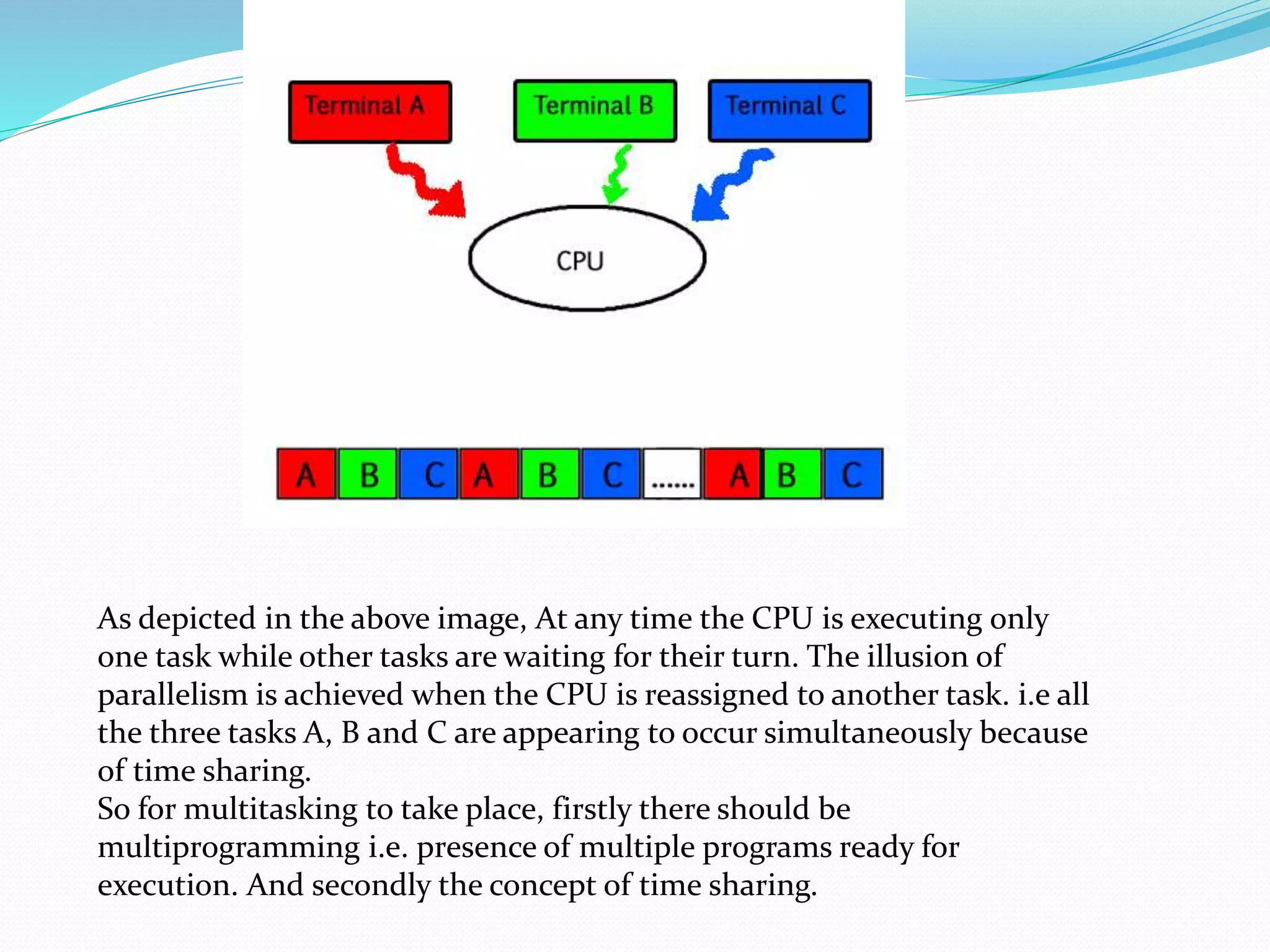
As depicted in the above image, At any time the CPU is executing only
one task while other tasks are waiting for their turn. The illusion of
parallelism is achieved when the CPU is reassigned to another task. i.e all
the three tasks A, B and C are appearing to occur simultaneously because
of time sharing.
So for multitasking to take place, firstly there should be
multiprogramming i.e. presence of multiple programs ready for
execution. And secondly the concept of time sharing.
Multi threading
 A thread is a basic unit of CPU utilization. Multi threading
is an execution model that allows a single process to have
multiple code segments (i.e., threads) running
concurrently within the “context” of that process.
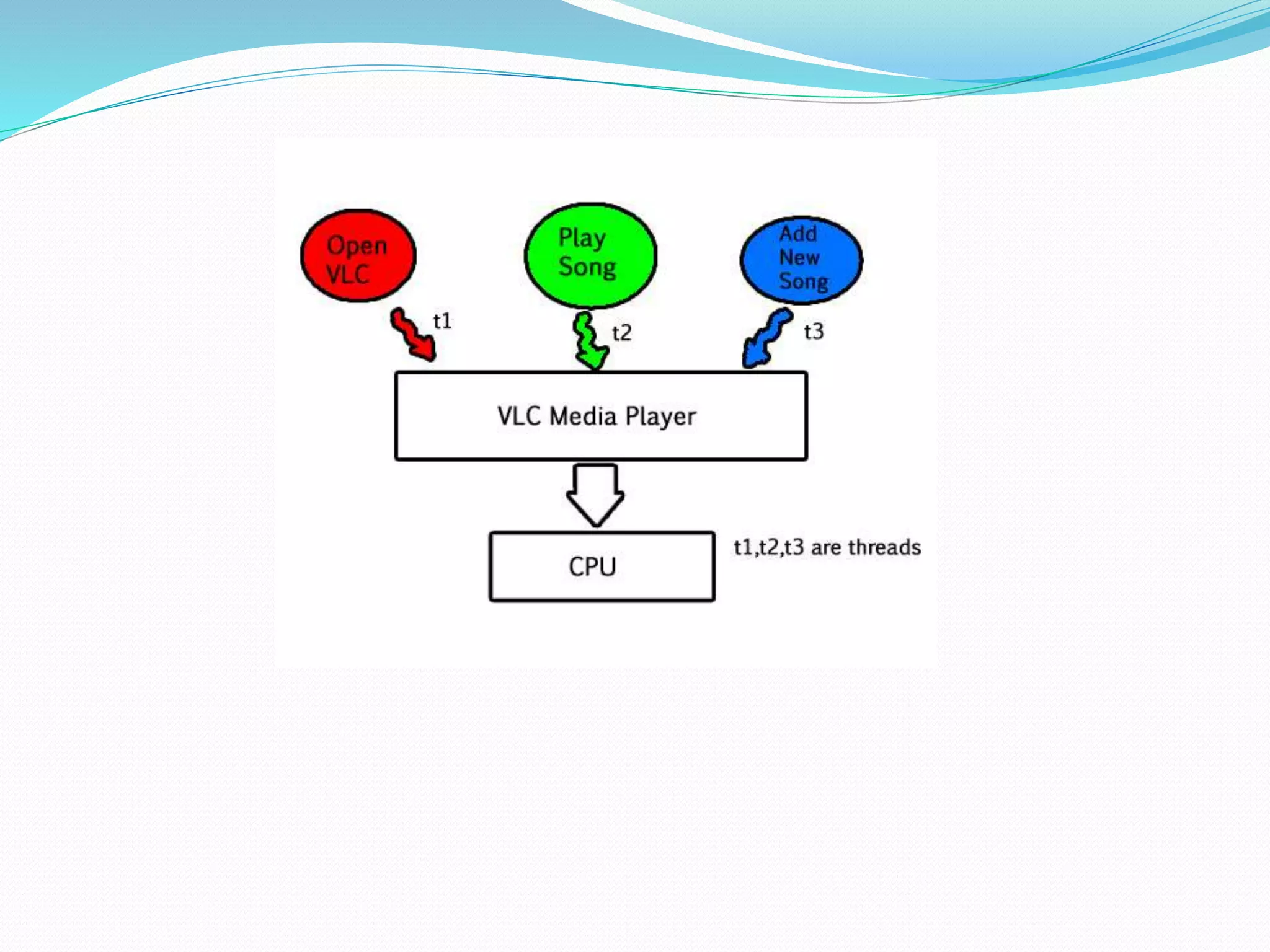
e.g. VLC media player, where one thread is used for
opening the VLC media player, one thread for playing
a particular song and another thread for adding new
songs to the playlist.
 Multi threading is the ability of a process to manage its use
by more than one user at a time and to manage multiple
requests by the same user without having to have multiple
copies of the program.
Cont….
Example 1 –
 Say there is a web server which processes client requests. Now if
it executes as a single threaded process, then it will not be able to
process multiple requests at a time. Firstly one client will make
its request and finish its execution and only then, the server will
be able to process another client request. This is really costly,
time consuming and tiring task. To avoid this, multi threading
can be made use of.
 Now, whenever a new client request comes in, the web server
simply creates a new thread for processing this request and
resumes its execution to hear more client requests. So the web
server has the task of listening to new client requests and
creating threads for each individual request. Each newly created
thread processes one client request, thus reducing the burden on
web server.
Distributed os
 Distributed systems use multiple central processors to
serve multiple real-time applications and multiple
users. Data processing jobs are distributed among the
processors accordingly.
 The processors communicate with one another
through various communication lines (such as high-
speed buses or telephone lines). These are referred
as loosely coupled systems or distributed systems.
Processors in a distributed system may vary in size and
function. These processors are referred as sites, nodes,
computers, and so on.
Cont……
The advantages of distributed systems are as follows −
 With resource sharing facility, a user at one site may be
able to use the resources available at another.
 Speedup the exchange of data with one another via
electronic mail.
 If one site fails in a distributed system, the remaining
sites can potentially continue operating.
 Better service to the customers.
 Reduction of the load on the host computer.
 Reduction of delays in data processing.
Real time os
 Real-time systems are used when there are rigid
time requirements on the operation of a processor
or the flow of data and real-time systems can be
used as a control device in a dedicated application.
 A real-time operating system must have well-
defined, fixed time constraints, otherwise the
system will fail.
 For example, Scientific experiments, medical
imaging systems, industrial control systems,
weapon systems, robots, air traffic control systems,
etc.
Real time os
There are two types of real-time operating systems.
 Hard real-time systems: Hard real-time systems guarantee that critical
tasks complete on time. In hard real-time systems, secondary storage is
limited or missing and the data is stored in ROM. In these systems, virtual
memory is almost never found.
 Soft real-time systems: Soft real-time systems are less restrictive. A critical
real-time task gets priority over other tasks and retains the priority until it
completes. Soft real-time systems have limited utility than hard real-time
systems. For example, multimedia, virtual reality, Advanced Scientific
Projects like undersea exploration and planetary rovers, etc.
Time sharing os
 Time-sharing enables many people, located at various
terminals, to use a particular computer system at the same
time.
 Multiple jobs are implemented by the CPU by switching
between them, but the switches occur so frequently. So, the
user can receive an immediate response.
 For an example, in a transaction processing, the processor
executes each user program in a short burst or quantum of
computation, i.e.; if n users are present, then each user can
get a time quantum. Whenever the user submits the
command, the response time is in few seconds at most.
Cont…..
Advantages of Timesharing operating systems are −
 It provides the advantage of quick response.
 This type of operating system avoids duplication of
software.
 It reduces CPU idle time.
Disadvantages of Time-sharing operating systems are −
 Time sharing has problem of reliability.
 Question of security and integrity of user programs
and data can be raised.
 Problem of data communication occurs.
Batch os
 Batch operating system
 The users of a batch operating system do not interact with the
computer directly. Each user prepares his job on an off-line
device like punch cards and submits it to the computer operator.
To speed up processing, jobs with similar needs are batched
together and run as a group. The programmers leave their
programs with the operator and the operator then sorts the
programs with similar requirements into batches.
The problems with Batch Systems are as follows −
 Lack of interaction between the user and the job.
 CPU is often idle, because the speed of the mechanical I/O
devices is slower than the CPU.
 Difficult to provide the desired priority.

Types or evolution of operating system

  • 1.
    TYPES / EVOLUTIONOF OPERATING SYSTEM
  • 2.
    Multi programming  Ina multi-programmed system, as soon as one job goes for an I/O task, the Operating System interrupts that job, chooses another job from the job pool (waiting queue), gives CPU to this new job and starts its execution. The previous job keeps doing its I/O operation while this new job does CPU bound tasks. Now say the second job also goes for an I/O task, the CPU chooses a third job and starts executing it. As soon as a job completes its I/O operation and comes back for CPU tasks, the CPU is allocated to it.  In this way, no CPU time is wasted by the system waiting for the I/O task to be completed. Therefore, the ultimate goal of multi programming is to keep the CPU busy as long as there are processes ready to execute. This way, multiple programs can be executed on a single processor by executing a part of a program at one time, a part of another program after this, then a part of another program and so on, hence executing multiple programs. Hence, the CPU never remains idle.
  • 3.
    Multi processing In auni-processor system, only one process executes at a time. Multiprocessing is the use of two or more CPUs (processors) within a single Computer system. The term also refers to the ability of a system to support more than one processor within a single computer system. Now since there are multiple processors available, multiple processes can be executed at a time. These multi processors share the computer bus, sometimes the clock, memory and peripheral devices also.
  • 4.
    Multi processing system’sworking  With the help of multiprocessing, many processes can be executed simultaneously. Say processes P1, P2, P3 and P4 are waiting for execution. Now in a single processor system, firstly one process will execute, then the other, then the other and so on.  But with multiprocessing, each process can be assigned to a different processor for its execution. If its a dual-core processor (2 processors), two processes can be executed simultaneously and thus will be two times faster, similarly a quad core processor will be four times as fast as a single processor.
  • 5.
    difference between multiprocessing andmulti programming  Multiprocessing is basically executing multiple processes at the same time on multiple processors, whereas multi programming is keeping several programs in main memory and executing them concurrently using a single CPU only.  Multiprocessing occurs by means of parallel processing whereas Multi programming occurs by switching from one process to other (phenomenon called as context switching).
  • 6.
    Multi tasking  Ina time sharing system, each process is assigned some specific quantum of time for which a process is meant to execute. Say there are 4 processes P1, P2, P3, P4 ready to execute. So each of them are assigned some time quantum for which they will execute e.g time quantum of 5 nanoseconds (5 ns). As one process begins execution (say P2), it executes for that quantum of time (5 ns). After 5 ns the CPU starts the execution of the other process (say P3) for the specified quantum of time.  Thus the CPU makes the processes to share time slices between them and execute accordingly. As soon as time quantum of one process expires, another process begins its execution.  Here also basically a context switch is occurring but it is occurring so fast that the user is able to interact with each program separately while it is running. This way, the user is given the illusion that multiple processes/ tasks are executing simultaneously. But actually only one process/ task is executing at a particular instant of time. In multitasking, time sharing is best manifested because each running process takes only a fair quantum of the CPU time.
  • 7.
    As depicted inthe above image, At any time the CPU is executing only one task while other tasks are waiting for their turn. The illusion of parallelism is achieved when the CPU is reassigned to another task. i.e all the three tasks A, B and C are appearing to occur simultaneously because of time sharing. So for multitasking to take place, firstly there should be multiprogramming i.e. presence of multiple programs ready for execution. And secondly the concept of time sharing.
  • 8.
    Multi threading  Athread is a basic unit of CPU utilization. Multi threading is an execution model that allows a single process to have multiple code segments (i.e., threads) running concurrently within the “context” of that process. e.g. VLC media player, where one thread is used for opening the VLC media player, one thread for playing a particular song and another thread for adding new songs to the playlist.  Multi threading is the ability of a process to manage its use by more than one user at a time and to manage multiple requests by the same user without having to have multiple copies of the program.
  • 9.
    Cont…. Example 1 – Say there is a web server which processes client requests. Now if it executes as a single threaded process, then it will not be able to process multiple requests at a time. Firstly one client will make its request and finish its execution and only then, the server will be able to process another client request. This is really costly, time consuming and tiring task. To avoid this, multi threading can be made use of.  Now, whenever a new client request comes in, the web server simply creates a new thread for processing this request and resumes its execution to hear more client requests. So the web server has the task of listening to new client requests and creating threads for each individual request. Each newly created thread processes one client request, thus reducing the burden on web server.
  • 11.
    Distributed os  Distributedsystems use multiple central processors to serve multiple real-time applications and multiple users. Data processing jobs are distributed among the processors accordingly.  The processors communicate with one another through various communication lines (such as high- speed buses or telephone lines). These are referred as loosely coupled systems or distributed systems. Processors in a distributed system may vary in size and function. These processors are referred as sites, nodes, computers, and so on.
  • 12.
    Cont…… The advantages ofdistributed systems are as follows −  With resource sharing facility, a user at one site may be able to use the resources available at another.  Speedup the exchange of data with one another via electronic mail.  If one site fails in a distributed system, the remaining sites can potentially continue operating.  Better service to the customers.  Reduction of the load on the host computer.  Reduction of delays in data processing.
  • 13.
    Real time os Real-time systems are used when there are rigid time requirements on the operation of a processor or the flow of data and real-time systems can be used as a control device in a dedicated application.  A real-time operating system must have well- defined, fixed time constraints, otherwise the system will fail.  For example, Scientific experiments, medical imaging systems, industrial control systems, weapon systems, robots, air traffic control systems, etc.
  • 14.
    Real time os Thereare two types of real-time operating systems.  Hard real-time systems: Hard real-time systems guarantee that critical tasks complete on time. In hard real-time systems, secondary storage is limited or missing and the data is stored in ROM. In these systems, virtual memory is almost never found.  Soft real-time systems: Soft real-time systems are less restrictive. A critical real-time task gets priority over other tasks and retains the priority until it completes. Soft real-time systems have limited utility than hard real-time systems. For example, multimedia, virtual reality, Advanced Scientific Projects like undersea exploration and planetary rovers, etc.
  • 15.
    Time sharing os Time-sharing enables many people, located at various terminals, to use a particular computer system at the same time.  Multiple jobs are implemented by the CPU by switching between them, but the switches occur so frequently. So, the user can receive an immediate response.  For an example, in a transaction processing, the processor executes each user program in a short burst or quantum of computation, i.e.; if n users are present, then each user can get a time quantum. Whenever the user submits the command, the response time is in few seconds at most.
  • 16.
    Cont….. Advantages of Timesharingoperating systems are −  It provides the advantage of quick response.  This type of operating system avoids duplication of software.  It reduces CPU idle time. Disadvantages of Time-sharing operating systems are −  Time sharing has problem of reliability.  Question of security and integrity of user programs and data can be raised.  Problem of data communication occurs.
  • 17.
    Batch os  Batchoperating system  The users of a batch operating system do not interact with the computer directly. Each user prepares his job on an off-line device like punch cards and submits it to the computer operator. To speed up processing, jobs with similar needs are batched together and run as a group. The programmers leave their programs with the operator and the operator then sorts the programs with similar requirements into batches. The problems with Batch Systems are as follows −  Lack of interaction between the user and the job.  CPU is often idle, because the speed of the mechanical I/O devices is slower than the CPU.  Difficult to provide the desired priority.