MAINFRAME SYSTEMS
Mrs.G.Chandraprabha,M.Sc.,M.Phil.,
Assistant Professor
Department of Information Technology
V.V.Vanniaperumal College for Women
Virudhunagar
Mainframe Systems
• Main frame computers were the first
computers to tackle many commercial and
scientific applications.
• Main frame systems are evoluated from
simple batch systems (where the computer
runs one only one-application) to time-shared
systems(which allow for user interaction with
the computer system).
I. Batch Systems
The users who using a batch operating system do not interact
with the computer directly.
Each user prepares its job on an off-line device like punch
cards and submits it to the computer operator.
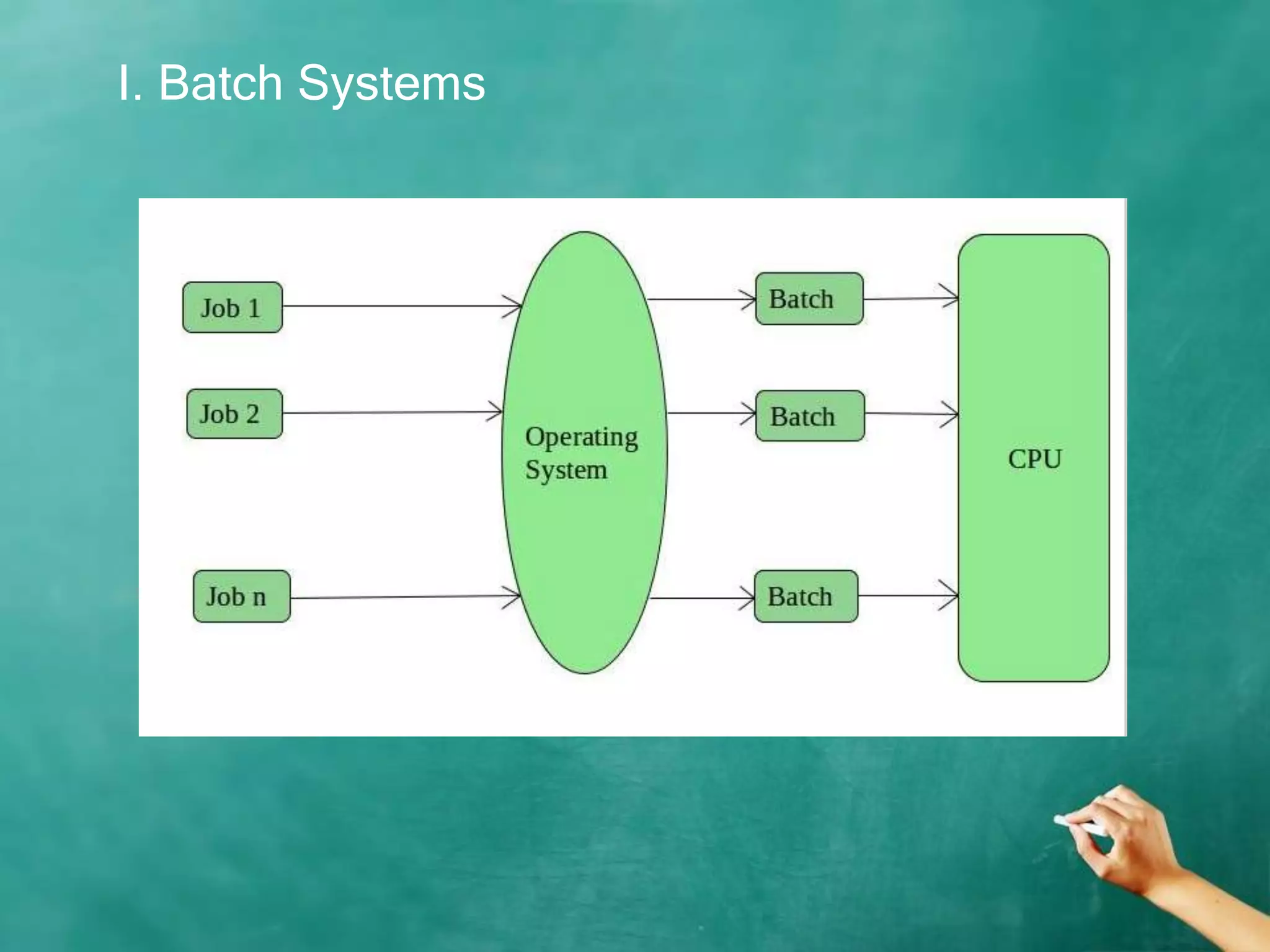
 To speed up the processing, jobs with similar needs are
batched together and run as a group.
The programmers exit their programs with the operator and
the operator then sorts the programs with similar requirements
into batches.
All the jobs of one batch are executed together.
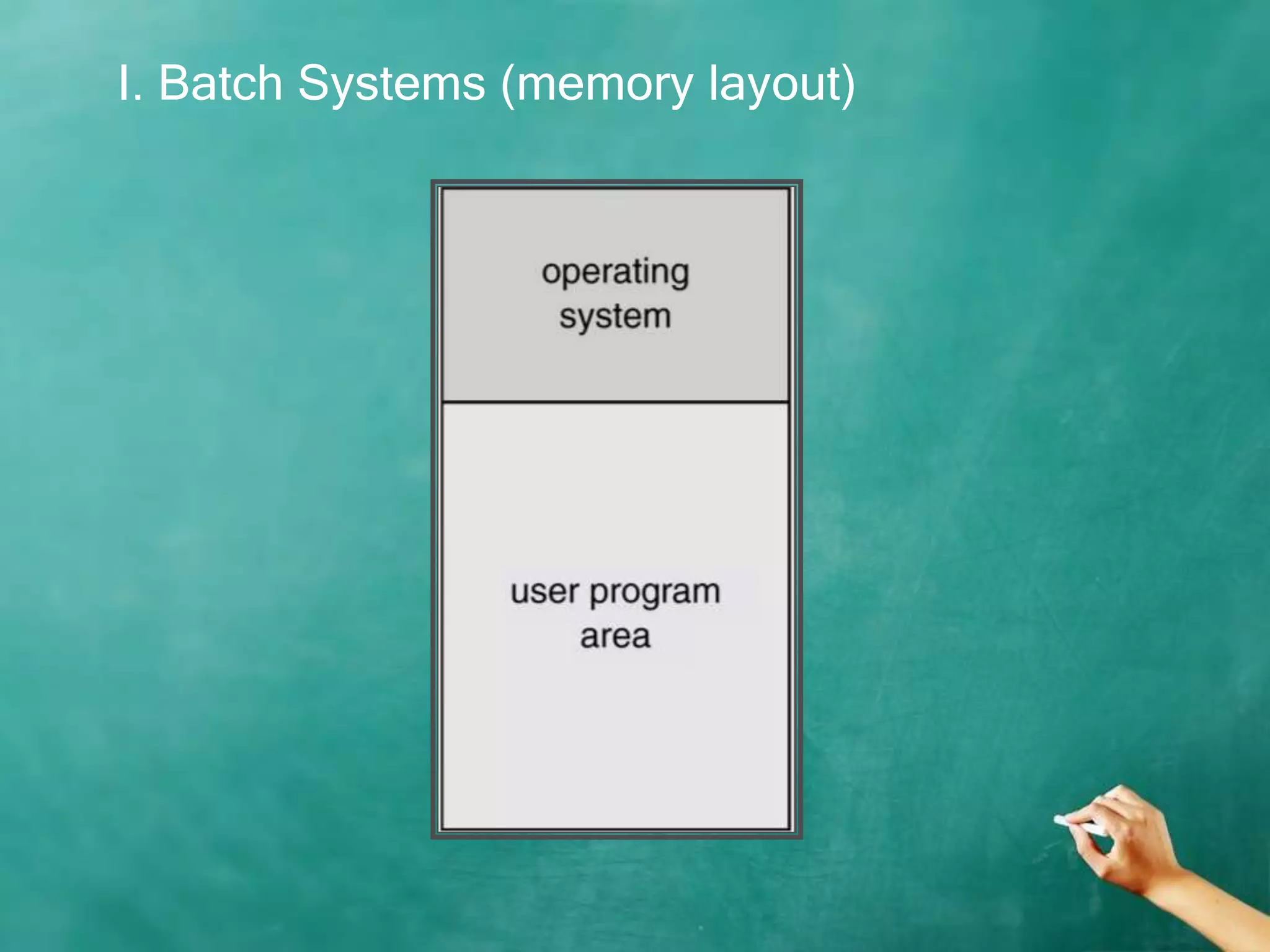
I. Batch Systems (memory layout)
I. Batch Systems
I. Batch Systems - Advantages
It is very difficult to guess or know the time
required for any job to complete. Processors of the
batch systems know how long the job would be when
it is in queue.
Multiple users can share the batch systems.
The idle time for the batch system is very less.
It is easy to manage large work repeatedly in batch
systems.
I. Batch Systems - Disadvantages
The computer operators should be well known with batch
systems.
Batch systems are hard to debug.
It is sometimes costly.
The other jobs will have to wait for an unknown time if any
job fails.
All the jobs of a batch are executed sequentially one after the
other.
The output is obtained only after all the jobs are executed.
Thus, priority can not be implemented if a certain job has to
be executed on an urgent basis.
Batch operating system may lead to starvation.
There is a lack of interaction between a user and his job.
II. Multiprogrammed
Systems
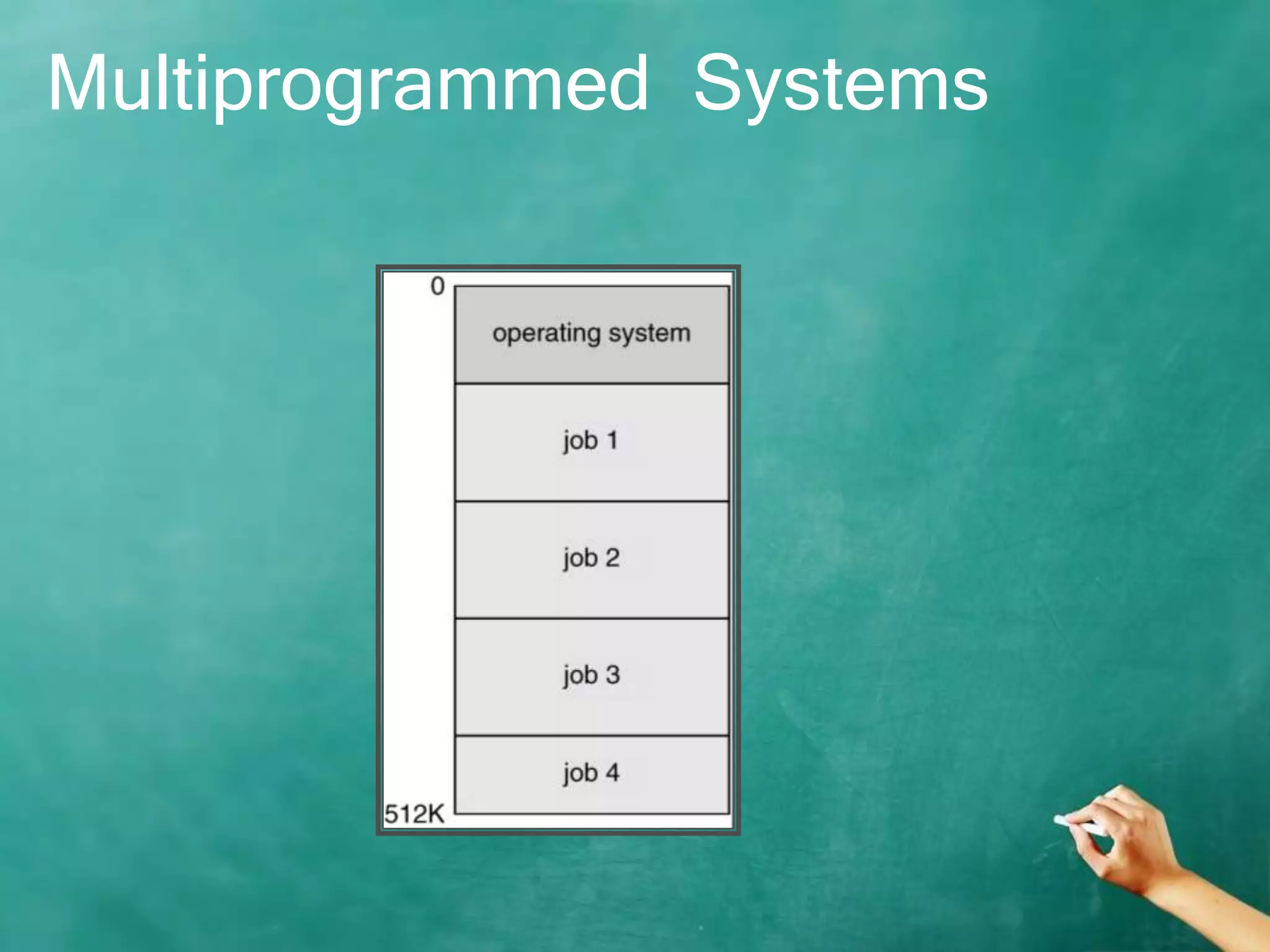
Several jobs are kept in main memory at the same time,
and the CPU is multiplexed among them.
Sharing the processor, when two or more programs reside
in memory at the same time, is referred
as Multiprogramming.
 Multiprogramming assumes a single shared processor.
Multiprogramming increases CPU utilization by
organizing jobs so that the CPU always has one to execute.
Multiprogrammed Systems
 An OS does the following activities related to
multiprogramming.
 The operating system keeps several jobs in memory at a
time.
 This set of jobs is a subset of the jobs kept in the job
pool.
 The operating system picks and begins to execute one of
the jobs in the memory.
 Multiprogramming operating systems monitor the state
of all active programs and system resources using
memory management programs to ensures that the CPU
is never idle, unless there are no jobs to process.
Multiprogrammed Systems
Advantages
 High and efficient CPU utilization.
 User feels that many programs are allotted CPU
almost simultaneously.
Disadvantages
 CPU scheduling is required.
 To accommodate many jobs in memory, memory
management is required.
III.Time-Sharing Systems
• Time-sharing is a technique which enables many people,
located at various terminals, to use a particular computer
system at the same time.
• Time-sharing or multitasking is a logical extension of
multiprogramming. Processor's time which is shared among
multiple users simultaneously is termed as time-sharing.
• The main difference between Multi-programmed Batch
Systems and Time-Sharing Systems is that in case of Multi-
programmed batch systems, the objective is to maximize
processor use, whereas in Time-Sharing Systems, the objective
is to minimize response time.
• Multiple jobs are executed by the CPU by switching between
them, but the switches occur so frequently. Thus, the user can
receive an immediate response.
III.Time-Sharing Systems
• For example, in a transaction processing, the processor
executes each user program in a short burst or quantum of
computation.
• That is, if n users are present, then each user can get a time
quantum. When the user submits the command, the
response time is in few seconds at most.
• The operating system uses CPU scheduling and
multiprogramming to provide each user with a small
portion of a time.
• Computer systems that were designed primarily as batch
systems have been modified to time-sharing systems.
III.Time-Sharing Systems
• A program loaded into memory and executes, it performs a
short period of time either before completion or to complete
I/O.
• This short period of time during which user gets attention of
CPU is known as time slice, time slot or quantum. It is
typically of the order of 10 to 100 milliseconds.
• Time shared operating systems are more complex than
multi-programmed operating systems.
• In both, multiple jobs must be kept in memory
simultaneously, so the system must have memory
management and security.
III.Time-Sharing Systems
 To achieve a good response time, jobs may have to swap in
and out of disk from main memory which now serves as a
backing store for main memory.
 A common method to achieve this goal is virtual memory,
a technique that allows the execution of a job that may not
be completely in memory.
 Requirements of Time Sharing Operating System :
An alarm clock mechanism to send an interrupt signal
to the CPU after every time slice. Memory Protection
mechanism to prevent one job’s instructions and data from
interfering with other jobs.
III.Time-Sharing Systems
Advantages:
• Provides the advantage of quick response.
• Avoids duplication of software.
• Reduces CPU idle time.
Disadvantages:
• Problem of reliability.
• Question of security and integrity of user
programs and data.
• Problem of data communication.

Mainframe systems

  • 1.
    MAINFRAME SYSTEMS Mrs.G.Chandraprabha,M.Sc.,M.Phil., Assistant Professor Departmentof Information Technology V.V.Vanniaperumal College for Women Virudhunagar
  • 2.
    Mainframe Systems • Mainframe computers were the first computers to tackle many commercial and scientific applications. • Main frame systems are evoluated from simple batch systems (where the computer runs one only one-application) to time-shared systems(which allow for user interaction with the computer system).
  • 3.
    I. Batch Systems Theusers who using a batch operating system do not interact with the computer directly. Each user prepares its job on an off-line device like punch cards and submits it to the computer operator.  To speed up the processing, jobs with similar needs are batched together and run as a group. The programmers exit their programs with the operator and the operator then sorts the programs with similar requirements into batches. All the jobs of one batch are executed together.
  • 4.
    I. Batch Systems(memory layout)
  • 5.
  • 6.
    I. Batch Systems- Advantages It is very difficult to guess or know the time required for any job to complete. Processors of the batch systems know how long the job would be when it is in queue. Multiple users can share the batch systems. The idle time for the batch system is very less. It is easy to manage large work repeatedly in batch systems.
  • 7.
    I. Batch Systems- Disadvantages The computer operators should be well known with batch systems. Batch systems are hard to debug. It is sometimes costly. The other jobs will have to wait for an unknown time if any job fails. All the jobs of a batch are executed sequentially one after the other. The output is obtained only after all the jobs are executed. Thus, priority can not be implemented if a certain job has to be executed on an urgent basis. Batch operating system may lead to starvation. There is a lack of interaction between a user and his job.
  • 8.
    II. Multiprogrammed Systems Several jobsare kept in main memory at the same time, and the CPU is multiplexed among them. Sharing the processor, when two or more programs reside in memory at the same time, is referred as Multiprogramming.  Multiprogramming assumes a single shared processor. Multiprogramming increases CPU utilization by organizing jobs so that the CPU always has one to execute.
  • 9.
  • 10.
    Multiprogrammed Systems  AnOS does the following activities related to multiprogramming.  The operating system keeps several jobs in memory at a time.  This set of jobs is a subset of the jobs kept in the job pool.  The operating system picks and begins to execute one of the jobs in the memory.  Multiprogramming operating systems monitor the state of all active programs and system resources using memory management programs to ensures that the CPU is never idle, unless there are no jobs to process.
  • 11.
    Multiprogrammed Systems Advantages  Highand efficient CPU utilization.  User feels that many programs are allotted CPU almost simultaneously. Disadvantages  CPU scheduling is required.  To accommodate many jobs in memory, memory management is required.
  • 12.
    III.Time-Sharing Systems • Time-sharingis a technique which enables many people, located at various terminals, to use a particular computer system at the same time. • Time-sharing or multitasking is a logical extension of multiprogramming. Processor's time which is shared among multiple users simultaneously is termed as time-sharing. • The main difference between Multi-programmed Batch Systems and Time-Sharing Systems is that in case of Multi- programmed batch systems, the objective is to maximize processor use, whereas in Time-Sharing Systems, the objective is to minimize response time. • Multiple jobs are executed by the CPU by switching between them, but the switches occur so frequently. Thus, the user can receive an immediate response.
  • 13.
    III.Time-Sharing Systems • Forexample, in a transaction processing, the processor executes each user program in a short burst or quantum of computation. • That is, if n users are present, then each user can get a time quantum. When the user submits the command, the response time is in few seconds at most. • The operating system uses CPU scheduling and multiprogramming to provide each user with a small portion of a time. • Computer systems that were designed primarily as batch systems have been modified to time-sharing systems.
  • 14.
    III.Time-Sharing Systems • Aprogram loaded into memory and executes, it performs a short period of time either before completion or to complete I/O. • This short period of time during which user gets attention of CPU is known as time slice, time slot or quantum. It is typically of the order of 10 to 100 milliseconds. • Time shared operating systems are more complex than multi-programmed operating systems. • In both, multiple jobs must be kept in memory simultaneously, so the system must have memory management and security.
  • 15.
    III.Time-Sharing Systems  Toachieve a good response time, jobs may have to swap in and out of disk from main memory which now serves as a backing store for main memory.  A common method to achieve this goal is virtual memory, a technique that allows the execution of a job that may not be completely in memory.  Requirements of Time Sharing Operating System : An alarm clock mechanism to send an interrupt signal to the CPU after every time slice. Memory Protection mechanism to prevent one job’s instructions and data from interfering with other jobs.
  • 16.
    III.Time-Sharing Systems Advantages: • Providesthe advantage of quick response. • Avoids duplication of software. • Reduces CPU idle time. Disadvantages: • Problem of reliability. • Question of security and integrity of user programs and data. • Problem of data communication.