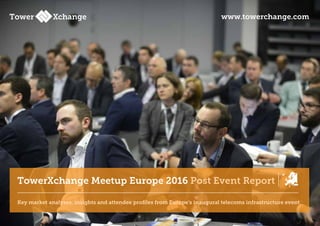
TowerXchange Meetup Europe 2016 Post Event Report
Key market analyses, insights and attendee profiles from Europe’s inaugural telecoms infrastructure event
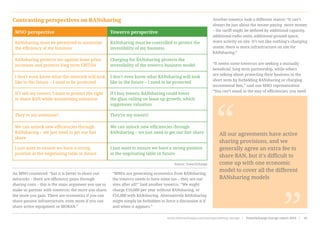
www.towerchange.com
(Chairman) Daniel Lee
Managing Director
Intrepid Advisory Partners
Zhiyong Zhang
Chairman & President
Miteno
Akhil Gupta
Chairman
Bharti Infratel
Michel Faivre
Directeur Programme Partage
d’Infrastructure AMEA, Orange
Nina Triantis
Managing Director, Global, Head of
Telecoms & Media
Standard Bank
Terry Rhodes
CEO
Eaton Towers
Marc Ganzi
President, Digital Bridge &
Mexico Tower Partners
Arun Kapur
Executive Chairman
Irrawaddy Green Towers
James Maclaurin
formerly CEO
edotco
Areef Kassam
Director of Infrastructure
GSMA Mobile for Development
Ayman Al Adl
Director - TMT
Standard Chartered Bank
Dagan Kasavana
CEO
Phoenix Tower International
Chuck Green
Executive Chairman
Helios Towers Africa
Suresh Sidhu
CEO
edotco
Malcolm Collins
Chief Executive
CTIL
Ted Zhong
CEO
Q Towers International
Hal Hess
EVP, International Operations and
President, EMEA and Latin America
American Tower
Nobel Tanihaha
President Director
PT SOLUSI TUNAS PRATAMA (STP)
Umang Das
Chief Mentor
Viom Networks
Gilles Kuntz
CEO
TowerCo of Madagascar
Maria Scotti
CEO
Torrecom
David Meganck
Founder and COO
Acsys
Tilak Raj Dua
Director General
TAIPA
Peter Owen Edmunds
Co-founder and Chairman
Russian Towers
Kurt Bagwell
President International
SBA Communications
Jim Eisenstein
Chairman & CEO
Grupo TorreSur
Bimal Dayal
COO
Indus Towers
Inder Bajaj
CEO
HTN Towers
Riana Donaldson
Manager: International Network
Operations Support
Vodacom
Tunde Titilayo
Vice Chairman
SWAP International
Jack Dessay
Managing Director
Macquarie Capital
Jeffrey Eldredge
Partner
Vinson & Elkins
Enda Hardiman
Managing Partner
Hardiman Telecommunications Ltd.
Adeel Bajwa
Senior GM of Legal Affairs and
Contracts, Warid Telecom
Scott Coates
CEO
Wireless Infrastructure Group
Carlo Ramella
COO, EI Towers
and Chairman, Towertel
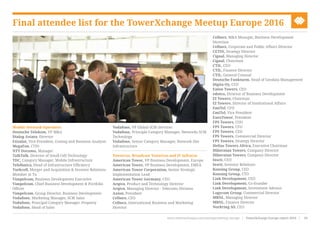
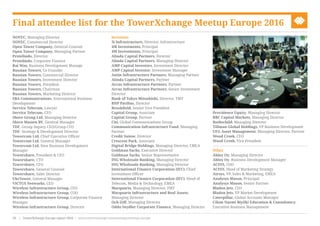
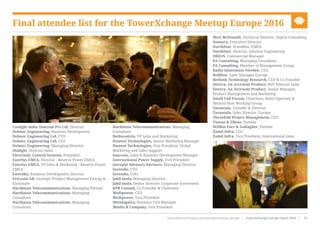
With special thanks to the TowerXchange “Inner Circle”
About TowerXchange
TowerXchange is your independent
community for operators, towercos, investors
and suppliers interested in EMEA, CALA
and Asian towers. We’re a community
of practitioners formed to promote
and accelerate infrastructure sharing.
TowerXchange don’t build, operate or invest
in towers; we’re a neutral community host
and commentator on telecoms infrastructure.
The TowerXchange Journal is free to
qualifying recipients. We also provide
webinars and regular meetups.
TowerXchange monetizes this community
through hosting annual Meetups and the
sale of advertising, without compromising
editorial integrity.
TowerXchange was founded by Kieron
Osmotherly, a TMT community host and
events organizer with 16 years’ experience,
and is governed with the support and advice
of the TowerXchange “Inner Circle” – an
informal network of advisors
Our informal network of advisers:
© 2015 Site Seven Media Ltd. All rights reserved. Neither the
whole nor any substantial part of this publication may be re-
produced, stored in a retrieval system, or transmitted by any
means without the prior permission of Site Seven Media Ltd.
Short extracts may be quoted if TowerXchange is cited as the
source. TowerXchange is a trading name of Site Seven Media
Ltd, registered in the UK. Company number 8293930.
www.towerxchange.com/meetups/meetup-europe | TowerXchange Europe report 2016 | XX| TowerXchange Europe report 2016 | www.towerxchange.com/meetups/meetup-europe2
Contents
www.towerxchange.com/meetups/meetup-europe | TowerXchange Europe report 2016 | 3| TowerXchange Europe report 2016 | www.towerxchange.com/meetups/meetup-europeXX
1
2
3
4
5
6
4 2016 Meetup roundup
5 TowerXchange Meetup Europe at a glance
6 Testimonials
7 2017 highlights
8 How we promote Meetups
9 The European tower market
14 Who’s who in European towers
29 TowerXchange Meetup Europe 2016 attendee list
32 Select roundtable and panel reports
TowerXchange Meetup calendar
< TowerXchange Meetup Americas, June 16-17, 2016
< TowerXchange Meetup Africa, October 19-20, 2016
< TowerXchange Meetup Asia, December 13-14, 2016
< TowerXchange Meetup Europe, April 4-5, 2017
Leaders of 36 towercos attended, including here from WIG, FPS, Arqiva and Russian Towers
Invaluable roundtable debate After hours networking!
Foreword by TowerXchange CEO, Kieron Osmotherly
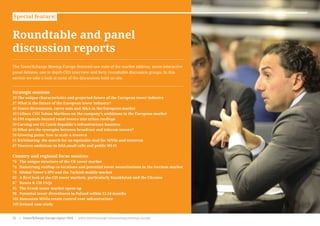
228 leaders of the European tower industry gathered at the Business
Design Centre, London for the inaugural TowerXchange Meetup Europe
in April 2016. Amongst the attendance were 81 executives representing 36
tower companies and infracos which manage a total of 174,049 sites on the
continent. They were joined by 26 MNO executives representing 13 different
operators and 39 investors representing 28 investment companies as well as
leading advisors, strategic consultants and supply chain companies. What’s
more, towercos from across Asia, Africa and the Americas, between them
managing a portfolio of over 150,000 towers, brought a global perspective to
the discussions at Europe’s most high profile industry gathering to date.
Over 40 roundtable discussion groups opened debate and tackled issues on such topics as decommissioning,
opportunities in small cells and DAS, how to scale a towerco, RANsharing, tower valuations and deal
structures whilst country focus tables assembled the who’s who in prominent European tower markets.
Supplemented by keynote panels and questioning of leaders of the European tower sector, including an
in depth interview with Cellnex CEO, Tobias Martinez, the Meetup also featured a showcase of leading
access control systems, remote monitoring software, site management systems and energy equipment
whereby executives could meet with key suppliers to the European market. Concurrent with the Meetup,
the inaugural TowerXchange Investors Club facilitated private conversations between investors, investible
towerco platforms and their suppliers.
An evening of caipirinhas and Brazilian barbeque set the stage for some informal networking and relaxation
after a hard day’s meetings and helped to solidify the relationships built over the course of the two days.
I would like to take this opportunity to thank our speakers, sponsors and delegates who helped make the
inaugural Meetup Europe a resounding success and I look forward to welcoming new faces and old friends
to the 2017 event on 4-5 April 2017 at the Business Design Centre, London.
Kind regards
Kieron Osmotherly
Founder and CEO
TowerXchange
www.towerxchange.com/meetups/meetup-europe | TowerXchange Europe report 2016 | XX| TowerXchange Europe report 2016 | www.towerxchange.com/meetups/meetup-europe4
TowerXchange Meetup Europe 2016 at a glance
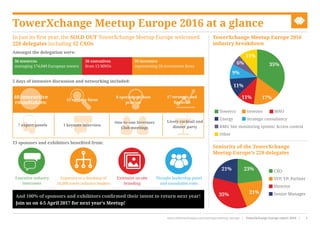
Seniority of the TowerXchange
Meetup Europe’s 228 delegates
CXO
SVP, VP, Partner
Director
Senior Manager
In just its first year, the SOLD OUT TowerXchange Meetup Europe welcomed
228 delegates including 52 CXOs
TowerXchange Meetup Europe 2016
industry breakdown
Towerco	Investor	MNO
Energy		 Strategic consultancy
RMS/ Site monitoring system/ Access control
Other
35%
17%11%
11%
9%
6%
11%
23%
21%35%
21%
2 days of intensive discussion and networking included:
And 100% of sponsors and exhibitors confirmed their intent to return next year!
Join us on 4-5 April 2017 for next year’s Meetup!
Amongst the delegation were:
36 towercos
managing 174,049 European towers
26 executives
from 13 MNOs
39 investors
representing 28 investment firms
13 sponsors and exhibitors benefited from:
Thought leadership panel
and roundtable roles
Executive industry
interviews
Exposure to a database of
16,000 tower industry leaders
Extensive on-site
branding
7 expert panels
15 country focus
1 keynote interview
8 operational best
practice
One-to-one Investors
Club meetings
17 strategic and
financial
Lively cocktail and
dinner party
www.towerxchange.com/meetups/meetup-europe | TowerXchange Europe report 2016 | 5| TowerXchange Europe report 2016 | www.towerxchange.com/meetups/meetup-europeXX
40 interactive
roundtables:
Feedback from TowerXchange Meetup Europe 2016 attendees
“Thank you for inviting Russian Towers to be on
your opening panel at the TowerXchange Meetup
Europe 2016. I thought it was an interesting
panel and that the event overall was excellent.
We at Russian Towers found it very useful.
Congratulations. I look forward to making it next
year” - Peter Owen Edmunds, Chairman of the
Board of Directors, Russian Towers
“Congratulations on a very successful conference,
the organisation was amazing and I only heard
positive comments from attendees” - Peter
Egbertsen, Director, Protelindo
“A very high quality event which provided significant
current knowledge sharing and the ability to
network effectively… I would say this was arguably
the best run and structured event I have ever been
to” - Justin Speake, President & COO, EuroTower
“A unique meeting point for investors, MNOs
and tower CXOs to understand and exchange
information” - Torbjorn Teigen, CEO, Norkring AS
“The unique meeting focused on wireless
infrastructure. It exceeded expectations” - Paolo
Crocetti, Director of Institutional Affairs, EI
Towers
“I personally found the Meetup very useful in
terms of valuable information about the current
developments in the tower market in Europe and
meeting new potential clients in person. It was
also a good experience for preparation of our
participation in Africa” - Elena Gatcheva, Vice
President, Business Development, IPS
“One of the best sessions I have come across over the
years. Innovative and very informative. High quality
attendees” - Joris Fleerackers, European Sales,
Deltanode Solutions
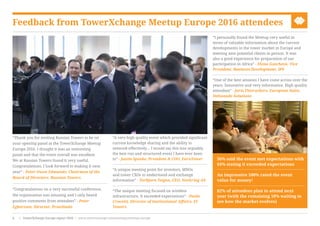
36% said the event met expectations with
64% stating it exceeded expectations
An impressive 100% rated the event
value for money!
82% of attendees plan to attend next
year (with the remaining 18% waiting to
see how the market evolves)
www.towerxchange.com/meetups/meetup-europe | TowerXchange Europe report 2016 | XX| TowerXchange Europe report 2016 | www.towerxchange.com/meetups/meetup-europe6
Ten reasons you can’t afford to miss the 2017
TowerXchange Meetup Europe
1. Europe’s most focused gathering of towerco CXOs and MNO tower
strategists – network with executives holding ultimate responsibility for
the continent’s ~600,000 cell sites
2. MNO tower strategy evaluation is progressing rapidly – discover
what’s next for carve outs, sales and IPOs and learn from the
experiences of first movers
3. Towers will have changed hands – understand the improvement capex
that will be required to integrate new portfolios into existing operations
4. Experience in DAS and small cells is growing – hear further insights
on the successful deployment by independent infrastructure providers
5. New regions covered – explore opportunities arising across Eastern
and Western Europe and into Central Asia
6. Towerco strategies are evolving – examine company YOY growth
statistics and how they have achieved this
7. Enhanced operational focus – the Meetup is set to open up beyond
CXOs and welcome those at the heart of engineering and purchasing
decisions
8. Bigger public and private investor base – increased attendance from a
broader spectrum of investors bringing new money and insights
9. The co-located exhibition is expanding – with a larger space visit an
increased number of suppliers helping to improve tower operations
10. With phenomenal feedback from the 2016 Meetup, 2017 dates are
already firmly marked on the calendars of the sector’s most influential
figures and with all previous Meetups having sold out be sure to book
early to avoid disappointment!
How can I get involved?
To register your interest or to discuss sponsorship and exhibition opportunities
at the TowerXchange Meetup Europe, contact:
Annabelle Mayhew, Chief Commercial Officer
E: amayhew@towerxchange.com
T: +44 (0) 7423 512588
2nd Annual TowerXchange Meetup Europe
4-5 April 2017, Business Design Centre, London | www.towerxchange.com/meetup/meetup-europe
www.towerxchange.com/meetups/meetup-europe | TowerXchange Europe report 2016 | 7| TowerXchange Europe report 2016 | www.towerxchange.com/meetups/meetup-europeXX
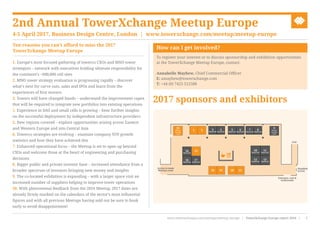
2017 sponsors and exhibitors
21 3
Reserved
4
Reserved
5
Reserved
6
Reserved
18 19 20 21
7
Reserved
8
Reserved
12
Reserved
10
Reserved
13
Reserved
16
Reserved
Exit
17
Reserved
14
Reserved
22
Private
meeting
room
9
Private
meeting
room
15 11
Reserved
Access to main
Meetup room
Entrance, exit &
washrooms
Disabled
access
How we promote TowerXchange Meetups
< The core of our promotional campaign is TowerXchange’s proprietary database of the top 16,000
decision makers in the global telecom tower industry
< The TowerXchange database includes the management teams of 169 towercos who between them own
over 2mn of the world’s 3.3mn towers
< We also maintain relationships with over 3,000 CXOs and Heads of M&A, Network Planning,
Procurement and Tower Strategy at MNOs worldwide
< TowerXchange is read by 1,082 individuals at 511 investors, of which 116 have capital deployed in
towers and is followed by 842 investment bankers and advisors	
< TowerXchange also maintains the world’s most exhaustive database of telecom infrastructure
suppliers, from tower manufacturers, managed service providers, to RMS, site management
platforms, access control and energy equipment and service providers
< Every month TowerXchange adds an average of 700 new highly qualified members to our community
through a combination of “pull” marketing via TowerXchange research, and P2P introductions and
research within the tower industry
< A total of 33 personalised emails with industry specific messaging were sent to our database to
promote the TowerXchange Meetup Europe
< Our email campaign is supported by a direct mail campaign to 660 selected VIPs, and by a courtesy
calls to over 1,000 key target attendees
< A key component of our promotional campaign is the TowerXchange Europe Dossier – this annual
publication collates and updates critical baseline data and the best interviews with key European
tower industry stakeholders
< We use Google Adwords to amplify the findability of the dossier, and other selected industry news and
analyses, attracting new, qualified members to our community
TowerXchange are grateful for the support of our
media and association partners for Africa:
< European Wireless Infrastructure Association
< Analysys Mason
< BMI Research
< Hardiman Telecommunications
< Inside Towers
< The National Association of Tower Erectors
< Small Cell Forum
< Telecom Finance
< ABI Research
www.towerxchange.com/meetups/meetup-europe | TowerXchange Europe report 2016 | XX| TowerXchange Europe report 2016 | www.towerxchange.com/meetups/meetup-europe8
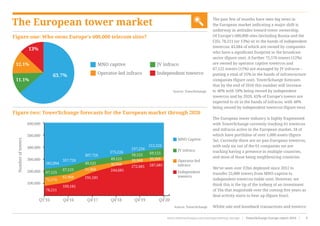
The European tower market The past few of months have seen big news in
the European market indicating a major shift is
underway in attitudes toward tower ownership.
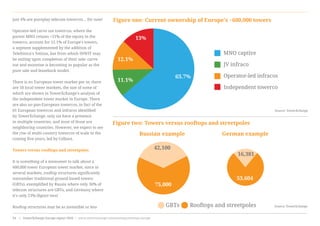
Of Europe’s 600,000 sites (including Russia and the
CIS), 78,211 (or 13%) sit in the hands of independent
towercos; 43,684 of which are owned by companies
who have a significant footprint in the broadcast
sector (figure one). A further 72,570 towers (12%)
are owned by operator captive towercos and
67,125 towers (11%) are managed by JV infracos –
putting a total of 35% in the hands of infrastructure
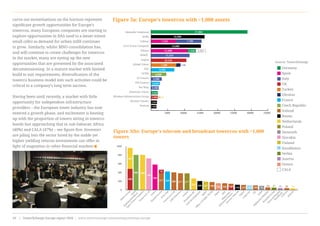
companies (figure one). TowerXchange forecasts
that by the end of 2016 this number will increase
to 40% with 18% being owned by independent
towercos and by 2020, 65% of Europe’s towers are
expected to sit in the hands of infracos, with 48%
being owned by independent towercos (figure two).
The European tower industry is highly fragmented
with TowerXchange currently tracking 61 towercos
and infracos active in the European market, 18 of
which have portfolios of over 1,000 assets (figure
3a). Currently there are no pan-European towercos,
with only six out of the 61 companies we are
tracking having a presence in multiple countries,
and most of those being neighbouring countries.
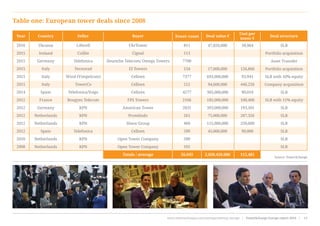
We’ve seen over €2bn deployed since 2012 to
transfer 25,000 towers from MNO-captive to
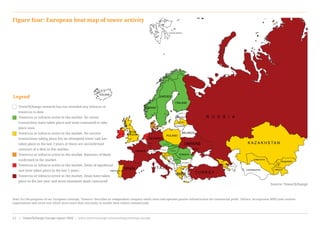
independent towercos (table one). However, we
think this is the tip of the iceberg of an investment
of 10x that magnitude over the coming five years as
deal activity starts to heat up (figure four).
Whilst sale and leaseback transactions and towerco
63.7%
11.1%
12.1%
13%
Source: TowerXchange
Figure one: Who owns Europe’s 600,000 telecom sites?
Figure two: TowerXchange forecasts for the European market through 2020
Source: TowerXchange
MNO captive		 JV infraco
Operator-led infraco 	 Independent towerco
www.towerxchange.com/meetups/meetup-europe | TowerXchange Europe report 2016 | 9| TowerXchange Europe report 2016 | www.towerxchange.com/meetups/meetup-europeXX
MNO Captive
JV infraco
600,000
500,000
400,000
300,000
200,000
100,000
Q4’16Q1’16 Q4’17 Q4’18 Q4’19 Q4’20
382,094
357,726
307,726
275,226
237,226
212,226
67,125
67,125
49,125
49,125
59,125 69,125
72,570
65,968
51,968
30,968
30,968 30,968
78,211
109,181
191,181
244,681
272,681 287,681
Numberoftowers
Operator-led
infraco
Independent
towerco
carve out monetisations on the horizon represent
significant growth opportunities for Europe’s
towercos, many European companies are starting to
explore opportunities in DAS (and to a lesser extent
small cells) as demand for urban infill continues
to grow. Similarly, whilst MNO consolidation has,
and will continue to create challenges for towercos
in the market, many are eyeing up the new
opportunities that are presented by the associated
decommissioning. In a mature market with limited
build to suit requirements, diversification of the
towerco business model into such activities could be
critical to a company’s long term success.
Having been until recently, a market with little
opportunity for independent infrastructure
providers – the European tower industry has now
entered a growth phase, and excitement is heating
up with the proportion of towers sitting in towerco
hands fast approaching that in sub-Saharan Africa
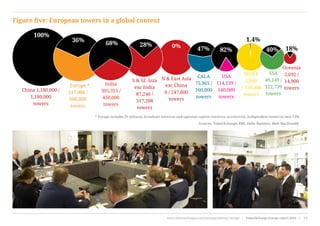
(40%) and CALA (47%) – see figure five. Investors
are piling into the sector lured by the stable yet
higher yielding returns investments can offer in
light of stagnation in other financial markets
Figure 3a: Europe’s towercos with >1,000 assets
Source: TowerXchange
120
Deutsche Funkturm
RTRS
Cellnex
First Tower Company
Telxius
INWIT
Arqiva
Global Tower
TDF
CETIN
EI Towers
FPS Towers
Rai Way
American Tower
Wireless Infrastructure Group
Russian Towers
Vertical
5000 10000 15000 20000 25000 30000 35000
0
200
400
600
800
1000
Shere
G
roup
Ceske
Radiokom
unikace
O
pen
Tow
er
Com
pany
Axion
ITAS
TIM
Tow
ercom
Ltd
ESB
Telecom
s
Em
itel
Protelindo
BV
Link
D
evelopm
ent
O
ffice
ofPublic
W
orks
D
igea
2RN
H
ibernian
/
Britannia
Tow
ers
Cignal
Cellcom
Alticom
Germany
Spain
Italy
UK
Turkey
Ukraine
France
Czech Republic
Ireland
Russia
Netherlands
Poland
Denmark
Slovakia
Finland
Kazakhstan
Serbia
Austria
Greece
CALA
27,000
7,7097,410
16,000
11,519
14,000
11,000
10,550
2,804
7,500
6,966
4,800
3,200
2,618
2,350
2,300
2,028
1,900
1,800
1,181
1,600
50 50
500
460
800 800
Tow
ercom
AS
700
586
377
79
Shared
Access
420 400 377 377
260 200 180 156 150 140 113
H
ighpoint(O
belisk)
50
Logycom
100
CIE
100
Falck
75
Konsing
G
roup
47
Service
Telecom
187
D
igita
40
Ö
sterreichischer
Rundfunk
40 33
120
Deutsche Funkturm
RTRS
Cellnex
First Tower Company
Telxius
INWIT
Arqiva
Global Tower
TDF
CETIN
EI Towers
FPS Towers
Rai Way
American Tower
Wireless Infrastructure Group
Russian Towers
Vertical
5000 10000 15000 20000 25000 30000 35000
0
200
400
600
800
1000
Germany
Spain
Italy
UK
Turkey
Ukraine
France
Czech Republic
Ireland
Russia
Netherlands
Poland
Denmark
Slovakia
Finland
Kazakhstan
Serbia
Austria
Greece
CALA
27,000
7,7097,410
16,000
11,519
14,000
11,000
10,550
2,804
7,500
6,966
4,800
3,200
2,618
2,350
2,300
2,028
1,900
1,800
1,181
1,600
50 50
500
460
800 800
700
586
377
79
420 400 377 377
260 200 180 156 150 140 113
50
100 100 75
47187 4040 33
120
Deutsche Funkturm
RTRS
Cellnex
First Tower Company
Telxius
INWIT
Arqiva
Global Tower
TDF
CETIN
EI Towers
FPS Towers
Rai Way
American Tower
Wireless Infrastructure Group
Russian Towers
Vertical
5000 10000 15000 20000 25000 30000 35000
0
200
400
600
800
1000
Shere
G
roup
Ceske
Radiokom
unikace
O
pen
Tow
er
Com
pany
Axion
ITAS
TIM
Tow
ercom
Ltd
ESB
Telecom
s
Em
itel
Protelindo
BV
Link
D
evelopm
ent
O
ffice
ofPublic
W
orks
D
igea
2RN
H
ibernian
/
Britannia
Tow
ers
Cignal
Cellcom
Alticom
Germany
Spain
Italy
UK
Turkey
Ukraine
France
Czech Republic
Ireland
Russia
Netherlands
Poland
Denmark
Slovakia
Finland
Kazakhstan
Serbia
Austria
Greece
CALA
27,000
7,7097,410
16,000
11,519
14,000
11,000
10,550
2,804
7,500
6,966
4,800
3,200
2,618
2,350
2,300
2,028
1,900
1,800
1,181
1,600
50 50
500
460
800 800
Tow
ercom
AS
700
586
377
79
Shared
Access
420 400 377 377
260 200 180 156 150 140 113
H
ighpoint(O
belisk)
50
Logycom
100
CIE
100
Falck
75
Konsing
G
roup
47
Service
Telecom
187
D
igita
40
Ö
sterreichischer
Rundfunk
40 33
Figure 3(b): Europe’s telecom and broadcast towercos with <1,000
towers
www.towerxchange.com/meetups/meetup-europe | TowerXchange Europe report 2016 | XX| TowerXchange Europe report 2016 | www.towerxchange.com/meetups/meetup-europe10
Table one: European tower deals since 2008
Year Country Seller Buyer Tower count
Cost per
tower €
Deal structureDeal value €
Source: TowerXchange
58,964
126,866
93,941
446,226
90,016
100,400
193,501
287,356
250,000
90,000
112,481
SLB
Portfolio acquisition
Asset Transfer
Portfolio acquisition
SLB with 10% equity
Company acquisition
SLB
SLB with 15% equity
SLB
SLB
SLB
SLB
SLB
SLB
47,820,000
17,000,000
693,000,000
94,600,000
385,000,000
185,000,000
393,000,000
75,000,000
115,000,000
45,000,000
2,050,420,000
811
113
7700
134
7377
212
4277
2166
2031
261
460
500
500
101
26,643
2016
2015
2015
2015
2015
2015
2014
2012
2012
2012
2012
2012
2010
2008
UkrTower
Cignal
Deutsche Telecom/ Omega Towers
EI Towers
Cellnex
Cellnex
Cellnex
FPS Towers
American Tower
Protelindo
Shere Group
Cellnex
Open Tower Company
Open Tower Company
Totals / average
Lifecell
Coillte
Telefonica
Tecnorad
Wind (Vimpelcom)
TowerCo
Telefonica/Yoigo
Bougyes Telecom
KPN
KPN
KPN
Telefonica
KPN
KPN
Ukraine
Ireland
Germany
Italy
Italy
Italy
Spain
France
Germany
Netherlands
Netherlands
Spain
Netherlands
Netherlands
www.towerxchange.com/meetups/meetup-europe | TowerXchange Europe report 2016 | 11| TowerXchange Europe report 2016 | www.towerxchange.com/meetups/meetup-europeXX
Figure four: European heat map of tower activity
TowerXchange research has not revealed any infracos or
towercos to date
Towercos or infracos active in the market. No recent
transactions have taken place and none rumoured to take
place soon
Towercos or infracos active in the market. No current
transactions taking place but an attempted tower sale has
taken place in the last 3 years or there are unconfirmed
rumours of a deal in this market.
Towercos or infracos active in the market. Rumours of deals
confirmed in the market.
Towercos or infracos active in the market. Deals of significant
size have taken place in the last 5 years.
Towercos or infracos active in the market. Deals have taken
place in the last year and more imminent deals rumoured
Legend
Note: For the purposes of our European coverage, ‘Towerco’ describes an independent company which owns and operates passive infrastructure for commercial profit. ‘Infraco’ incorporates MNO joint venture
organisations and carve outs which serve more than one entity or market their towers commercially
Source: TowerXchange
www.towerxchange.com/meetups/meetup-europe | TowerXchange Europe report 2016 | XX| TowerXchange Europe report 2016 | www.towerxchange.com/meetups/meetup-europe12
Figure five: European towers in a global context
Sources: TowerXchange, RBC, Delta Partners, Mott MacDonald
N & East Asia
exc China
0 / 247,600
towers
47%
CALA
75,965 /
160,000
towers
SSA
49,149 /
122,739
towers
Oceania
2,692 /
14,900
towers
82%
1.4%
18%
MENA
2,040
/ 139,800
towers
USA
114,139 /
140,000
towers
40%
0%
100%
36%
China 1,180,000 /
1,180,000
towers
S & SE Asia
exc India
87,246 /
317,208
towers
Europe *
217,906 /
600,000
towers
India
305,355 /
450,000
towers
28%68%
* Europe includes JV infracos, broadcast towercos and operator-captive towercos as towercos. Independent towercos own 13%
www.towerxchange.com/meetups/meetup-europe | TowerXchange Europe report 2016 | 13| TowerXchange Europe report 2016 | www.towerxchange.com/meetups/meetup-europeXX
TowerXchange’s who’s who
in European towers
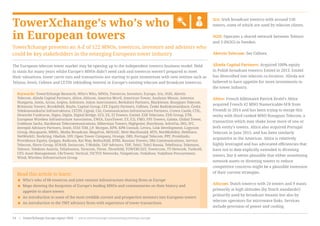
TowerXchange presents an A-Z of 122 MNOs, towercos, investors and advisors who
could be key stakeholders in the emerging European tower industry
2rn: Irish broadcast towerco with around 150
towers, some of which are used by telecom clients.
3GIS: Operates a shared network between Telenor
and 3 (Hi3G) in Sweden.
Abertis Telecom: See Cellnex.
Alinda Capital Partners: Acquired 100% equity
in Polish broadcast towerco Emitel in 2013. Emitel
has diversified into telecom co-location. Alinda are
believed to have appetite for more investments in
the tower industry.
Altice: French billionaire Patrick Drahl’s Altice
acquired French #2 MNO Numericable-SFR from
Vivendi in 2014 and has been trying to merge this
entity with third ranked MNO Bouygues Telecom, a
transaction which may shake loose more of one or
both entity’s towers. Altice also acquired Portugal
Telecom in June 2015, and has been similarly
acquisitive in the Americas. Altice is relatively
highly leveraged and has advocated efficiencies that
have not to date explicitly extended to divesting
towers, but it seems plausible that either monetising
network assets or divesting towers to reduce
competitive concerns might be a plausible extension
of their current strategies.
Alticom: Dutch towerco with 24 towers and 9 masts
primarily at high altitudes (by Dutch standards!)
primarily used by broadcast tenants but also by
telecom operators for microwave links. Services
include provision of power and cooling.
Read this article to learn:
< Who’s who of 68 towercos and joint venture infrastructure sharing firms in Europe
< Maps showing the footprints of Europe’s leading MNOs and commentaries on their history and
appetite to share towers
< An introduction to some of the most credible current and prospective investors into European towers
< An introduction to the TMT advisory firms with experience of tower transactions
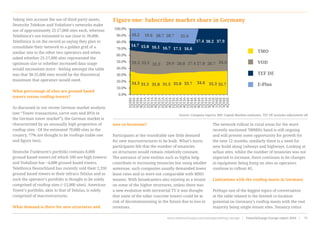
The European telecom tower market may be opening up to the independent towerco business model. Held
in stasis for many years whilst Europe’s MNOs didn’t need cash and towercos weren’t prepared to meet
their valuations, tower carve outs and transactions are starting to gain momentum with new entities such as
Telxius, Inwit, Cellnex and CETIN rekindling interest in Europe’s existing telecom and broadcast towercos.
Keywords: TowerXchange Research, Who’s Who, MNOs, Towercos, Investors, Europe, 2rn, 3GIS, Abertis
Telecom, Alinda Capital Partners, Altice, Alticom, America Movil, American Tower, Analysys Mason, Antenna
Hungaria, Antin, Arcus, Arqiva, Ashmore, Axion Azerconnect, Berkshire Partners, Blackstone, Bouygues Telecom,
Britannia Towers, Brookfield, BuyIn, Capital Group, CEE Equity Partners, Cellnex, České Radiokomunikace, Česká
Telekomunikační Infrastruktura, CETIN, Cignal, Citi, Communication Infrastructure Partners, Crown Castle, CTIL,
Deutsche Funkturm, Digea, Digita, Digital Bridge, ECS, EE, EI Towers, Emitel, ESB Telecoms, ESN Group, ETB,
European Wireless Infrastructure Association, EWIA, EuroTower, EY, F2i, FMO, FPS Towers, Galata, Global Tower,
Goldman Sachs, Hardiman Telecommunications, Hibernian Towers, Highpoint, Hutchison, InfraVia, ING, IFC,
Intrepid Advisory Partners, Inwit, ITAS TIM, J.P. Morgan, KPN, KPR Consult, Levira, Link Development, Logycom
Group, Macquarie, MBNL, Media Broadcast, MegaFon, MOSAIC, Mott MacDonald, MTS, Net4Mobility, NetShare,
NetWorkS!, Norkring, Obelisk, OIV, Open Tower Company, Orange, ORS, Portugal Telecom, PPF, Protelindo,
Providence Equity, Quippo, Radicom, Rai Way, Rothschild, RTRS, Russian Towers, SBA Communications, Service
Telecom, Shere Group, SUNAB, Swisscom, T-Mobile, TAP Advisors, TDF, Tele2, Tele2 Russia, Telefónica, Telemont,
Telenor, Telekom Austria, TeliaSonera, Teracom, Three, Threefold, TOWERCAST, Towercom, TT-Network, Turkcell,
UFG Asset Management, UkrTower, Vertical, VICTUS Networks, Vimpelcom, Vodafone, Vodafone Procurement,
Wind, Wireless Infrastructure Group
www.towerxchange.com/meetups/meetup-europe | TowerXchange Europe report 2016 | XX| TowerXchange Europe report 2016 | www.towerxchange.com/meetups/meetup-europe14
America Movil: See Telekom Austria.
American Tower: The world’s largest independent
commercial towerco, American Tower need no
introduction within this publication. Present
in Europe to date only in Germany, where the
company owns and operates a network of 2,031
sites, the majority acquired in 2012 for €393mn
from KPN.
“We liked the opportunity in Germany because of
the size and economic stability of the market, the
absence of other independent towercos, and an
attractive valuation that allowed the portfolio to
yield over 8% on day one,” said Hal Hess, President
of EMEA and Latin America for American Tower
in a August 2015 TowerXchange interview. “The
acquisition made economic sense for us despite the
acquisition of E-Plus by Telefónica – we knew this
was a likely scenario, so when we structured the
transaction we made adjustments to be able to meet
our objectives. Our German business continues to
perform above the expectations we set out in our
acquisition business case.”
“We are very interested in further transaction
opportunities in Germany, provided of course they
meet our investment criteria,” continued Hess.
“We feel it may make sense for an independent
towerco to be involved in the consolidation
and rationalisation of the other national tower
portfolios.”
Analysys Mason: Marco Cordoni and his team
at Analysys Mason are among the ‘go-to-guys’ for
tower market analysis and due diligence on a global
basis, and Europe is no exception.
Antenna Hungaria: Hungary’s recently re-
Nationalised broadcast towerco also sells
co-locations to and provides installation and
maintenance services to telecom clients.
Antin Infrastructure Partners: One of the first
movers in the European telecom tower asset class,
Antin are investors in FPS Towers which owns over
2,000 towers and the rights to 15,000 rooftops in
France, and Axion the leading broadcast towerco
in Andalucía, Spain. Antin has appetite for further
European tower investments.
Arcus Infrastructure Partners: Arcus has been
an active investor in European towers for over 11
years with the predecessor of what is now UK and
Dutch towerco Shere Group. More recently Arcus
manages their own and other consortium members’
investments in TDF, France’s largest towerco
with 9,950 sites. Arcus has an interest in further
opportunities in European towers which may or may
not be addressed through their existing platforms,
depending on scale and geo.
Arqiva: The largest independent towerco in the UK
with around 10,550 active towers with a tenancy
ratio around 2.5 and a portfolio of 16,500 in total,
of which less than 1,000 are pure broadcast sites.
Acquired by a Macquarie-led consortium in 2005,
into which was rollup up the NTL Broadcast and
National Grid Wireless assets. Arqiva has over 2,000
employees and has deep I&C and O&M competencies
and resources spanning broadcast and telecom.
Arqiva is currently restructuring debt which could
result in a change of strategic direction for the
company.
Ashmore: Another investment firm with an appetite
for telecom towers.
Axion: Operates 586 broadcast towers with some
telecom co-location in Spain, 70% of which are in
Andalucía. Owners Antin Infrastructure are believed
to be seeking to sell some or all of their stake.
Azerconnect: Infrasharing business in Azerbaijan.
Berkshire Partners: Berkshire backed Crown
Altice
www.towerxchange.com/meetups/meetup-europe | TowerXchange Europe report 2016 | 15| TowerXchange Europe report 2016 | www.towerxchange.com/meetups/meetup-europeXX
Castle during their successful foray into European
towers in the late nineties, and currently has
active investments in Protelindo (largest towerco
in Indonesia with a small footprint in the
Netherlands), Torres Unidas (Andean region of
CALA) and Tower Development Corporation in the
US and Puerto Rico.
Blackstone: Another serial towerco investor
currently working with Phoenix Tower
International in CALA with at least one other
investment in the asset class imminent, none of
which is in Europe leaving a vacancy in their
stable!
Bouygues Telecom: Bouygues Telecom was
one of Europe’s first MNOs to sell towers to
an independent towerco, selling 2,166 of their
estimated 17,000 towers to Antin’s FPS Towers
in 2012 for €185mn. Acquisition overtures from
Altice, which already owns Numericable-SFR,
could result in the divestment of more towers.
Britannia Towers / Hibernian Towers: Privately
owned towerco with 60 towers in the UK under
the Britannia brand, 60 towers in Ireland under
Hibernian and a further 20 towers in Northern
Ireland under Ulstercom.
Broadcast Networks Europe: Association of 18
broadcast companies operating in 21 European
countries whose remit includes ensuring the
economic competitiveness of Europe’s broadcast
networks, optimising platform developments and
representing the industry with regards to policy
developments and regulatory intervention.
Brookfield Infrastructure Partners: Participated
in the consortium which acquired equity in TDF
in 2014 and known to have an appetite for further
opportunities in European towers.
BuyIn: A 50/50 procurement joint venture between
Deutsche Telekom and Orange with an annual
budget of €28bn across network technology and
other telecom equipment categories.
Capital Group: Another investor keen on the
telecom tower asset class, Capital Group has or had
capital at work in Russian Towers as well as Eaton
Towers in Africa.
CEE Equity Partners: Investor exploring
opportunities in CEE towers.
Cellnex: Catalysts for the opening of the European
tower market, Cellnex (formerly Abertis Telecom)
have to date deployed over €1.2bn rolling up a
portfolio of 15,140 telecom and broadcast towers
across Spain and Italy. To put that into context,
the sum represents more than half the total
capital spent on European towers in the last five
years. Flush with capital and confidence from
their successful IPO, Cellnex has a €multi-billion
acquisition warchest. Although Cellnex dominates
the European deal table, it still has plenty of room
for growth in its existing markets: towercos own
just 18% of towers in Spain and 48% of Italy’s
towers. In conjunction with infrastructure fund F2i,
Cellnex are one of the three short listed bidders for
a stake in Telecom Italia’s Inwit.
“Our model (in Europe) is not based on the idea of
getting three or four tenants on a tower, it’s based
around the idea you can dismantle the tenants on
an existing tower and transfer them to new sites,”
said David Bernal Cantero, BDM at Cellnex in a
recent TowerXchange interview.
“Our plan in Europe is diversification,” continued
Bernal Cantero. “Germany is an attractive market
at the moment, reducing the number of operators
from four to three will shake things up. The UK
is also interesting but it’s a very competitive
market with strong incumbent towercos. France
is a strong market with some MNO transactions
in the pipeline which might drive some changes
in the market. We see some good short term
opportunities in Europe, not only in the countries
mentioned above but also in other European
countries.”
České Radiokomunikace: With 1,000 access
points across the Czech Republic, České
Radiokomunikace provides structures and
services to broadcast and telecom clients. Owned
by Macquarie.
Česká Telekomunikační Infrastruktura
(CETIN): When PPF acquired O2 Czech
Republic from Telefónica in January 2014, they
immediately set about separating the retail assets
from the infrastructure, in the latter case creating
CETIN which was briefly listed on the Prague
stock exchange prior to a squeeze out of minority
www.towerxchange.com/meetups/meetup-europe | TowerXchange Europe report 2016 | XX| TowerXchange Europe report 2016 | www.towerxchange.com/meetups/meetup-europe16
shareholders putting PPF as sole shareholders. CETIN
owns 20,000,000 km of metallic cable pairs, 38,000km
of fibre and 5,300 outdoor base stations plus 750
micro base stations, providing 99.6% population
coverage. With O2 having set up a network sharing
agreement with T-Mobile prior to the carve out,
CETIN have taken over O2’s role in managing the
RAN sharing with T-Mobile
Cignal: Owns 115 towers developed for Hutch in
Ireland, plus the ground leases under a just under
300 other operator towers. Recently sold to InfraVia
prior to which it was known as Coillte.
Citi: One of the world’s leading tower transaction
advisory groups can be found within the TMT team
at Citi.
Communication Infrastructure Partners: Owners
of Open Tower Company, which acquired 601 towers
from KPN in the Netherlands in two tranches in 2008
and 2010 for an undisclosed sum. Current tower
count: 684.
Crown Castle: Publicly listed U.S. towerco Crown
Castle had a profitable foray into European towers
between 1997 and 2003, acquiring a £75mn revenue
tower business from the BBC and transforming
it into a £233mn revenue tower business with a
tenancy ratio of 2.9 by 2003, selling it to National Grid
Wireless for £1.1bn (just over US$2bn). While Crown
Castle has largely retrenched from their international
strategy to deploy capital domestically diversifying
into small cells and fibre, TowerXchange would not
rule out the U.S. giant returning to Europe.
CTIL: Joint venture between Vodafone and O2
(Telefónica) in the UK with around 18,000 sites.
Predecessor Cornerstone established the passive
infrastructure sharing business, the new CTIL
business now has around a £1bn of passive assets
on its balance sheet whilst also leading the Beacon
active infrastructure sharing project, again between
Vodafone and O2.
Deutsche Funkturm (DFMG): Towerco carved out
of Deutsche Telekom in 2002. Their parent company
remains their lead client representing around a
third of DFMG’s tenancies. Operates 27,000 sites, of
which around half are rooftops. Deutsche Telekom
has twice been rumored to be on the brink of
divesting DFMG, but to date the assets are retained
on their balance sheet.
Digea: Greek broadcast towerco with 156 sites.
Digita: Broadcast towerco from Finland owning 27
high masts and using an additional 450 lower masts,
of which about a third are owned by the company.
Digital Bridge: Serial tower entrepreneurs Mark
Ganzi and Ben Jenkins are building another empire
having sold their last venture, GTP, to American
Tower for US$4.8bn. Digital Bridge is an investment
vehicle through which stakes are invested in
towercos around the world. Digital Bridge recently
appointed Phil Cooper as Managing Director
EMEA, having previously kicked the tyres on the
opportunity to invest in TDF. We expect Digital
Bridge to have an active investment / platform in
Europe by Q2 2016.
ECS: Polish tower builder with an appetite to
move up the value chain.
EE: UK MNO joint venture between T-Mobile and
Orange, recently taken over by BT.
EI Towers: Broadcast towerco with a progressive
management team and an appetite to diversify
into telecoms – a strategy they are well under
way in executing having acquired 900 telecom
towers from various small independent towercos
in Italy. Telecom now represents 8.9% of EI
Towers’ revenues. EI Towers more recently made
headlines for their aggressive but ultimately
justifiable persuit of an acquisition of Italy’s other
broadcast towerco Rai Way – the combination
of the two entities could create tremendous
efficiencies given the estimated 60% overlap in
their networks.
Emitel: Polish broadcast towerco diversifying
into telecoms. Own 377 sites.  Acquired by Alinda
Capital Partners.
ESB Telecoms: Subsidiary of Irish National power
company ESB Networks developed to operate
telecom sites. Most of their sites, which total
around 400, are in substations.
ESN Group: Russian oil and gas, energy,
engineering and infrastructure giant founded by
Grigory Berezkin. Had been interested to bid for
Vimpelcom’s Russian towers when the process
started and stopped in the past – interest in the
current process unknown.
www.towerxchange.com/meetups/meetup-europe | TowerXchange Europe report 2016 | 17| TowerXchange Europe report 2016 | www.towerxchange.com/meetups/meetup-europeXX
ETB: Serbian broadcast towerco.
European Wireless Infrastructure Association
(EWIA): Trade association for independent
towercos in Europe whose members included (at
time of press): American Tower Germany, Arqiva,
Axion, Cellnex, EI Towers, FPS Towers, Open Tower
Company, PCIA, Protelindo Towers BV, Towercom
and Wireless Infrastructure Group, whose CEO Scott
Coates chairs the EWIA.
EuroTower: Aspiring towerco for Europe with
big vision and a willingness to evolve the business
model to meet the needs of European MNOs. Yet to
close their first deal.
EY: TMT strategy and corporate finance advisory
team with extensive experience of advising on
tower transactions.
F2i: One of the largest infrastructure funds in
Europe, and owns a majority stake in Metroweb,
which operates a fibre network in Milan and
Lombardy. F2i was rumored to have bid for Wind’s
towers ultimately acquired by Cellnex, and is now
bidding in conjunction with the company for the
45% stake in Telecom Italia’s Inwit.
First Tower Company: Carved out of Megafon in
November 2015, infrastructure subsidiary First
Tower Company manages 14,000 towers. Megafon
CEO Ivan Tavrin has hinted they plan to sell the unit
to a strategic investor
FMO: Dutch development bank 51% government
owned, 49% by commercial banks and financial
institutions. Have invested in African towercos, not
yet in Europe, where Eastern Europe is a better fit
than the West given their developing market remit.
FPS Towers: FPS was formed in 2012 by Antin
Infrastructure Partners to acquire and manage
2,618 towers acquired from Bouygues Telecom – the
company now owns 2,051 towers, primarily in rural
areas. FPS is currently focusing solely on the French
market.
“We aim to push our development programme in
both our rural and urban rooftop portfolios. FPS
now employs 70 people and we are expecting gross
revenue of more than €45 million for this year,
representing 30% growth in the last three years,”
said Frederic Zimer, CEO of FPS Towers in a recent
TowerXchange interview. “In terms of rooftop
growth, we currently manage with exclusivity
around 20,000 and expect to reach 30-35,000 in
the next two years. Within this number we also
aim to have more than 1,000 rooftop sites owned
outright. In terms of value added, we seek to own
the rooftops and every site we have in our portfolio.
FPS is a towerco and a towerco is an infrastructure
investor and manager – we invest to grow our assets
and after that it’s a cash machine. That’s why we
seek to replicate our rural model in urban areas,”
concluded Zimer.
Galata: Wind towerco acquired by Cellnex – see
WIND Telecomunicazioni.
Global Tower: Founded in 2006 as a subsidiary of
Turkcell, Global Tower is the biggest infrastructure
operator in Turkey with more than 23,000 points
of service, of which 7,500 are towers, the rest
being rooftops and IBS. Tenants include GSM and
fixed-based operators, TV and radio broadcasters,
public institutions and service providers. Global
Tower also owns UkrTower in the Ukraine, which
owns 1181 sites following the 2016 acquisition
of 811 towers from Lifecell (Turkcell’s Ukrainian
subsidiary). Turkcell have commenced proceedings
for an IPO of Global Tower.
Goldman Sachs: Experienced advisors on tower
transactions and lenders to towercos.
Hardiman Telecommunications: A unique
consultancy equally capable advising on
engineering and operational issues as they are
Hutchison / 3 Group
www.towerxchange.com/meetups/meetup-europe | TowerXchange Europe report 2016 | XX| TowerXchange Europe report 2016 | www.towerxchange.com/meetups/meetup-europe18
extensive experience in towers, including some of
the landmark European transactions.
Konsing Group: Serbian managed service provider
active in multiple European markets, also own and
operate 74 towers in their home country.
KPN: Leading telecom and IT service provider in
The Netherlands. Sold a total of 1,322 Dutch towers
in four tranches between 2008 and 2012 to Open
Tower Company, Shere Group and Protelindo. Sold
a further 2,031 towers in Germany to American
Tower in 2012 before the sale of their German
subsidiary, E-Plus, to Telefónica in October 2014.
KPR Consult: Renowned ‘tower doctors’ – go-
to guys for structural / technical due diligence,
improvement capex planning, decommissioning
and just about anything to do with tower design
and maintenance. KPR also manage a significant
proportion of the towers in Denmark through co-
location management agreements.
Levira: Estonian broadcast towerco, data centre,
network, cloud and media service provider. 51%
owned by the government, 49% by TDF. Owns 22
transmitter towers across Estonia and provides co-
location services to MNOs.
Link Development: Operates over 300 towers,
primarily in Northwest Russia, supplemented by a
growing fleet of smart poles.
Logycom Group: The first independent towerco in
Kazakhstan, with a contract for their first 100 BTS
towers.
on commercial strategy and corporate finance.
Extensive experience advising on both the buy-side
and sell-side in tower transactions.
Hibernian Towers: See Britannia Towers.
Highpoint: See Obelisk Group.
Hutchison: MNO typically operating under the
brand 3. Active in Europe in Italy, the UK, Sweden,
Denmark, Austria and Ireland. Hutchison has sold
four tranches of towers in Indonesia to Protelindo
and STP, but has not yet completed any divestments
in Europe, although they have participated
in infrastructure sharing JVs such as MOSAIC
in Ireland and MBNL in the UK. Speculation
suggests that the merger of Vimpelcom’s Wind
and Hutchison’s 3 Italia may result in the sale of
Hutchison’s 8,000 towers in Italy, while in the UK,
Three’s takeover of O2 has been blocked by the
European Commission amidst concerns around
competition and the impact on network sharing
agreements in the country.
InfraVia Capital Partners: Acquired Coillte’s
300 sites in August 2015 for an undisclosed sum,
renaming the company Cignal.
ING Commercial Banking: Leading Dutch bank
with considerable experience of providing debt
finance to the tower industry.
International Finance Corporation (IFC): The
IFC is a member of the World Bank Group, the
world’s leading DFI. The IFC has invested around
half a billion dollars in debt and equity into
eight towercos across emerging markets, with an
objective to double that total investment by 2018.
IFC’s exposure in Europe to date is a US$20mn
equity investment into Russian Towers.
Intrepid Advisory Partners: Advisory firm
established by Daniel Lee, the “Rainmaker” of the
African tower industry – Dan advised on 11 of the
first 13 deals to close in Africa.
Inwit (Infrastrutture Wireless Italiane S.p.A.):
Telecom Italia carved out Inwit as an independent
towerco and listed 40% of the equity in the
company in a successful IPO on the Milan stock
exchange, raising €875.3mn. Telecom Italia has
since commenced a process to sell a further 45%
of the equity in the company to a third party,
with EI Towers, American Tower and Cellnex in
conjunction with F2i the shortlisted bidders.
Inwit operates 11,519 towers in Italy, of
which 7,400 are in suburban or rural areas,
commanding a €1577 lease rate, and 4,100 in
urban areas, with a €2297 lease rate. At the time
of the IPO, Inwit’s tenancy ratio was 1.55, with
Telecom Italia as their anchor tenant, Vodafone
as their primary second tenant and around 1,500
Wind tenancies
ITAS TIM: Family owned towerco which operates
420 towers in France with a combination of
broadcast, radio, M2M, WiMAX and MNO tenants.
J.P. Morgan: Leading TMT advisory team with
www.towerxchange.com/meetups/meetup-europe | TowerXchange Europe report 2016 | 19| TowerXchange Europe report 2016 | www.towerxchange.com/meetups/meetup-europeXX
Macquarie Group: Serial towerco investors, with
capital at work in Europe within Arqiva and Russian
Towers, and farther afield with Axicom (formerly
Crown Castle Australia), Mexico Tower Partners
and Viom Networks (soon to be part of ATC India).
Macquarie also has an excellent TMT advisory
practice with experience of advising on tower
transactions.
MBNL: Joint venture between EE and Three
(Hutchison) in the UK with around 18,000 sites,
although the assets remain on its shareholders’
balance sheets. The BT-EE merger has not affected
the status of the JV.
Media Broadcast: Broadcast towerco operating
over 300 transmitters across Germany. Media
Broadcast was separated from TDF in April 2015.
MegaFon: Number two MNO in Russia, carved
out 14,000 towers into captive towerco, First
Tower Company in November 2015. more recently
Megafon CEO, Ivan Tavrin provided further hints as
to the potential means and timelines for monetising
MegaFon’s towerco: “We are not going to put our
tower company on the bourse.” It seems that a
partial or complete sale to a strategic investor may
be the more likely outcome:” We believe that if
we thoroughly prepare, we’ll manage to pocket a
high-quality investor and win a high-quality future
operating history.”
MOSAIC: Vehicle for the infrastructure sharing
partnership between Three and Eircom in Ireland.
Assets remain on the balance sheets of the MNOs.
Mott MacDonald: Digital Infrastructure team
has extensive experience of advising on tower
transactions and investments.
MTS: Russian MNO currently with no appetite to
divest their estimated 10,400 towers.
Net4Mobility: Swedish joint venture infrastructure
sharing firm founded in 2009 by Telenor and Tele2.
NetShare: Former Vodafone-Three Ireland JV from
which Three were compelled to exit under the
terms of their merger with O2. NetShare continues
to administer the Vodafone network.
NetWorkS! 50-50 Polish joint venture infrastructure
sharing firm responsible for the management of
T-Mobile and Orange’s networks. When launched
in 2011, and prior to consolidation, NetWorkS!
managed 10,000 base stations.
Norkring: Wholly owned subsidiary of Telenor
which owns both the Norweigan and Belgian
broadcast towercos. Norkring has 2,750
transmission stations across Norway, with space
leased to broadcasters, MNOs, broadband and
public service providers. Norkring Belgie is 25%
owned by PMV, itself owned by the Flemish
government.
Obelisk Group: Obelisk Group is a diversified
energy and telecoms EPC contractor which also
owns Highpoint, a towerco which markets and
manages more than 150 sites in Ireland.
OIV: Croatian broadcast towerco which offers co-
location to MNOs from 218 sites.
Open Tower Company: See Communication
Infrastructure Partners.
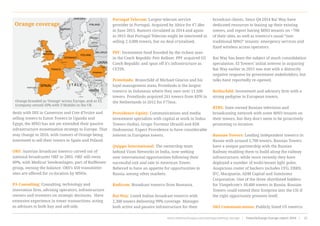
Orange: One of Europe’s largest MNOs with
a footprint across France, Spain, Belgium,
Luxembourg, Germany, Poland, Slovakia,
Moldova, Romania, Ireland and the UK, where
they are a 50% shareholder in EE. Orange has
agreed active infrastructure sharing deals in
Spain, Poland and Romania, and has partnered
with Three to create MBNL in the UK. While
Orange has partnered with independent towercos
in Africa, agreeing ‘manage with license to lease’
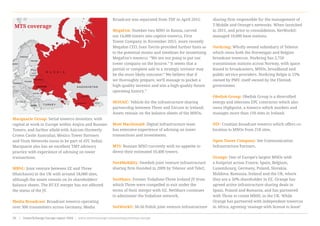
MTS coverage
XXwww.towerxchange.com/meetups/meetup-europe | TowerXchange Europe report 2016 | XX| TowerXchange Europe report 2016 | www.towerxchange.com/meetups/meetup-europe20
deals with IHS in Cameroon and Cote d’Ivoire and
selling towers to Eaton Towers in Uganda and
Egypt, the MNO has not yet extended their passive
infrastructure monetisation strategy to Europe. That
may change in 2016, with rumors of Orange being
interested to sell their towers in Spain and Poland.
ORS: Austrian broadcast towerco carved out of
national broadcaster ORF in 2005. ORF still owns
60%, with Medicur Sendeanlagen, part of Raiffeisen
group, owning the balance. ORS’s 450 transmitter
sites are offered for co-location by MNOs.
PA Consulting: Consulting, technology and
innovation firm, advising operators, infrastructure
owners and investors on strategic decisions. Have
extensive experience in tower transactions; acting
as advisors to both buy and sell-side.
Portugal Telecom: Largest telecom service
provider in Portugal. Acquired by Altice for €7.4bn
in June 2015. Rumors circulated in 2014 and again
in 2015 that Portugal Telecom might be interested in
selling 2-3,000 towers, but no deal crystalised.
PPF: Investment fund founded by the richest man
in the Czech Republic Petr Kellner. PPF acquired O2
Czech Republic and spun off it’s infrastructure as
CETIN.
Protelindo: Brainchild of Michael Gearon and his
loyal management team, Protelindo is the largest
towerco in Indonesia where they own over 11,500
towers. Protelindo acquired 261 towers from KPN in
the Netherlands in 2012 for €75mn.
Providence Equity: Communications and media
investment specialists with capital at work in Indus
Towers (India), Grupo Torresur (Brazil) and KIN
(Indonesia). Expect Providence to have considerable
interest in European towers.
Quippo International: The ownership team
behind Viom Networks in India, now seeking
new international opportunities following their
successful exit and sale to American Tower.
Believed to have an appetite for opportunities in
Russia, among other markets.
Radicom: Broadcast towerco from Romania.
Rai Way: Listed Italian broadcast towerco with
2,300 towers delivering 99% coverage. Manages
both active and passive infrastructure for their
broadcast clients. Since Q4 2014 Rai Way have
dedicated resources to leasing up their existing
towers, and report having MNO tenants on ~700
of their sites, as well as towerco’s usual “non-
traditional MNO” tenants: emergency services and
fixed wireless access operators.
Rai Way has been the subject of much consolidation
speculation. EI Towers’ initial interest in acquiring
Rai Way earlier in 2015 was met with a distinctly
negative response by government stakeholders, but
talks have reportedly re-opened.
Rothschild: Investment and advisory firm with a
strong pedigree in European towers.
RTRS: State-owned Russian television and
broadcasting network with some MNO tenants on
their towers, but they don’t seem to be proactively
promoting co-location.
Russian Towers: Leading independent towerco in
Russia with around 1,700 towers. Russian Towers
have a unique partnership with the Russian
Railway enabling them to build along the railway
infrastructure, while more recently they have
deployed a number of multi-tenant light poles.
Auspicious roster of backers includes UFG, EBRD,
IFC, Macquarie, ADM Capital and Sumitomo
Corporation. One of the three shortlisted bidders
for Vimpelcom’s 10,400 towers in Russia. Russian
Towers could extend their footprint into the CIS if
the right opportunity presents itself.
SBA Communications: Publicly listed US towerco
Orange coverage
Orange branded as ‘Orange’ across Europe, and as EE
(company owned 50% with T-Mobile) in the UK
www.towerxchange.com/meetups/meetup-europe | TowerXchange Europe report 2016 | 21| TowerXchange Europe report 2016 | www.towerxchange.com/meetups/meetup-europeXX
with over 25,000 towers in North and South
America. No presence in Europe. Yet.
Shared Access: Towerco with a portfolio of over
50,000 site locations, that have been assembled
through partnerships with major sporting and
farming organisations available for development
across the UK and Ireland.
Service Telecom: Towerco with over 100 towers
and microsites in Moscow.
Shere Group: Independent towerco owned by
Arcus Infrastructure with 860 towers across the UK
and the Netherlands.
SUNAB: Active infrastructure sharing joint venture
between Tele2 and TeliaSonera in Sweden.
Swisscom: Swiss broadcast towerco.
T-Mobile: Leading European MNO which has
been involved in network sharing JVs in Poland,
the Netherlands, the Czech Republic and the UK
(through their 50% stake in EE). T-Mobile has not
yet sold any towers in Europe but has done in the
US, where they also operate their own towerco
T-Mobile Towers.
TAP Advisors: Boutique M&A and investment
advisory firm with long history of advising on tower
deals, including advising Inwit on their IPO.
TDF: Leading French towerco with 6,966 sites and
over 2,000 employees. Refinanced in March 2015
with Brookfield, APG, PSP, Arcus Infrastructure and
Credit Agricole becoming shareholders. In recent
years TDF has refocused on their domestic French
market and has less appetite for international
opportunities, selling broadcast towercos Axion
(Spain), Alticom (Netherlands), Digita (Finland),
Antenna Hungaria (Hungary) and separating Media
Broadcast (Germany). In 2014-15 41.2% of TDF’s
revenues came from telecom, 30.3% from TV and
18.3% from radio broadcast.
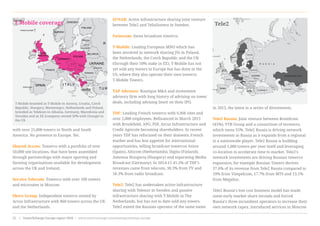
Tele2: Tele2 has undertaken active infrastructure
sharing with Telenor in Sweden and passive
infrastructure sharing with T-Mobile in The
Netherlands, but has not to date sold any towers.
Tele2 exited the Russian operator of the same name
in 2013, the latest in a series of divestments.
Tele2 Russia: Joint venture between Rostelcom
(45%), VTB Group and a consortium of investors,
which owns 55%. Tele2 Russia is driving network
investments in Russia as it expands from a regional
to a nationwide player. Tele2 Russia is building
around 1,000 towers per year itself and leveraging
co-location to accelerate time to market. Tele2’s
network investments are driving Russian towerco
expansion, for example Russian Towers derives
37.6% of its revenue from Tele2 Russia compared to
19% from Vimpelcom, 17.7% from MTS and 13.1%
from Megafon.
Tele2 Russia’s low cost business model has made
some early market share inroads and forced
Russia’s three incumbent operators to increase their
own network capex. Introduced services in Moscow
Tele2T Mobile coverage
T-Mobile branded as T-Mobile in Austria, Croatia, Czech
Republic, Hungary, Montenegro, Netherlands and Poland,
branded as Telekom in Albania, Germany, Macedonia and
Slovakia and as EE (company owned 50% with Orange) in
the UK
www.towerxchange.com/meetups/meetup-europe | TowerXchange Europe report 2016 | XX| TowerXchange Europe report 2016 | www.towerxchange.com/meetups/meetup-europe22
and Moscow Oblast in October 2015 having built a
formidable network of 5,000 3G and 2,000 LTE base
stations.
Telefónica: Spanish owned multinational MNO
Telefónica has made the headlines through the
creation of new infrastructure business – Telxius,
which incorporates their 11,000 Spanish towers
(thought to comprise of rooftop and ground based
towers) and 2,350 German ground based towers
(plus 2,832 towers in Brazil, Peru and Chile and
31,000km of fibre optic cable).
Telefónica has already sold 500 towers in Spain
to Abertis (now Cellnex) in 2012 before a further
bundle of 4,277 Telefónica and Yoigo towers
was sold to the same company in 2014, raising
€385mn. Telefónica’s acquisition of E-Plus from
KPN in Germany precipitated the transfer of 7,700
sites – mostly rooftops – to Deutsche Telekom and
ultimately to Deutsche Funkturm.
Telefónica has also sold a total of over 9,000 towers
in Brazil, Mexico, Chile and Colombia, raising a total
of over US$1.5bn.
Telemont: Leading Russian tower I&C and O&M
subcontractor.
Telenor: Multinational Norwegian owned MNO
Telenor has shared infrastructure all over its
footprint, but has tended to partner with towercos
in greenfield launches, such as the launch of Uninor
(now Telenor India) and the launch of Telenor
Myanmar. Within established markets, Telenor has
seemingly preferred to retain towers and instead
form active infrastructure sharing partnerships
such as with TeliaSonera in Denmark and with
Tele2 and Hutchison in Sweden.
Telekom Austria: America Movil owns a 59.7%
stake in €4bn MNO Telekom Austria, which has a
footprint across Austria, Slovenia, Croatia, Serbia,
Macedonia, Bulgaria and Belarus. TowerXchange
have picked up the first hints that Telekom Austria
Telekom Austria
Telefonica
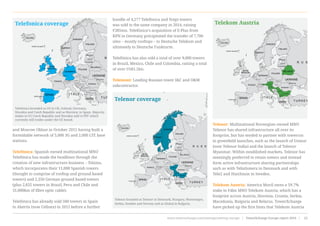
Telenor coverage
Telenor branded as Telenor in Denmark, Hungary, Montenegro,
Serbia, Sweden and Norway and as Globul in Bulgaria
Telefonica coverage
Telefonica branded as O2 in UK, Ireland, Germany,
Slovakia and Czech Republic and as Movistar in Spain. Majority
stakes in O2 Czech Republic and Slovakia sold to PPF which
currently still trades under the O2 brand.
www.towerxchange.com/meetups/meetup-europe | TowerXchange Europe report 2016 | 23| TowerXchange Europe report 2016 | www.towerxchange.com/meetups/meetup-europeXX
might be receptive to some form of infrastructure
outsourcing deal, possibly involving passive and
active equipment.
TeliaSonera: TeliaSonera has completed one
tower transaction to date in Europe – their Spain
subsidiary Yoigo contributed some of the 4,277
Telefónica and Yoigo towers sold to Cellnex in 2014.
TeliaSonera has engaged in active infrastructure
sharing partnerships in Denmark, with Telenor,
and in Finland, with DNA. TeliaSonera’s proposed
merger with Telenor in Denmark, which may
have shaken loose some towers, has been called
off. However the acquisition of Tele2 Norway
has been closed, with network integration
ongoing – anticipate some towers being sold or
decommissioned as a result.
TeliaSonera recently appointed UBS to explore
their potential exit from Kazakhstan, Uzbekistan,
Azerbaijan, Tajikistan, Nepal, Georgia and Moldova,
enabling the group to sharpen its focus on the rest
of Europe and the Nordics.
Telxius: Telefónica’s newly created global
subsidiary formed in early 2016 to bring together a
selection of the group’s infrastructure assets.  The
unit initially incorporates 11,000 Spanish towers
(thought to comprise of rooftop and ground based
towers) and 2,350 German ground based towers
(plus 2,832 towers in Brazil, Peru and Chile and
31,000km of fibre optic cable). Telxius reports
pro forma FY15 revenues of €600mn, with 60%
attributed to the submarine cabling components
of their business and 40% to towers, of which 85%
comes from their European towers  Calculating the
average revenue per tower we arrive at the figure of
just under €17k per site – in line with the revenues
reported by Cellnex. Telefónica have reportedly
hired Goldman Sachs and JP Morgan to join UBS in
commencing an IPO process for Telxius, with an
early July listing on the Madrid Stock Exchange
mooted.
Teracom: Broadcast towerco for Denmark and
Sweden.
Three Italy: The merger of Vimpelcom’s Wind
and Hutchison’s 3 Italia may result in the sale of
Hutchison’s 8,000 towers in Italy.
Three UK and Ireland: Three’s merger
with Telefónica’s O2 in Ireland precipitated Three
exiting the Netshare joint venture with Vodafone.
Three’s JV with Vodafone in the UK, CTIL, looks
set to remain following the EC’s block of Three’s
takeover of O2.
Threefold: Leading Irish tower I&C and O&M
firm which led the buyout of Eircom’s mast
infrastructure in 2007, and the subsequent
establishment of Towercom. Threefold now
provides tower strategy advice to stakeholders
across Europe and beyond.
TOWERCAST: French broadcast towerco owned by
NRJ Group. Also sells co-location to telecom clients.
Towercom Ltd.: Towerco in the Republic of Ireland
carved out and sold by Eircom in 2007. Operates
over 400 towers. Sold to the Irish Infrastructure
Fund in 2013.
Towercom A.S.: Slovakian tower company with
over 700 masts and 90 years experience in the
broadcast sector. The company was acquired
by Macquarie in 2013, undergoing a process
of restructuring and at the start of 2016 was
rebranded.
TowerTel: Wholly owned subsidiary of Italian
broadcast towerco EI Towers, managing the
company’s 900 telecom towers.
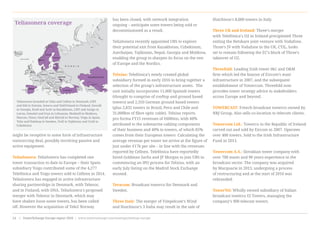
Teliasonera branded as Telia and Callme in Denmark, EMT
and Diil in Estonia, Sonera and TeleFinland in Finland, Geocell
in Georgia, Kcell and Activ in Kazakhstan, LMT and Amigo in
Latvia, Omnitel and Ezys in Lithuania, Moldcell in Moldova,
Netcom, Chess, OneCall and MyCall in Norway, Yoigo in Spain,
Telia and Halebop in Sweden, Tcell in Tajikistan and Ucell in
Uzbekistan
Teliasonera coverage
www.towerxchange.com/meetups/meetup-europe | TowerXchange Europe report 2016 | XX| TowerXchange Europe report 2016 | www.towerxchange.com/meetups/meetup-europe24
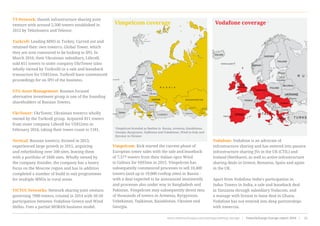
Vimpelcom: Kick started the current phase of
European tower sales with the sale and leaseback
of 7,377 towers from their Italian opco Wind
to Cellnex for €693mn in 2015. Vimpelcom has
subsequently commenced processes to sell 10,400
towers (and up to 19,000 rooftop sites) in Russia -
with a deal expected to be announced imminently
and processes also under way in Bangladesh and
Pakistan. Vimpelcom may subsequently divest tens
of thousands of towers in Armenia, Kyrgyzstan,
Uzbekistan, Tajikistan, Kazakhstan, Ukraine and
Georgia.
Vodafone: Vodafone is an advocate of
infrastructure sharing and has entered into passive
infrastructure sharing JVs in the UK (CTIL) and
Ireland (NetShare), as well as active infrastructure
sharing deals in Greece, Romania, Spain and again
in the UK.
Apart from Vodafone India’s participation in
Indus Towers in India, a sale and leaseback deal
in Tanzania through subsidiary Vodacom, and
a manage with license to lease deal in Ghana,
Vodafone has not entered into deep partnerships
with towercos.
TT-Network: Danish infrastructure sharing joint
venture with around 2,500 towers established in
2012 by TeliaSonera and Telenor.
Turkcell: Leading MNO in Turkey. Carved out and
retained their own towerco, Global Tower, which
they are now rumoured to be looking to IPO. In
March 2016, their Ukrainian subsidiary, Lifecell,
sold 811 towers to sister company UkrTower (also
wholly owned by Turkcell) in a sale and leaseback
transaction for US$52mn. Turkcell have commenced
proceedings for an IPO of the business.
UFG Asset Management: Russian focused
alternative investment group is one of the founding
shareholders of Russian Towers.
UkrTower: UkrTower, Ukrainian towerco wholly
owned by the Turkcell group. Acquired 811 towers
from sister company Lifecell for US$52mn in
February 2016, taking their tower count to 1181.
Vertical: Russian towerco, formed in 2013,
experienced large growth in 2015, acquiring
and refurbishing over 500 sites, leaving them
with a portfolio of 1600 sites. Wholly owned by
the company founder, the company has a heavy
focus on the Moscow region and has in addition
completed a number of build to suit programmes
for multiple MNOs in rural areas.
VICTUS Networks: Network sharing joint venture,
governing 7000 towers, created in 2014 with 50-50
participation between Vodafone Greece and Wind
Hellas. Uses a partial MORAN business model.
Vodafone coverage
Vimplecom
Vimpelcom coverage
Vimpelcom branded as Beeline in  Russia, Armenia, Kazakhstan,
Georgia, Kyrgyzstan, Tajikistan and Uzbekistan, Wind in Italy and
Kyivstar in Ukraine
www.towerxchange.com/meetups/meetup-europe | TowerXchange Europe report 2016 | 25| TowerXchange Europe report 2016 | www.towerxchange.com/meetups/meetup-europeXX
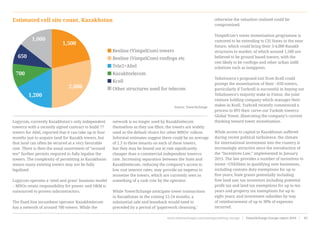
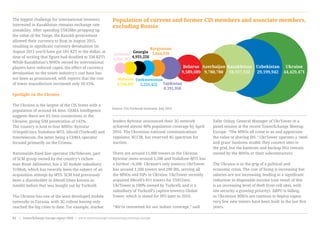
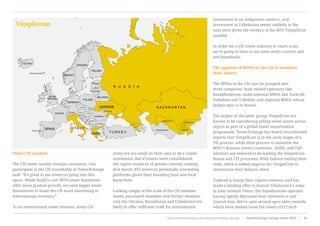
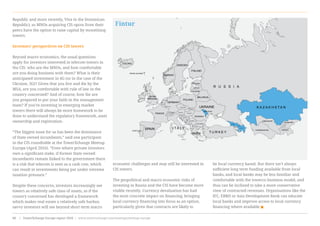
Vodafone Procurement Company (VPC):
Vodafone founded VPC in 2008 to leverage scale
and a leaner procurement and SCM model. VPC
administers a total procurement budget in excess
of €20bn per annum, and provides procurement
services to third parties, including independent
towercos.
Wind Telecomunicazioni: Vimpelcom’s Italian
opco whose towerco Galata was sold to Cellnex in
2015, with Wind retaining a 15% equity stake, as
well as a small proportion of the towers. Wind is
currently engaged in a merger with Hutchison’s 3
Italia, which could shake loose more towers.
Wireless Infrastructure Group (WIG): One of
Europe’s most entrepreneurial middle-market
towercos, WIG became a bona fide towerco in
2007. Through a combination of organic growth
and small to mid-sized acquisitions, WIG has
grown a portfolio of over 2,000 active sites. The
company and their investors Wood Creek Capital
Management remain acquisitive.
“If we get to half the level of outsourcing as the
US market there would be an additional 100,000
towers owned by towercos,” said WIG CEO Scott
Coates. “The opportunity also extends beyond
towers – WIG for example has an active DAS
business and we are looking at outdoor small
cell networks for cities in the UK.  Whether it’s
towers or small cells, the wholesale sector has a
major role to play in the next chapter of European
wireless networks.”
www.towerxchange.com
Meetup Africa
2016
19-20 October,
Johannesburg
Meetup Asia
2016
13-14 December,
Singapore
Meetup
Europe 2017
4-5 April,
London
Meetup
Americas 2016
16-17 June,
Boca Raton
See you at our future events!
www.towerxchange.com/meetups/meetup-europe | TowerXchange Europe report 2016 | XX| TowerXchange Europe report 2016 | www.towerxchange.com/meetups/meetup-europe26
European towerco and infraco league table
						Tower count	Countries
Deutsche Funkturm 			27,000		Germany
CTIL						18,000		UK
MBNL					18,000		UK
RTRS						16,000		Russia
Cellnex					15,127		Spain, Italy
First Tower Company			14,000		Russia
Telxius					13,893		Germany, Spain(count exc sites in CALA )
INWIT					11,519		Italy
Arqiva					10,550		UK
Global Tower / UkrTower		 8,681			 Turkey, Ukraine
Victus Networks				7,000			Greece
TDF						6,996			France
CETIN					4,800			Czech Republic
Mosaic					4,000			Ireland
EI Towers					3,200			Italy
FPS Towers					2,618			France
Rai Way					2,300			Italy
American Tower				2,031				
Wireless Infrastructure Group	 2,000			 UK, Ireland, Netherlands
Russian Towers				1,800			Russia
Vertical					1,600			Russia
Shere Group				960			UK, Netherlands
Germany (count exc 13 other countries outside Europe)
Independent pureplay telecom
towerco
Towerco with substantial
broadcast component
JV infraco
Operator-led infraco
Companies represented at the
TowerXchange Meetup Europe
2016 are shown in bold
Source: TowerXchange
www.towerxchange.com/meetups/meetup-europe | TowerXchange Europe report 2016 | 27| TowerXchange Europe report 2016 | www.towerxchange.com/meetups/meetup-europe14
*count excludes sites in CALA
Tower count	Countries
Ceske Radiokommunikace		800			Czech Republic
Towercom AS				700			Slovakia
Open Tower Company			684			Netherlands
Axion					586			Spain
Shared Access				460			Ireland, UK
ITAS TIM					420			France
Towercom Ltd				400			Ireland
ESB Telecom				377			Ireland
Emitel					377			Poland
Link Development			300			Russia
Protelindo BV				260			Netherlands
Digita					187			Finland
2RN						150			Ireland
Hibernian / Brittannia Towers	 140			 UK, Ireland
Service Telecom				120			Russia
Cignal					113			Ireland
Logycom					100			Kazakhstan
CIE						100			Ireland
Falck						75			Denmark
Highpoint / OBELISK			50			Ireland
Konsing Group				47			Serbia
Cellcom					40			Ireland
Österreichischer Rundfunk		40			Austria
Alticom					33			Netherlands
Notes: several other towercos and infracos exist
in Europe whose counts have not been disclosed,
estimates of which are included in our analysis.
These include Azerconnect (Azerbaijan), Digea
(Greece), ETB (Serbia), EuroTower, Media Broadcast
(Germany), NetWorkS! (Poland), Net4Mobility
(Sweden), Norkring (Norway and Belgium), OIV
(Croatia), Ovidu (Romania), Radiocom (Romania),
RTP (Portugal), SUNAB (Sweden), Teracom (Sweden,
Denmark), and Towercast (France).
Independent pureplay telecom
towerco
Towerco with substantial
broadcast component
JV infraco
Operator-led infraco
Companies represented at the
TowerXchange Meetup Europe
2016 are shown in bold
Source: TowerXchange
www.towerxchange.com/meetups/meetup-europe | TowerXchange Europe report 2016 | 15| TowerXchange Europe report 2016 | www.towerxchange.com/meetups/meetup-europe28
Vodafone, VP Global SCM Services
Vodafone, Principle Category Manager, Networks SCM
Technology
Vodafone, Senior Category Manager, Network Site
Infrastructure
Towercos, Broadcast Towercos and JV Infracos
American Tower, VP Business Development, Europe
American Tower, VP Business Development, EMEA
American Tower Corporation, Senior Strategic
Implementation Lead
American Tower Germany, CEO
Arqiva, Product and Technology Director
Arqiva, Managing Director - Telecoms Division
Axion, President
Cellnex, CEO
Cellnex, International Business and Marketing
Director
Final attendee list for the TowerXchange Meetup Europe 2016
Mobile Network Operators
Deutsche Telekom, VP M&A
Dialog Axiata, Director
Etisalat, Vice President, Costing and Business Analysis
MegaFon, CTIO
NTT Docomo, Manager
TalkTalk, Director of Small Cell Technology
TDC, Category Manager, Mobile Infrastructure
Telefonica, Head of Infrastructure Efficiency
Turkcell, Merger and Acquisition & Investor Relations
Member at Tu
Vimpelcom, Business Development Executive
Vimpelcom, Chief Business Development & Portfolio
Officer
Vimpelcom, Group Director, Business Development
Vodafone, Marketing Manager, SCM Sales
Vodafone, Principal Category Manager, Property
Vodafone, Head of Sales
Cellnex, M&A Manager, Business Development
Direction
Cellnex, Corporate and Public Affairs Director
CETIN, Strategy Director
Cignal, Managing Director
Cignal, Chairman
CTIL, CEO
CTIL, Finance Director
CTIL, General Counsel
Deutsche Funkturm, Head of Geodata Management
Digita Oy, CEO
Eaton Towers, CEO
edotco, Director of Business Development
EI Towers, Chairman
EI Towers, Director of Institutional Affairs
EmiTel, CFO
EmiTel, Vice President
EuroTower, President
FPS Towers, COO
FPS Towers, CFO
FPS Towers, CEO
FPS Towers, Commercial Director
FPS Towers, Strategy Director
Helios Towers Africa, Executive Chairman
Hibernian Towers, Company Director
Inwit, CEO
Inwit, Investor Relations
Konsing Group, CEO
Konsing Group, CTO
Link Development, CEO
Link Development, Co-founder
Link Development, Investment Advisor
Logycom Group, Commercial Director
MBNL, Managing Director
MBNL, Finance Director
Norkring AS, CEO
www.towerxchange.com/meetups/meetup-europe | TowerXchange Europe report 2016 | 29| TowerXchange Europe report 2016 | www.towerxchange.com/meetups/meetup-europe16
Final attendee list for the TowerXchange Meetup Europe 2016
NOVEC, Managing Director
NOVEC, Commercial Director
Open Tower Company, General Counsel
Open Tower Company, Managing Partner
Protelindo, Director
Protelindo, Corporate Finance
Rai Way, Business Development Manage
Russian Towers, Co-Founder
Russian Towers, Commercial Director
Russian Towers, Investment Director
Russian Towers, President
Russian Towers, Chairman
Russian Towers, Marketing Director
SBA Communications, International Business
Development
Service Telecom, Lawyer
Service Telecom, CEO
Shere Group Ltd, Managing Director
Shere Masten BV, General Manager
TDF, Group Deputy CEO/Group CFO
TDF, Strategy & Development Director
Towercom Ltd, Chief Executive Officer
Towercom Ltd, General Manager
Towercom Ltd, New Business Development
Manager
Towershare, President & CEO
Towershare, CTO
Towershare, CFO
Towershare, General Counsel
Towershare, Sales Director
UkrTower, General Manager
VICTUS Networks, CEO
Wireless Infrastructure Group, CEO
Wireless Infrastructure Group, COO
Wireless Infrastructure Group, Corporate Finance
Manager
Wireless Infrastructure Group, Director
Investors
3i Infrastructure, Director, Infrastructure
4M Investments, Principal
Alinda Capital Partners, Director
Alinda Capital Partners, Managing Director
AMP Capital Investors, Investment Director
AMP Capital Investor, Investment Manager
Antin Infrastructure Partners, Managing Partner
Alinda Capital Partners, Partner
Arcus Infrastructure Partners, Partner
Arcus Infrastructure Partners, Senior Investment
Director
Bank of Tokyo Mitsubishi, Director, TMT
BNP Paribas, Director
Brookfield, Senior Vice President
Capital Group, Associate
Capital Group, Partner
Citi, Global Communications Group
Communication Infrastructure Fund, Managing
Partner
Credit Suisse, Director
Crescent Park, Associate
Digital Bridge Holdings, Managing Director, EMEA
Goldman Sachs, Executive Director
Goldman Sachs, Senior Representative
ING Wholesale Banking, Managing Director
International Finance Corporation (IFC), Chief
Investment Officer
International Finance Corporation (IFC), Head of
Telecom, Media & Technology, EMEA
Macquarie, Managing Director, TMT
Macquarie Infrastructure and Real Assets,
Managing Director
Och-Ziff, Managing Director
Oddo Seydler Corporate Finance, Managing Director
Providence Equity, Managing Director
RBC Capital Markets, Managing Director
Rothschild, Managing Director
Tillman Global Holdings, VP Business Development
UFG Asset Management, Managing Director, Partner
Wood Creek, CEO
Wood Creek, Vice President
Other
Abloy Oy, Managing Director
Abloy Oy, Business Development Manager
ACSYS, COO
ACSYS, Head of Marketing Strategy
Airsys, VP, Sales & Marketing, EMEA
Analysys Mason, Principal
Analysys Mason, Senior Partner
Bladon Jets, CEO
Bladon Jets, VP Market Development
Caterpillar, Global Accounts Manager
Cihan Nazmi Biyilki Education & Consultancy,
Executive Business Management
www.towerxchange.com/meetups/meetup-europe | TowerXchange Europe report 2016 | 17| TowerXchange Europe report 2016 | www.towerxchange.com/meetups/meetup-europe30
Coslight India Telecom Pvt Ltd, Director
Delmec Engineering, Business Development
Delmec Engineering Ltd, CTO
Delmec Engineering Ltd, CEO
Delmec Engineering, Managing Director
Dialight, Director Sales
Electronic Control Systems, President
EnerSys EMEA, Director - Reserve Power EMEA
EnerSys EMEA, VP Sales & Marketing - Reserve Power
EMEA
Enertika, Business Development Director
Ericsson AB, Strategic Product Management Energy &
Enclosure
Hardiman Telecommunications, Managing Partner
Hardiman Telecommunications, Managing
Consultant
Hardiman Telecommunications, Managing
Consultant
Hardiman Telecommunications, Managing
Consultant
Heliocentris, VP Sales and Marketing
Huawei Technologies, Senior Marketing Manager
Huawei Technologies, Vice President, Global
Marketing and Sales Support
Inaccess, Sales & Business Development Manager
International Power Supply, Vice President
Intrepid Advisory Partners, Managing Director
Invendis, CTO
Invendis, COO
Jabil Inala, Managing Director
Jabil Inala, Senior Director, Corporate Investment
KPR Consult, Co-Founder & Chairman
Medipower, CEO
Medipower, Vice President
Metalogalva, Business Unit Manager
Moelis & Company, Vice President
Mott McDonald, Technical Director, Digital Consulting
Nomura, Executive Director
NorthStar, President, EMEA
NorthStar, Director, Solution Engineering
ORION, Commercial Manager
PA Consulting, Managing Consultant
PA Consulting, Member of Management Group
Radio Innovation Sweden, CEO
Redflow, Sales Manager Europe
Rethink Technology Research, CEO & Co-Founder
Siterra, An Accruent Product, RVP Telecom Sales
Siterra, An Accruent Product, Senior Manager,
Product Management and Marketing
Small Cell Forum, Chairman, Multi-Operator &
Neutral Host Working Group
Tarantula, Founder & Director
Tarantula, Sales Director, Europe
Threefold Project Management, CEO
Vinson & Elkins, Partner
Willkie Farr & Gallagher, Partner
Zamil Infra, CEO
Zamil Infra, Vice President, International Sales
Final attendee list for the TowerXchange Meetup Europe 2016
www.towerxchange.com/meetups/meetup-europe | TowerXchange Europe report 2016 | 31| TowerXchange Europe report 2016 | www.towerxchange.com/meetups/meetup-europe18
Special feature:
The TowerXchange Meetup Europe featured one state of the market address, seven interactive
panel debates, one in depth CEO interview and forty roundtable discussion groups. In this
section we take a look at some of the discussions held on site.
Roundtable and panel
discussion reports
Strategic sessions
33 The unique characteristics and projected future of the European tower industry
37 What is the future of the European tower industry?
40 Tower divestments, carve outs and M&A in the European market
43 Cellnex CEO Tobias Martinez on the company’s ambitions in the European market
46 FPS expands beyond rural towers into urban rooftops
50 Carving out O2 Czech Republic’s infrastructure business
53 What are the synergies between broadcast and telecom towers?
56 Growing pains: how to scale a towerco
61 RANsharing: the search for an equitable deal for MNOs and towercos
67 Towerco ambitions in DAS,small cells and public Wi-Fi
Country and regional focus sessions
70 The unique structure of the UK tower market
74 Hamstrung rooftop co-locations and potential tower monetisations in the German market
78 Global Tower’s IPO and the Turkish mobile market
82 A first look at the CIS tower markets, particularly Kazakhstan and the Ukraine
87 Russia & CIS FAQs
95 The Greek tower market opens up
98 Potential tower divestitures in Poland within 12-24 months
101 Romanian MNOs retain control over infrastructure
103 Ireland case study
www.towerxchange.com/meetups/meetup-europe | TowerXchange Europe report 2016 | 19| TowerXchange Europe report 2016 | www.towerxchange.com/meetups/meetup-europe32
The unique characteristics and
projected future of the European
tower industry
The current state and forecast future growth of
the European tower industry through 2020
In Europe (inclusive of Russia and the CIS), there
are a total of 600,000 cell sites. These sites are
comprised of towers, streetpoles, rooftops and in-
building solutions – by TowerXchange’s definition,
we count any site that is potentially shareable. As a
mature tower market, that total of around 600,000
is staying fairly constant with new build being
more or less cancelled out by the decommissioning
of parallel infrastructure.
The structure of the European tower market is
quite unique, with joint venture infrastructure
sharing companies such as CTIL and MBNL in
the UK, VICTUS Networks in Greece, NetGrid in
Romania, Mosaic in Ireland and a host of others in
Scandinavia operating (if not always owning) 11.1%
of the continent’s towers (figure one). They’re
a different breed from a commercial towerco
because they are typically created to serve solely
the needs of their parent MNOs, may price leases
solely at a chargeback level, and may not lease sites
to third parties.
A second unique characteristic of the European
market is the prevalence and scale of broadcast-
telecom hybrid towercos. Broadcast infrastructure
is generally a different but parallel asset class
characterised by less growth than the telecom
towerco asset class. Hybrid broadcast and telecom
towercos represent around 9% of the 13% of
Europe’s towers owned by independent towercos;
Read this article to learn:
< The different roles of JV infracos and operator-led, broadcast and independent towercos in the
European tower industry
< Who Europe’s key infracos and towercos are
< The mix of ground based towers and rooftop towers in the European market
< Key transactions and deal structures to date
< Motivators behind recent transactions
< How tower ownership is forecasted to change hands in the next five years
Keywords: Acquisition, American Tower, Arqiva, Broadcast, Capacity Enhancements, Carve Out, Cashflow
Finance, Cellnex, CETIN, Core Network, Backhaul & FTTT, DAS, Deal Structure, Decommissioning,
Densification, Deutsche Funkturm, EBITDA, EI Towers, Europe, Europe Insights, Europe News, First Tower
Company, FPS Towers, Global Tower, IBS, Infrastructure Sharing, Investment, INWIT, LTE, Market Overview,
MNOs, Operator-Led JV, Rai Way, Rooftop, RTRS, Russia & CIS, Russian Towers, Sale & Leaseback, Small Cells,
TDF, Telxius, Tower Count, Towercos, TowerXchange Research, UkrTower, Urban versus Rural, Valuation,
Vertical, Who’s Who, WIG
At the TowerXchange Meetup Europe, TowerXchange
opened proceedings with a run down of the key
characteristics, trends and transactions in the
European tower industry, examining key motivators
and forecasting how the shape of the market is set to
change. We summarise some of the main take home
messages and revisit key charts and figures presented
to provide a 101 on this rapidly evolving marketplace.
Kieron Osmotherly, CEO, TowerXchange and Laura Dinnewell,
Head of TowerXchange EMEA
www.towerxchange.com/meetups/meetup-europe | TowerXchange Europe report 2016 | 33| TowerXchange Europe report 2016 | www.towerxchange.com/meetups/meetup-europe20
just 4% are pureplay telecom towercos… for now!
Operator-led carve out towercos, where the
parent MNO retains >51% of the equity in the
towerco, account for 12.1% of Europe’s towers,
a segment supplemented by the addition of
Telefónica’s Telxius, but from which INWIT may
be exiting upon completion of their sale: carve
out and monetise is becoming as popular as the
pure sale and leaseback model.
There is no European tower market per se, there
are 50 local tower markets, the size of some of
which are shown in TowerXchange’s analysis of
the independent tower market in Europe. There
are also no pan-European towercos, in fact of the
61 European towercos and infracos identified
by TowerXchange, only six have a presence
in multiple countries, and most of those are
neighboring countries. However, we expect to see
the rise of multi-country towercos of scale in the
coming five years, led by Cellnex.
Towers versus rooftops and streetpoles
It is something of a misnomer to talk about a
600,000 tower European tower market, since in
several markets, rooftop structures significantly
outnumber traditional ground based towers
(GBTs), exemplified by Russia where only 36% of
telecom structures are GBTs, and Germany where
it’s only 23% (figure two)
Rooftop structures may be as investible or less
Figure one: Current ownership of Europe’s ~600,000 towers
Source: TowerXchange
63.7%
11.1%
12.1%
13%
MNO captive
JV infraco
Operator-led infracos
Independent towerco
Source: TowerXchangeGBTs Rooftops and streetpoles
Figure two: Towers versus rooftops and streetpoles
Russian example German example
42,100
16,381
75,000
53,604
www.towerxchange.com/meetups/meetup-europe | TowerXchange Europe report 2016 | 21| TowerXchange Europe report 2016 | www.towerxchange.com/meetups/meetup-europe34
investible than full GBTs as a function of their
structural capacity, rights of access and the
contractual relationship with the landlord.
A lot of the new build we’re seeing in Europe
consists of streetpoles and infill microcell sites,
rather than full scale GBTs.
An introduction to Europe’s towercos
There are 17 towercos in Europe which possess
portfolios of over 1000 towers, rooftops and
streetpoles (see figure 1a in TowerXchange’s
analysis of the independent tower market in
Europe).  
1. Deutsche Funkturm is Deutsche Telekom’s
captive towerco, and owns just under 40% of the
towers and rooftops in Germany.
2. RTRS is the Russian broadcast towerco with
16,000 towers.
3. Cellnex is the fastest growing towerco in Europe,
with 15,120 towers across Spain and Italy and an
appetite for further opportunities in their existing
markets plus Portugal, France, Germany, Austria,
Switzerland, Belgium, the Netherlands, the UK and
Ireland.
4. First Tower Company is Russian operator
MegaFon’s infraco and manages a portfolio of
14,000 towers. MegaFon has been open about its
intention to sell to a strategic investor in the next
12-24 months.
5. Telxius, Telefónica’s infraco manages a portfolio
of 13,350 sites in Europe – 2,350 ground based
towers in Germany and an estimated 11,000 ground
based towers and rooftop sites in Spain. Telefónica
is considering an IPO of the unit on the Madrid
Stock Exchange in early July.
6. INWIT, Telecom Italia’s infraco with 11,519 sites
was listed on the Milan Stock Exchange last year
and a further stake in the company is being fought
over by Cellnex/F2i and EI Towers.
7. Arqiva, the UK’s broadcast telecom hybrid with
10,550 towers, are currently restructuring their
balance sheet.
8. Global Tower, Turkcell’s infrastructure
subsidiary with ~8,000 towers in Turkey and a
further 1,181 in the Ukraine (managed under
UkrTower) is at the beginning of an IPO process.
9. TDF, the French broadcast/telecom hybrid
towerco has 6,966 towers, was recently refinanced
and is now owned by a consortium including
Brookfield and Arcus.
10. CETIN is a 4,800 tower infraco carved out
of O2 Czech Republic, which owns and operates
transmission, passive and active infrastructure.
11. EI Towers, the Italian broadcast towerco with
2,300 sites, also incorporates TowerTel with over
900 telecom towers. The company is one of the
shortlisted bidders for the INWIT equity stake
and is in talks regarding a takeover of rival Italian
broadcast towerco, Rai Way.
12. FPS Towers has 2,618 towers plus rights to
over 20,000 rooftops in France. It is rumoured
that the company may be sold by investors Antin
Infrastructure Partners.
13. Rai Way is an Italian broadcast towerco, less
aggressively seeking opportunities in the telecoms
sector than its rival EI Towers. There exists the
possibility that Rai Way and EI Towers may merge.
14. American Tower, the world’s largest
independent towerco American Tower has just a
2,028 tower portfolio in Germany. The company
is reportedly seeking a new minority investor,
potentially to fund expansion in Europe.
15. Wireless Infrastructure Group is the largest
pureplay independent towerco in the UK with over
2,000 sites, a few of which are in Ireland and the
Netherlands.
16. Russian Towers has built a portfolio of 1,800
sites in their home country Russia. As one of the
finalists to acquire VimpelCom’s 10,400 towers
in Russia and with an appetite for transactions
across the CIS, their portfolio may be set to increase
substantially.
17. Vertical, with a portfolio of 1,600 sites are
competing with Russian Towers in the ongoing
VimpelCom process in Russia and similarly have an
www.towerxchange.com/meetups/meetup-europe | TowerXchange Europe report 2016 | 35| TowerXchange Europe report 2016 | www.towerxchange.com/meetups/meetup-europe22
appetite for further tower sales in the region.
Beyond this, TowerXchange track 27 telecom
towercos and smaller broadcast towercos with
less than 1,000 towers and 12 JV infracos, the
largest of which are the UK’s CTIL and MBNL,
each managing portfolios of ~18,000 sites. Further
information on these players can be found in
“TowerXchange’s who’s who in European towers”
in the 15th edition of the TowerXchange journal.
European tower deals since 2008
We’ve seen over €2bn deployed since 2012 to
transfer 25,000 towers from MNO-captive to
independent towercos (see the deal table in
“TowerXchange’s analysis of the independent
tower market in Europe”). However, we think this
is the tip of the iceberg of an investment of more
than 10x that magnitude over the coming five
years.
The trend to monetise European towers was
initiated in the Netherlands where KPN sold 1,300
towers to three different towercos, then again
by KPN in Germany to American Tower, before
Bouygues Telecom’s sale of over 2,000 towers to
Antin’s FPS Towers in France.
What really kick started the European tower
industry were large transactions by Cellnex in
Spain (with Telefónica and Yoigo) and 14 months
ago with Wind in Italy, bringing us up to the
current day with the VimpelCom process to sell
10,400 towers well under way in Russia.
A second trend is starting to emerge in the
monetisation of European passive infrastructure,
initiated by Telecom Italia’s strategy for their
infraco, INWIT. With a partial listing of INWIT on
the Madrid Stock Exchange now being followed
by a strategic sale of a further tranche of equity
in the infraco, other operators are considering
both options for their newly created captive
towercos. Turkcell have initiated the IPO process
for Global Tower, Deutsche Telekom have hinted
at a potential listing of Deutsche Funkturm,
Telefónica are rumoured to be planning an early
July IPO of Telxius, and MegaFon are looking for a
strategic buyer for First Tower Company.
Drivers of change
Why wasn’t there a substantial pipeline of
European tower transactions and monetisations
when there is now?
Firstly, many European MNOs didn’t need
the cash as urgently as did their counterparts
in Africa for example. But the efficiency
benefits of transferring assets to infrastructure
specialists, whilst focusing on selling minutes
and megabytes, remains common to MNOs
worldwide.
European towers is a seller’s market, and with
relative valuation arbitrage so significant,
whether they’re considering selling and leasing
back or carving out and keeping their towers,
the monetisation of towers is creeping up the
boardroom agenda within MNOs across Europe.
Where is activity expected?
Looking at the heatmap presented in the article
“TowerXchange’s analysis of the independent tower
market in Europe” in this journal, you can see that
the continent is awash with opportunities.
In this edition of the journal we take a detailed look
at the tower industry in Russia, Germany, Turkey,
Italy, Spain, UK and the CIS where known activity
is underway. We also examine emerging markets
including Romania, Poland and Greece and discuss
the potential for the creation of independent tower
markets in each country.  
As stated earlier, of Europe’s 600,000 towers
(including Russia and the CIS) 36% are owned by
infracos and a third of which (13%) are owned
by independent tower companies. Examining the
transactions which TowerXchange are tracking
and the trends we are observing, we forecast the
percentage of towers to be owned by infracos
(independent towercos + operator-led towercos +
JV infracos) to increase to 40% by the end of this
year and 65% by 2020. In terms of ownership by
independent towercos, we forecast this to increase
to 18% by the end of 2016 and 48% by 2020.
Again, refer to the infographic in “TowerXchange’s
analysis of the independent tower market in
Europe” to see how we anticipate that forecast
being realised
www.towerxchange.com/meetups/meetup-europe | TowerXchange Europe report 2016 | 23| TowerXchange Europe report 2016 | www.towerxchange.com/meetups/meetup-europe36
What is the future of the
European tower industry?
WIG, Russian Towers, Arqiva and FPS Towers share their projections at the opening
of the inaugural TowerXchange Meetup Europe
Motivating factors surrounding the recent spate
of European tower activity
TowerXchange’s analysis of the size and growth of
the European tower industry was presented at the
opening of the TowerXchange Meetup Europe. Of
Europe’s 600,000 cell sites (including Russia and
the CIS), 36% are in the hands of infrastructure
companies, with 13% being owned by independent
towercos and by 2020, we forecast these numbers
to reach 65% and 48% respectively. Considering
the recent surge in activity and tower transaction
pipeline projected, the panel were asked for their
views on the factors affecting these dynamics.
The success of the towerco business model
internationally has paved the way for the European
market and the subsequent IPOs of Inwit and
Cellnex were then the catalyst in bringing the model
to the attention of European MNOs. Such healthy
valuations demonstrated to operators that the value
of their towers could be crystallised and as such, had
the potential to serve as an effective means to reduce
pressure on balance sheets as they looked to invest
further capital into next generation networks, whilst
maintaining dividend payments.
Whist panellists agreed that many of Europe’s
operators are not as capital constrained as their
international counterparts (many of whom have
completed sale and leaseback transactions), they
did feel operators had come to realise the added
incentives to monetise their towers. In times of
reduced margins, operators are starting to feel
that time and money are better spent focussing on
quality of service and customer retention plans
Read this article to learn:
< Towerco CXO perspectives on the maturity of the European tower industry
< Whether regulation of the sector is of concern
< Tower carve outs, sale and leaseback and IPOs: which business model will prevail?
< Where towerco growth opportunities exist
Keywords: 4G, Active Equipment, Active Infrasharing, ARPU, Arqiva, Business Model, C-Level
Perspectives, Capacity Enhancements, Carve Out, Cellnex, Co-locations, EBITDA, Europe, Europe
Insights, European Wireless Infrastructure Association, EWIA, FPS Towers, France, IBS, Infrastructure
Funds, Infrastructure Sharing, INWIT, LTE, Masts & Towers, MNOs, Multi-Region, Network Rollout,
Regulation, Rooftop, Russia & CIS, Russian Towers, Tenancy Ratios, Towercos, UK, United Kingdom,
Urban vs Rural, Valuation, Wireless Infrastructure Group
News surrounding MNO tower divestitures, carve outs and joint ventures is starting to secure more
inches in European telecom press, suggesting that the European tower industry is very much at an
inflection point in its growth curve. On the opening morning of the TowerXchange Meetup Europe, four
prominent towerco executives were invited to share their perspectives on what the future has in store
for the market. Joining the panel was Scott Coates, CEO of Wireless Infrastructure Group and Chair of
the newly formed European Wireless Infrastructure Association; Peter Owen Edmunds, Chairman of the
Board of Directors at Russian Towers, being closely watched regarding their shortlisting for VimpelCom’s
10,400 towers; Nicolas Ott, Managing Director of Telecoms at broadcast-telecom towerco Arqiva which
owns over 10,000 towers and has a growing presence in small cells and DAS; and Frederic Zimer, CEO
of FPS Towers who have experienced 40% YoY growth following an ambitious strategy to realise the
potential of France’s rooftops.
www.towerxchange.com/meetups/meetup-europe | TowerXchange Europe report 2016 | 37| TowerXchange Europe report 2016 | www.towerxchange.com/meetups/meetup-europe24
than on retention and management of their passive
infrastructure.  
All panellists felt that we were past the point where
MNOs see their towers as a source of competitive
advantage, similarly past the point where engineers
were sceptical that third parties could effectively
manage their networks. The decision to divest
infrastructure assets ultimately comes down to
balance sheet drivers; when is the right time to
monetise? Ultimately, the panel felt that all operators
will be drawn into considering alternative options
for management of their passive infrastructure.
The IPOs of Cellnex and INWIT have also put
another force at work in the market. Bringing
awareness of the independent tower sector to
the public markets has fuelled the appetites of
institutional investors who have been struggling
to obtain the returns they are looking for in
conventional investments. Amidst low interest rates
across the continent, the stable, long term yet higher
yielding returns offered by tower lease contracts
represent an attractive alternative investment.
Competition amongst investors for a piece of the
asset class continues to prop up valuations and
further motivate operators to examine carve outs
and IPOs or strategic sales.
Panellists were keen to point out that the attitudes
of operators are, however, not homogenous with
Peter Owen Edmunds using the different attitudes of
Russian operators as an example. Within the Russian
market, three distinct business models can be
seen: VimpelCom have chosen a sale and leaseback
structure, with 10,400 towers on the market and an
appetite to follow a similar strategy across their CIS
portfolios; MegaFon have favoured the creation and
potential strategic sale of their own towerco - First
Tower Company, which manages the company’s
14,000 towers; whilst MTS prefer to retain their
passive infrastructure, seeing the management of
their services end to end as a source of competitive
advantage (Editor’s note: MTS has since announced
the creation of “MTS Towers” through which they
propose to lease up 5,500 towers, around half their
portfolio).
As to which business model was the optimum choice
for an operator and which model would prevail, the
panellists commented that this very much depended
on the strategic agenda of each MNO. The different
paths answer to different business goals and what’s
more, are not mutually exclusive.
Panellists felt that momentum has however started
to build in the sector, further fuelled by the activities
such entities such as the European Wireless
Infrastructure Association and TowerXchange which
are helping to focus the spotlight on the industry.
Regulation
At present, the tower industry is largely unregulated
yet it sits in a precarious position between the
regulation governing active infrastructure and the
regulation governing the land on which towers
sit.  Authorities are often confused about where
the boundaries are - what is passive, what is active
and what is land. As a relatively new industry,
it sits upon the shoulders of towercos to educate
and communicate with authorities to clarify such
definitions and ensure that the market is able to
develop effectively. In the eyes of many operators,
over-regulation has hampered the development of
the European telecoms industry, and panellists felt
it was critical that the tower industry did not go the
same way.
The European Wireless Infrastructure Association,
TowerXchange Meetup Europe 2016 panel
www.towerxchange.com/meetups/meetup-europe | TowerXchange Europe report 2016 | 25| TowerXchange Europe report 2016 | www.towerxchange.com/meetups/meetup-europe38
as an advocacy group representing the interests of
the sector, plays a critical role in this. The telecoms
industry as a whole is undergoing a major overhaul
and it is important that the tower industry is
involved in putting in place the new framework. The
association has already established itself as a voice
in Brussels, working closely with key commissioners
to influence their vision for the European telecoms
sector.
All panellists felt that there was no need for
regulation of the tower industry, with it being a
highly competitive and well functioning sector.
It’s ability to improve the quality of telecoms
infrastructure whilst bringing new investment to the
sector and lowering costs was helping to improve
connectivity across the continent. Panellists felt
that the tower industry’s value was appreciated
by regulators and as such, they did not expect a
heavy hand from authorities. By contrast, panellists
anticipated that the tower industry and regulators
would work hand in hand to modify policies in such
a way that it helped alleviate bottlenecks, tackling
challenges in key areas such as permitting which
have hampered the cost effective rollout of new
infrastructure.
Where are the growth opportunities for
European tower companies?
Amidst changing market conditions, the latter part
of the panel focussed on where each of the towerco
panellists saw growth opportunities for their
companies.
In Russia, Peter Owen Edmunds saw two key areas
for Russian Towers to focus on. The first was the
building of new sites in urban environments where
much of the focus for operators currently sits. Less
keen to deploy sites using rooftops due to fragmented
building ownership in Russia, Russian Towers has
been working on a strategy using street lighting, and
anticipated that this would continue to eclipse work
in the rural sector, where the company had originally
focussed.
The second area of growth Edmunds mentioned was
the layering of additional offerings and services on
top of the provision of passive infrastructure. This
includes diversification into DAS, fibre to the towers
and possibly even small cells, areas in which the
company is currently running trials to take more of
proactive, service driven approach. Going forward
Peter felt that towerco revenues in Russia would be
less dependent on tenancy ratios and increasingly
driven by delivering extra layers of service to the
operators.
Nicolas Ott commented that he saw strong growth for
Arqiva. Due to expanded coverage obligations, the
UK market requires more sites in rural areas whilst
the overlay of additional equipment in urban areas
will be critical to meet capacity requirements. Arqiva
are already taking a front seat in the deployment of
small cells (rolling out networks for two operators),
while also playing a role in indoor DAS and Wi-Fi as
the challenges of deep indoor coverage increase. In
a world where we are short of spectrum, Ott added,
operators and infracos will need to deploy a range of
solutions to meet connectivity requirements.
FPS Towers CEO, Frederic Zimer commented that
the French market was similarly busy with major
growth potential for towercos - FPS recently
reported 40% YOY increase in revenues.  The rooftop
market, which is a core focus for FPS, is becoming
increasingly important for cell site densification in
France; the rollout of FREE mobile is still ongoing,
presenting significant opportunities for towercos;
and the deployment of RANsharing between SFR and
Bouygues and the rollout of the Internet of Things
for each of the operators provide extra avenues of
business.
Wireless Infrastructure Group’s Scott Coates
suggested that in the nine years they have been
running WIG, now is definitely the most exciting
period. In the UK, they are seeing an expansion
in network footprints involving macro sites,
which they haven’t seen for a long time, as well
as huge opportunities in DAS. When it comes to
outdoor small cells, Scott felt that whilst there
was an obvious opportunity, the strength of the
business model must first be closely evaluated.
Further exciting opportunities exist for towercos
in geographic expansion. Whilst to date they have
tended to confine their activities to their home
market, Coates saw this as changing. With new
investors in place, WIG themselves are now focussed
on M&A with other middle market towercos across
the UK and Western Europe, creating opportunities
to extend their footprint further.
With all four panellists seeing such strong
opportunities for growth the session provided an
upbeat start to the inaugural TowerXchange Meetup
Europe, providing insights from some of the sectors
most exciting towercos
www.towerxchange.com/meetups/meetup-europe | TowerXchange Europe report 2016 | 39| TowerXchange Europe report 2016 | www.towerxchange.com/meetups/meetup-europe26
Tower divestments, carve outs
and M&A in the European market
Cignal, CETIN and Russian Towers share their insights at the TowerXchange
Meetup Europe
Left to right: Colin Cunningham, Colin Shea and Alexander Chub
The tower transaction pipeline
Alexander Chub commented that the
infrastructure market in Russia was undergoing a
period of fundamental transformation. Three out
of the four operators in the country are looking at
monetisation of their towers, albeit through two
different strategies with VimpelCom and Tele2
looking into a sale and leaseback deal structure
and MegaFon having carved out their assets into
infraco First Tower Company, for which they will
reportedly seek a strategic buyer (Editor’s note:
MTS subsequently announced that they would
rent space on 5,500 of their towers – around half
their portfolio – through new entity MTS Towers,
although there has been no indication that they
would consider selling those assets). Professional
towercos, such as Russian Towers, are playing an
important role, firstly in constructing new sites on
behalf of the operators to assist in 4G rollout, and
secondly by participating in large transactions
when the operators decide to monetise.
Across the CIS, Chub also anticipated a
transformation of market structure and whilst
he forecasted that 2017 would be the year that
we would see major movements in the region,
he also anticipated that 2016 would see at least
one key development in the market. Questioned
on whether Russian Towers would likely be
participating in such a process should one
arise Alexander Chub mentioned that Russia’s
neighbouring markets were a priority for the
company and would be a key discussion point at
their upcoming board meeting, with the company
Read this article to learn:
< MNO attitudes towards tower divestments in key European markets
< Financial motivations for divestitures amongst well capitalised operators
< The rationale behind O2 Czech Republic’s infrastructure carve out
< The potential for consolidation among Europe’s towercos
Keywords: 4G, Acquisition, Active Infrasharing,
Business Case, C-Level Perspectives, Capacity
Enhancements, Cashflow Finance, CETIN, Cignal,
Construction, Czech Republic, Deal Structure, Debt
Finance, EBITDA, Europe, Infrastructure Funds,
Infrastructure Sharing, Investment, Investors,
Ireland, Market Entry, MNOs, Multi-Region, O2,
Opex Sharing, Passive Equipment, Regulation,
Russia, Russia & CIS, Tax, Towercos, Valuation
The second day of the TowerXchange Meetup Europe took a closer look at the motivations behind
tower carve outs and sales by operators and asked where else we may see tower portfolios changing
hands through M&A. Joining the panel were Alexander Chub, President of Russian Towers who are
closely monitoring any towers coming to market in Russia and the CIS; Colin Shea, Strategy Director of
CETIN, who was was heavily involved in the company’s carve out from O2 Czech Republic; and Colin
Cunningham, Managing Director of Irish towerco Cignal which came into existence in 2015 following
the acquisition of the communication assets of the State forestry company, Coillte.
www.towerxchange.com/meetups/meetup-europe | TowerXchange Europe report 2016 | 27| TowerXchange Europe report 2016 | www.towerxchange.com/meetups/meetup-europe40
considering opportunities in the region very
seriously.
In the Balkans and CEE, where CETIN are
interested in opportunities, Colin Shea commented
that they had observed a lot of network sharing
agreements from the leading MNOs but felt there
wasn’t much appetite for tower disposals, adding
that most of the tower divestitures that we have
seen in Europe to date have been from companies
who needed to re-engineer their balance sheet –
operators in his region weren’t under the same
financial pressure.
Cignal’s home market, Ireland, has to date only
seen one operator tower sale, with a relatively
modest divestment of 340 sites from a cash
strapped Eircom back in 2007.  At present, Colin
Cunningham thought it looked unlikely that there
would be any imminent sales from operators but
these would certainly be the transactions that
Ireland’s numerous towercos would be watching
for closely.
Financial motivations for well capitalised
operators
Whilst Europe’s operators may not be as
cash-strapped as some of their international
counterparts, we are still seeing some of the
more financially stable operators considering
monetisation of their passive infrastructure, with
Deutsche Telekom, for example, examining a part
listing of their tower business. We questioned the
panellists on the potential drivers behind why well
capitalised MNOs, both in Europe and overseas
would look to list or sell their towers.
In the US market, where operators only own
18% of the country’s towers, it was observed that
divestitures had primarily been driven by tax
reasons, with towers being reorganised into REITs
(Real Estate Investment Trusts).
In Europe, it was proposed that moves such as that
of Deutsche Telekom may be less about raising
cash and more about value actualisation - making
the value of their assets a bit more explicit to try
and support their overall market capitalisation.
A second motivation is the improvement of debt
ratios and thus the credit rating of the company,
with credit ratings under pressure for almost
all operators. Undertaking a sale and leaseback
transaction is a means of extracting cash which
can be used to undertake share buybacks or to
reinvest in the business, without raising straight
debt or impacting on the company’s debt ratio.
The treatment of a sale and leaseback from a
ratings perspective is more favourable today
under current IFRS than it is for debt. Whilst this
exists as a motivator for operators today, it was
noted that if the IFRS changes being mooted are
implemented this could significantly impact the
business case.
The rationale behind O2 Czech Republic’s carve
out of CETIN
Having been acquired by local private investor
PPF, O2 Czech Republic didn’t need cash but
their carve out of their infrastructure assets
into separate entity, CETIN has been hailed as
resounding success for both O2 and CETIN. Strategy
Director Colin Shea explained the motivations
behind the move which was fundamentally for
three key reasons. The first was in regards to the
focussing of the business - the retail and network
sides of the business have different priorities
and different investment horizons. As separate
entities, decision making can be optimised for
each side of the business.  The second reason was
in regards to regulation; regulation was impacting
on the retail business heavily but by separating
out the two businesses, most of the regulation
now applies solely to CETIN, enabling O2 to more
freely make decisions on pricing and services. With
CETIN not active in the retail sector, fulfilment
of the company’s regulatory obligations is now
easier. The final motivation was financial, with
the separation increasing the company’s financial
flexibility by revaluing their assets and altering the
debt.
The whole process of separation was realised in
less than a year, whereas attempts by operators to
make similar (although not such total) separations
in other countries have taken much longer. The
most challenging element was the complete
separation of the IT systems of the two businesses
but the two entities now operate as two completely
separated businesses, linked only by their
common shareholder, PPF. The move has been
well received by both the regulator and the market
and the number of inbound enquiries that CETIN
www.towerxchange.com/meetups/meetup-europe | TowerXchange Europe report 2016 | 41| TowerXchange Europe report 2016 | www.towerxchange.com/meetups/meetup-europe28
is receiving from other operators is suggestive of
others considering such a move.
Questioned as to whether the incorporation of
other infrastructure assets including 38,000km of
optic cable led to an undervaluation of the tower
component of the business, Colin Shea commented
that it was difficult to determine as PPF was the
sole owner of both businesses. With network
sharing presenting a threat to a pureplay tower
company however, the decision to create an infraco
rather than a towerco was a key strategic decision
in order to ensure the long term future of the
company.
To learn more about CETIN, read “Carving out O2
Czech Republic’s infrastructure business”in journal
Issue 15.
M&A to expand towerco geographic footprint
As discussed earlier in the panel, each of the
towercos would have an appetite for international
expansion - Russian towers into the CIS, CETIN
into the Balkans and CEE, and Cignal, with
pan-European infrastructure fund InfraVia as
shareholders, have a mandate to examine other
markets on the continent.
Pan-European operator tower portfolios coming
to market would represent the most attractive
opportunity to enter new geographies but at
present transactions are very much undertaken
country by country rather than group level. As
soon as an operator makes a decision to monetise
towers across multiple markets at a group level,
it will present a real opportunity for towercos to
extend their footprint and may also trigger pan-
European consolidation between towercos.
Asked to whether they would consider the
acquisition of smaller tower portfolios outside of
the Czech Republic, Colin Shea commented that
it very much depended on the assets. Whilst they
would consider small transactions, if it was a
portfolio which came with substantial operational
complexity it would probably need to be a more
sizeable deal to make the acquisition worth it.
In terms of whether we would see the
consolidation of smaller towercos it was
anticipated that this would start to happen. In
Ireland, where there are eight private towercos
and three state-owned players, some of the
smaller towercos are coming under pressure
from MNO consolidation. In particular, when
faced with the complexities created by MNO
consolidation, the state owned entities which have
grown organically over the years have begun to
look at handing over their assets to professional
companies equipped to deal with the market
restructuring. The sale of State forestry company
sites to Cignal was the first of such transactions
but we could potentially see more both in Ireland
and other European markets. As competition and
complexity increases and with tower valuations
at an all time high (buoyed by the IPOs of Cellnex
and Inwit), panellists thought it likely that even
towercos who were not forced to sell may consider
a strategic exit
www.towerxchange.com/meetups/meetup-europe | TowerXchange Europe report 2016 | 29| TowerXchange Europe report 2016 | www.towerxchange.com/meetups/meetup-europe42
Participate in the
TowerXchange
community
Join the TowerXchange LinkedIn™ group at
www.linkedin.com/groups/
TowerXchange-4536974
Investors &
advisers
Decision
makers
at
operators
Independent
towercos
Tower
manufacture
& installation
Equipment
& managed
services
Regulators
& policy
makers
Tower Xchange
Cellnex CEO Tobias Martinez
on the company’s ambitions in the
European market
Insights from Cellnex’s keynote interview at TowerXchange Meetup Europe
The emergence of Cellnex and the European
tower industry
Cellnex (formerly Abertis Telecom) originated in
the Spanish broadcasting sector. They entered
the telecoms sector through their acquisition of
Telefonica and Yoigo towers in Spain and then
to took their first step into Italy with the 2014
acquisition of TowerCo, which managed a portfolio
of 300 towers across the Italian motorway network.
Whilst a relatively modest investment, the deal
gave Cellnex the opportunity to understand the
market dynamics in Italy and how this differed to
Spain.
Commenting on the differing dynamics Martinez
noted that when one looks at the European market
it is important to realise it is not a single market,
there are 28 countries, 28 antitrust authorities
and a multitude of other differences. Getting to
know the Italian market provided Cellnex with
the skills and know how to participate in their
most important transaction, the acquisition of
of 7,377 towers from Wind. Reflecting on the
“challenging process” of the transaction, Martinez
noted that Cellnex was managing the acquisition in
Read this article to learn:
< How Cellnex have reached where they are today
< Cellnex’s views on how relationships with MNOs should be managed
< Why the INWIT portfolio is an important acquisition target
< Cellnex’s plans for international expansion
< The role for towercos in MNO consolidation and decommissioning
< Cellnex’s plans on small cells, DAS and fibre
Keywords: Acquisition, Business Case, C-Level Perspective, Cellnex, Capex, Carve Out, Co-locations, Core Network,
Backhaul & FTTT, DAS, Decommissioning, Densification, EBITDA, Europe, Europe Insights, IBS, Investors, INWIT,
Italy, LTE, MNOs, Multi-Region, Operational Excellence, Opex Reduction, Opex Sharing, QoS, ROI, Russia & CIS, Site
Level Profitability, SLA, Spain, Tenant’s Perspective, Tower Count, Towercos, Valuation
The entrance of Cellnex into the European telecoms sector has had a transformational
impact on the market. Purveyors of the two largest transactions that Europe has seen
to date (4,377 towers acquired across three phases from Spain’s Telefonica and Yoigo,
and 7,377 towers from Italy’s Wind in 2014 and 2015 respectively), the company set
a new benchmark in the sheer scale of tower deals and has amassed a portfolio of
15,120 towers in Spain and Italy. Perhaps even more significant than the scale of their
acquisitions was their listing on the Madrid stock exchange valuing the company at
€3.5bn - 15x EBITDA (versus the typical 3-4x EBITDA of an MNO). This crystallised the
value of towers in Europe and also equipped Cellnex with a €multi-billion war chest
with which to fund acquisitions across the continent. TowerXchange were delighted
to welcome Cellnex CEO, Tobias Martinez to the TowerXchange Meetup Europe where
Enda Hardiman  interviewed him in front of a packed auditorium.
Breaking news: In its recently announced
Q1 2016 results, Cellnex reported that Q1
revenues were up 41% YoY with first quarter
EBITDA growing 26% YoY to €63mn. Recurring
free cash flow was up 14% to €66mn and
Cellnex’s tenancy ratio across Italy and
Spain rose from 1.50 (at the time of the Wind
acquisition) to 1.54.
Tobias Martinez, CEO,
Cellnex
www.towerxchange.com/meetups/meetup-europe | TowerXchange Europe report 2016 | 43| TowerXchange Europe report 2016 | www.towerxchange.com/meetups/meetup-europe30
parallel with their IPO process, whilst facing stiff
competition from US companies. He put Cellnex’s
success down to their ability to really understand
the objectives of their customer, tailor making a
solution for them, adding that the offering is not a
pure sale and leaseback transaction, nor is it a pure
real estate infrastructure service play - it is really
a long term partnership. He feels that this attitude
and approach was why they were successful even
though they only had a portfolio of 300 towers
in Italy at the time. Up until the acquisition and
just before their IPO, Cellnex were very much an
unknown entity, now they are one of the biggest
names in telecoms infrastructure.
Capturing efficiencies and developing long term
partnerships
Customer focus has remained central to the
Cellnex business model. Martinez emphasised that
capturing efficiencies on behalf of operators has
to be part of the value proposition of a towerco.
It is simply not enough to just deliver co-location
and be creative with small cells and DAS, towercos
must work as a long term partner, looking at ways
to reduce costs, contribute to growth, and aid the
operator in achieving a competitive advantage.
This involves making huge investments and
working with operators on their future strategies.
As a company, Cellnex plan to remain a neutral
and independent party that doesn’t enter into
competition with their customers.
INWIT
Cellnex are in the final round of the process to
acquire a stake in INWIT’s 11,519 towers in Italy in
conjunction with F2i. From an industrial point of
view, Martinez felt that the acquisition made a lot
of sense. With Cellnex already running a portfolio
of almost 8,000 towers in the market, there are
huge synergies to be achieved by combining the
two portfolios, which will lead to significant cost
reduction.
Whilst Cellnex are fighting hard for the towers,
Martinez added that the company does have its
own red lines in terms of financial discipline
with returns to shareholders needing to be at the
forefront of their mind. The negotiations are also
Cellnex has 7,708 sites in Italy, 7,412 in Spain
Countries Martinez mentioned Cellnex is targeting for expansion
Other countries Cellnex mentioned as expansion targets in their IPO materials
Source: TowerXchange
www.towerxchange.com/meetups/meetup-europe | TowerXchange Europe report 2016 | 31| TowerXchange Europe report 2016 | www.towerxchange.com/meetups/meetup-europe44
complex, Cellnex are bidding to acquire 100% of
the available stake in the company which also
means taking care of minority shareholders as well
as the controlling shareholder. The Italian market
currently accounts for 35% of Cellnex’s revenues
but should the transaction go ahead, this figure will
increase to around 55-60%.
International expansion
Beyond Cellnex’s joint offer with F2i for majority
control in Telecom Italia’s INWIT, the company’s
plans for growth also include expansion into new
markets. After consolidating what they can in
existing markets, Cellnex have an international
strategy in place with the most immediate priorities
being in France, the UK and Germany where the
markets are largest. Whilst at present Cellnex
plans to focus on countries within the European
Union, Martinez added that they wouldn’t rule out
exploring partnerships within countries outside the
EU should the business case be right.
MNO consolidation and opportunities in
decommissioning
When you look at the European market, Martinez
commented, you will see 50 or so MNOs; in the US
market there are five or six key players. In order
to have a well functioning telecoms industry,
Martinez believes that further consolidation in
Europe will be necessary.
Rationalisation of the market to around 10-12
key players will create a lot of redundancy of
existing infrastructure (whilst also increasing
the requirements for densification in urban
areas). Towercos, Martinez added, are the perfect
partners for the execution of these sorts of
mergers, partnering with operators to dispose of
certain assets, reallocate services and increase the
efficiencies of their networks.
With a history in the broadcast sector, managing
both passive and active infrastructure, Cellnex
brings a strong degree of engineering expertise
to this area. Decommissioning of assets needs to
be a way of capturing efficiencies and delivering
them to customers, and it needs to be profitable
for both customers and towercos. With regards to
payback for towercos there is no golden rule, it is
different to a site you’re continuing to operate and
increase tenancy ratios on, however Cellnex see
significant growth opportunities for them in the
rationalisation of sites and it will form a key part of
their business strategy going forward.
Diversification of the towerco business model
Martinez’s vision extended from towers to fibre
and other pieces of the HetNet puzzle. The future of
services will need the combination of all different
types of infrastructure in order to deliver the
bandwidth and service that mobile customers
have come to expect. Optical fibre makes sense
to connect towers and it will become a critical
component of all networks. For an infraco there
is the opportunity to get involved in fibre to the
tower, however fibre to the home, Martinez felt,
would remain an operator play.
With regards to small cells, DAS and public Wi-
Fi this is something that Cellnex are already
involved in. In Italy, they have deployed DAS
networks inside tunnels, along motorways and on
provincial state and regional roads and they have
on going projects with MNOs to install systems in
specific areas like football stadiums, malls and
other high traffic places. In Barcelona, Cellnex
are rolling out the first 4G small cell network
together with Orange and with the support of the
local council. Orange owns the small cells whilst
Cellnex deploys and manages them, including
connecting fibre to the backbone. The agreement
also provides the opportunity for the small cells to
be shared with other operators, further deepening
the potential for infrastructure sharing and cost
reduction.
To round up the interview, Martinez emphasised
the critical role of telecommunications
infrastructure operators as a vehicle for enabling
society to enjoy all the possibilities that technology
currently offers, combining rationalised macro
and micro networks with improved connectivity
to meet the uplink and downlink needs of a large
number of simultaneous users.
“There is still a long way to go and all of us –
infrastructure operators, customers who provide
their services, content and applications, to end
users and local authorities – must work together
to achieve a fast and efficient roll-out so that such
infrastructure can provide service to various
network suppliers, promoting the “sharing”
concept rather than the “ownership” concept.”
www.towerxchange.com/meetups/meetup-europe | TowerXchange Europe report 2016 | 45| TowerXchange Europe report 2016 | www.towerxchange.com/meetups/meetup-europe32
Entrepreneurial towerco FPS
expands beyond rural towers into
urban rooftops
Insights into how the French tower market is evolving to meet the needs of four
MNOs, including a new rollout and a network plan being shaped by RAN-sharing
TowerXchange: Tell us about how FPS was
formed and your current footprint - how did
you manage to scale to over 2,000 towers and
20,000 rooftop sites in just three years?
Frederic Zimer, CEO, FPS Towers: We now have
2,051 towers which we acquired directly from
Bouygues Telecom which is how the company
was founded – through a sale and leaseback
agreement between Antin Infrastructure Partners
and Bouygues Telecom. Bouygues Telecom wanted
to divest, and to create a new player in France
to animate a market dominated by TDF. We can
cover the whole of France but our focus on certain
locations means our main offering has been in
rural areas.
Now we are engaged in a two-part development
plan – one focus is on working to put in place
some build to suit towers. FPS sees a way to
challenge our competitors because in France you
have towers, rooftops, churches, water towers et
cetera; you have maybe five to six main types of
site which can be used for tenants. With this build
to suit programme we’re planning to build towers
to densify or to replace existing sites which are
expensive or complicated to run, and we’re able to
propose a good price for them, so in the next two
to three years we expect to build several hundred
new towers across France.  
In order to complete our footprint in France we
also have to address urban areas. Historically
urban areas are a complicated area for towercos
Read this article to learn:
< How FPS’ background has created a unique niche in the French market
< FPS’ three-stage plan for growth in France
< The size of the French tower market and who owns the towers
< How the dynamics of the French market will drive tower growth in the country
< The impact new towercos such as Cellnex and Inwit have had in galvanising potential tower divestments
FPS was formed in 2012 by Antin
Infrastructure Partners to acquire and
manage just over 2,000 towers acquired
from Bouygues Telecom. Since then,
their ambitious growth strategy has led
to the acquisition of Loxel, a rooftop
management organisation, in 2015,
and further plans to leverage operator
consolidation and partnerships to
gain market share. We spoke to the
management team (Frederic Zimer,
CEO, Cedric Lepolard, CFO and Pierre
Cassier, Sales Director) of FPS, about
how the idiosyncrasies of the French
market and how FPS plans to deliver on
their growth plans.
Keywords: 4G, Acquisition, Anchor Tenant, Bouygues,
Decommissioning, Europe, FPS, France, Free Mobile, Insights,
Europe Insights, Interview, LTE, Market Overview, New Market
Entrant, Operator-Led JV, Orange, Private Equity, Rooftop, SFR,
TDF, Tower People, Towercos, Transfer Assets
Frederic Zimer, CEO, Cedric Lepolard, CFO & Pierre Cassier, Sales Director, FPS Towers
www.towerxchange.com/meetups/meetup-europe | TowerXchange Europe report 2016 | 31| TowerXchange Europe report 2016 | www.towerxchange.com/meetups/meetup-europe46
and carriers to address as there are many
constraints in terms of zoning and planning.
There are also aggressive reactions from people
who oppose towers near to their houses, so there
are a lot of complications around deployment
in urban areas. We think we’ve found a good
way to address this through the acquisition of
a company called LOXEL which is a council
for building owners and which manages the
relationship between building owners and
operators. For us it’s a way to quickly grow our
footprint in urban areas, allowing us to instantly
address 20,000 locations in urban areas.
The next step is to continue with the LOXEL
offering and at the same time propose an
expansion of this concept to building owners
in order to put FPS between the building
owners and the operators. We can both own
rooftops and lease rooftops and propose long
term partnerships with building owners
to commercialise their rooftop real estate.
We expect to transform our urban areas
dramatically.
The key difference between rural and urban
sites is the relationship we have to establish
with the building owners. In urban areas you
generally cannot purchase the entire building,
you have to enter into a good relationship with
the building owners – their main business is to
lease apartments, not rooftops, and that’s the
argument we use when dealing with the building
owners. We can manage the rooftops and quickly
commercialise empty rooftops as well, you can
have this model without any constraints on
people. The basics are easy to understand but
it’s a new approach: it’s not only two people in
an office signing a lease agreement and that’s
it, property owners have to focus on their main
business. Our proposition is that we can take any
constraints they’re facing with the rooftop, report
back as much as needed and share in a long term
process of 20-30 years of added value.
The building owners have the same timescales as
us – these are long term commitments. The lease
agreement is reassuring for building owners
because they worry about entering into a short-
term relationship without thought for the future.
TowerXchange: Tell us more about how the
LOXEL portfolio of rooftop terraces fits into
your portfolio.
Frederic Zimer, CEO, FPS Towers: Our plan for
next two to three years is to continue deployment
and manage our relationships with all our
customers – we see this as an opportunity to gain
market share from our competitors. We aim to
push our development programme in both our
rural and urban rooftop portfolios. FPS now
employs 70 people and we are expecting gross
revenue of more than €45 million for this year,
representing 30% growth in the last three years.
We are very aggressive in terms of development.
We want to launch this development programme
because we feel that our portfolio could be better
in terms of footprint and volume to allow us
to grow in the ways that we would like and to
respond to the increasing market needs (several
thousand points of service). The more points we
can propose to our customers, the more powerful
your place in the market. In terms of rooftop
growth, we currently manage with exclusivity
around 20,000 and expect to reach 30-35,000
in the next two years. Within this number we
also aim to have more than 1,000 rooftop sites
owned outright. In terms of value added, we
seek to own the rooftops and every site we have
in our portfolio. FPS is a towerco and a towerco
is an infrastructure investor and manager – we
invest to grow our assets and after that it’s a cash
machine. That’s why we seek to replicate our
rural model in urban areas.
TowerXchange: Please introduce us to the
French telecom and broadcast tower market:
how is tower ownership divided between
operator-captive and independent towercos?
Roughly how many towers and rooftops are
in the market, how has that grown and how
much further growth is foreseen? What are
typical tenancy ratios in France?
Cedric Lepolard, CFO, FPS Towers: This is very
complicated to explain because in Europe
and especially in France the competitive
towerco market is very new. TDF was the first
independent towerco in France and has been
operating without competition for a long time.
www.towerxchange.com/meetups/meetup-europe | TowerXchange Europe report 2016 | 47| TowerXchange Europe report 2016 | www.towerxchange.com/meetups/meetup-europe44
The market was not really dynamic before our
arrival and that’s why it’s difficult today to have
clear figures in terms of sites and points of
service.
FPS is a specialised telecom hosting services
company, not an operator or broadcasting
infrastructure provider. That’s the big difference.
If you can focus on the telecom market in France
you have at most 65,000 points of service – 30%
(around 20,000) rooftops and the rest (around
45,000) are towers. This means in France you still
have a large market share owned by the MNOs
still, especially Orange and SFR and I think today
Orange doesn’t have an interest in divesting their
tower assets. SFR I don’t know; they have a new
shareholder called Altice and we do not know
what its strategy is.
In the short term we cannot see any global
divestment coming from French MNOs, but what
we do expect in the short term is a growth of the
market due to 1) Free Mobile’s need to quickly
deploy its network which means we will see that
in the next two to three years there will still be
a large number of points of service to create.
2) the diversification process – as the MNOs
enter into new technology like 4G or even 5G to
provide new standards of data, they will need to
increase their price and my feeling is that they
are on the way to doing this, meaning MNOs
could soon have some more budget to invest in
densification and in new urban points of service
which is a good thing for us. If we can propose
to our customers a large amount of urban points
of service, we can facilitate their radio network
design within our portfolio and for us that’s a
strong added value to negotiate and discuss with
them.
TowerXchange: With some commentators
suggesting that consolidation is likely (and
indeed needed) in the French market, what
are the implications for tower sharing?
Cedric Lepolard, CFO, FPS Towers: Today in
France you have four main operators – Orange,
SFR, Bouygues Telecom and Free Mobile. Free
Mobile was the last to enter the market and
they have yet to deploy and build their network
– something which is a legal obligation but of
course also necessary for them. It’s really a
specificity of the French market at this time; we
have a dynamic actor obliged to build a network
from scratch, and that’s a very, very important
point for FPS. In terms of point of presence
numbers you can make a quick comparison
– Orange, SFR and Bouygues have on average
15-17,000 sites each and Free Mobile has fewer
than 10,000, so they need 5-7,000 more to be able
to compete.
Then you also have the established operators
such as Orange, which is the biggest player in
the market. Orange is focussed on European
consolidation but in France they’re not really
dynamic in terms of mobile, they’re more
focussed on fibre. Bouygues Telecom and SFR
have signed a RAN sharing agreement and are
at the beginning of the process. It’s a massive
programme because you have to find common
process and create a new team which is
complicated.
Luckily for us FPS was born during the
negotiation of this RAN-sharing deal so we’re
protected against losing revenue in the event of
consolidation or decommissioning. That means
that for us this deal is an opportunity – our
portfolio is secure but we can work with SFR and
Bouygues to design their new common network.
In order to build a common and efficient
network it may be necessary to dismantle two
existing towers and build a whole new tower, for
example if there’s 1km between them you would
build a new one in the middle. We can build
some new towers from this RAN sharing effect.
If we are clearly talking about dismantling and
new builds it’s possible to make a win win deal
– we see ourselves very much as partners to the
MNOs. Redesigning the network is necessary for
the telecom industry, they need to be agile.
TowerXchange: What role will microcells and
DAS play as the French network densifies for
4G?
Pierre Cassier, Sales Director, FPS Towers: I don’t
know how the operators see the technology
but in terms of responding to densification and
legal constraints, I think small cells are very
interesting. That’s why for us the value of the
www.towerxchange.com/meetups/meetup-europe | TowerXchange Europe report 2016 | 31| TowerXchange Europe report 2016 | www.towerxchange.com/meetups/meetup-europe48
rooftops in the coming years should increase
drastically.
TowerXchange: FPS is owned by Antin
Infrastructure Partners, who also own other
tower assets in Europe - how far does this affect
your remit to extend your footprint beyond
France?
Cedric Lepolard, CFO, FPS Towers: Antin is
a infrastructure fund today focussed on the
Eurozone with several investments across
infrastructure, two in towercos; FPS in France and
Axion in Spain. My feeling is that we have a lot to
do in France in order to grow but I think FPS is
more than an investment, it’s a real company with
strategic projects and a long term programme. In
the short and medium term, FPS has a lot to do
in France before we entertain any international
ambitions - it’s important to be ‘global’ in the
domestic market, by which I mean having the
visibility and credibility to address deployment,
BTS, solutions in urban areas, new network
services, and network design services. We are a
young company we want to grow quickly but we
have to take one step at a time.
TowerXchange: Given the volume of
transactions in France, Italy and Spain at the
moment, it seems there’s a lot of tower activity
in Southern Europe, do you feel this will have a
knock-on impact in the rest of Europe?
Cedric Lepolard, CFO, FPS Towers: I think that
the consolidation process will be accelerated
in the coming year. For me it’s nonsense to
have three to four MNOs in each country and
to have three to four towercos in each country,
especially in a mature market. In Brazil or Africa
you can launch a towerco relatively quickly
and easily with a BTS programme because it’s a
growing market, but in Europe you have good
infrastructure, you have a lot of funds and I think
during the last five years the difficulty has been
to go beyond network rationalisation.
It’s still new to discuss long term programmes
with European operators, this is the main
difference between US, a mature market, and
Europe; in the US it’s usual for operators to
divest or to operate new points of presence with
towercos In Europe, this is the beginning of the
story.
Cellnex are probably the best recent example
of the beginning of the story. Cellnex, active
on the financial market, are clearly aiming to
be the pan-European player to consolidate the
market and to address all existing carriers with a
common process and infrastructure relationship
across Europe. I am sure that we’re now entering
into a period with a lot of discussions taking
place.
TowerXchange: How can smaller and
ambitious towercos gain market share in
markets like the UK, France and Germany,
where the market is lead by large towercos
with seemingly little appetite to acquire towers?
Frederic Zimer, CEO, FPS Towers: I think if you are
in a dynamic market, as is now the case in France
compared with the past, you have a place for
everybody – for big players with process like TDF
and for more entrepreneurial firms like FPS.
Our chance is that we’re in a growing market,
which means you can address a new market
not only to try to gain market share from your
competitors, but you can profit from the global
growth. Due to Free Mobile and densification in
France you can have a place for global players and
in the end, in terms of scale, if you want to build
or manage less than 1,000 towers you can stay
small with few people but if you want to grow and
get over that 1,000 mark and continue to grow,
you need to design an organisation with strong
governance processes.
It’s important to not lose the entrepreneurial spirit
as you grow. At the end of 2012 we employed fewer
than 10 people, now the team is more than 70
people, but we try every day to maintain a strong
relationship between the management and the
rest of the team to maintain their start-up spirit
and entrepreneurialism. I’m convinced that the
main advantage of FPS compared with TDF is our
start-up spirt, our agile processes, our capability to
respond quickly and to engage people and funds
if necessary. That’s the best model for a towerco:
backed by strong shareholders in terms of capital
and capabilities
www.towerxchange.com/meetups/meetup-europe | TowerXchange Europe report 2016 | 49| TowerXchange Europe report 2016 | www.towerxchange.com/meetups/meetup-europe44
Carving out O2 Czech Republic’s
infrastructure business
An interview with CETIN CEO Petr Slováček
TowerXchange: Please can you provide a brief
introduction to your background and how you
got into the telecoms sector?
Petr Slováček, CEO, CETIN: I graduated
from the Technical University, Prague, with
a degree in telecommunications and then
obtained a postgraduate Master of Business
Telecommunications at the Technical University of
Delft in the Netherlands. After graduation I joined
the Telecommunications Research Institute in
Prague, prior to joining SPT TELECOM (the previous
commercial name of O2 Czech Republic) in 1989,
working in switching, technical development,
network management projects and OSS. In O2 Czech
Republic, I was in charge of the Infrastructure and
Wholesale Division and a member of the Board of
Directors from 2003, serving as Vice Chairman from
June 2008 - March 2014. Since June of last year I am
now the  Vice Chairman of the Board of Directors
and CEO of CETIN
TowerXchange: Please introduce CETIN - how
would you describe the company’s business
model? Do you see yourselves as a ‘towerco’, an
‘infraco’ or something entirely unique?
Petr Slováček, CEO, CETIN: CETIN (short for Česká
telekomunikační infrastruktura) was created in
June of last year when it separated out from O2
in the Czech Republic. We manage and operate
the largest telecommunications network in the
Czech Republic, consisting of 20,000,000 km of
metallic cable pairs, 38,000 km of optic cables,
5300 macro towers and 750 micro-sites. We would
class ourselves as an infrastructure provider
Read this article to learn:
< Who CETIN are and what role they play in the Czech telecoms sector
< What motivated the separation of the infrastructure and retail businesses
< How CETIN’s separation from O2 impacted on their network sharing agreement with T-Mobile
< Why trading of CETIN on the Prague Stock Exchange was terminated in January 2016
< What synergies exist between sharing towers and networks and sharing backbone and last mile fibre
Česká Telekomunikační Infrastruktura (CETIN) manages the largest
telecommunication network in the Czech Republic comprising of
5,300 towers, with access to a further 5,000 through a network sharing
agreement with T-Mobile,  20,000,000 km of metallic cable pairs and
38,000 km of optic cable. The company was formed in 2015 following
a spin out of O2 Czech Republic’s infrastructure business. Following a
brief stint trading on the Prague Stock Exchange, CETIN is now wholly
owned by investors PPF. In this interview we talk with CETIN CEO,
Petr Slováček to discuss the details behind the successful carve out and
delve into the company’s business strategy in the Czech Republic.
Keywords: 3G, 4G, Active Equipment, Active Infrasharing, Business
Case, C-Level Perspective, Carve Out, CETIN, Core Network, Backhaul
& FTTT, Czech Republic, Deal Structure, Decommissioning, Europe,
Europe Insights, Infrastructure Sharing, Insights, Masts & Towers, MNOs,
Network Rollout, O2, Operator-Led JV, Passive Equipment, Regulation,
Tenancy Ratios, Tower Count, Towercos
Petr Slováček, CEO, CETIN
www.towerxchange.com/meetups/meetup-europe | TowerXchange Europe report 2016 | 31| TowerXchange Europe report 2016 | www.towerxchange.com/meetups/meetup-europe50
rather than a towerco as we also own and operate
both the active and passive infrastructure as well
as the connectivity between towers. We are an
autonomous and fully independent wholesaler,
entirely separate from O2 out of which we were
separated through corporate spin-off as of June
2015. We provide open access to the network
offering fair and equal conditions to all operators
(B2B). We do not sell to end customers (B2C).
TowerXchange: What motivated O2 to separate
CETIN as an infrastructure business from their
retained retail business?
Petr Slováček, CEO, CETIN: The decision was
suggested by O2’s board of directors to separate the
business for a couple of reasons.  As a former CTO
at O2 I appreciate the advantages offered by the
separation very well (both for O2 and CETIN).
Firstly, decision-making within a vertically
integrated company always involves a number of
compromises – the telco and infrastructure part
of the operator have to certain extent different
business targets with different investment horizons
and different amounts of customers. Separating
these two parts of the business enables each to
make decisions independently which are in their
own better interests.
Also from the regulatory point of view it is better to
have these two businesses separated – most of the
regulation applies to CETIN, O2 in the future will
only be slightly regulated. This frees up O2 to make
decisions in relation to retail price determination,
balancing of the services portfolio, etc. But that is
enough of O2, what is crucial for CETIN, as we are
not active in the retail segment, fulfilment of our
regulatory obligations will be easier.
The separation was completely voluntary and
based purely on business merits. CETIN  can now
plan on more appropriate investment horizons,
looking for an ROI within a longer 5-10 year period
which better suits our business model. This helps
significantly with setting our network plans - we
have, for example, just approved a seven year
investment of US$900mn in backbone and FTTC.
What is necessary to emphasise from the
competition office and other regulator´s points
of interests – the separation of O2 and CETIN is
not only of a corporate character. The separated
companies have the same owner but apart from
that they are fully independent. PPF, as the owner
of majority of shares in both companies, does treat
O2 only as a financial investment, only CETIN is
part of the PPF group. After the separation was
completed, we have separated HR and legal teams,
we have moved to separate premises, there is no
overlap in our boards of directors or supervisory
board and so we are two entirely separate entities.
We are also different economic units from the
competition regulation perspective.
The whole process was realised in less than a
year. Other attempts to make similar (although
not such total) separations in various countries
have not been completed to such a standard as
ours as well or in such record time. O2 has been
granted several awards for the completion of the
separation.
TowerXchange: How has the regulator responded
to the creation of CETIN? For example, how is the
business licensed?
Petr Slováček, CEO, CETIN: The telecom regulator
has been generally favorable to the separation
and has adopted a very pragmatic approach to the
assignment of regulatory obligations between O2
and CETIN. We have been registered with the Czech
regulator for the provision of fixed network and
services.
TowerXchange: I understand O2 and
T-Mobile have had a deep network sharing
partnership (governing both active and passive
infrastructure) since your joint 3G rollout,
extending to accelerate time to market for 4G.
How does the creation of CETIN affect that
partnership with T-Mobile?
Petr Slováček, CEO, CETIN: O2 set in place a network
sharing agreement governing both passive and
active infrastructure with T-Mobile across 10,000
macro sites (of which 35-40% are targeted to be
decommissioned). The creation of CETIN did
not affect the cooperation. We act as a complete
network outsourcing provider for O2CZ in terms of
RAN and took over the network sharing agreement
in full. From that point of view nothing changed in
the operating model or management of different
areas. We are only now the only contractual partner
to T-Mobile instead of O2.
We continuously look for ways to deepen and
expand the cooperation with other operators in
order to bring better services to more customers,
www.towerxchange.com/meetups/meetup-europe | TowerXchange Europe report 2016 | 51| TowerXchange Europe report 2016 | www.towerxchange.com/meetups/meetup-europe44
accelerate deployment of 4G, reduce environmental
impacts of the networks, etc.
TowerXchange: Beyond the aforementioned
network sharing agreement, is there a culture
of infrastructure sharing in the Czech Republic?
Do you foresee opportunities for more co-
locations beyond T-Mobile?
Petr Slováček, CEO, CETIN: Whilst the CETIN -
T-Mobile network sharing agreement is a major
one, even before this hundreds of sites were used
by multiple parties – I would estimate at least 20%
of towers in the Czech Republic have multiple
users.
When it comes to additional partners accessing
our networks, yes there are more operators
and we want to attract more of them to use our
infrastructure. Generally speaking we continue
to offer and further develop fair, reasonable and
transparent conditions for tower access.
TowerXchange: Are there other independent
infrastructure providers in the Czech Republic?
Petr Slováček, CEO, CETIN: Nearly all other
towers are owned by respective MNOs or by
broadcaster, České Radiokomunikace, which
operates in particular a DVB-T networks. The state
has some of its own infrastructure, for instance
for the operation of Tetra integrated emergency
communication systems, but this is of relatively
small scale in comparison to commercial networks.
CETIN is the only company focusing exclusively
on telecommunication infrastructure with the
exclusion of retail.
TowerXchange:  I understand CETIN will invest
just under US$900mn over the next seven years,
in backbone and FTTC. What do you see as the
synergies between sharing towers and networks
and sharing backbone and last mile fibre -
should all these assets be managed by the same
company and provided on a wholesale basis to
all retail operators?
Petr Slováček, CEO, CETIN: I do not see a reason
why not. Although this is not the case in the Czech
Republic, not all or most assets (towers, backbone
and last mile fibre) are held by one company,
CETIN or other. We believe that investment in both
backbone and FTTC is a natural direction of such
a company as CETIN, being active in both these
infrastructure markets.
We do offer both last mile wholesale access as
well as fibre optic backhaul on a transparent and
non-discriminatory basis to all interested parties
and we are convinced this is the most efficient and
effective way to bring high quality services to the
end customer. We believe that the investments
to be made will only help the end users in this
respect.
In terms of towers, there is significant reuse of
these assets for other forms of last mile radio
access in the enterprise market, e.g. via high
capacity microwaves to locations which are difficult
or costly to reach with fibre.
TowerXchange: CETIN listed on the Prague Stock
Exchange on 1 June 2015 - what can you tell us
about the ownership and investability of CETIN?
Petr Slováček, CEO, CETIN: CETIN is not listed on
the regulated market of the Prague Stock Exchange.
It was the activity of other independent parties
which registered our shares to be traded on the
un-regulated market of the Prague Stock Exchange
and we had no influence of the fact. In any event,
since 4th January 2016 trading of CETIN shares on
this market was terminated due to the squeeze out
of minority shareholders at the General Meeting of
CETIN in December 2015. PPF (who had originally
bought O2 from Telefonica) is now the sole owner of
the company.
TowerXchange: Please sum up your impressions
of the CETIN carve out - and should other
European countries and MNOs consider
following O2’s lead to carve out a infraco?
Petr Slováček, CEO, CETIN: It was a great and
unique step for us, as it enables better business
and investment planning for both the telco and
the infrastructure company. We do not necessarily
advise other operators abroad to follow our
example, as every market is slightly different and
such a fundamental decision must be taken in
light of an individual company’s strategy, national
regulatory framework and economic situation, but
it was a good solution for the Czech Republic. We
can see even now (some few months after the actual
spin-off in June 2015) that both the market as well as
the regulatory bodies do acknowledge the positive
effects of the separation and we are confident that
this approach will only grow/expand
www.towerxchange.com/meetups/meetup-europe | TowerXchange Europe report 2016 | 31| TowerXchange Europe report 2016 | www.towerxchange.com/meetups/meetup-europe52
What are the synergies between
broadcast and telecom towers?
Examination of the opportunities and limitations of hybrid business models
Of the 78,000 towers owned by independent
infrastructure providers in Europe, almost 48,000 are
owned by companies which also generate significant
revenue from the broadcast and radio sectors. Each
European country has at least one broadcast towerco
and some markets (such as Spain and Italy) have two,
often heavily regulated, many with significant State
ownership. The attitudes of broadcast towercos to the
telecoms sector varies with some companies actively
pursuing opportunities in the sector (France’s TDF
reports that 40% of their revenues come from the
telecom industry; Italy’s EI Towers is one of the two
front runners to acquire a stake in Telecom Italia’s
INWIT), whilst others have adopted much more of a
passive approach.
The principal difference between a broadcast tower
and a telecom tower is their height. Requiring
a direct line of site for transmission, and with a
broader signal propagation, broadcast towers are
advantageously positioned on high land. This very
feature makes them ideal for providing microwave
backhaul services the telecoms market (which also
requires a direct line of site). MNOs have looked
into alternatives to broadcast towers for backhaul
but currently the usage of such towers remains a
central part of their network. What’s more, with
requirements for 100% uptime, these sites usually
possess significant power backup and as such
represent ideal sites to serve as network hubs for
telcos.
Broadcast towers for at the heart of telecom
networks
With the broadcast sector coming under threat
Read this article to learn:
< The importance and strategic fit of broadcast infrastructure in provision of backhaul and as
network hubs
< To what extent the telecoms sector can effectively de-risk broadcast towerco revenues
< Does the merger of telecom and broadcast assets make financial sense?
< How broadcast engineering expertise can bring strengths to the diversification of the towerco
business model
< Differences in regulation of the two sectors
Keywords: Acquisition, Active Equipment, ARPU, Axion, Broadcast, Business Case, Capacity
Enhancements, Cellnex, Co-locations, Core Network, Backhaul & FTTT, DAS, Densification, EBITDA,
EI Towers, Europe, Fixed Price, Infrastructure Sharing, Lease Rates, Masts & Towers, MNOs, Passive
Equipment, Rai Way, Regulation, Site-Level Profitability, Small Cells, TDF, Tenancy Ratios, Towercos,
Urban vs Rural, Valuation
With broadcast towercos
representing Spain, Italy, the
UK, France, Poland, Norway and
Finland in attendance at the
TowerXchange Meetup Europe,
we hosted a panel session
and roundtable to explore the
synergies between the two
sectors. Here’s what we learned.
www.towerxchange.com/meetups/meetup-europe | TowerXchange Europe report 2016 | 53| TowerXchange Europe report 2016 | www.towerxchange.com/meetups/meetup-europe53
from internet TV and reduced advertising, many
stakeholders believe a big question mark hangs
over the long term revenues stream for broadcast
towercos. This creates a serious concern for the
telcos that are using the sites as the core backbone of
their backhaul network.
Speaking to one broadcast towerco, however, they
remain confident that these tall towers will remain,
a position backed by various statistics; in Italy still
95% of the population watch TV for more than four
hours a day; the over 50s still rely on TV (in place of
the Internet) as their primary source of news and
that population will still be around for over 20 years;
a large proportion of cars can only receive FM radio
and so a switch off of radio broadcast is unlikely any
time soon; increased data usage can be correlated
with significant television events such as football
matches and talent shows… all indicating that
growth and demand for broadcast and telecom data
and infrastructure remains synergistic.
Generation of extra revenue streams for
broadcast towercos
Nonetheless, it would seem prudent that broadcast
towercos look to diversify into the telecoms
market as a means protecting themselves against
any decreases in demand and revenue from
their broadcast tenants, sweating the assets, and
effectively de-risking their business model.
Telecom antennae can typically be hung at lower
heights, minimising the direct competition for space
between the broadcast and telecom equipment. In
addition to mobile network operators as tenants
there are further niche markets for which broadcast
infrastructure can provide backbone capacity - the
football league in Italy being one. The Internet
of Things also presents significant opportunities.
Sigfox are using many broadcast towers and, with
their network being the inverse of a broadcast
network (several smaller points converging on one
receiving point to be transmitted to the cloud versus
one central point transmitting to multiple), the two
markets are very complimentary.
M&A between the broadcast and telecom sectors
Having an established presence in the broadcast
infrastructure sector also serves as a strong base in
which to grow through acquisitions, including into
parallel markets like telecom. EI Towers is perhaps
the most notable example of this. EI Towers are one
of two shortlisted bidders for the INWIT portfolio,
while they have also created a business rolling
up the infrastructure assets of smaller telecom
towercos in the market. Whilst they see strong
synergies in the acquisition of telecom assets, their
competitors in in Italy, Rai Way have chosen to stay
out of the telecom market beyond promoting their
sites for co-location. WIth telecom towercos trading
at higher multiples than broadcast towercos it puts
telecom towercos in a stronger position to bid for
assets more aggressively. At the same time, the
synergies between two telecom tower portfolios are
higher than that between a telecom and broadcast
portfolio and as such, the telecom towercos have a
stronger motivation to bid more aggressively. With
these two factors in mind, most broadcast towercos
have chosen not to play in telecom infrastructure
transactions.  
Sticking with the example of EI Towers and INWIT,
it is also interesting to note that INWIT CEO, Oscar
Cicchetti, has been quoted as believing that greater
synergies exist between the company and Cellnex,
than do between the company and EI Towers. It
must however be noted that there is a Chinese
wall between INWIT’s management and that of
parent company Telecom Italia and so Cicchetti’s
comments cannot be taken as indicative of thinking
within the Italian MNO.
Management of active equipment
With broadcast towercos typically keeping
their engineering capabilities in house, often
managing the active as well as passive equipment
for the clients, it was commented that broadcast
companies are ideally positioned to play a role
in small cells and DAS, possessing the technical
expertise that may currently be lacking amongst
many of Europe’s ‘steel and grass only’ telecom
towercos. A critical strategy of towercos brought
up at this year’s TowerXchange Meetup Europe
was their desire to diversify their business
model and one could argue that in this instance,
broadcast companies may be ahead of the curve in
their experience managing active infrastructure
components.
In regards to the upgrade and maintenance of
active equipment that is hung on sites however,
it was commented that the broadcast market
was generally a lot more stable - with antennae
typically only needing to be changed once in a
decade. Within the telecoms sector, there are a
huge number of equipment swaps that need to be
www.towerxchange.com/meetups/meetup-europe | TowerXchange Europe report 2016 | 54| TowerXchange Europe report 2016 | www.towerxchange.com/meetups/meetup-europe54
completed which makes it less attractive to lease
space on a fixed capacity.
Regulatory differences
Further differences between the telecoms and
broadcast sector appear when we talk about
regulation. The two businesses are managed by
separate authorities and codes of conduct, with
the broadcast sector generally being more highly
regulated. One example being that when it comes
to infrastructure sharing, many broadcasters are
mandated to allow their competitors access to their
towers. In the telecoms sector, there still exists a
degree of choice in refusing access to some strategic
sites. Such differences in regulation and technology
has led some broadcast towercos to manage the
broadcast and telecom parts of their business
separately, viewing them as different entities.
Whilst indisputably broadcast towers are critical to
the backhaul network for telecom tenants, whether
much growth in tenancy from MNOs would be seen
on such sites created differences in opinion. Some
saw stronger growth in the telecoms than broadcast
sector, whilst others didn’t expect any significant
increases in telecom tenants on their towers - citing
the fact that most broadcast towers were located in
rural locations and the current focus for Europe’s
operators was on densification in urban areas.
However, with most broadcast towers attracting
telecom tenants, whether or not the company
is actively pursuing such business, the natural
synergies that do exist between the two sectors
cannot be overlooked
www.towerxchange.com
Meetup Africa
2016
19-20 October,
Johannesburg
Meetup Asia
2016
13-14 December,
Singapore
Meetup
Europe 2017
4-5 April,
London
Meetup
Americas 2016
16-17 June,
Boca Raton
See you at our future events!
www.towerxchange.com/meetups/meetup-europe | TowerXchange Europe report 2016 | 55| TowerXchange Europe report 2016 | www.towerxchange.com/meetups/meetup-europe55
Growing pains:
how to scale a towerco
Every deal has to make sense
The ‘Growing and scaling a towerco’ roundtable
Discipline: every tower has to make sense
Discipline is critical when scaling a towerco; every
investment – every individual tower – has to make
sense. With growing competition in this sector, you
have to be very wary of making stupid deals. It’s
important to remember the cautionary tales; even
in the U.S. lots of towercos went bankrupt when the
bubble burst in the early noughties; even American
Tower and SBA Communications lost huge market
cap – you’ve got to manage your leverage so you can
survive tough times.
“Don’t grow for the sake of growth. You can retire
on the cash flow from five towers, or you can buy
towers, but every deal has to make sense,” said
one towerco. “For example, we made an €80mn
acquisition in a European country, funded half from
cashflow, half with bank debt. That deal looks good
now, and we’ve recovered the acquisition cost, but
if the debt was twice the price the deal would look
pretty average. If you don’t have access to low cost
capital you have to be even more disciplined. Your
deals have got to be futureproofed.”
The temptation for less disciplined inorganic growth
is substantial as there aren’t many businesses you
can scale as quickly as a towerco. Hypothetically
you can achieve scale in a tower company from a
standing start with your first deal; given sufficient
upfront capital, and assuming you can find an MNO
who will trust a prospective partner with little or no
operational track record, a towerco can scale quickly
and put capital to work under a business model with
which investors are increasingly comfortable. But
Read this article to learn:
< The discipline required to scale towercos organically and inorganically
< The importance of negotiating and defending a good MLA
< The risks of deep discounts on lease rates and cutting corners on permitting and quality
< The different appetites of different sources of capital
< Is there a minimum tower count to realise economies of scale?
Keywords: Africa & ME, Americas, Asia, Bankability, Best of TowerXchange, Build-to-Suit, Business Model,
C-Level Perspective, Cashflow Finance, Deal Structure, Debt Finance, Decommissioning, ESCOs, Europe,
Exit Strategy, Fixed Price, Investment, Lease Rates,MLA, Multi-Region, Pass-Through, Private Equity,
Research, Site Level Profitability, Small Cells, TowerXchange Research, Towercos, Valuation
As the participants in the “Growing and scaling
a towerco” roundtable gathered at the recent
TowerXchange Meetup Europe, it was soon evident we
were in for a treat. The experience and international
mix of participants was remarkable: moderator Peter
Egbertsen shared experience as a Director at Protelindo
(with a footprint in Indonesia, Myanmar, and the
Netherlands), we had contributions from Towershare in
Pakistan, Towercom in Ireland, Brittannia / Hibernian
Towers / Ulstercom in the UK and Ireland, Eaton Towers
in SSA, NOVEC in the Netherlands, Digital Bridge in
the Americas and China, and American Tower in 13
countries and counting! These views were supplemented
by several debt, private and public equity investors with
experience in the asset class. Here’s what we learned…
$
www.towerxchange.com/meetups/meetup-europe | TowerXchange Europe report 2016 | 35| TowerXchange Europe report 2016 | www.towerxchange.com/meetups/meetup-europe56
just because you can grow quickly, doesn’t mean to
say you should.
One simple piece of guidance: put enough of your
own money at stake that you walk away from
deals you don’t like. Investors will always be more
inclined to back a management team with ‘skin in
the game’. “I’ve personally said no on occasions
when the board says yes,” said one towerco CEO.
“It pays to be ‘boringly rational’ – every deal has to
make sense, tower by tower, country by country.”
If that’s a good guiding principle for inorganic
growth, there’s a parallel principle for organic
growth: don’t issue stupid MLAs!
Towercos have got to get the contractual terms
right, and that means they’ve got to get the
relationship with the MNO right. It might be
tempting to slash lease rates to secure a big BTS
contract, but if you need almost two tenants
per tower and 5,000 sites to achieve scale, your
investors may run out of patience and you may
run out of cash before you get to scale – and what’s
your exit strategy? No-one’s going to want to buy
a portfolio with a deeply discounted lease rate. It’s
also not in MNOs’ interests to work with towercos
who may be here today, gone tomorrow. Disciplined
towercos negotiate and defend a good MLA. In the
words of one towerco: “the capital value is in the
contract, not in the steel.”
Don’t assume the scale and co-location revenue will
come just because your leases are cheaper than
the other guy’s – and don’t cut corners on permits
and quality – again, no-one going to want to buy
a portfolio in which they need to invest tens of
thousands of dollars or euros retreading permitting
processes or upgrading structures.
Again the lesson is simple: only do deals where you
see the returns. Don’t give away too much value in
the pursuit of scale. There is a time to sit back and
not do anything. Another business cliché tower
entrepreneurs hold dear: “you don’t need to be the
biggest, just be the best.”
Today’s low interest rates can be an anathema to
discipline. If you trim the margin too thin on a
tower acquisition or tower build, today’s interest
rates can only go up. You need to have a really good
M&A team and access to smart capital which makes
sense in the future as well as today.
Sources of capital
With Europe a zero interest rate environment,
towers are increasingly interesting as an
investment opportunity in long term contracts
with proven cash flow streams. Putting money in
towers makes more sense than putting money in
the bank. Whether it’s pension funds gravitating
toward infrastructure investments, or strategic
investors such as American Tower with access to
low cost capital from their own cash flow, there is
no shortage of prospective sources of funding for
European towers, although still not the same depth
of investor pool as in the U.S. when it comes to
institutional capital, private equity growth funds,
and pension funds with account mandates.
“There’s a natural tendency to look at the towercos
listed in the U.S., plus the likes of Cellnex as
examples of what liquidity looks like in this asset
class,” said one investor, “but don’t lose sight of the
cost of capital to scale a business. Towercos need
discipline in terms of their cost of capital. For firms
like us with a remit to invest across multiple sectors
it’s about comparative valuations. I’m nervous that
everyone is so excited about the tower business.
Even high teens valuations in the U.S. still seem
high to me, so we’re looking for low double digit
multiples, and seeking an exit through sale to a
strategic or aggregator. Given the vintage of 4G in
Europe, and the development of a market in which a
significant proportion of MNOs retain towers, clearly
some stakeholders think there’s more value to be
found in the future than now.”
As ever, different breeds of capital have different
appetites. Many private equity investors don’t
“ “It pays to be ‘boringly
rational’ – every deal has to
make sense, tower by tower,
country by country
www.towerxchange.com/meetups/meetup-europe | TowerXchange Europe report 2016 | 57| TowerXchange Europe report 2016 | www.towerxchange.com/meetups/meetup-europe26
see the same magnitude of growth opportunity in
Europe to deliver their targeted 20%+ annualised
returns, and thus have a preference for emerging
market towers where the ongoing 3G and subsequent
4G rollout and the associated growth in data demand
mean tower networks are still being extended as
well as densified, thus organic growth can be more
substantial. The relatively high operational, country
and currency risk associated with emerging market
towers has meant the pension funds have been less
keen on such opportunities to date.
Is there a minimum tower count to realise
economies of scale?
In a mature tower market like Indonesia, where the
majority of acquirable operator towers have been
sold, the principle remaining path to scale is through
organic growth and lease up – a towerco might need
at least 2,000 Indonesian towers to achieve scale.
Europe is a different story; one towerco cited an
example where they have just 260 towers under
management, which they run with just two fulltime
employees, plus backup from their corporate HQ.
Another towerco in the same European country has
20 staff managing 800 towers. A third towerco has
30 staff managing 2,000, whereas a fourth towerco
reported a significantly higher headcount managing
2,000 towers, but in a context where the company
was deploying more aggressively.
“We used to think we needed 1,000-2,000 towers per
country to have scale,” said the CEO of an African
towerco. “But then we built a portfolio of 300 towers
in South Africa and it’s been very profitable, so our
minimum scale for entry into a market has dropped.
It’s all about how you structure and manage the
business. We can be profitable more quickly when
focusing on organic growth. But African towerco
operations aren’t as lean as European towercos; we
need more people for logistics – half our time and
money spent on power.”
“We buy few portfolios with less than 1,000
sites unless we already have a footprint in the
country,” said a representative of a large, listed
towerco. “What adds value for us is any steps
the seller has taken which compresses the time
it takes to integrate a new portfolio. A seller will
attract a premium valuation if they have all their
documentation in order.”
Value drivers
Value drivers vary across different tower
markets. For example, while consolidation and
decommissioning of towers is a big issue in Europe,
most delegates at the U.S.-centric tower summit
at the CTIA were unfamiliar with the concept of
decommissioning. However, the U.S. market is
host to a thriving ecosystem of independent tower
developers building and selling towers half a dozen
or a dozen at a time – that’s not a phenomenon we
see in Europe yet.
Rollup
“Build to flip” tower entrepreneurs also feed another
tier of the towerco ecosystem; rollup plays. The
most renowned of these was Global Tower Partners
(GTP), backed by Blackstone and built by Marc Ganzi
and his team, largely on the back of over 300 small
acquisitions, most with independent developers
and ‘Mom and Pop’ operations. GTP scaled to over
15,000 towers, and was sold to American Tower for
US$4.8bn. That roadmap is being played out again
by Ganzi and former Blackstone Partner Ben Jenkins
in their latest venture, Digital Bridge, albeit this time
with a more global and diverse footprint, extending
beyond macro towers into data centres and small
cells – Digital Bridge’s biggest acquisition to date
being the acquisition of ExteNet Systems from SBA
Communications for US$1.4bn.
Expansion across borders
Opinion differed as to the opportunity for multi-
country tower plays in Europe. One investor
made the comparison that it was easier to cross
jurisdictions in the U.S. tower market where
one remained under common rule of law with
leasing frameworks and tax structures largely
institutionalised, whereas in Europe has disparate
tax regimes, disparate landlord freehold/leasehold
relationships, and differing MNO requirements. The
investor concerned felt European towercos needed
to walk before they run to scale across multiple
countries.
In contrast, a towerco contended that scaling any
business was about hiring and backing the right
management team, and towercos are no different.
If you have people that can execute a towerco
business plan in one market, you can you spread
that overhead across adjacent countries. Another
www.towerxchange.com/meetups/meetup-europe | TowerXchange Europe report 2016 | 35| TowerXchange Europe report 2016 | www.towerxchange.com/meetups/meetup-europe58
towerco concurred: while each country needed local
management, there are many functions a towerco
can centralise rather than replicate in every country.
How to persuade operators to sell their towers
“It’s a push and pull process, said one towerco. “We
have to educate MNOs but there needs to be a need.”
One investor recalled the then CEO of American
Tower Steve Dodge touring European MNOs in the
late nineties, advocating the monetisation of towers
or the creation of joint ventures. As we know, few
European towers changed hands outside of Crown
Castle’s foray into the United Kingdom, but with
subscriber and revenue growth plateauing, debt
rising and pressure to maintain dividends to prop
up stock, European MNOs have greater incentive
to monetise towers than ever, particularly given
the relative valuation benchmarks established by
Cellnex and INWIT’s IPOs.
The independent towerco business model is
increasingly proven outside the U.S.; there are
towercos building trust by creating efficiencies
on every continent now, and those towercos are
increasingly prepared to offer more flexibility on
deal structures.
How can we accelerate Europe’s transition from
a market where 87% of towers remain operator-
captive, or on the balance sheet of operator-led
towercos and JVs? “Towercos need to start giving
the MNOs more of what they want,” proposed one
towerco CEO. “More pertinently, what aren’t we
giving them?” Suggestions ranged from improving
cycle times for co-location to easing tower
transactions: “the transition of a portfolio from MNO
to towerco is always a painful process.”
“Towercos can’t survive if we give MNOs everything
they want,” contended another towerco. “Valuations
are high, opex is high in the markets we’re targeting.
It’s a challenge to convince MNOs in the Middle East
that they need to leave something on the table – if
MNOs retain too much of the value, the towerco may
not have the opportunity to create sufficient value to
raise capital.”
“We were recently negotiating with an MNO who
also have their own towerco,” said another towerco.
“We found ourselves negotiating about pockets of
value we sometimes hadn’t realised existed yet! But
MNOs who have run their own towerco appreciate
that independent towercos work the assets harder
than MNOs. We’ve worked with some demanding
customers and sellers over the last ten years,
but we’ve found that there is enough value from
co-location growth to make it worthwhile for all
parties.”
The operational challenges of building and
scaling a towerco
The operational challenges for towercos are
amplified when the business model calls for
provision of power as a service, as opposed to
markets like the US and Indonesia where power is a
pass through.
“There’s no one thing the supply side that makes a
transformational difference to opex and thus the
bottom line performance of a full service towerco –
it’s a hundred little things, which therefore requires
huge attention to detail,” said the CEO of an African
Top ten tips for scaling a towerco
1. Have the discipline to walk away from deals that don’t make sense
2. Manage your leverage so you can survive tough times – interest rates can only go up!
3. Be prepared to take the time to rollup smaller tower portfolios
4. “The capital value is in the contract not in the steel”
5. Don’t discount leases excessively – no-one will want to buy your portfolio!
6. Don’t cut corners on permitting and structures – you’ll harm valuation
7. You may not need 1,000+ towers to achieve scale – build smart, build organically
8. Investors are more interested in the people they invest in than the assets – the credibility of your
management team is critical
9. If MNOs try to retain too much value, they risk making their towerco partners uninvestible
10. Be wary that a towerco providing power as a service is a fundamentally different animal to a
pureplay ‘steel and grass’ towerco – pick a business model and stick to it
www.towerxchange.com/meetups/meetup-europe | TowerXchange Europe report 2016 | 59| TowerXchange Europe report 2016 | www.towerxchange.com/meetups/meetup-europe26
towerco whose lease prices are inclusive of power.
“The structure of your outsourcing partnerships
becomes critical, as does the management of people
and the power supply chain. I don’t want to be in
the power generation industry but at the moment
there’s no one stop shop solution – each vendor
provides incremental benefits, but I don’t see a clear
structure for provision of power as a service across
all emerging markets, and it’s still not clear which
model will prevail.”
“The operational challenges of power management
are magnified in Myanmar, where there was no
endemic no tower industry, and no distributed power
generation industry either. We didn’t encounter any
partner we could trust to take whole power problem
away,” said another towerco representative. “We’d
be interested to buy power as a service, or buy power
by the kWh, but we remain unconvinced that the
ESCOs have access to the necessary capital, nor have
the proven execution capability from delivery to
installation and running the sites.”
“MNOs are inclined to wash their hands of their
principle operational challenges and risks,” said
another towerco. “Towercos must stay disciplined
and focus on the core model.”
Another towerco agreed: “in one country the MNO
was trying to make us take responsibility for power
provision but still tell us what DG to put on a site.
They can’t have it both ways, but unfortunately
this creates just another opportunity for cowboy
towercos to sign bad deals to the detriment of all
concerned.”
www.towerxchange.com/meetups/meetup-europe | TowerXchange Europe report 2016 | 35| TowerXchange Europe report 2016 | www.towerxchange.com/meetups/meetup-europe60
< Access to the “Internet of People” in emerging market
towers – a trust web of over +10,000 decision makers
in passive infrastructure
< Independent analysis and commentaries on the
prospects for tower transactions in selected countries
< The latest industry emerging market tower industry
news – BEFORE it’s published in the TowerXchange
Journal, accessible 24/7 from desktop, tablet or mobile
< A comprehensive archive of TowerXchange’s
interviews and analyses, searchable by topic, country,
company or grouped by category (e.g. interviews or
how to guides)
< The latest news and registration information about
TowerXchange’s Meetups.
Visit the TowerXchange.com website
Tower Xchange
RANsharing: the search for an
equitable deal for MNOs and towercos
Heated debate helps MNOs and towercos appreciate one another’s perspective
Heated debate at the RANsharing roundtable
Introduction
If RANsharing is an exciting potential source of
efficiencies for MNOs, it’s an equally daunting
potential dampener of revenue for towercos. With
so much at stake, it is perhaps unsurprising that
negotiations between MNOs and towercos can get
a little heated where RANsharing is concerned.
Provision for the treatment of RANsharing must be
negotiated into towercos’ Master Lease Agreements,
so what is the magic number – how should
RANsharing be priced, if at all?
RANsharing 101
There are already several permutations of
RANsharing, with the potential for still more to
evolve in the future. The foremost of these are:
< MORAN (Multi Operator RAN where antennae are
shared but not spectrum)
< MOCN (Multi Operator Core Network, in which
both antennae and spectrum are shared)
< GWCN (Gateway Core Network, where both RAN
and core network are shared)
These are illustrated in figure one, taken from
Analysys Mason’s excellent essay in a issue nine
of the TowerXchange Journal: “RANsharing:
opportunity or threat?”
With so many brands of RANsharing, it is difficult
for a towerco to know what it is seeking to protect
itself against.
RANsharing joint ventures in Europe
Read this article to learn:
< The different permutations of RANsharing which must be anticipated in MLAs
< Three example RANsharing case studies: the UK, Greece and an Asian example
< Understanding MNO and towerco perspectives on this contentious issue
< The search for the magic number: what is a fair price, and fair contractual terms, to ensure a
win-win outcome from RANsharing?
< How the potential for future RANsharing affects tower valuations and divestitures
Keywords: Active Equipment, Active Infrasharing, Asia, Bankability, Best of TowerXchange, C-Level
Perspective, CTIL, Deal Structure, EBITDA, Europe, Europe Research, Greece, Infrastructure Sharing,
Lease Rates, MBNL, MLA, Project Finance, RANsharing, ROI, Research, Single RAN, Tenancy Ratios,
TowerXchange Research, UK, Valuation, Victus Networks
RANsharing is always a controversial
topic at TowerXchange Meetups.
The RANsharing roundtable at the
TowerXchange Meetup Europe 2016
was tremendously useful because MNOs
and towercos both put their cards on
the table, the discussion got a little
tense, but ultimately all parties left
better understanding a little more about
what was at stake for one another. We
summarise the debate here…
www.towerxchange.com/meetups/meetup-europe | TowerXchange Europe report 2016 | 61| TowerXchange Europe report 2016 | www.towerxchange.com/meetups/meetup-europe38
Europe has one of the world’s least mature tower
industries in part because instead of selling passive
infrastructure, in many instances Europe’s MNOs
dived straight into active infrastructure sharing joint
ventures. The continent is home to the world’s most
mature RANsharing ecosystems, with several deep
RANsharing partnerships in prominent markets.
These RANsharing partnerships have generally been
successful for MNOs, driven by a principle that if
you’re an MNO with your own estate into which
you invest €100mn you get €100mn back, whereas if
sharing the same network costs two parties €50mn
each (or you still put in €100mn each and rollout
faster). The benefits are obvious before one even
considers the savings from sharing opex.
In order for independent towercos to take root in
markets where RANsharing is taking place, or may
take place in the future, towercos must adapt their
contracts, business models and expectations. When
the independent towerco business model took root
in the U.S., India and even more recently in SSA,
RANsharing was not prevalent. The balance of
power is different in Europe, and the contractual
provisions concerning RANsharing can be critical
to ensuring a win-win outcome for MNOs and
towercos.
Let’s compare three examples; from a market where
RANsharing is widespread and where towercos
are active; another market with a RANsharing
joint venture (JV) where towercos may enter in
the medium term; and a market where there is
currently little or no RANsharing but where several
MNOs are seeking to monetise their towers.
RANsharing and towercos co-existing: the UK
example
The management and operation of UK telecom
networks is unlike anywhere else in the world,
largely thanks to two deep infrastructure sharing
joint ventures, CTIL (Vodafone+O2) and MBNL (EE +
Three) which between them operate over half of the
country’s ~50,000 towers.
CTIL owns and operates the networks of Vodafone
and O2 (Telefonica) in the UK. Structured along an
East-West divide, CTIL is programme managing
Beacon, Vodafone and O2’s joint 4G rollout,
underpinned by RANsharing.
Another JV, MBNL is one of the deepest integrated
RANshares in the world, wherein EE and Three
share sites, power and security under a mixed
MORAN business model – sharing everything except
spectrum. MBNL manages RAN for EE’s 2G and
4G network, and for Three’s 4G, and also runs a
MORAN equivalent model for transmission. The JV
was envisaged in 2007 when the strength of market
leaders Vodafone and Cellnet (now O2) forced
Three and T-Mobile (now EE, and being acquired
Service
platforms
Service
platforms
HLR HLR
MOCNMORAN
Service
platforms
Service
platforms
HLR HLR
MSC/
SGSN
BSC / RNCBSC / RNC
BTS/ Node BBTS/ Node B
First stage of active RAN
sharing where spectrum
is not shared
Operator A Operator B
` Shared elementLegend
Second stage of active
RAN sharing where
spectrum is also shared
BSC / RNCBSC / RNC
BTS/ Node BBTS/ Node B
MSC/
SGSN
MSC/
SGSN
MSC/
SGSN
Backhaul Backhaul
Service
platforms
Service
platforms
HLR HLR
GWCN
BSC / RNCBSC / RNC
BTS/ Node BBTS/ Node B
MSC/MSC/
SGSNSGSN
Backhaul
Third stage of active
RAN sharing where CS
and PS core elements
are also shared
Service
platforms
Service
platforms
HLR HLR
MOCNMORAN
Service
platforms
Service
platforms
HLR HLR
MSC/
SGSN
BSC / RNCBSC / RNC
BTS/ Node BBTS/ Node B
First stage of active RAN
sharing where spectrum
is not shared
Operator A Operator B
` Shared elementLegend
Second stage of active
RAN sharing where
spectrum is also shared
BSC / RNCBSC / RNC
BTS/ Node BBTS/ Node B
MSC/
SGSN
MSC/
SGSN
MSC/
SGSN
Backhaul Backhaul
Service
platforms
Service
platforms
HLR HLR
GWCN
BSC / RNCBSC / RNC
BTS/ Node BBTS/ Node B
MSC/MSC/
SGSNSGSN
Backhaul
Third stage of active
RAN sharing where CS
and PS core elements
are also shared
Figure one: RANsharing models as identified by Analysys Mason
Source: Analysys Mason
www.towerxchange.com/meetups/meetup-europe | TowerXchange Europe report 2016 | 35| TowerXchange Europe report 2016 | www.towerxchange.com/meetups/meetup-europe62
by BT) to consolidate assets, decommission parallel
infrastructure, and reinvest savings and rollout to
achieve 99%+ coverage. An estimated ~£1bn has
been saved over each of the initial seven years of the
joint venture.
“RANsharing looks scary,” said one UK towerco,
“but the worst thing a towerco can do is fight its
customers. We’ve got to get in front of these changes
and consider how to create value for our customers
in ways which also creates value for your towerco.
For example, look at some of the non-core assets
in shared networks; perhaps the RANsharing joint
venture identifies parallel infrastructure they no
longer need but on which there are still third party
tenants – perhaps a towerco can acquire or manage
such sites?”
“We restructured relationships with the UK’s JV
RANsharing companies, and were able to protect
our business,” continued the towerco. “Remember
that network sharing isn’t about reducing footprint,
it’s ultimately about increasing points of presence
(PoPs). Through the creation of MBNL, for example,
EE would have increased from around 8,000 to 18-
19,000 PoPs.”
RANsharing in a market towercos may enter
soon: the Greek example
Economic turbulence has created a scenario where
at least one Greek MNO may monetise their towers
in the next 12-24 months. Towercos interested in
this 12,000 tower market will have to decode the
implications of the current RANsharing agreement
in the country between Vodafone Greece and Wind
Hellas, operated Victus Networks, which manages
around 7,000 of the country’s towers.
Victus Networks is a 50/50 JV formed in 2014 by
Vodafone and Wind to help them challenge the
dominant market share and larger spectrum
holdings of Cosmote, 100% owned by OTE, itself
now majority owned by Deutsche Telekom.
Victus Networks manages the Radio Access and
Transmission Networks of its parent companies
and, in parallel, is implementing a partial active
radio network sharing (MORAN) for 2G and 3G
technologies in rural and selected urban areas of
Greece. Victus networks claims to have delivered
~€100mn in savings across capex and opex.
“If the network is a factory, our objective is to reduce
unit production cost and enable reinvestment,” said
one of the stakeholders in the Greek RANsharing
venture.
When inaugurating a RANsharing JV, MNOs need to
consider a “checklist of soft issues,” continued the
same Greek stakeholder. “The corporate matchup
(people and management) is important – in this
instance it was easier for two challengers to agree
terms. It requires a lot of management effort to
make these partnerships happen, and the first year
is tough – you need commitment, focus and drive,
How do MNOs compete when RANsharing?
Competition is through a raft of factors beyond the network: brand, handsets, price, channels, distribution
and the customer experience all create a brand halo, and those are todays competitive differentators.
However RANsharing doesn’t prevent competition at the network level: if one MNO has more spectrum
they still have more capacity. Sharing partner MNOs can still deploy at totally different rates
“ “RANsharing looks scary, but the worst thing a towerco can do is fight
its customers. We’ve got to get in front of these changes and consider
how to create value for our customers in ways which also creates value
for your towerco
www.towerxchange.com/meetups/meetup-europe | TowerXchange Europe report 2016 | 63| TowerXchange Europe report 2016 | www.towerxchange.com/meetups/meetup-europe38
but we’ve ultimately found it to be a fruitful
journey.”
Preparing for RANsharing in a market where
none exists, and where MNOs are seeking to
monetise their towers: an Asian example
There is currently little or no RANsharing between
the MNOs in this next example country, but
negotiations are ongoing for the sale of towers by
multiple MNOs.
The MNOs’ proposed terms and conditions
leave the door wide open for RANsharing, while
the interested towercos would prefer to see
RANsharing prohibited, or at least priced in the
MLA. The issue has become contentious as it
is potentially highly value destructive for the
towerco at a time when the MNO is seeking to
realise a valuation equivalent of 8-12x EBITDA
when selling their towers.
“I need to achieve a tenancy ratio of 1.7 to build
an investible business case to acquire the towers.
Given that if two parties engage in RANsharing
it could eliminate 60% of potential tenancy
ratio growth, I need to negotiate some form of
contractual protection against RANsharing,” said
one of the towercos bidding for the assets.
The balance of power depends largely on how
embedded active infrastructure sharing is
within the network at the time a towerco enters
These three examples illustrate a simple truth: if
RANsharing already exists, towercos have to live
with it. If RANsharing doesn’t exist, MNOs need to
be mindful of the potential of RANsharing to lower
the glass ceiling on tenancy ratios, so they need to
manage their valuation expectations accordingly –
or afford the towerco some degree of contractual
protection against the potential future impact of
RANsharing.
Contractual protection: what price RANsharing?
It’s a simple question with an important answer:
how many tenancies does a towerco lose when their
clients agree to share RAN?
If a towerco is well protected by their contracts,
they may lose very few tenancies. “When two of our
clients agreed to 2G, 3G and 4G RANsharing in rural
areas only, representing around 60% of territory, we
were barely affected,” said one towerco. “However,
another towerco in the same country lost almost
10% of their tenancies.”
“There’s virtually no active infrastructure sharing
in Africa,” said another towerco. “But the biggest
argument we have with our clients today still
concerns RANsharing because we sign 10-15 year
agreements. All our agreements have active sharing
provisions, and we generally agree an extra fee
to share RAN, but it’s difficult to come up with
one economic model to cover all the different
RANsharing models.”
Mitigating the risk of RANsharing by extending the towerco business model
“If you cannot fight against RANsharing you have to lead it,” suggested one towerco. “Vendors
forecast network densification may require 10x as many base stations as we have today, so perhaps
it is incumbent upon towercos to build sites designed for RANsharing, and to build value for MNOs.
We’re building 1,000 light poles per year, on which we own the base stations. Outdoor DAS is a similar
opportunity.”
Another towerco suggested: “we’re talking about telecom infrastructure sharing at a country level rather
than speaking to MNOs. When smaller countries prove the model of sharing networks from the outset,
that will change the model.”
“There’s only one power distribution network, and one rail network, in many countries,” suggested an
MNO. “Deep network sharing is a natural extension of the dynamics of infrastructure consolidation.”
A UK towerco disagreed: “The UK regulator clearly wants to see infrastructure competition. I feel we’re
decades away from a single network. We still need differentiation on quality of network to incentivise
innovation and investment – we’re a long way away from telecoms networks becoming a utility.”
www.towerxchange.com/meetups/meetup-europe | TowerXchange Europe report 2016 | 35| TowerXchange Europe report 2016 | www.towerxchange.com/meetups/meetup-europe64
An MNO countered: “but it is better to share our
networks – there are efficiency gains through
sharing costs – this is the main argument you use to
make us partner with towercos: the more you share,
the more you gain. There are economics if you can
share passive infrastructure, even more if you can
share active equipment or MORAN.”
RANsharing must be permitted to maximise
the efficiency of my business
RANsharing protects me against lease price
increases and protects long term EBITDA
I don’t even know what the network will look
like in the future – I need to be protected
If I sell my towers, I want to protect the right
to share RAN while maximising valuation
They’re my antennae!
We can unlock new efficiencies through
RANsharing – we just need to get our fair
share
I just want to ensure we have a strong
position at the negotiating table in future
RANsharing must be controlled to protect the
investibility of my business
Charging for RANsharing protects the
investibility of the towerco business model
I don’t even know what RANsharing will look
like in the future – I need to be protected
If I buy towers, RANsharing could lower
the glass ceiling on lease up growth, which
suppresses valuation
They’re my towers!
We can unlock new efficiencies through
RANsharing – we just need to get our fair share
I just want to ensure we have a strong position
at the negotiating table in future
“MNOs are generating economics from RANsharing,
the towerco needs to have some too – they are our
sites after all!” Said another towerco. “We might
charge €10,000 per year without RANsharing, or
€16,000 with RANsharing. Alternatively RANsharing
might simply be forbidden to force a discussion it if
and when it appears.”
Another towerco took a different stance: “It can’t
always be just about the tenant paying  more money
– the tariff might be defined by additional capacity,
additional radio units, additional ground space,
more activity on site. It’s not like nothing’s changing
onsite; there is more infrastructure on site for
RANsharing.”
“It seems some towercos are seeking a mutually
beneficial, long term partnership, while others
are talking about protecting their business in the
short term by forbidding RANsharing or charging
incremental fees,” said one MNO representative.
“You can’t stand in the way of efficiencies; you need
MNO perspective Towerco perspective
Contrasting perspectives on RANsharing
Source: TowerXchange
“
“
All our agreements have active
sharing provisions, and we
generally agree an extra fee to
share RAN, but it’s difficult to
come up with one economic
model to cover all the different
RANsharing models
www.towerxchange.com/meetups/meetup-europe | TowerXchange Europe report 2016 | 65| TowerXchange Europe report 2016 | www.towerxchange.com/meetups/meetup-europe38
to diversify into small cells and FTTT – seek new
sources of value.”
“MNOs need RANsharing to protect against
escalating lease prices and the associated risk to
EBITDA,” added another MNO, as the discussion got
a little tense!
“We have not intention of forbidding RANsharing;
we’re advocating creating clauses in the contract
which create a strong position from which to
negotiate,” interjected a towerco. “In some cases we
won’t increase prices where the RAN is shared, we
might get a BTS contract instead, for example.”
“When we are buying towers from an MNO, their
valuation is derived from the anchor lease fee plus
a premium for the potential incremental value
from additional tenancies,” commented another
towerco. “If the book value versus decommissioning
is €40,000 and the MNO is selling for over €100,000
per tower, it’s not reasonable for the seller to then
get in bed with their competitor, agree to share RAN,
and take away 60-80% of that potential lease up
premium. Most anchor tenants don’t pay enough for
the towerco to breakeven – the value is in the lease
up. There has to be a magic number for the value
and price of RANsharing where it works for both
sides. If MNOs insist on sharing RAN, they need to
pay the lost lease up potential, or at least respect
that their towerco partners need to retain the right
to negotiate that if it happens. If towercos’ capital
providers see too much risk of RANsharing, the
contract becomes unbankable and MNOs will lose
access to towercos as a source of capital.”
“We’re seeing the difference between RANsharing
in a mature tower market when the towers were
transferred off MNO balance sheets years ago,
and a market when you’re at the point of handing
over the cheque,” said another towerco. “The UK,
for example, is a heavily network shared market
– we know the ‘crossed arms’ position (several
towercos and MNOs round the table were sat with
crossed arms at this point!), and we’ve changed
the language we use completely. That was the only
choice we had, if we were to believe in a bigger long
term story.”
Conclusion
One or more permutations of RANsharing are
inevitable in most tower markets over a long
enough time horizon. The question isn’t whether
RANsharing will happen, the question is what are
the risks and what are the fair protections a towerco
can ask for?
If the anchor tenant was expected to pay so
much that all the return on capital invested was
recovered, then the lease rate would be unpalatable,
so MNOs have to accept that some degree of lease up
is necessary, and therefore some degree of control
over network sharing must be agreed. Towercos
don’t necessarily want to enforce premium lease
prices for RANsharing, and they don’t want to forbid
it entirely, but they do need contractual provision to
guarantee their place at the negotiating table. If not,
the business model ceases to be investible and we
all go home
“ “If the book value versus decommissioning is €40,000 and the MNO is
selling for over €100,000 per tower, it’s not reasonable for the seller
to then get in bed with their competitor, agree to share RAN, and take
away 60-80% of that potential lease up premium
www.towerxchange.com/meetups/meetup-europe | TowerXchange Europe report 2016 | 35| TowerXchange Europe report 2016 | www.towerxchange.com/meetups/meetup-europe66
Towerco ambitions in DAS,
small cells and public Wi-Fi
Small Cell Forum moderates debate between Cellnex, INWIT, WIG, ip.access and
Arqiva at the TowerXchange Meetup Europe
What opportunities do towercos see for
themselves in small cells and DAS?
INWIT, formed following a carve out from
Telecom Italia and subsequent IPO, has a network
of 11,500 towers. CEO Oscar Cicchetti also sees
small cells presenting an opportunity. MNOs are
increasingly willing to share infrastructure amid
the financial pressure created by the high levels
of capital needed to be deployed in spectrum
auctions and the rollout of new equipment for
LTE. Passive infrastructure is only the tip of the
iceberg in terms of what a towerco can be offering
to an operator. Small cells should be offered as an
added service; as we move through the rollout of
4G and ultimately 5G, there will be an increased
requirement for densification and MNOs are
already interested in sharing this micro-coverage.
INWIT are closely following the technology
roadmaps of LTE microcell multi-operator vendors.
Alex Mestre from Cellnex came with the message
to the audience that the advent of small cells will
not kill macro cells. In auctions, MNOs are paying
billions of dollars for 700 and 800MHz frequencies
which will never be used for small cells. Urban,
as well as rural areas will still need macro cells
operating on lower frequencies. It is important that
the community convey this message to analysts
- small cells and macrocells are two different
systems that sit hand in hand and there is a role
for both in the future of telecoms infrastructure.
Both are required to achieve optimum coverage
and capacity. In Italy, Cellnex have deployed DAS
networks inside tunnels, along motorways and
Read this article to learn:
< What opportunities Europe’s towercos see in the deployment of DAS and small cells
< Advantages that an independent infrastructure provider can bring to both venues and operators
in the deployment of venue DAS
< What some of the key challenges are in the deployment of outdoor small cell networks
< Opportunities for infracos in public Wi-Fi
Keywords: 4G, Active Equipment, Active Infrasharing, Arqiva, Business Case, Capacity Enhancements,
Cellnex, Core Network, Backhaul & FTTT, DAS, Densification, Europe, Europe Insights, IBS,
Infrastructure Sharing, Installation, INWIT, Leasing & Permitting, LTE, Market Forecasts, Network
Rollout, Passive Equipment, Rethink Technology Research, Small Cell Forum, Small Cells, Towercos,
Wireless Infrastructure Group
Two of the busiest roundtables at the inaugural TowerXchange
Meetup Europe focussed on small cells and DAS, reflective
of the tower industry’s growing appetite to diversify their
business models beyond macro structures. Rounding up the
second day of the Meetup, Rethink Technology Research’s
Caroline Gabriel represented the Small Cell Forum and
moderated a discussion between towercos Cellnex, INWIT,
Arqiva and WIG, plus vendors ip.access, in an open panel
discussion examining the challenges and opportunities
presented by small cells, DAS and heterogeneous networks.
By Laura Dinnewell, Head of EMEA,
TowerXchange
www.towerxchange.com/meetups/meetup-europe | TowerXchange Europe report 2016 | 67| TowerXchange Europe report 2016 | www.towerxchange.com/meetups/meetup-europe46
on provincial state and regional roads through
their subsidiary, TowerCo. In Spain Cellnex have
secured concessions on street architecture in
Barcelona and are undertaking a project to deploy
small cells on the infrastructure for an operator
whilst also installing systems in football stadia and
other high traffic venues.
Scott Coates from Wireless Infrastructure Group
(WIG) referenced how they had entered the DAS
market out of necessity, given the absence of
quality independent infrastructure players active
in the sector in the UK and Europe. In the last 18
months WIG have installed 20 new DAS systems
in the UK. Coates commented that whilst there
are challenges having to work with active as well
as passive equipment, he was convinced that it
was an opportunity for infrastructure companies
such as themselves. When it came to outdoor
small cells, he felt that whilst it was clear there
is a potential role for wholesale infrastructure
providers, it was not yet clear whether such
solutions represented an investible platform.
ip.access co-founder Nick Johnson commented
that there are currently more small cells than
macrocells deployed although, added Cellnex’ Alex
Mestre, the demand for small cells is not equal
across the globe; where there is a higher scarcity
of frequency, there is a higher requirement for
small cells. As the interaction of small cells with
the macronetwork increases, there is more of a
role created for the towerco. Towercos are ideally
positioned to sit as an honest broker between the
operator and the building owner.
What are the advantages offered by an
independent infrastructure provider in venue-
DAS?
Arqiva’s Nicolas Ott commented that he felt
towercos were the preferred choice for landlords
in the deployment of DAS. They served as a one
stop shop, acting as a single contact person for
the landlord and could achieve cost savings by
aggregating multiple MNOs within a single system.
He also felt that as long term investors in the
infrastructure, towercos were ideally positioned to
make investments to improve the systems.
Scott Coates added to this, pointing out the benefits
also brought to operators through working with
infracos. Often the decision making process of
venues for new potential DAS systems is very
slow. Venues need to be taken through the value
proposition early on, explaining how robust
coverage is an essential service they should be
delivering to their patrons, rather than viewing
it as a money making exercise to install Wi-Fi
systems.
Alex Mestre added to this that venues can often
feel like it is the operator’s duty to install a DAS
system in a venue when coverage is not up to
scratch. MNOs don’t want to pay for installations,
whereas venues think the MNO should be
paying as they aren’t delivering the right level of
coverage. As an independent third party, infracos
can enter this discussion with venues, presenting
an offering to help them improve coverage
without the added complexities and pushback
that an operator would face. Working through an
infraco in such a way can be a significant advantage
to an operator.
What are some of the challenges faced in the
deployment of small cells?
Whilst the jury is still out on the strength of the
business case for towercos in the deployment of
small cells, some are already active in the field.
In line with this, we asked panellists who had
experience to share some of their thoughts on
where the biggest challenges existed.
Securing the right location for small cells is key,
commented Oscar Cicchetti. Arqiva called attention
to the challenges that are presented around
permitting, commenting that within the UK you
could find different local authorities having very
different processes - the cost and time required to
install small cells in different London boroughs,
for example, can vary widely. A second major
challenge is in relation to backhaul - microwave
won’t be sufficient to support requirements and
rolling fibre out to each individual small cell is
costly. There needs to be a balanced economic
model that’s a win-win for all parties, with small
cells securing easy access to the backhaul that they
require.
Is there a role for towercos in public Wi-Fi?
Discussion moved on from small cells and DAS
to look at public Wi-Fi. Panellists felt that the
installation of Wi-Fi was simple and quick and
www.towerxchange.com/meetups/meetup-europe | TowerXchange Europe report 2016 | 35| TowerXchange Europe report 2016 | www.towerxchange.com/meetups/meetup-europe68
that there was a key role for towercos to play.
Arqiva have installed the public Wi-Fi system in
Heathrow while in Barcelona, Cellnex have put
public Wi-Fi on almost 10,000 hotspots located on
traffic lights.
As well as Wi-Fi being used to provide services in
public places such as hotels and shopping malls,
it is also a crucial component for data offload
when congestion is high. In the U.S. this is much
more advanced, with MNOs having taken a very
pragmatic approach with the lack of frequencies
having necessitated offload. In Europe, where
licensed frequencies are more able to handle
traffic, Wi-Fi has been seen as a threat by some
MNOs. Oscar Cicchetti added to discussions that
from a technical point of view Wi-Fi may just
become one unlicensed frequency that is managed
by operators.
In a world where we are short of spectrum
however, all panellists agreed that the interaction
between macro and micro-networks was set to
increase and that there will be a key role for a full
spectrum of solutions to meet growing coverage
requirements. At the inception of the tower
industry and of TowerXchange, back in 2012, focus
amongst actors centred very heavily on macro
structures and pure passive equipment. One thing
that became increasingly clear during the Meetup
was that this paradigm is changing - business
models are diversifying, networks are becoming
heterogeneous, and boundaries are blurring as
we look to find a way to deliver global telecoms
infrastructure most cost effectively
www.towerxchange.com
Meetup Africa
2016
19-20 October,
Johannesburg
Meetup Asia
2016
13-14 December,
Singapore
Meetup
Europe 2017
4-5 April,
London
Meetup
Americas 2016
16-17 June,
Boca Raton
See you at our future events!
www.towerxchange.com/meetups/meetup-europe | TowerXchange Europe report 2016 | 69| TowerXchange Europe report 2016 | www.towerxchange.com/meetups/meetup-europe46
The unique structure of the
UK tower market
‘Business as usual’ in the increasingly likely event of the O2-Three merger collapsing
UK roundtable moderator Malcolm Collins, CEO, CTIL
Consolidation among UK MNOs; implications for
the tower industry
The spectre of a third major restructuring of the UK
tower landscape within the past few years seems to
be receding, with increasing indications that the O2-
Three (Telefónica -Hutch) merger will be blocked by
Brussels. At time of writing the formal announcement
was expected on May 19, 2016. However, with
significantly reduced dialogue about remedies, many
designed to foster the introduction of an alternate
fourth operator, the likelihood of the merger being
approved appears increasingly remote. Speculation
has already commenced that Telefónica may seek an
alternate counterpart through whom to exit the UK,
with Liberty Global almost inevitably mentioned.
In the increasingly unlikely event that O2-Three
was permitted, there was a growing view that
regulators might force the divestiture of O2’s towers,
giving a prospective new entrant third operator an
opportunity to ‘hit the ground running’ by acquiring
a network.
“We’ve looked at being a fourth entrant MNO in
the UK, and there is a model that we think works,”
said one participant in the UK roundtable at the
recent TowerXchange Meetup Europe. “We know
the number of towers we need, it is doable. But any
new entrant would have to make it economically
advantageous – they would have to reduce capex
and opex relative to incumbents – which implies a
need for different business models like some of those
we’ve seen at the TowerXchange Meetup over the
past two days.”
Read this article to learn:
< What are CTIL and MBNL? How do their business models differ
< The implications of MNO consolidation (or not!) for the UK tower industry
< The need for greater transparency into MNOs’ network capex
< Lessons learned trying to drive uncommercial coverage
< Leveraging rail infrastructure
Keywords: 4G, Active Infrasharing, Arqiva, Best of TowerXchange, BT, CTIL, Decommissioning, Densification,
EE, Europe, Europe Research, Hutchison, Infrastructure Sharing, MBNL, MNOs, Market Overview, Masts
& Towers, O2, Operator-Led JV, Regulation, Research, Shere Group, Telefónica, Three, Tower Count,
TowerXchange Research, Towercos, UK, United Kingdom, Vodafone, Wireless Infrastructure Group
Joint venture infrastructure companies CTIL
(Vodafone + O2) and MBNL (Three + EE / BT)
operate parallel yet subtly different siteshare
businesses, and operate more than half the
UK’s ~40,000 active towers. Each has different
models of sharing and asset ownership. CTIL
and MBNL each has around 20,000 sites, around
two thirds of which are their own, the rest co-
located on a variety of independent towers. The
UK’s leading independent towerco Arqiva has
10,550 towers, Wireless Infrastructure Group
has 2,000, Shere Group 500, and a variety of
smaller towercos and other stakeholders make
up the other ~1,450 sites.
www.towerxchange.com/meetups/meetup-europe | TowerXchange Europe report 2016 | 35| TowerXchange Europe report 2016 | www.towerxchange.com/meetups/meetup-europe70
Another participant concurred: “New market
entrant options to compete and differentiate on
price may be limited, given the finite room to
maneuver offered by handset prices. This would
suggest any four to three consolidation include
remedies so severe that the cost base for a fourth
entrant is discounted, otherwise the experiences
of Three, which struggled to achieve profitability,
suggest the cost base is unsustainable.”
Parallels were draw with the Irish tower market,
where Three was also the fourth operator, where
they struggled to compete with Vodafone, Meteor
(Eir) and O2, and where eventually Three had to
acquire O2 to achieve scale. The parallels were even
more apt given that O2’s partnership in NetShare
with Vodafone had to be broken up as a condition
of the merger. While in Ireland the merger was
permitted, in the UK it seems less likely.
Whether the UK MNO landscape consolidates from
four to three or remains at four, some roundtable
participants suggested it was interesting that
the CMA opposed O2-Three when BT-EE passed
relatively seamlessly. Perhaps as a vertical merger,
in which spectrum holdings didn’t materially
change, there was less immediate cause for concern,
even though the transaction will leave BT in a
very strong position. BT acquiring EE introduced
a maverick new operator, whereas O2-Three was
a contraction affecting both the primary and
wholesale markets.
Whilst MNO consolidation remains uncertain, the
principle for business operation in the UK tower
market has been and shall remain “business as
usual.”
What does ‘business as usual’ look like in the UK?
The structure of the UK tower market is unique
because the two joint venture infracos, CTIL
and MBNL, are both the primary clients of the
UK’s independent towercos, and are sitesharing
businesses in their own right.
Back in 2009, Vodafone and O2 established a
joint team called Cornerstone to share passive
infrastructure. Cornerstone evolved into CTIL in
2012 and now programme manages Beacon, the
parent companies’ joint 4G rollout.  “CTIL are
currently focused on acquiring sites for Beacon to
meet the license obligations of our parent MNOs by
2017.” Ofcom requires that O2 cover at least 98% of
the UK population with 4G by 2017.
“CTIL is a passive share,” said UK roundtable
moderator and CTIL CEO Malcolm Collins. “We
manage telecom property and real estate; we own
assets of both our parent operators, whereas MBNL’s
parent operators own their assets, but MBNL’s
model extends to active equipment and transmission
sharing.”
While CTIL is an AssetCo, the UK’s other joint
venture siteshare business, MBNL, is a ServiceCo
– MBNL don’t own the assets. Both joint ventures
have yielded significant network consolidation,
decommissioning and cost reductions, while
accelerating 3G rollout.
MBNL was envisaged in 2007. It’s a RANshare using
the MORAN model between Three and EE (becoming
BT). MBNL claims to have enabled ~£1bn savings
each over their initial seven years and that has been
realised.
CTIL and MBNL have a good relationship each other
and share around 500 of each others’ towers.
CTIL has over 11,000 of their own structures,
including streetworks and rooftops, with a total
network approaching 20,000 sites, including third
CTIL
12,000
500
Shared Source: TowerXchange
Co-locations
500
MBNL
12,000
Independent
towercos
14,500
Tower ownership and co-location
in the UK
www.towerxchange.com/meetups/meetup-europe | TowerXchange Europe report 2016 | 71| TowerXchange Europe report 2016 | www.towerxchange.com/meetups/meetup-europe46
party sites, which they use for reasons of “speed,
cost and quality”. MBNL has similar tower numbers.
“We still have to build a bunch of towers for 4G,”
said one of the UK siteshare businesses. “We take
the independent tower companies’ maps and work
out where they aren’t – we have to build such sites
ourselves.” While there is some new build in the UK,
both JV siteshare businesses have undertaken a deep
process of network rationalisation; TowerXchange
estimate there a little over 40,000 active towers in
the UK, and a little over 50,000 towers in total.
A call for greater transparency into MNOs’
network capex
“While five or ten years ago the UK’s MNOs were
keen to deploy their own network capex, their
ability to invest in their networks is now reduced,”
said one UK independent towerco. “Yet despite this,
there isn’t much transparency into their plans.
Towercos have capital to spend – tell us where to
spend it!”
Another towerco concurred: “Especially as UK
networks extend into rural areas, MNOs are going
to need taller towers, and to get transmission out to
them. While towercos like us have such sites, we’re
not seeing footprints disclosed – we’re desperate to
find a way to better engage.”
What would the tower industry ask of MNOs in
terms of understanding projected demand over a
longer period?
“I can get coverage demand, but the site specificity
doesn’t come until late in the day,” said one towerco.
“If we get a batch of nominal (search ring), we
respond almost overnight, but then we’ll often not
hear about that for a long period of time. When
communication is patchy, we don’t know if the
requirements is real enough to resource it,” added
another.
Towercos and siteshare businesses in the UK
appealed for progression toward more of a
partnership model, wherein MNOs would share
their forward requirements. It seemed no one was
seeing even one year forecasts of site demand from
MNOs, let alone five years – a time horizon some felt
unrealistic as too much would change.
The fact that UK networks are shared along an East-
West divide was felt to represent a challenge to this
kind of partnership model. Similar split country
models have been used in Sweden and Spain, one
participant suggested the approach had worked well
in the latter because the project managers from the
partnering MNOs were cousins!
“It’s all about trust,” said one participant. “You sit
down and define the value chain starting from the
MNOs’ own patchy information, to the siteshare
business seeking to serve an ill-defined demand.
They in turn ask towercos for help… the towerco
makes money, the siteshare business saves time,
the MNO saves money… There’s enough pie for
everyone to have a slice!”
“Even in Myanmar, where towercos build
The UK is one of several European markets where existing and potential new trackside masts could be
very valuable both for coverage in adjacent communities, and potentially for coverage on trains.
“We use network rail infrastructure in a big way, but we’re very restricted in frequencies and power if
we put sites on their land,” said one participant.
“There’s often a degree of engineering inertia when dealing with rail and other State or former State
infrastructure,” said a towerco. “No-one knows the assets are worth anything.”
“Delivering free Wi-Fi on trains requires near complete transmission,” said one participant.
“I’d anticipate increasing use of LTE relay technology for localised coverage,” suggested another. “It
won’t work at that speed. We use a wide band repeater on each car for this in other European markets,”
countered a third
Rail infrastructure
www.towerxchange.com/meetups/meetup-europe | TowerXchange Europe report 2016 | 35| TowerXchange Europe report 2016 | www.towerxchange.com/meetups/meetup-europe72
everything, there is more disclosure of where the
MNOs need the sites,” said another roundtable
participant. “Towercos transparently facilitate
rollouts in other markets, but we haven’t achieved
that degree of integration in the UK.”
Uncommercial coverage
“We’re talking about uncommercial coverage,
driven by regulation,” countered a towerco. “So the
environment is different.”
“The current 98% coverage requirement would
need 1,000 extra sites in our network,” said another
participant, “so we’re digging through spreadsheets
finding out what’s there, and what we need.”
“The MIP (Mobile Infrastructure Project) had noble
intentions to provide coverage where there wasn’t
even 2G, but it hasn’t been particularly successful,”
added another participant. Under the MIP, the
UK government provided £150mn to fund the
connection of “not-spots and partial not-spots”, yet
when it concluded at the end of March 2016, the
project was expected to have delivered just 60 of the
600 masts identified in the original plan.
“MIP failed because of lack of transmission
infrastructure – microwave is expensive – so the
per site cost went through the roof,” said one
participant. “The MIP programme came in the
middle of the 4G rollout, and the reality is that the
MNOs never wanted it. It should be revisited in
three to four years when there’s more fibre. But if
the government wants to make the infrastructure
free in uncommercial rural areas, they need to fund
transmission as well as towers.”
One of the outcomes of MIP is an increasing
government appetite to permit taller masts. “the
regulators’ relaxation of planning laws to allow
higher masts will accelerate site acquisition, possibly
as soon as Summer 2016,” said one participant.
New build volumes in the UK
One towerco estimated there were around 2,000
new points of presence (PoPs) per year being added
by the UK’s four MNOs via CTIL and MBNL.
CTIL’s remarks suggest an upward revision of that
estimate: “We’ll add 700-800 rural sites this year,
500 in London, a couple of hundred infills in other
cities; maybe 1,500 total. We prefer existing tower
structures to accelerate time to market in rural
areas, but sometimes we see the ‘site’ on a tower
company’s database yet when we get there it’s a
green field!”
A towerco added: “We expect more demand to
upgrade structures than build new sites. Many
MNOs built smaller structures, some of which are
upgradeable, others will have to have foundations
and/or towers replaced.”
Declining NIMBY concerns
Whilst the battle to provide rural coverage and
urban capacity continues to be a challenge, one side
effect is a reduced NIMBY (not in my back yard)
mentality on the part of ‘Joe Public.’
The concerns of the British public are apparently
now more focused the implications of coverage for
the value of their real estate (and the importance
of getting good coverage on the toilet!), than they
are concerned about the health implications of cell
tower proximity
“ “if the government wants to
make the infrastructure free in
uncommercial rural areas, they
need to fund transmission as
well as towers
UK mobile coverage, by % of premises
2G
3G
3G
93%
88%
46%
All MNOs
>99%
99.3%
90%
Any MNO
Source: Ofcom’s Connected Nations Report, June 2015
www.towerxchange.com/meetups/meetup-europe | TowerXchange Europe report 2016 | 73| TowerXchange Europe report 2016 | www.towerxchange.com/meetups/meetup-europe46
Hamstrung rooftop co-locations
and potential tower monetisations in
the German market
Insights from the Germany roundtable at the TowerXchange Meetup Europe 2016
Who are the key players?
Germany has three mobile network operators
following Telefónica’s acquisition of E+ in 2014.
Telefónica now boasts the largest market share
sitting just under 38%, Deutsche Telekom has just
under 36% and Vodafone just under 27% (figure
one), the remainder of the market is accounted for
by a number of MVNOs.
Each of the operators retain their assets with
Deutsche Telekom’s subsidiary Deutsche Funkturm
managing their portfolio of 27,000 sites and
their subsidiary Omega Towers owning the
7,700 sites transferred from Telefónica following
the E+ acquisition (predominantly rooftops, of
which approximately 50% are expected to be
decommissioned). The fourth owner of towers
in the German market is independent towerco
American Tower, which owns a portfolio of 2,031
towers in the country (table one). [Editor’s note:
Since the Meetup it has been announced that
Telefónica has sold their 2,350 ground-based towers
to subsidiary, Telxius].
What degree of infrastructure sharing is there in
the market?
There is an established culture of infrastructure
sharing between each of the operators, with all
three using third party towers and leasing space
on their towers to third parties. It is estimated that
Deutsche Funkturm have approximately three times
as many tenants on their sites than the number of
third party sites they use.
Read this article to learn:
< The breakdown of tower ownership in the German market
< Expected growth in new build and co-locations
< Why tenancy ratios on rooftop sites are so low in the country
< How a potential monetisation of Deutsche Funkturm and carve out of Telefónica sites could
affect market dynamics
Keywords: 4G, Acquisition, American Tower, American Tower Germany, Capacity Enhancements, Co-
locations, Decommissioning, Deutsche Funkturm, Deutsche Telekom, Europe, Europe Insights, Germany,
Infrastructure Sharing, Investment, Lease Rates, Masts & Towers, MNOs, Network Rollout, Rooftop,
Sigfox, Site Level Profitability, Telefónica, Telxius, Tenancy Ratios, Tower Count, Towercos, Vodafone
The German tower industry, whilst considered a
relatively stable, low growth market, has started to
see a spate of activity that could alter dynamics in the
country with a potential monetisation of one tower
portfolio, a carve out of another and new investment
raised for a third. At the 2016 TowerXchange Meetup
Europe, key actors in the country met to examine
the substance behind such speculations, whilst
discussing growth opportunities in the market
and the challenges presented by the country’s
proportionally high number of rooftop sites.
www.towerxchange.com/meetups/meetup-europe | TowerXchange Europe report 2016 | 35| TowerXchange Europe report 2016 | www.towerxchange.com/meetups/meetup-europe74
Taking into account the use of third party assets,
Deutsche Telekom and Vodafone’s networks make
use of approximately 25-27,000 sites each, whereas
Telefónica’s are estimated to use close to 39,000.
Telefónica is on the record as saying they plan to
consolidate their network to a golden grid of a
similar size to the other two operators and when
asked whether 25-27,000 sites represented the
optimum size or whether increased data usage
would necessitate more - feeling amongst the table
was that 30-32,000 sites would be the theoretical
maximum that operators would need.
What percentage of sites are ground based
towers versus rooftop towers?
As discussed in our recent German market analysis
(see “Tower transactions, carve outs and IPOs in
the German tower market”), the German market is
characterised by an unusually high proportion of
rooftop sites - Of the estimated 70,000 sites in the
country, 77% are thought to be rooftops (table one
and figure two).
Deutsche Funkturm’s portfolio contains 8,000
ground based towers (of which 500 are high towers)
and Vodafone has ~4,000 ground based towers.
Telefónica Deutschland has recently sold their 2,350
ground based towers to their infraco Telxius and as
such the operator’s portfolio is thought to be solely
comprised of rooftop sites (~12,000 sites). American
Tower’s portfolio, akin to that of Telxius, is solely
comprised of macrostructures.
What demand is there for new structures and
new co-locations?
Participants at the roundtable saw little demand
for new macrostructures to be built. What’s more,
participants felt that the number of tenancies
on structures would remain relatively constant.
The entrance of new entities such as Sigfox help
contribute to increasing tenancies but using smaller
antennae, such companies usually demanded lower
lease rates and so were not comparable with MNO
tenants. With broadcasters also existing as a tenant
on some of the higher structures, unless there was
a new evolution with terrestrial TV it was thought
that some of the taller concrete towers could be at
risk of decommissioning in the future due to loss in
revenues.
The network rollout in rural areas for the more
recently auctioned 700MHz band is still ongoing
and will present some opportunity for growth for
the next 12 months, similarly there is a need for
new build along railways and highways. Looking at
urban sites, whilst the number of tenancies was not
expected to increase, there continues to be changes
in equipment being hung on sites as operators
continue to rollout 4G.
Limitations with the rooftop masts in Germany
Perhaps one of the biggest topics of conversation
at the table related to the limited co-location
potential on Germany’s rooftop masts with the vast
majority being single tenant sites. Tenancy ratios
TMO
VOD
TEF DE
E-Plus
Figure one: Subscriber market share in Germany
Source: Company reports, RBC Capital Markets estimates. TEF DE includes adjustment aft
34.3 31.5 31.0 31.5 33.0 33.7 34.6 35.3 35.7
33.3 33.5 32.2 29.9 28.0 27.4 27.0 26.7 26.6
14.7 15.8 16.1 16.7 17.1 16.6
37.4 38.2 37.9
18.2 19.6 20.7 20.7 21.6
0.0%
10.0%
20.0%
30.0%
40.0%
50.0%
60.0%
70.0%
80.0%
90.0%
100.0%
1Q10A
2Q10A
3Q10A
4Q10A
1Q11A
2Q11A
3Q11A
4Q11A
1Q12A
2Q12A
3Q12A
4Q12A
1Q13A
2Q13A
3Q13A
4Q13A
1Q14A
2Q14A
3Q14A
4Q14A
1Q15A
2Q15A
3Q15A
4Q15E
1Q16E
2Q16E
3Q16E
4Q16E
www.towerxchange.com/meetups/meetup-europe | TowerXchange Europe report 2016 | 75| TowerXchange Europe report 2016 | www.towerxchange.com/meetups/meetup-europe46
on Deutsche Funkturm’s ground based towers sit
around 2.5, whilst the average tenancy ratio on
their rooftop sites is around just 1.1;  American
Tower Germany, whose portfolio is comprised solely
of ground based towers, has an estimated average
tenancy ratio of 1.8 - much higher than that of the
resident operators with rooftops in their portfolios.
Whilst regulations surround electromagnetic
radiation to some extent limit the co-location
potential of rooftop masts in populated areas,
the real hurdle is the additional rental payments
demanded by landlords. The majority of building
owners are aware of the extra revenue that can
be generated by additional tenancies and as such,
look to levy extra lease payments from the mast
owner. Such a strategy compromises the business
case surrounding co-location and has hampered
the development of effective rooftop infrastructure
sharing in the country. It was commented that the
hard negotiations of rooftop owners have led mast
owners threatening to cancel their leases in order to
avoid escalating costs.
It was commented by participants that whilst
operators had seen infrastructure sharing on
rooftop masts as a strong potential business
opportunity in earlier days, the rooftop model
doesn’t work in the German market. American
Tower with their portfolio of ground-based towers
is unlikely to make any move into the rooftop sector
given the economics that the operators are seeing,
and similarly it is not expected that Telefónica
Deutschland’s rooftop sites will be transferred to
Telxius.
Rumours and news: Monetisation of Deutsche
Funkturm assets, a carve out of Telefónica
towers and expansion by American Tower
It had been publically announced earlier in 2016
that Deutsche Telekom was looking into a potential
monetisation of their infrastructure business,
Deutsche Funkturm. Whilst it is early days in the
discussions and not something the company is
able to publically comment on, the founding idea
of Deutsche Funkturm was that the assets would
eventually be sold. With the company keeping
most of their operations in house (with a large
payroll to support this) - the assets are thought
to have been well managed and maintained,
with robust management processes effectively
developed. With ongoing broadband expansion
and requirements for fibre rollout, monetisation of
Deutsche Funkturm would provide working capital
to Deutsche Telekom to support this and with no
debt, such a monetisation would also provide an
attractive €multi-million dividend for shareholders.
Since the Meetup, Telefónica Deutschland has sold
their 2,350 ground based towers to infraco Telxius.
The move follows in the footsteps of their Spanish,
Brazilian, Peruvian and Chilean subsidiaries with
over 16,000 sites now having being sold to the
entity. Whilst Telefónica’s plans for Telxius have
yet to be announced, it has been reported that an
early July IPO on the Madrid Stock Exchange could
be on the cards. Given the expected news that
Source: TowerXchange
GBTs Rooftops and streetpoles
16,381
53,604
Figure two: GBTs vs rooftops and streetpoles in Germany
www.towerxchange.com/meetups/meetup-europe | TowerXchange Europe report 2016 | 35| TowerXchange Europe report 2016 | www.towerxchange.com/meetups/meetup-europe76
the European Commission will block Hutchison’s
takeover of Telefónica’s O2 in the UK, monetisation
of their assets is looking increasingly likely. Should
an additional stake in Telxius be offered in a strategic
sale (akin to Telecom Italia’s two stage divestment
of equity in INWIT), one can expect interest from a
number of parties.
It was posed that the coming to market of either
Deutsche Telekom or Telefónica towers could be an
ideal opportunity for American Tower to expand
their footprint in the market - suggesting that it
would be the optimal time for American Tower to
decide whether they were going to “double down
or quit” in Europe. As to whether the Telefónica or
Deutsche Funkturm portfolios were complementary
to that of American Tower’s, it was assumed that they
most likely would be largely additive, enhancing the
potential value of such an acquisition.
It is known across the industry that investors
including Blackrock have been approached
regarding a potential 10-20% stake in an
international towerco with a presence in Germany.
As the only independent towerco with a footprint in
the German market, one can easily deduce that this
is American Tower looking to raise capital - as to
whether this is to fund a potential acquisition in the
market it remains to be seen.
Concurrent with their global strategy, it was not
expected that Vodafone would look to sell their
assets or acquire those of third parties, however it
was suggested that it may make sense for Deutsche
Funkturm to absorb Telefónica towers, should a
strategic sale be offered
Meetup Africa 2016
Meetup Asia 2016
Meetup Americas
2016
www.towerxchange.com
Meetup Europe 2017
19-20 October, Johannesburg
13-14 December, Singapore
16-17 June, Florida
4-5 April, London
Deutsche
Telekom*
23,636 18,000 11,968 0 53,604
8,000 4,000 2,350* 2,031 16,381
31, 636 22,000 14,318* 2,031 69,985
-7,700 1,500 22,700 0 16,500
3,000 2,000 2,031 0 7,031
26,936 25,500 39,049* 2,031 93,516
Rooftop sites owned
3rd party rooftops
Ground based towers owned
3rd party towers
Total owned
Total used (Jan 2016)
TotalAmerican TowerTelefónica
Deutschland
Vodafone
Table one: Tower ownership in the German market Source: RBC Capital Markets
*Telefónica’s ground based towers sold to their wholly owned infraco, Telxius
www.towerxchange.com/meetups/meetup-europe | TowerXchange Europe report 2016 | 77| TowerXchange Europe report 2016 | www.towerxchange.com/meetups/meetup-europe46
Global Tower’s IPO and the
Turkish mobile market
The Turkish mobile market
As of December 2015 there were 73.6mn mobile
subscribers in the Turkish mobile market,
representing a penetration rate of 93.5%. On 9th
April 2016, the Turkish Ministry of Transportation,
Communication and Maritime Affairs announced
that all villages in Turkey now have mobile
coverage following the rollout of the government’s
Universal Service Fund Network Mobile network
which brought coverage to underserved populated
rural areas.
Turkey’s mobile operators
There are three mobile network operators in the
Turkish market - Turkcell, Vodafone and Turk
Telekom. With both Turkcell and Turk Telekom
active in both fixed line and TV, and Vodafone
looking to go the same way, the companies are
better described as converged communication
and technology services providers than pure-play
mobile network operators.
Turkcell are Turkey’s incumbent mobile operator,
boasting the largest market share with 34mn
mobile subscribers (47%). Turkcell Turkey’s Q1 16
revenues were TRY2.9bn, up 10% on the previous
year’s performance. In 2006 Turkcell founded
Global Tower, a 100% owned subsidiary which is
the country’s only telecom infrastructure operator
and which is responsible for managing Turkcell’s
infrastructure. Whilst Turkcell have not confirmed
the size of their tower portfolio, they are believed
to have approximately 24,000 sites of which an
Read this article to learn:
< Key dynamics of the Turkish mobile market including MNO market shares, spectrum allocations,
LTE rollout and new build capex
< Disputes surrounding fibre regulation in the country
< How Turkey’s build operate transfer arrangement governing towers impacts the market
< Tower ownership and infrastructure sharing in the country
< The estimated size of the Global Tower portfolio and the implications of an IPO
Keywords: 3G, 4G, Acquisition, Asia, Avea, Capex, Co-locations, Construction, Densification, EBITDA,
Energy, Europe, Europe News, Global Tower, Infrastructure Sharing, IPO, LTE, Masts & Towers, MNOs,
Network Rollout, On-Grid, Tenancy Ratios, Tower Count, Turkcell, Turk Telekom, Turkey,  Ukraine,
UkrTower, Unreliable Grid, Valuation, Vodafone
On 28 April 2016, Turkcell’s
Board of Directors announced
that the company was initiating
the process for an IPO of an
undisclosed amount of equity in
its infrastructure business Global
Tower. Drawing upon discussions
held at the Turkey roundtable at
April’s TowerXchange Meetup
Europe, we examine the Turkish
market and Turkcell’s freshly
announced IPO process.
www.towerxchange.com/meetups/meetup-europe | TowerXchange Europe report 2016 | 35| TowerXchange Europe report 2016 | www.towerxchange.com/meetups/meetup-europe78
estimated 8,000 are ground based towers.
Multinational player Vodafone are the market’s
number two operator with 30% of the market share.
The company entered the country in 2006 and, after
a turbulent first couple of years, have seen their
revenues grow continuously.
Whilst leading the fixed-line market, Turk Telekom
is number three in terms of mobile market share,
with 17.7mn mobile subscribers as of Q1 2016
(adding 1.1mm subscribers in the past 12 months).
The Turkish government has a 35% stake in the
company, whilst 55% is owned by Oger Telecom
and 15% is listed on the Istanbul Stock Exchange.
Previously operating their mobile business under
the brand Avea, January 2016 saw the company
rebrand the unit as Turk Telekom.
The launch of 4.5G and LTE rollout
On 1st April, Turkey launched LTE services with
LTE population coverage currently sitting at 66%.
Smartphone penetration stands at 68% of which
42% of smartphones are 4.5G enabled, while 22%
of data traffic currently uses 4.5G networks. In the
26 August 2015 4.5G spectrum auction, Turkcell
acquired the largest share, acquiring 47% of all
spectrum auctioned, whilst Turk Telekom acquired
30% and Vodafone 23%. The spectrum was
technology neutral, giving operators more flexibility
in their network planning.
Fibre penetration and the establishment of a
joint venture
Fibre penetration levels in Turkey are less than half
the OECD average. Turk Telekom has by far the most
extensive network in the country, having invested
over US$7bn in the past decade in developing their
infrastructure. The operator has laid 213,000km of
fibre, approximately six times more than mobile
incumbent Turkcell which has an estimated
35,000km. Turk Telekom effectively sets the rates at
which it charges its competitors to use the network,
and both Turkcell and Vodafone are calling upon
the government to ease the burden on investment
and introduce tighter regulation of wholesale fibre
access prices, whilst proposing a joint venture
which brings together all of the fibre resources of
the three operators. Whilst Vodafone and Turkcell
are strongly behind the notion of a joint venture,
estimating that it will save operators around
US$12.5bn, Turk Telekom are less than keen having
already deployed a significant amount of their own
capital in establishing a network.
Tower ownership in Turkey
Most of the towers in the Turkish market were
constructed under a build-operate-transfer (BOT)
model with licenses for 2G spectrum set to end
in 2023 and licenses for 3G by 2029. At this time,
applicable active and passive infrastructure must
be returned. Exactly how this will play out is yet
unclear with it thought that a tender process will
be introduced for the operators to buy back the
towers, although reference prices have not been
determined.
Not all of Turkey’s towers were constructed under
the BOT agreement. Global Tower is Turkey’s first
and the single tower operator offering professional
tower and infrastructure services. Since the
establishment of the company in 2006 Global Tower
has erected their own towers and has a revenue
share model with the tower owners. This unique
position gives Global Tower the opportunity to
Turkcell
Vodafone
Turk Telekom
Source: TowerXchange
Mobile subscriber market share
47%
30%
23%
www.towerxchange.com/meetups/meetup-europe | TowerXchange Europe report 2016 | 79| TowerXchange Europe report 2016 | www.towerxchange.com/meetups/meetup-europe46
grow its business at the end of the MNO’s BOT time
period.
Infrastructure sharing
1,200 RANshared base stations belong to the
government’s universal service network which was
designed to bring connectivity to rural communities
where the population of the community is
under 500. As mentioned previously, under the
arrangement each of the mobile network operators
must take it in turns to manage the network
for a three year period, without no financial
remuneration from the other parties or the
government.
Beyond the RANsharing agreement put in place
under the universal service network, there is a
degree of passive infrastructure sharing between
the operators. Turkcell have confirmed they use a
small number of third party towers in the country,
whilst around 25% (~2,000) of their towers are
thought to be used by Turk Telekom and Vodafone.
Assuming most of the co-locations are on ground
based towers rather than other sites (e.g. rooftops),
this suggests Global Tower might have a tenancy
ratio of around 1.25 on their greenfield towers.
Power supply to Turkey’s towers
Nearly all of Turkey’s towers are thought to be
connected to the grid, although in the eastern part
of the country, some issues exist with the reliability
of the grid. In order to bring power to sites quickly
some of the operators have paid to build the
connections from the electricity grid. Electricity
costs in Turkey are thought to account for 30% of
total site costs.
What is the rate of new build and what does it
cost to build a tower?
The average cost to build a tower in Turkey
is thought to be US$30-50k which is low by
international standards, perhaps reflecting the
strong local steel tower manufacturing industry.
Last year approximately 500 towers are thought to
have been erected in the country, with about 50% of
these built to replace existing towers. New towers
built by the operators, or their towerco, will not
need to be returned to the government when those
built under the BOT scheme are.
The commencement of an IPO process for Global
Tower
On 28 April Turkcell announced that its Board of
Directors had decided to initiated the process for an
IPO of a “certain amount of shares” in Global Tower.
Global Tower is thought to possess a portfolio of
93.5%
SIM penetration
100%
mobile network
coverage in towns
and villages
Global Tower
has 8,000 towers,
of which ~5,000
under BOT
4.5G launched
April 2016
66% LTE
population
coverage smartphone
penetration
73.6mn mobile
subscribers
Turkcell
Vodafone
Turk Telekom
47%
30%
23%
3 MNOs:
BOT arrangement:
2G towers returned 2023;
3G towers returned 2028
Fibre regulation
and JV fibreco
proposed
Global Tower
IPO initiated
68%
www.towerxchange.com/meetups/meetup-europe | TowerXchange Europe report 2016 | 35| TowerXchange Europe report 2016 | www.towerxchange.com/meetups/meetup-europe80
approximately 8,000 towers in Turkey, while they
also have a wholly owned subsidiary, UkrTower,
with an additional 1,181 towers in the Ukraine. Both
the Turkish and the Ukrainian assets are held under
the Global Tower business unit, putting the portfolio
at just over 9,000 towers. This number is complicated
by the fact that an estimated 60% of their Turkish
towers are held under a BOT arrangement with the
Turkish government, with those erected as part of 2G
rollout reaching the end of their license and needing
to be returned in 2023; and those under 3G by 2028.
Negotiations are ongoing between the operators and
government to reach an agreement on how this will
be managed, however it is an uncertain variable to
any potential valuation of the Global Tower portfolio.
With regards to the motivations behind the IPO,
Turkcell Chief Strategy Officer Ilter Terzioglu
stated in an interview with TowerXchange, that the
company wanted to ensure that the true value of
their assets was understood and appreciated by the
market. He added that the evaluation of different
options to create shareholder value was key and
that “managing our business more efficiently and
achieving a more accurate positioning of our assets
are among our priorities for the entire Turkcell
Group”. With Turkcell currently trading at 6.2x
EBITDA and most listed towercos trading at >12x
EBITDA, it is likely that Turkcell will stand to benefit
from transferring its assets from their balance sheet
to that of a listed towerco. Then known as Avea, Turk
Telekom tried to monetise their towers around five
years ago, but the process was aborted. That Turkcell
is now listing their towerco, Global Tower, illustrates
the maturation of the Turkish market
www.towerxchange.com/meetups/meetup-europe | TowerXchange Europe report 2016 | 81| TowerXchange Europe report 2016 | www.towerxchange.com/meetups/meetup-europe46
< Access to the “Internet of People” in emerging market
towers – a trust web of over +10,000 decision makers
in passive infrastructure
< Independent analysis and commentaries on the
prospects for tower transactions in selected countries
< The latest industry emerging market tower industry
news – BEFORE it’s published in the TowerXchange
Journal, accessible 24/7 from desktop, tablet or mobile
< A comprehensive archive of TowerXchange’s
interviews and analyses, searchable by topic, country,
company or grouped by category (e.g. interviews or
how to guides)
< The latest news and registration information about
TowerXchange’s Meetups.
Visit the TowerXchange.com website
Tower Xchange
A first look at the CIS tower
markets, particularly Kazakhstan
and the Ukraine
Towers could come to market from VimpelCom and TeliaSonera / Turkcell
The emerging European tower markets panel at TowerXchange
Spotlight on Kazakhstan
With a 2.7mn km² and only 18.2mn population,
Kazakhstan is not densely populated. However, as
the third largest of the CIS member and associate
member States, it is home to one of the region’s
more investible tower markets.
The Kazakh mobile market consolidated from
four to three operators when Kazakhtelecom’s
Altel merged with Tele2 in 2015. The combined
entity is 51% owned by Kazakhtelecom but
Tele2 has operational and management control.
Altel’s 4G monopoly is currently being opened
up to competition from the country’s other
operators, Beeline (VimpelCom) and Kcell
(TeliaSonera+Turkcell). LTE spectrum auctions in
2016 will introduce license obligations requiring
provision of coverage to all settlements with a
population over 500. This means 800-1,000 new
towns will need to be connected, requiring the
erection of 1,000-1,500 additional towers.
Kazakhstan currently has around 25,000 base
stations located on various structures including
around 7,000 cell sites, ~5,300 of which remain
MNO-captive. A further ~700 towers are owned by
fixed line operator Kazakhtelecom, while around
1,000 privately owned structures are also in use.
Participants in the CIS roundtable suggested over
a thousand towers could be erected in Kazakhstan
in the next two to three years, driven by next
generation network rollouts and big infrastructure
projects like providing coverage along the main
railway lines and along the highway from China to
Western Europe finished last year.
Read this article to learn:
< Opportunities in the Kazakh tower market
< Opportunities in the Ukrainian tower market
< Challenges achieving the scale necessary to attract international investment in CIS towers
< The appetite of MNOs in the CIS to monetise their towers
< Investors’ perspectives on CIS towers
Keywords: 4G, ARPU, Altel, Armenia, Asia Research, Asset Register, Azerbaijan, Bankability, Belarus,
CIS, Central Asia, Country Risk, Debt Finance, Europe, Europe Research, Georgia, Infrastructure Sharing,
Kazakhstan, Kazakhtelecom, Kyivstar, Kyrgyzstan, Lease Rates, Logycom, MTS, Market Overview, Moldova,
Network Rollout, Pass-Through, Research, Sale & Leaseback, Tajikistan, Tax, TeliaSonera, Tower Count,
TowerXchange Research, Turkcell, Turkmenistan, UkrTower, Ukraine, Uzbekistan, VimpelCom, lifecell
Thousands of towers are expected to come
to market across the CIS in the next couple
of years, triggered by the extension of
VimpelCom’s tower monetisation programme
to the region. At the recent sell-out
TowerXchange Meetup Europe, TowerXchange
hosted a panel session on Emerging European
tower markets and a subsequent roundtable
focusing on the CIS. With thanks to the
moderators and participants of those sessions,
here’s what we learned.
www.towerxchange.com/meetups/meetup-europe | TowerXchange Europe report 2016 | 35| TowerXchange Europe report 2016 | www.towerxchange.com/meetups/meetup-europe82
Logycom, currently Kazakhstan’s only independent
towerco with a recently signed contract to build 77
towers for Altel, reported that it can take up to four
months just to acquire land for Kazakh towers, but
that land can often be secured at a very favorable
rate. There is then the usual assortment of “around
ten” further permits required to fully legalise the
towers. The complexity of permitting in Kazakhstan
means many existing towers may not be fully
legalised.
Logycom operates a ‘steel and grass’ business model
– MNOs retain responsibility for power, and O&M is
outsourced to proven subcontractors.
The fixed line incumbent operator Kazakhtelecom
has a network of around 700 towers. While the
network is no longer used by Kazakhtelecom
themselves as they use fibre, the towers are widely
used as the default choice for other MNOs’ rollout.
Informal estimates suggest there could be an average
of 2.5 to three tenants on each of these towers,
but they may be leased out at rate significantly
cheaper than a commercial independent towerco
rate. Increasing separation between the State and
Kazakhtelecom, reducing the company’s access to
low cost interest rates, may provide an impetus to
monetise the towers, which are currently seen as
something of a cash cow by the operator.
While TowerXchange anticipate tower transactions
in Kazakhstan in the coming 12-24 months, a
substantial sale and leaseback would need to
preceded by a period of ‘paperwork cleansing,’
otherwise the valuation realised could be
compromised.
VimpelCom’s tower monetisation programme is
rumored to be extending to CIS States in the near
future, which could bring their 3-4,000 Kazakh
structures to market, of which around 1,500 are
believed to be ground based towers, with the
rest likely to be rooftops and other urban infill
solutions such as lampposts.
TeliaSonera’s proposed exit from Kcell could
prompt the monetisation of their ~650 towers,
particularly if Turkcell is successful in buying out
TeliaSonera’s majority stake in Fintur, the joint
venture holding company which manages their
stakes in Kcell. Turkcell recently commenced a
process to IPO their carve-out Turkish towerco
Global Tower, illustrating the company’s current
thinking toward tower monetisation.
While access to capital in Kazakhstan suffered
during recent political turbulence, the climate
for international investment into the country is
increasingly attractive since the introduction of
the “Incentives Law,” implemented in January
2015. The law provides a number of incentives to
invest >US$20mn in qualifying new businesses,
including customs duty exemptions for up to
five years; State grants potentially including
free land use; tax incentives including potential
profit tax and land tax exemptions for up to ten
years and property tax exemptions for up to
eight years; and investment subsidies by way
of reimbursement of up to 30% of expenses
incurred.
Estimated cell site count, Kazakhstan
Beeline (VimpelCom) towers
Beeline (VimpelCom) rooftops etc
Tele2+Altel
Kazakhtelecom
Kcell
Other structures used for telecom
Source: TowerXchange
1,500
2,000
1,200
700
650
1,000
www.towerxchange.com/meetups/meetup-europe | TowerXchange Europe report 2016 | 83| TowerXchange Europe report 2016 | www.towerxchange.com/meetups/meetup-europe46
The biggest challenge for international investors
interested in Kazakhstan remains exchange rate
instability. After spending US$28bn propping up
the value of the Tenge, the Kazakh government
allowed their currency to float in August 2015,
resulting in significant currency devaluation (in
August 2015 you’d have got 185 KZT to the dollar, at
time of writing that figure had doubled to 330 KZT).
While Kazakhstan’s MNOs owned by international
players have reduced capex, the effect of currency
devaluation on the tower industry’s cost base has
not been as pronounced, with reports that the cost
of tower manufacture increased only 10-15%.
Spotlight on the Ukraine
The Ukraine is the largest of the CIS States with a
population of around 44.4mn. GSMA Intelligence
suggests there are 63.5mn connections in the
Ukraine, giving SIM penetration of 142%.
The country is host to four MNOs: Kyivstar
(VimpelCom), Vodafone-MTS, lifecell (Turkcell) and
Intertelecom, the latter being a CDMA operator
focused primarily on the Crimea.
Nationwide fixed line operator UkrTelecom, part
of SCM group owned by the country’s richest
man Rinat Akhmetov, has a 3G mobile subsidiary
TriMob, which has recently been the subject of an
acquisition attempt by MTS. SCM had previously
been a shareholder in lifecell (then known as
Astelit) before that was bought out by Turkcell.
The Ukraine has one of the least developed mobile
networks in Eurasia, with 3G rollout having only
reached the big cities to date. For example, market
leaders Kyivstar announced their 3G network
achieved almost 40% population coverage by April
2016. The Ukrainian national communications
regulator, NCCIR, has reserved 4G spectrum for
auction.
There are around 11,000 towers in the Ukraine.
Kyivstar owns around 5,500 and Vodafone-MTS has
a further ~4,500. Ukraine’s only towerco UkrTower
has around 1,200 towers and 290 IBS, serving all
the MNOs and ISPs in Ukraine. UkrTower recently
acquired lifecell’s 811 towers for US$52mn.
UkrTower is 100% owned by Turkcell, and is a
subsidiary of Turkcell’s captive towerco Global
Tower, which is slated for IPO later in 2016.
“We’re renowned for our indoor coverage,” said
Zafer Ozbay, General Manager of UkrTower in a
panel session at the recent TowerXchange Meetup
Europe. “The MNOs all come to us and appreciate
the value of sharing IBS.” UkrTower operates a ‘steel
and grass’ business model; they connect sites to
the grid, but the batteries and backup DGs remain
owned by the MNOs or their subcontractors.
The Ukraine is in the grip of a political and
economic crisis. The cost of living is increasing but
salaries are not increasing, leading to a significant
reduction in disposable income (one result of this
is an increasing level of theft from cell sites, with
site security a growing priority). ARPU is falling,
so Ukrainian MNOs are cautious to deploy capex;
very few new towers have been built in the last five
years.
Population of current and former CIS members and associate members,
excluding Russia
Source: CIA Factbook estimates, July 2015
Armenia
3,056,382
Ukraine
44,429,471
Uzbekistan
29,199,942
Azerbaijan
9,780,780
Kazakhstan
18,157,122
Belarus
9,589,689
Tajikistan
8,191,958
Kyrgyzstan
5,664,939
Turkmenistan
5,231,422
Georgia
4,931,226
Moldova
3,546,847
www.towerxchange.com/meetups/meetup-europe | TowerXchange Europe report 2016 | 35| TowerXchange Europe report 2016 | www.towerxchange.com/meetups/meetup-europe84
Other CIS markets
The CIS tower market remains immature. One
participant in the CIS roundtable at TowerXchange
said: “It’s great to see towercos going into this
space. While build to suit (BTS) tower businesses
offer more gradual growth, we need bigger tower
divestitures to make the CIS more interesting to
international investors.”
To an international tower investor, many CIS
states are too small on their own to be a viable
investment, but if towers were consolidated,
the region would be of greater interest, making
first mover BTS towercos potentially interesting
platforms, given their founding base and local
know-how.
Looking simply at the scale of the CIS member
States, associated members and former member,
only the Ukraine, Kazakhstan and Uzbekistan are
likely to offer sufficient scale for international
investment in an indigenous towerco, and
investment in Uzbekistan seems unlikely in the
near term given the recency of the MTS-VimpelCom
scandal.
In order for a CIS tower industry to reach scale,
we’re going to have to see some multi-country sale
and leasebacks.
The appetite of MNOs in the CIS to monetise
their towers
The MNOs in the CIS case be grouped into
three categories: State owned operators like
Kazakhtelecom; multi-national MNOs like Turkcell,
Vodafone and T-Mobile; and regional MNOs whose
largest opco is in Russia.
The largest of the latter group, VimpelCom are
known to be considering selling tower assets across
region as part of a global tower monetisation
programme. TowerXchange has heard unconfirmed
reports that VimpelCom is in the early stages of a
CIS process, while their process to monetise the
MNO’s Russian towers continues.  BAML and TAP
Advisors are believed to be leading the VimpelCom
Russia and CIS processes. With Telenor exiting their
stake, there is added impetus for VimpelCom to
restructure their balance sheet.
Turkcell is listing their captive towerco, and has
made a binding offer to buyout TeliaSonera’s stake
in joint venture Fintur, the Scandinavian operator
having openly discussed their intention to exit
Central Asia. We’ve seen several opco sales recently
which have shaken loose the towers (O2 Czech
Vimplecom
www.towerxchange.com/meetups/meetup-europe | TowerXchange Europe report 2016 | 85| TowerXchange Europe report 2016 | www.towerxchange.com/meetups/meetup-europe46
Republic and more recently, Viva in the Dominican
Republic), so MNOs acquiring CIS opcos from their
peers have the option to raise capital by monetising
towers.
Investors’ perspectives on CIS towers
Beyond macro economics, the usual questions
apply for investors interested in telecom towers in
the CIS: who are the MNOs, and how comfortable
are you doing business with them? What is their
anticipated investment in 4G (or in the case of the
Ukraine, 3G)? Given that you live and die by the
MSA, are you comfortable with rule of law in the
country concerned? And of course, how far are
you prepared to put your faith in the management
team? If you’re investing in emerging market
towers there will always be more homework to be
done to understand the regulatory framework, asset
ownership and registration.
“The biggest issue for us has been the dominance
of State owned incumbents,” said one participant
in the CIS roundtable at the TowerXchange Meetup
Europe (April 2016). “Even where private investors
own a significant stake, if former State owned
incumbents remain linked to the government there
is a risk that telecom is seen as a cash cow, which
can result in investments being put under extreme
taxation pressure.”
Despite these concerns, investors increasingly see
towers as relatively safe class of assets, so if the
country concerned has developed a framework
which makes real estate a relatively safe harbor,
savvy investors will see beyond short term macro
economic challenges and may still be interested in
CIS towers.
The geopolitical and macro economic risks of
investing in Russia and the CIS have become more
visible recently. Currency devaluation has had
the most concrete impact on financing, bringing
local currency financing into focus as an option,
particularly given that contracts are likely to
be local currency based. But there isn’t always
sufficient long term funding available from local
banks, and local banks may be less familiar and
comfortable with the towerco business model, and
thus can be inclined to take a more conservative
view of contracted revenues. Organisations like the
IFC, EBRD or Asia Development Bank can educate
local banks and improve access to local currency
financing where available
Fintur
www.towerxchange.com/meetups/meetup-europe | TowerXchange Europe report 2016 | 35| TowerXchange Europe report 2016 | www.towerxchange.com/meetups/meetup-europe86
Russia and CIS FAQs
(updated May 2016)
Over 25 questions and answers to help you understand the tremendous
opportunities within the Russian and CIS tower markets
Russian telecoms infrastructure
How many towers are there currently in Russia?
TowerXchange estimates that there are around
42,100 ground based towers (GBTs) in Russia.
Megafon has the most extensive network with
~14,000 towers, MTS and VimpelCom each have
around 10,400 towers, while Tele2 has around
3,500. Russian Towers owns a further 1,800 towers,
newer entrants Vertical claim to have 1,600 sites,
and a handful of smaller towercos including Link
Development and Service Telecom account for a
few hundred more.
How many rooftop and streetpole masts are
there in Russia?
TowerXchange estimates there are around 75,000
urban mast solutions in Russia, mostly rooftops
and streetpoles. However this number is hard
to pinpoint as asset registers and contractual
documentation is often incomplete as far as these
assets are concerned.
What is the current situation for urban masts?
A lot of the urban capacity in Russia is currently
provided by rooftop and pole solutions. MNOs
find it easier to secure licensing for streetpoles
and are subsequently more inclined to put points
of service on existing high buildings. However
there is no standard for agreements on rooftop
space and dealing with multiple private landlords
across urban areas is a logistical nightmare for
operators. There are also a lot of question marks
over the legality of new and existing rooftop masts
Read this article to learn:
< The creation of the three leading Russian MNOs’ towercos and their plans for monetisation
< The independent towercos and investors bidding to acquire Russia’s towers
< The relative value and complexity of management of towers versus rooftops
< The prospects of Russian towerco business models extending beyond towers to fibre and power
< Forecasts for new tower builds and for the percentage of towers that will be owned by towercos
by 2017
As the largest country on the planet, Russian telecom networks are made up of
~42,100 towers and ~75,000 rooftops across its populated regions, most of which
remain operator-captive. In a fiercely competitive MNO landscape with relatively
few shared sites, only Russian Towers, Vertical and a couple of other smaller
towercos are steadily creating an independent towerco market in the country.  That
may all be about to change. Each of Russia’s three leading MNOs has carved out
their own towerco: VimpelCom has created ‘National Tower Company’ which they
intend to sell and leaseback the towers if their valuation can be met, Megafon has
carved out ‘First Tower Company’ with a view to a future sale to a strategic buyer,
while MTS has injected 5,500 towers into ‘MTS Towers.’ Even Tele2 Russia are
rumored to be selling their towers. This update combined TowerXchange research
with insights gleaned from the Russia roundtable at our recent European Meetup.
Keywords: Editorial, MNOs, Towercos, Russia & CIS, Europe, Russia, Ukraine, Kazakhstan, Russian Towers,
ESN, Tele2, Megafon, Vimpelcom, MTS, Acquisition, Market Overview, Valuation, 4G, LTE, Deal Structure,
Transfer Assets, Urban vs Rural Co-locations, Infrastructure Sharing, Risk, Build-to-Suit, First Mover
Advantage, Country Risk, Rooftop, Sale & Leaseback, Private Equity, Infrastructure Funds
By Frances Rose, Head of
EMEA, TowerXchange
www.towerxchange.com/meetups/meetup-europe | TowerXchange Europe report 2016 | 87| TowerXchange Europe report 2016 | www.towerxchange.com/meetups/meetup-europe46
and the permitting situation is not always clear.
Although rooftops and streetpoles would probably
not be included in a potential tower divestment,
TowerXchange believes there may be room in
the market for a standardised and legal solution
provider for Russian rooftop points of service.
How extensive is current LTE coverage?
LTE population coverage in Russia is now
significantly in excess of 50%. MTS reportedly
has coverage in 83 Russian regions, MegaFon 77
regions and VimpelCom 58 regions.
Politics, economy and business environment
How has the recent decline of the rouble
affected the Russian telecoms market?
On one hand the unstable currency and resulting
economic turbulence is causing operators to
reassess their capital expenditure, but on the other
hand devaluation of the rouble is a disincentive
for divestiture of passive infrastructure assets as
MNOs won’t want to sell if they can’t get full value.
Russian tenants would pay their bills in roubles
and although raw materials and rent for towers
are bought in roubles, and Russia has plenty of
domestic energy resources, technology tends to
be bought from overseas and is thus effectively
building and maintaining towers becomea more
and more expensive as a function of devaluation.
With at least the first Russian tower transaction,
and possibly subsequent transactions, priced in
roubles and with lease revenue in roubles, this
Estimated GBT count, Russia
Breakdown of Russia’s 117,100
sites: GBTs versus rooftops and
streetpoles
Mobile subscribers of Russia’s top
four MNOs, Q4 2015 (mns)
Source: TowerXchange
Source: Annual Reports, note that most recent figure for Tele2
dates from Q3 2015, the other subscriber numbers from Q4 2015
GBTs Rooftops and streetpoles
42,100
75,000
MTS MegaFon
VimpelCom Tele2
77.3
76.8
59.8
35.5
MTS
VimpelCom
Tele2 Russia
Russian Towers
Vertical
MegaFon/
First Tower Company
Other independent
towercos
10,400
14,000
10,400
3,500
1,800
1,600
500
3,000 6,000 9,000 12,000 15,000
www.towerxchange.com/meetups/meetup-europe | TowerXchange Europe report 2016 | 85| TowerXchange Europe report 2016 | www.towerxchange.com/meetups/meetup-europe88
narrows this field of prospective investors.
What is the current status of the Russian mobile
market?
A competitively balanced market between MTS,
MegaFon and VimpelCom has been shaken up by
the consolidation and refinancing of Rostelecom
and Tele2, whose investment in infrastructure
(leveraging co-location where possible) and launch
in Moscow has shaken up the market. A further
new entrant, LTE-only Antares, is scheduled for
launch in the second half of 2016.
 
SIM penetration sits at a whopping 173%
among Russia’s 140mn+ population, but mobile
broadband penetration is still only 38% (statistics
courtesy of GSMA Intelligence, Q4 2015 and the
World Bank). ARPU sits in the 220-290 rouble range
(US$3.20-4.20).
The status of potential tower transactions in
Russia and the CIS
 
What is the status of the VimpelCom tower
divestiture?
The process, led by BAML, has been ongoing since
2015 and is nearing conclusion. An initial shortlist
of eight bidders has reportedly been whittled down
to three: Russian Towers, Vertical and a consortium
led by the Russian Direct Investment Fund also
including Mubadala and Baring Vostock Capital.
At the core of the process is the sale and leaseback
of VimpelCom’s 10,400 Russian GBTs. The portfolio
could be supplemented by up to a further 19,000
rooftop and streetpole sites, or through the
addition of as many as 40,000 VimpelCom sites
in CIS countries. However, it seems increasingly
likely that any CIS deal may be closed subsequent
to a Russian tower sale.
 
Whilst there may still be a gap in valuation
(TowerXchange latest intel suggests that the latest
round of bids are believed to be in the US$550mn
range, while VimpelCom drives for a $600mn+
valuation), we feel there is a strong probability
this deal will close. VimpelCom has placed tower
monetisation at the heart of a global strategy to
reduce debt, with parallel processes under way
in Pakistan and Bangladesh, with a new process
mooted in Algeria, and with €693mn already
pocketed from the sale of 7,377 Wind towers in
Italy.
 
What is the status of the MegaFon carve out
towerco?
In November 2015, Megafon carved out their
~14,000 towers into a captive towerco, First
Tower Company. Motivated by the high valuation
multiples commanded by towercos relative to
their MNO parents, MegaFon CEO Ivan Tavrin has
since explained his intention to “have an SPV with
a service agreement, properly executed towers
and management. We’re absolutely convinced
that this will enable us to get the best price and a
high quality buyer. People will see that they are
investing in a well-managed business and not just
in a collection of steel towers.”
More recently Tavrin provided further hints as to
the potential means and timelines for monetising
MegaFon’s towerco: “We are not going to put our
tower company on the bourse.” It seems that a
partial or complete sale to a strategic investor may
be the more likely outcome: “It primarily depends
on conditions, on how the tower company works
with your towers, from the financial climate and
other factors,” said Tavrin. “We don’t think that if
we are the first to sell our towers, we will be able
to earn the most money and sign the best deal.
We believe that if we thoroughly prepare, we’ll
manage to pocket a high-quality investor and win a
high-quality future operating history.”
 
Could the other Russian MNOs also monetise
their towers?
Russian publication Vedomosti reported in
February 2016 that Tele2, Russia’s #4 MNO, was
seeking to raise US$500mn through the sale of
10,000 towers. While TowerXchange has not been
able to verify this report, it would seem logical for
Tele2 to monetise their tower assets before they
became stranded on their balance sheet, although
reports that Tele2 is selling 10,000 towers may be
erroneous – our intel suggested Tele2 had a little
over 2,000 towers a year ago and, although they
are building fast, TowerXchange estimate Tele2 has
~3,500 GBT’s with their rooftop count bringing the
total to 10,000.
 
As recently as November 2015 MTS indicated that
they saw no business case to sell their towers:
“Tower companies enjoy profitability of 60–70%
www.towerxchange.com/meetups/meetup-europe | TowerXchange Europe report 2016 | 89| TowerXchange Europe report 2016 | www.towerxchange.com/meetups/meetup-europe46
in other markets. A question arises: who creates
this profitability for tower companies?” Asked
MTS President Andrei Dubovskov. “It is created
by lessees, and the lessees are cellular companies.
For the latter, it will be a constant, stable, huge
and always growing expense.” However, at the
end of April 2016, MTS announced the carve out
of 5,500 towers (around half their network) into
“MTS Towers”, with intent to lease those towers
to other MNOs and third parties. While it seems
MTS has decided to participate in the towerco
business, there is no indication that this carve out
is the first step toward a divestiture. Further assets,
potentially including fibre, may be injected into
MTS Towers: “By the end of 2016 and beyond, MTS
may gradually offer to rent additional towers and
antenna support structures to meet potential rental
demand” said MTS VP Andrey Ushatsky.
 
Where is the capital to finance one or more
Russian tower transactions going to come from?
The combination of forex challenges and trade
sanctions make it difficult, if not impossible, for
US or Western European investors to participate in
the current round of Russian tower transactions.
However, that will not significantly reduce the
number of credible bidders at the table as a
significant local operational footprint was always
likely to be required.
 
Russia has no shortage of it’s own investors with
an appetite for telecoms and/or infrastructure
assets. Foremost of which the RDIF has been
linked with Russian tower transactions since last
mooted in 2012 (when a prospective joint venture
towerco between Russia’s leading MNOs failed
to materialise). Middle Eastern and Far Eastern
investors could also be attracted to invest in Russian
towers, as well as smart money investors who have
achieved good returns from Southern Asian towers.
Urban versus rural Russian tower markets
What is the most important market in Russia?
Moscow is the biggest market in Russia, with by
far the greatest population density and the highest
ARPU, however there are still significant coverage
gaps in the area and MNOs are keen to add capacity
to improve their quality of service to Muscovites.
Which regions are the hardest for Russian
operators to cover?
Due to a much lower ARPU and population density
than the rest of the country, the far east is the
hardest area to cover and sustain operationally
and MNOs are much more open to infrastructure
sharing in this area to try and minimise opex. All
operators are under pressure from the government
to provide service to rural areas and 4G licenses
require that Russia’s MNOs cover all areas with a
population of 10,000+. Leveraging the Rostelecom
network then delivering the ‘last mile’ helps them to
do this.
The current status of tower sharing in Russia
How has the Russian tower market evolved?
As mobile penetration has exploded in Russia over
the last ten years, the three major MNOs engaged
in something of an ‘arms race’ in order to gain
competitive advantage through better network
coverage. However MNOs are now being more
cautious about this kind of capital expenditure
and over the last couple of years Russia’s operators
have started to focus on bilateral swaps and
leasing space where possible, and only built new
infrastructure where there was a clear revenue
stream. A large MNO in Russia told us they
currently spend around US$1bn per annum (a
figure quoted before the rouble crashed) on their
network to develop coverage and capacity.
Where is tower growth needed in Russia?
The main priorities for operators in the short term
is the LTE roll out and infill in Moscow.
In sparsely populated parts of Russia offering
network coverage is commercially unattractive,
however MNOs are able to use Rostelecom’s fixed-
line infrastructure and focus on providing the
‘last mile’ of network connection in order to fulfil
license obligations.
What does sharing look like now?
Currently tower sharing does take place to a
limited extent in the form of bilateral swaps. Tele2
is generally excluded from this, particularly in
Moscow where the most value is to be found, as
they are unable to offer attractive tower locations
to the most established MNOs.
There are substantial network sharing agreements
www.towerxchange.com/meetups/meetup-europe | TowerXchange Europe report 2016 | 85| TowerXchange Europe report 2016 | www.towerxchange.com/meetups/meetup-europe90
between VimpelCom and MegaFon, to cover ten
Russian regions and over 1,300 4G base stations,
and between VimpelCom and MTS, with MTS
deploying in 19 regions and VimpelCom in 17.
What is the current tenancy ratio and how
many towers are shared?
TowerXchange sources suggest that less than 30%
of towers are currently shared, typically through
bilateral swaps and some through existing
towercos such as market leaders Russian Towers.
Existing tenancy ratios on independent towers are
thought to be around 1.2.
Who are the most likely prospective tenants on
Russia’s towers?
Tele2 have the most to gain from a tower
transaction, provided the MLA does not prohibit
them from co-locating on many sites. Tele2 would
not take on tenancies on the towers wholesale –
they would pick and choose according to when
the towers became available, their locations and
local competition.  Nonetheless, Tele2’s appetite to
rollout represents a potential near-term spike in
tenancy ratio growth.
 
In Q3 2015 Russian publication Vedomosti
reported that Russian Towers received 37.6% of
its revenues from Tele2 compared to 19% from
VimpelCom, 17.7% from MTS and 13.1% from
MegaFon.
The oft-delayed entrance of LTE-only MNO
Antares into the Russian market could add a
further MNO hungry to accelerate time to market
through co-location, particularly in Moscow.
 
What is the current state of asset registers in
Russia?
A year ago, the majority of asset registers were
blighted by poor maintenance, poor record
keeping, complex legislation and unclear
information about land ownership. Since then a
significant amount of work has been undertaken to
prepare Russian tower portfolios for monetisation,
certainly by VimpelCom, whose asset register has
already been exposed to the rigors of several due
diligence processes, and likely at MegaFon as they
professionalise their management of towers under
the First Tower Company entity, in advance of a
potential trade sale in the next 6-18 months.
 
Who’s who: the shortlisted bidders for
VimpelCom’s towers (in alphabetical order)
  
Russian Direct Investment Fund (RDIF)
RDIF, a US$10bn government fund established in
2011 to make equity investments in their domestic
market, heads up a consortium of investors
believed to include Mubadala and Baring Vostock
Capital. RDIF’s ideal deal size is US$50-500mn, with
up to 50% ownership. RDIF was previously linked
with investing in a Russian joint venture towerco,
mooted by MTS and VimpelCom in 2012.
 
Russian Towers
Russian Towers was established in 2009 by
both Russian and Western professionals with
substantial telco experience in Russia.
Russian Towers is backed by both Russian and
international investors, including ADM Capital,
EBRD, IFC, Macquarie Russia & CIS Infrastructure
Fund, Sumitomo Corporation and UFG Private
Equity.
 
Russian Towers’ current portfolio of around
1,800 towers are spread across 50 regions of
Russia, counting all MNOs as tenants. Leveraging
relationships with key partners including
Russian Railways, the business grew over 90%
YOY organically, adding 950 towers in 2015. The
company are also deploying light poles with
capacity for two to three tenants, particularly as an
urban infill solution.
Russian Towers’ appetite for acquisitions extends
to the CIS in the immediate term, and beyond
thereafter.
 
Vertical
Formed in 2013, Vertical experienced rapid growth
in 2015, adding the acquisition and refurbishment
of 500 street poles to scale to a portfolio of 1,600
sites. Their assets primarily consist of 30-35m
street poles in Moscow and the surrounding
region.
Vertical has developed in-house tower building
capability to accelerate time to market, and
now has around 250 staff. Serial entrepreneur,
Vertical Founder and owner Georgy Chumburidze
www.towerxchange.com/meetups/meetup-europe | TowerXchange Europe report 2016 | 91| TowerXchange Europe report 2016 | www.towerxchange.com/meetups/meetup-europe46
is also a Director of Massive Multiplayer
Online Games company 4game and content
distribution management company Pladform.
Strategy Director Egor Bykov has a background
investing in telecommunication infrastructure at
Macquarie.
 
Other interested parties
Other parties which could be interested in future
Russian tower opportunities, either as direct
bidders or participants in a consortium, include
local Russian towercos Link Development and
Service Telecom, one or more Chinese towercos,
and Quippo International, the international
investment subsidiary of SREI Infrastructure,
which recently agreed the sale of their stake in
Viom Networks to American Tower India.
TowerXchange don’t expect Cellnex, American
Tower or any of the other listed U.S. towercos to
be direct bidders for Russian towers in the near
term.
 
TowerXchange forecast for the Russian tower
market
Towerco penetration could reach 100% of GBTs
by 2017
It is not difficult to foresee a Russian tower
market where independent and operator-captive
towercos might own 100% of Russian ground
based towers by 2017, with independent towercos
owning 75%. Such a forecast would depend on
the closure of the current VimpelCom process,
While the Russian market gains momentum
toward the adoption of the independent towerco
model, it’s earlier days for the tower industry in
the CIS. However, TowerXchange still anticipate
tower deals in the CIS within the next 12-18
months.
 
VimpelCom has made no secret of their interest in
divesting tens of thousands of towers in Armenia,
Kyrgyzstan, Uzbekistan, Tajikistan, Kazakhstan,
Ukraine and Georgia during or, more likely,
following their Russian tower sale process.
“VimpelCom as an entity is now looking across its
networks for divestitures, so any place where they
have a presence therefore becomes a potential
market where we will next see independent
towercos emerging,” said the IFC’s Eric Crabtree
in a recent TowerXchange interview. “VimpelCom
will drive the creation of the industry as they
move, they are quite serious about the divestiture
process and it’s not just going to be Russia, it’s
going to be others in the region and so that’s
where to place your bets on anything happening.”
MegaFon has only one CIS subsidiary, in Tajikistan.
It is not known whether their towers are included
in First Tower Company. MTS also operates in
Ukraine, Belarus, Armenia, Uzbekistan and
Turkmenistan, but seemingly has little appetite to
monetise towers.
 
TeliaSonera and Telenor’s appetite to exit their CIS
investments may precipitate transactions which
could be part financed by tower divestitures.
 
While there is little towerco activity in the CIS
at present, there are a couple of interesting
exceptions. Turkcell has transferred 811 towers
from it’s Lifecell subsidiary in Ukraine to it’s
Ukrtower subsidiary in the same country, for
US$52mn. Ukrtower now has ~1,200 towers,
representing 11% of the country’s total tower
stock. Turkcell are known to be exploring
the monetisation of their tower assets, so the
restructuring of their Ukrainian assets could
precede a sale or IPO. Meanwhile, Logycom
has secured a contract to build 77 towers in
Kazakhstan
CIS towers
www.towerxchange.com/meetups/meetup-europe | TowerXchange Europe report 2016 | 85| TowerXchange Europe report 2016 | www.towerxchange.com/meetups/meetup-europe92
the sale of MegaFon’s First Tower Company to a
strategic buyer, the injection of MTS’ remaining
towers into MTS Towers, and the continuing
organic growth of Russia’s existing tower
companies. The level of towerco penetration could
only reach 100% if a Tele2 Russia tower sale were
also completed. One of Russia’s tower companies
will be among Europe’s largest towercos by 2017 –
although which one, we’re not sure!
 
Expect upwards of US$1.5bn (100bn roubles) to
be spent transferring Russian towers from MNO-
captive to independent towercos in the coming
18 months. We’ve seen Russia get to the brink
of tower deals before, only to step back, but the
process has gone farther than before, the drivers
are real, the assets are ready, the buyers are ready,
the capital is there. It’s an exciting time for Russian
towers!
 
Tenancy ratio growth could approach 0.2 per
year
Given Tele2’s ongoing need for network expansion,
and the continuing rollout of 4G, the tenancy ratio
in Russia could achieve a healthy annual growth
rate near 0.2, and eventually exceed two, although
would be unlikely to go beyond three. We would
expect a substantial difference, in the order of 0.5
or greater, between the potential tenancy ratios
in major urban cities compared to smaller towns
exceeding 10,000 population. Infrastructure
sharing in rural areas may be more likely to be
facilitated by RANsharing that by substantial
involvement of independent towercos.
Insights gleaned from the Russia roundtable at
the TowerXchange Meetup Europe
Extending infrastructure sharing beyond towers
to fibre
 
There has been growing discussion in the market
that selling towers is the first step toward the
integration of end to end approach to telecom
infrastructure management, with some experts
suggesting we’ll see fibre optics and active
equipment divested, leaving only spectrum control
and customer relationship management to the
operator, with the rest outsourced.
 
Fibre backhaul is seen by many as a natural
extension of the towerco business model towards
being a netco model, but the majority opinion
at the Russia roundtable seemed to be that fibre
represented a new challenge that we were unlikely
to see independent towercos engaging with for the
next 5-10 years in Russia. “Fibre is less relevant for
towercos now than new macro tower and infill site
builds,” said one towerco.
 
“I can see Russian towercos getting into microcells
and DAS, but I can’t see them getting any more
involved in active equipment than that,” said
another participant. “Fibre can cannibalise revenue
from existing microwave dishes, so it’s not as easy
as just adding another set of infrastructure to share
– the whole business model has to be re-examined.”
 
“We are less interested in owning the cabling, but
are more interested to control the ‘last mile’,”
added the towerco.
 
The value of Russian rooftop sites
 
It is believed that 60-65% of Russian MNOs’ active
equipment is based on rooftops while the rest is
on towers. Rooftops were reportedly transferred
to a towerco for free in Germany does this set
a precedent. Will rooftops attract a similar
valuation to regular towers, or be given away for
free in Russia?
 
“The rooftop business has been shunned by
towercos in Russia due to the complexity of
dealing with landlords,” suggested one towerco.
“We don’t have any rooftops in our portfolio,”
said another Russian towerco. “MNOs are moving
away from using rooftops toward using towers
due to these problems,” said a third towerco,
who continued: “Frequently the landlords are
individuals, not even companies, and there are
a lot of complaints from residents on residential
buildings.”
 
“In India this isn’t an issue,” contributed another
participant. “Once a site is operating no one can
stop it.” Apparently Indian rooftop sites attract a
different price tag but still have a positive value:
“rooftop sites are also shared and can be as
productive as towers. In urban areas the problem
isn’t about securing extra structures, it’s about
getting another lease from a landlord in prime
territory.”
www.towerxchange.com/meetups/meetup-europe | TowerXchange Europe report 2016 | 93| TowerXchange Europe report 2016 | www.towerxchange.com/meetups/meetup-europe46
“How do MNOs achieve coverage at low signal
propagation spectrum bands if they don’t have
rooftops?” Asked one participant.
 
“The MNOs have thousands of rooftops, but it’s a
very labour intensive part of the portfolio. While
tower contracts are for 20 years, the duration of
the rooftop contract might be only 11 months,
which generates a huge amount of paperwork.”
 
“In India the rooftop contracts are the same as for
towers – 15 years. In India the problem is that the
key rooftop sites have already gone. Light poles
and camouflaging are growing trends in India. So
the old rooftops are a prize catch as they have a
long lease already agreed.”
 
“When comparing we should bear in mind
different nature of proprietary rights,” said
another towerco from the Russia and CIS region.
“In Kazakhstan rooftops represent about 20%
of the network. Towers are movable property
and rooftops have a different legal status. Could
towercos change the legal status of rooftops to be
more similar to towers, establishing longer term
contracts for five to ten years? As towercos we can
propose very good service because rooftops are a
headache to MNOs.”
 
“On the operational and legal side there’s a lot
which would make that impossible,” said an
experienced tower transaction advisor. “On the
other hand I love rooftops – if there is a way to
make the rooftop business work it could be quite
attractive. The value is all in the relationships,
there’s very little capex in this. It’s all about
making sure you have the right to attract new
tenants and making sure that adding those new
tenants doesn’t double your cost base.”
 
“So we’re back to the first question; will MNOs give
away this headache for free, or do Russian rooftop
sites have value?”
 
“It depends if you can lease them up,” said the
advisor. “If you can’t lease them up then the MNO
should give away the rooftops: a one-year lease is
not really an asset. Especially if you’re then tied
into a long term contract with the MNO, there’s not
much value to be created.”
 
How many new sites will be built in Russia?
 
Russia needs another 15,000 base stations in
the next two to three years. Russia’s two largest
towercos are building around 100 new sites per
month, a combination of ground based towers and
lampposts.
 
Should Russian towercos diversify beyond steel
and real estate to provide power, a/c etc?
 
In markets with low grid coverage what makes the
business case for towercos to provide power as a
service is that the consumption of a generator isn’t
proportional to output – so if you have two tenants
it won’t cost you more than one tenant. So in Africa
they were able to add additional tenants without
additional diesel consumption. In markets where
the lions share of opex comes from maintenance
rather than energy, it depends who owns the
shelters, and whether MNOs are happy to share
those shelters. If so, significant efficiencies can be
unlocked by optimising air conditioning.
 
“Batteries are not currently part of our offering,”
said one Russian towerco. “There are very few
sites without electricity. And any battery backup is
provided by the operators.”
 
“Electricity supply is a matter of cost,” said another
towerco “All operators want lower tariffs so they
decided to keep the headaches to keep the costs
down.”
 
It seems most European towercos are not
responsible for power, although in some cases a
sister infraco is responsible, as is the case with
Deutsche Funkturm.
 
Russian tower association proposed
 
During the Russia roundtable at the recent
TowerXchange Meetup Europe, Alexander Chub,
President of Russian Towers, proposed the creation
of a community to present a united front to the
regulator and other stakeholders, and to utilise
resources more efficiently. The idea was supported
by all participating towercos. Any other Russian
towercos interested in joining such an association
please feel free to contact TowerXchange and we’ll
connect you with Alexander
www.towerxchange.com/meetups/meetup-europe | TowerXchange Europe report 2016 | 85| TowerXchange Europe report 2016 | www.towerxchange.com/meetups/meetup-europe94
Greek tower market opens up
Macroeconomics and the dominance of market leaders Cosmote creates an
incentive for Greek’s challenger MNOs to monetise their towers
Greek roundtable moderator Nikos Babalis, CEO, Victus Networks
Greek mobile market
Greece has a well developed mobile market
with SIM penetration of 163% (Source: GSMA
Intelligence, Q4 2015). The biggest player in
the market is Hellenic Telecommunications
Organization S.A., the former state monopoly, which
is now majority owned by Deutsche Telekom. Since
September 2015, the company has been trading
under the Cosmote brand name. The other two
major operators are Vodafone Greece and WIND
Hellas, which trades both under the name WIND
and Q Telecom (following a 2006 acquisition of the
number four operator) plus MVNO Cyta, launched
in 2014. Any further M&A in the mobile market
has been postponed due to current economic
uncertainties.
The Greek economy is still reeling from a financial
crisis and massive austerity measures required by
three international bailouts since 2010. It has the
highest unemployment rate in the European Union,
and its economy is 25% smaller than it was in 2009
(Source: The Huffington Post). These economic
factors, together with increased regulation and
intense price competition, have had a corrosive
effect on operators’ margins. Between 2008 and
2015 the revenue of the top three MNOs in Greece
declined by 53%.
Victus Networks, a Vodafone and WIND joint
venture
Driven partly by cost considerations, Vodafone
Greece and WIND Hellas formed a 50/50 joint
Read this article to learn:
< About the joint venture between Vodafone Greece and WIND Hellas
< Why Greek MNOs may be open to carving out or selling their towers
< Drivers for the monetisation of Greece’s broadcast towers
< How Greek operators are preparing for LTE-Advanced
< Why VAT is such as big issue in the Greek telecoms sector
Keywords: 4G, Bankability, Cosmote, Country Risk, Cyta, DG Runtime, Debt Finance, Decommissioning,
Deutsche Telekom, Digea, Europe, Europe Research, Greece, IFC, Infrastructure Sharing, LTE-Advanced,
MNOs, Market Overview, OTE, Off-Grid, On-Grid, Operator-Led JV, Research, Sale & Leaseback, Tax,
Tenancy Ratios, Tower Count, TowerXchange Research, Victus Networks, VimpelCom, Vodafone,
Vodafone Greece, WIND EHellas, Wind
Greece’s telecoms market has been subject to
some very tough economic conditions in recent
years, leading to lower sector revenue and
investment. Operators across the board have
seen gross profits tumble year after year, and
the continuing economic turmoil will make
market conditions particularly tough during
the next few years. At the Greece roundtable
at the TowerXchange Meetup Europe 2016,
the parlous state of the Greek economy was
extensively discussed. The general consensus
amongst the participants was that the telecoms
market had reached a tipping point, making
the entry of an independent tower company a
distinct possibility.
www.towerxchange.com/meetups/meetup-europe | TowerXchange Europe report 2016 | 95| TowerXchange Europe report 2016 | www.towerxchange.com/meetups/meetup-europe46
venture (JV) company called Victus Networks
to share 2G and 3G mobile access network
infrastructure in March 2014. The company’s
main objective is to manage the Radio Access
and Transmission Networks (RAN) of its parent
companies and, in parallel, implement a partial
active radio network sharing (MORAN) for 2G and
3G technologies in rural and selected urban areas of
Greece.
Whilst infrastructure sharing is significant between
Vodafone Greece and WIND Hellas, incumbent
Cosmote has less of an appetite to share their
towers.
The Greek tower market
There are around 12,000 towers and rooftop
structures now in Greece, representing around 1,500
SIMs per tower, indicative of a relatively mature
network. At present, no telecom tower companies
have a foothold in the country – the MNOs own all of
the assets.
Broadcast infraco Digea has 156 sites and also
leases capacity from the MNOs in the market, as
well as ~80 sites owned by States TV and Radio
provider ERT. Digea is owned by seven different
private broadcasters, each possessing a temporary
nationwide broadcast license. One of these
seven private broadcasters is already defunct,
most the others are deeply in the red. Greece’s
new government wants to restructure broadcast
licensing, auctioning off four permanent nationwide
licenses. This could create an incentive for the
current seven stakeholders to monetise and exit
Digea.
At present, only 30% of the MNOs towers are
located in urban areas, where licensing, landlords
and official bureaucracy is are hampering further
densification.
Vodafone Greece and WIND Hellas currently own
7,000 tower and rooftop sites between them. Prior
to the establishment of the JV, several hundred sites
had been set up for co-location; these sites are now
being utilised for network sharing. The tenancy
ratio on Victus Networks’ towers and rooftops is 1.5
but is expected to go up as the MNOs increase their
network sharing. A decommissioning programme
is under way which is expected to result in the
Victus Networks tower count falling to 6,000 and
the tenancy ratio increase in tandem.
Victus Networks report that around 200 sites
(primarily in mountainous regions) in their
portfolio are off-grid, with the majority running
24/7 on hybrid, energy efficient DGs.
163%
SIM penetration
€€€
50-50 JV
between WIND
and Vodafone
Greece has
12,000 towers
1,500 SIMs
per tower
Victus
Networks
Victus Networks
has 200 off-grid sites
Victus Networks
tenancy ratio 1.5
Economy
contracted
by 25%
MNO revenue
down 53% in
the last 7 years
Cosmote don’t
need cash
SLBimminent?
Broadcast towerco
Digea has 156 sites
156
www.towerxchange.com/meetups/meetup-europe | TowerXchange Europe report 2016 | 35| TowerXchange Europe report 2016 | www.towerxchange.com/meetups/meetup-europe96
Prospects for tower divestitures
Market leaders Cosmote, 100% owned by OTE
which in turn is 40% owned by Deutsche Telekom,
whose passive infrastructure assets were inherited
from a former fixed services incumbent monopoly,
were historically not amenable to co-location by
other MNOs or broadcasters. As a result Cosmote
may consider spinning off their towers into a fully
owned subsidiary, partly to reduce the risk of
being classified a dominant player by the regulator.
While Cosmote have little incentive to monetise
towers with net debts of just €859.8mn compared
to revenues of around €4bn per annum (74% from
Greece), a carve-out towerco in Greece could be
part of a larger group-level strategy implemented
by Deutsche Telekom.
The two Victus Networks partners have differing
levels of motivation to monetise towers. Vodafone
Greece has zero debt and a strict capital intensity
KPI which means there is no incentive to release
cash from a tower sale, whereas Wind Hellas are
significantly more cash hungry.
In common with many other cell site portfolios
in Europe, the cell site portfolios most likely to
come to market in Greece consist of relatively
few greenfield ground based towers; a degree
of parallel infrastructure which may need
decommissioning (particularly in urban areas);
and may require that substantial work be
undertaken to prepare the assets for monetisation,
including updating maintenance, licensing and
permitting.
Preparing for LTE-Advanced
Vodafone Greece and WIND Hellas joined forces
in part to fend off competition from Cosmote,
which currently has a market share of 50%. Given
its market dominance, Cosmote is well placed to
deliver  LTE-Advanced services, which were made
available in parts of Athens and Thessaloniki in Q3
2015. Cosmote’s 4G population coverage is believed
to be around 80% at time of writing.
To prepare for LTE-Advanced, Victus Networks will
be extending coverage into rural areas and sharing
more assets between the operators in major towns
and cities.
Considering the current economic conditions
in Greece, investment in 4G in the country is
overwhelming.
Opportunities for tower companies
There is a high probability that a tower company
will enter the Greek market within the next two
or three years. Greek MNOs are under pressure
to invest in the revenue generating side of their
businesses and let someone else take care of the
infrastructure. In the case of Victus Networks, it is
public knowledge that one of the MNOs is open to
selling some of the JV’s towers to a third party.
There are two obstacles to a tower company
entering the market. The biggest obstacle revolves
around VAT. VAT is at 23% in Greece and must
be paid to the state prior to any purchase. When
Victus Networks was formed, the MNOs asked to be
exempt from the tax but their request was refused
by the government. As a result, Vodafone and
WIND’s Greek towers still sit on the MNOs’ balance
sheets, not on Victus’. Any tower company entering
the Greek market would need to have the capital
available to pay the tax prior to actually acquiring
the assets. The ability of the DFIs to now invest in
Greece for a limited period of time however opens
up another line of investment for a prospective
towerco in the market.
Secondly, tower sites in Greece need to be licensed
and the whole process is very bureaucratic. The
active equipment on every single site has to be
licensed and permits need to be acquired for forklift
trucks and other equipment. MNOs also have to
re-apply for licenses every time they add a new
frequency to a tower. Any tower company choosing
to enter the Greek market will need to have the time
and patience to deal with these issues.
Conclusion
The joint venture between Vodafone Greece and
WIND Hellas has allowed both companies to pool
their production costs and invest more capital
into their networks. Cost cutting will continue to
be a priority for Greek MNOs as long as consumer
spending stays stagnant.
The potential exists for at least one, if not two
leading operators to divest their tower portfolios,
which makes it likely that a tower company will
enter Greece in the near future
www.towerxchange.com/meetups/meetup-europe | TowerXchange Europe report 2016 | 97| TowerXchange Europe report 2016 | www.towerxchange.com/meetups/meetup-europe46
Potential tower divestitures
in Poland within 12-24 months
New 4G spectrum accelerates migration to shared infrastructure in Poland
Poland is seen as one of the most investible
economies in CEE with real GDP growth expected to
be 3.6% YOY in 2015, forecast to rise to 3.9% in 2016,
giving GDP per capita of €11,262 in 2016, according
to BMI. So how investible is Poland’s tower market,
and what are the prospects for towercos to enter the
market?
Polish telecoms market
The Polish mobile market is attractive to towercos
because it is relatively evenly balanced between four
players – T-Mobile, Orange Polska, Plus and Play,
although at the end of 2014 Polish regulator the UKE
had licensed seven MNOs and 20 MVNOs. In 2014,
the entire telecommunications market in Poland was
worth PLN 39.21 billion (around €9bn).
Over the past few years there has been a steady
decline in revenue from fixed line and mobile
telephony (According to Analysys Mason ARPU had
declined to PLN 32.3 / €7.70 by 2014), which has
been compensated for by a rapid increase in income
from Internet services. In 2014, the Polish Internet
market grew by more than 11.5% compared to
the previous year. According to GSMA Intelligence
(Q4 2015), SIM penetration is at 143% with mobile
broadband penetration at 61% in a 38.6mn
population country.
Orange and T-Mobile joint venture
In July 2011, Orange and T-Mobile signed a 15
year deal to share their radio access networks. A
JV infraco called NetWorkS! was set up by the two
Read this article to learn:
< The current state of the Polish telecoms market
< About the joint venture between Orange and T-Mobile
< Opportunities for tower companies in Poland
< Infrastructure refurbishment required for for LTE
Keywords: 4G, ARPU, Active Infrasharing, Emitel, Europe, Europe Research, Hardiman
Telecommunications, Infrastructure Sharing, LTE, Market Forecasts, Market Overview, NetWorkS!
T-Mobile, Network Rollout, Operator-Led JV, Orange, Orange Polska, Play, Plus, Poland, Research, Sale &
Leaseback, Small Cells, Tower Count, TowerXchange Research
Source: UKE 2014
A culture of infrastructure sharing has existed
in Poland since 2011 when T-Mobile and Orange
signed a 15 year deal to share radio access
networks. Fast forward to 2016, and the joint
venture (JV) appears to be in danger of collapse.
There is speculation that one or both of the
parties may want to exit the agreement and sell
some of their towers to a third party. Drawing
on insights gleaned from the Poland roundtable
at the TowerXchange Meetup Europe 2016,
moderated by Darragh Stokes of Hardiman
Telecommunications, let’s explore the JV in
more detail and take a broader look at the
structure of Poland’s tower and mobile market.
Polish mobile subscriber market share
Orange Polska
Polkomtel
T-Mobile Polska
P4
Other
26.7%
22.6%
26.8%
21.9% 2%
www.towerxchange.com/meetups/meetup-europe | TowerXchange Europe report 2016 | 35| TowerXchange Europe report 2016 | www.towerxchange.com/meetups/meetup-europe98
operators to cover the management, planning,
support, development and maintenance of their base
stations and infrastructure. Orange and T-Mobile
have continued to manage their core networks and
frequencies.
The 50/50 JV was set up with the intention of
enhancing network performance, cutting costs and
preparing the shared network for LTE. At present,
combined the two operators own about 13,000
towers and rooftops. There is a significant amount
of parallel infrastructure that is held in common
between them. Over the next few years, the MNOs
plan to eliminate some duplicate base stations and
re-build and refurbish a significant proportion of
their towers to use recently acquired 4G spectrum.
3G coverage is almost complete in Poland, while
Orange claim 87% 4G coverage and T-Mobile is
forecasting 92% 4G coverage by the end of Q2 2016.
According to TeleGeography, recipients of new 4G
spectrum have two years to cover 1,149 regions
with no internet access or access at speeds of below
10Mbps. They must also cover 1,053 towns of up to
30,000 inhabitants within three years and 91 towns
of between 30,000 and 50,000 inhabitants within
four years.
Polish tower market
There are roughly 22,000 towers in Poland. Orange
owns roughly 7,000 towers, while T-Mobile and
Plus have 6,400 and 4,000 towers respectively.
There is currently one independent tower company
in the country – Emitel – which owns about 370
towers, most of which are broadcast facilities.
TowerXchange is tracking one further startup
towerco in the country, details of which have yet to
emerge into the public domain.
There is speculation that T-Mobile and Orange
may be open to selling some of their towers to an
independent tower company. They have different
values – T-Mobile is strongly focused on cutting
costs, while Orange is more focused on expansion.
In addition, the JV hasn’t operated as efficiently as
some might have hoped. This has led some analysts
to conclude that the JV is ill-fated, and that one or
both of the MNOs may be interested in divesting
towers in the future.
143%
SIM penetration
3,000-5,000
towers need
renovation for 4G
€€€€
22,000 total
Emitel has
370 towersARPU
€7.70€9bn
telecom
market
61% 87-92%
4GBroadband
penetration
50-50 JV
between Orange
and T-Mobile
operates
13,000 towers
NetWorkS! SLBimminent???
“
“
There is speculation that T-Mobile
and Orange may be open to
selling some of their towers to an
independent tower company. They
have different values – T-Mobile is
strongly focused on cutting costs,
while Orange is more focused on
expansion
www.towerxchange.com/meetups/meetup-europe | TowerXchange Europe report 2016 | 99| TowerXchange Europe report 2016 | www.towerxchange.com/meetups/meetup-europe46
Preparing for LTE
In October 2015, the Polish telecom market regulator
UKE launched an auction for 19 frequencies in the
800 MHz and 2.6 GHz ranges. Frequency bands
offered by UKE had been freed after the switch to
digital TV from analogue services. Poland, as the rest
of Europe, intends to allocate these frequencies to
the development of fast mobile Internet.
The auction came at an opportune moment – had
the government restricted Internet services to the
current frequencies, the operators would have
struggled to provide good quality services within two
years.
Since the frequencies were announced, a number
of broadcasters have expressed an interest in the
multiplex licenses (multiplex five and six). DDT
channels in Poland are still growing in terms of
ownership and ad revenues, and there has been
considerable interest in the licenses. Over twenty
channels have applied for the licenses so far, which
will be allocated shortly in a beauty contest.
It is estimated that between 3,000 and 5,000 towers
will need to be renovated to support the rollout of
4G. Ultimately, the success or failure of the rollout
will be determined by the willingness of the MNOs to
share resources.
Network sharing
The format that this sharing will take has yet to be
decided, but there are a number of avenues that the
MNOs can explore. They may choose to increase
the number of Points of Presence (POPs) on their
towers by installing 4G antennae across their existing
portfolio. Alternatively, they may opt to retro fit their
towers with multi band antennae.
Operators are also exploring the possibility of
using small cells, street furniture and fibre to
provide fast broadband to customers. Emitel has
already embarked on a programme to add fibre to
its towers, and other operators are likely to follow
suit. Converting street furniture presents a bigger
challenge and it is not always immediately clear
who actually owns the assets. Despite this, the MNOs
have already approached some municipalities in the
country to set up pilots.
Conclusion
The number of Fibre to the Home (FTTH) network
connections is expected to grow rapidly in Poland
over the next few years. Over five million connections
are expected to be added over the next four years. To
give a sense of the increase, Poland only had 77,000
FTTH lines at the end of 2013. Given these facts, it is
hardly surprising that Polish MNOs are focused so
strongly on delivering 4G services. The rollout of a
nationwide LTE network over the next five years – as
mandated by law – will create many opportunities for
tower companies and equipment providers.
Then there is the Orange and T-Mobile JV. If the JV
dissolves, it is likely that one or both operators may
wish to sell some of its towers.
The prospects for increased competition in the tower
market in Poland are good, so watch this space
www.towerxchange.com/meetups/meetup-europe | TowerXchange Europe report 2016 | 35| TowerXchange Europe report 2016 | www.towerxchange.com/meetups/meetup-europe100
Participate in the
TowerXchange
community
Join the TowerXchange LinkedIn™ group at
www.linkedin.com/groups/
TowerXchange-4536974
Investors &
advisers
Decision
makers
at
operators
Independent
towercos
Tower
manufacture
& installation
Equipment
& managed
services
Regulators
& policy
makers
Tower Xchange
Romanian MNOs retain
control over infrastructure
Opportunities for tower companies appear to be limited
Romanian telecoms market
The Romanian mobile telephony market includes
four operators – Orange, Vodafone, Telekom
Romania (owned by Deutsche Telekom) and
RCS&RDS. At the end of 2014, Orange Romania
had 10.5mn mobile clients, while Vodafone
Romania had 8.6mn users, followed by Telekom
Romania with 5.9mn mobile subscribers.
RCS&RDS does not record data on its clients, but
according to an estimate published in the local
business daily Ziarul Financiar, the company had
just over a million mobile customers in 2014.
Local sources suggest RCS&RDS may IPO in H2
2016.
Although Romania is the tenth poorest country
in Europe, it has taken great strides to improve
its digital infrastructure. In January 2014, the
country had 3.79mn fixed broadband lines,
representing the 9th highest number of lines
amongst European Union (EU) countries. During
the same year, ultra fast broadband (at least
100 Mbps) penetration reached 4.%, well above
the EU average of 1.6%. Launched in 2015,
Lycamobile was the first MVNO in Romania.
Romania’s investment in broadband is expected
to spearhead more growth in the telecoms sector.
Driven by the introduction of 4G, the market is
predicted to grow at a CAGR of 2.7% between
now and 2018, reaching RON 16.4bn (~€3.66bn)
by 2018. The top growth segments are expected
to be fixed and mobile data, boosted by multiplay
service uptake.
Read this article to learn:
< The evolution of Orange and Vodafone’s joint venture Netgrid
< How Romania is embracing 4G
< The current state of the Romanian telecoms market
< Why MNOs in Romania appear to have no plans to divest towers
Keywords: 4G, ANCOM, ARPU, Deutsche Telekom, Europe, Europe Research, Infrastructure Sharing,
LTE, Lycamobile, Market Overview, Netgrid Telecom, Operator-Led JV, Orange, Ovidiu, RCS&RDS,
Regulation, Research, Romania, Telekom Romania, TowerXchange Research, Vodafone
The Romanian telecom and broadband market is one of
the most advanced in Europe, although SIM penetration
of 141% (GSMA Intelligence, Q4 2015) among a population
of 19.4mn is somewhat inflated by multi-SIMing. In recent
years network investment has meant that 3G is available
widely, while LTE has a growing footprint and is expected
to be available countrywide in 2016. Market competition
has also rendered services increasingly affordable for
consumers. It is a positive picture for MNOs and consumers,
but not necessarily tower companies, who have struggled
historically to gain entry to the market. Drawing on insights
gleaned from the Romania roundtable at the TowerXchange
Meetup Europe 2016, let’s look at why tower companies
have been locked out of the country, and whether there is
any chance that they may get admitted in the near future.
www.towerxchange.com/meetups/meetup-europe | TowerXchange Europe report 2016 | 101| TowerXchange Europe report 2016 | www.towerxchange.com/meetups/meetup-europe46
Network sharing agreements
In 2013, Orange Romania and Vodafone
Romania set up a joint venture called Ovidiu
Telecommunications to manage the two companies’
shared infrastructure. The deal, which covers active
and passive equipment, was expected to generate
savings of about €10mn over 16 years. In April
2014, the two companies announced that they had
rebranded the company as Netgrid Telecom.
Orange Romania launched LTE in 2012 and claimed
to have 70% population coverage in Q4 2015. At that
time Telekom’s coverage was around 35%. Orange
has since signed a wholesale network sharing
agreement with Telekom, giving the latter national
roaming on Orange’s 4G network.
Romania’s Infrastructure Law and National NGN
infrastructure plan
Passed in 2012 by ANCOM, the National Authority
for Management and Regulation in Communications
of Romania, the Infrastructure Law (no. 154/2012)
defines the regulator’s stance on infrastructure
sharing (see http://www.intt.tn/upload/files/
Roumanie.pdf). The Infrastructure Law also:
< States that if documentation is correctly
submitted and access conditions met, sites can be
built on public property within 30 days of request
for access being received
< Provides a standard contract for access on private
property
The Infrastructure Law also appears to more or less
mandate infrastructure sharing of sites on public
property, while setting the minimum structural
capacity of sites.
In 2015 Romania’s Ministry for Information Society
approved a National Plan for Next Generation
Network Infrastructure Development to promote the
widespread availability of fast broadband Internet.
Promotion of access to passive infrastructure and
improving transparency and coordination of civil
works are two of five pillars of the plan.
Romanian tower market
Initiated in 2014, ANCOM is finalising a national
inventory of electronic communications networks,
in part to ensure a common database is used for
network sharing, prior to the publication of which
it is not possible at present to ascertain how many
towers are present in Romania. All of Romania’s
towers are currently owned by the MNOs, and there
are no independent tower companies operating in
the country.
The prospects for independent tower companies
appear to be poor. While Romania is one of the
poorest countries in Europe, its citizens are
extremely enthusiastic about technology. Network
coverage is excellent both for voice and Internet, and
the range of handsets and smartphones available
is extensive. Romania is the most competitive and
advanced telecoms market in Eastern Europe. With
Average Revenue Per User (ARPU) of €20, operators
are under no pressure to divest any of their towers.
They can comfortably re-invest a portion of their
earnings in maintaining and improving their
infrastructure. It also makes a difference that the
majority of MNOs operating in the country are
foreign-owned multinational businesses with deep
pockets.
Conclusion
The Romanian mobile telecoms market is one of
the most dynamic in Eastern Europe. Over the
coming years, the market is expected to consolidate,
with operators providing a number of integrated
services covering data, broadband, Internet, TV and
video. Competition is heating up in the market and
operators are actively looking for new commercial
opportunities – for example, RCS&RDS recently
announced plans to enter the energy market and
become a power supplier.
However, at present, there do not appear to be
any prospects for tower companies to enter the
Romanian market. There is currently no market
rationale for the MNOs to divest their towers to a
third party. Unless something dramatic happens in
the sector, tower companies are better off seeking
opportunities in other European markets
“ “at present, there do not appear to be
any prospects for tower companies
to enter the Romanian market.
There is currently no market
rationale for the MNOs to divest
their towers to a third party
www.towerxchange.com/meetups/meetup-europe | TowerXchange Europe report 2016 | 35| TowerXchange Europe report 2016 | www.towerxchange.com/meetups/meetup-europe102
TowerXchange’s analysis of
the Irish tower market
An insight into one of Europe’s most fragmented tower markets
How many towers are there in Ireland?
There are currently 4,000 towers in the Irish
market, of which 60% sit in the hands of the three
incumbent MNOs - Vodafone, Meteor (owned by
Eir, previously known as Eircom) and 3 (Hutchison)
who have just recently acquired O2 (Telefónica).
The remaining 40% of towers are owned and
operated by a number of towercos, broadcasters
and state enterprises.
Who are Ireland’s MNOs and what scale are their
networks?
The history of MNOs in Ireland is complicated by a
number of mergers and acquisitions and network
sharing agreements. Eircell, 100% owned by Eircom
was the first MNO in the Irish market. In 2001
Eircell was bought by Vodafone, demerging from
Eircom. Vodafone currently has the largest market
share in Ireland sitting at 38% with 99% network
coverage.
The second MNO to launch in the Irish market was
Digifone, owned by Irish billionaire Denis O’Brien.
Digifone was rebranded O2 in 2001 following a take
over and then demerger from BT, and was then
owned by Telefónica following their takeover of O2
Ireland’s parent company in 2006 (until their recent
acquisition by 3).
Meteor Mobile, at the time owned by US company
Western Wireless, launched in Ireland in 2001
as the third MNO in the market and then was
subsequently acquired by Eircom in 2005, still
Read this article to learn:
< Who the key players are in the Irish tower market
< How MNO consolidation has affected tower industry dynamics
< What potential exists for tower transactions in the future
< What opportunities are presented by new build and decommissioning
< How factors such as the entry of ground lease aggregators and the rollout of the National Broadband
plan will affect the market
With a population of 4.78mn and 4.9mn mobile connections, 60% of Ireland’s
4,000 telecom towers sit in the hands of the country’s three MNOs leaving
the remaining 40% in the hands of independent tower companies, broadcast
operators and public sector players. With no one dominant tower company, the
market is ripe for consolidation as ambitious towercos look to get a foothold in
the region. December’s announcement of the National Broadband Plan, coupled
with the consolidation from four to three MNOs following 3’s acquisition of O2,
creates new opportunities and challenges for towercos in the market.
Keywords: 2RN, 3, Britannia, Build-to-suit, Business Case, Business Model, Carve Out, Cellcom, CIE,
Cignal, Co-locations, Coillte, Deal Structure, Decommissioning, Densification, Editorial, Eir, Eircom,
ESB Telecoms, Europe, Europe Insights, Europe Research, FIM, Hibernian, Highpoint, Hutchison,
Infrastructure Funds, Infrastructure Sharing, Insights, Installation, Investment, Investors, Ireland,
Market Entry, Market Forecasts, Market Overview, Masts & Towers, Network Rollout, O2, Obelisk, OPW,
Regulation, RTE, Sale & Leaseback, Telefonica, Tenancy Ratios, Tender, Three, Tower Count, Towercom,
TowerCos, TowerXchange Research, Transfer Assets, Urban vs Rural, Valuation, Vodafone, Who’s Who,
WIG, Wireless Infrastructure Group
By Laura Dinnewell,
Head of EMEA, TowerXchange
www.towerxchange.com/meetups/meetup-europe | TowerXchange Europe report 2016 | 103| TowerXchange Europe report 2016 | www.towerxchange.com/meetups/meetup-europe102
operating under the brand Meteor. Meteor
currently have 21% of the market share in Ireland
with 75% network coverage and is the only Irish
owned MNO in the market.
3 (Hutchison) was the latest MNO to launch in the
Irish market in 2005 and up until 2014, held only 9%
of the market. Following an acquisition of number
two operator, O2 from Telefónica in 2014 for
€780mn, the newly formed entity currently controls
33% of the market with over 95% network coverage.
The consolidation from four to three MNOs
(following 3’s acquisition of O2) has been further
complicated by network sharing ventures set up
by each of the operators. Vodafone and 3 formed a
network sharing venture called Netshare which has
since been restructured - Netshare is now wholly
owned by Vodafone. Prior to O2’s acquisition by
3, O2 created a network sharing agreement with
Meteor - the EU has ruled however that following
O2’s acquisition the network sharing agreement
must remain - thus tying together the O2, 3 and
Meteor networks.
Who are Ireland’s independent tower
companies?
40% of towers in the Irish market are outside the
hands of MNOs, higher than the 27% average in
Europe. The biggest towerco players are Towercom
and ESB Telecoms each with around 400 towers,
joined by six further tower companies which
TowerXchange are tracking, with portfolios ranging
from 40 to 113 towers (see table two). In addition,
state owned broadcaster 2RN (RTE) owns 150
towers, the Office of Public Works 180 and CIE, the
Irish national railway company, 100. See sidebar
one for information on each company.
How has MNO consolidation impacted towercos
in the market?
Towercos have been affected to varying degrees by
the acquisition of O2 by 3. Towercom, whose towers
had a predominance of Vodafone tenancies have
felt the impact less than others. Those that had a
high concentration of O2, 3 and Meteor have most
acutely felt the impact of consolidation as, due to
the network sharing agreement between O2 and
Meteor, the three networks are now effectively one.
In order to mitigate the loss of tenancies, some
towercos are looking at the added value they can
bring to their towers to position them as core assets
for the MNOs - one of the primary mechanisms
being the deployment of fibre to sites.
What tower transactions of scale have occurred
in the Irish market?
In August of 2015, Coillte, the state forestry agency,
sold a total of 113 masts and 400 plots of land (on
which Coillte masts and those of third parties -
predominantly MNOs sat) to French investment
fund InfraVia Capital Partners. Following the deal
a new entity, Cignal, was created to manage the
sites on InfraVia’s behalf. Whist details of the deal
value have not been released by any of the involved
parties, rumours indicate this was in the order of
Figure One: Irish operator mobile market share
Vodafone
3 (Hutchison) + O2 (Telefonica)
Meteor (Eir)
Others (primarily MVNOs Tesco Mobile
& Lyca Mobile)
Source: TowerXchange
38%
35%
19%
8%
www.towerxchange.com/meetups/meetup-europe | TowerXchange Europe report 2016 | 35| TowerXchange Europe report 2016 | www.towerxchange.com/meetups/meetup-europe104
€70mn. Prior to that Towercom bought 340 masts
from Eircom for €155mn in 2007.
Could we see Ireland’s three MNOs divesting
towers?
Despite the sale of 340 masts from a cash-strapped
Eircom to Towercom back in 2007, MNOs have not
to date expressed an interest in the sale of their
towers. Whilst tower companies have approached
the incumbent MNOs with sale and lease-back
proposals, the well capitalised operators have not yet
been motivated to sell.
Prior to the takeover of O2 by 3, observers were
watching O2 closely with the belief that their
financial pressures may necessitate the sale of
towers to raise capital. The recent carve out of
11,500 Telefónica towers in Spain and speculation
surrounding divestment of further assets has
brought credibility to this theory, however since
the acquisition by 3 we are unlikely to see a sale in
the near future. Similarly, Vodafone, who have yet
to monetise many of their towers globally, do not
look set to be bucking this trend in Ireland. So no
divestiture is currently expected from their Irish
operations.
There have been no rumours of any further tower
divestments by Meteor, although Eir is now selling
its exchange portfolio (including some very valuable
urban locations). Potentially once they’ve run out of
unused properties some commentators believe they
could look to sell their 525 towers.
Could we see M&A amongst Ireland’s towercos?
As a highly fragmented market, there exists strong
potential for consolidation between Irish towercos.
Whilst 2015 saw one transaction of note, no further
transactions are currently expected in 2016,
although the more acquisitive towercos are keen to
engage in dialogue on the subject.
Insiders believe that a sale from a state or semi-
state entity could be more likely. An ESB Telecoms
tower sale had been considered a few years ago as a
means to help reduce state debt, however with ESB
now being in a much better financial position and
with strong management in place, a tower sale in
the near future seems unlikely. There has been talk
that OPW could look to sell some of their towers and
some observers believe there is a potential for a sale
Figure Two: Irish MNO installation
and tower counts
MNO			 Number of	 Number of
			installations	towers
Vodafone		2400		 800
3 + O2 (Hutchison) 	 3600		 1100
Meteor (Eir)		1800		 500
Source: TowerXchange
*3 had 50% network coverage prior to merger with O2 which
had 95%. There are also two key MVNOs in Ireland- Tesco Mobile
and Lyca Mobile which account for the remainder of the mobile
market share
3 + O2 (Hutchison)
Vodafone
Meteor (Eir)
Towercom
ESB Telecoms
Office of Public Works
2RN (RTE)
Cignal*
CIE
Wireless Infrastructure Group
Hibernian (Britannia)
Highpoint (Obelisk)
Cellcom
Figure Three: Who owns Ireland’s 4,000 towers?
1,100800
500
400
377
180
150
113*
100
100
70
50
40
*113 owned towers with additional ground lease income on 400 plots of land on which Cignal and 3rd party towers sit
www.towerxchange.com/meetups/meetup-europe | TowerXchange Europe report 2016 | 105| TowerXchange Europe report 2016 | www.towerxchange.com/meetups/meetup-europe102
at 2RN with its assets having been carved out from
parent company, RTE, however, to date there have
been no qualified rumours of such a transaction
occurring.
What level of new build is happening in Ireland?
Following the amount of MNO consolidation that
has occurred in the market, MNOs are currently
very closed regarding future rollout plans and most
believe appetite to be limited in the market with
operators instead using existing assets and rights
on rooftops. The last major batch of towers to be
developed was as part of the National Broadband
Scheme, led by 3 (which Cignal’s towers played a
major role in).
Whilst rumours surrounding rollout are limited,
we have heard talk that Vodafone are approaching
towercos in the market regarding a build to suit
programme but discussions are very much in the
early stages.
What is the level of decommissioning?
Following the acquisition of O2 by 3, a
requirement for decommissioning of existing
sites has been created. The lengthy regulatory
process surrounding the acquisition had stalled
decommissioning but a program over the next two
to three years has commenced and represents a key
focus for some towercos. There are mixed opinions
when it comes to the volume of decommissioning in
the market however there is a growing sentiment
Towercom Formed in 2007 following the
acquisition of 400 masts from Eircom, Towercom
was one of the first independent tower companies
in Ireland. In 2013 the company was acquired by
the Irish Infrastructure Fund (managed by AMP
Capital).
ESB Telecoms ESB Telecoms is a fully owned
subsidiary of the state owned power company –
the Electricity Supply Board of Ireland. Formed in
the 1970s to meet ESB’s own telecommunication
requirements, ESB Telecoms entered commercial
operation in the 1990s, leasing space to operators
on their towers. They currently own 377 towers
and have also launched a fibre business.
Office of Public Works The Office of Public
Works is a public service organisation tasked
with managing the country’s estate portfolio.
They currently own and operate 180 towers.
2RN (RTE) RTE is the national communication
and radio company currently owning 150 broadcast
masts. They haven’t proactively sold space to MNOs
but there has been a high uptake by operators for
tenancies on their masts.
Cignal Cignal, is Ireland’s newest towerco, which
was established in 2015 following InfraVia Capital
Partners’ acquisition of 113 towers and 400 plots of
land (on which towers are situated) from Coillte, the
state owned forestry company.
CIE CIE is the Irish railway company and currently
owns 100 masts on which around 35 have MNOs
as tenants. There is however a drive to get away
from these sites as licensing arrangements are very
complicated.
Wireless Infrastructure Group Wireless
Infrastructure Group, launched over eight years
ago and have 2,000 towers across three European
markets (UK, Netherlands and Ireland) and a
fast growing DAS and small cells business. They
currently own around 100 towers in the Irish
market having acquired FIM’s portfolio of 42
towers.
Hibernian Towers Hibernian towers formed ten
years ago and have since acquired the majority of
their portfolio from MNOs and smaller towercos
(with some degree of new build). In addition
to their 70 towers in Ireland they also have a
similarly sized portfolio in the UK under the name
Britannia.
Highpoint Highpoint, owned by Obelisk group,
currently manages a portfolio of 150 sites, of which
50 are Highpoint owned. The majority of their
towers are based around the borders and the West
Coast, having stayed away from the East Coast.
Cellcom Cellcom, with a portfolio of 40 towers,
based mainly around the West Coast are privately
owned. Their towers have a high tenancy ratio,
thought to be upwards of two
Snapshots of Ireland’s tower operators
www.towerxchange.com/meetups/meetup-europe | TowerXchange Europe report 2016 | 35| TowerXchange Europe report 2016 | www.towerxchange.com/meetups/meetup-europe106
that the level of decommissioning required will
be lower than people originally thought and
that potentially there may be a risk of “over-
decommissioning” as MNOs look to focus on short
term stock market performance over longer term
network planning.
What role have ground lease aggregators played
in the market to date and how exposed are each
of the towercos?
The exposure of Ireland’s towercos to the actions
of ground lease aggregators varies company
to company. State or semi-state towercos are
relatively safe - 2RN owns the land under most of
its portfolio, ESB Telecoms own all of their own
sites and OPW are in the same position. Other
companies not at risk from the interference of
ground lease aggregators are Cignal (who are end
owners of the land) and Towercom (who have full
rights to all of their sites). Cellcom have long leases
but are exposed somewhat, whilst the majority of
Hibernian, Highpoint and WIG’s sites are leased.
Ground lease aggregators who have been looking
at the market include AP Wireless, but to date they
have reportedly not been getting a huge amount of
traction. The problem in the market is not finding
the product, rather it’s finding a party to offload
it to. Towercos are not mature enough and the
financial institutions won’t pay a large enough
multiple.
Is there a focus from the MNOs on improving
rural coverage?
Whilst there are a few not-spots in rural areas,
the issues are very much localised. After a deep
recession some of the MNOs took their foot off
the pedal in addressing these not-spots but they
are now working on infill for some very specific
locations. Due to the fragmented and very localised
nature of this infill, it does not constitute a major
opportunity for towercos.
What is the National Broadband Plan and what
implication does this have on Irish towercos?
In December, a new National Broadband Plan was
announced for Ireland to build upon the work of
the National Broadband Scheme initiated in 2006.
The original scheme, awarded to 3 Ireland, was to
provide a minimum of 1.2MB of download speed to
rural areas; the aim of the new National Broadband
Plan is to bring this up to a minimum of 30MB.
The state have done a lot of mapping and there are
approximately 750,000 premises in the catchment
area to be covered by the plan.
Companies were invited to enter the pre-
qualification process just before Christmas and
responses need to be in before the end of February,
after which a formal tender process will be opened.
Details need to be extrapolated within the plan,
however thinking is that the delivery will follow
both a fibre and a wireless strategy, potentially
creating requirements for new tower build (as was
the case with Coillte’s towers in the original scheme)
and also the bringing of fibre to towers (which is
something that is currently being planned by some
towercos in the country)
Meetup Africa 2016
Meetup Asia 2016
Meetup Americas
2016
www.towerxchange.com
Meetup Europe 2017
19-20 October, Johannesburg
13-14 December, Singapore
16-17 June, Florida
4-5 April, London
www.towerxchange.com/meetups/meetup-europe | TowerXchange Europe report 2016 | 107| TowerXchange Europe report 2016 | www.towerxchange.com/meetups/meetup-europe102
See you at our future events!
www.towerxchange.com
Meetup Africa
2016
Meetup Asia
2016
Meetup
Europe 2017
Meetup
Americas 2016
19-20 October, Johannesburg
13-14 December, Singapore 4-5 April, London
16-17 June, Florida
© 2016 Site Seven Media Ltd
Tower Xchange
Design by BLACKLIGHT Design Agency

TX_MeetupEurope2016_Report

  • 1.
    TowerXchange Meetup Europe2016 Post Event Report Key market analyses, insights and attendee profiles from Europe’s inaugural telecoms infrastructure event www.towerchange.com
  • 2.
    (Chairman) Daniel Lee ManagingDirector Intrepid Advisory Partners Zhiyong Zhang Chairman & President Miteno Akhil Gupta Chairman Bharti Infratel Michel Faivre Directeur Programme Partage d’Infrastructure AMEA, Orange Nina Triantis Managing Director, Global, Head of Telecoms & Media Standard Bank Terry Rhodes CEO Eaton Towers Marc Ganzi President, Digital Bridge & Mexico Tower Partners Arun Kapur Executive Chairman Irrawaddy Green Towers James Maclaurin formerly CEO edotco Areef Kassam Director of Infrastructure GSMA Mobile for Development Ayman Al Adl Director - TMT Standard Chartered Bank Dagan Kasavana CEO Phoenix Tower International Chuck Green Executive Chairman Helios Towers Africa Suresh Sidhu CEO edotco Malcolm Collins Chief Executive CTIL Ted Zhong CEO Q Towers International Hal Hess EVP, International Operations and President, EMEA and Latin America American Tower Nobel Tanihaha President Director PT SOLUSI TUNAS PRATAMA (STP) Umang Das Chief Mentor Viom Networks Gilles Kuntz CEO TowerCo of Madagascar Maria Scotti CEO Torrecom David Meganck Founder and COO Acsys Tilak Raj Dua Director General TAIPA Peter Owen Edmunds Co-founder and Chairman Russian Towers Kurt Bagwell President International SBA Communications Jim Eisenstein Chairman & CEO Grupo TorreSur Bimal Dayal COO Indus Towers Inder Bajaj CEO HTN Towers Riana Donaldson Manager: International Network Operations Support Vodacom Tunde Titilayo Vice Chairman SWAP International Jack Dessay Managing Director Macquarie Capital Jeffrey Eldredge Partner Vinson & Elkins Enda Hardiman Managing Partner Hardiman Telecommunications Ltd. Adeel Bajwa Senior GM of Legal Affairs and Contracts, Warid Telecom Scott Coates CEO Wireless Infrastructure Group Carlo Ramella COO, EI Towers and Chairman, Towertel With special thanks to the TowerXchange “Inner Circle” About TowerXchange TowerXchange is your independent community for operators, towercos, investors and suppliers interested in EMEA, CALA and Asian towers. We’re a community of practitioners formed to promote and accelerate infrastructure sharing. TowerXchange don’t build, operate or invest in towers; we’re a neutral community host and commentator on telecoms infrastructure. The TowerXchange Journal is free to qualifying recipients. We also provide webinars and regular meetups. TowerXchange monetizes this community through hosting annual Meetups and the sale of advertising, without compromising editorial integrity. TowerXchange was founded by Kieron Osmotherly, a TMT community host and events organizer with 16 years’ experience, and is governed with the support and advice of the TowerXchange “Inner Circle” – an informal network of advisors Our informal network of advisers: © 2015 Site Seven Media Ltd. All rights reserved. Neither the whole nor any substantial part of this publication may be re- produced, stored in a retrieval system, or transmitted by any means without the prior permission of Site Seven Media Ltd. Short extracts may be quoted if TowerXchange is cited as the source. TowerXchange is a trading name of Site Seven Media Ltd, registered in the UK. Company number 8293930. www.towerxchange.com/meetups/meetup-europe | TowerXchange Europe report 2016 | XX| TowerXchange Europe report 2016 | www.towerxchange.com/meetups/meetup-europe2
  • 3.
    Contents www.towerxchange.com/meetups/meetup-europe | TowerXchangeEurope report 2016 | 3| TowerXchange Europe report 2016 | www.towerxchange.com/meetups/meetup-europeXX 1 2 3 4 5 6 4 2016 Meetup roundup 5 TowerXchange Meetup Europe at a glance 6 Testimonials 7 2017 highlights 8 How we promote Meetups 9 The European tower market 14 Who’s who in European towers 29 TowerXchange Meetup Europe 2016 attendee list 32 Select roundtable and panel reports TowerXchange Meetup calendar < TowerXchange Meetup Americas, June 16-17, 2016 < TowerXchange Meetup Africa, October 19-20, 2016 < TowerXchange Meetup Asia, December 13-14, 2016 < TowerXchange Meetup Europe, April 4-5, 2017 Leaders of 36 towercos attended, including here from WIG, FPS, Arqiva and Russian Towers Invaluable roundtable debate After hours networking!
  • 4.
    Foreword by TowerXchangeCEO, Kieron Osmotherly 228 leaders of the European tower industry gathered at the Business Design Centre, London for the inaugural TowerXchange Meetup Europe in April 2016. Amongst the attendance were 81 executives representing 36 tower companies and infracos which manage a total of 174,049 sites on the continent. They were joined by 26 MNO executives representing 13 different operators and 39 investors representing 28 investment companies as well as leading advisors, strategic consultants and supply chain companies. What’s more, towercos from across Asia, Africa and the Americas, between them managing a portfolio of over 150,000 towers, brought a global perspective to the discussions at Europe’s most high profile industry gathering to date. Over 40 roundtable discussion groups opened debate and tackled issues on such topics as decommissioning, opportunities in small cells and DAS, how to scale a towerco, RANsharing, tower valuations and deal structures whilst country focus tables assembled the who’s who in prominent European tower markets. Supplemented by keynote panels and questioning of leaders of the European tower sector, including an in depth interview with Cellnex CEO, Tobias Martinez, the Meetup also featured a showcase of leading access control systems, remote monitoring software, site management systems and energy equipment whereby executives could meet with key suppliers to the European market. Concurrent with the Meetup, the inaugural TowerXchange Investors Club facilitated private conversations between investors, investible towerco platforms and their suppliers. An evening of caipirinhas and Brazilian barbeque set the stage for some informal networking and relaxation after a hard day’s meetings and helped to solidify the relationships built over the course of the two days. I would like to take this opportunity to thank our speakers, sponsors and delegates who helped make the inaugural Meetup Europe a resounding success and I look forward to welcoming new faces and old friends to the 2017 event on 4-5 April 2017 at the Business Design Centre, London. Kind regards Kieron Osmotherly Founder and CEO TowerXchange www.towerxchange.com/meetups/meetup-europe | TowerXchange Europe report 2016 | XX| TowerXchange Europe report 2016 | www.towerxchange.com/meetups/meetup-europe4
  • 5.
    TowerXchange Meetup Europe2016 at a glance Seniority of the TowerXchange Meetup Europe’s 228 delegates CXO SVP, VP, Partner Director Senior Manager In just its first year, the SOLD OUT TowerXchange Meetup Europe welcomed 228 delegates including 52 CXOs TowerXchange Meetup Europe 2016 industry breakdown Towerco Investor MNO Energy Strategic consultancy RMS/ Site monitoring system/ Access control Other 35% 17%11% 11% 9% 6% 11% 23% 21%35% 21% 2 days of intensive discussion and networking included: And 100% of sponsors and exhibitors confirmed their intent to return next year! Join us on 4-5 April 2017 for next year’s Meetup! Amongst the delegation were: 36 towercos managing 174,049 European towers 26 executives from 13 MNOs 39 investors representing 28 investment firms 13 sponsors and exhibitors benefited from: Thought leadership panel and roundtable roles Executive industry interviews Exposure to a database of 16,000 tower industry leaders Extensive on-site branding 7 expert panels 15 country focus 1 keynote interview 8 operational best practice One-to-one Investors Club meetings 17 strategic and financial Lively cocktail and dinner party www.towerxchange.com/meetups/meetup-europe | TowerXchange Europe report 2016 | 5| TowerXchange Europe report 2016 | www.towerxchange.com/meetups/meetup-europeXX 40 interactive roundtables:
  • 6.
    Feedback from TowerXchangeMeetup Europe 2016 attendees “Thank you for inviting Russian Towers to be on your opening panel at the TowerXchange Meetup Europe 2016. I thought it was an interesting panel and that the event overall was excellent. We at Russian Towers found it very useful. Congratulations. I look forward to making it next year” - Peter Owen Edmunds, Chairman of the Board of Directors, Russian Towers “Congratulations on a very successful conference, the organisation was amazing and I only heard positive comments from attendees” - Peter Egbertsen, Director, Protelindo “A very high quality event which provided significant current knowledge sharing and the ability to network effectively… I would say this was arguably the best run and structured event I have ever been to” - Justin Speake, President & COO, EuroTower “A unique meeting point for investors, MNOs and tower CXOs to understand and exchange information” - Torbjorn Teigen, CEO, Norkring AS “The unique meeting focused on wireless infrastructure. It exceeded expectations” - Paolo Crocetti, Director of Institutional Affairs, EI Towers “I personally found the Meetup very useful in terms of valuable information about the current developments in the tower market in Europe and meeting new potential clients in person. It was also a good experience for preparation of our participation in Africa” - Elena Gatcheva, Vice President, Business Development, IPS “One of the best sessions I have come across over the years. Innovative and very informative. High quality attendees” - Joris Fleerackers, European Sales, Deltanode Solutions 36% said the event met expectations with 64% stating it exceeded expectations An impressive 100% rated the event value for money! 82% of attendees plan to attend next year (with the remaining 18% waiting to see how the market evolves) www.towerxchange.com/meetups/meetup-europe | TowerXchange Europe report 2016 | XX| TowerXchange Europe report 2016 | www.towerxchange.com/meetups/meetup-europe6
  • 7.
    Ten reasons youcan’t afford to miss the 2017 TowerXchange Meetup Europe 1. Europe’s most focused gathering of towerco CXOs and MNO tower strategists – network with executives holding ultimate responsibility for the continent’s ~600,000 cell sites 2. MNO tower strategy evaluation is progressing rapidly – discover what’s next for carve outs, sales and IPOs and learn from the experiences of first movers 3. Towers will have changed hands – understand the improvement capex that will be required to integrate new portfolios into existing operations 4. Experience in DAS and small cells is growing – hear further insights on the successful deployment by independent infrastructure providers 5. New regions covered – explore opportunities arising across Eastern and Western Europe and into Central Asia 6. Towerco strategies are evolving – examine company YOY growth statistics and how they have achieved this 7. Enhanced operational focus – the Meetup is set to open up beyond CXOs and welcome those at the heart of engineering and purchasing decisions 8. Bigger public and private investor base – increased attendance from a broader spectrum of investors bringing new money and insights 9. The co-located exhibition is expanding – with a larger space visit an increased number of suppliers helping to improve tower operations 10. With phenomenal feedback from the 2016 Meetup, 2017 dates are already firmly marked on the calendars of the sector’s most influential figures and with all previous Meetups having sold out be sure to book early to avoid disappointment! How can I get involved? To register your interest or to discuss sponsorship and exhibition opportunities at the TowerXchange Meetup Europe, contact: Annabelle Mayhew, Chief Commercial Officer E: amayhew@towerxchange.com T: +44 (0) 7423 512588 2nd Annual TowerXchange Meetup Europe 4-5 April 2017, Business Design Centre, London | www.towerxchange.com/meetup/meetup-europe www.towerxchange.com/meetups/meetup-europe | TowerXchange Europe report 2016 | 7| TowerXchange Europe report 2016 | www.towerxchange.com/meetups/meetup-europeXX 2017 sponsors and exhibitors 21 3 Reserved 4 Reserved 5 Reserved 6 Reserved 18 19 20 21 7 Reserved 8 Reserved 12 Reserved 10 Reserved 13 Reserved 16 Reserved Exit 17 Reserved 14 Reserved 22 Private meeting room 9 Private meeting room 15 11 Reserved Access to main Meetup room Entrance, exit & washrooms Disabled access
  • 8.
    How we promoteTowerXchange Meetups < The core of our promotional campaign is TowerXchange’s proprietary database of the top 16,000 decision makers in the global telecom tower industry < The TowerXchange database includes the management teams of 169 towercos who between them own over 2mn of the world’s 3.3mn towers < We also maintain relationships with over 3,000 CXOs and Heads of M&A, Network Planning, Procurement and Tower Strategy at MNOs worldwide < TowerXchange is read by 1,082 individuals at 511 investors, of which 116 have capital deployed in towers and is followed by 842 investment bankers and advisors < TowerXchange also maintains the world’s most exhaustive database of telecom infrastructure suppliers, from tower manufacturers, managed service providers, to RMS, site management platforms, access control and energy equipment and service providers < Every month TowerXchange adds an average of 700 new highly qualified members to our community through a combination of “pull” marketing via TowerXchange research, and P2P introductions and research within the tower industry < A total of 33 personalised emails with industry specific messaging were sent to our database to promote the TowerXchange Meetup Europe < Our email campaign is supported by a direct mail campaign to 660 selected VIPs, and by a courtesy calls to over 1,000 key target attendees < A key component of our promotional campaign is the TowerXchange Europe Dossier – this annual publication collates and updates critical baseline data and the best interviews with key European tower industry stakeholders < We use Google Adwords to amplify the findability of the dossier, and other selected industry news and analyses, attracting new, qualified members to our community TowerXchange are grateful for the support of our media and association partners for Africa: < European Wireless Infrastructure Association < Analysys Mason < BMI Research < Hardiman Telecommunications < Inside Towers < The National Association of Tower Erectors < Small Cell Forum < Telecom Finance < ABI Research www.towerxchange.com/meetups/meetup-europe | TowerXchange Europe report 2016 | XX| TowerXchange Europe report 2016 | www.towerxchange.com/meetups/meetup-europe8
  • 9.
    The European towermarket The past few of months have seen big news in the European market indicating a major shift is underway in attitudes toward tower ownership. Of Europe’s 600,000 sites (including Russia and the CIS), 78,211 (or 13%) sit in the hands of independent towercos; 43,684 of which are owned by companies who have a significant footprint in the broadcast sector (figure one). A further 72,570 towers (12%) are owned by operator captive towercos and 67,125 towers (11%) are managed by JV infracos – putting a total of 35% in the hands of infrastructure companies (figure one). TowerXchange forecasts that by the end of 2016 this number will increase to 40% with 18% being owned by independent towercos and by 2020, 65% of Europe’s towers are expected to sit in the hands of infracos, with 48% being owned by independent towercos (figure two). The European tower industry is highly fragmented with TowerXchange currently tracking 61 towercos and infracos active in the European market, 18 of which have portfolios of over 1,000 assets (figure 3a). Currently there are no pan-European towercos, with only six out of the 61 companies we are tracking having a presence in multiple countries, and most of those being neighbouring countries. We’ve seen over €2bn deployed since 2012 to transfer 25,000 towers from MNO-captive to independent towercos (table one). However, we think this is the tip of the iceberg of an investment of 10x that magnitude over the coming five years as deal activity starts to heat up (figure four). Whilst sale and leaseback transactions and towerco 63.7% 11.1% 12.1% 13% Source: TowerXchange Figure one: Who owns Europe’s 600,000 telecom sites? Figure two: TowerXchange forecasts for the European market through 2020 Source: TowerXchange MNO captive JV infraco Operator-led infraco Independent towerco www.towerxchange.com/meetups/meetup-europe | TowerXchange Europe report 2016 | 9| TowerXchange Europe report 2016 | www.towerxchange.com/meetups/meetup-europeXX MNO Captive JV infraco 600,000 500,000 400,000 300,000 200,000 100,000 Q4’16Q1’16 Q4’17 Q4’18 Q4’19 Q4’20 382,094 357,726 307,726 275,226 237,226 212,226 67,125 67,125 49,125 49,125 59,125 69,125 72,570 65,968 51,968 30,968 30,968 30,968 78,211 109,181 191,181 244,681 272,681 287,681 Numberoftowers Operator-led infraco Independent towerco
  • 10.
    carve out monetisationson the horizon represent significant growth opportunities for Europe’s towercos, many European companies are starting to explore opportunities in DAS (and to a lesser extent small cells) as demand for urban infill continues to grow. Similarly, whilst MNO consolidation has, and will continue to create challenges for towercos in the market, many are eyeing up the new opportunities that are presented by the associated decommissioning. In a mature market with limited build to suit requirements, diversification of the towerco business model into such activities could be critical to a company’s long term success. Having been until recently, a market with little opportunity for independent infrastructure providers – the European tower industry has now entered a growth phase, and excitement is heating up with the proportion of towers sitting in towerco hands fast approaching that in sub-Saharan Africa (40%) and CALA (47%) – see figure five. Investors are piling into the sector lured by the stable yet higher yielding returns investments can offer in light of stagnation in other financial markets Figure 3a: Europe’s towercos with >1,000 assets Source: TowerXchange 120 Deutsche Funkturm RTRS Cellnex First Tower Company Telxius INWIT Arqiva Global Tower TDF CETIN EI Towers FPS Towers Rai Way American Tower Wireless Infrastructure Group Russian Towers Vertical 5000 10000 15000 20000 25000 30000 35000 0 200 400 600 800 1000 Shere G roup Ceske Radiokom unikace O pen Tow er Com pany Axion ITAS TIM Tow ercom Ltd ESB Telecom s Em itel Protelindo BV Link D evelopm ent O ffice ofPublic W orks D igea 2RN H ibernian / Britannia Tow ers Cignal Cellcom Alticom Germany Spain Italy UK Turkey Ukraine France Czech Republic Ireland Russia Netherlands Poland Denmark Slovakia Finland Kazakhstan Serbia Austria Greece CALA 27,000 7,7097,410 16,000 11,519 14,000 11,000 10,550 2,804 7,500 6,966 4,800 3,200 2,618 2,350 2,300 2,028 1,900 1,800 1,181 1,600 50 50 500 460 800 800 Tow ercom AS 700 586 377 79 Shared Access 420 400 377 377 260 200 180 156 150 140 113 H ighpoint(O belisk) 50 Logycom 100 CIE 100 Falck 75 Konsing G roup 47 Service Telecom 187 D igita 40 Ö sterreichischer Rundfunk 40 33 120 Deutsche Funkturm RTRS Cellnex First Tower Company Telxius INWIT Arqiva Global Tower TDF CETIN EI Towers FPS Towers Rai Way American Tower Wireless Infrastructure Group Russian Towers Vertical 5000 10000 15000 20000 25000 30000 35000 0 200 400 600 800 1000 Germany Spain Italy UK Turkey Ukraine France Czech Republic Ireland Russia Netherlands Poland Denmark Slovakia Finland Kazakhstan Serbia Austria Greece CALA 27,000 7,7097,410 16,000 11,519 14,000 11,000 10,550 2,804 7,500 6,966 4,800 3,200 2,618 2,350 2,300 2,028 1,900 1,800 1,181 1,600 50 50 500 460 800 800 700 586 377 79 420 400 377 377 260 200 180 156 150 140 113 50 100 100 75 47187 4040 33 120 Deutsche Funkturm RTRS Cellnex First Tower Company Telxius INWIT Arqiva Global Tower TDF CETIN EI Towers FPS Towers Rai Way American Tower Wireless Infrastructure Group Russian Towers Vertical 5000 10000 15000 20000 25000 30000 35000 0 200 400 600 800 1000 Shere G roup Ceske Radiokom unikace O pen Tow er Com pany Axion ITAS TIM Tow ercom Ltd ESB Telecom s Em itel Protelindo BV Link D evelopm ent O ffice ofPublic W orks D igea 2RN H ibernian / Britannia Tow ers Cignal Cellcom Alticom Germany Spain Italy UK Turkey Ukraine France Czech Republic Ireland Russia Netherlands Poland Denmark Slovakia Finland Kazakhstan Serbia Austria Greece CALA 27,000 7,7097,410 16,000 11,519 14,000 11,000 10,550 2,804 7,500 6,966 4,800 3,200 2,618 2,350 2,300 2,028 1,900 1,800 1,181 1,600 50 50 500 460 800 800 Tow ercom AS 700 586 377 79 Shared Access 420 400 377 377 260 200 180 156 150 140 113 H ighpoint(O belisk) 50 Logycom 100 CIE 100 Falck 75 Konsing G roup 47 Service Telecom 187 D igita 40 Ö sterreichischer Rundfunk 40 33 Figure 3(b): Europe’s telecom and broadcast towercos with <1,000 towers www.towerxchange.com/meetups/meetup-europe | TowerXchange Europe report 2016 | XX| TowerXchange Europe report 2016 | www.towerxchange.com/meetups/meetup-europe10
  • 11.
    Table one: Europeantower deals since 2008 Year Country Seller Buyer Tower count Cost per tower € Deal structureDeal value € Source: TowerXchange 58,964 126,866 93,941 446,226 90,016 100,400 193,501 287,356 250,000 90,000 112,481 SLB Portfolio acquisition Asset Transfer Portfolio acquisition SLB with 10% equity Company acquisition SLB SLB with 15% equity SLB SLB SLB SLB SLB SLB 47,820,000 17,000,000 693,000,000 94,600,000 385,000,000 185,000,000 393,000,000 75,000,000 115,000,000 45,000,000 2,050,420,000 811 113 7700 134 7377 212 4277 2166 2031 261 460 500 500 101 26,643 2016 2015 2015 2015 2015 2015 2014 2012 2012 2012 2012 2012 2010 2008 UkrTower Cignal Deutsche Telecom/ Omega Towers EI Towers Cellnex Cellnex Cellnex FPS Towers American Tower Protelindo Shere Group Cellnex Open Tower Company Open Tower Company Totals / average Lifecell Coillte Telefonica Tecnorad Wind (Vimpelcom) TowerCo Telefonica/Yoigo Bougyes Telecom KPN KPN KPN Telefonica KPN KPN Ukraine Ireland Germany Italy Italy Italy Spain France Germany Netherlands Netherlands Spain Netherlands Netherlands www.towerxchange.com/meetups/meetup-europe | TowerXchange Europe report 2016 | 11| TowerXchange Europe report 2016 | www.towerxchange.com/meetups/meetup-europeXX
  • 12.
    Figure four: Europeanheat map of tower activity TowerXchange research has not revealed any infracos or towercos to date Towercos or infracos active in the market. No recent transactions have taken place and none rumoured to take place soon Towercos or infracos active in the market. No current transactions taking place but an attempted tower sale has taken place in the last 3 years or there are unconfirmed rumours of a deal in this market. Towercos or infracos active in the market. Rumours of deals confirmed in the market. Towercos or infracos active in the market. Deals of significant size have taken place in the last 5 years. Towercos or infracos active in the market. Deals have taken place in the last year and more imminent deals rumoured Legend Note: For the purposes of our European coverage, ‘Towerco’ describes an independent company which owns and operates passive infrastructure for commercial profit. ‘Infraco’ incorporates MNO joint venture organisations and carve outs which serve more than one entity or market their towers commercially Source: TowerXchange www.towerxchange.com/meetups/meetup-europe | TowerXchange Europe report 2016 | XX| TowerXchange Europe report 2016 | www.towerxchange.com/meetups/meetup-europe12
  • 13.
    Figure five: Europeantowers in a global context Sources: TowerXchange, RBC, Delta Partners, Mott MacDonald N & East Asia exc China 0 / 247,600 towers 47% CALA 75,965 / 160,000 towers SSA 49,149 / 122,739 towers Oceania 2,692 / 14,900 towers 82% 1.4% 18% MENA 2,040 / 139,800 towers USA 114,139 / 140,000 towers 40% 0% 100% 36% China 1,180,000 / 1,180,000 towers S & SE Asia exc India 87,246 / 317,208 towers Europe * 217,906 / 600,000 towers India 305,355 / 450,000 towers 28%68% * Europe includes JV infracos, broadcast towercos and operator-captive towercos as towercos. Independent towercos own 13% www.towerxchange.com/meetups/meetup-europe | TowerXchange Europe report 2016 | 13| TowerXchange Europe report 2016 | www.towerxchange.com/meetups/meetup-europeXX
  • 14.
    TowerXchange’s who’s who inEuropean towers TowerXchange presents an A-Z of 122 MNOs, towercos, investors and advisors who could be key stakeholders in the emerging European tower industry 2rn: Irish broadcast towerco with around 150 towers, some of which are used by telecom clients. 3GIS: Operates a shared network between Telenor and 3 (Hi3G) in Sweden. Abertis Telecom: See Cellnex. Alinda Capital Partners: Acquired 100% equity in Polish broadcast towerco Emitel in 2013. Emitel has diversified into telecom co-location. Alinda are believed to have appetite for more investments in the tower industry. Altice: French billionaire Patrick Drahl’s Altice acquired French #2 MNO Numericable-SFR from Vivendi in 2014 and has been trying to merge this entity with third ranked MNO Bouygues Telecom, a transaction which may shake loose more of one or both entity’s towers. Altice also acquired Portugal Telecom in June 2015, and has been similarly acquisitive in the Americas. Altice is relatively highly leveraged and has advocated efficiencies that have not to date explicitly extended to divesting towers, but it seems plausible that either monetising network assets or divesting towers to reduce competitive concerns might be a plausible extension of their current strategies. Alticom: Dutch towerco with 24 towers and 9 masts primarily at high altitudes (by Dutch standards!) primarily used by broadcast tenants but also by telecom operators for microwave links. Services include provision of power and cooling. Read this article to learn: < Who’s who of 68 towercos and joint venture infrastructure sharing firms in Europe < Maps showing the footprints of Europe’s leading MNOs and commentaries on their history and appetite to share towers < An introduction to some of the most credible current and prospective investors into European towers < An introduction to the TMT advisory firms with experience of tower transactions The European telecom tower market may be opening up to the independent towerco business model. Held in stasis for many years whilst Europe’s MNOs didn’t need cash and towercos weren’t prepared to meet their valuations, tower carve outs and transactions are starting to gain momentum with new entities such as Telxius, Inwit, Cellnex and CETIN rekindling interest in Europe’s existing telecom and broadcast towercos. Keywords: TowerXchange Research, Who’s Who, MNOs, Towercos, Investors, Europe, 2rn, 3GIS, Abertis Telecom, Alinda Capital Partners, Altice, Alticom, America Movil, American Tower, Analysys Mason, Antenna Hungaria, Antin, Arcus, Arqiva, Ashmore, Axion Azerconnect, Berkshire Partners, Blackstone, Bouygues Telecom, Britannia Towers, Brookfield, BuyIn, Capital Group, CEE Equity Partners, Cellnex, České Radiokomunikace, Česká Telekomunikační Infrastruktura, CETIN, Cignal, Citi, Communication Infrastructure Partners, Crown Castle, CTIL, Deutsche Funkturm, Digea, Digita, Digital Bridge, ECS, EE, EI Towers, Emitel, ESB Telecoms, ESN Group, ETB, European Wireless Infrastructure Association, EWIA, EuroTower, EY, F2i, FMO, FPS Towers, Galata, Global Tower, Goldman Sachs, Hardiman Telecommunications, Hibernian Towers, Highpoint, Hutchison, InfraVia, ING, IFC, Intrepid Advisory Partners, Inwit, ITAS TIM, J.P. Morgan, KPN, KPR Consult, Levira, Link Development, Logycom Group, Macquarie, MBNL, Media Broadcast, MegaFon, MOSAIC, Mott MacDonald, MTS, Net4Mobility, NetShare, NetWorkS!, Norkring, Obelisk, OIV, Open Tower Company, Orange, ORS, Portugal Telecom, PPF, Protelindo, Providence Equity, Quippo, Radicom, Rai Way, Rothschild, RTRS, Russian Towers, SBA Communications, Service Telecom, Shere Group, SUNAB, Swisscom, T-Mobile, TAP Advisors, TDF, Tele2, Tele2 Russia, Telefónica, Telemont, Telenor, Telekom Austria, TeliaSonera, Teracom, Three, Threefold, TOWERCAST, Towercom, TT-Network, Turkcell, UFG Asset Management, UkrTower, Vertical, VICTUS Networks, Vimpelcom, Vodafone, Vodafone Procurement, Wind, Wireless Infrastructure Group www.towerxchange.com/meetups/meetup-europe | TowerXchange Europe report 2016 | XX| TowerXchange Europe report 2016 | www.towerxchange.com/meetups/meetup-europe14
  • 15.
    America Movil: SeeTelekom Austria. American Tower: The world’s largest independent commercial towerco, American Tower need no introduction within this publication. Present in Europe to date only in Germany, where the company owns and operates a network of 2,031 sites, the majority acquired in 2012 for €393mn from KPN. “We liked the opportunity in Germany because of the size and economic stability of the market, the absence of other independent towercos, and an attractive valuation that allowed the portfolio to yield over 8% on day one,” said Hal Hess, President of EMEA and Latin America for American Tower in a August 2015 TowerXchange interview. “The acquisition made economic sense for us despite the acquisition of E-Plus by Telefónica – we knew this was a likely scenario, so when we structured the transaction we made adjustments to be able to meet our objectives. Our German business continues to perform above the expectations we set out in our acquisition business case.” “We are very interested in further transaction opportunities in Germany, provided of course they meet our investment criteria,” continued Hess. “We feel it may make sense for an independent towerco to be involved in the consolidation and rationalisation of the other national tower portfolios.” Analysys Mason: Marco Cordoni and his team at Analysys Mason are among the ‘go-to-guys’ for tower market analysis and due diligence on a global basis, and Europe is no exception. Antenna Hungaria: Hungary’s recently re- Nationalised broadcast towerco also sells co-locations to and provides installation and maintenance services to telecom clients. Antin Infrastructure Partners: One of the first movers in the European telecom tower asset class, Antin are investors in FPS Towers which owns over 2,000 towers and the rights to 15,000 rooftops in France, and Axion the leading broadcast towerco in Andalucía, Spain. Antin has appetite for further European tower investments. Arcus Infrastructure Partners: Arcus has been an active investor in European towers for over 11 years with the predecessor of what is now UK and Dutch towerco Shere Group. More recently Arcus manages their own and other consortium members’ investments in TDF, France’s largest towerco with 9,950 sites. Arcus has an interest in further opportunities in European towers which may or may not be addressed through their existing platforms, depending on scale and geo. Arqiva: The largest independent towerco in the UK with around 10,550 active towers with a tenancy ratio around 2.5 and a portfolio of 16,500 in total, of which less than 1,000 are pure broadcast sites. Acquired by a Macquarie-led consortium in 2005, into which was rollup up the NTL Broadcast and National Grid Wireless assets. Arqiva has over 2,000 employees and has deep I&C and O&M competencies and resources spanning broadcast and telecom. Arqiva is currently restructuring debt which could result in a change of strategic direction for the company. Ashmore: Another investment firm with an appetite for telecom towers. Axion: Operates 586 broadcast towers with some telecom co-location in Spain, 70% of which are in Andalucía. Owners Antin Infrastructure are believed to be seeking to sell some or all of their stake. Azerconnect: Infrasharing business in Azerbaijan. Berkshire Partners: Berkshire backed Crown Altice www.towerxchange.com/meetups/meetup-europe | TowerXchange Europe report 2016 | 15| TowerXchange Europe report 2016 | www.towerxchange.com/meetups/meetup-europeXX
  • 16.
    Castle during theirsuccessful foray into European towers in the late nineties, and currently has active investments in Protelindo (largest towerco in Indonesia with a small footprint in the Netherlands), Torres Unidas (Andean region of CALA) and Tower Development Corporation in the US and Puerto Rico. Blackstone: Another serial towerco investor currently working with Phoenix Tower International in CALA with at least one other investment in the asset class imminent, none of which is in Europe leaving a vacancy in their stable! Bouygues Telecom: Bouygues Telecom was one of Europe’s first MNOs to sell towers to an independent towerco, selling 2,166 of their estimated 17,000 towers to Antin’s FPS Towers in 2012 for €185mn. Acquisition overtures from Altice, which already owns Numericable-SFR, could result in the divestment of more towers. Britannia Towers / Hibernian Towers: Privately owned towerco with 60 towers in the UK under the Britannia brand, 60 towers in Ireland under Hibernian and a further 20 towers in Northern Ireland under Ulstercom. Broadcast Networks Europe: Association of 18 broadcast companies operating in 21 European countries whose remit includes ensuring the economic competitiveness of Europe’s broadcast networks, optimising platform developments and representing the industry with regards to policy developments and regulatory intervention. Brookfield Infrastructure Partners: Participated in the consortium which acquired equity in TDF in 2014 and known to have an appetite for further opportunities in European towers. BuyIn: A 50/50 procurement joint venture between Deutsche Telekom and Orange with an annual budget of €28bn across network technology and other telecom equipment categories. Capital Group: Another investor keen on the telecom tower asset class, Capital Group has or had capital at work in Russian Towers as well as Eaton Towers in Africa. CEE Equity Partners: Investor exploring opportunities in CEE towers. Cellnex: Catalysts for the opening of the European tower market, Cellnex (formerly Abertis Telecom) have to date deployed over €1.2bn rolling up a portfolio of 15,140 telecom and broadcast towers across Spain and Italy. To put that into context, the sum represents more than half the total capital spent on European towers in the last five years. Flush with capital and confidence from their successful IPO, Cellnex has a €multi-billion acquisition warchest. Although Cellnex dominates the European deal table, it still has plenty of room for growth in its existing markets: towercos own just 18% of towers in Spain and 48% of Italy’s towers. In conjunction with infrastructure fund F2i, Cellnex are one of the three short listed bidders for a stake in Telecom Italia’s Inwit. “Our model (in Europe) is not based on the idea of getting three or four tenants on a tower, it’s based around the idea you can dismantle the tenants on an existing tower and transfer them to new sites,” said David Bernal Cantero, BDM at Cellnex in a recent TowerXchange interview. “Our plan in Europe is diversification,” continued Bernal Cantero. “Germany is an attractive market at the moment, reducing the number of operators from four to three will shake things up. The UK is also interesting but it’s a very competitive market with strong incumbent towercos. France is a strong market with some MNO transactions in the pipeline which might drive some changes in the market. We see some good short term opportunities in Europe, not only in the countries mentioned above but also in other European countries.” České Radiokomunikace: With 1,000 access points across the Czech Republic, České Radiokomunikace provides structures and services to broadcast and telecom clients. Owned by Macquarie. Česká Telekomunikační Infrastruktura (CETIN): When PPF acquired O2 Czech Republic from Telefónica in January 2014, they immediately set about separating the retail assets from the infrastructure, in the latter case creating CETIN which was briefly listed on the Prague stock exchange prior to a squeeze out of minority www.towerxchange.com/meetups/meetup-europe | TowerXchange Europe report 2016 | XX| TowerXchange Europe report 2016 | www.towerxchange.com/meetups/meetup-europe16
  • 17.
    shareholders putting PPFas sole shareholders. CETIN owns 20,000,000 km of metallic cable pairs, 38,000km of fibre and 5,300 outdoor base stations plus 750 micro base stations, providing 99.6% population coverage. With O2 having set up a network sharing agreement with T-Mobile prior to the carve out, CETIN have taken over O2’s role in managing the RAN sharing with T-Mobile Cignal: Owns 115 towers developed for Hutch in Ireland, plus the ground leases under a just under 300 other operator towers. Recently sold to InfraVia prior to which it was known as Coillte. Citi: One of the world’s leading tower transaction advisory groups can be found within the TMT team at Citi. Communication Infrastructure Partners: Owners of Open Tower Company, which acquired 601 towers from KPN in the Netherlands in two tranches in 2008 and 2010 for an undisclosed sum. Current tower count: 684. Crown Castle: Publicly listed U.S. towerco Crown Castle had a profitable foray into European towers between 1997 and 2003, acquiring a £75mn revenue tower business from the BBC and transforming it into a £233mn revenue tower business with a tenancy ratio of 2.9 by 2003, selling it to National Grid Wireless for £1.1bn (just over US$2bn). While Crown Castle has largely retrenched from their international strategy to deploy capital domestically diversifying into small cells and fibre, TowerXchange would not rule out the U.S. giant returning to Europe. CTIL: Joint venture between Vodafone and O2 (Telefónica) in the UK with around 18,000 sites. Predecessor Cornerstone established the passive infrastructure sharing business, the new CTIL business now has around a £1bn of passive assets on its balance sheet whilst also leading the Beacon active infrastructure sharing project, again between Vodafone and O2. Deutsche Funkturm (DFMG): Towerco carved out of Deutsche Telekom in 2002. Their parent company remains their lead client representing around a third of DFMG’s tenancies. Operates 27,000 sites, of which around half are rooftops. Deutsche Telekom has twice been rumored to be on the brink of divesting DFMG, but to date the assets are retained on their balance sheet. Digea: Greek broadcast towerco with 156 sites. Digita: Broadcast towerco from Finland owning 27 high masts and using an additional 450 lower masts, of which about a third are owned by the company. Digital Bridge: Serial tower entrepreneurs Mark Ganzi and Ben Jenkins are building another empire having sold their last venture, GTP, to American Tower for US$4.8bn. Digital Bridge is an investment vehicle through which stakes are invested in towercos around the world. Digital Bridge recently appointed Phil Cooper as Managing Director EMEA, having previously kicked the tyres on the opportunity to invest in TDF. We expect Digital Bridge to have an active investment / platform in Europe by Q2 2016. ECS: Polish tower builder with an appetite to move up the value chain. EE: UK MNO joint venture between T-Mobile and Orange, recently taken over by BT. EI Towers: Broadcast towerco with a progressive management team and an appetite to diversify into telecoms – a strategy they are well under way in executing having acquired 900 telecom towers from various small independent towercos in Italy. Telecom now represents 8.9% of EI Towers’ revenues. EI Towers more recently made headlines for their aggressive but ultimately justifiable persuit of an acquisition of Italy’s other broadcast towerco Rai Way – the combination of the two entities could create tremendous efficiencies given the estimated 60% overlap in their networks. Emitel: Polish broadcast towerco diversifying into telecoms. Own 377 sites.  Acquired by Alinda Capital Partners. ESB Telecoms: Subsidiary of Irish National power company ESB Networks developed to operate telecom sites. Most of their sites, which total around 400, are in substations. ESN Group: Russian oil and gas, energy, engineering and infrastructure giant founded by Grigory Berezkin. Had been interested to bid for Vimpelcom’s Russian towers when the process started and stopped in the past – interest in the current process unknown. www.towerxchange.com/meetups/meetup-europe | TowerXchange Europe report 2016 | 17| TowerXchange Europe report 2016 | www.towerxchange.com/meetups/meetup-europeXX
  • 18.
    ETB: Serbian broadcasttowerco. European Wireless Infrastructure Association (EWIA): Trade association for independent towercos in Europe whose members included (at time of press): American Tower Germany, Arqiva, Axion, Cellnex, EI Towers, FPS Towers, Open Tower Company, PCIA, Protelindo Towers BV, Towercom and Wireless Infrastructure Group, whose CEO Scott Coates chairs the EWIA. EuroTower: Aspiring towerco for Europe with big vision and a willingness to evolve the business model to meet the needs of European MNOs. Yet to close their first deal. EY: TMT strategy and corporate finance advisory team with extensive experience of advising on tower transactions. F2i: One of the largest infrastructure funds in Europe, and owns a majority stake in Metroweb, which operates a fibre network in Milan and Lombardy. F2i was rumored to have bid for Wind’s towers ultimately acquired by Cellnex, and is now bidding in conjunction with the company for the 45% stake in Telecom Italia’s Inwit. First Tower Company: Carved out of Megafon in November 2015, infrastructure subsidiary First Tower Company manages 14,000 towers. Megafon CEO Ivan Tavrin has hinted they plan to sell the unit to a strategic investor FMO: Dutch development bank 51% government owned, 49% by commercial banks and financial institutions. Have invested in African towercos, not yet in Europe, where Eastern Europe is a better fit than the West given their developing market remit. FPS Towers: FPS was formed in 2012 by Antin Infrastructure Partners to acquire and manage 2,618 towers acquired from Bouygues Telecom – the company now owns 2,051 towers, primarily in rural areas. FPS is currently focusing solely on the French market. “We aim to push our development programme in both our rural and urban rooftop portfolios. FPS now employs 70 people and we are expecting gross revenue of more than €45 million for this year, representing 30% growth in the last three years,” said Frederic Zimer, CEO of FPS Towers in a recent TowerXchange interview. “In terms of rooftop growth, we currently manage with exclusivity around 20,000 and expect to reach 30-35,000 in the next two years. Within this number we also aim to have more than 1,000 rooftop sites owned outright. In terms of value added, we seek to own the rooftops and every site we have in our portfolio. FPS is a towerco and a towerco is an infrastructure investor and manager – we invest to grow our assets and after that it’s a cash machine. That’s why we seek to replicate our rural model in urban areas,” concluded Zimer. Galata: Wind towerco acquired by Cellnex – see WIND Telecomunicazioni. Global Tower: Founded in 2006 as a subsidiary of Turkcell, Global Tower is the biggest infrastructure operator in Turkey with more than 23,000 points of service, of which 7,500 are towers, the rest being rooftops and IBS. Tenants include GSM and fixed-based operators, TV and radio broadcasters, public institutions and service providers. Global Tower also owns UkrTower in the Ukraine, which owns 1181 sites following the 2016 acquisition of 811 towers from Lifecell (Turkcell’s Ukrainian subsidiary). Turkcell have commenced proceedings for an IPO of Global Tower. Goldman Sachs: Experienced advisors on tower transactions and lenders to towercos. Hardiman Telecommunications: A unique consultancy equally capable advising on engineering and operational issues as they are Hutchison / 3 Group www.towerxchange.com/meetups/meetup-europe | TowerXchange Europe report 2016 | XX| TowerXchange Europe report 2016 | www.towerxchange.com/meetups/meetup-europe18
  • 19.
    extensive experience intowers, including some of the landmark European transactions. Konsing Group: Serbian managed service provider active in multiple European markets, also own and operate 74 towers in their home country. KPN: Leading telecom and IT service provider in The Netherlands. Sold a total of 1,322 Dutch towers in four tranches between 2008 and 2012 to Open Tower Company, Shere Group and Protelindo. Sold a further 2,031 towers in Germany to American Tower in 2012 before the sale of their German subsidiary, E-Plus, to Telefónica in October 2014. KPR Consult: Renowned ‘tower doctors’ – go- to guys for structural / technical due diligence, improvement capex planning, decommissioning and just about anything to do with tower design and maintenance. KPR also manage a significant proportion of the towers in Denmark through co- location management agreements. Levira: Estonian broadcast towerco, data centre, network, cloud and media service provider. 51% owned by the government, 49% by TDF. Owns 22 transmitter towers across Estonia and provides co- location services to MNOs. Link Development: Operates over 300 towers, primarily in Northwest Russia, supplemented by a growing fleet of smart poles. Logycom Group: The first independent towerco in Kazakhstan, with a contract for their first 100 BTS towers. on commercial strategy and corporate finance. Extensive experience advising on both the buy-side and sell-side in tower transactions. Hibernian Towers: See Britannia Towers. Highpoint: See Obelisk Group. Hutchison: MNO typically operating under the brand 3. Active in Europe in Italy, the UK, Sweden, Denmark, Austria and Ireland. Hutchison has sold four tranches of towers in Indonesia to Protelindo and STP, but has not yet completed any divestments in Europe, although they have participated in infrastructure sharing JVs such as MOSAIC in Ireland and MBNL in the UK. Speculation suggests that the merger of Vimpelcom’s Wind and Hutchison’s 3 Italia may result in the sale of Hutchison’s 8,000 towers in Italy, while in the UK, Three’s takeover of O2 has been blocked by the European Commission amidst concerns around competition and the impact on network sharing agreements in the country. InfraVia Capital Partners: Acquired Coillte’s 300 sites in August 2015 for an undisclosed sum, renaming the company Cignal. ING Commercial Banking: Leading Dutch bank with considerable experience of providing debt finance to the tower industry. International Finance Corporation (IFC): The IFC is a member of the World Bank Group, the world’s leading DFI. The IFC has invested around half a billion dollars in debt and equity into eight towercos across emerging markets, with an objective to double that total investment by 2018. IFC’s exposure in Europe to date is a US$20mn equity investment into Russian Towers. Intrepid Advisory Partners: Advisory firm established by Daniel Lee, the “Rainmaker” of the African tower industry – Dan advised on 11 of the first 13 deals to close in Africa. Inwit (Infrastrutture Wireless Italiane S.p.A.): Telecom Italia carved out Inwit as an independent towerco and listed 40% of the equity in the company in a successful IPO on the Milan stock exchange, raising €875.3mn. Telecom Italia has since commenced a process to sell a further 45% of the equity in the company to a third party, with EI Towers, American Tower and Cellnex in conjunction with F2i the shortlisted bidders. Inwit operates 11,519 towers in Italy, of which 7,400 are in suburban or rural areas, commanding a €1577 lease rate, and 4,100 in urban areas, with a €2297 lease rate. At the time of the IPO, Inwit’s tenancy ratio was 1.55, with Telecom Italia as their anchor tenant, Vodafone as their primary second tenant and around 1,500 Wind tenancies ITAS TIM: Family owned towerco which operates 420 towers in France with a combination of broadcast, radio, M2M, WiMAX and MNO tenants. J.P. Morgan: Leading TMT advisory team with www.towerxchange.com/meetups/meetup-europe | TowerXchange Europe report 2016 | 19| TowerXchange Europe report 2016 | www.towerxchange.com/meetups/meetup-europeXX
  • 20.
    Macquarie Group: Serialtowerco investors, with capital at work in Europe within Arqiva and Russian Towers, and farther afield with Axicom (formerly Crown Castle Australia), Mexico Tower Partners and Viom Networks (soon to be part of ATC India). Macquarie also has an excellent TMT advisory practice with experience of advising on tower transactions. MBNL: Joint venture between EE and Three (Hutchison) in the UK with around 18,000 sites, although the assets remain on its shareholders’ balance sheets. The BT-EE merger has not affected the status of the JV. Media Broadcast: Broadcast towerco operating over 300 transmitters across Germany. Media Broadcast was separated from TDF in April 2015. MegaFon: Number two MNO in Russia, carved out 14,000 towers into captive towerco, First Tower Company in November 2015. more recently Megafon CEO, Ivan Tavrin provided further hints as to the potential means and timelines for monetising MegaFon’s towerco: “We are not going to put our tower company on the bourse.” It seems that a partial or complete sale to a strategic investor may be the more likely outcome:” We believe that if we thoroughly prepare, we’ll manage to pocket a high-quality investor and win a high-quality future operating history.” MOSAIC: Vehicle for the infrastructure sharing partnership between Three and Eircom in Ireland. Assets remain on the balance sheets of the MNOs. Mott MacDonald: Digital Infrastructure team has extensive experience of advising on tower transactions and investments. MTS: Russian MNO currently with no appetite to divest their estimated 10,400 towers. Net4Mobility: Swedish joint venture infrastructure sharing firm founded in 2009 by Telenor and Tele2. NetShare: Former Vodafone-Three Ireland JV from which Three were compelled to exit under the terms of their merger with O2. NetShare continues to administer the Vodafone network. NetWorkS! 50-50 Polish joint venture infrastructure sharing firm responsible for the management of T-Mobile and Orange’s networks. When launched in 2011, and prior to consolidation, NetWorkS! managed 10,000 base stations. Norkring: Wholly owned subsidiary of Telenor which owns both the Norweigan and Belgian broadcast towercos. Norkring has 2,750 transmission stations across Norway, with space leased to broadcasters, MNOs, broadband and public service providers. Norkring Belgie is 25% owned by PMV, itself owned by the Flemish government. Obelisk Group: Obelisk Group is a diversified energy and telecoms EPC contractor which also owns Highpoint, a towerco which markets and manages more than 150 sites in Ireland. OIV: Croatian broadcast towerco which offers co- location to MNOs from 218 sites. Open Tower Company: See Communication Infrastructure Partners. Orange: One of Europe’s largest MNOs with a footprint across France, Spain, Belgium, Luxembourg, Germany, Poland, Slovakia, Moldova, Romania, Ireland and the UK, where they are a 50% shareholder in EE. Orange has agreed active infrastructure sharing deals in Spain, Poland and Romania, and has partnered with Three to create MBNL in the UK. While Orange has partnered with independent towercos in Africa, agreeing ‘manage with license to lease’ MTS coverage XXwww.towerxchange.com/meetups/meetup-europe | TowerXchange Europe report 2016 | XX| TowerXchange Europe report 2016 | www.towerxchange.com/meetups/meetup-europe20
  • 21.
    deals with IHSin Cameroon and Cote d’Ivoire and selling towers to Eaton Towers in Uganda and Egypt, the MNO has not yet extended their passive infrastructure monetisation strategy to Europe. That may change in 2016, with rumors of Orange being interested to sell their towers in Spain and Poland. ORS: Austrian broadcast towerco carved out of national broadcaster ORF in 2005. ORF still owns 60%, with Medicur Sendeanlagen, part of Raiffeisen group, owning the balance. ORS’s 450 transmitter sites are offered for co-location by MNOs. PA Consulting: Consulting, technology and innovation firm, advising operators, infrastructure owners and investors on strategic decisions. Have extensive experience in tower transactions; acting as advisors to both buy and sell-side. Portugal Telecom: Largest telecom service provider in Portugal. Acquired by Altice for €7.4bn in June 2015. Rumors circulated in 2014 and again in 2015 that Portugal Telecom might be interested in selling 2-3,000 towers, but no deal crystalised. PPF: Investment fund founded by the richest man in the Czech Republic Petr Kellner. PPF acquired O2 Czech Republic and spun off it’s infrastructure as CETIN. Protelindo: Brainchild of Michael Gearon and his loyal management team, Protelindo is the largest towerco in Indonesia where they own over 11,500 towers. Protelindo acquired 261 towers from KPN in the Netherlands in 2012 for €75mn. Providence Equity: Communications and media investment specialists with capital at work in Indus Towers (India), Grupo Torresur (Brazil) and KIN (Indonesia). Expect Providence to have considerable interest in European towers. Quippo International: The ownership team behind Viom Networks in India, now seeking new international opportunities following their successful exit and sale to American Tower. Believed to have an appetite for opportunities in Russia, among other markets. Radicom: Broadcast towerco from Romania. Rai Way: Listed Italian broadcast towerco with 2,300 towers delivering 99% coverage. Manages both active and passive infrastructure for their broadcast clients. Since Q4 2014 Rai Way have dedicated resources to leasing up their existing towers, and report having MNO tenants on ~700 of their sites, as well as towerco’s usual “non- traditional MNO” tenants: emergency services and fixed wireless access operators. Rai Way has been the subject of much consolidation speculation. EI Towers’ initial interest in acquiring Rai Way earlier in 2015 was met with a distinctly negative response by government stakeholders, but talks have reportedly re-opened. Rothschild: Investment and advisory firm with a strong pedigree in European towers. RTRS: State-owned Russian television and broadcasting network with some MNO tenants on their towers, but they don’t seem to be proactively promoting co-location. Russian Towers: Leading independent towerco in Russia with around 1,700 towers. Russian Towers have a unique partnership with the Russian Railway enabling them to build along the railway infrastructure, while more recently they have deployed a number of multi-tenant light poles. Auspicious roster of backers includes UFG, EBRD, IFC, Macquarie, ADM Capital and Sumitomo Corporation. One of the three shortlisted bidders for Vimpelcom’s 10,400 towers in Russia. Russian Towers could extend their footprint into the CIS if the right opportunity presents itself. SBA Communications: Publicly listed US towerco Orange coverage Orange branded as ‘Orange’ across Europe, and as EE (company owned 50% with T-Mobile) in the UK www.towerxchange.com/meetups/meetup-europe | TowerXchange Europe report 2016 | 21| TowerXchange Europe report 2016 | www.towerxchange.com/meetups/meetup-europeXX
  • 22.
    with over 25,000towers in North and South America. No presence in Europe. Yet. Shared Access: Towerco with a portfolio of over 50,000 site locations, that have been assembled through partnerships with major sporting and farming organisations available for development across the UK and Ireland. Service Telecom: Towerco with over 100 towers and microsites in Moscow. Shere Group: Independent towerco owned by Arcus Infrastructure with 860 towers across the UK and the Netherlands. SUNAB: Active infrastructure sharing joint venture between Tele2 and TeliaSonera in Sweden. Swisscom: Swiss broadcast towerco. T-Mobile: Leading European MNO which has been involved in network sharing JVs in Poland, the Netherlands, the Czech Republic and the UK (through their 50% stake in EE). T-Mobile has not yet sold any towers in Europe but has done in the US, where they also operate their own towerco T-Mobile Towers. TAP Advisors: Boutique M&A and investment advisory firm with long history of advising on tower deals, including advising Inwit on their IPO. TDF: Leading French towerco with 6,966 sites and over 2,000 employees. Refinanced in March 2015 with Brookfield, APG, PSP, Arcus Infrastructure and Credit Agricole becoming shareholders. In recent years TDF has refocused on their domestic French market and has less appetite for international opportunities, selling broadcast towercos Axion (Spain), Alticom (Netherlands), Digita (Finland), Antenna Hungaria (Hungary) and separating Media Broadcast (Germany). In 2014-15 41.2% of TDF’s revenues came from telecom, 30.3% from TV and 18.3% from radio broadcast. Tele2: Tele2 has undertaken active infrastructure sharing with Telenor in Sweden and passive infrastructure sharing with T-Mobile in The Netherlands, but has not to date sold any towers. Tele2 exited the Russian operator of the same name in 2013, the latest in a series of divestments. Tele2 Russia: Joint venture between Rostelcom (45%), VTB Group and a consortium of investors, which owns 55%. Tele2 Russia is driving network investments in Russia as it expands from a regional to a nationwide player. Tele2 Russia is building around 1,000 towers per year itself and leveraging co-location to accelerate time to market. Tele2’s network investments are driving Russian towerco expansion, for example Russian Towers derives 37.6% of its revenue from Tele2 Russia compared to 19% from Vimpelcom, 17.7% from MTS and 13.1% from Megafon. Tele2 Russia’s low cost business model has made some early market share inroads and forced Russia’s three incumbent operators to increase their own network capex. Introduced services in Moscow Tele2T Mobile coverage T-Mobile branded as T-Mobile in Austria, Croatia, Czech Republic, Hungary, Montenegro, Netherlands and Poland, branded as Telekom in Albania, Germany, Macedonia and Slovakia and as EE (company owned 50% with Orange) in the UK www.towerxchange.com/meetups/meetup-europe | TowerXchange Europe report 2016 | XX| TowerXchange Europe report 2016 | www.towerxchange.com/meetups/meetup-europe22
  • 23.
    and Moscow Oblastin October 2015 having built a formidable network of 5,000 3G and 2,000 LTE base stations. Telefónica: Spanish owned multinational MNO Telefónica has made the headlines through the creation of new infrastructure business – Telxius, which incorporates their 11,000 Spanish towers (thought to comprise of rooftop and ground based towers) and 2,350 German ground based towers (plus 2,832 towers in Brazil, Peru and Chile and 31,000km of fibre optic cable). Telefónica has already sold 500 towers in Spain to Abertis (now Cellnex) in 2012 before a further bundle of 4,277 Telefónica and Yoigo towers was sold to the same company in 2014, raising €385mn. Telefónica’s acquisition of E-Plus from KPN in Germany precipitated the transfer of 7,700 sites – mostly rooftops – to Deutsche Telekom and ultimately to Deutsche Funkturm. Telefónica has also sold a total of over 9,000 towers in Brazil, Mexico, Chile and Colombia, raising a total of over US$1.5bn. Telemont: Leading Russian tower I&C and O&M subcontractor. Telenor: Multinational Norwegian owned MNO Telenor has shared infrastructure all over its footprint, but has tended to partner with towercos in greenfield launches, such as the launch of Uninor (now Telenor India) and the launch of Telenor Myanmar. Within established markets, Telenor has seemingly preferred to retain towers and instead form active infrastructure sharing partnerships such as with TeliaSonera in Denmark and with Tele2 and Hutchison in Sweden. Telekom Austria: America Movil owns a 59.7% stake in €4bn MNO Telekom Austria, which has a footprint across Austria, Slovenia, Croatia, Serbia, Macedonia, Bulgaria and Belarus. TowerXchange have picked up the first hints that Telekom Austria Telekom Austria Telefonica Telenor coverage Telenor branded as Telenor in Denmark, Hungary, Montenegro, Serbia, Sweden and Norway and as Globul in Bulgaria Telefonica coverage Telefonica branded as O2 in UK, Ireland, Germany, Slovakia and Czech Republic and as Movistar in Spain. Majority stakes in O2 Czech Republic and Slovakia sold to PPF which currently still trades under the O2 brand. www.towerxchange.com/meetups/meetup-europe | TowerXchange Europe report 2016 | 23| TowerXchange Europe report 2016 | www.towerxchange.com/meetups/meetup-europeXX
  • 24.
    might be receptiveto some form of infrastructure outsourcing deal, possibly involving passive and active equipment. TeliaSonera: TeliaSonera has completed one tower transaction to date in Europe – their Spain subsidiary Yoigo contributed some of the 4,277 Telefónica and Yoigo towers sold to Cellnex in 2014. TeliaSonera has engaged in active infrastructure sharing partnerships in Denmark, with Telenor, and in Finland, with DNA. TeliaSonera’s proposed merger with Telenor in Denmark, which may have shaken loose some towers, has been called off. However the acquisition of Tele2 Norway has been closed, with network integration ongoing – anticipate some towers being sold or decommissioned as a result. TeliaSonera recently appointed UBS to explore their potential exit from Kazakhstan, Uzbekistan, Azerbaijan, Tajikistan, Nepal, Georgia and Moldova, enabling the group to sharpen its focus on the rest of Europe and the Nordics. Telxius: Telefónica’s newly created global subsidiary formed in early 2016 to bring together a selection of the group’s infrastructure assets.  The unit initially incorporates 11,000 Spanish towers (thought to comprise of rooftop and ground based towers) and 2,350 German ground based towers (plus 2,832 towers in Brazil, Peru and Chile and 31,000km of fibre optic cable). Telxius reports pro forma FY15 revenues of €600mn, with 60% attributed to the submarine cabling components of their business and 40% to towers, of which 85% comes from their European towers  Calculating the average revenue per tower we arrive at the figure of just under €17k per site – in line with the revenues reported by Cellnex. Telefónica have reportedly hired Goldman Sachs and JP Morgan to join UBS in commencing an IPO process for Telxius, with an early July listing on the Madrid Stock Exchange mooted. Teracom: Broadcast towerco for Denmark and Sweden. Three Italy: The merger of Vimpelcom’s Wind and Hutchison’s 3 Italia may result in the sale of Hutchison’s 8,000 towers in Italy. Three UK and Ireland: Three’s merger with Telefónica’s O2 in Ireland precipitated Three exiting the Netshare joint venture with Vodafone. Three’s JV with Vodafone in the UK, CTIL, looks set to remain following the EC’s block of Three’s takeover of O2. Threefold: Leading Irish tower I&C and O&M firm which led the buyout of Eircom’s mast infrastructure in 2007, and the subsequent establishment of Towercom. Threefold now provides tower strategy advice to stakeholders across Europe and beyond. TOWERCAST: French broadcast towerco owned by NRJ Group. Also sells co-location to telecom clients. Towercom Ltd.: Towerco in the Republic of Ireland carved out and sold by Eircom in 2007. Operates over 400 towers. Sold to the Irish Infrastructure Fund in 2013. Towercom A.S.: Slovakian tower company with over 700 masts and 90 years experience in the broadcast sector. The company was acquired by Macquarie in 2013, undergoing a process of restructuring and at the start of 2016 was rebranded. TowerTel: Wholly owned subsidiary of Italian broadcast towerco EI Towers, managing the company’s 900 telecom towers. Teliasonera branded as Telia and Callme in Denmark, EMT and Diil in Estonia, Sonera and TeleFinland in Finland, Geocell in Georgia, Kcell and Activ in Kazakhstan, LMT and Amigo in Latvia, Omnitel and Ezys in Lithuania, Moldcell in Moldova, Netcom, Chess, OneCall and MyCall in Norway, Yoigo in Spain, Telia and Halebop in Sweden, Tcell in Tajikistan and Ucell in Uzbekistan Teliasonera coverage www.towerxchange.com/meetups/meetup-europe | TowerXchange Europe report 2016 | XX| TowerXchange Europe report 2016 | www.towerxchange.com/meetups/meetup-europe24
  • 25.
    Vimpelcom: Kick startedthe current phase of European tower sales with the sale and leaseback of 7,377 towers from their Italian opco Wind to Cellnex for €693mn in 2015. Vimpelcom has subsequently commenced processes to sell 10,400 towers (and up to 19,000 rooftop sites) in Russia - with a deal expected to be announced imminently and processes also under way in Bangladesh and Pakistan. Vimpelcom may subsequently divest tens of thousands of towers in Armenia, Kyrgyzstan, Uzbekistan, Tajikistan, Kazakhstan, Ukraine and Georgia. Vodafone: Vodafone is an advocate of infrastructure sharing and has entered into passive infrastructure sharing JVs in the UK (CTIL) and Ireland (NetShare), as well as active infrastructure sharing deals in Greece, Romania, Spain and again in the UK. Apart from Vodafone India’s participation in Indus Towers in India, a sale and leaseback deal in Tanzania through subsidiary Vodacom, and a manage with license to lease deal in Ghana, Vodafone has not entered into deep partnerships with towercos. TT-Network: Danish infrastructure sharing joint venture with around 2,500 towers established in 2012 by TeliaSonera and Telenor. Turkcell: Leading MNO in Turkey. Carved out and retained their own towerco, Global Tower, which they are now rumoured to be looking to IPO. In March 2016, their Ukrainian subsidiary, Lifecell, sold 811 towers to sister company UkrTower (also wholly owned by Turkcell) in a sale and leaseback transaction for US$52mn. Turkcell have commenced proceedings for an IPO of the business. UFG Asset Management: Russian focused alternative investment group is one of the founding shareholders of Russian Towers. UkrTower: UkrTower, Ukrainian towerco wholly owned by the Turkcell group. Acquired 811 towers from sister company Lifecell for US$52mn in February 2016, taking their tower count to 1181. Vertical: Russian towerco, formed in 2013, experienced large growth in 2015, acquiring and refurbishing over 500 sites, leaving them with a portfolio of 1600 sites. Wholly owned by the company founder, the company has a heavy focus on the Moscow region and has in addition completed a number of build to suit programmes for multiple MNOs in rural areas. VICTUS Networks: Network sharing joint venture, governing 7000 towers, created in 2014 with 50-50 participation between Vodafone Greece and Wind Hellas. Uses a partial MORAN business model. Vodafone coverage Vimplecom Vimpelcom coverage Vimpelcom branded as Beeline in  Russia, Armenia, Kazakhstan, Georgia, Kyrgyzstan, Tajikistan and Uzbekistan, Wind in Italy and Kyivstar in Ukraine www.towerxchange.com/meetups/meetup-europe | TowerXchange Europe report 2016 | 25| TowerXchange Europe report 2016 | www.towerxchange.com/meetups/meetup-europeXX
  • 26.
    Vodafone Procurement Company(VPC): Vodafone founded VPC in 2008 to leverage scale and a leaner procurement and SCM model. VPC administers a total procurement budget in excess of €20bn per annum, and provides procurement services to third parties, including independent towercos. Wind Telecomunicazioni: Vimpelcom’s Italian opco whose towerco Galata was sold to Cellnex in 2015, with Wind retaining a 15% equity stake, as well as a small proportion of the towers. Wind is currently engaged in a merger with Hutchison’s 3 Italia, which could shake loose more towers. Wireless Infrastructure Group (WIG): One of Europe’s most entrepreneurial middle-market towercos, WIG became a bona fide towerco in 2007. Through a combination of organic growth and small to mid-sized acquisitions, WIG has grown a portfolio of over 2,000 active sites. The company and their investors Wood Creek Capital Management remain acquisitive. “If we get to half the level of outsourcing as the US market there would be an additional 100,000 towers owned by towercos,” said WIG CEO Scott Coates. “The opportunity also extends beyond towers – WIG for example has an active DAS business and we are looking at outdoor small cell networks for cities in the UK.  Whether it’s towers or small cells, the wholesale sector has a major role to play in the next chapter of European wireless networks.” www.towerxchange.com Meetup Africa 2016 19-20 October, Johannesburg Meetup Asia 2016 13-14 December, Singapore Meetup Europe 2017 4-5 April, London Meetup Americas 2016 16-17 June, Boca Raton See you at our future events! www.towerxchange.com/meetups/meetup-europe | TowerXchange Europe report 2016 | XX| TowerXchange Europe report 2016 | www.towerxchange.com/meetups/meetup-europe26
  • 27.
    European towerco andinfraco league table Tower count Countries Deutsche Funkturm 27,000 Germany CTIL 18,000 UK MBNL 18,000 UK RTRS 16,000 Russia Cellnex 15,127 Spain, Italy First Tower Company 14,000 Russia Telxius 13,893 Germany, Spain(count exc sites in CALA ) INWIT 11,519 Italy Arqiva 10,550 UK Global Tower / UkrTower 8,681 Turkey, Ukraine Victus Networks 7,000 Greece TDF 6,996 France CETIN 4,800 Czech Republic Mosaic 4,000 Ireland EI Towers 3,200 Italy FPS Towers 2,618 France Rai Way 2,300 Italy American Tower 2,031 Wireless Infrastructure Group 2,000 UK, Ireland, Netherlands Russian Towers 1,800 Russia Vertical 1,600 Russia Shere Group 960 UK, Netherlands Germany (count exc 13 other countries outside Europe) Independent pureplay telecom towerco Towerco with substantial broadcast component JV infraco Operator-led infraco Companies represented at the TowerXchange Meetup Europe 2016 are shown in bold Source: TowerXchange www.towerxchange.com/meetups/meetup-europe | TowerXchange Europe report 2016 | 27| TowerXchange Europe report 2016 | www.towerxchange.com/meetups/meetup-europe14 *count excludes sites in CALA
  • 28.
    Tower count Countries Ceske Radiokommunikace 800 CzechRepublic Towercom AS 700 Slovakia Open Tower Company 684 Netherlands Axion 586 Spain Shared Access 460 Ireland, UK ITAS TIM 420 France Towercom Ltd 400 Ireland ESB Telecom 377 Ireland Emitel 377 Poland Link Development 300 Russia Protelindo BV 260 Netherlands Digita 187 Finland 2RN 150 Ireland Hibernian / Brittannia Towers 140 UK, Ireland Service Telecom 120 Russia Cignal 113 Ireland Logycom 100 Kazakhstan CIE 100 Ireland Falck 75 Denmark Highpoint / OBELISK 50 Ireland Konsing Group 47 Serbia Cellcom 40 Ireland Österreichischer Rundfunk 40 Austria Alticom 33 Netherlands Notes: several other towercos and infracos exist in Europe whose counts have not been disclosed, estimates of which are included in our analysis. These include Azerconnect (Azerbaijan), Digea (Greece), ETB (Serbia), EuroTower, Media Broadcast (Germany), NetWorkS! (Poland), Net4Mobility (Sweden), Norkring (Norway and Belgium), OIV (Croatia), Ovidu (Romania), Radiocom (Romania), RTP (Portugal), SUNAB (Sweden), Teracom (Sweden, Denmark), and Towercast (France). Independent pureplay telecom towerco Towerco with substantial broadcast component JV infraco Operator-led infraco Companies represented at the TowerXchange Meetup Europe 2016 are shown in bold Source: TowerXchange www.towerxchange.com/meetups/meetup-europe | TowerXchange Europe report 2016 | 15| TowerXchange Europe report 2016 | www.towerxchange.com/meetups/meetup-europe28
  • 29.
    Vodafone, VP GlobalSCM Services Vodafone, Principle Category Manager, Networks SCM Technology Vodafone, Senior Category Manager, Network Site Infrastructure Towercos, Broadcast Towercos and JV Infracos American Tower, VP Business Development, Europe American Tower, VP Business Development, EMEA American Tower Corporation, Senior Strategic Implementation Lead American Tower Germany, CEO Arqiva, Product and Technology Director Arqiva, Managing Director - Telecoms Division Axion, President Cellnex, CEO Cellnex, International Business and Marketing Director Final attendee list for the TowerXchange Meetup Europe 2016 Mobile Network Operators Deutsche Telekom, VP M&A Dialog Axiata, Director Etisalat, Vice President, Costing and Business Analysis MegaFon, CTIO NTT Docomo, Manager TalkTalk, Director of Small Cell Technology TDC, Category Manager, Mobile Infrastructure Telefonica, Head of Infrastructure Efficiency Turkcell, Merger and Acquisition & Investor Relations Member at Tu Vimpelcom, Business Development Executive Vimpelcom, Chief Business Development & Portfolio Officer Vimpelcom, Group Director, Business Development Vodafone, Marketing Manager, SCM Sales Vodafone, Principal Category Manager, Property Vodafone, Head of Sales Cellnex, M&A Manager, Business Development Direction Cellnex, Corporate and Public Affairs Director CETIN, Strategy Director Cignal, Managing Director Cignal, Chairman CTIL, CEO CTIL, Finance Director CTIL, General Counsel Deutsche Funkturm, Head of Geodata Management Digita Oy, CEO Eaton Towers, CEO edotco, Director of Business Development EI Towers, Chairman EI Towers, Director of Institutional Affairs EmiTel, CFO EmiTel, Vice President EuroTower, President FPS Towers, COO FPS Towers, CFO FPS Towers, CEO FPS Towers, Commercial Director FPS Towers, Strategy Director Helios Towers Africa, Executive Chairman Hibernian Towers, Company Director Hibernian Towers, Company Director Inwit, CEO Inwit, Investor Relations Konsing Group, CEO Konsing Group, CTO Link Development, CEO Link Development, Co-founder Link Development, Investment Advisor Logycom Group, Commercial Director MBNL, Managing Director MBNL, Finance Director Norkring AS, CEO www.towerxchange.com/meetups/meetup-europe | TowerXchange Europe report 2016 | 29| TowerXchange Europe report 2016 | www.towerxchange.com/meetups/meetup-europe16
  • 30.
    Final attendee listfor the TowerXchange Meetup Europe 2016 NOVEC, Managing Director NOVEC, Commercial Director Open Tower Company, General Counsel Open Tower Company, Managing Partner Protelindo, Director Protelindo, Corporate Finance Rai Way, Business Development Manage Russian Towers, Co-Founder Russian Towers, Commercial Director Russian Towers, Investment Director Russian Towers, President Russian Towers, Chairman Russian Towers, Marketing Director SBA Communications, International Business Development Service Telecom, Lawyer Service Telecom, CEO Shere Group Ltd, Managing Director Shere Masten BV, General Manager TDF, Group Deputy CEO/Group CFO TDF, Strategy & Development Director Towercom Ltd, Chief Executive Officer Towercom Ltd, General Manager Towercom Ltd, New Business Development Manager Towershare, President & CEO Towershare, CTO Towershare, CFO Towershare, General Counsel Towershare, Sales Director UkrTower, General Manager VICTUS Networks, CEO Wireless Infrastructure Group, CEO Wireless Infrastructure Group, COO Wireless Infrastructure Group, Corporate Finance Manager Wireless Infrastructure Group, Director Investors 3i Infrastructure, Director, Infrastructure 4M Investments, Principal 4M Investments, Principal Alinda Capital Partners, Director Alinda Capital Partners, Managing Director AMP Capital Investors, Investment Director AMP Capital Investor, Investment Manager Antin Infrastructure Partners, Managing Partner Alinda Capital Partners, Partner Arcus Infrastructure Partners, Partner Arcus Infrastructure Partners, Senior Investment Director Bank of Tokyo Mitsubishi, Director, TMT BNP Paribas, Director Brookfield, Senior Vice President Capital Group, Associate Capital Group, Partner Citi, Global Communications Group Communication Infrastructure Fund, Managing Partner Credit Suisse, Director Crescent Park, Associate Digital Bridge Holdings, Managing Director, EMEA Goldman Sachs, Executive Director Goldman Sachs, Senior Representative ING Wholesale Banking, Managing Director ING Wholesale Banking, Managing Director International Finance Corporation (IFC), Chief Investment Officer International Finance Corporation (IFC), Head of Telecom, Media & Technology, EMEA Macquarie, Managing Director, TMT Macquarie Infrastructure and Real Assets, Managing Director Och-Ziff, Managing Director Oddo Seydler Corporate Finance, Managing Director Providence Equity, Managing Director RBC Capital Markets, Managing Director Rothschild, Managing Director Tillman Global Holdings, VP Business Development UFG Asset Management, Managing Director, Partner Wood Creek, CEO Wood Creek, Vice President Other Abloy Oy, Managing Director Abloy Oy, Business Development Manager ACSYS, COO ACSYS, Head of Marketing Strategy Airsys, VP, Sales & Marketing, EMEA Analysys Mason, Principal Analysys Mason, Senior Partner Bladon Jets, CEO Bladon Jets, VP Market Development Caterpillar, Global Accounts Manager Cihan Nazmi Biyilki Education & Consultancy, Executive Business Management www.towerxchange.com/meetups/meetup-europe | TowerXchange Europe report 2016 | 17| TowerXchange Europe report 2016 | www.towerxchange.com/meetups/meetup-europe30
  • 31.
    Coslight India TelecomPvt Ltd, Director Delmec Engineering, Business Development Delmec Engineering Ltd, CTO Delmec Engineering Ltd, CEO Delmec Engineering, Managing Director Dialight, Director Sales Electronic Control Systems, President EnerSys EMEA, Director - Reserve Power EMEA EnerSys EMEA, VP Sales & Marketing - Reserve Power EMEA Enertika, Business Development Director Ericsson AB, Strategic Product Management Energy & Enclosure Hardiman Telecommunications, Managing Partner Hardiman Telecommunications, Managing Consultant Hardiman Telecommunications, Managing Consultant Hardiman Telecommunications, Managing Consultant Heliocentris, VP Sales and Marketing Huawei Technologies, Senior Marketing Manager Huawei Technologies, Vice President, Global Marketing and Sales Support Inaccess, Sales & Business Development Manager International Power Supply, Vice President Intrepid Advisory Partners, Managing Director Invendis, CTO Invendis, COO Jabil Inala, Managing Director Jabil Inala, Senior Director, Corporate Investment KPR Consult, Co-Founder & Chairman Medipower, CEO Medipower, Vice President Metalogalva, Business Unit Manager Moelis & Company, Vice President Mott McDonald, Technical Director, Digital Consulting Nomura, Executive Director NorthStar, President, EMEA NorthStar, Director, Solution Engineering ORION, Commercial Manager PA Consulting, Managing Consultant PA Consulting, Member of Management Group Radio Innovation Sweden, CEO Redflow, Sales Manager Europe Rethink Technology Research, CEO & Co-Founder Siterra, An Accruent Product, RVP Telecom Sales Siterra, An Accruent Product, Senior Manager, Product Management and Marketing Small Cell Forum, Chairman, Multi-Operator & Neutral Host Working Group Tarantula, Founder & Director Tarantula, Sales Director, Europe Threefold Project Management, CEO Vinson & Elkins, Partner Willkie Farr & Gallagher, Partner Zamil Infra, CEO Zamil Infra, Vice President, International Sales Final attendee list for the TowerXchange Meetup Europe 2016 www.towerxchange.com/meetups/meetup-europe | TowerXchange Europe report 2016 | 31| TowerXchange Europe report 2016 | www.towerxchange.com/meetups/meetup-europe18
  • 32.
    Special feature: The TowerXchangeMeetup Europe featured one state of the market address, seven interactive panel debates, one in depth CEO interview and forty roundtable discussion groups. In this section we take a look at some of the discussions held on site. Roundtable and panel discussion reports Strategic sessions 33 The unique characteristics and projected future of the European tower industry 37 What is the future of the European tower industry? 40 Tower divestments, carve outs and M&A in the European market 43 Cellnex CEO Tobias Martinez on the company’s ambitions in the European market 46 FPS expands beyond rural towers into urban rooftops 50 Carving out O2 Czech Republic’s infrastructure business 53 What are the synergies between broadcast and telecom towers? 56 Growing pains: how to scale a towerco 61 RANsharing: the search for an equitable deal for MNOs and towercos 67 Towerco ambitions in DAS,small cells and public Wi-Fi Country and regional focus sessions 70 The unique structure of the UK tower market 74 Hamstrung rooftop co-locations and potential tower monetisations in the German market 78 Global Tower’s IPO and the Turkish mobile market 82 A first look at the CIS tower markets, particularly Kazakhstan and the Ukraine 87 Russia & CIS FAQs 95 The Greek tower market opens up 98 Potential tower divestitures in Poland within 12-24 months 101 Romanian MNOs retain control over infrastructure 103 Ireland case study www.towerxchange.com/meetups/meetup-europe | TowerXchange Europe report 2016 | 19| TowerXchange Europe report 2016 | www.towerxchange.com/meetups/meetup-europe32
  • 33.
    The unique characteristicsand projected future of the European tower industry The current state and forecast future growth of the European tower industry through 2020 In Europe (inclusive of Russia and the CIS), there are a total of 600,000 cell sites. These sites are comprised of towers, streetpoles, rooftops and in- building solutions – by TowerXchange’s definition, we count any site that is potentially shareable. As a mature tower market, that total of around 600,000 is staying fairly constant with new build being more or less cancelled out by the decommissioning of parallel infrastructure. The structure of the European tower market is quite unique, with joint venture infrastructure sharing companies such as CTIL and MBNL in the UK, VICTUS Networks in Greece, NetGrid in Romania, Mosaic in Ireland and a host of others in Scandinavia operating (if not always owning) 11.1% of the continent’s towers (figure one). They’re a different breed from a commercial towerco because they are typically created to serve solely the needs of their parent MNOs, may price leases solely at a chargeback level, and may not lease sites to third parties. A second unique characteristic of the European market is the prevalence and scale of broadcast- telecom hybrid towercos. Broadcast infrastructure is generally a different but parallel asset class characterised by less growth than the telecom towerco asset class. Hybrid broadcast and telecom towercos represent around 9% of the 13% of Europe’s towers owned by independent towercos; Read this article to learn: < The different roles of JV infracos and operator-led, broadcast and independent towercos in the European tower industry < Who Europe’s key infracos and towercos are < The mix of ground based towers and rooftop towers in the European market < Key transactions and deal structures to date < Motivators behind recent transactions < How tower ownership is forecasted to change hands in the next five years Keywords: Acquisition, American Tower, Arqiva, Broadcast, Capacity Enhancements, Carve Out, Cashflow Finance, Cellnex, CETIN, Core Network, Backhaul & FTTT, DAS, Deal Structure, Decommissioning, Densification, Deutsche Funkturm, EBITDA, EI Towers, Europe, Europe Insights, Europe News, First Tower Company, FPS Towers, Global Tower, IBS, Infrastructure Sharing, Investment, INWIT, LTE, Market Overview, MNOs, Operator-Led JV, Rai Way, Rooftop, RTRS, Russia & CIS, Russian Towers, Sale & Leaseback, Small Cells, TDF, Telxius, Tower Count, Towercos, TowerXchange Research, UkrTower, Urban versus Rural, Valuation, Vertical, Who’s Who, WIG At the TowerXchange Meetup Europe, TowerXchange opened proceedings with a run down of the key characteristics, trends and transactions in the European tower industry, examining key motivators and forecasting how the shape of the market is set to change. We summarise some of the main take home messages and revisit key charts and figures presented to provide a 101 on this rapidly evolving marketplace. Kieron Osmotherly, CEO, TowerXchange and Laura Dinnewell, Head of TowerXchange EMEA www.towerxchange.com/meetups/meetup-europe | TowerXchange Europe report 2016 | 33| TowerXchange Europe report 2016 | www.towerxchange.com/meetups/meetup-europe20
  • 34.
    just 4% arepureplay telecom towercos… for now! Operator-led carve out towercos, where the parent MNO retains >51% of the equity in the towerco, account for 12.1% of Europe’s towers, a segment supplemented by the addition of Telefónica’s Telxius, but from which INWIT may be exiting upon completion of their sale: carve out and monetise is becoming as popular as the pure sale and leaseback model. There is no European tower market per se, there are 50 local tower markets, the size of some of which are shown in TowerXchange’s analysis of the independent tower market in Europe. There are also no pan-European towercos, in fact of the 61 European towercos and infracos identified by TowerXchange, only six have a presence in multiple countries, and most of those are neighboring countries. However, we expect to see the rise of multi-country towercos of scale in the coming five years, led by Cellnex. Towers versus rooftops and streetpoles It is something of a misnomer to talk about a 600,000 tower European tower market, since in several markets, rooftop structures significantly outnumber traditional ground based towers (GBTs), exemplified by Russia where only 36% of telecom structures are GBTs, and Germany where it’s only 23% (figure two) Rooftop structures may be as investible or less Figure one: Current ownership of Europe’s ~600,000 towers Source: TowerXchange 63.7% 11.1% 12.1% 13% MNO captive JV infraco Operator-led infracos Independent towerco Source: TowerXchangeGBTs Rooftops and streetpoles Figure two: Towers versus rooftops and streetpoles Russian example German example 42,100 16,381 75,000 53,604 www.towerxchange.com/meetups/meetup-europe | TowerXchange Europe report 2016 | 21| TowerXchange Europe report 2016 | www.towerxchange.com/meetups/meetup-europe34
  • 35.
    investible than fullGBTs as a function of their structural capacity, rights of access and the contractual relationship with the landlord. A lot of the new build we’re seeing in Europe consists of streetpoles and infill microcell sites, rather than full scale GBTs. An introduction to Europe’s towercos There are 17 towercos in Europe which possess portfolios of over 1000 towers, rooftops and streetpoles (see figure 1a in TowerXchange’s analysis of the independent tower market in Europe).   1. Deutsche Funkturm is Deutsche Telekom’s captive towerco, and owns just under 40% of the towers and rooftops in Germany. 2. RTRS is the Russian broadcast towerco with 16,000 towers. 3. Cellnex is the fastest growing towerco in Europe, with 15,120 towers across Spain and Italy and an appetite for further opportunities in their existing markets plus Portugal, France, Germany, Austria, Switzerland, Belgium, the Netherlands, the UK and Ireland. 4. First Tower Company is Russian operator MegaFon’s infraco and manages a portfolio of 14,000 towers. MegaFon has been open about its intention to sell to a strategic investor in the next 12-24 months. 5. Telxius, Telefónica’s infraco manages a portfolio of 13,350 sites in Europe – 2,350 ground based towers in Germany and an estimated 11,000 ground based towers and rooftop sites in Spain. Telefónica is considering an IPO of the unit on the Madrid Stock Exchange in early July. 6. INWIT, Telecom Italia’s infraco with 11,519 sites was listed on the Milan Stock Exchange last year and a further stake in the company is being fought over by Cellnex/F2i and EI Towers. 7. Arqiva, the UK’s broadcast telecom hybrid with 10,550 towers, are currently restructuring their balance sheet. 8. Global Tower, Turkcell’s infrastructure subsidiary with ~8,000 towers in Turkey and a further 1,181 in the Ukraine (managed under UkrTower) is at the beginning of an IPO process. 9. TDF, the French broadcast/telecom hybrid towerco has 6,966 towers, was recently refinanced and is now owned by a consortium including Brookfield and Arcus. 10. CETIN is a 4,800 tower infraco carved out of O2 Czech Republic, which owns and operates transmission, passive and active infrastructure. 11. EI Towers, the Italian broadcast towerco with 2,300 sites, also incorporates TowerTel with over 900 telecom towers. The company is one of the shortlisted bidders for the INWIT equity stake and is in talks regarding a takeover of rival Italian broadcast towerco, Rai Way. 12. FPS Towers has 2,618 towers plus rights to over 20,000 rooftops in France. It is rumoured that the company may be sold by investors Antin Infrastructure Partners. 13. Rai Way is an Italian broadcast towerco, less aggressively seeking opportunities in the telecoms sector than its rival EI Towers. There exists the possibility that Rai Way and EI Towers may merge. 14. American Tower, the world’s largest independent towerco American Tower has just a 2,028 tower portfolio in Germany. The company is reportedly seeking a new minority investor, potentially to fund expansion in Europe. 15. Wireless Infrastructure Group is the largest pureplay independent towerco in the UK with over 2,000 sites, a few of which are in Ireland and the Netherlands. 16. Russian Towers has built a portfolio of 1,800 sites in their home country Russia. As one of the finalists to acquire VimpelCom’s 10,400 towers in Russia and with an appetite for transactions across the CIS, their portfolio may be set to increase substantially. 17. Vertical, with a portfolio of 1,600 sites are competing with Russian Towers in the ongoing VimpelCom process in Russia and similarly have an www.towerxchange.com/meetups/meetup-europe | TowerXchange Europe report 2016 | 35| TowerXchange Europe report 2016 | www.towerxchange.com/meetups/meetup-europe22
  • 36.
    appetite for furthertower sales in the region. Beyond this, TowerXchange track 27 telecom towercos and smaller broadcast towercos with less than 1,000 towers and 12 JV infracos, the largest of which are the UK’s CTIL and MBNL, each managing portfolios of ~18,000 sites. Further information on these players can be found in “TowerXchange’s who’s who in European towers” in the 15th edition of the TowerXchange journal. European tower deals since 2008 We’ve seen over €2bn deployed since 2012 to transfer 25,000 towers from MNO-captive to independent towercos (see the deal table in “TowerXchange’s analysis of the independent tower market in Europe”). However, we think this is the tip of the iceberg of an investment of more than 10x that magnitude over the coming five years. The trend to monetise European towers was initiated in the Netherlands where KPN sold 1,300 towers to three different towercos, then again by KPN in Germany to American Tower, before Bouygues Telecom’s sale of over 2,000 towers to Antin’s FPS Towers in France. What really kick started the European tower industry were large transactions by Cellnex in Spain (with Telefónica and Yoigo) and 14 months ago with Wind in Italy, bringing us up to the current day with the VimpelCom process to sell 10,400 towers well under way in Russia. A second trend is starting to emerge in the monetisation of European passive infrastructure, initiated by Telecom Italia’s strategy for their infraco, INWIT. With a partial listing of INWIT on the Madrid Stock Exchange now being followed by a strategic sale of a further tranche of equity in the infraco, other operators are considering both options for their newly created captive towercos. Turkcell have initiated the IPO process for Global Tower, Deutsche Telekom have hinted at a potential listing of Deutsche Funkturm, Telefónica are rumoured to be planning an early July IPO of Telxius, and MegaFon are looking for a strategic buyer for First Tower Company. Drivers of change Why wasn’t there a substantial pipeline of European tower transactions and monetisations when there is now? Firstly, many European MNOs didn’t need the cash as urgently as did their counterparts in Africa for example. But the efficiency benefits of transferring assets to infrastructure specialists, whilst focusing on selling minutes and megabytes, remains common to MNOs worldwide. European towers is a seller’s market, and with relative valuation arbitrage so significant, whether they’re considering selling and leasing back or carving out and keeping their towers, the monetisation of towers is creeping up the boardroom agenda within MNOs across Europe. Where is activity expected? Looking at the heatmap presented in the article “TowerXchange’s analysis of the independent tower market in Europe” in this journal, you can see that the continent is awash with opportunities. In this edition of the journal we take a detailed look at the tower industry in Russia, Germany, Turkey, Italy, Spain, UK and the CIS where known activity is underway. We also examine emerging markets including Romania, Poland and Greece and discuss the potential for the creation of independent tower markets in each country.   As stated earlier, of Europe’s 600,000 towers (including Russia and the CIS) 36% are owned by infracos and a third of which (13%) are owned by independent tower companies. Examining the transactions which TowerXchange are tracking and the trends we are observing, we forecast the percentage of towers to be owned by infracos (independent towercos + operator-led towercos + JV infracos) to increase to 40% by the end of this year and 65% by 2020. In terms of ownership by independent towercos, we forecast this to increase to 18% by the end of 2016 and 48% by 2020. Again, refer to the infographic in “TowerXchange’s analysis of the independent tower market in Europe” to see how we anticipate that forecast being realised www.towerxchange.com/meetups/meetup-europe | TowerXchange Europe report 2016 | 23| TowerXchange Europe report 2016 | www.towerxchange.com/meetups/meetup-europe36
  • 37.
    What is thefuture of the European tower industry? WIG, Russian Towers, Arqiva and FPS Towers share their projections at the opening of the inaugural TowerXchange Meetup Europe Motivating factors surrounding the recent spate of European tower activity TowerXchange’s analysis of the size and growth of the European tower industry was presented at the opening of the TowerXchange Meetup Europe. Of Europe’s 600,000 cell sites (including Russia and the CIS), 36% are in the hands of infrastructure companies, with 13% being owned by independent towercos and by 2020, we forecast these numbers to reach 65% and 48% respectively. Considering the recent surge in activity and tower transaction pipeline projected, the panel were asked for their views on the factors affecting these dynamics. The success of the towerco business model internationally has paved the way for the European market and the subsequent IPOs of Inwit and Cellnex were then the catalyst in bringing the model to the attention of European MNOs. Such healthy valuations demonstrated to operators that the value of their towers could be crystallised and as such, had the potential to serve as an effective means to reduce pressure on balance sheets as they looked to invest further capital into next generation networks, whilst maintaining dividend payments. Whist panellists agreed that many of Europe’s operators are not as capital constrained as their international counterparts (many of whom have completed sale and leaseback transactions), they did feel operators had come to realise the added incentives to monetise their towers. In times of reduced margins, operators are starting to feel that time and money are better spent focussing on quality of service and customer retention plans Read this article to learn: < Towerco CXO perspectives on the maturity of the European tower industry < Whether regulation of the sector is of concern < Tower carve outs, sale and leaseback and IPOs: which business model will prevail? < Where towerco growth opportunities exist Keywords: 4G, Active Equipment, Active Infrasharing, ARPU, Arqiva, Business Model, C-Level Perspectives, Capacity Enhancements, Carve Out, Cellnex, Co-locations, EBITDA, Europe, Europe Insights, European Wireless Infrastructure Association, EWIA, FPS Towers, France, IBS, Infrastructure Funds, Infrastructure Sharing, INWIT, LTE, Masts & Towers, MNOs, Multi-Region, Network Rollout, Regulation, Rooftop, Russia & CIS, Russian Towers, Tenancy Ratios, Towercos, UK, United Kingdom, Urban vs Rural, Valuation, Wireless Infrastructure Group News surrounding MNO tower divestitures, carve outs and joint ventures is starting to secure more inches in European telecom press, suggesting that the European tower industry is very much at an inflection point in its growth curve. On the opening morning of the TowerXchange Meetup Europe, four prominent towerco executives were invited to share their perspectives on what the future has in store for the market. Joining the panel was Scott Coates, CEO of Wireless Infrastructure Group and Chair of the newly formed European Wireless Infrastructure Association; Peter Owen Edmunds, Chairman of the Board of Directors at Russian Towers, being closely watched regarding their shortlisting for VimpelCom’s 10,400 towers; Nicolas Ott, Managing Director of Telecoms at broadcast-telecom towerco Arqiva which owns over 10,000 towers and has a growing presence in small cells and DAS; and Frederic Zimer, CEO of FPS Towers who have experienced 40% YoY growth following an ambitious strategy to realise the potential of France’s rooftops. www.towerxchange.com/meetups/meetup-europe | TowerXchange Europe report 2016 | 37| TowerXchange Europe report 2016 | www.towerxchange.com/meetups/meetup-europe24
  • 38.
    than on retentionand management of their passive infrastructure.   All panellists felt that we were past the point where MNOs see their towers as a source of competitive advantage, similarly past the point where engineers were sceptical that third parties could effectively manage their networks. The decision to divest infrastructure assets ultimately comes down to balance sheet drivers; when is the right time to monetise? Ultimately, the panel felt that all operators will be drawn into considering alternative options for management of their passive infrastructure. The IPOs of Cellnex and INWIT have also put another force at work in the market. Bringing awareness of the independent tower sector to the public markets has fuelled the appetites of institutional investors who have been struggling to obtain the returns they are looking for in conventional investments. Amidst low interest rates across the continent, the stable, long term yet higher yielding returns offered by tower lease contracts represent an attractive alternative investment. Competition amongst investors for a piece of the asset class continues to prop up valuations and further motivate operators to examine carve outs and IPOs or strategic sales. Panellists were keen to point out that the attitudes of operators are, however, not homogenous with Peter Owen Edmunds using the different attitudes of Russian operators as an example. Within the Russian market, three distinct business models can be seen: VimpelCom have chosen a sale and leaseback structure, with 10,400 towers on the market and an appetite to follow a similar strategy across their CIS portfolios; MegaFon have favoured the creation and potential strategic sale of their own towerco - First Tower Company, which manages the company’s 14,000 towers; whilst MTS prefer to retain their passive infrastructure, seeing the management of their services end to end as a source of competitive advantage (Editor’s note: MTS has since announced the creation of “MTS Towers” through which they propose to lease up 5,500 towers, around half their portfolio). As to which business model was the optimum choice for an operator and which model would prevail, the panellists commented that this very much depended on the strategic agenda of each MNO. The different paths answer to different business goals and what’s more, are not mutually exclusive. Panellists felt that momentum has however started to build in the sector, further fuelled by the activities such entities such as the European Wireless Infrastructure Association and TowerXchange which are helping to focus the spotlight on the industry. Regulation At present, the tower industry is largely unregulated yet it sits in a precarious position between the regulation governing active infrastructure and the regulation governing the land on which towers sit.  Authorities are often confused about where the boundaries are - what is passive, what is active and what is land. As a relatively new industry, it sits upon the shoulders of towercos to educate and communicate with authorities to clarify such definitions and ensure that the market is able to develop effectively. In the eyes of many operators, over-regulation has hampered the development of the European telecoms industry, and panellists felt it was critical that the tower industry did not go the same way. The European Wireless Infrastructure Association, TowerXchange Meetup Europe 2016 panel www.towerxchange.com/meetups/meetup-europe | TowerXchange Europe report 2016 | 25| TowerXchange Europe report 2016 | www.towerxchange.com/meetups/meetup-europe38
  • 39.
    as an advocacygroup representing the interests of the sector, plays a critical role in this. The telecoms industry as a whole is undergoing a major overhaul and it is important that the tower industry is involved in putting in place the new framework. The association has already established itself as a voice in Brussels, working closely with key commissioners to influence their vision for the European telecoms sector. All panellists felt that there was no need for regulation of the tower industry, with it being a highly competitive and well functioning sector. It’s ability to improve the quality of telecoms infrastructure whilst bringing new investment to the sector and lowering costs was helping to improve connectivity across the continent. Panellists felt that the tower industry’s value was appreciated by regulators and as such, they did not expect a heavy hand from authorities. By contrast, panellists anticipated that the tower industry and regulators would work hand in hand to modify policies in such a way that it helped alleviate bottlenecks, tackling challenges in key areas such as permitting which have hampered the cost effective rollout of new infrastructure. Where are the growth opportunities for European tower companies? Amidst changing market conditions, the latter part of the panel focussed on where each of the towerco panellists saw growth opportunities for their companies. In Russia, Peter Owen Edmunds saw two key areas for Russian Towers to focus on. The first was the building of new sites in urban environments where much of the focus for operators currently sits. Less keen to deploy sites using rooftops due to fragmented building ownership in Russia, Russian Towers has been working on a strategy using street lighting, and anticipated that this would continue to eclipse work in the rural sector, where the company had originally focussed. The second area of growth Edmunds mentioned was the layering of additional offerings and services on top of the provision of passive infrastructure. This includes diversification into DAS, fibre to the towers and possibly even small cells, areas in which the company is currently running trials to take more of proactive, service driven approach. Going forward Peter felt that towerco revenues in Russia would be less dependent on tenancy ratios and increasingly driven by delivering extra layers of service to the operators. Nicolas Ott commented that he saw strong growth for Arqiva. Due to expanded coverage obligations, the UK market requires more sites in rural areas whilst the overlay of additional equipment in urban areas will be critical to meet capacity requirements. Arqiva are already taking a front seat in the deployment of small cells (rolling out networks for two operators), while also playing a role in indoor DAS and Wi-Fi as the challenges of deep indoor coverage increase. In a world where we are short of spectrum, Ott added, operators and infracos will need to deploy a range of solutions to meet connectivity requirements. FPS Towers CEO, Frederic Zimer commented that the French market was similarly busy with major growth potential for towercos - FPS recently reported 40% YOY increase in revenues.  The rooftop market, which is a core focus for FPS, is becoming increasingly important for cell site densification in France; the rollout of FREE mobile is still ongoing, presenting significant opportunities for towercos; and the deployment of RANsharing between SFR and Bouygues and the rollout of the Internet of Things for each of the operators provide extra avenues of business. Wireless Infrastructure Group’s Scott Coates suggested that in the nine years they have been running WIG, now is definitely the most exciting period. In the UK, they are seeing an expansion in network footprints involving macro sites, which they haven’t seen for a long time, as well as huge opportunities in DAS. When it comes to outdoor small cells, Scott felt that whilst there was an obvious opportunity, the strength of the business model must first be closely evaluated. Further exciting opportunities exist for towercos in geographic expansion. Whilst to date they have tended to confine their activities to their home market, Coates saw this as changing. With new investors in place, WIG themselves are now focussed on M&A with other middle market towercos across the UK and Western Europe, creating opportunities to extend their footprint further. With all four panellists seeing such strong opportunities for growth the session provided an upbeat start to the inaugural TowerXchange Meetup Europe, providing insights from some of the sectors most exciting towercos www.towerxchange.com/meetups/meetup-europe | TowerXchange Europe report 2016 | 39| TowerXchange Europe report 2016 | www.towerxchange.com/meetups/meetup-europe26
  • 40.
    Tower divestments, carveouts and M&A in the European market Cignal, CETIN and Russian Towers share their insights at the TowerXchange Meetup Europe Left to right: Colin Cunningham, Colin Shea and Alexander Chub The tower transaction pipeline Alexander Chub commented that the infrastructure market in Russia was undergoing a period of fundamental transformation. Three out of the four operators in the country are looking at monetisation of their towers, albeit through two different strategies with VimpelCom and Tele2 looking into a sale and leaseback deal structure and MegaFon having carved out their assets into infraco First Tower Company, for which they will reportedly seek a strategic buyer (Editor’s note: MTS subsequently announced that they would rent space on 5,500 of their towers – around half their portfolio – through new entity MTS Towers, although there has been no indication that they would consider selling those assets). Professional towercos, such as Russian Towers, are playing an important role, firstly in constructing new sites on behalf of the operators to assist in 4G rollout, and secondly by participating in large transactions when the operators decide to monetise. Across the CIS, Chub also anticipated a transformation of market structure and whilst he forecasted that 2017 would be the year that we would see major movements in the region, he also anticipated that 2016 would see at least one key development in the market. Questioned on whether Russian Towers would likely be participating in such a process should one arise Alexander Chub mentioned that Russia’s neighbouring markets were a priority for the company and would be a key discussion point at their upcoming board meeting, with the company Read this article to learn: < MNO attitudes towards tower divestments in key European markets < Financial motivations for divestitures amongst well capitalised operators < The rationale behind O2 Czech Republic’s infrastructure carve out < The potential for consolidation among Europe’s towercos Keywords: 4G, Acquisition, Active Infrasharing, Business Case, C-Level Perspectives, Capacity Enhancements, Cashflow Finance, CETIN, Cignal, Construction, Czech Republic, Deal Structure, Debt Finance, EBITDA, Europe, Infrastructure Funds, Infrastructure Sharing, Investment, Investors, Ireland, Market Entry, MNOs, Multi-Region, O2, Opex Sharing, Passive Equipment, Regulation, Russia, Russia & CIS, Tax, Towercos, Valuation The second day of the TowerXchange Meetup Europe took a closer look at the motivations behind tower carve outs and sales by operators and asked where else we may see tower portfolios changing hands through M&A. Joining the panel were Alexander Chub, President of Russian Towers who are closely monitoring any towers coming to market in Russia and the CIS; Colin Shea, Strategy Director of CETIN, who was was heavily involved in the company’s carve out from O2 Czech Republic; and Colin Cunningham, Managing Director of Irish towerco Cignal which came into existence in 2015 following the acquisition of the communication assets of the State forestry company, Coillte. www.towerxchange.com/meetups/meetup-europe | TowerXchange Europe report 2016 | 27| TowerXchange Europe report 2016 | www.towerxchange.com/meetups/meetup-europe40
  • 41.
    considering opportunities inthe region very seriously. In the Balkans and CEE, where CETIN are interested in opportunities, Colin Shea commented that they had observed a lot of network sharing agreements from the leading MNOs but felt there wasn’t much appetite for tower disposals, adding that most of the tower divestitures that we have seen in Europe to date have been from companies who needed to re-engineer their balance sheet – operators in his region weren’t under the same financial pressure. Cignal’s home market, Ireland, has to date only seen one operator tower sale, with a relatively modest divestment of 340 sites from a cash strapped Eircom back in 2007.  At present, Colin Cunningham thought it looked unlikely that there would be any imminent sales from operators but these would certainly be the transactions that Ireland’s numerous towercos would be watching for closely. Financial motivations for well capitalised operators Whilst Europe’s operators may not be as cash-strapped as some of their international counterparts, we are still seeing some of the more financially stable operators considering monetisation of their passive infrastructure, with Deutsche Telekom, for example, examining a part listing of their tower business. We questioned the panellists on the potential drivers behind why well capitalised MNOs, both in Europe and overseas would look to list or sell their towers. In the US market, where operators only own 18% of the country’s towers, it was observed that divestitures had primarily been driven by tax reasons, with towers being reorganised into REITs (Real Estate Investment Trusts). In Europe, it was proposed that moves such as that of Deutsche Telekom may be less about raising cash and more about value actualisation - making the value of their assets a bit more explicit to try and support their overall market capitalisation. A second motivation is the improvement of debt ratios and thus the credit rating of the company, with credit ratings under pressure for almost all operators. Undertaking a sale and leaseback transaction is a means of extracting cash which can be used to undertake share buybacks or to reinvest in the business, without raising straight debt or impacting on the company’s debt ratio. The treatment of a sale and leaseback from a ratings perspective is more favourable today under current IFRS than it is for debt. Whilst this exists as a motivator for operators today, it was noted that if the IFRS changes being mooted are implemented this could significantly impact the business case. The rationale behind O2 Czech Republic’s carve out of CETIN Having been acquired by local private investor PPF, O2 Czech Republic didn’t need cash but their carve out of their infrastructure assets into separate entity, CETIN has been hailed as resounding success for both O2 and CETIN. Strategy Director Colin Shea explained the motivations behind the move which was fundamentally for three key reasons. The first was in regards to the focussing of the business - the retail and network sides of the business have different priorities and different investment horizons. As separate entities, decision making can be optimised for each side of the business.  The second reason was in regards to regulation; regulation was impacting on the retail business heavily but by separating out the two businesses, most of the regulation now applies solely to CETIN, enabling O2 to more freely make decisions on pricing and services. With CETIN not active in the retail sector, fulfilment of the company’s regulatory obligations is now easier. The final motivation was financial, with the separation increasing the company’s financial flexibility by revaluing their assets and altering the debt. The whole process of separation was realised in less than a year, whereas attempts by operators to make similar (although not such total) separations in other countries have taken much longer. The most challenging element was the complete separation of the IT systems of the two businesses but the two entities now operate as two completely separated businesses, linked only by their common shareholder, PPF. The move has been well received by both the regulator and the market and the number of inbound enquiries that CETIN www.towerxchange.com/meetups/meetup-europe | TowerXchange Europe report 2016 | 41| TowerXchange Europe report 2016 | www.towerxchange.com/meetups/meetup-europe28
  • 42.
    is receiving fromother operators is suggestive of others considering such a move. Questioned as to whether the incorporation of other infrastructure assets including 38,000km of optic cable led to an undervaluation of the tower component of the business, Colin Shea commented that it was difficult to determine as PPF was the sole owner of both businesses. With network sharing presenting a threat to a pureplay tower company however, the decision to create an infraco rather than a towerco was a key strategic decision in order to ensure the long term future of the company. To learn more about CETIN, read “Carving out O2 Czech Republic’s infrastructure business”in journal Issue 15. M&A to expand towerco geographic footprint As discussed earlier in the panel, each of the towercos would have an appetite for international expansion - Russian towers into the CIS, CETIN into the Balkans and CEE, and Cignal, with pan-European infrastructure fund InfraVia as shareholders, have a mandate to examine other markets on the continent. Pan-European operator tower portfolios coming to market would represent the most attractive opportunity to enter new geographies but at present transactions are very much undertaken country by country rather than group level. As soon as an operator makes a decision to monetise towers across multiple markets at a group level, it will present a real opportunity for towercos to extend their footprint and may also trigger pan- European consolidation between towercos. Asked to whether they would consider the acquisition of smaller tower portfolios outside of the Czech Republic, Colin Shea commented that it very much depended on the assets. Whilst they would consider small transactions, if it was a portfolio which came with substantial operational complexity it would probably need to be a more sizeable deal to make the acquisition worth it. In terms of whether we would see the consolidation of smaller towercos it was anticipated that this would start to happen. In Ireland, where there are eight private towercos and three state-owned players, some of the smaller towercos are coming under pressure from MNO consolidation. In particular, when faced with the complexities created by MNO consolidation, the state owned entities which have grown organically over the years have begun to look at handing over their assets to professional companies equipped to deal with the market restructuring. The sale of State forestry company sites to Cignal was the first of such transactions but we could potentially see more both in Ireland and other European markets. As competition and complexity increases and with tower valuations at an all time high (buoyed by the IPOs of Cellnex and Inwit), panellists thought it likely that even towercos who were not forced to sell may consider a strategic exit www.towerxchange.com/meetups/meetup-europe | TowerXchange Europe report 2016 | 29| TowerXchange Europe report 2016 | www.towerxchange.com/meetups/meetup-europe42 Participate in the TowerXchange community Join the TowerXchange LinkedIn™ group at www.linkedin.com/groups/ TowerXchange-4536974 Investors & advisers Decision makers at operators Independent towercos Tower manufacture & installation Equipment & managed services Regulators & policy makers Tower Xchange
  • 43.
    Cellnex CEO TobiasMartinez on the company’s ambitions in the European market Insights from Cellnex’s keynote interview at TowerXchange Meetup Europe The emergence of Cellnex and the European tower industry Cellnex (formerly Abertis Telecom) originated in the Spanish broadcasting sector. They entered the telecoms sector through their acquisition of Telefonica and Yoigo towers in Spain and then to took their first step into Italy with the 2014 acquisition of TowerCo, which managed a portfolio of 300 towers across the Italian motorway network. Whilst a relatively modest investment, the deal gave Cellnex the opportunity to understand the market dynamics in Italy and how this differed to Spain. Commenting on the differing dynamics Martinez noted that when one looks at the European market it is important to realise it is not a single market, there are 28 countries, 28 antitrust authorities and a multitude of other differences. Getting to know the Italian market provided Cellnex with the skills and know how to participate in their most important transaction, the acquisition of of 7,377 towers from Wind. Reflecting on the “challenging process” of the transaction, Martinez noted that Cellnex was managing the acquisition in Read this article to learn: < How Cellnex have reached where they are today < Cellnex’s views on how relationships with MNOs should be managed < Why the INWIT portfolio is an important acquisition target < Cellnex’s plans for international expansion < The role for towercos in MNO consolidation and decommissioning < Cellnex’s plans on small cells, DAS and fibre Keywords: Acquisition, Business Case, C-Level Perspective, Cellnex, Capex, Carve Out, Co-locations, Core Network, Backhaul & FTTT, DAS, Decommissioning, Densification, EBITDA, Europe, Europe Insights, IBS, Investors, INWIT, Italy, LTE, MNOs, Multi-Region, Operational Excellence, Opex Reduction, Opex Sharing, QoS, ROI, Russia & CIS, Site Level Profitability, SLA, Spain, Tenant’s Perspective, Tower Count, Towercos, Valuation The entrance of Cellnex into the European telecoms sector has had a transformational impact on the market. Purveyors of the two largest transactions that Europe has seen to date (4,377 towers acquired across three phases from Spain’s Telefonica and Yoigo, and 7,377 towers from Italy’s Wind in 2014 and 2015 respectively), the company set a new benchmark in the sheer scale of tower deals and has amassed a portfolio of 15,120 towers in Spain and Italy. Perhaps even more significant than the scale of their acquisitions was their listing on the Madrid stock exchange valuing the company at €3.5bn - 15x EBITDA (versus the typical 3-4x EBITDA of an MNO). This crystallised the value of towers in Europe and also equipped Cellnex with a €multi-billion war chest with which to fund acquisitions across the continent. TowerXchange were delighted to welcome Cellnex CEO, Tobias Martinez to the TowerXchange Meetup Europe where Enda Hardiman  interviewed him in front of a packed auditorium. Breaking news: In its recently announced Q1 2016 results, Cellnex reported that Q1 revenues were up 41% YoY with first quarter EBITDA growing 26% YoY to €63mn. Recurring free cash flow was up 14% to €66mn and Cellnex’s tenancy ratio across Italy and Spain rose from 1.50 (at the time of the Wind acquisition) to 1.54. Tobias Martinez, CEO, Cellnex www.towerxchange.com/meetups/meetup-europe | TowerXchange Europe report 2016 | 43| TowerXchange Europe report 2016 | www.towerxchange.com/meetups/meetup-europe30
  • 44.
    parallel with theirIPO process, whilst facing stiff competition from US companies. He put Cellnex’s success down to their ability to really understand the objectives of their customer, tailor making a solution for them, adding that the offering is not a pure sale and leaseback transaction, nor is it a pure real estate infrastructure service play - it is really a long term partnership. He feels that this attitude and approach was why they were successful even though they only had a portfolio of 300 towers in Italy at the time. Up until the acquisition and just before their IPO, Cellnex were very much an unknown entity, now they are one of the biggest names in telecoms infrastructure. Capturing efficiencies and developing long term partnerships Customer focus has remained central to the Cellnex business model. Martinez emphasised that capturing efficiencies on behalf of operators has to be part of the value proposition of a towerco. It is simply not enough to just deliver co-location and be creative with small cells and DAS, towercos must work as a long term partner, looking at ways to reduce costs, contribute to growth, and aid the operator in achieving a competitive advantage. This involves making huge investments and working with operators on their future strategies. As a company, Cellnex plan to remain a neutral and independent party that doesn’t enter into competition with their customers. INWIT Cellnex are in the final round of the process to acquire a stake in INWIT’s 11,519 towers in Italy in conjunction with F2i. From an industrial point of view, Martinez felt that the acquisition made a lot of sense. With Cellnex already running a portfolio of almost 8,000 towers in the market, there are huge synergies to be achieved by combining the two portfolios, which will lead to significant cost reduction. Whilst Cellnex are fighting hard for the towers, Martinez added that the company does have its own red lines in terms of financial discipline with returns to shareholders needing to be at the forefront of their mind. The negotiations are also Cellnex has 7,708 sites in Italy, 7,412 in Spain Countries Martinez mentioned Cellnex is targeting for expansion Other countries Cellnex mentioned as expansion targets in their IPO materials Source: TowerXchange www.towerxchange.com/meetups/meetup-europe | TowerXchange Europe report 2016 | 31| TowerXchange Europe report 2016 | www.towerxchange.com/meetups/meetup-europe44
  • 45.
    complex, Cellnex arebidding to acquire 100% of the available stake in the company which also means taking care of minority shareholders as well as the controlling shareholder. The Italian market currently accounts for 35% of Cellnex’s revenues but should the transaction go ahead, this figure will increase to around 55-60%. International expansion Beyond Cellnex’s joint offer with F2i for majority control in Telecom Italia’s INWIT, the company’s plans for growth also include expansion into new markets. After consolidating what they can in existing markets, Cellnex have an international strategy in place with the most immediate priorities being in France, the UK and Germany where the markets are largest. Whilst at present Cellnex plans to focus on countries within the European Union, Martinez added that they wouldn’t rule out exploring partnerships within countries outside the EU should the business case be right. MNO consolidation and opportunities in decommissioning When you look at the European market, Martinez commented, you will see 50 or so MNOs; in the US market there are five or six key players. In order to have a well functioning telecoms industry, Martinez believes that further consolidation in Europe will be necessary. Rationalisation of the market to around 10-12 key players will create a lot of redundancy of existing infrastructure (whilst also increasing the requirements for densification in urban areas). Towercos, Martinez added, are the perfect partners for the execution of these sorts of mergers, partnering with operators to dispose of certain assets, reallocate services and increase the efficiencies of their networks. With a history in the broadcast sector, managing both passive and active infrastructure, Cellnex brings a strong degree of engineering expertise to this area. Decommissioning of assets needs to be a way of capturing efficiencies and delivering them to customers, and it needs to be profitable for both customers and towercos. With regards to payback for towercos there is no golden rule, it is different to a site you’re continuing to operate and increase tenancy ratios on, however Cellnex see significant growth opportunities for them in the rationalisation of sites and it will form a key part of their business strategy going forward. Diversification of the towerco business model Martinez’s vision extended from towers to fibre and other pieces of the HetNet puzzle. The future of services will need the combination of all different types of infrastructure in order to deliver the bandwidth and service that mobile customers have come to expect. Optical fibre makes sense to connect towers and it will become a critical component of all networks. For an infraco there is the opportunity to get involved in fibre to the tower, however fibre to the home, Martinez felt, would remain an operator play. With regards to small cells, DAS and public Wi- Fi this is something that Cellnex are already involved in. In Italy, they have deployed DAS networks inside tunnels, along motorways and on provincial state and regional roads and they have on going projects with MNOs to install systems in specific areas like football stadiums, malls and other high traffic places. In Barcelona, Cellnex are rolling out the first 4G small cell network together with Orange and with the support of the local council. Orange owns the small cells whilst Cellnex deploys and manages them, including connecting fibre to the backbone. The agreement also provides the opportunity for the small cells to be shared with other operators, further deepening the potential for infrastructure sharing and cost reduction. To round up the interview, Martinez emphasised the critical role of telecommunications infrastructure operators as a vehicle for enabling society to enjoy all the possibilities that technology currently offers, combining rationalised macro and micro networks with improved connectivity to meet the uplink and downlink needs of a large number of simultaneous users. “There is still a long way to go and all of us – infrastructure operators, customers who provide their services, content and applications, to end users and local authorities – must work together to achieve a fast and efficient roll-out so that such infrastructure can provide service to various network suppliers, promoting the “sharing” concept rather than the “ownership” concept.” www.towerxchange.com/meetups/meetup-europe | TowerXchange Europe report 2016 | 45| TowerXchange Europe report 2016 | www.towerxchange.com/meetups/meetup-europe32
  • 46.
    Entrepreneurial towerco FPS expandsbeyond rural towers into urban rooftops Insights into how the French tower market is evolving to meet the needs of four MNOs, including a new rollout and a network plan being shaped by RAN-sharing TowerXchange: Tell us about how FPS was formed and your current footprint - how did you manage to scale to over 2,000 towers and 20,000 rooftop sites in just three years? Frederic Zimer, CEO, FPS Towers: We now have 2,051 towers which we acquired directly from Bouygues Telecom which is how the company was founded – through a sale and leaseback agreement between Antin Infrastructure Partners and Bouygues Telecom. Bouygues Telecom wanted to divest, and to create a new player in France to animate a market dominated by TDF. We can cover the whole of France but our focus on certain locations means our main offering has been in rural areas. Now we are engaged in a two-part development plan – one focus is on working to put in place some build to suit towers. FPS sees a way to challenge our competitors because in France you have towers, rooftops, churches, water towers et cetera; you have maybe five to six main types of site which can be used for tenants. With this build to suit programme we’re planning to build towers to densify or to replace existing sites which are expensive or complicated to run, and we’re able to propose a good price for them, so in the next two to three years we expect to build several hundred new towers across France.   In order to complete our footprint in France we also have to address urban areas. Historically urban areas are a complicated area for towercos Read this article to learn: < How FPS’ background has created a unique niche in the French market < FPS’ three-stage plan for growth in France < The size of the French tower market and who owns the towers < How the dynamics of the French market will drive tower growth in the country < The impact new towercos such as Cellnex and Inwit have had in galvanising potential tower divestments FPS was formed in 2012 by Antin Infrastructure Partners to acquire and manage just over 2,000 towers acquired from Bouygues Telecom. Since then, their ambitious growth strategy has led to the acquisition of Loxel, a rooftop management organisation, in 2015, and further plans to leverage operator consolidation and partnerships to gain market share. We spoke to the management team (Frederic Zimer, CEO, Cedric Lepolard, CFO and Pierre Cassier, Sales Director) of FPS, about how the idiosyncrasies of the French market and how FPS plans to deliver on their growth plans. Keywords: 4G, Acquisition, Anchor Tenant, Bouygues, Decommissioning, Europe, FPS, France, Free Mobile, Insights, Europe Insights, Interview, LTE, Market Overview, New Market Entrant, Operator-Led JV, Orange, Private Equity, Rooftop, SFR, TDF, Tower People, Towercos, Transfer Assets Frederic Zimer, CEO, Cedric Lepolard, CFO & Pierre Cassier, Sales Director, FPS Towers www.towerxchange.com/meetups/meetup-europe | TowerXchange Europe report 2016 | 31| TowerXchange Europe report 2016 | www.towerxchange.com/meetups/meetup-europe46
  • 47.
    and carriers toaddress as there are many constraints in terms of zoning and planning. There are also aggressive reactions from people who oppose towers near to their houses, so there are a lot of complications around deployment in urban areas. We think we’ve found a good way to address this through the acquisition of a company called LOXEL which is a council for building owners and which manages the relationship between building owners and operators. For us it’s a way to quickly grow our footprint in urban areas, allowing us to instantly address 20,000 locations in urban areas. The next step is to continue with the LOXEL offering and at the same time propose an expansion of this concept to building owners in order to put FPS between the building owners and the operators. We can both own rooftops and lease rooftops and propose long term partnerships with building owners to commercialise their rooftop real estate. We expect to transform our urban areas dramatically. The key difference between rural and urban sites is the relationship we have to establish with the building owners. In urban areas you generally cannot purchase the entire building, you have to enter into a good relationship with the building owners – their main business is to lease apartments, not rooftops, and that’s the argument we use when dealing with the building owners. We can manage the rooftops and quickly commercialise empty rooftops as well, you can have this model without any constraints on people. The basics are easy to understand but it’s a new approach: it’s not only two people in an office signing a lease agreement and that’s it, property owners have to focus on their main business. Our proposition is that we can take any constraints they’re facing with the rooftop, report back as much as needed and share in a long term process of 20-30 years of added value. The building owners have the same timescales as us – these are long term commitments. The lease agreement is reassuring for building owners because they worry about entering into a short- term relationship without thought for the future. TowerXchange: Tell us more about how the LOXEL portfolio of rooftop terraces fits into your portfolio. Frederic Zimer, CEO, FPS Towers: Our plan for next two to three years is to continue deployment and manage our relationships with all our customers – we see this as an opportunity to gain market share from our competitors. We aim to push our development programme in both our rural and urban rooftop portfolios. FPS now employs 70 people and we are expecting gross revenue of more than €45 million for this year, representing 30% growth in the last three years. We are very aggressive in terms of development. We want to launch this development programme because we feel that our portfolio could be better in terms of footprint and volume to allow us to grow in the ways that we would like and to respond to the increasing market needs (several thousand points of service). The more points we can propose to our customers, the more powerful your place in the market. In terms of rooftop growth, we currently manage with exclusivity around 20,000 and expect to reach 30-35,000 in the next two years. Within this number we also aim to have more than 1,000 rooftop sites owned outright. In terms of value added, we seek to own the rooftops and every site we have in our portfolio. FPS is a towerco and a towerco is an infrastructure investor and manager – we invest to grow our assets and after that it’s a cash machine. That’s why we seek to replicate our rural model in urban areas. TowerXchange: Please introduce us to the French telecom and broadcast tower market: how is tower ownership divided between operator-captive and independent towercos? Roughly how many towers and rooftops are in the market, how has that grown and how much further growth is foreseen? What are typical tenancy ratios in France? Cedric Lepolard, CFO, FPS Towers: This is very complicated to explain because in Europe and especially in France the competitive towerco market is very new. TDF was the first independent towerco in France and has been operating without competition for a long time. www.towerxchange.com/meetups/meetup-europe | TowerXchange Europe report 2016 | 47| TowerXchange Europe report 2016 | www.towerxchange.com/meetups/meetup-europe44
  • 48.
    The market wasnot really dynamic before our arrival and that’s why it’s difficult today to have clear figures in terms of sites and points of service. FPS is a specialised telecom hosting services company, not an operator or broadcasting infrastructure provider. That’s the big difference. If you can focus on the telecom market in France you have at most 65,000 points of service – 30% (around 20,000) rooftops and the rest (around 45,000) are towers. This means in France you still have a large market share owned by the MNOs still, especially Orange and SFR and I think today Orange doesn’t have an interest in divesting their tower assets. SFR I don’t know; they have a new shareholder called Altice and we do not know what its strategy is. In the short term we cannot see any global divestment coming from French MNOs, but what we do expect in the short term is a growth of the market due to 1) Free Mobile’s need to quickly deploy its network which means we will see that in the next two to three years there will still be a large number of points of service to create. 2) the diversification process – as the MNOs enter into new technology like 4G or even 5G to provide new standards of data, they will need to increase their price and my feeling is that they are on the way to doing this, meaning MNOs could soon have some more budget to invest in densification and in new urban points of service which is a good thing for us. If we can propose to our customers a large amount of urban points of service, we can facilitate their radio network design within our portfolio and for us that’s a strong added value to negotiate and discuss with them. TowerXchange: With some commentators suggesting that consolidation is likely (and indeed needed) in the French market, what are the implications for tower sharing? Cedric Lepolard, CFO, FPS Towers: Today in France you have four main operators – Orange, SFR, Bouygues Telecom and Free Mobile. Free Mobile was the last to enter the market and they have yet to deploy and build their network – something which is a legal obligation but of course also necessary for them. It’s really a specificity of the French market at this time; we have a dynamic actor obliged to build a network from scratch, and that’s a very, very important point for FPS. In terms of point of presence numbers you can make a quick comparison – Orange, SFR and Bouygues have on average 15-17,000 sites each and Free Mobile has fewer than 10,000, so they need 5-7,000 more to be able to compete. Then you also have the established operators such as Orange, which is the biggest player in the market. Orange is focussed on European consolidation but in France they’re not really dynamic in terms of mobile, they’re more focussed on fibre. Bouygues Telecom and SFR have signed a RAN sharing agreement and are at the beginning of the process. It’s a massive programme because you have to find common process and create a new team which is complicated. Luckily for us FPS was born during the negotiation of this RAN-sharing deal so we’re protected against losing revenue in the event of consolidation or decommissioning. That means that for us this deal is an opportunity – our portfolio is secure but we can work with SFR and Bouygues to design their new common network. In order to build a common and efficient network it may be necessary to dismantle two existing towers and build a whole new tower, for example if there’s 1km between them you would build a new one in the middle. We can build some new towers from this RAN sharing effect. If we are clearly talking about dismantling and new builds it’s possible to make a win win deal – we see ourselves very much as partners to the MNOs. Redesigning the network is necessary for the telecom industry, they need to be agile. TowerXchange: What role will microcells and DAS play as the French network densifies for 4G? Pierre Cassier, Sales Director, FPS Towers: I don’t know how the operators see the technology but in terms of responding to densification and legal constraints, I think small cells are very interesting. That’s why for us the value of the www.towerxchange.com/meetups/meetup-europe | TowerXchange Europe report 2016 | 31| TowerXchange Europe report 2016 | www.towerxchange.com/meetups/meetup-europe48
  • 49.
    rooftops in thecoming years should increase drastically. TowerXchange: FPS is owned by Antin Infrastructure Partners, who also own other tower assets in Europe - how far does this affect your remit to extend your footprint beyond France? Cedric Lepolard, CFO, FPS Towers: Antin is a infrastructure fund today focussed on the Eurozone with several investments across infrastructure, two in towercos; FPS in France and Axion in Spain. My feeling is that we have a lot to do in France in order to grow but I think FPS is more than an investment, it’s a real company with strategic projects and a long term programme. In the short and medium term, FPS has a lot to do in France before we entertain any international ambitions - it’s important to be ‘global’ in the domestic market, by which I mean having the visibility and credibility to address deployment, BTS, solutions in urban areas, new network services, and network design services. We are a young company we want to grow quickly but we have to take one step at a time. TowerXchange: Given the volume of transactions in France, Italy and Spain at the moment, it seems there’s a lot of tower activity in Southern Europe, do you feel this will have a knock-on impact in the rest of Europe? Cedric Lepolard, CFO, FPS Towers: I think that the consolidation process will be accelerated in the coming year. For me it’s nonsense to have three to four MNOs in each country and to have three to four towercos in each country, especially in a mature market. In Brazil or Africa you can launch a towerco relatively quickly and easily with a BTS programme because it’s a growing market, but in Europe you have good infrastructure, you have a lot of funds and I think during the last five years the difficulty has been to go beyond network rationalisation. It’s still new to discuss long term programmes with European operators, this is the main difference between US, a mature market, and Europe; in the US it’s usual for operators to divest or to operate new points of presence with towercos In Europe, this is the beginning of the story. Cellnex are probably the best recent example of the beginning of the story. Cellnex, active on the financial market, are clearly aiming to be the pan-European player to consolidate the market and to address all existing carriers with a common process and infrastructure relationship across Europe. I am sure that we’re now entering into a period with a lot of discussions taking place. TowerXchange: How can smaller and ambitious towercos gain market share in markets like the UK, France and Germany, where the market is lead by large towercos with seemingly little appetite to acquire towers? Frederic Zimer, CEO, FPS Towers: I think if you are in a dynamic market, as is now the case in France compared with the past, you have a place for everybody – for big players with process like TDF and for more entrepreneurial firms like FPS. Our chance is that we’re in a growing market, which means you can address a new market not only to try to gain market share from your competitors, but you can profit from the global growth. Due to Free Mobile and densification in France you can have a place for global players and in the end, in terms of scale, if you want to build or manage less than 1,000 towers you can stay small with few people but if you want to grow and get over that 1,000 mark and continue to grow, you need to design an organisation with strong governance processes. It’s important to not lose the entrepreneurial spirit as you grow. At the end of 2012 we employed fewer than 10 people, now the team is more than 70 people, but we try every day to maintain a strong relationship between the management and the rest of the team to maintain their start-up spirit and entrepreneurialism. I’m convinced that the main advantage of FPS compared with TDF is our start-up spirt, our agile processes, our capability to respond quickly and to engage people and funds if necessary. That’s the best model for a towerco: backed by strong shareholders in terms of capital and capabilities www.towerxchange.com/meetups/meetup-europe | TowerXchange Europe report 2016 | 49| TowerXchange Europe report 2016 | www.towerxchange.com/meetups/meetup-europe44
  • 50.
    Carving out O2Czech Republic’s infrastructure business An interview with CETIN CEO Petr Slováček TowerXchange: Please can you provide a brief introduction to your background and how you got into the telecoms sector? Petr Slováček, CEO, CETIN: I graduated from the Technical University, Prague, with a degree in telecommunications and then obtained a postgraduate Master of Business Telecommunications at the Technical University of Delft in the Netherlands. After graduation I joined the Telecommunications Research Institute in Prague, prior to joining SPT TELECOM (the previous commercial name of O2 Czech Republic) in 1989, working in switching, technical development, network management projects and OSS. In O2 Czech Republic, I was in charge of the Infrastructure and Wholesale Division and a member of the Board of Directors from 2003, serving as Vice Chairman from June 2008 - March 2014. Since June of last year I am now the  Vice Chairman of the Board of Directors and CEO of CETIN TowerXchange: Please introduce CETIN - how would you describe the company’s business model? Do you see yourselves as a ‘towerco’, an ‘infraco’ or something entirely unique? Petr Slováček, CEO, CETIN: CETIN (short for Česká telekomunikační infrastruktura) was created in June of last year when it separated out from O2 in the Czech Republic. We manage and operate the largest telecommunications network in the Czech Republic, consisting of 20,000,000 km of metallic cable pairs, 38,000 km of optic cables, 5300 macro towers and 750 micro-sites. We would class ourselves as an infrastructure provider Read this article to learn: < Who CETIN are and what role they play in the Czech telecoms sector < What motivated the separation of the infrastructure and retail businesses < How CETIN’s separation from O2 impacted on their network sharing agreement with T-Mobile < Why trading of CETIN on the Prague Stock Exchange was terminated in January 2016 < What synergies exist between sharing towers and networks and sharing backbone and last mile fibre Česká Telekomunikační Infrastruktura (CETIN) manages the largest telecommunication network in the Czech Republic comprising of 5,300 towers, with access to a further 5,000 through a network sharing agreement with T-Mobile,  20,000,000 km of metallic cable pairs and 38,000 km of optic cable. The company was formed in 2015 following a spin out of O2 Czech Republic’s infrastructure business. Following a brief stint trading on the Prague Stock Exchange, CETIN is now wholly owned by investors PPF. In this interview we talk with CETIN CEO, Petr Slováček to discuss the details behind the successful carve out and delve into the company’s business strategy in the Czech Republic. Keywords: 3G, 4G, Active Equipment, Active Infrasharing, Business Case, C-Level Perspective, Carve Out, CETIN, Core Network, Backhaul & FTTT, Czech Republic, Deal Structure, Decommissioning, Europe, Europe Insights, Infrastructure Sharing, Insights, Masts & Towers, MNOs, Network Rollout, O2, Operator-Led JV, Passive Equipment, Regulation, Tenancy Ratios, Tower Count, Towercos Petr Slováček, CEO, CETIN www.towerxchange.com/meetups/meetup-europe | TowerXchange Europe report 2016 | 31| TowerXchange Europe report 2016 | www.towerxchange.com/meetups/meetup-europe50
  • 51.
    rather than atowerco as we also own and operate both the active and passive infrastructure as well as the connectivity between towers. We are an autonomous and fully independent wholesaler, entirely separate from O2 out of which we were separated through corporate spin-off as of June 2015. We provide open access to the network offering fair and equal conditions to all operators (B2B). We do not sell to end customers (B2C). TowerXchange: What motivated O2 to separate CETIN as an infrastructure business from their retained retail business? Petr Slováček, CEO, CETIN: The decision was suggested by O2’s board of directors to separate the business for a couple of reasons.  As a former CTO at O2 I appreciate the advantages offered by the separation very well (both for O2 and CETIN). Firstly, decision-making within a vertically integrated company always involves a number of compromises – the telco and infrastructure part of the operator have to certain extent different business targets with different investment horizons and different amounts of customers. Separating these two parts of the business enables each to make decisions independently which are in their own better interests. Also from the regulatory point of view it is better to have these two businesses separated – most of the regulation applies to CETIN, O2 in the future will only be slightly regulated. This frees up O2 to make decisions in relation to retail price determination, balancing of the services portfolio, etc. But that is enough of O2, what is crucial for CETIN, as we are not active in the retail segment, fulfilment of our regulatory obligations will be easier. The separation was completely voluntary and based purely on business merits. CETIN  can now plan on more appropriate investment horizons, looking for an ROI within a longer 5-10 year period which better suits our business model. This helps significantly with setting our network plans - we have, for example, just approved a seven year investment of US$900mn in backbone and FTTC. What is necessary to emphasise from the competition office and other regulator´s points of interests – the separation of O2 and CETIN is not only of a corporate character. The separated companies have the same owner but apart from that they are fully independent. PPF, as the owner of majority of shares in both companies, does treat O2 only as a financial investment, only CETIN is part of the PPF group. After the separation was completed, we have separated HR and legal teams, we have moved to separate premises, there is no overlap in our boards of directors or supervisory board and so we are two entirely separate entities. We are also different economic units from the competition regulation perspective. The whole process was realised in less than a year. Other attempts to make similar (although not such total) separations in various countries have not been completed to such a standard as ours as well or in such record time. O2 has been granted several awards for the completion of the separation. TowerXchange: How has the regulator responded to the creation of CETIN? For example, how is the business licensed? Petr Slováček, CEO, CETIN: The telecom regulator has been generally favorable to the separation and has adopted a very pragmatic approach to the assignment of regulatory obligations between O2 and CETIN. We have been registered with the Czech regulator for the provision of fixed network and services. TowerXchange: I understand O2 and T-Mobile have had a deep network sharing partnership (governing both active and passive infrastructure) since your joint 3G rollout, extending to accelerate time to market for 4G. How does the creation of CETIN affect that partnership with T-Mobile? Petr Slováček, CEO, CETIN: O2 set in place a network sharing agreement governing both passive and active infrastructure with T-Mobile across 10,000 macro sites (of which 35-40% are targeted to be decommissioned). The creation of CETIN did not affect the cooperation. We act as a complete network outsourcing provider for O2CZ in terms of RAN and took over the network sharing agreement in full. From that point of view nothing changed in the operating model or management of different areas. We are only now the only contractual partner to T-Mobile instead of O2. We continuously look for ways to deepen and expand the cooperation with other operators in order to bring better services to more customers, www.towerxchange.com/meetups/meetup-europe | TowerXchange Europe report 2016 | 51| TowerXchange Europe report 2016 | www.towerxchange.com/meetups/meetup-europe44
  • 52.
    accelerate deployment of4G, reduce environmental impacts of the networks, etc. TowerXchange: Beyond the aforementioned network sharing agreement, is there a culture of infrastructure sharing in the Czech Republic? Do you foresee opportunities for more co- locations beyond T-Mobile? Petr Slováček, CEO, CETIN: Whilst the CETIN - T-Mobile network sharing agreement is a major one, even before this hundreds of sites were used by multiple parties – I would estimate at least 20% of towers in the Czech Republic have multiple users. When it comes to additional partners accessing our networks, yes there are more operators and we want to attract more of them to use our infrastructure. Generally speaking we continue to offer and further develop fair, reasonable and transparent conditions for tower access. TowerXchange: Are there other independent infrastructure providers in the Czech Republic? Petr Slováček, CEO, CETIN: Nearly all other towers are owned by respective MNOs or by broadcaster, České Radiokomunikace, which operates in particular a DVB-T networks. The state has some of its own infrastructure, for instance for the operation of Tetra integrated emergency communication systems, but this is of relatively small scale in comparison to commercial networks. CETIN is the only company focusing exclusively on telecommunication infrastructure with the exclusion of retail. TowerXchange:  I understand CETIN will invest just under US$900mn over the next seven years, in backbone and FTTC. What do you see as the synergies between sharing towers and networks and sharing backbone and last mile fibre - should all these assets be managed by the same company and provided on a wholesale basis to all retail operators? Petr Slováček, CEO, CETIN: I do not see a reason why not. Although this is not the case in the Czech Republic, not all or most assets (towers, backbone and last mile fibre) are held by one company, CETIN or other. We believe that investment in both backbone and FTTC is a natural direction of such a company as CETIN, being active in both these infrastructure markets. We do offer both last mile wholesale access as well as fibre optic backhaul on a transparent and non-discriminatory basis to all interested parties and we are convinced this is the most efficient and effective way to bring high quality services to the end customer. We believe that the investments to be made will only help the end users in this respect. In terms of towers, there is significant reuse of these assets for other forms of last mile radio access in the enterprise market, e.g. via high capacity microwaves to locations which are difficult or costly to reach with fibre. TowerXchange: CETIN listed on the Prague Stock Exchange on 1 June 2015 - what can you tell us about the ownership and investability of CETIN? Petr Slováček, CEO, CETIN: CETIN is not listed on the regulated market of the Prague Stock Exchange. It was the activity of other independent parties which registered our shares to be traded on the un-regulated market of the Prague Stock Exchange and we had no influence of the fact. In any event, since 4th January 2016 trading of CETIN shares on this market was terminated due to the squeeze out of minority shareholders at the General Meeting of CETIN in December 2015. PPF (who had originally bought O2 from Telefonica) is now the sole owner of the company. TowerXchange: Please sum up your impressions of the CETIN carve out - and should other European countries and MNOs consider following O2’s lead to carve out a infraco? Petr Slováček, CEO, CETIN: It was a great and unique step for us, as it enables better business and investment planning for both the telco and the infrastructure company. We do not necessarily advise other operators abroad to follow our example, as every market is slightly different and such a fundamental decision must be taken in light of an individual company’s strategy, national regulatory framework and economic situation, but it was a good solution for the Czech Republic. We can see even now (some few months after the actual spin-off in June 2015) that both the market as well as the regulatory bodies do acknowledge the positive effects of the separation and we are confident that this approach will only grow/expand www.towerxchange.com/meetups/meetup-europe | TowerXchange Europe report 2016 | 31| TowerXchange Europe report 2016 | www.towerxchange.com/meetups/meetup-europe52
  • 53.
    What are thesynergies between broadcast and telecom towers? Examination of the opportunities and limitations of hybrid business models Of the 78,000 towers owned by independent infrastructure providers in Europe, almost 48,000 are owned by companies which also generate significant revenue from the broadcast and radio sectors. Each European country has at least one broadcast towerco and some markets (such as Spain and Italy) have two, often heavily regulated, many with significant State ownership. The attitudes of broadcast towercos to the telecoms sector varies with some companies actively pursuing opportunities in the sector (France’s TDF reports that 40% of their revenues come from the telecom industry; Italy’s EI Towers is one of the two front runners to acquire a stake in Telecom Italia’s INWIT), whilst others have adopted much more of a passive approach. The principal difference between a broadcast tower and a telecom tower is their height. Requiring a direct line of site for transmission, and with a broader signal propagation, broadcast towers are advantageously positioned on high land. This very feature makes them ideal for providing microwave backhaul services the telecoms market (which also requires a direct line of site). MNOs have looked into alternatives to broadcast towers for backhaul but currently the usage of such towers remains a central part of their network. What’s more, with requirements for 100% uptime, these sites usually possess significant power backup and as such represent ideal sites to serve as network hubs for telcos. Broadcast towers for at the heart of telecom networks With the broadcast sector coming under threat Read this article to learn: < The importance and strategic fit of broadcast infrastructure in provision of backhaul and as network hubs < To what extent the telecoms sector can effectively de-risk broadcast towerco revenues < Does the merger of telecom and broadcast assets make financial sense? < How broadcast engineering expertise can bring strengths to the diversification of the towerco business model < Differences in regulation of the two sectors Keywords: Acquisition, Active Equipment, ARPU, Axion, Broadcast, Business Case, Capacity Enhancements, Cellnex, Co-locations, Core Network, Backhaul & FTTT, DAS, Densification, EBITDA, EI Towers, Europe, Fixed Price, Infrastructure Sharing, Lease Rates, Masts & Towers, MNOs, Passive Equipment, Rai Way, Regulation, Site-Level Profitability, Small Cells, TDF, Tenancy Ratios, Towercos, Urban vs Rural, Valuation With broadcast towercos representing Spain, Italy, the UK, France, Poland, Norway and Finland in attendance at the TowerXchange Meetup Europe, we hosted a panel session and roundtable to explore the synergies between the two sectors. Here’s what we learned. www.towerxchange.com/meetups/meetup-europe | TowerXchange Europe report 2016 | 53| TowerXchange Europe report 2016 | www.towerxchange.com/meetups/meetup-europe53
  • 54.
    from internet TVand reduced advertising, many stakeholders believe a big question mark hangs over the long term revenues stream for broadcast towercos. This creates a serious concern for the telcos that are using the sites as the core backbone of their backhaul network. Speaking to one broadcast towerco, however, they remain confident that these tall towers will remain, a position backed by various statistics; in Italy still 95% of the population watch TV for more than four hours a day; the over 50s still rely on TV (in place of the Internet) as their primary source of news and that population will still be around for over 20 years; a large proportion of cars can only receive FM radio and so a switch off of radio broadcast is unlikely any time soon; increased data usage can be correlated with significant television events such as football matches and talent shows… all indicating that growth and demand for broadcast and telecom data and infrastructure remains synergistic. Generation of extra revenue streams for broadcast towercos Nonetheless, it would seem prudent that broadcast towercos look to diversify into the telecoms market as a means protecting themselves against any decreases in demand and revenue from their broadcast tenants, sweating the assets, and effectively de-risking their business model. Telecom antennae can typically be hung at lower heights, minimising the direct competition for space between the broadcast and telecom equipment. In addition to mobile network operators as tenants there are further niche markets for which broadcast infrastructure can provide backbone capacity - the football league in Italy being one. The Internet of Things also presents significant opportunities. Sigfox are using many broadcast towers and, with their network being the inverse of a broadcast network (several smaller points converging on one receiving point to be transmitted to the cloud versus one central point transmitting to multiple), the two markets are very complimentary. M&A between the broadcast and telecom sectors Having an established presence in the broadcast infrastructure sector also serves as a strong base in which to grow through acquisitions, including into parallel markets like telecom. EI Towers is perhaps the most notable example of this. EI Towers are one of two shortlisted bidders for the INWIT portfolio, while they have also created a business rolling up the infrastructure assets of smaller telecom towercos in the market. Whilst they see strong synergies in the acquisition of telecom assets, their competitors in in Italy, Rai Way have chosen to stay out of the telecom market beyond promoting their sites for co-location. WIth telecom towercos trading at higher multiples than broadcast towercos it puts telecom towercos in a stronger position to bid for assets more aggressively. At the same time, the synergies between two telecom tower portfolios are higher than that between a telecom and broadcast portfolio and as such, the telecom towercos have a stronger motivation to bid more aggressively. With these two factors in mind, most broadcast towercos have chosen not to play in telecom infrastructure transactions.   Sticking with the example of EI Towers and INWIT, it is also interesting to note that INWIT CEO, Oscar Cicchetti, has been quoted as believing that greater synergies exist between the company and Cellnex, than do between the company and EI Towers. It must however be noted that there is a Chinese wall between INWIT’s management and that of parent company Telecom Italia and so Cicchetti’s comments cannot be taken as indicative of thinking within the Italian MNO. Management of active equipment With broadcast towercos typically keeping their engineering capabilities in house, often managing the active as well as passive equipment for the clients, it was commented that broadcast companies are ideally positioned to play a role in small cells and DAS, possessing the technical expertise that may currently be lacking amongst many of Europe’s ‘steel and grass only’ telecom towercos. A critical strategy of towercos brought up at this year’s TowerXchange Meetup Europe was their desire to diversify their business model and one could argue that in this instance, broadcast companies may be ahead of the curve in their experience managing active infrastructure components. In regards to the upgrade and maintenance of active equipment that is hung on sites however, it was commented that the broadcast market was generally a lot more stable - with antennae typically only needing to be changed once in a decade. Within the telecoms sector, there are a huge number of equipment swaps that need to be www.towerxchange.com/meetups/meetup-europe | TowerXchange Europe report 2016 | 54| TowerXchange Europe report 2016 | www.towerxchange.com/meetups/meetup-europe54
  • 55.
    completed which makesit less attractive to lease space on a fixed capacity. Regulatory differences Further differences between the telecoms and broadcast sector appear when we talk about regulation. The two businesses are managed by separate authorities and codes of conduct, with the broadcast sector generally being more highly regulated. One example being that when it comes to infrastructure sharing, many broadcasters are mandated to allow their competitors access to their towers. In the telecoms sector, there still exists a degree of choice in refusing access to some strategic sites. Such differences in regulation and technology has led some broadcast towercos to manage the broadcast and telecom parts of their business separately, viewing them as different entities. Whilst indisputably broadcast towers are critical to the backhaul network for telecom tenants, whether much growth in tenancy from MNOs would be seen on such sites created differences in opinion. Some saw stronger growth in the telecoms than broadcast sector, whilst others didn’t expect any significant increases in telecom tenants on their towers - citing the fact that most broadcast towers were located in rural locations and the current focus for Europe’s operators was on densification in urban areas. However, with most broadcast towers attracting telecom tenants, whether or not the company is actively pursuing such business, the natural synergies that do exist between the two sectors cannot be overlooked www.towerxchange.com Meetup Africa 2016 19-20 October, Johannesburg Meetup Asia 2016 13-14 December, Singapore Meetup Europe 2017 4-5 April, London Meetup Americas 2016 16-17 June, Boca Raton See you at our future events! www.towerxchange.com/meetups/meetup-europe | TowerXchange Europe report 2016 | 55| TowerXchange Europe report 2016 | www.towerxchange.com/meetups/meetup-europe55
  • 56.
    Growing pains: how toscale a towerco Every deal has to make sense The ‘Growing and scaling a towerco’ roundtable Discipline: every tower has to make sense Discipline is critical when scaling a towerco; every investment – every individual tower – has to make sense. With growing competition in this sector, you have to be very wary of making stupid deals. It’s important to remember the cautionary tales; even in the U.S. lots of towercos went bankrupt when the bubble burst in the early noughties; even American Tower and SBA Communications lost huge market cap – you’ve got to manage your leverage so you can survive tough times. “Don’t grow for the sake of growth. You can retire on the cash flow from five towers, or you can buy towers, but every deal has to make sense,” said one towerco. “For example, we made an €80mn acquisition in a European country, funded half from cashflow, half with bank debt. That deal looks good now, and we’ve recovered the acquisition cost, but if the debt was twice the price the deal would look pretty average. If you don’t have access to low cost capital you have to be even more disciplined. Your deals have got to be futureproofed.” The temptation for less disciplined inorganic growth is substantial as there aren’t many businesses you can scale as quickly as a towerco. Hypothetically you can achieve scale in a tower company from a standing start with your first deal; given sufficient upfront capital, and assuming you can find an MNO who will trust a prospective partner with little or no operational track record, a towerco can scale quickly and put capital to work under a business model with which investors are increasingly comfortable. But Read this article to learn: < The discipline required to scale towercos organically and inorganically < The importance of negotiating and defending a good MLA < The risks of deep discounts on lease rates and cutting corners on permitting and quality < The different appetites of different sources of capital < Is there a minimum tower count to realise economies of scale? Keywords: Africa & ME, Americas, Asia, Bankability, Best of TowerXchange, Build-to-Suit, Business Model, C-Level Perspective, Cashflow Finance, Deal Structure, Debt Finance, Decommissioning, ESCOs, Europe, Exit Strategy, Fixed Price, Investment, Lease Rates,MLA, Multi-Region, Pass-Through, Private Equity, Research, Site Level Profitability, Small Cells, TowerXchange Research, Towercos, Valuation As the participants in the “Growing and scaling a towerco” roundtable gathered at the recent TowerXchange Meetup Europe, it was soon evident we were in for a treat. The experience and international mix of participants was remarkable: moderator Peter Egbertsen shared experience as a Director at Protelindo (with a footprint in Indonesia, Myanmar, and the Netherlands), we had contributions from Towershare in Pakistan, Towercom in Ireland, Brittannia / Hibernian Towers / Ulstercom in the UK and Ireland, Eaton Towers in SSA, NOVEC in the Netherlands, Digital Bridge in the Americas and China, and American Tower in 13 countries and counting! These views were supplemented by several debt, private and public equity investors with experience in the asset class. Here’s what we learned… $ www.towerxchange.com/meetups/meetup-europe | TowerXchange Europe report 2016 | 35| TowerXchange Europe report 2016 | www.towerxchange.com/meetups/meetup-europe56
  • 57.
    just because youcan grow quickly, doesn’t mean to say you should. One simple piece of guidance: put enough of your own money at stake that you walk away from deals you don’t like. Investors will always be more inclined to back a management team with ‘skin in the game’. “I’ve personally said no on occasions when the board says yes,” said one towerco CEO. “It pays to be ‘boringly rational’ – every deal has to make sense, tower by tower, country by country.” If that’s a good guiding principle for inorganic growth, there’s a parallel principle for organic growth: don’t issue stupid MLAs! Towercos have got to get the contractual terms right, and that means they’ve got to get the relationship with the MNO right. It might be tempting to slash lease rates to secure a big BTS contract, but if you need almost two tenants per tower and 5,000 sites to achieve scale, your investors may run out of patience and you may run out of cash before you get to scale – and what’s your exit strategy? No-one’s going to want to buy a portfolio with a deeply discounted lease rate. It’s also not in MNOs’ interests to work with towercos who may be here today, gone tomorrow. Disciplined towercos negotiate and defend a good MLA. In the words of one towerco: “the capital value is in the contract, not in the steel.” Don’t assume the scale and co-location revenue will come just because your leases are cheaper than the other guy’s – and don’t cut corners on permits and quality – again, no-one going to want to buy a portfolio in which they need to invest tens of thousands of dollars or euros retreading permitting processes or upgrading structures. Again the lesson is simple: only do deals where you see the returns. Don’t give away too much value in the pursuit of scale. There is a time to sit back and not do anything. Another business cliché tower entrepreneurs hold dear: “you don’t need to be the biggest, just be the best.” Today’s low interest rates can be an anathema to discipline. If you trim the margin too thin on a tower acquisition or tower build, today’s interest rates can only go up. You need to have a really good M&A team and access to smart capital which makes sense in the future as well as today. Sources of capital With Europe a zero interest rate environment, towers are increasingly interesting as an investment opportunity in long term contracts with proven cash flow streams. Putting money in towers makes more sense than putting money in the bank. Whether it’s pension funds gravitating toward infrastructure investments, or strategic investors such as American Tower with access to low cost capital from their own cash flow, there is no shortage of prospective sources of funding for European towers, although still not the same depth of investor pool as in the U.S. when it comes to institutional capital, private equity growth funds, and pension funds with account mandates. “There’s a natural tendency to look at the towercos listed in the U.S., plus the likes of Cellnex as examples of what liquidity looks like in this asset class,” said one investor, “but don’t lose sight of the cost of capital to scale a business. Towercos need discipline in terms of their cost of capital. For firms like us with a remit to invest across multiple sectors it’s about comparative valuations. I’m nervous that everyone is so excited about the tower business. Even high teens valuations in the U.S. still seem high to me, so we’re looking for low double digit multiples, and seeking an exit through sale to a strategic or aggregator. Given the vintage of 4G in Europe, and the development of a market in which a significant proportion of MNOs retain towers, clearly some stakeholders think there’s more value to be found in the future than now.” As ever, different breeds of capital have different appetites. Many private equity investors don’t “ “It pays to be ‘boringly rational’ – every deal has to make sense, tower by tower, country by country www.towerxchange.com/meetups/meetup-europe | TowerXchange Europe report 2016 | 57| TowerXchange Europe report 2016 | www.towerxchange.com/meetups/meetup-europe26
  • 58.
    see the samemagnitude of growth opportunity in Europe to deliver their targeted 20%+ annualised returns, and thus have a preference for emerging market towers where the ongoing 3G and subsequent 4G rollout and the associated growth in data demand mean tower networks are still being extended as well as densified, thus organic growth can be more substantial. The relatively high operational, country and currency risk associated with emerging market towers has meant the pension funds have been less keen on such opportunities to date. Is there a minimum tower count to realise economies of scale? In a mature tower market like Indonesia, where the majority of acquirable operator towers have been sold, the principle remaining path to scale is through organic growth and lease up – a towerco might need at least 2,000 Indonesian towers to achieve scale. Europe is a different story; one towerco cited an example where they have just 260 towers under management, which they run with just two fulltime employees, plus backup from their corporate HQ. Another towerco in the same European country has 20 staff managing 800 towers. A third towerco has 30 staff managing 2,000, whereas a fourth towerco reported a significantly higher headcount managing 2,000 towers, but in a context where the company was deploying more aggressively. “We used to think we needed 1,000-2,000 towers per country to have scale,” said the CEO of an African towerco. “But then we built a portfolio of 300 towers in South Africa and it’s been very profitable, so our minimum scale for entry into a market has dropped. It’s all about how you structure and manage the business. We can be profitable more quickly when focusing on organic growth. But African towerco operations aren’t as lean as European towercos; we need more people for logistics – half our time and money spent on power.” “We buy few portfolios with less than 1,000 sites unless we already have a footprint in the country,” said a representative of a large, listed towerco. “What adds value for us is any steps the seller has taken which compresses the time it takes to integrate a new portfolio. A seller will attract a premium valuation if they have all their documentation in order.” Value drivers Value drivers vary across different tower markets. For example, while consolidation and decommissioning of towers is a big issue in Europe, most delegates at the U.S.-centric tower summit at the CTIA were unfamiliar with the concept of decommissioning. However, the U.S. market is host to a thriving ecosystem of independent tower developers building and selling towers half a dozen or a dozen at a time – that’s not a phenomenon we see in Europe yet. Rollup “Build to flip” tower entrepreneurs also feed another tier of the towerco ecosystem; rollup plays. The most renowned of these was Global Tower Partners (GTP), backed by Blackstone and built by Marc Ganzi and his team, largely on the back of over 300 small acquisitions, most with independent developers and ‘Mom and Pop’ operations. GTP scaled to over 15,000 towers, and was sold to American Tower for US$4.8bn. That roadmap is being played out again by Ganzi and former Blackstone Partner Ben Jenkins in their latest venture, Digital Bridge, albeit this time with a more global and diverse footprint, extending beyond macro towers into data centres and small cells – Digital Bridge’s biggest acquisition to date being the acquisition of ExteNet Systems from SBA Communications for US$1.4bn. Expansion across borders Opinion differed as to the opportunity for multi- country tower plays in Europe. One investor made the comparison that it was easier to cross jurisdictions in the U.S. tower market where one remained under common rule of law with leasing frameworks and tax structures largely institutionalised, whereas in Europe has disparate tax regimes, disparate landlord freehold/leasehold relationships, and differing MNO requirements. The investor concerned felt European towercos needed to walk before they run to scale across multiple countries. In contrast, a towerco contended that scaling any business was about hiring and backing the right management team, and towercos are no different. If you have people that can execute a towerco business plan in one market, you can you spread that overhead across adjacent countries. Another www.towerxchange.com/meetups/meetup-europe | TowerXchange Europe report 2016 | 35| TowerXchange Europe report 2016 | www.towerxchange.com/meetups/meetup-europe58
  • 59.
    towerco concurred: whileeach country needed local management, there are many functions a towerco can centralise rather than replicate in every country. How to persuade operators to sell their towers “It’s a push and pull process, said one towerco. “We have to educate MNOs but there needs to be a need.” One investor recalled the then CEO of American Tower Steve Dodge touring European MNOs in the late nineties, advocating the monetisation of towers or the creation of joint ventures. As we know, few European towers changed hands outside of Crown Castle’s foray into the United Kingdom, but with subscriber and revenue growth plateauing, debt rising and pressure to maintain dividends to prop up stock, European MNOs have greater incentive to monetise towers than ever, particularly given the relative valuation benchmarks established by Cellnex and INWIT’s IPOs. The independent towerco business model is increasingly proven outside the U.S.; there are towercos building trust by creating efficiencies on every continent now, and those towercos are increasingly prepared to offer more flexibility on deal structures. How can we accelerate Europe’s transition from a market where 87% of towers remain operator- captive, or on the balance sheet of operator-led towercos and JVs? “Towercos need to start giving the MNOs more of what they want,” proposed one towerco CEO. “More pertinently, what aren’t we giving them?” Suggestions ranged from improving cycle times for co-location to easing tower transactions: “the transition of a portfolio from MNO to towerco is always a painful process.” “Towercos can’t survive if we give MNOs everything they want,” contended another towerco. “Valuations are high, opex is high in the markets we’re targeting. It’s a challenge to convince MNOs in the Middle East that they need to leave something on the table – if MNOs retain too much of the value, the towerco may not have the opportunity to create sufficient value to raise capital.” “We were recently negotiating with an MNO who also have their own towerco,” said another towerco. “We found ourselves negotiating about pockets of value we sometimes hadn’t realised existed yet! But MNOs who have run their own towerco appreciate that independent towercos work the assets harder than MNOs. We’ve worked with some demanding customers and sellers over the last ten years, but we’ve found that there is enough value from co-location growth to make it worthwhile for all parties.” The operational challenges of building and scaling a towerco The operational challenges for towercos are amplified when the business model calls for provision of power as a service, as opposed to markets like the US and Indonesia where power is a pass through. “There’s no one thing the supply side that makes a transformational difference to opex and thus the bottom line performance of a full service towerco – it’s a hundred little things, which therefore requires huge attention to detail,” said the CEO of an African Top ten tips for scaling a towerco 1. Have the discipline to walk away from deals that don’t make sense 2. Manage your leverage so you can survive tough times – interest rates can only go up! 3. Be prepared to take the time to rollup smaller tower portfolios 4. “The capital value is in the contract not in the steel” 5. Don’t discount leases excessively – no-one will want to buy your portfolio! 6. Don’t cut corners on permitting and structures – you’ll harm valuation 7. You may not need 1,000+ towers to achieve scale – build smart, build organically 8. Investors are more interested in the people they invest in than the assets – the credibility of your management team is critical 9. If MNOs try to retain too much value, they risk making their towerco partners uninvestible 10. Be wary that a towerco providing power as a service is a fundamentally different animal to a pureplay ‘steel and grass’ towerco – pick a business model and stick to it www.towerxchange.com/meetups/meetup-europe | TowerXchange Europe report 2016 | 59| TowerXchange Europe report 2016 | www.towerxchange.com/meetups/meetup-europe26
  • 60.
    towerco whose leaseprices are inclusive of power. “The structure of your outsourcing partnerships becomes critical, as does the management of people and the power supply chain. I don’t want to be in the power generation industry but at the moment there’s no one stop shop solution – each vendor provides incremental benefits, but I don’t see a clear structure for provision of power as a service across all emerging markets, and it’s still not clear which model will prevail.” “The operational challenges of power management are magnified in Myanmar, where there was no endemic no tower industry, and no distributed power generation industry either. We didn’t encounter any partner we could trust to take whole power problem away,” said another towerco representative. “We’d be interested to buy power as a service, or buy power by the kWh, but we remain unconvinced that the ESCOs have access to the necessary capital, nor have the proven execution capability from delivery to installation and running the sites.” “MNOs are inclined to wash their hands of their principle operational challenges and risks,” said another towerco. “Towercos must stay disciplined and focus on the core model.” Another towerco agreed: “in one country the MNO was trying to make us take responsibility for power provision but still tell us what DG to put on a site. They can’t have it both ways, but unfortunately this creates just another opportunity for cowboy towercos to sign bad deals to the detriment of all concerned.” www.towerxchange.com/meetups/meetup-europe | TowerXchange Europe report 2016 | 35| TowerXchange Europe report 2016 | www.towerxchange.com/meetups/meetup-europe60 < Access to the “Internet of People” in emerging market towers – a trust web of over +10,000 decision makers in passive infrastructure < Independent analysis and commentaries on the prospects for tower transactions in selected countries < The latest industry emerging market tower industry news – BEFORE it’s published in the TowerXchange Journal, accessible 24/7 from desktop, tablet or mobile < A comprehensive archive of TowerXchange’s interviews and analyses, searchable by topic, country, company or grouped by category (e.g. interviews or how to guides) < The latest news and registration information about TowerXchange’s Meetups. Visit the TowerXchange.com website Tower Xchange
  • 61.
    RANsharing: the searchfor an equitable deal for MNOs and towercos Heated debate helps MNOs and towercos appreciate one another’s perspective Heated debate at the RANsharing roundtable Introduction If RANsharing is an exciting potential source of efficiencies for MNOs, it’s an equally daunting potential dampener of revenue for towercos. With so much at stake, it is perhaps unsurprising that negotiations between MNOs and towercos can get a little heated where RANsharing is concerned. Provision for the treatment of RANsharing must be negotiated into towercos’ Master Lease Agreements, so what is the magic number – how should RANsharing be priced, if at all? RANsharing 101 There are already several permutations of RANsharing, with the potential for still more to evolve in the future. The foremost of these are: < MORAN (Multi Operator RAN where antennae are shared but not spectrum) < MOCN (Multi Operator Core Network, in which both antennae and spectrum are shared) < GWCN (Gateway Core Network, where both RAN and core network are shared) These are illustrated in figure one, taken from Analysys Mason’s excellent essay in a issue nine of the TowerXchange Journal: “RANsharing: opportunity or threat?” With so many brands of RANsharing, it is difficult for a towerco to know what it is seeking to protect itself against. RANsharing joint ventures in Europe Read this article to learn: < The different permutations of RANsharing which must be anticipated in MLAs < Three example RANsharing case studies: the UK, Greece and an Asian example < Understanding MNO and towerco perspectives on this contentious issue < The search for the magic number: what is a fair price, and fair contractual terms, to ensure a win-win outcome from RANsharing? < How the potential for future RANsharing affects tower valuations and divestitures Keywords: Active Equipment, Active Infrasharing, Asia, Bankability, Best of TowerXchange, C-Level Perspective, CTIL, Deal Structure, EBITDA, Europe, Europe Research, Greece, Infrastructure Sharing, Lease Rates, MBNL, MLA, Project Finance, RANsharing, ROI, Research, Single RAN, Tenancy Ratios, TowerXchange Research, UK, Valuation, Victus Networks RANsharing is always a controversial topic at TowerXchange Meetups. The RANsharing roundtable at the TowerXchange Meetup Europe 2016 was tremendously useful because MNOs and towercos both put their cards on the table, the discussion got a little tense, but ultimately all parties left better understanding a little more about what was at stake for one another. We summarise the debate here… www.towerxchange.com/meetups/meetup-europe | TowerXchange Europe report 2016 | 61| TowerXchange Europe report 2016 | www.towerxchange.com/meetups/meetup-europe38
  • 62.
    Europe has oneof the world’s least mature tower industries in part because instead of selling passive infrastructure, in many instances Europe’s MNOs dived straight into active infrastructure sharing joint ventures. The continent is home to the world’s most mature RANsharing ecosystems, with several deep RANsharing partnerships in prominent markets. These RANsharing partnerships have generally been successful for MNOs, driven by a principle that if you’re an MNO with your own estate into which you invest €100mn you get €100mn back, whereas if sharing the same network costs two parties €50mn each (or you still put in €100mn each and rollout faster). The benefits are obvious before one even considers the savings from sharing opex. In order for independent towercos to take root in markets where RANsharing is taking place, or may take place in the future, towercos must adapt their contracts, business models and expectations. When the independent towerco business model took root in the U.S., India and even more recently in SSA, RANsharing was not prevalent. The balance of power is different in Europe, and the contractual provisions concerning RANsharing can be critical to ensuring a win-win outcome for MNOs and towercos. Let’s compare three examples; from a market where RANsharing is widespread and where towercos are active; another market with a RANsharing joint venture (JV) where towercos may enter in the medium term; and a market where there is currently little or no RANsharing but where several MNOs are seeking to monetise their towers. RANsharing and towercos co-existing: the UK example The management and operation of UK telecom networks is unlike anywhere else in the world, largely thanks to two deep infrastructure sharing joint ventures, CTIL (Vodafone+O2) and MBNL (EE + Three) which between them operate over half of the country’s ~50,000 towers. CTIL owns and operates the networks of Vodafone and O2 (Telefonica) in the UK. Structured along an East-West divide, CTIL is programme managing Beacon, Vodafone and O2’s joint 4G rollout, underpinned by RANsharing. Another JV, MBNL is one of the deepest integrated RANshares in the world, wherein EE and Three share sites, power and security under a mixed MORAN business model – sharing everything except spectrum. MBNL manages RAN for EE’s 2G and 4G network, and for Three’s 4G, and also runs a MORAN equivalent model for transmission. The JV was envisaged in 2007 when the strength of market leaders Vodafone and Cellnet (now O2) forced Three and T-Mobile (now EE, and being acquired Service platforms Service platforms HLR HLR MOCNMORAN Service platforms Service platforms HLR HLR MSC/ SGSN BSC / RNCBSC / RNC BTS/ Node BBTS/ Node B First stage of active RAN sharing where spectrum is not shared Operator A Operator B ` Shared elementLegend Second stage of active RAN sharing where spectrum is also shared BSC / RNCBSC / RNC BTS/ Node BBTS/ Node B MSC/ SGSN MSC/ SGSN MSC/ SGSN Backhaul Backhaul Service platforms Service platforms HLR HLR GWCN BSC / RNCBSC / RNC BTS/ Node BBTS/ Node B MSC/MSC/ SGSNSGSN Backhaul Third stage of active RAN sharing where CS and PS core elements are also shared Service platforms Service platforms HLR HLR MOCNMORAN Service platforms Service platforms HLR HLR MSC/ SGSN BSC / RNCBSC / RNC BTS/ Node BBTS/ Node B First stage of active RAN sharing where spectrum is not shared Operator A Operator B ` Shared elementLegend Second stage of active RAN sharing where spectrum is also shared BSC / RNCBSC / RNC BTS/ Node BBTS/ Node B MSC/ SGSN MSC/ SGSN MSC/ SGSN Backhaul Backhaul Service platforms Service platforms HLR HLR GWCN BSC / RNCBSC / RNC BTS/ Node BBTS/ Node B MSC/MSC/ SGSNSGSN Backhaul Third stage of active RAN sharing where CS and PS core elements are also shared Figure one: RANsharing models as identified by Analysys Mason Source: Analysys Mason www.towerxchange.com/meetups/meetup-europe | TowerXchange Europe report 2016 | 35| TowerXchange Europe report 2016 | www.towerxchange.com/meetups/meetup-europe62
  • 63.
    by BT) toconsolidate assets, decommission parallel infrastructure, and reinvest savings and rollout to achieve 99%+ coverage. An estimated ~£1bn has been saved over each of the initial seven years of the joint venture. “RANsharing looks scary,” said one UK towerco, “but the worst thing a towerco can do is fight its customers. We’ve got to get in front of these changes and consider how to create value for our customers in ways which also creates value for your towerco. For example, look at some of the non-core assets in shared networks; perhaps the RANsharing joint venture identifies parallel infrastructure they no longer need but on which there are still third party tenants – perhaps a towerco can acquire or manage such sites?” “We restructured relationships with the UK’s JV RANsharing companies, and were able to protect our business,” continued the towerco. “Remember that network sharing isn’t about reducing footprint, it’s ultimately about increasing points of presence (PoPs). Through the creation of MBNL, for example, EE would have increased from around 8,000 to 18- 19,000 PoPs.” RANsharing in a market towercos may enter soon: the Greek example Economic turbulence has created a scenario where at least one Greek MNO may monetise their towers in the next 12-24 months. Towercos interested in this 12,000 tower market will have to decode the implications of the current RANsharing agreement in the country between Vodafone Greece and Wind Hellas, operated Victus Networks, which manages around 7,000 of the country’s towers. Victus Networks is a 50/50 JV formed in 2014 by Vodafone and Wind to help them challenge the dominant market share and larger spectrum holdings of Cosmote, 100% owned by OTE, itself now majority owned by Deutsche Telekom. Victus Networks manages the Radio Access and Transmission Networks of its parent companies and, in parallel, is implementing a partial active radio network sharing (MORAN) for 2G and 3G technologies in rural and selected urban areas of Greece. Victus networks claims to have delivered ~€100mn in savings across capex and opex. “If the network is a factory, our objective is to reduce unit production cost and enable reinvestment,” said one of the stakeholders in the Greek RANsharing venture. When inaugurating a RANsharing JV, MNOs need to consider a “checklist of soft issues,” continued the same Greek stakeholder. “The corporate matchup (people and management) is important – in this instance it was easier for two challengers to agree terms. It requires a lot of management effort to make these partnerships happen, and the first year is tough – you need commitment, focus and drive, How do MNOs compete when RANsharing? Competition is through a raft of factors beyond the network: brand, handsets, price, channels, distribution and the customer experience all create a brand halo, and those are todays competitive differentators. However RANsharing doesn’t prevent competition at the network level: if one MNO has more spectrum they still have more capacity. Sharing partner MNOs can still deploy at totally different rates “ “RANsharing looks scary, but the worst thing a towerco can do is fight its customers. We’ve got to get in front of these changes and consider how to create value for our customers in ways which also creates value for your towerco www.towerxchange.com/meetups/meetup-europe | TowerXchange Europe report 2016 | 63| TowerXchange Europe report 2016 | www.towerxchange.com/meetups/meetup-europe38
  • 64.
    but we’ve ultimatelyfound it to be a fruitful journey.” Preparing for RANsharing in a market where none exists, and where MNOs are seeking to monetise their towers: an Asian example There is currently little or no RANsharing between the MNOs in this next example country, but negotiations are ongoing for the sale of towers by multiple MNOs. The MNOs’ proposed terms and conditions leave the door wide open for RANsharing, while the interested towercos would prefer to see RANsharing prohibited, or at least priced in the MLA. The issue has become contentious as it is potentially highly value destructive for the towerco at a time when the MNO is seeking to realise a valuation equivalent of 8-12x EBITDA when selling their towers. “I need to achieve a tenancy ratio of 1.7 to build an investible business case to acquire the towers. Given that if two parties engage in RANsharing it could eliminate 60% of potential tenancy ratio growth, I need to negotiate some form of contractual protection against RANsharing,” said one of the towercos bidding for the assets. The balance of power depends largely on how embedded active infrastructure sharing is within the network at the time a towerco enters These three examples illustrate a simple truth: if RANsharing already exists, towercos have to live with it. If RANsharing doesn’t exist, MNOs need to be mindful of the potential of RANsharing to lower the glass ceiling on tenancy ratios, so they need to manage their valuation expectations accordingly – or afford the towerco some degree of contractual protection against the potential future impact of RANsharing. Contractual protection: what price RANsharing? It’s a simple question with an important answer: how many tenancies does a towerco lose when their clients agree to share RAN? If a towerco is well protected by their contracts, they may lose very few tenancies. “When two of our clients agreed to 2G, 3G and 4G RANsharing in rural areas only, representing around 60% of territory, we were barely affected,” said one towerco. “However, another towerco in the same country lost almost 10% of their tenancies.” “There’s virtually no active infrastructure sharing in Africa,” said another towerco. “But the biggest argument we have with our clients today still concerns RANsharing because we sign 10-15 year agreements. All our agreements have active sharing provisions, and we generally agree an extra fee to share RAN, but it’s difficult to come up with one economic model to cover all the different RANsharing models.” Mitigating the risk of RANsharing by extending the towerco business model “If you cannot fight against RANsharing you have to lead it,” suggested one towerco. “Vendors forecast network densification may require 10x as many base stations as we have today, so perhaps it is incumbent upon towercos to build sites designed for RANsharing, and to build value for MNOs. We’re building 1,000 light poles per year, on which we own the base stations. Outdoor DAS is a similar opportunity.” Another towerco suggested: “we’re talking about telecom infrastructure sharing at a country level rather than speaking to MNOs. When smaller countries prove the model of sharing networks from the outset, that will change the model.” “There’s only one power distribution network, and one rail network, in many countries,” suggested an MNO. “Deep network sharing is a natural extension of the dynamics of infrastructure consolidation.” A UK towerco disagreed: “The UK regulator clearly wants to see infrastructure competition. I feel we’re decades away from a single network. We still need differentiation on quality of network to incentivise innovation and investment – we’re a long way away from telecoms networks becoming a utility.” www.towerxchange.com/meetups/meetup-europe | TowerXchange Europe report 2016 | 35| TowerXchange Europe report 2016 | www.towerxchange.com/meetups/meetup-europe64
  • 65.
    An MNO countered:“but it is better to share our networks – there are efficiency gains through sharing costs – this is the main argument you use to make us partner with towercos: the more you share, the more you gain. There are economics if you can share passive infrastructure, even more if you can share active equipment or MORAN.” RANsharing must be permitted to maximise the efficiency of my business RANsharing protects me against lease price increases and protects long term EBITDA I don’t even know what the network will look like in the future – I need to be protected If I sell my towers, I want to protect the right to share RAN while maximising valuation They’re my antennae! We can unlock new efficiencies through RANsharing – we just need to get our fair share I just want to ensure we have a strong position at the negotiating table in future RANsharing must be controlled to protect the investibility of my business Charging for RANsharing protects the investibility of the towerco business model I don’t even know what RANsharing will look like in the future – I need to be protected If I buy towers, RANsharing could lower the glass ceiling on lease up growth, which suppresses valuation They’re my towers! We can unlock new efficiencies through RANsharing – we just need to get our fair share I just want to ensure we have a strong position at the negotiating table in future “MNOs are generating economics from RANsharing, the towerco needs to have some too – they are our sites after all!” Said another towerco. “We might charge €10,000 per year without RANsharing, or €16,000 with RANsharing. Alternatively RANsharing might simply be forbidden to force a discussion it if and when it appears.” Another towerco took a different stance: “It can’t always be just about the tenant paying  more money – the tariff might be defined by additional capacity, additional radio units, additional ground space, more activity on site. It’s not like nothing’s changing onsite; there is more infrastructure on site for RANsharing.” “It seems some towercos are seeking a mutually beneficial, long term partnership, while others are talking about protecting their business in the short term by forbidding RANsharing or charging incremental fees,” said one MNO representative. “You can’t stand in the way of efficiencies; you need MNO perspective Towerco perspective Contrasting perspectives on RANsharing Source: TowerXchange “ “ All our agreements have active sharing provisions, and we generally agree an extra fee to share RAN, but it’s difficult to come up with one economic model to cover all the different RANsharing models www.towerxchange.com/meetups/meetup-europe | TowerXchange Europe report 2016 | 65| TowerXchange Europe report 2016 | www.towerxchange.com/meetups/meetup-europe38
  • 66.
    to diversify intosmall cells and FTTT – seek new sources of value.” “MNOs need RANsharing to protect against escalating lease prices and the associated risk to EBITDA,” added another MNO, as the discussion got a little tense! “We have not intention of forbidding RANsharing; we’re advocating creating clauses in the contract which create a strong position from which to negotiate,” interjected a towerco. “In some cases we won’t increase prices where the RAN is shared, we might get a BTS contract instead, for example.” “When we are buying towers from an MNO, their valuation is derived from the anchor lease fee plus a premium for the potential incremental value from additional tenancies,” commented another towerco. “If the book value versus decommissioning is €40,000 and the MNO is selling for over €100,000 per tower, it’s not reasonable for the seller to then get in bed with their competitor, agree to share RAN, and take away 60-80% of that potential lease up premium. Most anchor tenants don’t pay enough for the towerco to breakeven – the value is in the lease up. There has to be a magic number for the value and price of RANsharing where it works for both sides. If MNOs insist on sharing RAN, they need to pay the lost lease up potential, or at least respect that their towerco partners need to retain the right to negotiate that if it happens. If towercos’ capital providers see too much risk of RANsharing, the contract becomes unbankable and MNOs will lose access to towercos as a source of capital.” “We’re seeing the difference between RANsharing in a mature tower market when the towers were transferred off MNO balance sheets years ago, and a market when you’re at the point of handing over the cheque,” said another towerco. “The UK, for example, is a heavily network shared market – we know the ‘crossed arms’ position (several towercos and MNOs round the table were sat with crossed arms at this point!), and we’ve changed the language we use completely. That was the only choice we had, if we were to believe in a bigger long term story.” Conclusion One or more permutations of RANsharing are inevitable in most tower markets over a long enough time horizon. The question isn’t whether RANsharing will happen, the question is what are the risks and what are the fair protections a towerco can ask for? If the anchor tenant was expected to pay so much that all the return on capital invested was recovered, then the lease rate would be unpalatable, so MNOs have to accept that some degree of lease up is necessary, and therefore some degree of control over network sharing must be agreed. Towercos don’t necessarily want to enforce premium lease prices for RANsharing, and they don’t want to forbid it entirely, but they do need contractual provision to guarantee their place at the negotiating table. If not, the business model ceases to be investible and we all go home “ “If the book value versus decommissioning is €40,000 and the MNO is selling for over €100,000 per tower, it’s not reasonable for the seller to then get in bed with their competitor, agree to share RAN, and take away 60-80% of that potential lease up premium www.towerxchange.com/meetups/meetup-europe | TowerXchange Europe report 2016 | 35| TowerXchange Europe report 2016 | www.towerxchange.com/meetups/meetup-europe66
  • 67.
    Towerco ambitions inDAS, small cells and public Wi-Fi Small Cell Forum moderates debate between Cellnex, INWIT, WIG, ip.access and Arqiva at the TowerXchange Meetup Europe What opportunities do towercos see for themselves in small cells and DAS? INWIT, formed following a carve out from Telecom Italia and subsequent IPO, has a network of 11,500 towers. CEO Oscar Cicchetti also sees small cells presenting an opportunity. MNOs are increasingly willing to share infrastructure amid the financial pressure created by the high levels of capital needed to be deployed in spectrum auctions and the rollout of new equipment for LTE. Passive infrastructure is only the tip of the iceberg in terms of what a towerco can be offering to an operator. Small cells should be offered as an added service; as we move through the rollout of 4G and ultimately 5G, there will be an increased requirement for densification and MNOs are already interested in sharing this micro-coverage. INWIT are closely following the technology roadmaps of LTE microcell multi-operator vendors. Alex Mestre from Cellnex came with the message to the audience that the advent of small cells will not kill macro cells. In auctions, MNOs are paying billions of dollars for 700 and 800MHz frequencies which will never be used for small cells. Urban, as well as rural areas will still need macro cells operating on lower frequencies. It is important that the community convey this message to analysts - small cells and macrocells are two different systems that sit hand in hand and there is a role for both in the future of telecoms infrastructure. Both are required to achieve optimum coverage and capacity. In Italy, Cellnex have deployed DAS networks inside tunnels, along motorways and Read this article to learn: < What opportunities Europe’s towercos see in the deployment of DAS and small cells < Advantages that an independent infrastructure provider can bring to both venues and operators in the deployment of venue DAS < What some of the key challenges are in the deployment of outdoor small cell networks < Opportunities for infracos in public Wi-Fi Keywords: 4G, Active Equipment, Active Infrasharing, Arqiva, Business Case, Capacity Enhancements, Cellnex, Core Network, Backhaul & FTTT, DAS, Densification, Europe, Europe Insights, IBS, Infrastructure Sharing, Installation, INWIT, Leasing & Permitting, LTE, Market Forecasts, Network Rollout, Passive Equipment, Rethink Technology Research, Small Cell Forum, Small Cells, Towercos, Wireless Infrastructure Group Two of the busiest roundtables at the inaugural TowerXchange Meetup Europe focussed on small cells and DAS, reflective of the tower industry’s growing appetite to diversify their business models beyond macro structures. Rounding up the second day of the Meetup, Rethink Technology Research’s Caroline Gabriel represented the Small Cell Forum and moderated a discussion between towercos Cellnex, INWIT, Arqiva and WIG, plus vendors ip.access, in an open panel discussion examining the challenges and opportunities presented by small cells, DAS and heterogeneous networks. By Laura Dinnewell, Head of EMEA, TowerXchange www.towerxchange.com/meetups/meetup-europe | TowerXchange Europe report 2016 | 67| TowerXchange Europe report 2016 | www.towerxchange.com/meetups/meetup-europe46
  • 68.
    on provincial stateand regional roads through their subsidiary, TowerCo. In Spain Cellnex have secured concessions on street architecture in Barcelona and are undertaking a project to deploy small cells on the infrastructure for an operator whilst also installing systems in football stadia and other high traffic venues. Scott Coates from Wireless Infrastructure Group (WIG) referenced how they had entered the DAS market out of necessity, given the absence of quality independent infrastructure players active in the sector in the UK and Europe. In the last 18 months WIG have installed 20 new DAS systems in the UK. Coates commented that whilst there are challenges having to work with active as well as passive equipment, he was convinced that it was an opportunity for infrastructure companies such as themselves. When it came to outdoor small cells, he felt that whilst it was clear there is a potential role for wholesale infrastructure providers, it was not yet clear whether such solutions represented an investible platform. ip.access co-founder Nick Johnson commented that there are currently more small cells than macrocells deployed although, added Cellnex’ Alex Mestre, the demand for small cells is not equal across the globe; where there is a higher scarcity of frequency, there is a higher requirement for small cells. As the interaction of small cells with the macronetwork increases, there is more of a role created for the towerco. Towercos are ideally positioned to sit as an honest broker between the operator and the building owner. What are the advantages offered by an independent infrastructure provider in venue- DAS? Arqiva’s Nicolas Ott commented that he felt towercos were the preferred choice for landlords in the deployment of DAS. They served as a one stop shop, acting as a single contact person for the landlord and could achieve cost savings by aggregating multiple MNOs within a single system. He also felt that as long term investors in the infrastructure, towercos were ideally positioned to make investments to improve the systems. Scott Coates added to this, pointing out the benefits also brought to operators through working with infracos. Often the decision making process of venues for new potential DAS systems is very slow. Venues need to be taken through the value proposition early on, explaining how robust coverage is an essential service they should be delivering to their patrons, rather than viewing it as a money making exercise to install Wi-Fi systems. Alex Mestre added to this that venues can often feel like it is the operator’s duty to install a DAS system in a venue when coverage is not up to scratch. MNOs don’t want to pay for installations, whereas venues think the MNO should be paying as they aren’t delivering the right level of coverage. As an independent third party, infracos can enter this discussion with venues, presenting an offering to help them improve coverage without the added complexities and pushback that an operator would face. Working through an infraco in such a way can be a significant advantage to an operator. What are some of the challenges faced in the deployment of small cells? Whilst the jury is still out on the strength of the business case for towercos in the deployment of small cells, some are already active in the field. In line with this, we asked panellists who had experience to share some of their thoughts on where the biggest challenges existed. Securing the right location for small cells is key, commented Oscar Cicchetti. Arqiva called attention to the challenges that are presented around permitting, commenting that within the UK you could find different local authorities having very different processes - the cost and time required to install small cells in different London boroughs, for example, can vary widely. A second major challenge is in relation to backhaul - microwave won’t be sufficient to support requirements and rolling fibre out to each individual small cell is costly. There needs to be a balanced economic model that’s a win-win for all parties, with small cells securing easy access to the backhaul that they require. Is there a role for towercos in public Wi-Fi? Discussion moved on from small cells and DAS to look at public Wi-Fi. Panellists felt that the installation of Wi-Fi was simple and quick and www.towerxchange.com/meetups/meetup-europe | TowerXchange Europe report 2016 | 35| TowerXchange Europe report 2016 | www.towerxchange.com/meetups/meetup-europe68
  • 69.
    that there wasa key role for towercos to play. Arqiva have installed the public Wi-Fi system in Heathrow while in Barcelona, Cellnex have put public Wi-Fi on almost 10,000 hotspots located on traffic lights. As well as Wi-Fi being used to provide services in public places such as hotels and shopping malls, it is also a crucial component for data offload when congestion is high. In the U.S. this is much more advanced, with MNOs having taken a very pragmatic approach with the lack of frequencies having necessitated offload. In Europe, where licensed frequencies are more able to handle traffic, Wi-Fi has been seen as a threat by some MNOs. Oscar Cicchetti added to discussions that from a technical point of view Wi-Fi may just become one unlicensed frequency that is managed by operators. In a world where we are short of spectrum however, all panellists agreed that the interaction between macro and micro-networks was set to increase and that there will be a key role for a full spectrum of solutions to meet growing coverage requirements. At the inception of the tower industry and of TowerXchange, back in 2012, focus amongst actors centred very heavily on macro structures and pure passive equipment. One thing that became increasingly clear during the Meetup was that this paradigm is changing - business models are diversifying, networks are becoming heterogeneous, and boundaries are blurring as we look to find a way to deliver global telecoms infrastructure most cost effectively www.towerxchange.com Meetup Africa 2016 19-20 October, Johannesburg Meetup Asia 2016 13-14 December, Singapore Meetup Europe 2017 4-5 April, London Meetup Americas 2016 16-17 June, Boca Raton See you at our future events! www.towerxchange.com/meetups/meetup-europe | TowerXchange Europe report 2016 | 69| TowerXchange Europe report 2016 | www.towerxchange.com/meetups/meetup-europe46
  • 70.
    The unique structureof the UK tower market ‘Business as usual’ in the increasingly likely event of the O2-Three merger collapsing UK roundtable moderator Malcolm Collins, CEO, CTIL Consolidation among UK MNOs; implications for the tower industry The spectre of a third major restructuring of the UK tower landscape within the past few years seems to be receding, with increasing indications that the O2- Three (Telefónica -Hutch) merger will be blocked by Brussels. At time of writing the formal announcement was expected on May 19, 2016. However, with significantly reduced dialogue about remedies, many designed to foster the introduction of an alternate fourth operator, the likelihood of the merger being approved appears increasingly remote. Speculation has already commenced that Telefónica may seek an alternate counterpart through whom to exit the UK, with Liberty Global almost inevitably mentioned. In the increasingly unlikely event that O2-Three was permitted, there was a growing view that regulators might force the divestiture of O2’s towers, giving a prospective new entrant third operator an opportunity to ‘hit the ground running’ by acquiring a network. “We’ve looked at being a fourth entrant MNO in the UK, and there is a model that we think works,” said one participant in the UK roundtable at the recent TowerXchange Meetup Europe. “We know the number of towers we need, it is doable. But any new entrant would have to make it economically advantageous – they would have to reduce capex and opex relative to incumbents – which implies a need for different business models like some of those we’ve seen at the TowerXchange Meetup over the past two days.” Read this article to learn: < What are CTIL and MBNL? How do their business models differ < The implications of MNO consolidation (or not!) for the UK tower industry < The need for greater transparency into MNOs’ network capex < Lessons learned trying to drive uncommercial coverage < Leveraging rail infrastructure Keywords: 4G, Active Infrasharing, Arqiva, Best of TowerXchange, BT, CTIL, Decommissioning, Densification, EE, Europe, Europe Research, Hutchison, Infrastructure Sharing, MBNL, MNOs, Market Overview, Masts & Towers, O2, Operator-Led JV, Regulation, Research, Shere Group, Telefónica, Three, Tower Count, TowerXchange Research, Towercos, UK, United Kingdom, Vodafone, Wireless Infrastructure Group Joint venture infrastructure companies CTIL (Vodafone + O2) and MBNL (Three + EE / BT) operate parallel yet subtly different siteshare businesses, and operate more than half the UK’s ~40,000 active towers. Each has different models of sharing and asset ownership. CTIL and MBNL each has around 20,000 sites, around two thirds of which are their own, the rest co- located on a variety of independent towers. The UK’s leading independent towerco Arqiva has 10,550 towers, Wireless Infrastructure Group has 2,000, Shere Group 500, and a variety of smaller towercos and other stakeholders make up the other ~1,450 sites. www.towerxchange.com/meetups/meetup-europe | TowerXchange Europe report 2016 | 35| TowerXchange Europe report 2016 | www.towerxchange.com/meetups/meetup-europe70
  • 71.
    Another participant concurred:“New market entrant options to compete and differentiate on price may be limited, given the finite room to maneuver offered by handset prices. This would suggest any four to three consolidation include remedies so severe that the cost base for a fourth entrant is discounted, otherwise the experiences of Three, which struggled to achieve profitability, suggest the cost base is unsustainable.” Parallels were draw with the Irish tower market, where Three was also the fourth operator, where they struggled to compete with Vodafone, Meteor (Eir) and O2, and where eventually Three had to acquire O2 to achieve scale. The parallels were even more apt given that O2’s partnership in NetShare with Vodafone had to be broken up as a condition of the merger. While in Ireland the merger was permitted, in the UK it seems less likely. Whether the UK MNO landscape consolidates from four to three or remains at four, some roundtable participants suggested it was interesting that the CMA opposed O2-Three when BT-EE passed relatively seamlessly. Perhaps as a vertical merger, in which spectrum holdings didn’t materially change, there was less immediate cause for concern, even though the transaction will leave BT in a very strong position. BT acquiring EE introduced a maverick new operator, whereas O2-Three was a contraction affecting both the primary and wholesale markets. Whilst MNO consolidation remains uncertain, the principle for business operation in the UK tower market has been and shall remain “business as usual.” What does ‘business as usual’ look like in the UK? The structure of the UK tower market is unique because the two joint venture infracos, CTIL and MBNL, are both the primary clients of the UK’s independent towercos, and are sitesharing businesses in their own right. Back in 2009, Vodafone and O2 established a joint team called Cornerstone to share passive infrastructure. Cornerstone evolved into CTIL in 2012 and now programme manages Beacon, the parent companies’ joint 4G rollout.  “CTIL are currently focused on acquiring sites for Beacon to meet the license obligations of our parent MNOs by 2017.” Ofcom requires that O2 cover at least 98% of the UK population with 4G by 2017. “CTIL is a passive share,” said UK roundtable moderator and CTIL CEO Malcolm Collins. “We manage telecom property and real estate; we own assets of both our parent operators, whereas MBNL’s parent operators own their assets, but MBNL’s model extends to active equipment and transmission sharing.” While CTIL is an AssetCo, the UK’s other joint venture siteshare business, MBNL, is a ServiceCo – MBNL don’t own the assets. Both joint ventures have yielded significant network consolidation, decommissioning and cost reductions, while accelerating 3G rollout. MBNL was envisaged in 2007. It’s a RANshare using the MORAN model between Three and EE (becoming BT). MBNL claims to have enabled ~£1bn savings each over their initial seven years and that has been realised. CTIL and MBNL have a good relationship each other and share around 500 of each others’ towers. CTIL has over 11,000 of their own structures, including streetworks and rooftops, with a total network approaching 20,000 sites, including third CTIL 12,000 500 Shared Source: TowerXchange Co-locations 500 MBNL 12,000 Independent towercos 14,500 Tower ownership and co-location in the UK www.towerxchange.com/meetups/meetup-europe | TowerXchange Europe report 2016 | 71| TowerXchange Europe report 2016 | www.towerxchange.com/meetups/meetup-europe46
  • 72.
    party sites, whichthey use for reasons of “speed, cost and quality”. MBNL has similar tower numbers. “We still have to build a bunch of towers for 4G,” said one of the UK siteshare businesses. “We take the independent tower companies’ maps and work out where they aren’t – we have to build such sites ourselves.” While there is some new build in the UK, both JV siteshare businesses have undertaken a deep process of network rationalisation; TowerXchange estimate there a little over 40,000 active towers in the UK, and a little over 50,000 towers in total. A call for greater transparency into MNOs’ network capex “While five or ten years ago the UK’s MNOs were keen to deploy their own network capex, their ability to invest in their networks is now reduced,” said one UK independent towerco. “Yet despite this, there isn’t much transparency into their plans. Towercos have capital to spend – tell us where to spend it!” Another towerco concurred: “Especially as UK networks extend into rural areas, MNOs are going to need taller towers, and to get transmission out to them. While towercos like us have such sites, we’re not seeing footprints disclosed – we’re desperate to find a way to better engage.” What would the tower industry ask of MNOs in terms of understanding projected demand over a longer period? “I can get coverage demand, but the site specificity doesn’t come until late in the day,” said one towerco. “If we get a batch of nominal (search ring), we respond almost overnight, but then we’ll often not hear about that for a long period of time. When communication is patchy, we don’t know if the requirements is real enough to resource it,” added another. Towercos and siteshare businesses in the UK appealed for progression toward more of a partnership model, wherein MNOs would share their forward requirements. It seemed no one was seeing even one year forecasts of site demand from MNOs, let alone five years – a time horizon some felt unrealistic as too much would change. The fact that UK networks are shared along an East- West divide was felt to represent a challenge to this kind of partnership model. Similar split country models have been used in Sweden and Spain, one participant suggested the approach had worked well in the latter because the project managers from the partnering MNOs were cousins! “It’s all about trust,” said one participant. “You sit down and define the value chain starting from the MNOs’ own patchy information, to the siteshare business seeking to serve an ill-defined demand. They in turn ask towercos for help… the towerco makes money, the siteshare business saves time, the MNO saves money… There’s enough pie for everyone to have a slice!” “Even in Myanmar, where towercos build The UK is one of several European markets where existing and potential new trackside masts could be very valuable both for coverage in adjacent communities, and potentially for coverage on trains. “We use network rail infrastructure in a big way, but we’re very restricted in frequencies and power if we put sites on their land,” said one participant. “There’s often a degree of engineering inertia when dealing with rail and other State or former State infrastructure,” said a towerco. “No-one knows the assets are worth anything.” “Delivering free Wi-Fi on trains requires near complete transmission,” said one participant. “I’d anticipate increasing use of LTE relay technology for localised coverage,” suggested another. “It won’t work at that speed. We use a wide band repeater on each car for this in other European markets,” countered a third Rail infrastructure www.towerxchange.com/meetups/meetup-europe | TowerXchange Europe report 2016 | 35| TowerXchange Europe report 2016 | www.towerxchange.com/meetups/meetup-europe72
  • 73.
    everything, there ismore disclosure of where the MNOs need the sites,” said another roundtable participant. “Towercos transparently facilitate rollouts in other markets, but we haven’t achieved that degree of integration in the UK.” Uncommercial coverage “We’re talking about uncommercial coverage, driven by regulation,” countered a towerco. “So the environment is different.” “The current 98% coverage requirement would need 1,000 extra sites in our network,” said another participant, “so we’re digging through spreadsheets finding out what’s there, and what we need.” “The MIP (Mobile Infrastructure Project) had noble intentions to provide coverage where there wasn’t even 2G, but it hasn’t been particularly successful,” added another participant. Under the MIP, the UK government provided £150mn to fund the connection of “not-spots and partial not-spots”, yet when it concluded at the end of March 2016, the project was expected to have delivered just 60 of the 600 masts identified in the original plan. “MIP failed because of lack of transmission infrastructure – microwave is expensive – so the per site cost went through the roof,” said one participant. “The MIP programme came in the middle of the 4G rollout, and the reality is that the MNOs never wanted it. It should be revisited in three to four years when there’s more fibre. But if the government wants to make the infrastructure free in uncommercial rural areas, they need to fund transmission as well as towers.” One of the outcomes of MIP is an increasing government appetite to permit taller masts. “the regulators’ relaxation of planning laws to allow higher masts will accelerate site acquisition, possibly as soon as Summer 2016,” said one participant. New build volumes in the UK One towerco estimated there were around 2,000 new points of presence (PoPs) per year being added by the UK’s four MNOs via CTIL and MBNL. CTIL’s remarks suggest an upward revision of that estimate: “We’ll add 700-800 rural sites this year, 500 in London, a couple of hundred infills in other cities; maybe 1,500 total. We prefer existing tower structures to accelerate time to market in rural areas, but sometimes we see the ‘site’ on a tower company’s database yet when we get there it’s a green field!” A towerco added: “We expect more demand to upgrade structures than build new sites. Many MNOs built smaller structures, some of which are upgradeable, others will have to have foundations and/or towers replaced.” Declining NIMBY concerns Whilst the battle to provide rural coverage and urban capacity continues to be a challenge, one side effect is a reduced NIMBY (not in my back yard) mentality on the part of ‘Joe Public.’ The concerns of the British public are apparently now more focused the implications of coverage for the value of their real estate (and the importance of getting good coverage on the toilet!), than they are concerned about the health implications of cell tower proximity “ “if the government wants to make the infrastructure free in uncommercial rural areas, they need to fund transmission as well as towers UK mobile coverage, by % of premises 2G 3G 3G 93% 88% 46% All MNOs >99% 99.3% 90% Any MNO Source: Ofcom’s Connected Nations Report, June 2015 www.towerxchange.com/meetups/meetup-europe | TowerXchange Europe report 2016 | 73| TowerXchange Europe report 2016 | www.towerxchange.com/meetups/meetup-europe46
  • 74.
    Hamstrung rooftop co-locations andpotential tower monetisations in the German market Insights from the Germany roundtable at the TowerXchange Meetup Europe 2016 Who are the key players? Germany has three mobile network operators following Telefónica’s acquisition of E+ in 2014. Telefónica now boasts the largest market share sitting just under 38%, Deutsche Telekom has just under 36% and Vodafone just under 27% (figure one), the remainder of the market is accounted for by a number of MVNOs. Each of the operators retain their assets with Deutsche Telekom’s subsidiary Deutsche Funkturm managing their portfolio of 27,000 sites and their subsidiary Omega Towers owning the 7,700 sites transferred from Telefónica following the E+ acquisition (predominantly rooftops, of which approximately 50% are expected to be decommissioned). The fourth owner of towers in the German market is independent towerco American Tower, which owns a portfolio of 2,031 towers in the country (table one). [Editor’s note: Since the Meetup it has been announced that Telefónica has sold their 2,350 ground-based towers to subsidiary, Telxius]. What degree of infrastructure sharing is there in the market? There is an established culture of infrastructure sharing between each of the operators, with all three using third party towers and leasing space on their towers to third parties. It is estimated that Deutsche Funkturm have approximately three times as many tenants on their sites than the number of third party sites they use. Read this article to learn: < The breakdown of tower ownership in the German market < Expected growth in new build and co-locations < Why tenancy ratios on rooftop sites are so low in the country < How a potential monetisation of Deutsche Funkturm and carve out of Telefónica sites could affect market dynamics Keywords: 4G, Acquisition, American Tower, American Tower Germany, Capacity Enhancements, Co- locations, Decommissioning, Deutsche Funkturm, Deutsche Telekom, Europe, Europe Insights, Germany, Infrastructure Sharing, Investment, Lease Rates, Masts & Towers, MNOs, Network Rollout, Rooftop, Sigfox, Site Level Profitability, Telefónica, Telxius, Tenancy Ratios, Tower Count, Towercos, Vodafone The German tower industry, whilst considered a relatively stable, low growth market, has started to see a spate of activity that could alter dynamics in the country with a potential monetisation of one tower portfolio, a carve out of another and new investment raised for a third. At the 2016 TowerXchange Meetup Europe, key actors in the country met to examine the substance behind such speculations, whilst discussing growth opportunities in the market and the challenges presented by the country’s proportionally high number of rooftop sites. www.towerxchange.com/meetups/meetup-europe | TowerXchange Europe report 2016 | 35| TowerXchange Europe report 2016 | www.towerxchange.com/meetups/meetup-europe74
  • 75.
    Taking into accountthe use of third party assets, Deutsche Telekom and Vodafone’s networks make use of approximately 25-27,000 sites each, whereas Telefónica’s are estimated to use close to 39,000. Telefónica is on the record as saying they plan to consolidate their network to a golden grid of a similar size to the other two operators and when asked whether 25-27,000 sites represented the optimum size or whether increased data usage would necessitate more - feeling amongst the table was that 30-32,000 sites would be the theoretical maximum that operators would need. What percentage of sites are ground based towers versus rooftop towers? As discussed in our recent German market analysis (see “Tower transactions, carve outs and IPOs in the German tower market”), the German market is characterised by an unusually high proportion of rooftop sites - Of the estimated 70,000 sites in the country, 77% are thought to be rooftops (table one and figure two). Deutsche Funkturm’s portfolio contains 8,000 ground based towers (of which 500 are high towers) and Vodafone has ~4,000 ground based towers. Telefónica Deutschland has recently sold their 2,350 ground based towers to their infraco Telxius and as such the operator’s portfolio is thought to be solely comprised of rooftop sites (~12,000 sites). American Tower’s portfolio, akin to that of Telxius, is solely comprised of macrostructures. What demand is there for new structures and new co-locations? Participants at the roundtable saw little demand for new macrostructures to be built. What’s more, participants felt that the number of tenancies on structures would remain relatively constant. The entrance of new entities such as Sigfox help contribute to increasing tenancies but using smaller antennae, such companies usually demanded lower lease rates and so were not comparable with MNO tenants. With broadcasters also existing as a tenant on some of the higher structures, unless there was a new evolution with terrestrial TV it was thought that some of the taller concrete towers could be at risk of decommissioning in the future due to loss in revenues. The network rollout in rural areas for the more recently auctioned 700MHz band is still ongoing and will present some opportunity for growth for the next 12 months, similarly there is a need for new build along railways and highways. Looking at urban sites, whilst the number of tenancies was not expected to increase, there continues to be changes in equipment being hung on sites as operators continue to rollout 4G. Limitations with the rooftop masts in Germany Perhaps one of the biggest topics of conversation at the table related to the limited co-location potential on Germany’s rooftop masts with the vast majority being single tenant sites. Tenancy ratios TMO VOD TEF DE E-Plus Figure one: Subscriber market share in Germany Source: Company reports, RBC Capital Markets estimates. TEF DE includes adjustment aft 34.3 31.5 31.0 31.5 33.0 33.7 34.6 35.3 35.7 33.3 33.5 32.2 29.9 28.0 27.4 27.0 26.7 26.6 14.7 15.8 16.1 16.7 17.1 16.6 37.4 38.2 37.9 18.2 19.6 20.7 20.7 21.6 0.0% 10.0% 20.0% 30.0% 40.0% 50.0% 60.0% 70.0% 80.0% 90.0% 100.0% 1Q10A 2Q10A 3Q10A 4Q10A 1Q11A 2Q11A 3Q11A 4Q11A 1Q12A 2Q12A 3Q12A 4Q12A 1Q13A 2Q13A 3Q13A 4Q13A 1Q14A 2Q14A 3Q14A 4Q14A 1Q15A 2Q15A 3Q15A 4Q15E 1Q16E 2Q16E 3Q16E 4Q16E www.towerxchange.com/meetups/meetup-europe | TowerXchange Europe report 2016 | 75| TowerXchange Europe report 2016 | www.towerxchange.com/meetups/meetup-europe46
  • 76.
    on Deutsche Funkturm’sground based towers sit around 2.5, whilst the average tenancy ratio on their rooftop sites is around just 1.1;  American Tower Germany, whose portfolio is comprised solely of ground based towers, has an estimated average tenancy ratio of 1.8 - much higher than that of the resident operators with rooftops in their portfolios. Whilst regulations surround electromagnetic radiation to some extent limit the co-location potential of rooftop masts in populated areas, the real hurdle is the additional rental payments demanded by landlords. The majority of building owners are aware of the extra revenue that can be generated by additional tenancies and as such, look to levy extra lease payments from the mast owner. Such a strategy compromises the business case surrounding co-location and has hampered the development of effective rooftop infrastructure sharing in the country. It was commented that the hard negotiations of rooftop owners have led mast owners threatening to cancel their leases in order to avoid escalating costs. It was commented by participants that whilst operators had seen infrastructure sharing on rooftop masts as a strong potential business opportunity in earlier days, the rooftop model doesn’t work in the German market. American Tower with their portfolio of ground-based towers is unlikely to make any move into the rooftop sector given the economics that the operators are seeing, and similarly it is not expected that Telefónica Deutschland’s rooftop sites will be transferred to Telxius. Rumours and news: Monetisation of Deutsche Funkturm assets, a carve out of Telefónica towers and expansion by American Tower It had been publically announced earlier in 2016 that Deutsche Telekom was looking into a potential monetisation of their infrastructure business, Deutsche Funkturm. Whilst it is early days in the discussions and not something the company is able to publically comment on, the founding idea of Deutsche Funkturm was that the assets would eventually be sold. With the company keeping most of their operations in house (with a large payroll to support this) - the assets are thought to have been well managed and maintained, with robust management processes effectively developed. With ongoing broadband expansion and requirements for fibre rollout, monetisation of Deutsche Funkturm would provide working capital to Deutsche Telekom to support this and with no debt, such a monetisation would also provide an attractive €multi-million dividend for shareholders. Since the Meetup, Telefónica Deutschland has sold their 2,350 ground based towers to infraco Telxius. The move follows in the footsteps of their Spanish, Brazilian, Peruvian and Chilean subsidiaries with over 16,000 sites now having being sold to the entity. Whilst Telefónica’s plans for Telxius have yet to be announced, it has been reported that an early July IPO on the Madrid Stock Exchange could be on the cards. Given the expected news that Source: TowerXchange GBTs Rooftops and streetpoles 16,381 53,604 Figure two: GBTs vs rooftops and streetpoles in Germany www.towerxchange.com/meetups/meetup-europe | TowerXchange Europe report 2016 | 35| TowerXchange Europe report 2016 | www.towerxchange.com/meetups/meetup-europe76
  • 77.
    the European Commissionwill block Hutchison’s takeover of Telefónica’s O2 in the UK, monetisation of their assets is looking increasingly likely. Should an additional stake in Telxius be offered in a strategic sale (akin to Telecom Italia’s two stage divestment of equity in INWIT), one can expect interest from a number of parties. It was posed that the coming to market of either Deutsche Telekom or Telefónica towers could be an ideal opportunity for American Tower to expand their footprint in the market - suggesting that it would be the optimal time for American Tower to decide whether they were going to “double down or quit” in Europe. As to whether the Telefónica or Deutsche Funkturm portfolios were complementary to that of American Tower’s, it was assumed that they most likely would be largely additive, enhancing the potential value of such an acquisition. It is known across the industry that investors including Blackrock have been approached regarding a potential 10-20% stake in an international towerco with a presence in Germany. As the only independent towerco with a footprint in the German market, one can easily deduce that this is American Tower looking to raise capital - as to whether this is to fund a potential acquisition in the market it remains to be seen. Concurrent with their global strategy, it was not expected that Vodafone would look to sell their assets or acquire those of third parties, however it was suggested that it may make sense for Deutsche Funkturm to absorb Telefónica towers, should a strategic sale be offered Meetup Africa 2016 Meetup Asia 2016 Meetup Americas 2016 www.towerxchange.com Meetup Europe 2017 19-20 October, Johannesburg 13-14 December, Singapore 16-17 June, Florida 4-5 April, London Deutsche Telekom* 23,636 18,000 11,968 0 53,604 8,000 4,000 2,350* 2,031 16,381 31, 636 22,000 14,318* 2,031 69,985 -7,700 1,500 22,700 0 16,500 3,000 2,000 2,031 0 7,031 26,936 25,500 39,049* 2,031 93,516 Rooftop sites owned 3rd party rooftops Ground based towers owned 3rd party towers Total owned Total used (Jan 2016) TotalAmerican TowerTelefónica Deutschland Vodafone Table one: Tower ownership in the German market Source: RBC Capital Markets *Telefónica’s ground based towers sold to their wholly owned infraco, Telxius www.towerxchange.com/meetups/meetup-europe | TowerXchange Europe report 2016 | 77| TowerXchange Europe report 2016 | www.towerxchange.com/meetups/meetup-europe46
  • 78.
    Global Tower’s IPOand the Turkish mobile market The Turkish mobile market As of December 2015 there were 73.6mn mobile subscribers in the Turkish mobile market, representing a penetration rate of 93.5%. On 9th April 2016, the Turkish Ministry of Transportation, Communication and Maritime Affairs announced that all villages in Turkey now have mobile coverage following the rollout of the government’s Universal Service Fund Network Mobile network which brought coverage to underserved populated rural areas. Turkey’s mobile operators There are three mobile network operators in the Turkish market - Turkcell, Vodafone and Turk Telekom. With both Turkcell and Turk Telekom active in both fixed line and TV, and Vodafone looking to go the same way, the companies are better described as converged communication and technology services providers than pure-play mobile network operators. Turkcell are Turkey’s incumbent mobile operator, boasting the largest market share with 34mn mobile subscribers (47%). Turkcell Turkey’s Q1 16 revenues were TRY2.9bn, up 10% on the previous year’s performance. In 2006 Turkcell founded Global Tower, a 100% owned subsidiary which is the country’s only telecom infrastructure operator and which is responsible for managing Turkcell’s infrastructure. Whilst Turkcell have not confirmed the size of their tower portfolio, they are believed to have approximately 24,000 sites of which an Read this article to learn: < Key dynamics of the Turkish mobile market including MNO market shares, spectrum allocations, LTE rollout and new build capex < Disputes surrounding fibre regulation in the country < How Turkey’s build operate transfer arrangement governing towers impacts the market < Tower ownership and infrastructure sharing in the country < The estimated size of the Global Tower portfolio and the implications of an IPO Keywords: 3G, 4G, Acquisition, Asia, Avea, Capex, Co-locations, Construction, Densification, EBITDA, Energy, Europe, Europe News, Global Tower, Infrastructure Sharing, IPO, LTE, Masts & Towers, MNOs, Network Rollout, On-Grid, Tenancy Ratios, Tower Count, Turkcell, Turk Telekom, Turkey,  Ukraine, UkrTower, Unreliable Grid, Valuation, Vodafone On 28 April 2016, Turkcell’s Board of Directors announced that the company was initiating the process for an IPO of an undisclosed amount of equity in its infrastructure business Global Tower. Drawing upon discussions held at the Turkey roundtable at April’s TowerXchange Meetup Europe, we examine the Turkish market and Turkcell’s freshly announced IPO process. www.towerxchange.com/meetups/meetup-europe | TowerXchange Europe report 2016 | 35| TowerXchange Europe report 2016 | www.towerxchange.com/meetups/meetup-europe78
  • 79.
    estimated 8,000 areground based towers. Multinational player Vodafone are the market’s number two operator with 30% of the market share. The company entered the country in 2006 and, after a turbulent first couple of years, have seen their revenues grow continuously. Whilst leading the fixed-line market, Turk Telekom is number three in terms of mobile market share, with 17.7mn mobile subscribers as of Q1 2016 (adding 1.1mm subscribers in the past 12 months). The Turkish government has a 35% stake in the company, whilst 55% is owned by Oger Telecom and 15% is listed on the Istanbul Stock Exchange. Previously operating their mobile business under the brand Avea, January 2016 saw the company rebrand the unit as Turk Telekom. The launch of 4.5G and LTE rollout On 1st April, Turkey launched LTE services with LTE population coverage currently sitting at 66%. Smartphone penetration stands at 68% of which 42% of smartphones are 4.5G enabled, while 22% of data traffic currently uses 4.5G networks. In the 26 August 2015 4.5G spectrum auction, Turkcell acquired the largest share, acquiring 47% of all spectrum auctioned, whilst Turk Telekom acquired 30% and Vodafone 23%. The spectrum was technology neutral, giving operators more flexibility in their network planning. Fibre penetration and the establishment of a joint venture Fibre penetration levels in Turkey are less than half the OECD average. Turk Telekom has by far the most extensive network in the country, having invested over US$7bn in the past decade in developing their infrastructure. The operator has laid 213,000km of fibre, approximately six times more than mobile incumbent Turkcell which has an estimated 35,000km. Turk Telekom effectively sets the rates at which it charges its competitors to use the network, and both Turkcell and Vodafone are calling upon the government to ease the burden on investment and introduce tighter regulation of wholesale fibre access prices, whilst proposing a joint venture which brings together all of the fibre resources of the three operators. Whilst Vodafone and Turkcell are strongly behind the notion of a joint venture, estimating that it will save operators around US$12.5bn, Turk Telekom are less than keen having already deployed a significant amount of their own capital in establishing a network. Tower ownership in Turkey Most of the towers in the Turkish market were constructed under a build-operate-transfer (BOT) model with licenses for 2G spectrum set to end in 2023 and licenses for 3G by 2029. At this time, applicable active and passive infrastructure must be returned. Exactly how this will play out is yet unclear with it thought that a tender process will be introduced for the operators to buy back the towers, although reference prices have not been determined. Not all of Turkey’s towers were constructed under the BOT agreement. Global Tower is Turkey’s first and the single tower operator offering professional tower and infrastructure services. Since the establishment of the company in 2006 Global Tower has erected their own towers and has a revenue share model with the tower owners. This unique position gives Global Tower the opportunity to Turkcell Vodafone Turk Telekom Source: TowerXchange Mobile subscriber market share 47% 30% 23% www.towerxchange.com/meetups/meetup-europe | TowerXchange Europe report 2016 | 79| TowerXchange Europe report 2016 | www.towerxchange.com/meetups/meetup-europe46
  • 80.
    grow its businessat the end of the MNO’s BOT time period. Infrastructure sharing 1,200 RANshared base stations belong to the government’s universal service network which was designed to bring connectivity to rural communities where the population of the community is under 500. As mentioned previously, under the arrangement each of the mobile network operators must take it in turns to manage the network for a three year period, without no financial remuneration from the other parties or the government. Beyond the RANsharing agreement put in place under the universal service network, there is a degree of passive infrastructure sharing between the operators. Turkcell have confirmed they use a small number of third party towers in the country, whilst around 25% (~2,000) of their towers are thought to be used by Turk Telekom and Vodafone. Assuming most of the co-locations are on ground based towers rather than other sites (e.g. rooftops), this suggests Global Tower might have a tenancy ratio of around 1.25 on their greenfield towers. Power supply to Turkey’s towers Nearly all of Turkey’s towers are thought to be connected to the grid, although in the eastern part of the country, some issues exist with the reliability of the grid. In order to bring power to sites quickly some of the operators have paid to build the connections from the electricity grid. Electricity costs in Turkey are thought to account for 30% of total site costs. What is the rate of new build and what does it cost to build a tower? The average cost to build a tower in Turkey is thought to be US$30-50k which is low by international standards, perhaps reflecting the strong local steel tower manufacturing industry. Last year approximately 500 towers are thought to have been erected in the country, with about 50% of these built to replace existing towers. New towers built by the operators, or their towerco, will not need to be returned to the government when those built under the BOT scheme are. The commencement of an IPO process for Global Tower On 28 April Turkcell announced that its Board of Directors had decided to initiated the process for an IPO of a “certain amount of shares” in Global Tower. Global Tower is thought to possess a portfolio of 93.5% SIM penetration 100% mobile network coverage in towns and villages Global Tower has 8,000 towers, of which ~5,000 under BOT 4.5G launched April 2016 66% LTE population coverage smartphone penetration 73.6mn mobile subscribers Turkcell Vodafone Turk Telekom 47% 30% 23% 3 MNOs: BOT arrangement: 2G towers returned 2023; 3G towers returned 2028 Fibre regulation and JV fibreco proposed Global Tower IPO initiated 68% www.towerxchange.com/meetups/meetup-europe | TowerXchange Europe report 2016 | 35| TowerXchange Europe report 2016 | www.towerxchange.com/meetups/meetup-europe80
  • 81.
    approximately 8,000 towersin Turkey, while they also have a wholly owned subsidiary, UkrTower, with an additional 1,181 towers in the Ukraine. Both the Turkish and the Ukrainian assets are held under the Global Tower business unit, putting the portfolio at just over 9,000 towers. This number is complicated by the fact that an estimated 60% of their Turkish towers are held under a BOT arrangement with the Turkish government, with those erected as part of 2G rollout reaching the end of their license and needing to be returned in 2023; and those under 3G by 2028. Negotiations are ongoing between the operators and government to reach an agreement on how this will be managed, however it is an uncertain variable to any potential valuation of the Global Tower portfolio. With regards to the motivations behind the IPO, Turkcell Chief Strategy Officer Ilter Terzioglu stated in an interview with TowerXchange, that the company wanted to ensure that the true value of their assets was understood and appreciated by the market. He added that the evaluation of different options to create shareholder value was key and that “managing our business more efficiently and achieving a more accurate positioning of our assets are among our priorities for the entire Turkcell Group”. With Turkcell currently trading at 6.2x EBITDA and most listed towercos trading at >12x EBITDA, it is likely that Turkcell will stand to benefit from transferring its assets from their balance sheet to that of a listed towerco. Then known as Avea, Turk Telekom tried to monetise their towers around five years ago, but the process was aborted. That Turkcell is now listing their towerco, Global Tower, illustrates the maturation of the Turkish market www.towerxchange.com/meetups/meetup-europe | TowerXchange Europe report 2016 | 81| TowerXchange Europe report 2016 | www.towerxchange.com/meetups/meetup-europe46 < Access to the “Internet of People” in emerging market towers – a trust web of over +10,000 decision makers in passive infrastructure < Independent analysis and commentaries on the prospects for tower transactions in selected countries < The latest industry emerging market tower industry news – BEFORE it’s published in the TowerXchange Journal, accessible 24/7 from desktop, tablet or mobile < A comprehensive archive of TowerXchange’s interviews and analyses, searchable by topic, country, company or grouped by category (e.g. interviews or how to guides) < The latest news and registration information about TowerXchange’s Meetups. Visit the TowerXchange.com website Tower Xchange
  • 82.
    A first lookat the CIS tower markets, particularly Kazakhstan and the Ukraine Towers could come to market from VimpelCom and TeliaSonera / Turkcell The emerging European tower markets panel at TowerXchange Spotlight on Kazakhstan With a 2.7mn km² and only 18.2mn population, Kazakhstan is not densely populated. However, as the third largest of the CIS member and associate member States, it is home to one of the region’s more investible tower markets. The Kazakh mobile market consolidated from four to three operators when Kazakhtelecom’s Altel merged with Tele2 in 2015. The combined entity is 51% owned by Kazakhtelecom but Tele2 has operational and management control. Altel’s 4G monopoly is currently being opened up to competition from the country’s other operators, Beeline (VimpelCom) and Kcell (TeliaSonera+Turkcell). LTE spectrum auctions in 2016 will introduce license obligations requiring provision of coverage to all settlements with a population over 500. This means 800-1,000 new towns will need to be connected, requiring the erection of 1,000-1,500 additional towers. Kazakhstan currently has around 25,000 base stations located on various structures including around 7,000 cell sites, ~5,300 of which remain MNO-captive. A further ~700 towers are owned by fixed line operator Kazakhtelecom, while around 1,000 privately owned structures are also in use. Participants in the CIS roundtable suggested over a thousand towers could be erected in Kazakhstan in the next two to three years, driven by next generation network rollouts and big infrastructure projects like providing coverage along the main railway lines and along the highway from China to Western Europe finished last year. Read this article to learn: < Opportunities in the Kazakh tower market < Opportunities in the Ukrainian tower market < Challenges achieving the scale necessary to attract international investment in CIS towers < The appetite of MNOs in the CIS to monetise their towers < Investors’ perspectives on CIS towers Keywords: 4G, ARPU, Altel, Armenia, Asia Research, Asset Register, Azerbaijan, Bankability, Belarus, CIS, Central Asia, Country Risk, Debt Finance, Europe, Europe Research, Georgia, Infrastructure Sharing, Kazakhstan, Kazakhtelecom, Kyivstar, Kyrgyzstan, Lease Rates, Logycom, MTS, Market Overview, Moldova, Network Rollout, Pass-Through, Research, Sale & Leaseback, Tajikistan, Tax, TeliaSonera, Tower Count, TowerXchange Research, Turkcell, Turkmenistan, UkrTower, Ukraine, Uzbekistan, VimpelCom, lifecell Thousands of towers are expected to come to market across the CIS in the next couple of years, triggered by the extension of VimpelCom’s tower monetisation programme to the region. At the recent sell-out TowerXchange Meetup Europe, TowerXchange hosted a panel session on Emerging European tower markets and a subsequent roundtable focusing on the CIS. With thanks to the moderators and participants of those sessions, here’s what we learned. www.towerxchange.com/meetups/meetup-europe | TowerXchange Europe report 2016 | 35| TowerXchange Europe report 2016 | www.towerxchange.com/meetups/meetup-europe82
  • 83.
    Logycom, currently Kazakhstan’sonly independent towerco with a recently signed contract to build 77 towers for Altel, reported that it can take up to four months just to acquire land for Kazakh towers, but that land can often be secured at a very favorable rate. There is then the usual assortment of “around ten” further permits required to fully legalise the towers. The complexity of permitting in Kazakhstan means many existing towers may not be fully legalised. Logycom operates a ‘steel and grass’ business model – MNOs retain responsibility for power, and O&M is outsourced to proven subcontractors. The fixed line incumbent operator Kazakhtelecom has a network of around 700 towers. While the network is no longer used by Kazakhtelecom themselves as they use fibre, the towers are widely used as the default choice for other MNOs’ rollout. Informal estimates suggest there could be an average of 2.5 to three tenants on each of these towers, but they may be leased out at rate significantly cheaper than a commercial independent towerco rate. Increasing separation between the State and Kazakhtelecom, reducing the company’s access to low cost interest rates, may provide an impetus to monetise the towers, which are currently seen as something of a cash cow by the operator. While TowerXchange anticipate tower transactions in Kazakhstan in the coming 12-24 months, a substantial sale and leaseback would need to preceded by a period of ‘paperwork cleansing,’ otherwise the valuation realised could be compromised. VimpelCom’s tower monetisation programme is rumored to be extending to CIS States in the near future, which could bring their 3-4,000 Kazakh structures to market, of which around 1,500 are believed to be ground based towers, with the rest likely to be rooftops and other urban infill solutions such as lampposts. TeliaSonera’s proposed exit from Kcell could prompt the monetisation of their ~650 towers, particularly if Turkcell is successful in buying out TeliaSonera’s majority stake in Fintur, the joint venture holding company which manages their stakes in Kcell. Turkcell recently commenced a process to IPO their carve-out Turkish towerco Global Tower, illustrating the company’s current thinking toward tower monetisation. While access to capital in Kazakhstan suffered during recent political turbulence, the climate for international investment into the country is increasingly attractive since the introduction of the “Incentives Law,” implemented in January 2015. The law provides a number of incentives to invest >US$20mn in qualifying new businesses, including customs duty exemptions for up to five years; State grants potentially including free land use; tax incentives including potential profit tax and land tax exemptions for up to ten years and property tax exemptions for up to eight years; and investment subsidies by way of reimbursement of up to 30% of expenses incurred. Estimated cell site count, Kazakhstan Beeline (VimpelCom) towers Beeline (VimpelCom) rooftops etc Tele2+Altel Kazakhtelecom Kcell Other structures used for telecom Source: TowerXchange 1,500 2,000 1,200 700 650 1,000 www.towerxchange.com/meetups/meetup-europe | TowerXchange Europe report 2016 | 83| TowerXchange Europe report 2016 | www.towerxchange.com/meetups/meetup-europe46
  • 84.
    The biggest challengefor international investors interested in Kazakhstan remains exchange rate instability. After spending US$28bn propping up the value of the Tenge, the Kazakh government allowed their currency to float in August 2015, resulting in significant currency devaluation (in August 2015 you’d have got 185 KZT to the dollar, at time of writing that figure had doubled to 330 KZT). While Kazakhstan’s MNOs owned by international players have reduced capex, the effect of currency devaluation on the tower industry’s cost base has not been as pronounced, with reports that the cost of tower manufacture increased only 10-15%. Spotlight on the Ukraine The Ukraine is the largest of the CIS States with a population of around 44.4mn. GSMA Intelligence suggests there are 63.5mn connections in the Ukraine, giving SIM penetration of 142%. The country is host to four MNOs: Kyivstar (VimpelCom), Vodafone-MTS, lifecell (Turkcell) and Intertelecom, the latter being a CDMA operator focused primarily on the Crimea. Nationwide fixed line operator UkrTelecom, part of SCM group owned by the country’s richest man Rinat Akhmetov, has a 3G mobile subsidiary TriMob, which has recently been the subject of an acquisition attempt by MTS. SCM had previously been a shareholder in lifecell (then known as Astelit) before that was bought out by Turkcell. The Ukraine has one of the least developed mobile networks in Eurasia, with 3G rollout having only reached the big cities to date. For example, market leaders Kyivstar announced their 3G network achieved almost 40% population coverage by April 2016. The Ukrainian national communications regulator, NCCIR, has reserved 4G spectrum for auction. There are around 11,000 towers in the Ukraine. Kyivstar owns around 5,500 and Vodafone-MTS has a further ~4,500. Ukraine’s only towerco UkrTower has around 1,200 towers and 290 IBS, serving all the MNOs and ISPs in Ukraine. UkrTower recently acquired lifecell’s 811 towers for US$52mn. UkrTower is 100% owned by Turkcell, and is a subsidiary of Turkcell’s captive towerco Global Tower, which is slated for IPO later in 2016. “We’re renowned for our indoor coverage,” said Zafer Ozbay, General Manager of UkrTower in a panel session at the recent TowerXchange Meetup Europe. “The MNOs all come to us and appreciate the value of sharing IBS.” UkrTower operates a ‘steel and grass’ business model; they connect sites to the grid, but the batteries and backup DGs remain owned by the MNOs or their subcontractors. The Ukraine is in the grip of a political and economic crisis. The cost of living is increasing but salaries are not increasing, leading to a significant reduction in disposable income (one result of this is an increasing level of theft from cell sites, with site security a growing priority). ARPU is falling, so Ukrainian MNOs are cautious to deploy capex; very few new towers have been built in the last five years. Population of current and former CIS members and associate members, excluding Russia Source: CIA Factbook estimates, July 2015 Armenia 3,056,382 Ukraine 44,429,471 Uzbekistan 29,199,942 Azerbaijan 9,780,780 Kazakhstan 18,157,122 Belarus 9,589,689 Tajikistan 8,191,958 Kyrgyzstan 5,664,939 Turkmenistan 5,231,422 Georgia 4,931,226 Moldova 3,546,847 www.towerxchange.com/meetups/meetup-europe | TowerXchange Europe report 2016 | 35| TowerXchange Europe report 2016 | www.towerxchange.com/meetups/meetup-europe84
  • 85.
    Other CIS markets TheCIS tower market remains immature. One participant in the CIS roundtable at TowerXchange said: “It’s great to see towercos going into this space. While build to suit (BTS) tower businesses offer more gradual growth, we need bigger tower divestitures to make the CIS more interesting to international investors.” To an international tower investor, many CIS states are too small on their own to be a viable investment, but if towers were consolidated, the region would be of greater interest, making first mover BTS towercos potentially interesting platforms, given their founding base and local know-how. Looking simply at the scale of the CIS member States, associated members and former member, only the Ukraine, Kazakhstan and Uzbekistan are likely to offer sufficient scale for international investment in an indigenous towerco, and investment in Uzbekistan seems unlikely in the near term given the recency of the MTS-VimpelCom scandal. In order for a CIS tower industry to reach scale, we’re going to have to see some multi-country sale and leasebacks. The appetite of MNOs in the CIS to monetise their towers The MNOs in the CIS case be grouped into three categories: State owned operators like Kazakhtelecom; multi-national MNOs like Turkcell, Vodafone and T-Mobile; and regional MNOs whose largest opco is in Russia. The largest of the latter group, VimpelCom are known to be considering selling tower assets across region as part of a global tower monetisation programme. TowerXchange has heard unconfirmed reports that VimpelCom is in the early stages of a CIS process, while their process to monetise the MNO’s Russian towers continues.  BAML and TAP Advisors are believed to be leading the VimpelCom Russia and CIS processes. With Telenor exiting their stake, there is added impetus for VimpelCom to restructure their balance sheet. Turkcell is listing their captive towerco, and has made a binding offer to buyout TeliaSonera’s stake in joint venture Fintur, the Scandinavian operator having openly discussed their intention to exit Central Asia. We’ve seen several opco sales recently which have shaken loose the towers (O2 Czech Vimplecom www.towerxchange.com/meetups/meetup-europe | TowerXchange Europe report 2016 | 85| TowerXchange Europe report 2016 | www.towerxchange.com/meetups/meetup-europe46
  • 86.
    Republic and morerecently, Viva in the Dominican Republic), so MNOs acquiring CIS opcos from their peers have the option to raise capital by monetising towers. Investors’ perspectives on CIS towers Beyond macro economics, the usual questions apply for investors interested in telecom towers in the CIS: who are the MNOs, and how comfortable are you doing business with them? What is their anticipated investment in 4G (or in the case of the Ukraine, 3G)? Given that you live and die by the MSA, are you comfortable with rule of law in the country concerned? And of course, how far are you prepared to put your faith in the management team? If you’re investing in emerging market towers there will always be more homework to be done to understand the regulatory framework, asset ownership and registration. “The biggest issue for us has been the dominance of State owned incumbents,” said one participant in the CIS roundtable at the TowerXchange Meetup Europe (April 2016). “Even where private investors own a significant stake, if former State owned incumbents remain linked to the government there is a risk that telecom is seen as a cash cow, which can result in investments being put under extreme taxation pressure.” Despite these concerns, investors increasingly see towers as relatively safe class of assets, so if the country concerned has developed a framework which makes real estate a relatively safe harbor, savvy investors will see beyond short term macro economic challenges and may still be interested in CIS towers. The geopolitical and macro economic risks of investing in Russia and the CIS have become more visible recently. Currency devaluation has had the most concrete impact on financing, bringing local currency financing into focus as an option, particularly given that contracts are likely to be local currency based. But there isn’t always sufficient long term funding available from local banks, and local banks may be less familiar and comfortable with the towerco business model, and thus can be inclined to take a more conservative view of contracted revenues. Organisations like the IFC, EBRD or Asia Development Bank can educate local banks and improve access to local currency financing where available Fintur www.towerxchange.com/meetups/meetup-europe | TowerXchange Europe report 2016 | 35| TowerXchange Europe report 2016 | www.towerxchange.com/meetups/meetup-europe86
  • 87.
    Russia and CISFAQs (updated May 2016) Over 25 questions and answers to help you understand the tremendous opportunities within the Russian and CIS tower markets Russian telecoms infrastructure How many towers are there currently in Russia? TowerXchange estimates that there are around 42,100 ground based towers (GBTs) in Russia. Megafon has the most extensive network with ~14,000 towers, MTS and VimpelCom each have around 10,400 towers, while Tele2 has around 3,500. Russian Towers owns a further 1,800 towers, newer entrants Vertical claim to have 1,600 sites, and a handful of smaller towercos including Link Development and Service Telecom account for a few hundred more. How many rooftop and streetpole masts are there in Russia? TowerXchange estimates there are around 75,000 urban mast solutions in Russia, mostly rooftops and streetpoles. However this number is hard to pinpoint as asset registers and contractual documentation is often incomplete as far as these assets are concerned. What is the current situation for urban masts? A lot of the urban capacity in Russia is currently provided by rooftop and pole solutions. MNOs find it easier to secure licensing for streetpoles and are subsequently more inclined to put points of service on existing high buildings. However there is no standard for agreements on rooftop space and dealing with multiple private landlords across urban areas is a logistical nightmare for operators. There are also a lot of question marks over the legality of new and existing rooftop masts Read this article to learn: < The creation of the three leading Russian MNOs’ towercos and their plans for monetisation < The independent towercos and investors bidding to acquire Russia’s towers < The relative value and complexity of management of towers versus rooftops < The prospects of Russian towerco business models extending beyond towers to fibre and power < Forecasts for new tower builds and for the percentage of towers that will be owned by towercos by 2017 As the largest country on the planet, Russian telecom networks are made up of ~42,100 towers and ~75,000 rooftops across its populated regions, most of which remain operator-captive. In a fiercely competitive MNO landscape with relatively few shared sites, only Russian Towers, Vertical and a couple of other smaller towercos are steadily creating an independent towerco market in the country.  That may all be about to change. Each of Russia’s three leading MNOs has carved out their own towerco: VimpelCom has created ‘National Tower Company’ which they intend to sell and leaseback the towers if their valuation can be met, Megafon has carved out ‘First Tower Company’ with a view to a future sale to a strategic buyer, while MTS has injected 5,500 towers into ‘MTS Towers.’ Even Tele2 Russia are rumored to be selling their towers. This update combined TowerXchange research with insights gleaned from the Russia roundtable at our recent European Meetup. Keywords: Editorial, MNOs, Towercos, Russia & CIS, Europe, Russia, Ukraine, Kazakhstan, Russian Towers, ESN, Tele2, Megafon, Vimpelcom, MTS, Acquisition, Market Overview, Valuation, 4G, LTE, Deal Structure, Transfer Assets, Urban vs Rural Co-locations, Infrastructure Sharing, Risk, Build-to-Suit, First Mover Advantage, Country Risk, Rooftop, Sale & Leaseback, Private Equity, Infrastructure Funds By Frances Rose, Head of EMEA, TowerXchange www.towerxchange.com/meetups/meetup-europe | TowerXchange Europe report 2016 | 87| TowerXchange Europe report 2016 | www.towerxchange.com/meetups/meetup-europe46
  • 88.
    and the permittingsituation is not always clear. Although rooftops and streetpoles would probably not be included in a potential tower divestment, TowerXchange believes there may be room in the market for a standardised and legal solution provider for Russian rooftop points of service. How extensive is current LTE coverage? LTE population coverage in Russia is now significantly in excess of 50%. MTS reportedly has coverage in 83 Russian regions, MegaFon 77 regions and VimpelCom 58 regions. Politics, economy and business environment How has the recent decline of the rouble affected the Russian telecoms market? On one hand the unstable currency and resulting economic turbulence is causing operators to reassess their capital expenditure, but on the other hand devaluation of the rouble is a disincentive for divestiture of passive infrastructure assets as MNOs won’t want to sell if they can’t get full value. Russian tenants would pay their bills in roubles and although raw materials and rent for towers are bought in roubles, and Russia has plenty of domestic energy resources, technology tends to be bought from overseas and is thus effectively building and maintaining towers becomea more and more expensive as a function of devaluation. With at least the first Russian tower transaction, and possibly subsequent transactions, priced in roubles and with lease revenue in roubles, this Estimated GBT count, Russia Breakdown of Russia’s 117,100 sites: GBTs versus rooftops and streetpoles Mobile subscribers of Russia’s top four MNOs, Q4 2015 (mns) Source: TowerXchange Source: TowerXchange Source: Annual Reports, note that most recent figure for Tele2 dates from Q3 2015, the other subscriber numbers from Q4 2015 GBTs Rooftops and streetpoles 42,100 75,000 MTS MegaFon VimpelCom Tele2 77.3 76.8 59.8 35.5 MTS VimpelCom Tele2 Russia Russian Towers Vertical MegaFon/ First Tower Company Other independent towercos 10,400 14,000 10,400 3,500 1,800 1,600 500 3,000 6,000 9,000 12,000 15,000 www.towerxchange.com/meetups/meetup-europe | TowerXchange Europe report 2016 | 85| TowerXchange Europe report 2016 | www.towerxchange.com/meetups/meetup-europe88
  • 89.
    narrows this fieldof prospective investors. What is the current status of the Russian mobile market? A competitively balanced market between MTS, MegaFon and VimpelCom has been shaken up by the consolidation and refinancing of Rostelecom and Tele2, whose investment in infrastructure (leveraging co-location where possible) and launch in Moscow has shaken up the market. A further new entrant, LTE-only Antares, is scheduled for launch in the second half of 2016.   SIM penetration sits at a whopping 173% among Russia’s 140mn+ population, but mobile broadband penetration is still only 38% (statistics courtesy of GSMA Intelligence, Q4 2015 and the World Bank). ARPU sits in the 220-290 rouble range (US$3.20-4.20). The status of potential tower transactions in Russia and the CIS   What is the status of the VimpelCom tower divestiture? The process, led by BAML, has been ongoing since 2015 and is nearing conclusion. An initial shortlist of eight bidders has reportedly been whittled down to three: Russian Towers, Vertical and a consortium led by the Russian Direct Investment Fund also including Mubadala and Baring Vostock Capital. At the core of the process is the sale and leaseback of VimpelCom’s 10,400 Russian GBTs. The portfolio could be supplemented by up to a further 19,000 rooftop and streetpole sites, or through the addition of as many as 40,000 VimpelCom sites in CIS countries. However, it seems increasingly likely that any CIS deal may be closed subsequent to a Russian tower sale.   Whilst there may still be a gap in valuation (TowerXchange latest intel suggests that the latest round of bids are believed to be in the US$550mn range, while VimpelCom drives for a $600mn+ valuation), we feel there is a strong probability this deal will close. VimpelCom has placed tower monetisation at the heart of a global strategy to reduce debt, with parallel processes under way in Pakistan and Bangladesh, with a new process mooted in Algeria, and with €693mn already pocketed from the sale of 7,377 Wind towers in Italy.   What is the status of the MegaFon carve out towerco? In November 2015, Megafon carved out their ~14,000 towers into a captive towerco, First Tower Company. Motivated by the high valuation multiples commanded by towercos relative to their MNO parents, MegaFon CEO Ivan Tavrin has since explained his intention to “have an SPV with a service agreement, properly executed towers and management. We’re absolutely convinced that this will enable us to get the best price and a high quality buyer. People will see that they are investing in a well-managed business and not just in a collection of steel towers.” More recently Tavrin provided further hints as to the potential means and timelines for monetising MegaFon’s towerco: “We are not going to put our tower company on the bourse.” It seems that a partial or complete sale to a strategic investor may be the more likely outcome: “It primarily depends on conditions, on how the tower company works with your towers, from the financial climate and other factors,” said Tavrin. “We don’t think that if we are the first to sell our towers, we will be able to earn the most money and sign the best deal. We believe that if we thoroughly prepare, we’ll manage to pocket a high-quality investor and win a high-quality future operating history.”   Could the other Russian MNOs also monetise their towers? Russian publication Vedomosti reported in February 2016 that Tele2, Russia’s #4 MNO, was seeking to raise US$500mn through the sale of 10,000 towers. While TowerXchange has not been able to verify this report, it would seem logical for Tele2 to monetise their tower assets before they became stranded on their balance sheet, although reports that Tele2 is selling 10,000 towers may be erroneous – our intel suggested Tele2 had a little over 2,000 towers a year ago and, although they are building fast, TowerXchange estimate Tele2 has ~3,500 GBT’s with their rooftop count bringing the total to 10,000.   As recently as November 2015 MTS indicated that they saw no business case to sell their towers: “Tower companies enjoy profitability of 60–70% www.towerxchange.com/meetups/meetup-europe | TowerXchange Europe report 2016 | 89| TowerXchange Europe report 2016 | www.towerxchange.com/meetups/meetup-europe46
  • 90.
    in other markets.A question arises: who creates this profitability for tower companies?” Asked MTS President Andrei Dubovskov. “It is created by lessees, and the lessees are cellular companies. For the latter, it will be a constant, stable, huge and always growing expense.” However, at the end of April 2016, MTS announced the carve out of 5,500 towers (around half their network) into “MTS Towers”, with intent to lease those towers to other MNOs and third parties. While it seems MTS has decided to participate in the towerco business, there is no indication that this carve out is the first step toward a divestiture. Further assets, potentially including fibre, may be injected into MTS Towers: “By the end of 2016 and beyond, MTS may gradually offer to rent additional towers and antenna support structures to meet potential rental demand” said MTS VP Andrey Ushatsky.   Where is the capital to finance one or more Russian tower transactions going to come from? The combination of forex challenges and trade sanctions make it difficult, if not impossible, for US or Western European investors to participate in the current round of Russian tower transactions. However, that will not significantly reduce the number of credible bidders at the table as a significant local operational footprint was always likely to be required.   Russia has no shortage of it’s own investors with an appetite for telecoms and/or infrastructure assets. Foremost of which the RDIF has been linked with Russian tower transactions since last mooted in 2012 (when a prospective joint venture towerco between Russia’s leading MNOs failed to materialise). Middle Eastern and Far Eastern investors could also be attracted to invest in Russian towers, as well as smart money investors who have achieved good returns from Southern Asian towers. Urban versus rural Russian tower markets What is the most important market in Russia? Moscow is the biggest market in Russia, with by far the greatest population density and the highest ARPU, however there are still significant coverage gaps in the area and MNOs are keen to add capacity to improve their quality of service to Muscovites. Which regions are the hardest for Russian operators to cover? Due to a much lower ARPU and population density than the rest of the country, the far east is the hardest area to cover and sustain operationally and MNOs are much more open to infrastructure sharing in this area to try and minimise opex. All operators are under pressure from the government to provide service to rural areas and 4G licenses require that Russia’s MNOs cover all areas with a population of 10,000+. Leveraging the Rostelecom network then delivering the ‘last mile’ helps them to do this. The current status of tower sharing in Russia How has the Russian tower market evolved? As mobile penetration has exploded in Russia over the last ten years, the three major MNOs engaged in something of an ‘arms race’ in order to gain competitive advantage through better network coverage. However MNOs are now being more cautious about this kind of capital expenditure and over the last couple of years Russia’s operators have started to focus on bilateral swaps and leasing space where possible, and only built new infrastructure where there was a clear revenue stream. A large MNO in Russia told us they currently spend around US$1bn per annum (a figure quoted before the rouble crashed) on their network to develop coverage and capacity. Where is tower growth needed in Russia? The main priorities for operators in the short term is the LTE roll out and infill in Moscow. In sparsely populated parts of Russia offering network coverage is commercially unattractive, however MNOs are able to use Rostelecom’s fixed- line infrastructure and focus on providing the ‘last mile’ of network connection in order to fulfil license obligations. What does sharing look like now? Currently tower sharing does take place to a limited extent in the form of bilateral swaps. Tele2 is generally excluded from this, particularly in Moscow where the most value is to be found, as they are unable to offer attractive tower locations to the most established MNOs. There are substantial network sharing agreements www.towerxchange.com/meetups/meetup-europe | TowerXchange Europe report 2016 | 85| TowerXchange Europe report 2016 | www.towerxchange.com/meetups/meetup-europe90
  • 91.
    between VimpelCom andMegaFon, to cover ten Russian regions and over 1,300 4G base stations, and between VimpelCom and MTS, with MTS deploying in 19 regions and VimpelCom in 17. What is the current tenancy ratio and how many towers are shared? TowerXchange sources suggest that less than 30% of towers are currently shared, typically through bilateral swaps and some through existing towercos such as market leaders Russian Towers. Existing tenancy ratios on independent towers are thought to be around 1.2. Who are the most likely prospective tenants on Russia’s towers? Tele2 have the most to gain from a tower transaction, provided the MLA does not prohibit them from co-locating on many sites. Tele2 would not take on tenancies on the towers wholesale – they would pick and choose according to when the towers became available, their locations and local competition.  Nonetheless, Tele2’s appetite to rollout represents a potential near-term spike in tenancy ratio growth.   In Q3 2015 Russian publication Vedomosti reported that Russian Towers received 37.6% of its revenues from Tele2 compared to 19% from VimpelCom, 17.7% from MTS and 13.1% from MegaFon. The oft-delayed entrance of LTE-only MNO Antares into the Russian market could add a further MNO hungry to accelerate time to market through co-location, particularly in Moscow.   What is the current state of asset registers in Russia? A year ago, the majority of asset registers were blighted by poor maintenance, poor record keeping, complex legislation and unclear information about land ownership. Since then a significant amount of work has been undertaken to prepare Russian tower portfolios for monetisation, certainly by VimpelCom, whose asset register has already been exposed to the rigors of several due diligence processes, and likely at MegaFon as they professionalise their management of towers under the First Tower Company entity, in advance of a potential trade sale in the next 6-18 months.   Who’s who: the shortlisted bidders for VimpelCom’s towers (in alphabetical order)    Russian Direct Investment Fund (RDIF) RDIF, a US$10bn government fund established in 2011 to make equity investments in their domestic market, heads up a consortium of investors believed to include Mubadala and Baring Vostock Capital. RDIF’s ideal deal size is US$50-500mn, with up to 50% ownership. RDIF was previously linked with investing in a Russian joint venture towerco, mooted by MTS and VimpelCom in 2012.   Russian Towers Russian Towers was established in 2009 by both Russian and Western professionals with substantial telco experience in Russia. Russian Towers is backed by both Russian and international investors, including ADM Capital, EBRD, IFC, Macquarie Russia & CIS Infrastructure Fund, Sumitomo Corporation and UFG Private Equity.   Russian Towers’ current portfolio of around 1,800 towers are spread across 50 regions of Russia, counting all MNOs as tenants. Leveraging relationships with key partners including Russian Railways, the business grew over 90% YOY organically, adding 950 towers in 2015. The company are also deploying light poles with capacity for two to three tenants, particularly as an urban infill solution. Russian Towers’ appetite for acquisitions extends to the CIS in the immediate term, and beyond thereafter.   Vertical Formed in 2013, Vertical experienced rapid growth in 2015, adding the acquisition and refurbishment of 500 street poles to scale to a portfolio of 1,600 sites. Their assets primarily consist of 30-35m street poles in Moscow and the surrounding region. Vertical has developed in-house tower building capability to accelerate time to market, and now has around 250 staff. Serial entrepreneur, Vertical Founder and owner Georgy Chumburidze www.towerxchange.com/meetups/meetup-europe | TowerXchange Europe report 2016 | 91| TowerXchange Europe report 2016 | www.towerxchange.com/meetups/meetup-europe46
  • 92.
    is also aDirector of Massive Multiplayer Online Games company 4game and content distribution management company Pladform. Strategy Director Egor Bykov has a background investing in telecommunication infrastructure at Macquarie.   Other interested parties Other parties which could be interested in future Russian tower opportunities, either as direct bidders or participants in a consortium, include local Russian towercos Link Development and Service Telecom, one or more Chinese towercos, and Quippo International, the international investment subsidiary of SREI Infrastructure, which recently agreed the sale of their stake in Viom Networks to American Tower India. TowerXchange don’t expect Cellnex, American Tower or any of the other listed U.S. towercos to be direct bidders for Russian towers in the near term.   TowerXchange forecast for the Russian tower market Towerco penetration could reach 100% of GBTs by 2017 It is not difficult to foresee a Russian tower market where independent and operator-captive towercos might own 100% of Russian ground based towers by 2017, with independent towercos owning 75%. Such a forecast would depend on the closure of the current VimpelCom process, While the Russian market gains momentum toward the adoption of the independent towerco model, it’s earlier days for the tower industry in the CIS. However, TowerXchange still anticipate tower deals in the CIS within the next 12-18 months.   VimpelCom has made no secret of their interest in divesting tens of thousands of towers in Armenia, Kyrgyzstan, Uzbekistan, Tajikistan, Kazakhstan, Ukraine and Georgia during or, more likely, following their Russian tower sale process. “VimpelCom as an entity is now looking across its networks for divestitures, so any place where they have a presence therefore becomes a potential market where we will next see independent towercos emerging,” said the IFC’s Eric Crabtree in a recent TowerXchange interview. “VimpelCom will drive the creation of the industry as they move, they are quite serious about the divestiture process and it’s not just going to be Russia, it’s going to be others in the region and so that’s where to place your bets on anything happening.” MegaFon has only one CIS subsidiary, in Tajikistan. It is not known whether their towers are included in First Tower Company. MTS also operates in Ukraine, Belarus, Armenia, Uzbekistan and Turkmenistan, but seemingly has little appetite to monetise towers.   TeliaSonera and Telenor’s appetite to exit their CIS investments may precipitate transactions which could be part financed by tower divestitures.   While there is little towerco activity in the CIS at present, there are a couple of interesting exceptions. Turkcell has transferred 811 towers from it’s Lifecell subsidiary in Ukraine to it’s Ukrtower subsidiary in the same country, for US$52mn. Ukrtower now has ~1,200 towers, representing 11% of the country’s total tower stock. Turkcell are known to be exploring the monetisation of their tower assets, so the restructuring of their Ukrainian assets could precede a sale or IPO. Meanwhile, Logycom has secured a contract to build 77 towers in Kazakhstan CIS towers www.towerxchange.com/meetups/meetup-europe | TowerXchange Europe report 2016 | 85| TowerXchange Europe report 2016 | www.towerxchange.com/meetups/meetup-europe92
  • 93.
    the sale ofMegaFon’s First Tower Company to a strategic buyer, the injection of MTS’ remaining towers into MTS Towers, and the continuing organic growth of Russia’s existing tower companies. The level of towerco penetration could only reach 100% if a Tele2 Russia tower sale were also completed. One of Russia’s tower companies will be among Europe’s largest towercos by 2017 – although which one, we’re not sure!   Expect upwards of US$1.5bn (100bn roubles) to be spent transferring Russian towers from MNO- captive to independent towercos in the coming 18 months. We’ve seen Russia get to the brink of tower deals before, only to step back, but the process has gone farther than before, the drivers are real, the assets are ready, the buyers are ready, the capital is there. It’s an exciting time for Russian towers!   Tenancy ratio growth could approach 0.2 per year Given Tele2’s ongoing need for network expansion, and the continuing rollout of 4G, the tenancy ratio in Russia could achieve a healthy annual growth rate near 0.2, and eventually exceed two, although would be unlikely to go beyond three. We would expect a substantial difference, in the order of 0.5 or greater, between the potential tenancy ratios in major urban cities compared to smaller towns exceeding 10,000 population. Infrastructure sharing in rural areas may be more likely to be facilitated by RANsharing that by substantial involvement of independent towercos. Insights gleaned from the Russia roundtable at the TowerXchange Meetup Europe Extending infrastructure sharing beyond towers to fibre   There has been growing discussion in the market that selling towers is the first step toward the integration of end to end approach to telecom infrastructure management, with some experts suggesting we’ll see fibre optics and active equipment divested, leaving only spectrum control and customer relationship management to the operator, with the rest outsourced.   Fibre backhaul is seen by many as a natural extension of the towerco business model towards being a netco model, but the majority opinion at the Russia roundtable seemed to be that fibre represented a new challenge that we were unlikely to see independent towercos engaging with for the next 5-10 years in Russia. “Fibre is less relevant for towercos now than new macro tower and infill site builds,” said one towerco.   “I can see Russian towercos getting into microcells and DAS, but I can’t see them getting any more involved in active equipment than that,” said another participant. “Fibre can cannibalise revenue from existing microwave dishes, so it’s not as easy as just adding another set of infrastructure to share – the whole business model has to be re-examined.”   “We are less interested in owning the cabling, but are more interested to control the ‘last mile’,” added the towerco.   The value of Russian rooftop sites   It is believed that 60-65% of Russian MNOs’ active equipment is based on rooftops while the rest is on towers. Rooftops were reportedly transferred to a towerco for free in Germany does this set a precedent. Will rooftops attract a similar valuation to regular towers, or be given away for free in Russia?   “The rooftop business has been shunned by towercos in Russia due to the complexity of dealing with landlords,” suggested one towerco. “We don’t have any rooftops in our portfolio,” said another Russian towerco. “MNOs are moving away from using rooftops toward using towers due to these problems,” said a third towerco, who continued: “Frequently the landlords are individuals, not even companies, and there are a lot of complaints from residents on residential buildings.”   “In India this isn’t an issue,” contributed another participant. “Once a site is operating no one can stop it.” Apparently Indian rooftop sites attract a different price tag but still have a positive value: “rooftop sites are also shared and can be as productive as towers. In urban areas the problem isn’t about securing extra structures, it’s about getting another lease from a landlord in prime territory.” www.towerxchange.com/meetups/meetup-europe | TowerXchange Europe report 2016 | 93| TowerXchange Europe report 2016 | www.towerxchange.com/meetups/meetup-europe46
  • 94.
    “How do MNOsachieve coverage at low signal propagation spectrum bands if they don’t have rooftops?” Asked one participant.   “The MNOs have thousands of rooftops, but it’s a very labour intensive part of the portfolio. While tower contracts are for 20 years, the duration of the rooftop contract might be only 11 months, which generates a huge amount of paperwork.”   “In India the rooftop contracts are the same as for towers – 15 years. In India the problem is that the key rooftop sites have already gone. Light poles and camouflaging are growing trends in India. So the old rooftops are a prize catch as they have a long lease already agreed.”   “When comparing we should bear in mind different nature of proprietary rights,” said another towerco from the Russia and CIS region. “In Kazakhstan rooftops represent about 20% of the network. Towers are movable property and rooftops have a different legal status. Could towercos change the legal status of rooftops to be more similar to towers, establishing longer term contracts for five to ten years? As towercos we can propose very good service because rooftops are a headache to MNOs.”   “On the operational and legal side there’s a lot which would make that impossible,” said an experienced tower transaction advisor. “On the other hand I love rooftops – if there is a way to make the rooftop business work it could be quite attractive. The value is all in the relationships, there’s very little capex in this. It’s all about making sure you have the right to attract new tenants and making sure that adding those new tenants doesn’t double your cost base.”   “So we’re back to the first question; will MNOs give away this headache for free, or do Russian rooftop sites have value?”   “It depends if you can lease them up,” said the advisor. “If you can’t lease them up then the MNO should give away the rooftops: a one-year lease is not really an asset. Especially if you’re then tied into a long term contract with the MNO, there’s not much value to be created.”   How many new sites will be built in Russia?   Russia needs another 15,000 base stations in the next two to three years. Russia’s two largest towercos are building around 100 new sites per month, a combination of ground based towers and lampposts.   Should Russian towercos diversify beyond steel and real estate to provide power, a/c etc?   In markets with low grid coverage what makes the business case for towercos to provide power as a service is that the consumption of a generator isn’t proportional to output – so if you have two tenants it won’t cost you more than one tenant. So in Africa they were able to add additional tenants without additional diesel consumption. In markets where the lions share of opex comes from maintenance rather than energy, it depends who owns the shelters, and whether MNOs are happy to share those shelters. If so, significant efficiencies can be unlocked by optimising air conditioning.   “Batteries are not currently part of our offering,” said one Russian towerco. “There are very few sites without electricity. And any battery backup is provided by the operators.”   “Electricity supply is a matter of cost,” said another towerco “All operators want lower tariffs so they decided to keep the headaches to keep the costs down.”   It seems most European towercos are not responsible for power, although in some cases a sister infraco is responsible, as is the case with Deutsche Funkturm.   Russian tower association proposed   During the Russia roundtable at the recent TowerXchange Meetup Europe, Alexander Chub, President of Russian Towers, proposed the creation of a community to present a united front to the regulator and other stakeholders, and to utilise resources more efficiently. The idea was supported by all participating towercos. Any other Russian towercos interested in joining such an association please feel free to contact TowerXchange and we’ll connect you with Alexander www.towerxchange.com/meetups/meetup-europe | TowerXchange Europe report 2016 | 85| TowerXchange Europe report 2016 | www.towerxchange.com/meetups/meetup-europe94
  • 95.
    Greek tower marketopens up Macroeconomics and the dominance of market leaders Cosmote creates an incentive for Greek’s challenger MNOs to monetise their towers Greek roundtable moderator Nikos Babalis, CEO, Victus Networks Greek mobile market Greece has a well developed mobile market with SIM penetration of 163% (Source: GSMA Intelligence, Q4 2015). The biggest player in the market is Hellenic Telecommunications Organization S.A., the former state monopoly, which is now majority owned by Deutsche Telekom. Since September 2015, the company has been trading under the Cosmote brand name. The other two major operators are Vodafone Greece and WIND Hellas, which trades both under the name WIND and Q Telecom (following a 2006 acquisition of the number four operator) plus MVNO Cyta, launched in 2014. Any further M&A in the mobile market has been postponed due to current economic uncertainties. The Greek economy is still reeling from a financial crisis and massive austerity measures required by three international bailouts since 2010. It has the highest unemployment rate in the European Union, and its economy is 25% smaller than it was in 2009 (Source: The Huffington Post). These economic factors, together with increased regulation and intense price competition, have had a corrosive effect on operators’ margins. Between 2008 and 2015 the revenue of the top three MNOs in Greece declined by 53%. Victus Networks, a Vodafone and WIND joint venture Driven partly by cost considerations, Vodafone Greece and WIND Hellas formed a 50/50 joint Read this article to learn: < About the joint venture between Vodafone Greece and WIND Hellas < Why Greek MNOs may be open to carving out or selling their towers < Drivers for the monetisation of Greece’s broadcast towers < How Greek operators are preparing for LTE-Advanced < Why VAT is such as big issue in the Greek telecoms sector Keywords: 4G, Bankability, Cosmote, Country Risk, Cyta, DG Runtime, Debt Finance, Decommissioning, Deutsche Telekom, Digea, Europe, Europe Research, Greece, IFC, Infrastructure Sharing, LTE-Advanced, MNOs, Market Overview, OTE, Off-Grid, On-Grid, Operator-Led JV, Research, Sale & Leaseback, Tax, Tenancy Ratios, Tower Count, TowerXchange Research, Victus Networks, VimpelCom, Vodafone, Vodafone Greece, WIND EHellas, Wind Greece’s telecoms market has been subject to some very tough economic conditions in recent years, leading to lower sector revenue and investment. Operators across the board have seen gross profits tumble year after year, and the continuing economic turmoil will make market conditions particularly tough during the next few years. At the Greece roundtable at the TowerXchange Meetup Europe 2016, the parlous state of the Greek economy was extensively discussed. The general consensus amongst the participants was that the telecoms market had reached a tipping point, making the entry of an independent tower company a distinct possibility. www.towerxchange.com/meetups/meetup-europe | TowerXchange Europe report 2016 | 95| TowerXchange Europe report 2016 | www.towerxchange.com/meetups/meetup-europe46
  • 96.
    venture (JV) companycalled Victus Networks to share 2G and 3G mobile access network infrastructure in March 2014. The company’s main objective is to manage the Radio Access and Transmission Networks (RAN) of its parent companies and, in parallel, implement a partial active radio network sharing (MORAN) for 2G and 3G technologies in rural and selected urban areas of Greece. Whilst infrastructure sharing is significant between Vodafone Greece and WIND Hellas, incumbent Cosmote has less of an appetite to share their towers. The Greek tower market There are around 12,000 towers and rooftop structures now in Greece, representing around 1,500 SIMs per tower, indicative of a relatively mature network. At present, no telecom tower companies have a foothold in the country – the MNOs own all of the assets. Broadcast infraco Digea has 156 sites and also leases capacity from the MNOs in the market, as well as ~80 sites owned by States TV and Radio provider ERT. Digea is owned by seven different private broadcasters, each possessing a temporary nationwide broadcast license. One of these seven private broadcasters is already defunct, most the others are deeply in the red. Greece’s new government wants to restructure broadcast licensing, auctioning off four permanent nationwide licenses. This could create an incentive for the current seven stakeholders to monetise and exit Digea. At present, only 30% of the MNOs towers are located in urban areas, where licensing, landlords and official bureaucracy is are hampering further densification. Vodafone Greece and WIND Hellas currently own 7,000 tower and rooftop sites between them. Prior to the establishment of the JV, several hundred sites had been set up for co-location; these sites are now being utilised for network sharing. The tenancy ratio on Victus Networks’ towers and rooftops is 1.5 but is expected to go up as the MNOs increase their network sharing. A decommissioning programme is under way which is expected to result in the Victus Networks tower count falling to 6,000 and the tenancy ratio increase in tandem. Victus Networks report that around 200 sites (primarily in mountainous regions) in their portfolio are off-grid, with the majority running 24/7 on hybrid, energy efficient DGs. 163% SIM penetration €€€ 50-50 JV between WIND and Vodafone Greece has 12,000 towers 1,500 SIMs per tower Victus Networks Victus Networks has 200 off-grid sites Victus Networks tenancy ratio 1.5 Economy contracted by 25% MNO revenue down 53% in the last 7 years Cosmote don’t need cash SLBimminent? Broadcast towerco Digea has 156 sites 156 www.towerxchange.com/meetups/meetup-europe | TowerXchange Europe report 2016 | 35| TowerXchange Europe report 2016 | www.towerxchange.com/meetups/meetup-europe96
  • 97.
    Prospects for towerdivestitures Market leaders Cosmote, 100% owned by OTE which in turn is 40% owned by Deutsche Telekom, whose passive infrastructure assets were inherited from a former fixed services incumbent monopoly, were historically not amenable to co-location by other MNOs or broadcasters. As a result Cosmote may consider spinning off their towers into a fully owned subsidiary, partly to reduce the risk of being classified a dominant player by the regulator. While Cosmote have little incentive to monetise towers with net debts of just €859.8mn compared to revenues of around €4bn per annum (74% from Greece), a carve-out towerco in Greece could be part of a larger group-level strategy implemented by Deutsche Telekom. The two Victus Networks partners have differing levels of motivation to monetise towers. Vodafone Greece has zero debt and a strict capital intensity KPI which means there is no incentive to release cash from a tower sale, whereas Wind Hellas are significantly more cash hungry. In common with many other cell site portfolios in Europe, the cell site portfolios most likely to come to market in Greece consist of relatively few greenfield ground based towers; a degree of parallel infrastructure which may need decommissioning (particularly in urban areas); and may require that substantial work be undertaken to prepare the assets for monetisation, including updating maintenance, licensing and permitting. Preparing for LTE-Advanced Vodafone Greece and WIND Hellas joined forces in part to fend off competition from Cosmote, which currently has a market share of 50%. Given its market dominance, Cosmote is well placed to deliver  LTE-Advanced services, which were made available in parts of Athens and Thessaloniki in Q3 2015. Cosmote’s 4G population coverage is believed to be around 80% at time of writing. To prepare for LTE-Advanced, Victus Networks will be extending coverage into rural areas and sharing more assets between the operators in major towns and cities. Considering the current economic conditions in Greece, investment in 4G in the country is overwhelming. Opportunities for tower companies There is a high probability that a tower company will enter the Greek market within the next two or three years. Greek MNOs are under pressure to invest in the revenue generating side of their businesses and let someone else take care of the infrastructure. In the case of Victus Networks, it is public knowledge that one of the MNOs is open to selling some of the JV’s towers to a third party. There are two obstacles to a tower company entering the market. The biggest obstacle revolves around VAT. VAT is at 23% in Greece and must be paid to the state prior to any purchase. When Victus Networks was formed, the MNOs asked to be exempt from the tax but their request was refused by the government. As a result, Vodafone and WIND’s Greek towers still sit on the MNOs’ balance sheets, not on Victus’. Any tower company entering the Greek market would need to have the capital available to pay the tax prior to actually acquiring the assets. The ability of the DFIs to now invest in Greece for a limited period of time however opens up another line of investment for a prospective towerco in the market. Secondly, tower sites in Greece need to be licensed and the whole process is very bureaucratic. The active equipment on every single site has to be licensed and permits need to be acquired for forklift trucks and other equipment. MNOs also have to re-apply for licenses every time they add a new frequency to a tower. Any tower company choosing to enter the Greek market will need to have the time and patience to deal with these issues. Conclusion The joint venture between Vodafone Greece and WIND Hellas has allowed both companies to pool their production costs and invest more capital into their networks. Cost cutting will continue to be a priority for Greek MNOs as long as consumer spending stays stagnant. The potential exists for at least one, if not two leading operators to divest their tower portfolios, which makes it likely that a tower company will enter Greece in the near future www.towerxchange.com/meetups/meetup-europe | TowerXchange Europe report 2016 | 97| TowerXchange Europe report 2016 | www.towerxchange.com/meetups/meetup-europe46
  • 98.
    Potential tower divestitures inPoland within 12-24 months New 4G spectrum accelerates migration to shared infrastructure in Poland Poland is seen as one of the most investible economies in CEE with real GDP growth expected to be 3.6% YOY in 2015, forecast to rise to 3.9% in 2016, giving GDP per capita of €11,262 in 2016, according to BMI. So how investible is Poland’s tower market, and what are the prospects for towercos to enter the market? Polish telecoms market The Polish mobile market is attractive to towercos because it is relatively evenly balanced between four players – T-Mobile, Orange Polska, Plus and Play, although at the end of 2014 Polish regulator the UKE had licensed seven MNOs and 20 MVNOs. In 2014, the entire telecommunications market in Poland was worth PLN 39.21 billion (around €9bn). Over the past few years there has been a steady decline in revenue from fixed line and mobile telephony (According to Analysys Mason ARPU had declined to PLN 32.3 / €7.70 by 2014), which has been compensated for by a rapid increase in income from Internet services. In 2014, the Polish Internet market grew by more than 11.5% compared to the previous year. According to GSMA Intelligence (Q4 2015), SIM penetration is at 143% with mobile broadband penetration at 61% in a 38.6mn population country. Orange and T-Mobile joint venture In July 2011, Orange and T-Mobile signed a 15 year deal to share their radio access networks. A JV infraco called NetWorkS! was set up by the two Read this article to learn: < The current state of the Polish telecoms market < About the joint venture between Orange and T-Mobile < Opportunities for tower companies in Poland < Infrastructure refurbishment required for for LTE Keywords: 4G, ARPU, Active Infrasharing, Emitel, Europe, Europe Research, Hardiman Telecommunications, Infrastructure Sharing, LTE, Market Forecasts, Market Overview, NetWorkS! T-Mobile, Network Rollout, Operator-Led JV, Orange, Orange Polska, Play, Plus, Poland, Research, Sale & Leaseback, Small Cells, Tower Count, TowerXchange Research Source: UKE 2014 A culture of infrastructure sharing has existed in Poland since 2011 when T-Mobile and Orange signed a 15 year deal to share radio access networks. Fast forward to 2016, and the joint venture (JV) appears to be in danger of collapse. There is speculation that one or both of the parties may want to exit the agreement and sell some of their towers to a third party. Drawing on insights gleaned from the Poland roundtable at the TowerXchange Meetup Europe 2016, moderated by Darragh Stokes of Hardiman Telecommunications, let’s explore the JV in more detail and take a broader look at the structure of Poland’s tower and mobile market. Polish mobile subscriber market share Orange Polska Polkomtel T-Mobile Polska P4 Other 26.7% 22.6% 26.8% 21.9% 2% www.towerxchange.com/meetups/meetup-europe | TowerXchange Europe report 2016 | 35| TowerXchange Europe report 2016 | www.towerxchange.com/meetups/meetup-europe98
  • 99.
    operators to coverthe management, planning, support, development and maintenance of their base stations and infrastructure. Orange and T-Mobile have continued to manage their core networks and frequencies. The 50/50 JV was set up with the intention of enhancing network performance, cutting costs and preparing the shared network for LTE. At present, combined the two operators own about 13,000 towers and rooftops. There is a significant amount of parallel infrastructure that is held in common between them. Over the next few years, the MNOs plan to eliminate some duplicate base stations and re-build and refurbish a significant proportion of their towers to use recently acquired 4G spectrum. 3G coverage is almost complete in Poland, while Orange claim 87% 4G coverage and T-Mobile is forecasting 92% 4G coverage by the end of Q2 2016. According to TeleGeography, recipients of new 4G spectrum have two years to cover 1,149 regions with no internet access or access at speeds of below 10Mbps. They must also cover 1,053 towns of up to 30,000 inhabitants within three years and 91 towns of between 30,000 and 50,000 inhabitants within four years. Polish tower market There are roughly 22,000 towers in Poland. Orange owns roughly 7,000 towers, while T-Mobile and Plus have 6,400 and 4,000 towers respectively. There is currently one independent tower company in the country – Emitel – which owns about 370 towers, most of which are broadcast facilities. TowerXchange is tracking one further startup towerco in the country, details of which have yet to emerge into the public domain. There is speculation that T-Mobile and Orange may be open to selling some of their towers to an independent tower company. They have different values – T-Mobile is strongly focused on cutting costs, while Orange is more focused on expansion. In addition, the JV hasn’t operated as efficiently as some might have hoped. This has led some analysts to conclude that the JV is ill-fated, and that one or both of the MNOs may be interested in divesting towers in the future. 143% SIM penetration 3,000-5,000 towers need renovation for 4G €€€€ 22,000 total Emitel has 370 towersARPU €7.70€9bn telecom market 61% 87-92% 4GBroadband penetration 50-50 JV between Orange and T-Mobile operates 13,000 towers NetWorkS! SLBimminent??? “ “ There is speculation that T-Mobile and Orange may be open to selling some of their towers to an independent tower company. They have different values – T-Mobile is strongly focused on cutting costs, while Orange is more focused on expansion www.towerxchange.com/meetups/meetup-europe | TowerXchange Europe report 2016 | 99| TowerXchange Europe report 2016 | www.towerxchange.com/meetups/meetup-europe46
  • 100.
    Preparing for LTE InOctober 2015, the Polish telecom market regulator UKE launched an auction for 19 frequencies in the 800 MHz and 2.6 GHz ranges. Frequency bands offered by UKE had been freed after the switch to digital TV from analogue services. Poland, as the rest of Europe, intends to allocate these frequencies to the development of fast mobile Internet. The auction came at an opportune moment – had the government restricted Internet services to the current frequencies, the operators would have struggled to provide good quality services within two years. Since the frequencies were announced, a number of broadcasters have expressed an interest in the multiplex licenses (multiplex five and six). DDT channels in Poland are still growing in terms of ownership and ad revenues, and there has been considerable interest in the licenses. Over twenty channels have applied for the licenses so far, which will be allocated shortly in a beauty contest. It is estimated that between 3,000 and 5,000 towers will need to be renovated to support the rollout of 4G. Ultimately, the success or failure of the rollout will be determined by the willingness of the MNOs to share resources. Network sharing The format that this sharing will take has yet to be decided, but there are a number of avenues that the MNOs can explore. They may choose to increase the number of Points of Presence (POPs) on their towers by installing 4G antennae across their existing portfolio. Alternatively, they may opt to retro fit their towers with multi band antennae. Operators are also exploring the possibility of using small cells, street furniture and fibre to provide fast broadband to customers. Emitel has already embarked on a programme to add fibre to its towers, and other operators are likely to follow suit. Converting street furniture presents a bigger challenge and it is not always immediately clear who actually owns the assets. Despite this, the MNOs have already approached some municipalities in the country to set up pilots. Conclusion The number of Fibre to the Home (FTTH) network connections is expected to grow rapidly in Poland over the next few years. Over five million connections are expected to be added over the next four years. To give a sense of the increase, Poland only had 77,000 FTTH lines at the end of 2013. Given these facts, it is hardly surprising that Polish MNOs are focused so strongly on delivering 4G services. The rollout of a nationwide LTE network over the next five years – as mandated by law – will create many opportunities for tower companies and equipment providers. Then there is the Orange and T-Mobile JV. If the JV dissolves, it is likely that one or both operators may wish to sell some of its towers. The prospects for increased competition in the tower market in Poland are good, so watch this space www.towerxchange.com/meetups/meetup-europe | TowerXchange Europe report 2016 | 35| TowerXchange Europe report 2016 | www.towerxchange.com/meetups/meetup-europe100 Participate in the TowerXchange community Join the TowerXchange LinkedIn™ group at www.linkedin.com/groups/ TowerXchange-4536974 Investors & advisers Decision makers at operators Independent towercos Tower manufacture & installation Equipment & managed services Regulators & policy makers Tower Xchange
  • 101.
    Romanian MNOs retain controlover infrastructure Opportunities for tower companies appear to be limited Romanian telecoms market The Romanian mobile telephony market includes four operators – Orange, Vodafone, Telekom Romania (owned by Deutsche Telekom) and RCS&RDS. At the end of 2014, Orange Romania had 10.5mn mobile clients, while Vodafone Romania had 8.6mn users, followed by Telekom Romania with 5.9mn mobile subscribers. RCS&RDS does not record data on its clients, but according to an estimate published in the local business daily Ziarul Financiar, the company had just over a million mobile customers in 2014. Local sources suggest RCS&RDS may IPO in H2 2016. Although Romania is the tenth poorest country in Europe, it has taken great strides to improve its digital infrastructure. In January 2014, the country had 3.79mn fixed broadband lines, representing the 9th highest number of lines amongst European Union (EU) countries. During the same year, ultra fast broadband (at least 100 Mbps) penetration reached 4.%, well above the EU average of 1.6%. Launched in 2015, Lycamobile was the first MVNO in Romania. Romania’s investment in broadband is expected to spearhead more growth in the telecoms sector. Driven by the introduction of 4G, the market is predicted to grow at a CAGR of 2.7% between now and 2018, reaching RON 16.4bn (~€3.66bn) by 2018. The top growth segments are expected to be fixed and mobile data, boosted by multiplay service uptake. Read this article to learn: < The evolution of Orange and Vodafone’s joint venture Netgrid < How Romania is embracing 4G < The current state of the Romanian telecoms market < Why MNOs in Romania appear to have no plans to divest towers Keywords: 4G, ANCOM, ARPU, Deutsche Telekom, Europe, Europe Research, Infrastructure Sharing, LTE, Lycamobile, Market Overview, Netgrid Telecom, Operator-Led JV, Orange, Ovidiu, RCS&RDS, Regulation, Research, Romania, Telekom Romania, TowerXchange Research, Vodafone The Romanian telecom and broadband market is one of the most advanced in Europe, although SIM penetration of 141% (GSMA Intelligence, Q4 2015) among a population of 19.4mn is somewhat inflated by multi-SIMing. In recent years network investment has meant that 3G is available widely, while LTE has a growing footprint and is expected to be available countrywide in 2016. Market competition has also rendered services increasingly affordable for consumers. It is a positive picture for MNOs and consumers, but not necessarily tower companies, who have struggled historically to gain entry to the market. Drawing on insights gleaned from the Romania roundtable at the TowerXchange Meetup Europe 2016, let’s look at why tower companies have been locked out of the country, and whether there is any chance that they may get admitted in the near future. www.towerxchange.com/meetups/meetup-europe | TowerXchange Europe report 2016 | 101| TowerXchange Europe report 2016 | www.towerxchange.com/meetups/meetup-europe46
  • 102.
    Network sharing agreements In2013, Orange Romania and Vodafone Romania set up a joint venture called Ovidiu Telecommunications to manage the two companies’ shared infrastructure. The deal, which covers active and passive equipment, was expected to generate savings of about €10mn over 16 years. In April 2014, the two companies announced that they had rebranded the company as Netgrid Telecom. Orange Romania launched LTE in 2012 and claimed to have 70% population coverage in Q4 2015. At that time Telekom’s coverage was around 35%. Orange has since signed a wholesale network sharing agreement with Telekom, giving the latter national roaming on Orange’s 4G network. Romania’s Infrastructure Law and National NGN infrastructure plan Passed in 2012 by ANCOM, the National Authority for Management and Regulation in Communications of Romania, the Infrastructure Law (no. 154/2012) defines the regulator’s stance on infrastructure sharing (see http://www.intt.tn/upload/files/ Roumanie.pdf). The Infrastructure Law also: < States that if documentation is correctly submitted and access conditions met, sites can be built on public property within 30 days of request for access being received < Provides a standard contract for access on private property The Infrastructure Law also appears to more or less mandate infrastructure sharing of sites on public property, while setting the minimum structural capacity of sites. In 2015 Romania’s Ministry for Information Society approved a National Plan for Next Generation Network Infrastructure Development to promote the widespread availability of fast broadband Internet. Promotion of access to passive infrastructure and improving transparency and coordination of civil works are two of five pillars of the plan. Romanian tower market Initiated in 2014, ANCOM is finalising a national inventory of electronic communications networks, in part to ensure a common database is used for network sharing, prior to the publication of which it is not possible at present to ascertain how many towers are present in Romania. All of Romania’s towers are currently owned by the MNOs, and there are no independent tower companies operating in the country. The prospects for independent tower companies appear to be poor. While Romania is one of the poorest countries in Europe, its citizens are extremely enthusiastic about technology. Network coverage is excellent both for voice and Internet, and the range of handsets and smartphones available is extensive. Romania is the most competitive and advanced telecoms market in Eastern Europe. With Average Revenue Per User (ARPU) of €20, operators are under no pressure to divest any of their towers. They can comfortably re-invest a portion of their earnings in maintaining and improving their infrastructure. It also makes a difference that the majority of MNOs operating in the country are foreign-owned multinational businesses with deep pockets. Conclusion The Romanian mobile telecoms market is one of the most dynamic in Eastern Europe. Over the coming years, the market is expected to consolidate, with operators providing a number of integrated services covering data, broadband, Internet, TV and video. Competition is heating up in the market and operators are actively looking for new commercial opportunities – for example, RCS&RDS recently announced plans to enter the energy market and become a power supplier. However, at present, there do not appear to be any prospects for tower companies to enter the Romanian market. There is currently no market rationale for the MNOs to divest their towers to a third party. Unless something dramatic happens in the sector, tower companies are better off seeking opportunities in other European markets “ “at present, there do not appear to be any prospects for tower companies to enter the Romanian market. There is currently no market rationale for the MNOs to divest their towers to a third party www.towerxchange.com/meetups/meetup-europe | TowerXchange Europe report 2016 | 35| TowerXchange Europe report 2016 | www.towerxchange.com/meetups/meetup-europe102
  • 103.
    TowerXchange’s analysis of theIrish tower market An insight into one of Europe’s most fragmented tower markets How many towers are there in Ireland? There are currently 4,000 towers in the Irish market, of which 60% sit in the hands of the three incumbent MNOs - Vodafone, Meteor (owned by Eir, previously known as Eircom) and 3 (Hutchison) who have just recently acquired O2 (Telefónica). The remaining 40% of towers are owned and operated by a number of towercos, broadcasters and state enterprises. Who are Ireland’s MNOs and what scale are their networks? The history of MNOs in Ireland is complicated by a number of mergers and acquisitions and network sharing agreements. Eircell, 100% owned by Eircom was the first MNO in the Irish market. In 2001 Eircell was bought by Vodafone, demerging from Eircom. Vodafone currently has the largest market share in Ireland sitting at 38% with 99% network coverage. The second MNO to launch in the Irish market was Digifone, owned by Irish billionaire Denis O’Brien. Digifone was rebranded O2 in 2001 following a take over and then demerger from BT, and was then owned by Telefónica following their takeover of O2 Ireland’s parent company in 2006 (until their recent acquisition by 3). Meteor Mobile, at the time owned by US company Western Wireless, launched in Ireland in 2001 as the third MNO in the market and then was subsequently acquired by Eircom in 2005, still Read this article to learn: < Who the key players are in the Irish tower market < How MNO consolidation has affected tower industry dynamics < What potential exists for tower transactions in the future < What opportunities are presented by new build and decommissioning < How factors such as the entry of ground lease aggregators and the rollout of the National Broadband plan will affect the market With a population of 4.78mn and 4.9mn mobile connections, 60% of Ireland’s 4,000 telecom towers sit in the hands of the country’s three MNOs leaving the remaining 40% in the hands of independent tower companies, broadcast operators and public sector players. With no one dominant tower company, the market is ripe for consolidation as ambitious towercos look to get a foothold in the region. December’s announcement of the National Broadband Plan, coupled with the consolidation from four to three MNOs following 3’s acquisition of O2, creates new opportunities and challenges for towercos in the market. Keywords: 2RN, 3, Britannia, Build-to-suit, Business Case, Business Model, Carve Out, Cellcom, CIE, Cignal, Co-locations, Coillte, Deal Structure, Decommissioning, Densification, Editorial, Eir, Eircom, ESB Telecoms, Europe, Europe Insights, Europe Research, FIM, Hibernian, Highpoint, Hutchison, Infrastructure Funds, Infrastructure Sharing, Insights, Installation, Investment, Investors, Ireland, Market Entry, Market Forecasts, Market Overview, Masts & Towers, Network Rollout, O2, Obelisk, OPW, Regulation, RTE, Sale & Leaseback, Telefonica, Tenancy Ratios, Tender, Three, Tower Count, Towercom, TowerCos, TowerXchange Research, Transfer Assets, Urban vs Rural, Valuation, Vodafone, Who’s Who, WIG, Wireless Infrastructure Group By Laura Dinnewell, Head of EMEA, TowerXchange www.towerxchange.com/meetups/meetup-europe | TowerXchange Europe report 2016 | 103| TowerXchange Europe report 2016 | www.towerxchange.com/meetups/meetup-europe102
  • 104.
    operating under thebrand Meteor. Meteor currently have 21% of the market share in Ireland with 75% network coverage and is the only Irish owned MNO in the market. 3 (Hutchison) was the latest MNO to launch in the Irish market in 2005 and up until 2014, held only 9% of the market. Following an acquisition of number two operator, O2 from Telefónica in 2014 for €780mn, the newly formed entity currently controls 33% of the market with over 95% network coverage. The consolidation from four to three MNOs (following 3’s acquisition of O2) has been further complicated by network sharing ventures set up by each of the operators. Vodafone and 3 formed a network sharing venture called Netshare which has since been restructured - Netshare is now wholly owned by Vodafone. Prior to O2’s acquisition by 3, O2 created a network sharing agreement with Meteor - the EU has ruled however that following O2’s acquisition the network sharing agreement must remain - thus tying together the O2, 3 and Meteor networks. Who are Ireland’s independent tower companies? 40% of towers in the Irish market are outside the hands of MNOs, higher than the 27% average in Europe. The biggest towerco players are Towercom and ESB Telecoms each with around 400 towers, joined by six further tower companies which TowerXchange are tracking, with portfolios ranging from 40 to 113 towers (see table two). In addition, state owned broadcaster 2RN (RTE) owns 150 towers, the Office of Public Works 180 and CIE, the Irish national railway company, 100. See sidebar one for information on each company. How has MNO consolidation impacted towercos in the market? Towercos have been affected to varying degrees by the acquisition of O2 by 3. Towercom, whose towers had a predominance of Vodafone tenancies have felt the impact less than others. Those that had a high concentration of O2, 3 and Meteor have most acutely felt the impact of consolidation as, due to the network sharing agreement between O2 and Meteor, the three networks are now effectively one. In order to mitigate the loss of tenancies, some towercos are looking at the added value they can bring to their towers to position them as core assets for the MNOs - one of the primary mechanisms being the deployment of fibre to sites. What tower transactions of scale have occurred in the Irish market? In August of 2015, Coillte, the state forestry agency, sold a total of 113 masts and 400 plots of land (on which Coillte masts and those of third parties - predominantly MNOs sat) to French investment fund InfraVia Capital Partners. Following the deal a new entity, Cignal, was created to manage the sites on InfraVia’s behalf. Whist details of the deal value have not been released by any of the involved parties, rumours indicate this was in the order of Figure One: Irish operator mobile market share Vodafone 3 (Hutchison) + O2 (Telefonica) Meteor (Eir) Others (primarily MVNOs Tesco Mobile & Lyca Mobile) Source: TowerXchange 38% 35% 19% 8% www.towerxchange.com/meetups/meetup-europe | TowerXchange Europe report 2016 | 35| TowerXchange Europe report 2016 | www.towerxchange.com/meetups/meetup-europe104
  • 105.
    €70mn. Prior tothat Towercom bought 340 masts from Eircom for €155mn in 2007. Could we see Ireland’s three MNOs divesting towers? Despite the sale of 340 masts from a cash-strapped Eircom to Towercom back in 2007, MNOs have not to date expressed an interest in the sale of their towers. Whilst tower companies have approached the incumbent MNOs with sale and lease-back proposals, the well capitalised operators have not yet been motivated to sell. Prior to the takeover of O2 by 3, observers were watching O2 closely with the belief that their financial pressures may necessitate the sale of towers to raise capital. The recent carve out of 11,500 Telefónica towers in Spain and speculation surrounding divestment of further assets has brought credibility to this theory, however since the acquisition by 3 we are unlikely to see a sale in the near future. Similarly, Vodafone, who have yet to monetise many of their towers globally, do not look set to be bucking this trend in Ireland. So no divestiture is currently expected from their Irish operations. There have been no rumours of any further tower divestments by Meteor, although Eir is now selling its exchange portfolio (including some very valuable urban locations). Potentially once they’ve run out of unused properties some commentators believe they could look to sell their 525 towers. Could we see M&A amongst Ireland’s towercos? As a highly fragmented market, there exists strong potential for consolidation between Irish towercos. Whilst 2015 saw one transaction of note, no further transactions are currently expected in 2016, although the more acquisitive towercos are keen to engage in dialogue on the subject. Insiders believe that a sale from a state or semi- state entity could be more likely. An ESB Telecoms tower sale had been considered a few years ago as a means to help reduce state debt, however with ESB now being in a much better financial position and with strong management in place, a tower sale in the near future seems unlikely. There has been talk that OPW could look to sell some of their towers and some observers believe there is a potential for a sale Figure Two: Irish MNO installation and tower counts MNO Number of Number of installations towers Vodafone 2400 800 3 + O2 (Hutchison) 3600 1100 Meteor (Eir) 1800 500 Source: TowerXchange *3 had 50% network coverage prior to merger with O2 which had 95%. There are also two key MVNOs in Ireland- Tesco Mobile and Lyca Mobile which account for the remainder of the mobile market share 3 + O2 (Hutchison) Vodafone Meteor (Eir) Towercom ESB Telecoms Office of Public Works 2RN (RTE) Cignal* CIE Wireless Infrastructure Group Hibernian (Britannia) Highpoint (Obelisk) Cellcom Figure Three: Who owns Ireland’s 4,000 towers? 1,100800 500 400 377 180 150 113* 100 100 70 50 40 *113 owned towers with additional ground lease income on 400 plots of land on which Cignal and 3rd party towers sit www.towerxchange.com/meetups/meetup-europe | TowerXchange Europe report 2016 | 105| TowerXchange Europe report 2016 | www.towerxchange.com/meetups/meetup-europe102
  • 106.
    at 2RN withits assets having been carved out from parent company, RTE, however, to date there have been no qualified rumours of such a transaction occurring. What level of new build is happening in Ireland? Following the amount of MNO consolidation that has occurred in the market, MNOs are currently very closed regarding future rollout plans and most believe appetite to be limited in the market with operators instead using existing assets and rights on rooftops. The last major batch of towers to be developed was as part of the National Broadband Scheme, led by 3 (which Cignal’s towers played a major role in). Whilst rumours surrounding rollout are limited, we have heard talk that Vodafone are approaching towercos in the market regarding a build to suit programme but discussions are very much in the early stages. What is the level of decommissioning? Following the acquisition of O2 by 3, a requirement for decommissioning of existing sites has been created. The lengthy regulatory process surrounding the acquisition had stalled decommissioning but a program over the next two to three years has commenced and represents a key focus for some towercos. There are mixed opinions when it comes to the volume of decommissioning in the market however there is a growing sentiment Towercom Formed in 2007 following the acquisition of 400 masts from Eircom, Towercom was one of the first independent tower companies in Ireland. In 2013 the company was acquired by the Irish Infrastructure Fund (managed by AMP Capital). ESB Telecoms ESB Telecoms is a fully owned subsidiary of the state owned power company – the Electricity Supply Board of Ireland. Formed in the 1970s to meet ESB’s own telecommunication requirements, ESB Telecoms entered commercial operation in the 1990s, leasing space to operators on their towers. They currently own 377 towers and have also launched a fibre business. Office of Public Works The Office of Public Works is a public service organisation tasked with managing the country’s estate portfolio. They currently own and operate 180 towers. 2RN (RTE) RTE is the national communication and radio company currently owning 150 broadcast masts. They haven’t proactively sold space to MNOs but there has been a high uptake by operators for tenancies on their masts. Cignal Cignal, is Ireland’s newest towerco, which was established in 2015 following InfraVia Capital Partners’ acquisition of 113 towers and 400 plots of land (on which towers are situated) from Coillte, the state owned forestry company. CIE CIE is the Irish railway company and currently owns 100 masts on which around 35 have MNOs as tenants. There is however a drive to get away from these sites as licensing arrangements are very complicated. Wireless Infrastructure Group Wireless Infrastructure Group, launched over eight years ago and have 2,000 towers across three European markets (UK, Netherlands and Ireland) and a fast growing DAS and small cells business. They currently own around 100 towers in the Irish market having acquired FIM’s portfolio of 42 towers. Hibernian Towers Hibernian towers formed ten years ago and have since acquired the majority of their portfolio from MNOs and smaller towercos (with some degree of new build). In addition to their 70 towers in Ireland they also have a similarly sized portfolio in the UK under the name Britannia. Highpoint Highpoint, owned by Obelisk group, currently manages a portfolio of 150 sites, of which 50 are Highpoint owned. The majority of their towers are based around the borders and the West Coast, having stayed away from the East Coast. Cellcom Cellcom, with a portfolio of 40 towers, based mainly around the West Coast are privately owned. Their towers have a high tenancy ratio, thought to be upwards of two Snapshots of Ireland’s tower operators www.towerxchange.com/meetups/meetup-europe | TowerXchange Europe report 2016 | 35| TowerXchange Europe report 2016 | www.towerxchange.com/meetups/meetup-europe106
  • 107.
    that the levelof decommissioning required will be lower than people originally thought and that potentially there may be a risk of “over- decommissioning” as MNOs look to focus on short term stock market performance over longer term network planning. What role have ground lease aggregators played in the market to date and how exposed are each of the towercos? The exposure of Ireland’s towercos to the actions of ground lease aggregators varies company to company. State or semi-state towercos are relatively safe - 2RN owns the land under most of its portfolio, ESB Telecoms own all of their own sites and OPW are in the same position. Other companies not at risk from the interference of ground lease aggregators are Cignal (who are end owners of the land) and Towercom (who have full rights to all of their sites). Cellcom have long leases but are exposed somewhat, whilst the majority of Hibernian, Highpoint and WIG’s sites are leased. Ground lease aggregators who have been looking at the market include AP Wireless, but to date they have reportedly not been getting a huge amount of traction. The problem in the market is not finding the product, rather it’s finding a party to offload it to. Towercos are not mature enough and the financial institutions won’t pay a large enough multiple. Is there a focus from the MNOs on improving rural coverage? Whilst there are a few not-spots in rural areas, the issues are very much localised. After a deep recession some of the MNOs took their foot off the pedal in addressing these not-spots but they are now working on infill for some very specific locations. Due to the fragmented and very localised nature of this infill, it does not constitute a major opportunity for towercos. What is the National Broadband Plan and what implication does this have on Irish towercos? In December, a new National Broadband Plan was announced for Ireland to build upon the work of the National Broadband Scheme initiated in 2006. The original scheme, awarded to 3 Ireland, was to provide a minimum of 1.2MB of download speed to rural areas; the aim of the new National Broadband Plan is to bring this up to a minimum of 30MB. The state have done a lot of mapping and there are approximately 750,000 premises in the catchment area to be covered by the plan. Companies were invited to enter the pre- qualification process just before Christmas and responses need to be in before the end of February, after which a formal tender process will be opened. Details need to be extrapolated within the plan, however thinking is that the delivery will follow both a fibre and a wireless strategy, potentially creating requirements for new tower build (as was the case with Coillte’s towers in the original scheme) and also the bringing of fibre to towers (which is something that is currently being planned by some towercos in the country) Meetup Africa 2016 Meetup Asia 2016 Meetup Americas 2016 www.towerxchange.com Meetup Europe 2017 19-20 October, Johannesburg 13-14 December, Singapore 16-17 June, Florida 4-5 April, London www.towerxchange.com/meetups/meetup-europe | TowerXchange Europe report 2016 | 107| TowerXchange Europe report 2016 | www.towerxchange.com/meetups/meetup-europe102
  • 108.
    See you atour future events! www.towerxchange.com Meetup Africa 2016 Meetup Asia 2016 Meetup Europe 2017 Meetup Americas 2016 19-20 October, Johannesburg 13-14 December, Singapore 4-5 April, London 16-17 June, Florida
  • 109.
    © 2016 SiteSeven Media Ltd Tower Xchange Design by BLACKLIGHT Design Agency