Scope and Significanceof Environmental
Economics
Environmental economics studies how economic activities and policies
affect the environment and how environmental issues impact the
economy. It focuses on how economic activity affects the environment
and how environmental degradation, in turn, affects the economy.
3.
Scope of EnvironmentalEconomics
Valuation of Environmental Goods and Services: It develops methods to assign monetary
value to things typically not traded in markets, like clean air, biodiversity, and scenic views.
This is crucial for the cost-benefit analysis of environmental policies.
Example
We often undervalue essential resources like clean air and drinking water when they are
abundant. However, this perspective changes drastically for those who struggle with
access to these vital necessities. Another case would be, inhaling polluted air can lead to
chronic respiratory diseases. Despite these severe health consequences, individuals may
not fully grasp the detrimental effects of pollution, leading them to assign a lower
monetary value to clean air than its actual worth.
Regarding scenic views, their monetary value can be assessed by analyzing the expenses
people incur to visit specific tourist destinations (e.g., through the travel cost method).
4.
Scope of EnvironmentalEconomics
Environmental Policy Analysis: It analyzes the effectiveness, efficiency, and
equity of various environmental policies (e.g., taxes, regulations, permits)
designed to address pollution and resource depletion.
For instance, analyzing the economic and environmental effects of a
pollution tax comes under the scope of environmental economics. The
economic effects includes the rise in the price and fall in the output with a
pollution tax. Environmental effects primarily looks into estimating reduction
in the pollution (e.g: carbon emission) with levying pollution tax.
Another example is, analyzing comparing the effects of a monetary barrier
(tax) and non monetary barrier (law, regulations) concerning environmental
conservation.
5.
Scope of EnvironmentalEconomics
Resource Management: It studies the optimal allocation and
management of natural resources, both renewable (like forests and
fisheries) and non-renewable (like oil and minerals).
Determining the optimum amount of a particular natural resource to
be taken from a particular eco system, so that there is enough to
regenerate (in case of such resources) and enough for the future
generation.
6.
Scope of EnvironmentalEconomics
Sustainable Development: A core concern is how economies can grow
and develop without compromising the ability of future generations to
meet their own needs.
Sustainable development is development that meets the needs of the
present without compromising the ability of future generations to meet
their own needs.
Brundtland Commission Report, (Our Common Future), 1987.
7.
Scope of EnvironmentalEconomics
International Environmental Issues: It examines global environmental
challenges like climate change, ozone depletion, and transboundary
pollution, and proposes international cooperation mechanisms.
International cooperations/organizations to deal with environmental issues:
UNFCCC, IPCC, UNEP.
International initiatives: Carbon trading, climate finance, dealing with the
problem of carbon leakage etc.
8.
Significance of EnvironmentalEconomics
Market Failures: The free market system may fail to/cannot allocate
environmental resources efficiently. This will lead to over-
exploitation/pollution or both.
Example: Tragedy of the Commons: People will overuse the common pool
resources (grasslands, pond, etc.) as the private benefits are higher than the
private costs. However, the social costs will be higher than the total benefits.
9.
Significance of EnvironmentalEconomics
Policy Relevance: It provides economic tools and frameworks for
policymakers to design effective environmental regulations and incentives.
Example: Providing economic incentives for environmental protection,
afforestation, and desertification control, etc., is an emerging area of
research.
Informing Decision-Making: By valuing environmental impacts, it helps
individuals, businesses, and governments make more informed decisions
that consider environmental consequences.
Sustainable Future: It offers insights into how economic systems can be
restructured to promote long-term environmental sustainability.
10.
The Relationship BetweenEconomy and the
Environment
The economy and the environment are inextricably linked. The environment
serves as both a source for the economy and a sink for its byproducts.
As a Source:
Resource Provider: The environment provides all the natural resources (raw
materials) that are inputs into economic production. This includes timber for
construction, minerals for manufacturing, water for agriculture and industry,
fossil fuels for energy, and fertile land for food production.
Example: A car manufacturing plant (economy) relies on iron ore extracted
from mines (environment) for steel, rubber from trees (environment) for
tires, and water (environment) for cooling processes.
11.
The Relationship Betweenthe Economy and
the Environment
As a Source:
Life Support System: The environment provides essential life-support
services without which economic activity (and human life) cannot exist, such
as oxygen production, water purification, climate regulation, and nutrient
cycling.
Example: Bees (environment) pollinate crops, which is a vital ecosystem
service directly contributing to agricultural output and food security
(economy). Deforestation (environmental degradation) can lead to soil
erosion and loss of agricultural productivity.
12.
The Relationship Betweenthe Economy and
the Environment
As a Sink:
Waste Absorption: The environment absorbs and assimilates the waste products
and pollution generated by economic activity (e.g., industrial emissions into the
atmosphere, wastewater discharge into rivers, solid waste in landfills).
Example: Factories (economy) release greenhouse gases (like CO2) into the
atmosphere (environment) as a byproduct of energy production or manufacturing.
This contributes to climate change. Similarly, plastic waste from consumption
(economy) ends up in oceans or landfills (environment).
13.
The Relationship Betweenthe Economy and
the Environment
The Interdependence
Economic growth often leads to increased demand for resources and
increased waste generation, putting pressure on the environment's source
and sink capacities. Conversely, environmental degradation (e.g., water
scarcity, air pollution, climate change impacts) can directly harm economic
productivity, human health, and quality of life. For instance, air pollution
from industrial activity (economy) can lead to increased healthcare costs and
reduced labor productivity (economic impact).
Value of Environmentand Natural Resources
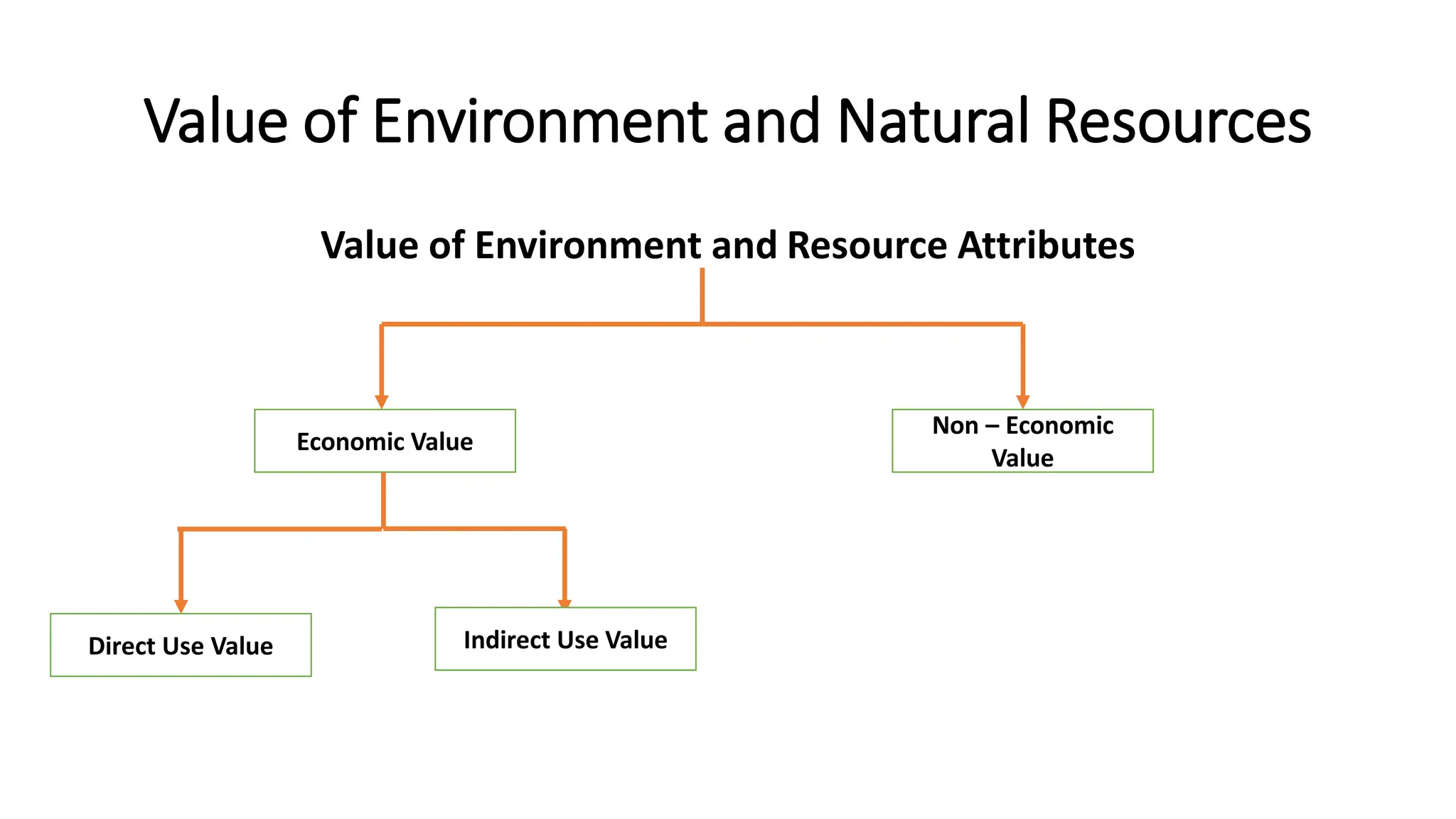
Value of Environment and Resource Attributes
Economic Value
Non – Economic
Value
Direct Use Value Indirect Use Value
16.
Economic Value ofEnvironment and Natural
Resources
The economic value of an environmental resource can be broken down to
direct use value and indirect use value.
• Direct Use Value: Value derived from direct consumption or use of a
resource.
Examples:
Timber: The market price of wood used for furniture or construction.
Fish: The market price of fish caught for consumption.
Recreational activities: The money spent on tickets, travel, and equipment for
hiking in a national park, fishing, or birdwatching.
17.
Economic Value ofEnvironment and Natural
Resources
• Indirect Use Value: Value derived from the functions of ecosystems that
support human activities but are not directly consumed.
Examples:
Wetlands: Their role in filtering water, controlling floods, and serving as nurseries
for fish stocks (which have direct use value). The economic value here is the
avoided cost of water purification or flood damage.
Forests: Their role in carbon sequestration (mitigating climate change), soil
erosion prevention, and water cycle regulation.
Pollination: The economic value of pollinators (like bees) to agriculture.
18.
Non-Economic Value ofEnvironment and
Natural Resources
These are values that are difficult to quantify in monetary terms but are profoundly
important. They often relate to intrinsic worth, cultural significance, or spiritual
connection.
• Option Value: The value of preserving a resource for potential future direct or indirect
uses.
Example: Valuing the Amazon rainforest not just for its current resources, but for
potential future discoveries of medicines, genetic material, or tourism opportunities.
• Existence Value: The value derived from simply knowing that a natural resource or
species exists, even if there's no intention of ever using or seeing it. This often stems
from ethical, moral, or aesthetic considerations.
Example: The value placed on saving endangered species like tigers or blue whales, even
by people who will never see them in the wild.
19.
Non-Economic Value ofEnvironment and
Natural Resources
• Cultural/Historical Value: The significance of natural sites or species within a
community's traditions, identity, history, or spiritual beliefs.
Example: Sacred groves in India, ancestral lands for indigenous communities, or
specific animal species that hold totemic importance.
• Aesthetic Value: The appreciation of the beauty and grandeur of natural
landscapes and biodiversity.
Example: The awe inspired by a sunset over the ocean, the tranquility of a forest,
or the intricate patterns of a snowflake. This contributes to human well-being and
inspiration.
20.
Non-Economic Value ofEnvironment and
Natural Resources
• Moral/Ethical Value: The belief that humans have a moral responsibility to
protect the environment and other species.
Example: The ethical imperative to prevent species extinction or to reduce
pollution that harms vulnerable populations.
• Scientific/Ecological Value: The importance of ecosystems and species for
scientific study, understanding natural processes, and maintaining
ecological balance, even if their direct economic utility isn't immediately
apparent.
Example: The role of microorganisms in soil health, which underpins
agriculture, or the study of unique ecosystems like coral reefs for
understanding climate change impacts.
21.
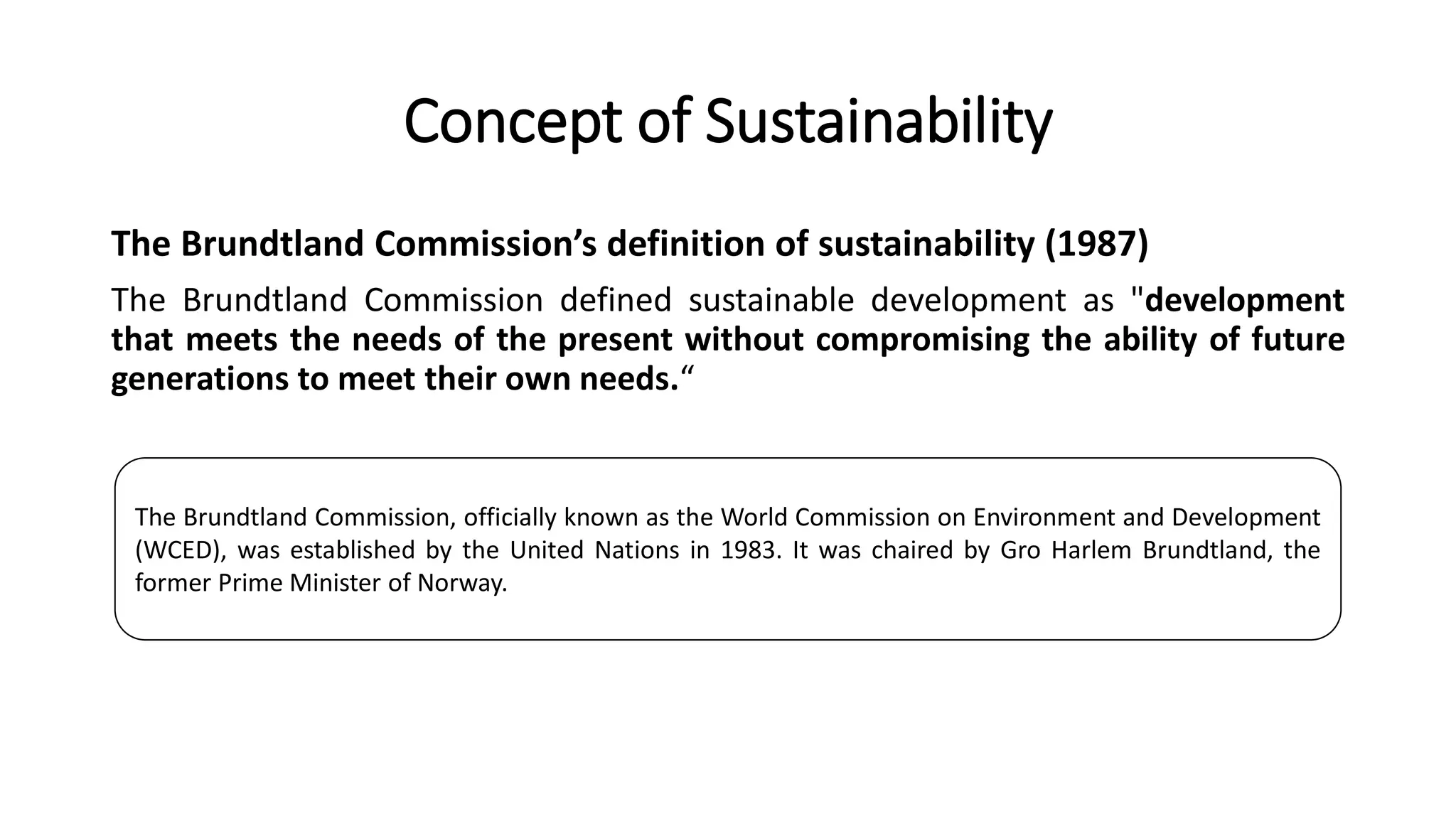
Concept of Sustainability
TheBrundtland Commission’s definition of sustainability (1987)
The Brundtland Commission defined sustainable development as "development
that meets the needs of the present without compromising the ability of future
generations to meet their own needs.“
The Brundtland Commission, officially known as the World Commission on Environment and Development
(WCED), was established by the United Nations in 1983. It was chaired by Gro Harlem Brundtland, the
former Prime Minister of Norway.
22.
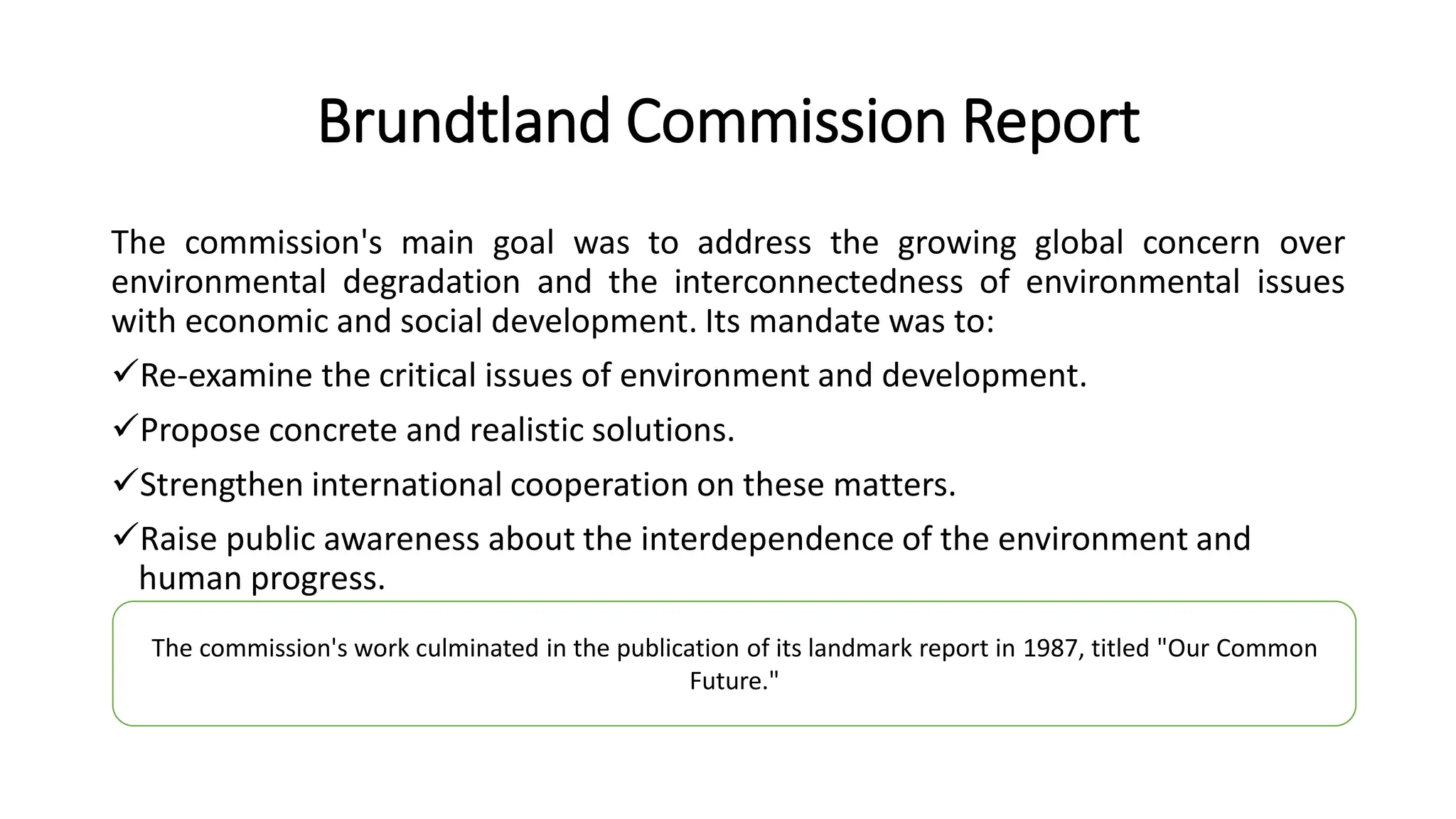
Brundtland Commission Report
Thecommission's main goal was to address the growing global concern over
environmental degradation and the interconnectedness of environmental issues
with economic and social development. Its mandate was to:
Re-examine the critical issues of environment and development.
Propose concrete and realistic solutions.
Strengthen international cooperation on these matters.
Raise public awareness about the interdependence of the environment and
human progress.
The commission's work culminated in the publication of its landmark report in 1987, titled "Our Common
Future."
23.
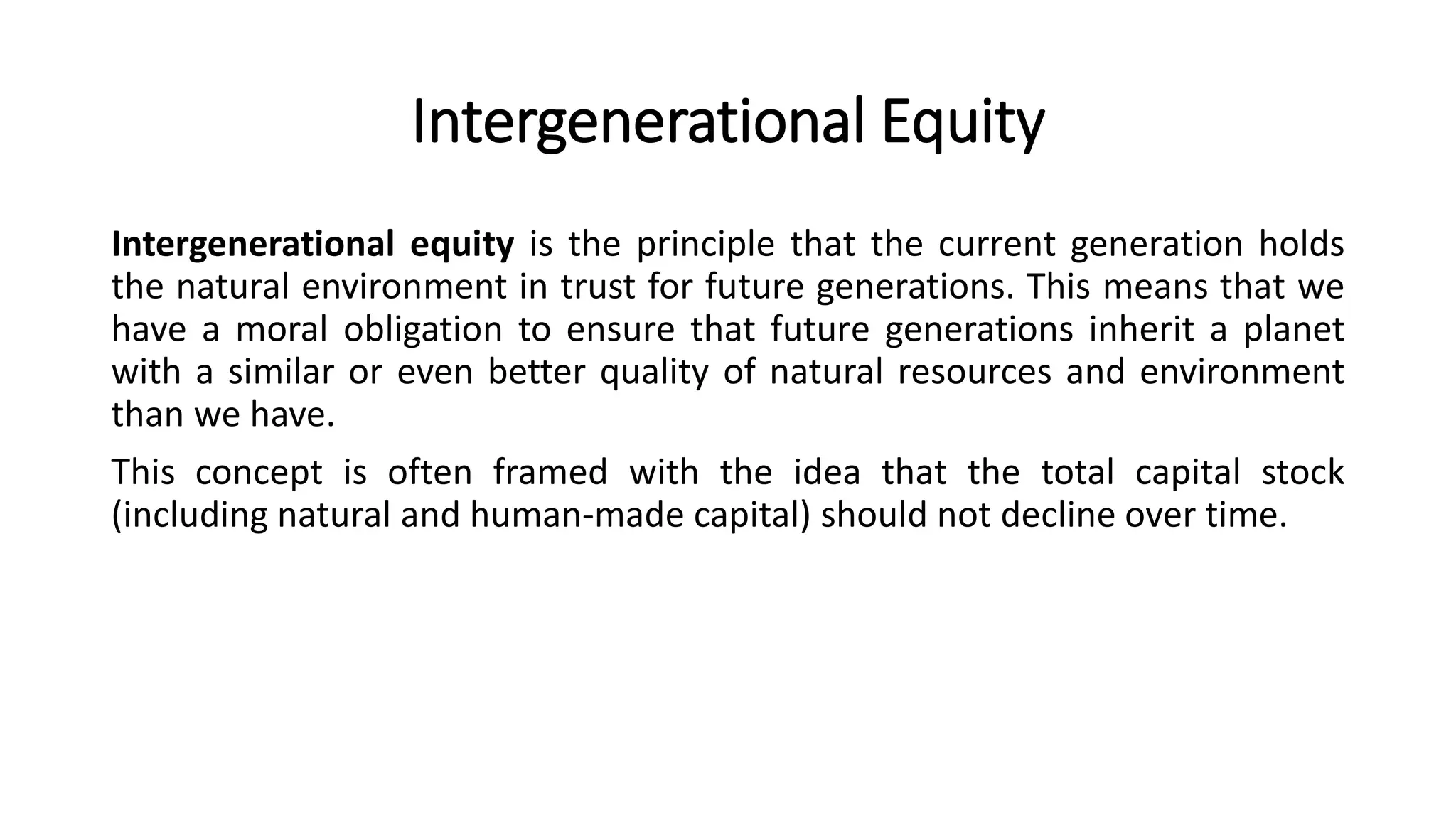
Intergenerational Equity
Intergenerational equityis the principle that the current generation holds
the natural environment in trust for future generations. This means that we
have a moral obligation to ensure that future generations inherit a planet
with a similar or even better quality of natural resources and environment
than we have.
This concept is often framed with the idea that the total capital stock
(including natural and human-made capital) should not decline over time.
24.
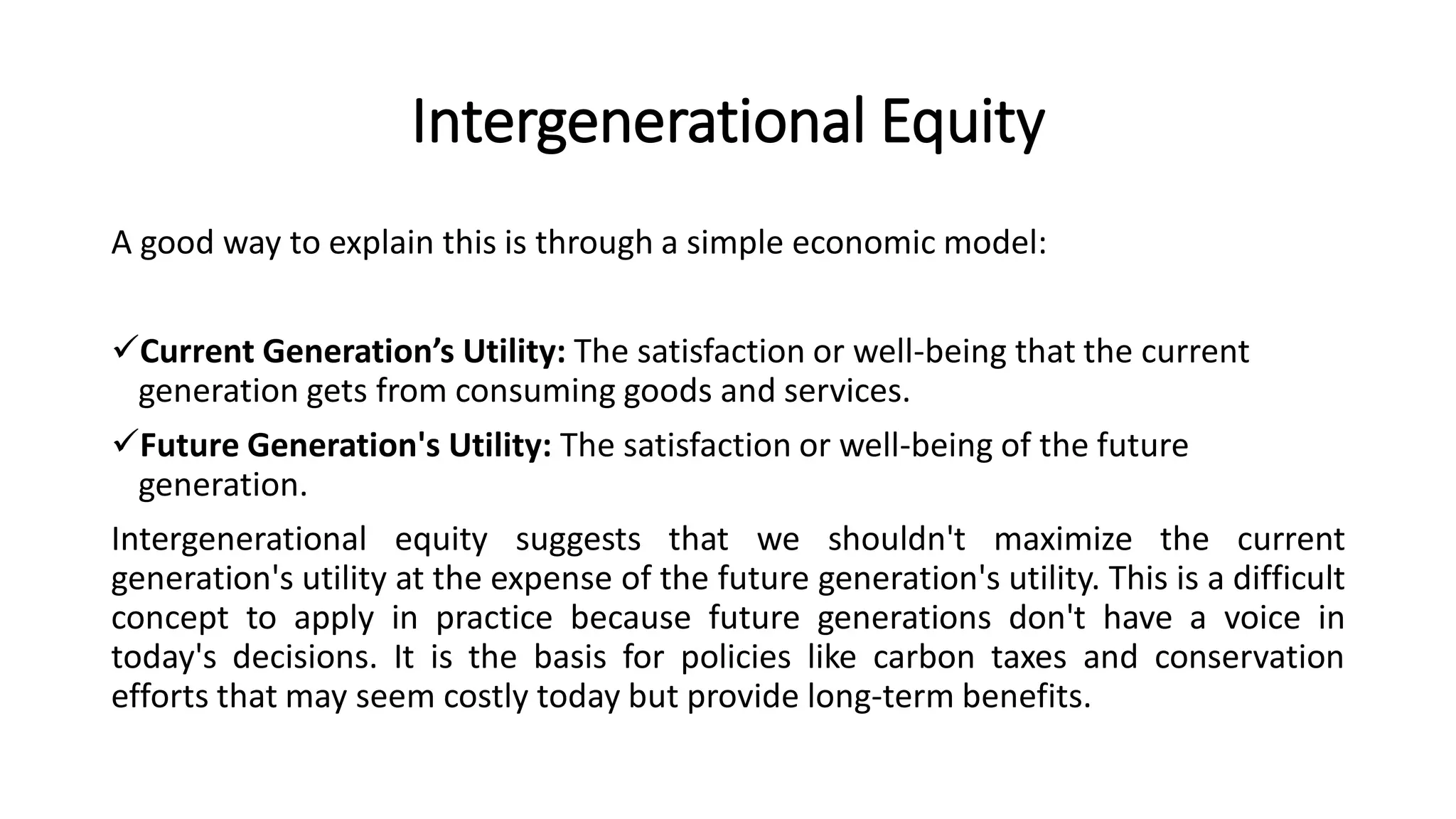
Intergenerational Equity
A goodway to explain this is through a simple economic model:
Current Generation’s Utility: The satisfaction or well-being that the current
generation gets from consuming goods and services.
Future Generation's Utility: The satisfaction or well-being of the future
generation.
Intergenerational equity suggests that we shouldn't maximize the current
generation's utility at the expense of the future generation's utility. This is a difficult
concept to apply in practice because future generations don't have a voice in
today's decisions. It is the basis for policies like carbon taxes and conservation
efforts that may seem costly today but provide long-term benefits.
25.
Broader concept ofsustainability
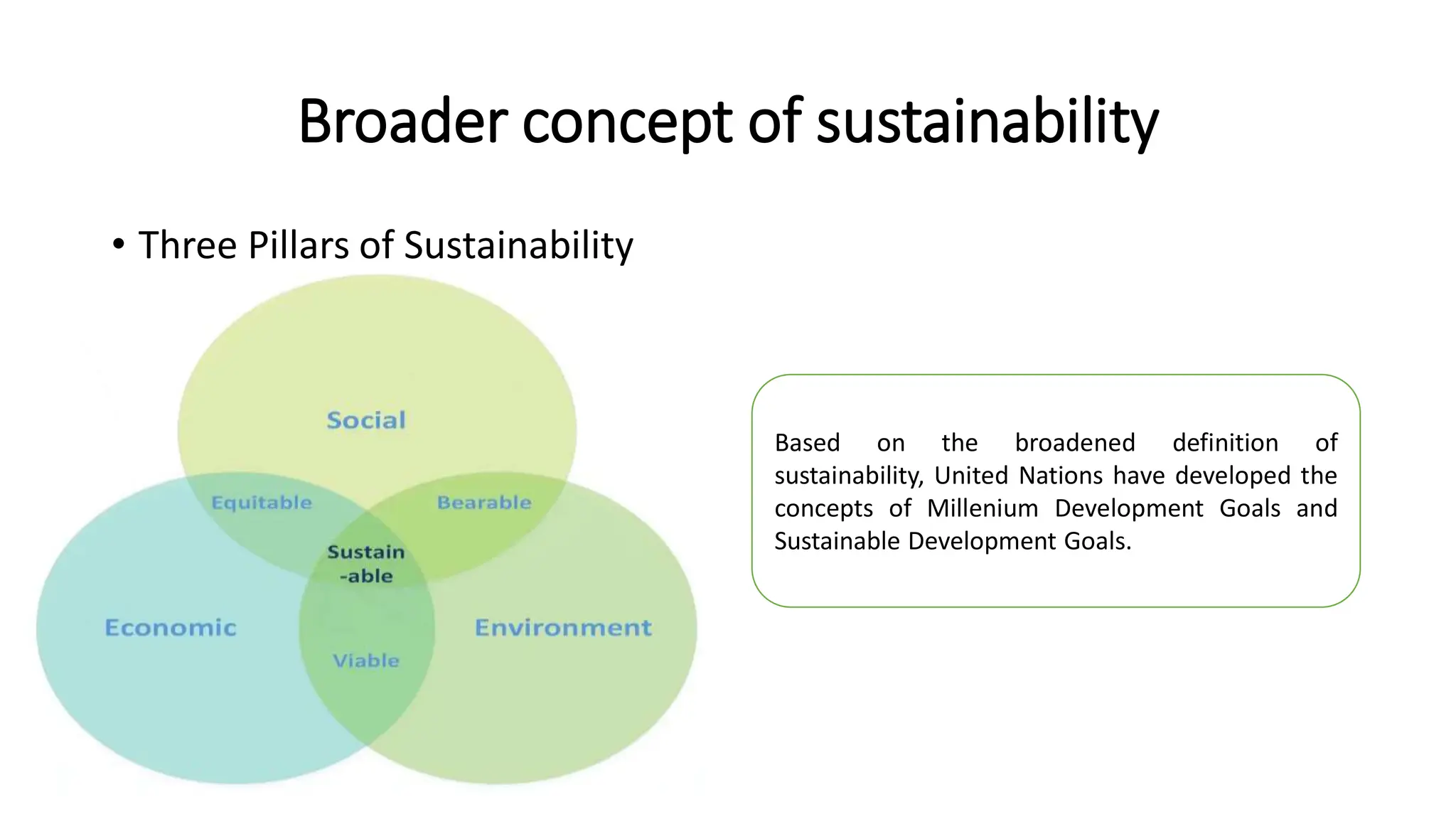
• Three Pillars of Sustainability
Based on the broadened definition of
sustainability, United Nations have developed the
concepts of Millenium Development Goals and
Sustainable Development Goals.
26.
Broader concept ofsustainability
Sustainability can be broken down into three pillars:
Economic Sustainability: Maintaining economic growth and
development without causing irreparable damage to the
environment.
Environmental Sustainability: Protecting natural resources and
ecosystems.
Social Sustainability: Ensuring equity, social well-being, and a high
quality of life for all people.
27.
Sustainable Development Goals
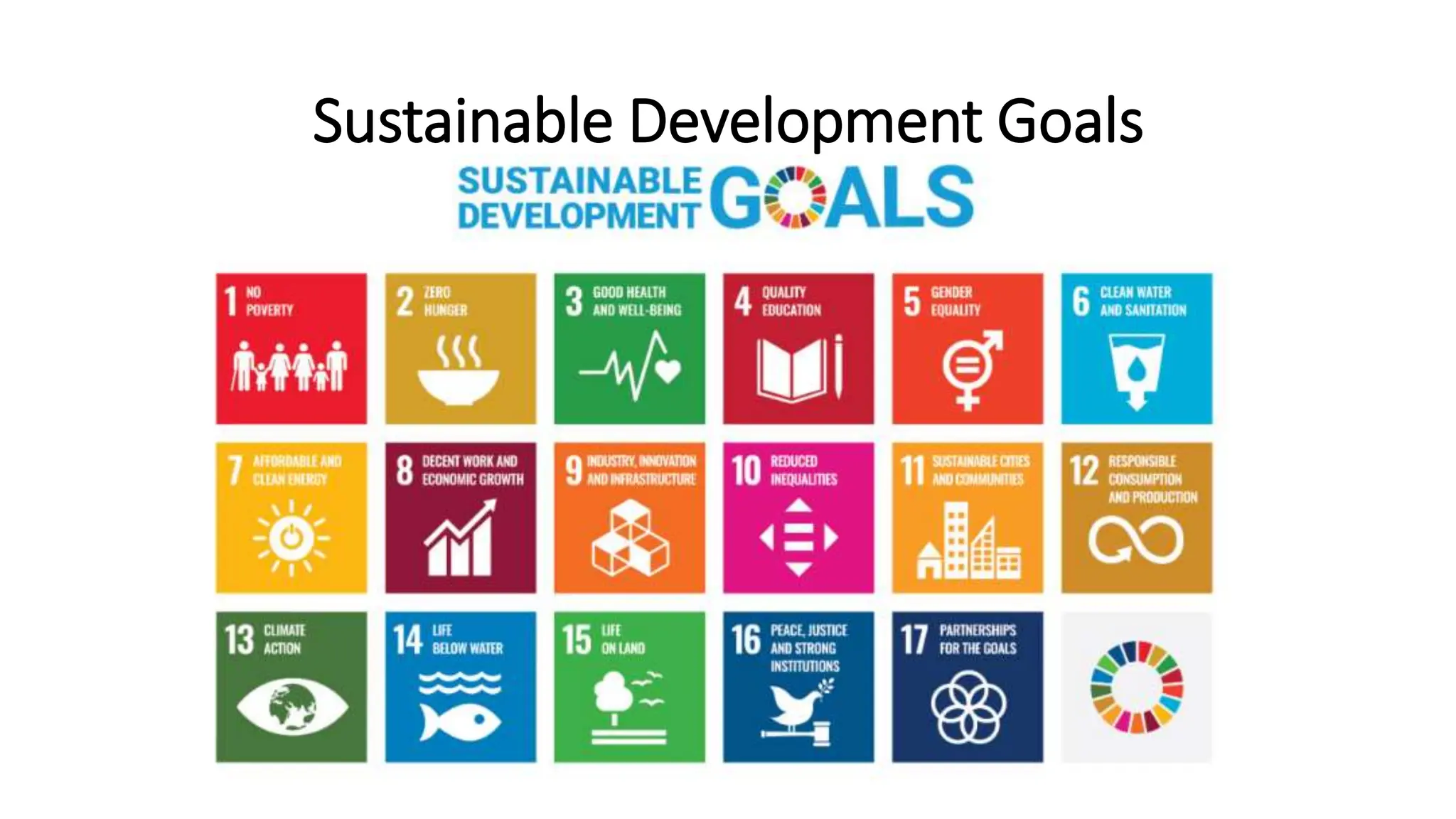
TheSustainable Development Goals (SDGs) are a collection of 17
interconnected global goals designed to be a "blueprint to achieve a
better and more sustainable future for all." They were adopted by all
United Nations Member States in 2015 as part of the 2030 Agenda for
Sustainable Development. The SDGs expanded on the Millennium
Development Goals (MDGs) by including a more comprehensive range
of issues, such as economic growth, inequality, and climate change, and
by applying to all countries, not just developing ones.


![NR_chapter_one_and_two_-2024[1].pptx eco](https://cdn.slidesharecdn.com/ss_thumbnails/nrchapteroneandtwo-20241-240802123027-ab512880-thumbnail.jpg?width=640&height=640&fit=bounds)


![[DSC Europe 25] Milan Sekuloski - Data, Defence, and Development: Cybersecuri...](https://cdn.slidesharecdn.com/ss_thumbnails/dfrkwwx4qly6atqpbl4z-4-251209104645-c3d4b0ca-thumbnail.jpg?width=640&height=640&fit=bounds)
![[DSC Europe 25] Bassam Maharmeh - Artificial Intelligence: Opportunities and ...](https://cdn.slidesharecdn.com/ss_thumbnails/thhfmr2fqpawzj7hsjpg-5-251211083048-2c23204f-thumbnail.jpg?width=640&height=640&fit=bounds)


![[DSC Europe 25] Jon Dajci - Bridging TradFi and DeFi: Building the Future of ...](https://cdn.slidesharecdn.com/ss_thumbnails/fqmhfvlbqhkihjvqvhmu-7-251211083849-6af7e325-thumbnail.jpg?width=640&height=640&fit=bounds)


![[DSC Europe 25] Hans Kleinsman - The Compliance Gearbox: How Tax Tech Mediate...](https://cdn.slidesharecdn.com/ss_thumbnails/dxdytie1toel0hr90bjs-2-251212103250-174fdbe7-thumbnail.jpg?width=640&height=640&fit=bounds)

![[DSC Europe 25] Branko Urosevic -Rethinking Financial Talent: Integrating Cod...](https://cdn.slidesharecdn.com/ss_thumbnails/8jjrus8ttko6qj64f58f-3-251212103250-642c6374-thumbnail.jpg?width=640&height=640&fit=bounds)
![[DSC Europe 25] Nikolay Burlutskiy - Best Practices for Building Enterprise M...](https://cdn.slidesharecdn.com/ss_thumbnails/uirvaiuvq8y1w8hzd9tx-7-251212103249-2619edb4-thumbnail.jpg?width=640&height=640&fit=bounds)
![[DSC Europe 25] Ivan Peric - Intelligence Swarm Logic and Techno-Functional M...](https://cdn.slidesharecdn.com/ss_thumbnails/7my7c97fsduiccadgavw-2-251212103249-5a03f7c6-thumbnail.jpg?width=640&height=640&fit=bounds)

