Environment
Course Title: Environmental Economics
Course Code: Econ 3105
Presented To
Mohammed Ziaul Haider, Ph.D.
Professor
Economics Discipline
Khulna University, Khulna Presented By
Homyra Israt Supty (191510)
Nishat Tasnim Zinnia(191537 )
What is environment?
Sum of all the living and non-living
elements and their effects that influence
human life.
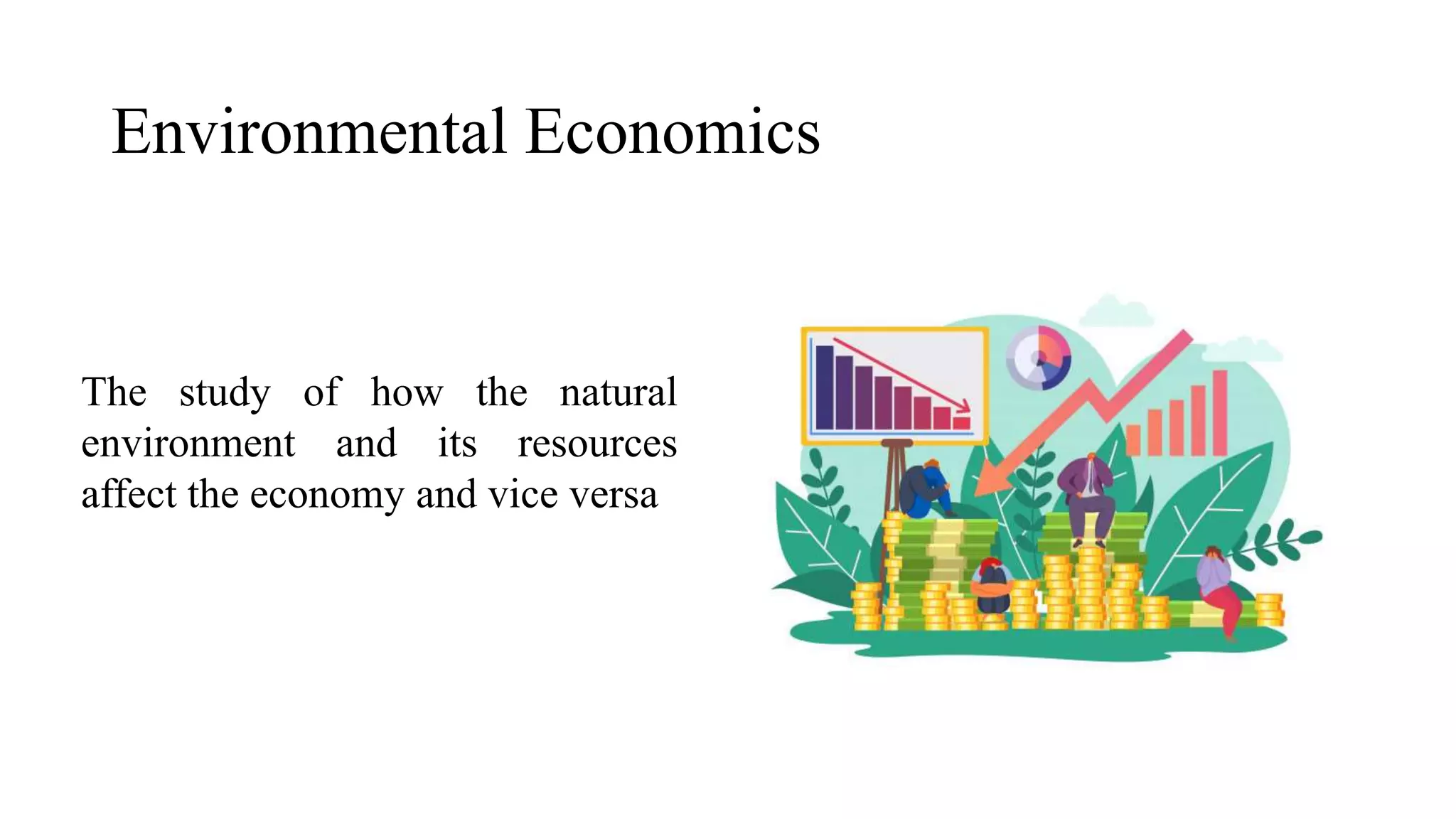
Environmental Economics
The study of how the natural
environment and its resources
affect the economy and vice versa
The Economy-Environment Relationship
Environment Pollutants
• Natural Pollutants
volcanic eruptions, salt spray,
forest fire,sand strome etc.
• Antropogenic Pollutants
Burning of of fossil fuels,chemical
use in agriculture
activities,industrial wastes,
automobile exhausts etc.
Economic growth and the environment
China’s economic growth or double edge sword
Environmental Kuznets Hypothesis
Economic development vs. environment is a complex challenge of competing
interests:
 Developed vs. developing countries;
 Present generation vs. future generations and;
 Country vs. Country (from a nationalistic economic standpoint).
 Economic development to alleviate poverty
 Poverty and environmental degradation
 Environmental degradation worsening poverty
 Natural resources can be categorized on the
basis of renewability
o Non-renewable Resources
o Renewable Resources
Great
Britain:
United
States:
South
Africa:
Australia: India: Peru: Viet
Nam:
Mean
Response:
1.41 1.46 1.74 1.34 1.60 1.36 1.55
The Environment versus the Economy: A Losing Battle?
How humans are destroying environment in the name of development:
 Overpopulation
 Global Warming
 Deforestation
 Unsustainable Agriculture
Green Economy
The present economic system is destroying our natural resources and thereby eroding the prosperity of future
generations. Large-scale logging, depletion of the oceans’ fish stocks and the loss of arable soil are prime
examples of this development.
o Transformation to a Green Economy
o Green markets of the future
o Benefits and costs of environmental protection
o Environmental protection creates jobs
o Failure to protect the environment generates costs
 Cars
 Coal Mining
 Overfishing
 Dam Follies
The figure below shows that as global GDP increases,
atmospheric CO2 increases.
Market approach
refers to incentive-based policy that encourages conservative practices or pollution reduction strategies
 Difference between market approach and command-and-control approach is how each approach attempts
to achieve its objectives
 Types of Market Instruments
o Pollution charge
o Subsidies
o Deposit/refund systems
o Pollution permit trading systems
Environmental sustainability:
Consumption of
renewable resources
State of environment Sustainability
Moe than nature’s ability to
replenish
Environmental degradation Not sustainable
Equal to nature’s ability to
replenish
Environmental equilibrium Steady state economy
Less than nature’s ability to
replenish
Environmental renewal
Environmentally
sustainable
Green growth:
The green growth is not identical to sustainable development. While sustainable development is seeking a balance
among economic growth, environmental projection, and social justice, a strict definition of green growth does not
address “social justice,” focusing rather on economic growth while reducing environmental impact. In this regard,
green growth is a narrower or subordinate concept of sustainable development as seen in the figure below
 Can poor countries afford to be green????
References
 Callan, S.J. and Thomas, J.M. (2013). ENVIRONMENTAL ECONOMICS & MANAGEMENT: Theory, Policy and Applications, 6th edition, Cengage
Learning, Canada.
 Lopez, M.I. and Suryomenggolo, J. (2018). Environmental Resources Use and Challenges in Contemporary Southeast Asia: Tropical Ecosystems in
Transition.
 Common, M. (1996). Environmental and Resource Economics: An Introduction, 2nd edition, Financial Times, USA.
 Kasperowicz, R. (2015). Economic growth and CO2 emissions: the ECM analysis, Journal of International Studies, Vol. 8, No 3, 2015, pp. 91-98.
 Cengiz, C. (2015). The valuation of China’s environmental degradation from 2004 to 2017, Environmental Science and Ecotechnology, volume 1.
 Chen, J. (2021). Environmental Economics Definition, [online] Available at: https://www.investopedia.com/terms/e/environmental-economics.asp, (Accessed
on 21 January 2021)
 Pettinger, T. (2019). Environmental Kuznets curve, [online] Available at: https://www.economicshelp.org/blog/14337/environment/environmental-kuznets,
(Accessed on 21 January 2021)
 Kneese, Ayres, and D’Arge (1970)
 Dr. Rajiv Desai, Economic Development vis-à-vis Environment (Personal communication, September 2,2013).
 http://www.bmub.bund.de/en/topics/economy-products-resources-tourism/economy-and-environment/environmental-technology/environmental-technology-
atlas-for-germany/
 The Umweltbundesamt - For our environment.
 World Commission on Environment and Development, Our Common Future, 1987, 41, http://www.un-documents.net/our- common-future.pdf.

Econ_3105_20220124_191510_Environment.ppt.pptx

  • 1.
    Environment Course Title: EnvironmentalEconomics Course Code: Econ 3105 Presented To Mohammed Ziaul Haider, Ph.D. Professor Economics Discipline Khulna University, Khulna Presented By Homyra Israt Supty (191510) Nishat Tasnim Zinnia(191537 )
  • 2.
    What is environment? Sumof all the living and non-living elements and their effects that influence human life.
  • 3.
    Environmental Economics The studyof how the natural environment and its resources affect the economy and vice versa
  • 4.
  • 5.
    Environment Pollutants • NaturalPollutants volcanic eruptions, salt spray, forest fire,sand strome etc. • Antropogenic Pollutants Burning of of fossil fuels,chemical use in agriculture activities,industrial wastes, automobile exhausts etc.
  • 6.
    Economic growth andthe environment
  • 8.
    China’s economic growthor double edge sword
  • 9.
  • 10.
    Economic development vs.environment is a complex challenge of competing interests:  Developed vs. developing countries;  Present generation vs. future generations and;  Country vs. Country (from a nationalistic economic standpoint).  Economic development to alleviate poverty  Poverty and environmental degradation  Environmental degradation worsening poverty  Natural resources can be categorized on the basis of renewability o Non-renewable Resources o Renewable Resources
  • 11.
    Great Britain: United States: South Africa: Australia: India: Peru:Viet Nam: Mean Response: 1.41 1.46 1.74 1.34 1.60 1.36 1.55
  • 12.
    The Environment versusthe Economy: A Losing Battle?
  • 13.
    How humans aredestroying environment in the name of development:  Overpopulation  Global Warming  Deforestation  Unsustainable Agriculture Green Economy The present economic system is destroying our natural resources and thereby eroding the prosperity of future generations. Large-scale logging, depletion of the oceans’ fish stocks and the loss of arable soil are prime examples of this development. o Transformation to a Green Economy o Green markets of the future o Benefits and costs of environmental protection o Environmental protection creates jobs o Failure to protect the environment generates costs  Cars  Coal Mining  Overfishing  Dam Follies
  • 14.
    The figure belowshows that as global GDP increases, atmospheric CO2 increases.
  • 15.
    Market approach refers toincentive-based policy that encourages conservative practices or pollution reduction strategies  Difference between market approach and command-and-control approach is how each approach attempts to achieve its objectives  Types of Market Instruments o Pollution charge o Subsidies o Deposit/refund systems o Pollution permit trading systems Environmental sustainability: Consumption of renewable resources State of environment Sustainability Moe than nature’s ability to replenish Environmental degradation Not sustainable Equal to nature’s ability to replenish Environmental equilibrium Steady state economy Less than nature’s ability to replenish Environmental renewal Environmentally sustainable
  • 16.
    Green growth: The greengrowth is not identical to sustainable development. While sustainable development is seeking a balance among economic growth, environmental projection, and social justice, a strict definition of green growth does not address “social justice,” focusing rather on economic growth while reducing environmental impact. In this regard, green growth is a narrower or subordinate concept of sustainable development as seen in the figure below  Can poor countries afford to be green????
  • 17.
    References  Callan, S.J.and Thomas, J.M. (2013). ENVIRONMENTAL ECONOMICS & MANAGEMENT: Theory, Policy and Applications, 6th edition, Cengage Learning, Canada.  Lopez, M.I. and Suryomenggolo, J. (2018). Environmental Resources Use and Challenges in Contemporary Southeast Asia: Tropical Ecosystems in Transition.  Common, M. (1996). Environmental and Resource Economics: An Introduction, 2nd edition, Financial Times, USA.  Kasperowicz, R. (2015). Economic growth and CO2 emissions: the ECM analysis, Journal of International Studies, Vol. 8, No 3, 2015, pp. 91-98.  Cengiz, C. (2015). The valuation of China’s environmental degradation from 2004 to 2017, Environmental Science and Ecotechnology, volume 1.  Chen, J. (2021). Environmental Economics Definition, [online] Available at: https://www.investopedia.com/terms/e/environmental-economics.asp, (Accessed on 21 January 2021)  Pettinger, T. (2019). Environmental Kuznets curve, [online] Available at: https://www.economicshelp.org/blog/14337/environment/environmental-kuznets, (Accessed on 21 January 2021)  Kneese, Ayres, and D’Arge (1970)  Dr. Rajiv Desai, Economic Development vis-à-vis Environment (Personal communication, September 2,2013).  http://www.bmub.bund.de/en/topics/economy-products-resources-tourism/economy-and-environment/environmental-technology/environmental-technology- atlas-for-germany/  The Umweltbundesamt - For our environment.  World Commission on Environment and Development, Our Common Future, 1987, 41, http://www.un-documents.net/our- common-future.pdf.