Program “Youth meetings”
Archimedes Foundation Youth Agency
Triin Ulla
triin.ulla@archimedes.ee
YOUTH MEETINGS
Launched in 2015
Format of local youth exchanges
Half of the participants are Russian-speaking
~ 1700 young people yearly / ~ 45 projects
noored.ee
“Best integration program in Estonia”
General aim of the program
• To promote cultural awareness, openness and tolerance among
the program participants (and in the society in general) through
communication, cooperation and contacts
• 16-24 youngsters at a time / 3-6 days in a row / 1-3 times
• Main target group: secondary school (age 11-16)
Youth meetings
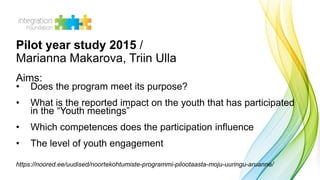
Aims:
• Does the program meet its purpose?
• What is the reported impact on the youth that has participated
in the “Youth meetings”
• Which competences does the participation influence
• The level of youth engagement
https://noored.ee/uudised/noortekohtumiste-programmi-pilootaasta-moju-uuringu-aruanne/
Pilot year study 2015 /
Marianna Makarova, Triin Ulla
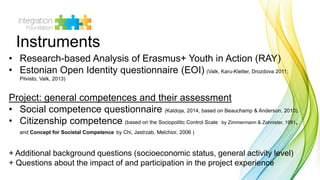
Instruments
• Research-based Analysis of Erasmus+ Youth in Action (RAY)
• Estonian Open Identity questionnaire (EOI) (Valk, Karu-Kletter, Drozdova 2011;
Pilvisto, Valk, 2013)
Project: general competences and their assessment
• Social competence questionnaire (Kaldoja, 2014, based on Beauchamp & Anderson, 2010).
• Citizenship competence (based on the Sociopolitic Control Scale by Zimmermann & Zahnister, 1991,
and Concept for Societal Competence by Chi, Jastrzab, Melchior, 2006 )
+ Additional background questions (socioeconomic status, general activity level)
+ Questions about the impact of and participation in the project experience
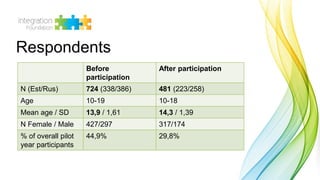
Respondents
Before
participation
After participation
N (Est/Rus) 724 (338/386) 481 (223/258)
Age 10-19 10-18
Mean age / SD 13,9 / 1,61 14,3 / 1,39
N Female / Male 427/297 317/174
% of overall pilot
year participants
44,9% 29,8%
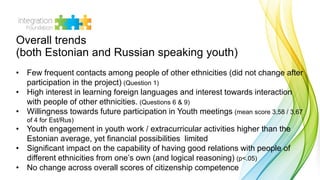
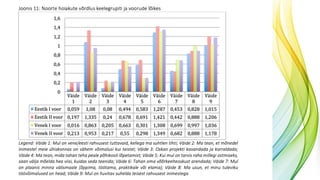
• Few frequent contacts among people of other ethnicities (did not change after
participation in the project) (Question 1)
• High interest in learning foreign languages and interest towards interaction
with people of other ethnicities. (Questions 6 & 9)
• Willingness towards future participation in Youth meetings (mean score 3,58 / 3,67
of 4 for Est/Rus)
• Youth engagement in youth work / extracurricular activities higher than the
Estonian average, yet financial possibilities limited
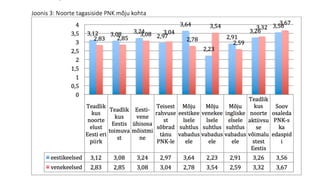
• Significant impact on the capability of having good relations with people of
different ethnicities from one’s own (and logical reasoning) (p<.05)
• No change across overall scores of citizenship competence
Overall trends
(both Estonian and Russian speaking youth)
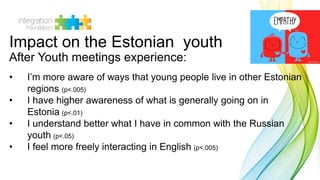
Impact on the Estonian youth
After Youth meetings experience:
• I’m more aware of ways that young people live in other Estonian
regions (p<.005)
• I have higher awareness of what is generally going on in
Estonia (p<.01)
• I understand better what I have in common with the Russian
youth (p<.05)
• I feel more freely interacting in English (p<.005)
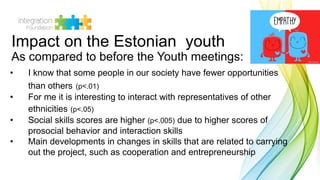
Impact on the Estonian youth
As compared to before the Youth meetings:
• I know that some people in our society have fewer opportunities
than others (p<.01)
• For me it is interesting to interact with representatives of other
ethnicities (p<.05)
• Social skills scores are higher (p<.005) due to higher scores of
prosocial behavior and interaction skills
• Main developments in changes in skills that are related to carrying
out the project, such as cooperation and entrepreneurship
Impact on the Estonian youth
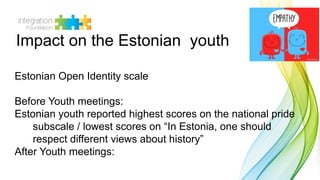
Estonian Open Identity scale
Before Youth meetings:
Estonian youth reported highest scores on the national pride
subscale / lowest scores on “In Estonia, one should
respect different views about history”
After Youth meetings:
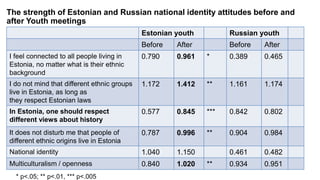
The strength of Estonian and Russian national identity attitudes before and
after Youth meetings
* p<.05; ** p<.01, *** p<.005
Estonian youth Russian youth
Before After Before After
I feel connected to all people living in
Estonia, no matter what is their ethnic
background
0.790 0.961 * 0.389 0.465
I do not mind that different ethnic groups
live in Estonia, as long as
they respect Estonian laws
1.172 1.412 ** 1.161 1.174
In Estonia, one should respect
different views about history
0.577 0.845 *** 0.842 0.802
It does not disturb me that people of
different ethnic origins live in Estonia
0.787 0.996 ** 0.904 0.984
National identity 1.040 1.150 0.461 0.482
Multiculturalism / openness 0.840 1.020 ** 0.934 0.951
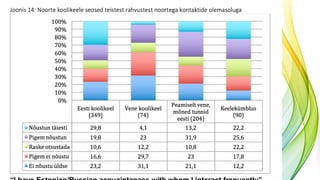
• More likely to see their future outside Estonia than their Estonian
peers (p<.01)
• The number of contacts with other ethnicities co-varies with the
type of education they are engaged in
• Rise in their skill scores of “interacting with people with a
different mother tongue” (p<.01) and making myself clear in
Estonian (p<.05).
Russian youth
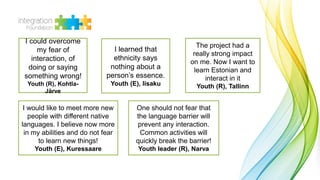
I could overcome
my fear of
interaction, of
doing or saying
something wrong!
Youth (R), Kohtla-
Järve
I learned that
ethnicity says
nothing about a
person’s essence.
Youth (E), Iisaku
The project had a
really strong impact
on me. Now I want to
learn Estonian and
interact in it
Youth (R), Tallinn
I would like to meet more new
people with different native
languages. I believe now more
in my abilities and do not fear
to learn new things!
Youth (E), Kuressaare
One should not fear that
the language barrier will
prevent any interaction.
Common activities will
quickly break the barrier!
Youth leader (R), Narva
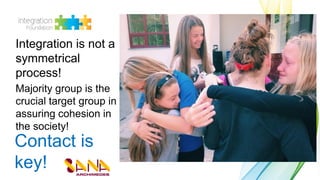
Integration is not a
symmetrical
process!
Majority group is the
crucial target group in
assuring cohesion in
the society!
Contact is
key!

Triin Ulla: Program "Youth meetings"

  • 1.
    Program “Youth meetings” ArchimedesFoundation Youth Agency Triin Ulla triin.ulla@archimedes.ee
  • 2.
    YOUTH MEETINGS Launched in2015 Format of local youth exchanges Half of the participants are Russian-speaking ~ 1700 young people yearly / ~ 45 projects noored.ee “Best integration program in Estonia”
  • 3.
    General aim ofthe program • To promote cultural awareness, openness and tolerance among the program participants (and in the society in general) through communication, cooperation and contacts • 16-24 youngsters at a time / 3-6 days in a row / 1-3 times • Main target group: secondary school (age 11-16) Youth meetings
  • 4.
    Aims: • Does theprogram meet its purpose? • What is the reported impact on the youth that has participated in the “Youth meetings” • Which competences does the participation influence • The level of youth engagement https://noored.ee/uudised/noortekohtumiste-programmi-pilootaasta-moju-uuringu-aruanne/ Pilot year study 2015 / Marianna Makarova, Triin Ulla
  • 5.
    Instruments • Research-based Analysisof Erasmus+ Youth in Action (RAY) • Estonian Open Identity questionnaire (EOI) (Valk, Karu-Kletter, Drozdova 2011; Pilvisto, Valk, 2013) Project: general competences and their assessment • Social competence questionnaire (Kaldoja, 2014, based on Beauchamp & Anderson, 2010). • Citizenship competence (based on the Sociopolitic Control Scale by Zimmermann & Zahnister, 1991, and Concept for Societal Competence by Chi, Jastrzab, Melchior, 2006 ) + Additional background questions (socioeconomic status, general activity level) + Questions about the impact of and participation in the project experience
  • 6.
    Respondents Before participation After participation N (Est/Rus)724 (338/386) 481 (223/258) Age 10-19 10-18 Mean age / SD 13,9 / 1,61 14,3 / 1,39 N Female / Male 427/297 317/174 % of overall pilot year participants 44,9% 29,8%
  • 7.
    • Few frequentcontacts among people of other ethnicities (did not change after participation in the project) (Question 1) • High interest in learning foreign languages and interest towards interaction with people of other ethnicities. (Questions 6 & 9) • Willingness towards future participation in Youth meetings (mean score 3,58 / 3,67 of 4 for Est/Rus) • Youth engagement in youth work / extracurricular activities higher than the Estonian average, yet financial possibilities limited • Significant impact on the capability of having good relations with people of different ethnicities from one’s own (and logical reasoning) (p<.05) • No change across overall scores of citizenship competence Overall trends (both Estonian and Russian speaking youth)
  • 10.
    Impact on theEstonian youth After Youth meetings experience: • I’m more aware of ways that young people live in other Estonian regions (p<.005) • I have higher awareness of what is generally going on in Estonia (p<.01) • I understand better what I have in common with the Russian youth (p<.05) • I feel more freely interacting in English (p<.005)
  • 11.
    Impact on theEstonian youth As compared to before the Youth meetings: • I know that some people in our society have fewer opportunities than others (p<.01) • For me it is interesting to interact with representatives of other ethnicities (p<.05) • Social skills scores are higher (p<.005) due to higher scores of prosocial behavior and interaction skills • Main developments in changes in skills that are related to carrying out the project, such as cooperation and entrepreneurship
  • 12.
    Impact on theEstonian youth Estonian Open Identity scale Before Youth meetings: Estonian youth reported highest scores on the national pride subscale / lowest scores on “In Estonia, one should respect different views about history” After Youth meetings:
  • 13.
    The strength ofEstonian and Russian national identity attitudes before and after Youth meetings * p<.05; ** p<.01, *** p<.005 Estonian youth Russian youth Before After Before After I feel connected to all people living in Estonia, no matter what is their ethnic background 0.790 0.961 * 0.389 0.465 I do not mind that different ethnic groups live in Estonia, as long as they respect Estonian laws 1.172 1.412 ** 1.161 1.174 In Estonia, one should respect different views about history 0.577 0.845 *** 0.842 0.802 It does not disturb me that people of different ethnic origins live in Estonia 0.787 0.996 ** 0.904 0.984 National identity 1.040 1.150 0.461 0.482 Multiculturalism / openness 0.840 1.020 ** 0.934 0.951
  • 14.
    • More likelyto see their future outside Estonia than their Estonian peers (p<.01) • The number of contacts with other ethnicities co-varies with the type of education they are engaged in • Rise in their skill scores of “interacting with people with a different mother tongue” (p<.01) and making myself clear in Estonian (p<.05). Russian youth
  • 16.
    I could overcome myfear of interaction, of doing or saying something wrong! Youth (R), Kohtla- Järve I learned that ethnicity says nothing about a person’s essence. Youth (E), Iisaku The project had a really strong impact on me. Now I want to learn Estonian and interact in it Youth (R), Tallinn I would like to meet more new people with different native languages. I believe now more in my abilities and do not fear to learn new things! Youth (E), Kuressaare One should not fear that the language barrier will prevent any interaction. Common activities will quickly break the barrier! Youth leader (R), Narva
  • 17.
    Integration is nota symmetrical process! Majority group is the crucial target group in assuring cohesion in the society! Contact is key!