Trichotomy of Debate
OverviewThis is a pretty weak argument that says that all claims are either fact, value, or policy, and that because we can only interpret them in one right way, and the government team interprets them wrong, then opp should win.  It looks like this:
FormatA.  Background-  In Aristotle’s text, “Rhetoric,” he outlines three types of claims:  Fact, Value, and Policy.  Each one is unique and should be treated as such.  Parliamentary debate has certain norms that surround each interpretation, and it is important that we interpret each claim correctly so that teams are able to adequately prepare for the round.
FormatB-  Violation:  The government team interpreted this resolution as a (fact when it should have been policy, value when it should have been fact, etc…)
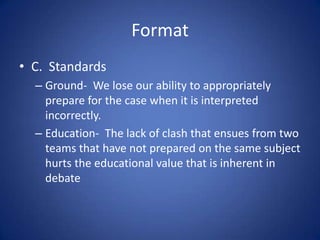
FormatC.  StandardsGround-  We lose our ability to appropriately prepare for the case when it is interpreted incorrectly.  Education-  The lack of clash that ensues from two teams that have not prepared on the same subject hurts the educational value that is inherent in debate
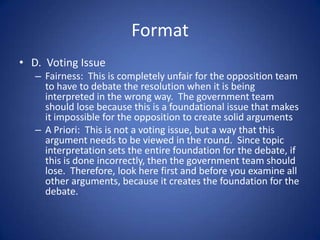
FormatD.  Voting IssueFairness:  This is completely unfair for the opposition team to have to debate the resolution when it is being interpreted in the wrong way.  The government team should lose because this is a foundational issue that makes it impossible for the opposition to create solid argumentsA Priori:  This is not a voting issue, but a way that this argument needs to be viewed in the round.  Since topic interpretation sets the entire foundation for the debate, if this is done incorrectly, then the government team should lose.  Therefore, look here first and before you examine all other arguments, because it creates the foundation for the debate.

Trichotomy of debate

  • 1.
  • 2.
    OverviewThis is apretty weak argument that says that all claims are either fact, value, or policy, and that because we can only interpret them in one right way, and the government team interprets them wrong, then opp should win. It looks like this:
  • 3.
    FormatA. Background- In Aristotle’s text, “Rhetoric,” he outlines three types of claims: Fact, Value, and Policy. Each one is unique and should be treated as such. Parliamentary debate has certain norms that surround each interpretation, and it is important that we interpret each claim correctly so that teams are able to adequately prepare for the round.
  • 4.
    FormatB- Violation: The government team interpreted this resolution as a (fact when it should have been policy, value when it should have been fact, etc…)
  • 5.
    FormatC. StandardsGround- We lose our ability to appropriately prepare for the case when it is interpreted incorrectly. Education- The lack of clash that ensues from two teams that have not prepared on the same subject hurts the educational value that is inherent in debate
  • 6.
    FormatD. VotingIssueFairness: This is completely unfair for the opposition team to have to debate the resolution when it is being interpreted in the wrong way. The government team should lose because this is a foundational issue that makes it impossible for the opposition to create solid argumentsA Priori: This is not a voting issue, but a way that this argument needs to be viewed in the round. Since topic interpretation sets the entire foundation for the debate, if this is done incorrectly, then the government team should lose. Therefore, look here first and before you examine all other arguments, because it creates the foundation for the debate.