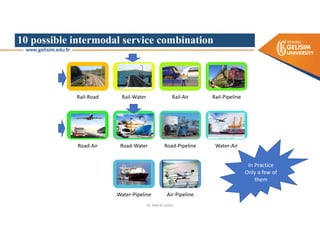
10 possible intermodal service combination
Rail-Road Rail-Water Rail-Air Rail-Pipeline
Road-Air Road-Water Road-Pipeline Water-Air
Water-Pipeline Air-Pipeline
In Practice
Only a few of
them
Dr. Mehdi Safaei
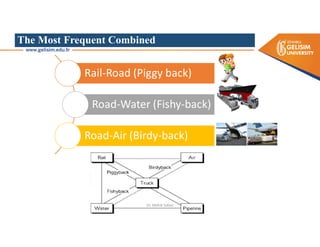
The Most Frequent Combined
Rail-Road (Piggy back)
Road-Water (Fishy-back)
Road-Air (Birdy-back)
Dr. Mehdi Safaei
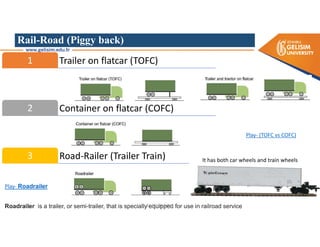
Rail-Road (Piggy back)
Trailer on flatcar (TOFC)
1
Container on flatcar (COFC)
2
Road-Railer (Trailer Train)
3
Roadrailer is a trailer, or semi-trailer, that is specially equipped for use in railroad service
It has both car wheels and train wheels
Play- (TOFC vs COFC)
Play- Roadrailer
Dr. Mehdi Safaei
Other transportation options
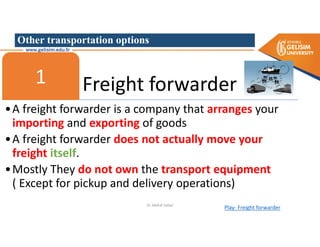
Freight forwarder
1
•A freight forwarder is a company that arranges your
importing and exporting of goods
•A freight forwarder does not actually move your
freight itself.
•Mostly They do not own the transport equipment
( Except for pickup and delivery operations)
Play- Freight forwarder
Dr. Mehdi Safaei
Other transportation options
Freight forwarder
1
Shippers’ Association or Cooperative
2
• "Shippers' Associations generally are non-profit
transportation membership cooperatives which arrange for
the domestic or international shipment
• Mostly they have contract with Motor, Rail, Air and Water
carrier
Dr. Mehdi Safaei
Other transportation options
Freight forwarder
1
Shippers’ Association or Cooperative
2
Intermodal marketing companies
3
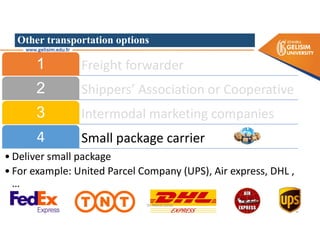
• An intermodal marketing company is a logistics
company that purchases intermodal capacity directly from
the railroads and trucking firms
Dr. Mehdi Safaei
Other transportation options
Freight forwarder
1
Shippers’ Association or Cooperative
2
Intermodal marketing companies
3
Small package carrier
4
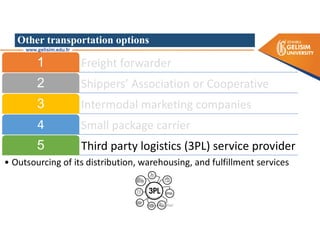
• Deliver small package
• For example: United Parcel Company (UPS), Air express, DHL ,
…
Dr. Mehdi Safaei
Other transportation options
Freight forwarder
1
Shippers’ Association or Cooperative
2
Intermodal marketing companies
3
Small package carrier
4
Third party logistics (3PL) service provider
5
• Outsourcing of its distribution, warehousing, and fulfillment services
Dr. Mehdi Safaei
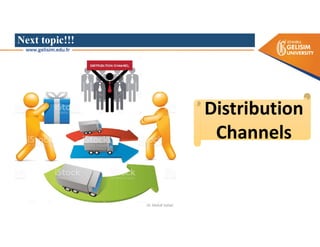
Next topic!!!
Distribution
Channels
Dr. Mehdi Safaei
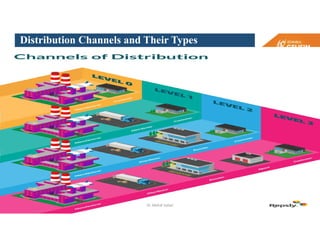
Distribution Channels and Their Types
Dr. Mehdi Safaei
Distribution Channels and Their Types
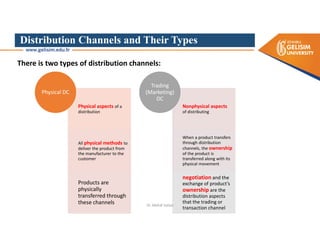
There is two types of distribution channels:
Physical aspects of a
distribution
All physical methods to
deliver the product from
the manufacturer to the
customer
Products are
physically
transferred through
these channels
Physical DC
Nonphysical aspects
of distributing
When a product transfers
through distribution
channels, the ownership
of the product is
transferred along with its
physical movement
negotiation and the
exchange of product’s
ownership are the
distribution aspects
that the trading or
transaction channel
Trading
(Marketing)
DC
Dr. Mehdi Safaei
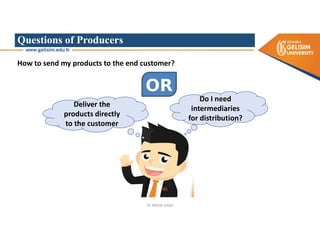
Questions of Producers
How to send my products to the end customer?
Do I need
intermediaries
for distribution?
Deliver the
products directly
to the customer
Dr. Mehdi Safaei
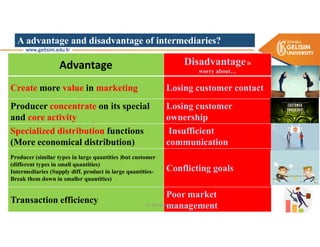
A advantage and disadvantage of intermediaries?
Disadvantageis
worry about…
Advantage
Losing customer contact
Create more value in marketing
Losing customer
ownership
Producer concentrate on its special
and core activity
Insufficient
communication
Specialized distribution functions
(More economical distribution)
Conflicting goals
Producer (similar types in large quantities )but customer
(different types in small quantities)
Intermediaries (Supply diff. product in large quantities-
Break them down in smaller quantities)
Poor market
management
Transaction efficiency Dr. Mehdi Safaei
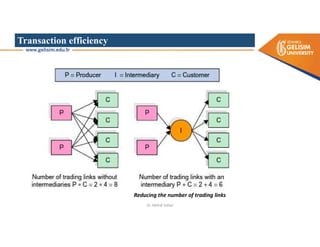
Transaction efficiency
Reducing the number of trading links
Dr. Mehdi Safaei
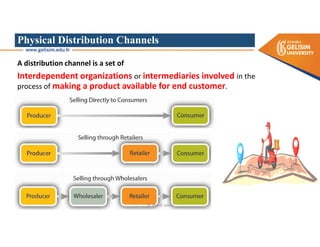
Physical Distribution Channels
A distribution channel is a set of
Interdependent organizations or intermediaries involved in the
process of making a product available for end customer.
Dr. Mehdi Safaei
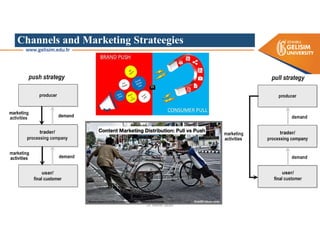
Channels and Marketing Strateegies
Dr. Mehdi Safaei
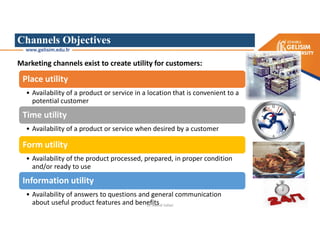
Channels Objectives
Marketing channels exist to create utility for customers:
Place utility
• Availability of a product or service in a location that is convenient to a
potential customer
Time utility
• Availability of a product or service when desired by a customer
Form utility
• Availability of the product processed, prepared, in proper condition
and/or ready to use
Information utility
• Availability of answers to questions and general communication
about useful product features and benefits
Dr. Mehdi Safaei
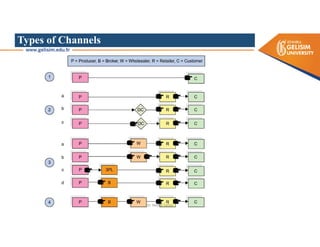
Types of Channels
Dr. Mehdi Safaei
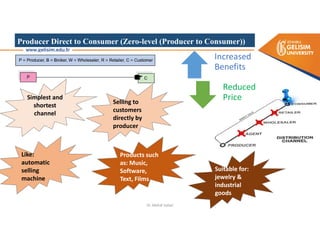
Producer Direct to Consumer (Zero-level (Producer to Consumer))
Increased
Benefits
Reduced
Price
Simplest and
shortest
channel
Selling to
customers
directly by
producer
Like:
automatic
selling
machine
Products such
as: Music,
Software,
Text, Films
Suitable for:
jewelry &
industrial
goods
Dr. Mehdi Safaei
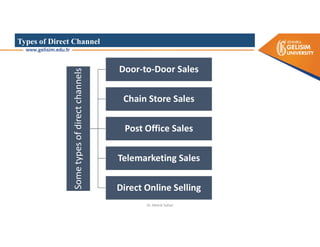
Types of Direct Channel
Some
types
of
direct
channels
Door-to-Door Sales
Chain Store Sales
Post Office Sales
Telemarketing Sales
Direct Online Selling
Dr. Mehdi Safaei
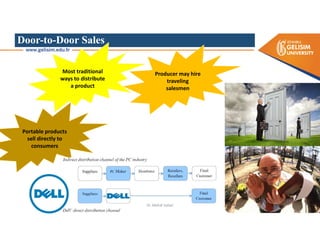
Door-to-Door Sales
Most traditional
ways to distribute
a product
Producer may hire
traveling
salesmen
Portable products
sell directly to
consumers
Dr. Mehdi Safaei
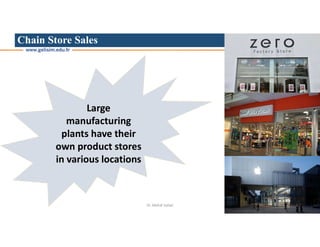
Chain Store Sales
Large
manufacturing
plants have their
own product stores
in various locations
Dr. Mehdi Safaei
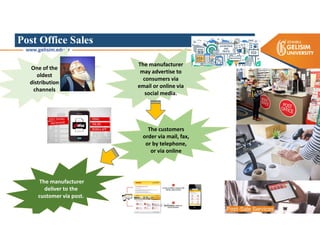
Post Office Sales
One of the
oldest
distribution
channels
The manufacturer
may advertise to
consumers via
email or online via
social media.
The customers
order via mail, fax,
or by telephone,
or via online
The manufacturer
deliver to the
customer via post.
Dr. Mehdi Safaei
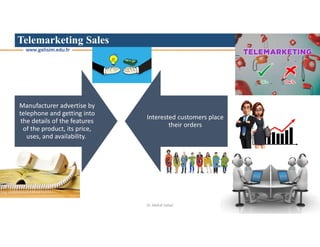
Telemarketing Sales
Manufacturer advertise by
telephone and getting into
the details of the features
of the product, its price,
uses, and availability.
Interested customers place
their orders
Dr. Mehdi Safaei
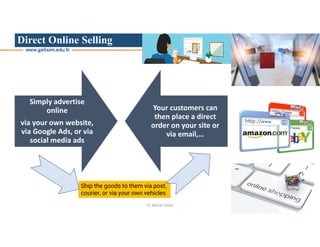
Direct Online Selling
Simply advertise
online
via your own website,
via Google Ads, or via
social media ads
Your customers can
then place a direct
order on your site or
via email,…
Ship the goods to them via post,
courier, or via your own vehicles
Dr. Mehdi Safaei
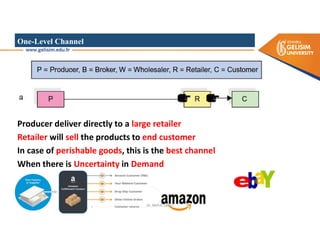
One-Level Channel
Producer deliver directly to a large retailer
Retailer will sell the products to end customer
In case of perishable goods, this is the best channel
When there is Uncertainty in Demand
Dr. Mehdi Safaei
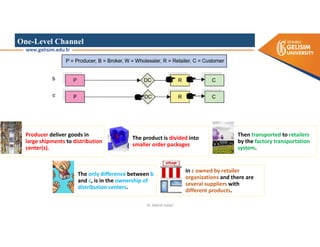
One-Level Channel
Producer deliver goods in
large shipments to distribution
center(s).
The product is divided into
smaller order packages
Then transported to retailers
by the factory transportation
system.
The only difference between b
and c, is in the ownership of
distribution centers.
In c owned by retailer
organizations and there are
several suppliers with
different products.
Dr. Mehdi Safaei
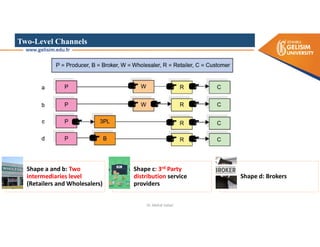
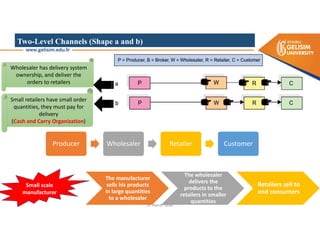
Two-Level Channels
Shape a and b: Two
intermediaries level
(Retailers and Wholesalers)
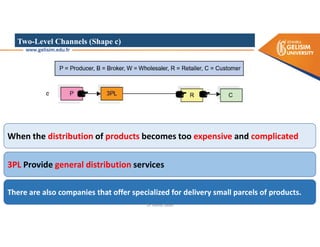
Shape c: 3rd Party
distribution service
providers
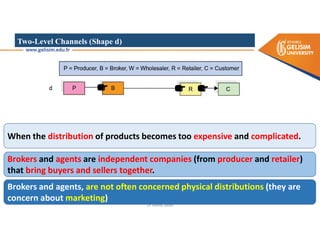
Shape d: Brokers
Dr. Mehdi Safaei
Two-Level Channels (Shape a and b)
Producer Wholesaler Retailer Customer
The manufacturer
sells his products
in large quantities
to a wholesaler
The wholesaler
delivers the
products to the
retailers in smaller
quantities
Retailers sell to
end consumers
Small scale
manufacturer
Wholesaler has delivery system
ownership, and deliver the
orders to retailers
Small retailers have small order
quantities, they must pay for
delivery
(Cash and Carry Organization)
Dr. Mehdi Safaei
Two-Level Channels (Shape c)
When the distribution of products becomes too expensive and complicated
3PL Provide general distribution services
There are also companies that offer specialized for delivery small parcels of products.
Dr. Mehdi Safaei
Two-Level Channels (Shape d)
When the distribution of products becomes too expensive and complicated.
Brokers and agents are independent companies (from producer and retailer)
that bring buyers and sellers together.
Brokers and agents, are not often concerned physical distributions (they are
concern about marketing)
Dr. Mehdi Safaei
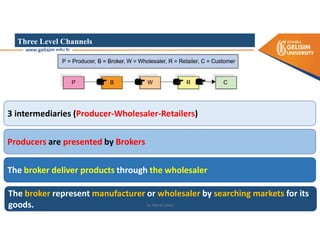
Three Level Channels
3 intermediaries (Producer-Wholesaler-Retailers)
Producers are presented by Brokers
The broker deliver products through the wholesaler
The broker represent manufacturer or wholesaler by searching markets for its
goods. Dr. Mehdi Safaei

Transportation modes and physical distribution

  • 1.
    10 possible intermodalservice combination Rail-Road Rail-Water Rail-Air Rail-Pipeline Road-Air Road-Water Road-Pipeline Water-Air Water-Pipeline Air-Pipeline In Practice Only a few of them Dr. Mehdi Safaei
  • 2.
    The Most FrequentCombined Rail-Road (Piggy back) Road-Water (Fishy-back) Road-Air (Birdy-back) Dr. Mehdi Safaei
  • 3.
    Rail-Road (Piggy back) Traileron flatcar (TOFC) 1 Container on flatcar (COFC) 2 Road-Railer (Trailer Train) 3 Roadrailer is a trailer, or semi-trailer, that is specially equipped for use in railroad service It has both car wheels and train wheels Play- (TOFC vs COFC) Play- Roadrailer Dr. Mehdi Safaei
  • 4.
    Other transportation options Freightforwarder 1 •A freight forwarder is a company that arranges your importing and exporting of goods •A freight forwarder does not actually move your freight itself. •Mostly They do not own the transport equipment ( Except for pickup and delivery operations) Play- Freight forwarder Dr. Mehdi Safaei
  • 5.
    Other transportation options Freightforwarder 1 Shippers’ Association or Cooperative 2 • "Shippers' Associations generally are non-profit transportation membership cooperatives which arrange for the domestic or international shipment • Mostly they have contract with Motor, Rail, Air and Water carrier Dr. Mehdi Safaei
  • 6.
    Other transportation options Freightforwarder 1 Shippers’ Association or Cooperative 2 Intermodal marketing companies 3 • An intermodal marketing company is a logistics company that purchases intermodal capacity directly from the railroads and trucking firms Dr. Mehdi Safaei
  • 7.
    Other transportation options Freightforwarder 1 Shippers’ Association or Cooperative 2 Intermodal marketing companies 3 Small package carrier 4 • Deliver small package • For example: United Parcel Company (UPS), Air express, DHL , … Dr. Mehdi Safaei
  • 8.
    Other transportation options Freightforwarder 1 Shippers’ Association or Cooperative 2 Intermodal marketing companies 3 Small package carrier 4 Third party logistics (3PL) service provider 5 • Outsourcing of its distribution, warehousing, and fulfillment services Dr. Mehdi Safaei
  • 9.
  • 10.
    Distribution Channels andTheir Types Dr. Mehdi Safaei
  • 11.
    Distribution Channels andTheir Types There is two types of distribution channels: Physical aspects of a distribution All physical methods to deliver the product from the manufacturer to the customer Products are physically transferred through these channels Physical DC Nonphysical aspects of distributing When a product transfers through distribution channels, the ownership of the product is transferred along with its physical movement negotiation and the exchange of product’s ownership are the distribution aspects that the trading or transaction channel Trading (Marketing) DC Dr. Mehdi Safaei
  • 12.
    Questions of Producers Howto send my products to the end customer? Do I need intermediaries for distribution? Deliver the products directly to the customer Dr. Mehdi Safaei
  • 13.
    A advantage anddisadvantage of intermediaries? Disadvantageis worry about… Advantage Losing customer contact Create more value in marketing Losing customer ownership Producer concentrate on its special and core activity Insufficient communication Specialized distribution functions (More economical distribution) Conflicting goals Producer (similar types in large quantities )but customer (different types in small quantities) Intermediaries (Supply diff. product in large quantities- Break them down in smaller quantities) Poor market management Transaction efficiency Dr. Mehdi Safaei
  • 14.
    Transaction efficiency Reducing thenumber of trading links Dr. Mehdi Safaei
  • 15.
    Physical Distribution Channels Adistribution channel is a set of Interdependent organizations or intermediaries involved in the process of making a product available for end customer. Dr. Mehdi Safaei
  • 16.
    Channels and MarketingStrateegies Dr. Mehdi Safaei
  • 17.
    Channels Objectives Marketing channelsexist to create utility for customers: Place utility • Availability of a product or service in a location that is convenient to a potential customer Time utility • Availability of a product or service when desired by a customer Form utility • Availability of the product processed, prepared, in proper condition and/or ready to use Information utility • Availability of answers to questions and general communication about useful product features and benefits Dr. Mehdi Safaei
  • 18.
  • 19.
    Producer Direct toConsumer (Zero-level (Producer to Consumer)) Increased Benefits Reduced Price Simplest and shortest channel Selling to customers directly by producer Like: automatic selling machine Products such as: Music, Software, Text, Films Suitable for: jewelry & industrial goods Dr. Mehdi Safaei
  • 20.
    Types of DirectChannel Some types of direct channels Door-to-Door Sales Chain Store Sales Post Office Sales Telemarketing Sales Direct Online Selling Dr. Mehdi Safaei
  • 21.
    Door-to-Door Sales Most traditional waysto distribute a product Producer may hire traveling salesmen Portable products sell directly to consumers Dr. Mehdi Safaei
  • 22.
    Chain Store Sales Large manufacturing plantshave their own product stores in various locations Dr. Mehdi Safaei
  • 23.
    Post Office Sales Oneof the oldest distribution channels The manufacturer may advertise to consumers via email or online via social media. The customers order via mail, fax, or by telephone, or via online The manufacturer deliver to the customer via post. Dr. Mehdi Safaei
  • 24.
    Telemarketing Sales Manufacturer advertiseby telephone and getting into the details of the features of the product, its price, uses, and availability. Interested customers place their orders Dr. Mehdi Safaei
  • 25.
    Direct Online Selling Simplyadvertise online via your own website, via Google Ads, or via social media ads Your customers can then place a direct order on your site or via email,… Ship the goods to them via post, courier, or via your own vehicles Dr. Mehdi Safaei
  • 26.
    One-Level Channel Producer deliverdirectly to a large retailer Retailer will sell the products to end customer In case of perishable goods, this is the best channel When there is Uncertainty in Demand Dr. Mehdi Safaei
  • 27.
    One-Level Channel Producer delivergoods in large shipments to distribution center(s). The product is divided into smaller order packages Then transported to retailers by the factory transportation system. The only difference between b and c, is in the ownership of distribution centers. In c owned by retailer organizations and there are several suppliers with different products. Dr. Mehdi Safaei
  • 28.
    Two-Level Channels Shape aand b: Two intermediaries level (Retailers and Wholesalers) Shape c: 3rd Party distribution service providers Shape d: Brokers Dr. Mehdi Safaei
  • 29.
    Two-Level Channels (Shapea and b) Producer Wholesaler Retailer Customer The manufacturer sells his products in large quantities to a wholesaler The wholesaler delivers the products to the retailers in smaller quantities Retailers sell to end consumers Small scale manufacturer Wholesaler has delivery system ownership, and deliver the orders to retailers Small retailers have small order quantities, they must pay for delivery (Cash and Carry Organization) Dr. Mehdi Safaei
  • 30.
    Two-Level Channels (Shapec) When the distribution of products becomes too expensive and complicated 3PL Provide general distribution services There are also companies that offer specialized for delivery small parcels of products. Dr. Mehdi Safaei
  • 31.
    Two-Level Channels (Shaped) When the distribution of products becomes too expensive and complicated. Brokers and agents are independent companies (from producer and retailer) that bring buyers and sellers together. Brokers and agents, are not often concerned physical distributions (they are concern about marketing) Dr. Mehdi Safaei
  • 32.
    Three Level Channels 3intermediaries (Producer-Wholesaler-Retailers) Producers are presented by Brokers The broker deliver products through the wholesaler The broker represent manufacturer or wholesaler by searching markets for its goods. Dr. Mehdi Safaei