Symposium
Marketing and social responsibility in banks
Belgrade, 11-12.04.2012
Transition to Sustainability
A snapshot of Current Trends in the Financial Sector
Harry Papageorgiou
Head, Group Environment & Quality Division, Eurobank EFG Group
Chair, European Task Force UNEP FI
Head, Sustainability Committee Hellenic Bank Association
© www.dimplex-resource.co.uk
2
Sustainability & Sustainable Development: Definitions
UNEP FI Guide to Banking & Sustainability
Sustainability
The Brundtland Commission, UN 1987
“Meeting the needs of the present without compromising the ability of future generations to meet their own needs.”
This definition is supported by the equally widely acknowledged three pillars: economic, social and environmental development.
http://www.un-documents.net/wced-ocf.htm
ESG
A generic term usually traced back to the initial work of United
Nations Global Compact on financial markets and sustainability
issues, now widely used in capital markets by investors.
ESG (environmental, social and governance) factors are
considered as a subset of non-financial performance
indicators, which serve to evaluate corporate behaviour and
determine the future financial performance of companies.
United Nations Global Compact Who Cares Wins Series, 2004-2008
http://www.unglobalcompact.org/Issues/financial_markets/index.html
Corporate Social Responsibility
The origins of Corporate Social Responsibility (CSR)
terminology are closer to the corporate sector itself, with a
distinct focus on the concerns, needs and expectations of
society.
As such CSR addresses the integration of issues of concern
to society in companies’ business operations and their
interaction with stakeholders, on a voluntary basis.
Social Responsibilities of the Businessman, Howard Bowen, 1953.
Corporate Citizenship
Corporate Citizenship is a concept close to CSR but perhaps
preferred by some (and especially in North America) for its more
intimate connection to the communities directly surrounding
the corporation.
Corporate Citizenship strives to meet the social, cultural and
environmental responsibilities with the community wherein
which the institution seeks a license to operate, as well as
economic and financial responsibilities to its shareholders
or immediate stakeholders.
Business Ethics
Business Ethics is an approach founded more closely on ethical
and moral beliefs:
what is the right (or wrong) thing to do? When the actions of
individuals and firms, in the pursuit of self-interest and
profits, adversely affect others, it is an ethical imperative to
exercise appropriate constraint.
3
Sustainability & Sustainable Development: Corporate Sustainability
4
Sustainability & Sustainable Development: What is it about?
5
Sustainability & Sustainable Development
& The Green Economy
The financial sector can play a
critical role in the transformation
to a more sustainable
environment.
As financial intermediaries in an
economy, financial institutions
can contribute to mitigating
environmental problems, while at
the same time taking advantage of
the opportunities that
sustainability offers to the finance
sector.
[UNEP FI (2004): Finance & Sustainability
in CEE]
"Support for the green economy
and the environment goes hand-in-
hand with the Cohesion Policy's
objective to deliver sustainable
growth, jobs and
competitiveness. In a difficult
financial climate, this investment will
be instrumental in creating long-term
employment and reviving local
economies, as well as underpinning
the EU's commitment to the fight
against climate change."
Danuta Hübner, European Commissioner for
Regional Policy (9/3/2009)
The Green Economy The Financial Sector…and
6
Sustainability & Sustainable Development: Confusing?
ESG ? Reporting ?
Green Economy ?
CSR ?
Business Ethics ? Operational Footprint ?
Sustainability?
Risks ? Citizenship ?
7
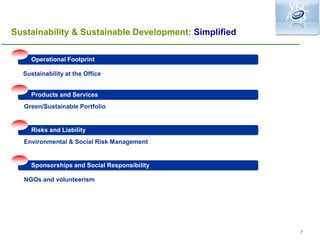
Sustainability & Sustainable Development: Simplified
Operational Footprint
Products and Services
Risks and Liability
Sponsorships and Social Responsibility
Sustainability at the Office
Green/Sustainable Portfolio
Environmental & Social Risk Management
NGOs and volunteerism
8
Sustainability & Banking: Simplified
Operational Footprint
Sustainability at the Office
Environmental/Quality/Health & Safety
Management Systems
9
Sustainability & Banking: Simplified
Operational Footprint
Sustainability at the Office
Procurement
Data Input Quality and Precision
Use Savings Programme
Top Spenders/Top savers
Statistics:
Building/Counter (in conjunction with CC
allocations)
Indicators
Output
GHG Emissions
Reporting
Indicators
Energy Flow
per source/per area/ per building/ per person
Energy mix - Renewables
Informed Decision Making
Material
Flow
Management
Market/Legislation Monitoring
Benchmarking
Opportunities
-Offsetting
-Carbon Neutral Bank
Resource/Material Flow Analysis
e.g. Energy
10
Sustainability & Banking: Simplified
Operational Footprint
Sustainability at the Office
11
Sustainability & Banking: Simplified
Operational Footprint
Products and Services
Risks and Liability
Communications, Sponsorships and Social Responsibility
Sustainability at the Office
Green/Sustainable Portfolio
Environmental & Social Risk Management
Sustainability profiling, NGOs and volunteerism
12
Sustainability & Banking: Simplified
Products and Services
Green/Sustainable Portfolio
UNEP FI Survey 2007
Home Mortgages Commercial Building Loans
Home Equity Loans Auto & Fleet Loans
Credit & Debit Cards Personal Accounts
Green Sale & Travel Money Products
Retail Banking
Project Finance Securitization
Venture Capital & Private Equity
Carbon Commodity Products and Services
Corporate &
Investment Banking
Fiscal Funds Investment Funds
Carbon Funds Cat Bond Funds
Asset Management
Auto Insurance
Home & Business Insurance
Carbon Insurance
Insurance
13
Sustainability & Banking: Simplified
Products and Services
Green/Sustainable Portfolio
UNEP FI Survey 2007
Product
or service
Model
Banks
Studied
Region Key Product(s) and Results or Potential Lesson Learned
Home
Mortgage
Dutch
banks
NL Government led „green mortgage‟ initiative.
Homeowners and banks have not found the
scheme particularly attractive. Product
does demonstrate longevity, and has increased
demand for green mortgages in the country.
Banks and customers consider the maximum mortgage
amount too low (€34,000) and selection criteria too
stringent.
Home
Mortgage
CFS UK Offers free home energy rating and offsets
carbon emissions for every year of loan. During
2005, offset over 50,000 tonnes of CO2
emissions. Will soon launch added features into
portfolio. Success.
Significant environmental benefits. Customer loyalty and
acquisition. First Mover Advantage. Potential to improve
brand and reputation. CFS believes “eco home loans will
become the norm in the future.”
Home
Mortgage
Abbey,
HBOS,
Halifax and
others
Europe (UK) Green mortgages have only been announced by
these banks, some of which are the largest
mortgage providers in the country.
UK Government announcement stimulated recent surge
of interes in „green‟ mortgages. Align product design
with stateled initiatives and commitments.
Home
Mortgage
Bendigo
Bank
Australia Generation Green™ Home Loan.
Success.
Offered to both new and old homes, so those with
existing mortgages can take advantage of discounted
rates. Notable savings. All projects must exceed state
requirements.
14
Sustainability & Sustainable Development: Simplified
Operational Footprint
Products and Services
Risks and Liability
Sponsorships and Social Responsibility
Sustainability at the Office
Green/Sustainable Portfolio
Environmental & Social Risk Management
NGOs and volunteerism
15
Sustainability & Banking: Simplified
Risks and Liability
Environmental & Social Risk Management
Probably the most crucial and
challenging element of sustainable
banking and finance…
16
Environmental Liability: What is it about? (1)
The PPP
The famous “Polluter Pays” Principle
Already set out in the Treaty establishing the European Community (Article
174(2) TEC, now Article 191 of the Treaty of the Functioning of the EU)
“Community policy on the environment shall aim at a high level of protection taking into
account the diversity of situations in the various regions of the Community. It shall be
based on the precautionary principle and on the principles that preventive action should be
taken, that environmental damage should as a priority be rectified at source and that
the polluter should pay”
The very basis of Environmental Economics Science
It is about “external” cost internalisation & allocation
Internalisation of Environmental Externalities
17
Environmental Liability: What is it about?(2)
Prevention and Remediation
From fines to cost of prevention and remediation of Environmental Damage
Environmental Risk Assessment & Management
Synthesis between Risk Assessment & Environmental Management disciplines
Financial Security
Insurance Policies?
Other Financial Security Measures/Schemes
18
Environmental Liability & the Financial Sector
Institutional Investment Institutions
The Financial Sector
Banks
Insurance Companies
Banking Groups
19
Environmental Liability & the Financial Sector
Current trends in the industrialised world
Institutional Investors
Growing Attention and measures due to major environmental incidents
Ethical, Socially Responsible, Sustainability, Green FUNDS
Sustainability Indices (FTSE4Good, Dow Jones Sustainability Index)
Voluntary Initiatives
 Principles for Responsible Investment
Number of signatories
Asset owners 246
Investment managers 571
Professional service
partners
161
Total 978
http://www.unpri.org
Assets
under management $30.000.000.000.000 (30 trillion$)
20
Environmental Liability & the Financial Sector
Current trends in the industrialised world
Insurance Companies
Pollution and Environmental Liability products evolving
Insurers as Investors
21
Environmental Liability & the Financial Sector
Current trends in the industrialised world
Banks
Multilateral/Development Banks
Commercial Banks
22
Environmental Liability & the Financial Sector
Development Banks
23
Environmental Liability & the Financial Sector
Development Banks
24
Environmental Liability & the Financial Sector
Commercial Banks
Environmental Risk
Management in EU and
US Banks is NOT a new
concept
25
Environmental Liability & the Financial Sector
Why Bother?
Financial Risks?
Legislation Risks?
Reputational Risks?
Risks
Opportunities
?
26
Environmental Liability & the Financial Sector
Commercial Banks
Why Bother?
Financial Risks
Legal Risks
Reputation Risks
Credit
Cost of fines and/or remediation for environmental
damage + product/brand/corporate reputational
damage can impair customer's ability to pay back
loans
Collaterals
Reduced value of assets
Costs e.g. for waste removal or land
decontamination
27
Environmental Liability & the Financial Sector
Commercial Banks
Why Bother?
Financial Risks
Legal Risks
Reputation Risks
Potential Liabilities through control of client
management and decision making
Possession of assets
28
Environmental Liability & the Financial Sector
Commercial Banks
Why Bother?
Financial Risks
Legal Risks
Reputation Risks
Association with polluting
customer/project
Vulnerability to NGO and media attacks
29
Environmental Liability & the Banking Sector
Incentives & Disincentives for Environmental Risk Management
Incentives Disincentives
Risk Identification &
Management
Customer Relationships
Competition
Compliance with Basel II
Development of Green
Products & Services
Other Products (Insurance
Policies Etc)
Costs
Customer Relationships
Competition
Potential Management
Involvement Claims
Lack of internal knowhow
Unstable and
incomprehensive
regulatory regime
30
Sustainability & Sustainable Development: Simplified
Operational Footprint
Products and Services
Risks and Liability
Sponsorships and Social Responsibility
Sustainability at the Office
Green/Sustainable Portfolio
Environmental & Social Risk Management
NGOs and volunteerism
31
Sustainability & Banking: Simplified
Communications, Sponsorships and Social Responsibility
Sustainability profiling, NGOs and volunteerism
32
Sustainability & Banking: Simplified
Communications, Sponsorships and Social Responsibility
Sustainability profiling, NGOs and volunteerism
Basic Thoughts
 Increasingly crucial for reputation management
 Stakeholder mapping essential
 Very often blamed for “green washing”
 Should be embedded in overall Sustainability Strategy
 Environmental/social benefits should be crystal clear
 Carefully selected partnerships with NGOs
 Volunteerism an essential element
 “Walk the talk”, or “practice what you preach”
 Engage with international networks and initiatives (UNEP FI, Global Compact, etc)
33
Sustainability & Banking: How?
 Management Commitment
 Sustainability Management Systems
 Roles and Responsibilities
 Reporting
34
Sustainability & Banking: How?
 Management Commitment
 Sustainability Management Systems
 Roles and Responsibilities
 Reporting
Sustainability Policy
Key commitments’ framework
Signed/Approved by CEO
Sector Policies
In line with key commitments
Applicable to suppliers/customers etc
Sustainability Committees
Senior Management Representatives
Regular Meetings
35
Sustainability & Banking: How?
 Management Commitment
 Sustainability Management Systems
 Roles and Responsibilities
 Reporting
Footprint Management
Globally Recognised Standards (ISO14001/EMAS etc)
Environmental & Social Risk Management
A special focus to Relationship Managers
Internal knowhow and Sector Libraries
Monitoring Progress and Continuous Improvement
SMART Indicators
(Specific, Measurable, Achievable, Relevant, Time-bound)
Regular Meetings
Products and Services
Support sustainable innovation
Develop and share know-how
New products and services
36
Sustainability & Banking: How?
 Management Commitment
 Sustainability Management Systems
 Roles and Responsibilities
 Reporting
http://www.unepfi.org/publications/banking/index.html
37
Sustainability & Banking: How?
 Management Commitment
 Sustainability Management Systems
 Roles and Responsibilities
 Reporting
Audits and Verifications
Increased Transparency and Credibility
Sustainability Reporting Frameworks/Indexes
Global Reporting Initiative (GRI)
Dow Jones Sustainability Index (DJSI)
FTSE4Good
Carbon Disclosure Project
38
Sustainability & Banking:
Reporting
Why ? (1)
(Socially) Responsible Investment [(S)RI] - Sustainable Investment (SI)
Increasingly, investors are diversifying their portfolios by investing in companies
that set industry-wide best practices with regard to sustainability, because:
 Attractiveness
 Sustainability aims to increase long-term shareholder value
 Sustainability performance financially quantified – investable corporate sustainability
concept.
 Superior performance and risk/return profiles
 A growing number of investors are convinced that sustainability is a catalyst for
enlightened and disciplined management, and, thus, a crucial success factor.
39
Sustainability & Banking:
Reporting
Why ? (2)
(Source: European sustainable investment forum study EUROSIF 2010)
 Sustainable investment is now largely perceived by the European HNWI
population as a financial discipline rather than an investment style
 Specific knowledge of ESG (environmental, social and corporate
governance) issues necessary in order to be successful.
 An explanation of impressing market growth (even in difficult times)
 Eurosif estimates the 2010 European HNWI sustainable investment market to be
approximately €729 billion, representing approximately 11% of European HNWIs’
portfolios as of December 31, 2009. This is a growth rate of 35% over the two-year
period since the data was previously collected.
40
Key reasons why banks
consider sustainability issues
Increased credibility and gain in reputation
?
Demand by investors
?
Lower risk and better returns
?
Increased value to stakeholders
?
Potential for business development
?
Liabilities
?
Non-performing loan experience
?
Demand by clients
?
Sustainability & Banking: Why Bother?
41
Transition to Sustainability
Sustainable Banks are definitely the Banks of the Future
Top Management Commitment
Integrate Environmental & Sustainability Strategies in core business
Sustainability Management: a systems approach
A growing need for the development of internal sustainability capacity,
structures and know-how
Open communication & collaboration with stakeholders – commonly agreed
processes
Environmental Risk Awareness & Management in Banking & Investment
doesn’t mean sector exclusions and credit rejections but rather informed
decision making and improved customer relationships - opportunities
Participation in international initiatives & networks (e.g. UNEP FI, Global
Compact etc), external communications, partnerships with NGOs
We practice what we preach, so that we don’t face “green washing”
accusations
Key Messages

Transition to sustainability

  • 1.
    Symposium Marketing and socialresponsibility in banks Belgrade, 11-12.04.2012 Transition to Sustainability A snapshot of Current Trends in the Financial Sector Harry Papageorgiou Head, Group Environment & Quality Division, Eurobank EFG Group Chair, European Task Force UNEP FI Head, Sustainability Committee Hellenic Bank Association © www.dimplex-resource.co.uk
  • 2.
    2 Sustainability & SustainableDevelopment: Definitions UNEP FI Guide to Banking & Sustainability Sustainability The Brundtland Commission, UN 1987 “Meeting the needs of the present without compromising the ability of future generations to meet their own needs.” This definition is supported by the equally widely acknowledged three pillars: economic, social and environmental development. http://www.un-documents.net/wced-ocf.htm ESG A generic term usually traced back to the initial work of United Nations Global Compact on financial markets and sustainability issues, now widely used in capital markets by investors. ESG (environmental, social and governance) factors are considered as a subset of non-financial performance indicators, which serve to evaluate corporate behaviour and determine the future financial performance of companies. United Nations Global Compact Who Cares Wins Series, 2004-2008 http://www.unglobalcompact.org/Issues/financial_markets/index.html Corporate Social Responsibility The origins of Corporate Social Responsibility (CSR) terminology are closer to the corporate sector itself, with a distinct focus on the concerns, needs and expectations of society. As such CSR addresses the integration of issues of concern to society in companies’ business operations and their interaction with stakeholders, on a voluntary basis. Social Responsibilities of the Businessman, Howard Bowen, 1953. Corporate Citizenship Corporate Citizenship is a concept close to CSR but perhaps preferred by some (and especially in North America) for its more intimate connection to the communities directly surrounding the corporation. Corporate Citizenship strives to meet the social, cultural and environmental responsibilities with the community wherein which the institution seeks a license to operate, as well as economic and financial responsibilities to its shareholders or immediate stakeholders. Business Ethics Business Ethics is an approach founded more closely on ethical and moral beliefs: what is the right (or wrong) thing to do? When the actions of individuals and firms, in the pursuit of self-interest and profits, adversely affect others, it is an ethical imperative to exercise appropriate constraint.
  • 3.
    3 Sustainability & SustainableDevelopment: Corporate Sustainability
  • 4.
    4 Sustainability & SustainableDevelopment: What is it about?
  • 5.
    5 Sustainability & SustainableDevelopment & The Green Economy The financial sector can play a critical role in the transformation to a more sustainable environment. As financial intermediaries in an economy, financial institutions can contribute to mitigating environmental problems, while at the same time taking advantage of the opportunities that sustainability offers to the finance sector. [UNEP FI (2004): Finance & Sustainability in CEE] "Support for the green economy and the environment goes hand-in- hand with the Cohesion Policy's objective to deliver sustainable growth, jobs and competitiveness. In a difficult financial climate, this investment will be instrumental in creating long-term employment and reviving local economies, as well as underpinning the EU's commitment to the fight against climate change." Danuta Hübner, European Commissioner for Regional Policy (9/3/2009) The Green Economy The Financial Sector…and
  • 6.
    6 Sustainability & SustainableDevelopment: Confusing? ESG ? Reporting ? Green Economy ? CSR ? Business Ethics ? Operational Footprint ? Sustainability? Risks ? Citizenship ?
  • 7.
    7 Sustainability & SustainableDevelopment: Simplified Operational Footprint Products and Services Risks and Liability Sponsorships and Social Responsibility Sustainability at the Office Green/Sustainable Portfolio Environmental & Social Risk Management NGOs and volunteerism
  • 8.
    8 Sustainability & Banking:Simplified Operational Footprint Sustainability at the Office Environmental/Quality/Health & Safety Management Systems
  • 9.
    9 Sustainability & Banking:Simplified Operational Footprint Sustainability at the Office Procurement Data Input Quality and Precision Use Savings Programme Top Spenders/Top savers Statistics: Building/Counter (in conjunction with CC allocations) Indicators Output GHG Emissions Reporting Indicators Energy Flow per source/per area/ per building/ per person Energy mix - Renewables Informed Decision Making Material Flow Management Market/Legislation Monitoring Benchmarking Opportunities -Offsetting -Carbon Neutral Bank Resource/Material Flow Analysis e.g. Energy
  • 10.
    10 Sustainability & Banking:Simplified Operational Footprint Sustainability at the Office
  • 11.
    11 Sustainability & Banking:Simplified Operational Footprint Products and Services Risks and Liability Communications, Sponsorships and Social Responsibility Sustainability at the Office Green/Sustainable Portfolio Environmental & Social Risk Management Sustainability profiling, NGOs and volunteerism
  • 12.
    12 Sustainability & Banking:Simplified Products and Services Green/Sustainable Portfolio UNEP FI Survey 2007 Home Mortgages Commercial Building Loans Home Equity Loans Auto & Fleet Loans Credit & Debit Cards Personal Accounts Green Sale & Travel Money Products Retail Banking Project Finance Securitization Venture Capital & Private Equity Carbon Commodity Products and Services Corporate & Investment Banking Fiscal Funds Investment Funds Carbon Funds Cat Bond Funds Asset Management Auto Insurance Home & Business Insurance Carbon Insurance Insurance
  • 13.
    13 Sustainability & Banking:Simplified Products and Services Green/Sustainable Portfolio UNEP FI Survey 2007 Product or service Model Banks Studied Region Key Product(s) and Results or Potential Lesson Learned Home Mortgage Dutch banks NL Government led „green mortgage‟ initiative. Homeowners and banks have not found the scheme particularly attractive. Product does demonstrate longevity, and has increased demand for green mortgages in the country. Banks and customers consider the maximum mortgage amount too low (€34,000) and selection criteria too stringent. Home Mortgage CFS UK Offers free home energy rating and offsets carbon emissions for every year of loan. During 2005, offset over 50,000 tonnes of CO2 emissions. Will soon launch added features into portfolio. Success. Significant environmental benefits. Customer loyalty and acquisition. First Mover Advantage. Potential to improve brand and reputation. CFS believes “eco home loans will become the norm in the future.” Home Mortgage Abbey, HBOS, Halifax and others Europe (UK) Green mortgages have only been announced by these banks, some of which are the largest mortgage providers in the country. UK Government announcement stimulated recent surge of interes in „green‟ mortgages. Align product design with stateled initiatives and commitments. Home Mortgage Bendigo Bank Australia Generation Green™ Home Loan. Success. Offered to both new and old homes, so those with existing mortgages can take advantage of discounted rates. Notable savings. All projects must exceed state requirements.
  • 14.
    14 Sustainability & SustainableDevelopment: Simplified Operational Footprint Products and Services Risks and Liability Sponsorships and Social Responsibility Sustainability at the Office Green/Sustainable Portfolio Environmental & Social Risk Management NGOs and volunteerism
  • 15.
    15 Sustainability & Banking:Simplified Risks and Liability Environmental & Social Risk Management Probably the most crucial and challenging element of sustainable banking and finance…
  • 16.
    16 Environmental Liability: Whatis it about? (1) The PPP The famous “Polluter Pays” Principle Already set out in the Treaty establishing the European Community (Article 174(2) TEC, now Article 191 of the Treaty of the Functioning of the EU) “Community policy on the environment shall aim at a high level of protection taking into account the diversity of situations in the various regions of the Community. It shall be based on the precautionary principle and on the principles that preventive action should be taken, that environmental damage should as a priority be rectified at source and that the polluter should pay” The very basis of Environmental Economics Science It is about “external” cost internalisation & allocation Internalisation of Environmental Externalities
  • 17.
    17 Environmental Liability: Whatis it about?(2) Prevention and Remediation From fines to cost of prevention and remediation of Environmental Damage Environmental Risk Assessment & Management Synthesis between Risk Assessment & Environmental Management disciplines Financial Security Insurance Policies? Other Financial Security Measures/Schemes
  • 18.
    18 Environmental Liability &the Financial Sector Institutional Investment Institutions The Financial Sector Banks Insurance Companies Banking Groups
  • 19.
    19 Environmental Liability &the Financial Sector Current trends in the industrialised world Institutional Investors Growing Attention and measures due to major environmental incidents Ethical, Socially Responsible, Sustainability, Green FUNDS Sustainability Indices (FTSE4Good, Dow Jones Sustainability Index) Voluntary Initiatives  Principles for Responsible Investment Number of signatories Asset owners 246 Investment managers 571 Professional service partners 161 Total 978 http://www.unpri.org Assets under management $30.000.000.000.000 (30 trillion$)
  • 20.
    20 Environmental Liability &the Financial Sector Current trends in the industrialised world Insurance Companies Pollution and Environmental Liability products evolving Insurers as Investors
  • 21.
    21 Environmental Liability &the Financial Sector Current trends in the industrialised world Banks Multilateral/Development Banks Commercial Banks
  • 22.
    22 Environmental Liability &the Financial Sector Development Banks
  • 23.
    23 Environmental Liability &the Financial Sector Development Banks
  • 24.
    24 Environmental Liability &the Financial Sector Commercial Banks Environmental Risk Management in EU and US Banks is NOT a new concept
  • 25.
    25 Environmental Liability &the Financial Sector Why Bother? Financial Risks? Legislation Risks? Reputational Risks? Risks Opportunities ?
  • 26.
    26 Environmental Liability &the Financial Sector Commercial Banks Why Bother? Financial Risks Legal Risks Reputation Risks Credit Cost of fines and/or remediation for environmental damage + product/brand/corporate reputational damage can impair customer's ability to pay back loans Collaterals Reduced value of assets Costs e.g. for waste removal or land decontamination
  • 27.
    27 Environmental Liability &the Financial Sector Commercial Banks Why Bother? Financial Risks Legal Risks Reputation Risks Potential Liabilities through control of client management and decision making Possession of assets
  • 28.
    28 Environmental Liability &the Financial Sector Commercial Banks Why Bother? Financial Risks Legal Risks Reputation Risks Association with polluting customer/project Vulnerability to NGO and media attacks
  • 29.
    29 Environmental Liability &the Banking Sector Incentives & Disincentives for Environmental Risk Management Incentives Disincentives Risk Identification & Management Customer Relationships Competition Compliance with Basel II Development of Green Products & Services Other Products (Insurance Policies Etc) Costs Customer Relationships Competition Potential Management Involvement Claims Lack of internal knowhow Unstable and incomprehensive regulatory regime
  • 30.
    30 Sustainability & SustainableDevelopment: Simplified Operational Footprint Products and Services Risks and Liability Sponsorships and Social Responsibility Sustainability at the Office Green/Sustainable Portfolio Environmental & Social Risk Management NGOs and volunteerism
  • 31.
    31 Sustainability & Banking:Simplified Communications, Sponsorships and Social Responsibility Sustainability profiling, NGOs and volunteerism
  • 32.
    32 Sustainability & Banking:Simplified Communications, Sponsorships and Social Responsibility Sustainability profiling, NGOs and volunteerism Basic Thoughts  Increasingly crucial for reputation management  Stakeholder mapping essential  Very often blamed for “green washing”  Should be embedded in overall Sustainability Strategy  Environmental/social benefits should be crystal clear  Carefully selected partnerships with NGOs  Volunteerism an essential element  “Walk the talk”, or “practice what you preach”  Engage with international networks and initiatives (UNEP FI, Global Compact, etc)
  • 33.
    33 Sustainability & Banking:How?  Management Commitment  Sustainability Management Systems  Roles and Responsibilities  Reporting
  • 34.
    34 Sustainability & Banking:How?  Management Commitment  Sustainability Management Systems  Roles and Responsibilities  Reporting Sustainability Policy Key commitments’ framework Signed/Approved by CEO Sector Policies In line with key commitments Applicable to suppliers/customers etc Sustainability Committees Senior Management Representatives Regular Meetings
  • 35.
    35 Sustainability & Banking:How?  Management Commitment  Sustainability Management Systems  Roles and Responsibilities  Reporting Footprint Management Globally Recognised Standards (ISO14001/EMAS etc) Environmental & Social Risk Management A special focus to Relationship Managers Internal knowhow and Sector Libraries Monitoring Progress and Continuous Improvement SMART Indicators (Specific, Measurable, Achievable, Relevant, Time-bound) Regular Meetings Products and Services Support sustainable innovation Develop and share know-how New products and services
  • 36.
    36 Sustainability & Banking:How?  Management Commitment  Sustainability Management Systems  Roles and Responsibilities  Reporting http://www.unepfi.org/publications/banking/index.html
  • 37.
    37 Sustainability & Banking:How?  Management Commitment  Sustainability Management Systems  Roles and Responsibilities  Reporting Audits and Verifications Increased Transparency and Credibility Sustainability Reporting Frameworks/Indexes Global Reporting Initiative (GRI) Dow Jones Sustainability Index (DJSI) FTSE4Good Carbon Disclosure Project
  • 38.
    38 Sustainability & Banking: Reporting Why? (1) (Socially) Responsible Investment [(S)RI] - Sustainable Investment (SI) Increasingly, investors are diversifying their portfolios by investing in companies that set industry-wide best practices with regard to sustainability, because:  Attractiveness  Sustainability aims to increase long-term shareholder value  Sustainability performance financially quantified – investable corporate sustainability concept.  Superior performance and risk/return profiles  A growing number of investors are convinced that sustainability is a catalyst for enlightened and disciplined management, and, thus, a crucial success factor.
  • 39.
    39 Sustainability & Banking: Reporting Why? (2) (Source: European sustainable investment forum study EUROSIF 2010)  Sustainable investment is now largely perceived by the European HNWI population as a financial discipline rather than an investment style  Specific knowledge of ESG (environmental, social and corporate governance) issues necessary in order to be successful.  An explanation of impressing market growth (even in difficult times)  Eurosif estimates the 2010 European HNWI sustainable investment market to be approximately €729 billion, representing approximately 11% of European HNWIs’ portfolios as of December 31, 2009. This is a growth rate of 35% over the two-year period since the data was previously collected.
  • 40.
    40 Key reasons whybanks consider sustainability issues Increased credibility and gain in reputation ? Demand by investors ? Lower risk and better returns ? Increased value to stakeholders ? Potential for business development ? Liabilities ? Non-performing loan experience ? Demand by clients ? Sustainability & Banking: Why Bother?
  • 41.
    41 Transition to Sustainability SustainableBanks are definitely the Banks of the Future Top Management Commitment Integrate Environmental & Sustainability Strategies in core business Sustainability Management: a systems approach A growing need for the development of internal sustainability capacity, structures and know-how Open communication & collaboration with stakeholders – commonly agreed processes Environmental Risk Awareness & Management in Banking & Investment doesn’t mean sector exclusions and credit rejections but rather informed decision making and improved customer relationships - opportunities Participation in international initiatives & networks (e.g. UNEP FI, Global Compact etc), external communications, partnerships with NGOs We practice what we preach, so that we don’t face “green washing” accusations Key Messages