Ed Henkler
Xx-xxx-12


             1
   Doom, gloom                  This is a priceless
   It’s not fair….               opportunity…
   They owe me…                 I’d wish transition on a
   I can’t let my friends        friend once…an enemy
    (family?) know….              twice….
   I’ll never find another      It’s not a pink slip, it’s
    job…..                        a blank sheet….
   I’m too old….                I will look back on this
                                  as a wonderful point in
   I’m too young,
                                  my life…
    inexperienced…..


                                                               2
   Jonathan Buckland: never complain about your troubles
    because 95% of the people don’t care and the other 5% are
    glad they happened to you.
   Napoleon Hill: Many successful people have found
    opportunities in failure and adversity that they could not
    recognize in more favorable circumstances.
   Ben Sweetland: Success is a journey, not a destination.
   We can’t control our experiences but we can control our
    reactions to them.
   There are two main strategies for maintaining hope in the
    face of difficulties:
    ◦ Change the situation
    ◦ Change how you feel about the situation


                                                                 3
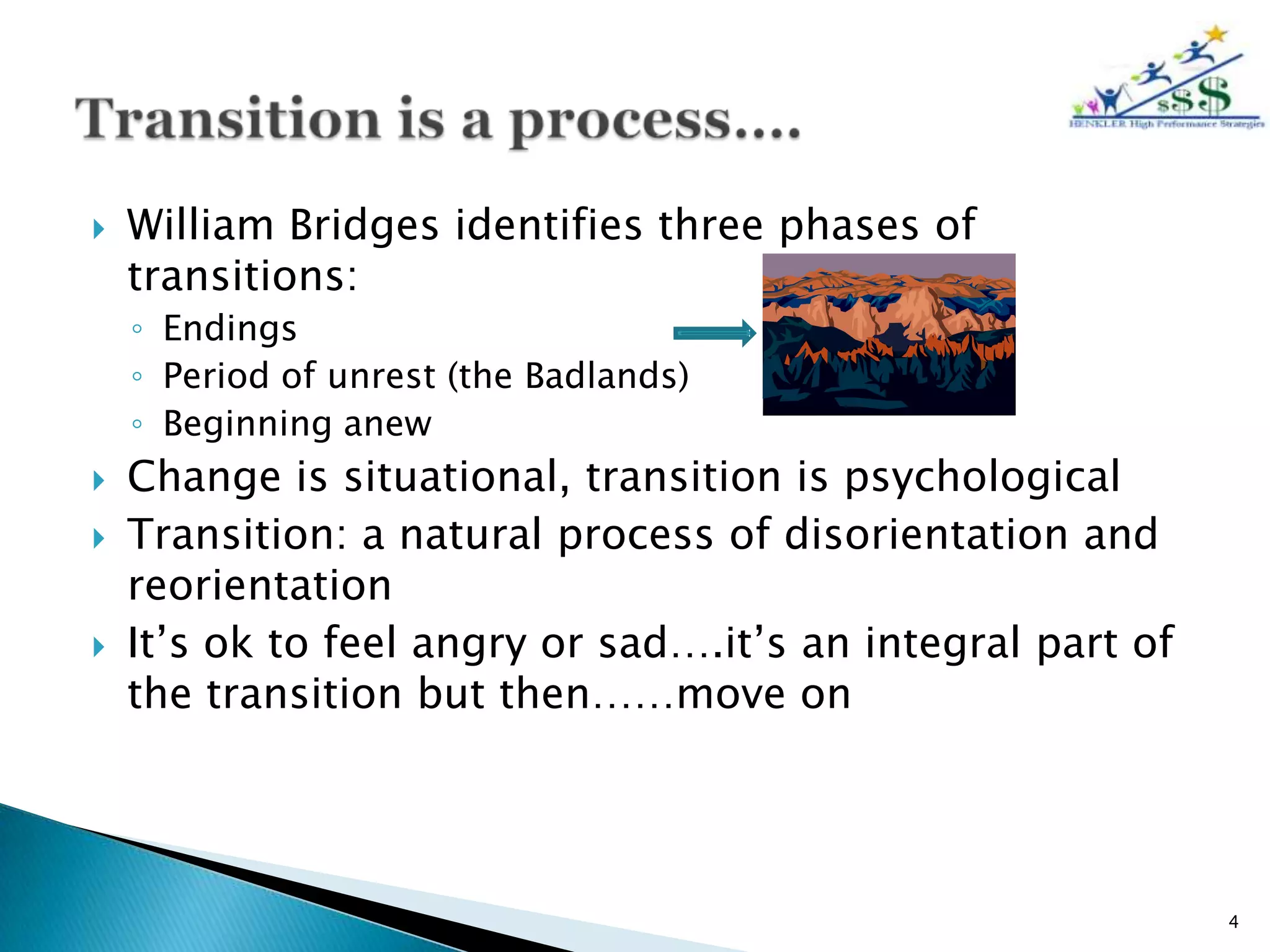
   William Bridges identifies three phases of
    transitions:
    ◦ Endings
    ◦ Period of unrest (the Badlands)
    ◦ Beginning anew
   Change is situational, transition is psychological
   Transition: a natural process of disorientation and
    reorientation
   It’s ok to feel angry or sad….it’s an integral part of
    the transition but then……move on


                                                             4
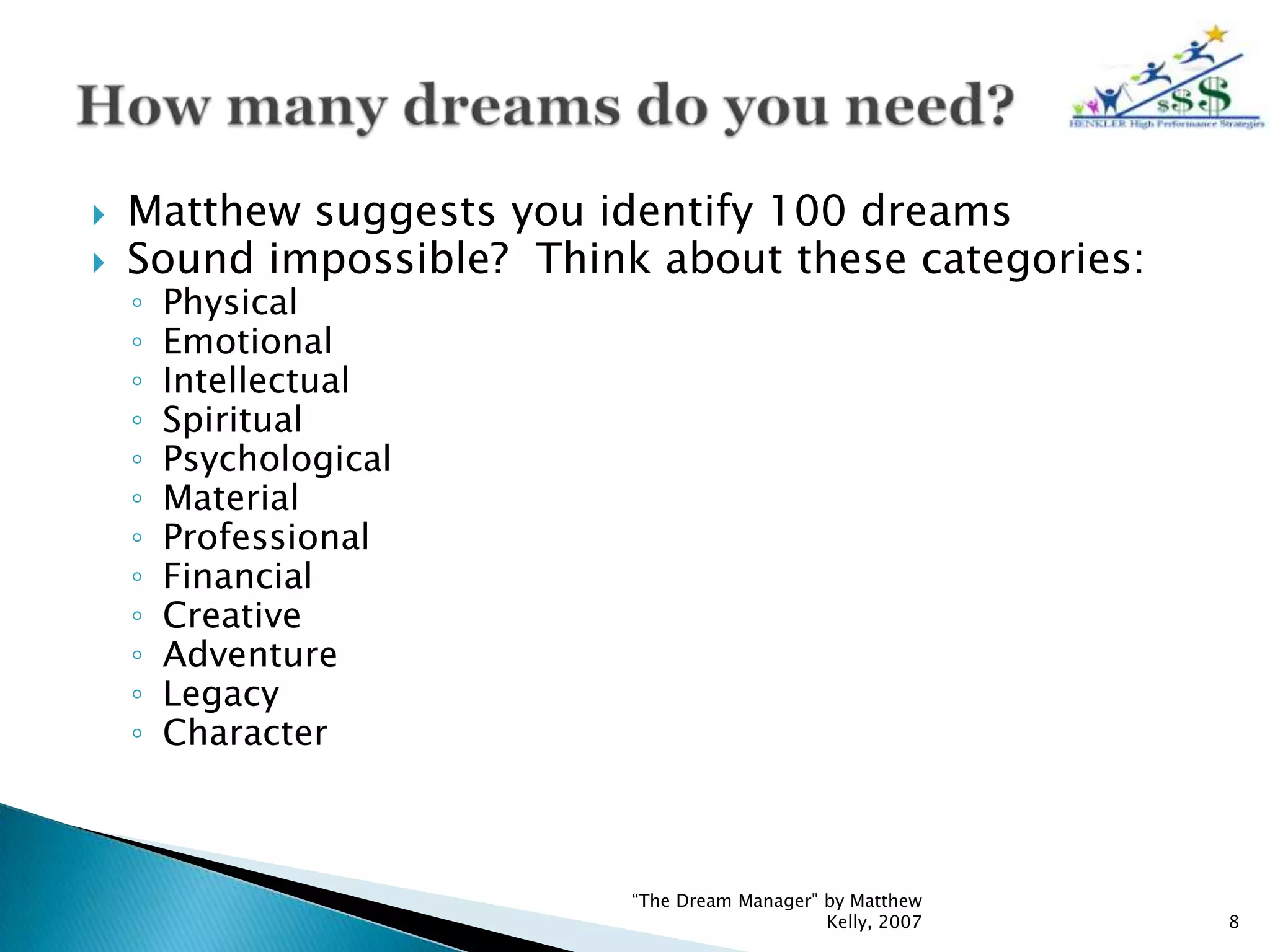
   Has your life been a series of strategic or
    opportunistic steps?
   When’s the last time you chose your next step
    rather than vice versa?
   What is your dream????
   Are you pursuing it?


                           “The Dream Manager" by Matthew
                                               Kelly, 2007   5
   Let me tell you a story from 2007…


                           “The Dream Manager" by Matthew
                                               Kelly, 2007   6
   You want meaningful work
   You need to feel you are progressing and
    advancing
   You also need to believe you are moving toward
    fulfillment of your dreams
   The DM’s role is to help you articulate your dreams
   Next you have to formulate a plan for the
    achievement of short-term, medium-term, and
    long-term goals
   The plan has to be manageable and measurable,
    while also stretching you


                            “The Dream Manager" by Matthew
                                                Kelly, 2007   7
   Matthew suggests you identify 100 dreams
   Sound impossible? Think about these categories:
    ◦   Physical
    ◦   Emotional
    ◦   Intellectual
    ◦   Spiritual
    ◦   Psychological
    ◦   Material
    ◦   Professional
    ◦   Financial
    ◦   Creative
    ◦   Adventure
    ◦   Legacy
    ◦   Character


                           “The Dream Manager" by Matthew
                                               Kelly, 2007   8
   Pick your vision – make it real!
   What’s your current state?
   What will it take to succeed and what your
    obstacles?
   You also need a partner:
    ◦   Coach
    ◦   Friend
    ◦   Family member
    ◦   They’ll keep you on track!


                                     “The Dream Manager" by Matthew
                                                         Kelly, 2007   9
   Everyone pick one dream:
    ◦ Make it just a bit audacious
    ◦ Pretend you’re 6 years old and don’t realize you can fail
   Now I need a volunteer…..


                                                                  10
   Start with your current blessings – establish a positive
    mindset
   Consider your desired end state – it’s the day you retire:
    ◦ What have you accomplished?
    ◦ What does your business card say?
    ◦ Where are you and who’s there with you?
   Companies have values, a mission, and vision – do you?
    ◦ What are your core values?
    ◦ What do you hope to achieve over the next 10 years?
    ◦ Combine those into your personal vision
   Complete a personal SWOT analysis:
    ◦   Strengths
    ◦   Weaknesses
    ◦   Opportunities
    ◦   Threats


                                                                 11
   Build your life plan before your business plan:
    ◦   Where do you want to live?
    ◦   Who do you want as friends?
    ◦   Work at night? On weekends?
    ◦   Commute?
    ◦   Travel?
   Establish goals for next 1, 5 years
    ◦   Ensure they are consistent with life plan
    ◦   Start with 5 year targets
    ◦   Consider the 1 year targets which you move you forward
    ◦   Check again for consistency
    ◦   Develop a 90 day plan; will it get you to 1 year target?


                                                                   12
   What must change to achieve your goals?
    ◦ How must you change?
    ◦ Pay forward & give back
    ◦ Determine the intermediate steps to achieve your top goals
       Focus on progress, not perfection
    ◦ Stay flexible – “change” happens
    ◦ Be consistent and be audacious!
    ◦ Don’t stop “3’ from Gold”
   Evaluate your support network:
    ◦ Which ties should be strengthened?
    ◦ Which should be dropped?


                                                                   13

Transition Ending Or Beginning

  • 1.
  • 2.
    Doom, gloom  This is a priceless  It’s not fair…. opportunity…  They owe me…  I’d wish transition on a  I can’t let my friends friend once…an enemy (family?) know…. twice….  I’ll never find another  It’s not a pink slip, it’s job….. a blank sheet….  I’m too old….  I will look back on this as a wonderful point in  I’m too young, my life… inexperienced….. 2
  • 3.
    Jonathan Buckland: never complain about your troubles because 95% of the people don’t care and the other 5% are glad they happened to you.  Napoleon Hill: Many successful people have found opportunities in failure and adversity that they could not recognize in more favorable circumstances.  Ben Sweetland: Success is a journey, not a destination.  We can’t control our experiences but we can control our reactions to them.  There are two main strategies for maintaining hope in the face of difficulties: ◦ Change the situation ◦ Change how you feel about the situation 3
  • 4.
    William Bridges identifies three phases of transitions: ◦ Endings ◦ Period of unrest (the Badlands) ◦ Beginning anew  Change is situational, transition is psychological  Transition: a natural process of disorientation and reorientation  It’s ok to feel angry or sad….it’s an integral part of the transition but then……move on 4
  • 5.
    Has your life been a series of strategic or opportunistic steps?  When’s the last time you chose your next step rather than vice versa?  What is your dream????  Are you pursuing it? “The Dream Manager" by Matthew Kelly, 2007 5
  • 6.
    Let me tell you a story from 2007… “The Dream Manager" by Matthew Kelly, 2007 6
  • 7.
    You want meaningful work  You need to feel you are progressing and advancing  You also need to believe you are moving toward fulfillment of your dreams  The DM’s role is to help you articulate your dreams  Next you have to formulate a plan for the achievement of short-term, medium-term, and long-term goals  The plan has to be manageable and measurable, while also stretching you “The Dream Manager" by Matthew Kelly, 2007 7
  • 8.
    Matthew suggests you identify 100 dreams  Sound impossible? Think about these categories: ◦ Physical ◦ Emotional ◦ Intellectual ◦ Spiritual ◦ Psychological ◦ Material ◦ Professional ◦ Financial ◦ Creative ◦ Adventure ◦ Legacy ◦ Character “The Dream Manager" by Matthew Kelly, 2007 8
  • 9.
    Pick your vision – make it real!  What’s your current state?  What will it take to succeed and what your obstacles?  You also need a partner: ◦ Coach ◦ Friend ◦ Family member ◦ They’ll keep you on track! “The Dream Manager" by Matthew Kelly, 2007 9
  • 10.
    Everyone pick one dream: ◦ Make it just a bit audacious ◦ Pretend you’re 6 years old and don’t realize you can fail  Now I need a volunteer….. 10
  • 11.
    Start with your current blessings – establish a positive mindset  Consider your desired end state – it’s the day you retire: ◦ What have you accomplished? ◦ What does your business card say? ◦ Where are you and who’s there with you?  Companies have values, a mission, and vision – do you? ◦ What are your core values? ◦ What do you hope to achieve over the next 10 years? ◦ Combine those into your personal vision  Complete a personal SWOT analysis: ◦ Strengths ◦ Weaknesses ◦ Opportunities ◦ Threats 11
  • 12.
    Build your life plan before your business plan: ◦ Where do you want to live? ◦ Who do you want as friends? ◦ Work at night? On weekends? ◦ Commute? ◦ Travel?  Establish goals for next 1, 5 years ◦ Ensure they are consistent with life plan ◦ Start with 5 year targets ◦ Consider the 1 year targets which you move you forward ◦ Check again for consistency ◦ Develop a 90 day plan; will it get you to 1 year target? 12
  • 13.
    What must change to achieve your goals? ◦ How must you change? ◦ Pay forward & give back ◦ Determine the intermediate steps to achieve your top goals  Focus on progress, not perfection ◦ Stay flexible – “change” happens ◦ Be consistent and be audacious! ◦ Don’t stop “3’ from Gold”  Evaluate your support network: ◦ Which ties should be strengthened? ◦ Which should be dropped? 13

Editor's Notes

  • #2 Start with video clip: http://www.youtube.com/watch?v=ok_9g420tewRemember elementary school, when you had to pick sides….well, I’m going to ask you to pick sidesAdditional resources: PBJ article: Believe in yourself when no one else doesMarshall Goldsmith – Mojo abstractSteve Covey, Jennifer Colosimo - Great Work, Great Career notes
  • #3 I bet quite a few of you are on the left side and I need to ask why?If you were a hiring manager, would you pick someone from the left column?Even if you don’t accept karma, don’t you believe that anger and depression sap your energy, preventing you from being the best possible version of yourself?Someone made an interesting observation of pro golfer Phil Mickelson, noting that his success bloomed when he shifted from “I think I can” to “I will” – there is nothing more powerful than a positive attitude!It’s easy to blame your old employer – you worked hard for them – how could they let you go? Let me tell you a story about the origins of this country, when we depended on friends, family, and neighbors….somewhere along the way, we became dependent on big government and big companies….I would argue we’re returning to a healthier time when we depend more on the folks who are closest to us – friends, family, and neighbors, including the virtual ones available in an electronic world
  • #5 From two books by William Bridges: “Transitions, Making Sense of Life's Changes” and “Managing Transitions, Making the Most of Change”Three phases of transitions:Endings:Before something new can start, no matter how wonderful, we must acknowledge the end of what preceded itPeriod of unrest:Many external changes are processed (new office, new home, new partner, new child) but we may not have given up our previous environment (married without children, old work team, etc) and subconsciously clinging to the old can cause confusion and frustration even when the transition is to something better than you had beforeEven if you understand your style of endings, some part of you may resist that understanding as though your life depended on itBeginning anew:For this to be successful, you must have first acknowledged the associated ending and also passed through the period of unrestChange is situational, transition is psychological (too often we don’t acknowledge the psychological impact of transitions, viewing them as minor change)Transition is a natural process of disorientation and reorientation marking the turning points in the path of growth. Throughout nature, growth involves periodic accelerations and transformations. Things go slowly for a time and nothing seems to happen – until suddenly the eggshell cracks, the branch blossoms, the tadpole’s tail shrinks away, the leaf falls, the hibernation beginsThe next step will be to talk about how to create your personal strategic plan
  • #6 Now that you see the steps in a personal strategic plan, I want to expand your thinking…Nearly every young child has a dream and…..they absolutely believe it will come true!Do you still have one?If not, why not? What would it take to make you pursue your dream?If yes, what is it? How do you plan to achieve it?
  • #7 Tell the story of the Dream Manager
  • #9 It’s ok to have grandiose dreams but you also need intermediate steps – they can be identified as steps in a strategic plan but can also be short term dreams – perhaps a vacation, visiting friends or family routinely. Achieving some of your “easier” dreams will empower you to reach for the stars…
  • #10 Everyone needs a coach (not necessarily a paid resource) – think of the best athletes in the world – they all have coaches – is it because they aren’t very good – obviously not. The coach is standing outside, looking in and will see things that we can never see ourselves – either because we’re too emotionally involved or just because very few of us are sufficiently self-aware
  • #11 Second volunteer, if time (audience manages the 2nd)
  • #12 We won’t endeavor to do this right now but please consider the steps in developing a “personal strategic plan” – many of you might have seen company strategic plans – they’re essential for business success – why wouldn’t you want the same thing for yourself?Core values: personal navigation system, your very essence, non-negotiableGandhi:Keep my words positive, because my words become my behaviors.Keep my behaviors positive, because my behaviors become habits.Keep my habits positive, because my habits become my values.Keep my values positive, because my values become my destiny.Mission:A personal mission statement is a brief description of who you want to become and what you will focus on and achieve during the next 10 years. It is a way to focus your energy, actions, behaviors and decisions toward the things most important to you.Vision: combines of all your core values and the actions of your mission statement into a single proclamation, a clear description of your life’s greatest possible outcome.Imagine a race between three people to complete a 1,000-piece puzzle.Person No. 1 was given one with the picture on the box.Person No. 2 was given the box with no picture on it.Person No. 3 was given a box with the wrong picture on it.Who is going to win? Exactly, person No. 1. You need a clear picture (vision) to complete the puzzle of your life.
  • #13 Most of us build our business plan and squeeze our life around it – might be much more balanced to do the opposite.Setting goals – start with the end point in mind, then pick a shorter term target90 day objectives (In “Traction”, Gino Wickman calls these “rocks”) are essential for your success – when are target is a year away, it is easy to procrastinate or conversely, to become overwhelmed – 90 day “rocks” help keep us focused and also inject periodic rewards to keep us motivated
  • #14 It is very likely that something will have to change if you are to reach your goals – merely the act of consciously choosing a destination imposes changeThe single most important change for many of us is to focus on helping others – while it is certainly possible to make it through the badlands once through the support of our friends and colleagues but if you are a “taker” only, folks won’t be quite as helpful the next time you face a challenge – I truly think we will succeed best when we give freely of ourselves with no expectation of a “return on investment” – there is a related concept from Stephen Covey, which approaches this a bit more pragmatically – giving freely of yourself but slowing down if there is no reciprocation – I think either approach can work but still favor the unfettered giving3’ From Gold by Sharon Lechter and Greg ReidSupport network - negative influences drag us down – surrounding yourself with happy, optimistic people can be infectious – unfortunately, the same is true of negative or destructive people (and some times the “dark side” seems infinitely stronger)