Electrónica
Analógica
Eduardo Emanuel Tovias
Garza
Engineer Aurelio García
Técnico
Mecatrónica Área
Automatización
30th July 2020 - Matamoros,
Tamaulipas
Transistors Electrical
Characteristics
And
Operation
Material Structure of BJT’S
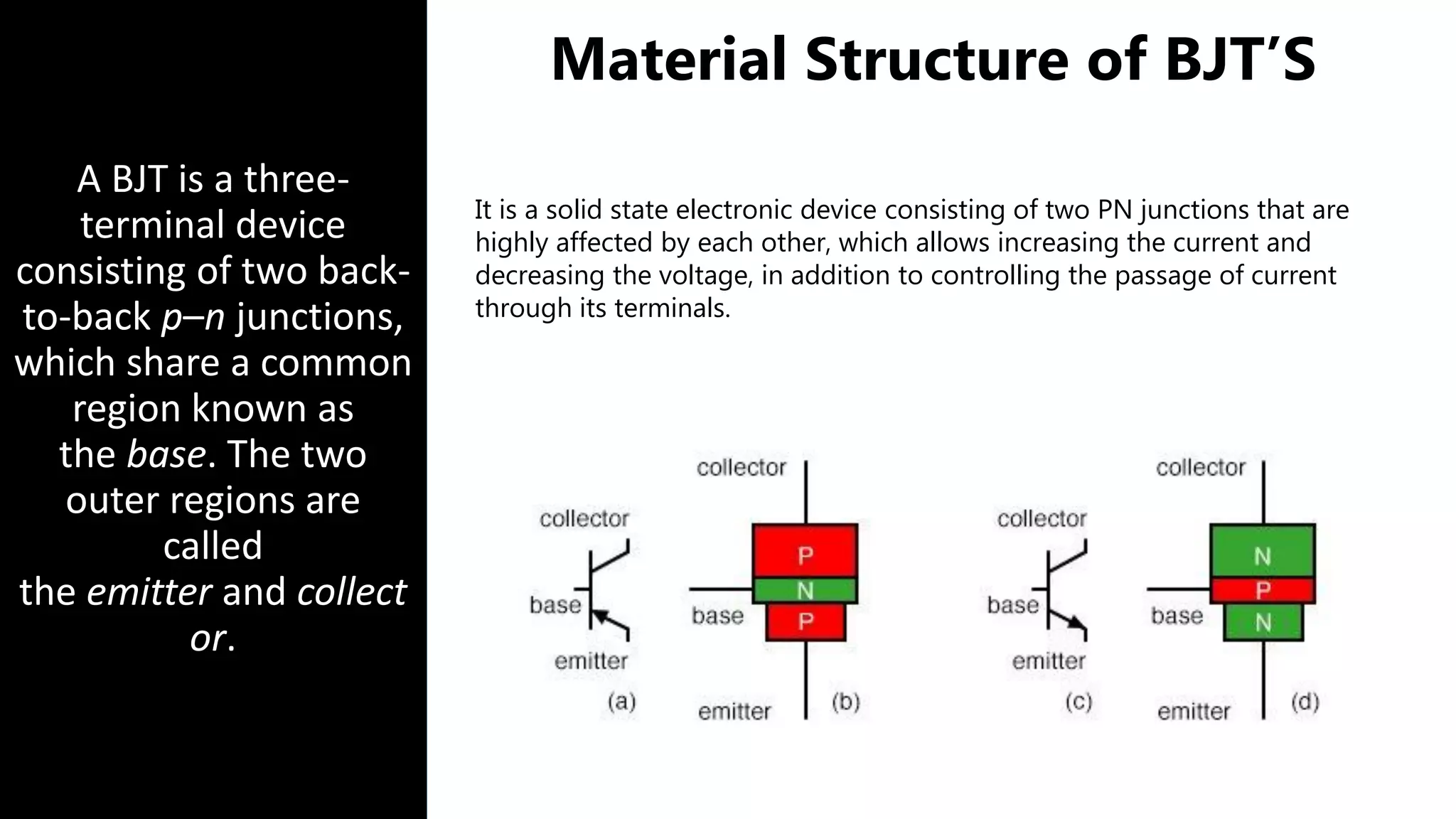
A BJT is a three-
terminal device
consisting of two back-
to-back p–n junctions,
which share a common
region known as
the base. The two
outer regions are
called
the emitter and collect
or.
It is a solid state electronic device consisting of two PN junctions that are
highly affected by each other, which allows increasing the current and
decreasing the voltage, in addition to controlling the passage of current
through its terminals.
Bipolar junction transistors has two junctions base emitter junction, base
collector junction. Accordingly there are four different regions of operation
in which either of the two junctions are forward biased reverse biased or
both. But the BJT can be effectively operated in there different modes
according to the external bias voltage applied at each junction. i.e. Transistor
in active region, saturation and cutoff. The other region of operation of BJT is
called as inverse active region.
Operation Regions of BJT’S
Transistor in active region
The region between cut off and saturation is known as active region. In the
active region, collector-base junction remains reverse biased while base-
emitter junction remains forward biased. Consequently, the transistor will
function normally in this region.
Active mode: In this mode, the
transistor acts as an amplifier that is
the current from the collector
terminal to the emitter terminal that
corresponds to the current through
the terminal base. The base will
amplify the current moving to the
collector terminal and sell the
emitter terminal.
Signal Amplifier
Operation Regions of BJT’S
Transistor in Cut-Off
The transistor operates in cutoff region when both the emitter and collector
junctions are reverse biased. As in cutoff region, the collector current, emitter
current and base currents are nil, we can write as IC=IE=IB=0
In this mode, the transistor also acts
as a switch, but there is no current
flow from the collector to the emitter
(open circuit). There is no current
flow through the emitter and
collector terminals.
Open Switch
Operation Regions of BJT’S
Transistor in Saturation
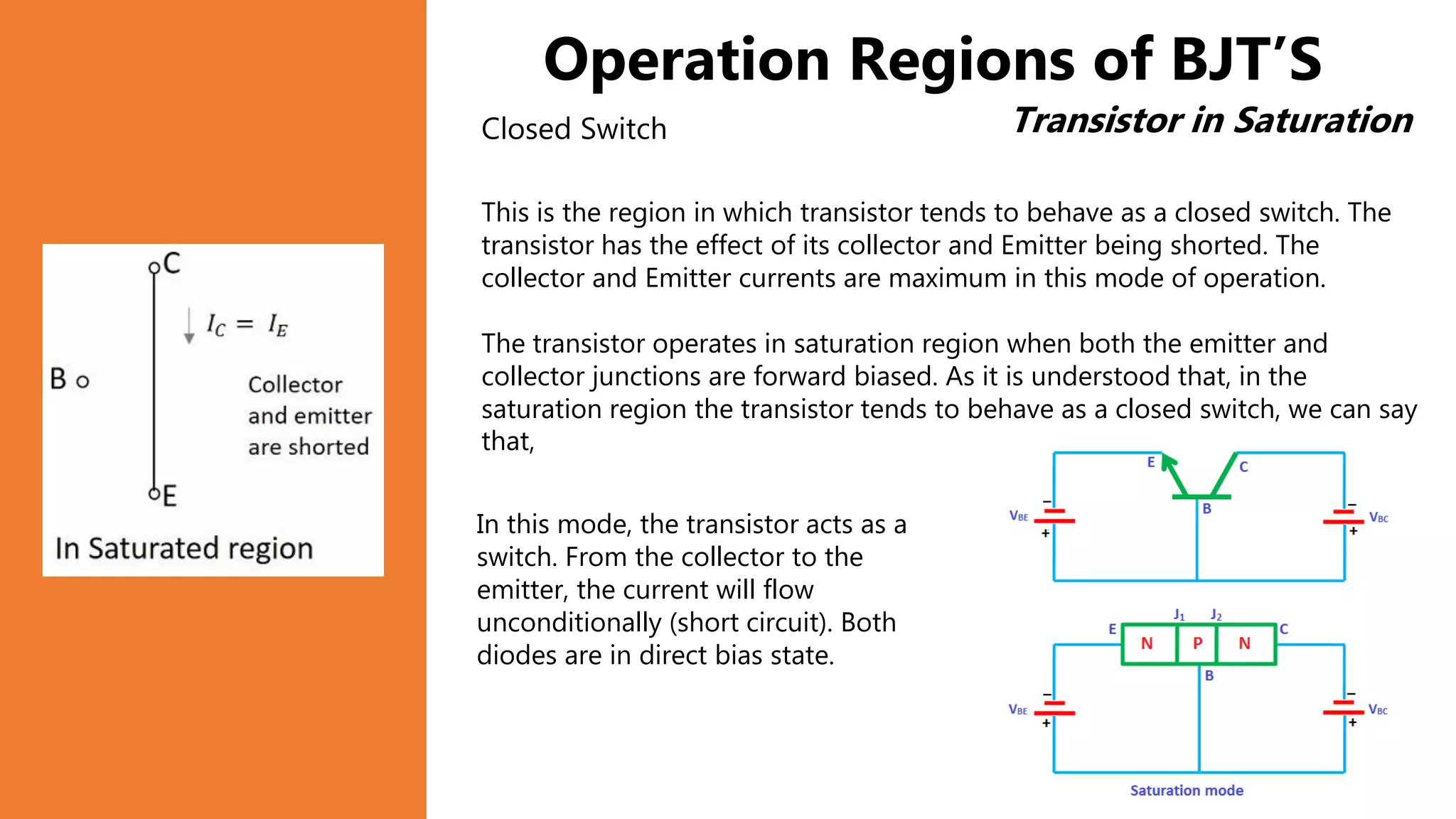
This is the region in which transistor tends to behave as a closed switch. The
transistor has the effect of its collector and Emitter being shorted. The
collector and Emitter currents are maximum in this mode of operation.
The transistor operates in saturation region when both the emitter and
collector junctions are forward biased. As it is understood that, in the
saturation region the transistor tends to behave as a closed switch, we can say
that,
In this mode, the transistor acts as a
switch. From the collector to the
emitter, the current will flow
unconditionally (short circuit). Both
diodes are in direct bias state.
Closed Switch
Maximum Ratings of P2N2222A BJT
Transistor
Maximum Ratings of P2N2222A BJT
Transistor
Maximum Ratings of P2N2222A BJT
Transistor
Maximum Ratings of P2N2222A BJT
Transistor
Field Efect Transistor (FET)
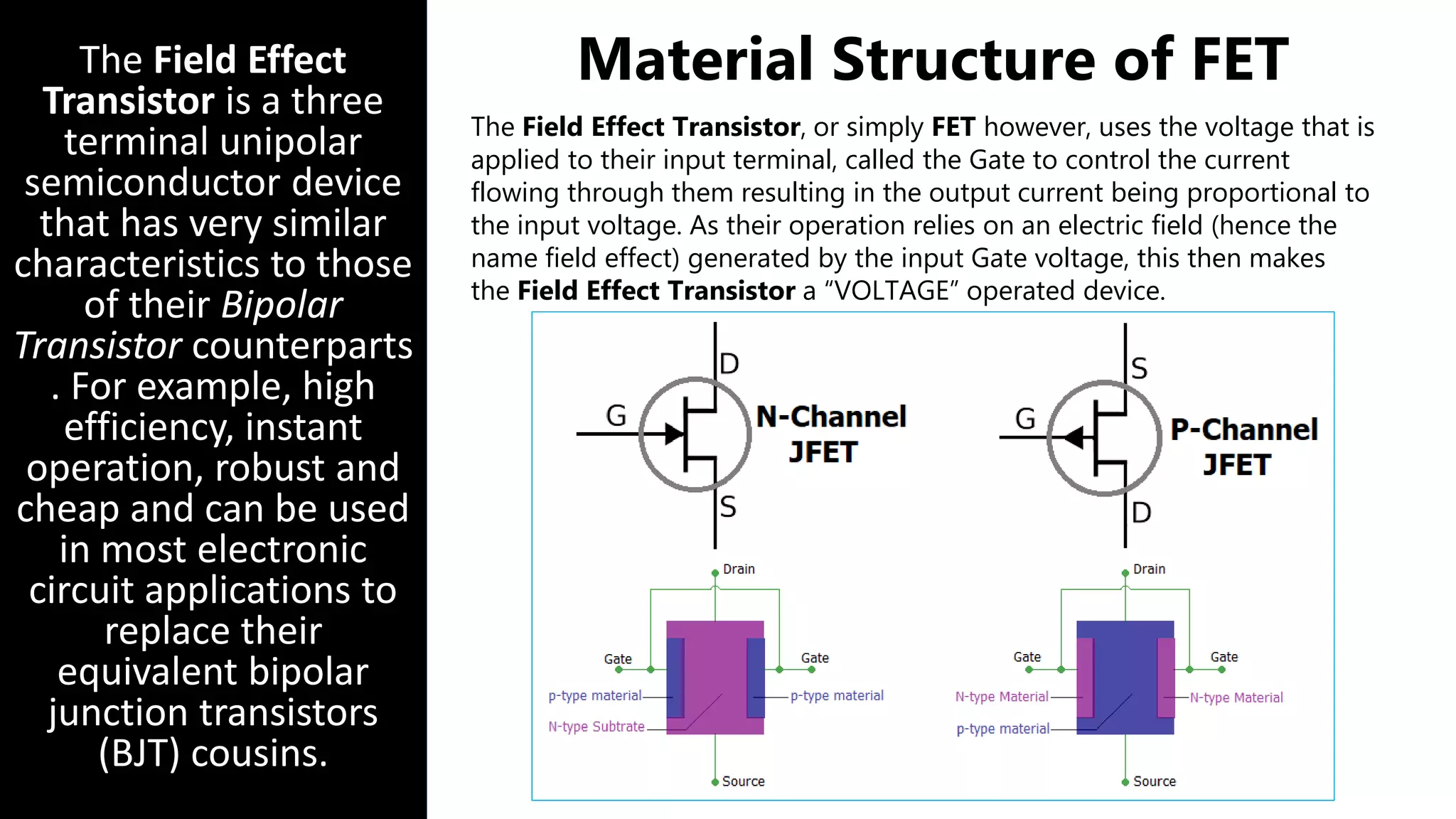
Material Structure of FETThe Field Effect
Transistor is a three
terminal unipolar
semiconductor device
that has very similar
characteristics to those
of their Bipolar
Transistor counterparts
. For example, high
efficiency, instant
operation, robust and
cheap and can be used
in most electronic
circuit applications to
replace their
equivalent bipolar
junction transistors
(BJT) cousins.
The Field Effect Transistor, or simply FET however, uses the voltage that is
applied to their input terminal, called the Gate to control the current
flowing through them resulting in the output current being proportional to
the input voltage. As their operation relies on an electric field (hence the
name field effect) generated by the input Gate voltage, this then makes
the Field Effect Transistor a “VOLTAGE” operated device.
Operations Regions of FETThe Saturation region is
characterized by a constant
drain current, controlled by the
gate-source voltage.
The Ohmic region is the
operating region where the
inversion region exists and
current flows, but
this region has begun to taper
near the source.
Cut off region: This is the region
of output characteristics
where Vgs < Vt in which drain
current is almost Zero.
There are mainly three regions of operation in MOSFET as it is evident from
output characteristics shown above listed as
• Cut off region
• Ohmic region (or) Triode region
• Saturation region
Operations Regions of FET (Description)
1. Cut off region (Cut-Off region) – A MOS device is said to be operating when the
gate-to-source voltage is less than Vth.
Thus, for MOS to be in cut-off region.
Cut-off region is also known as sub-threshold region. In this region, the dependence
of current on gate voltage is exponential. The magnitude of current flowing through
MOS in cut-off region is negligible as the channel is not present. The conduction
happening in this region is known as sub-threshold conduction.
2. Linear or non saturation region (Ohmic region) – For an MOS, as gate voltage
increases beyond threshold voltage, channel is formed between source
and drain terminals. Now, if there is voltage difference between source and drain,
current will flow. The magnitude of current increases
linearly with increasing drain voltage.
The current is, then, represented as a linear function of gate-to-source and drain-to-
source voltages.
That is why, MOS is said to be operating in linear region.
3. Saturation Region (Active region) – For an MOS, at a particular gate and source
voltage, there is a particular level of voltage for drain,
beyond which, increasing drain voltage seems to have no effect on current. When a
MOS operates in this region, it is said to be in saturation.
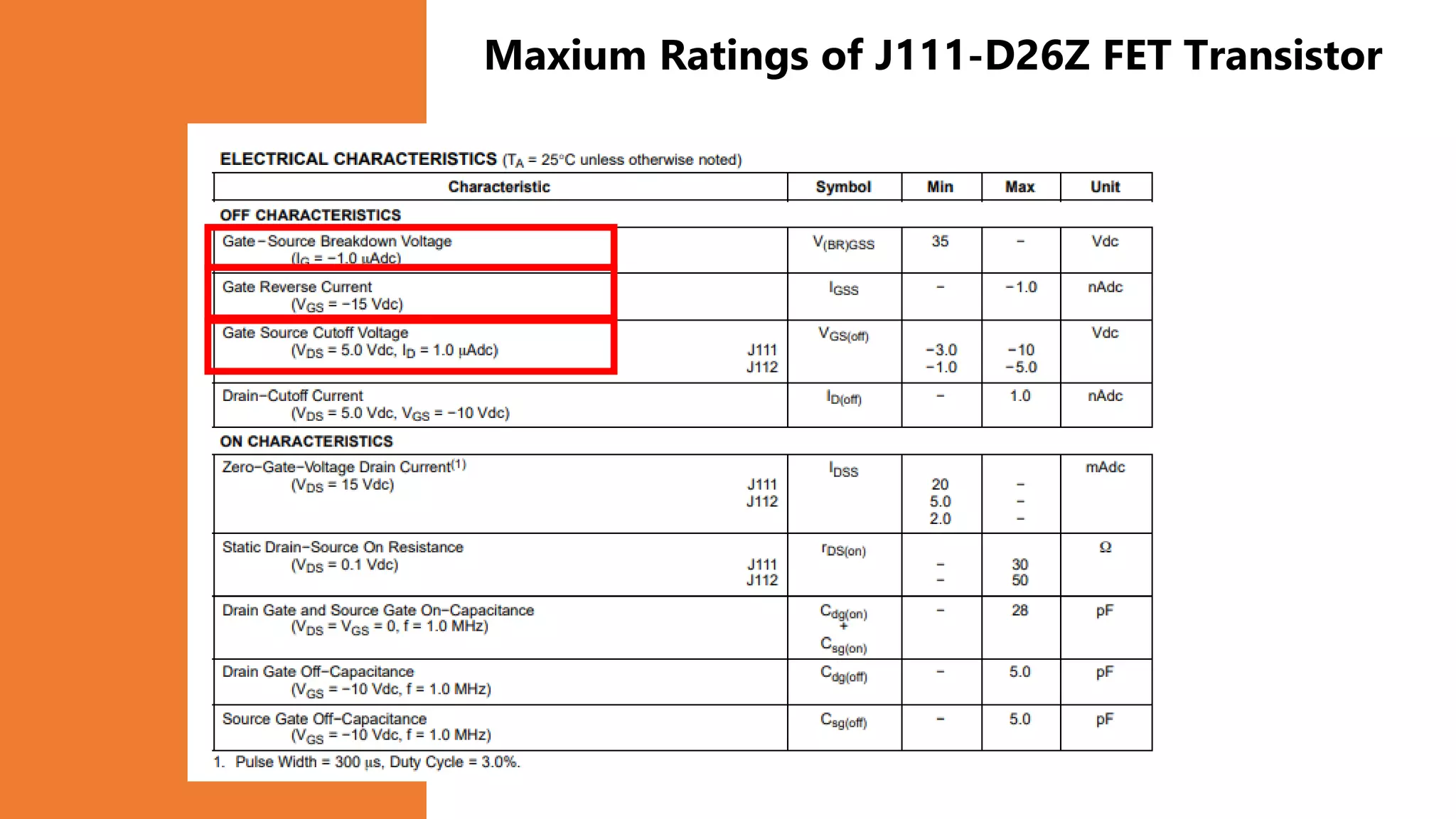
Maxium Ratings of J111-D26Z FET Transistor
EXAMPLE – APPLICATION OF FET
TRANSISTOR AS ELECTRONIC SWITCH

Transistors

  • 1.
    Electrónica Analógica Eduardo Emanuel Tovias Garza EngineerAurelio García Técnico Mecatrónica Área Automatización 30th July 2020 - Matamoros, Tamaulipas Transistors Electrical Characteristics And Operation
  • 2.
    Material Structure ofBJT’S A BJT is a three- terminal device consisting of two back- to-back p–n junctions, which share a common region known as the base. The two outer regions are called the emitter and collect or. It is a solid state electronic device consisting of two PN junctions that are highly affected by each other, which allows increasing the current and decreasing the voltage, in addition to controlling the passage of current through its terminals.
  • 3.
    Bipolar junction transistorshas two junctions base emitter junction, base collector junction. Accordingly there are four different regions of operation in which either of the two junctions are forward biased reverse biased or both. But the BJT can be effectively operated in there different modes according to the external bias voltage applied at each junction. i.e. Transistor in active region, saturation and cutoff. The other region of operation of BJT is called as inverse active region. Operation Regions of BJT’S
  • 4.
    Operation Regions ofBJT’S Transistor in active region The region between cut off and saturation is known as active region. In the active region, collector-base junction remains reverse biased while base- emitter junction remains forward biased. Consequently, the transistor will function normally in this region. Active mode: In this mode, the transistor acts as an amplifier that is the current from the collector terminal to the emitter terminal that corresponds to the current through the terminal base. The base will amplify the current moving to the collector terminal and sell the emitter terminal. Signal Amplifier
  • 5.
    Operation Regions ofBJT’S Transistor in Cut-Off The transistor operates in cutoff region when both the emitter and collector junctions are reverse biased. As in cutoff region, the collector current, emitter current and base currents are nil, we can write as IC=IE=IB=0 In this mode, the transistor also acts as a switch, but there is no current flow from the collector to the emitter (open circuit). There is no current flow through the emitter and collector terminals. Open Switch
  • 6.
    Operation Regions ofBJT’S Transistor in Saturation This is the region in which transistor tends to behave as a closed switch. The transistor has the effect of its collector and Emitter being shorted. The collector and Emitter currents are maximum in this mode of operation. The transistor operates in saturation region when both the emitter and collector junctions are forward biased. As it is understood that, in the saturation region the transistor tends to behave as a closed switch, we can say that, In this mode, the transistor acts as a switch. From the collector to the emitter, the current will flow unconditionally (short circuit). Both diodes are in direct bias state. Closed Switch
  • 7.
    Maximum Ratings ofP2N2222A BJT Transistor
  • 8.
    Maximum Ratings ofP2N2222A BJT Transistor
  • 9.
    Maximum Ratings ofP2N2222A BJT Transistor
  • 10.
    Maximum Ratings ofP2N2222A BJT Transistor
  • 11.
  • 12.
    Material Structure ofFETThe Field Effect Transistor is a three terminal unipolar semiconductor device that has very similar characteristics to those of their Bipolar Transistor counterparts . For example, high efficiency, instant operation, robust and cheap and can be used in most electronic circuit applications to replace their equivalent bipolar junction transistors (BJT) cousins. The Field Effect Transistor, or simply FET however, uses the voltage that is applied to their input terminal, called the Gate to control the current flowing through them resulting in the output current being proportional to the input voltage. As their operation relies on an electric field (hence the name field effect) generated by the input Gate voltage, this then makes the Field Effect Transistor a “VOLTAGE” operated device.
  • 13.
    Operations Regions ofFETThe Saturation region is characterized by a constant drain current, controlled by the gate-source voltage. The Ohmic region is the operating region where the inversion region exists and current flows, but this region has begun to taper near the source. Cut off region: This is the region of output characteristics where Vgs < Vt in which drain current is almost Zero. There are mainly three regions of operation in MOSFET as it is evident from output characteristics shown above listed as • Cut off region • Ohmic region (or) Triode region • Saturation region
  • 14.
    Operations Regions ofFET (Description) 1. Cut off region (Cut-Off region) – A MOS device is said to be operating when the gate-to-source voltage is less than Vth. Thus, for MOS to be in cut-off region. Cut-off region is also known as sub-threshold region. In this region, the dependence of current on gate voltage is exponential. The magnitude of current flowing through MOS in cut-off region is negligible as the channel is not present. The conduction happening in this region is known as sub-threshold conduction. 2. Linear or non saturation region (Ohmic region) – For an MOS, as gate voltage increases beyond threshold voltage, channel is formed between source and drain terminals. Now, if there is voltage difference between source and drain, current will flow. The magnitude of current increases linearly with increasing drain voltage. The current is, then, represented as a linear function of gate-to-source and drain-to- source voltages. That is why, MOS is said to be operating in linear region. 3. Saturation Region (Active region) – For an MOS, at a particular gate and source voltage, there is a particular level of voltage for drain, beyond which, increasing drain voltage seems to have no effect on current. When a MOS operates in this region, it is said to be in saturation.
  • 15.
    Maxium Ratings ofJ111-D26Z FET Transistor
  • 16.
    Maxium Ratings ofJ111-D26Z FET Transistor
  • 17.
    EXAMPLE – APPLICATIONOF FET TRANSISTOR AS ELECTRONIC SWITCH