TRANSISTOR
BIASING
Presented by:
Md Abdullah Al Muzahid,
Md Abdur Rahman,
Emdadul Bari Fahad,
METHODS OF TRANSISTOR BIASING:
There are four types of transistor biasing
method,
(i) Base resistor method.
(ii) Emitter bias method.
(iii) Biasing with collector-feedback
resistor.
(iv) Voltage-divider bias.
BASE RESISTOR METHOD:
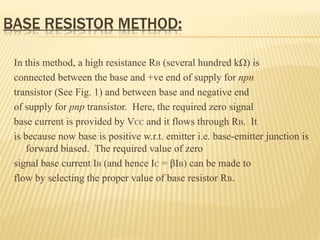
In this method, a high resistance RB (several hundred kΩ) is
connected between the base and +ve end of supply for npn
transistor (See Fig. 1) and between base and negative end
of supply for pnp transistor. Here, the required zero signal
base current is provided by VCC and it flows through RB. It
is because now base is positive w.r.t. emitter i.e. base-emitter junction is
forward biased. The required value of zero
signal base current IB (and hence IC = βIB) can be made to
flow by selecting the proper value of base resistor RB.
CIRCUIT ANALYSIS:
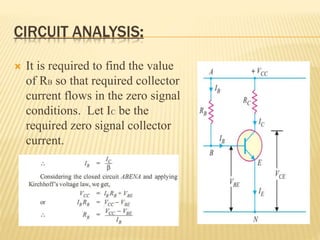
 It is required to find the value
of RB so that required collector
current flows in the zero signal
conditions. Let IC be the
required zero signal collector
current.
CIRCUIT ANALYSIS:
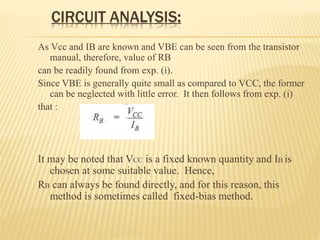
As Vcc and IB are known and VBE can be seen from the transistor
manual, therefore, value of RB
can be readily found from exp. (i).
Since VBE is generally quite small as compared to VCC, the former
can be neglected with little error. It then follows from exp. (i)
that :
It may be noted that VCC is a fixed known quantity and IB is
chosen at some suitable value. Hence,
RB can always be found directly, and for this reason, this
method is sometimes called fixed-bias method.
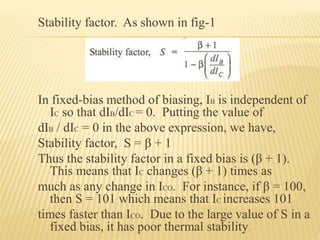
Stability factor. As shown in fig-1
In fixed-bias method of biasing, IB is independent of
IC so that dIB/dIC = 0. Putting the value of
dIB / dIC = 0 in the above expression, we have,
Stability factor, S = β + 1
Thus the stability factor in a fixed bias is (β + 1).
This means that IC changes (β + 1) times as
much as any change in ICO. For instance, if β = 100,
then S = 101 which means that IC increases 101
times faster than ICO. Due to the large value of S in a
fixed bias, it has poor thermal stability.
ADVANTAGES :
(i) This biasing circuit is very simple as only
one resistance RB is required.
(ii) Biasing conditions can easily be set and the
calculations are simple.
(iii) There is no loading of the source by the
biasing circuit since no resistor is employed
across base-emitter junction.
DISADVANTAGES :
(i) This method provides poor stabilization. It is
because there is no means to stop a self
increase in collector current due to
temperature rise and individual variations.
For example, if β increases due to transistor
replacement, then IC also increases by the
same factor as IB is constant.
(ii) The stability factor is very high. Therefore,
there are strong chances of thermal
runaway.
Due to these disadvantages, this method of
biasing is rarely employed.
METHODS OF TRANSISTOR
BIASING
 Base resistor method
 Emitter bias method
 Biasing with collector feedback resistor
 Voltage-divider bias
TRANSISTOR BIASING
 The proper flow of zero signal collector
current and the maintenance of proper
collector-emitter voltage during the passage
of signal is known as transistor biasing.
VOLTAGE DIVIDER
BIAS METHOD
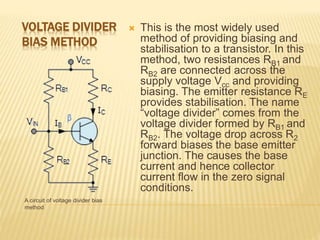
A circuit of voltage divider bias
method
 This is the most widely used
method of providing biasing and
stabilisation to a transistor. In this
method, two resistances RB1 and
RB2 are connected across the
supply voltage Vcc and providing
biasing. The emitter resistance RE
provides stabilisation. The name
“voltage divider” comes from the
voltage divider formed by RB1 and
RB2. The voltage drop across R2
forward biases the base emitter
junction. The causes the base
current and hence collector
current flow in the zero signal
conditions.
CIRCUIT ANALYSIS
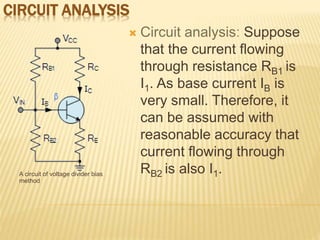
A circuit of voltage divider bias
method
 Circuit analysis: Suppose
that the current flowing
through resistance RB1 is
I1. As base current IB is
very small. Therefore, it
can be assumed with
reasonable accuracy that
current flowing through
RB2 is also I1.
CIRCUIT ANALYSIS
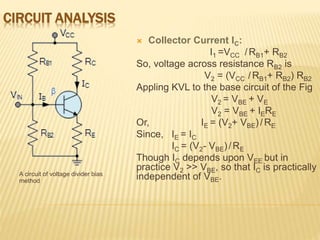
A circuit of voltage divider bias
method
 Collector Current IC:
I1 =VCC ̸ RB1+ RB2
So, voltage across resistance RB2 is
V2 = (VCC ̸ RB1+ RB2) RB2
Appling KVL to the base circuit of the Fig
V2 = VBE + VE
V2 = VBE + IERE
Or, IE = (V2+ VBE) ̸ RE
Since, IE = IC
IC = (V2- VBE) ̸ RE
Though IC depends upon VEE but in
practice V2 >> VBE, so that IC is practically
independent of VBE.
CIRCUIT ANALYSIS
A circuit of voltage divider bias
method
 Collector-emitter voltage VCE:
Applying KVL to the collector side.
VCC = ICRC + VCE + IERE
= ICRC + VCE + ICRE
[Because IE = IC]
= IC (RC + RE) + VCE
VCE = VCC – IC (RC + RE)
Stabilisation: In this circuit, excellent
stabilization is provided by RE. We know
that,
V2 = VCC – IC (RC + RE)
Suppose the collector current IC
increases due to rise in temperature.
This will cause the voltage drop across
emitter resistance RE to increases. As
voltage drop across R2 is independent
of IC therefore, VBE decreases. This in
turn causes IB to decrease. The
reduced value of IB tends to restore IC
to the original value.
THE END

Transistor biasing

  • 1.
    TRANSISTOR BIASING Presented by: Md AbdullahAl Muzahid, Md Abdur Rahman, Emdadul Bari Fahad,
  • 2.
    METHODS OF TRANSISTORBIASING: There are four types of transistor biasing method, (i) Base resistor method. (ii) Emitter bias method. (iii) Biasing with collector-feedback resistor. (iv) Voltage-divider bias.
  • 3.
    BASE RESISTOR METHOD: Inthis method, a high resistance RB (several hundred kΩ) is connected between the base and +ve end of supply for npn transistor (See Fig. 1) and between base and negative end of supply for pnp transistor. Here, the required zero signal base current is provided by VCC and it flows through RB. It is because now base is positive w.r.t. emitter i.e. base-emitter junction is forward biased. The required value of zero signal base current IB (and hence IC = βIB) can be made to flow by selecting the proper value of base resistor RB.
  • 4.
    CIRCUIT ANALYSIS:  Itis required to find the value of RB so that required collector current flows in the zero signal conditions. Let IC be the required zero signal collector current.
  • 5.
    CIRCUIT ANALYSIS: As Vccand IB are known and VBE can be seen from the transistor manual, therefore, value of RB can be readily found from exp. (i). Since VBE is generally quite small as compared to VCC, the former can be neglected with little error. It then follows from exp. (i) that : It may be noted that VCC is a fixed known quantity and IB is chosen at some suitable value. Hence, RB can always be found directly, and for this reason, this method is sometimes called fixed-bias method.
  • 6.
    Stability factor. Asshown in fig-1 In fixed-bias method of biasing, IB is independent of IC so that dIB/dIC = 0. Putting the value of dIB / dIC = 0 in the above expression, we have, Stability factor, S = β + 1 Thus the stability factor in a fixed bias is (β + 1). This means that IC changes (β + 1) times as much as any change in ICO. For instance, if β = 100, then S = 101 which means that IC increases 101 times faster than ICO. Due to the large value of S in a fixed bias, it has poor thermal stability.
  • 7.
    ADVANTAGES : (i) Thisbiasing circuit is very simple as only one resistance RB is required. (ii) Biasing conditions can easily be set and the calculations are simple. (iii) There is no loading of the source by the biasing circuit since no resistor is employed across base-emitter junction.
  • 8.
    DISADVANTAGES : (i) Thismethod provides poor stabilization. It is because there is no means to stop a self increase in collector current due to temperature rise and individual variations. For example, if β increases due to transistor replacement, then IC also increases by the same factor as IB is constant. (ii) The stability factor is very high. Therefore, there are strong chances of thermal runaway. Due to these disadvantages, this method of biasing is rarely employed.
  • 9.
    METHODS OF TRANSISTOR BIASING Base resistor method  Emitter bias method  Biasing with collector feedback resistor  Voltage-divider bias
  • 10.
    TRANSISTOR BIASING  Theproper flow of zero signal collector current and the maintenance of proper collector-emitter voltage during the passage of signal is known as transistor biasing.
  • 11.
    VOLTAGE DIVIDER BIAS METHOD Acircuit of voltage divider bias method  This is the most widely used method of providing biasing and stabilisation to a transistor. In this method, two resistances RB1 and RB2 are connected across the supply voltage Vcc and providing biasing. The emitter resistance RE provides stabilisation. The name “voltage divider” comes from the voltage divider formed by RB1 and RB2. The voltage drop across R2 forward biases the base emitter junction. The causes the base current and hence collector current flow in the zero signal conditions.
  • 12.
    CIRCUIT ANALYSIS A circuitof voltage divider bias method  Circuit analysis: Suppose that the current flowing through resistance RB1 is I1. As base current IB is very small. Therefore, it can be assumed with reasonable accuracy that current flowing through RB2 is also I1.
  • 13.
    CIRCUIT ANALYSIS A circuitof voltage divider bias method  Collector Current IC: I1 =VCC ̸ RB1+ RB2 So, voltage across resistance RB2 is V2 = (VCC ̸ RB1+ RB2) RB2 Appling KVL to the base circuit of the Fig V2 = VBE + VE V2 = VBE + IERE Or, IE = (V2+ VBE) ̸ RE Since, IE = IC IC = (V2- VBE) ̸ RE Though IC depends upon VEE but in practice V2 >> VBE, so that IC is practically independent of VBE.
  • 14.
    CIRCUIT ANALYSIS A circuitof voltage divider bias method  Collector-emitter voltage VCE: Applying KVL to the collector side. VCC = ICRC + VCE + IERE = ICRC + VCE + ICRE [Because IE = IC] = IC (RC + RE) + VCE VCE = VCC – IC (RC + RE) Stabilisation: In this circuit, excellent stabilization is provided by RE. We know that, V2 = VCC – IC (RC + RE) Suppose the collector current IC increases due to rise in temperature. This will cause the voltage drop across emitter resistance RE to increases. As voltage drop across R2 is independent of IC therefore, VBE decreases. This in turn causes IB to decrease. The reduced value of IB tends to restore IC to the original value.
  • 15.