Underground cables
Presented by:
Anisur Rahman
ID: 1402EEE00033
Department OF EEE
Manarat International University
Khagan, Ashulia, Shavar, Dhaka, Bangladesh
Contents
 Introduction of Underground cables
 Construction of cables
 CABLE STRUCTURE
 Classification of cables
 Properties of Insulating Material
 Insulating materials for cables
 Examples of types
 Advantages and disadvantages of cable
2
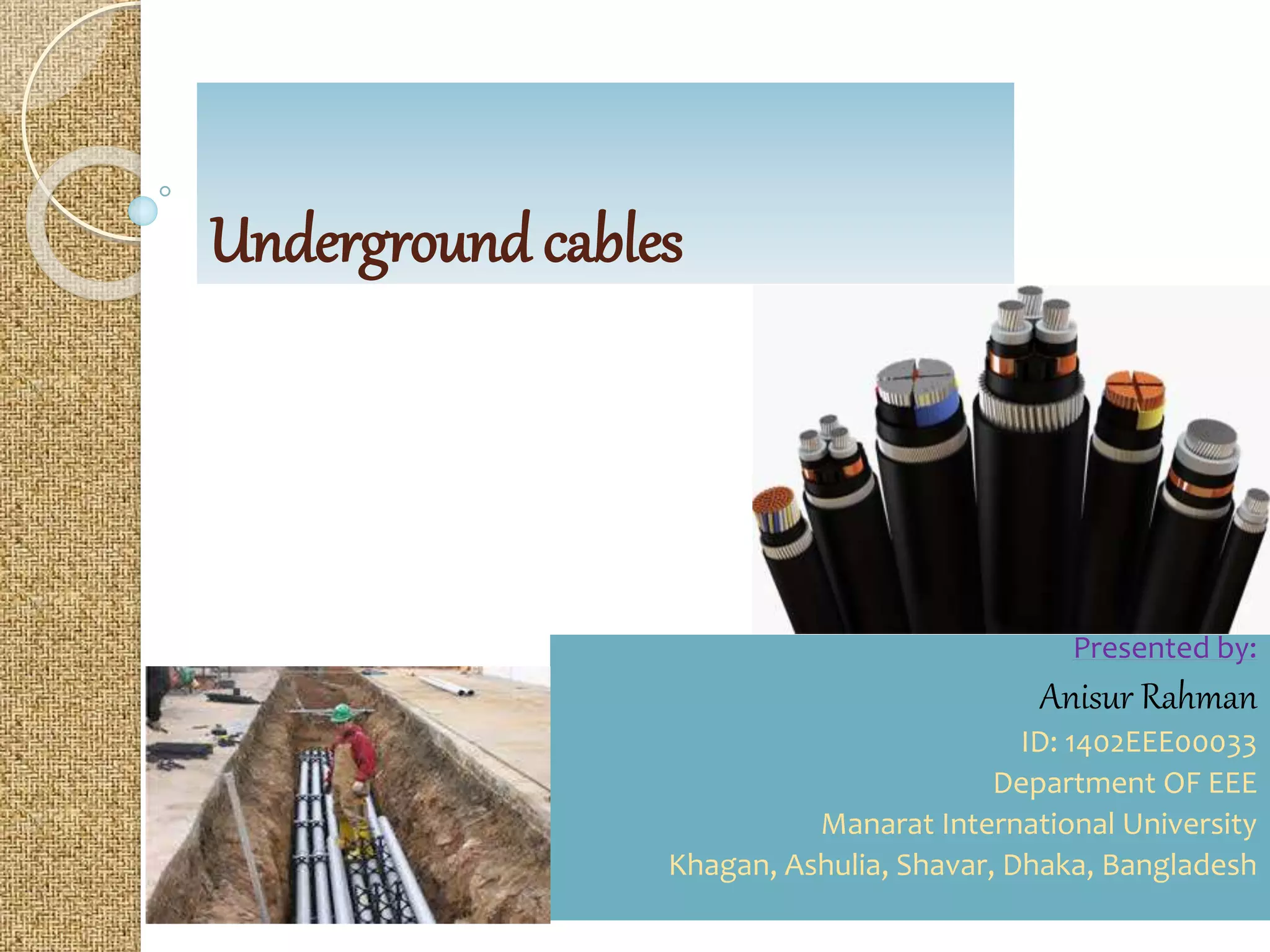
Underground cables
 An underground cable consists of one or more
conductors covered with some suitable insulating
material and surrounded by a protecting cover.
 The interference from external disturbances like
storms, lightening, ice, trees etc. should be reduced to
achieve trouble free service.
 The cables may be buried directly in the ground, or
may be installed in ducts buried in the ground.
3
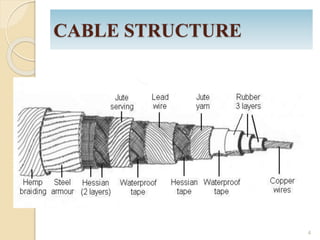
CABLE STRUCTURE
4
Construction of Cables
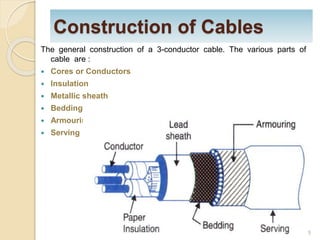
The general construction of a 3-conductor cable. The various parts of
cable are :
 Cores or Conductors
 Insulation
 Metallic sheath
 Bedding
 Armouring
 Serving
5
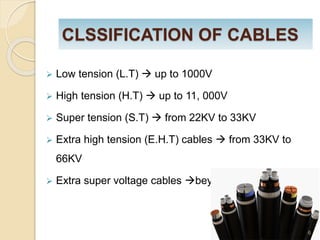
CLSSIFICATION OF CABLES
 Low tension (L.T)  up to 1000V
 High tension (H.T)  up to 11, 000V
 Super tension (S.T)  from 22KV to 33KV
 Extra high tension (E.H.T) cables  from 33KV to
66KV
 Extra super voltage cables beyond 132KV
6
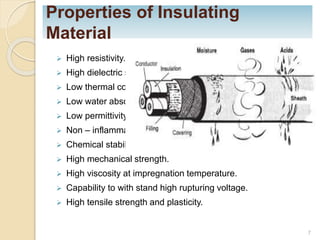
Properties of Insulating
Material
 High resistivity.
 High dielectric strength.
 Low thermal co-efficient.
 Low water absorption.
 Low permittivity.
 Non – inflammable.
 Chemical stability.
 High mechanical strength.
 High viscosity at impregnation temperature.
 Capability to with stand high rupturing voltage.
 High tensile strength and plasticity.
7
Insulating Materials for Cables
• Rubber
It can be obtained from milky sap of tropical trees or
from oil products.
It has the dielectric strength of 30 KV/mm.
Insulation resistivity of 10 exp 17 ohm.cm
Relative permittivity varying between 2 and 3.
They readily absorbs moisture, soft and liable to
damage due to rough handling and ages when exposed
to light.
Maximum safe temperature is very low about 38 C
8
Insulating Materials for Cables
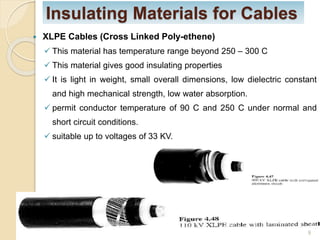
 XLPE Cables (Cross Linked Poly-ethene)
 This material has temperature range beyond 250 – 300 C
 This material gives good insulating properties
 It is light in weight, small overall dimensions, low dielectric constant
and high mechanical strength, low water absorption.
 permit conductor temperature of 90 C and 250 C under normal and
short circuit conditions.
 suitable up to voltages of 33 KV.
9
Insulating Materials for Cables
 Rubber
 XLPE cable
 Vulcanized India Rubber
 Impregnated Paper
 Varnished Cambric
 Polyvinyl chloride (PVC)
10
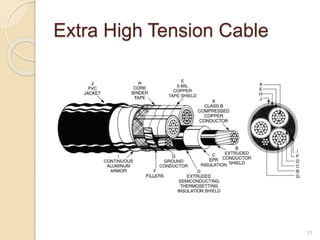
Extra High Tension Cable
11
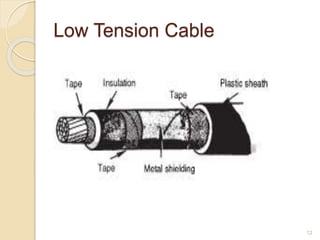
Low Tension Cable
12
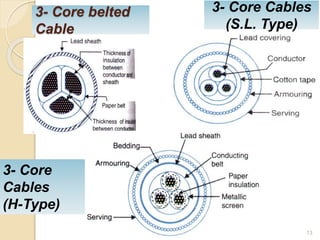
3- Core belted
Cable
13
3- Core
Cables
(H-Type)
3- Core Cables
(S.L. Type)
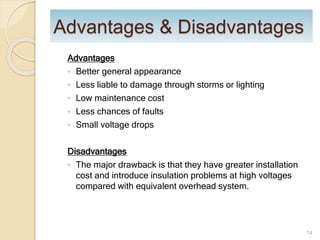
Advantages & Disadvantages
Advantages
◦ Better general appearance
◦ Less liable to damage through storms or lighting
◦ Low maintenance cost
◦ Less chances of faults
◦ Small voltage drops
Disadvantages
◦ The major drawback is that they have greater installation
cost and introduce insulation problems at high voltages
compared with equivalent overhead system.
14
THANKS TO ALL
End
Of
The
slide
15

Underground cables

  • 1.
    Underground cables Presented by: AnisurRahman ID: 1402EEE00033 Department OF EEE Manarat International University Khagan, Ashulia, Shavar, Dhaka, Bangladesh
  • 2.
    Contents  Introduction ofUnderground cables  Construction of cables  CABLE STRUCTURE  Classification of cables  Properties of Insulating Material  Insulating materials for cables  Examples of types  Advantages and disadvantages of cable 2
  • 3.
    Underground cables  Anunderground cable consists of one or more conductors covered with some suitable insulating material and surrounded by a protecting cover.  The interference from external disturbances like storms, lightening, ice, trees etc. should be reduced to achieve trouble free service.  The cables may be buried directly in the ground, or may be installed in ducts buried in the ground. 3
  • 4.
  • 5.
    Construction of Cables Thegeneral construction of a 3-conductor cable. The various parts of cable are :  Cores or Conductors  Insulation  Metallic sheath  Bedding  Armouring  Serving 5
  • 6.
    CLSSIFICATION OF CABLES Low tension (L.T)  up to 1000V  High tension (H.T)  up to 11, 000V  Super tension (S.T)  from 22KV to 33KV  Extra high tension (E.H.T) cables  from 33KV to 66KV  Extra super voltage cables beyond 132KV 6
  • 7.
    Properties of Insulating Material High resistivity.  High dielectric strength.  Low thermal co-efficient.  Low water absorption.  Low permittivity.  Non – inflammable.  Chemical stability.  High mechanical strength.  High viscosity at impregnation temperature.  Capability to with stand high rupturing voltage.  High tensile strength and plasticity. 7
  • 8.
    Insulating Materials forCables • Rubber It can be obtained from milky sap of tropical trees or from oil products. It has the dielectric strength of 30 KV/mm. Insulation resistivity of 10 exp 17 ohm.cm Relative permittivity varying between 2 and 3. They readily absorbs moisture, soft and liable to damage due to rough handling and ages when exposed to light. Maximum safe temperature is very low about 38 C 8
  • 9.
    Insulating Materials forCables  XLPE Cables (Cross Linked Poly-ethene)  This material has temperature range beyond 250 – 300 C  This material gives good insulating properties  It is light in weight, small overall dimensions, low dielectric constant and high mechanical strength, low water absorption.  permit conductor temperature of 90 C and 250 C under normal and short circuit conditions.  suitable up to voltages of 33 KV. 9
  • 10.
    Insulating Materials forCables  Rubber  XLPE cable  Vulcanized India Rubber  Impregnated Paper  Varnished Cambric  Polyvinyl chloride (PVC) 10
  • 11.
  • 12.
  • 13.
    3- Core belted Cable 13 3-Core Cables (H-Type) 3- Core Cables (S.L. Type)
  • 14.
    Advantages & Disadvantages Advantages ◦Better general appearance ◦ Less liable to damage through storms or lighting ◦ Low maintenance cost ◦ Less chances of faults ◦ Small voltage drops Disadvantages ◦ The major drawback is that they have greater installation cost and introduce insulation problems at high voltages compared with equivalent overhead system. 14
  • 15.