CLASSES OF AMPLIFIERS
PRESENTED BY ARSALAN SAEED QURESHI (D-16-TE-09)
PRESENTED TO ENGR. BUSHRA SHAIKH
DEPARTMENT OF TELECOMMUNICATION
ENGINEERING
CLASSES OF AMPLIFIERS
THE FOLLOWING IS THE PRESENTATION OF OUR TOPIC FROM
SUBJECT AMPLIFIERS AND OSCILLATORS “CLASSES OF
AMPLIFIERS”. SO WITHOUT ANY FURTHER ADO LET’S GET
STARTED.
AGENDA
• AMPLIFICATION CLASSES.
• CLASS A AMPLIFIERS.
• CLASS B AMPLIFIERS.
• CLASS AB AMPLIFIERS.
• CLASS C AMPLIFIERS.
• CONCLUSION.
AMPLIFICATION CLASSES
• Amplifiers are divided into classes. Each class describes how
the amplifying device reacts to an applied input. The amplifying
device may be:
• a transistor (BJT),
• a field effect transistor (FET) or even
• a valve.
The amplifying devices can be biased to operate as either Class
A, Class B or Class C. Each of these are examined below
CLASS A AMPLIFIERS
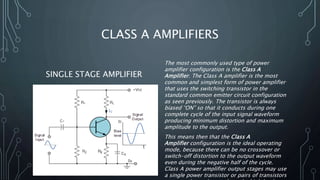
SINGLE STAGE AMPLIFIER
The most commonly used type of power
amplifier configuration is the Class A
Amplifier. The Class A amplifier is the most
common and simplest form of power amplifier
that uses the switching transistor in the
standard common emitter circuit configuration
as seen previously. The transistor is always
biased “ON” so that it conducts during one
complete cycle of the input signal waveform
producing minimum distortion and maximum
amplitude to the output.
This means then that the Class A
Amplifier configuration is the ideal operating
mode, because there can be no crossover or
switch-off distortion to the output waveform
even during the negative half of the cycle.
Class A power amplifier output stages may use
a single power transistor or pairs of transistors
CLASS A AMPLIFIER
The efficiency of the circuit is very low, less than 50% as the
transistor conducts even when the input is zero. Current flows
through the load in order to produce the 10v drop. This means
that energy is being dissipated in the form of heat.
Advantage:
Good quality output signal as the transistor is operating on a
linear portion of it’s characteristic.
Disadvantage:
Poor efficiency limits its use as a power amplifier – tends to be
used for pre-amplifiers only.
CLASS B AMPLIFIERS
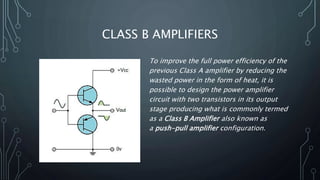
To improve the full power efficiency of the
previous Class A amplifier by reducing the
wasted power in the form of heat, it is
possible to design the power amplifier
circuit with two transistors in its output
stage producing what is commonly termed
as a Class B Amplifier also known as
a push-pull amplifier configuration.
CLASS B AMPLIFIERS
This places the amplifier designer/user in a dilemma. The Class A amplifier
uses devices that always pass high currents, and small signals only modulate
these by a modest amount, avoiding the above problems. Alas, Class A is very
power inefficient. Class B is far more efficient, but can lead to signal
distortions. The solution is to find a ‘half-way house’ that tries to take the
good points of each and minimise the problems. The most common solution
is Class AB amplification, see later.
Advantages:
More efficient than Class A – quoted value is 78.5%
Disadvantages:
• Cross over distortion
• Normally requires a positive and negative supply.
CLASS AB AMPLIFIER
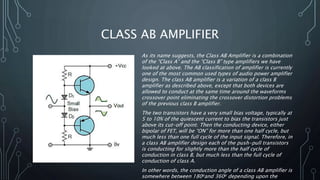
As its name suggests, the Class AB Amplifier is a combination
of the “Class A” and the “Class B” type amplifiers we have
looked at above. The AB classification of amplifier is currently
one of the most common used types of audio power amplifier
design. The class AB amplifier is a variation of a class B
amplifier as described above, except that both devices are
allowed to conduct at the same time around the waveforms
crossover point eliminating the crossover distortion problems
of the previous class B amplifier.
The two transistors have a very small bias voltage, typically at
5 to 10% of the quiescent current to bias the transistors just
above its cut-off point. Then the conducting device, either
bipolar of FET, will be “ON” for more than one half cycle, but
much less than one full cycle of the input signal. Therefore, in
a class AB amplifier design each of the push-pull transistors
is conducting for slightly more than the half cycle of
conduction in class B, but much less than the full cycle of
conduction of class A.
In other words, the conduction angle of a class AB amplifier is
somewhere between 180oand 360o depending upon the
CLASS AB AMPLIFIER
The advantage of this small bias voltage, provided by series
diodes or resistors, is that the crossover distortion created by
the class B amplifier characteristics is overcome, without the
inefficiencies of the class A amplifier design. So the class AB
amplifier is a good compromise between class A and class B in
terms of efficiency and linearity, with conversion efficiencies
reaching about 50% to 60%.
CLASS C AMPLIFIER
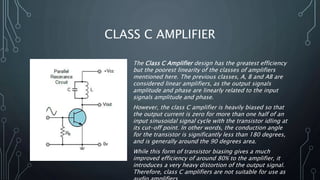
The Class C Amplifier design has the greatest efficiency
but the poorest linearity of the classes of amplifiers
mentioned here. The previous classes, A, B and AB are
considered linear amplifiers, as the output signals
amplitude and phase are linearly related to the input
signals amplitude and phase.
However, the class C amplifier is heavily biased so that
the output current is zero for more than one half of an
input sinusoidal signal cycle with the transistor idling at
its cut-off point. In other words, the conduction angle
for the transistor is significantly less than 180 degrees,
and is generally around the 90 degrees area.
While this form of transistor biasing gives a much
improved efficiency of around 80% to the amplifier, it
introduces a very heavy distortion of the output signal.
Therefore, class C amplifiers are not suitable for use as
CLASS C AMPLIFIER
Due to its heavy audio distortion, class C amplifiers are
commonly used in high frequency sine wave oscillators and
certain types of radio frequency amplifiers, where the pulses of
current produced at the amplifiers output can be converted to
complete sine waves of a particular frequency by the use of LC
resonant circuits in its collector circuit.
CONCLUSION
In this presentation we get to learn about the working and
classification of amplifiers and how each class differs from the
others. In my perspective every amplifier is important.
“
”
THANK YOU SO MUCH EVERYONE FOR
LISTENING AND PAYING ATTENTION TO
MY PRESENTATION MAY ALLAH BLESS YOU
ALL.
ALLAH HAFIZ

Classes of amplifiers

  • 1.
    CLASSES OF AMPLIFIERS PRESENTEDBY ARSALAN SAEED QURESHI (D-16-TE-09) PRESENTED TO ENGR. BUSHRA SHAIKH DEPARTMENT OF TELECOMMUNICATION ENGINEERING
  • 2.
    CLASSES OF AMPLIFIERS THEFOLLOWING IS THE PRESENTATION OF OUR TOPIC FROM SUBJECT AMPLIFIERS AND OSCILLATORS “CLASSES OF AMPLIFIERS”. SO WITHOUT ANY FURTHER ADO LET’S GET STARTED.
  • 3.
    AGENDA • AMPLIFICATION CLASSES. •CLASS A AMPLIFIERS. • CLASS B AMPLIFIERS. • CLASS AB AMPLIFIERS. • CLASS C AMPLIFIERS. • CONCLUSION.
  • 4.
    AMPLIFICATION CLASSES • Amplifiersare divided into classes. Each class describes how the amplifying device reacts to an applied input. The amplifying device may be: • a transistor (BJT), • a field effect transistor (FET) or even • a valve. The amplifying devices can be biased to operate as either Class A, Class B or Class C. Each of these are examined below
  • 5.
    CLASS A AMPLIFIERS SINGLESTAGE AMPLIFIER The most commonly used type of power amplifier configuration is the Class A Amplifier. The Class A amplifier is the most common and simplest form of power amplifier that uses the switching transistor in the standard common emitter circuit configuration as seen previously. The transistor is always biased “ON” so that it conducts during one complete cycle of the input signal waveform producing minimum distortion and maximum amplitude to the output. This means then that the Class A Amplifier configuration is the ideal operating mode, because there can be no crossover or switch-off distortion to the output waveform even during the negative half of the cycle. Class A power amplifier output stages may use a single power transistor or pairs of transistors
  • 6.
    CLASS A AMPLIFIER Theefficiency of the circuit is very low, less than 50% as the transistor conducts even when the input is zero. Current flows through the load in order to produce the 10v drop. This means that energy is being dissipated in the form of heat. Advantage: Good quality output signal as the transistor is operating on a linear portion of it’s characteristic. Disadvantage: Poor efficiency limits its use as a power amplifier – tends to be used for pre-amplifiers only.
  • 7.
    CLASS B AMPLIFIERS Toimprove the full power efficiency of the previous Class A amplifier by reducing the wasted power in the form of heat, it is possible to design the power amplifier circuit with two transistors in its output stage producing what is commonly termed as a Class B Amplifier also known as a push-pull amplifier configuration.
  • 8.
    CLASS B AMPLIFIERS Thisplaces the amplifier designer/user in a dilemma. The Class A amplifier uses devices that always pass high currents, and small signals only modulate these by a modest amount, avoiding the above problems. Alas, Class A is very power inefficient. Class B is far more efficient, but can lead to signal distortions. The solution is to find a ‘half-way house’ that tries to take the good points of each and minimise the problems. The most common solution is Class AB amplification, see later. Advantages: More efficient than Class A – quoted value is 78.5% Disadvantages: • Cross over distortion • Normally requires a positive and negative supply.
  • 9.
    CLASS AB AMPLIFIER Asits name suggests, the Class AB Amplifier is a combination of the “Class A” and the “Class B” type amplifiers we have looked at above. The AB classification of amplifier is currently one of the most common used types of audio power amplifier design. The class AB amplifier is a variation of a class B amplifier as described above, except that both devices are allowed to conduct at the same time around the waveforms crossover point eliminating the crossover distortion problems of the previous class B amplifier. The two transistors have a very small bias voltage, typically at 5 to 10% of the quiescent current to bias the transistors just above its cut-off point. Then the conducting device, either bipolar of FET, will be “ON” for more than one half cycle, but much less than one full cycle of the input signal. Therefore, in a class AB amplifier design each of the push-pull transistors is conducting for slightly more than the half cycle of conduction in class B, but much less than the full cycle of conduction of class A. In other words, the conduction angle of a class AB amplifier is somewhere between 180oand 360o depending upon the
  • 10.
    CLASS AB AMPLIFIER Theadvantage of this small bias voltage, provided by series diodes or resistors, is that the crossover distortion created by the class B amplifier characteristics is overcome, without the inefficiencies of the class A amplifier design. So the class AB amplifier is a good compromise between class A and class B in terms of efficiency and linearity, with conversion efficiencies reaching about 50% to 60%.
  • 11.
    CLASS C AMPLIFIER TheClass C Amplifier design has the greatest efficiency but the poorest linearity of the classes of amplifiers mentioned here. The previous classes, A, B and AB are considered linear amplifiers, as the output signals amplitude and phase are linearly related to the input signals amplitude and phase. However, the class C amplifier is heavily biased so that the output current is zero for more than one half of an input sinusoidal signal cycle with the transistor idling at its cut-off point. In other words, the conduction angle for the transistor is significantly less than 180 degrees, and is generally around the 90 degrees area. While this form of transistor biasing gives a much improved efficiency of around 80% to the amplifier, it introduces a very heavy distortion of the output signal. Therefore, class C amplifiers are not suitable for use as
  • 12.
    CLASS C AMPLIFIER Dueto its heavy audio distortion, class C amplifiers are commonly used in high frequency sine wave oscillators and certain types of radio frequency amplifiers, where the pulses of current produced at the amplifiers output can be converted to complete sine waves of a particular frequency by the use of LC resonant circuits in its collector circuit.
  • 13.
    CONCLUSION In this presentationwe get to learn about the working and classification of amplifiers and how each class differs from the others. In my perspective every amplifier is important.
  • 14.
    “ ” THANK YOU SOMUCH EVERYONE FOR LISTENING AND PAYING ATTENTION TO MY PRESENTATION MAY ALLAH BLESS YOU ALL. ALLAH HAFIZ