Contents:
 Introduction
 What is Transformer
 Working principle
 Types of transformers
 Ideal and practical transformer
 Applications of transformers
INTRODUCTION
One of greatest advantage of alternating current over direct current
the alternating currents can be easily transferable from lowest voltage to
high or high voltage to low voltage. . Alternating voltage can be raised or
lowered as per requirements in the different stages of electrical network as
Generation ,transmission, distribution and utilization. This is possible
with a device is called as transformer.
WHAT IS TRANSFORMER
 Transformer is a static device which transfers the electrical
power or energy from one alternating current circuit to
another with desired change in voltage or current and
Without any change in the frequency.
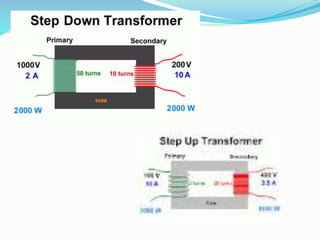
 A transformer used to increase the voltage is called step up
transformer .while that used to decrease the voltage is
called a step down transformer.
Working principle of transformer
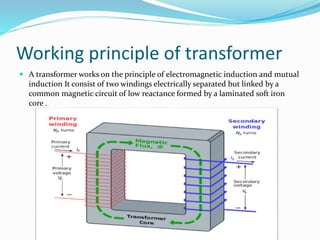
 A transformer works on the principle of electromagnetic induction and mutual
induction It consist of two windings electrically separated but linked by a
common magnetic circuit of low reactance formed by a laminated soft iron
core .
TYPES OF TRANSFORMERS
According to no. of phases:
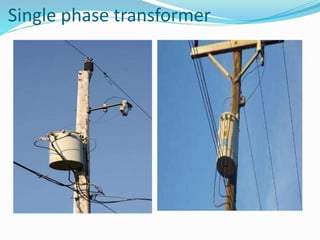
a) single phase transformer
b) three phase transformer
 According to Construction :
a) core type
b) Shell type
c) berry type
 According to function :
a) power transformer
i) step up transformer
ii) step down transformer
b) Distribution transformers
Single phase transformer
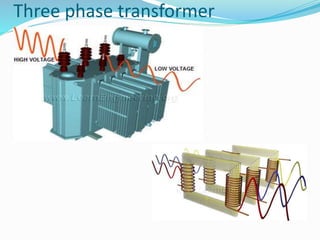
Three phase transformer
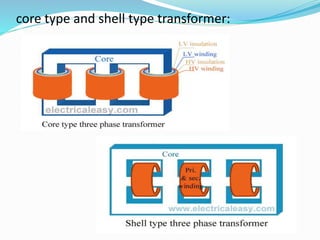
core type and shell type transformer:
IDEAL VS PRACTICAL TRANSFORMER
A transformer is said to be ideal if satisfies the following
properties ,
 It has no losses.
 Winding resistance has zero.
 There is no flux leakage.
 Efficiency is 100 %.
But in practical ,there are some losses in transformer.
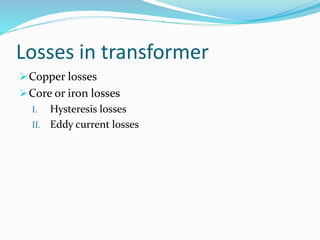
Losses in transformer
Copper losses
Core or iron losses
I. Hysteresis losses
II. Eddy current losses
APPLICATIONS:
Irrigation purpose
Electronic devices
Domestic purpose
Indoor/ outdoor Sub stations
REFERNCES
 Electrical engineering by UA Bakshi.
 Principal of electrical machine by VK Mehta.
 Electrical machine by R.K.Rajput.
 www.allabout circuits.com
 www.ieee.com
Transformers seminar

Transformers seminar

  • 2.
    Contents:  Introduction  Whatis Transformer  Working principle  Types of transformers  Ideal and practical transformer  Applications of transformers
  • 3.
    INTRODUCTION One of greatestadvantage of alternating current over direct current the alternating currents can be easily transferable from lowest voltage to high or high voltage to low voltage. . Alternating voltage can be raised or lowered as per requirements in the different stages of electrical network as Generation ,transmission, distribution and utilization. This is possible with a device is called as transformer.
  • 4.
    WHAT IS TRANSFORMER Transformer is a static device which transfers the electrical power or energy from one alternating current circuit to another with desired change in voltage or current and Without any change in the frequency.  A transformer used to increase the voltage is called step up transformer .while that used to decrease the voltage is called a step down transformer.
  • 5.
    Working principle oftransformer  A transformer works on the principle of electromagnetic induction and mutual induction It consist of two windings electrically separated but linked by a common magnetic circuit of low reactance formed by a laminated soft iron core .
  • 6.
    TYPES OF TRANSFORMERS Accordingto no. of phases: a) single phase transformer b) three phase transformer  According to Construction : a) core type b) Shell type c) berry type  According to function : a) power transformer i) step up transformer ii) step down transformer b) Distribution transformers
  • 7.
  • 8.
  • 9.
    core type andshell type transformer:
  • 11.
    IDEAL VS PRACTICALTRANSFORMER A transformer is said to be ideal if satisfies the following properties ,  It has no losses.  Winding resistance has zero.  There is no flux leakage.  Efficiency is 100 %. But in practical ,there are some losses in transformer.
  • 12.
    Losses in transformer Copperlosses Core or iron losses I. Hysteresis losses II. Eddy current losses
  • 13.
  • 14.
    REFERNCES  Electrical engineeringby UA Bakshi.  Principal of electrical machine by VK Mehta.  Electrical machine by R.K.Rajput.  www.allabout circuits.com  www.ieee.com