INVERTER
UNIT 4
INTRODUCTION TO POWER
ELECTRONICS
DEE 402
by
VINOD SHRIVASTAVA
Department of Electrical Engineering
University Polytechnic
IFTM University, Moradabad
CONTENTS
1. Introduction
2. Types of Inverter
3. Square Wave Inverter
4. Modified Sine Wave Inverter
5. Sine Wave Inverter
6. Single-phase inverter
7. Three-phase Inverter
8. IMPORTANT QUESTIONS
9. MULTIPLE CHOICE QUESTIONS
2
INTRODUCTION
What is an Inverter?
An inverter (or power inverter) is a power electronics device
which used to convert DC voltage into AC voltage.
The inverter is a static device. It can convert one form of
electrical power into other forms of electrical power. But it
cannot generate electrical power. Hence the inverter is a
converter, not a generator.
It can be used as a standalone device such as solar power or
back power for home appliances.
The inverter takes DC power from the batteries and converts
into AC power at the time of the power failure.
3
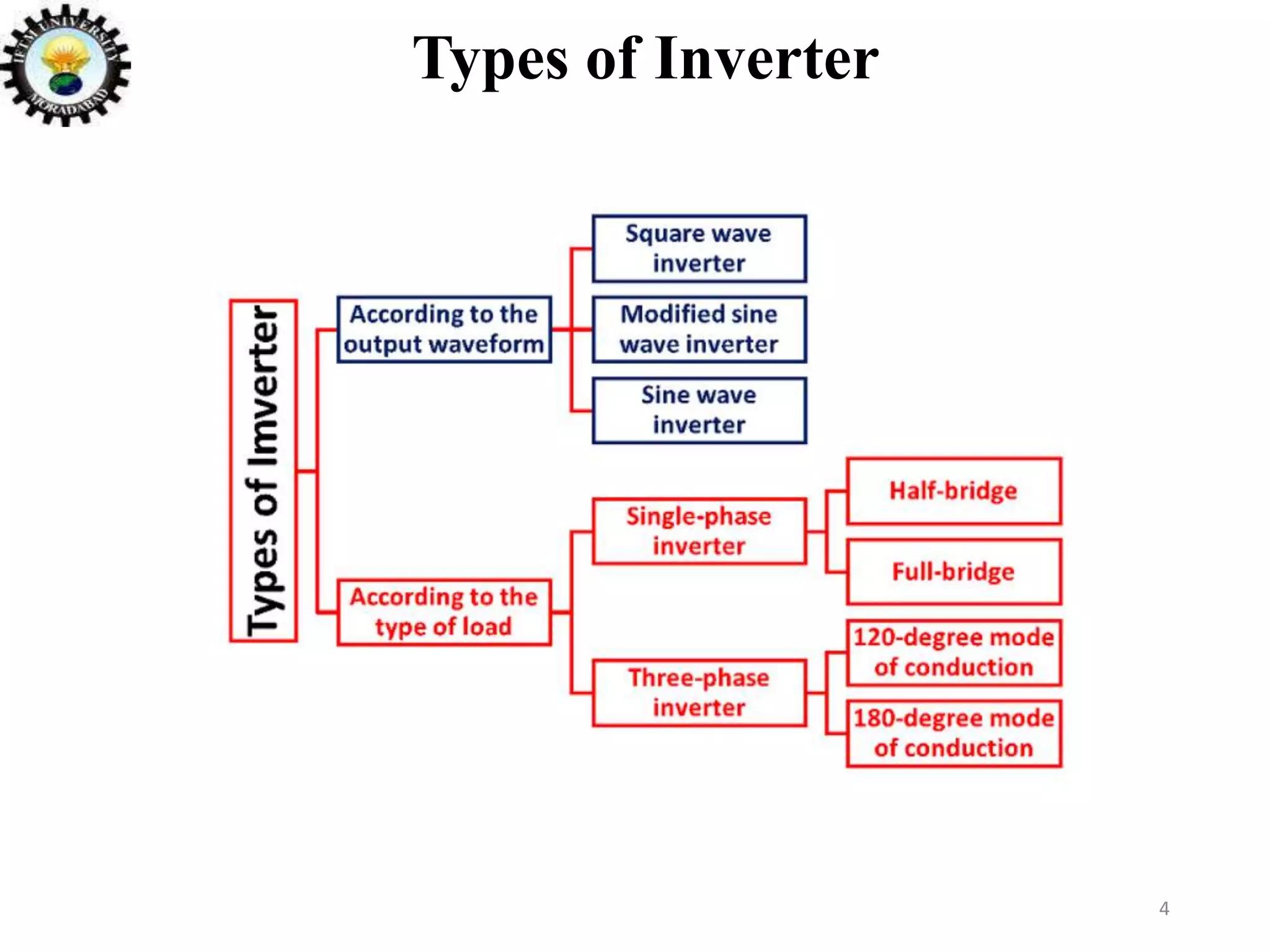
Types of Inverter
4
5
According to the Output Waveform
• There are three types of inverters.
• Square wave inverter
• Modified sine wave inverter
• Sine wave inverter
Square Wave Inverter
6
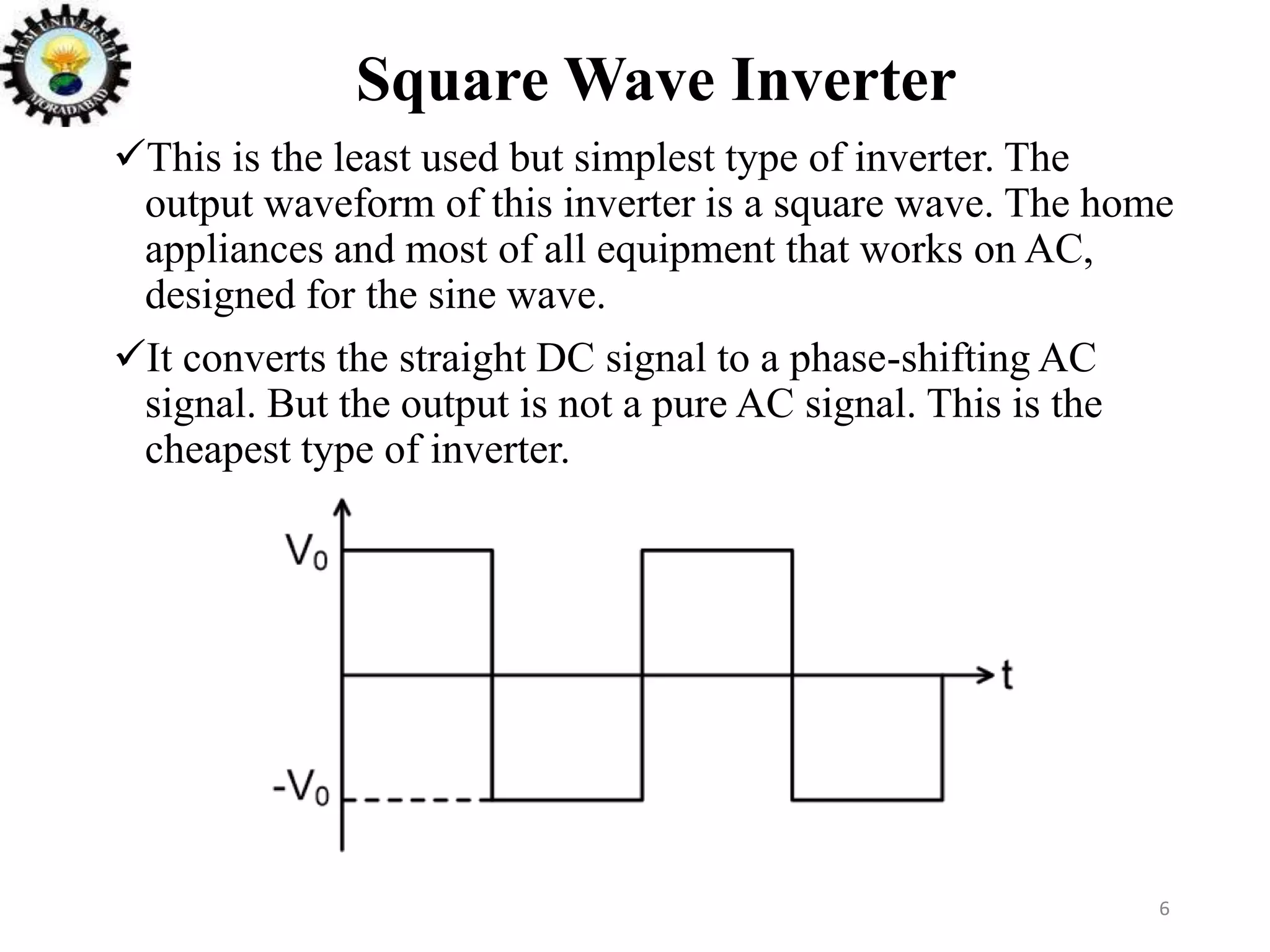
This is the least used but simplest type of inverter. The
output waveform of this inverter is a square wave. The home
appliances and most of all equipment that works on AC,
designed for the sine wave.
It converts the straight DC signal to a phase-shifting AC
signal. But the output is not a pure AC signal. This is the
cheapest type of inverter.
This inverter is also known as quasi wave inverter. This
inverter generates the signal near to the sine wave. But it
cannot generate the smooth sine wave.
The construction of this inverter is more complex than the
square wave inverter but simpler than the sine wave inverter.
7
Modified Sine Wave Inverter
Sine Wave Inverter
This is the most efficient and complex type of inverter. It
generates the pure sine wave which is a similar waveform of
the grid power. All AC equipment designed to work on the
sine wave signal.
This inverter made the least losses. But the cost of this
inverter is very high. This type of inverters is widely used in
residential and commercial applications.
8
According to the Type of Load
There are two types of AC power; single-phase and three-
phase. Therefore, there are two types of load. And according
to that, there are two types of inverters:
Single-phase inverter
Three-phase inverter
9
SINGLE-PHASE INVERTER
10
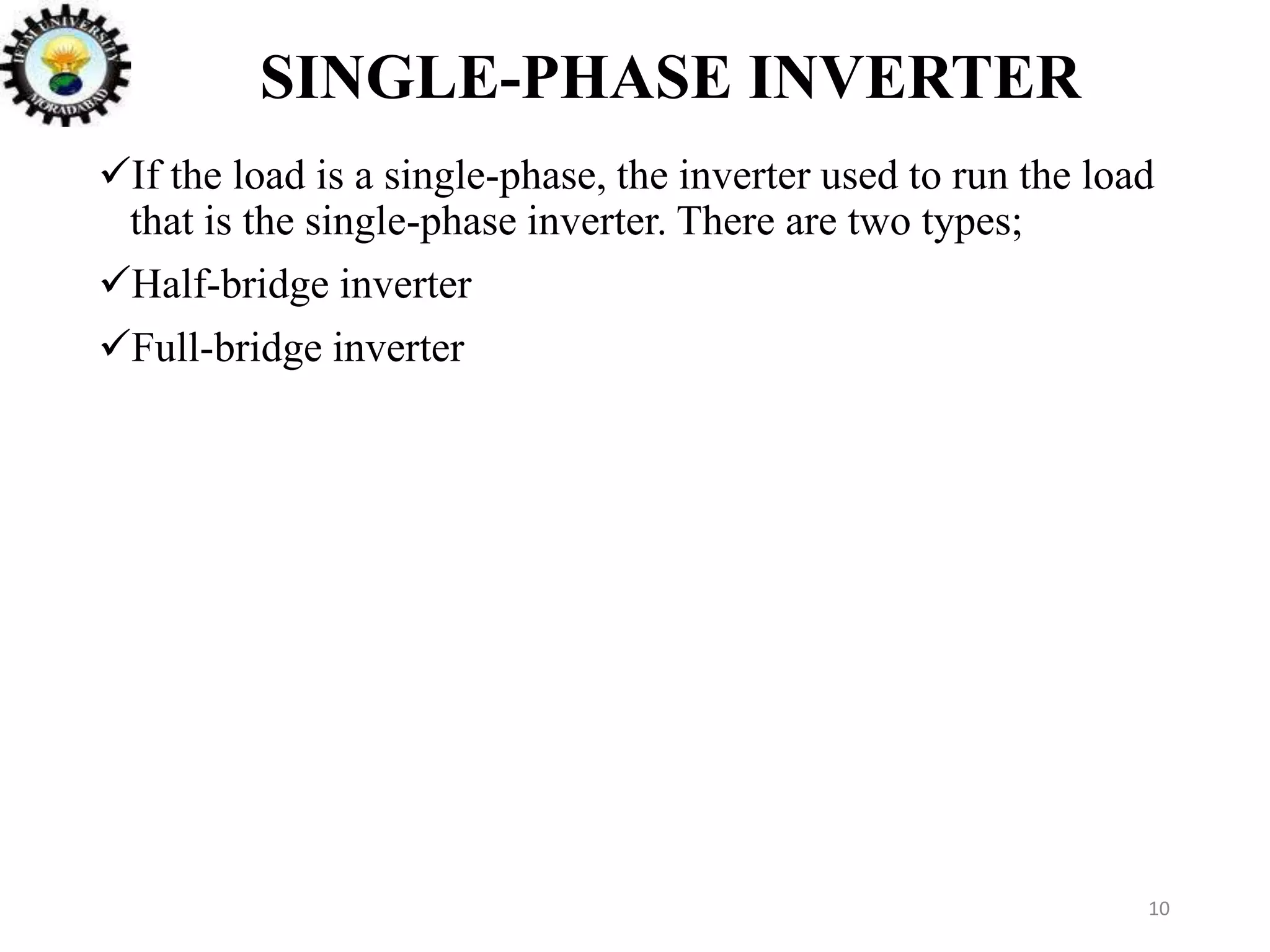
If the load is a single-phase, the inverter used to run the load
that is the single-phase inverter. There are two types;
Half-bridge inverter
Full-bridge inverter
Single-phase Half-bridge Inverter
11
Two thyristors (T1 and T2) connected with two feedback
diodes (D1 and D2) as shown in the below circuit diagram.
The supply voltage divides into two equal parts. The
resistive load used to understand the working principle.
12
Single-phase Half-bridge Inverter
Mode-1
Thyristor T1 is ON and T2 is
OFF during this mode. The
current flowing path is Vs/2-
T1-B-RL-A-Vs/2.
The current flowing through
the load is B to A direction.
And the voltage across the
load is positive Vs/2. In this
mode, the positive cycle of
the output generates.
Single-phase Half-bridge Inverter
• Mode-2
Thyristor T2 is ON and T1 is
OFF during this mode. The
current flowing path is Vs/2-A-
RL-B-T2-Vs/2.
The current flowing through
the load A to B direction. The
voltage across the load is
negative Vs/2. In this mode, the
negative cycle of output
generates.
13
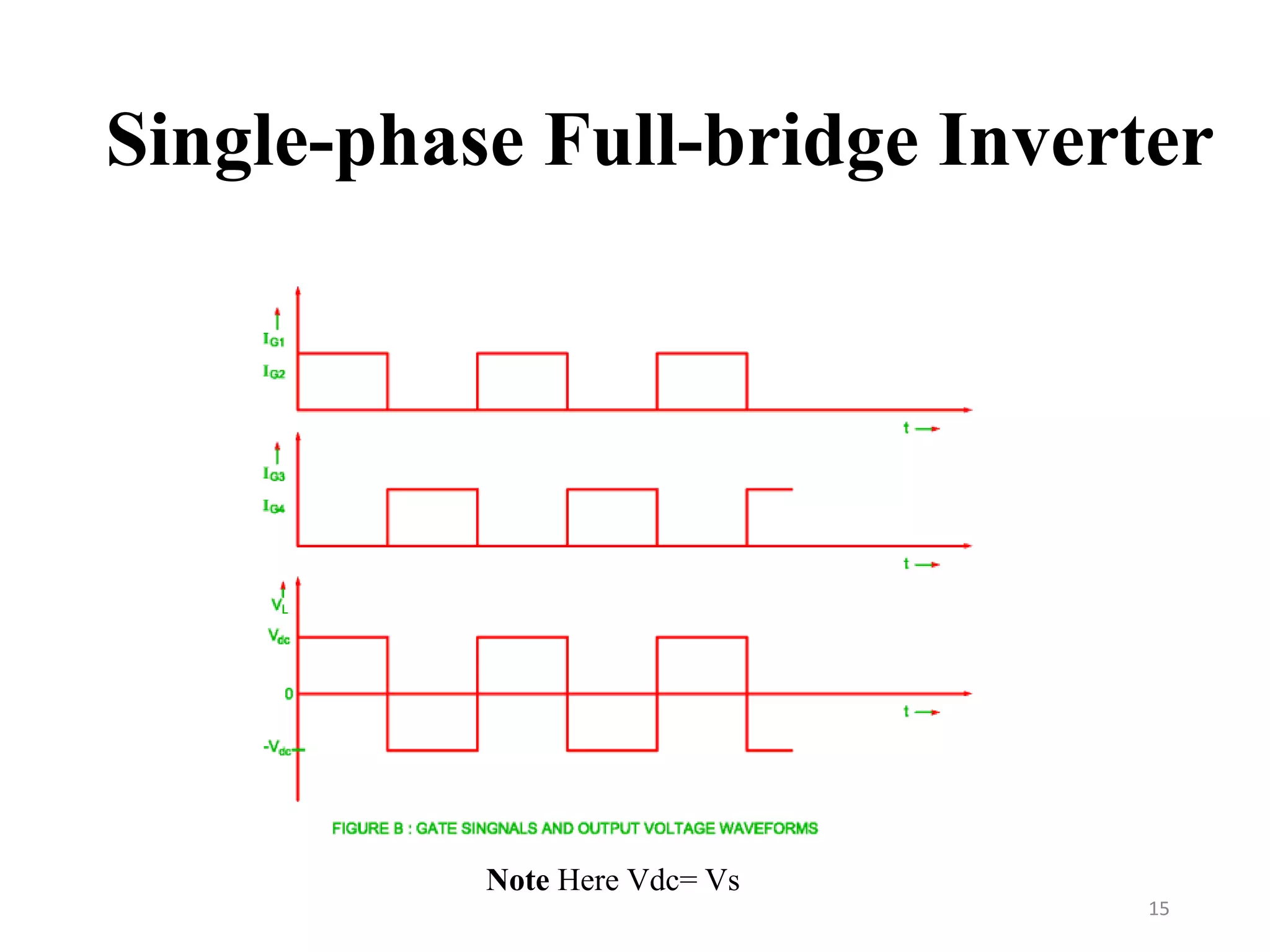
Single-phase Full-bridge Inverter
In a full-bridge inverter,
four thyristors and four
feedback diodes used.
One DC source applied
to the circuit.
In a half-bridge inverter,
one switch is in
conduction at a time.
And in a full-bridge
inverter, two switches
are in conduction at a
time.
14
Single-phase Full-bridge Inverter
15
Note Here Vdc= Vs
Single-phase Full-bridge Inverter
Mode-1
 Thyristor S1 and S2
are ON and
thyristors S3 and S4
are OFF during this
mode. The current
flowing path is V-
S1-A-RL-B-S2-V.
 The current flowing
through the load is
from A to B and
make a positive half
cycle.
16
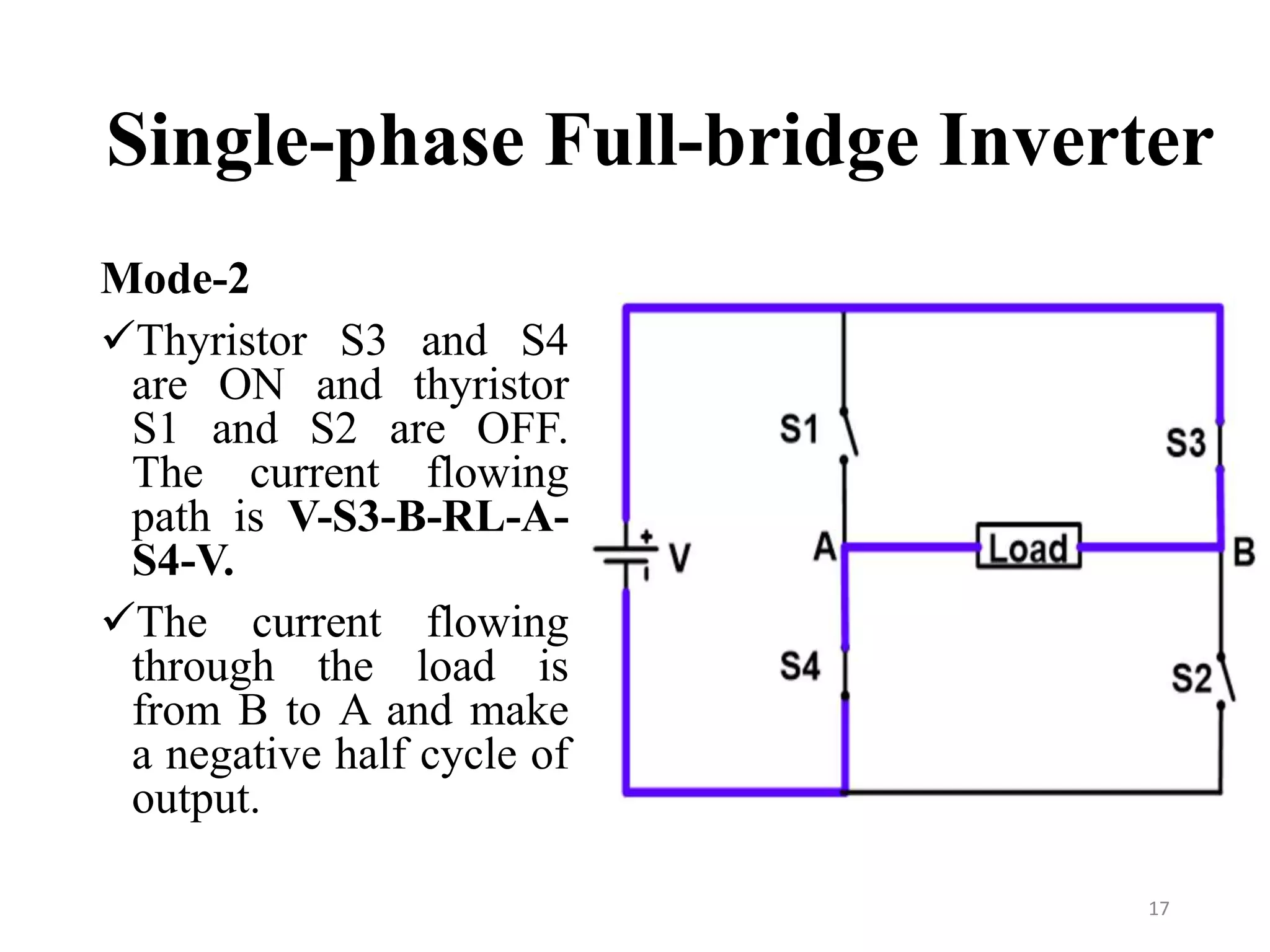
Single-phase Full-bridge Inverter
Mode-2
Thyristor S3 and S4
are ON and thyristor
S1 and S2 are OFF.
The current flowing
path is V-S3-B-RL-A-
S4-V.
The current flowing
through the load is
from B to A and make
a negative half cycle of
output.
17
Three-phase Inverter
Generally, three-phase AC supply used in industries
and the load is three-phase. In this case, a three-
phase inverter used to run this load.
18
Three-phase Inverter
In a three-phase inverter, six diodes and six
thyristors used. According to the conduction time of
thyristor, this inverter divides into two types;
• 120-degree mode of operation
• 180-degree mode of operation
19
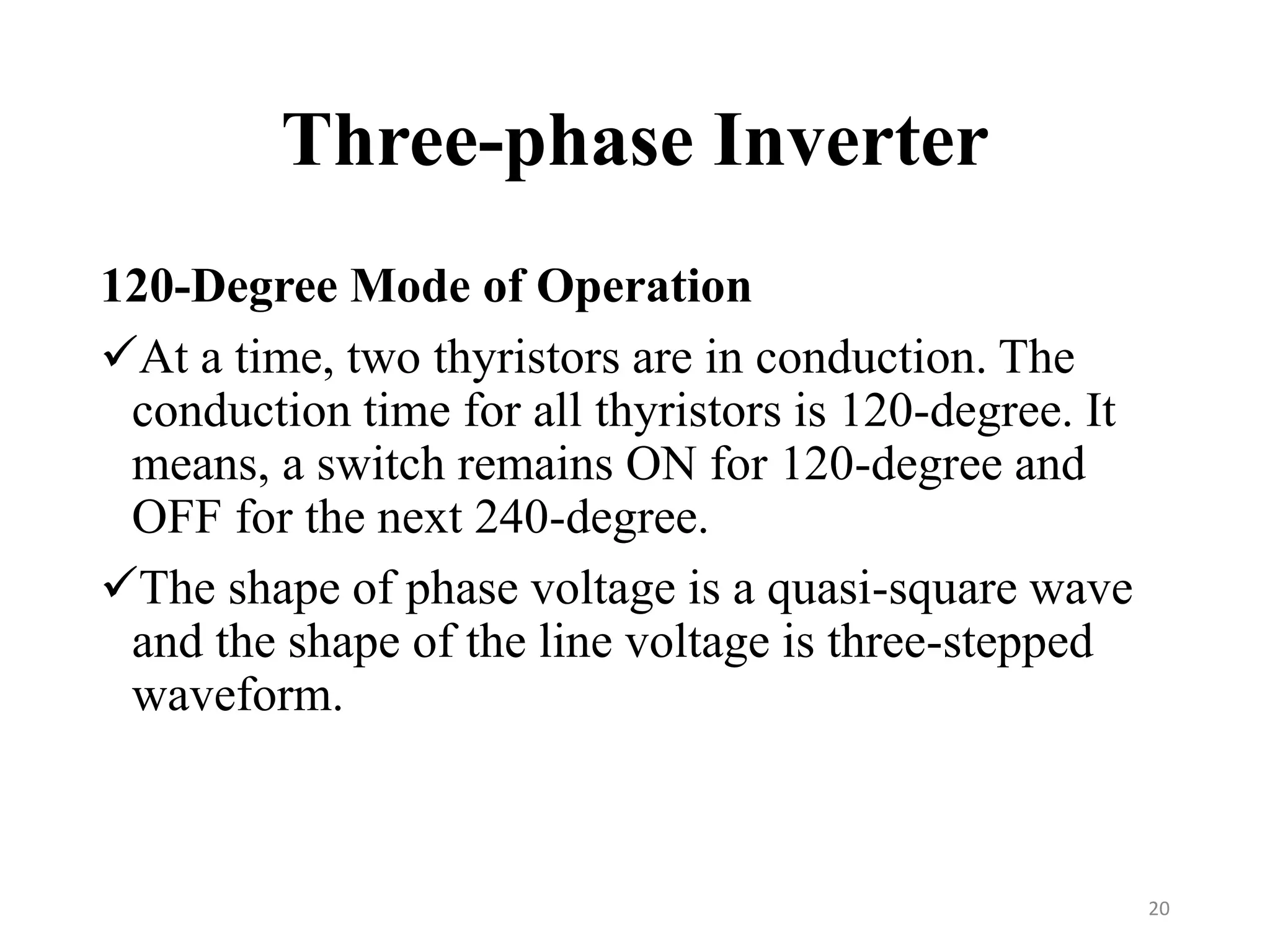
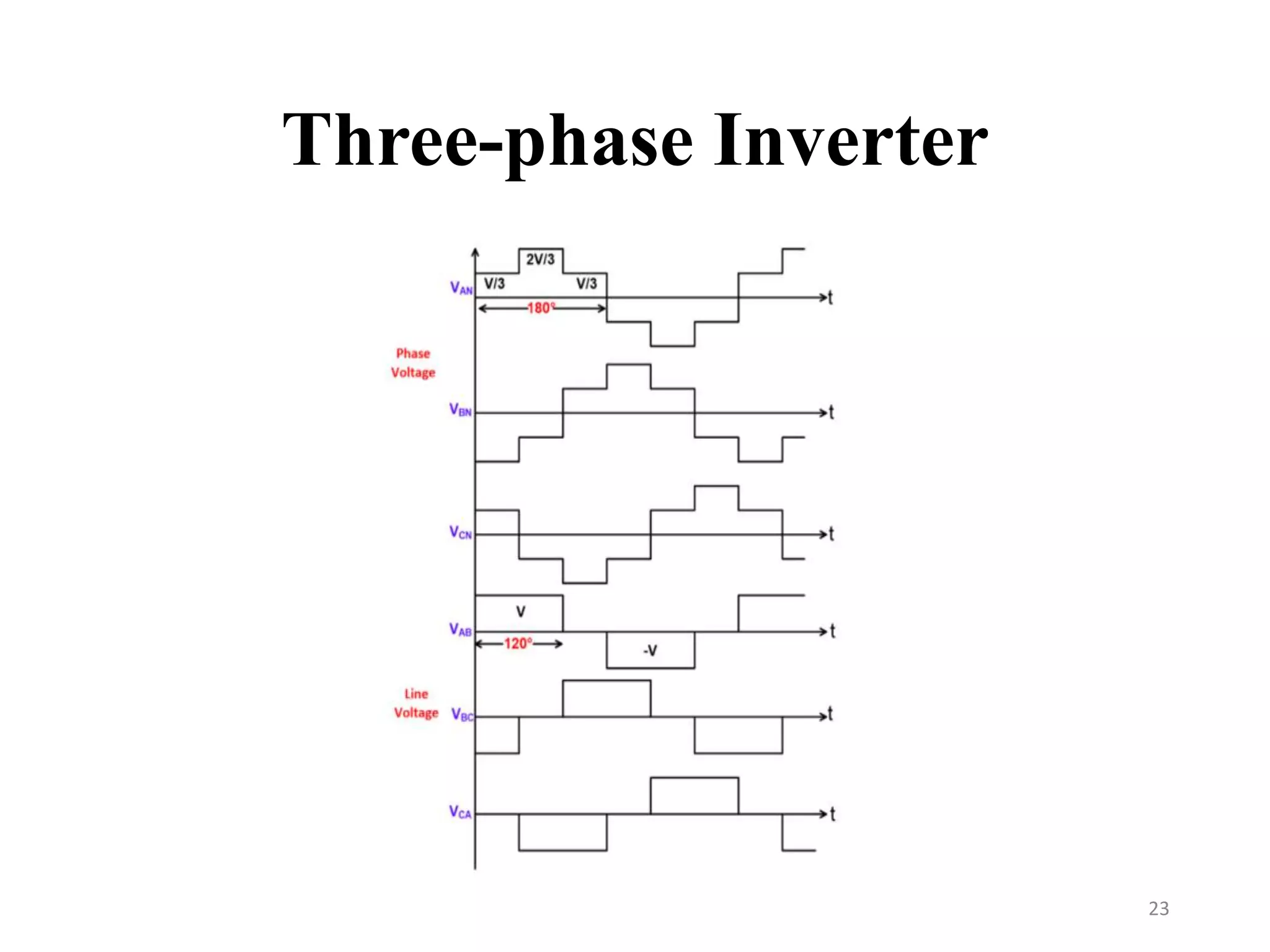
Three-phase Inverter
120-Degree Mode of Operation
At a time, two thyristors are in conduction. The
conduction time for all thyristors is 120-degree. It
means, a switch remains ON for 120-degree and
OFF for the next 240-degree.
The shape of phase voltage is a quasi-square wave
and the shape of the line voltage is three-stepped
waveform.
20
Three-phase Inverter
21
Three-phase Inverter
180-Degree Mode of Operation
Three thyristors are in conduction at a time. The conduction time
for all thyristors is 180-degree.
The shape of the line voltage and phase voltage is opposite to the
120-degree mode of operation. Here, for phase voltage, a
waveform is a three-stepped wave and for line voltage, a
waveform is a quasi-square wave.
In a 180-degree mode of operation, two thyristors of the common
bridge are ON and OFF simultaneously. For example, in half cycle
(180-degree) S1 is ON and the next half-cycle S4 is ON. So, at the
same time, S1 is switching OFF and S4 is switching ON. Because
of this simultaneous conduction, it is possible that the source may
sort circuited.
This problem will not happen in a 120-degree mode of operation.
22
Three-phase Inverter
23
24
IMPORTANT QUESTIONS
Q.1. Explain the single phase half bridge inverter for R Load
with circuit diagram and waveforms.
Q.2. Explain the single phase full bridge inverter for R Load
with circuit diagram and waveforms.
Q.3.Explain the working principle of 3 phase bridge inverter.
Also draw the voltage waveform for 180 degree mode VSI.
Q.4. What is inverter? Explain its types according to its output
waveforms.
MULTIPLE CHOICE QUESTIONS
Q1.In a VSI (Voltage source inverter) …………………. i) the internal impedance of the DC
source is negligible ii) the internal impedance of the DC source is very very high iii) the
internal impedance of the AC source is negligible iv) the IGBTs are fired at 0 degrees
Q2. Single phase half bridge inverters requires……………………… i) two wire ac supply ii)
two wire dc supply iii) three wire ac supply iv) three wire dc supply
Q3.In the 180° mode VSI, ___________ devices conduct at a time. i) 5 ii) 2 iii) 3 iv) 4
Q4.The shape of the output voltage waveform in a single PWM is……………… i) square
wave ii) triangular wave
iii) quasi-square wave iv) sine wave
Q5.Several equidistant pulses per half cycle are used in ___________ type of modulation
technique. i) single-pulse ii) multiple-pulse iii) sine-pulse iv) equidistant-pulse
25
MULTIPLE CHOICE QUESTIONS
Q6.In ___________ type of modulation method, the pulse width is not equal for all the pulses. i) multiple
pulse width modulation ii) single pulse width modulation iii) sinusoidal pulse width modulation iv)
none of the above
Q7.In the sinusoidal pulse width modulation, __________ is the carrier wave signal. i) square wave ii)
triangular wave iii) sinusoidal wave iv) quasi-square wave
Q8. In a half wave circuit, forced commutation is essential when the
a) load is inductive b) load is resistive c) source voltage is below 150 V d) none of the mentioned
Q.9. A thyristor equivalent of a thyratron tube is a 1. Diac 2. Triac 3. Silicon controlled rectifier 4. None of
the above
Q.10. A triac is a 1. 2 terminal switch 2. 2 terminal bilateral switch 3. 3 terminal bilateral switch 4. 3
terminal bidirectional switch
26

Inverter

  • 1.
    INVERTER UNIT 4 INTRODUCTION TOPOWER ELECTRONICS DEE 402 by VINOD SHRIVASTAVA Department of Electrical Engineering University Polytechnic IFTM University, Moradabad
  • 2.
    CONTENTS 1. Introduction 2. Typesof Inverter 3. Square Wave Inverter 4. Modified Sine Wave Inverter 5. Sine Wave Inverter 6. Single-phase inverter 7. Three-phase Inverter 8. IMPORTANT QUESTIONS 9. MULTIPLE CHOICE QUESTIONS 2
  • 3.
    INTRODUCTION What is anInverter? An inverter (or power inverter) is a power electronics device which used to convert DC voltage into AC voltage. The inverter is a static device. It can convert one form of electrical power into other forms of electrical power. But it cannot generate electrical power. Hence the inverter is a converter, not a generator. It can be used as a standalone device such as solar power or back power for home appliances. The inverter takes DC power from the batteries and converts into AC power at the time of the power failure. 3
  • 4.
  • 5.
    5 According to theOutput Waveform • There are three types of inverters. • Square wave inverter • Modified sine wave inverter • Sine wave inverter
  • 6.
    Square Wave Inverter 6 Thisis the least used but simplest type of inverter. The output waveform of this inverter is a square wave. The home appliances and most of all equipment that works on AC, designed for the sine wave. It converts the straight DC signal to a phase-shifting AC signal. But the output is not a pure AC signal. This is the cheapest type of inverter.
  • 7.
    This inverter isalso known as quasi wave inverter. This inverter generates the signal near to the sine wave. But it cannot generate the smooth sine wave. The construction of this inverter is more complex than the square wave inverter but simpler than the sine wave inverter. 7 Modified Sine Wave Inverter
  • 8.
    Sine Wave Inverter Thisis the most efficient and complex type of inverter. It generates the pure sine wave which is a similar waveform of the grid power. All AC equipment designed to work on the sine wave signal. This inverter made the least losses. But the cost of this inverter is very high. This type of inverters is widely used in residential and commercial applications. 8
  • 9.
    According to theType of Load There are two types of AC power; single-phase and three- phase. Therefore, there are two types of load. And according to that, there are two types of inverters: Single-phase inverter Three-phase inverter 9
  • 10.
    SINGLE-PHASE INVERTER 10 If theload is a single-phase, the inverter used to run the load that is the single-phase inverter. There are two types; Half-bridge inverter Full-bridge inverter
  • 11.
    Single-phase Half-bridge Inverter 11 Twothyristors (T1 and T2) connected with two feedback diodes (D1 and D2) as shown in the below circuit diagram. The supply voltage divides into two equal parts. The resistive load used to understand the working principle.
  • 12.
    12 Single-phase Half-bridge Inverter Mode-1 ThyristorT1 is ON and T2 is OFF during this mode. The current flowing path is Vs/2- T1-B-RL-A-Vs/2. The current flowing through the load is B to A direction. And the voltage across the load is positive Vs/2. In this mode, the positive cycle of the output generates.
  • 13.
    Single-phase Half-bridge Inverter •Mode-2 Thyristor T2 is ON and T1 is OFF during this mode. The current flowing path is Vs/2-A- RL-B-T2-Vs/2. The current flowing through the load A to B direction. The voltage across the load is negative Vs/2. In this mode, the negative cycle of output generates. 13
  • 14.
    Single-phase Full-bridge Inverter Ina full-bridge inverter, four thyristors and four feedback diodes used. One DC source applied to the circuit. In a half-bridge inverter, one switch is in conduction at a time. And in a full-bridge inverter, two switches are in conduction at a time. 14
  • 15.
  • 16.
    Single-phase Full-bridge Inverter Mode-1 Thyristor S1 and S2 are ON and thyristors S3 and S4 are OFF during this mode. The current flowing path is V- S1-A-RL-B-S2-V.  The current flowing through the load is from A to B and make a positive half cycle. 16
  • 17.
    Single-phase Full-bridge Inverter Mode-2 ThyristorS3 and S4 are ON and thyristor S1 and S2 are OFF. The current flowing path is V-S3-B-RL-A- S4-V. The current flowing through the load is from B to A and make a negative half cycle of output. 17
  • 18.
    Three-phase Inverter Generally, three-phaseAC supply used in industries and the load is three-phase. In this case, a three- phase inverter used to run this load. 18
  • 19.
    Three-phase Inverter In athree-phase inverter, six diodes and six thyristors used. According to the conduction time of thyristor, this inverter divides into two types; • 120-degree mode of operation • 180-degree mode of operation 19
  • 20.
    Three-phase Inverter 120-Degree Modeof Operation At a time, two thyristors are in conduction. The conduction time for all thyristors is 120-degree. It means, a switch remains ON for 120-degree and OFF for the next 240-degree. The shape of phase voltage is a quasi-square wave and the shape of the line voltage is three-stepped waveform. 20
  • 21.
  • 22.
    Three-phase Inverter 180-Degree Modeof Operation Three thyristors are in conduction at a time. The conduction time for all thyristors is 180-degree. The shape of the line voltage and phase voltage is opposite to the 120-degree mode of operation. Here, for phase voltage, a waveform is a three-stepped wave and for line voltage, a waveform is a quasi-square wave. In a 180-degree mode of operation, two thyristors of the common bridge are ON and OFF simultaneously. For example, in half cycle (180-degree) S1 is ON and the next half-cycle S4 is ON. So, at the same time, S1 is switching OFF and S4 is switching ON. Because of this simultaneous conduction, it is possible that the source may sort circuited. This problem will not happen in a 120-degree mode of operation. 22
  • 23.
  • 24.
    24 IMPORTANT QUESTIONS Q.1. Explainthe single phase half bridge inverter for R Load with circuit diagram and waveforms. Q.2. Explain the single phase full bridge inverter for R Load with circuit diagram and waveforms. Q.3.Explain the working principle of 3 phase bridge inverter. Also draw the voltage waveform for 180 degree mode VSI. Q.4. What is inverter? Explain its types according to its output waveforms.
  • 25.
    MULTIPLE CHOICE QUESTIONS Q1.Ina VSI (Voltage source inverter) …………………. i) the internal impedance of the DC source is negligible ii) the internal impedance of the DC source is very very high iii) the internal impedance of the AC source is negligible iv) the IGBTs are fired at 0 degrees Q2. Single phase half bridge inverters requires……………………… i) two wire ac supply ii) two wire dc supply iii) three wire ac supply iv) three wire dc supply Q3.In the 180° mode VSI, ___________ devices conduct at a time. i) 5 ii) 2 iii) 3 iv) 4 Q4.The shape of the output voltage waveform in a single PWM is……………… i) square wave ii) triangular wave iii) quasi-square wave iv) sine wave Q5.Several equidistant pulses per half cycle are used in ___________ type of modulation technique. i) single-pulse ii) multiple-pulse iii) sine-pulse iv) equidistant-pulse 25
  • 26.
    MULTIPLE CHOICE QUESTIONS Q6.In___________ type of modulation method, the pulse width is not equal for all the pulses. i) multiple pulse width modulation ii) single pulse width modulation iii) sinusoidal pulse width modulation iv) none of the above Q7.In the sinusoidal pulse width modulation, __________ is the carrier wave signal. i) square wave ii) triangular wave iii) sinusoidal wave iv) quasi-square wave Q8. In a half wave circuit, forced commutation is essential when the a) load is inductive b) load is resistive c) source voltage is below 150 V d) none of the mentioned Q.9. A thyristor equivalent of a thyratron tube is a 1. Diac 2. Triac 3. Silicon controlled rectifier 4. None of the above Q.10. A triac is a 1. 2 terminal switch 2. 2 terminal bilateral switch 3. 3 terminal bilateral switch 4. 3 terminal bidirectional switch 26