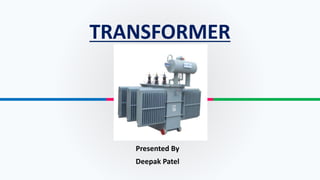
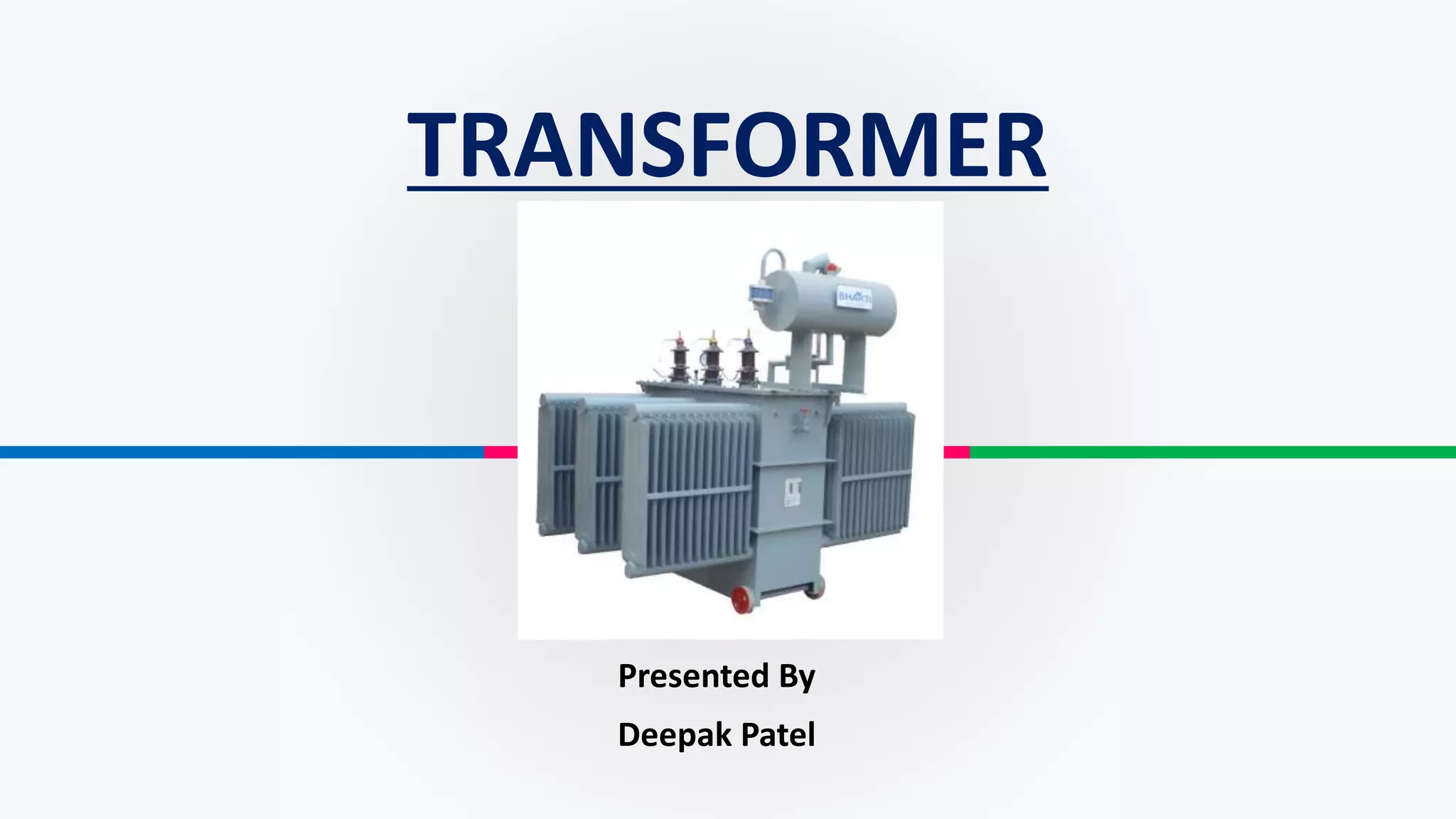
TRANSFORMER
Presented By
Deepak Patel
 Introduction
 Working Principle
 Construction
Types of transformer
 Ideal Transformer
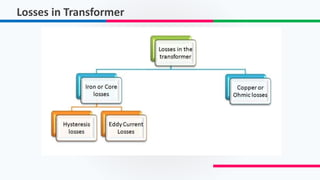
 Losses in Transformer
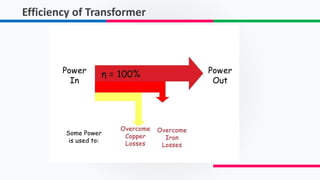
 Efficiency
 Voltage Regulation
Contents
Transformer is an static device that transfer electric power at same frequency usually
from one voltage level to another.
In brief,
1. Transfers electric power from one circuit to another.
2. It does so without a change of frequency.
3. It accomplishes this by electromagnetic induction
4. The two electric circuits are in mutual inductive influence.
Transformers are ubiquitous device. They are used to either step-up the AC voltage or
step down it.
Introduction
Why should we do this voltage transformation?
By increasing the transmission voltage.
 Power transfer capability of line increased.
 Power loss in transmission line is reduced.
 Area of cross section and volume of conductor is reduced.
Working Principle
• It is based on principle of Electromagnetic Induction.
• According to this principle, a varying magnetic flux associated with a loop will
induce an electromotive force across it.
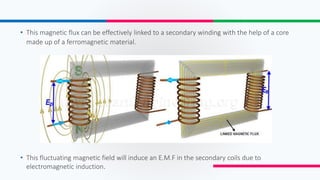
• This magnetic flux can be effectively linked to a secondary winding with the help of a core
made up of a ferromagnetic material.
• This fluctuating magnetic field will induce an E.M.F in the secondary coils due to
electromagnetic induction.
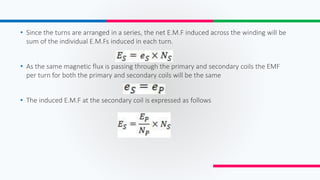
• Since the turns are arranged in a series, the net E.M.F induced across the winding will be
sum of the individual E.M.Fs induced in each turn.
• As the same magnetic flux is passing through the primary and secondary coils the EMF
per turn for both the primary and secondary coils will be the same
• The induced E.M.F at the secondary coil is expressed as follows
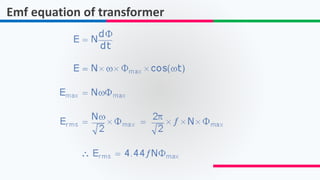
Emf equation of transformer
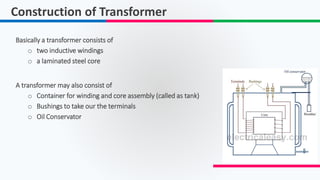
Construction of Transformer
Basically a transformer consists of
o two inductive windings
o a laminated steel core
A transformer may also consist of
o Container for winding and core assembly (called as tank)
o Bushings to take our the terminals
o Oil Conservator
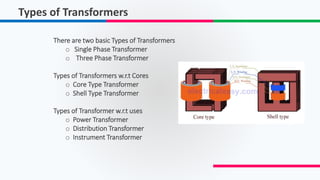
Types of Transformers
There are two basic Types of Transformers
o Single Phase Transformer
o Three Phase Transformer
Types of Transformers w.r.t Cores
o Core Type Transformer
o Shell Type Transformer
Types of Transformer w.r.t uses
o Power Transformer
o Distribution Transformer
o Instrument Transformer
Ideal Transformer
An ideal transformer is an imaginary transformer which has
o no copper losses (no winding resistance)
o no iron loss in core
o no leakage flux
o Infinite permeability of the core
o 100% efficiency
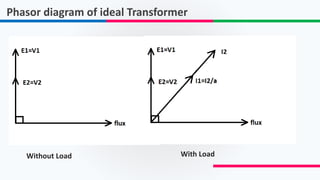
Phasor diagram of ideal Transformer
Without Load With Load
Losses in Transformer
Efficiency of Transformer
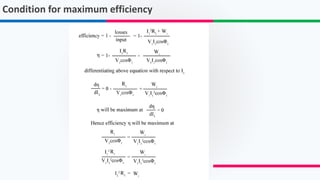
Condition for maximum efficiency
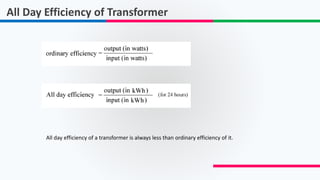
All Day Efficiency of Transformer
All day efficiency of a transformer is always less than ordinary efficiency of it.
Voltage Regulation
The change in magnitude of secondary(terminal) voltage when full load at specified power
factor is thrown off i.e. reduced to no load with primary voltage held constant, as percentage
of rated load terminal voltage.
Voltage Regulation is a figure of merit of a transformer and its low value is desirable.
Regulation can be reduced by reducing the per unit impedance.
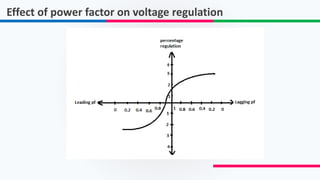
Effect of power factor on voltage regulation
Transformer

Transformer

  • 1.
  • 2.
     Introduction  WorkingPrinciple  Construction Types of transformer  Ideal Transformer  Losses in Transformer  Efficiency  Voltage Regulation Contents
  • 3.
    Transformer is anstatic device that transfer electric power at same frequency usually from one voltage level to another. In brief, 1. Transfers electric power from one circuit to another. 2. It does so without a change of frequency. 3. It accomplishes this by electromagnetic induction 4. The two electric circuits are in mutual inductive influence. Transformers are ubiquitous device. They are used to either step-up the AC voltage or step down it. Introduction
  • 4.
    Why should wedo this voltage transformation? By increasing the transmission voltage.  Power transfer capability of line increased.  Power loss in transmission line is reduced.  Area of cross section and volume of conductor is reduced.
  • 5.
    Working Principle • Itis based on principle of Electromagnetic Induction. • According to this principle, a varying magnetic flux associated with a loop will induce an electromotive force across it.
  • 6.
    • This magneticflux can be effectively linked to a secondary winding with the help of a core made up of a ferromagnetic material. • This fluctuating magnetic field will induce an E.M.F in the secondary coils due to electromagnetic induction.
  • 7.
    • Since theturns are arranged in a series, the net E.M.F induced across the winding will be sum of the individual E.M.Fs induced in each turn. • As the same magnetic flux is passing through the primary and secondary coils the EMF per turn for both the primary and secondary coils will be the same • The induced E.M.F at the secondary coil is expressed as follows
  • 8.
    Emf equation oftransformer
  • 9.
    Construction of Transformer Basicallya transformer consists of o two inductive windings o a laminated steel core A transformer may also consist of o Container for winding and core assembly (called as tank) o Bushings to take our the terminals o Oil Conservator
  • 10.
    Types of Transformers Thereare two basic Types of Transformers o Single Phase Transformer o Three Phase Transformer Types of Transformers w.r.t Cores o Core Type Transformer o Shell Type Transformer Types of Transformer w.r.t uses o Power Transformer o Distribution Transformer o Instrument Transformer
  • 11.
    Ideal Transformer An idealtransformer is an imaginary transformer which has o no copper losses (no winding resistance) o no iron loss in core o no leakage flux o Infinite permeability of the core o 100% efficiency
  • 12.
    Phasor diagram ofideal Transformer Without Load With Load
  • 13.
  • 14.
  • 15.
  • 16.
    All Day Efficiencyof Transformer All day efficiency of a transformer is always less than ordinary efficiency of it.
  • 17.
    Voltage Regulation The changein magnitude of secondary(terminal) voltage when full load at specified power factor is thrown off i.e. reduced to no load with primary voltage held constant, as percentage of rated load terminal voltage. Voltage Regulation is a figure of merit of a transformer and its low value is desirable. Regulation can be reduced by reducing the per unit impedance.
  • 18.
    Effect of powerfactor on voltage regulation