Training Need Assessment
Prof. Vikram Shinde
Introduction
 Improper training can result in failure in result and
increase in ineffective costs.
 As most of the capital and time is invested in training,
it can be total failure if not done accurately.
 The performance of any company depends on the
work of people and work depends on training taken.
 A needs assessment is a part of planning process,
often used for improvement in individuals,
education/training, organizations, or communities.
Meaning
 A needs assessment is a systematic process for
determining and addressing needs, or "gaps" between
current conditions and desired conditions or "wants".
 The discrepancy between the current condition and
wanted condition must be measured to appropriately
identify the need.
 Training needs are identified on the basis of
organizational analysis, job analysis and manpower
analysis.
 Training Needs = Desired Capability – Current
Capability of the Participants
Meaning: Pictur View
Definitions
 D. Stout: “A Needs Assessment is a
systematic exploration of the way things are
and the way they should be. These “things”
are usually associated with organizational
and/or individual performance.”
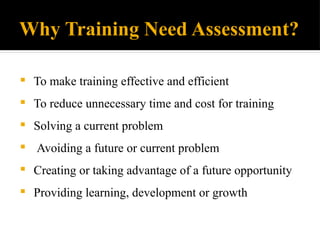
Why Training Need Assessment?
 To make training effective and efficient
 To reduce unnecessary time and cost for training
 Solving a current problem
 Avoiding a future or current problem
 Creating or taking advantage of a future opportunity
 Providing learning, development or growth
Types of Needs Assessment
Types of Needs : Cont…
Need Assessment Process
Need Assessment Process: Cont..
 Organizational assessment evaluates the level of organizational performance.
An assessment of this type will determine the skills, knowledge, and ability
needs of an agency. It also identifies what is required to alleviate the problems
and weaknesses of the agency as well as to enhance strengths and
competencies. Organizational assessment takes into consideration factors such
as changing demographics, political trends, technology, and the economy.
 Group/Occupational assessment examines the skills, knowledge, and
abilities required for affected occupational groups. Occupational assessment
identifies how and which occupational discrepancies or gaps exist, as well as
examining new ways to do work that could fix those discrepancies or gaps.
 Individual assessment analyzes how well an individual employee is doing a
job and determines the individual's capacity to do new or different work.
Individual assessment provides information on which employees need training
and what kind.
Benefits of Need Assessment
 Puts training needs in context of organizational
needs (business drivers)
 Validates and/or augments sponsor’s ideas about
the need for training
 Ensures training design will respond to need
 Identifies non-training issues influencing
performance
 Ensures survival of training function
 Establishes foundation for post-training evaluation
References
 D. Stout, Performance Analysis for Training,
1995.
 Personnel and Human Resource Management
by P. Subba Rao, Himalaya Publication, 2010.
 Training & Development, Chapter One, Tata
McGraw Hill.
 A Handbook of Human Resource Management
Practice, Kogan Page, 8th Ed.,2001)
 Wikipedia.

Training Need Assessment, concept, process, methods

  • 1.
  • 2.
    Introduction  Improper trainingcan result in failure in result and increase in ineffective costs.  As most of the capital and time is invested in training, it can be total failure if not done accurately.  The performance of any company depends on the work of people and work depends on training taken.  A needs assessment is a part of planning process, often used for improvement in individuals, education/training, organizations, or communities.
  • 3.
    Meaning  A needsassessment is a systematic process for determining and addressing needs, or "gaps" between current conditions and desired conditions or "wants".  The discrepancy between the current condition and wanted condition must be measured to appropriately identify the need.  Training needs are identified on the basis of organizational analysis, job analysis and manpower analysis.  Training Needs = Desired Capability – Current Capability of the Participants
  • 4.
  • 5.
    Definitions  D. Stout:“A Needs Assessment is a systematic exploration of the way things are and the way they should be. These “things” are usually associated with organizational and/or individual performance.”
  • 6.
    Why Training NeedAssessment?  To make training effective and efficient  To reduce unnecessary time and cost for training  Solving a current problem  Avoiding a future or current problem  Creating or taking advantage of a future opportunity  Providing learning, development or growth
  • 7.
    Types of NeedsAssessment
  • 8.
    Types of Needs: Cont…
  • 9.
  • 10.
    Need Assessment Process:Cont..  Organizational assessment evaluates the level of organizational performance. An assessment of this type will determine the skills, knowledge, and ability needs of an agency. It also identifies what is required to alleviate the problems and weaknesses of the agency as well as to enhance strengths and competencies. Organizational assessment takes into consideration factors such as changing demographics, political trends, technology, and the economy.  Group/Occupational assessment examines the skills, knowledge, and abilities required for affected occupational groups. Occupational assessment identifies how and which occupational discrepancies or gaps exist, as well as examining new ways to do work that could fix those discrepancies or gaps.  Individual assessment analyzes how well an individual employee is doing a job and determines the individual's capacity to do new or different work. Individual assessment provides information on which employees need training and what kind.
  • 11.
    Benefits of NeedAssessment  Puts training needs in context of organizational needs (business drivers)  Validates and/or augments sponsor’s ideas about the need for training  Ensures training design will respond to need  Identifies non-training issues influencing performance  Ensures survival of training function  Establishes foundation for post-training evaluation
  • 12.
    References  D. Stout,Performance Analysis for Training, 1995.  Personnel and Human Resource Management by P. Subba Rao, Himalaya Publication, 2010.  Training & Development, Chapter One, Tata McGraw Hill.  A Handbook of Human Resource Management Practice, Kogan Page, 8th Ed.,2001)  Wikipedia.