PROGRAMIRANJE TRENINGA
KONDICIJSKE PRIPREME SPORTAŠA
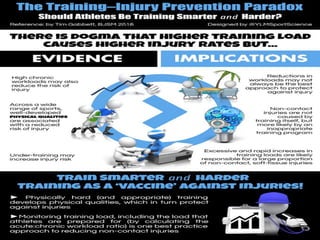
„The training-injury prevention paradox: should
athletes be training smarter and harder?”
Marko Matušinskij mag.cin
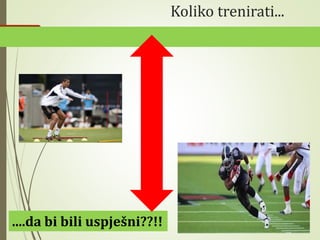
Koliko trenirati...
....da bi bili uspješni??!!
“Prognoziranje” trenažnog
opterećenja
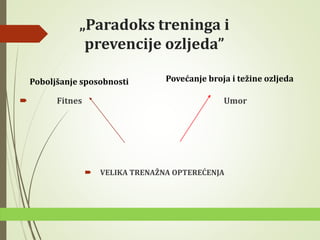
„Paradoks treninga i
prevencije ozljeda”
 Fitnes Umor
 VELIKA TRENAŽNA OPTEREĆENJA
Poboljšanje sposobnosti Povećanje broja i težine ozljeda
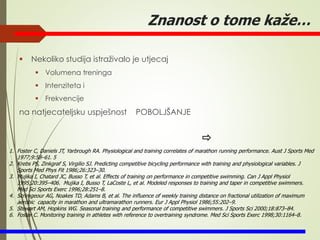
Znanost o tome kaže…
 Nekoliko studija istraživalo je utjecaj
 Volumena treninga
 Intenziteta i
 Frekvencije
na natjecateljsku uspješnost POBOLJŠANJE
1. Foster C, Daniels JT, Yarbrough RA. Physiological and training correlates of marathon running performance. Aust J Sports Med
1977;9:58–61. 5
2. Krebs PS, Zinkgraf S, Virgilio SJ. Predicting competitive bicycling performance with training and physiological variables. J
Sports Med Phys Fit 1986;26:323–30.
3. Mujika I, Chatard JC, Busso T, et al. Effects of training on performance in competitive swimming. Can J Appl Physiol
1995;20:395–406. Mujika I, Busso T, LaCoste L, et al. Modeled responses to training and taper in competitive swimmers.
Med Sci Sports Exerc 1996;28:251–8.
4. Scrimgeour AG, Noakes TD, Adams B, et al. The influence of weekly training distance on fractional utilization of maximum
aerobic capacity in marathon and ultramarathon runners. Eur J Appl Physiol 1986;55:202–9.
5. Stewart AM, Hopkins WG. Seasonal training and performance of competitive swimmers. J Sports Sci 2000;18:873–84.
6. Foster C. Monitoring training in athletes with reference to overtraining syndrome. Med Sci Sports Exerc 1998;30:1164–8.
1. Foster C. Monitoring training in athletes with reference to overtraining syndrome.Med Sci Sports Exerc
1998;30:1164–8.
2. Gabbett TJ. Influence of training and match intensity on injuries in rugby league.J Sports Sci
2004;22:409–17.
3. Huxley DJ, O’Connor D, Healey PA. An examination of the training profiles and injuries in elite youth
track and field athletes. Eur J Sport Sci 2014;14:185–92.
4. Colby MJ, Dawson B, Heasman J, et al. Accelerometer and GPS-derived running loads and injury risk
in elite Australian footballers. J Strength Cond Res 2014;28:2244–52.
5. Cross MJ, Williams S, Trewartha G, et al. The influence of in-season training loads on injury risk in
professional rugby union. Int J Sports Physiol Perform 2015 (in press).
6. Anderson L, Triplett-McBride T, Foster C, et al. Impact of training patterns on incidence of illness and
injury during a women’s collegiate basketball season. J Strength Cond Res 2003;17:734–8.
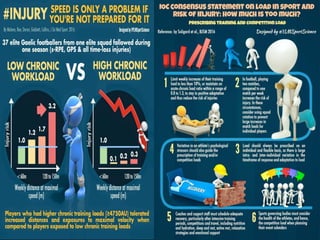
 Suprotno tome, istraživanja su utvrdila i da
je NAJVEĆI BROJ OZLJEDA TE BOLESTI u
sportaša prisutan pri velikim opterećenjima
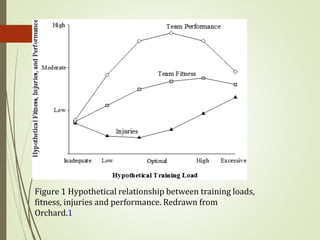
Figure 1 Hypothetical relationship between training loads,
fitness, injuries and performance. Redrawn from
Orchard.1
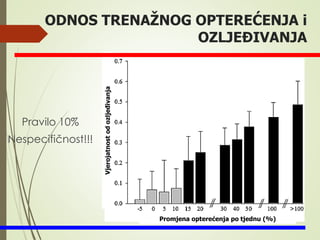
ODNOS TRENAŽNOG OPTEREĆENJA i
OZLJEĐIVANJA
Pravilo 10%
Nespecifičnost!!!
Promjena opterećenja po tjednu (%)
Vjerojatnostodozljeđivanja
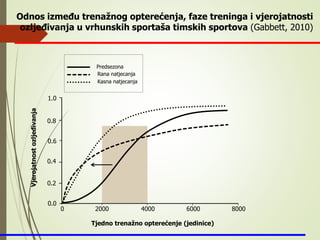
Vjerojatnostozljeđivanja
Tjedno trenažno opterećenje (jedinice)
0.0
Odnos između trenažnog opterećenja, faze treninga i vjerojatnosti
ozljeđivanja u vrhunskih sportaša timskih sportova (Gabbett, 2010)
0.2
0.4
0.6
0.8
1.0
0 2000 4000 6000 8000
Predsezona
Rana natjecanja
Kasna natjecanja
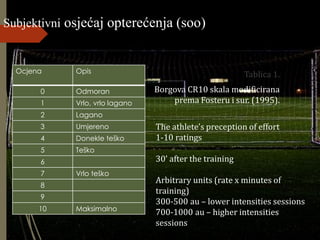
Subjektivni osjećaj opterećenja (soo)
Tablica 1.
Borgova CR10 skala modificirana
prema Fosteru i sur. (1995).
Ocjena Opis
0 Odmoran
1 Vrlo, vrlo lagano
2 Lagano
3 Umjereno
4 Donekle teško
5 Teško
6
7 Vrlo teško
8
9
10 Maksimalno
The athlete’s preception of effort
1-10 ratings
30’ after the training
Arbitrary units (rate x minutes of
training)
300-500 au – lower intensities sessions
700-1000 au – higher intensities
sessions
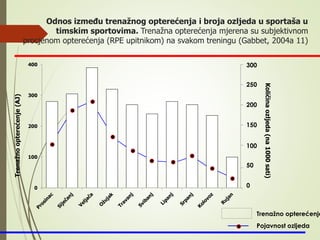
Odnos između trenažnog opterećenja i broja ozljeda u sportaša u
timskim sportovima. Trenažna opterećenja mjerena su subjektivnom
procjenom opterećenja (RPE upitnikom) na svakom treningu (Gabbet, 2004a 11)
0
100
200
300
400
Trenažnoopterećenje(AJ)
Količinaozljeda(na1000sati)
300
250
200
150
100
0
50
Trenažno opterećenje
Pojavnost ozljeda
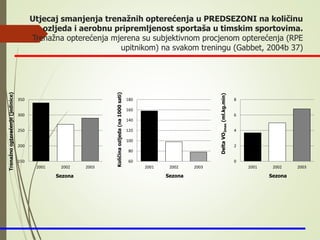
Utjecaj smanjenja trenažnih opterećenja u PREDSEZONI na količinu
ozljeda i aerobnu pripremljenost sportaša u timskim sportovima.
Trenažna opterećenja mjerena su subjektivnom procjenom opterećenja (RPE
upitnikom) na svakom treningu (Gabbet, 2004b 37)
150
200
250
300
350
2001 2002 2003
Sezona
Trenažnoopterećenje(jedinice)
60
80
100
120
140
160
180
2001 2002 2003
Količinaozljeda(na1000sati)
Sezona
0
2
4
6
8
2001 2002 2003
DeltaVO2max(ml.kg.min)
Sezona
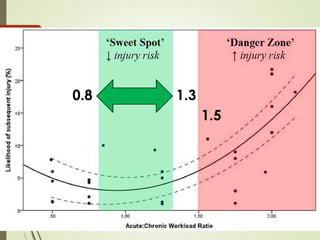
0.8 1.3
1.5
Ozljede!
nos
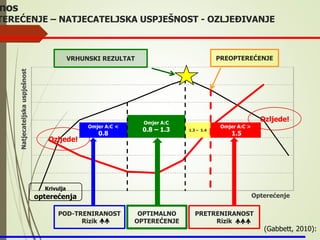
TEREĆENJE – NATJECATELJSKA USPJEŠNOST - OZLJEĐIVANJE
Omjer A:C <
0.8
Omjer A:C
0.8 – 1.3 1.3 – 1.4
Omjer A:C >
1.5
Natjecateljskauspješnost
POD-TRENIRANOST
Rizik
OPTIMALNO
OPTEREĆENJE
PRETRENIRANOST
Rizik
Ozljede!
Opterećenje
Krivulja
opterećenja
VRHUNSKI REZULTAT PREOPTEREĆENJE
(Gabbett, 2010):
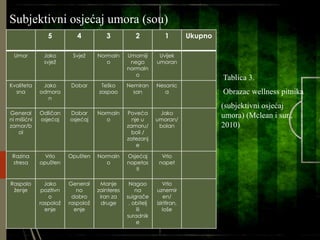
Subjektivni osjećaj umora (sou)
Tablica 3.
Obrazac wellness pitnika
(subjektivni osjećaj
umora) (Mclean i sur.,
2010)
5 4 3 2 1 Ukupno
Umor Jako
svjež
Svjež Normaln
o
Umorniji
nego
normaln
o
Uvijek
umoran
Kvaliteta
sna
Jako
odmora
n
Dobar Teško
zaspao
Nemiran
san
Nesanic
a
General
ni mišićni
zamor/b
ol
Odličan
osjećaj
Dobar
osjećaj
Normaln
o
Poveća
nje u
zamoru/
boli /
zatezanj
e
Jako
umoran/
bolan
Razina
stresa
Vrlo
opušten
Opušten Normaln
o
Osjećaj
napetos
ti
Vrlo
napet
Raspolo
ženje
Jako
pozitivn
o
raspolož
enje
General
no
dobro
raspolož
enje
Manje
zainteres
iran za
druge
Nagao
na
suigrače
, obitelj
ili
suradnik
e
Vrlo
uznemir
en/
iziritiran,
loše
16,85
17,73
0
18,1 17,86
19,5
0
5
10
15
20
25
PON UTO SRI ČET PET SUB
SOU
375
630
0
431
371
750
0
100
200
300
400
500
600
700
800
PON UTO SRI ČET PET NED
SOO
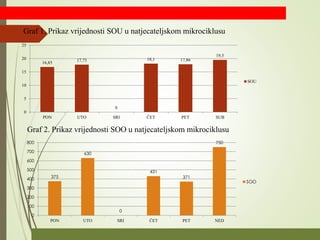
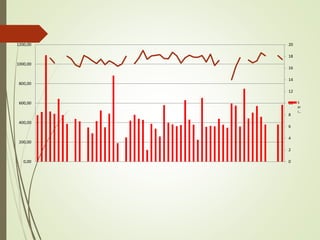
Graf 1. Prikaz vrijednosti SOU u natjecateljskom mikrociklusu
Graf 2. Prikaz vrijednosti SOO u natjecateljskom mikrociklusu
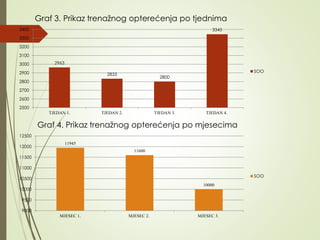
Graf 4. Prikaz trenažnog opterećenja po mjesecima
Graf 3. Prikaz trenažnog opterećenja po tjednima
2963
2833
2800
3345
2500
2600
2700
2800
2900
3000
3100
3200
3300
3400
TJEDAN 1. TJEDAN 2. TJEDAN 3. TJEDAN 4.
SOO
11945
11600
10000
9000
9500
10000
10500
11000
11500
12000
12500
MJESEC 1. MJESEC 2. MJESEC 3.
SOO
0
2
4
6
8
10
12
14
16
18
20
0,00
200,00
400,00
600,00
800,00
1000,00
1200,00
S
er
i…
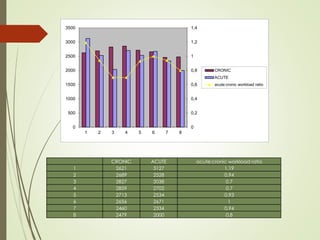
CRONIC ACUTE acute:cronic workload ratio
1 2621 3127 1,19
2 2689 2528 0,94
3 2827 2038 0,7
4 2859 2702 0,7
5 2713 2534 0,93
6 2656 2671 1
7 2460 2334 0,94
8 2479 2000 0,8
0
0,2
0,4
0,6
0,8
1
1,2
1,4
0
500
1000
1500
2000
2500
3000
3500
1 2 3 4 5 6 7 8
CRONIC
ACUTE
acute:cronic workload ratio
pon uto čet pet
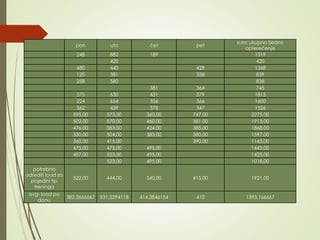
sum: ukupno tjedno
opterečenje
248 882 189 1319
420 420
480 440 428 1348
120 381 338 839
258 580 838
381 364 745
375 630 431 379 1815
224 654 356 366 1600
362 439 378 347 1526
595,00 573,00 360,00 747,00 2275,00
502,00 570,00 460,00 381,00 1913,00
476,00 583,00 424,00 385,00 1868,00
330,00 504,00 383,00 380,00 1597,00
360,00 415,00 390,00 1165,00
475,00 475,00 495,00 1445,00
407,00 523,00 495,00 1425,00
523,00 495,00 1018,00
potrebno
odrediti load za
pojedini tip
treninga
522,00 444,00 540,00 415,00 1921,00
avg- load po
danu
382,2666667 531,5294118 414,3846154 410 1393,166667
What are the findings?
 ▸ Dogma exists around the effects of high (and low) training
 loads on injury.
 ▸ This review highlights the positive and negative effects of
 high training loads on injury risk, fitness and thus,
 performance.
 ▸ There is a relationship between high training loads and
 injuries but well-developed physical qualities protect against
 injury.
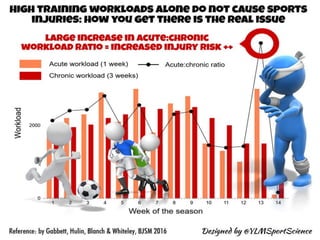
 ▸ The ratio of acute to chronic training load is a better
 predictor of injury than acute or chronic loads in isolation.
How might it impact on
clinical practice in the future?
 ▸ In many high performance settings, training loads are
 reported on a week-to-week basis. Recording acute and
 chronic training loads, and modelling the acute:chronic
 workload ratio allows practitioners to determine if athletes
 are in a state of ‘fitness’ (ie, net training recovery, lower
 than average risk of injury) or ‘fatigue’ (ie, net training
 stress, higher than average risk of injury).
 ▸ The Training-Injury Prevention Paradox Model allows
 practitioners to monitor and prescribe training to team sport
 athletes on an individual basis.
 ▸ Providing evidence around the effects of acute and chronic
 training load on injury risk, physical fitness and performance
 will allow practitioners to systematically prescribe high
 training loads while minimising the risk of athletes
 sustaining a ‘load-related’ injury.
HVALA NA PAŽNJI
 LITERATURA:
 Kelly V., Coutts A.J. (2007). Plannig and monitoring
training loads during the competition phase in team
sports. Strenght an conditioning journal, 29, 32-37.
 Mclean M.D., Coutts A.J., Kelly V., McGuigan M.R.,
Cormack S.J. (2010). Neuromuscular, Endocrine and
perceptual fatigueresponese during differen tlenght
between – Match microcycles in professional rugby
league players. Human Kinetics, 5, 367-383
E-mail:
m.matusinskij@gmail.com

TRAINING INJURY PREVENTION PARADOX

  • 1.
    PROGRAMIRANJE TRENINGA KONDICIJSKE PRIPREMESPORTAŠA „The training-injury prevention paradox: should athletes be training smarter and harder?” Marko Matušinskij mag.cin
  • 2.
  • 3.
  • 4.
    „Paradoks treninga i prevencijeozljeda”  Fitnes Umor  VELIKA TRENAŽNA OPTEREĆENJA Poboljšanje sposobnosti Povećanje broja i težine ozljeda
  • 5.
    Znanost o tomekaže…  Nekoliko studija istraživalo je utjecaj  Volumena treninga  Intenziteta i  Frekvencije na natjecateljsku uspješnost POBOLJŠANJE 1. Foster C, Daniels JT, Yarbrough RA. Physiological and training correlates of marathon running performance. Aust J Sports Med 1977;9:58–61. 5 2. Krebs PS, Zinkgraf S, Virgilio SJ. Predicting competitive bicycling performance with training and physiological variables. J Sports Med Phys Fit 1986;26:323–30. 3. Mujika I, Chatard JC, Busso T, et al. Effects of training on performance in competitive swimming. Can J Appl Physiol 1995;20:395–406. Mujika I, Busso T, LaCoste L, et al. Modeled responses to training and taper in competitive swimmers. Med Sci Sports Exerc 1996;28:251–8. 4. Scrimgeour AG, Noakes TD, Adams B, et al. The influence of weekly training distance on fractional utilization of maximum aerobic capacity in marathon and ultramarathon runners. Eur J Appl Physiol 1986;55:202–9. 5. Stewart AM, Hopkins WG. Seasonal training and performance of competitive swimmers. J Sports Sci 2000;18:873–84. 6. Foster C. Monitoring training in athletes with reference to overtraining syndrome. Med Sci Sports Exerc 1998;30:1164–8.
  • 6.
    1. Foster C.Monitoring training in athletes with reference to overtraining syndrome.Med Sci Sports Exerc 1998;30:1164–8. 2. Gabbett TJ. Influence of training and match intensity on injuries in rugby league.J Sports Sci 2004;22:409–17. 3. Huxley DJ, O’Connor D, Healey PA. An examination of the training profiles and injuries in elite youth track and field athletes. Eur J Sport Sci 2014;14:185–92. 4. Colby MJ, Dawson B, Heasman J, et al. Accelerometer and GPS-derived running loads and injury risk in elite Australian footballers. J Strength Cond Res 2014;28:2244–52. 5. Cross MJ, Williams S, Trewartha G, et al. The influence of in-season training loads on injury risk in professional rugby union. Int J Sports Physiol Perform 2015 (in press). 6. Anderson L, Triplett-McBride T, Foster C, et al. Impact of training patterns on incidence of illness and injury during a women’s collegiate basketball season. J Strength Cond Res 2003;17:734–8.  Suprotno tome, istraživanja su utvrdila i da je NAJVEĆI BROJ OZLJEDA TE BOLESTI u sportaša prisutan pri velikim opterećenjima
  • 7.
    Figure 1 Hypotheticalrelationship between training loads, fitness, injuries and performance. Redrawn from Orchard.1
  • 8.
    ODNOS TRENAŽNOG OPTEREĆENJAi OZLJEĐIVANJA Pravilo 10% Nespecifičnost!!! Promjena opterećenja po tjednu (%) Vjerojatnostodozljeđivanja
  • 9.
    Vjerojatnostozljeđivanja Tjedno trenažno opterećenje(jedinice) 0.0 Odnos između trenažnog opterećenja, faze treninga i vjerojatnosti ozljeđivanja u vrhunskih sportaša timskih sportova (Gabbett, 2010) 0.2 0.4 0.6 0.8 1.0 0 2000 4000 6000 8000 Predsezona Rana natjecanja Kasna natjecanja
  • 10.
    Subjektivni osjećaj opterećenja(soo) Tablica 1. Borgova CR10 skala modificirana prema Fosteru i sur. (1995). Ocjena Opis 0 Odmoran 1 Vrlo, vrlo lagano 2 Lagano 3 Umjereno 4 Donekle teško 5 Teško 6 7 Vrlo teško 8 9 10 Maksimalno The athlete’s preception of effort 1-10 ratings 30’ after the training Arbitrary units (rate x minutes of training) 300-500 au – lower intensities sessions 700-1000 au – higher intensities sessions
  • 11.
    Odnos između trenažnogopterećenja i broja ozljeda u sportaša u timskim sportovima. Trenažna opterećenja mjerena su subjektivnom procjenom opterećenja (RPE upitnikom) na svakom treningu (Gabbet, 2004a 11) 0 100 200 300 400 Trenažnoopterećenje(AJ) Količinaozljeda(na1000sati) 300 250 200 150 100 0 50 Trenažno opterećenje Pojavnost ozljeda
  • 13.
    Utjecaj smanjenja trenažnihopterećenja u PREDSEZONI na količinu ozljeda i aerobnu pripremljenost sportaša u timskim sportovima. Trenažna opterećenja mjerena su subjektivnom procjenom opterećenja (RPE upitnikom) na svakom treningu (Gabbet, 2004b 37) 150 200 250 300 350 2001 2002 2003 Sezona Trenažnoopterećenje(jedinice) 60 80 100 120 140 160 180 2001 2002 2003 Količinaozljeda(na1000sati) Sezona 0 2 4 6 8 2001 2002 2003 DeltaVO2max(ml.kg.min) Sezona
  • 14.
  • 15.
    Ozljede! nos TEREĆENJE – NATJECATELJSKAUSPJEŠNOST - OZLJEĐIVANJE Omjer A:C < 0.8 Omjer A:C 0.8 – 1.3 1.3 – 1.4 Omjer A:C > 1.5 Natjecateljskauspješnost POD-TRENIRANOST Rizik OPTIMALNO OPTEREĆENJE PRETRENIRANOST Rizik Ozljede! Opterećenje Krivulja opterećenja VRHUNSKI REZULTAT PREOPTEREĆENJE (Gabbett, 2010):
  • 18.
    Subjektivni osjećaj umora(sou) Tablica 3. Obrazac wellness pitnika (subjektivni osjećaj umora) (Mclean i sur., 2010) 5 4 3 2 1 Ukupno Umor Jako svjež Svjež Normaln o Umorniji nego normaln o Uvijek umoran Kvaliteta sna Jako odmora n Dobar Teško zaspao Nemiran san Nesanic a General ni mišićni zamor/b ol Odličan osjećaj Dobar osjećaj Normaln o Poveća nje u zamoru/ boli / zatezanj e Jako umoran/ bolan Razina stresa Vrlo opušten Opušten Normaln o Osjećaj napetos ti Vrlo napet Raspolo ženje Jako pozitivn o raspolož enje General no dobro raspolož enje Manje zainteres iran za druge Nagao na suigrače , obitelj ili suradnik e Vrlo uznemir en/ iziritiran, loše
  • 19.
    16,85 17,73 0 18,1 17,86 19,5 0 5 10 15 20 25 PON UTOSRI ČET PET SUB SOU 375 630 0 431 371 750 0 100 200 300 400 500 600 700 800 PON UTO SRI ČET PET NED SOO Graf 1. Prikaz vrijednosti SOU u natjecateljskom mikrociklusu Graf 2. Prikaz vrijednosti SOO u natjecateljskom mikrociklusu
  • 20.
    Graf 4. Prikaztrenažnog opterećenja po mjesecima Graf 3. Prikaz trenažnog opterećenja po tjednima 2963 2833 2800 3345 2500 2600 2700 2800 2900 3000 3100 3200 3300 3400 TJEDAN 1. TJEDAN 2. TJEDAN 3. TJEDAN 4. SOO 11945 11600 10000 9000 9500 10000 10500 11000 11500 12000 12500 MJESEC 1. MJESEC 2. MJESEC 3. SOO
  • 21.
  • 22.
    CRONIC ACUTE acute:cronicworkload ratio 1 2621 3127 1,19 2 2689 2528 0,94 3 2827 2038 0,7 4 2859 2702 0,7 5 2713 2534 0,93 6 2656 2671 1 7 2460 2334 0,94 8 2479 2000 0,8 0 0,2 0,4 0,6 0,8 1 1,2 1,4 0 500 1000 1500 2000 2500 3000 3500 1 2 3 4 5 6 7 8 CRONIC ACUTE acute:cronic workload ratio
  • 23.
    pon uto četpet sum: ukupno tjedno opterečenje 248 882 189 1319 420 420 480 440 428 1348 120 381 338 839 258 580 838 381 364 745 375 630 431 379 1815 224 654 356 366 1600 362 439 378 347 1526 595,00 573,00 360,00 747,00 2275,00 502,00 570,00 460,00 381,00 1913,00 476,00 583,00 424,00 385,00 1868,00 330,00 504,00 383,00 380,00 1597,00 360,00 415,00 390,00 1165,00 475,00 475,00 495,00 1445,00 407,00 523,00 495,00 1425,00 523,00 495,00 1018,00 potrebno odrediti load za pojedini tip treninga 522,00 444,00 540,00 415,00 1921,00 avg- load po danu 382,2666667 531,5294118 414,3846154 410 1393,166667
  • 25.
    What are thefindings?  ▸ Dogma exists around the effects of high (and low) training  loads on injury.  ▸ This review highlights the positive and negative effects of  high training loads on injury risk, fitness and thus,  performance.  ▸ There is a relationship between high training loads and  injuries but well-developed physical qualities protect against  injury.  ▸ The ratio of acute to chronic training load is a better  predictor of injury than acute or chronic loads in isolation.
  • 26.
    How might itimpact on clinical practice in the future?  ▸ In many high performance settings, training loads are  reported on a week-to-week basis. Recording acute and  chronic training loads, and modelling the acute:chronic  workload ratio allows practitioners to determine if athletes  are in a state of ‘fitness’ (ie, net training recovery, lower  than average risk of injury) or ‘fatigue’ (ie, net training  stress, higher than average risk of injury).  ▸ The Training-Injury Prevention Paradox Model allows  practitioners to monitor and prescribe training to team sport  athletes on an individual basis.  ▸ Providing evidence around the effects of acute and chronic  training load on injury risk, physical fitness and performance  will allow practitioners to systematically prescribe high  training loads while minimising the risk of athletes  sustaining a ‘load-related’ injury.
  • 27.
    HVALA NA PAŽNJI LITERATURA:  Kelly V., Coutts A.J. (2007). Plannig and monitoring training loads during the competition phase in team sports. Strenght an conditioning journal, 29, 32-37.  Mclean M.D., Coutts A.J., Kelly V., McGuigan M.R., Cormack S.J. (2010). Neuromuscular, Endocrine and perceptual fatigueresponese during differen tlenght between – Match microcycles in professional rugby league players. Human Kinetics, 5, 367-383 E-mail: m.matusinskij@gmail.com