TRAFFIC IMPACT
ASSESSMENT
(TIA)
TARIKH: 16 Oktober 2019
TEMPAT: CREaTE, Melaka
MOHD FIKRI BIN HASSAN
BAHAGIAN KEJURUTERAAN TRAFIK
CAWANGAN JALAN
IBU PEJABAT JKR MALAYSIA
INTRODUCTION
TRAFFIC IMPACT ASSESSMENT
(TIA)
BASED ON
GUIDELINES FOR TRAFFIC IMPACT ASSESSMENT
ATJ 38/2018
HISTORY
REAM-GL 10/2011Guidelines forTrafic ImpactAssessment
GUIDELINES FOR TRAFFIC IMPACT ASSESSMENT
ATJ 38/2018
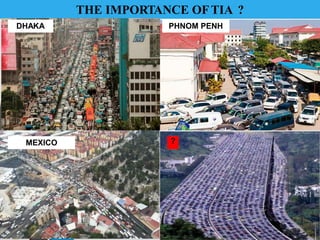
THE IMPORTANCE OFTIA?
When impacts are not accurately projected
through the traffic analysis process, the best
decisions may not be made. Poor decisions
can result in traffic congestion, safety issues,
or unnecessary improvements.
THE IMPORTANCE OFTIA ?
DHAKA PHNOM PENH
MEXICO ?
WHAT IS TIA?
❑ TIA is an important tool used to determine the transportation
and traffic impact of a proposed site development project
(upon full development) on the surrounding traffic and
transportation systems.
❑ It identifies the need for mitigation measures for a
transportation system to reduce congestion, as well as to
maintain or improve road safety.
❑ Local Authorities will use TIA as basis for assessing and
apportioning a developer’s contribution to road improvements.
❑ Local Authorities also will use TIA to evaluate Traffic
Management Plan proposals.
❑ Provides necessary technical input to other relevant reports
such as Environmental Impact Assessment, Social Impact
Assessment, Development Plan (Structure and Local Plan),
Transport Master Plan and the Road Safety Audits.
WHY DO WE NEED TIA?
1. T
o obtain degree of control at access requested by the
private / government entities.
2. T
o determine what type of access required to be
considered and constructed.
3. T
o predetermine future expansion if its required.
4. To offer alternatives solution to traffic improvement as
well as safety measures for the road users.
NOTES :
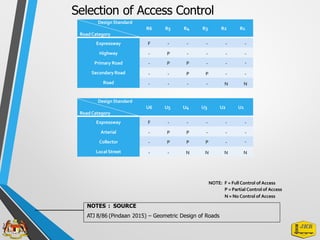
AS PER CLAUSE 2.3 IN ATJ 8/86 (Pindaan 2015) – ACCESS CONTROL
NOTE: F = Full Control of Access
P = Partial Control of Access
N = No Control of Access
NOTES : SOURCE
ATJ 8/86 (Pindaan 2015) – Geometric Design of Roads
Design Standard
U6 U5 U4 U3 U2 U1
RoadCategory
Expressway
Arterial
Collector
Local Street
F - - - - -
- P P - - -
- P P P - -
- - N N N N
Design Standard
R6 R5 R4 R3 R2 R1
RoadCategory
Expressway
Highway
Primary Road
Secondary Road
Road
F - - - - -
- P - - - -
- P P - - -
- - P P - -
- - - - N N
Selection of Access Control
All
ADT ≥ To To To
Volume
Category
Primary Road R5 - - -
- - R4 R3 - -
Expressway U6 - - - -
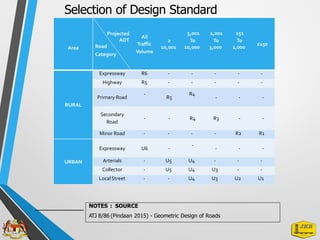
NOTES : SOURCE
ATJ 8/86 (Pindaan 2015) - Geometric Design of Roads
Area
Projected 3,001 1,001 151
Road Traffic
10,001 10,000 3,000 1,000
≤150
RURAL
Expressway R6 - - - - -
Highway R5 - - - - -
- R4
Secondary
Road
Minor Road - - - - R2 R1
URBAN
-
Arterials - U5 U4 - - -
Collector - U5 U4 U3 - -
LocalStreet - - U4 U3 U2 U1
Selection of Design Standard
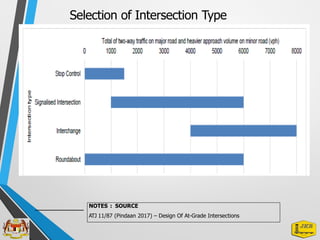
NOTES : SOURCE
ATJ 11/87 (Pindaan 2017) – Design Of At-Grade Intersections
Selection of Intersection Type
RELEV
ANT LA
W / REGULATION
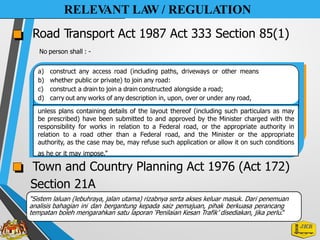
Road Transport Act 1987 Act 333 Section 85(1)
No person shall : -
a) construct any access road (including paths, driveways or other means
b) whether public or private) to join any road:
c) construct a drain to join a drain constructed alongside a road;
d) carry out any works of any description in, upon, over or under any road,
Town and Country Planning Act 1976 (Act 172)
Section 21A
“Sistem laluan (lebuhraya, jalan utama) rizabnya serta akses keluar masuk. Dari penemuan
analisis bahagian ini dan bergantung kepada saiz pemajuan, pihak berkuasa perancang
tempatan boleh mengarahkan satu laporan ‘Penilaian Kesan Trafik’ disediakan, jika perlu.”
unless plans containing details of the layout thereof (including such particulars as may
be prescribed) have been submitted to and approved by the Minister charged with the
responsibility for works in relation to a Federal road, or the appropriate authority in
relation to a road other than a Federal road, and the Minister or the appropriate
authority, as the case may be, may refuse such application or allow it on such conditions
as he or it may impose.”
RELEV
ANT LA
W / REGULATION
T
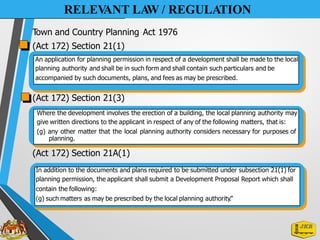
own and Country Planning Act 1976
(Act 172) Section 21(1)
(Act 172) Section 21(3)
planning.
(Act 172) Section 21A(1)
In addition to the documents and plans required to be submitted under subsection 21(1) for
planning permission, the applicant shall submit a Development Proposal Report which shall
contain the following:
(g) such matters as may be prescribed by the local planning authority.”
Where the development involves the erection of a building, the local planning authority may
give written directions to the applicant in respect of any of the following matters, that is:
(g) any other matter that the local planning authority considers necessary for purposes of
An application for planning permission in respect of a development shall be made to the local
planning authority and shall be in such form and shall contain such particulars and be
accompanied by such documents, plans, and fees as may be prescribed.
Berdasarkan Seksyen 5 (Akta Perwakilan Kuasa 1956: Akta 358), Menteri
mewakilkan kuasanya di bawah Seksyen 85: Akta Pengangkutan Jalan 1987
berkenaan Jalan Persekutuan kepada Pegawai yang diperturunkan bagi
meluluskan permohonan untuk membina jalan masuk ke Jalan Persekutuan
kepada Pengarah Negeri melalui Warta Kerajaan P.U. (B) 44.
RELEV
ANT LA
W / REGULATION
ATJ 3/2011 Garis Panduan Untuk Memproses
Permohonan
Persekutuan
Pembangunan T
epi Jalan
[RSD]
Klausa 1.3 Pegawai Yang Diberi Kuasa Meluluskan Permohonan
Penetapan jenis persimpangan yang diadakan mestilah atau berasaskan kepada
jumlah lalulintas yang akan dijanakan. Untuk skim pembangunan yang
melibatkan lebih daripada 200 unit dwellers atau 4,100 meter persegi
keluasan lantai kasar (gross floor area) pembangunan komersial, satu
laporan penilaian impak lalulintas oleh Jurutera Profesional wajib disediakan.
Klausa 2.1.7 - Polisi Am (Pembangunan Tepi Jalan)
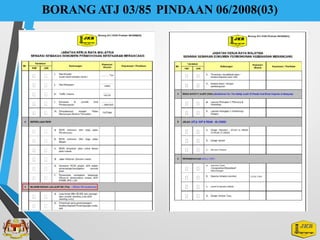
BORANGATJ 03/85 PINDAAN 06/2008(03)
PARTIES INVOLVED IN TIA
1. Developer
2. ApprovingAuthority
3. Traffic EngineeringConsultant
PARTIES INVOLVED IN TIA - Developer
1. Responsible for engaging aTraffic EngineeringConsultant to carry out
theTIA for his development or re-development.
2. Developer shall liaise withApprovingAuthority at the early stage of
planning the development in order to ensure that the type and scale of
the proposal is suitable for the site under consideration.
3. They must also liaise with road and transport authorities to
demonstrate the traffic planning for the development and to identify
any possible adverse traffic impacts.
4. Traffic EngineeringConsultant should be appointed by Developer at the
planning stage of the project so that professional inputs with regards
to traffic issues can be used by the planners/architects to develop the
preliminary site/layout plans.
5. Developer shall not influence or interfere with the professional work of
theTraffic EngineeringConsultant.
6. Developer shall implement the infrastructure improvement and
mitigation measures as required byApprovingAuthority.
PARTIES INVOLVED IN TIA - Approving Authority
1. Approving Authority has a regulatory role in the TIA process in relation to
land-use planning, and roads and transport infrastructure development.
It should encourage pre-application discussions with the Developer or Traffic
Engineering Consultant to steer the TIA study, identify the Study Area,
including giving direction on sources of information, good practice advice,
and clear guidance on what the Developer or Traffic Engineering Consultant
may be expected to provide in accordance with transport strategy of the
authority.
The TIA report will provide Approving Authority with the relevant input,
relating to traffic situation forecast and mitigation measures, for Authority’s
consideration of Developer’s application for planning permission approval.
Where appropriate, Approving Authority may use information in the TIA
report as a basis for determining the cost sharing of future infrastructure
improvements between developers.
Where an Approving Authority does not have in-house capacity to evaluate
the TIA report, it may engage an independent Traffic Engineering
Consultant to evaluate or review the reports on its behalf.
2.
3.
4.
5.
PARTIES INVOLVED IN TIA- T.E.C
1. Traffic EngineeringConsultant can be a Professional Engineer
with PractisingCertificate (PEPC) or a team of specialists in a
firm led by a qualified PEPC.
Traffic EngineeringConsultant who has been commissioned
by the Developer to carry out theTIA shall act independently
and professionally, without interference or influence from
any party.Traffic EngineeringConsultant shall directly or
indirectly look after the interests of the general public and
the local community.
Traffic EngineeringConsultant shall evaluate the planning
and design of the project in promoting sustainablemodes of
transportation.Optimisation of road capacity by means of
traffic management measures should be carefully studied
and taken into consideration.
2.
3.
CRITERIAFOR THEAPPOINTMENT OFTRAFFIC
ENGINEERING CONSULTANT
1. A qualifiedCivil Engineer specializing in traffic/ highway/
transport engineeringwho is registered with the Board of
Engineers, Malaysia as a PEPC;
2. have minimum of six (6) years’ experience in traffic engineering, of
which a minimum of three (3) years’ experience inTraffic Impact
Assessment (TIA); and
3. have attended a formal training course inTrafficStudy/TIA e.g.:
Course onTIA,TrafficStudy,TripGeneration Manual,Traffic
EngineeringSoftware and others that are organized by the Board
of Engineer Malaysia (BEM), PublicWorks DepartmentMalaysia
(JKR), or other approvedby BEM/JKR such as the Highway
PlanningDivision (HPD)Ministry ofWorks, Malaysian Highway
Authority (LLM), Institute of Engineers Malaysia(IEM), Institute of
Higher Learning, Malaysiaand Road EngineeringAssociation
Malaysia (REAM).
REGISTRATION OFTRAFFIC ENGINEERING
CONSULTANT FIRM
✓ TheTraffic Engineering Consultant Firm must be
registered with the Ministry of Finance (MOF) under the
Traffic Study (KajianTrafik) code (340202) or the
Transport Network (Kajian Rangkaian Pengangkutan)
code (340201) whichever is applicable or whatever
relevant to traffic engineering as required by MOF.
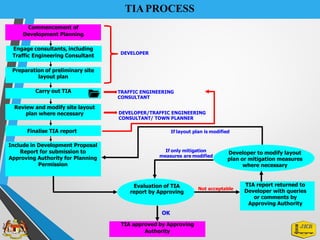
TIAPROCESS
DEVELOPER
TRAFFIC ENGINEERING
CONSULTANT
DEVELOPER/TRAFFIC ENGINEERING
CONSULTANT/ TOWN PLANNER
If layout plan is modified
If only mitigation
measures are modified
Developer to modify layout
plan or mitigation measures
where necessary
Evaluation of TIA
report by Approving
Not acceptable
OK
TIA approved by Approving
Authority
TIA report returned to
Developer with queries
or comments by
Approving Authority
Include in Development Proposal
Report for submission to
Approving Authority for Planning
Permission
Finalise TIA report
Review and modify site layout
plan where necessary
Carry out TIA
Preparation of preliminary site
layout plan
Engage consultants, including
Traffic Engineering Consultant
Commencement of
Development Planning
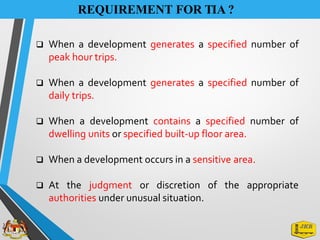
REQUIREMENT FOR TIA ?
❑ When a development generates a specified number of
peak hour trips.
❑ When a development generates a specified number of
daily trips.
❑ When a development contains a specified number of
dwelling units or specified built-up floor area.
❑ When a development occurs in a sensitive area.
❑ At the judgment or discretion of the appropriate
authorities under unusual situation.
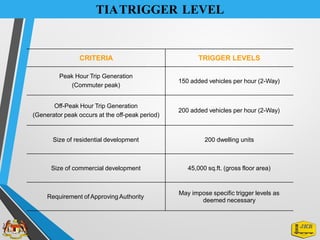
TIATRIGGER LEVEL
deemed necessary
CRITERIA TRIGGER LEVELS
Peak Hour Trip Generation
(Commuter peak)
150 added vehicles per hour (2-Way)
Off-Peak Hour Trip Generation
(Generator peak occurs at the off-peak period)
200 added vehicles per hour (2-Way)
Size of residential development 200 dwelling units
Size of commercial development 45,000 sq.ft. (gross floor area)
Requirement of Approving Authority
May impose specific trigger levels as
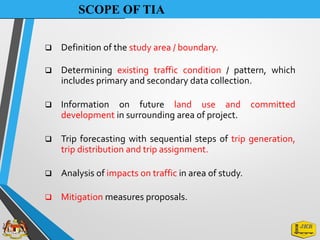
SCOPE OF TIA
❑ Definition of the study area / boundary.
❑ Determining existing traffic condition / pattern, which
includes primary and secondary data collection.
❑ Information on future land use and committed
development in surrounding area of project.
❑ Trip forecasting with sequential steps of trip generation,
trip distribution and trip assignment.
❑ Analysis of impacts on traffic in area of study.
❑ Mitigation measures proposals.
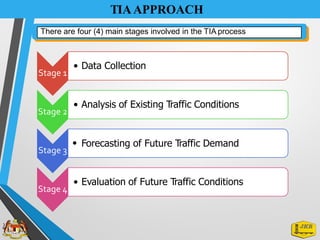
TIAAPPROACH
• Data Collection
Stage 1
• Analysis of Existing Traffic Conditions
Stage 2
• Forecasting of Future Traffic Demand
Stage 3
• Evaluation of Future Traffic Conditions
Stage 4
There are four (4) main stages involved in the TIA process
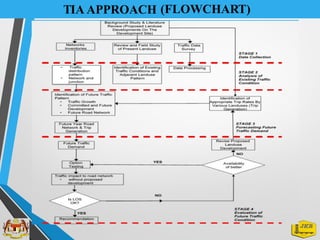
TIA APPROACH
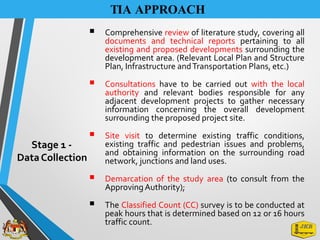
▪ Comprehensive review of literature study, covering all
documents and technical reports pertaining to all
existing and proposed developments surrounding the
development area. (Relevant Local Plan and Structure
Plan, Infrastructure andTransportation Plans, etc.)
▪ Consultations have to be carried out with the local
authority and relevant bodies responsible for any
adjacent development projects to gather necessary
information concerning the overall development
surrounding the proposed project site.
▪ Site visit to determine existing traffic conditions,
existing traffic and pedestrian issues and problems,
and obtaining information on the surrounding road
network, junctions and land uses.
▪ Demarcation of the study area (to consult from the
ApprovingAuthority);
▪ The Classified Count (CC) survey is to be conducted at
peak hours that is determined based on 12 or 16 hours
traffic count.
Stage 1 -
DataCollection
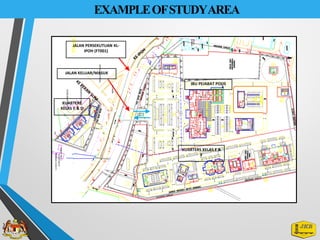
EXAMPLEOFSTUDYAREA
JALAN KELUAR/MASUK
JALAN PERSEKUTUAN KL-
IPOH (FT001)
KUARTERS
KELAS C & D
KUARTERS KELAS E &
F
IBU PEJABAT POLIS
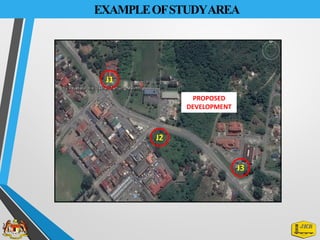
EXAMPLEOFSTUDYAREA
J1
J2
J3
PROPOSED
DEVELOPMENT
TIA APPROACH
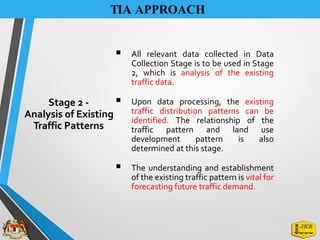
▪ All relevant data collected in Data
Collection Stage is to be used in Stage
2, which is analysis of the existing
traffic data.
▪ Upon data processing, the existing
traffic distribution patterns can be
identified. The relationship of the
traffic pattern and land use
development pattern is also
determined at this stage.
▪ The understanding and establishment
of the existing traffic pattern is vital for
forecasting future traffic demand.
Stage 2 -
Analysis of Existing
Traffic Patterns
TIA APPROACH
▪ In forecasting the future traffic growth in an area,
it is a function of demography which involves the
planning variables such as population growth,
employment supply, vehicle ownership,
committed and future property developments
and future road network.
▪ The future trip generation is calculated based on
the above inputs and empirical trip rates which is
established by the Highway Planning Division,
Ministry of Works Malaysia and other relevant
studies. In forecasting the future traffic, it is
necessary to determine the design year for which
the analysis of future traffic is to be undertaken.
▪ Traffic generated from the proposed and adjacent
developments are overlaid on the design year
traffic forecast to produce the total traffic volume
for the Impact AnalysisYear (IAY).
Stage 3 -
Forecasting
of Future
Traffic
Demand
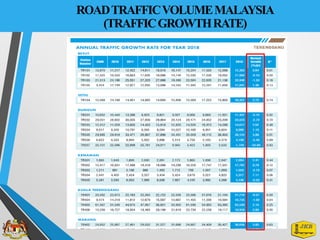
ROADTRAFFICVOLUMEMALAYSIA
(TRAFFICGROWTHRATE)
TIA APPROACH
▪ Road link and intersection capacities have been
assessed to determine whether the envisaged
road network would be able to accommodate the
traffic demand.
▪ Based on the traffic flow forecasts,
recommendations have been made on the
number and locations of ingress/egress points
required to service the full development and the
form of access intersections required.
▪ Possible locations for access points on to the
existing road network need to be suggested,
taking into account the intersection spacing
standards so as to provide an efficient traffic
circulation.
Stage 4 –
Evaluation
of Future
Traffic
Conditions
TIA APPROACH (FLOWCHART)
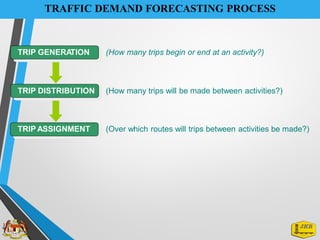
TRAFFIC DEMAND FORECASTING PROCESS
TRIP GENERA
TION (How many trips begin or end at an activity?)
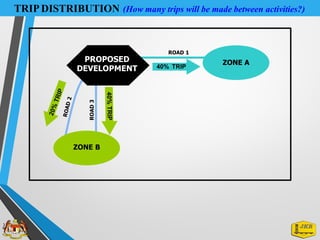
TRIP DISTRIBUTION (How many trips will be made between activities?)
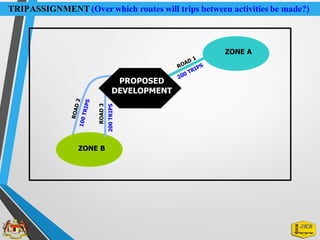
TRIP ASSIGNMENT (Over which routes will trips between activities be made?)
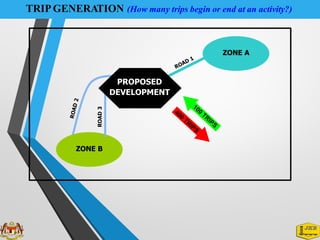
TRIPGENERATION (How many trips begin or end at an activity?)
ROAD
3
ZONE A
PROPOSED
DEVELOPMENT
ZONE B
TRIPGENERATION
TRIPGENERATION
If the site condition differs from that
in Malaysian Trip Generation Manual
(MTGM), then it is necessary to collect
data at sites of similar condition to
produce trip generation rates and
accepted by Approving Authority.
35/
21
TRIP DISTRIBUTION (How many trips will be made between activities?)
PROPOSED ZONE A
ROAD
3
ROAD 1
DEVELOPMENT 40% TRIP
ZONE B
TRIPASSIGNMENT (Over which routes will trips between activities be made?)
ROAD
3
200
TRIPS
ZONE A
PROPOSED
DEVELOPMENT
ZONE B
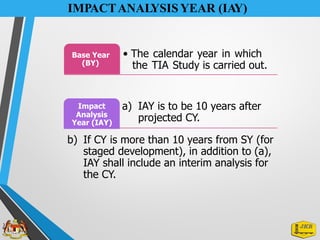
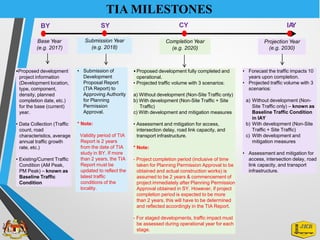
IMPACTANALYSIS YEAR (IAY)
Base Year
(BY)
• The calendar year in which
the TIA Study is carried out.
Impact
Analysis
Year (IAY)
a) IAY is to be 10 years after
projected CY.
b) If CY is more than 10 years from SY (for
staged development), in addition to (a),
IAY shall include an interim analysis for
the CY.
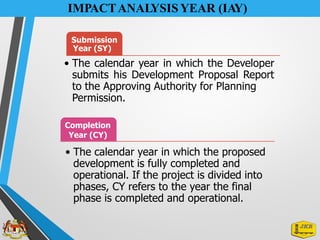
IMPACTANALYSIS YEAR (IAY)
Submission
Year (SY)
• The calendar year in which the Developer
submits his Development Proposal Report
to the Approving Authority for Planning
Permission.
Completion
Year (CY)
• The calendar year in which the proposed
development is fully completed and
operational. If the project is divided into
phases, CY refers to the year the final
phase is completed and operational.
• Proposed development fully completed and
operational.
• Projected traffic volume with 3 scenarios:
a) Without development (Non-Site Traffic only)
b) With development (Non-Site Traffic + Site
Traffic)
c) With development and mitigation measures
• Assessment and mitigation for access,
intersection delay, road link capacity, and
transport infrastructure.
* Note:
- Project completion period (inclusive of time
taken for Planning Permission Approval to be
obtained and actual construction works) is
assumed to be 2 years & commencement of
project immediately after Planning Permission
Approval obtained in SY. However, if project
completion period is expected to be more
than 2 years, this will have to be determined
and reflected accordingly in the TIA Report.
- For staged developments, traffic impact must
be assessed during operational year for each
stage.
•Proposed development
project information
(Development location,
type, component,
density, planned
completion date, etc.)
for the base (current)
year.
• Data Collection (Traffic
count, road
characteristics, average
annual traffic growth
rate, etc.)
• Existing/Current Traffic
Condition (AM Peak,
PM Peak) – known as
Baseline Traffic
Condition
TIA MILESTONES
CY IA
Y
SY
BY
• Forecast the traffic impacts 10
years upon completion.
• Projected traffic volume with 3
scenarios:
a) Without development (Non-
Site Traffic only) – known as
Baseline Traffic Condition
in IAY
b) With development (Non-Site
Traffic + Site Traffic)
c) With development and
mitigation measures
• Assessment and mitigation for
access, intersection delay, road
link capacity, and transport
infrastructure.
• Submission of
Development
Proposal Report
(TIA Report) to
Approving Authority
for Planning
Permission
Approval.
* Note:
Validity period of TIA
Report is 2 years
from the date of TIA
study in BY. If more
than 2 years, the TIA
Report must be
updated to reflect the
latest traffic
conditions of the
locality.
Projection Year
(e.g. 2030)
Completion Year
(e.g. 2020)
Submission Year
(e.g. 2018)
Base Year
(e.g. 2017)
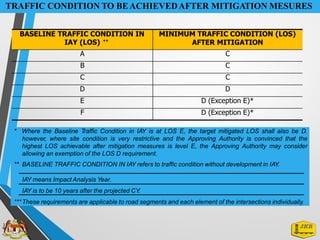
TRAFFIC CONDITION TO BEACHIEVEDAFTER MITIGATION MESURES
* Where the Baseline Traffic Condition in IAY is at LOS E, the target mitigated LOS shall also be D.
however, where site condition is very restrictive and the Approving Authority is convinced that the
highest LOS achievable after mitigation measures is level E, the Approving Authority may consider
allowing an exemption of the LOS D requirement.
** BASELINE TRAFFIC CONDITION IN IAY refers to traffic condition without development in IAY.
IAY means Impact Analysis Year.
IAY is to be 10 years after the projected CY.
***These requirements are applicable to road segments and each element of the intersections individually.
BASELINE TRAFFIC CONDITION IN
IAY (LOS) **
MINIMUM TRAFFIC CONDITION (LOS)
AFTER MITIGATION
A C
B C
C C
D D
E D (Exception E)*
F D (Exception E)*
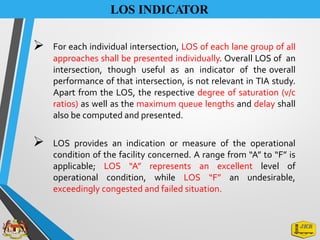
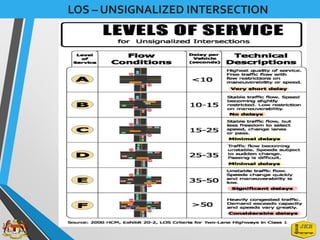
LOS INDICATOR
➢ For each individual intersection, LOS of each lane group of all
approaches shall be presented individually. Overall LOS of an
intersection, though useful as an indicator of the overall
performance of that intersection, is not relevant in TIA study.
Apart from the LOS, the respective degree of saturation (v/c
ratios) as well as the maximum queue lengths and delay shall
also be computed and presented.
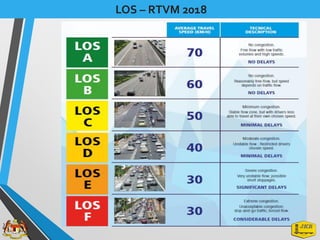
➢ LOS provides an indication or measure of the operational
condition of the facility concerned. A range from “A” to “F” is
applicable; LOS “A” represents an excellent level of
operational condition, while LOS “F” an undesirable,
exceedingly congested and failed situation.
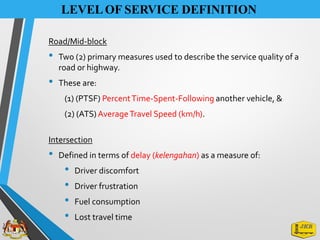
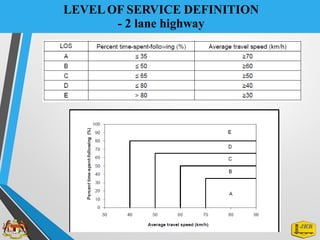
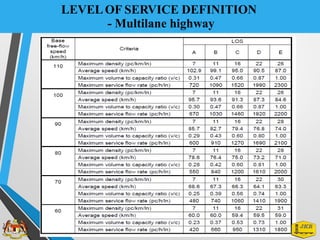
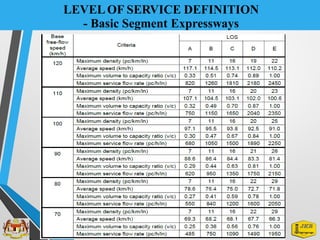
Road/Mid-block
• Two (2) primary measures used to describe the service quality of a
road or highway.
• These are:
(1) (PTSF) PercentTime-Spent-Following another vehicle, &
(2) (ATS)AverageTravel Speed (km/h).
Intersection
• Defined in terms of delay (kelengahan) as a measure of:
• Driver discomfort
• Driver frustration
• Fuel consumption
• Lost travel time
LEVELOF SERVICE DEFINITION
- 2 lane highway
LEVELOF SERVICE DEFINITION
- Multilane highway
LEVELOF SERVICE DEFINITION
- Basic Segment Expressways
LOS – RTVM 2018
LOS – UNSIGNALIZED INTERSECTION
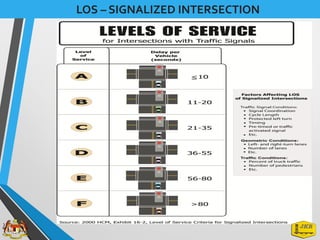
LOS – SIGNALIZED INTERSECTION
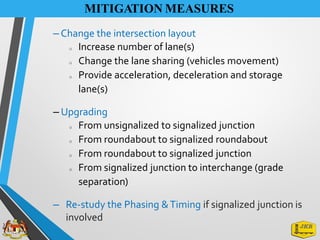
MITIGATION MEASURES
1. Where the analysis shows that there will be negative impact,
mitigation measures must be proposed to upgrade the
road facilities at that location so as to achieve the
requirements set out in this Guideline. This proposal, as decided
by Approving Authority, with the indicative costs of land
acquisition, design and construction of mitigation measure
which shall be borne by the Developer, shall be included in the
submission for the Planning Permission.
2. In developing mitigation measures, possible improvements in
relation to site access, geometry, traffic signal timing, new
facility, traffic management and other operational issues should
be investigated.
3. When reasonable improvements cannot sufficiently mitigate
the resulting impacts from the development, a review of the
proposed development in terms of project size, land use,
development density or plot ratio should be carried out, with a
view to lessen or reduce the level of such impacts to within the
acceptable level.
MITIGATION MEASURES
– Change the intersection layout
o Increase number of lane(s)
o Change the lane sharing (vehicles movement)
o Provide acceleration, deceleration and storage
lane(s)
– Upgrading
o From unsignalized to signalized junction
o From roundabout to signalized roundabout
o From roundabout to signalized junction
o From signalized junction to interchange (grade
separation)
– Re-study the Phasing &Timing if signalized junction is
involved
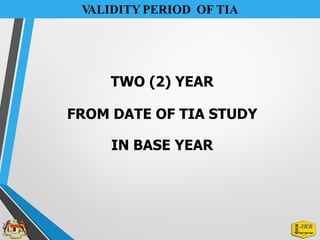
V
ALIDITY PERIOD OF TIA
TWO (2) YEAR
FROM DATE OF TIA STUDY
IN BASE YEAR
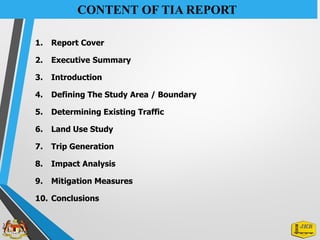
CONTENT OF TIA REPORT
1. Report Cover
2. Executive Summary
3. Introduction
4. Defining The Study Area / Boundary
5. Determining Existing Traffic
6. Land Use Study
7. Trip Generation
8. Impact Analysis
9. Mitigation Measures
10. Conclusions
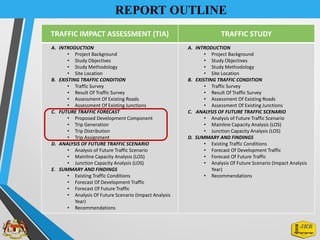
REPORT OUTLINE
TRAFFIC IMPACT ASSESSMENT (TIA) TRAFFIC STUDY
A. INTRODUCTION
• Project Background
• Study Objectives
• Study Methodology
• Site Location
B. EXISTING TRAFFIC CONDITION
• Traffic Survey
• Result Of Traffic Survey
• Assessment Of Existing Roads
• Assessment Of Existing Junctions
C. FUTURE TRAFFIC FORECAST
• Proposed Development Component
• Trip Generation
• Trip Distribution
• Trip Assignment
D. ANALYSIS OF FUTURE TRAFFIC SCENARIO
• Analysis of Future Traffic Scenario
• Mainline Capacity Analysis (LOS)
• Junction Capacity Analysis (LOS)
E. SUMMARY AND FINDINGS
• Existing Traffic Conditions
• Forecast Of Development Traffic
• Forecast Of Future Traffic
• Analysis Of Future Scenario (Impact Analysis
Year)
• Recommendations
A. INTRODUCTION
• Project Background
• Study Objectives
• Study Methodology
• Site Location
B. EXISTING TRAFFIC CONDITION
• Traffic Survey
• Result Of Traffic Survey
• Assessment Of Existing Roads
• Assessment Of Existing Junctions
C. ANALYSIS OF FUTURE TRAFFIC SCENARIO
• Analysis of Future Traffic Scenario
• Mainline Capacity Analysis (LOS)
• Junction Capacity Analysis (LOS)
D. SUMMARY AND FINDINGS
• Existing Traffic Conditions
• Forecast Of Development Traffic
• Forecast Of Future Traffic
• Analysis Of Future Scenario (Impact Analysis
Year)
• Recommendations
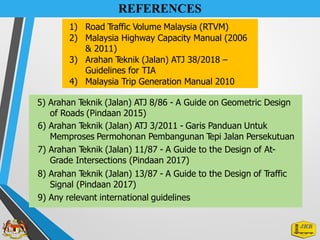
REFERENCES
1) Road Traffic Volume Malaysia (RTVM)
2) Malaysia Highway Capacity Manual (2006
& 2011)
3) Arahan T
eknik (Jalan) ATJ 38/2018 –
Guidelines for TIA
4) Malaysia Trip Generation Manual 2010
5) Arahan T
eknik (Jalan) ATJ 8/86 - A Guide on Geometric Design
of Roads (Pindaan 2015)
6) Arahan T
eknik (Jalan) ATJ 3/2011 - Garis Panduan Untuk
Memproses Permohonan Pembangunan T
epi Jalan Persekutuan
7) Arahan T
eknik (Jalan) 11/87 - A Guide to the Design of At-
Grade Intersections (Pindaan 2017)
8) Arahan T
eknik (Jalan) 13/87 - A Guide to the Design of Traffic
Signal (Pindaan 2017)
9) Any relevant international guidelines
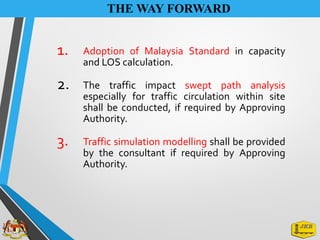
THE WAY FORWARD
1. Adoption of Malaysia Standard in capacity
and LOS calculation.
2. The traffic impact swept path analysis
especially for traffic circulation within site
shall be conducted, if required by Approving
Authority.
3. Traffic simulation modelling shall be provided
by the consultant if required by Approving
Authority.
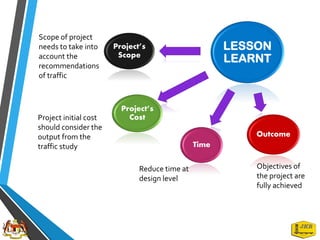
LESSON
LEARNT
Project’s
Scope
Outcome
Time
Project’s
Cost
Project initial cost
should consider the
output from the
traffic study
Scope of project
needs to take into
account the
recommendations
of traffic
Objectives of
the project are
fully achieved
Reduce time at
design level
THANK YOU

TRAFFIC IMOACT ASSESSMENT - AN OVERVIEW.pdf

  • 1.
    TRAFFIC IMPACT ASSESSMENT (TIA) TARIKH: 16Oktober 2019 TEMPAT: CREaTE, Melaka MOHD FIKRI BIN HASSAN BAHAGIAN KEJURUTERAAN TRAFIK CAWANGAN JALAN IBU PEJABAT JKR MALAYSIA
  • 2.
    INTRODUCTION TRAFFIC IMPACT ASSESSMENT (TIA) BASEDON GUIDELINES FOR TRAFFIC IMPACT ASSESSMENT ATJ 38/2018
  • 3.
    HISTORY REAM-GL 10/2011Guidelines forTraficImpactAssessment GUIDELINES FOR TRAFFIC IMPACT ASSESSMENT ATJ 38/2018
  • 4.
    THE IMPORTANCE OFTIA? Whenimpacts are not accurately projected through the traffic analysis process, the best decisions may not be made. Poor decisions can result in traffic congestion, safety issues, or unnecessary improvements.
  • 5.
    THE IMPORTANCE OFTIA? DHAKA PHNOM PENH MEXICO ?
  • 6.
    WHAT IS TIA? ❑TIA is an important tool used to determine the transportation and traffic impact of a proposed site development project (upon full development) on the surrounding traffic and transportation systems. ❑ It identifies the need for mitigation measures for a transportation system to reduce congestion, as well as to maintain or improve road safety. ❑ Local Authorities will use TIA as basis for assessing and apportioning a developer’s contribution to road improvements. ❑ Local Authorities also will use TIA to evaluate Traffic Management Plan proposals. ❑ Provides necessary technical input to other relevant reports such as Environmental Impact Assessment, Social Impact Assessment, Development Plan (Structure and Local Plan), Transport Master Plan and the Road Safety Audits.
  • 7.
    WHY DO WENEED TIA? 1. T o obtain degree of control at access requested by the private / government entities. 2. T o determine what type of access required to be considered and constructed. 3. T o predetermine future expansion if its required. 4. To offer alternatives solution to traffic improvement as well as safety measures for the road users. NOTES : AS PER CLAUSE 2.3 IN ATJ 8/86 (Pindaan 2015) – ACCESS CONTROL
  • 8.
    NOTE: F =Full Control of Access P = Partial Control of Access N = No Control of Access NOTES : SOURCE ATJ 8/86 (Pindaan 2015) – Geometric Design of Roads Design Standard U6 U5 U4 U3 U2 U1 RoadCategory Expressway Arterial Collector Local Street F - - - - - - P P - - - - P P P - - - - N N N N Design Standard R6 R5 R4 R3 R2 R1 RoadCategory Expressway Highway Primary Road Secondary Road Road F - - - - - - P - - - - - P P - - - - - P P - - - - - - N N Selection of Access Control
  • 9.
    All ADT ≥ ToTo To Volume Category Primary Road R5 - - - - - R4 R3 - - Expressway U6 - - - - NOTES : SOURCE ATJ 8/86 (Pindaan 2015) - Geometric Design of Roads Area Projected 3,001 1,001 151 Road Traffic 10,001 10,000 3,000 1,000 ≤150 RURAL Expressway R6 - - - - - Highway R5 - - - - - - R4 Secondary Road Minor Road - - - - R2 R1 URBAN - Arterials - U5 U4 - - - Collector - U5 U4 U3 - - LocalStreet - - U4 U3 U2 U1 Selection of Design Standard
  • 10.
    NOTES : SOURCE ATJ11/87 (Pindaan 2017) – Design Of At-Grade Intersections Selection of Intersection Type
  • 11.
    RELEV ANT LA W /REGULATION Road Transport Act 1987 Act 333 Section 85(1) No person shall : - a) construct any access road (including paths, driveways or other means b) whether public or private) to join any road: c) construct a drain to join a drain constructed alongside a road; d) carry out any works of any description in, upon, over or under any road, Town and Country Planning Act 1976 (Act 172) Section 21A “Sistem laluan (lebuhraya, jalan utama) rizabnya serta akses keluar masuk. Dari penemuan analisis bahagian ini dan bergantung kepada saiz pemajuan, pihak berkuasa perancang tempatan boleh mengarahkan satu laporan ‘Penilaian Kesan Trafik’ disediakan, jika perlu.” unless plans containing details of the layout thereof (including such particulars as may be prescribed) have been submitted to and approved by the Minister charged with the responsibility for works in relation to a Federal road, or the appropriate authority in relation to a road other than a Federal road, and the Minister or the appropriate authority, as the case may be, may refuse such application or allow it on such conditions as he or it may impose.”
  • 12.
    RELEV ANT LA W /REGULATION T own and Country Planning Act 1976 (Act 172) Section 21(1) (Act 172) Section 21(3) planning. (Act 172) Section 21A(1) In addition to the documents and plans required to be submitted under subsection 21(1) for planning permission, the applicant shall submit a Development Proposal Report which shall contain the following: (g) such matters as may be prescribed by the local planning authority.” Where the development involves the erection of a building, the local planning authority may give written directions to the applicant in respect of any of the following matters, that is: (g) any other matter that the local planning authority considers necessary for purposes of An application for planning permission in respect of a development shall be made to the local planning authority and shall be in such form and shall contain such particulars and be accompanied by such documents, plans, and fees as may be prescribed.
  • 13.
    Berdasarkan Seksyen 5(Akta Perwakilan Kuasa 1956: Akta 358), Menteri mewakilkan kuasanya di bawah Seksyen 85: Akta Pengangkutan Jalan 1987 berkenaan Jalan Persekutuan kepada Pegawai yang diperturunkan bagi meluluskan permohonan untuk membina jalan masuk ke Jalan Persekutuan kepada Pengarah Negeri melalui Warta Kerajaan P.U. (B) 44. RELEV ANT LA W / REGULATION ATJ 3/2011 Garis Panduan Untuk Memproses Permohonan Persekutuan Pembangunan T epi Jalan [RSD] Klausa 1.3 Pegawai Yang Diberi Kuasa Meluluskan Permohonan Penetapan jenis persimpangan yang diadakan mestilah atau berasaskan kepada jumlah lalulintas yang akan dijanakan. Untuk skim pembangunan yang melibatkan lebih daripada 200 unit dwellers atau 4,100 meter persegi keluasan lantai kasar (gross floor area) pembangunan komersial, satu laporan penilaian impak lalulintas oleh Jurutera Profesional wajib disediakan. Klausa 2.1.7 - Polisi Am (Pembangunan Tepi Jalan)
  • 14.
  • 15.
    PARTIES INVOLVED INTIA 1. Developer 2. ApprovingAuthority 3. Traffic EngineeringConsultant
  • 16.
    PARTIES INVOLVED INTIA - Developer 1. Responsible for engaging aTraffic EngineeringConsultant to carry out theTIA for his development or re-development. 2. Developer shall liaise withApprovingAuthority at the early stage of planning the development in order to ensure that the type and scale of the proposal is suitable for the site under consideration. 3. They must also liaise with road and transport authorities to demonstrate the traffic planning for the development and to identify any possible adverse traffic impacts. 4. Traffic EngineeringConsultant should be appointed by Developer at the planning stage of the project so that professional inputs with regards to traffic issues can be used by the planners/architects to develop the preliminary site/layout plans. 5. Developer shall not influence or interfere with the professional work of theTraffic EngineeringConsultant. 6. Developer shall implement the infrastructure improvement and mitigation measures as required byApprovingAuthority.
  • 17.
    PARTIES INVOLVED INTIA - Approving Authority 1. Approving Authority has a regulatory role in the TIA process in relation to land-use planning, and roads and transport infrastructure development. It should encourage pre-application discussions with the Developer or Traffic Engineering Consultant to steer the TIA study, identify the Study Area, including giving direction on sources of information, good practice advice, and clear guidance on what the Developer or Traffic Engineering Consultant may be expected to provide in accordance with transport strategy of the authority. The TIA report will provide Approving Authority with the relevant input, relating to traffic situation forecast and mitigation measures, for Authority’s consideration of Developer’s application for planning permission approval. Where appropriate, Approving Authority may use information in the TIA report as a basis for determining the cost sharing of future infrastructure improvements between developers. Where an Approving Authority does not have in-house capacity to evaluate the TIA report, it may engage an independent Traffic Engineering Consultant to evaluate or review the reports on its behalf. 2. 3. 4. 5.
  • 18.
    PARTIES INVOLVED INTIA- T.E.C 1. Traffic EngineeringConsultant can be a Professional Engineer with PractisingCertificate (PEPC) or a team of specialists in a firm led by a qualified PEPC. Traffic EngineeringConsultant who has been commissioned by the Developer to carry out theTIA shall act independently and professionally, without interference or influence from any party.Traffic EngineeringConsultant shall directly or indirectly look after the interests of the general public and the local community. Traffic EngineeringConsultant shall evaluate the planning and design of the project in promoting sustainablemodes of transportation.Optimisation of road capacity by means of traffic management measures should be carefully studied and taken into consideration. 2. 3.
  • 19.
    CRITERIAFOR THEAPPOINTMENT OFTRAFFIC ENGINEERINGCONSULTANT 1. A qualifiedCivil Engineer specializing in traffic/ highway/ transport engineeringwho is registered with the Board of Engineers, Malaysia as a PEPC; 2. have minimum of six (6) years’ experience in traffic engineering, of which a minimum of three (3) years’ experience inTraffic Impact Assessment (TIA); and 3. have attended a formal training course inTrafficStudy/TIA e.g.: Course onTIA,TrafficStudy,TripGeneration Manual,Traffic EngineeringSoftware and others that are organized by the Board of Engineer Malaysia (BEM), PublicWorks DepartmentMalaysia (JKR), or other approvedby BEM/JKR such as the Highway PlanningDivision (HPD)Ministry ofWorks, Malaysian Highway Authority (LLM), Institute of Engineers Malaysia(IEM), Institute of Higher Learning, Malaysiaand Road EngineeringAssociation Malaysia (REAM).
  • 20.
    REGISTRATION OFTRAFFIC ENGINEERING CONSULTANTFIRM ✓ TheTraffic Engineering Consultant Firm must be registered with the Ministry of Finance (MOF) under the Traffic Study (KajianTrafik) code (340202) or the Transport Network (Kajian Rangkaian Pengangkutan) code (340201) whichever is applicable or whatever relevant to traffic engineering as required by MOF.
  • 21.
    TIAPROCESS DEVELOPER TRAFFIC ENGINEERING CONSULTANT DEVELOPER/TRAFFIC ENGINEERING CONSULTANT/TOWN PLANNER If layout plan is modified If only mitigation measures are modified Developer to modify layout plan or mitigation measures where necessary Evaluation of TIA report by Approving Not acceptable OK TIA approved by Approving Authority TIA report returned to Developer with queries or comments by Approving Authority Include in Development Proposal Report for submission to Approving Authority for Planning Permission Finalise TIA report Review and modify site layout plan where necessary Carry out TIA Preparation of preliminary site layout plan Engage consultants, including Traffic Engineering Consultant Commencement of Development Planning
  • 22.
    REQUIREMENT FOR TIA? ❑ When a development generates a specified number of peak hour trips. ❑ When a development generates a specified number of daily trips. ❑ When a development contains a specified number of dwelling units or specified built-up floor area. ❑ When a development occurs in a sensitive area. ❑ At the judgment or discretion of the appropriate authorities under unusual situation.
  • 23.
    TIATRIGGER LEVEL deemed necessary CRITERIATRIGGER LEVELS Peak Hour Trip Generation (Commuter peak) 150 added vehicles per hour (2-Way) Off-Peak Hour Trip Generation (Generator peak occurs at the off-peak period) 200 added vehicles per hour (2-Way) Size of residential development 200 dwelling units Size of commercial development 45,000 sq.ft. (gross floor area) Requirement of Approving Authority May impose specific trigger levels as
  • 24.
    SCOPE OF TIA ❑Definition of the study area / boundary. ❑ Determining existing traffic condition / pattern, which includes primary and secondary data collection. ❑ Information on future land use and committed development in surrounding area of project. ❑ Trip forecasting with sequential steps of trip generation, trip distribution and trip assignment. ❑ Analysis of impacts on traffic in area of study. ❑ Mitigation measures proposals.
  • 25.
    TIAAPPROACH • Data Collection Stage1 • Analysis of Existing Traffic Conditions Stage 2 • Forecasting of Future Traffic Demand Stage 3 • Evaluation of Future Traffic Conditions Stage 4 There are four (4) main stages involved in the TIA process
  • 26.
    TIA APPROACH ▪ Comprehensivereview of literature study, covering all documents and technical reports pertaining to all existing and proposed developments surrounding the development area. (Relevant Local Plan and Structure Plan, Infrastructure andTransportation Plans, etc.) ▪ Consultations have to be carried out with the local authority and relevant bodies responsible for any adjacent development projects to gather necessary information concerning the overall development surrounding the proposed project site. ▪ Site visit to determine existing traffic conditions, existing traffic and pedestrian issues and problems, and obtaining information on the surrounding road network, junctions and land uses. ▪ Demarcation of the study area (to consult from the ApprovingAuthority); ▪ The Classified Count (CC) survey is to be conducted at peak hours that is determined based on 12 or 16 hours traffic count. Stage 1 - DataCollection
  • 27.
    EXAMPLEOFSTUDYAREA JALAN KELUAR/MASUK JALAN PERSEKUTUANKL- IPOH (FT001) KUARTERS KELAS C & D KUARTERS KELAS E & F IBU PEJABAT POLIS
  • 28.
  • 29.
    TIA APPROACH ▪ Allrelevant data collected in Data Collection Stage is to be used in Stage 2, which is analysis of the existing traffic data. ▪ Upon data processing, the existing traffic distribution patterns can be identified. The relationship of the traffic pattern and land use development pattern is also determined at this stage. ▪ The understanding and establishment of the existing traffic pattern is vital for forecasting future traffic demand. Stage 2 - Analysis of Existing Traffic Patterns
  • 30.
    TIA APPROACH ▪ Inforecasting the future traffic growth in an area, it is a function of demography which involves the planning variables such as population growth, employment supply, vehicle ownership, committed and future property developments and future road network. ▪ The future trip generation is calculated based on the above inputs and empirical trip rates which is established by the Highway Planning Division, Ministry of Works Malaysia and other relevant studies. In forecasting the future traffic, it is necessary to determine the design year for which the analysis of future traffic is to be undertaken. ▪ Traffic generated from the proposed and adjacent developments are overlaid on the design year traffic forecast to produce the total traffic volume for the Impact AnalysisYear (IAY). Stage 3 - Forecasting of Future Traffic Demand
  • 31.
  • 32.
    TIA APPROACH ▪ Roadlink and intersection capacities have been assessed to determine whether the envisaged road network would be able to accommodate the traffic demand. ▪ Based on the traffic flow forecasts, recommendations have been made on the number and locations of ingress/egress points required to service the full development and the form of access intersections required. ▪ Possible locations for access points on to the existing road network need to be suggested, taking into account the intersection spacing standards so as to provide an efficient traffic circulation. Stage 4 – Evaluation of Future Traffic Conditions
  • 33.
  • 34.
    TRAFFIC DEMAND FORECASTINGPROCESS TRIP GENERA TION (How many trips begin or end at an activity?) TRIP DISTRIBUTION (How many trips will be made between activities?) TRIP ASSIGNMENT (Over which routes will trips between activities be made?)
  • 35.
    TRIPGENERATION (How manytrips begin or end at an activity?) ROAD 3 ZONE A PROPOSED DEVELOPMENT ZONE B
  • 36.
  • 37.
    TRIPGENERATION If the sitecondition differs from that in Malaysian Trip Generation Manual (MTGM), then it is necessary to collect data at sites of similar condition to produce trip generation rates and accepted by Approving Authority. 35/ 21
  • 38.
    TRIP DISTRIBUTION (Howmany trips will be made between activities?) PROPOSED ZONE A ROAD 3 ROAD 1 DEVELOPMENT 40% TRIP ZONE B
  • 39.
    TRIPASSIGNMENT (Over whichroutes will trips between activities be made?) ROAD 3 200 TRIPS ZONE A PROPOSED DEVELOPMENT ZONE B
  • 40.
    IMPACTANALYSIS YEAR (IAY) BaseYear (BY) • The calendar year in which the TIA Study is carried out. Impact Analysis Year (IAY) a) IAY is to be 10 years after projected CY. b) If CY is more than 10 years from SY (for staged development), in addition to (a), IAY shall include an interim analysis for the CY.
  • 41.
    IMPACTANALYSIS YEAR (IAY) Submission Year(SY) • The calendar year in which the Developer submits his Development Proposal Report to the Approving Authority for Planning Permission. Completion Year (CY) • The calendar year in which the proposed development is fully completed and operational. If the project is divided into phases, CY refers to the year the final phase is completed and operational.
  • 42.
    • Proposed developmentfully completed and operational. • Projected traffic volume with 3 scenarios: a) Without development (Non-Site Traffic only) b) With development (Non-Site Traffic + Site Traffic) c) With development and mitigation measures • Assessment and mitigation for access, intersection delay, road link capacity, and transport infrastructure. * Note: - Project completion period (inclusive of time taken for Planning Permission Approval to be obtained and actual construction works) is assumed to be 2 years & commencement of project immediately after Planning Permission Approval obtained in SY. However, if project completion period is expected to be more than 2 years, this will have to be determined and reflected accordingly in the TIA Report. - For staged developments, traffic impact must be assessed during operational year for each stage. •Proposed development project information (Development location, type, component, density, planned completion date, etc.) for the base (current) year. • Data Collection (Traffic count, road characteristics, average annual traffic growth rate, etc.) • Existing/Current Traffic Condition (AM Peak, PM Peak) – known as Baseline Traffic Condition TIA MILESTONES CY IA Y SY BY • Forecast the traffic impacts 10 years upon completion. • Projected traffic volume with 3 scenarios: a) Without development (Non- Site Traffic only) – known as Baseline Traffic Condition in IAY b) With development (Non-Site Traffic + Site Traffic) c) With development and mitigation measures • Assessment and mitigation for access, intersection delay, road link capacity, and transport infrastructure. • Submission of Development Proposal Report (TIA Report) to Approving Authority for Planning Permission Approval. * Note: Validity period of TIA Report is 2 years from the date of TIA study in BY. If more than 2 years, the TIA Report must be updated to reflect the latest traffic conditions of the locality. Projection Year (e.g. 2030) Completion Year (e.g. 2020) Submission Year (e.g. 2018) Base Year (e.g. 2017)
  • 43.
    TRAFFIC CONDITION TOBEACHIEVEDAFTER MITIGATION MESURES * Where the Baseline Traffic Condition in IAY is at LOS E, the target mitigated LOS shall also be D. however, where site condition is very restrictive and the Approving Authority is convinced that the highest LOS achievable after mitigation measures is level E, the Approving Authority may consider allowing an exemption of the LOS D requirement. ** BASELINE TRAFFIC CONDITION IN IAY refers to traffic condition without development in IAY. IAY means Impact Analysis Year. IAY is to be 10 years after the projected CY. ***These requirements are applicable to road segments and each element of the intersections individually. BASELINE TRAFFIC CONDITION IN IAY (LOS) ** MINIMUM TRAFFIC CONDITION (LOS) AFTER MITIGATION A C B C C C D D E D (Exception E)* F D (Exception E)*
  • 44.
    LOS INDICATOR ➢ Foreach individual intersection, LOS of each lane group of all approaches shall be presented individually. Overall LOS of an intersection, though useful as an indicator of the overall performance of that intersection, is not relevant in TIA study. Apart from the LOS, the respective degree of saturation (v/c ratios) as well as the maximum queue lengths and delay shall also be computed and presented. ➢ LOS provides an indication or measure of the operational condition of the facility concerned. A range from “A” to “F” is applicable; LOS “A” represents an excellent level of operational condition, while LOS “F” an undesirable, exceedingly congested and failed situation.
  • 45.
    Road/Mid-block • Two (2)primary measures used to describe the service quality of a road or highway. • These are: (1) (PTSF) PercentTime-Spent-Following another vehicle, & (2) (ATS)AverageTravel Speed (km/h). Intersection • Defined in terms of delay (kelengahan) as a measure of: • Driver discomfort • Driver frustration • Fuel consumption • Lost travel time LEVELOF SERVICE DEFINITION
  • 46.
  • 47.
  • 48.
    LEVELOF SERVICE DEFINITION -Basic Segment Expressways
  • 49.
  • 50.
  • 51.
    LOS – SIGNALIZEDINTERSECTION
  • 52.
    MITIGATION MEASURES 1. Wherethe analysis shows that there will be negative impact, mitigation measures must be proposed to upgrade the road facilities at that location so as to achieve the requirements set out in this Guideline. This proposal, as decided by Approving Authority, with the indicative costs of land acquisition, design and construction of mitigation measure which shall be borne by the Developer, shall be included in the submission for the Planning Permission. 2. In developing mitigation measures, possible improvements in relation to site access, geometry, traffic signal timing, new facility, traffic management and other operational issues should be investigated. 3. When reasonable improvements cannot sufficiently mitigate the resulting impacts from the development, a review of the proposed development in terms of project size, land use, development density or plot ratio should be carried out, with a view to lessen or reduce the level of such impacts to within the acceptable level.
  • 53.
    MITIGATION MEASURES – Changethe intersection layout o Increase number of lane(s) o Change the lane sharing (vehicles movement) o Provide acceleration, deceleration and storage lane(s) – Upgrading o From unsignalized to signalized junction o From roundabout to signalized roundabout o From roundabout to signalized junction o From signalized junction to interchange (grade separation) – Re-study the Phasing &Timing if signalized junction is involved
  • 54.
    V ALIDITY PERIOD OFTIA TWO (2) YEAR FROM DATE OF TIA STUDY IN BASE YEAR
  • 55.
    CONTENT OF TIAREPORT 1. Report Cover 2. Executive Summary 3. Introduction 4. Defining The Study Area / Boundary 5. Determining Existing Traffic 6. Land Use Study 7. Trip Generation 8. Impact Analysis 9. Mitigation Measures 10. Conclusions
  • 56.
    REPORT OUTLINE TRAFFIC IMPACTASSESSMENT (TIA) TRAFFIC STUDY A. INTRODUCTION • Project Background • Study Objectives • Study Methodology • Site Location B. EXISTING TRAFFIC CONDITION • Traffic Survey • Result Of Traffic Survey • Assessment Of Existing Roads • Assessment Of Existing Junctions C. FUTURE TRAFFIC FORECAST • Proposed Development Component • Trip Generation • Trip Distribution • Trip Assignment D. ANALYSIS OF FUTURE TRAFFIC SCENARIO • Analysis of Future Traffic Scenario • Mainline Capacity Analysis (LOS) • Junction Capacity Analysis (LOS) E. SUMMARY AND FINDINGS • Existing Traffic Conditions • Forecast Of Development Traffic • Forecast Of Future Traffic • Analysis Of Future Scenario (Impact Analysis Year) • Recommendations A. INTRODUCTION • Project Background • Study Objectives • Study Methodology • Site Location B. EXISTING TRAFFIC CONDITION • Traffic Survey • Result Of Traffic Survey • Assessment Of Existing Roads • Assessment Of Existing Junctions C. ANALYSIS OF FUTURE TRAFFIC SCENARIO • Analysis of Future Traffic Scenario • Mainline Capacity Analysis (LOS) • Junction Capacity Analysis (LOS) D. SUMMARY AND FINDINGS • Existing Traffic Conditions • Forecast Of Development Traffic • Forecast Of Future Traffic • Analysis Of Future Scenario (Impact Analysis Year) • Recommendations
  • 57.
    REFERENCES 1) Road TrafficVolume Malaysia (RTVM) 2) Malaysia Highway Capacity Manual (2006 & 2011) 3) Arahan T eknik (Jalan) ATJ 38/2018 – Guidelines for TIA 4) Malaysia Trip Generation Manual 2010 5) Arahan T eknik (Jalan) ATJ 8/86 - A Guide on Geometric Design of Roads (Pindaan 2015) 6) Arahan T eknik (Jalan) ATJ 3/2011 - Garis Panduan Untuk Memproses Permohonan Pembangunan T epi Jalan Persekutuan 7) Arahan T eknik (Jalan) 11/87 - A Guide to the Design of At- Grade Intersections (Pindaan 2017) 8) Arahan T eknik (Jalan) 13/87 - A Guide to the Design of Traffic Signal (Pindaan 2017) 9) Any relevant international guidelines
  • 58.
    THE WAY FORWARD 1.Adoption of Malaysia Standard in capacity and LOS calculation. 2. The traffic impact swept path analysis especially for traffic circulation within site shall be conducted, if required by Approving Authority. 3. Traffic simulation modelling shall be provided by the consultant if required by Approving Authority.
  • 59.
    LESSON LEARNT Project’s Scope Outcome Time Project’s Cost Project initial cost shouldconsider the output from the traffic study Scope of project needs to take into account the recommendations of traffic Objectives of the project are fully achieved Reduce time at design level
  • 60.