
Towards collaboration at scale:
Libraries, the social and the technical
OCLC Asia Pacific Regional Council meeting,
RMIT University, Melbourne.
3-4 December 2015.
Lorcan Dempsey
@LorcanD
http://www.mfacade.com/wp-content/uploads/2013/08/DSC02547-Edited-Edited.jpg
The social and the
technical
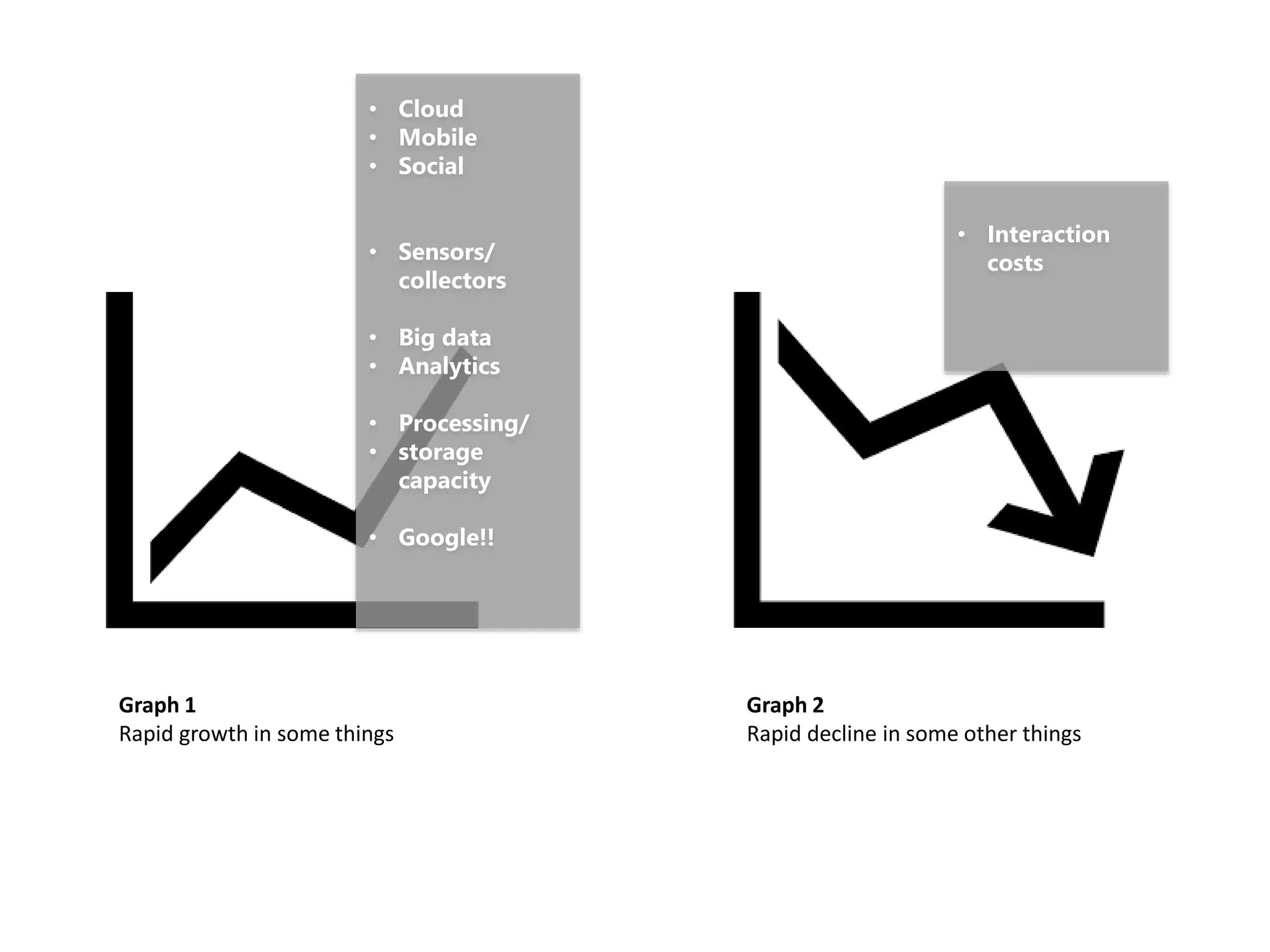
Graph 1
Rapid growth in some things
Graph 2
Rapid decline in some other things
• Cloud
• Mobile
• Social
• Sensors/
collectors
• Big data
• Analytics
• Processing/
• storage
capacity
• Google!!
• Interaction
costs
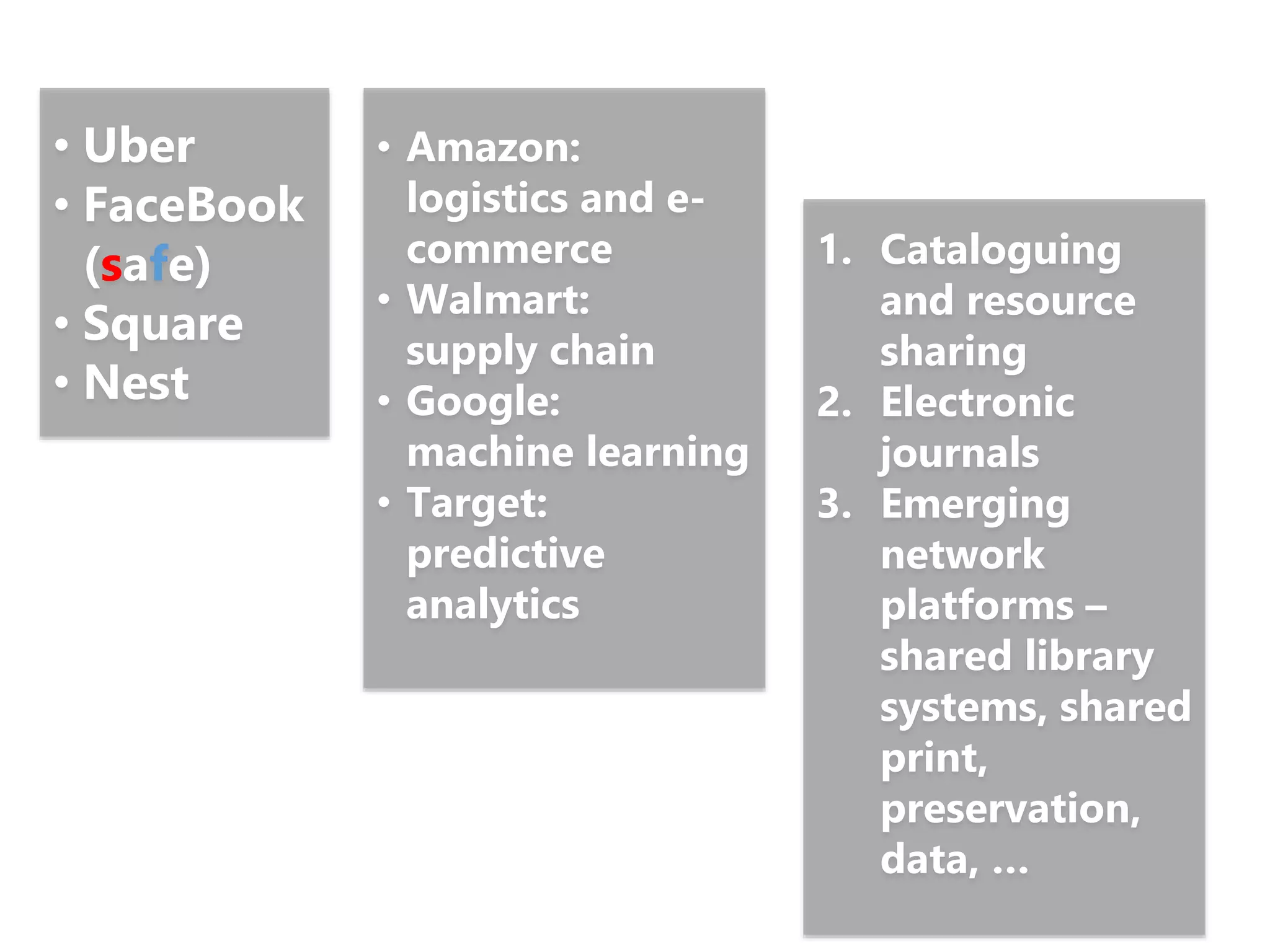
• Amazon:
logistics and e-
commerce
• Walmart:
supply chain
• Google:
machine learning
• Target:
predictive
analytics
• Uber
• FaceBook
(safe)
• Square
• Nest
1. Cataloguing
and resource
sharing
2. Electronic
journals
3. Emerging
network
platforms –
shared library
systems, shared
print,
preservation,
data, …
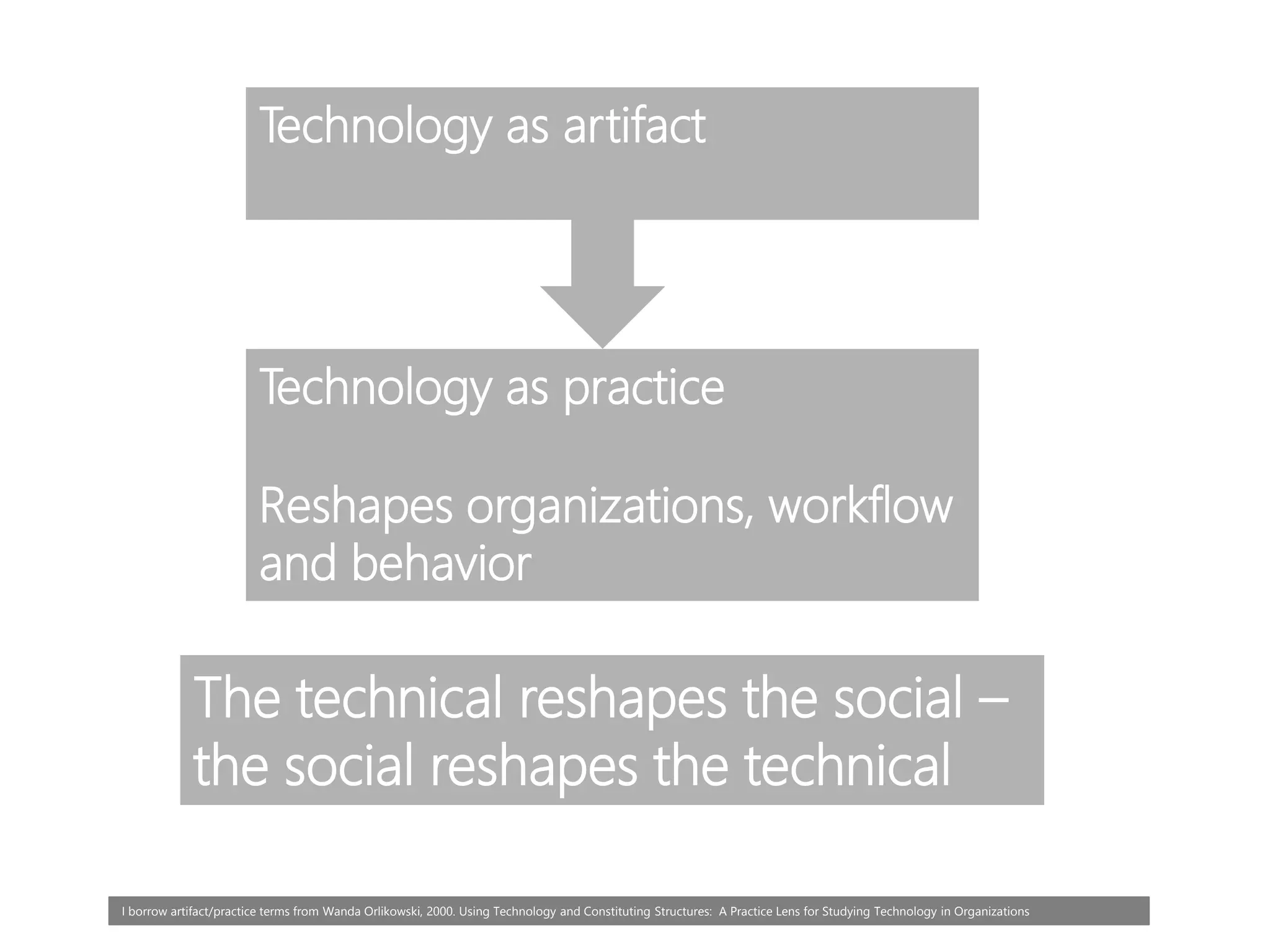
Technology as artifact
Technology as practice
Reshapes organizations, workflow
and behavior
The technical reshapes the social –
the social reshapes the technical
I borrow artifact/practice terms from Wanda Orlikowski, 2000. Using Technology and Constituting Structures: A Practice Lens for Studying Technology in Organizations
Technology in practice:
an example
Cell phone and mobility
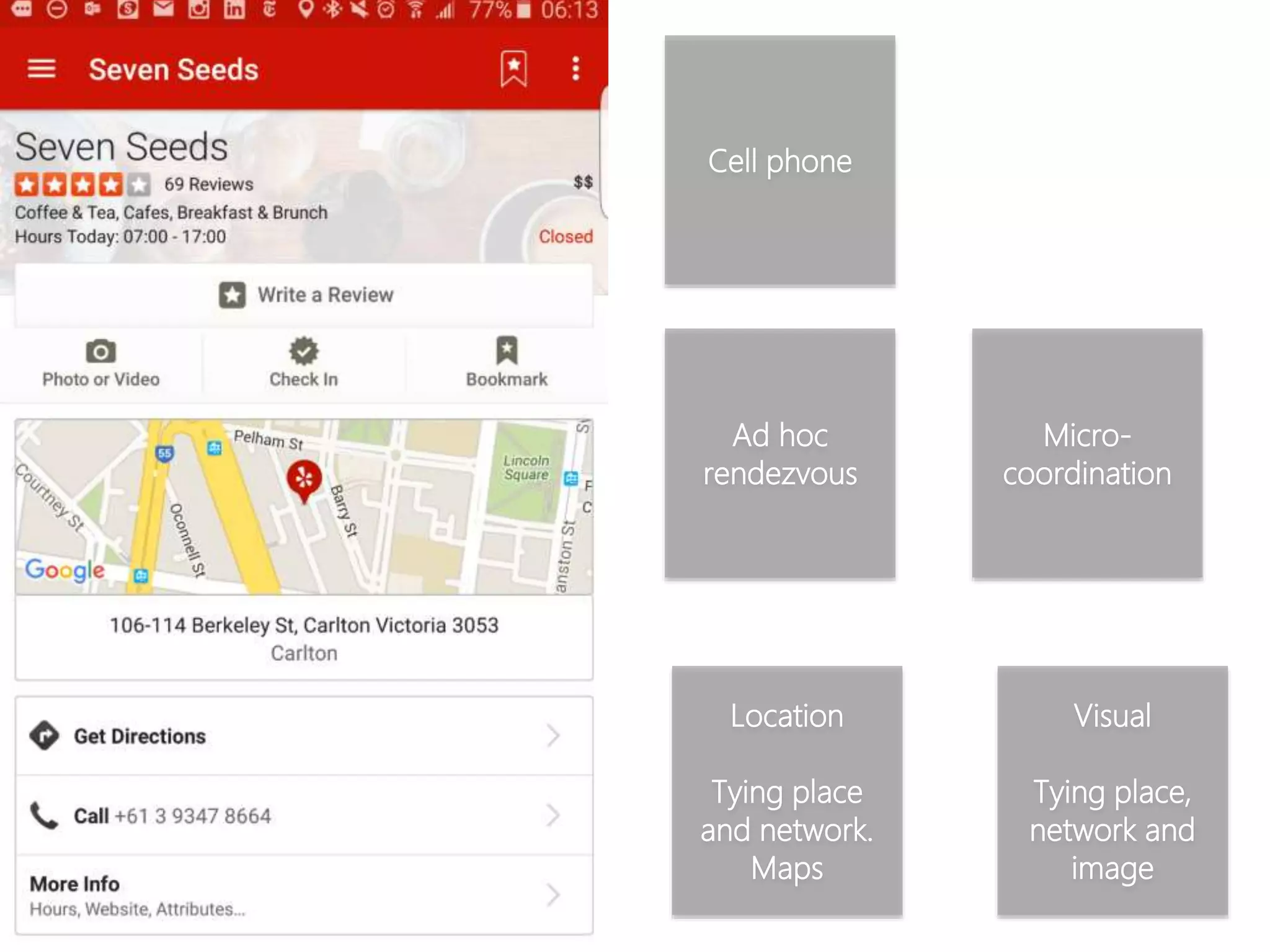
Micro-
coordination
Ad hoc
rendezvous
Location
Tying place
and network.
Maps
Visual
Tying place,
network and
image
Cell phone
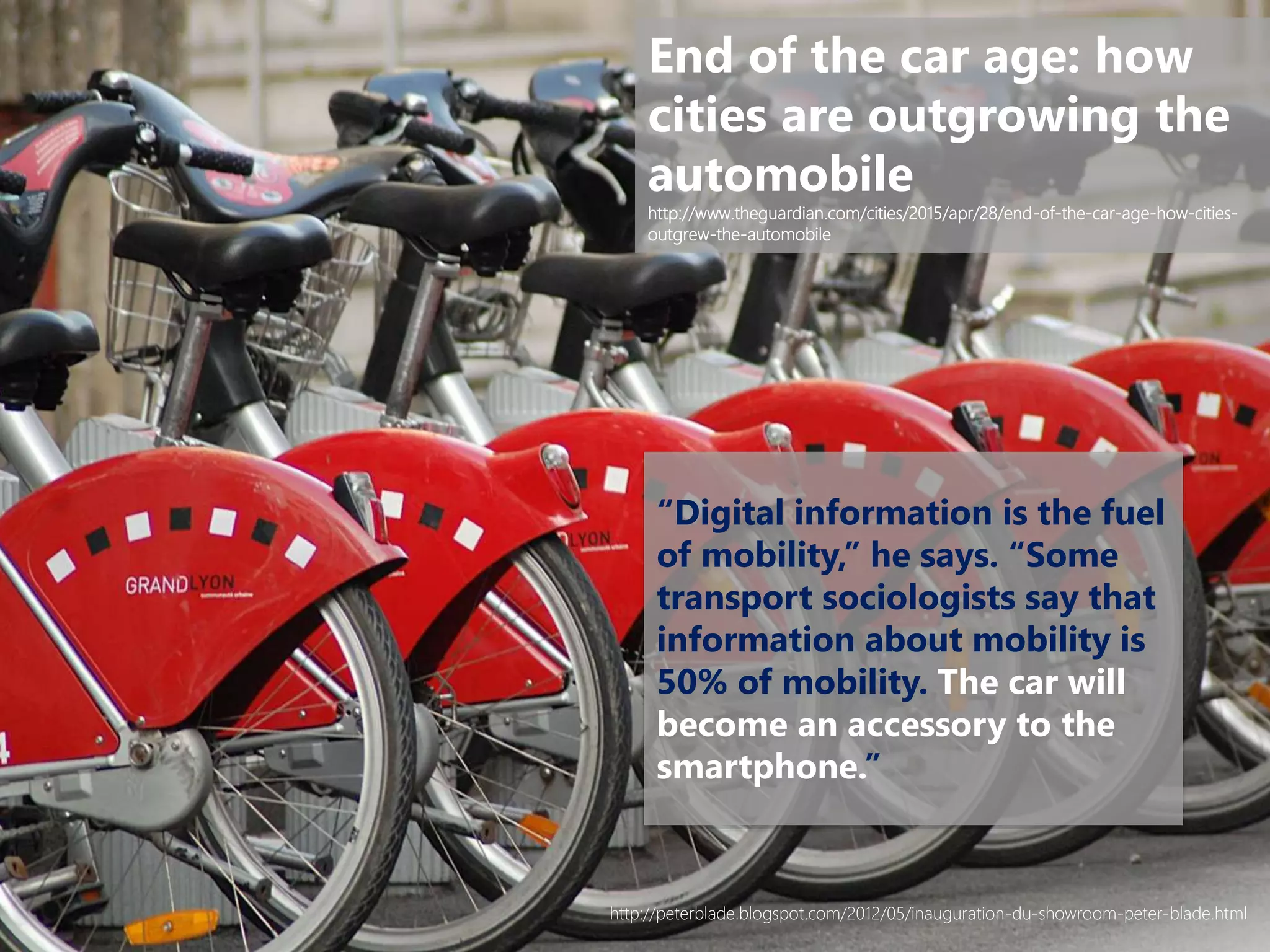
“Digital information is the fuel
of mobility,” he says. “Some
transport sociologists say that
information about mobility is
50% of mobility. The car will
become an accessory to the
smartphone.”
End of the car age: how
cities are outgrowing the
automobile
http://www.theguardian.com/cities/2015/apr/28/end-of-the-car-age-how-cities-
outgrew-the-automobile
http://peterblade.blogspot.com/2012/05/inauguration-du-showroom-peter-blade.html
9
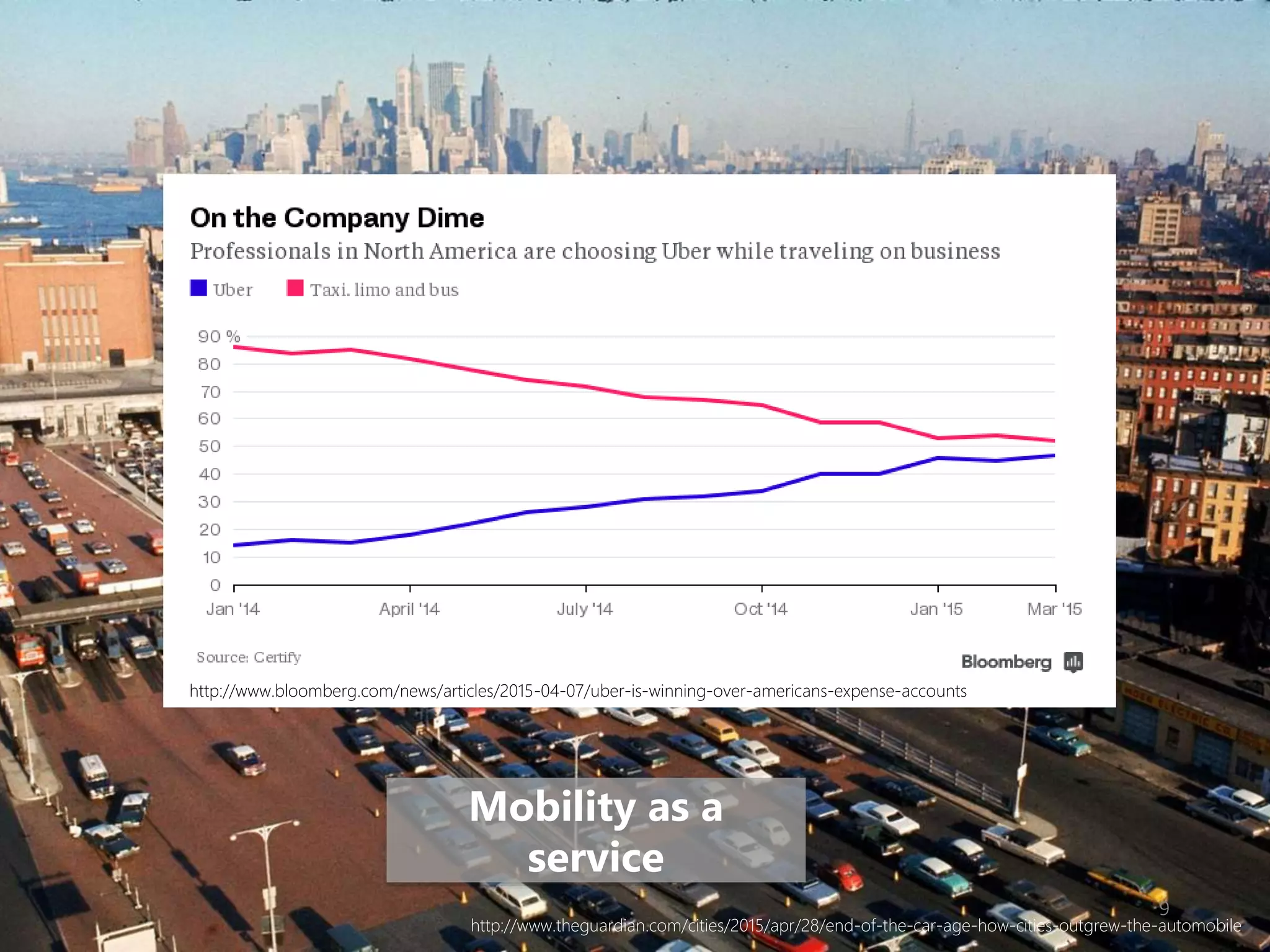
http://www.bloomberg.com/news/articles/2015-04-07/uber-is-winning-over-americans-expense-accounts
Mobility as a
service
http://www.theguardian.com/cities/2015/apr/28/end-of-the-car-age-how-cities-outgrew-the-automobile
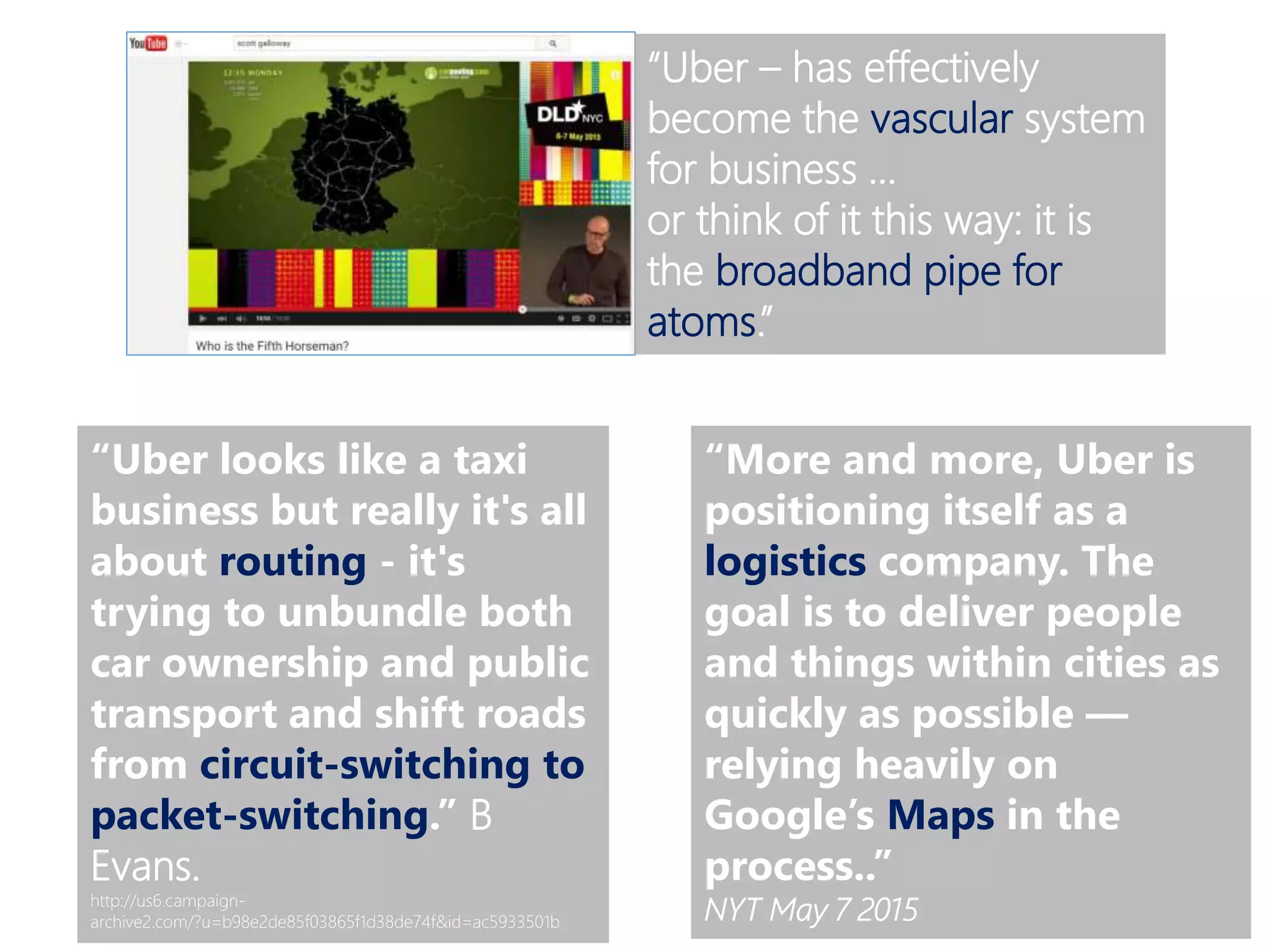
“Uber – has effectively
become the vascular system
for business …
or think of it this way: it is
the broadband pipe for
atoms.”
“Uber looks like a taxi
business but really it's all
about routing - it's
trying to unbundle both
car ownership and public
transport and shift roads
from circuit-switching to
packet-switching.” B
Evans.
http://us6.campaign-
archive2.com/?u=b98e2de85f03865f1d38de74f&id=ac5933501b
“More and more, Uber is
positioning itself as a
logistics company. The
goal is to deliver people
and things within cities as
quickly as possible —
relying heavily on
Google’s Maps in the
process..”
NYT May 7 2015
Uber drivers— and other “on-demand”
workers— have become increasingly
vocal as the question the rights of these
enterprises to operate outside of minimum
wage laws, anti-discrimination statutes,
workers’ compensation laws, and union-
organizing rights. …
In a Wall Street Journal article about on-
demand employment, One worker tells
the WSJ, ‘We are not robots; we are not a
remote control; we are individuals…”
http://www.faz.net/aktuell/feuilleton/debatten/the-digital-debate/shoshana-zuboff-on-the-sharing-economy-13500770-p4.html
Shoshana Zuboff on the sharing economy.
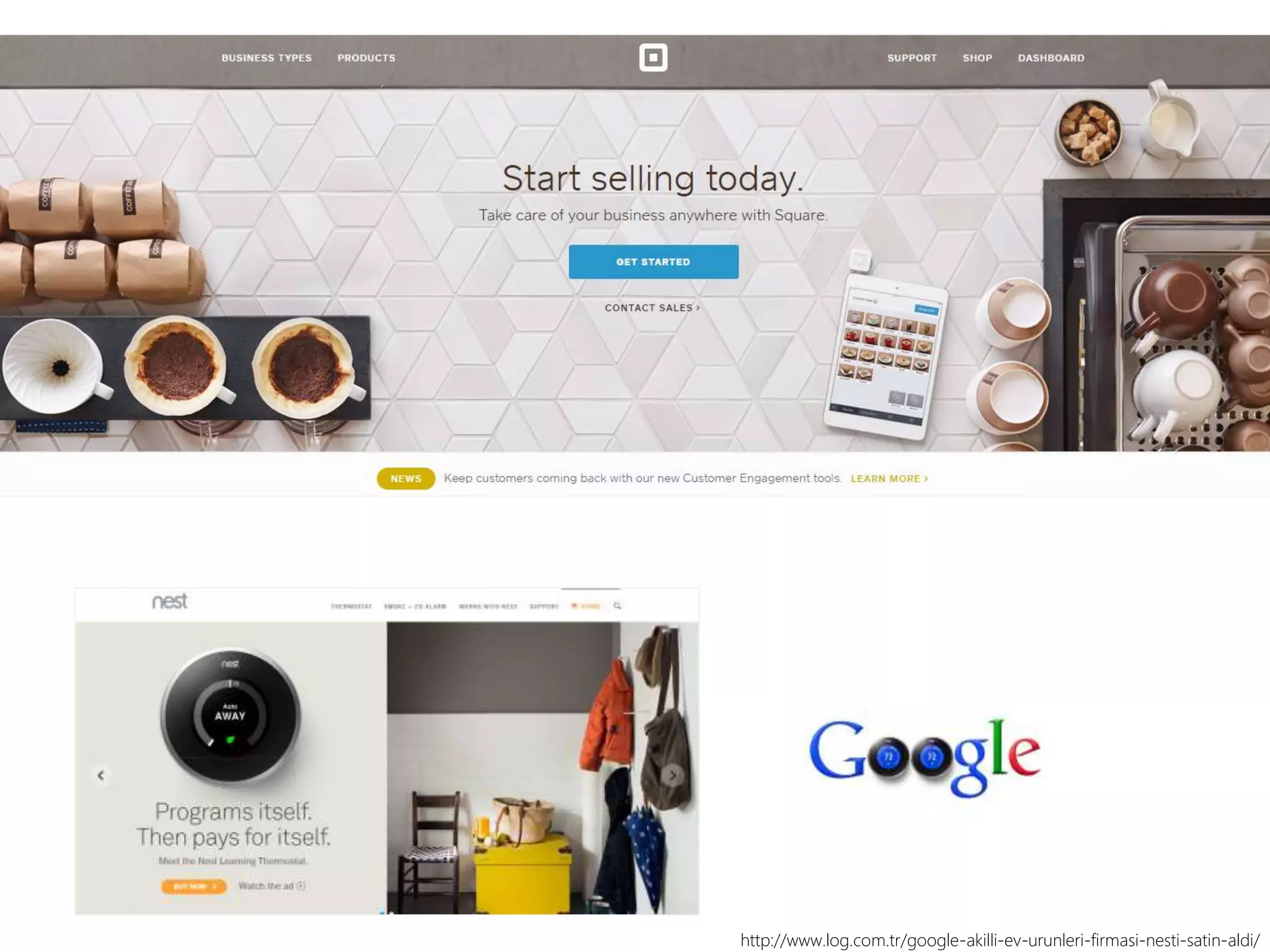
http://www.log.com.tr/google-akilli-ev-urunleri-firmasi-nesti-satin-aldi/
A communication device.
Connecting identity, place and workflows
to reshape industries and behaviors.
This:
And this:
3 library examples
Citation management
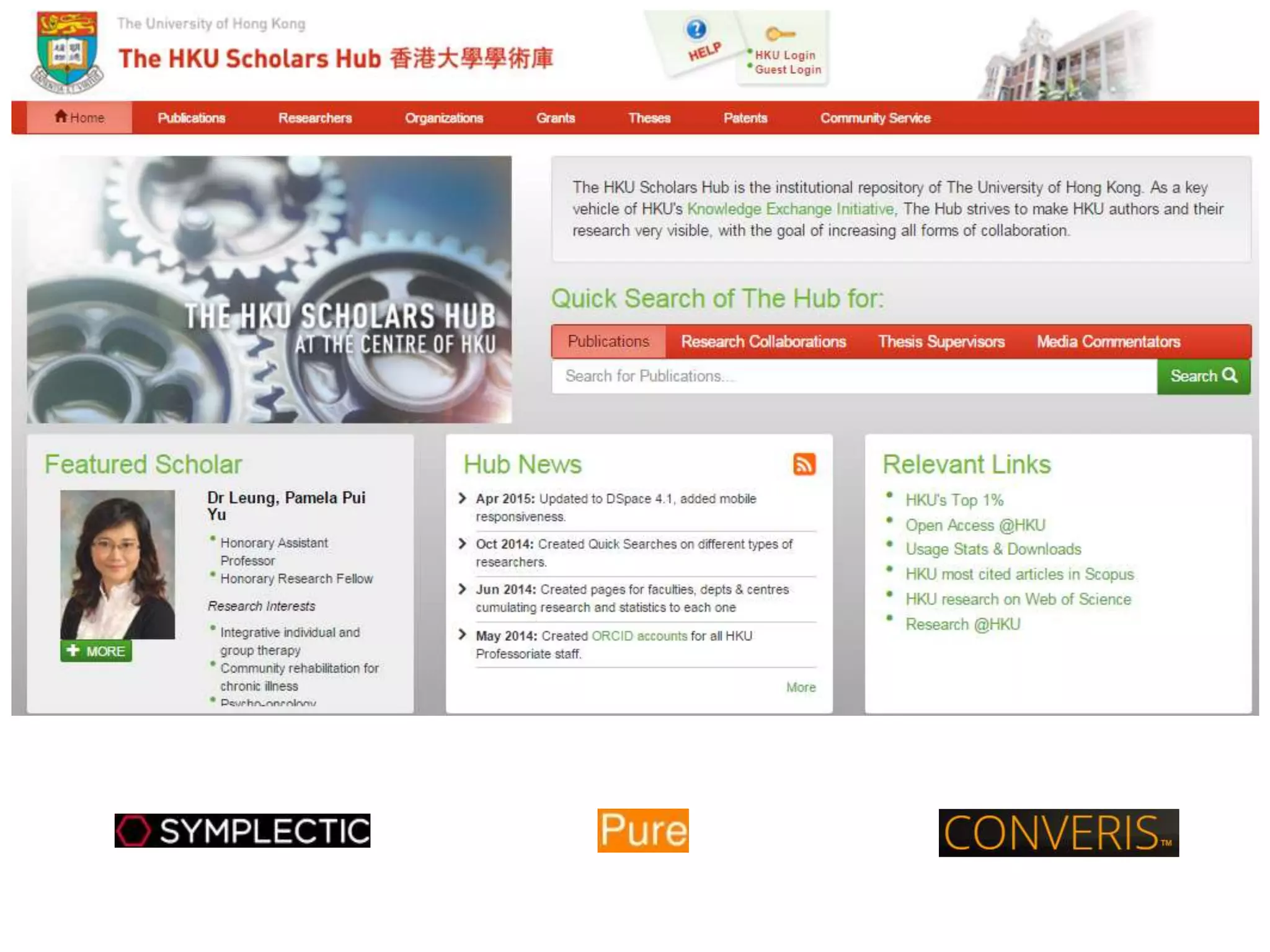
Institutional repository > workflow is the new content
The collections shift
Technology as practice
Reshaping behaviors/workflows
Citation management
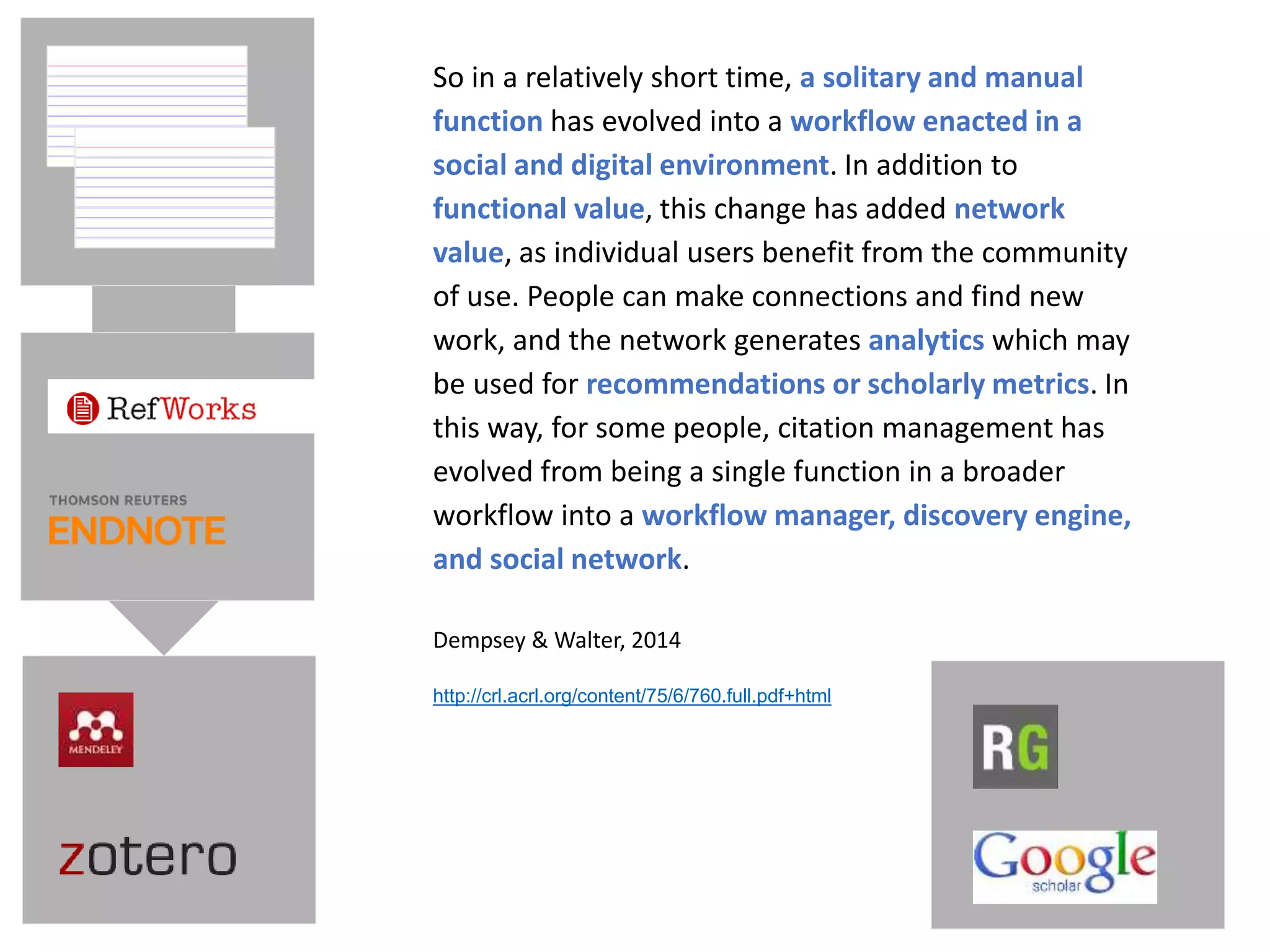
So in a relatively short time, a solitary and manual
function has evolved into a workflow enacted in a
social and digital environment. In addition to
functional value, this change has added network
value, as individual users benefit from the community
of use. People can make connections and find new
work, and the network generates analytics which may
be used for recommendations or scholarly metrics. In
this way, for some people, citation management has
evolved from being a single function in a broader
workflow into a workflow manager, discovery engine,
and social network.
Dempsey & Walter, 2014
http://crl.acrl.org/content/75/6/760.full.pdf+html
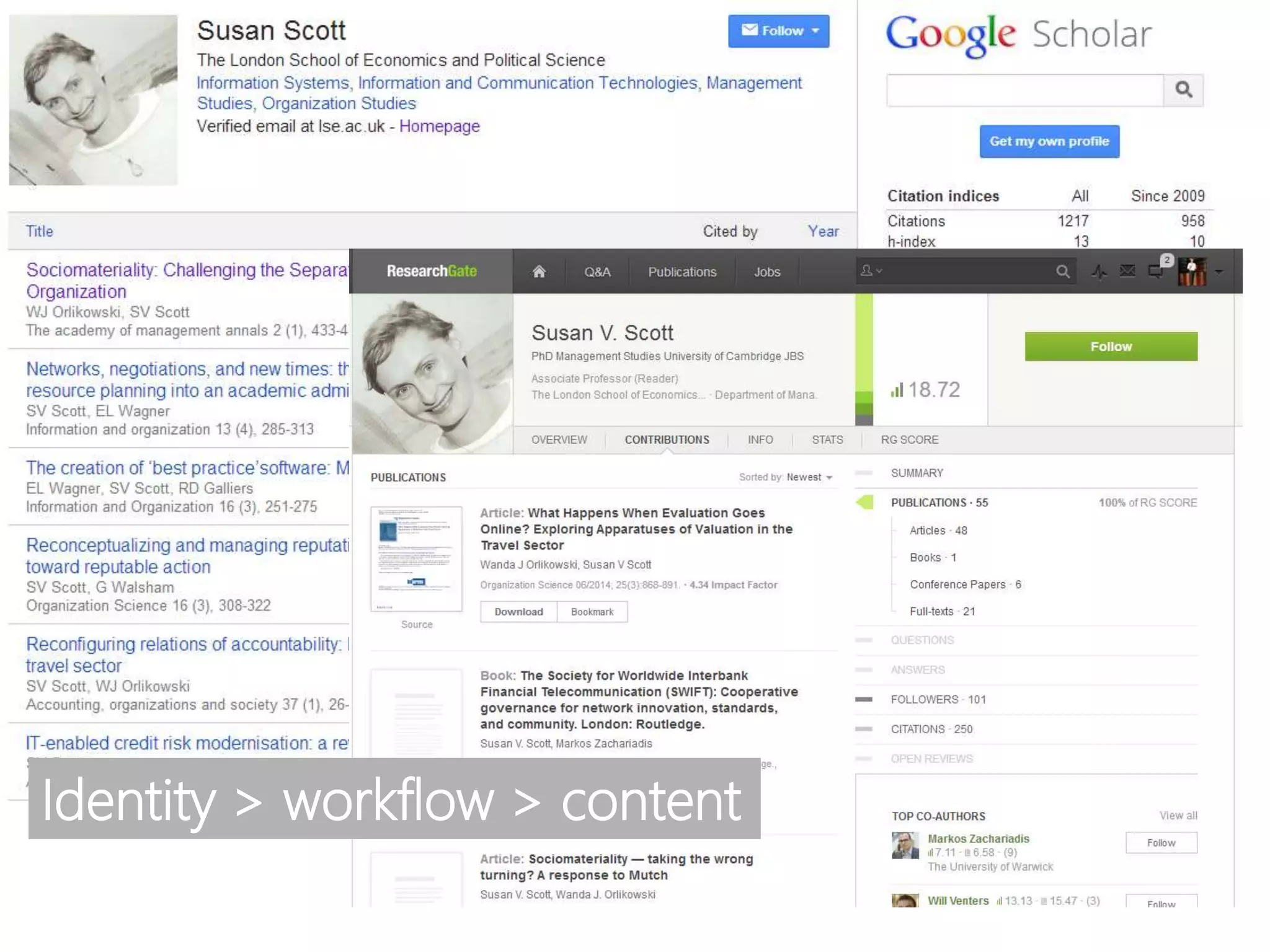
Identity > workflow > content
Provide and promote reference manager
products.
Support – and help shape - emerging
practices around citation management,
research networking and profiles.
This:
And this:
Technology as practice
Reshaping behaviors/workflows
Institutional repository > workflow is the new content
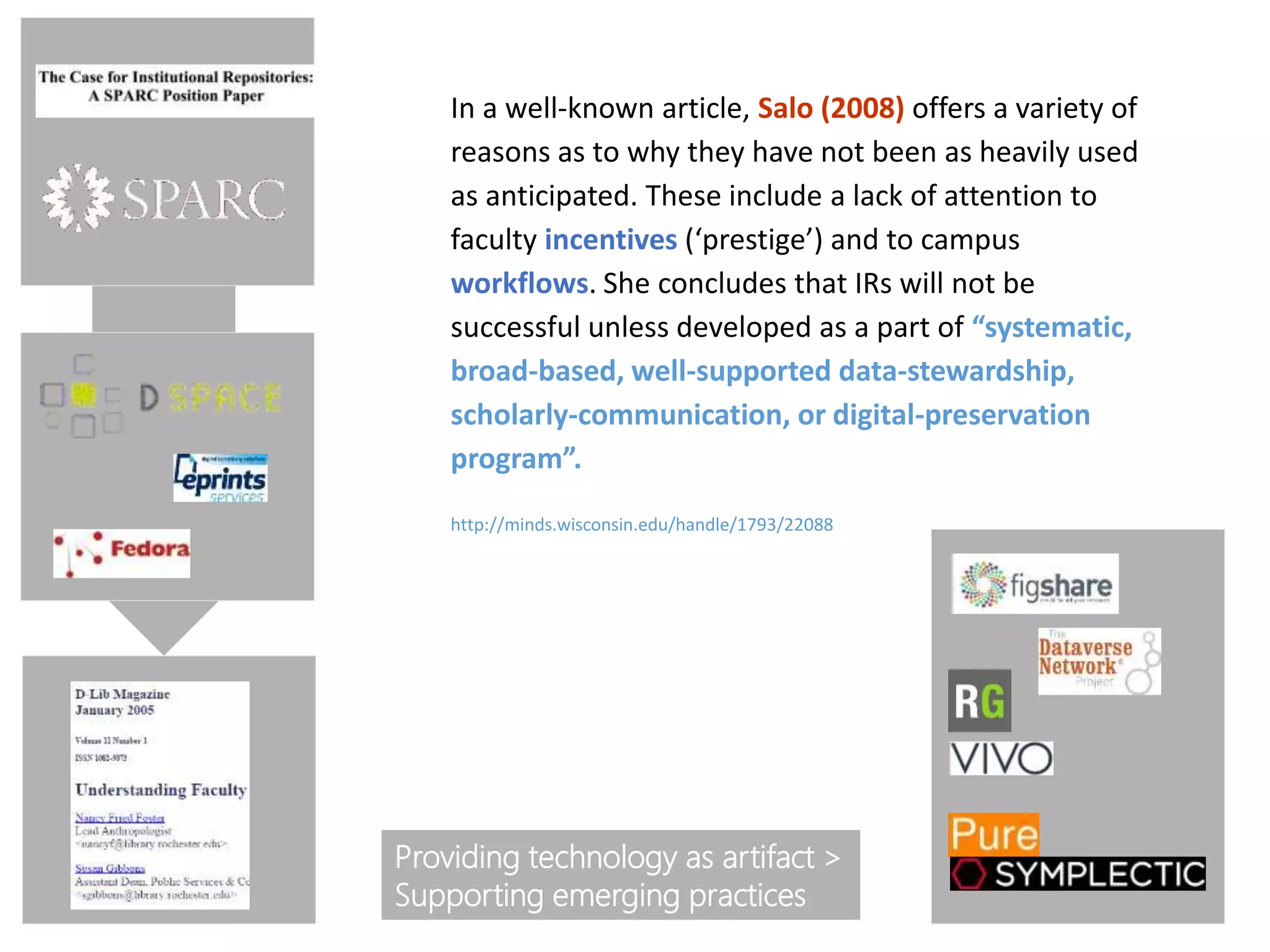
In a well-known article, Salo (2008) offers a variety of
reasons as to why they have not been as heavily used
as anticipated. These include a lack of attention to
faculty incentives (‘prestige’) and to campus
workflows. She concludes that IRs will not be
successful unless developed as a part of “systematic,
broad-based, well-supported data-stewardship,
scholarly-communication, or digital-preservation
program”.
Providing technology as artifact >
Supporting emerging practices
http://minds.wisconsin.edu/handle/1793/22088
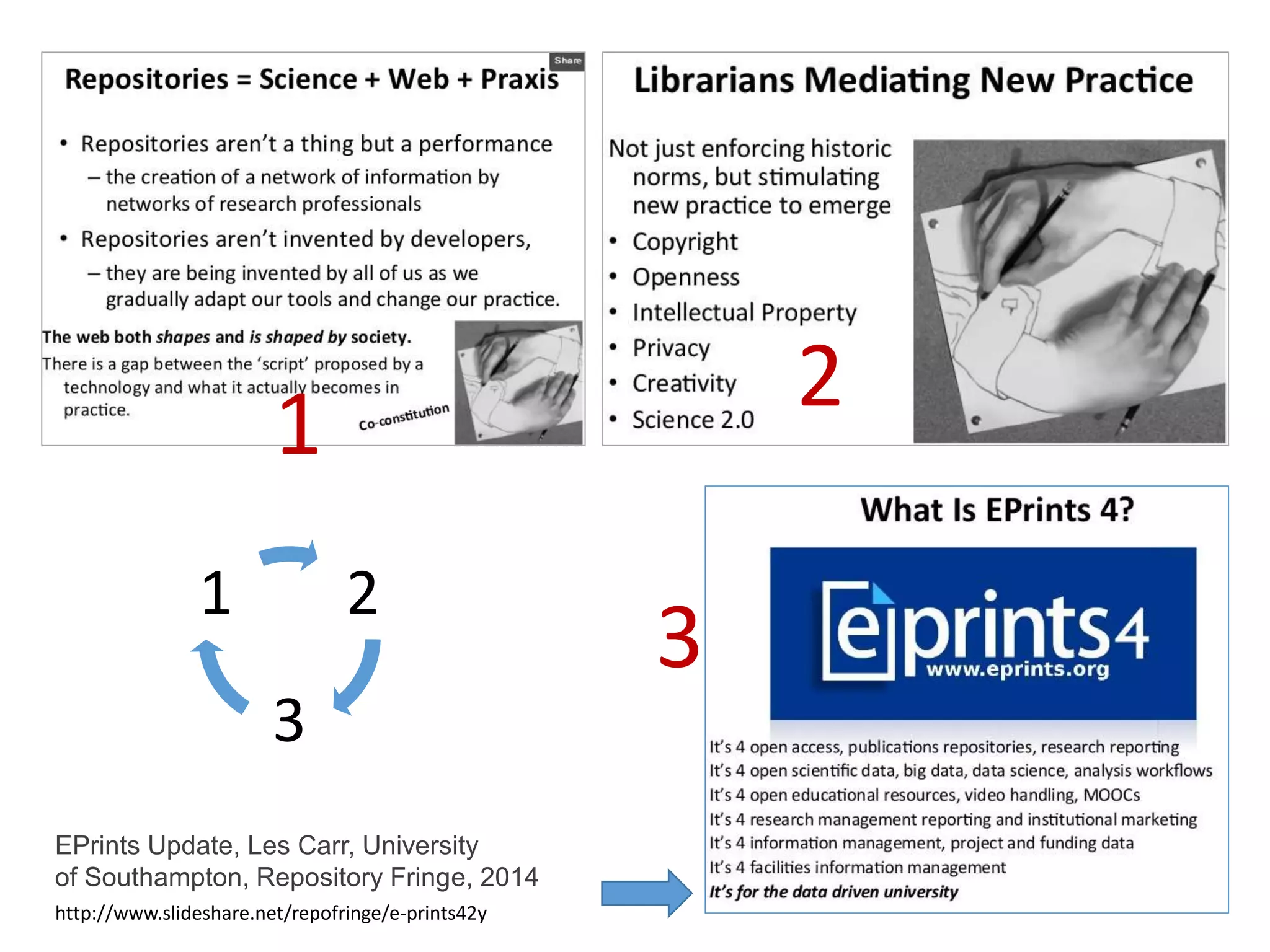
http://www.slideshare.net/repofringe/e-prints42y
EPrints Update, Les Carr, University
of Southampton, Repository Fringe, 2014
1
2
3
2
3
1
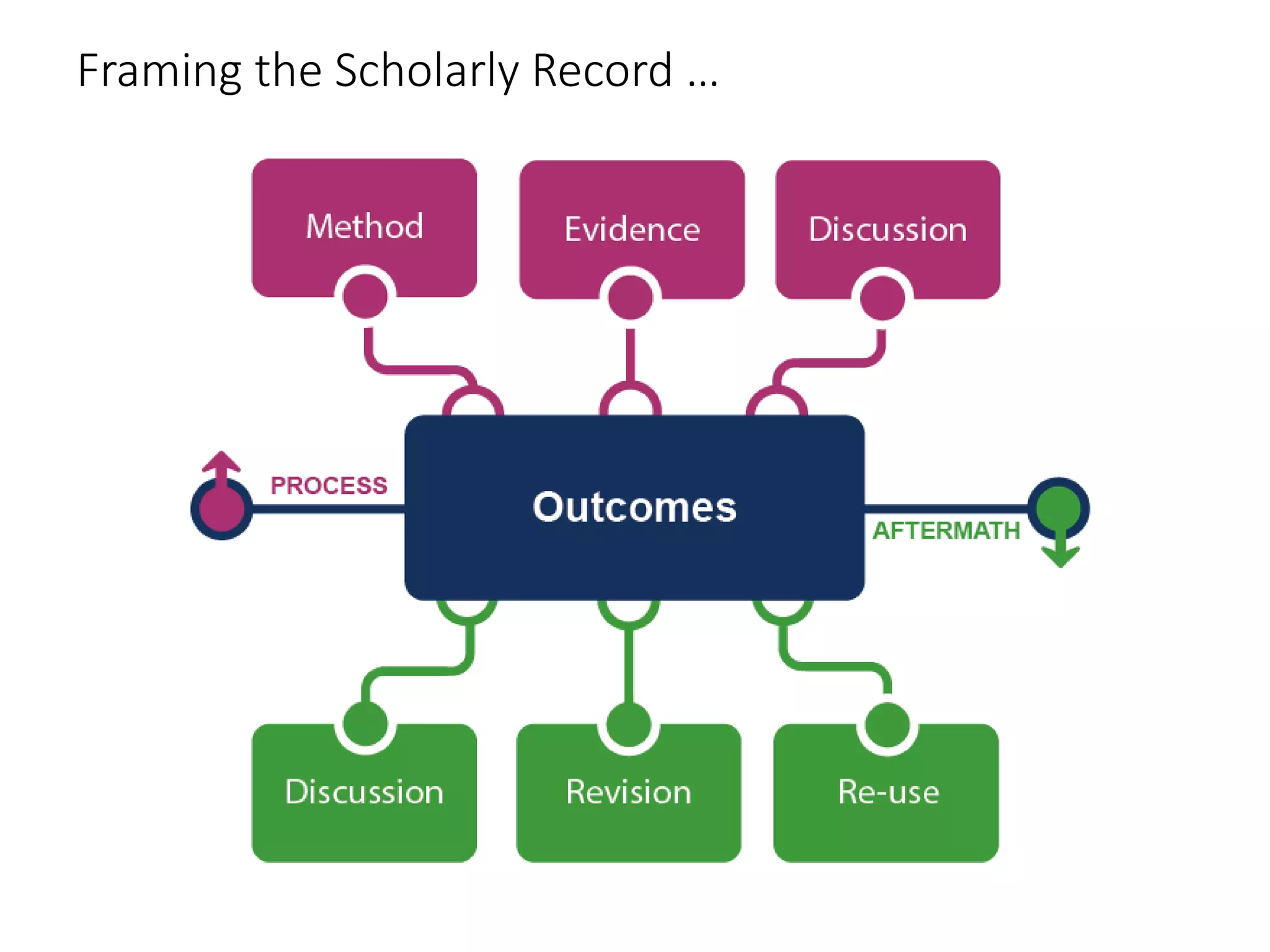
Framing the Scholarly Record …
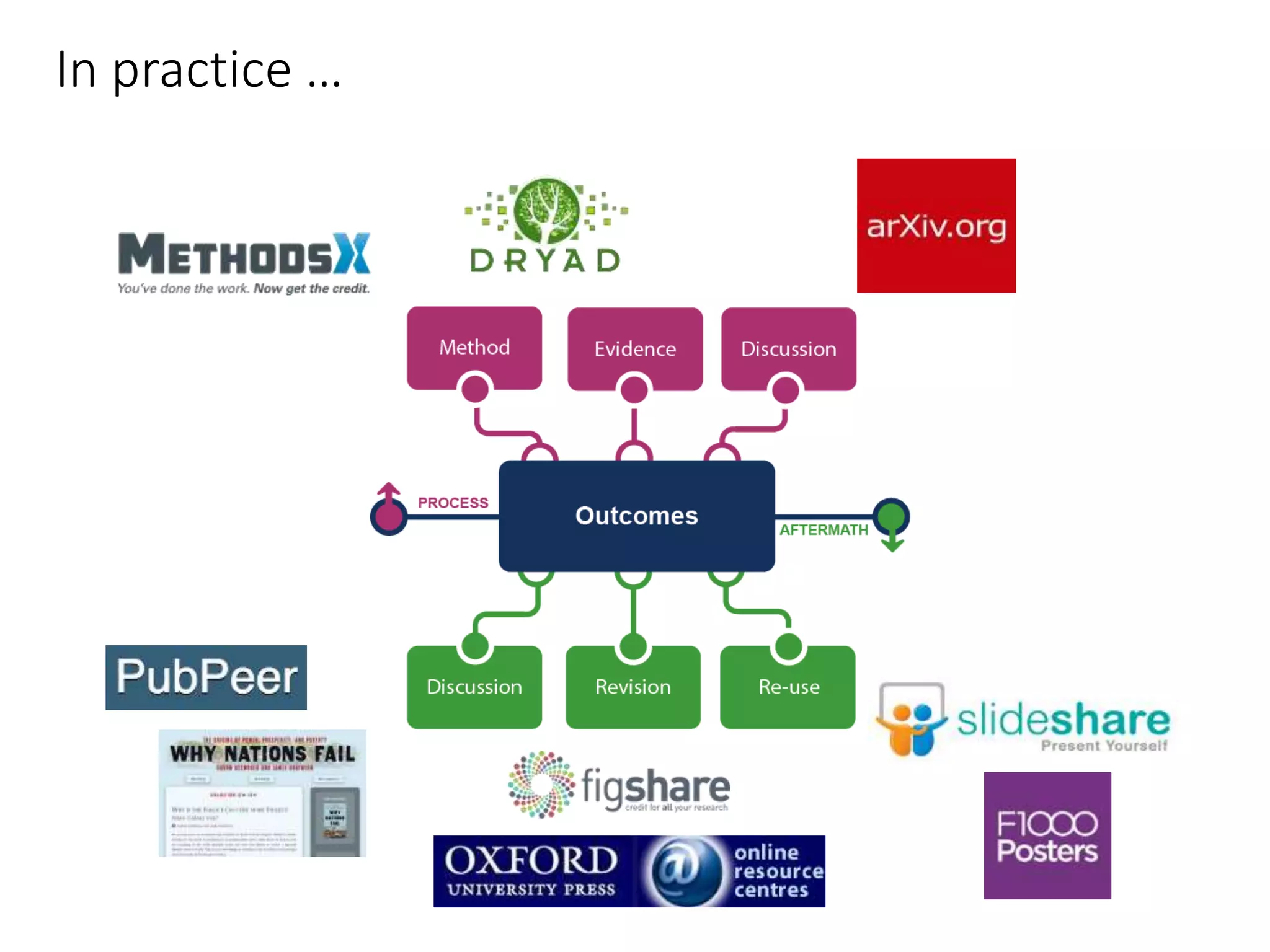
In practice …
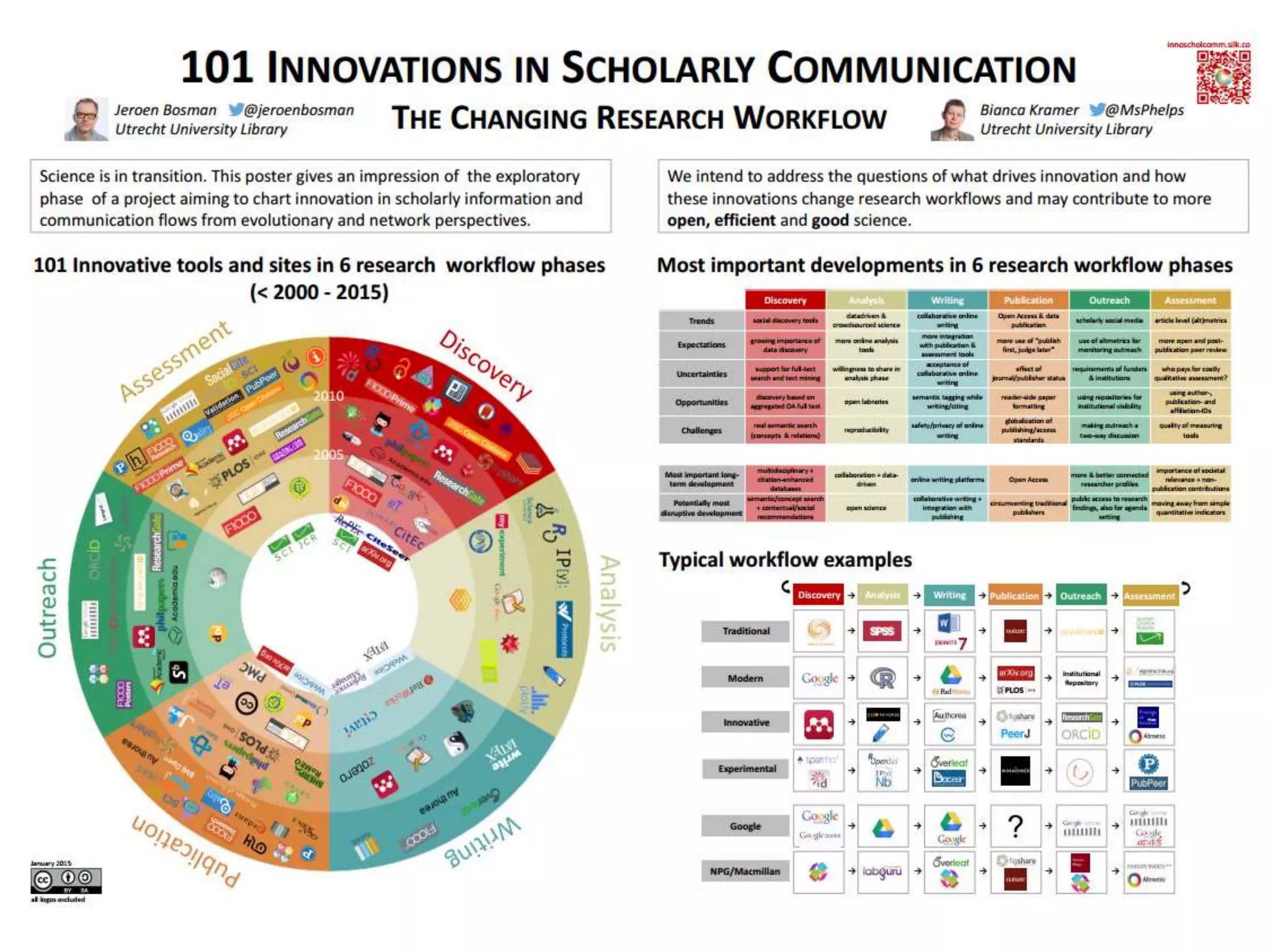
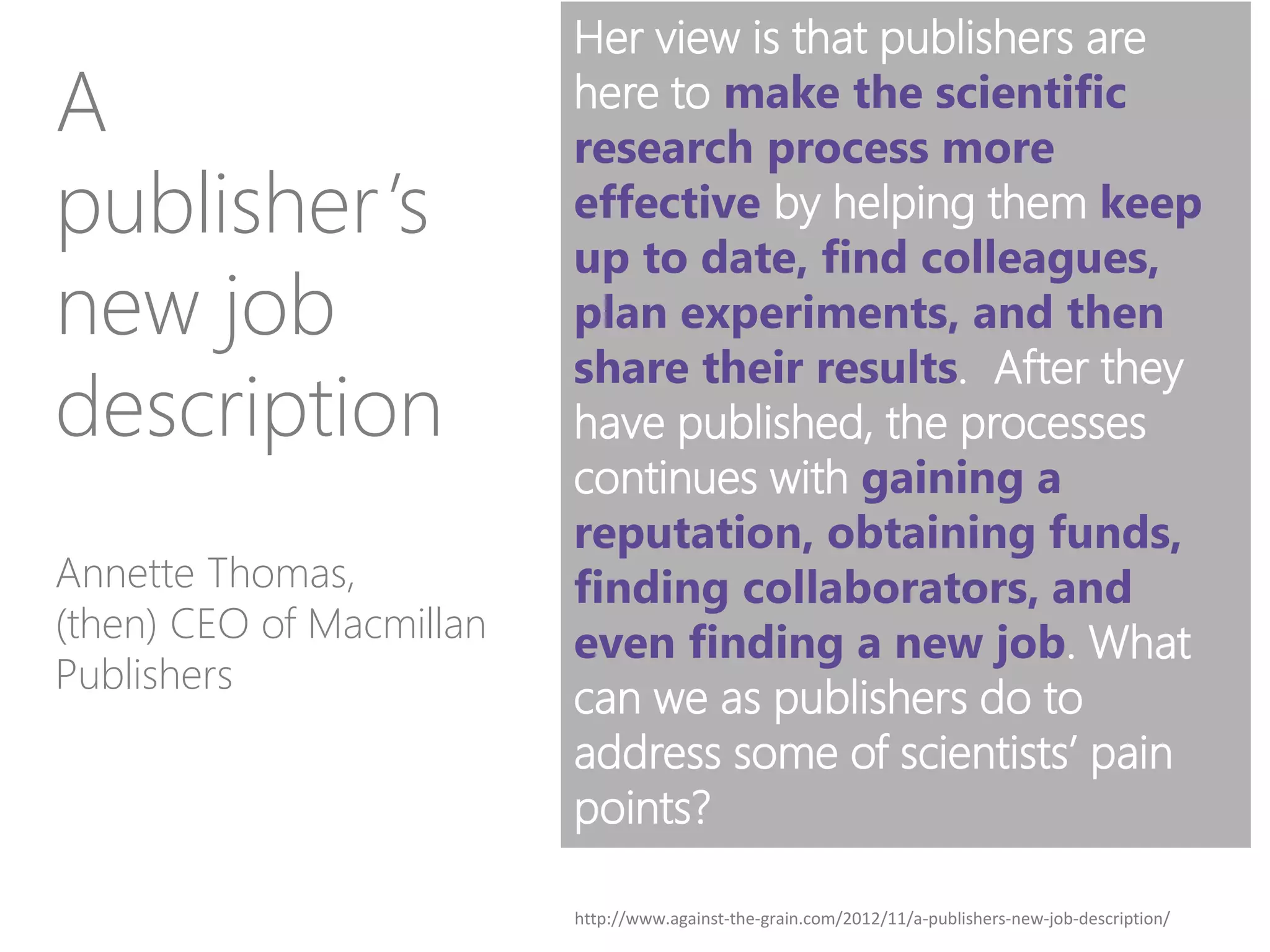
Her view is that publishers are
here to make the scientific
research process more
effective by helping them keep
up to date, find colleagues,
plan experiments, and then
share their results. After they
have published, the processes
continues with gaining a
reputation, obtaining funds,
finding collaborators, and
even finding a new job. What
can we as publishers do to
address some of scientists’ pain
points?
Annette Thomas,
(then) CEO of Macmillan
Publishers
A
publisher’s
new job
description
http://www.against-the-grain.com/2012/11/a-publishers-new-job-description/
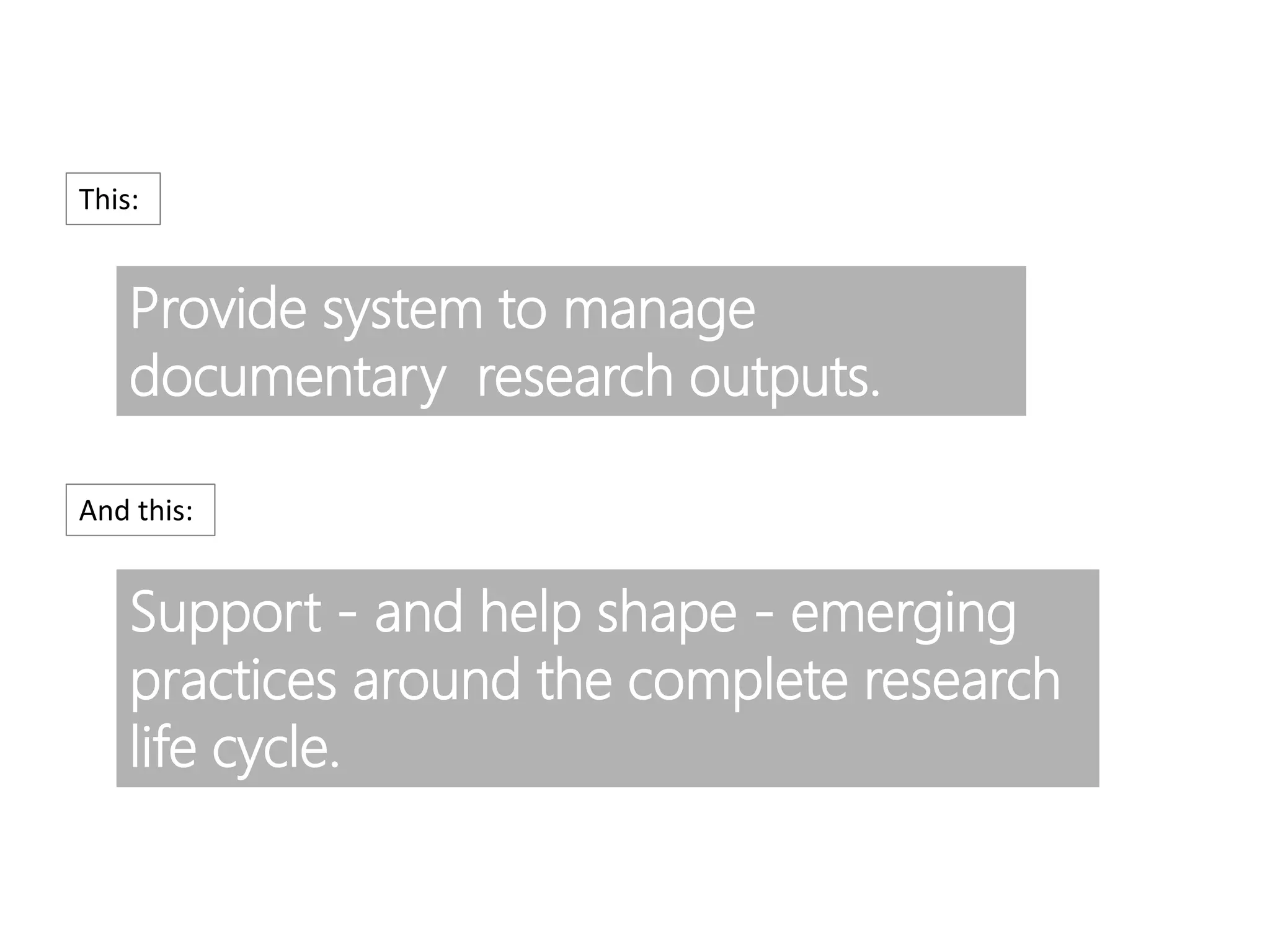
Support - and help shape - emerging
practices around the complete research
life cycle.
Provide system to manage
documentary research outputs.
This:
And this:
Technology as practice
Reshaping behaviors/workflows
The collections shift – 4 contexts and towards the facilitated
collection
The logic of print distribution influenced
library development:
• Close to user – multiple library
collections.
• Big = good.
• Just in case.
1
The bubble of growth in
twentieth-century
printed collections has left …
librarians
with a tricky problem.
Barbara Fister
New Roles for the Road Ahead:
Essays commissioned for ACRL’s 75th Birthday
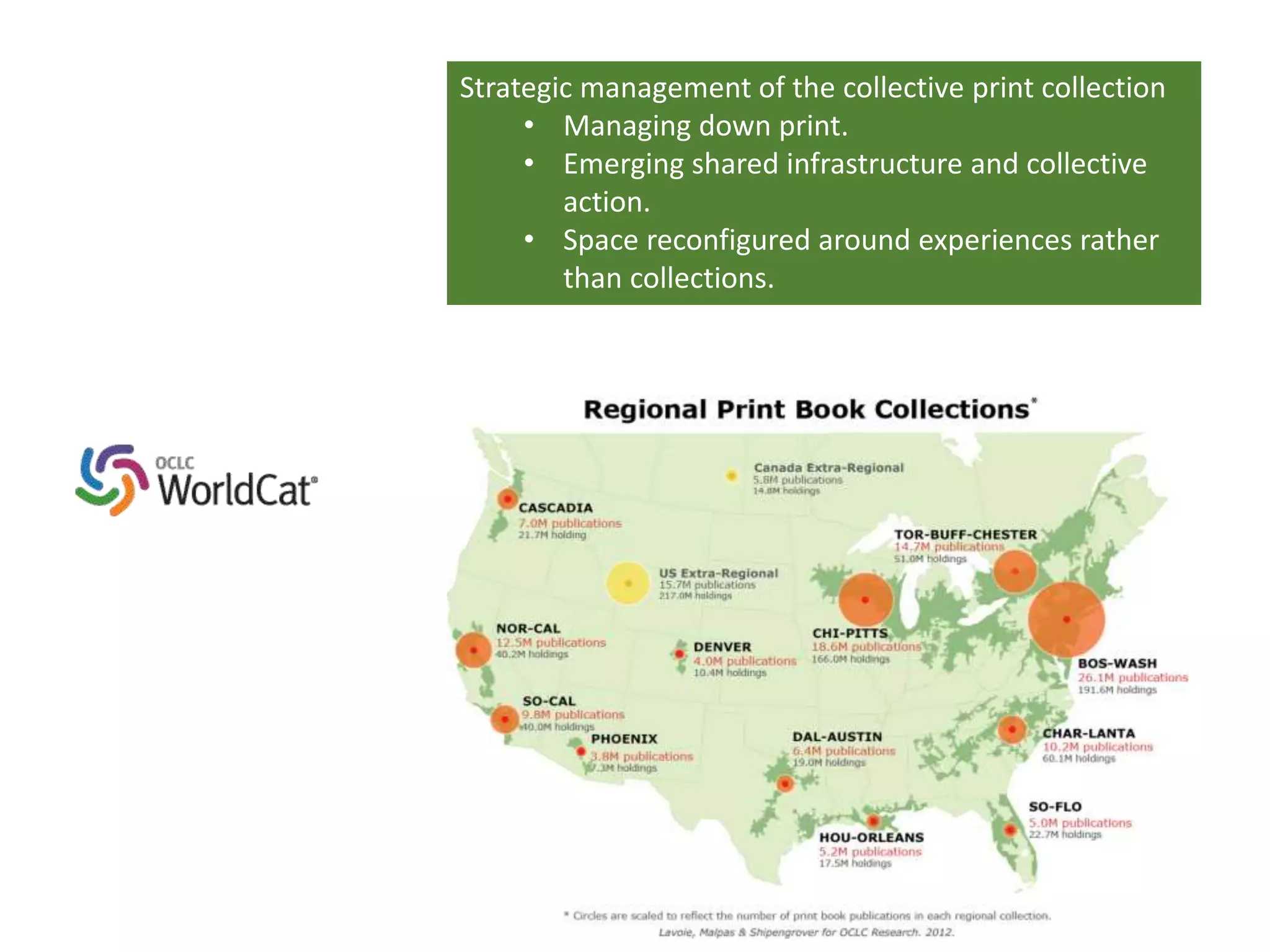
Strategic management of the collective print collection
• Managing down print.
• Emerging shared infrastructure and collective
action.
• Space reconfigured around experiences rather
than collections.
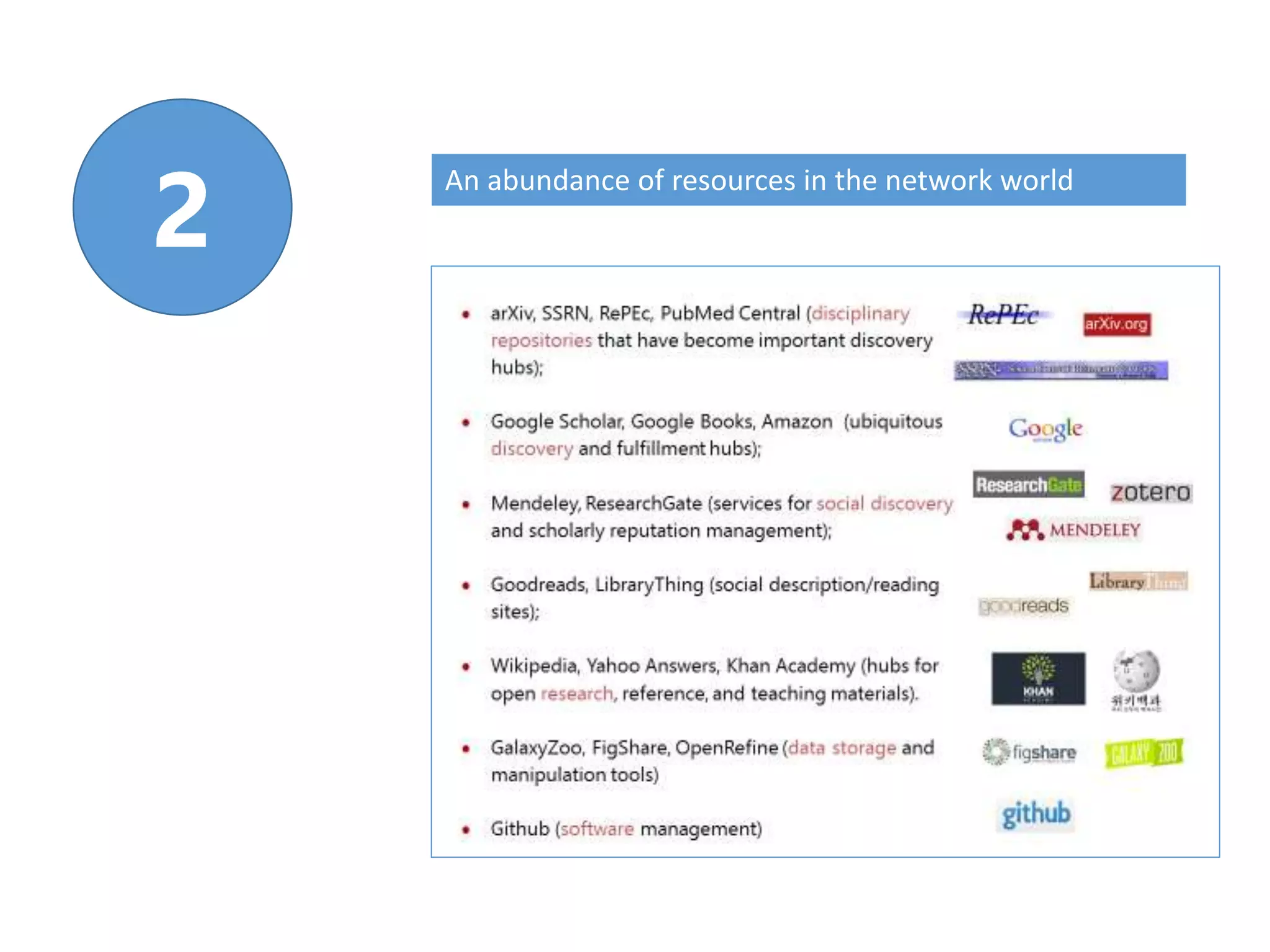
An abundance of resources in the network world
2
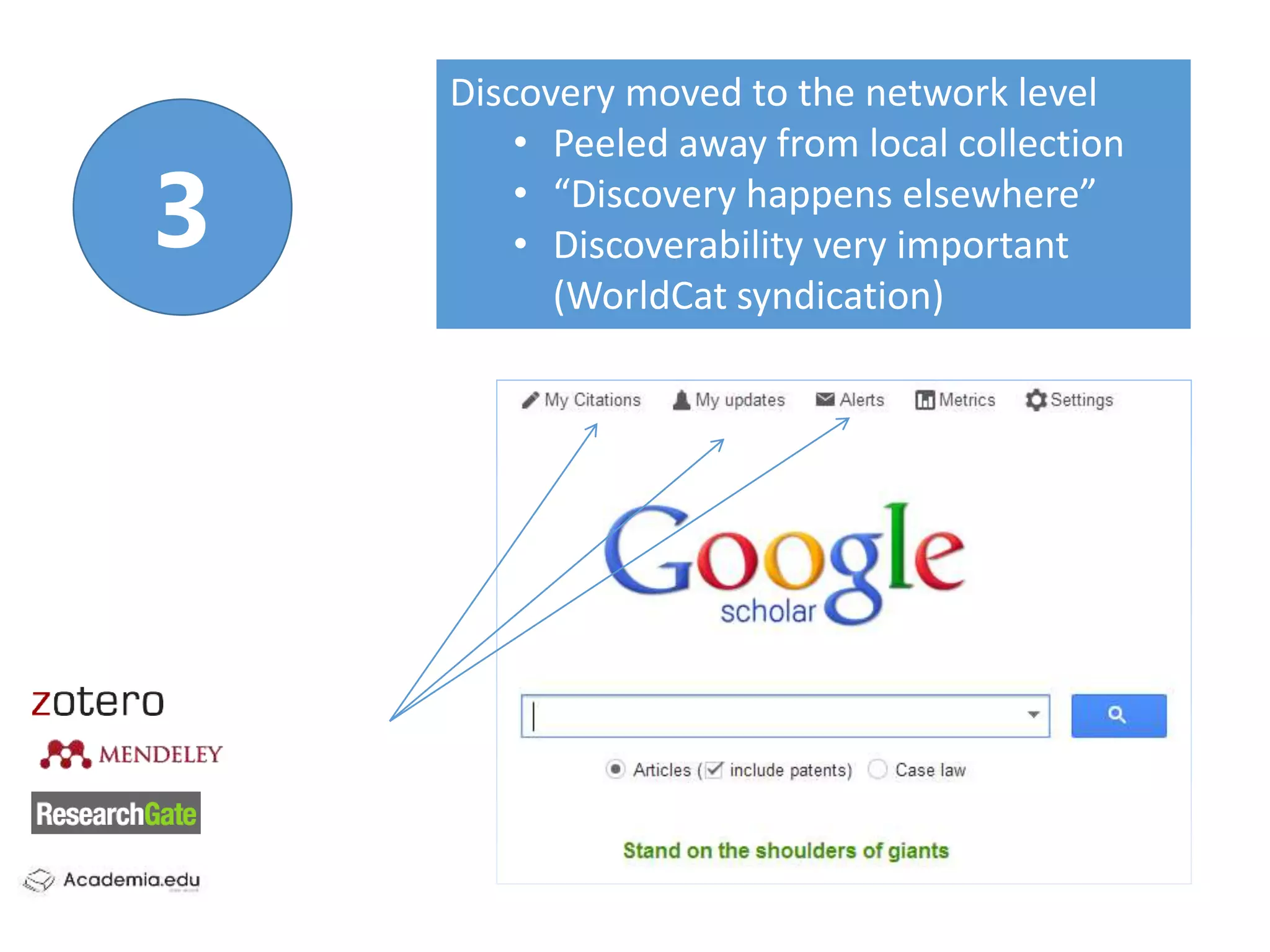
Discovery moved to the network level
• Peeled away from local collection
• “Discovery happens elsewhere”
• Discoverability very important
(WorldCat syndication)
3
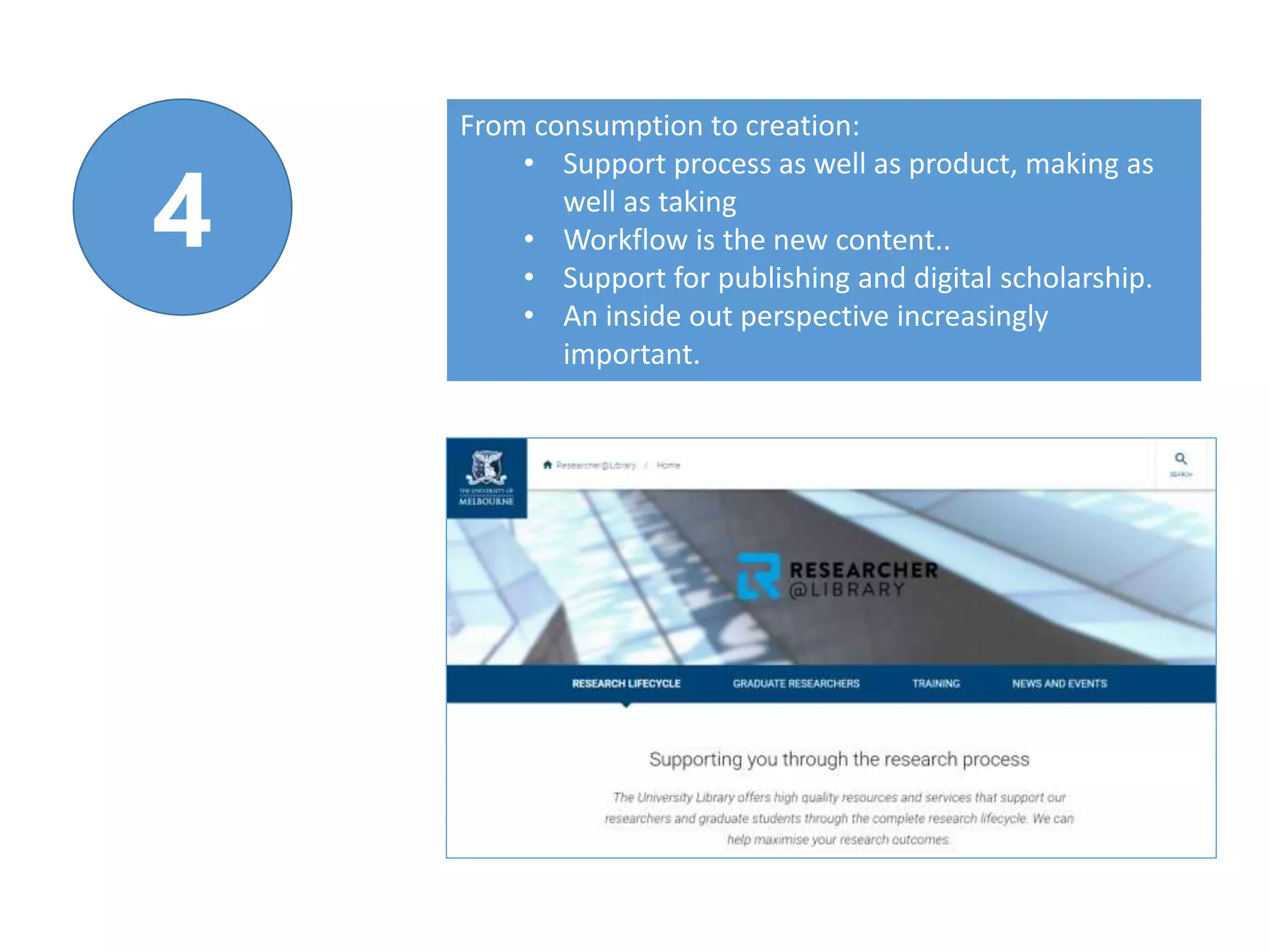
From consumption to creation:
• Support process as well as product, making as
well as taking
• Workflow is the new content..
• Support for publishing and digital scholarship.
• An inside out perspective increasingly
important.
4
From owned/licensed to facilitated.
• Organized around user needs
• Curation is community oriented?
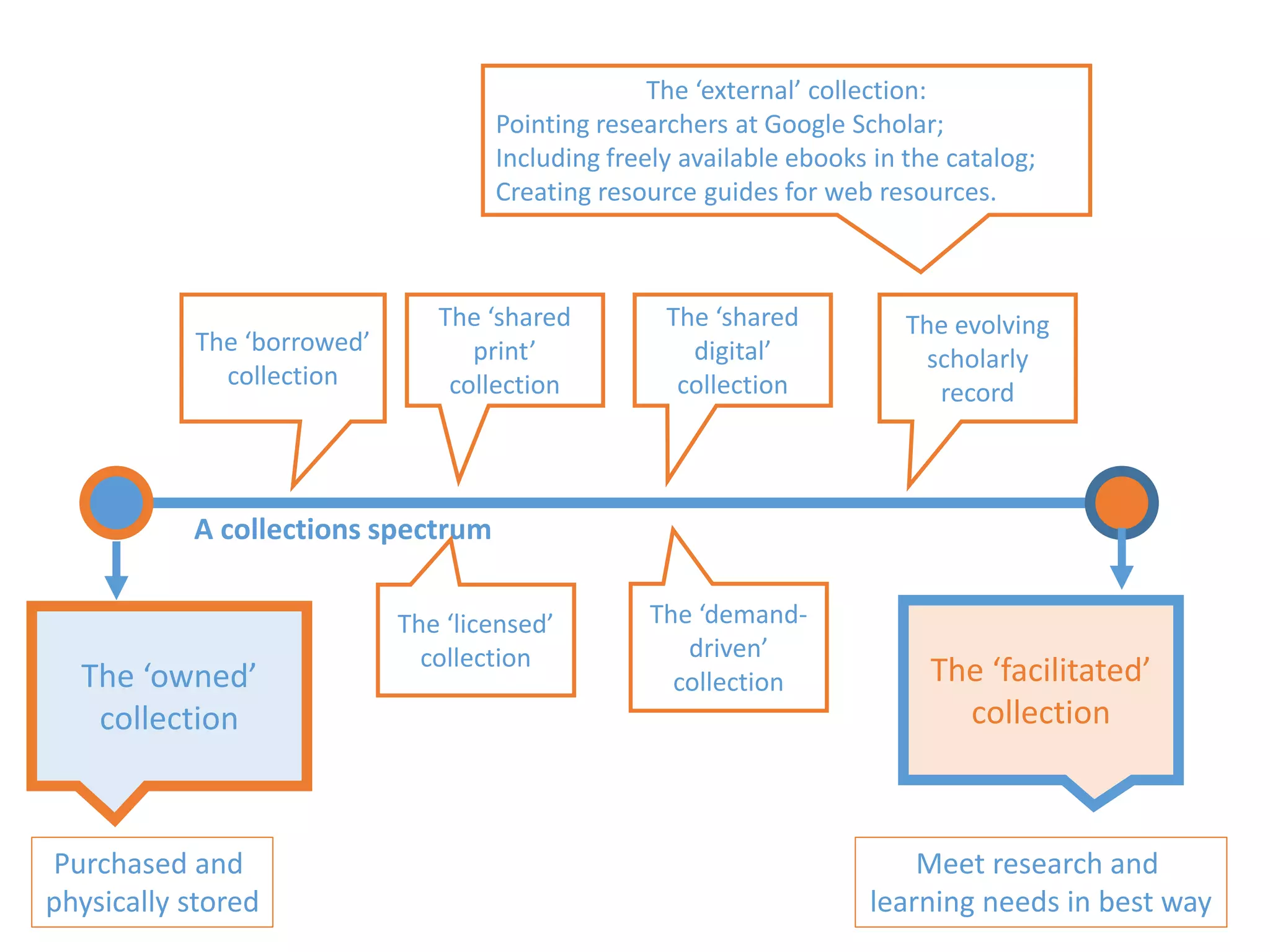
Collections shift …
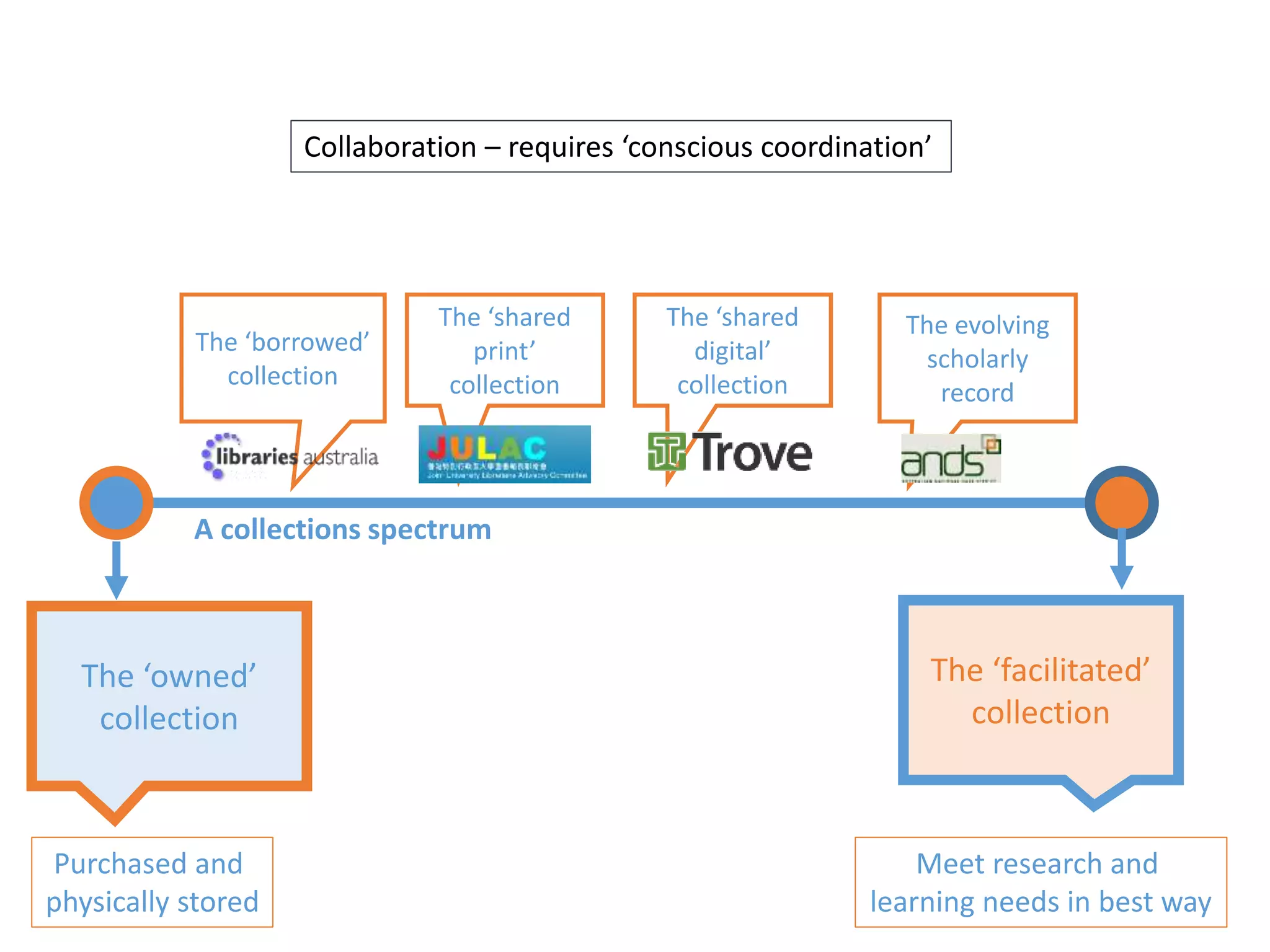
The ‘owned’
collection
The ‘facilitated’
collection
The ‘borrowed’
collection
A collections spectrum
The ‘shared
print’
collection
The ‘shared
digital’
collection
The evolving
scholarly
record
Purchased and
physically stored
Meet research and
learning needs in best way
The ‘licensed’
collection
The ‘demand-
driven’
collection
The ‘external’ collection:
Pointing researchers at Google Scholar;
Including freely available ebooks in the catalog;
Creating resource guides for web resources.
The ‘owned’
collection
The ‘facilitated’
collection
The ‘borrowed’
collection
A collections spectrum
The ‘shared
print’
collection
The ‘shared
digital’
collection
The evolving
scholarly
record
Purchased and
physically stored
Meet research and
learning needs in best way
Collaboration – requires ‘conscious coordination’
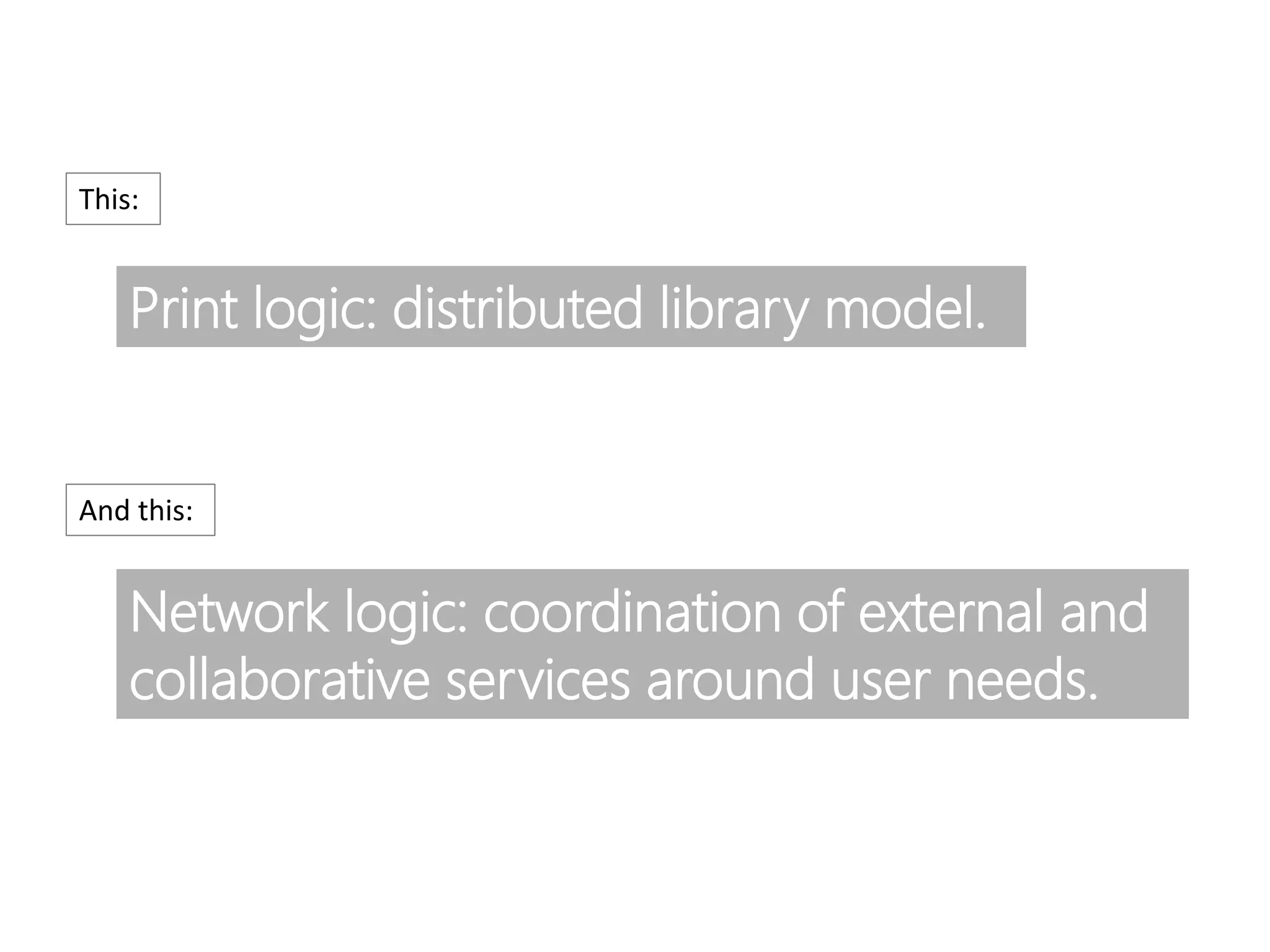
Network logic: coordination of external and
collaborative services around user needs.
Print logic: distributed library model.
This:
And this:
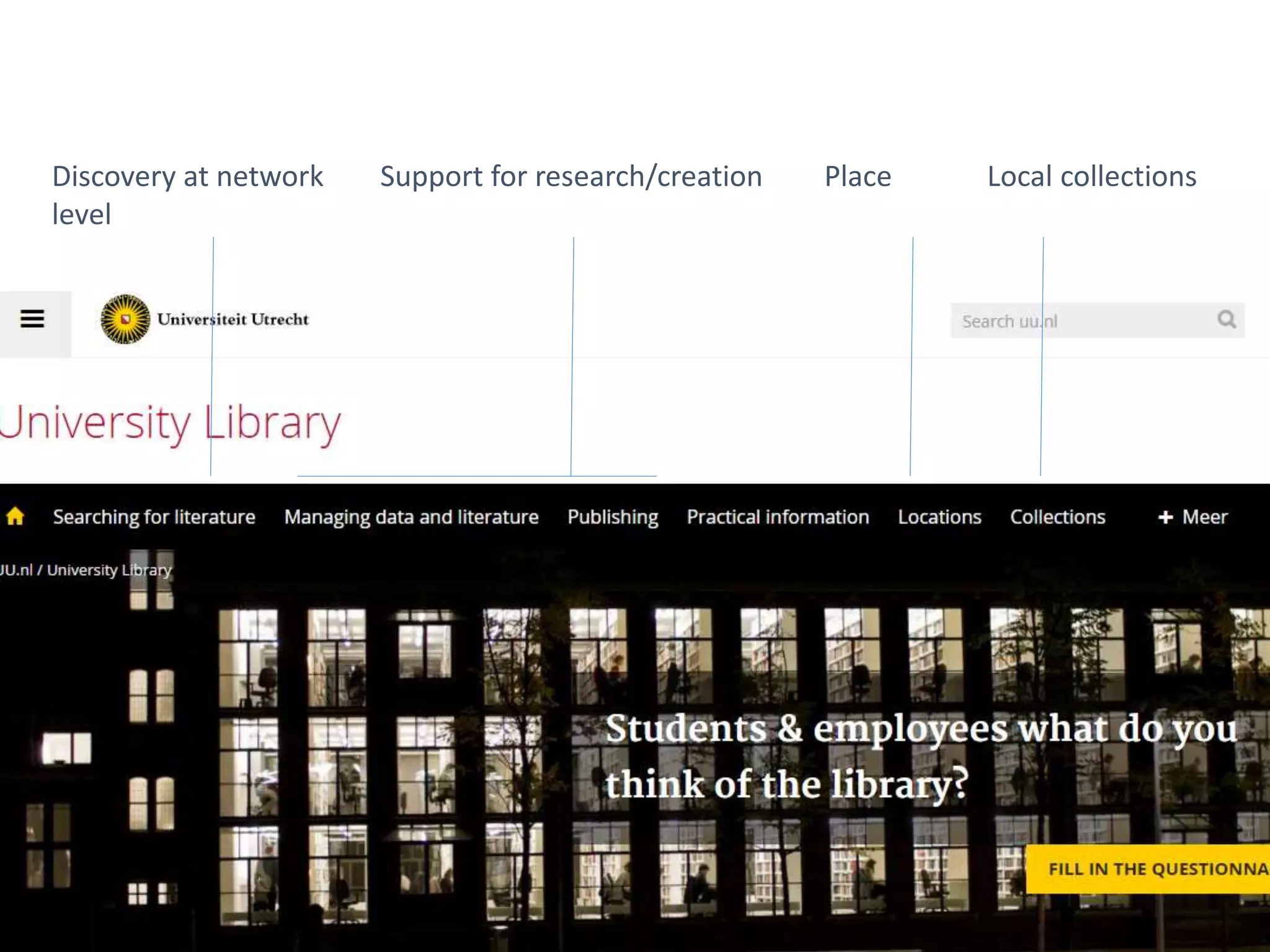
Discovery at network
level
Support for research/creation Local collectionsPlace
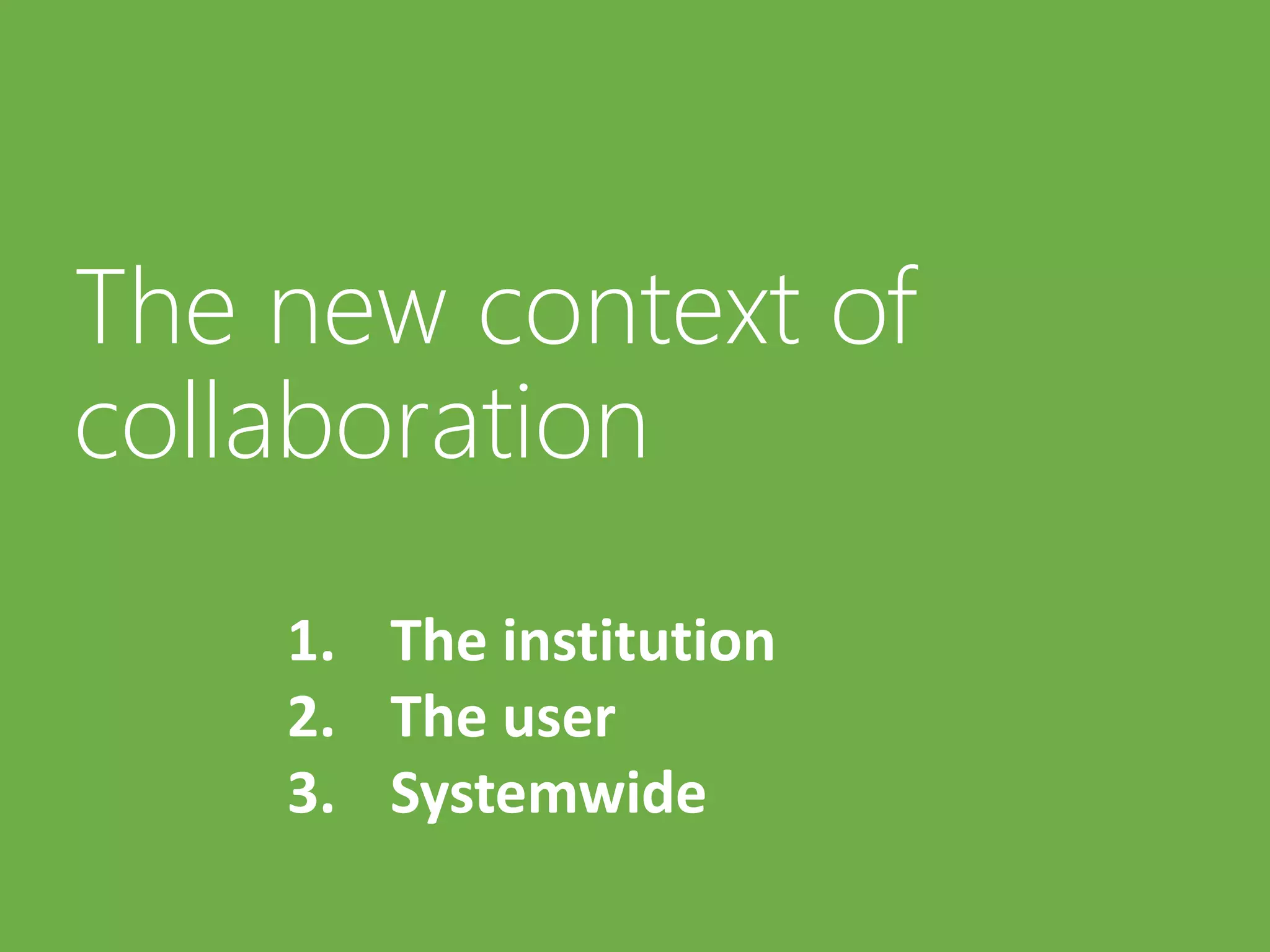
The new context of
collaboration
1. The institution
2. The user
3. Systemwide
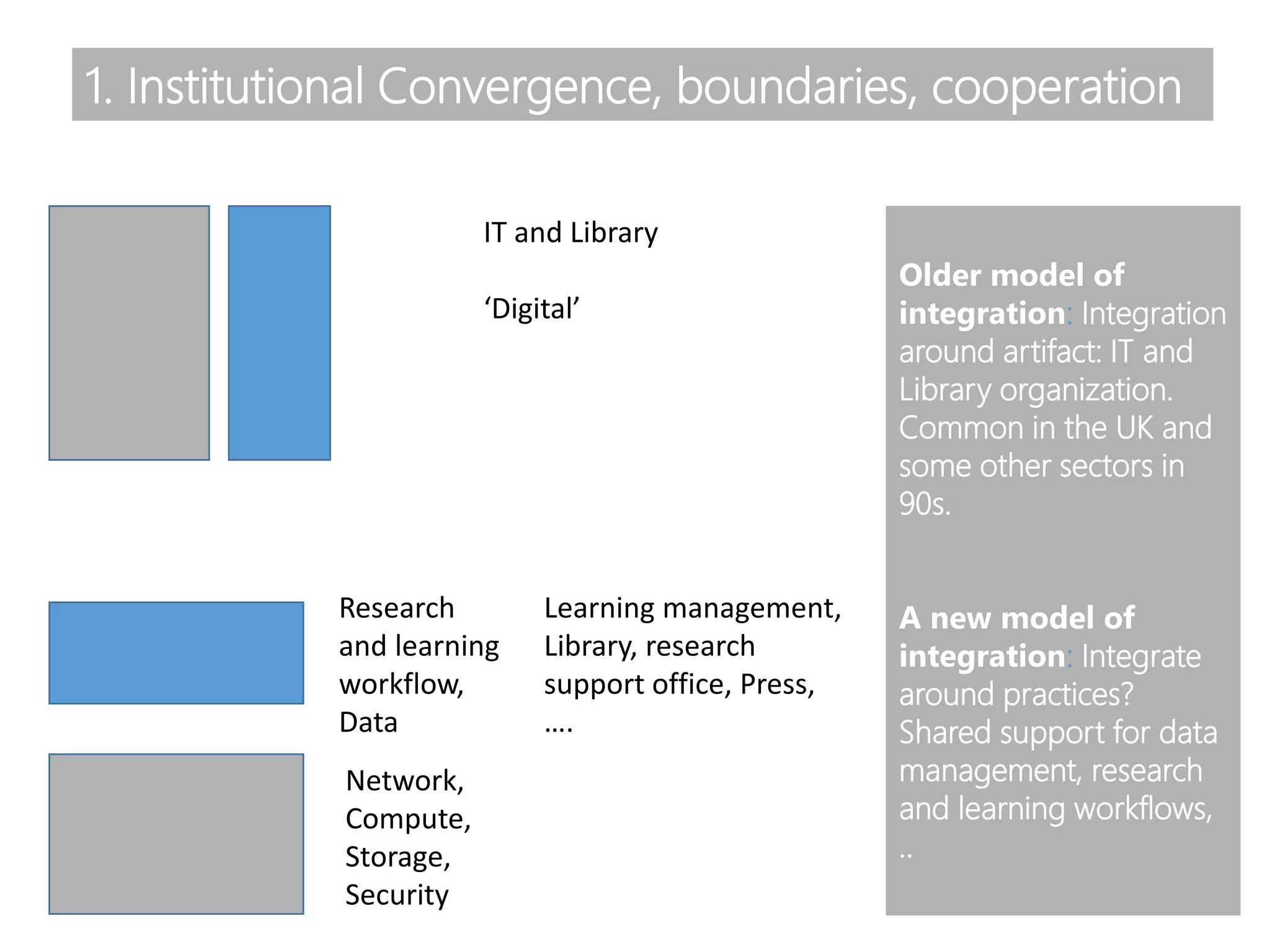
1. Institutional Convergence, boundaries, cooperation
IT and Library
‘Digital’
Network,
Compute,
Storage,
Security
Research
and learning
workflow,
Data
Learning management,
Library, research
support office, Press,
….
Older model of
integration: Integration
around artifact: IT and
Library organization.
Common in the UK and
some other sectors in
90s.
A new model of
integration: Integrate
around practices?
Shared support for data
management, research
and learning workflows,
..
Our traditional model was one in which we thought of the
user in the life of the library
… but we are now increasingly thinking about the
library in the life of the user as they enact new
research and learning practices.
2. Deeper engagement with research and
learning behaviors of library users – a partner
in knowledge creation.
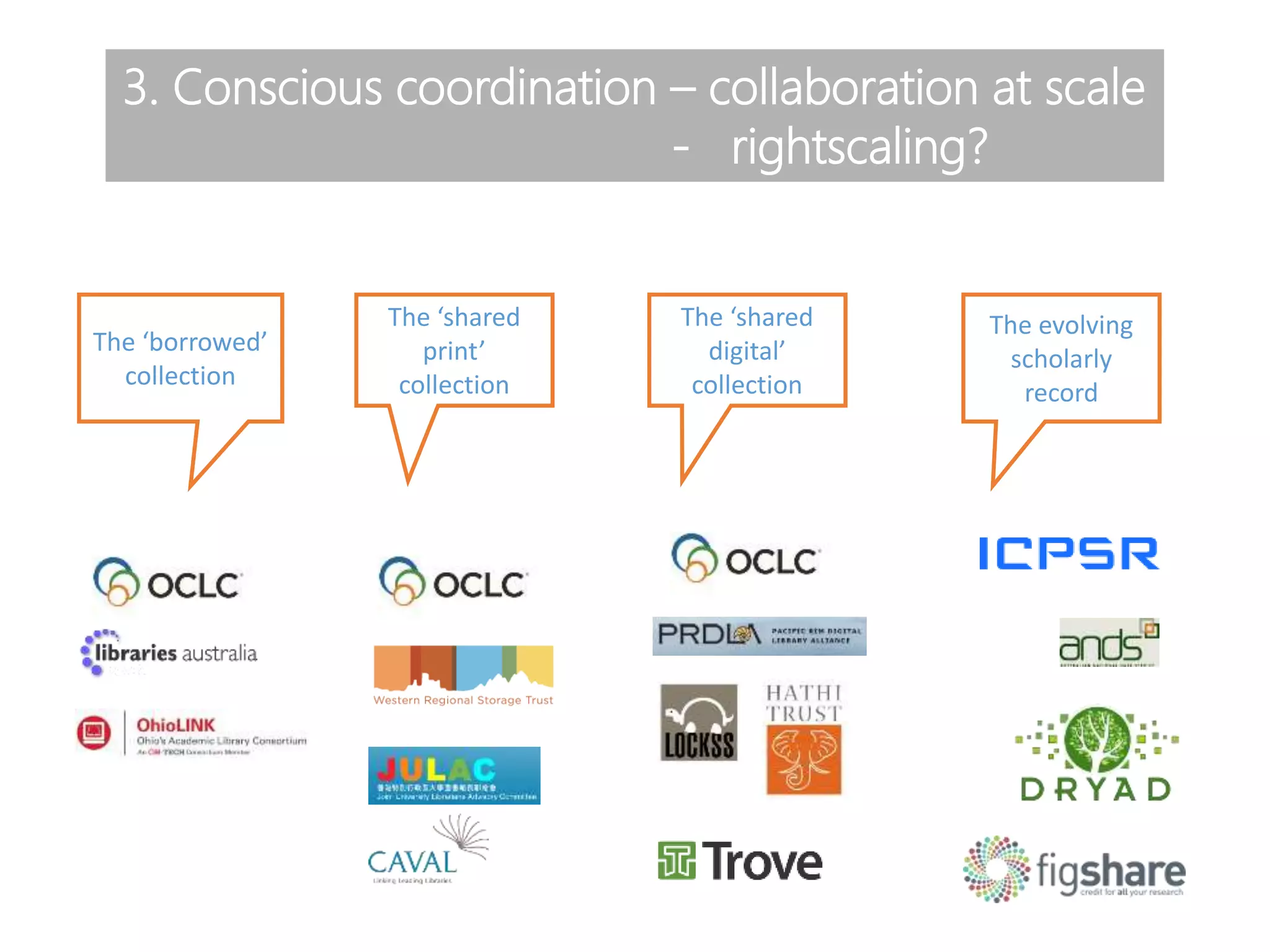
3. Conscious coordination – collaboration at scale
- rightscaling?
The ‘borrowed’
collection
The ‘shared
print’
collection
The ‘shared
digital’
collection
The evolving
scholarly
record
So …
Manage systems and services to support
research and learning.
Support – and help shape - knowledge
creation and sharing practices
in data-rich network environments.
This:
And this:
Collaboration at
scale
A shared data network that connects people to
knowledge through the world’s libraries and their
collections.
A platform for library services that enables
libraries to share data, work and resources to
save money and deliver value to their users.

Towards collaboration at scale: Libraries, the social and the technical

  • 1.
    Towards collaboration atscale: Libraries, the social and the technical OCLC Asia Pacific Regional Council meeting, RMIT University, Melbourne. 3-4 December 2015. Lorcan Dempsey @LorcanD http://www.mfacade.com/wp-content/uploads/2013/08/DSC02547-Edited-Edited.jpg
  • 2.
    The social andthe technical
  • 3.
    Graph 1 Rapid growthin some things Graph 2 Rapid decline in some other things • Cloud • Mobile • Social • Sensors/ collectors • Big data • Analytics • Processing/ • storage capacity • Google!! • Interaction costs
  • 4.
    • Amazon: logistics ande- commerce • Walmart: supply chain • Google: machine learning • Target: predictive analytics • Uber • FaceBook (safe) • Square • Nest 1. Cataloguing and resource sharing 2. Electronic journals 3. Emerging network platforms – shared library systems, shared print, preservation, data, …
  • 5.
    Technology as artifact Technologyas practice Reshapes organizations, workflow and behavior The technical reshapes the social – the social reshapes the technical I borrow artifact/practice terms from Wanda Orlikowski, 2000. Using Technology and Constituting Structures: A Practice Lens for Studying Technology in Organizations
  • 6.
    Technology in practice: anexample Cell phone and mobility
  • 7.
    Micro- coordination Ad hoc rendezvous Location Tying place andnetwork. Maps Visual Tying place, network and image Cell phone
  • 8.
    “Digital information isthe fuel of mobility,” he says. “Some transport sociologists say that information about mobility is 50% of mobility. The car will become an accessory to the smartphone.” End of the car age: how cities are outgrowing the automobile http://www.theguardian.com/cities/2015/apr/28/end-of-the-car-age-how-cities- outgrew-the-automobile http://peterblade.blogspot.com/2012/05/inauguration-du-showroom-peter-blade.html
  • 9.
  • 10.
    “Uber – haseffectively become the vascular system for business … or think of it this way: it is the broadband pipe for atoms.” “Uber looks like a taxi business but really it's all about routing - it's trying to unbundle both car ownership and public transport and shift roads from circuit-switching to packet-switching.” B Evans. http://us6.campaign- archive2.com/?u=b98e2de85f03865f1d38de74f&id=ac5933501b “More and more, Uber is positioning itself as a logistics company. The goal is to deliver people and things within cities as quickly as possible — relying heavily on Google’s Maps in the process..” NYT May 7 2015
  • 11.
    Uber drivers— andother “on-demand” workers— have become increasingly vocal as the question the rights of these enterprises to operate outside of minimum wage laws, anti-discrimination statutes, workers’ compensation laws, and union- organizing rights. … In a Wall Street Journal article about on- demand employment, One worker tells the WSJ, ‘We are not robots; we are not a remote control; we are individuals…” http://www.faz.net/aktuell/feuilleton/debatten/the-digital-debate/shoshana-zuboff-on-the-sharing-economy-13500770-p4.html Shoshana Zuboff on the sharing economy.
  • 12.
  • 13.
    A communication device. Connectingidentity, place and workflows to reshape industries and behaviors. This: And this:
  • 14.
    3 library examples Citationmanagement Institutional repository > workflow is the new content The collections shift
  • 15.
    Technology as practice Reshapingbehaviors/workflows Citation management
  • 16.
    So in arelatively short time, a solitary and manual function has evolved into a workflow enacted in a social and digital environment. In addition to functional value, this change has added network value, as individual users benefit from the community of use. People can make connections and find new work, and the network generates analytics which may be used for recommendations or scholarly metrics. In this way, for some people, citation management has evolved from being a single function in a broader workflow into a workflow manager, discovery engine, and social network. Dempsey & Walter, 2014 http://crl.acrl.org/content/75/6/760.full.pdf+html
  • 17.
  • 18.
    Provide and promotereference manager products. Support – and help shape - emerging practices around citation management, research networking and profiles. This: And this:
  • 19.
    Technology as practice Reshapingbehaviors/workflows Institutional repository > workflow is the new content
  • 20.
    In a well-knownarticle, Salo (2008) offers a variety of reasons as to why they have not been as heavily used as anticipated. These include a lack of attention to faculty incentives (‘prestige’) and to campus workflows. She concludes that IRs will not be successful unless developed as a part of “systematic, broad-based, well-supported data-stewardship, scholarly-communication, or digital-preservation program”. Providing technology as artifact > Supporting emerging practices http://minds.wisconsin.edu/handle/1793/22088
  • 21.
    http://www.slideshare.net/repofringe/e-prints42y EPrints Update, LesCarr, University of Southampton, Repository Fringe, 2014 1 2 3 2 3 1
  • 22.
  • 23.
  • 26.
    Her view isthat publishers are here to make the scientific research process more effective by helping them keep up to date, find colleagues, plan experiments, and then share their results. After they have published, the processes continues with gaining a reputation, obtaining funds, finding collaborators, and even finding a new job. What can we as publishers do to address some of scientists’ pain points? Annette Thomas, (then) CEO of Macmillan Publishers A publisher’s new job description http://www.against-the-grain.com/2012/11/a-publishers-new-job-description/
  • 27.
    Support - andhelp shape - emerging practices around the complete research life cycle. Provide system to manage documentary research outputs. This: And this:
  • 28.
    Technology as practice Reshapingbehaviors/workflows The collections shift – 4 contexts and towards the facilitated collection
  • 29.
    The logic ofprint distribution influenced library development: • Close to user – multiple library collections. • Big = good. • Just in case. 1
  • 30.
    The bubble ofgrowth in twentieth-century printed collections has left … librarians with a tricky problem. Barbara Fister New Roles for the Road Ahead: Essays commissioned for ACRL’s 75th Birthday
  • 31.
    Strategic management ofthe collective print collection • Managing down print. • Emerging shared infrastructure and collective action. • Space reconfigured around experiences rather than collections.
  • 32.
    An abundance ofresources in the network world 2
  • 33.
    Discovery moved tothe network level • Peeled away from local collection • “Discovery happens elsewhere” • Discoverability very important (WorldCat syndication) 3
  • 34.
    From consumption tocreation: • Support process as well as product, making as well as taking • Workflow is the new content.. • Support for publishing and digital scholarship. • An inside out perspective increasingly important. 4
  • 35.
    From owned/licensed tofacilitated. • Organized around user needs • Curation is community oriented? Collections shift …
  • 36.
    The ‘owned’ collection The ‘facilitated’ collection The‘borrowed’ collection A collections spectrum The ‘shared print’ collection The ‘shared digital’ collection The evolving scholarly record Purchased and physically stored Meet research and learning needs in best way The ‘licensed’ collection The ‘demand- driven’ collection The ‘external’ collection: Pointing researchers at Google Scholar; Including freely available ebooks in the catalog; Creating resource guides for web resources.
  • 37.
    The ‘owned’ collection The ‘facilitated’ collection The‘borrowed’ collection A collections spectrum The ‘shared print’ collection The ‘shared digital’ collection The evolving scholarly record Purchased and physically stored Meet research and learning needs in best way Collaboration – requires ‘conscious coordination’
  • 38.
    Network logic: coordinationof external and collaborative services around user needs. Print logic: distributed library model. This: And this:
  • 39.
    Discovery at network level Supportfor research/creation Local collectionsPlace
  • 40.
    The new contextof collaboration 1. The institution 2. The user 3. Systemwide
  • 41.
    1. Institutional Convergence,boundaries, cooperation IT and Library ‘Digital’ Network, Compute, Storage, Security Research and learning workflow, Data Learning management, Library, research support office, Press, …. Older model of integration: Integration around artifact: IT and Library organization. Common in the UK and some other sectors in 90s. A new model of integration: Integrate around practices? Shared support for data management, research and learning workflows, ..
  • 42.
    Our traditional modelwas one in which we thought of the user in the life of the library … but we are now increasingly thinking about the library in the life of the user as they enact new research and learning practices. 2. Deeper engagement with research and learning behaviors of library users – a partner in knowledge creation.
  • 43.
    3. Conscious coordination– collaboration at scale - rightscaling? The ‘borrowed’ collection The ‘shared print’ collection The ‘shared digital’ collection The evolving scholarly record
  • 44.
  • 45.
    Manage systems andservices to support research and learning. Support – and help shape - knowledge creation and sharing practices in data-rich network environments. This: And this:
  • 46.
    Collaboration at scale A shareddata network that connects people to knowledge through the world’s libraries and their collections. A platform for library services that enables libraries to share data, work and resources to save money and deliver value to their users.

Editor's Notes

  • #24 http://global.oup.com/uk/orc/busecon/economics/carlin/
  • #42 In the UK in the 80s and 90s it was common for Libraries and IT to merge. At one stage over 50% of universities had this model. It was also adopted elsewhere. This belongs to an earlier stage, when it was thought possible to isolate technology-as-artifact – all the ‘digital’ stuff was being put together. As the digital has become more pervasive I had thought we would see a differently structured integration emerge, where the ‘infrastructure’ was managed by one group (network, compute, storage, security, …), and research and learning workflows were managed in a more integrated way in some new organizational contexts. For example, think about learning management, research support, data curation, university press, and so on. In practice we have not see this happened widely. It will be interesting to see how services do emerge to meet the needs of research and learning behaviors increasingly enacted in data-rich, network environments.