The Research Library: scalable
efficiency and scalable learning

  David Kaser Lecture Series
  Lorcan Dempsey / @LorcanD
       Indiana University,
         7 October 2012
“
    How terrific to see you are the featured
    lecturer this year. Just thought I'd
    mention that David Kaser was a most
    terrific library school professor. He was
    definitely the professor at Indiana who
    was most influential in my library career
    and also my favorite professor. I think it is
    fabulous that you are giving this lecture
    this year.

    (OCLC colleague)
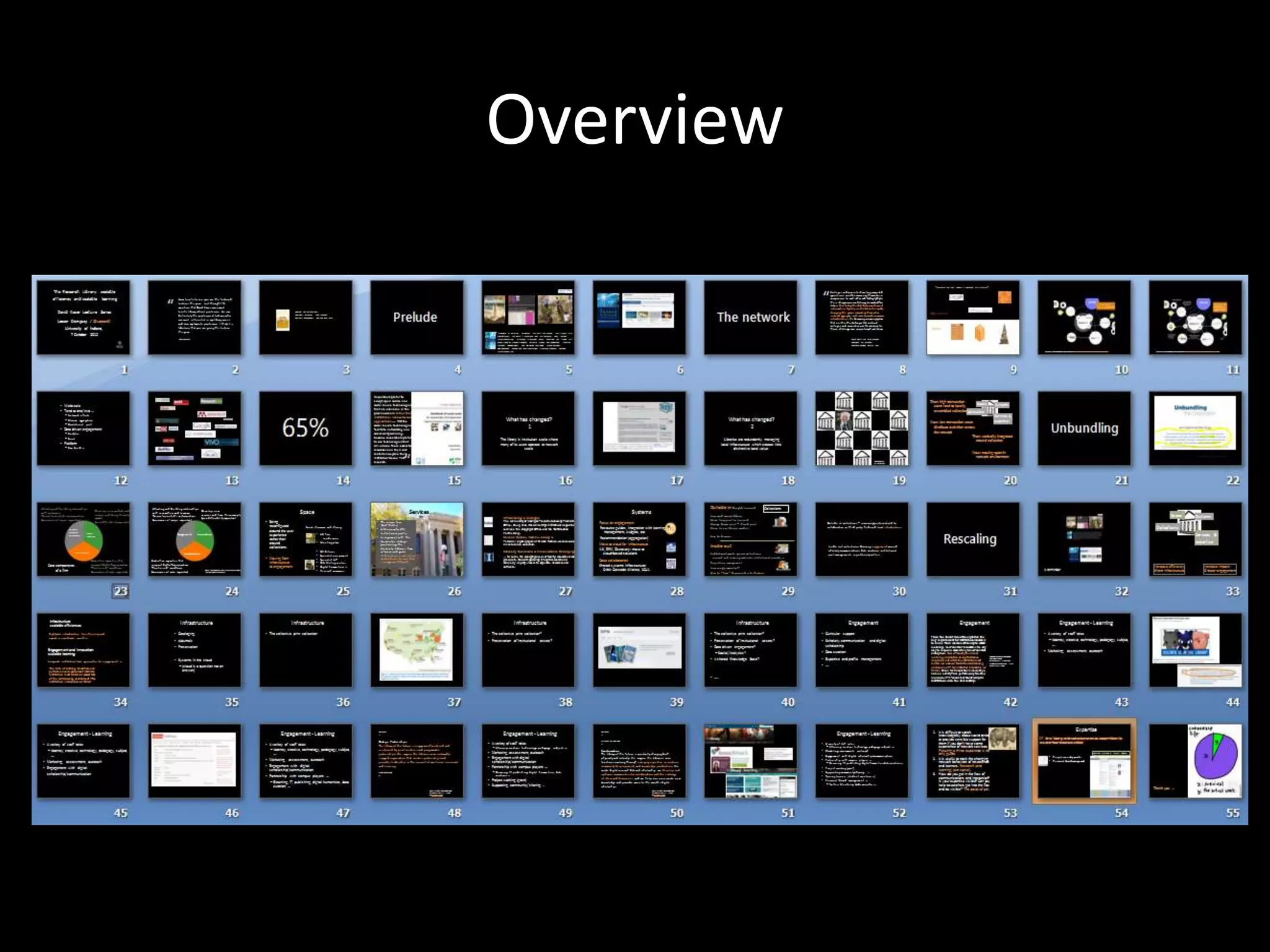
Overview
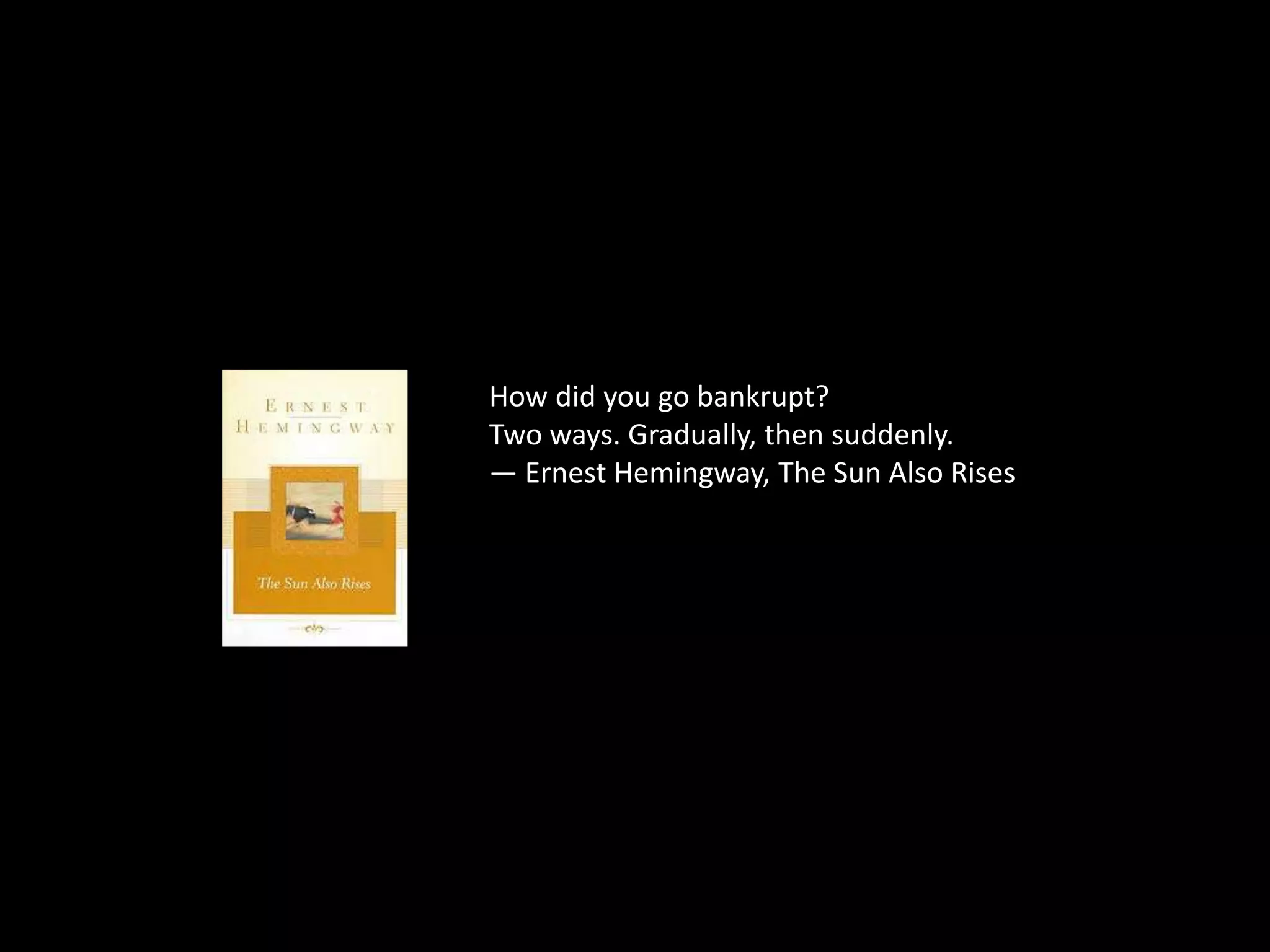
How did you go bankrupt?
Two ways. Gradually, then suddenly.
― Ernest Hemingway, The Sun Also Rises
Prelude
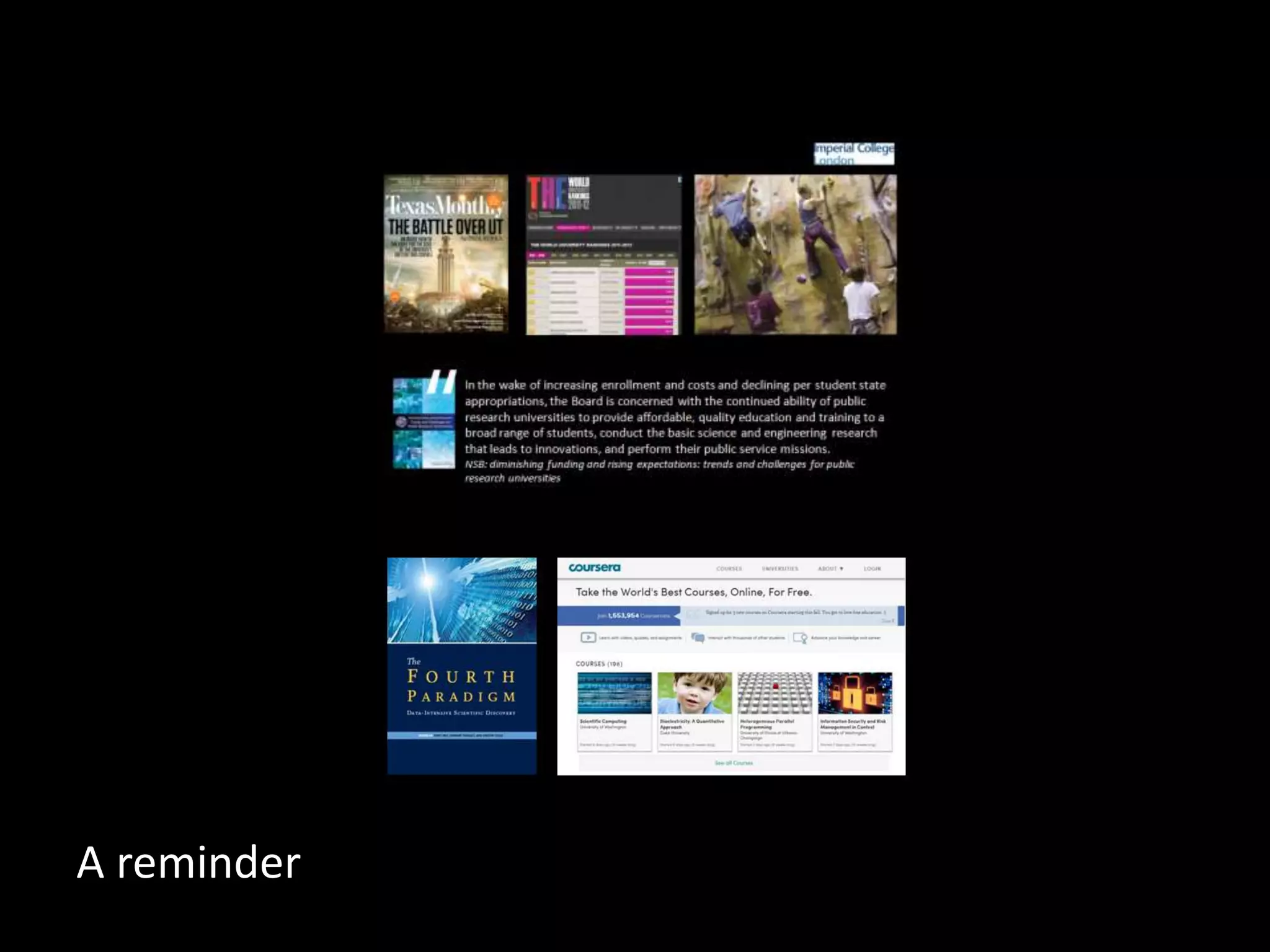
“
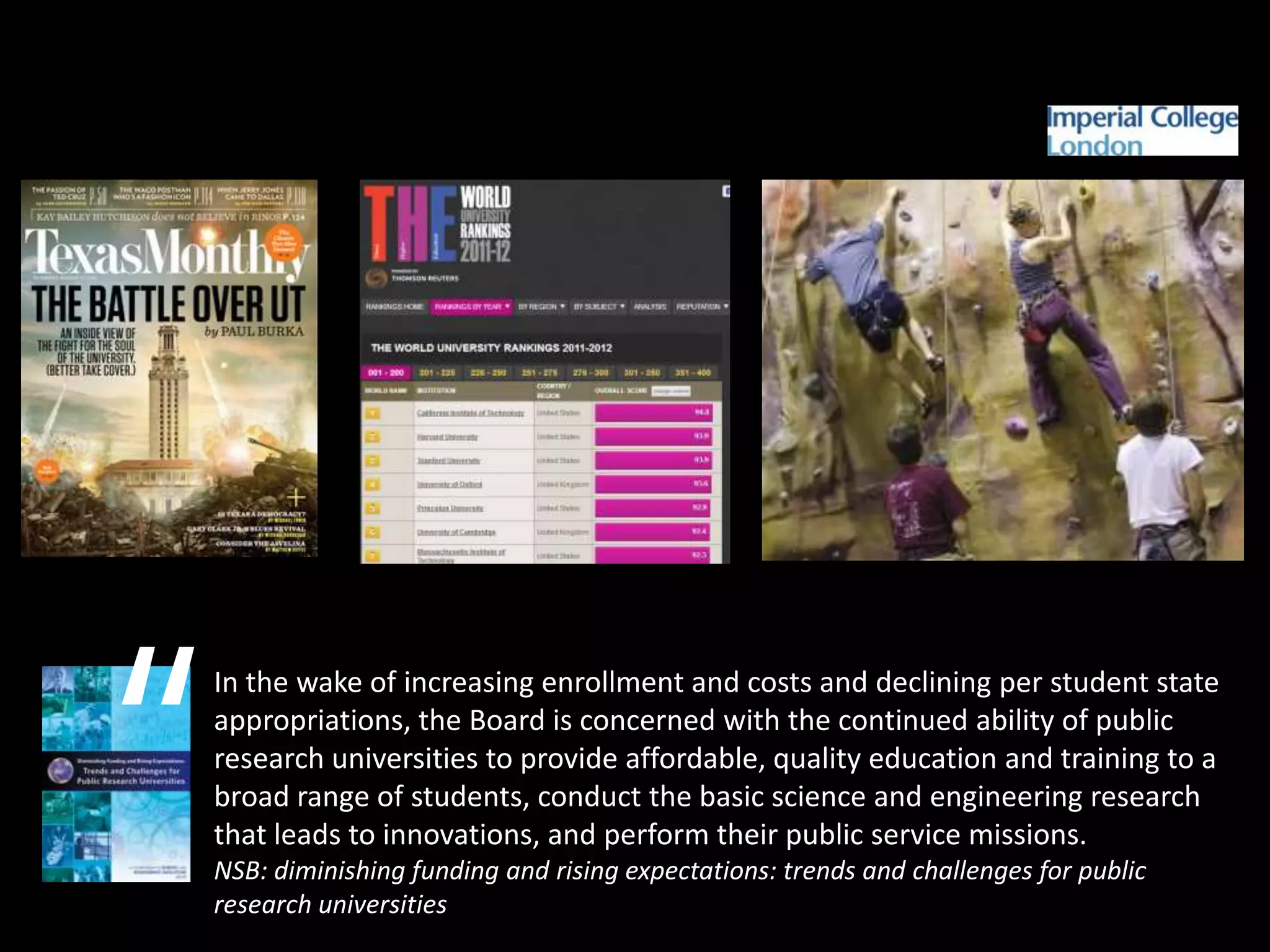
    In the wake of increasing enrollment and costs and declining per student state
    appropriations, the Board is concerned with the continued ability of public
    research universities to provide affordable, quality education and training to a
    broad range of students, conduct the basic science and engineering research
    that leads to innovations, and perform their public service missions.
    NSB: diminishing funding and rising expectations: trends and challenges for public
    research universities
The network
“
    Colleges and universities have long competed
    against one another, measuring themselves in
    comparison to each other and holding tightly to
    their idiosyncrasies as defining elements of their
    status. But today, the distribution and reuse of
    information digitally via the Internet is rapidly
    changing the game, rewarding those who
    instead aggregate and scale toward a common
    infrastructure. It is becoming increasingly clear
    that neither the challenges that confront
    colleges and universities nor the solutions to
    those challenges are unique to each institution.


                        Chuck Henry and Brad Wheeler
                        The game has changed
                        Educause Review, March 2012
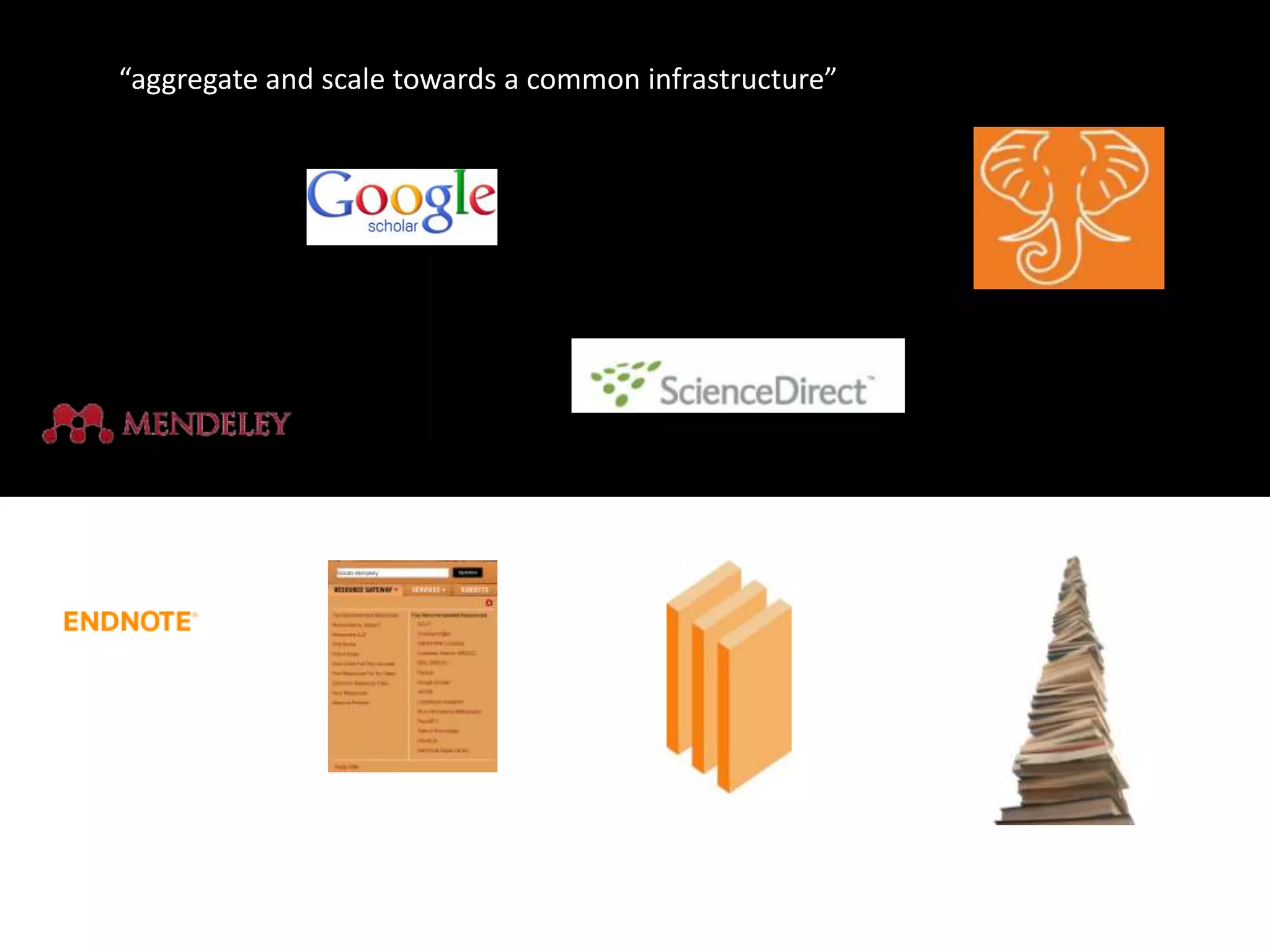
“aggregate and scale towards a common infrastructure”
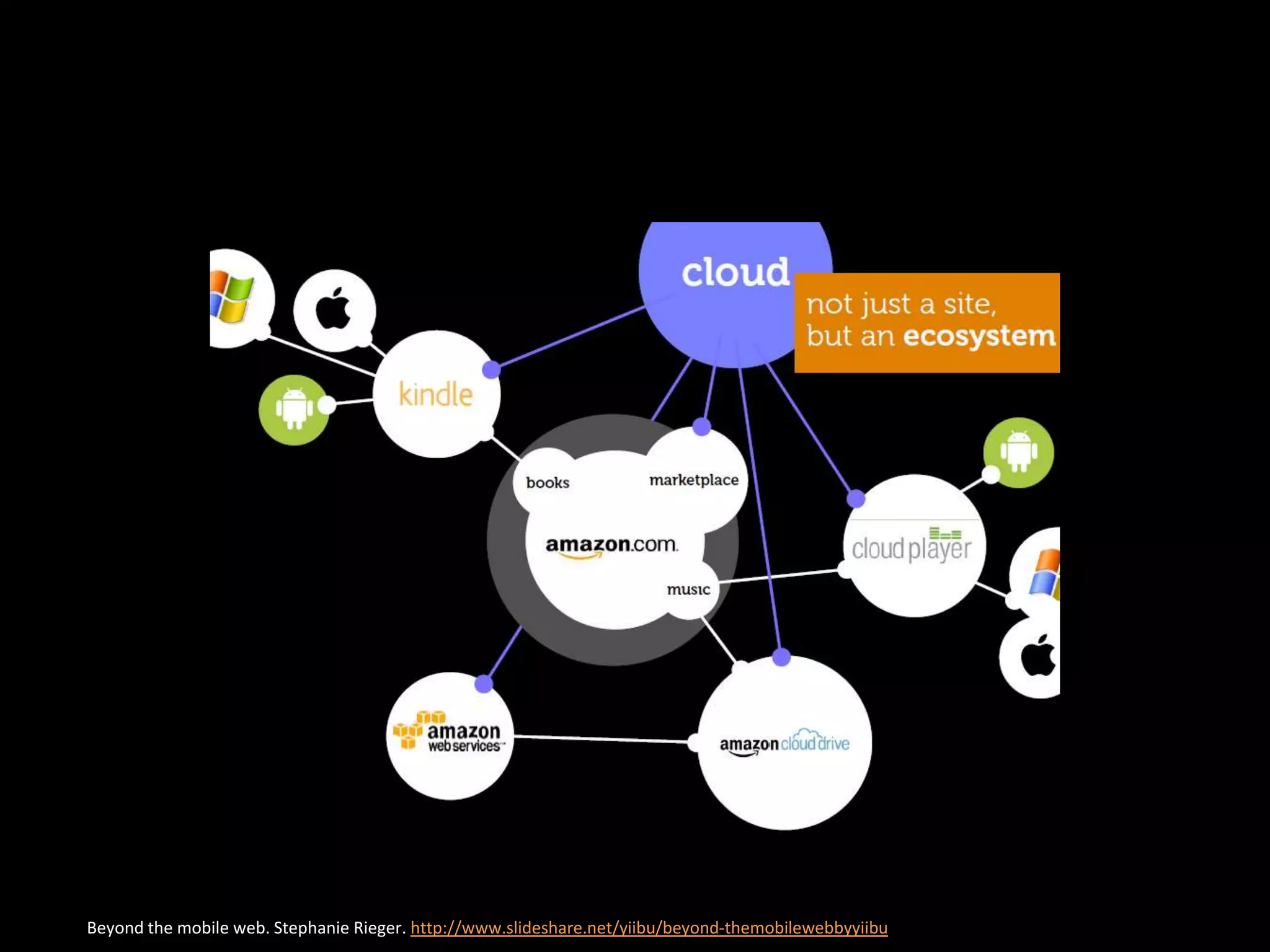
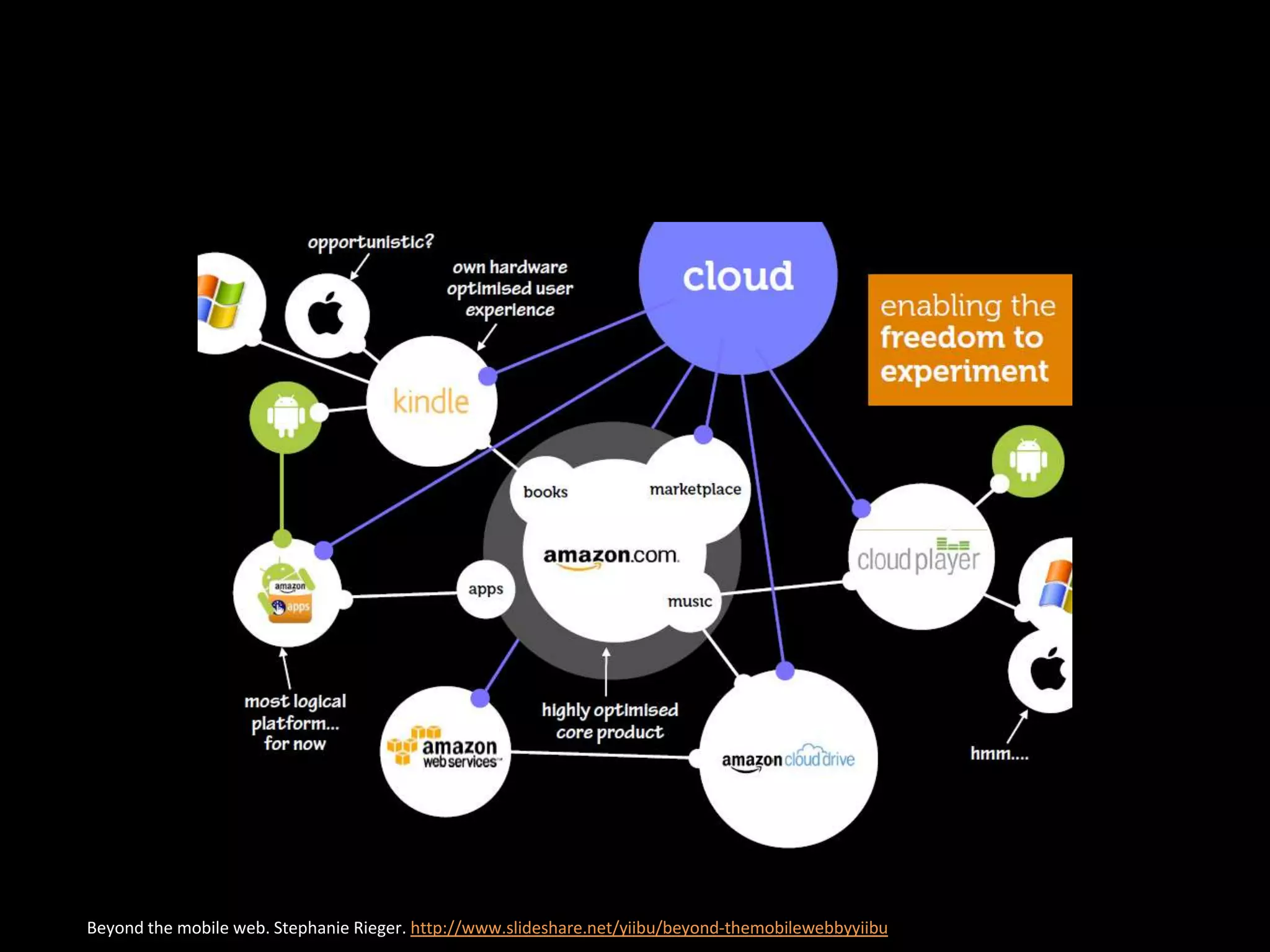
Beyond the mobile web. Stephanie Rieger. http://www.slideshare.net/yiibu/beyond-themobilewebbyyiibu
• Webscale
• Tend to one/two …
  – Network effects
  – Massive aggregation
  – Gravitational pull
• Data driven engagement
  – Analytics
  – Social
• Platform
  – Leverage for developers …
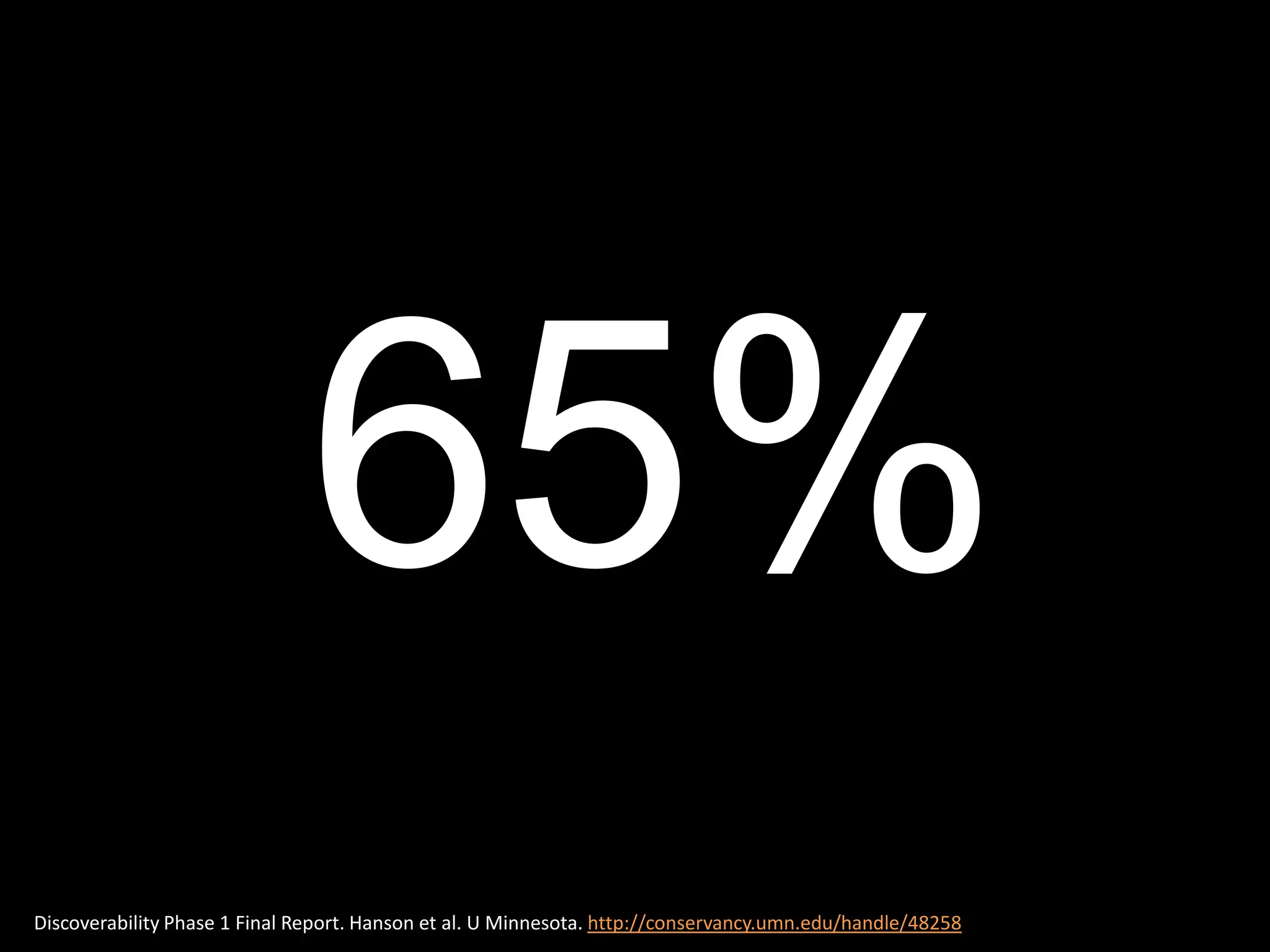
65%
Discoverability Phase 1 Final Report. Hanson et al. U Minnesota. http://conservancy.umn.edu/handle/48258
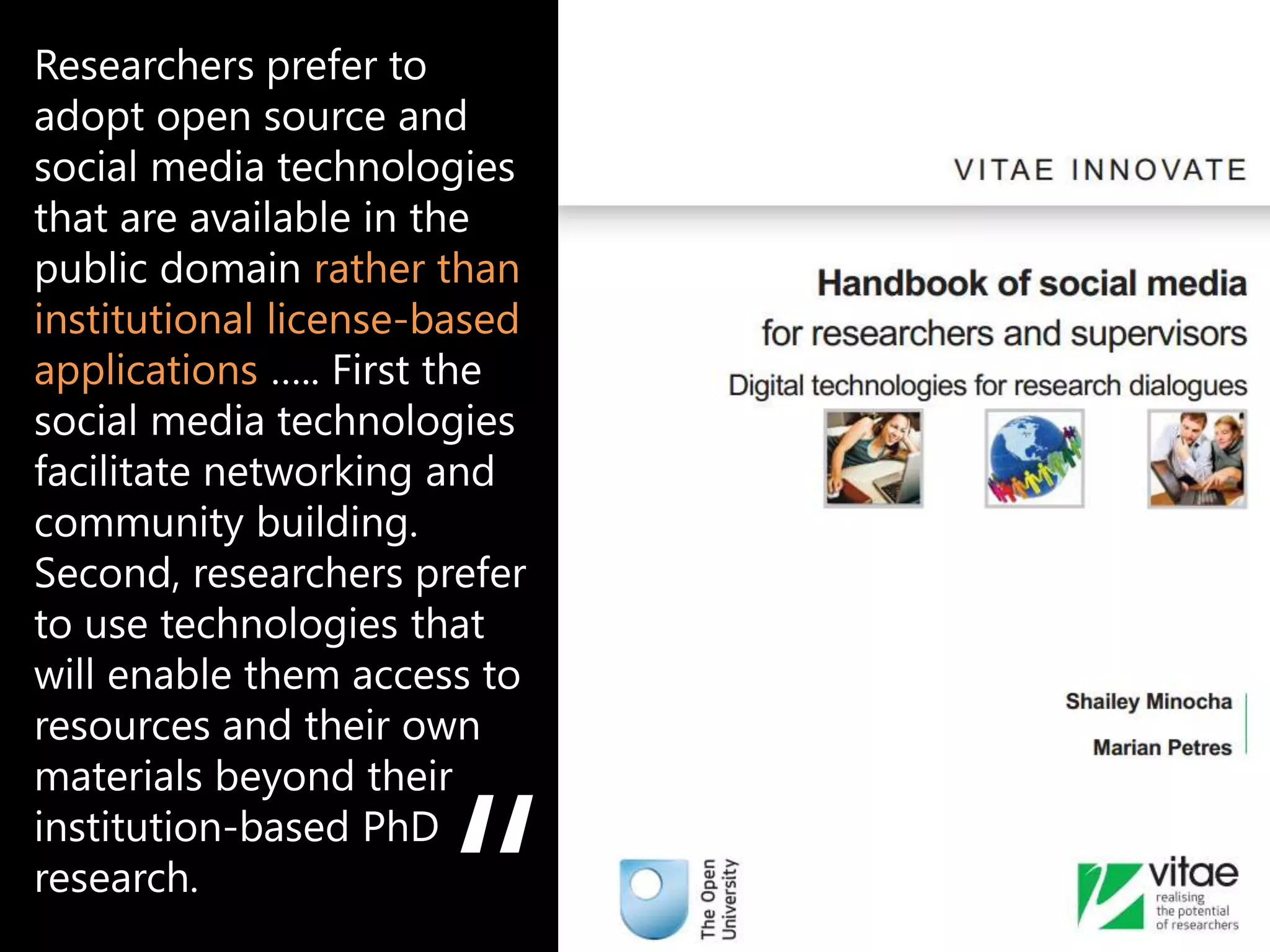
Researchers prefer to
adopt open source and
social media technologies
that are available in the
public domain rather than
institutional license-based
applications ….. First the
social media technologies
facilitate networking and
community building.
Second, researchers prefer
to use technologies that
will enable them access to
resources and their own
materials beyond their
institution-based PhD
research.                     e.g. Mendeley, Zotero, Endnote
What has changed?
            1

The library is institution scale where
many of its users operate at network
                 scale
What has changed?
             2

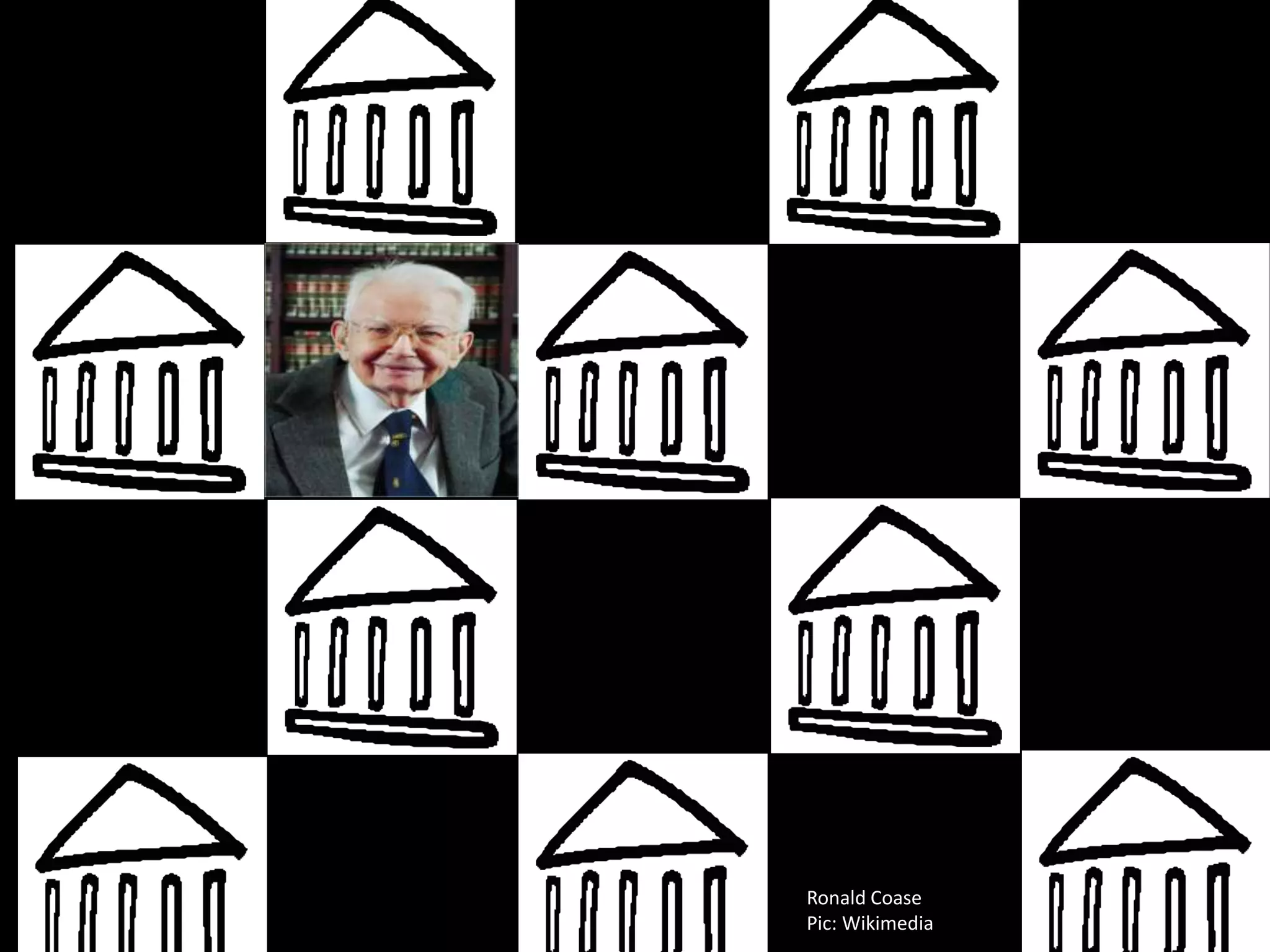
  Libraries are redundantly managing
local infrastructure which creates little
          distinctive local value.
Ronald Coase
Pic: Wikimedia
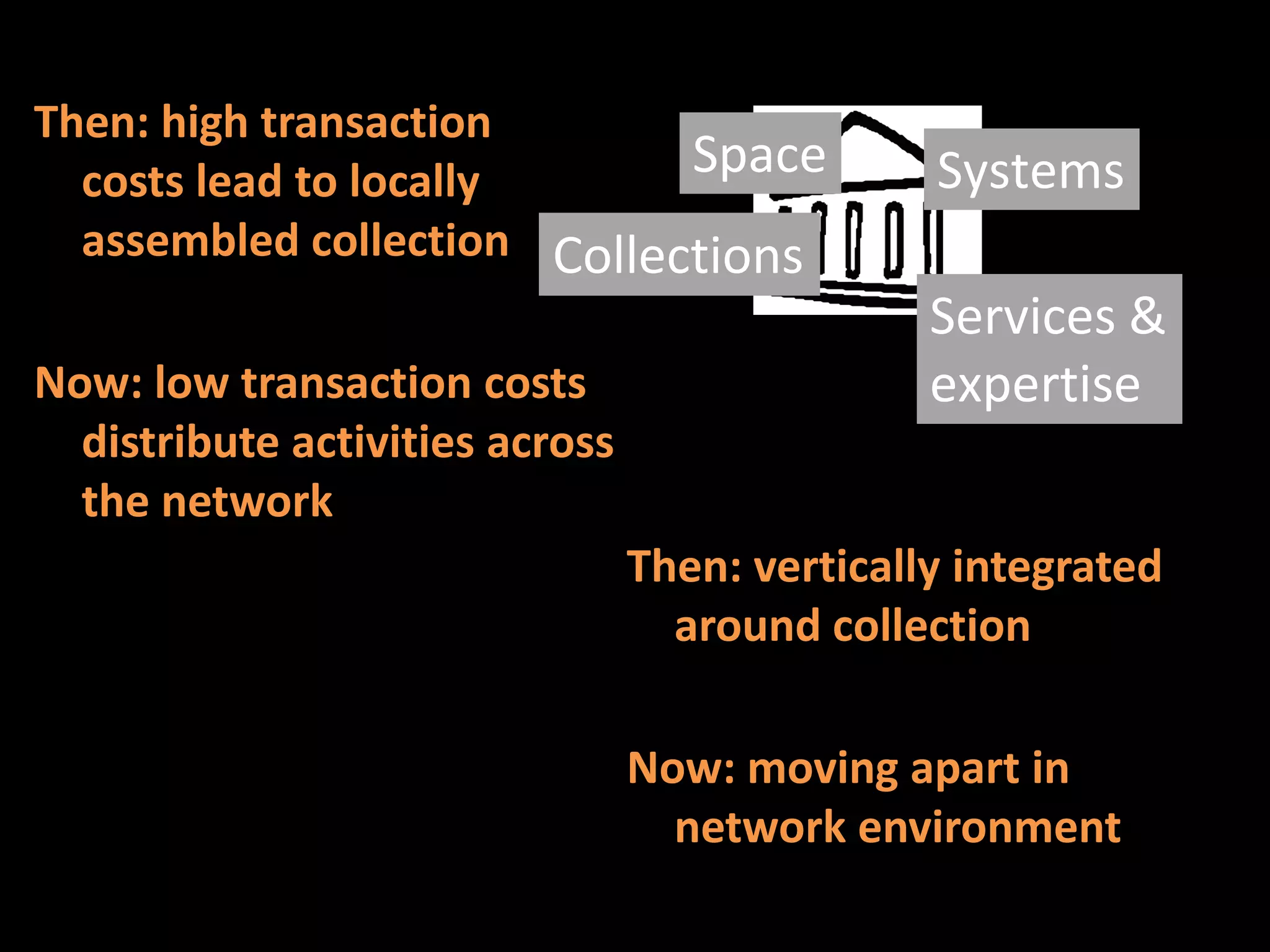
Then: high transaction
  costs lead to locally      Space              Systems
  assembled collection Collections
                                                Services &
Now: low transaction costs                      expertise
  distribute activities across
  the network
                                 Then: vertically integrated
                                   around collection

                                 Now: moving apart in
                                   network environment
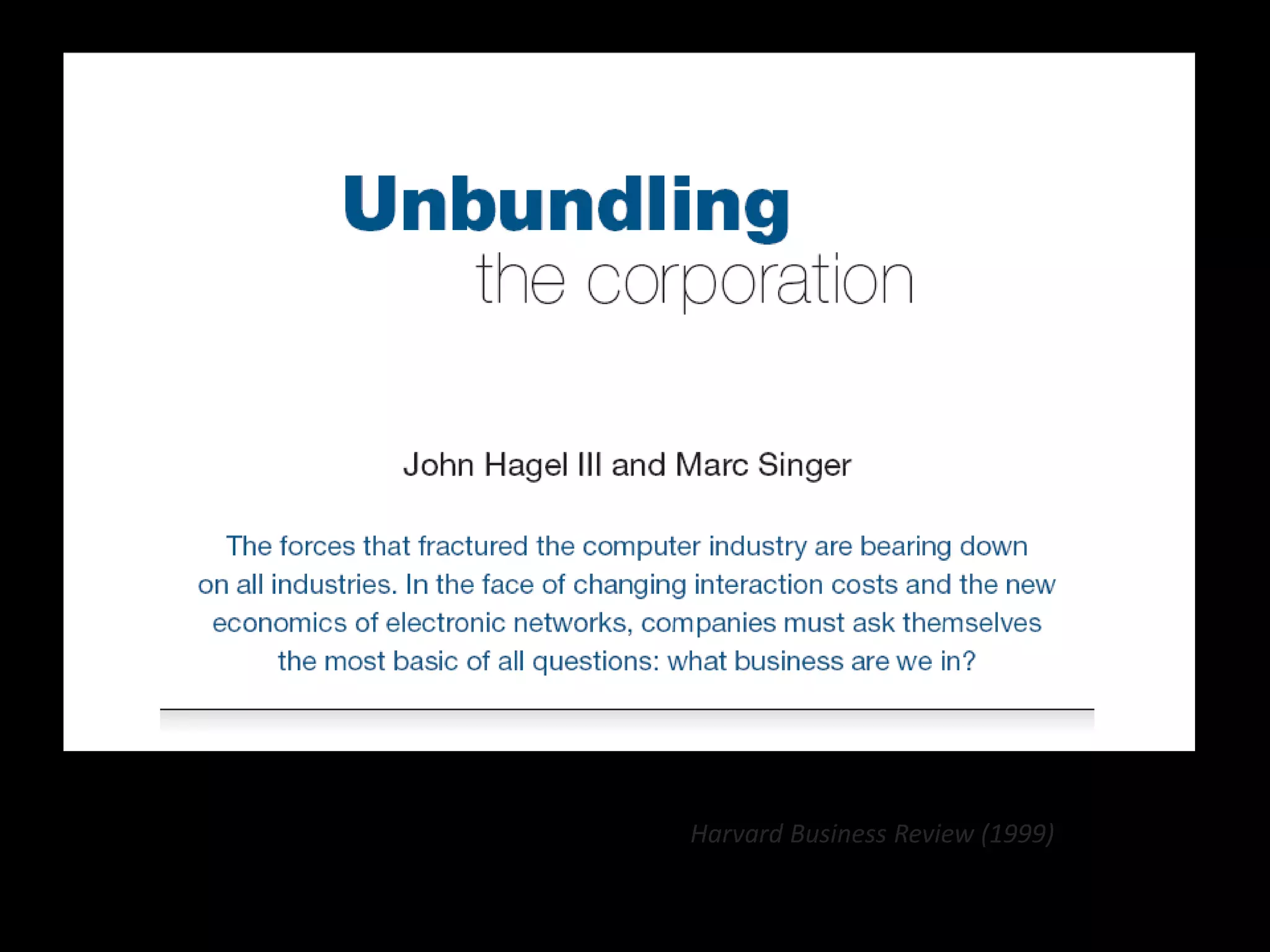
Unbundling
Harvard Business Review (1999)
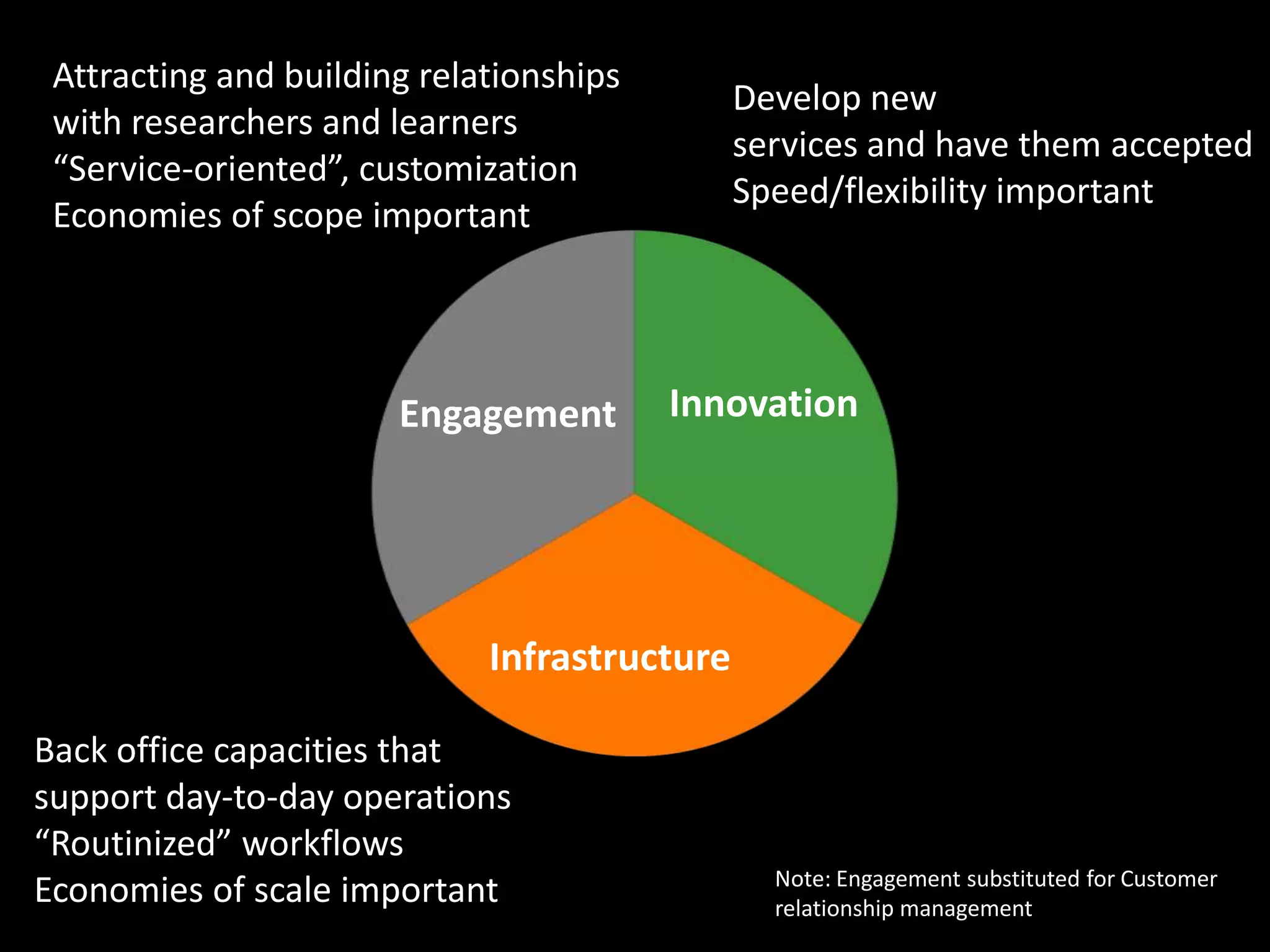
Attracting and building relationships
                                              Develop new
 with researchers and learners
                                              services and have them accepted
 “Service-oriented”, customization
                                              Speed/flexibility important
 Economies of scope important


                       Engagement        Innovation


                             Infrastructure

Back office capacities that
support day-to-day operations
“Routinized” workflows
                                                Note: Engagement substituted for Customer
Economies of scale important                    relationship management
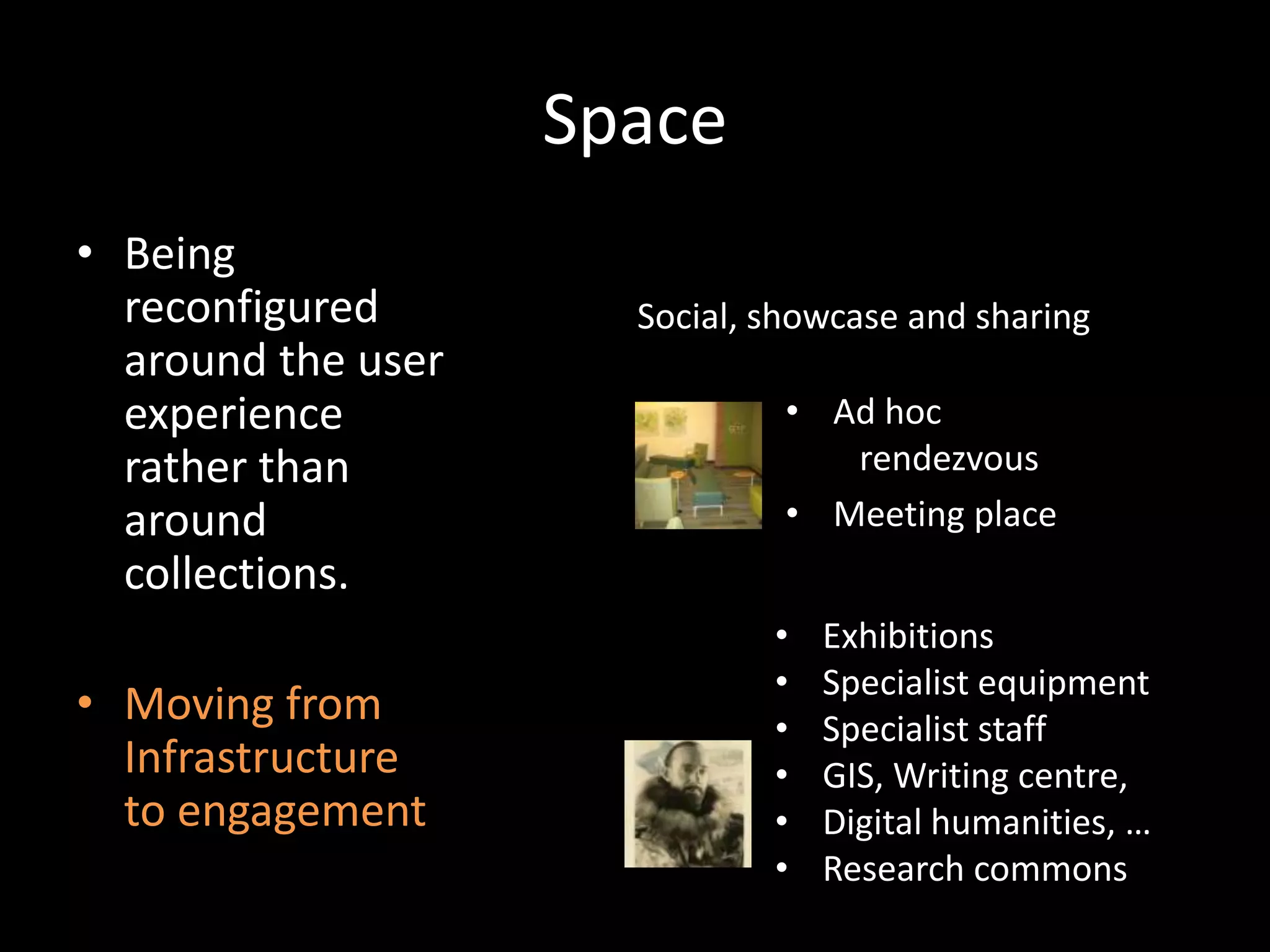
Space
• Being
  reconfigured        Social, showcase and sharing
  around the user
  experience                   • Ad hoc
  rather than                     rendezvous
  around                       • Meeting place
  collections.
                              •   Exhibitions
                              •   Specialist equipment
• Moving from                 •   Specialist staff
  Infrastructure              •   GIS, Writing centre,
  to engagement               •   Digital humanities, …
                              •   Research commons
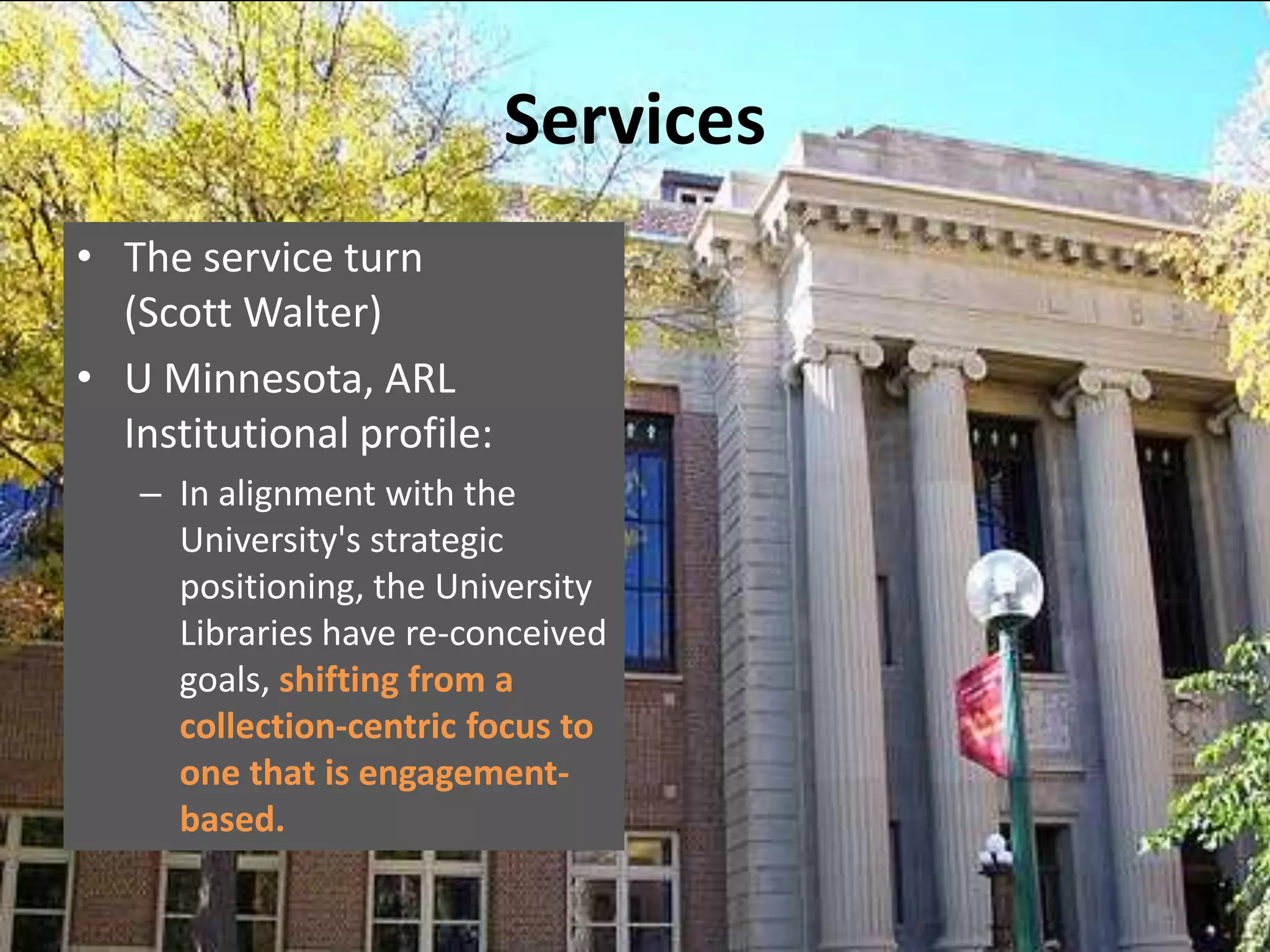
Services
• The service turn
  (Scott Walter)
• U Minnesota, ARL
  Institutional profile:
   – In alignment with the
     University's strategic
     positioning, the University
     Libraries have re-conceived
     goals, shifting from a
     collection-centric focus to
     one that is engagement-
     based.
MPublishing, U Michigan
The University of Michigan Press, the Scholarly Publishing
Office, Deep Blue (the University’s institutional repository
service), the Copyright Office, and the Text Creation
Partnership,
Salman Rushdie Archive, Emory U
Personal digital papers of Salman Rushdie. Have become
his reference collection.

Scholarly Commons, U Illinois Urbana Champaign
... to serve the emerging needs of faculty, researchers and
graduate students pursuing in-depth research and scholarly
inquiry. Access to expertise, hardware and software.
Systems
Focus on engagement
Resource guides, integration with learning
  management, widgets, etc
Recommendation (aggregation)
Move to cloud for infrastructure
ILS, ERM, Discovery: move to
   cloud-based solutions
Deep collaboration
Shared systems infrastructure:
  Orbis Cascade Alliance, 2CUL
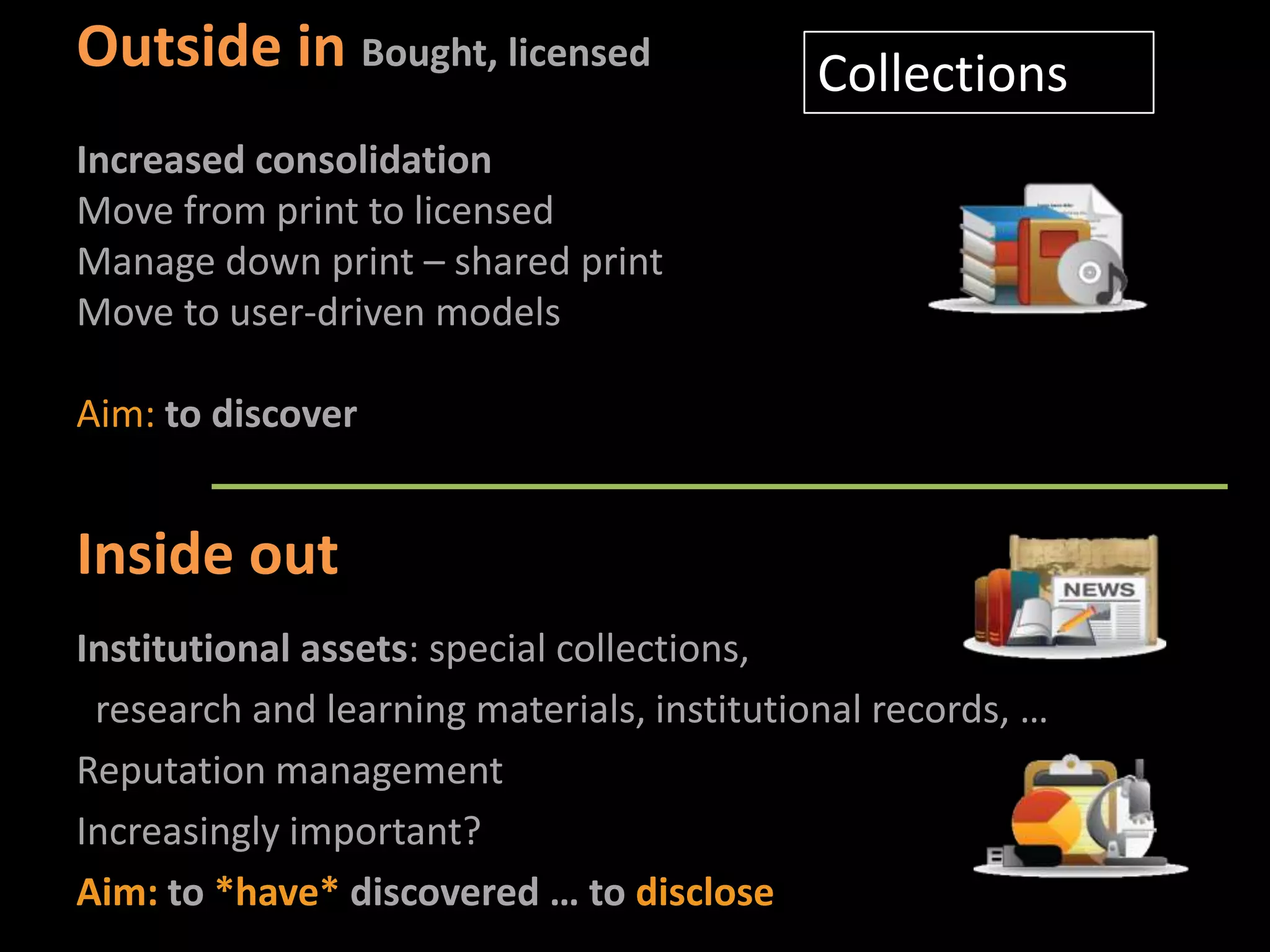
Outside in Bought, licensed                 Collections
Increased consolidation
Move from print to licensed
Manage down print – shared print
Move to user-driven models

Aim: to discover


Inside out
Institutional assets: special collections,
 research and learning materials, institutional records, …
Reputation management
Increasingly important?
Aim: to *have* discovered … to disclose
Outside in collections – increasingly externalised to
collaborative or third party. Reduced local infrastructure.


Inside out collections. Growing engagement around
scholarly communication, data curation, institutional
asset management, reputation/profiles. Leverage internal/
external infrastructure.
Rescaling
A reminder
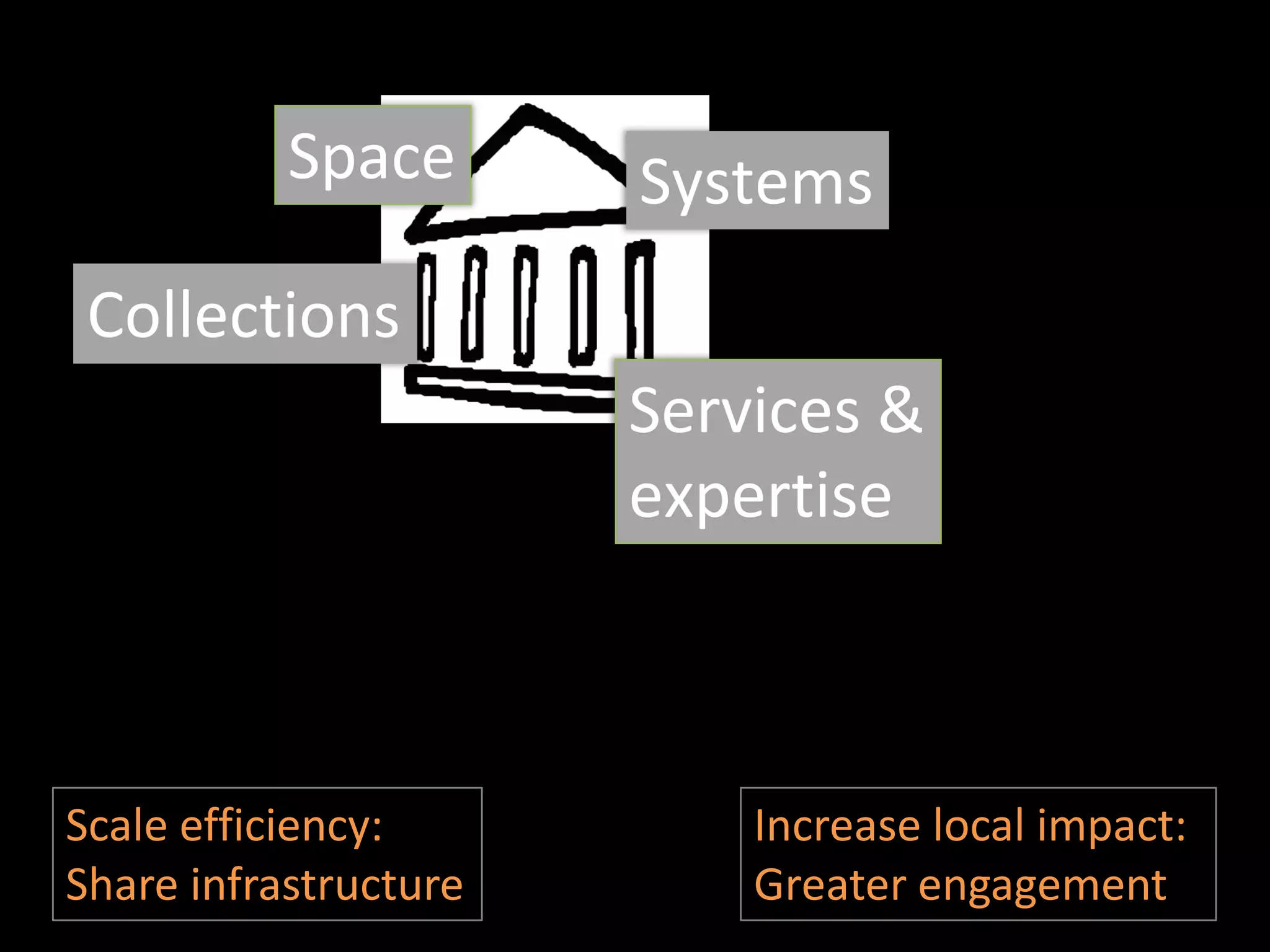
Space       Systems
 Collections
                       Services &
                       expertise


Scale efficiency:          Increase local impact:
Share infrastructure       Greater engagement
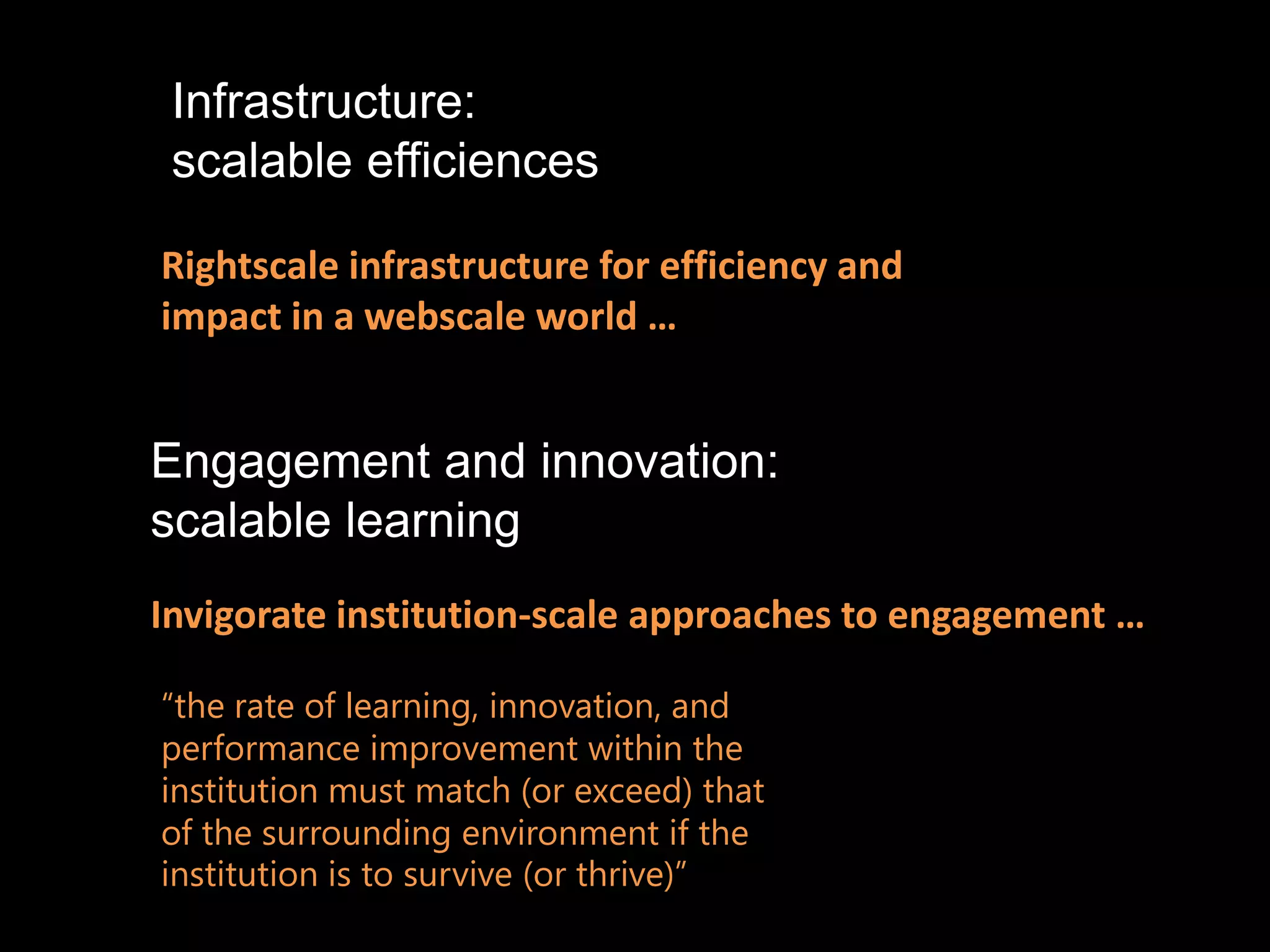
Infrastructure:
 scalable efficiences

Rightscale infrastructure for efficiency and
impact in a webscale world …


Engagement and innovation:
scalable learning
Invigorate institution-scale approaches to engagement …

“the rate of learning, innovation, and
performance improvement within the
institution must match (or exceed) that
of the surrounding environment if the
institution is to survive (or thrive)”
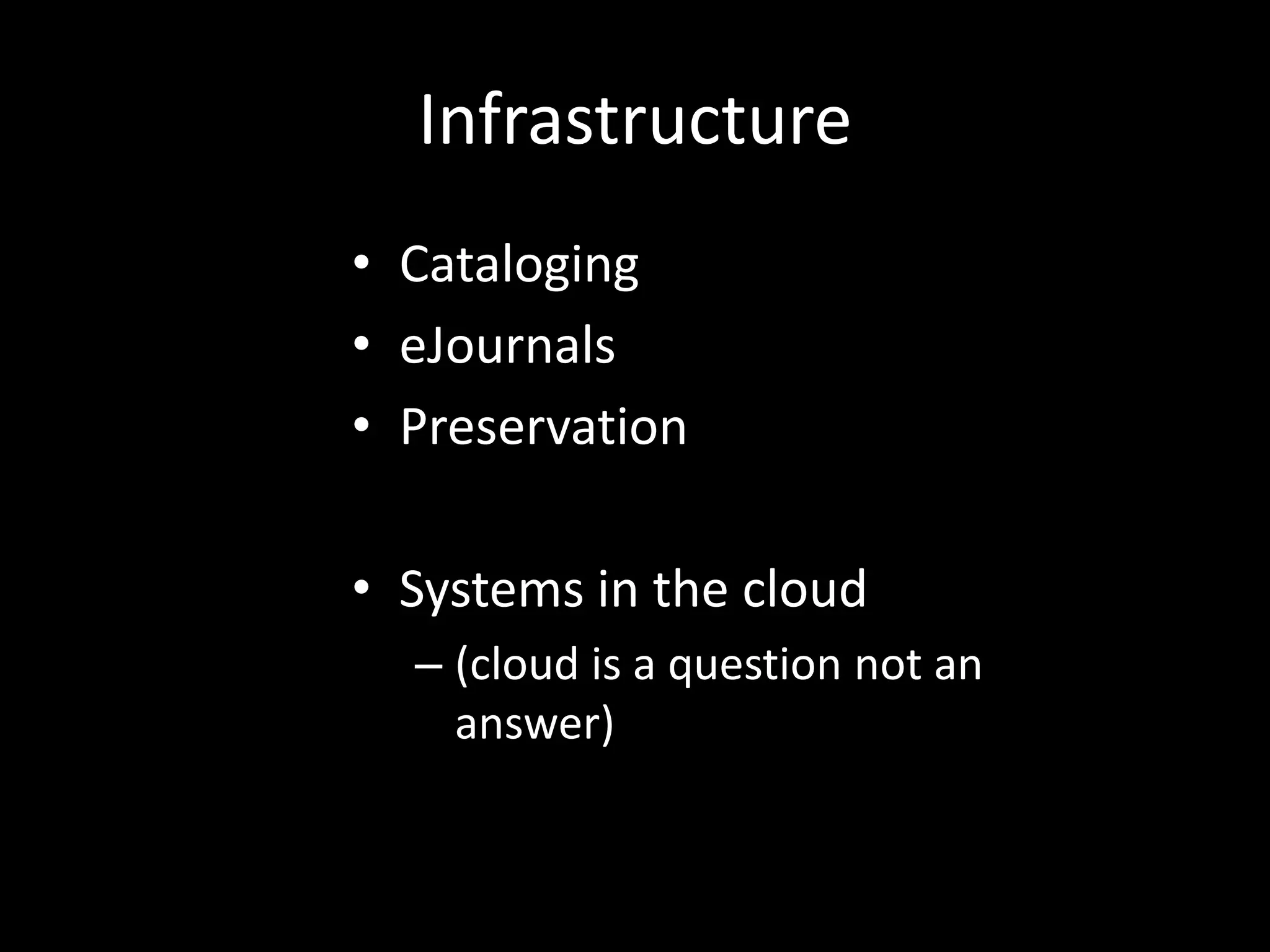
Infrastructure
• Cataloging
• eJournals
• Preservation

• Systems in the cloud
  – (cloud is a question not an
    answer)
Infrastructure
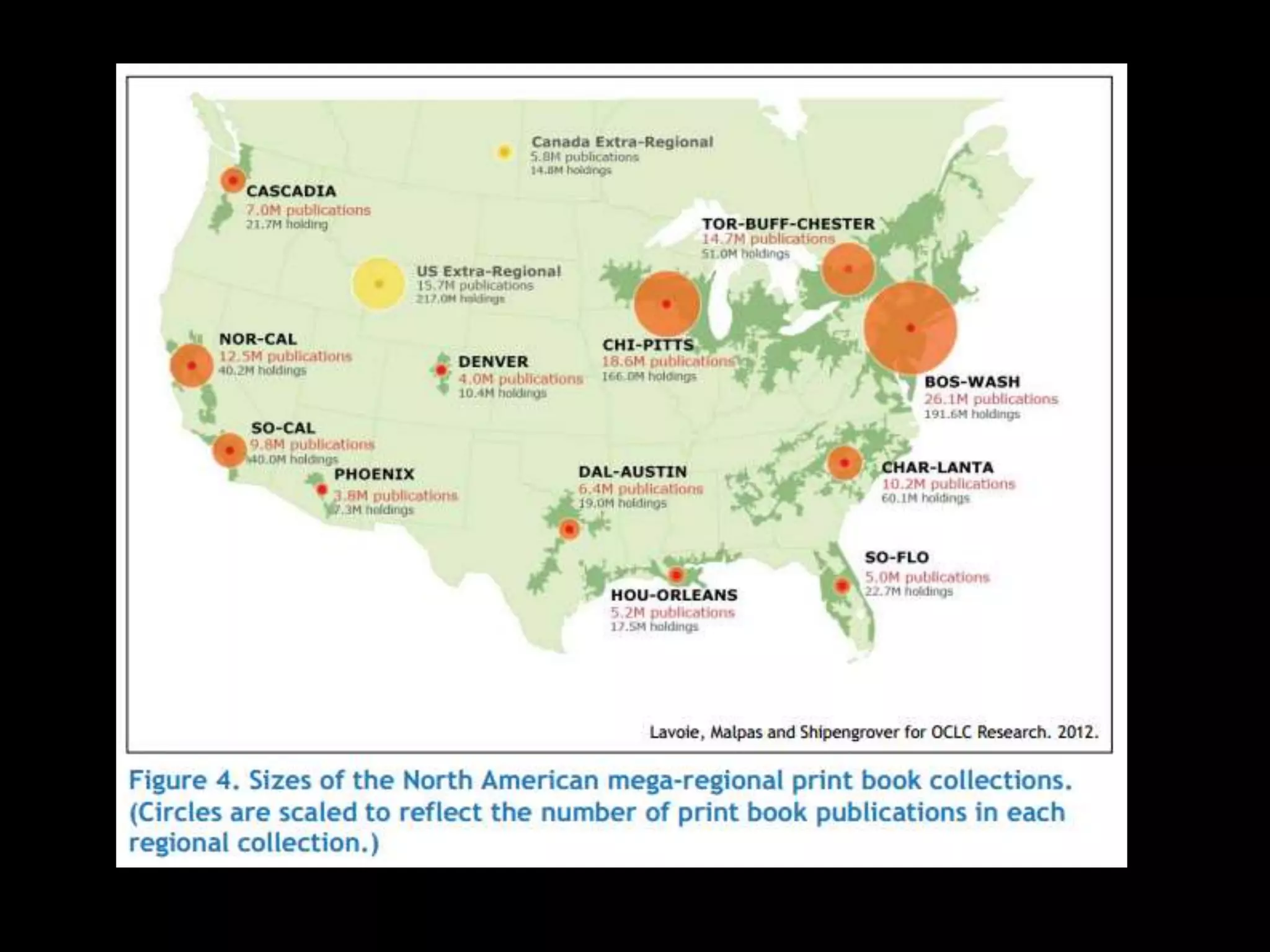
• The collective print collection
Infrastructure
• The collective print collection?
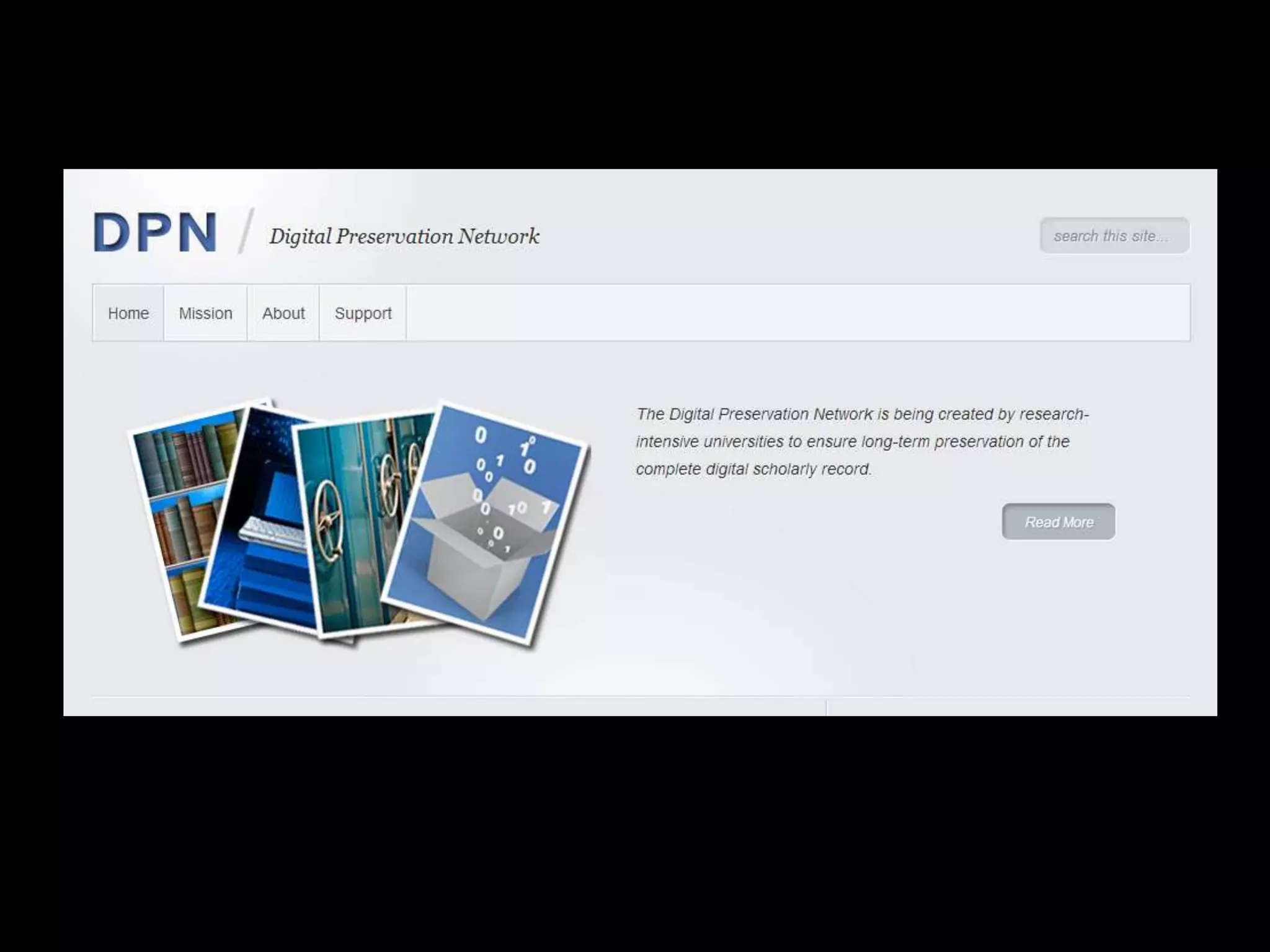
• Preservation of institutional assets?
Infrastructure
• The collective print collection?
• Preservation of institutional assets?
• Data driven engagement?
  – Social/Analytics?
• A shared Knowledge Base?


• …..
Engagement
• Curricular support
• Scholarly communication and digital
  scholarship
• Data curation
• Expertise and profile management
• ….
Engagement
                                                                              Libraries need
                                                                              to do both ..
From the talent side of the equation the                                      Earlier stage in
key requirement for institutional success is                                  cycle
to move from scalable efficiency to scalable
learning. Near-constant innovation is the only
way to respond successfully to near-constant
disruption. Said differently, the rate of
learning, innovation, and performance                         The New Organization Model:
                                                              Learning at Scale
improvement within the institution must                       by John Hagel III, John Seely
match (or exceed) that of the surrounding                     Brown and Lang Davison | 6:03
                                                              PM March 11, 2009
environment if the institution is to survive (or
thrive). Given that innovation is inherently a
human activity--one performed by talented
individuals--it follows that talent will pull
institutions into the 21st century.           http://blogs.hbr.org/bigshift/2009/03/can-your-company-
                                                         scale-its-lea.html
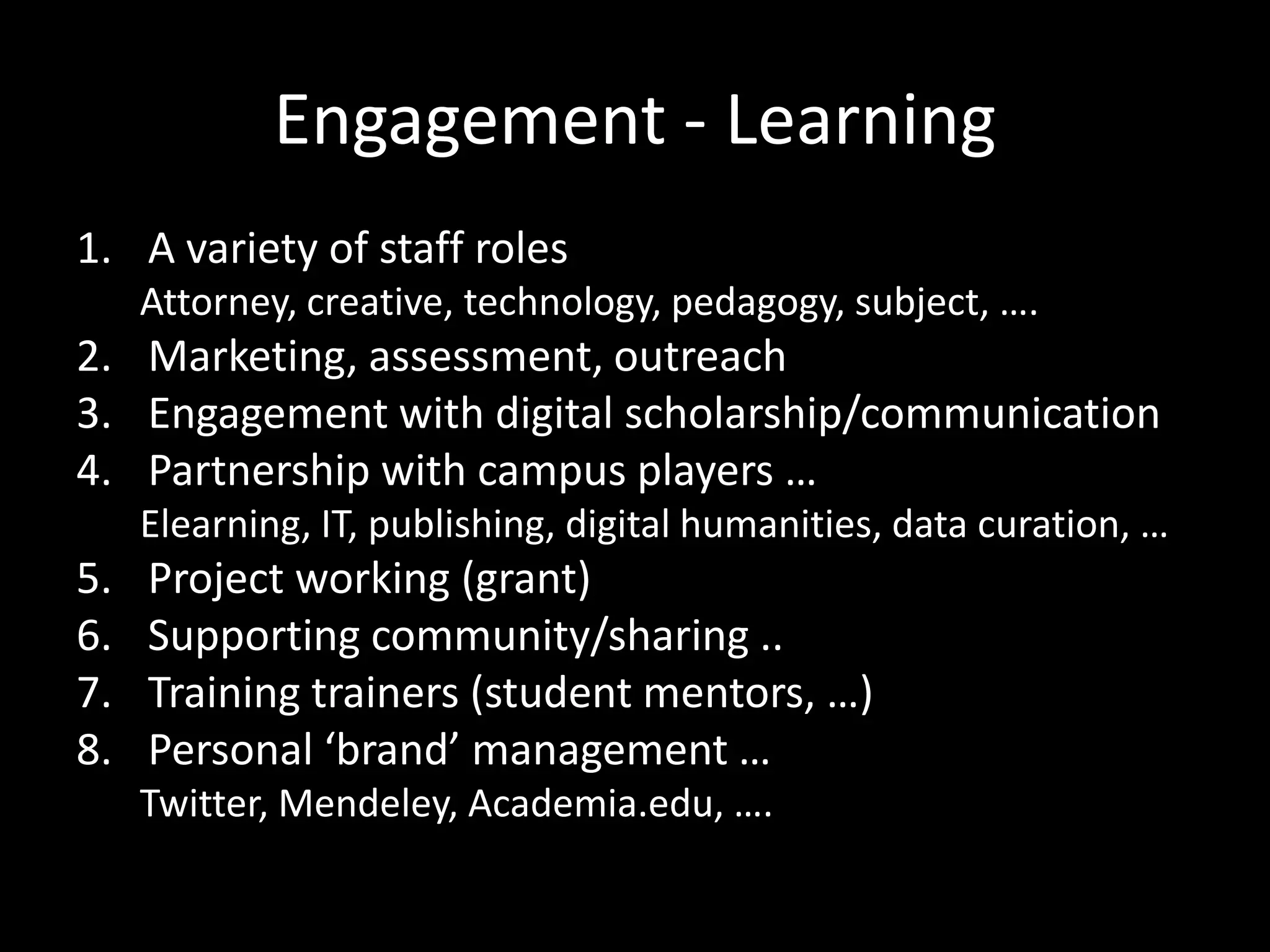
Engagement - Learning
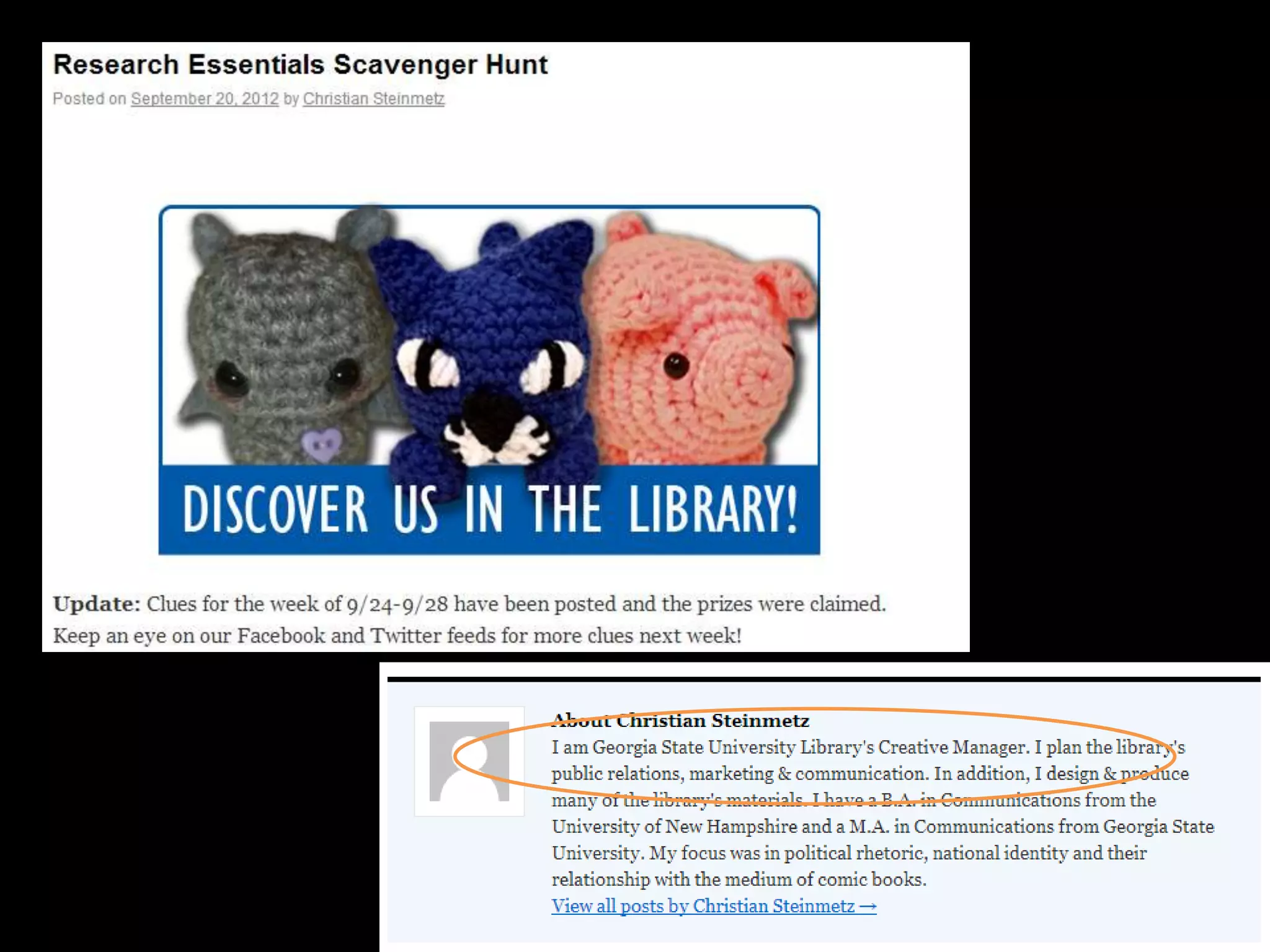
1. A variety of staff roles
   Attorney, creative, technology, pedagogy, subject, ….
2. Marketing, assessment, outreach
Engagement - Learning
1. A variety of staff roles
   Attorney, creative, technology, pedagogy, subject, ….
2. Marketing, assessment, outreach
3. Deeper engagement with faculty/students
   around digital scholarship/communication
Engagement - Learning
1. A variety of staff roles
   Attorney, creative, technology, pedagogy, subject, ….
2. Marketing, assessment, outreach
3. Deeper engagement with faculty/students
   digital scholarship/communication
4. Partnership with campus players …
   Elearning, IT, publishing, digital humanities, data
      curation, …
Platform
…

Strategic Partnerships
The library of the future is engagement-centered and
reinforced by joint ventures and programmatic
partnerships. We imagine the Libraries as an outwardly
engaged organization that creates partnerships and
provides leadership in the pursuit of excellence in research
and learning.
Transformation
…


                                        Our strategy: be regenerative
                                        October 4, 2012, 12:51 pm
                                        By Brian Mathews
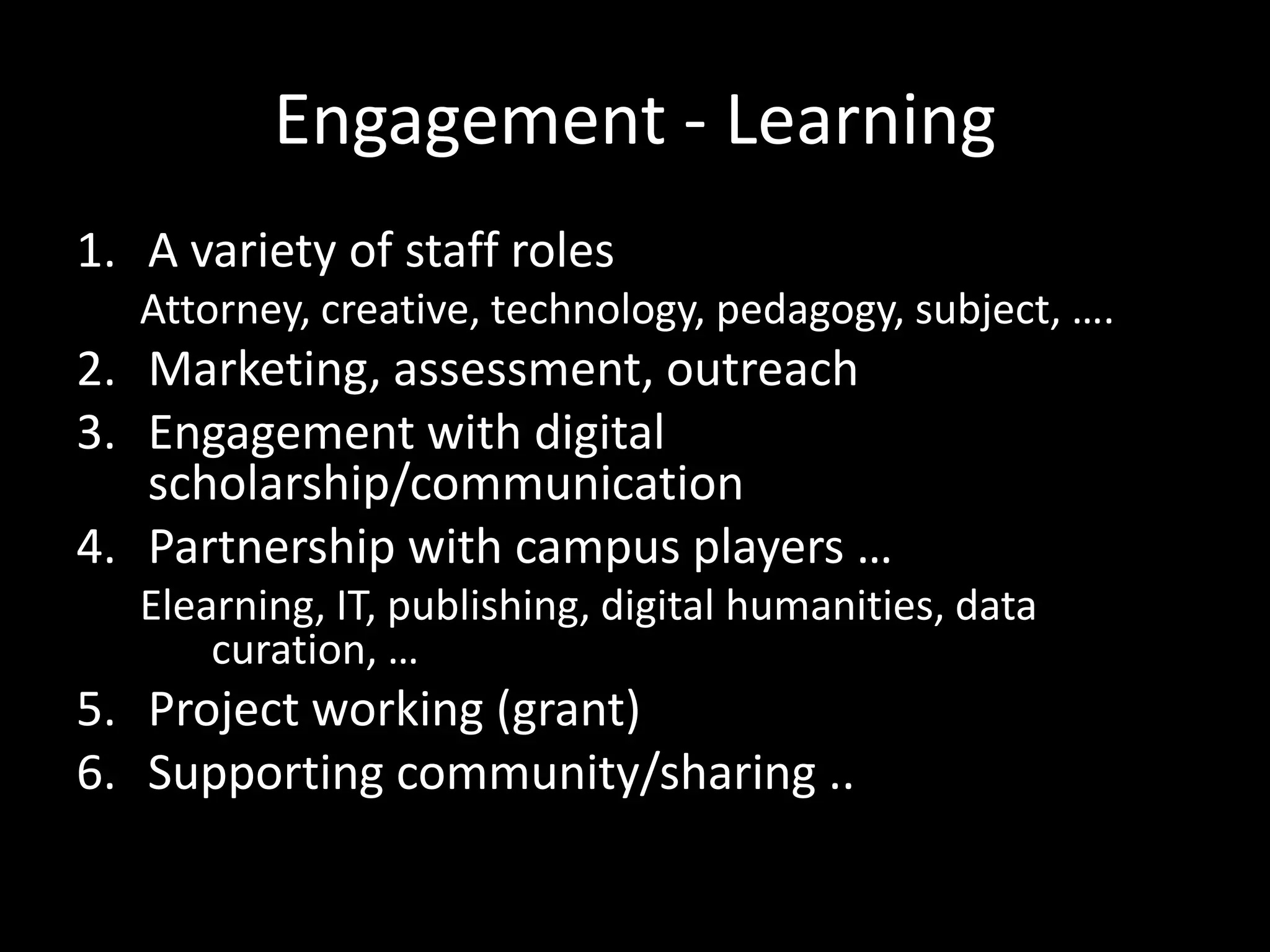
Engagement - Learning
1. A variety of staff roles
   Attorney, creative, technology, pedagogy, subject, ….
2. Marketing, assessment, outreach
3. Engagement with digital
   scholarship/communication
4. Partnership with campus players …
   Elearning, IT, publishing, digital humanities, data
       curation, …
5. Project working (grant)
6. Supporting community/sharing ..
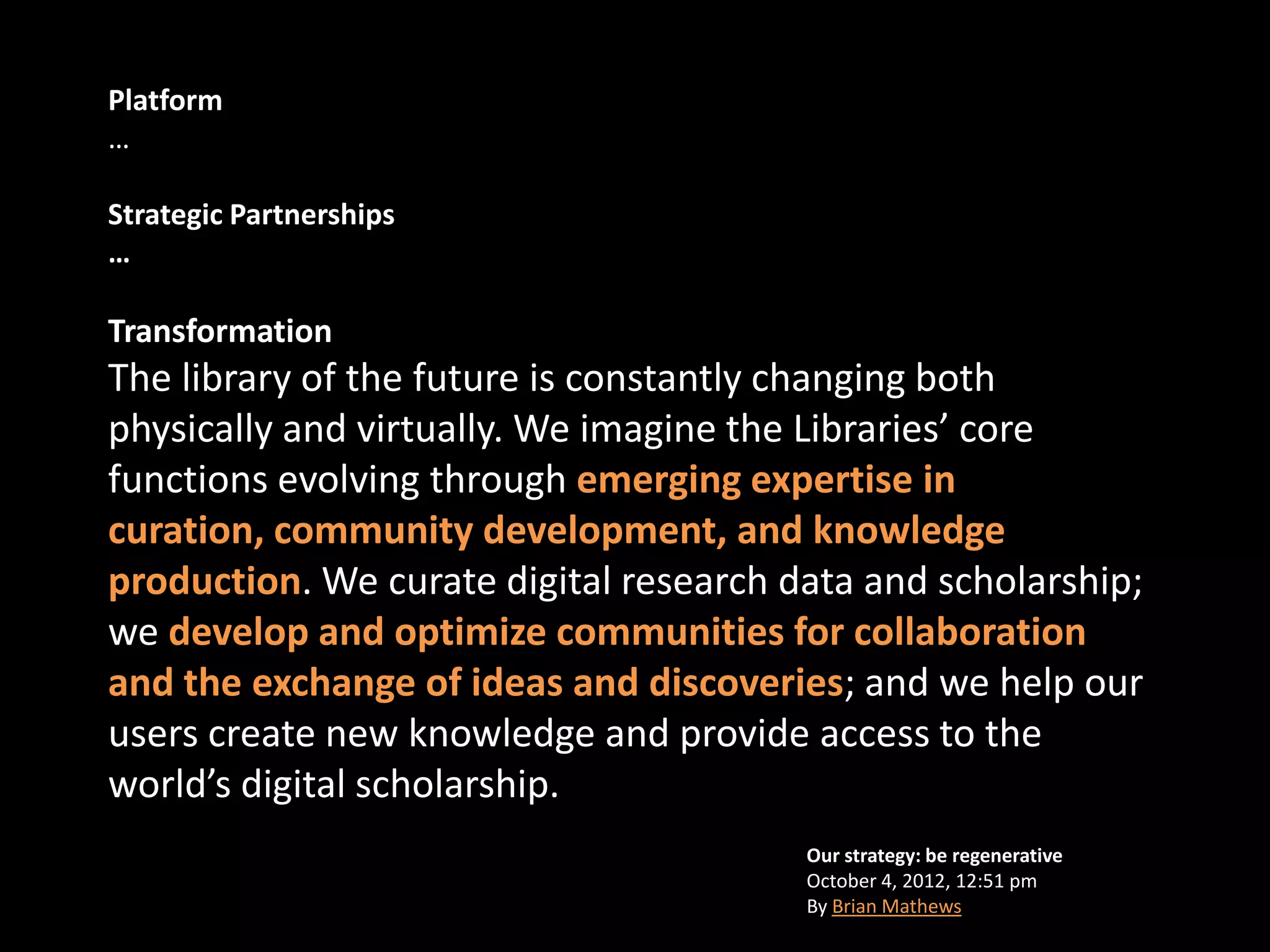
Platform
…

Strategic Partnerships
…

Transformation
The library of the future is constantly changing both
physically and virtually. We imagine the Libraries’ core
functions evolving through emerging expertise in
curation, community development, and knowledge
production. We curate digital research data and scholarship;
we develop and optimize communities for collaboration
and the exchange of ideas and discoveries; and we help our
users create new knowledge and provide access to the
world’s digital scholarship.
                                        Our strategy: be regenerative
                                        October 4, 2012, 12:51 pm
                                        By Brian Mathews
Engagement - Learning
1. A variety of staff roles
     Attorney, creative, technology, pedagogy, subject, ….
2. Marketing, assessment, outreach
3. Engagement with digital scholarship/communication
4. Partnership with campus players …
     Elearning, IT, publishing, digital humanities, data curation, …
5.   Project working (grant)
6.   Supporting community/sharing ..
7.   Training trainers (student mentors, …)
8.   Personal ‘brand’ management …
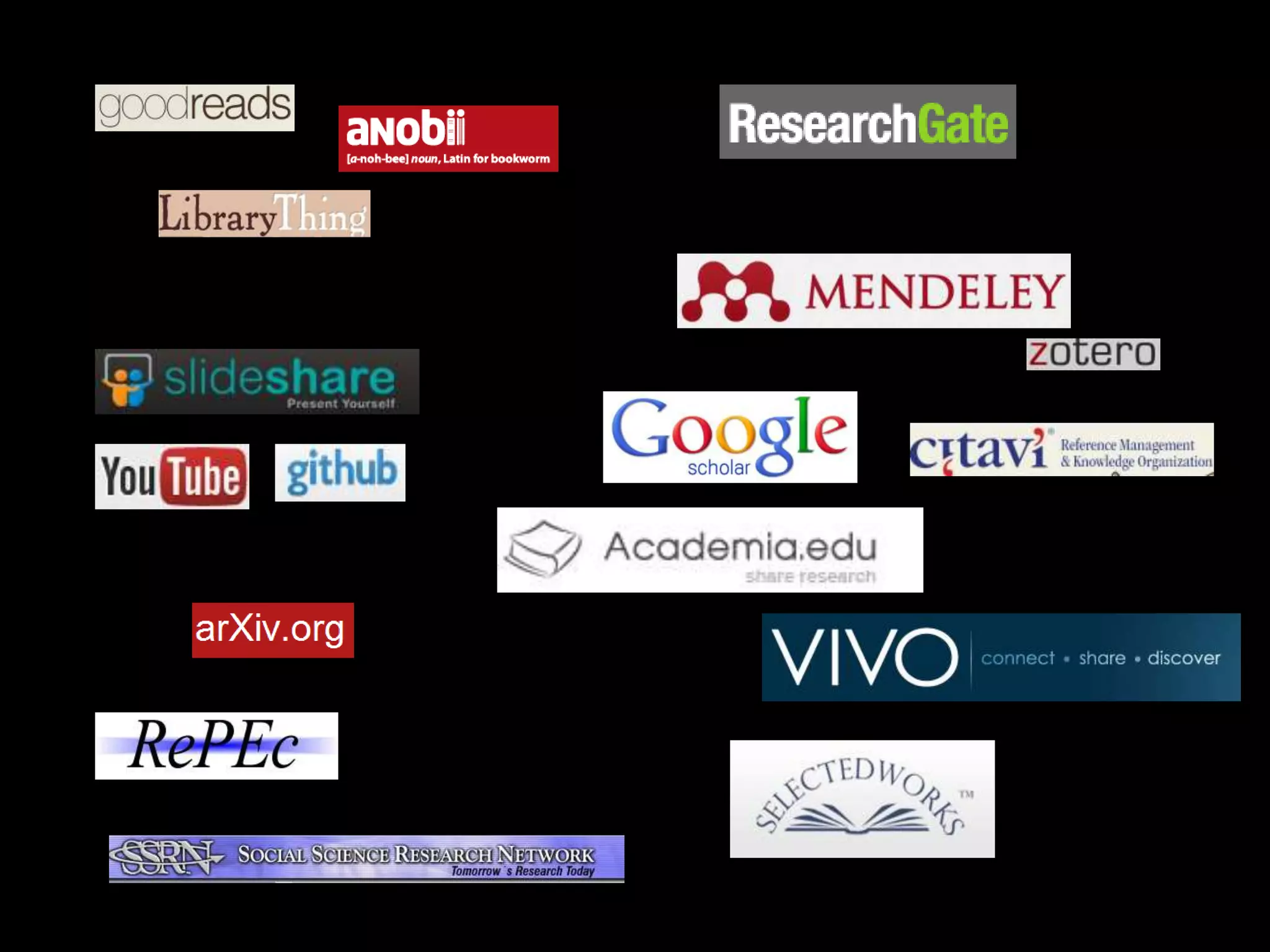
     Twitter, Mendeley, Academia.edu, ….
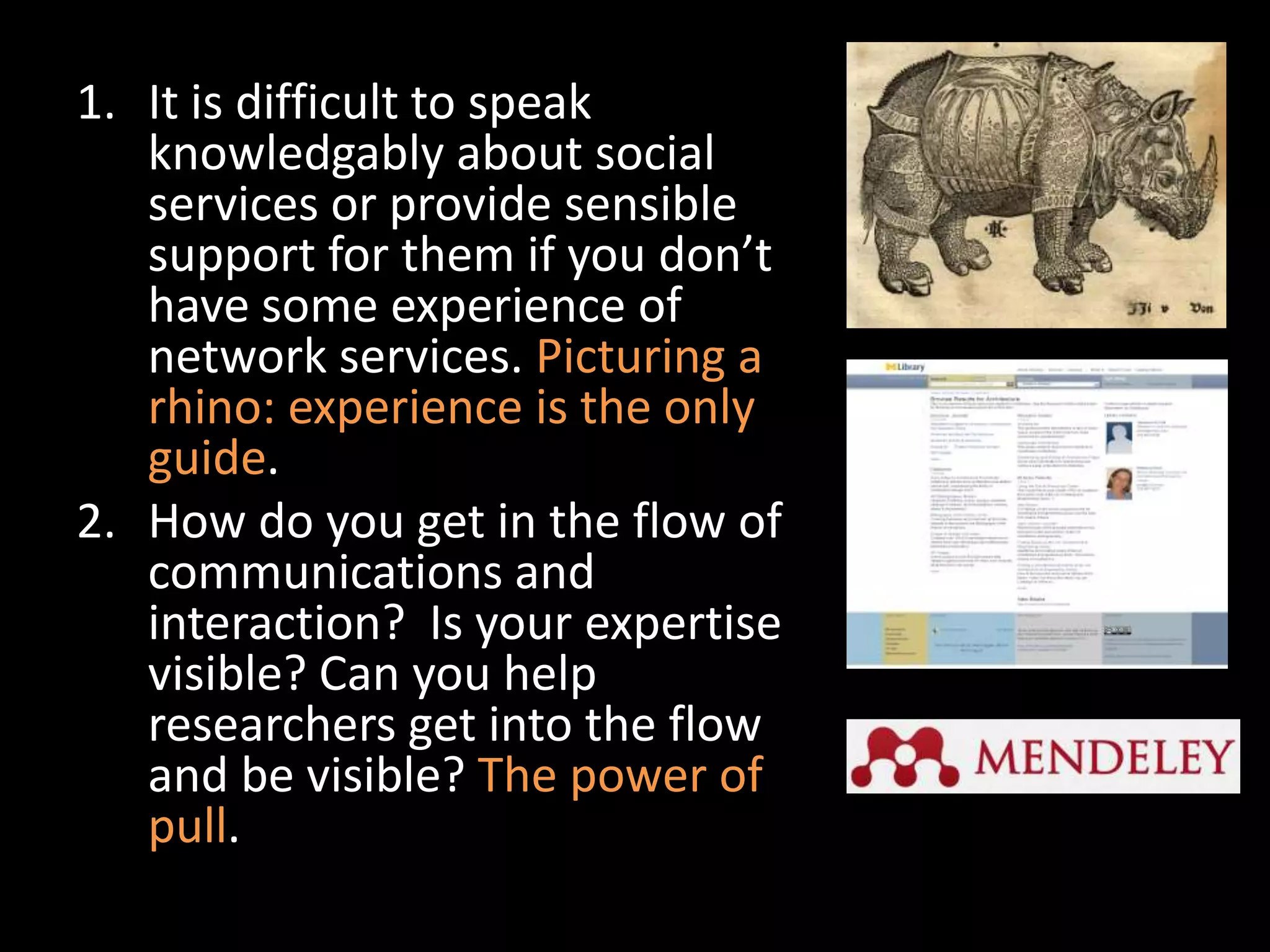
1. It is difficult to speak
   knowledgably about social
   services or provide sensible
   support for them if you don’t
   have some experience of
   network services. Picturing a
   rhino: experience is the only
   guide.
2. How do you get in the flow of
   communications and
   interaction? Is your expertise
   visible? Can you help
   researchers get into the flow
   and be visible? The power of
   pull.
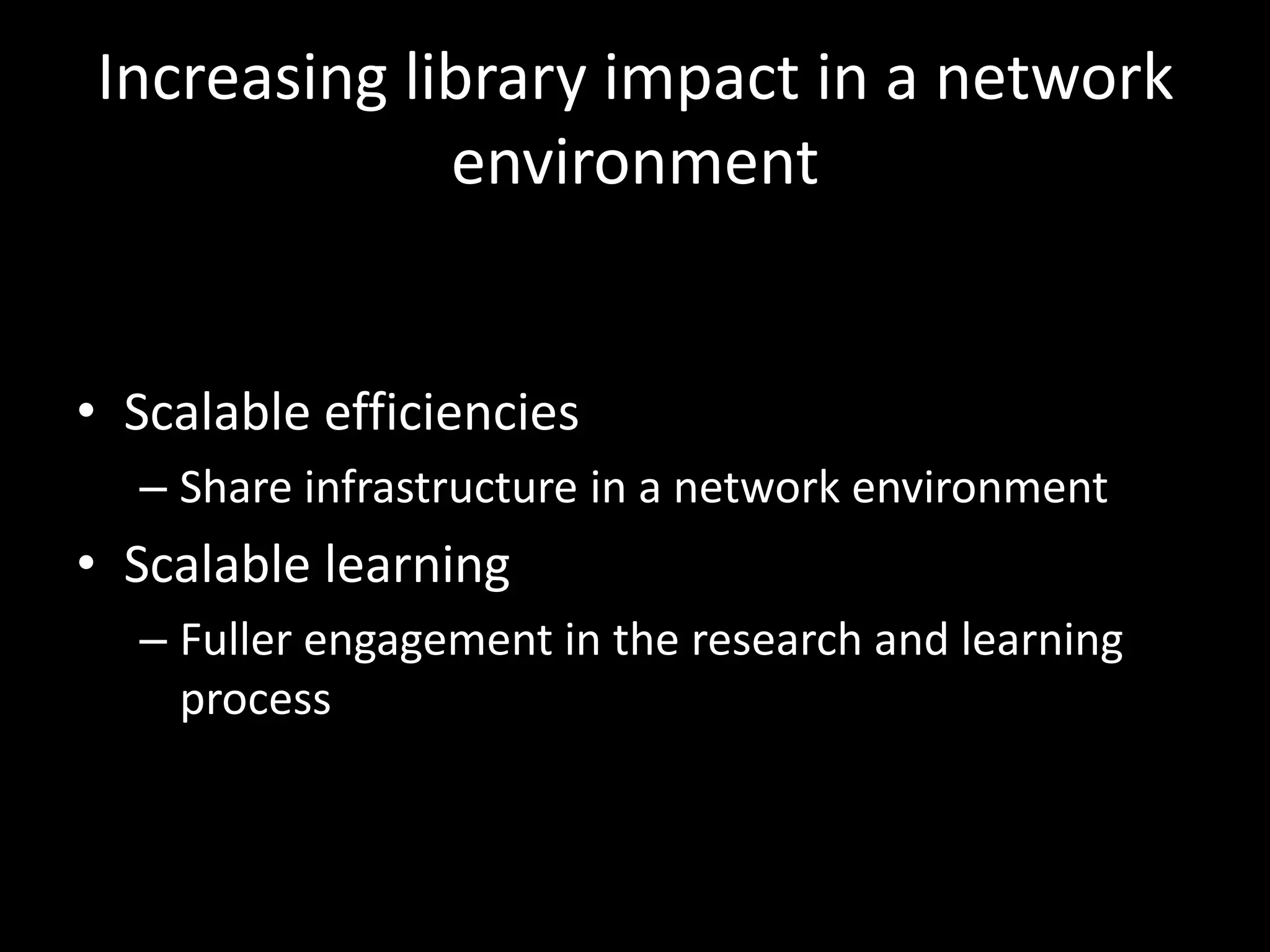
Increasing library impact in a network
             environment


• Scalable efficiencies
  – Share infrastructure in a network environment
• Scalable learning
  – Fuller engagement in the research and learning
    process
Thank you …

The research library: scalable efficiency and scalable learning

  • 1.
    The Research Library:scalable efficiency and scalable learning David Kaser Lecture Series Lorcan Dempsey / @LorcanD Indiana University, 7 October 2012
  • 2.
    How terrific to see you are the featured lecturer this year. Just thought I'd mention that David Kaser was a most terrific library school professor. He was definitely the professor at Indiana who was most influential in my library career and also my favorite professor. I think it is fabulous that you are giving this lecture this year. (OCLC colleague)
  • 3.
  • 4.
    How did yougo bankrupt? Two ways. Gradually, then suddenly. ― Ernest Hemingway, The Sun Also Rises
  • 5.
  • 6.
    In the wake of increasing enrollment and costs and declining per student state appropriations, the Board is concerned with the continued ability of public research universities to provide affordable, quality education and training to a broad range of students, conduct the basic science and engineering research that leads to innovations, and perform their public service missions. NSB: diminishing funding and rising expectations: trends and challenges for public research universities
  • 8.
  • 9.
    Colleges and universities have long competed against one another, measuring themselves in comparison to each other and holding tightly to their idiosyncrasies as defining elements of their status. But today, the distribution and reuse of information digitally via the Internet is rapidly changing the game, rewarding those who instead aggregate and scale toward a common infrastructure. It is becoming increasingly clear that neither the challenges that confront colleges and universities nor the solutions to those challenges are unique to each institution. Chuck Henry and Brad Wheeler The game has changed Educause Review, March 2012
  • 10.
    “aggregate and scaletowards a common infrastructure”
  • 11.
    Beyond the mobileweb. Stephanie Rieger. http://www.slideshare.net/yiibu/beyond-themobilewebbyyiibu
  • 12.
    Beyond the mobileweb. Stephanie Rieger. http://www.slideshare.net/yiibu/beyond-themobilewebbyyiibu
  • 13.
    • Webscale • Tendto one/two … – Network effects – Massive aggregation – Gravitational pull • Data driven engagement – Analytics – Social • Platform – Leverage for developers …
  • 15.
    65% Discoverability Phase 1Final Report. Hanson et al. U Minnesota. http://conservancy.umn.edu/handle/48258
  • 16.
    Researchers prefer to adoptopen source and social media technologies that are available in the public domain rather than institutional license-based applications ….. First the social media technologies facilitate networking and community building. Second, researchers prefer to use technologies that will enable them access to resources and their own materials beyond their institution-based PhD research. e.g. Mendeley, Zotero, Endnote
  • 17.
    What has changed? 1 The library is institution scale where many of its users operate at network scale
  • 19.
    What has changed? 2 Libraries are redundantly managing local infrastructure which creates little distinctive local value.
  • 20.
  • 21.
    Then: high transaction costs lead to locally Space Systems assembled collection Collections Services & Now: low transaction costs expertise distribute activities across the network Then: vertically integrated around collection Now: moving apart in network environment
  • 22.
  • 23.
  • 24.
    Attracting and buildingrelationships Develop new with researchers and learners services and have them accepted “Service-oriented”, customization Speed/flexibility important Economies of scope important Engagement Innovation Infrastructure Back office capacities that support day-to-day operations “Routinized” workflows Note: Engagement substituted for Customer Economies of scale important relationship management
  • 25.
    Space • Being reconfigured Social, showcase and sharing around the user experience • Ad hoc rather than rendezvous around • Meeting place collections. • Exhibitions • Specialist equipment • Moving from • Specialist staff Infrastructure • GIS, Writing centre, to engagement • Digital humanities, … • Research commons
  • 26.
    Services • The serviceturn (Scott Walter) • U Minnesota, ARL Institutional profile: – In alignment with the University's strategic positioning, the University Libraries have re-conceived goals, shifting from a collection-centric focus to one that is engagement- based.
  • 27.
    MPublishing, U Michigan TheUniversity of Michigan Press, the Scholarly Publishing Office, Deep Blue (the University’s institutional repository service), the Copyright Office, and the Text Creation Partnership, Salman Rushdie Archive, Emory U Personal digital papers of Salman Rushdie. Have become his reference collection. Scholarly Commons, U Illinois Urbana Champaign ... to serve the emerging needs of faculty, researchers and graduate students pursuing in-depth research and scholarly inquiry. Access to expertise, hardware and software.
  • 28.
    Systems Focus on engagement Resourceguides, integration with learning management, widgets, etc Recommendation (aggregation) Move to cloud for infrastructure ILS, ERM, Discovery: move to cloud-based solutions Deep collaboration Shared systems infrastructure: Orbis Cascade Alliance, 2CUL
  • 29.
    Outside in Bought,licensed Collections Increased consolidation Move from print to licensed Manage down print – shared print Move to user-driven models Aim: to discover Inside out Institutional assets: special collections, research and learning materials, institutional records, … Reputation management Increasingly important? Aim: to *have* discovered … to disclose
  • 30.
    Outside in collections– increasingly externalised to collaborative or third party. Reduced local infrastructure. Inside out collections. Growing engagement around scholarly communication, data curation, institutional asset management, reputation/profiles. Leverage internal/ external infrastructure.
  • 31.
  • 32.
  • 33.
    Space Systems Collections Services & expertise Scale efficiency: Increase local impact: Share infrastructure Greater engagement
  • 34.
    Infrastructure: scalable efficiences Rightscaleinfrastructure for efficiency and impact in a webscale world … Engagement and innovation: scalable learning Invigorate institution-scale approaches to engagement … “the rate of learning, innovation, and performance improvement within the institution must match (or exceed) that of the surrounding environment if the institution is to survive (or thrive)”
  • 35.
    Infrastructure • Cataloging • eJournals •Preservation • Systems in the cloud – (cloud is a question not an answer)
  • 36.
  • 38.
    Infrastructure • The collectiveprint collection? • Preservation of institutional assets?
  • 40.
    Infrastructure • The collectiveprint collection? • Preservation of institutional assets? • Data driven engagement? – Social/Analytics? • A shared Knowledge Base? • …..
  • 41.
    Engagement • Curricular support •Scholarly communication and digital scholarship • Data curation • Expertise and profile management • ….
  • 42.
    Engagement Libraries need to do both .. From the talent side of the equation the Earlier stage in key requirement for institutional success is cycle to move from scalable efficiency to scalable learning. Near-constant innovation is the only way to respond successfully to near-constant disruption. Said differently, the rate of learning, innovation, and performance The New Organization Model: Learning at Scale improvement within the institution must by John Hagel III, John Seely match (or exceed) that of the surrounding Brown and Lang Davison | 6:03 PM March 11, 2009 environment if the institution is to survive (or thrive). Given that innovation is inherently a human activity--one performed by talented individuals--it follows that talent will pull institutions into the 21st century. http://blogs.hbr.org/bigshift/2009/03/can-your-company- scale-its-lea.html
  • 43.
    Engagement - Learning 1.A variety of staff roles Attorney, creative, technology, pedagogy, subject, …. 2. Marketing, assessment, outreach
  • 45.
    Engagement - Learning 1.A variety of staff roles Attorney, creative, technology, pedagogy, subject, …. 2. Marketing, assessment, outreach 3. Deeper engagement with faculty/students around digital scholarship/communication
  • 47.
    Engagement - Learning 1.A variety of staff roles Attorney, creative, technology, pedagogy, subject, …. 2. Marketing, assessment, outreach 3. Deeper engagement with faculty/students digital scholarship/communication 4. Partnership with campus players … Elearning, IT, publishing, digital humanities, data curation, …
  • 49.
    Platform … Strategic Partnerships The libraryof the future is engagement-centered and reinforced by joint ventures and programmatic partnerships. We imagine the Libraries as an outwardly engaged organization that creates partnerships and provides leadership in the pursuit of excellence in research and learning. Transformation … Our strategy: be regenerative October 4, 2012, 12:51 pm By Brian Mathews
  • 50.
    Engagement - Learning 1.A variety of staff roles Attorney, creative, technology, pedagogy, subject, …. 2. Marketing, assessment, outreach 3. Engagement with digital scholarship/communication 4. Partnership with campus players … Elearning, IT, publishing, digital humanities, data curation, … 5. Project working (grant) 6. Supporting community/sharing ..
  • 51.
    Platform … Strategic Partnerships … Transformation The libraryof the future is constantly changing both physically and virtually. We imagine the Libraries’ core functions evolving through emerging expertise in curation, community development, and knowledge production. We curate digital research data and scholarship; we develop and optimize communities for collaboration and the exchange of ideas and discoveries; and we help our users create new knowledge and provide access to the world’s digital scholarship. Our strategy: be regenerative October 4, 2012, 12:51 pm By Brian Mathews
  • 53.
    Engagement - Learning 1.A variety of staff roles Attorney, creative, technology, pedagogy, subject, …. 2. Marketing, assessment, outreach 3. Engagement with digital scholarship/communication 4. Partnership with campus players … Elearning, IT, publishing, digital humanities, data curation, … 5. Project working (grant) 6. Supporting community/sharing .. 7. Training trainers (student mentors, …) 8. Personal ‘brand’ management … Twitter, Mendeley, Academia.edu, ….
  • 54.
    1. It isdifficult to speak knowledgably about social services or provide sensible support for them if you don’t have some experience of network services. Picturing a rhino: experience is the only guide. 2. How do you get in the flow of communications and interaction? Is your expertise visible? Can you help researchers get into the flow and be visible? The power of pull.
  • 55.
    Increasing library impactin a network environment • Scalable efficiencies – Share infrastructure in a network environment • Scalable learning – Fuller engagement in the research and learning process
  • 56.